




Abstract
In exploring why American mothers spend more time on care work compared to prior decades while increasingly engaging in paid work, Hays (1997) attributed women's actions to intensive motherhood (IM) ideology. Hays also asserted that women purposedly adhere to IM to resist an increasingly neoliberal market-based society by dedicating time and effort to nurturing children and family life. Here, we undertake a content analysis to take stock of IM literature's evolution in recent decades. Specifically, we examine scholars’ treatment of how women adhere to IM, and why and whether women do so in resistance to neoliberalism. We found that while scholars consistently cite and echo Hays (1997) on how women adhere to IM, most depart from Hays (1997) by positing women adhere to live up to an ideal of being a perfect mother due to the pervasive nature of IM. We also found many scholars focus on the possibility of resisting IM ideology itself rather than Hays’s (1997) perspective that women employ the ideology to resist neoliberalism. These findings raise questions about how women's agency manifests in the IM context, and concerns about embedded assumptions that limit our understanding of women's realities. Implications are discussed.
Keywords
A pivotal gain made during the American Women's Liberation Movement in the 1970s was a more widespread acceptance for mothers to pursue paid work. Consequently, women entered the paid workforce at unprecedented levels, particularly middle-class mothers (Women's Bureau, 2022). However, the ensuing outcome endorsed women's reprisal of the traditional mid-century maternal role (Faludi, 1991). Accordingly, women have increasingly been pressured to devote themselves to both work and family (Blair-Loy, 2001; Pedersen, 2016).
Hays (1997), cited often across motherhood literature (Nomaguchi & Milkie, 2020), was concerned about women internalizing these conflicting social expectations, and investigated why women spend more time mothering compared to previous decades despite their increased participation in paid employment. She attributed this behavior to women's adherence to intensive mothering (IM) ideology, which comprises three main tenets: mother as primary caregiver, dedication of abundant energy and resources to her child, and her maternal role’s precedence over paid work. Hays (1997) described the ideology as a “fully elaborated, logically cohesive combination of beliefs” (pp. 8–9) which “fundamentally shapes the way mothers think about mothering” (p. 96).
Importantly, Hays (1997) also explained why women adhere to IM, asserting they do so in resistance to neoliberalism. 1 Such a claim reflects an important agentic facet (McNay, 2016) to Hays’s (1997) thesis, as mothers “are certainly not cultural dopes who unselfconsciously mimic the child-rearing methods recommended by others” (p. 75). Additionally, mothers do so “not because they are irrational or selfless, and not because they are forced to, but because they are actively participating in a rejection of [neoliberal] logic” (Hays, 1997, p. 173). This resistance represents an important societal contribution by working to ensure “sustainable human ties, free of competition and selfish individualism, that are meant to preserve us … from an unbearable moral solitude” (Hays, 1997, p. 175). In other words, mothers purposefully spend more time caring for their children compared to prior decades to counteract the primacy of paid work and capital accumulation, and to reinforce the importance of family and community (Almond, 2010; Warner, 2006).
In the decades since Hays (1997) published her work, IM literature has grown (Nomaguchi & Milkie, 2020) and morphed into a dedicated area of research that advocates on behalf of women (Johnston & Swanson, 2006) and covers many topics. Maternal adherence to IM has been explored based on women's employment status (Johnston & Swanson, 2007; Liss et al., 2013; Loyal et al., 2017; Walls et al., 2016), economic status (Elliott & Bowen, 2018; Lavee & Benjamin, 2015), and other social conditions such as migrant (Peng & Wong, 2013) and incarcerated mothers (Granja et al., 2015). Scholars have also examined IM adherence across life stages, from first-time mothers (Sevon, 2012) to middle-aged mothers (Gunderson & Barrett, 2017), and in different circumstances, such as single mothers (Layne, 2015), mothers suffering from postpartum depression (Cesar et al., 2018; Scharp & Thomas, 2017), and mothers of special-needs children (Clarke, 2013, 2015). Other special interests include mothers’ attitudes toward food purchases and feeding (Afflerback et al., 2013; Mackendrick, 2014), vaccines (Reich, 2014), religious devotion (Gallagher et al., 2013), and leisure time (O’Brien et al., 2017) in the IM context. Additionally, whereas Hays (1997) focused on mothers, IM scholars have extended this work to include men (Herbrand, 2018; Schiffrin et al., 2014; Trussell & Shaw, 2012; Yarwood & Locke, 2016). Finally, scholars have also examined adverse effects of IM's influence (Caputo, 2007; Rizzo et al., 2013), including stigma for not meeting IM ideals (Elliott & Bowen, 2018), depression (Loyal et al., 2017), and burnout (Meeussen & van Laar, 2018). Thus, scholars have greatly expanded on Hays’s (1997) work.
However, a preliminary reading of IM literature indicates scholars have extended Hays’s (1997) work by focusing primarily on how mothers adhere to IM. Further, women are often described as adhering to a hegemonic ideology (Afflerback et al., 2013) to live up to an ideal of motherhood (Henderson et al., 2016); resistance to neoliberalism is rarely mentioned. This approach reflects a less agentic perspective in its departure from Hays (1997), perhaps because Hays focuses most of her book on how women adhere to IM and only in the final chapter explains why women do so: to resist neoliberalism. Had scholars not read the final chapter? We would have expected them to at least acknowledge, if not argue against it, when asserting women strive toward an ideal under a pervasive influence. As such, a cursory reading indicates scholars’ treatment of how and why women adhere to IM reflects ambivalence about women's agency in the literature. Yet, McNay (2016) asserts ideology and agency are integral; when examining the impact of social influence and adherence to ideology, it is crucial to account for individuals’ autonomous capacity to think, rationalize, and act. Relatedly, Hays (1997) warned that not understanding women's motivations can lead to misunderstanding their actions and discounting their agency and social contributions outside the androcentric mold (Bergerson, 2016). Hence, our concern here is that focusing primarily on ideology without sufficient consideration of women's agency can limit our understanding (Grabowska, 2011) of their actions and realities, which may consequently translate into how scholars shape future research, public policy, counseling, and other supports for mothers (Spade & Willse, 2016). Moreover, overlooking the possibility that women adhere to IM to resist neoliberalism ignores and undermines women's societal contribution through their care work (Puig de la Bellacasa, 2011). Such an oversight also misses the opportunity to center society's collective responsibility for care work, which women often continue to shoulder alone (Card, 2002).
Considering the above concerns, as well as Hays’s (1997) influence and the growth of IM literature (Nomaguchi & Milkie, 2020) within the larger, ever-expanding scholarship on motherhood, it is important to take stock and gain a deeper understanding (Boyatzis, 1998) of the IM literature developed in recent decades. Here, we seek to understand how scholars have evolved IM literature with respect to how women adhere to IM ideology, why and whether in resistance to neoliberalism, which, to our knowledge, has not been previously examined. Drawing on content analysis, which is well suited to making meaning across a body of literature (Schreier, 2012), we explore all empirical IM literature since Hays’s (1997) book publication. The following research questions guided our work:
How have scholars evolved IM literature with respect to the following questions:
How women adhere to IM ideology? Why women adhere to IM? Do women adhere to IM to resist neoliberalism?
Conceptual framework
Ideology
Žižek (2008) refers to ideology as a “naïve consciousness” (p. 24), proposing “Ideology is not a dream-like illusion that we build to escape insupportable reality … it is a fantasy-construction which serves as a support for our ‘reality’ itself” (p. 44). Žižek's (2008) approach draws on Foucault (1978), who upended traditional conceptualizations of power (Bordo, 1993), such as monarchic or state rule. Foucault (1978) proposed that social influences serve as a ubiquitous, never-ending power relation inducing individuals to act according to societal expectations. Moreover, social influences pervade every aspect of our lives and culture (Bourdieu, 1998), including our language (Uhlmann & Uhlmann, 2005); bodies (Silva, 2005); and attitudes about love, feelings, and how we act towards others (Liskova, 2011). As individuals internalize such influences, they self-regulate accordingly, further validating and perpetuating such social beliefs (Foucault, 1978, 1994).
Yet, these same scholars also consider agency. Bourdieu (1998) reasons humans are not mindless automatons; they can think and reason independently. Žižek (2008) asserts our cultural context is the result of a consensus to which all individuals actively contribute. Foucault (1994) believes social influence can be exerted “only over free subjects, and only insofar as they are, ‘free’” (p. 342), and that “where there is power, there is resistance” (Foucault, 1978, p. 95). Still, to what extent resistance is possible and how that extent is determined remains undertheorized (Ells, 2003).
Agency
McNay (2016) defines agency as “the capacity of a person … to intervene in the world in a manner that is deemed, according to some criterion or another, to be independent or relatively autonomous” (p. 40). Further, agency is a universal capacity that exists within everyone (King, 2009). Yet, some individuals face more and/or different social constraints than others (McNay, 2016) due to the inequitable way in which they are treated in relation to their identities (e.g., race, gender) and circumstances (e.g., low-income). Hence, agency is a function of individuals’ balancing, reconciling, and navigating the demands and constraints of society with their own sense of need and want (Epstein, 1973), and no one model can apply to everyone (McNay, 2016). For example, in her desire to spend time with her child, a single, low-income mother may have less agency due to financial constraints compared to a married, middle-class mother (Murray, 2015). Taken together, the literature reflects both a pervasive impact stemming from ideology and social influence, and the possibility and nuance of agency while accounting for individual context and constraints (Brandtstädter, 2007).
Agency in the context of motherhood
As debates on choice feminism reflect, while we celebrate mothers’ freedom to make choices, they are made in a framework that limits and exploits (Budgeon, 2015). Some feminists assert hegemonic ideologies cannot be challenged because they frame our realities (Budgeon, 2015); some contend society's treatment of motherhood as institution adversely affects women's sense of choice (Rich, 1979); others posit reflexivity enables probing, questioning, and challenging of such frameworks (Sinclair, 2017).
Consequently, some feminists call for “a more nuanced approach” (Sinclair, 2017, p. 7) that considers mothers’ motivations and actions (Fonow & Cook, 1991) and identifies omissions about their lived experience, “looking at what is missing, what is passed over, and what is avoided” (Pillow & Mayo, 2012, p. 196). For example, De Marneffe (2019) suggests maternal desire is a powerful motivator for women, leading them to act in ways deemed oppressive, such as foregoing paid work to stay home with their children. But the absence of discourse on maternal desire perpetuates the perception that foregoing paid work is a form of oppression rather than a rewarding, valuable societal contribution (Hays, 1997). Meanwhile, scholars who center the ethics of care (Noddings, 1986) worry that doing so perpetuates essentialist sexist stereotypes (Card, 2002). At the same time, centering care also reflects resistance against perspectives that undermine its importance (Puig de la Bellacasa, 2011) and positions it as a moral obligation for which all genders should be responsible (Lauritzen, 1992). Thus, a deeper understanding of maternal agency necessitates more dynamic and varied viewpoints.
Methodology
Content analysis
While content analysis is commonly known as a method that entails coding, categorizing, and counting frequencies within text (Ahuvia, 2001), Schreier (2012) describes it as a means for systematically examining meaning across qualitative texts, to “interpret the whole, or the gestalt” (Drisko & Maschi, 2016, p. 4). Such an approach is especially useful to examine IM scholars’ consideration of how women adhere to IM, and why and whether women adhere to IM to resist neoliberalism, which can be subtle and indirectly inferred through the text. The interpretive nature of this method also supports our feminist aims of probing for omissions and assumptions (Ahuvia, 2001).
Sample and selection
Using the term “intensive mother*” we searched PsychInfo for all peer-reviewed journal articles published between January 1998, since Hays’s (1997) book, through December 2019, selecting those with “intensive mother*” in the title or abstract to ensure they explicitly focused on IM. In fact, if the article focused on IM, it was not necessary that Hays (1997) was cited; however, all but three articles in the final sample cited her. A list of 92 potential articles was identified based on these initial inclusion criteria. Of these, n = 12 were not accessible to us through Psychinfo, and n = 26 were excluded for two reasons: n = 17 studies included “intensive mother*” in their abstract but had little to do with IM, briefly mentioning IM as a social context; an additional n = 9 were excluded because although they were concerned with IM, they focused on interpreting media published relating to motherhood, as opposed to engaging mothers directly. The remaining n = 54 articles that established the final sample for this study empirically engaged women through interviews, focus groups, and social media posts. The above process of criteria and final sample selection was reviewed and agreed by the first and second authors prior to commencement of coding by the first author.
Sample characteristics
Of the 54 articles comprising the data set, all were authored by women, mostly published after 2014 (whereas Hays published her work in 1997). Almost half the studies originated in the US (43%); a third from Canada, the UK, and Australia combined (33%); and the remainder from other parts of the world (24%), including Europe (11%) and Asia (7%). More than half the studies focused on middle-class (52%), White (44%), heterosexual (80%+) participants with children of varied ages. Most drew on qualitative methods (76%) and did not explicitly state use of theory (83%), though those that did (17%) used feminist or constructivist theory. The Appendix in the supplemental material displays a list of the articles comprising the sample, including authorship, year, title, journal, theme, and methodology.
Analysis
A common concern in content analysis is that interpretations of latent meaning inferred through the body of text can be subjective (Neuendorf, 2017). To address the ambiguity inherent in such an interpretive process, Ahuvia (2001) highlights the importance of methodical, systematic, and consistent processes and detailed explanations to aid researchers in repeatedly arriving at similar conclusions. We adhered to this approach in several ways. First, each article was read and analyzed in its entirety at least three times (see what follows; also see Figure 1), and the larger meaning of each article was considered each time to ensure consistency in reasoning (Boyatzis, 1998; Schreier, 2012). Second, through comparative analysis, we compared code definitions with excerpts (Glaser, 1965) while identifying repetitive patterns (Miles et al., 2020).
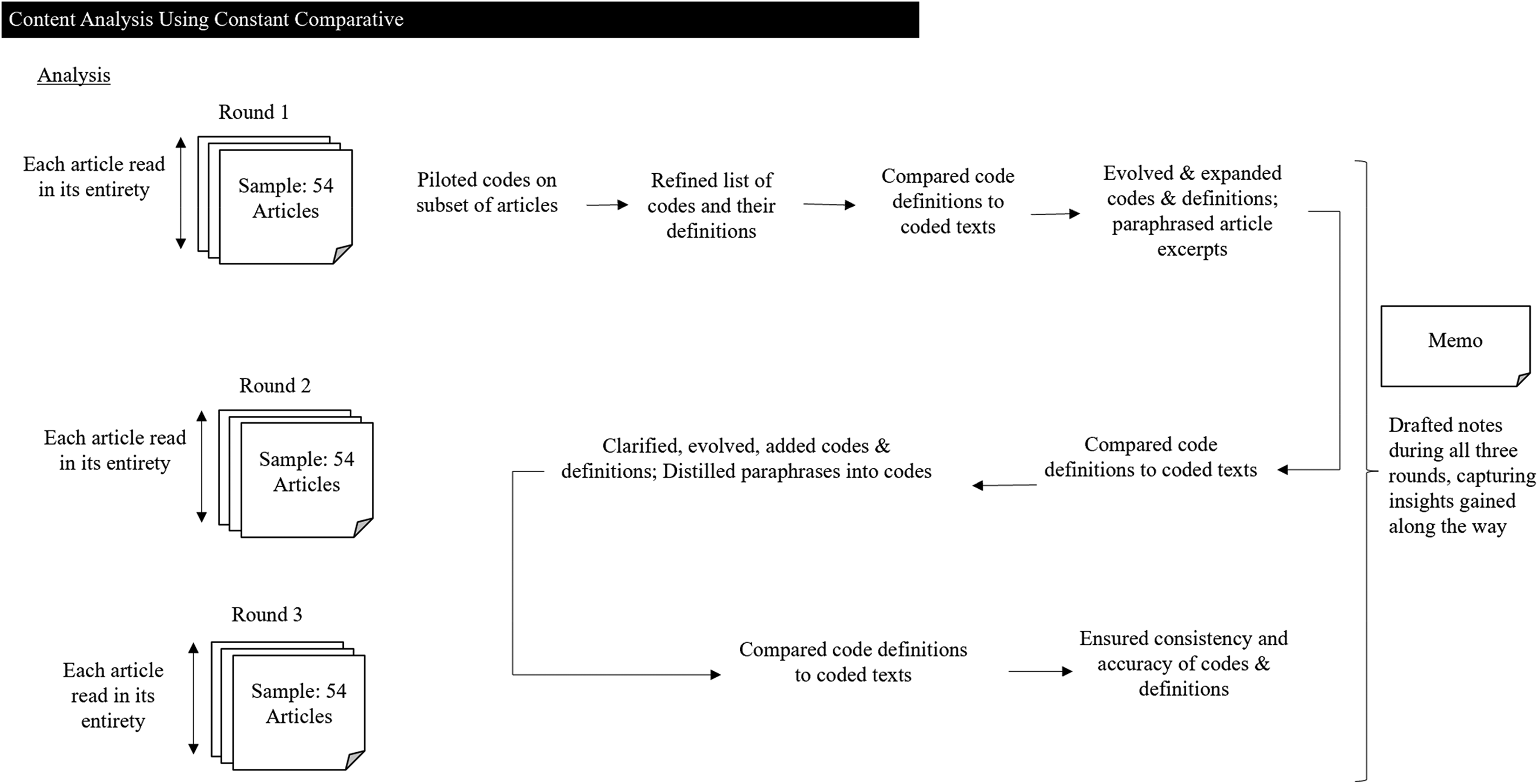
Constant comparative content analysis process.
During the first round, each article was read to identify “codable moment[s]” (Boyatzis, 1998, p. 4) aligned with our research questions while remaining attuned to new insights. This entailed the paraphrasing of excerpts, which we then further distilled into codes that reflected the text (Schreier, 2012), and tested them on a subset of articles. Upon identifying anomalies in the coding scheme (Boyatzis, 1998), the codes were refined for clarity and precision (Schreier, 2012). Articles previously reviewed were revisited using the updated codes. During the second round, codes were continually refined for accuracy and consistency (Miles et al., 2020). The third round focused on ensuring consistency of codes across all articles. Throughout this process, drafting memos contributed insights and transparency into our interpretations and thought process, conducive to trustworthiness in our analysis work (Krippendorff, 2019).
To illustrate, during the first analysis round, as we reviewed a preliminary handful of articles on why mothers adhere to IM, we found scholars consistently focused on women succumbing to a pervasive influence. We coded as such while remaining attuned to patterns that might also reflect agency. A key pattern identified was the possibility of women's resistance to IM, which represents a different form of agency from our initial research aims relating to Hays (1997). In other words, scholars focused on women's resistance against ideology rather than neoliberalism. Nonetheless, we proceeded to code articles on women's resistance to ideology, capturing quotes emphasizing this stance, such as Guendozi's (2005) statement that “the workplace provides a social context where [women's] individual identities can be expressed through jointly constructed cultural scripts that may (attempt to) resist the hegemonic discourse of intensive mothering” (p. 907).
Findings
Our findings indicate scholars consistently echo Hays (1997) on the tenets of IM, and focus on how women adhere to it, often characterizing it as a pervasive influence (e.g., Elliott et al., 2015). Almost none of the studies address why women adhere to IM, and rarely mention Hays’s (1997) point about IM representing women's resistance to neoliberalism. At the same time, we also found that many scholars suggest the possibility of resisting IM. We discuss these findings in detail below.
How scholars describe women as adhering to IM
Throughout 100% of the sample, scholars refer to the tenets of IM ideology similarly to Hays (1997), and all but three studies (Diaz Gorfinkiel, 2011; Guendozi, 2005; Peng & Wong, 2013) directly cite her on this point; for example, IM ideology reflects the “belief that the proper development of children requires mothers lavishing large amounts of time and energy on offspring (Hays, 1997)” (Milkie et al., 2015, p. 355). IM is also “child-centered, expert-guided … financially expensive” (Henderson et al., 2016, p. 513) and requires “the cultural validation of expert guidance over the minutiae of child rearing” (Lee, 2008, p. 469). Many scholars include variations of some or all these tenets (Janning & Scalise, 2015). Some studies reflect newer interpretations of IM that focus on the notion of “risk society” and medicalization. For example, Afflerback et al. (2013) assert that IM “requires the ‘good mother’ to take measures to minimize potential risks posed to her children” (p. 388), and Clarke (2013), who studies mothers of children with mental health issues, expresses concern that mothers are “expected to work ceaselessly, even at great costs to their own well-being (Furedi, 2008; Hays, 1997)” (Clarke, 2013, p. 217). To sum, IM scholars consistently cite and echo Hays (1997) on how women adhere to IM while applying tenets of the ideology toward new areas of study.
Why women adhere to IM and whether they do so to resist neoliberalism
We found that few studies explicitly address why women adhere to IM, and only n = 2 studies cite or echo Hays’s (1997) point on neoliberalism. In the remainder of the sample, scholars imply women adhere to IM to live up to an ideal (n = 47) or that IM is inescapable (n = 3). Villalobos’s (2015) U.S. study is the only one in the sample to cite Hays (1997) on women's adherence to IM as a form of resistance to neoliberalism. But then she contests it, proposing instead that women mother intensively due to their insecurities surrounding their partnerships or employment, explaining, “children can become attachment figures for mothers, a sort of living security blanket” (Villalobos, 2015, p. 1953), to assuage their difficulties in paid work and marriage. Meanwhile, Gallagher et al.'s (2013) American study more closely echoes but does not cite Hays (1997) on this point, positing that women who adhere to IM for spiritual and meaningful fulfillment experience better outcomes compared to those who adhere to IM ideology as an abstract ideal.
Across most studies (n = 47), few explicitly discuss why women adhere to IM. Importantly, scholars interpret and present their findings based on the premise that women adhere to IM to live up to an ideal and avoid judgement; other possible explanations are not considered (Guendozi, 2005). In these studies, IM represents a “felt imperative [that] positions motherhood as requiring intensive labour in the fulfilment of the demands of acting as a good mother. Otherwise, mothers have been found to be blamed” (Clarke, 2013, p. 223). Consequently, some studies seem more focused on illustrating women's adherence to IM (Meeussen & van Laar, 2018) than on gauging whether or to what degree they adhere to it, or on considering other reasons why they adhere to IM. For example, in O’Brien et al.'s (2017) Australian study on leisure time in the context of IM, a participant's explanation about why she foregoes leisure time is interpreted as an “excuse,” and her behavior is attributed to an adherence to IM: Gabby, for example, didn’t have time during the day to engage in [leisure] and when her husband came home, her excuse was, “oh, no, I’m tired, I’ve got to cook the dinner, I’ve got to do the housework or whatever.” Gabby's comment illustrates how the overwhelming workloads and assumptions of intensive mothering can leave women feeling a profound sense of embodied exhaustion.” (p. 224)
Similarly, in Trussell and Shaw's (2012) Canadian study, parents’ involvement in sports is described as compliance with IM: “through the very provision of organized youth sport opportunities, parents may feel a sense of comfort and accomplishment that they are, indeed, meeting societal expectations for being a good parent” (p. 391). The authors do not discuss other possibilities for parents’ involvement, such as sports being a means to engage their children, or for the sense of community with fellow parents. In another example, Afflerback et al. (2013) study how American mothers attribute meaning to food purchases for their children. The authors assert that women's research on healthy food options exemplifies their adherence to IM, as they look to authorities for guidance. However, searching for product information as a consumer is a task common to most, including men. Here, when done by women in relation to their children, it is interpreted as adherence to IM ideology. Thus, throughout the sample, there is a focus on proving that women adhere to IM to live up to an ideal. Several scholars (n = 3) even contend women adhere to IM because it is inescapable (Henderson et al., 2016). These are discussed in further detail in the next section.
A focus on resistance to IM
A recurring pattern identified was authors’ persistent discussion on the possibility of resisting IM's powerful influence, which is an important indication of agency in the IM context. Specifically, we found n = 37 assert the possibility to resist, n = 3 do not find it possible, and in n = 14 articles authors’ position on resistance was unclear. Studies reflecting the potential for resistance describe women who are more “confident” about their mothering (Lee, 2008), have supportive partners (Sevon, 2012), or who recognize IM's potentially negative consequences (Wall, 2010). Additionally, those whose realities are more constrained compared to idealized middle-class women can better resist IM, such as imprisoned (Granja et al., 2015) or low-income mothers (Lavee & Benjamin, 2015). As Romagnoli and Wall (2012) assert, “It appears that being outside of the ideal middle-class motherhood framework had an insulating effect by affording the mothers in our study the opportunity to reject, and call into question, assumptions about how the ‘good’ mother is defined” (p. 287). Employed women are also able to resist (Walls et al., 2016) by reframing the ideology to suit their circumstances (Christopher, 2012).
Conversely, several scholars indicate an inability to resist IM, such as Hilbrecht et al. (2008), who assert in their Canadian study that, “Blake's [author] societal ‘hamster cage’ is an appropriate metaphor. These mothers often seemed caught up on an exercise wheel that was spinning with its own momentum, propelled by social and cultural forces beyond their control” (p. 473). Moreover, “the hegemony of these maternal standards continue to affect how women parent” (Newman & Henderson, 2014, p. 474); Henderson et al. (2016) “propose that regardless of choice, the pressure to be a perfect mother affects all women” (p. 514) and that “the ideology of being the perfect mother is inescapable; it is far-reaching and negatively affects mothers who do not even buy in to it” (p. 523).
In other studies, authors’ perspective on resistance was coded as unclear. For example, Trussell and Shaw (2012) suggest mothers and fathers are always adhering to one form of cultural ideology or another, IM being the latest trend. But the authors do not indicate whether parents choose to adhere to a given ideology, and if they are able resist it. Others, such as Meeussen and van Laar (2018), in their British study, offer conflicting ideas on resistance to IM: “mothers are not just passive recipients of intensive mothering norms, they likely also try to actively regulate such social pressure to be a perfect mother” (p. 2), but at the same time, “even when mothers may appear to choose to take over childcare tasks from their partner or reduce their career ambitions, it is important to stress that such choices are (also) driven by social norms in their environment” (p. 10). Hence, while some studies reflect ambivalence, most of the sample suggests the possibility that women can resist IM ideology despite its pervasive influence.
Discussion
Through this content analysis of IM scholarship since Hays (1997) published her work, we found that the sample focuses primarily on how women adhere to an ideology often described as pervasive (e.g., Elliott et al., 2015) and hegemonic (Guendozi, 2005), and which drives them to live up to an ideal. Hays’s (1997) point on women's adherence to IM as resistance to neoliberalism was rarely mentioned. These findings lead us to question how maternal agency manifests in the context of IM. For example, are women aware of the ideology's influence? Do they have an active role in internalizing it? To what extent do they have capacity to think and act outside of its influence (McNay, 2016)? Does adhering to an ideology with the aim of living up to its ideal reflect an awareness of the ideology's influence; or does it mean that one is too immersed in the ideology to recognize its influence in driving one toward that ideal (Žižek, 2008)? Furthermore, is it possible for women to adhere to the ideology to achieve specific agentic goals beyond simply living up to an ideal (Hays, 1997)? Having reread and analyzed all 54 articles numerous times, scholars’ perspectives on these questions remain unclear to us. As such, we are concerned about the lack of clarity and explicit discussion surrounding agency in the IM context (Bergerson, 2016), which can also result in a limited, distorted understanding of women's realities (Grabowska, 2011).
To illustrate, our finding that most articles discuss the potential for resistance to IM ideology is encouraging in that it represents a consideration of some form of agency, which is important in the context of examining ideology (McNay, 2016). However, scholars’ constant focus on resistance to the ideology as the main form of agency and their repeated claims that women adhere to IM to live up to an ideal suggest that scholars perceive women as heavily influenced by social pressure to behave certain ways. Women are rarely described as purposefully acting toward specific aims in the way Hays (1997) claimed they resist neoliberalism.
However, in assuming that women adhere to IM because of its powerful influence, we might not consider other reasons why they devote themselves to care work (Hays, 1997). Arguably, there are other possible reasons, such as the rewarding facet of motherhood (Sevon, 2012), maternal desire (De Marneffe, 2019), or a lack of support from partners (Caputo, 2007). Indeed, if women do not have sufficient support from their partners or social institutions, are they being labeled “intensive” because they lack agency against an ideology or because no one else is helping them do the work (Warner, 2006)? Or both?
Another potential reason for women's IM adherence, which we explored here, is Hays’s (1997) point that women resist neoliberalism as a social contribution, but we found that almost none of the studies address this point. As previously mentioned, this may be because many may have missed the final chapter of Hays’s (1997) book where she lays out her argument that women adhere to IM to resist neoliberalism. But if they had not missed it, then why is her point on resisting neoliberalism rarely mentioned, particularly given how diligently scholars quote, cite, and echo Hays (1997) regarding how women adhere to IM? If scholars disagree with Hays (1997) on this point, we would have expected to see discussion of it in the literature.
Yet, regardless of Hays (1997), we believe the possibility that women attempt to counter the primacy of paid work, capital accumulation (Warner, 2006), and commodification of care (Hochschild, 2003) to better cultivate family and community bonds (Almond, 2010) merits further attention and exploration. If indeed women are pursuing such aims and the literature does not address it, IM scholarship may therefore be inadvertently undermining women's efforts while perpetuating biased androcentric perspectives. For example, rarely do authors raise the issue of women or men spending significant time at work, striving to meet the good worker ideal (Blair-Loy, 2001); but mothers’ time spent on care work is characterized as intensive and driven by ideology. Such an approach also reinforces the primacy of paid work (Pedersen, 2016), and misses an opportunity to center care work. Are both not equally important to our society?
Indeed, scholars such as Puig de la Bellacasa (2011) highlight the need for more discourse on the importance of care work, while also avoiding essentialist perspectives on women's oppression (Card, 1991). Accordingly, some advocate an agenda of care that highlights its benefits beyond one's own child, as a larger societal contribution (Card, 2002) and a gender-neutral moral obligation (Lauritzen, 1992). Such an approach is particularly pressing given that in many societies, responsibility for social needs such as care work is increasingly left to be managed individually (Calder-Dawe et al., 2021; Gillborn et al., 2022) rather than collectively (Martinussen et al., 2020; Pedersen & Burnett, 2022).
We hope that through this content analysis we have not only highlighted the importance of explicitly accounting for women's agency in the context of IM, but also of centering women's societal contribution in care work. Accordingly, to better understand women's agency in the IM context, we must not only examine how women adhere to IM, but also explore further why, beyond living up to an ideal. We call for more discussion and future empirical work that further explores women's motivations in their mothering (Risman, 1998). More specifically, we suggest asking women about their values, beliefs, and motivations as mothers; that they be prompted and encouraged to express their attitudes and choices in their own words (Sharp & Weaver, 2015). Few studies in our sample reflected such questioning of their participants. Directly asking women about their motivations can help scholars avoid assumptions and misinterpretations (Hesse-Biber, 2012), and achieve greater clarity about women's behaviors. Such an approach can also avoid outdated androcentric perspectives (Bergerson, 2016) and better acknowledge the societal contribution of care work.
To sum, considering women's actions and agency as Hays (1997) originally proposed may offer a different, richer perspective (Parry, 2021) than the one currently reflected in IM literature. Such a perspective can also help more accurately reflect women's lived experience in future research, policy formulation, counseling, and other social supports to cater more effectively toward their realities. Additionally, concerns raised about the findings in this study could potentially be extended to other areas of motherhood literature that touch on issues of care work, such as gatekeeping (Puhlman & Pasley, 2016) and helicopter parenting (Schonning Vigdal & Kallesten Bronnick, 2022), to survey the literature with a similar lens that identifies potential omissions, assumptions, and biases.
Limitations
This study contributes to the literature by taking stock of how scholars have evolved the IM literature, which, to our knowledge, had not been done. Our findings indicate limitations in the literature that can significantly affect scholars’ understanding of women's realities. Yet, despite these contributions, we must acknowledge our study's limitations: its highly subjective nature in deciphering authors’ perceptions (Ahuvia, 2001) on several points, including how women adhere to IM, and why and whether they do so in resistance to neoliberalism. Since authors often do not explicitly state their views on these points, their perspectives had to be inferred. Accordingly, we may have inadvertently misinterpreted scholars’ perspectives, and our own interpretation may have been tainted unknowingly by our own context and beliefs. We attempted to mitigate this issue by drafting clear code definitions, coding each article in its entirety multiple times, constantly clarifying our code definitions, and maintaining detailed notes throughout analysis (Neuendorf, 2017). Nonetheless, we welcome further exploration and debate based on others’ interpretations of IM scholarship.
Supplemental Material
sj-docx-1-fap-10.1177_09593535231184719 - Supplemental material for Examining ideology and agency within intensive motherhood literature
Supplemental material, sj-docx-1-fap-10.1177_09593535231184719 for Examining ideology and agency within intensive motherhood literature by Maya Autret, Brad van Eeden-Moorefield, Soyoung Lee and Lyndal Khaw in Feminism & Psychology
Footnotes
Declaration of conflicting interests
The author(s) declared no potential conflicts of interest with respect to the research, authorship, and/or publication of this article.
Funding
The author(s) received no financial support for the research, authorship, and/or publication of this article.

Supplemental material
Supplemental material for this article is available online.
Notes
Author Biographies
References
Supplementary Material
Please find the following supplemental material available below.
For Open Access articles published under a Creative Commons License, all supplemental material carries the same license as the article it is associated with.
For non-Open Access articles published, all supplemental material carries a non-exclusive license, and permission requests for re-use of supplemental material or any part of supplemental material shall be sent directly to the copyright owner as specified in the copyright notice associated with the article.
