




Abstract
Online sex work refers to sexual services that are provided via the internet for compensation. Views of sex work range from empowering to oppressive. Various frameworks examine the balance between these extremes, but how these viewpoints operate in online sex work is underexplored. We examined the experiences of female and nonbinary online sex workers, using a feminist lens. Zoom interviews were conducted with 15 participants ranging from 18 to 33 years old. We describe results identified through thematic analysis within two groups—participants’ experiences with misogyny and with managing misogyny. We further identified major themes and subthemes within each. Findings were framed using a micro/macro theoretical framework in which experiences with misogyny were complex and involved both individual and structural consideration. Micro or individual factors such as empowerment, validation, and agency operate under larger macro systems such as misogyny, patriarchy, and capitalism. This study expands on current literature, illuminating how empowerment and oppression operate simultaneously in online sex work.
Online sex work is not a new phenomenon, though it has recently become a hot topic in mainstream media (Bernstein, 2019; Sauers & Rutherford, 2021; Seligson, 2020). Online sex work refers to services of a sexual nature that are provided via the internet for compensation. The increased relevance of online sex work, namely subscription sites such as OnlyFans, could be a result of the COVID-19 pandemic, which caused job losses and increased the dangers of in-person work. The primary aim of this study was to explore the experiences of female 1 and nonbinary online sex workers, using a feminist lens.
How online sex work works
The expansion of the internet has augmented sex work, leading to various avenues for sexual commerce (Jones, 2021), including subscription-based sites, camming sites (live, interactive websites where creators perform various erotic services; Jones, 2015a, 2015b), and online advertising for in-person sex work (Jones, 2015a, 2015b, 2016; Nayar, 2016). Online sex workers often market their online content through other social media platforms such as Twitter, Instagram, and Reddit. More recently, OnlyFans (the platform most used by the participants of this study) has emerged as a popular platform where individuals can create content, such as pictures or videos, which can be viewed by consumers who subscribe to their page for a monthly membership fee. Operating an OnlyFans page is similar to social media influencing, requiring work online where creators interact with clients, as well as preparing content offline (Bernstein, 2019). Creating content (i.e., photos and videos) is often a laborious task involving photoshoots and production of videos as content for the main page, promotion, and custom requests. Online sex workers sometimes collaborate with professional photographers, and some invest in expensive equipment. Online sex workers must plan times and locations for taking photos and videos and must buy or prepare clothing or costumes depending on the type of content. Editing content is a time-consuming process that requires scrutinizing one's body, creative expression, and technical skills. Online sex workers must then distribute content to subscribers, answer direct messages, and negotiate terms of online services, all of which require emotional labor (Hochschild, 1983). Emotional labor originates with Hochschild (1983) and describes the process of managing inner feelings and outer expressions. For this paper, we define emotional labor as having to manage others’ needs and demands. For online sex workers, this include the efforts that are put into feeling and expressing emotions required to manage personal feelings of disgust and/or displeasure, to ensure a positive experience for subscribers/clients. Though online sex work has entered social consciousness through media exposure, scientific research on this topic has just started to emerge (e.g., Jones, 2015a, 2015b, 2016; Nayar, 2016, 2017).
Empowerment, oppression, or both?
Much of the literature on sex work investigates and theorizes the experiences of in-person sex work, and there is much debate regarding whether sex work is empowering and agentic or oppressive and deviant (Enck & Preston, 1988; Sweet & Tewksbury, 2000; Wesely, 2003b; Wood, 2000). The prevalence of misogyny embedded in patriarchal societies is a structural force that impacts women's sexuality (Vance, 1984); thus, navigating a patriarchal system is even more challenging for female sex workers, who exude sexuality as they reckon with fierce societal judgment (i.e., Thompson & Harred, 1992; Wesely, 2002). For the purposes of this research, misogyny is defined as harmful psychological and emotional attitudes and behavior toward women (Ging & Siapera, 2018; Manne, 2017). Manne's (2017) framework capturing how men express resentment, punishment, or hostility towards women who break prescriptive societal norms for passive sexual behavior is also relevant.
Previous literature suggests that macro-level (structural) factors such as male privilege and male entitlement also impact micro-level (individual) experiences with sex work. The empowerment paradigm (Ditmore & Thukral, 2012) suggests that sex work requires agency, can be validating, empowering, and should be seen as any other form of work (Jones, 2015a, 2016; Weitzer, 2010). In direct contrast, the oppression paradigm (Dworkin, 1982, 1997; MacKinnon, 1989) suggests that any form of sex work is inherently exploitative because it increases the risk for violence against women, drug addiction, and sex trafficking; the only solution would be to eliminate the industry. A significant amount of research regarding sex work links it to deviant behavior, drug addiction, and previous objectification and sexualization by men (McCray et al., 2011; Wesely, 2002; Wood, 2000). By positing the polymorphous paradigm, Weitzer (2010) problematizes the dichotomy by explaining how experiences with exploitation, choice, victimization, and agency are all happening in relation to many circumstances. Thus, the question of whether sex work is empowering or oppressing should be answered with a both/and rather than an either/or. Often, women report feeling responsible for sexual gatekeeping; they must traverse the tension caused by the heteronormative male gaze, which creates elements of empowerment and threat (Frazier, 2021). This raises the question of how female and nonbinary online sex workers manage structural forces such as male entitlement while navigating individualized processes like setting boundaries. This study aims to explore this question through the perceptions and experiences of our participants.
Jones (2016) adapts Weitzer's (2010) polymorphous paradigm to camming (Jones, 2015a, 2015b). She suggests online sex workers benefit from increased feelings of safety due to the remote nature of the internet. The absence of physical risk increases pleasurable opportunities, which creates an embodied authenticity to clients, thus increasing the sex worker's income and empowerment (Jones, 2015a, 2016; Nayar, 2017). However, while many dangers are lessened in the online realm, others emerge, requiring an updated risk assessment (Campbell et al., 2019). Online sex workers must contend with online harassment, capping (clients recording content without permission to repost or sell), and doxing (the public sharing of their identifiable information, such as names or addresses, by hackers or clients; Jones, 2016). These risks can result in loss of income, stalking, or threats of physical violence (Jones, 2019).
The present study
The primary aim of this study was to explore the experiences of female and nonbinary online sex workers through a feminist lens. In doing so, we aim to explore and challenge the dominant narrative of women's sexuality, which often ignores or misconstrues women's experience (Jones, 2019). For example, Jones (2019) provides empirical evidence of the hegemonic portrayal of sexuality in scientific research, highlighting how pleasure is missing, there is a focus on heteronormativity, and there is a lack of an intersectional lens. Centering the focus on women's experiences and utilizing a feminist lens in qualitative research aims to challenge systems of oppression, amplifying and empowering women's voices. Through data analysis, we identified the importance of how online sex workers manage and cope with misogyny in the online realm, considering the juxtaposition between aspects such as agency and empowerment, and victimization and oppression.
Participants
Fifteen online sex workers, who were recruited through snowball sampling via initial personal contacts as well as social media advertisements, participated in this study. Researchers shared an infographic on their personal Facebook and Instagram accounts, which solicited voluntary participants that were 18 and older, identified as women and/or nonbinary, and engaged in online sex work. All participants were asked to refer other potential participants by forwarding the researchers’ contact information. Table 1 details participants’ demographic information, which they verbally self-identified at the beginning of their interviews. Participants were assigned gemstone-inspired pseudonyms by the research team after the interviews.
Participant demographic information
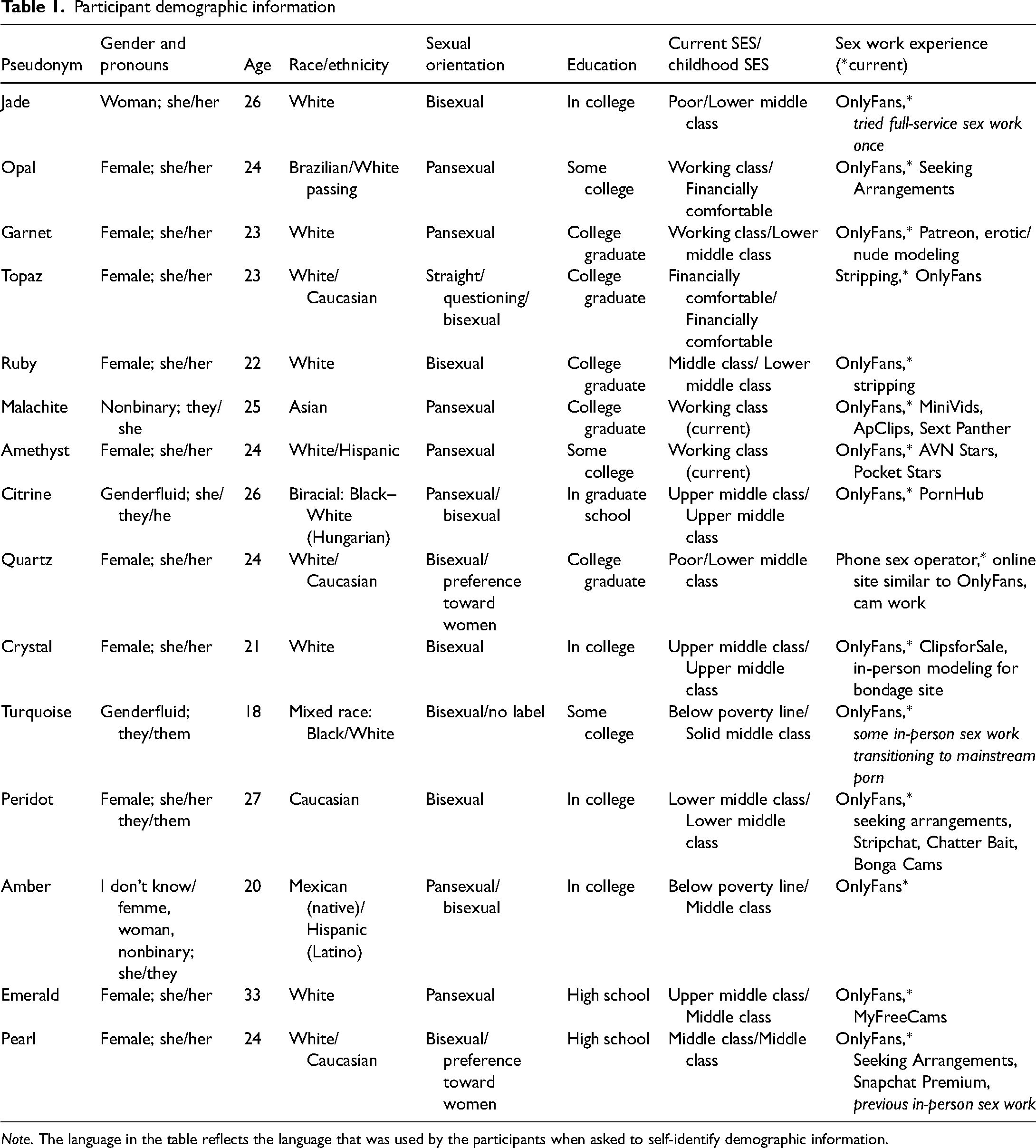
Note. The language in the table reflects the language that was used by the participants when asked to self-identify demographic information.
Interviews
Participants who showed interest provided their email address, and the assigned interviewer sent them the consent form, a description of the study, and a list of available times to complete an interview. Participants were also asked if they had a preference for the gender of their interviewer. Once the interview was scheduled, participants were emailed a Zoom link.
At the beginning of the interview, participants were given the option to choose the camera status (image on or off) for themselves and the interviewer. After obtaining verbal consent, interviewers obtained information for participants’ compensation, which was dispensed by the second author within 24 hours. The research team decided that US$25.00 was ethical but not coercive given the time and commitment needed to participate in this study and the potentially sensitive nature of it. We anticipated the interviews would last approximately 40 minutes, but participants often gave detailed histories of their time as sex workers and discussed their backgrounds, resulting in interviews that lasted 1–2 hours. Participants wanted to share their experiences and contribute to the narrative that sex work is work. The interview began with an icebreaker question and 10 demographic questions, followed by questions meant to explore the experiences of online sex workers regarding motivations, benefits, and tolls of online sex work (see Appendix A in the supplemental material for a list of the research questions).
Following the interview, participants received an email containing contact information for the research team and Institutional Review Board (IRB). This email also included relevant resources that may be helpful or enjoyable for people who engage in online sex work (see Appendix B for a list of these resources). Audio files and Zoom-generated transcripts were saved on the institution's secure OneDrive, a shared cloud file hosting program that allowed researchers to securely share and store data. This study protocol was approved by the institution's IRB (Bridgewater State University).
Reflexivity
This study was influenced by the positionality of the research team, comprised of eight individuals (five undergraduate psychology students; all White; three cisgender women, one trans woman, and one nonbinary person; and three mentors, all White women), none of whom have previous experience with online sex work. The project was developed out of the group's interest in the burgeoning area of online sex work, aiming to investigate the motivations, benefits, and tolls of engaging in online sex work. This paper was born from the first author's particular interest in the juxtaposition between empowerment and misogyny. The positionality of the researchers may have influenced the questions asked and/or the interpretation of the data. A separate manuscript analyzing the same dataset focuses on experiences of stigma (see Stutz et al., 2022).
Data analysis
Data analysis involved a multistep process and used inductive thematic analysis (Fereday & Muir-Cochrane, 2006). The first step involved familiarizing ourselves with the data. The five students transcribed the interviews by listening to the audio recording while reading along with the Zoom-generated transcript for clarity and accuracy, correcting any inconsistencies. Then, all eight team members read through the corrected transcript prior to beginning the coding process.
All research team members then individually coded transcripts from the first five participants using an inductive approach. This open coding was informed by the project's original research questions asking about the motivations, tolls, and benefits associated with online sex work; any passages deemed relevant to these questions were coded.
In the second stage, the group met to discuss their individual codes and began the process of creating a codebook that contained names for the codes as well as short definitions and an example of a coded passage. An example of a code is validation, defined as “passages in which participants express receiving compliments, praise, or positive feedback from clients or other sex workers as a benefit to online sex work.” Once these codes were defined, students approached coding the rest of the interviews using this codebook in teams of two. First, the students coded the transcripts individually. They met to resolve discrepancies in their coding process and discussed the passages until agreement was reached. Informed by this process, students revised the codebook as necessary, reaching consensus within the eight-person group on the final codes and definitions. The codebook originally consisted of 49 codes and was revised to 44 codes.
The final stage of data analysis involved theme development. The first two authors used a concept-driven analysis to collate all coded passages related to misogyny and empowerment. Specifically, such codes as control/autonomy, empowerment, and disregard for boundaries were collated, and then authors began to corroborate and legitimize the themes through discussion to ensure that themes best represented the original data and codes (Fereday & Muir-Cochrane, 2006). By applying the polymorphous paradigm (Weitzer, 2010) to the data, we explored how complexities in online sex workers’ experiences related to empowerment and misogyny, discussing how perceptions of participants, current literature, and our lens form our analysis. This stage of analysis also emphasized the dual process that participants experienced, as they described a combination of managing macro-level or structural influences as well as micro-level or individual processes. Due to the complexity and nuance of these topics, we chose to use a thematic map to aid in visualizing the relationships between the themes (Braun & Clarke, 2013; see Figure 1). We categorized participants’ responses into two groups: experiences with misogyny and managing misogyny. Each of these includes description of unique themes and subthemes below.
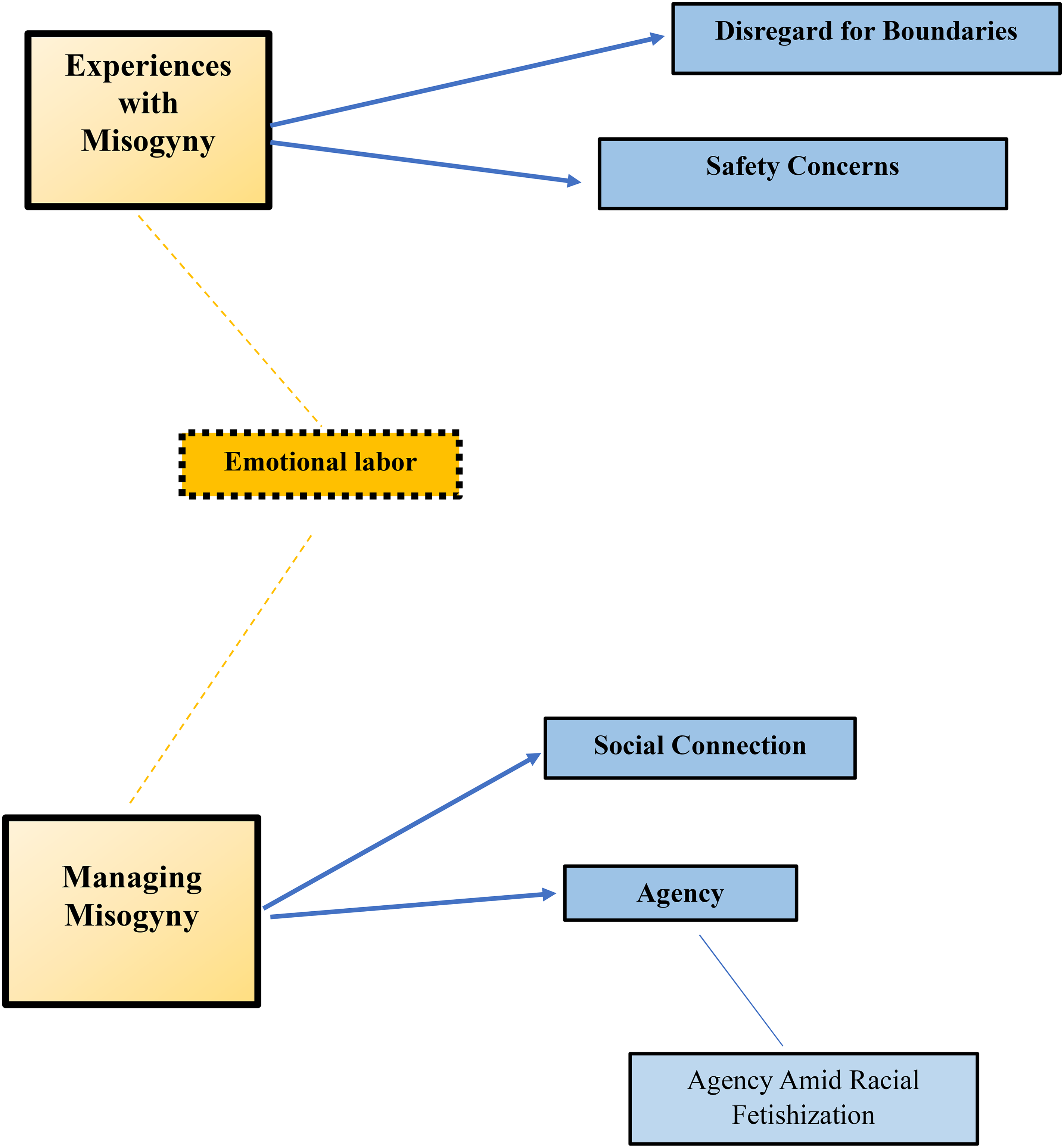
Thematic map.
Findings
Experiences with misogyny
The themes related to experiences with misogyny are disregard for boundaries and safety concerns. These themes reveal participants’ descriptions of unpleasant experiences with misogyny, which varied significantly in type and intensity. For some, these encounters were described as inevitable, a nuisance, or just part of the job. For others, encounters were more insidious or threatening, ranging from verbal to physical abuse and even sexual assault.
Disregard for boundaries
Most participants described how they established professional boundaries to manage male entitlement. Male entitlement is a manifestation of misogyny, a macro influence that was revealed online in the following ways: clients refusing to pay for content, requesting a deal on services, demanding services, stealing content (and profiting from it in some cases), binging content without subscribing, expecting and/or demanding responses, and/or expecting authenticity and exclusivity. Jade (26, White, woman) described one example of a boundary that she created and clearly posted on her profile; though she advertised on various media platforms, she only responded to direct messages on her OnlyFans page. She recalled: It can be draining to read messages over and over again, that are like … “hey, baby,” like, “blah, blah, blah,” they start off really positive. And then they’re like, “fine, you whore,” like when [I] don’t reply. For me, that happens every single day.
Men often resorted to verbal abuse and disrespect when they were ignored by online sex workers, even when it was a clearly established boundary; this could be a result of feeling entitled within a patriarchal system as a paying male client. Behaving as if they should have unfettered access to a woman's livelihood, body, and/or sexuality is a clear example of misogyny, particularly visible in the gendered nature of the insult. Insults are used to punish women who do not conform to men's expectations of power and dominance and can be used as a mechanism for policing their bodies and sexuality (Vance, 1984). For a man to call an online sex worker a “whore” only after attempting to solicit her service and being rejected is a clear example of how women's perceived value is often directly related to access to their body and/or sexuality.
Sometimes, boundary violations were described as “just part of the job.” In revealing the learning curve that comes with navigating misogyny online, participants often discussed being “scammed.” Amethyst (24, White, woman) provided a common example of this form of male entitlement. There's like a whole like lieu of people who love to scam … If there is a chargeback it comes directly out of your bank account … So I was negative $300 in my bank account, because this person decided to like scam me and take all this money back.
Participants’ responses to this boundary violation included feelings that their work was undervalued and that clients did not appreciate how much goes into creating content. Participants who talked about being scammed spoke as if they were not surprised, but instead disappointed and/or irritated.
Participants gave other examples of boundary violations, such as being badgered or pressured to adjust or expand their sexual boundaries. There was a range of responses to this kind of pressure; some found it empowering to assert their boundaries and push back, while others described feelings of discomfort as they tried to resist certain advances. These contradicting feelings are rooted in macro-level processes of the gendered socialization for women to be accommodating (Helgeson & Fritz, 1999). Women are raised to put others’ needs before their own; asserting their boundaries by telling clients “no,” defies this early messaging, which then creates discomfort for the women making the choice between prioritizing their own needs and the needs of their clients. On the other hand, OnlyFans makes it easy to block people as a way of asserting those boundaries—a mechanism not available in real life. OnlyFans is also at a distance, so to use that block button does not feel as difficult as refusing a man in real life, and it is thus especially empowering in the context of the persistent expectation for women to be nice and accommodating. Garnet (23, White, woman) illustrates her efforts in challenging boundary violations by honoring her own comfort levels. In her experience with erotic photography, she described feeling dehumanized by photographers when she was consistently pressured to perform outside of her boundaries. I’ve spoken to so many, like, photographers and like, told them my boundaries like … “I’m only comfortable with doing this like I’m not like super comfortable with that,” and they just don’t listen … they don’t really care, or like, see you as a person who, like, actually thinks or feels certain things.
She went on to say, “after doing it [trying to maintain boundaries] for a couple of years I’ve just kind of gotten to the point where I’m just like, tired of dealing with it.” Garnet explained that, with misogyny being considered in “the nature” of her work, she must decide whether to limit whom she works with and her earning potential or to expend emotional labor to work outside of her comfort zone. Participants often found themselves reckoning with choices like this, where agency became constructed on an individualized micro level within the parameters of these larger systems of misogyny and capitalism.
Safety concerns
Participants expressed a range of threats and dehumanization experiences that caused concerns for their safety. Though previous research suggests online sex work provides a safe physical barrier (Jones, 2019), some of our participants still referred to concerns for their physical safety, including sexual violence. Concerns for safety is a product of patriarchal structures, reflecting overall disrespect and disregard for online sex workers, often compounded by their gender identity and stigmatized profession. One common threat to physical safety was the threat of doxing (when identifiable information such as names or addresses can be obtained by hackers or clients; Jones, 2019).
Turquoise (18, mixed race, genderfluid) was a participant engaging in online sex work while also considering transitioning to mainstream porn. They illuminated how safety concerns are rooted in misogyny through disrespect and dehumanization as they described the harsh reality of navigating the online industry as a nonbinary person “with a female body.” They said, “Um, I’ve definitely had people threaten to find me and have sex with me before because of the job that I have.” Turquoise alluded to their concerns for potential sexual violence, which has historically been one example of how the power dynamics within a patriarchy work. Though they do not identify as a woman, they are perceived as being female, which automatically puts them at risk for sexual assault, and exponentially so for their choice to be a sex worker. Turquoise also expressed the potential threat to safety that all online sex workers face by the possibility of being doxed.
Crystal (21, White, woman) described being doxed and having had to cancel all her online accounts and to file a police report. After I got doxed, it was kind of like, I didn’t feel comfortable going back to it ‘cause I was, you know, afraid I felt really, like violated, I didn’t really-I didn’t know if it was something I’d like ever come back to … And then I just came back to it, because, you know, I remembered how much fun I had doing it.
Being doxed obstructed her openness and confidence, and her fears had become a barrier to engaging with the online sex work community. Crystal's potential for benefiting from community support, which was valued by most participants, was significantly decreased. In this way, macro-level structures of misogyny have interrupted this participant’s micro-level feelings of empowerment and autonomy.
Sexual harassment and the potential for sexual assault was something participants anticipated within the sex work industry; thus, participants were either wary of it or seemingly prepared to encounter it. This echoes the pattern seen on a larger societal scale in patriarchal cultures, in which it has become women's responsibility to manage their virtue through their bodies, especially by closely guarding their sexuality. Becoming their own sexual gatekeepers, women often face conflicting societal messages and must make the decision to either refrain from tempting men and/or surrender to them, whose sexual urges are deemed innate and uncontrollable (Vance, 1984).
Turquoise illustrated their concern for potential abuse. After describing an “awkward” encounter with a potential collaborator, the interviewer asked Turquoise if they wanted to share any other “uncomfortable situations.” They responded: I mean, I’ve definitely had my fair share of being like, Oh, I want to work with that person. Nevermind he rapes people like … It just like, kinda sucks … ‘cause like honestly, like, most of the time I feel like I can’t trust any dude in porn but like, I’m just going to anyway, like, I feel like I can’t really trust them like, I know that they’ve probably done something terrible. But … -I guess that's, just like, the nature of like, being in porn with a female body- it's just fuckin’… getting fucked over all the time, you know.
Most participants spoke as if boundary violations and potential sexual violence were something they must work around, whether engaged in online sex work or not. The tone of conversations surrounding this topic was matter of fact, suggesting the desensitization to sexual violence and the acceptance of its existence. This also suggests that women have assumed preventative responsibility. Since boundary violations and sexual harassment and/or assault were often viewed as inevitable, the emphasis was less on if one deals with it and more on how one deals with it.
Garnet, who participated in erotic modeling, revealed that collaborators were not exempt from being a threat to online sex workers’ physical safety when she disclosed her experiences with sexual assault. I was sexually assaulted over the summer at a shoot … like obviously there's like creeps and stuff but like I’ve never had anybody like physically, like, assault me like that, um, so that was definitely, like, a big thing for me.
Garnet illustrated the various degrees of violations that exist in online sex work. She compared the severity of assault to less threatening “creeps,” which she described as being somewhat tolerable, more like nuisances than threats. Although she did mention the emotional impact of being assaulted, she went on to downplay her trauma. I mean it was … I’m lucky that it only happened once and that it took, like, years for it to happen, like, I know that it's unfortunately so prevalent, um, so, I’m not lucky that it happened to me, but I’m lucky that it, like, only happened once and after so long.
Garnet reinforced the desensitization and normalization of sexual assault and hinted at the prevalence at which online sex workers encounter it.
Managing misogyny
The themes under managing misogyny are agency—with a subtheme titled agency amid racial fetishization—and social connection. These themes reveal various ways in which participants coped with or managed misogyny within online sex work. While participants each managed misogyny differently, most referred to feelings of control and reclamation, body positivity, autonomy, as well as community and social connections when encountering oppressive parameters. Most participants took pride in explaining the skills they developed for “dealing with” misogyny.
Agency
Agency was often described as feelings of control over what type of content to produce and whom to share it with. Additionally, many participants discussed feelings of financial autonomy in their ability to make money on their own terms. Some felt agentic in their unwavering boundaries; for others, online sex work offered a safe space to expand and experiment with sexuality and boundaries. Notably, some participants spoke of their own experiences with past sexual abuse, while many described their perception of the commonality of sexual assault within the community. Two participants explicitly reported their perception of sexual abuse as happening frequently among sex workers. Ruby said, “a lot of dancers have like, trauma, no doubt. And that's why, I feel like, I don’t know … Like, I relate so much.” Emerald supported this when she said, “And you know, really, the common denominator in the majority of us is that all of us have, you know, been sexually abused, at some point.” Those who described the abuse they had experienced before engaging in online sex work expressed how their work helped them to overcome it; that is, online sex work was a healing tool.
Many participants described the online realm as a safe space for self-discovery and self-sufficiency. Opal (24, Brazilian,
2
woman) began online sex work out of financial necessity during the COVID-19 lockdown. This option arose from the realization that after being told all her life how beautiful she was, she should “suck it up, and fucking profit off of it.” She refused to let the stigma of online sex work hinder her ability to make money in this profession while so many other women are “out there empowering themselves.” She also shared that online sex work became a space for self-discovery and healing: I’m a victim of sexual assault and that makes you feel like you have no control over your body. Like, zero control. And it's something that I’ve always struggled with throughout my life … Um, and this brought a lot of it back to me … it teaches you so much about yourself, that it almost like, brings you back to yourself, and who you are.
Opal revealed sexual agency as feelings of coming back to herself, as if sexual assault had separated her “being” from her body. Through her work, Opal felt she was able to flip the script, transforming her feelings of victimization into feelings of empowerment. It is important to note that while Opal expressed feelings of empowerment, it is still dependent on the value of her body and/or sexuality. While Opal was able to exert agency at a micro level, her decision-making and feelings about herself are still linked to and informed by the macro-level structures that objectify and sexualize women. In this case, Opal's true and valid feelings of empowerment exist alongside conventional and gendered expectations for women within a patriarchy.
Amethyst echoed feelings of dehumanization when she said: I’ve been catcalled every day that I’ve been alive, since I was 11 years old. Um that takes like a big emotional toll on people … like I’ve dealt with like lots of sexual assault in my life and like things like that, and like for a very, very long time, like, it was just like my body is not my own like I exist for other people.
By being objectified by others throughout her life, she felt her body was “not [her] own” and she did not have control over “ogling” or sexual harassment. Like Opal, she was able to “flip the script.” She said: I can’t stop people from looking at me or making those comments or thinking about me in nefarious ways, like, I have no control over that. But, I do have control over this person who is like, “oh hey let me see your tits” block, nope, only if you pay, you can see them if you pay for them. Um, really helped my self-esteem … I know that I have like value and like monetizing on it is just like a physical representation of … my own like physical value to myself.
Amethyst described a way to assert micro-level agency through regaining a sense of personal control amidst a macro-level context where harassment is rampant and viewed as an inevitable experience. She reframed negative experiences, deciding how, when, and for how much she would allow it to take place. She emphasized the value she was putting on herself as opposed to her body, calling it a “physical representation of [her] self-value.” Her feeling of empowerment through this process was less about money or others’ sexual gratification than her asserting that she was worthy of safety, comfort, and boundary setting.
Pearl (24, White, woman) also noted an evolution in her micro-level sense of agency. She said: Basically I guess just-I see-I see more value in myself. I’m like, I-I’m not just made for men, like I-I can … please men, but like under my-my terms and like, what I say and that's just really helped like my-my self-image in that respect.
Pearl expressed a shift in criteria for determining self-value within the parameters of patriarchal structures, an ever-present macro-level influence. “Pleasing men” still looms large in her experiences, but online sex work has given her a way to assert sexual agency by dictating the terms under which she will “please men.” That sexual agency has translated to feelings of empowerment and an improved sense of self, a micro-level phenomenon.
Peridot (27, White, woman) explained how agency was derived from online sex work through the safe space it provided for sexual exploration: It's really boosted my confidence and, uh, my self-esteem and stuff like that. So uh, am I, I don’t know, I don’t want to say it sounds silly, but I’m kinda grateful, you know, I’m grateful for … exploring this and-and really diving into my sexuality and realizing that like, it's not a bad thing … you know, because I did feel almost shameful … to have these desires, um, so to know that it's not, and that there's, there's a huge industry is kind of comforting.
Peridot revealed how online sex work has been a tool in overcoming shame, which results from misogynistic ideas that women's sexual desire is simply a response to men, instead of a natural, agentic process. Notably, for most participants, including Peridot, feelings of control and agency were commonly drawn from introspection and self-realization, specifically through the meaning, significance, or outcome of coping strategies.
Agency amid racial fetishization
Research suggests that women are often judged and categorized by visible identifiers through the commodification of aspects such as hair color or skin color (Wesely, 2003b). Similarly, racial fetishization was identified as a unique consideration by participants of color regarding their feelings of agency and level of emotional labor expended. It was defined through participants’ descriptions as sexualizing a person's race or reducing their identity or body to their race. It is important to note that fetishization was distinct from sexual fetishes or kinks, which was discussed by some participants in the context of either exploring their own or incorporating others’ into their services.
Strikingly, all participants of color discussed encounters with racial fetishization (all but one introduced the term themselves, rather than being prompted by the interviewer). Similar to past research, participants’ reactions toward fetishization often differed, as did their feelings about it and strategies to manage it (Wesely, 2003b). When asked if there was anything they would change about their work, Malachite (25, Asian, nonbinary) said, “I would change the like, fetishization of like, minorities.” They described how their lack of control over feeling racially fetishized in “regular” society had carried over to online sex work. Like as an Asian person I’m always going to like tag myself as Asian … that can be um, degrading in itself because, especially if you’ve been fetishized your whole life it's like, “okay now I’m like putting myself in this space where there's definitely people that are fetishizing me,” but I want their money.
Malachite described financial compensation as a benefit, which is seen in previous literature (Sweet & Tewksbury, 2000; Wesely, 2003b; Wood, 2000), but, importantly, illustrated a common process of participants of color in which they weighed the disadvantages of fetishization against the benefits of financial compensation. For some, racial fetishization created a pressure for marketing. Interestingly, while there was a level of exploitation in racial fetishization expressed by some, there were also instances in which participants felt agency and empowerment through how they managed it. Amber (20, Mexican, nonbinary) said: Yeah. So really, when it comes down to like, the thick of it, they’re looking at, they’re looking at your race, your mobility, and your genitalia. That's really like, what-all-the big three that it comes down to … for me, I don’t really ever try and fetishize myself, at least not when it comes to my ethnicity. Like, I’m, I’m definitely like, on the fucking the BBW [big, beautiful women] type shit … I’m gonna work my angle from that. But as far as it comes to, like, my ethnicity and stuff like that … I don’t … I have like a whole market, just because of, ‘cause, because I am fat, like … I-for the most part, I feel like I have control over that. The way that I present myself.
This reflects how societal pressures and/or discrimination via racism, ableism, or sexism, as Amber refers to, regarding physical appearance often inform micro-level processes of developing feelings about one's body and confidence; how people reconcile this is often a unique and individual process.
Citrine (26, biracial, genderfluid) also reframed feelings of being racially fetishized into a positive opportunity for building clientele, whom she identified as “by [and] large … in their mid-forties or older and mostly all White.” I think that if anything, because people can’t place me as mono-racial most of the time, or if they think I’m mono-racial, they can’t really figure out what that is, it's-it's more of an advantage, although it's fetishizing as hell, but it ultimately ends up being an advantage because I’m intriguing to people, uh, in that way.
Citrine explained that while racial fetishization was a large factor in her experience, it was employed as an advantage in drawing in customers. Emotional labor, in Citrine's case, was expended less in managing fetishization but more so in providing content for clients that were outside her typical “taste,” whom she would not normally date or to whom she would not be sexually attracted.
Social connection
Pleasure and enjoyment in online sex work were commonly derived from social and emotional connections with other sex workers as well as with clients. Social connection was often a tool for coping with structural forces like misogyny and capitalism.
Many participants described benefiting from the online sex work community connections; that communicating with other sex workers with shared experiences was encouraging and empowering. Online sex workers helped each other through offering advice or paid mentorships, and networking; participants often emphasized collaboration over competition despite challenges due to the saturation of the market.
Community connection had a deep meaning for Turquoise, who revealed their struggle with defining their gender identity. Turquoise was genderfluid and did not identify with the label of “transgender”; despite this, they felt a strong connection to the trans community and felt that the online sex work community offered them a place of belonging. I like the community, and I want to like, engage with these people a lot … I don’t think they would really want to communicate with me if it wasn’t work. So, like, I really want to continue to keep those friends and keep those connections.
For Turquoise, being without this connection would mean being without the support and social connection, as well as connections to the industry they felt were necessary for career-oriented success. Thus, this was a vital part of their experience.
Crystal expressed the positive influence the community had on her social life. Although being doxed caused her to shy away from social engagement online, Crystal revealed that the community was a reminder of the like-mindedness and acceptance that exist among sex workers. She described feelings of reassurance and comfort in knowing that there are people who will not judge her, “and [not tell] you what you’re doing is wrong.”
Others found that the community offered a sense of comradery, where online sex workers could talk about their experiences with sexual abuse. Emerald (33, White, woman) described the common experiences throughout the community and how reclamation of power and control was a way to cope with misogyny. [A]ll of us have, you know, been sexually abused, at some point … Um, or have, you know, faced some type of something horrible um, in our lives of the sexual nature, and this is very much a way to kind of reclaim that … I’ve talked to a lot of people in this community … they-a lot of them have a lot of similar experiences and feel the same way.
The ability to find a sense of belonging in a stigmatized job was valued. Because of the sensitive nature of their work and their experiences as online sex workers, sharing stories and offering support to each other offered deeply meaningful connections. This additionally serves as a step toward the de-stigmatization of the industry, which would offer empowerment to sex workers on an individual and structural level (Stutz et al., 2022).
In addition to social connections within the online sex work community, many participants described the value of genuine interactions with clients and found pleasure through these relationships. Quartz described a few clients that stood out in her mind as bringing her pleasure and job satisfaction. I love the positive attention that I get. Like the customers are usually super, super nice. Some of them actually want to have genuine conversations like, one guy gave me his full recipe for tomato soup after we had finished the work portion and then this other guy spent 30 minutes talking to me about my D&D character and giving me like tips on how to play a cleric.
Genuine conversations and companionship were often much deeper than sexual gratification and spoke more to a need for social connection. Jade gave an example of how being vulnerable and genuine with her subscribers had been emotionally and financially beneficial for her. I attempted suicide last year and had to go, um, to, like, a … facility. And I was open with them about that. And I got [laughs] a lot of money for one, um, obviously, because they felt really bad, but also just a lot of supportive comments … I don’t ever feel alone, ‘cause I can always go there … they want to be there for me, um, whether it be emotionally or financially, and so that's really nice.
Jade described the benefits of the support she received and went on to describe her relationship with a specific client as a friendship that was mutually beneficial. I was just like … “you’ve made a huge impact on my life … you’ve been there to help me pay my bills. And like, that means a lot to me.” I feel like … it's a friendship at that point, um because he doesn’t really ask for anything in return. Like I’ll, of course, like, send a couple sexy pictures to like, feel like I’m doing something, but … for the most part, he's … just being a decent person … I feel like I’ve made some really genuine connections.
While there is undoubtedly an element of sexuality throughout these interactions, it was made clear through these discussions how important a deeper emotional connection was to both the clients as well as the online sex workers. In many cases, sex was referred to as only part of the story of the online sex workers’ experiences and not necessarily the focus. This was especially true when considering the importance and value placed on the interactions with other online sex workers within the community. It was also made clear how, while the internet limits physical interactions, it does not hinder the ability of people to find a way to connect with and support each other, whether emotional, financially, or both.
Discussion
The purpose of this study was to understand the experience of online sex workers, and from this, our focus narrowed to how empowerment and misogyny coexist. Previous research suggests that experiences of sex workers are multifaceted and that most sex workers report aspects of both oppression and empowerment (Jones, 2016; Sweet & Tewksbury, 2000; Weitzer, 2010). Our findings echo this previous research as participants discussed oppressive experiences such as boundary violations, verbal abuse, and threats of violence, as well as feelings of empowerment through reclamation, agency, and autonomy. This study affirms Weitzer's polymorphous paradigm (2010), offering insight into how empowerment and oppression manifest in the online realm, where sex work is legal and more widely accessible.
Importantly, our analysis extends the polymorphous paradigm by going beyond the mere coexistence of empowerment and oppression, revealing a multitude of ways in which empowerment is a response to misogyny. People can only become empowered when they were previously powerless and, indeed, sexual abuse history was prevalent in our sample. Past research has also noted that some sex workers “try to reclaim power by selling their sexualized bodies for money while still enduring abuse within this context” (Wesely, 2002, p. 1182).
There is a delicate balance between performance and authenticity in online sex work. As previous research has shown, sex workers often appease customers’ sexual fantasies through performing, while continuing with the primary goal of money-making, often referred to as “counterfeit intimacy” (Enck & Preston, 1988). However, for online sex workers, sexual pleasure and capital gains are not mutually exclusive. Recent research suggests online sex work allows for sexual pleasure and exploration (see Jones, 2016), but there is an generalized understanding that sex work is work. Sex workers often use their identities and bodies to negotiate interactions, and previous research highlights that women's active choices about their bodies and identities might be constrained by the context in which they participate (Wesely, 2003a). Exploring individual experiences with a qualitative lens allows for a better understanding of how online sex workers negotiate their bodies to facilitate a beneficial experience, and how they might weigh up those benefits.
Participants’ experiences spoke to the oppression of female sexuality in Western culture via objectification, narrowly defined beauty standards, sexual harassment, and the like. Through online sex work, participants overwhelmingly reported feelings of empowerment via body acceptance, reclamation, agency, and autonomy. Similar experiences of empowerment have been previously described by other sex workers such as erotic dancers (see Sweet & Tewksbury, 2000; Wesely, 2002). The OnlyFans platform allowed participants control over the content they shared, and the amount of time and energy invested in their sex work, though it is ultimately a capitalist endeavor where the demands of customers can push online sex workers’ boundaries or extract emotional labor in upholding them. Many felt validated in being sexually desired online after experiencing a culture that previously rejected their size, body type, or skin tone. The physical distance offered by the internet was seen as an advantage, as participants blocked unwanted solicitation or abuse with the click of a button, while simultaneously feeling resigned to the inevitability of the pervasive harassment in the industry, which online sex workers have to handle as a part of their job. Participants often downplayed the misogyny they experienced in the industry, describing it as not as bad as it could be and just part of the job, to psychologically take control of the more direct misogynistic experiences in their work. Many decided to “control the script,” figuring that, if misogyny happens anyway, “why not profit from it?” As is often the case in the context of oppression, online sex workers sought solidarity with each other, creating a strong community of support (Sweet & Tewksbury, 2000).
In all these ways, empowerment in online sex work is a response to a broader context of misogyny, as has been observed in examinations of female sexuality outside of sex work (e.g., Liss et al., 2011). Many strategies for managing misogyny were consistent with existing literature regarding female socialization and cultural norms. Women in Western patriarchal societies are commonly socialized to see as their responsibility to refrain from tempting men in order to avoid sexual assault, which shifts the burden of protection to women rather than addressing the problematic or predatory behaviors of men (Frazier, 2021; Vance, 1984). The online realm is full of this pattern of scapegoating, victim blaming, and deferring responsibility. In many cases, online sex workers felt responsible for finding a comfortable and realistic way to confront misogyny. Participants expressed feelings of responsibility for being doxed or scammed; they felt they should have known better or paid closer attention, reflecting the premise that women are responsible for, and even “ask for,” the predatory behaviors of men. Thus, online sex work echoes patterns found throughout the culture in a unique manifestation of a familiar pattern.
The micro/macro dynamic is an integrative model we use to describe how micro-level, individual factors such as empowerment, validation, and/or agency operate within a larger system of macro-level, structural factors such as misogyny, patriarchy, and capitalism. This model, like the polymorphous paradigm (Weitzer, 2010) informing it, acknowledges how online sex work can be both empowering and oppressive at the same time, viewed from a systemic perspective where agentic individuals create meaning out of their own experiences, informed by macrosocial processes. Indeed, empowerment exists in this space in response to oppression; patriarchal repression of female sexuality, rampant objectification, and financial hardship create opportunities for empowerment through reclamation and capitalization. Sex workers make meaning out of their experiences according to their own emotions and introspection, and yet experiences of sexuality are also socially constructed, influenced by interactions with others, societal norms, and expectations, as well as socialized behaviors. Online sex workers recount feeling both objectified and desired at the same time, and the degree to which those feelings influence their overall experiences is unique. The micro/macro dynamic framework captures this complexity, illustrating how women assert agency and feel empowered at a micro level within a patriarchal society rife with experiences of victimization and exploitation at a macro level. It is urgent to recognize the risk of turning a blind eye to systemic patriarchy and capitalism, which perpetuate oppression. This model aims to reconcile this concern, privileging and validating individual positive experiences while recognizing that, although sexual agency is a step in the right direction, it does not address structural inequities.
The extent to which online sex workers’ feelings of empowerment translate to wieldable power remains unclear, but this power is constrained by the structures that exist within a patriarchal society. As reported by our participants, making money off misogyny feels empowering and, theoretically, could translate to economic power, yet many of our participants reported financial struggles in the face of a saturated market of online sex work. The findings are based on the accounts of participants who were willing and able to share their experience. Most of our participants reported their socioeconomic status as working class, often referred to the financial benefits of online sex work, and used online sex work as a supplementary income, suggesting they did not generate enough income from this avenue to consider it their only employment. Therefore, those who agreed to interview could have been influenced by the financial incentive to participate. Their experiences with misogyny and coping strategies may differ from those of someone who generates enough money for online sex work to be their primary source of income.
Ultimately, we observed that, to our participants, feeling empowered through online sex work is a better alternative to facing misogyny without access to the online sex work community and the feelings of control over their work and sexual agency that come with it. To continue this work, future studies should deepen this investigation of how individuals make meaning of empowerment, especially when it is derived from experiences of the body and appearance that depend on being desired by others. By building a stronger foundation of knowledge about female sexuality, this information would help to reconcile contrasting viewpoints regarding empowerment and oppression and contribute to reducing the stigma around online sex work (Stutz et al., 2022). As online sex work evolves, so should research. Research must be sensitive to how sex work can be a source of empowerment, agency, and autonomy, while also exposing the oppressive nature of patriarchal norms and misogyny. Empowerment and oppression in online sex work are intricately linked. Normalizing female sexuality and de-stigmatizing sex work are a step in the right direction for a revolution against oppression, but it is only the beginning.
Supplemental Material
sj-docx-1-fap-10.1177_09593535231184718 - Supplemental material for “I’m not just made for men”: Managing misogyny in online sex work
Supplemental material, sj-docx-1-fap-10.1177_09593535231184718 for “I’m not just made for men”: Managing misogyny in online sex work by Sarah E. Martins, Teresa K. King, Theresa E. Jackson, Laura R. Ramsey, Nyx Gomes and Clover Stutz in Feminism & Psychology
Supplemental Material
sj-docx-2-fap-10.1177_09593535231184718 - Supplemental material for “I’m not just made for men”: Managing misogyny in online sex work
Supplemental material, sj-docx-2-fap-10.1177_09593535231184718 for “I’m not just made for men”: Managing misogyny in online sex work by Sarah E. Martins, Teresa K. King, Theresa E. Jackson, Laura R. Ramsey, Nyx Gomes and Clover Stutz in Feminism & Psychology
Footnotes
Declaration of conflicting interests
The author(s) declared no potential conflicts of interest with respect to the research, authorship, and/or publication of this article.
Funding
The author(s) disclosed receipt of the following financial support for the research, authorship, and/or publication of this article: This research was supported by grants from the Office of Undergraduate Research at Bridgewater State University.

Supplemental material
Supplemental material for this article is available online.
Notes
Author Biographies
References
Supplementary Material
Please find the following supplemental material available below.
For Open Access articles published under a Creative Commons License, all supplemental material carries the same license as the article it is associated with.
For non-Open Access articles published, all supplemental material carries a non-exclusive license, and permission requests for re-use of supplemental material or any part of supplemental material shall be sent directly to the copyright owner as specified in the copyright notice associated with the article.
