




Abstract
Influenced by theories of intersectionality, performativity and gender hegemony, this review sought to explore the intersection of autism and gender in qualitative research into autistic identity. Twelve papers were subjected to a thematic metasynthesis following a systematic search. Study participants were predominantly cisgender female or gender-diverse: perspectives of cisgender autistic males were lacking. The three superordinate themes developed related to: (1) the ways in which autism discourses restricted gender identities, through the influence of the “extreme male brain” and “masking” narratives and the use of autism to explain gender non-conformity and gender diversity; (2) the ways in which gendered autistic identities were positioned within social power hierarchies as “othered”, subordinate and less acceptable ways of being; and (3) possibilities for finding spaces of belonging and resistance. While autism as an identity may offer community and freedom from normative expectations, dominant autism discourses act to restrict and police gender, reinforcing existing power hierarchies. We encourage practitioners to reflect on the clinical, ethical and political implications of their positioning in relation to the constructs of “autism” and “gender”, and to explore alongside people seeking support the personal and political impacts of gendered autism discourses.
Both autism and gender are concepts that shape constructions of identity. Both concepts have come increasingly under the gaze of “psy-professionals”, with drastic increases in rates of autism diagnoses in recent decades (Russell, 2021) and increasing numbers of referrals for individuals experiencing distress in relation to gender (Fielding & Bass, 2018). Considering both “autism” and “gender” in social constructionist terms, we are interested in the intersectionality of autistic and gender identities from the perspectives of individuals who identify as autistic. We begin by locating autism within its sociocultural and discursive context and sketch some possible meanings of autism for identity. We map the gendered landscape of autism as a construct before outlining theories of intersectionality, performativity and gender hegemony that influenced our thinking.
Autism: A powerful idea
Autism is a concept rich in history, grand theories and emotional investment. Theories of “mindblindness” (Baron-Cohen, 1995) and “the extreme male brain” (Baron-Cohen, 2002) have captured scientific and public imagination. Autism has become a sought-after commodity (Mallett & Runswick-Cole, 2016), with increasing demand for diagnosis likened to “pathologization from below” (Brinkmann, 2016, p. 2). Autism's parameters have expanded over time (O’Reilly et al., 2017), its boundaries with “normality” blurred and shifting (Lester et al., 2014). Autism has a bio-political function advancing truth claims regarding “normality” (Goodley, 2016) and policing the boundary of “deviance” (Vakirtzi & Bayliss, 2013). Problematising dominant, non-autistic “normality”, neurodiversity activists celebrate autistic differences and promote pride in autistic identity (Kapp et al., 2013; Runswick-Cole, 2014).
While the extent to which autism is integral to a person's sense of self varies, qualitative research indicates autism can assume huge significance in the construction of identity (Rosqvist, 2012). Not always experienced as positive, an autism diagnosis may trigger shame and hopelessness, increased surveillance from others and decreased autonomy (Johnson & Joshi, 2016; Powell & Acker, 2016). However, for those who embrace an autistic identity, some of whom may self-diagnose (Lewis, 2016), autism offers explanation and validation of experienced difficulties, and even a sense of exemption from social norms (Powell & Acker, 2016), including gendered expectations (Russell, 2021).
A gendered concept
Autism discourse is laden with gender baggage. From the foundational case studies of Kanner (1943), through the seminal epidemiological survey of Wing (1981), the “extreme male brain” theory (Baron-Cohen, 2002), and continuing in the differential male-to-female ratio in diagnosis (Loomes et al., 2017), autism has been coded “male”. Yet 21st-century autism seeks new gender markets, heralding increased interest in “female autism” (e.g., Hull et al., 2020) and in the relatively high co-occurrence of autism and transgender or non-binary identities (Stagg & Vincent, 2019).
Intersectionality, performativity and gender hegemony
Identity construction is a complex social and discursive process (Taylor, 2014). Drawing on the Bahktinian concept of “orchestrating voices”, Bagatell (2007) presented one individual's construction of autistic identity as involving negotiation of competing discourses: of “disability” and “deficit”, inscribed through diagnosis; of the authoritative voices of the neurotypical and ableist world, with their reminders to “fit in”; and of those from the neurodiversity movement, challenging “neurotypical” norms whilst creating and celebrating “autistic” norms. An intersectional lens is needed, however, to understand the negotiation of gendered autistic identities (Saxe, 2017).
First developed in Black feminist theory, intersectionality offers an analytic framework for exploring “dynamics of difference and sameness” (Cho et al., 2013, p. 787) within the “matrix of domination” (Collins, 1990) connecting different forms of power (interpersonal, patriarchal, hegemonic, disciplinary, etc.). Intersectional analyses have highlighted the gendered coding of dis/ability (Hirschmann, 2013) and the weaponising of dis/ability categories to delegitimise non-cisgender, non-heterosexual identities (Toft et al., 2020). There is, however, a danger in examining the intersection of autism and gender that these identity categories become reified and essentialised.
In the seminal Gender Trouble, Butler (2006) problematised assumptions that gender precedes enactment of gendered behaviour – rather, gender is “performatively constituted” (p. 34) through the “stylized repetition of acts” (p. 191), like gesture, movement and clothing). These ways of being have come to be recognised as “female” or “male” and are discursively produced within a “heterosexual matrix” that supports a hierarchical binary of masculine dominance. While non-normative gender performances are possible, they may not be “culturally intelligible” (pp. 23–4). Doing gender “wrong” risks punishment (p. 190). Building on the framework of the heterosexual matrix, Schippers (2007) extended Connell’s (1995) concept of “hegemonic masculinity” to describe “hegemonic femininity” (when women embody characteristics which complement and legitimate male dominance, e.g., being delicate or passive) and “pariah femininity” (when women appropriate “male” characteristics – e.g., physical prowess, authority – troubling the idealised relationship between masculinity and femininity).
Interesting overlaps connect feminist theory and autism studies. Pariah femininity informed Russell’s (2021) analysis of the ways in which non-conformity with traditional feminine standards is constructed as signifying autism in women and girls, meaning autism diagnosis polices the boundaries of normative feminine behaviour. Yet feminist scholars have also drawn upon autistic perspectives to destabilise gender: gender as multiple rhetorical possibilities which can be “invented and crafted in different situations” (Jack, 2012, p. 15); gender as a “ghost” to be given up (Davidson & Tamas, 2016, p. 61).
Rationale
Previous reviews related to the intersection of autistic and gender identities have focused on one gender (e.g., Taylor, 2019) or subsumed gender identity within a broader LGBTQ + focus, and autism within a broader disability category (e.g., Duke, 2011). Taylor’s (2019) narrative synthesis of research on female identity and autism argued that stereotypical depictions of autism and normative femininity presented “identity threats” to autistic women and girls, who experienced incongruence with such representations, resulting in identity confusion and negative self-esteem: clearly, this has a clinical relevance. However, focusing too narrowly on one gender identity risks reproducing essentialist accounts of gender, foreclosing opportunities to trace the workings of gender as a construct. We therefore formulated the following question for this review: How do autism and gender intersect in accounts of the negotiation of identity?
Method
Systematic search
The protocol was registered on Prospero (registration number CRD42020196928). Six databases were searched on 29 May 2020, returning 1546 results. Search terms are listed in Table 1.
Search terms.
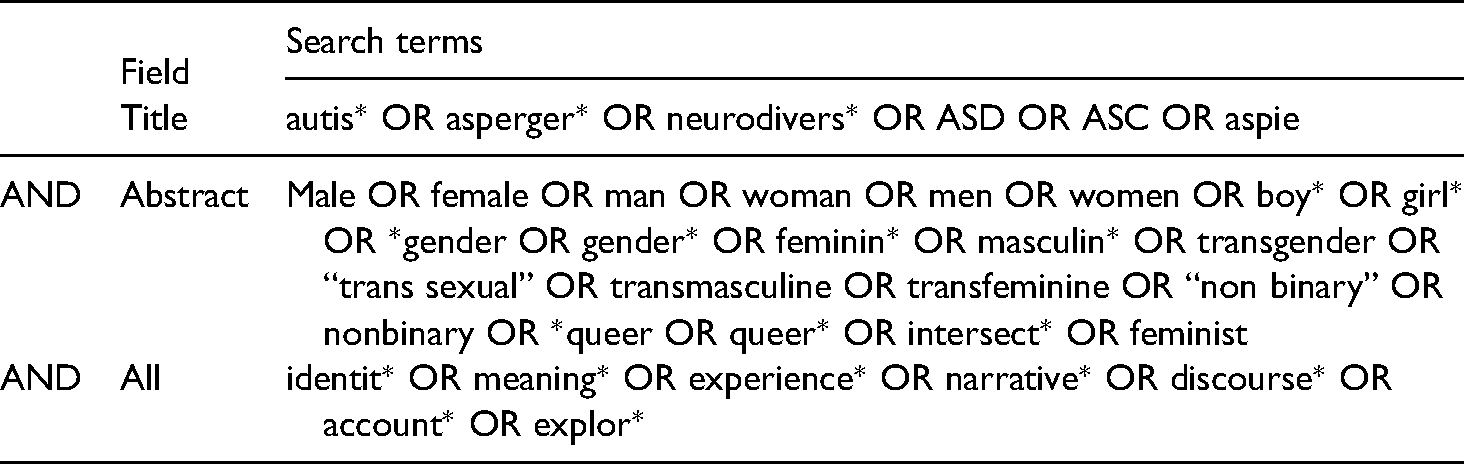
No date restrictions were imposed. Language was restricted to English. Depending on the database, filters or an additional line of search terms for qualitative research were used. Figure 1 details the screening and selection process.
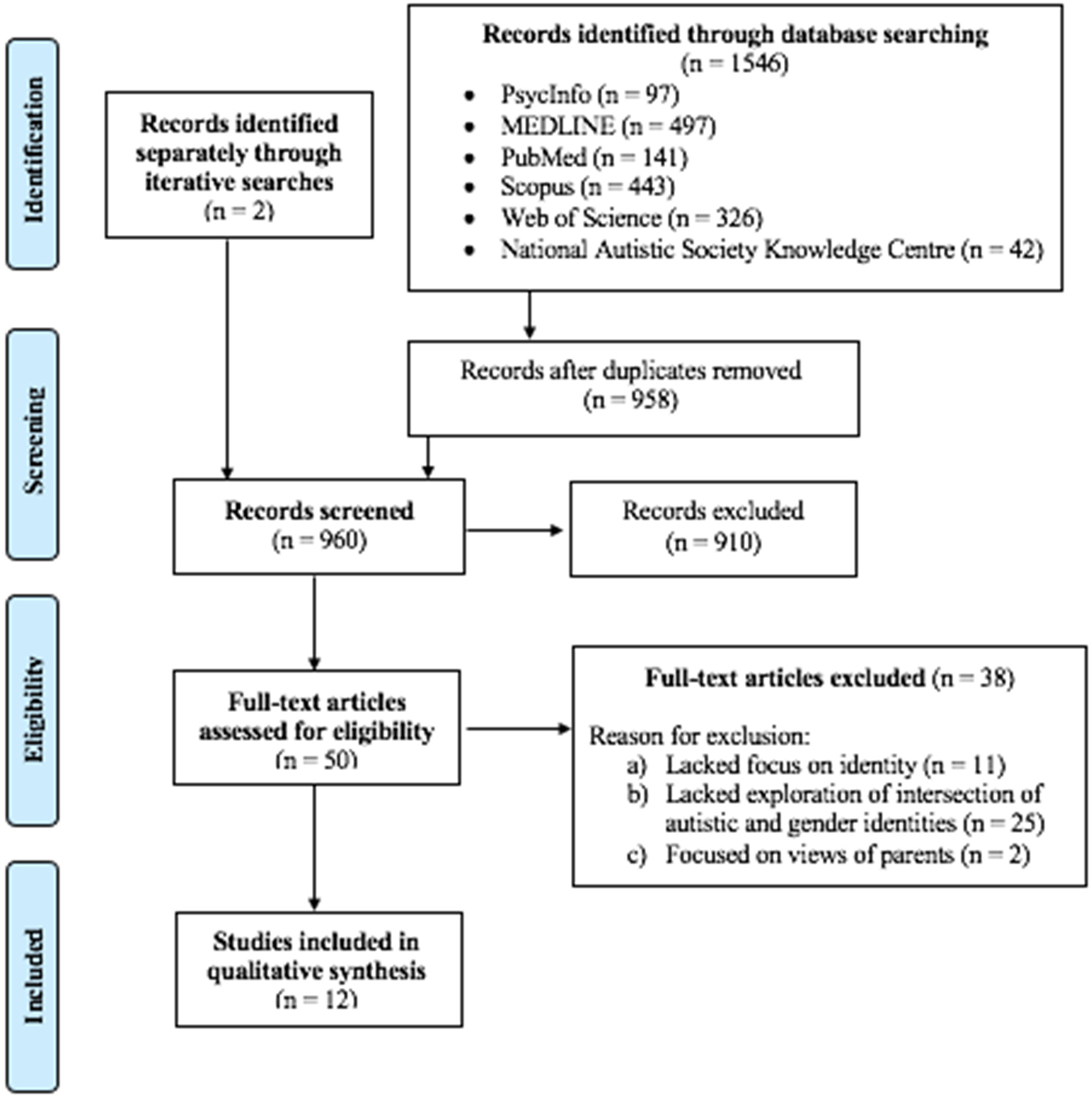
Adapted PRISMA flow diagram (Moher et al., 2009).
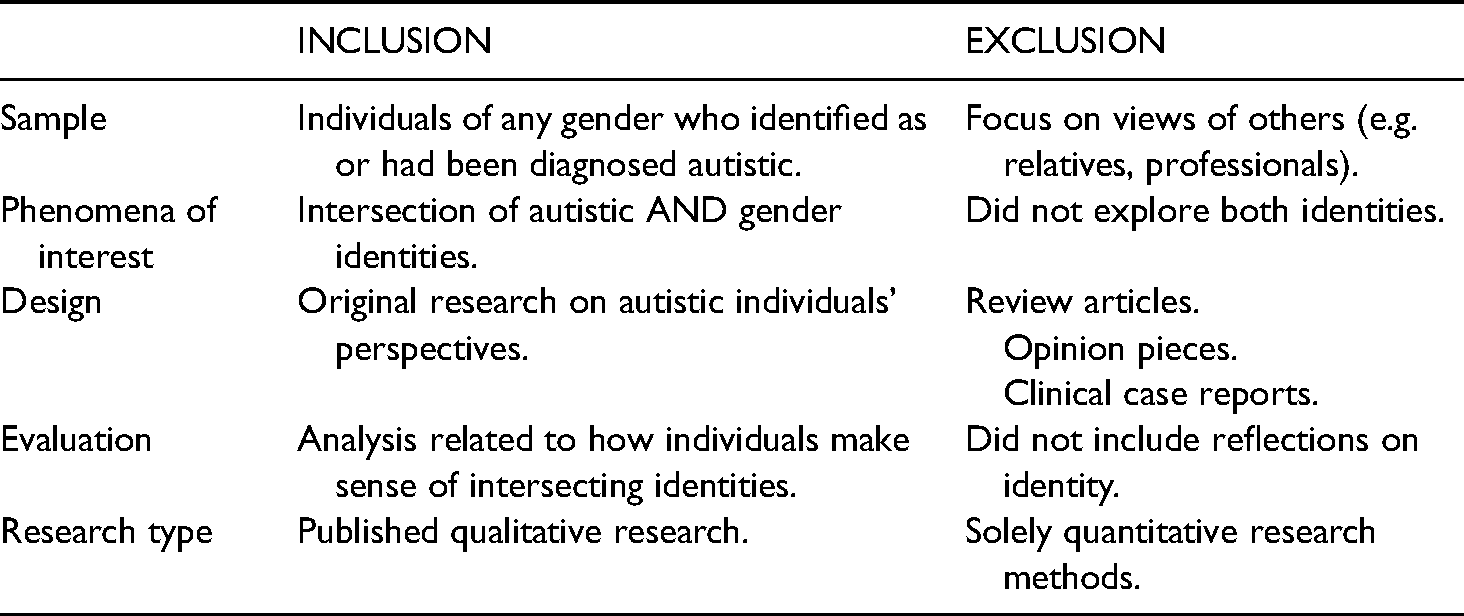
Inclusion criteria (Table 2) were developed with reference to the SPIDER tool (Cooke et al., 2012). No additional studies were identified through forward citation searches or checking the reference list of the 12 selected studies.
Inclusion/exclusion criteria.
Quality appraisal
Quality appraisal was undertaken from a social constructionist position, informed by Willig’s (2013) summary of principles for appraising qualitative research. Papers were assessed in relation to quality of data relevant for this particular review. Different reviewers would have appraised the papers differently. Following Dixon-Wood et al. (2006) and Thomas and Harden (2008), it was decided that a study would only be excluded on quality grounds if it was deemed fatally flawed, which did not apply to any of the selected studies. Sensitivity analysis (Thomas & Harden, 2008) was used to ensure that those studies which were judged of higher quality and relevance to the review were utilised more in theme development.
Thematic synthesis
Following Thomas and Harden (2008), all content from the Findings/Results sections of the studies (including direct quotations from participants and key concepts or themes as interpreted by study authors) were defined as the data set. Line-by-line coding was an inductive and iterative process orientated towards identifying relationships between codes across papers. Descriptive themes were developed and then translated into analytical categories, intended to extend beyond the original context of the primary studies. Provisional analytical themes were reviewed for coherence and fit. The data was recoded and regrouped into themes until a satisfactory analytical structure was achieved. The extent to which a theme captured something of interest to the review was prioritised over quantifying its prevalence across the data set. Analysis was oriented to latent-level interpretation from a constructionist standpoint (Braun & Clarke, 2006), with the role of the reviewers conceptualised as central in constructing findings (Willig, 2013).
Findings
Study characteristics
The 12 studies were published between 2016 and 2021. Sample sizes ranged from one (Cain & Velasaco, 2021) to 24 (Barnett, 2017). The majority used adult samples; two were based on adolescent samples; one included adolescents and adults. Two studies (Bargiela et al., 2016; Strang et al., 2018) excluded individuals who met the criteria for intellectual disability; Kanfiszer et al. (2017) supported participants with intellectual disabilities to be included. Only four studies reported participants’ racial identities: in three, the vast majority (Barnett, 2017; Strang et al., 2018) or entirety (Hillier et al., 2020) of the sample were “White”; whilst four out of seven participants were “White” in Miller et al.’s (2020) study. With one exception (Shapira & Granek, 2019: Canada/Israel), all studies were conducted in the UK or USA, although studies using Internet-mediated research methods included individuals from multiple countries. The findings of the studies – and consequently of our metasynthesis – are thus historically and culturally located at a specific timepoint and in a predominantly Anglo-American context.
In seven studies, all participants had received formal autism diagnoses, with two studies stipulating the diagnosis must have been given during adulthood (Bargiela et al., 2016; Kanfiszer et al., 2017). Participants in the remaining five studies identified as autistic, some with and some without a formal diagnosis. A range of terms were used to report the gender identity of participants. (In this review we use “transgender” when it is the language used by participants or authors of reviewed papers but use “gender-diverse” as a general term for non-normative gender identities.) Two studies recruited cisgender and gender-diverse participants. Five selected gender-diverse individuals only. One study defined their sample as “adults raised as girls”, recognising diversity in affirmed gender (Kourti & MacLeod, 2019); the four remaining studies defined their participants as “female”, “girls” or “women”. Cisgender autistic males were under-represented in the dataset. This inevitably shaped our synthesis, which consequently foregrounded the voices of cisgender women/girls and gender-diverse people: groups subordinated under hegemonic gender. Further details on the included studies and their contribution to the resultant themes can be found in supplementary material.
Metasynthesis
Three superordinate themes were constructed through the thematic synthesis, shown with sub-themes in Figure 2.
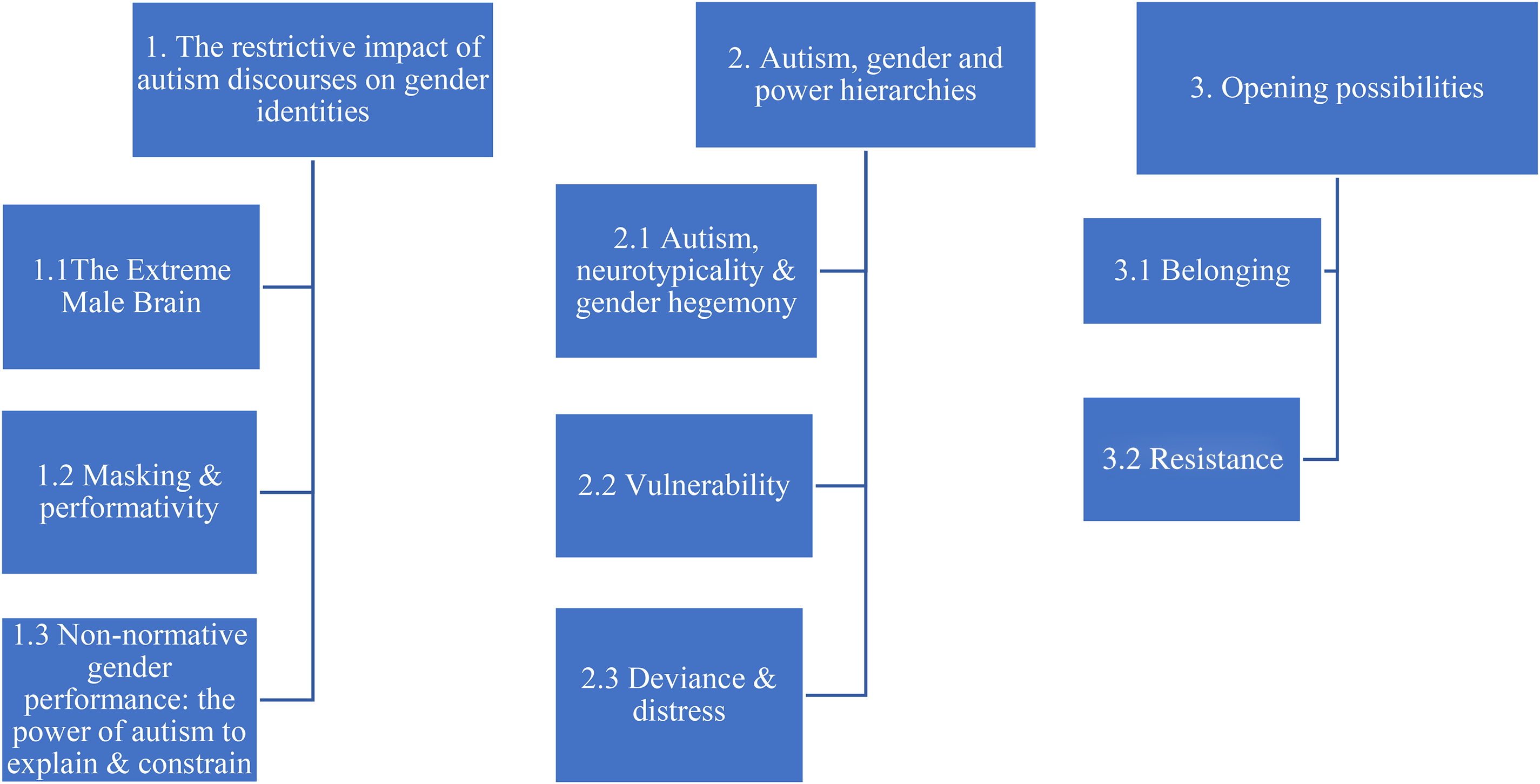
Theme map.
1. The restrictive impact of autism discourses on gender identities. This theme is about how gendered autism discourses shaped how individuals made sense of gender identities. Autism served to reinforce gender essentialism through the discourses of “the extreme male brain” (Subtheme 1.1) and the “female autistic masking” hypothesis (Subtheme 1.2). Understandings of autism also shaped explanations of non-normative gender performance (Subtheme 1.3).
1.1. The extreme male brain. The gendered discourse of “the extreme male brain” (Baron-Cohen, 2002) seemed to influence individuals’ constructions of gender identity and the reactions they encountered in others. Cisgender-female and gender-diverse participants negotiated assumptions that autism equated to masculinity and masculinity to a lack of emotionality. “[Y]ou tell someone that you’re autistic and they say you’re not a white, cis male. No way – you’re not autistic! But you show emotion, but you’re not Leonard Nimoy” (Strang et al., 2018, p. 4048). For participants affirming a female gender identity, this equation could be a source of distress: “the ‘gender-loaded stereotypes’ surrounding autism, e.g., ‘the extreme male brain’ theory increased her dysphoria (implying she had a male brain)” (Coleman-Smith et al., 2020, p. 2649). One cisgender-female participant rejected the extreme male brain narrative as incompatible with her identity as a woman: “I definitely don't have the extreme male brain … lots of other women I know and myself are living proof that we’re definitely not extreme males” (Kanfiszer et al., 2017, p. 665). There were signs among other participants, however, of the concept of autism as extreme male brain shaping their sense of self and how they related to the masculine-feminine binary: “I think there's possibly some sort of gender identity thing going on associated with the autism because I always felt closer to my dad” (Kanfiszer et al., 2017, p. 665).
1.2. Masking and performativity. A second gendered theory of autism, that of the “female autism” hypothesis and the associated concept of “masking” (concealing differences or difficulties relating to autism) shaped accounts of cisgender female autistic identity in ways that reproduced essentialist understandings of autism and gender.
In contrast to Butler's proposition that gender is a script performed by everybody, accounts of “masking” othered autistic women and girls as unique in performing femininity. The social learning of gender performance, as modelled by television, magazines or “books on body language”, was framed as “actively learning how to ‘mask’” (Bargiela et al., 2016, p. 3287) and thus symptomatic of the social impairments characteristic of autism – implying gender performance should be intuitive. Although not all female participants identified with it, “masking” was regarded as differentiating the female autistic presentation: “that's kind of the main difference that girls are just better at hiding their autism and […] with boys it's more obvious” (Milner et al., 2019, p. 2395).
It is questionable how much this conceptualisation of “masking” left space for understandings of gender beyond the binary: could non-binary or transgender individuals use the language of “masking”? Interestingly, in studies which included gender-diverse participants, the practice of concealing autistic features was instead expressed in an alternative discourse around “passing” as both neurotypical and cisgender (Coleman-Smith et al., 2020; Miller et al., 2020).
The association of autism with masculinity in the “extreme male brain” discourse was supported by cultural associations between being male and being unemotional. Similarly, the construction of autistic femininity as camouflaged beneath a “superficially adaptive” mask (Bargiela et al., 2016, p. 3287) may be intelligible because it connects with the gendered trope of female artifice (e.g., Serano, 2016). The “masks” constructed by women reproduced stereotypical constructions of femininity: I honed something of a persona which was kind of bubbly and vivacious, and maybe a bit dim […] So I cultivated an image, I suppose, that I brought out to social situations as my partner's girlfriend, that was not “me”. (Bargiela et al., 2016, p. 3287)
While such studies located these efforts within a narrative of autistic symptomatology, it is notable that the need to “mask” was expressed in terms which could also resonate with the gendered expectations encountered by women in general: “I’m going to have to make sure that I’m always perfect for everyone” (Tierney et al., 2016, p. 79).
1.3. Non-normative gender performance: the power of autism to explain and constrain. This sub-theme is about the versatility of autism as a concept to take on an explanatory function in constructions of autistic gender performance. A deficit-focused conceptualisation of autism, inscribed in the identity narratives of individuals, also limited possibilities of acceptance from others (professionals, relatives, acquaintances).
Participants placed autism in a causal position in relation to gender diversity: “I feel like having ASD sort of separated me from a connection from my body in some way and I feel like I am stuck more in my mind, and so I think that affected my gender identity” (Hillier et al., 2020, p. 103). In this narrative, an autistic “propensity to be trans” followed from difficulties with social interaction: “if you spend your entire childhood and young adult years feeling left out of traditional social coding of either feminine or masculine activities, then it's going to make you come to the realization that you’re trans a lot sooner” (Cain & Velasco, 2021, p. 369).
Numerous instances were reported of others citing “autistic symptoms” to “discredit” affirmed gender identities: “the doc sees your ASD expression, and hears you say, ‘I am Trans’, and draws the conclusion you are a very confused gay person who got confused by your ASD” (Shapira & Granek, 2019, p. 505), and, “If I happen to mention being both non-binary […] and being autistic, people take me less seriously because they are like ‘oh if you are autistic, then you don't know as much’” (Hillier et al., 2020, p. 104). Discrediting relied on deficit-based understandings of autism, whereby people were characterised as lacking in understanding, or as childish: I’ve always enjoyed collecting toys; [my father] said “if you’re still playing with toys … you’re not mature enough to make these decisions […]” … he thinks because of my interests I couldn't know about my gender … when your gender is wrong it's pretty clear! (Coleman-Smith et al., 2020, p. 2651)
The filtering of gender non-conformity through what one participant described as “the lens of ‘probably some autistic thing’” (Strang et al., 2018, p. 4049) also seemed to appear in some study authors’ constructions of participants’ perspectives. Autism was used to explain “improper” gender performance, even with issues non-autistic people may have. For example, Kanfiszer et al. (2017, p. 665) attributed participants’ complaints about menstruation and bra-wearing to (autistic) “practical reasoning”.
2. Autism, gender and power hierarchies. Whereas the first theme explored the inscribing of gendered autism discourses on individuals’ identities, this second theme considers the positioning of gendered autistic identities within the “matrix of domination”: how gender and autism intersected with other operations of power to create hierarchies of more and less acceptable ways of being, of subordination and other-ness. Autistic gendered identities were situated in relation to hegemonic masculinity and hegemonic femininity (Subtheme 2.1). The narrative of female autistic “vulnerability”, which synthesised the trope of feminine passivity with discourses of autistic “deficit” and disability, naturalised and obscured the operation of patriarchal power (Subtheme 2.2). Participants’ intersectionality was shaped by disciplinary power and the construction of “deviance” (Subtheme 2.3).
2.1. Autism, neurotypicality and gender hegemony. This sub-theme is about the dynamics of proximity and distance between constructions of autistic gendered identity and hegemonic femininity and masculinity. Here the influence of the extreme male brain equation of autism with masculinity can be read into the positioning of “autistic masculinity” as closer to “neurotypical masculinity” than “autistic femininity” to “neurotypical femininity”: “it's probably harder for girls with Asperger's in a way […] being a boy with Asperger's you’re probably more similar to neurotypical boys whereas an Asperger's girl is different to neurotypical girls” (Tierney et al., 2016, p. 77).
Autistic women and girls frequently related more to interests and behaviour constructed as “male”, identifying with the “tomboy” role (Kourti & MacLeod, 2019, p. 55). Girls are sort of bothered about what they’re wearing and what their hair looks like […] it's not actually possible for me to be less interested … whereas the guys would be mucking about … something I felt more inclined to be involved with. (Kanfiszer et al., 2017, p. 665)
Tierney et al. (2016, p. 77) claimed that one reason girls aligned more with male peers was that they “did not engage in emotion-based conversations”. Female participants characterised neurotypical female peer groups as prone to ostracising “different” autistic females (Milner et al., 2019, p. 2394). Friendships with other “Aspie” women were valued (Bargiela et al., 2016).
2.2. Vulnerability. This sub-theme is concerned with the effects of a “female autistic vulnerability” discourse, which constructs femininity as passive and autistic people as lacking awareness of social rules. Internalisation of these constructions seemed to result in self-blame in relation to participants’ experiences of sexual abuse: female participants described themselves as “passive”, “naïve”, and needing to please others (Bargiela et al., 2016; Milner et al., 2019) – patriarchal feminine traits. Bargiela et al. (2016, p. 3288) listed five reasons why the women they interviewed had “become entrapped in situations where their safety and rights were compromised”. This phrasing is revealing in its omission of the relational: who had “entrapped” the women? All five reasons, constructed from participants’ accounts, located the problem within the individual, rather than the victimisers or the patriarchal structures within which victimisation operates, instead blaming issues related to autism. For instance: We don't sense danger and can't. That's one reason, I think you not reading people to be able to tell if they’re being creepy, you’re that desperate for friends and relationships that if someone is showing an interest in you, you kind of go with it. (Bargiela et al., 2016, p. 3288)
Kanfiszer et al. (2017, p. 666) similarly attributed victimisation to autistic “difficulties with social interaction” and “difficulty judging subtle social cues” (subtleties which supposedly included “aggression or coercion”).
Scrutiny of the abuser, the abuser's actions and underlying power relations was impeded by the way in which these narratives rooted the reasons for experiencing abuse within the “vulnerable” autistic self. This framing of female autistic vulnerability as intrinsic to the individual seemed to be internalised in ways which allowed features of rape myths to surface in quotations from participants: for example, the notion that the woman may inadvertently have been “flirtatious” (Bargiela et al., 2016, p. 3288) or sent “the wrong body signals” to men (Milner et al., 2019, p. 2397). Again, autism narratives about lack of understanding of social boundaries were used to locate the problem as within the autistic person, risking slippage into victim-blaming territory.
2.3. Deviance and distress. This sub-theme is about participants’ experiences and fears of being othered. In the construction of deviance, hierarchies of hegemonic gender and ableism interacted. Departure from gender-normative and neurotypical ways of being was punished and “deviance” internalised, leading to distress.
Participants described experiencing pressure to act into normative gender roles, “so people don't hurt them or treat them differently” (Hillier et al., 2020, p. 104). Being bullied was believed to be a consequence of “deviating from the interests of female peers” (Kanfiszer et al., 2017, p. 666). On reporting bullying, one participant was told by teachers to “act more normal” (Bargiela et al., 2016, p. 3286). Another linked “lack of masculinity” and autism in recounting reasons other boys bullied him (Barnett, 2017, p. 1217).
Participants’ consciousness of their subordination in social hierarchies translated into “self-blame for their difficulty conforming to cis-normative neurotypical standards” (Coleman-Smith et al., 2020, p. 2649). There were signs that participants had internalised a sense of being “weird” (Cain & Velasco, 2021, p. 369) or “odd” (Kanfiszer et al., 2017, p. 664): “you know there's something wrong with you (Milner et al., 2019 p. 2398). This internalised sense of “deviance” seemed to serve a disciplinary function, instilling in participants “shame and fear” (Barnett, 2017, p. 1217). I was already being bullied at work, I was struggling due to my Asperger's … and to do anything that would make me more open to bullying … I couldn't afford that … I wouldn't have had the confidence to say “right guys I’m not a woman”. (Coleman-Smith et al., 2020, p. 2650)
The sense of “deviance” took a heavy toll: “it was terribly, really painful to me. I don't mean physically painful, but imagine being told that the way you sat, the way you walk was wrong” (Barnett, 2017, p. 1218). I just didn't feel I fitted in anywhere, not with my sisters, my brother, other people or EVEN with myself, it's like everyone was a stranger and I was the strangest of the lot … I’d think … am I just not supposed to exist?! (Coleman-Smith et al., 2020, p. 2648)
3. Opening possibilities. This theme is about how individuals created space to challenge marginalisation and hegemonic gender and ableist expectations. It is about finding community, belonging and valued identities (Subtheme 3.1), problematising gender and resisting repressive and exclusionary power structures (Subtheme 3.2).
3.1. Belonging. Individuals found positive narratives of inclusion, empowerment, self-acceptance and pride in their identities through connection with others. Online spaces offered opportunities for discovering community, acceptance and understanding (Bargiela et al., 2016). “Wrong Planet website [was] a platform for self-discovery, since it represented the first place where [the participant] both came out and realized that many autistic individuals also identify as LGBTQ” (Miller et al., 2020, p. 7). Several participants valued the membership of diverse communities their intersectional identities afforded (Hillier et al., 2020), and these communities could be a vector for consciousness-raising (Coleman-Smith et al., 2020). Some, however, commented that multiple identities could make it “difficult to find people who understand and accept you” (Hillier et al., 2020, p. 103) and noted the persistence of exclusionary practices within minoritised communities (Miller et al., 2020).
3.2. Resistance. This sub-theme is about the ways in which participants problematised gender, refused its dictates and defied pressure to conform to normative ways of being. Participants questioned gendered expectations: “[I don't] really accept the validity of gender stereotypes” (Bargiela et al., 2016, p. 3288). “You can exist as a cisgender person without subscribing to the gender roles ascribed to women, or the gender roles socially assigned to men” (Cain & Velasco, 2021, p. 365). Some rejected the gender binary for more “fluid” conceptualisations of gender identity (Cain & Velasco, 2021, pp. 336–7; Kourti & MacLeod, 2019). Others who affirmed a binary gender identity “described comfort with [… or] preference for, nonbinary gender expressions”, e.g., dressing “androgynously” (Strang et al., 2018, p. 4049). Gender-diverse participants fashioned a range of descriptors for their identities, including the term “odd” (Barnett, 2017, p. 1217).
This is not to interpret these more questioning or fluid relationships to gender as being due to autism, as of course they may also be shared by people who would not identify as autistic, but to consider how an intersectional gendered autistic identity could open up possibilities for alternative ways of understanding and being beyond ableism and gender hegemony. The symbolism of autism and the “ghost of gender” (Davidson & Tamas, 2016) is evoked in participants’ descriptions of “an absence of a sense of gender” (Kourti & MacLeod, 2019, p. 55), although in some accounts there seemed a risk that the problematising of gender rested on unproblematised essentialist notions of autistic other-ness: “We’re not born with this ‘Mundy’ encyclopaedia or this psychic network that Mundies seem to know naturally what to do, we don't have that” (Coleman-Smith et al., 2020, p. 2648).
A number of participants saw their interests as “central” to their identities (Kanfiszer et al., 2017), and, indeed, of more relevance to their identities than gender norms (Bargiela et al., 2016). The only constant identity that runs through my life as a thread is “dancer.” This is more important to me than gender, name or any other identifying features. even more important than mother. I wouldn't admit that in the NT [neurotypical] world as when I have, I have been corrected (after all Mother is supposed to be my primary identification, right?!) but I feel that I can admit that here. (Kourti & MacLeod, 2019, p. 56)
There were signs of participants resisting the prejudices of others and refusing to internalise the “deviance” projected onto them – “It's just being different it's not being less” (Milner et al., 2019, p. 2398). Restrictive (“neurotypical”) norms could be rejected, perhaps for affiliation with “neurodiverse” norms. “I’m quite happy with, my shield of ‘this is who I am’, if I don't actually do the ‘right’ social male thing tough … I’m used to not fitting in anyway” (Coleman-Smith et al., 2020, p. 2652).
Discussion
Stemming from curiosity about autism as a gendered construct, we undertook this systematic review to explore how autism and gender identities intersect in the accounts of individuals who identified as autistic, with or without a formal diagnosis. Although we intended to explore gender more broadly, participants in the reviewed studies were predominantly identified as cisgender-female or gender-diverse. The three superordinate themes generated through the metasynthesis were concerned with the restrictive impact of autism discourses on gender identities, the intersection of autism and gender with power hierarchies, and the opening of possibilities for belonging and resistance.
The restrictive impact
The restrictive impact of dominant autism discourses on gender identities pertained to their essentialising effects. Concepts of the “extreme male brain” and female “masking” synthesise medicalised understandings of “autism” with biologically defined conceptualisations of “male” and “female”. Dominant masculinised representations of autism limit the accessibility of autism as a “hermeneutic resource” to women (Pearse, 2020, p. 1), contributing to autistic women's sense of alienation (Davidson, 2007). Our analysis indicates a further effect of the “extreme male brain” discourse, which is that non-hegemonic femininity is construed as autistic – as women displaying such traits because of “male” brains. We wondered whether the dominance of the “extreme male brain” discourse might account for the absence of research exploring gender identities of cis-males with autism: some researchers might perhaps assume cis-male identities are the norm for autistic men and then be less likely to explore questions of gender identity with this group.
Our review highlighted how the narrative of female autistic “masking” offered a means of placing difficulties encountered in the performance of normative femininity within an essentialising cis-normative framework of autistic symptomatology and binary gender. Although “masking” was not accepted by all female participants, it was striking how the “masked” performance conformed to hegemonic femininity (e.g., “bubbly but dim”) and reflected societal pressures on women to meet standards of “perfection”. Feminist scholarship has illustrated the ways in which women may feel pleasure and achievement in meeting patriarchal standards of femininity, which confer acceptance and security (Haug, 1987). However, within some of the autistic women's accounts we analysed, there appeared some pride in the notion they might be more “masculine” than “typical” women (combined with denigration of stereotypically feminine traits), reproducing hegemonic masculinist values in a different form. Although the rejection of gendered expectations could be framed in feminist or queer theory terms, the studies reviewed instead tended to present resistance of “masking” in terms of embracing neurodiversity. Not only does this narrative fail to problematise the essentialising of female autism, this embrace of neurodiversity struggles to escape what Goodley (2016, p. 152) termed “the essentialism paradox”: the danger that in positioning neurological difference in the constellation of human diversity, “medicalising discourses become the all-encompassing narrative”.
This danger is apparent in the positioning of autism in relation to gender non-conformity. Our analysis illustrated how deficits attributed to autism, i.e., not understanding/following correct social norms, were commonly used to explain non-normative gender performance. This device, sometimes deployed by others to discredit an individual's gender identity, appeared within some individuals’ own accounts, and within interpretations made by some authors. This positioning of autism rests upon problem-saturated narratives of “deficit” and “disorder” rather than a celebration of diversity (Jackson-Perry, 2020). Placing disability in a causal position to gender diversity delegitimises these identities and continues a history of pathologising LGBT + people (Toft et al., 2020). Autism, conceived in essentialist neurodevelopmental terms, overrides affirmed gender in the interpretation of what is “authentic”. Questioning the “authenticity” of trans identities on the grounds of autism arguably also reifies essentialist ideas about the trans-cis binary.
Power
Discourses of gender and autism intersected with power hierarchies in ways which situated gendered autistic subjectivities in particular positions of “other-ness” and subordination. Female autistic identity, constructed as less feminine than neurotypical femininity, “unemotional” and “male-like”: an enactment of masculine traits (Schippers’, 2007, pariah femininity) which provoked sanction in the form of social exclusion, demarcating autistic femininity as “deviant”. This equation of pariah femininity and autism is troubling in that it risks pathologising any women who do not meet stereotypical gendered expectations; resistance of gender norms is delegitimised and reframed as another “symptom” of a person's “condition” (Russell, 2021).
The female autistic “vulnerability” narrative combined patriarchal constructions of femininity as passive and submissive with “deficit” discourses of autism. This positioning of autistic women as “vulnerable” resonated with broader associations in ableist discourses between disability, childlikeness, and vulnerability (Sandberg et al., 2021; Toft et al., 2020). Boyle (2003) argued “vulnerability” confers a negative identity on the person positioned as “vulnerable” and creates a power relationship in which their subordination is both reinforced and naturalised. The female autistic “vulnerability” narrative obscured the operation of interpersonal and patriarchal power in sexual abuse, leaving individuals with a sense of personal fault, enabling rape myths to perpetuate. Similarly to the discourse around “masking”, here the concept of autism appeared to work to naturalise patriarchal oppression.
Ableist discourses commonly “other” people with disabilities as either “vulnerable” or “deviant” (Sandberg et al., 2021). At the intersection of autism and gender, deviation from dominant norms of neurotypicality and hegemonic gender risked experiences of bullying and intersectional harassment, consistent with Butler’s (1988, p. 522) argument that “those who fail to do their gender right are regularly punished”.
Opening possibilities?
The review indicated connectedness to communities of identity, such as autistic/“neurodiverse” or LGBT + communities, can serve important functions in enabling consciousness-raising of oppressive societal narratives and internalised “deviance”, and in providing opportunities for belonging and peer support. Neurodiversity and transgender activist movements have made parallel arguments against the psychiatric language of “disorder”, namely, that autism and gender diversity are better understood as representing a range of valid ways to be (Dyck & Russell, 2019). Perhaps, in a further parallel, both autistic and gender diversity identity discourses offer marginalised individuals an escape from an individual experience of deviance through supporting connection to alternative norms, whether “autistic normalcy” (Rosqvist, 2012, p. 120), or the trans community.
Within the studies reviewed, while dominant autism discourses located the “problem” with gender within individuals (people have trouble performing gender because of autism), an alternative was to turn the gaze back on gender as a construct (people, “autistic” or not, have trouble performing gender because gender is troublesome). Expressions of gender fluidity and idiosyncratic gender identifiers evoked the notion of gender as rhetorical possibilities (Jack, 2012); avowals of an absence of a sense of gender evoked the “ghost” hunted by Davidson and Tamas (2016). Autistic “failure” to perform gender “properly” may be reframed through queer theory as “a particularly creative way of unknowing an imperfect system”, a means of holding a mirror up to the shortcomings of gender categories (Jackson-Perry, 2020, p. 224). Autism as a diagnostic category could also be considered an imperfect system (Runswick-Cole et al., 2016), yet in the reviewed studies, where participants questioned gender norms, this did not extend to critique of autism as a label. Perhaps this is unsurprising given studies recruited individuals who were diagnosed or identified as autistic, and individuals who question or reject an autism diagnosis may be unlikely to participate in such research. Yet it is interesting that as one identity (gender) became seen to be fluid, the other (autism) solidified. Autism may offer belonging in ways that sometimes support disruption to restrictive notions of gender, but this may come at the cost of essentialising “autism”.
Limitations and suggestions for further research
The specific time period of publication and the geographic concentration of the selected papers (possibly a function of searching English-language publications) illustrates the time- and culture-bound nature of understanding autistic gendered identity: a positioned understanding. The paucity of accounts of autistic masculinity in the reviewed studies was striking given constructions of autism as extreme masculinity (Baron-Cohen, 2002). Perhaps autistic masculine subjectivity has been under-researched because masculinity, implicitly constructed as the norm, becomes invisible (Gergen, 2001). Ableism, hegemonic gender and cisnormativity may intersect in particular ways with other negative operations of power for people with intellectual disabilities, with implications for their identities, however, this is also under-researched and thus not represented within this review.
Applied implications
In clinical practice, psychologists might explore with individuals the impact of ideological power (see the “Power threat meaning framework”; Johnstone and Boyle, 2018) in terms of the restricting and pathologising potential of gendered autism discourses. Ways of being that are often labelled as “symptoms” or attempts at “masking” or “passing” might be reformulated as understandable ways of reacting to threats of marginalisation associated with restrictive discourses concerning idealised performances of gender. Indeed, Butler (2006, p. 190) described gender as “a performance with clearly punitive consequences”, suggesting that it was a “strategy of survival”, always carried out under “duress”. Extending feminist and critical psychology approaches incorporating consciousness-raising (Conlin, 2017; Nelson & Prilleltensky, 2010), therapists might consider supporting individuals to make links between experiences of marginalisation and oppressive discourses, in ways that reduce self-criticism and enable people to resist socially prescribed norms. We encourage clinicians to reflect on their positioning in relation to “autism” and “gender”; to consider the clinical, ethical and political implications of their ways of understanding these constructs.
Supplemental Material
sj-docx-1-fap-10.1177_09593535221074806 - Supplemental material for The intersection of autism and gender in the negotiation of identity: A systematic review and metasynthesis
Supplemental material, sj-docx-1-fap-10.1177_09593535221074806 for The intersection of autism and gender in the negotiation of identity: A systematic review and metasynthesis by Isobel Moore, Gareth Morgan, Alice Welham and Ginny Russell in Feminism & Psychology
Footnotes
Acknowledgements
The authors are grateful to Professor Katherine Runswick-Cole for comments on an earlier draft and to Selina Lock for assistance with devising search terms. The authors would like to thank the two anonymous reviewers for the improvements they suggested to the manuscript.
Funding
This research received no specific grant from any funding agency in the public, commercial, or not-for-profit sectors.
Declaration of conflicting interests
The author(s) declared no potential conflicts of interest with respect to the research, authorship, and/or publication of this article.

Supplemental material
Supplemental material for this article is available online.
Author Biographies
References
Supplementary Material
Please find the following supplemental material available below.
For Open Access articles published under a Creative Commons License, all supplemental material carries the same license as the article it is associated with.
For non-Open Access articles published, all supplemental material carries a non-exclusive license, and permission requests for re-use of supplemental material or any part of supplemental material shall be sent directly to the copyright owner as specified in the copyright notice associated with the article.
