




Abstract
The focus of this study was on female emergency medical personnel's experiences of treating women who have been raped and on their own experiences of being women themselves working in this situation. We interviewed 12 female medical personnel in four focus groups of two to five participants each. The material was analyzed using inductive thematic analysis. Participants’ experiences were structured under two main themes: Prerequisites for care and Effects on oneself. As women, the participants emphasized their understanding of other women and stressed the importance of offering flexible care and taking time with each patient. They described how their work affected them personally, making them increasingly aware of men's violence against women and their need for support from their colleagues. They also discussed structural barriers to both patient care and self-care. If unaddressed, such shortcomings risk negatively affecting raped women seeking medical care and may also be detrimental to the health and well-being of the professional offering care.
The United Nations (2019) estimates that 35% of women worldwide will experience either physical and/or sexual intimate partner violence or sexual violence by a non-partner (not including sexual harassment) at least once. In previous studies, women who have been raped reported feelings of guilt, self-blame, loneliness and thoughts of suicide (Wilson & Miller, 2016). Women who have been raped are at great risk of developing anxiety, depression, and post-traumatic stress disorder (PTSD; Wilson & Scarpa, 2017). Those who have been sexually abused also often suffer psychosexual consequences (Perilloux et al., 2012), sexual shame (Herman, 1992), and sexual dissatisfaction (Stephenson & Meston, 2010).
Social support has been found to mediate psychological adjustment following abuse (Maddox et al., 2011). The psychological outcomes of women who disclose their experiences of sexual abuse seem to depend on whether or not the listener is supportive and empathetic (Campbell et al., 2006), with extensive research showing that women who have been raped are often revictimized by the medical and legal systems they turn to for help (Patterson et al., 2009). Women seeking medical treatment at standard treatment units are also more likely to face inadequately trained medical personnel than those who attend specialized rape units (Campbell et al., 2001), which can increase their risk of feeling blamed (Giardin, 2005).
The Swedish context
Swedish legislation defines rape as forced sexual intercourse or other equally coercive sexual violation of a person who is unwilling or unable to comprehend or consent or who is in a position of dependence on the perpetrator (Criminal Code, 1962, Chapter 6, §1). Although Sweden has a longer tradition of feminist efforts than most countries (Milles, 2011), the 2019 Swedish Crime Survey reported that 9.4% of all Swedish women (approximately 482,400) had suffered at least one serious sexual assault that year (Brå, 2019).
Sweden has only two specialized units for victims of rape, and women who cannot attend those units are referred to general gynaecological emergency care units. All women seeking emergency medical care after being raped, however, whether at a specialist unit or a general gynaecological emergency unit, are offered a full physical examination by an assistant nurse (AN), blood and urine testing by a registered nurse (RN), a gynaecological examination by a gynaecologist, and counselling with a therapist (e.g., https://www.sodersjukhuset.se/avdelningar-och-mottagningar/akutmottagningar/akutmottagning-for-valdtagna/#Efter-besok). Healthcare units also offer information and testing for sexually transmitted infections and pregnancy. Most professionals working in the Swedish healthcare system are women (88% of RNs, 91% of ANs, and all midwives). Among physicians, the distribution of women and men is more balanced; however, most gynaecologists are women (Statistics Sweden [SCB], 2020).
Women understanding women
Feminist researchers have conceived the practice of gender in different ways and not always as stable (Butler, 2004; Connell, 2009). Previous research shows that most victims of sexual abuse are cis-girls (e.g., Abajobir et al., 2017) and cis-women (e.g., Brå, 2019). Feminists have argued that regardless of ethnicity or social class, men throughout the world enjoy gender privilege – including the subordination and control of women, transgender people, and non-binary individuals. In patriarchal social structures, the threat or actual use of violence, including sexual violence, serves to preserve male power (Ahmed, 2017). Renzetti (2018), a feminist criminologist, has argued for the need to focus on women as victims of crime, and particularly of male perpetrators. This study focuses on cis-women (hereafter, women) as victims of rape perpetrated by cis-men (hereafter, men).
Women seeking help have reported that they feel more comfortable meeting with other women (Temkin & Krahé, 2008), and many countries assign female responders to women and girls who have been raped (Hodgson & Kelley, 2002). Martin (2005) suggested that this preference also goes the other way: women (presumably including female medical staff) share other women's understanding of rape, and hence, prefer to care for other women (and girls).
Activists and scholars have found feminist theory useful in discussing sexual violence (e.g., hooks, 2000), and the feminist movement has worked to frame sexual assault as a crime, rather than an interpersonal issue (Donat & D’Emilio, 1992; MacPhail, 2016). Feminist theory frames sexual violence as a means of social dominance over women. The ongoing threat of sexual violence perpetuates a continual fear in women (Rennison, 2014) so common it limits their ability to be active in the public arena (Donat & D’Emilio, 1992). The prevalence of rape and socialization of fear frame sexual violence as a likely event in the lives of girls and women, forcing them to make accommodations in their daily lives and in their psyches (Brown, 1991). This shared experience, it has been argued, creates in women a unique ability to understand each other. Previous research has found that female health care professionals are more likely to believe allegations of rape than their male colleagues (Heatherton & Beardsall, 1998). Furthermore, men demonstrate a greater tolerance of sexual harassment than women, show less negative attitudes toward sexual assault, and are more likely to blame victims for their abuse (Anderson et al., 1997; Rotundo et al., 2001).
Ahmed (2017) argues that to understand and counteract the structures of sexual violence, women need to share their stories of oppression and violence, support each other, and act together. Acting collectively also shares the burdens of violence, abuse, and oppression, making sexism less difficult to endure and unlocking resources to counteract it (Ahmed, 2017). Women who understand women may be beneficial in providing care and comfort to women who have been raped or abused, but unfortunately, they also risk developing secondary trauma (clinical symptoms similar to those experienced by the patient; Greinacher et al., 2019). For example, female emergency hospital workers are at higher risk of being diagnosed with PTSD than their male colleagues (Carmassi et al., 2018). Research shows that the risk of secondary traumatization can be reduced when professionals in various occupations who work with victims of violent crimes have access to professional support (Salston & Figley, 2003) and when they can discuss the stories they listen to with colleagues (Pearlman, 1999).
Aim
The focus of this research was on female medical personnel's experiences of treating women who have been raped: what they perceived as difficult or beneficial in their duties and responsibilities for both themselves and the women they wish to help, and further, their own experiences as women working in medical emergency care for women who have been raped. We aimed to explore how female medical personnel experience these encounters and what possibilities they see for providing good care while also taking care of themselves.
Method
Focus groups offer the possibility of novel findings, making them suitable for exploratory research (Yardley, 2000). Participants in focus groups can present new information and, unlike in individual interviews, disagree, contradict, and support each other's statements (Millward, 2006). This study was based on four focus groups of two to five female medical personnel each.
Participants
Four gynaecologists, four RNs, and four ANs participated. All participants were women, aged mid-20s to just over 50, with at least two years’ work experience. Three participants worked at a specialist unit for people (of any gender) who have been raped and nine worked at two gynaecological emergency units for women with various difficulties including having been raped. All units were located in larger Swedish cities (populations over 500,000). To safeguard participants’ privacy, we provide no more detailed information.
Procedure
This study is part of a larger research project titled “Female rape victims: Quality of initial police and medical care contact”, funded by the Swedish Crime Victim Compensation and Support Authority (grant no: 3108/18). The studies in the project have been ethically reviewed and approved by the regional ethical board in Gothenburg.
The first author recruited participants through gatekeepers at hospital units in the Swedish public health system who forwarded the letter of inquiry to ANs, RNs, and gynaecologists working with women who had been raped. The letter described the aims of the overall project and the focus group study and emphasized that participation was voluntary and anonymous. Gynaecologists, RNs, midwives, and ANs were invited to participate. Those interested in participating in a focus group were urged to contact the first author, who then organized a time that suited them all. All participants were given an information sheet and signed an informed consent form before the focus groups started. Two of the groups included only gynaecologists and the other two only nurses. No midwives volunteered to participate. Two focus groups were conducted at the University of Gothenburg, and two at the hospital units where the participants worked. The groups ran for 1.5 to 2 hours each. The first author moderated, audio-recorded (using a digital recorder), and transcribed all the focus group conversations verbatim, including pauses and non-verbal forms of communication.
Question guide
At the start of each focus group, the moderator asked participants to introduce themselves and relate a clinical situation that had remained in their memory. The questions that followed asked how often they had met professionally with women who had been raped, and whether they thought there were any common patterns for these meetings. Other questions asked about the organization of care (including physical examinations), participants’ practical knowledge, the availability of counselling for patients at the units, and what they found difficult, thought could be improved, and perceived as good and helpful in the care offered to women who have been raped. The last questions asked about professional guidelines, participants’ education, and their own need for support. All questions were open-ended, and the moderator followed the participants’ direction and allowed the discussions to develop accordingly. Follow-up questions were adapted to each focus group to encourage participants to give concrete examples and reflect with each other upon their concerns and experiences. The moderator ended all focus groups by asking the participants whether they felt anything had been missed in the discussion, how they felt about talking about this in a focus group, and how they thought they would feel afterwards. All informants were urged to contact the first author if they later thought of something they wanted to elaborate on or if they felt a need to discuss the feelings evoked by participating in the focus group.
Analysis
The transcripts were analyzed inductively using thematic analysis with a phenomenological epistemological approach to understand participants’ experiences. Thematic analysis is relatively independent of theoretical or epistemological approaches and offers flexibility, allowing for a range of interpretations on both semantic and latent levels (Braun & Clarke, 2006; Yardley, 2000). In this method, themes may be identified and constructed using either theory or a bottom-up approach focused on the participants’ experiences (Braun & Clarke, 2006). In this study, we identified themes using a bottom-up approach and kept the analysis close to the discussions. Two female researchers conducted the study and only women participated in the focus groups. This means that female lived experiences both grounded the material and provided the starting point of the interpretation.
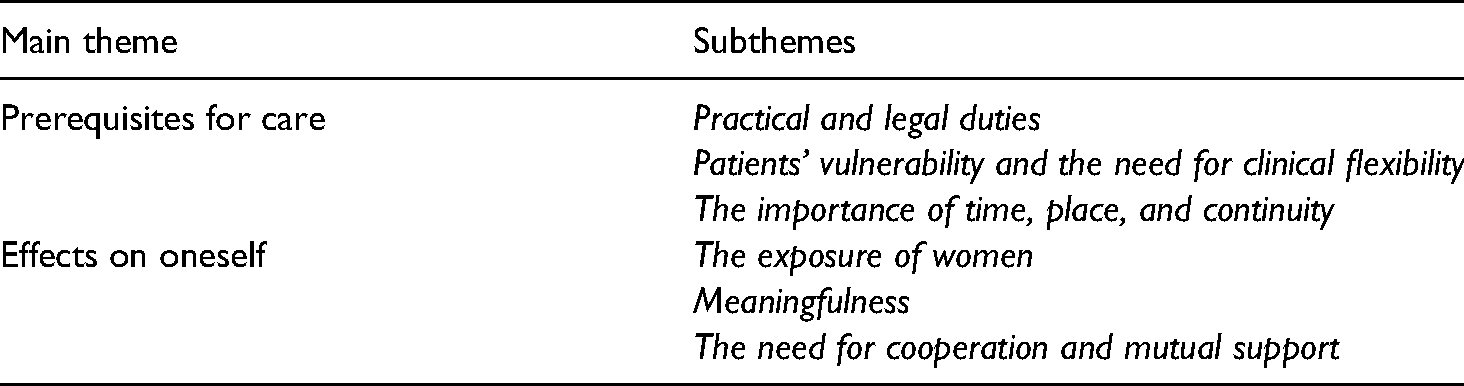
The first step involved the second author reading and re-reading each transcript in its entirety. During the second step, each transcript was scrutinized, line by line, and all broadly relevant material was labelled with codes. The codes for each focus group were scrutinized (Step 3), sometimes renamed or fused with others, and codes with similar content were grouped into preliminary subthemes. The subthemes from each group were combined into general themes (Step 4). The two authors scrutinized these themes and compared them with the original transcripts to ensure they had not been distorted during the analysis (Step 5). The authors named the main themes (Prerequisites for care and Effects on oneself) and identified representative extracts for the main themes and subthemes (Step 6).
The themes cannot possibly capture all the richness and nuance of the discussions, nor are they mutually exclusive or neatly defined; they should be seen as conceptualizations of complex phenomena that crystalize the participants’ experiences.
Reflexivity
We, the authors of this article, investigate self-perceptions, mental health, and treatment needs among individuals exposed to oppression and sexual violence. We also investigate prerequisites for providing person-centred care that acknowledges the unique needs and specific context of each individual. Our starting point is that medical personnel who treat people exposed to sexual abuse and various forms of oppression, not least gendered oppression, have important knowledge and insights into how medical reception and treatment may be improved.
Reflexivity enhances a focus on epistemology and the researcher's perception of knowledge production (Lazard & McAvoy, 2020). As researchers, we consider the experiences of medical personnel a valid source of knowledge and insights into improving reception and care. We also acknowledge the power imbalances, both between ourselves and the participants (Band-Winterstein et al., 2014), since we pose the questions and decide how the results are presented, and the different positions among study participants (Lazard & McAvoy, 2020), who were not homogeneous and varied considerably in power and income (gynaecologists, RNs, and ANs). In our research, however, we endeavour to treat their experiences and professional duties as equally important. This work is shaped by these perspectives and our wish to support action for a better world.
Findings
We present the findings according to the main themes and subthemes identified in the analysis. Quotations have been translated to English and lightly edited to facilitate reading. Participants’ professions are identified after each quote as G (gynaecologist), RN, or AN. Findings are summarized in Table 1.
Main theme and subthemes.
Prerequisites for care
This theme captures the practical aspects of caring for women who have been raped including DNA-sample collection, documentation, administration, and the importance of flexibility in such encounters. It also highlights the importance of short waiting times, a non-stressful work situation ensuring enough time for each patient, adequately planned and furnished rooms, and opportunities to provide continuous care.
Practical and legal duties
The practical and legal duties participants had in meeting with women who had been raped included collecting DNA samples, taking photographs of injuries, and documenting the patients’ narratives, all of which required precision since they could be decisive in future legal proceedings. Other administrative duties could be especially burdensome for gynaecologists, who had not only to document the patient's condition and all interventions conducted, but also to handle demands from both the legal and the healthcare systems. These practical and legal duties could be burdensome in different ways. Gathering DNA samples was emotionally difficult, since the process was physically intrusive on a patient who had recently been victimized, as described in the following dialog between two participants. Many [patients] are very brave; very few don’t go through with it [sample collection]. But most of them are crying … during the examination… (G) They want to get it over with. And we have to say, “Just hold out a little longer,” because there are so many samples… (G) It's an unbelievable amount of administration. It's like, the actual work with the patient isn’t too demanding, but this enormous package that comes afterward … Even though you really try to hurry, it takes about an hour. No matter how well prepared the case is, it takes at least an hour. (G) One woman who had been victimized … When she heard that we should report about children, she chose to leave, but she wasn’t well at all. She was bleeding so much and was in such pain, she couldn’t even walk properly. (AN)
Patients’ vulnerability and the need for clinical flexibility
The participants often spoke about patients’ multiple vulnerabilities as victims of rape, as patients, and sometimes as women with difficult life situations, such as mental illness, addiction, and poverty. They stressed the need for the healthcare system and individual practitioners to be empathetic, open to the various needs of patients, and prepared to provide flexible care, as described in the following dialog between two participants. … to be intuitive because all patients are different, and they react in different ways in this acute phase. I need to be able to sense, should I be more … into my professional role or more of a fellow human? And … if they are accompanied by a friend or a relative, they [the companions] can also be invited because they can support the patient in varying ways … (RN) One should not be too instrumental and clinical. To be more humble is appropriate, I think. More humility… (AN) [The others agree.] I try to keep eye contact during the examination, to [ask] “Are you okay?” and “Can you continue?” if I see that they are tense and want to get it over with. I remind them not to forget to breathe. I have breathed along with many patients. I hold their hand. Focusing on that makes it a bit difficult to assist, but never mind; that will be okay. And if it hurts, I tell them they can squeeze my hand, no matter how hard. Because [focusing on their pain], it does not hurt me. (AN) It's so different; it's never like “this is exactly as it has been.” (G) I perceive each situation as unique. (G)
The importance of time, place, and continuity
Our participants emphasized the need to have enough time and an appropriate space for meeting with each patient. The design and furnishing of the rooms in the treatment unit influenced the care provided. At the specialized unit, there were both examination rooms and rooms furnished with comfortable armchairs and a more homelike atmosphere to encourage dialog. Participants from the specialist unit valued these spaces, and participants from the emergency units desired something similar. At the emergency units, patients sometimes had to wait in examination rooms clearly meant for purely physical interventions, where they had only uncomfortable chairs or even stools to sit on for hours. One nurse working at an emergency unit described with resignation the lack of necessities to make the women feel comfortable. To be in an emergency unit where the wait time can be extensive, and not even have a room for oneself, I think … Those who come here, if they had known, many would not have come. (RN) [The others agree.] It becomes like a “walk of shame” when they have to walk here with the police [another participant agrees] into a room and … it becomes something of a spectacle for the others to watch. Yes, if it were me, I would prefer a room close to the entrance. (RN) There should be no stress [the others agree]. There might be a lot to do, and we need to plan things together … But when you’re there with the patient … there should be no 15-minute meetings. It's allowed to take time because it's needed. Some [patients] might just want to get it off their chest, while others need … And I do think we’re good at understanding this. (RN) We need to be perceptive … “Okay, what should I ask now?” … I know nothing specific and have nothing to start with. And we can sit there for more than an hour just to initiate a dialog. (AN) Even if we can give them a room where they are alone, they just end up there because there are so many others [patient groups with acute somatic conditions] who need to be taken care of first, and they might become exhausted from waiting and want to leave, and sometimes they do and most often they do not return. (RN)
Effects on oneself
This theme captures the participants’ experiences of how they have been affected by meeting with women who have been raped. For example, participants describe how their encounters with these women had made them more aware of the violence and oppression that women face and more willing to communicate about this to others. The theme also concerns the sense of meaning they found in their work, on both societal and personal levels, and their appreciation of the support staff members provide each other.
The exposure of women
Encounters with women who have been raped made our participants increasingly aware of how exposed women are in various situations, including intimate relationships, working life, social encounters, social media, and nightlife. Therefore, they took a stand against exploitation and violence and wanted to bear witness and explain to others how exposed women are. For example, the participants criticized gender-neutral restrooms at restaurants and nightclubs, since they had met several women who had been raped in such facilities. They also discussed how this knowledge had changed their own behaviours. Some participants no longer visited nightclubs. Others avoided socializing with heterosexual men and preferred to socialize with women and with men in the LGBTQ community. They were more cautious and never walked alone in the evening or at night. When discussing women's exposure to sexual violence, they also reflected on themselves. Some expressed gratitude for not having been victims of rape; others spoke about their own experiences, as described in the following dialog between two participants: I have thought about … What have I been through in previous relationships? Where were my boundaries [others agree]? And what was okay, and what was not? And there are a lot of things that weren’t okay. I feel great sadness and grief … (AN) I agree … When you think about it … when you were younger. It wasn’t okay [others agree]. “You don’t do such things” or [sighs] … situations when you sense that someone violated your boundaries. Today I know my boundaries. (RN) When you come home, and you sit there just thinking and thinking and finally you just pass out because you’re so tired. And it can linger inside of you, even when you’re awake, and then another day passes and it's still there, but you need to move on. Because another night of work comes, and you just work. (G)
Meaningfulness
Despite the emotional difficulties, the participants appreciated their work and perceived it as meaningful and important. It was fulfilling to meet with and support these patients. The ANs described comforting and holding the women, and they understood this humanitarian aspect of care as an important privilege of their work and in their lives. I have chosen to work in health care. I want to work with people, and that's what it's about: the patients I work with. I know that I can accomplish things, even though it seems I have not done that much. When I go home … I become so proud of my workplace and I know that here, with us, we will make you [the patient] feel safe. (AN)
The participants also sensed that their work was meaningful on a societal level. It was fulfilling to let patients know that they were victims of a crime and had the right to support. This was important to participants, as they had encountered women who questioned or blamed themselves. Participants felt that the seriousness of sexual crimes could be underestimated, for example, when people made jokes about their work: When I said I was going to start working with this, others said “Oh, so you’re going to work with that. Does that mean you’re going to become a man-hater now?” And I was like “What do you mean, ‘become’?” [laughter]. (RN)
The need for cooperation and mutual support
The participants also stressed the importance of contributing to a cooperative atmosphere and the need to support each other in concrete situations. Support and cooperation were described as fundamental both to adequate patient care and to protecting each other from being overwhelmed by the demands of work and the suffering of the patients, as described in the following dialog between two participants. I sense that the communication in our team works very well. I sense that we have this support [the others agree], so it's never hard. If, for example, it is difficult for me, if I have a patient and it's overwhelming or … we can always discuss it together. (RN) We can always share the duties. Nothing says that a specific person needs to do them. We can share duties and talk to each other. (AN) Psychiatry is an obstacle [the others agree]. It is difficult because it takes such a long time for them to take … a patient. And sometimes one senses that this is a patient that belongs in psychiatry. They might have many diagnoses, medication, and contact at a psychiatric outpatient clinic. (RN) Or they might have had a contact there earlier, but now they need therapy because of this trauma. (AN)
Discussion
Sexual violence against women is by no means new. Art, literature, and historical documents portray its long history in many cultures (Donat & D’Emilio, 1992). However, the meanings attached to sexual violence against women have drastically changed. In the 1960s, the feminist movement began to re-conceptualize sexual assault as a crime, transforming laws, popular culture, and people's everyday lives. The feminist anti-rape movement challenged people's assumptions about its definition, causes, and consequences, framing rape as an example of larger patterns of gender inequality, women's oppression, and men's abuse of power (Chasteen, 2001).
A shared female reality
Since the 1970s, the beliefs that every woman risks being raped and that men are potential sexual aggressors have been incorporated into popular crime narratives and women's everyday understandings of rape (Daly & Chasteen, 1997). Recently these understandings have been amplified by the “Me Too” movement, in which previously reticent women have offered their stories of sexual assault (Mendes et al., 2018). In a study by Chasteen (2001), female respondents rated the lifetime risk of women being raped by a stranger as somewhere from 11% to 20% and being raped by someone they knew as over 50%. Therefore, blame-attribution and the risk of rape could be said to exist in every woman's mind: the concept of rape pre-exists rape itself (Brownmiller, 2005).
In this study, female participants talked about how caring for women who have been raped had made them increasingly aware of the violence against and oppression of women. This insight made them want to bear witness about the experiences of women, and some related their patients’ experiences to their own previous sexual experiences. However, participants also described a need to hold back when talking to friends and relatives to avoid overwhelming them. They struggled to keep their anger and sadness inside, and they stressed the importance of caring for each other as colleagues: other women medical professionals in emergency care for women who had been raped were best equipped to understand their feelings. Understanding their patient's position, both as women and potential or previous victims of rape themselves and as professionals, made participants empathize with these women and imagine “if it were me.” Participants’ fear and concern about the dangers faced not only by their patients but by all women made them consider changing their own behaviours to safeguard themselves. This illustrates how women limit their own freedom of action to protect themselves from rape (Rozee, 2011). In this study, our participants criticized gender-neutral restrooms because they had met with women who had been raped in such facilities. This opinion is a pertinent example of women's fear of sharing private spaces with men who could be sexually violent, a fear also shared by transgender and non-binary individuals.
Rape can be understood both through its social context and as a distinct social practice (Primorac, 1999). This approach, combined with the empirical knowledge that most perpetrators are men, and most victims women and girls (e.g., Brå, 2019), recognizes rape as an extreme expression of the basic gender relations in our society. Much too often women are made to engage in sex they do not want through actual violence or various types of explicit or implicit coercion such as economic need or psychological pressure (Gavey, 2005; Primorac, 1999). The participants’ understandings of other women, especially those they treated for rape, expressed this shared reality. Identifying with the patient woman-to-woman inspired participants to offer empathetic and comforting care, and they described their work as deeply meaningful. However, participants also described several structural barriers within the Swedish healthcare system. The lack of good caring resources for women, both as patients and as healthcare professionals, combined with the fact that most professionals in women's health care are female, suggests that Swedish society does not commit adequate resources to combating men's violence against women or to specialist care units for patients who have been subjected to sexual violence. The continuing subordinate position of women furthers a deeper understanding between female professionals and victims, but it also exposes them both to inequitable vulnerability.
Structural barriers to patient care and healthcare professionals’ self-care
In describing their patients’ vulnerability, our participants recognized in themselves similar vulnerabilities. Acknowledging the vulnerability of women after sexual trauma, however, does not negate the strength and resilience also shown by women who have been raped. Rather, this acknowledgement releases women from managing the effects of abuse and “recovering” by themselves (Tseris, 2015).
Our participants’ work seemed to be a balancing act in which they juggled the emotional and relational needs of each patient, followed the legal demands connected to the physical examinations, and handled the limitations of the healthcare system. The emotional and relational needs of the women and the legal demands, however, were not compatible with each other. Participants managed this disconnect by explaining why the examinations were important, informing the women about the procedures and allowing them to set the pace, and accompanying, holding, and comforting them through the process. The limitations of the healthcare system, however, remained difficult to compensate for. While the participants from the specialist unit described having ample time, private and comfortable rooms, furnishings that offered a welcoming milieu, and follow-up for continuity of care, those from the emergency units described how the lack of all those benefits could influence some patients to leave before their examinations and hinder care for those who stayed. At the general emergency units, it was impossible, for example, to provide continuity, since patients could not return for follow-up and meet with the same professionals.
Women who have been raped need and deserve social support (Maddox et al., 2011) and an empathetic listener (Campbell et al., 2006); therefore, the need for continuity and psychosocial support should not be overlooked. Our participants made every effort to support the women before and during examinations, but they emphasized that the women needed more than that. Participants working in the emergency units especially regretted being unable to support the needs of their patients. The difficulty of referring women who have been raped to psychotherapy or psychiatric care, even when they already have a psychiatric history, means that access to psychosocial treatment after rape is limited for women who already live with and most need help with mental health issues. Participants’ observations of how difficult it was to reach and support ethnic minority women highlights the need for intersectional awareness in preventive work and access to care. Because our professionals worked in units that women from ethnic minorities did not seem to visit, we want to underline the importance of other stakeholders and social services reaching out to these women and offering support.
Methodological reflections
During the focus groups, the moderator considered it important for the participants to discuss the topics with each other. The question guide was therefore semi-structured and built on broad questions related to the areas of interest, and participants were encouraged to introduce new themes and elaborate freely on their thoughts. The interaction among participants in a focus group can stimulate memories that might otherwise not be accessible, which can enable genuine understanding of the participants’ experiences and introduce new perspectives on the studied phenomenon (Millward, 2006). However, as several respondents participate in a focus group, there is also the risk of participants being less willing to share their emotions and thoughts as openly as they would in an individual interview. In this study, however, the participants seemed to speak freely.
Focus groups typically include six to eight participants (e.g., Rabiee, 2004), but our four groups had only two, three, or five participants each, for a total sample of 12. It might have been desirable to have more participants per group, but the participants’ workloads made it difficult to find times when more participants could meet.
Although we invited midwives to the focus groups, no midwives volunteered to participate. One reason for this might be that that the invitation stressed the initial meeting with women who have been raped. In Sweden, midwives mainly meet with the woman in follow-up care (i.e., seldom in acute phases). Only female professionals participated in this study, as the vast majority of women's healthcare workers are women (SCB, 2020). Participants who related the experiences of their patients to their own previous sexual experiences stressed the general female experience of living with the risk of rape (Brownmiller, 2005). Because Sweden has a longer tradition of feminist efforts than most countries (Milles, 2011), our participants’ experiences and opinions might not be comparable to those of medical professionals working in emergency care for women who have been raped in other cultural settings. However, as Sweden is one of the world's most gender-equal countries (Milles, 2011), at least statistically, its shortcomings in the care offered to women who have been raped is a clear call for action.
Practical implications
Our participants strived to balance practical and legal duties with the clinical flexibility that ensures person-centred and supportive care. They emphasized that collegial cooperation and support were fundamental to their capacity to handle both their practical duties and their emotional reactions to seeing how exposed women are to violence. Although their work could be overwhelming, it was deeply meaningful to them. This sense of meaning and their collective knowledge gave them hope and strength to support their patients. Previous research shows that medical personnel working in programs specializing in the treatment of women who have been raped are better equipped to offer care than general medical staff (Campbell et al., 2001). In this study, participants stressed the importance of being flexible and offering continuity of care, privacy, and a homelike environment to the women while they were waiting. However, they also reported that their ability to do so was inadequate in general gynaecological emergency care units. Only two units in Sweden currently specialize in caring for victims of rape and sexual assault, and results of this study indicate a need for more such units. The participants’ descriptions of their difficulty in referring patients to psychotherapy or psychiatric care, even when the woman already had a psychiatric history, indicates a further need for extended cooperation between somatic and psychiatric care units.
Being women able to understand other women seemed beneficial to our participants’ ability to provide care and comfort; however, it may also increase their risk of developing secondary trauma. In this study, participants stressed that the support and cooperation of their colleagues was fundamental to their providing adequate care and protecting themselves. In this study participants working in general gynaecological care units described how their extensive workload left them little time, if any, to pause, reflect, and find support. This study indicates the need to provide medical personnel with the time and opportunity to seek emotional support and supervision in groups with colleagues. Such support and supervision is already offered to psychologists in Sweden and has been reported to both improve the working climate and foster a more flexible and collaborative style of interaction (Ögren & Sundin, 2009).
Participants also described encountering a general lack of understanding about women's exposure to sexual violence when they tried to confide in people outside their colleagues. Some participants described feeling exhausted when their shift ended. These results suggest the urgency of addressing current wait times and services for women seeking medical care for rape, as these can be detrimental to the health and well-being of the medical personnel offering care as well as to the patients. If these issues remain unaddressed, female medical personnel's wishes and efforts to make women who have been raped “feel safe” within their care, and their efforts to care for themselves and their colleagues, risk falling far short.
Footnotes
Acknowledgements
We extend our warmest thanks to the participants for sharing their thoughts and experiences with us.
Declaration of conflicting interests
The author(s) declared no potential conflicts of interest with respect to the research, authorship, and/or publication of this article.
Funding
The author(s) disclosed receipt of the following financial support for the research, authorship, and/or publication of this article: This work was supported by the The Swedish Crime Victim Support and Compensation Authority (grant number 3108/18).
