




Abstract
In everyday interaction, subtle manifestations of sexism often pass unacknowledged and become internalised and thus perceived as “natural” conduct. The introduction of new vocabularies for referring to previously unnamed sexist conduct would presumably enable individuals to start problematising hitherto unchallengeable sexism. In this paper, we investigate whether and how these vocabularies empower people to speak out against sexism. We focus on the use of the term “mansplaining” which, although coined over 10 years ago, remains controversial and contested. Using Conversation Analysis and Membership Categorisation Analysis, this paper excavates the interactional methods individuals use to formulate, in vivo, some prior spate of talk as mansplaining. In doing so, speakers necessarily reformulate a co-participant’s social action to highlight its sexist nature. Accusations of mansplaining are accomplished by invoking gender (and other) categories and their associated rights to knowledge. In reconstructing another’s conduct as mansplaining, speakers display their understanding of what mansplaining is (and could be) for the purpose at hand. Thus, the paper contributes to the well-established body of interactional research on manifestations of sexism by documenting how the normativity of epistemic rights is mobilised as a resource for bringing off accusations of mansplaining.
Sexist conduct ranges from overt, incontrovertible acts, for example using female gender categories to construct insults (Weatherall, 2015), to covert and subtle forms, such as women being explained to (Komarovsky, 1973) or corrected by men who have less expertise on the topics under discussion (Bates, 2016). Calling out subtle sexism is difficult not only because of the obscurity that subtle sexism can have, but also because, being ingrained in the fabric of everyday life, it becomes internalised and thus perceived as “natural” conduct (Chowdhury & Gibson, 2019).
One solution has been to transform these “unspeakable” acts into “talk-ables” through the development of new labels for everyday sexist conduct (Calder-Dawe, 2015). In theory, neologisms such as “mansplaining”, “bropropriating”, or “manterrupting” should enable women to speak out against subtle gender inequalities by exposing, problematising, and challenging sexist conduct (Bridges, 2017). However, while these new “vocabularies of everyday sexism” are quickly adopted by feminists, they can also spark arguments, defensive responses, and even counteraccusations of sexism (Jane, 2017). With this range of possible responses available to those accused of sexism, we ask whether and how new vocabularies of everyday sexism bring forth gender equality, in practice.
To answer this question, we use Conversation Analysis (henceforth CA) and Membership Categorisation Analysis (henceforth MCA) to examine naturally occurring accusations of mansplaining in talk-in-interaction. We chose to focus on mansplaining because the term enjoyed a growing popularity over the last few years. It has sparked countless debates across media channels about whether a particular action was or was not mansplaining (Bates, 2016; Bridges, 2017). Yet, to date, there is no agreed definition or scientific account of what constitutes mansplaining. As methods developed to scrutinise social actions and categories in interaction, CA and MCA are uniquely equipped to study sexism-in-conversation (Whitehead & Stokoe, 2015) and to lay out how gender and knowledge categories are mobilised within accusations of “mansplaining”.
To date, only a few studies have examined spontaneous accusations of sexism-in-interaction (Romaniuk, 2015; Speer, 2002; Weatherall, 2015), but none focused on the more subtle forms of sexism such as mansplaining. By scrutinising the moment-by-moment unfolding of accusations, we provide comprehensive empirical documentation of how accusations of “mansplaining” are constructed, how they are dealt with, and how they shape the trajectory of the interactions in which they occur.
We start with a brief review of conversation analytic research on language and gender; thereafter, we introduce mansplaining and discuss the controversies around the term with reference to a CA/MCA understanding of gender and knowledge rights.
Gender and language
Gendered speech differences have been a long-standing concern pioneered by Lakoff (1975). A vast body of literature has been dedicated to comparing women’s and men’s speech (see Weatherall (2002) for a review), and how sex/gender correlates with linguistic variables (e.g. tag questions, politeness, topic, directives, etc.). Moving on from the study of sex differences in language use, Kitzinger (1994, p. 501) asks not “how are women and men different/the same?” but “why and how are women oppressed and how can we change that?”. The latter question had been tackled by conversation analysts by undertaking “politically-engaged research and social critique” (Wilkinson & Kitzinger, 2008, p. 568) on issues related to gender, power and language (e.g. Sorrentino et al., 2018; Stokoe, 2003).
An early area of CA feminist research has investigated how women and men dispute the conversational floor. Conversation Analysis conceptualises battles for the floor by participants’ orientations (Edelsky, 1981) with rights to speak being locally managed (Sacks et al., 1974). Early linguistic research examining gendered conversational overlaps suggested that women’s contributions in professional settings are often ignored and go unrecognised (Tannen, 1994). Similarly, in everyday conversations, DeFrancisco (1991) found that men tend to silence women by disattending the topics they initiate and by talking to them in a patronising way. A landmark conversation analytic paper by Zimmerman and West (1975) argued that men tend to interrupt women, which the authors characterise as a display of dominance.
However, Kitzinger (2007) challenged this conclusion by unequivocally demonstrating that the majority of overlapping talk is not interruptive and that, when men do interrupt women – what conversation analysts call “interjacent overlap” (Jefferson, 1986) – they often act cooperatively rather than competitively. Importantly, Weatherall and Edmonds (2018) highlight that, when explicitly formulated, “interruptive” talk is tied to participants’ local institutional identities and their associated deontic rights and responsibilities. This suggests that, for example, a male TV show host would seem entitled to interrupt a female guest in his role as host, but that his interruption would be considered transgressive if it was tied to his gendered membership category. Accusing somebody of mansplaining potentially constitutes one resource that women have available to frame interruptive talk as a gender-based transgression. Interruptions, however, are not the only transgressions ostensibly encompassed by mansplaining, as we show next.
Making accusations of mansplaining
The term “mansplaining” entered the English vocabulary over 10 years ago. It originated from a short autobiographical essay by feminist writer Rebecca Solnit (2008), entitled “Men explain things to me (Facts didn’t get in their way)”. In the essay, Solnit recounts an interaction she and her friend had with a man who kept telling her about an important book he discovered but had not actually read. Meanwhile, her friend tried to intervene to inform him that Solnit was the author of that book. This scenario, in which a man seems to assume that he knows more about a topic than the woman with whom he is interacting when, in fact, it is the other way around, resonated with countless women who had had similar experiences. While the story does not feature the term “mansplaining”, the situation described by Solnit generated a surge in awareness of this behaviour, with countless threads on social media, blog posts, and newspaper articles debating mansplaining in the last 10 years.
Even though there is widespread agreement that mansplaining recurs frequently (Bates, 2016), no consensus has been reached about what actually constitutes “mansplaining” behaviour. “Mansplaining” has been defined as the act of explaining something to someone in a patronising and condescending manner (Reagle, 2016). Many definitions also highlight that it is usually a man who mansplains something to a woman. Some sources specify that the woman is assumed to be less knowledgeable about the topic and less capable of understanding than the “explainer” (Jashik, 2012), when in fact she has more knowledge or expertise in that particular topic (Reagle, 2016). Nonetheless, Solnit (2012, para. 3) urges that “mansplaining is not a universal flaw of the gender, just the intersection between overconfidence and cluelessness where some portion of that gender gets stuck”. Finally, mansplainers are said to usurp the floor and restrict interlocutors’ opportunities to contribute to the conversation (Wilhelm, 2017).
Most definitions tie mansplaining to interlocutors’ gender identities and their knowledge/expertise about the topic of the conversation. Drawing on CA and MCA concepts, we unpack how these notions, together with shared conversational norms, are mobilised in constituting mansplaining into a transgressive act (Drew, 1998). Extensive conversation analytic research has demonstrated that epistemics (a domain under which knowledge rights are subsumed) plays a constitutive role in the organisation of conversations (Heritage, 2012). One aspect of the complainability of mansplaining resides in it being formulated as infringing conversational norms related to the epistemic ordering of the conversation – specifically, what conversation analysts call “epistemic primacy” (Stivers et al., 2011), namely who has the right to provide information to whom. In naturally occurring conversations, interlocutors are responsible and hold each other accountable for taking into consideration their relative epistemic status regarding the topic under discussion; that is, their respective rights to knowledge about the topic (Heritage, 2012) as the basis for performing knowledge-oriented actions such as informing, explaining, or asserting. For instance, people avoid delivering news that others may have already heard (Terasaki, 2004) and manage the delicate implications of knowing more than their interlocutors when giving advice (Shaw & Hepburn, 2013).
A person’s epistemic status is grounded in their access to the domain of knowledge under discussion (Heritage & Raymond, 2005). In Solnit’s story, as she had written the book, she is presumed to have more knowledge about it than her interlocutor, who had not even read it. Category-based entitlement is another basis for claiming epistemic and moral rights/authority to display one’s knowledge (e.g. by providing an explanation or making a recommendation) in conversation (Potter, 1996). As the author of the book, Solnit was more entitled than her interlocutor to comment on its content. Note that both methods of holding one accountable render the man’s conduct as transgressive by formulating it in terms that highlight its blameworthiness. As conversational devices, formulations “advance the prior report by finding a point in the prior utterance and thus shifting its focus, redeveloping its gist, making something explicit that was previously implicit in the prior utterance, or by making inferences about its presuppositions or implications” (Heritage, 1985, p. 104). Accusations of mansplaining formulate some prior conduct as sexism by pointing out how it performed an ostensible violation of epistemic rights and linking it to participants’ gender categories.
How does gender come into play in accusations of mansplaining? As a transportable identity (Zimmerman, 1998), gender is perpetually available as a resource for speakers to make relevant at any moment in the conversation (Stokoe, 2003). In our analysis, we suggest that “mansplaining” works as a membership categorisation device (Sacks, 1989), making not only the interlocutor’s categorial identity (man) relevant, but at the same time placing the accuser in the paired membership category “woman”. This results in highlighting a patriarchal organisation of gender, with women presumed to be inferior – here having less knowledge/expertise – than men. As such, our analysis will show that accusations of mansplaining, unlike accusations of being patronising or condescending, allow speakers to index aspects of gender relations that compound the transgressor’s culpability. Not only are they guilty of wrongly claiming more/better knowledge, but they are also evidently sexist in presuming to be more knowledgeable than their women interlocutors and therefore treating them as clueless or ignorant.
Data and method
The data for this project are naturally occurring interactions, all in varieties of English, in which a participant accuses another of “mansplaining”. We used an internet search engine to identify recordings of real-life interactions featuring various forms of the lexeme “mansplain”. Most of the clips were found on social media platforms (see Table 1) even though they originally aired on television. For inclusion in our data corpus, we selected all clips that (1) retained the sequential and temporal properties of the interactions they depicted and (2) featured non-scripted talk. As a result, we discarded clips from films or TV series. These inclusion criteria ensured that the data we collected allowed us to examine naturally occurring uses of “mansplaining” in their original interactional environments.
Data sources.
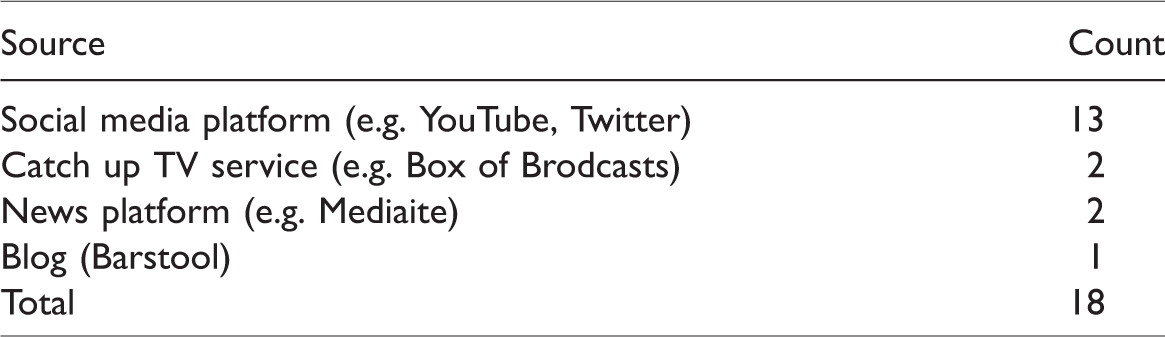
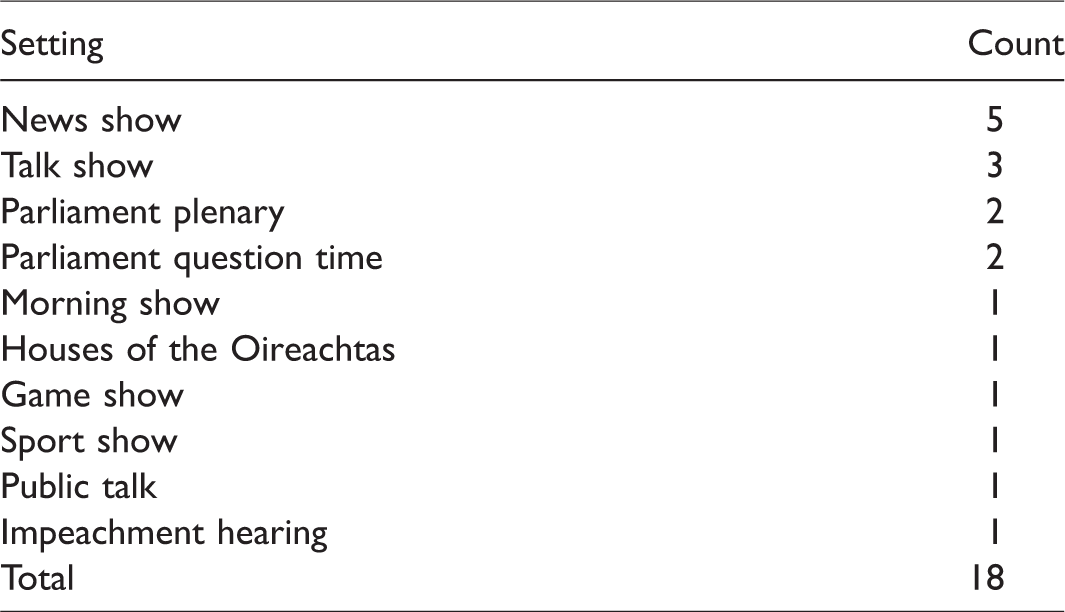
Applying these inclusion criteria to our search results yielded 18 clips and seven hours of interactional data. In 16 of these cases, which we investigate in this paper, speakers employ the target term within accusations leveraged against a co-present party. The remaining two cases feature speakers apologising for their own or others’ conduct. The extracts originate from a range of institutional settings (see Table 2) and feature participants involved in conversational activities such as debates, or news interviews while also orienting to an overhearing audience (Heritage, 1985). The clips can be accessed via the URLs available in the online supplemental material. The project received ethical approval from York St John University Research Ethics Committee and abides by the British Psychological Society’s guidelines for human research (2014) ethics and for internet-mediated research (2017).
Data settings.
We transcribed the data using the Jeffersonian system developed for CA which captured the fine details (e.g. prosody, tempo, volume) of speech production (Hepburn & Bolden, 2017). To analyse the data, we used a combination of Conversation Analysis (Sidnell & Stivers, 2013) and Membership Categorisation Analysis (Hester & Eglin, 1997), both introduced by Sacks (1992a, 1992b). We used these methods to examine the sequential environment of “mansplaining” whilst paying attention to how interlocutors’ identities and categorisation practices become relevant in and through accusations of mansplaining. Specifically, these approaches allowed us to observe how and what conduct is sanctioned by accusing someone of mansplaining, and how interlocutors’ reasoning practices are organised with respect to their shared social knowledge, in other words, how they produce “culture-in-action” (Housley & Fitzgerald, 2015, p. 4–5). The selected extracts shown in this paper span the range of recurring practices we found across our data collection.
Analysis
The extracts below illustrate three ways in which accusations of mansplaining are accomplished. We start with cases in which mansplaining exposes what participants locally problematise as patronising and condescending conduct. Next, we turn to accusations of mansplaining that challenge a man’s relative rights to claim authority over gendered knowledge, such as knowledge of women’s reproductive health. Finally, we observe how accusations of mansplaining are deployed in a dispute over who has epistemic authority over a specific domain of knowledge. Across several of these examples we show how speakers’ formulations of interlocutors’ conduct, which trade on, and produce, their relative epistemic rights, occur in conjunction with a battle for the floor.
Exposing a man’s patronising conduct
Extract 1 is taken from an episode of an internet sports show called “Barstool rundown”, which is based in the United States. The episode features three hosts – Dave (DP), Kevin (KC), and Dan (DK) – and five guests – Liz (LG), Frankie (FB), Jared (JD), Eric (EH), and Tommy (TS) (see Figure 1). The participants 1 are reviewing a recent baseball game between the Red Sox and Yankees, won by the former. Before line 01, the participants have been disapprovingly discussing Liz’s reaction to the loss, specifically a clip she recorded after the game, in which she reaffirms her devotion to the Yankees by stating she would rather be a loser than become a Red Sox fan. We are interested in Liz’s accusation of mansplaining in line 12 (highlighted in grey in the transcript) directed at Frankie, who is also a devoted Yankees supporter.
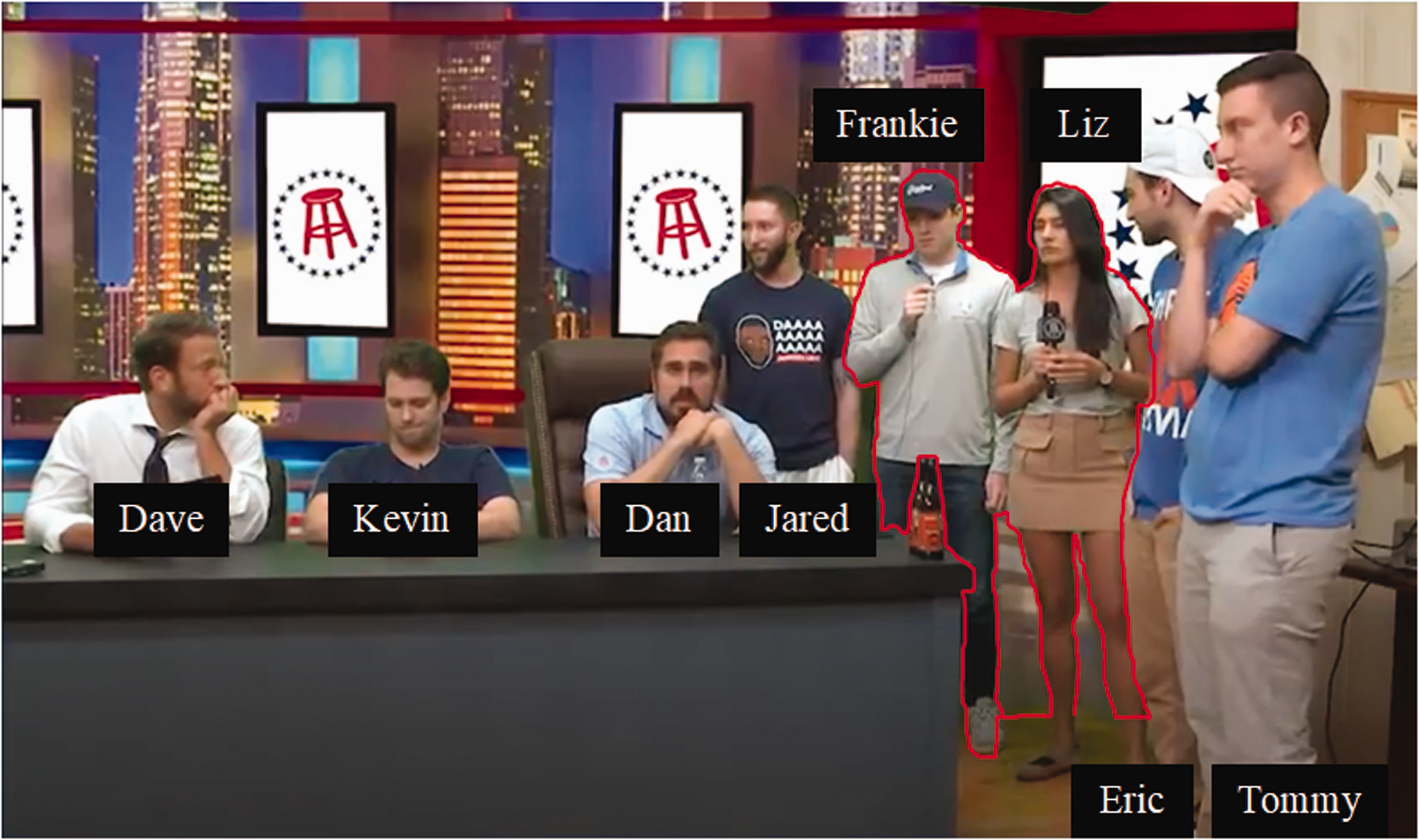
Configuration of panellists before the accusation2.
In the transcript, we use initials to identify the speakers – as listed above – plus the film crew (C). For clarity, in the analysis we refer to speakers by their first names.
With so much going on in the extract, we will start by tracing how the conversation unfolds before presenting our analysis. The extract starts with Frankie’s criticism of Liz’s display of support for the Yankees, whereby he implies that it is at odds with the reaction of other Yankees fans – which he refers to via the collective pronoun “we” (line 06), thereby excluding Liz from this category. He ends his turn with a latched understanding check “Do you get that?” (line 06), prompting an ironic counter from Liz “Do I get ↑that?” (line 08), followed by response cries from another participant (line 09) and the film crew (line 11) and, eventually, by Liz’s accusation of mansplaining (lines 12 and 14). Frankie immediately shouts a repeated denial (lines 15–16) and continues denying the accusation (lines 19 and 24), in response to Dave’s contention (line 24). Kevin produces a response cry, gets up to shake his fists triumphantly, and shouts the name of boxing-brawling event “Rough n’ Rowdy Six” (lines 17, 21–2). Dave then further insists on Frankie’s mansplaining (lines 28–9 and 33). Meanwhile, Liz continues talking but the shouting renders her turn unintelligible (line 22). She takes the floor again at line 26, where she rhetorically asks Frankie to confirm that the baseball season was over. Skipping 28 lines in which they return to discussing Liz’s message, we rejoin the participants in line 57 where Dave has not budged from characterising Frankie’s conduct towards Liz as mansplaining. In this fragment, Frankie explicitly disavows attempting to teach Liz about baseball (line 60), which attracts Dave’s prompt disagreement “O:h you di:d.” (lines 61–2).
Let us now focus on Liz’s accusation of mansplaining. Frankie’s turn in line 06 concludes with an understanding check which is followed by 0.6 seconds of silence, forecasting trouble. Liz’s oh-prefaced response in line 08 “Oh i- Hh (0.2) Do I get that?” points to the inapposite and condescending nature of the question (Heritage, 1998). The full repeat of the question locates the trouble source as the questioning action (Robinson & Kevoe-Feldman, 2010); that is, Frankie should not have questioned Liz’s understanding as she has equal status as a sports enthusiast and guest on the show.
At this point the other panellists begin attending to Liz’s handling of Frankie’s question with response cries in lines 09 and 11. Frankie, however, treats Liz’s turn in line 08 as a genuine repair initiation and projects a redoing of some prior turn “>like<”. Before he is able to redo his turn, Liz levies an accusation of mansplaining against him. The accusation makes Frankie’s and, by implication, Liz’s gender category relevant. While Frankie and Liz are co-members in the category “Yankees fans” and thus, presumably, have comparable knowledge of baseball, Frankie’s display of superior knowledge – via the understanding check – is tied, through the accusation of mansplaining, to his gender category. Retrospectively, the accusation renders Frankie’s conduct not only patronising but also sexist, on the basis that he has treated Liz as less knowledgeable than him about baseball because she is a woman.
The vehicle for this accusation, a rhetorical question, is in fact “unanswerable” (Heinemann, 2008). If Frankie answers “yes” he admits to having committed a sexist act; if he answers “no”, he denies that he has been explaining baseball to Liz, which he accountably has been doing. Frankie’s defence is a transformative answer (Stivers & Hayashi, 2010) that refutes the labelling of the action as “mansplaining” “THAT’S NOT MANSPLAINING. NO. THAT’S NOT ‘SPLAINING.” (lines 15–16). This defence strategy illuminates the stigmatised connotation of the term. Frankie’s emphatic and repeated denials further underscore the stigmatised connotations of ‘mansplaining’ as an ascription of sexist and thus morally sanctionable conduct. Two other moments in the interaction illuminate that and how the issue at stake here is Frankie’s treatment of Liz as less knowledgeable than himself about baseball. First, there is Liz’s ironic understanding check in lines 27–8 “YOU MEAN THERE’S NOT ANOTHER GAME THE SEASON’S ↑O::VER?”, whereby she solicits confirmation from Frankie on an issue to which she clearly knows the answer. Second, in line 60, Frankie produces a disavowal of the ongoing portrayal of his behaviour as trying to “t
A further accusation of mansplaining which exposes patronising conduct is featured in Extract 2 from Tucker Carlson Tonight, a TV show in the United States. Here the conservative political commentator, Tucker Carlson (TC), and his guest, Monica Klein (MK) 3 , a political strategist, disagree about Susan Collins’s character – a Republican senator who supported Brett Kavanaugh’s nomination to the US Supreme Court of the United States, despite sexual assault allegations against him.
The extract starts at a point where the disagreement between the interlocutors is escalating. In fact, in lines 01–02, we see Monica and Tucker overlapping, with neither dropping out. Managing to secure the floor, Monica follows her prediction of Collins’s electoral defeat with an account for this, namely that women will no longer support the Republican senator as a reaction to her support for Kavanaugh. In interjacent overlap, Tucker counters Monica’s point “Well not
Monica responds in line 10 by non-seriously thanking Tucker for mansplaining “↓Okay thank you for mansplaining that
To summarise, Extracts 1 and 2 feature accusations of mansplaining leveraged at men who treated their women interlocutors as ignorant or less knowledgeable than them about matters on which the women’s (equal) knowledge is unquestionable. These examples resonate with the mainstream vernacular understanding of mansplaining as condescending or patronising behaviour. Next we turn to accusations of mansplaining that build on women’s superior epistemic rights to matters related to reproductive healthcare.
Challenging a man’s epistemic authority over gendered knowledge
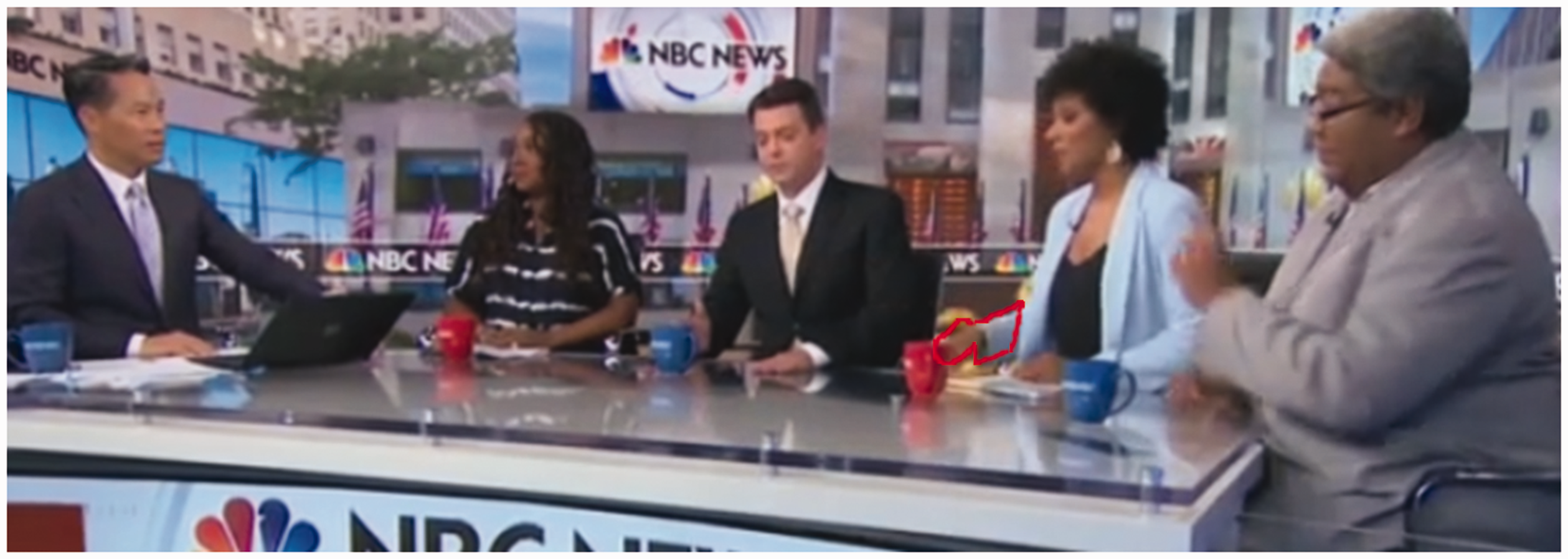
Extract 3 comes from another TV show in the United States. This extract is taken from an episode of MSNBC’s news show that also discusses Brett Kavanaugh’s appointment to the US Supreme Court. Before line 1, the panellists, Zerlina Maxwell (ZM), Noah Rothman (NR), and Danielle Moodie-Mills (DM) 4 , had been debating Kavanaugh’s judicial philosophy (“he” in line 1) and its impact on key points of contention between the Democrats and Republicans such as healthcare and abortion legislation. The video stills (Figures 2a–2c) following the transcript track Zerlina’s right-hand movements as she battles for the floor with Noah.
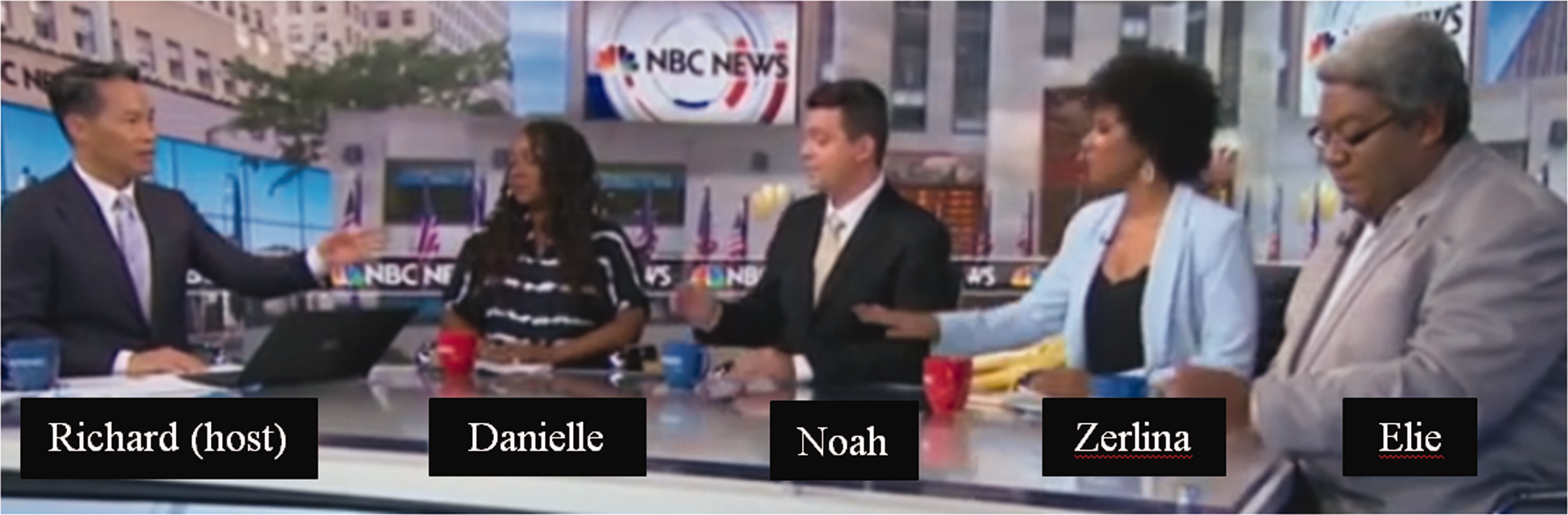
Zerlina raises her right hand to tap Noah’s forearm5.
Zerlina retracts her hand.
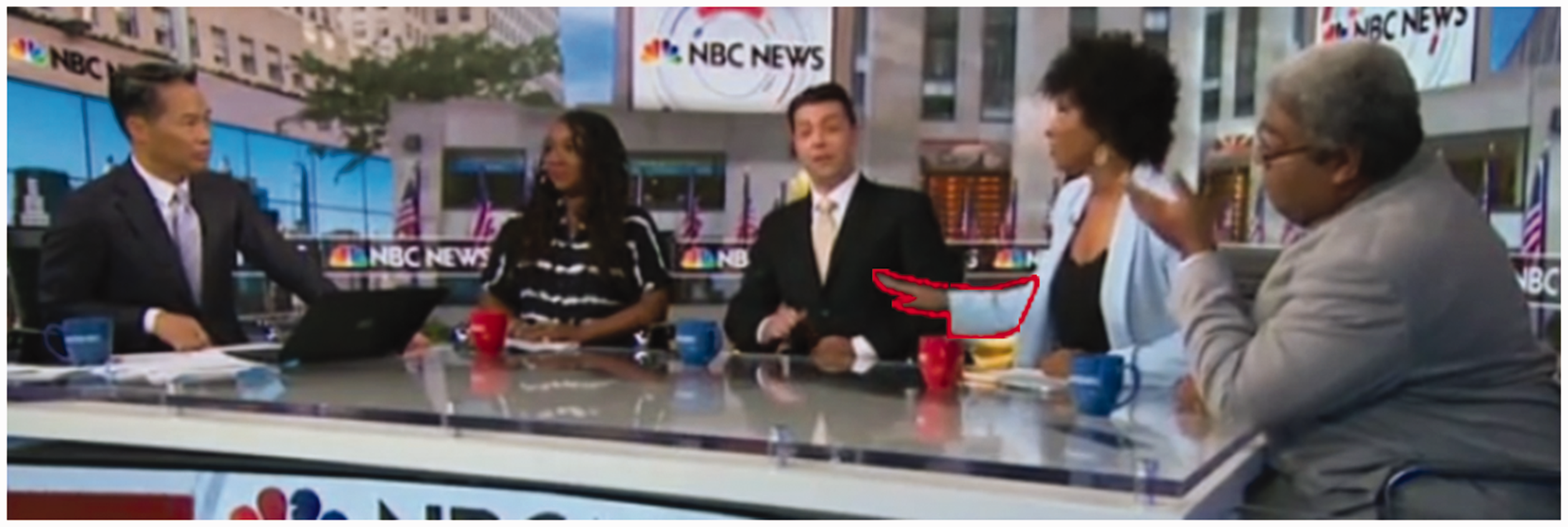
Zerlina raises her hand in front of Noah.
Prior to line 01, Noah, a Republican, has argued that Brett Kavanaugh, due to his judicial philosophy, would not necessarily favour the Republican agenda on restricting access to abortions. In line 05, Danielle erupts with the challenge “Are w↑e- are you ki↑dding” (upward arrows indicate high pitch), starting her turn in interjacent overlap, that is, while Noah was in the midst of presenting the conservative standpoint on abortion. She continues by strongly contesting Kavanaugh’s portrayal as a centrist. Next, Noah avoids directly engaging with Danielle’s contestation and instead attempts to resume his point about the conservative standpoint: “I am trying to explain to you what >the conservative< phil
Zerlina’s intervention stretches across several turns at talk, each responding to Noah’s turns. Starting in interjacent overlap in line 11, she admonishes Noah “Do:n- don’t do >y=do< that.” while also raising her right hand to tap his forearm (Figure 2a) which results in Noah momentarily pausing his turn (line 13). As he resumes talking (line 14), Zerlina produces the accusation of mansplaining in competition with Noah, who abandons his turn. At that point, having secured the floor, Zerlina retracts her hand (Figure 2b). She warns Noah that he is “heading” towards mansplaining, on the basis of his formulation of his own conduct as “trying to explain” something to Danielle. Latched to this warning is her own formulation of Noah’s action now portrayed as a sexist act: he was going to “>explain something,< .h to a woma:n” regarding “↓reproductive healthcare” (lines 16–18).
Noah’s attempt to respond (lines 19, 21, and 23) is littered with self-repairs and cut-offs employed to deal with Zerlina coming in again in interjacent overlap (Schegloff, 2000) with further admonishments (lines 20, 22, and 25) in a second attempt to prevent Noah from speaking (see Figure 2c). Despite Noah’s fragmented turn, we can surmise he is not engaging with Zerlina’s accusation directly and, instead, opts to continue his presentation of the conservative ideology “the notion we are presenting here” (line 23). Noah’s ignorance of the accusation is similar to what we saw with Frankie’s response in Extract 1 – not responding (e.g. with a denial or apology) therefore does not acknowledge that “mansplaining” has occurred, or indeed is even a real phenomenon.
Let us now unpack how Zerlina constructs Noah’s action as a gendered transgression. First, by using the term “mansplaining” she makes Noah’s gender relevant as opposed to, say, his political identity, thus tying his ostensible sexism to his incumbency in a gender membership category. Second, she formulates the topic of the conversation as “reproductive healthcare”, not conservative ideology. Topic formulation is crucial here for the accusation of mansplaining to be effective, as reproductive healthcare constitutes a domain of knowledge over which a woman would have more epistemic authority than a man, whereas Noah, as a Republican, would be well within his rights to claim epistemic authority over conservative ideology. Third, she makes Danielle’s gender relevant, by referring to her as “a woman”. In doing that, Noah’s gender identity also becomes salient. As a man, he should not have claimed to have more knowledge about reproductive healthcare than Danielle, who, as a woman, has epistemic authority over this domain.
Another accusation of mansplaining that is built on category entitlement to gendered knowledge about human reproduction is illustrated in Extract 4. It comes from a discussion, in the Houses of the Oireachtas – Ireland’s national parliament – of a new Health Bill which would legalise abortion following a referendum held in May 2018. Among the amendments to the bill is one put forward by Peadar Tóibín (PT), proposing that women are provided with information about abortion before they can access pregnancy terminations. This proposal occasions Kate O’Connell (KO)’s 6 accusation of mansplaining (lines 06–07).
As part of his proposed amendment to the Health Bill, in lines 01–05, Peadar suggests that abortion information could be digitally distributed for easy access. Kate’s intervention (line 06), in interjacent overlap, is timed to be heard as a non-serious alternative suggestion: instead of distributing the information via memory sticks, Peadar could “mansplain it in PERSON”. Here the use of “mansplaining” suggests that distributing information about abortion wrongly assumes that the population (of women) is unknowledgeable. Also, the government, through the amendment introduced by Peadar, illegitimately claims both more knowledge than the population and the right to intrude into citizens’ private sphere. Kate’s comment and its continuation in line 10 (“TIp around everyone’s house and have a cha:t”) ridicules Peadar as the promoter of the amendment and further builds the exaggerated non-real depiction of the information campaign.
Similar to Zerlina in Extract 3, Kate formulates mansplaining as a prospective transgression, predicated on Peader’s current actions. At that time, Peader was engaged in explaining and tabling amendments, which are activities fitted to his identity as a committee member. But the bill he was proposing would eventually lead to women having to receive information they did not seek from a source that claims epistemic authority over their reproductive health.
Peadar’s gender is left implicit, but as in the previous extract, “mansplaining” treats Peadar as morally culpable by making his gender relevant and tying it to his claims to epistemic primacy over women’s reproductive rights. Indeed, Peadar responds with a meta-comment that acknowledges institutional norms: “I’m tal- I’m talking to the minister here (.) deputy O’Connell” (lines 11–12), sidestepping the accusation by returning to institutional business. However, the accusation is unable to be withdrawn once on the record and Peadar’s sidestepping did not prevent the media from reporting his “mansplaining”.
To summarise, Extracts 3 and 4 show how, through accusations of mansplaining, women sanction men for claiming epistemic authority over women’s reproductive healthcare, a domain of knowledge to which women have primary rights. The turns housing the accusations are launched in interjacent overlap and they end up derailing the accused’s turn. By contrast, in the following two extracts, the accusations are grounded in the accusers’ (women’s) primary access to the domains of knowledge that underpin the debated topics.
Disputing relative epistemic authority on the basis of primary access to knowledge
We move to a debate in the British Parliament, where Extract 5 comes from. It features Andrea Leadsom (AL), a Conservative MP and Leader of the UK House of Commons, rebutting Chris Leslie’s (CL) 7 , then a Labour MP. In his question starting at line 1, Chris highlights the likelihood that the Prime Minister (Theresa May) will lose the upcoming vote (on 15 January 2019) for her Brexit deal, and that, as Leader of the House, Andrea ought to allow time for debate of the possible options following that defeat.
Andrea, as the Leader of the House, is responsible for organising the debate schedule and thus has epistemic authority over the schedule of events. Chris suggests that she will not adequately perform her duties: “she
In rebutting Chris’s tirade, Andrea directly and ironically accuses him of “helpfully
In Extract 5, the mansplaining accusation renders Chris’s conduct as sexist on the basis of him claiming more knowledge about parliamentary procedures than Andrea, the incumbent Leader of the House. In the final extract, we will see the speaker using the same method for accomplishing an accusation of mansplaining against a political adversary, but this time the label mischaracterises the accused’s conduct, thus illustrating how the term “mansplaining” can be exploited by a speaker to silence and discredit an opponent.
Extract 6, from the UK’s BBC ‘Politics Live’ show (host Jo Coburn – JC in the transcript), features a debate on what the Withdrawal Agreement (the treaty containing the terms of the UKs withdrawal from the European Union due to Brexit) means for the UK. We see Claire Perry (CP) accusing her interlocutor, Barry Gardiner (BG) 8 , of mansplaining (lines 14–16).
The extract begins with Claire explaining an earlier point which has been questioned by the host. Her extended turn between lines 03–10 trades on her job as a government minister to claim superior access to what the Withdrawal Agreement means. Claire marks this with a correction to Barry’s understanding (“WHAt Barry forgets is”, lines 08–09), and an implicit claim to epistemic authority (“what we’re
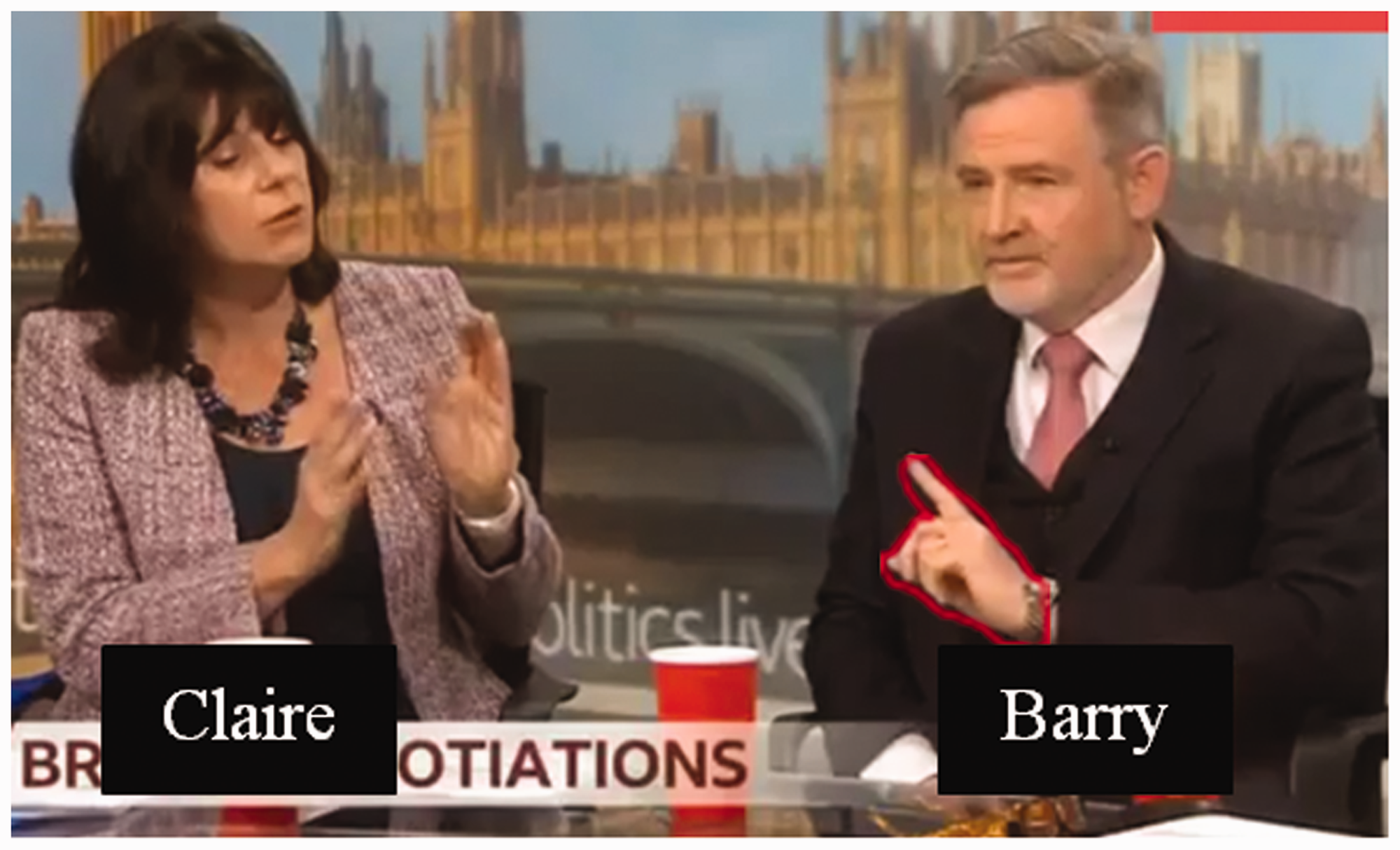
Barry raises left index finger 9 .
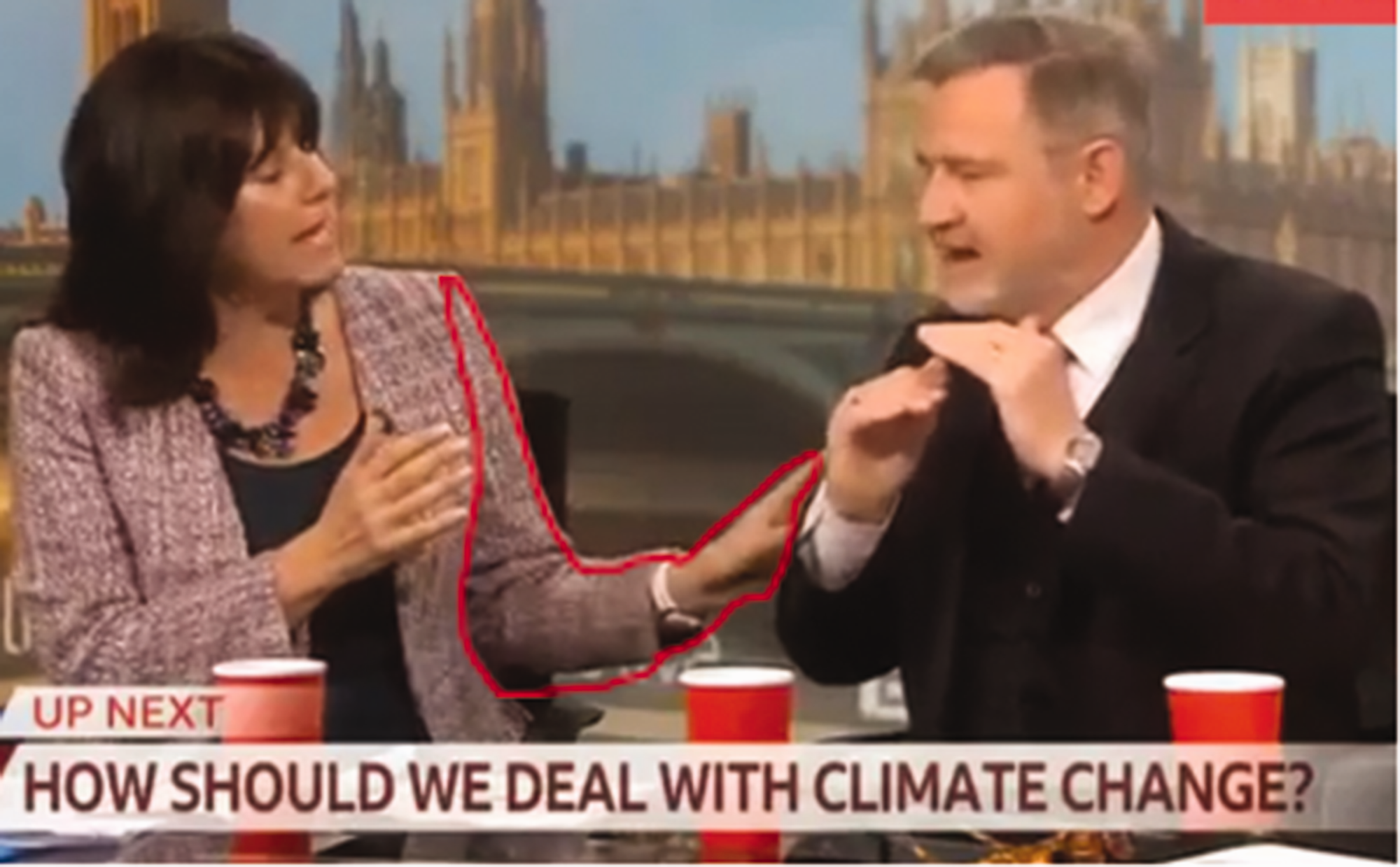
Claire touches Barry’s arm.
The direct accusation of mansplaining produced between lines 14–16: “st-stop the guy thing of e- stop mansplaining” (see also Figure 3b) interrupts Barry’s turn, invokes Claire’s epistemic authority, and casts future talk by Barry as potentially inaccurate. Moreover, repairing “guy thing” to “mansplaining” dismisses Barry’s talk on the basis that he is engaging in sexist behaviour, not only something that “guys” do (Kitzinger & Mandelbaum, 2013), but a recognisable transgression.
In sum, Extracts 5 and 6 feature accusations of mansplaining brought off through the invocation of the speaker’s direct access, and thus superior rights, to knowledge that informs the topic under discussion. However, the close examination of the sequential and interactional antecedents of these accusations reveals crucial differences between the two cases. While in Extract 5 the referent of mansplaining can be traced back to Chris’s questions that challenged Andrea’s competence as Leader of the House, in Extract 6, what Claire refers to as mansplaining is Barry’s disagreement with her assertion. In fact, as we trace the aftermath of the accusation, we see it used to silence Barry and ultimately undermine the credibility of his assertions.
Discussion
The present paper is the first to examine naturally occurring accusations of mansplaining in talk-in-interaction, thus providing empirical insight into what constitutes mansplaining. We found that women employ the term “mansplaining” to characterise men’s conduct not only as simply patronising and condescending, but as designed to assert the speaker’s superior knowledge, on the basis of their gender. Furthermore, mansplaining is used to call out unfounded claims for epistemic primacy over topics to which women, based on various category entitlements, (ostensibly) have more rights or superior knowledge.
Our cases evince a “family resemblance” in that they are connected not by a single common feature, but by a series of practices and resources that accusations of mansplaining partially share. In the first analytic section, we showed how accusations of mansplaining locate the transgression in a man’s patronising and condescending conduct. Specifically, the accusers implied that men treated their interlocutors as ignorant or questioned their knowledge on issues where the women had clear expertise. Next, we showed how accusations alleged that men claim to have more knowledge than women on issues to do with reproductive healthcare. The last two extracts featured accusations rooted in men’s claims of epistemic authority over topics to which women had direct access on the basis of their professional roles. Across all cases, gender categories were made salient and replaced other identity categories such as Yankee fan (Extract 1) or political opponent (Extracts 2–6). As a membership categorisation device “mansplaining” instantiates the “viewers’ maxim” (Sacks, 1992a) by tying participants’ gender categories to their situated conduct: the men who assume more knowledge than their women interlocutors do that as men rather than as Republicans, TV hosts, or politicians, which renders their conduct into a sexist act. Furthermore, in the case of accusations which trade on men’s claims to gendered knowledge (Extracts 3–4), the participants’ incumbency in gendered categories is constitutive of the transgression, because the victims, as women, have the right to claim superior knowledge over issues of reproductive healthcare. We also highlighted that the women who leveraged the accusations often deployed them in interjacent overlap (e.g. Extracts 3, 4, 6) which aligns with Kitzinger’s (2007) observation that women are equally likely to interrupt their male interlocutors. In Extract 6, the accusation of mansplaining is also accompanied by a treatment of the accused’s turn as interruptive, suggesting that there might still be a “kernel of truth” in the belief that men tend to interrupt women more often, or, at least, that interruptive talk can be recognisably tied to male gender identity.
We also sought to ascertain how gender shapes or is shaped by accusations and whether mansplaining, like other new vocabularies of sexism, fulfils the promise of empowering women to “unravel and resolve issues of power and historical obstacles of inequality” (Bridges, 2017, p. 98). Our findings suggest that women can use “mansplaining” to speak up against hitherto “unspeakable” inequalities. Unlike accusations of being patronising, mansplaining neatly packages gender relations within the term itself, thus magnifying the transgressor’s culpability. In these senses, “mansplaining” can empower women to “resist linguistic repressions” (Bridges, 2017, p. 97) as it strikes directly at both the gender inequality and interactional trouble caused by an interlocutor. However, we also discovered that the conversational mechanics that underpin accusations of mansplaining can be exploited to undermine interlocutors even if they had not transgressed (Extract 6). This goes to show that, like other action descriptions (Sidnell, 2017), formulations of mansplaining can be deployed to further the accuser’s agenda without necessarily providing a truthful characterisation of her interlocutor’s action.
The examined accusations come from eight different settings and a variety of multi-party activities such as panel discussions, parliamentary debates, and interviews, which increases the applicability of our findings. However, readers may wonder about the extent to which our findings are generalisable beyond the examined settings. Conversation analytic methodology posits that the building blocks of conversation are both context-specific, in that they are deployed to fit with local interactional circumstances, and context-independent, in that they function comparably across different contexts. Our analysis identified a series of methods people use to formulate accusations of mansplaining and, insofar as these methods draw on fundamental conversational practices and resources, such as gender categories and epistemic rights (Zimmerman & Boden, 1991), we are motivated to believe they are widely available to conversationalists.
Readers may wonder whether our collection of 16 cases exhausts the methods participants have to produce accusations of mansplaining. As conversation analysts, we do not use numeric criteria to evaluate the span and completeness of our analysis, which is geared towards providing a meticulous, in-depth characterisation of individual episodes of social interaction. Furthermore, the practices we describe in this paper are robust, recurrent, and exhaust all cases in our collection. However, knowing that language exhibits immense flexibility (Sacks et al., 1974), we do not rule out the possibility that other uses of mansplaining may exist or will develop over time.
In sum, our analysis has shown that spontaneous accusations of mansplaining index an epistemic injustice and hold the accused responsible for that imbalance. Moreover, by building gender into these accusations as the ostensible motive behind the transgression, the culpability of the conduct is compounded by sexism. Mansplaining, unlike accusations of being patronising or condescending, package a sanctionable action with an ostensible motive and thus make visible sexism as deliberate conduct.
Footnotes
Acknowledgements
We would like to thank the Discourse and Rhetoric Group at Loughborough, and the Conversation Analysis Reading & Data Sessions Group at Ulster for their valuable comments during data sessions on these recordings. We would also like to thank Mia Hayward for her assistance with transcription and Linda Walz for her useful discussions and feedback on analysis. Finally, and not least, we would like to thank the editor and two anonymous reviewers whose careful reading and clear comments strengthened this paper.
Declaration of conflicting interests
The author(s) declared no potential conflicts of interest with respect to the research, author- ship, and/or publication of this article.
Funding
This research received no specific grant from any funding agency in the public, commercial, or not-for-profit sectors.
