




Abstract
Whether intimate partner violence (IPV) is a gendered phenomenon or not is a question that continuously arouses debate both among scholars and the general public. This article analyses meaning-making around IPV and gender in online discussions that focus on IPV committed by women. The analysis draws upon critical discursive psychology, and identifies ideological dilemmas, interpretative repertoires and subject positions related in the discussions to the relevance of gender, on the one hand, and gender equality, on the other. The ideological dilemmas focused on the relevance of gender revolve around a gender-neutral repertoire and a gendered difference repertoire, while those focused on gender equality centre on the opposing repertoires of gender equality as a commonplace value and gender equality gone wrong. A more detailed examination of how these repertoires are constructed, negotiated, and used in the discussions reveals a pattern where discursive devices such as factualisation techniques are employed in combination with an affectively emphatic style of expression in ways that, for the most part, work to discredit the value of feminist understandings of links between IPV, gender, and power, while, instead, valorising seeming gender neutrality.
Keywords
For years there has been debate among researchers of intimate partner violence (IPV) 1 about whether they are dealing with a gendered phenomenon or not. This controversy has largely divided researchers into two camps: those who advocate a gender-sensitive, sometimes also called systemic, approach; and those advocating a gender-neutral or gender-inclusive one. The advocates of the gender-sensitive approach (e.g. Anderson, 2005; DeKeseredy & Dragiewicz, 2007; Johnson, 2011) see violence, particularly IPV towards women, as linked to gendered power relations and their reproduction. This view has been supported by literature in which gendered differences have been found in experiences, perpetration, and consequences of IPV. The gender-neutral view, in turn, finds evidence from research results that, instead, highlight lack of gendered differences in IPV. It is hence based on an assumption of gender symmetry and mutuality in perpetration of IPV among men and women (e.g. Dutton, 2012; Dutton & Nicholls, 2005; Straus, 2011). The emphasis in explaining violence from the latter perspective tends to be on individual pathology and/or proximal factors such as mutual spousal disputes, rather than on viewing violence in the context of gendered, structural inequalities (Lockwood Harris et al., 2012). These different emphases are thus linked with quite different understandings of IPV and gender, and, in particular, with different orientations to questions of power in the context of IPV and in relation to gender in general.
This paper approaches the debates around IPV from a discursive perspective, with a specific focus on how meaning-making in online discussions around IPV perpetrated by women employs culturally available notions about gender and equality. The analysis illustrates how different understandings of IPV are legitimised and managed in online discussions in ways that, for the most part, work to discredit feminist understandings of links between IPV, gender, and power. Moreover, the analysis shows how this meaning-making is based on a mixture of factualisation techniques and an affectively emphatic style of expression that is characteristic of online communication.
Meaning-making around IPV committed by women, gender, and (in)equalities
Women’s perpetration of IPV has been one of the core themes focused on not only by the advocates of a gender-inclusive approach (e.g. Graham-Kevan, 2007) in the research community but also by anti-feminist men’s rights advocates, whose presence particularly in online contexts has become increasingly salient in recent years (Dragiewicz, 2011). A common claim put forth by both of these groups is that women’s violence has been broadly ignored, and that the existence of IPV committed by women shows the irrelevance of gender in understanding the causes and dynamics of IPV (Enander, 2011). This tendency to raise the issue of violence committed by women in connection with refuting the validity of a gender-sensitive view on IPV poses a challenge for those who, instead, attempt to address the issue with an awareness of societal and structural gendered power dynamics (Scarduzio et al., 2017; Worcester, 2002). As Scarduzio et al. (2017) note, this difficulty in addressing the topic makes research focusing on perceptions of women as well as men as perpetrators of IPV highly relevant for the development of policies and interventions that aim at tackling IPV.
While there is a growing body of research focusing on how the general population ascribes meaning to IPV committed by women (often in comparison to men), discursive analyses of how gender and (in)equalities become meaningful in those understandings are scarce. Studies on the impact of gendered stereotypes have focused on such themes as perceptions of severity of IPV (e.g. Hamby & Jackson, 2010) and assessments of injury and the criminality of IPV committed by women and men (Allen & Bradley, 2018). Scarduzio et al. (2017), for instance, found that gendered stereotypes affect perceptions of IPV committed by women and men in terms of its nature, motives, and acceptability. Dragiewicz and Burgess (2016) have analysed public understandings of IPV with a more direct focus on their alignment with gendered and degendered views by using public online discussions as data. In order to investigate, in particular, where and how men are visible in accounts of men’s violence against women, they conducted a thematic analysis of Twitter discussions that followed a special episode of an Australian television program Q&A focusing on family violence. The authors found that both gendered and degendered views were prevalent in the discussions. Bou-Franch and Garcés-Conejos Blitvich (2014) have, in turn, analysed Spanish YouTube discussions about violence against women (VAW) with a combination of quantitative and discursive methods. They distinguished gender ideologies that were either supportive or challenging of VAW, and found that while only a small percentage of the analysed comments explicitly supported VAW, various implicit forms of support – such as the strategies of minimising the abuse, denying its existence, and blaming women – revealed the prevalence of the former ideology.
In this article, meaning-making around IPV, gender and (in)equalities in online discussions is analysed from the perspective of critical discursive psychology (CDP). This perspective is underpinned by a theoretical orientation towards language-use in social interaction that sees it as a central component of social practices through which gender and its significance in people’s lives are made sense of and thus socially constructed (e.g. Magnusson & Marecek, 2010). The current analysis conducted from this perspective broadens our knowledge on understandings of IPV – especially IPV committed by women – among the general population by unpacking the discursive dynamics and processes through which such understandings are constructed. The adopted perspective allows for seeing the competing understandings of IPV as discursive, dilemmatic resources that are drawn upon, customised and negotiated in context-specific language-use. Hence it directs attention to the situated use of these resources, as well as to their links with wider social and societal practices. A broadly similar discursive approach to the construction of understandings of IPV was adopted by Lockwood Harris et al. (2012), who analysed ways of talking about IPV, gender, and power in focus groups and interviews among university students in southwestern USA. Lockwood Harris et al. (2012) found that the contradictions, or ideological dilemmas (see the next section for a detailed definition), in understandings of these issues were negotiated through the use of discursive devices such as disclaimers and extreme case arguments, and by mobilising competing interpretative repertoires. While the authors showed how these devices worked to foreclose the mobilisation of systemic understandings of IPV and gender, they also noted that the contradictions in meanings ascribed to IPV also entail potential for changing public perceptions of it.
Since the debates around IPV and gender in online and offline contexts are, for the most part, based on competing notions about gender and (in)equalities, the current study taps into meaning-making around these broader issues as well. By so doing, it contributes to literature on not only perceptions of IPV (particularly on IPV committed by women) but also the discursive management of issues such as gender (in)equality and the validity of feminist efforts at societal change. Several studies have documented the discursive manoeuvres used by speakers in ascribing meaning to gender (in)equality as well as feminism in ways that allow them to dismiss the value of feminism while portraying themselves as non-sexist, progressive-minded, moderate, and in support of the commonly enforced value of gender equality. These manoeuvres include: divorcing feminism from equality and portraying feminists as extreme, man-hating and selfish; constructing contemporary society as already gender-equal and gender-neutral; and portraying men, instead of women, as the discriminated and victimised group (Calder-Dawe & Gavey, 2016a, 2016b; Edley & Wetherell, 2001; Gough & Peace, 2000; Peace, 2003; Riley, 2001).
This study extends previous research focused on these broader discursive patterns with an analysis that shows how meanings ascribed to gender and (in)equality work in unison with those ascribed to IPV. Furthermore, what makes the contribution of the current analysis unique is that it demonstrates how those meanings are constructed and legitimised in the specific context of online discussions. As Dragiewicz and Burgess (2016) have pointed out, online forums have become increasingly influential in shaping perceptions of societally relevant issues such as gender, (in)equalities, and IPV. Due to, for instance, the anonymous nature of communication, online contexts have been noted to influence the patterns and style of expression and formation of views, which tend to become polarised and even aggressive, particularly around politically charged issues (Bou-Franch & Garcés-Conejos Blitvich, 2014). Lastly, the potential of online contexts in assisting in not only the reproduction of gendered hierarchies but also in feminist efforts to challenge them has recently instigated increased discussion and research that aim to map out these various potentialities also among feminist psychologists (Locke et al., 2018). These discussions show the increased relevance of online research, which so far has seldom focused on the discursive construction of IPV, gender, and (in)equalities.
The online discussions analysed in this paper come from internet sites that are hosted in Finland. The Finnish context is particularly interesting because the gender-neutral approach to IPV has a particularly strong historical continuity (e.g. Kantola, 2004, see also Clarke, 2011). The relative predominance of a gender-neutral understanding entwines with widely circulated assumptions that gender equality has already been achieved in various areas of life in Finland (Nousiainen et al., 2013). The gendered view of IPV gained ground in Finland relatively late – primarily in the 1990s – and continues to co-exist with, and be broadly challenged by, the gender-neutral approach. Compared to other Western countries, the gender perspective on violence in Finland has been characterised as relatively moderate, as, overall, radical strands of feminism historically have not had a strong foothold in Finland (Nousiainen et al., 2013; Raevaara, 2008). At the same time, high rates of violence against women – for instance, Finland ranked second for violence against women per capita in an EU-wide survey in 2014 (European Union Agency for Fundamental Rights, 2014) – have often been the topic of public discussion. Research on the prevalence of IPV directed at men is, overall, scarce in the Finnish context. A relatively recent study (Heiskanen & Ruuskanen, 2010) that did focus on IPV directed at men found that 22 per cent of the interviewed men, in comparison to 35 per cent of the interviewed women, reported having encountered violence from their current or former partners. In the study the women reported considerably more serious consequences from the IPV they had encountered than the men. Thus, there is evidence of both gendered patterns in IPV in the Finnish context and a history of emphasis on gender neutrality that complicates the adoption of a gendered view on IPV.
Materials and methods
Online discussion forums allow for accessing diverse, spontaneously expressed views on issues such as violence that make for rich, naturalistic materials focusing on a topic that might otherwise be difficult to address (Jowett, 2015). The research materials for the current analysis were collected in April 2017 for a larger research project focusing on discourses about violence in the contemporary Finnish context, for which an analysis of online discourses on IPV committed by women constituted a sub-study. The materials used in this sub-study were identified by conducting internet searches with the use of Google and text search tools of various online discussion forums, with the search words “violence + women”, “women’s violence”, and “intimate partner violence experienced by men”. The search words, as well as the research materials, were originally in Finnish, and, similar to extracts in the analysis section, have been translated from Finnish to English by the author. Threads in which discussion did not focus on the topic of interest were not included in the data corpus. Discussion threads constituting the data corpus cover 10 years, 2007 to 2016, and they amounted to 98 threads and 3190 comments. The threads come from a diverse set of internet sites targeted at various audiences: 1) a general online discussion forum, and the discussion forums of 2) a national newspaper, 3) a regional (Northern Finland) newspaper, 4) a teenage girls' magazine, 5) a baby magazine, 6) a science magazine, and 7) nine blog sites hosted in Finland. All of the discussion threads on the blog sites were found from a popular blog section of a web newspaper. One of the writers of blogs in this section has become known as an advocate of a men’s rights movement in Finland, while others focus on diverse, societally relevant topics. Overall, however, the writers of both the blog posts and the comments in the discussion threads appear to constitute a heterogeneous group that adopts a variety of stances towards the issues of interest. Ten of the 98 discussion threads followed an article about IPV written by a reporter, whereas the rest followed a blog post or a discussion piece by a non-reporter. The length of the comments varied from a few words to several pages. All told, they constituted a corpus of 1439 pages and 329,350 words.
Acknowledging ongoing discussions about ethical conduct in internet research (e.g. Roberts, 2015), specific attention was given in this study to ethical questions, informed by the guidelines provided by, for instance, Markham and Buchanan (2012). Since the analysed online comments were publicly available at the time of data collection, they were regarded as directly available for research purposes. While the comments generally did not contain any identifying information, any details that might render writers identifiable have been removed from the materials. Furthermore, any further information about the discussion forums and blogs has been omitted, and the extracts are presented without revealing which forum they were from. Only the translated extracts are provided in the paper, which further hinders tracing the original discussions. The larger project of which this study is a part received ethics approval from the University of Jyväskylä.
As stated above, the analysis drew upon concepts and principles of critical discursive psychology (CDP) (e.g. Edley, 2001). CDP is guided by a central principle of viewing subjects as both the products and active producers of discourse (Edley, 2001; Wetherell, 1998). Thus, it follows a micro- and macro-orientation towards discourse, and views language-use as both dependent on macro-level discursive resources and as locally adaptive and oriented towards various situated functions. An analysis aligning with CPD is therefore focused on the entwinements of patterned discursive configurations with context-specific, interactional and creative language-use.
The analysis specifically employed, firstly, the concept of ideological dilemmas, referring to conflicting views on the same phenomenon that derive from commonsensical understandings drawn upon and recirculated in everyday sense-making (Billig et al., 1988). Secondly, the analysis utilised the concept of interpretative repertoires, defined as “relatively coherent ways of talking about objects and events in the world” (Edley, 2001, p. 198). Through the mobilisation of interpretative repertoires available in a particular socio-cultural context, objects being made sense of are constructed in specific ways. Following the notion of ideological dilemmas, these constructions may often constitute opposing views and thus contradict each other. The third concept used in the analysis is subject positions (Davies & Harré, 1990), referring to relational, social locations constructed for subjects in talk/text, through which they become identifiable as particular kinds of actors in relation to each other and the surrounding world. In CDP, positioning is understood as a discursive activity both constrained and enabled by culturally available discourses – or interpretative repertoires – which are adopted, modified and resisted in multiple, context-specific ways (Edley, 2001).
The analytic process began by coding the research materials to identify patterns in meaning-making that were organised around recurring themes and arguments. All stages of the analysis were completed by the author. After several rounds of re-reading the materials, the central ideological dilemmas were identified. These ideological dilemmas and the related interpretative repertoires and subject positions were then taken as entry points into a more detailed analysis of the discursive work accomplished in the discussions. At this stage, the negotiation of these dilemmas was examined by focusing on the processes of construction of various meanings attached to gender and equality in relation to IPV, and on the functions (Potter & Wetherell, 1987) their construction had. In other words, the focus at this latter stage of the analysis was on what these constructions accomplished, both in terms of positioning and identity work (see e.g. Edley & Wetherell, 2001) and wider relations of power and social practices that work to sustain them (e.g. Riley, 2001).
Analysis
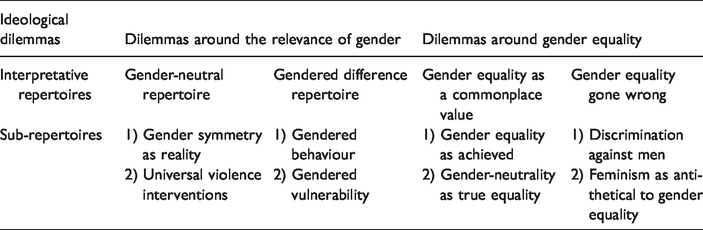
The following analysis is organised around ideological dilemmas and interpretative repertoires that were pervasive in sense-making on IPV committed by women in the online discussions. Two main ideological dilemmas were identified in the analysis: those constructed around the relevance of gender and those constructed around meanings linked to gender equality. Table 1 summarises these ideological dilemmas and the associated interpretative repertoires and sub-repertoires. The more detailed analysis below demonstrates how the dilemmas and the related interpretative repertoires are discursively constructed and negotiated, and how they work in unison to create the predominant patterns in meaning-making in the discussions, including the ways in which various actors are positioned in them. The extracts presented in the analysis section are followed by an identification number for the discussion forum, the year and the number of the discussion thread within the year in question on the particular forum.
The ideological dilemmas and interpretative repertoires in the discussions.
Dilemmas around the relevance of gender
The ideological dilemmas around the relevance of gender centre on the following contradictory interpretative repertoires: gender-neutral repertoire and gendered difference repertoire. The gender-neutral repertoire is further divided into two sub-repertoires: a repertoire of gender symmetry as reality and a repertoire of universal violence interventions. The gendered difference repertoire also entails two sub-repertoires: a repertoire of gendered behaviour and a repertoire of gendered vulnerability.
Gender-neutral repertoire
The gender-neutral repertoire is built upon the notion of gender as irrelevant in relation to perpetration and experiencing of IPV. The first of the sub-repertoires on which this broader repertoire leans – gender symmetry as reality – is based on establishing gender symmetry in IPV as an ontological fact through the use of various factualisation techniques. The latter sub-repertoire, universal violence interventions, is focused on ways of intervening in IPV – understood here broadly as orientations adopted in tackling IPV and not so much as specific intervention techniques – and constructs a gender-neutral approach in tackling IPV as the only conceivable moral option. Both of these sub-repertoires are evident in the following extract. The extract is from a discussion thread triggered by the reporting of a study in which nearly equal amounts of women and men were found to have experienced family violence. In the extract this finding is taken as irrefutable evidence of gender symmetry in IPV: A gendered view of Finnish family violence is, in the light of statistics, obviously false. Despite this the majority of public statements still repeat old stereotypes about men as batterers and women as victims. Instead, we should tackle intimate partner violence on the basis of the notion that every punch is too much, regardless of the gender of the one who hits or the victim! […] Intimate partner violence is such a serious problem that not one victim, let alone every other victim, should be disregarded. The work against intimate partner violence, the authorities who do that work, and the politicians who make decisions regarding it must let go of outdated gendered prejudices and tackle violence in families regardless of what the gender of the abuser and the victim happen to be. (2/2010/1)
By arguing for an inclusive approach in tackling IPV that, due to a gender-neutral outlook, equally attends to male and female victims, the extract above also evokes the universal violence interventions repertoire. The extract below further exemplifies the reliance of this latter repertoire on moral distinctions built with the help of subject positions. I respect A WOMAN, who says upon encountering violence: “stop using violence against HUMANS”, and not just against herself or the group that she represents. (14/2008/1)
Gendered difference repertoire
The prevalent argumentation for a gender-neutral approach illustrated above co-appeared in the discussions with counter-arguments that were predominantly built on gendered difference repertoires – more specifically, on the sub-repertoires of gendered behaviour and gendered vulnerability. Interestingly, there is a common tendency to do moderateness particularly in the context of mobilising gendered difference repertoires in the discussions. In other words, through discursive manoeuvres such as hedging and the use of disclaimers (Van Dijk et al., 1997), the writers often soften their argumentation and simultaneously orient towards opposing repertoires when making claims based on these repertoires. This has the effect of allowing the writers to appear reasonable and reflective, and to pre-empt any expected counter-arguments that may not only refute their claims but also position them unfavourably (Edwards & Potter, 1992). Simultaneously, however, the truth status of the claims made is diluted, and a level of uncertainty is attached to them. The following extract provides an example of such manoeuvring accompanying the mobilisation of the sub-repertoire of gendered behaviour. I think about intimate partner violence in such a stereotypical way that a man is usually physically stronger than a woman, so that he can better, for example, defend himself. If the situation were to escalate, and the woman tried to beat the man badly, then the man is usually stronger and usually also dares to say more firmly that now the beating ends. Women on the other hand easily stay to cry and retreat into themselves when they encounter intimate partner violence, and indeed men usually have a lot more strength so that even a slap might hurt a lot. Also, women are usually much more emotional, and do not dare to leave a violent relationship, because they are so attached to the other, whereas men might leave right away after the first blow already. Generalisation, generalization … sorry for being so stereotypical. I of course don’t accept either situation in any way, I am absolutely against intimate partner violence. And it might well be also so that the man is weaker and more “helpless” than the woman, so that it really depends on the situation. (11/2013/4)
The use of disclaimers in the extract also allows for refuting potential allegations of minimising and implicitly condoning IPV committed by women, of which the advocates of a gendered view have often been accused (Worcester, 2002). This is evident particularly in the last two sentences. In the second to the last sentence, instead of qualifying expressions, the claims-making is reinforced with extreme case formulations (Pomerantz, 1986) such as “absolutely” and “in any way”. These formulations work to indicate unqualified moral integrity in opposing violence in all its manifestations. In the last sentence the writer then glosses over gendered differences in a concession stating that the gendered power dynamics in IPV could also be reversed in some cases. Together, these sentences entail an orientation towards moral dimensions in meaning-making around IPV, and work to protect the writer’s appearance as a moral actor due to their effectiveness in proving their advocacy of non-violence and a commitment to avoid resorting to gendered double standards in their non-acceptance of IPV.
Alongside the careful manner of mobilising the gendered difference repertoires as seen above, there are also instances in the discussions where they are relied upon in a much more assured manner. Indeed, in some comments the gender-neutral argumentation in preceding comments in the discussion threads is responded to with similar but oppositional rhetoric. This works to legitimise gender-specific talk about IPV by refuting the moral value of arguments based on a gender-neutral repertoire. The following extract is an example of such a response triggered by previous comments, where the issue of IPV committed by women was raised in the context of refuting the high prevalence of violence against women in Finland. The extract also provides an example of the gendered vulnerability repertoire, which, unlike the gendered behaviour repertoire, specifically relies on acknowledging gendered differences in the consequences of IPV. Ah, the good old “what about men?” argument. Every time there’s talk about violence (hitting, kicking, rapes) experienced by women (mostly in intimate partner relations), someone always comes and heckles “what about men then, men are for sure victims of violence too”, and the whole conversation fizzles out. In Finland intimate partner relations and their ending are dangerous for women. Maybe it’s then such a difficult thing to admit for men that they need to divert attention away from the topic. (12/2014/1)
Refuting the credence of claims made by other writers advocating an opposing gender-neutral view constructs in the above extract a basis for the factuality of the following gender-specific statement about IPV being particularly dangerous for women. From this statement, the presence of a subject, and thus a potential stake, is effaced, which works to align it directly with the observable reality (Edwards, 2003). The severity of violence endured by women is further highlighted and factualised with detailed descriptions of the types of violent acts directed at them (Edwards & Potter, 1992). Together, these manoeuvres work to legitimise an alignment with the gendered vulnerability repertoire and to defend the validity of this understanding against arguments in favour of the opposing gender-neutral approach. It is worth noting, however, that these counter-arguments are seldom accompanied in the discussions by references to societal, gendered power relations in line with the systemic approach to IPV. Instead, the source of gendered differences remains often either unspecified (particularly in the case of the gendered vulnerability repertoire) or is attributed to biology or physiological characteristics of women and men (specifically in the case of gendered behaviour repertoire).
Dilemmas around gender equality
The theme of gender equality played a significant role in meaning-making around IPV in the discussions, and the repertoires used to ascribe meaning to it gave specific support particularly to the gender-neutral repertoire on the relevance of gender in IPV. The analysis identified two broad recurrent interpretative repertoires, through which gender equality gained contradictory meanings, and which thus constituted an ideological dilemma: gender equality as a commonplace value, and gender equality gone wrong. The former repertoire entailed the sub-repertoires of gender equality as achieved and gender-neutrality as true equality, and the latter the sub-repertoires of discrimination against men and feminism as antithetical to gender equality. The two main repertoires indicate different orientations towards equality especially in terms of its moral value: gender equality and efforts to achieve it are constructed either as a commonly acknowledged and valuable goal, or alternatively as something that threatens the thriving of society and individuals.
Gender equality as a commonplace value
The extract below illustrates the mobilisation of the repertoire of gender equality as a commonplace value, and more specifically of sub-repertoires gender equality as achieved and gender-neutrality as true equality. The extract is from a comment that is built around the argument that gender equality has been reached in Finland, and in which this argument is used in unison with the repertoire gender symmetry as reality. Regulations and attitudes that oppress women no longer apply in Finland nor several other Western countries, so it is completely unreasonable to punish modern individual men for them. I know that there are some total rednecks who imagine that genders are somehow fundamentally different, but I claim that they are their own, small redneck minority. I have never met a man who thinks the genders are unequal. Even those who I have not considered to be particularly bright consider gender equality as self-evident. (11/2015/1)
What is notable in the extract is that the distanced and marginalised counter-arguments against equality are equated with gender difference thinking, which therefore appears as in contradiction with gender equality. In other words, gender equality is associated in the extract with the advocacy of gender neutrality – i.e. not treating genders differently – thus also evoking the repertoire of gender-neutrality as true equality. This repertoire sets gender-neutrality as the only viable way of achieving genuine gender equality. The established prevalence and commonsensicality of views based on these associations provides a rationale for defending modern men against assumed accusations of sexism and violence by positioning them – or at least the majority of them – as progressive-minded and in favour of equality. This act of defending men against unjustified attacks positions the writer as justice-oriented and up-to-date with their views. Significantly, these positionings, echoing postfeminist notions about the redundancy of feminism (McRobbie, 2009), simultaneously allow the existence of discriminatory practices against women, such as gender-based violence, to be disputed.
Gender equality gone wrong
The opposing repertoire of gender equality gone wrong evident in the discussions positions gender equality as societally detrimental in its assumed current manifestations. This repertoire, and the associated sub-repertoires discrimination against men and feminism as antithetical to equality, echo notions circulated among the advocates of men’s rights movements in Finland and elsewhere, based on viewing efforts to achieve gender equality as having resulted in discrimination against men that surpasses that against women. The repertoire makes available the subject position of neglected and wronged victim to men, and creates an image of a reality characterised by reversed gender inequality (Calder-Dawe & Gavey, 2016b; Peace, 2003; Venäläinen, 2019). The following extract provides an example of this repertoire and, in particular, of the sub-repertoire discrimination against men. In a presumptive and biased manner people always think that the man is the perpetrator and the woman is the victim. This old-fashioned way of thinking, that is not in any way based on equality, what does it do? It puts women and men in the contemporary world in completely unequal positions in relation to each other. Equality becomes a weapon that justifies almost everything for women and nothing for men. Indeed, what appears as absurd in the modern world is that as women have gained rights and value, the game has, through slightly different methods, regressed approximately to the same level as it was when men reigned. (12/2014/5)
As the extract below illustrates, the repertoire of gender-neutrality as true gender equality is often mobilised in the discussions as the opposing cure for the gender equality gone wrong evident in the discrimination against men: A true act of equality would be to stop all the talk about men’s violence and start talking about close relationship violence or family violence. To advance equality for real instead of always highlighting man as a perpetrator and woman as a victim. (1/2009/3)
While the above extracts show how gendered assumptions about IPV are often presented as examples, and a source, of discrimination against men in the discussions, the extract below illustrates the associated functioning of the sub-repertoire feminism as antithetical to gender equality, and the way it explicitly positions feminist actors as the adversaries in efforts to gain true gender equality. Feminism promotes woman’s dominance against man. It has nothing to do with equality. Feminism has never cared for boys or men and it never will. How can it then be equality? It simply can’t. (11/2015/1)
Conclusion
The analysis identified contradictory ways of making sense of relations between IPV, gender, and gender equality in online discussions, and showed how the veracity of competing understandings around these topics is discursively constructed and refuted. A central limitation of the current study, similar to other studies using online discussion forums, is that due to the anonymous nature of communication, little can be known about the writers, their social locations, and backgrounds. Another limitation is that due to restricted space, the analysis was not able to engage in detail with the sequential flow of meaning-making, where consecutive comments feed into each other and encourage particular kinds of responses. However, what the current analysis is able to shed light on are the discursive resources, or repertoires, that are culturally available for meaning-making around IPV, and the discursive functions and processes linked to their mobilisation. In terms of the broader functions of the analysed meaning-making, particularly noteworthy are the ways in which gendered or feminist perspectives are often constructed in the discussions as inherently incapable of incorporating and making sense of IPV committed by women and experienced by men. This is coupled in the discussions with a tendency to equate a gendered perspective with gender essentialism and the accompanying assumptions of gendered differences as fixed and natural. The effect of such meaning-making is to make it difficult to draw upon feminist views in discussing phenomena such as IPV, which connects with the reiteration of simplistic views on feminist perspectives that ignore their capacity to engage with complex social practices that variously sustain, produce, and potentially alter gendered differences.
The discursive patterns identified in the analysis – particularly the positioning of men, women, and feminists in relation to gender equality – resemble closely those we have seen in meaning-making around both IPV and gender equality in other contexts as well (e.g. Calder-Dawe & Gavey, 2016a, 2016b; Gough & Peace, 2000; Lockwood Harris et al., 2012; Peace, 2003). Similar to previous studies, the writers in discussion forums commonly construct the ontological reality as gender-neutral and gender-equal, or, alternatively, as characterised by reversed inequality experienced by men, and use these constructs in discrediting the epistemological validity of feminist understandings. By shedding light on the ways in which this discrediting is accomplished both by mobilising available interpretative repertoires and by utilising various discursive devices such as factualisation techniques, the current analysis adds to existing research by highlighting the broad continuity in meaning-making around these topics across socio-historical contexts.
However, the analysis also suggests that the patterns discussed above can take particular shapes that align with the specific characteristics of online communication. What appears as distinct in the analysed meaning-making are the ways in which discursive factualisation frequently entwines with extreme, polarising forms of expression and the accompanying affective weight added to the claims-makings. This tone combined with attempts to refute the value of feminist views on IPV closely echoes anti-feminist men’s rights rhetoric (Dragiewicz, 2011), the impact of which, particularly in online contexts across the globe, has been vast in recent years. The wide reach of such rhetoric suggests a need for further analyses that delve into the discursive as well as affective processes that allow for the persuasiveness of claims-making against feminist efforts to tackle gendered inequalities. Equally important, however, are studies that shed light on how efforts to resist such meaning-making are accomplished in online contexts, since such knowledge can pave the way towards effective interventions into meaning-making around not only IPV but also inequalities and gender more generally.
Footnotes
Acknowledgements
I wish to thank the anonymous reviewers for their helpful comments on a previous version of the paper.
Declaration of conflicting interests
The author(s) declared no potential conflicts of interest with respect to the research, authorship, and/or publication of this article.
Funding
The author(s) disclosed receipt of the following financial support for the research, authorship, and/or publication of this article: This work was supported by the Kone Foundation.
