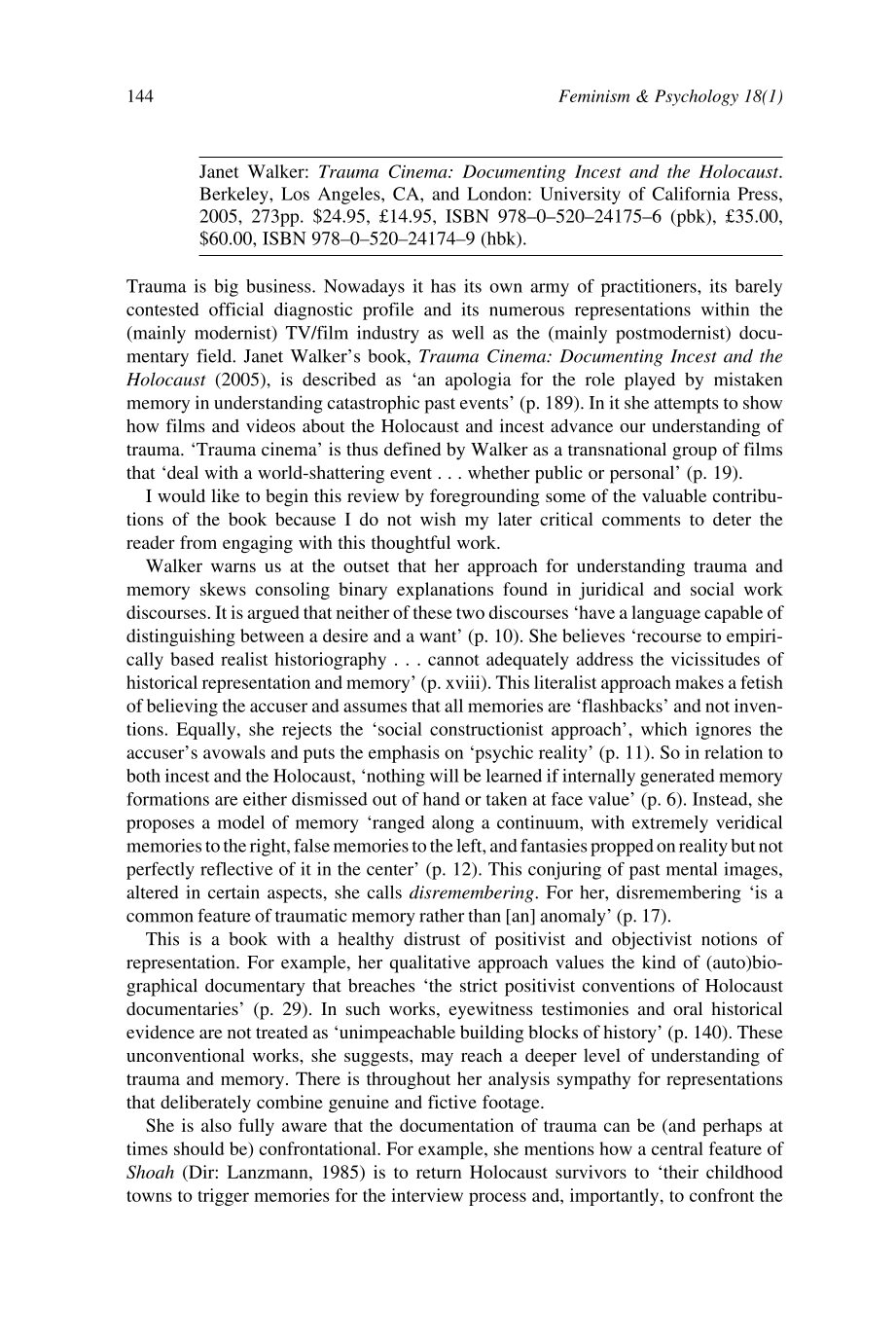
Review: Janet Walker: Trauma Cinema: Documenting Incest and the Holocaust. Berkeley,Los Angeles,CA,and London: University of California Press,2005,273pp. $24.95,£14.95,ISBN 978—0—520—24175—6 (pbk),£35.00,$60.00,ISBN 978—0—520—24174—9 (hbk)
Restricted accessReview articleFirst published online February, 2008
Review: Janet Walker: Trauma Cinema: Documenting Incest and the Holocaust. Berkeley,Los Angeles,CA,and London: University of California Press,2005,273pp. $24.95,£14.95,ISBN 978—0—520—24175—6 (pbk),£35.00,$60.00,ISBN 978—0—520—24174—9 (hbk)
Brown, L.S. and Burman, E. (1997) `Feminist Responses to the “False Memory” Debate', Feminism & Psychology7(1): 7—16.
2.
Burman, E. (1997) `Telling Stories: Psychologists, Children and the Production of “False Memories”', Theory &Psychology7(3): 291—309.
3.
Devlin, M. (2005) `“Teenage Traumas”: The Discursive Construction of Young People as a “Problem” in Irish Radio Documentary', Young: Nordic Journal of Youth Research13(2): 167—84.
4.
Kaplan, E.A. and Wang, B. (eds) (2003) Trauma and Cinema: Cross-Cultural Explorations. Hong Kong: Hong Kong University Press.
5.
McLaughlin, K. (2003) `Identities: Should we Survive or Surpass Them?', Journal of Critical Psychology, Counselling andPsychotherapy3(1): 48—58.
6.
Miltenburg, R. and Singer, E. (1999) `Culturally Mediated Learning and the Development of Self-Regulation by Survivors of Child Abuse: A Vygotskian Approach to the Support of Survivors of Child Abuse', Human Development42: 1—17.
7.
Schuman, J. and Galvez, M. (1996) `A Meta/Multi-Discursive Reading of “False Memory Syndrome”', Feminism & Psychology6(1): 7—29.
8.
Weine, S. (1999) `“A Forgotten History” and Related Risks for Speech Genre in Trauma Mental Health: A Commentary', Journal of Contemporary Psychotherapy29(4): 267—81.
9.
Zittoun, T. (2004) `Memorials and Semiotic Dynamics', Culture & Psychology10(4): 477—95.