




Abstract
Background
While isokinetic knee strength profiles have been widely studied in athletes, data based on physical activity levels in young adult men and women remain limited.
Objective
This study aimed to determine knee isokinetic strength values according to physical activity level, with a focus on inactive (sedentary) individuals.
Methods
A total of 84 participants (42 females, 42 males) were divided three groups based on the International Physical Activity Questionnaire-Short Form (IPAQ-SF): inactive, minimally active, and active (12–15 per subgroup). Unilateral knee strength was assessed using isokinetic dynamometry at 60°/s and 180°/s. Two-way ANOVA was used to evaluate differences across groups, and gender comparisons were analysed using a t-test.
Results
Men demonstrated higher absolute strength values than women in all activity levels. In inactive and minimally active groups, there were no significant gender differences in extensor relative peak moment (PM/kg), peak work (PW/kg), or peak power (PPw/kg) (p > 0.05). However, flexor values showed significant gender differences (p < 0.05). In the active group, all relative strength values differed significantly between genders.
Conclusion
The absence of gender difference in extensor strength of inactive individuals suggests their use as a normative references for this cohort. Gender differences became more pronounced with increased physical activity.
Introduction
The term physical inactivity (PA) describes an inadequate level of activity according to physical activity guidelines. 1 However, the sedentary behaviour, defined as a minimal energy consumption (around 1.5 METs), for example sitting, lying down, napping for long periods of day. 1 According to data from the National Health and Nutrition Examination Survey (NHANES), both children and adults in the United States spend an average of approximately 7.7 h per day in a waking state. 2 This time is mostly spent in sedentary behaviours such as watching television, playing passive video games and computer games. 2 In large population-based studies, physical activity level assessment has been performed by using self-survey application because these are more practical, economical and non-invasive. 3 Commonly, the version of the Short Form of the International Physical Activity Questionnaire (IPAQ-SF) has been modified for multi-cultural populations and is highly valued as the most widely used questionnaire. 4
The results of IPAQ-SF are calculated as walking, moderate and vigorous intensity PA and total PA score according to different physical activity levels. In addition, low, moderate and high PA are also determined as weekly energy expenditure and metabolic equivalents (METs min/wk-1). Up to date, the measurement of physical activity level has been addressed simultaneously with accelerometer, 5 maximal oxygen uptake (VO2max), 6 muscular endurance 7 has been determined according to the IPAQ-SF score in large populations. All these studies have shown a positive correlation between physical measurements and IPAQ-SF results. In addition, these studies related the validity of IPAQ-SF with VO2max6–8 and muscular strength endurance 7 and found significant correlations. 3 The results of the IPAQ-SF not only correlated with cardiovascular endurance and muscular strength, but also with flexibility and trunk muscular endurance. 9 In addition, the level of physical performance and inactivity affects muscle function. Indeed, skeletal muscle strength values are not only functionally important but also key to negative outcomes such as musculoskeletal diseases, disability and poor quality of life. 10 Reference values for lower extremity muscle strength have already been established in different populations such as athletes, 11 children, 12 elderly people 13 or specialised groups. Moreover, normative data also show that isokinetic muscle strength values vary depending on the sport type of the athletes. 14
However, to the best of our knowledge, no previous study has widely characterized the relationship of IPAQ-SF questionnaire results with isokinetic muscle strength values. In sports science research, participants are typically categorized into groups such as controls, athletes, or physically active individuals when undergoing isokinetic measurement tests. However, these classifications are often not based on objective strength levels or peak moment values. Therefore, there is a need for reference measurement ranges that allow for a more scientific classification of muscle strength levels using isokinetic assessments. Accordingly, the aim of this study is to determine the relative differences in muscle strength between physically active and inactive individuals, based on isokinetic dynamometry data obtained from participants classified into activity groups according to IPAQ. Furthermore, although isokinetic muscle strength has been widely studied across various sports disciplines, there is a lack of isokinetic data, especially inactive sedentary individuals. Also, sedentary behaviour is increasingly common among young adults and is associated with musculoskeletal weaknesses that may predispose individuals to injury or functional limitations. This study aims to address this gap by providing reference values for isokinetic knee strength in young men and women with varying physical activity levels, with a particular focus on sedentary individuals.
Methods
The study procedure and participants
Study data were collected on separate days. First, participants’ physical activity levels were determined using the self-administered IPAQ-SF questionnaire. 3 Then, the physical compositions of the participants were measured and right leg isokinetic knee muscle strength tests were performed.
A total of 84 participants (42 females and 42 males) were included in the study and categorized into three groups based on their physical activity levels according to the IPAQ-SF: inactive (15 females, 12 males), minimally active (12 females, 15 males), and active (15 females, 15 males). All participants had no musculoskeletal or neurological injuries or disabilities or use any anti-inflammatory drugs or any treatments during the research period.
Isokinetic test measurements were conducted on the right leg at the similar time of the day (±2 h) for all participants. The right leg was chosen for standardization purposes and because it is commonly the dominant limb in the general population, which helps reduce variability related to limb dominance. Previous studies have also commonly used the right leg in isokinetic testing for consistency and comparability.15,16 The same researcher carried out all measurements.
Assessment of the physical activity level using IPAQ-SF
The Turkish version of IPAQ-SF 17 was used to determine the physical activity level of the participants. The physical activity levels of the participants in the last 7 days were assessed in accordance with the scale. This scale includes seven questions assessing the duration of sitting, walking, moderate and vigorous activity. The total score is calculated by summing the scores from walking, moderate and vigorous activity. The IPAQ-SF final scores are reported in units of MET minutes-week-1. This calculating protocol for walking = (3.3 × walking minutes × walking days); moderate activity = (4.0 × moderate activity minutes × moderate activity days); and vigorous activity = (8.0 × vigorous activity minutes × vigorous activity days). Based on the total PA score, participants are categorized as an “Active, Minimally Active and Inactive person”. The sitting score is calculated separately, it indicates sedentary behaviour.4,17
Isokinetic test evaluation
The Isokinetic test, concentric/concentric active mode knee flexion and extension strength of the participants were evaluated by ISOMED 2000 (D.& R. Ferstl Gmbh, Hemau, Germany). Prior to the test, the participants were instructed about the evaluation process and visual feedback was also provided. All participants were verbally motivated for maximum effort. Participants were allowed to hold the handles on the edge of the seat and asked how to stop the test in case of an emergency. Knee, hip and waist positions were automatically adjusted by software to position the hips at the correct angle. The upper part of the body, shoulders, hips and upper leg were fixed with a belt to stabilise them. The distal part of the movable arm for the lower leg is attached to the lateral malleolus of the ankle. The swivel axis in the knee is positioned with the lateral femoral condyle of the knee joint at 90° knee flexion. The range of motion of the knee was adjusted between 0 and 90° with mechanical limits. Also, the effect of gravity correction was calculated before the test. The test protocol was performed at two different angular speeds, from slow to fast (60°/s and 180°/s) with flexion/extension and concentric/concentric mode. A familiarization session was conducted one day prior to the actual isokinetic testing, immediately following the completion of physical measurements. During this session, participants were positioned on the isokinetic dynamometer in the standard seated posture to ensure proper alignment and test readiness. After performing several submaximal trial repetitions at each angular velocity, participants completed five maximal voluntary contractions for both knee extension and flexion. This session aimed to accustom participants to the test procedures, angular velocities, and the requirement for maximal effort. To minimize potential measurement variability, all assessments were administered by the same experienced examiner. The participants actual test performed at the 60°/s 6 repetitions and 20 repetitions at the 180°/s angular velocity of knee flexion/extension. All isokinetic muscle strength parameters were analysed at the end of the test.
Statistical analysis
The data were analysed using the SPSS 30.0 software package. Descriptive data were expressed as number, minimum, maximum, mean and standard deviation. A priori power analysis was performed using G*Power software (version 3.1) to determine the required sample size for the two-way ANOVA design (3 activity levels × 2 gender = 6 groups). Assuming a large effect size (Cohen's f = 0.40), an alpha level of 0.05 and a power of 0.80, the analysis indicated that a total of 52 participants would be sufficient to detect statistically significant differences. This corresponds to a minimum of 9 participants per group. Accordingly, the study was designed with three physical activity groups of 12 to 15 participants each. Descriptive statistics were calculated for all variables. A two-way analysis of variance (ANOVA) was conducted to assess the main effects of gender (male, female) and physical activity level (inactive, minimally active, active), as well as their interaction, on isokinetic knee strength variables. The significance level was set at p < 0.05. The two-way ANOVA revealed significant main effects for both gender and physical activity level, indicating that each factor independently influenced strength outcomes. However, the interaction effect between gender and physical activity level was not statistically significant (p > 0.05), suggesting that the effect of gender on knee strength did not vary across different activity levels. In line with standard statistical practices, and due to the absence of a significant interaction, simple comparisons were performed to further investigate the main effect of gender. Independent samples t-tests were used to compare male and female participants within each physical activity group. This approach is methodologically appropriate for identifying the source of main effects when interaction terms are not significant.18,19
Results
In Table 1, participants were categorised as inactive, minimally active and active according to IPAQ-SF scores. In all groups, men had significantly higher body weight and height than women (p < 0.05), while women in the active group had significantly higher IPAQ scores (p < 0.05). (Table 1).
Classification of groups according to international physical activity questionnaire-short form scale scores.
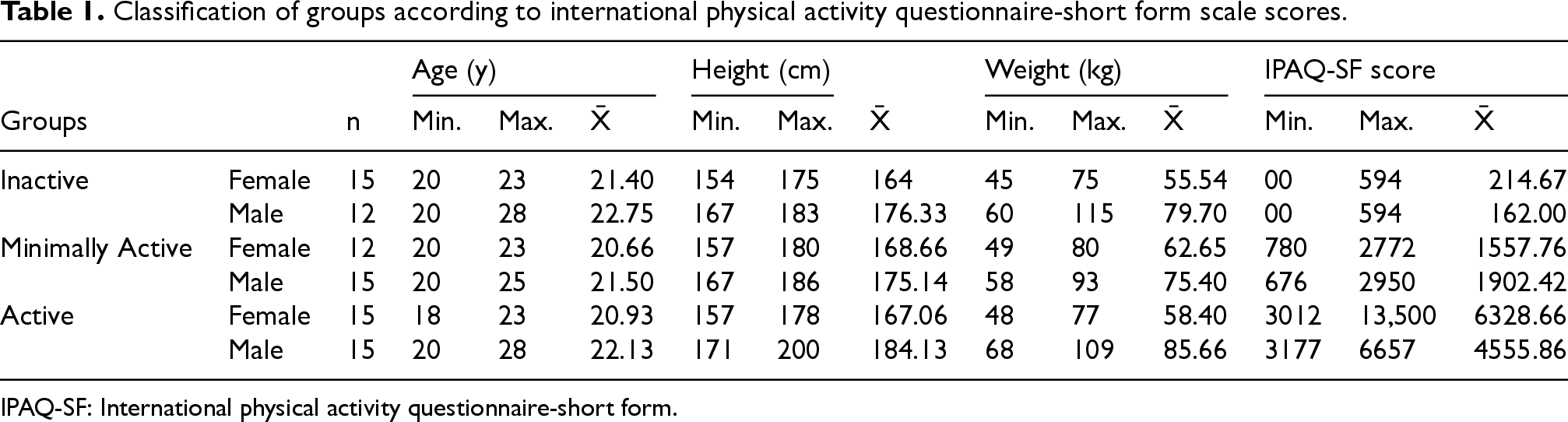
Classification of groups according to international physical activity questionnaire-short form scale scores.
IPAQ-SF: International physical activity questionnaire-short form.
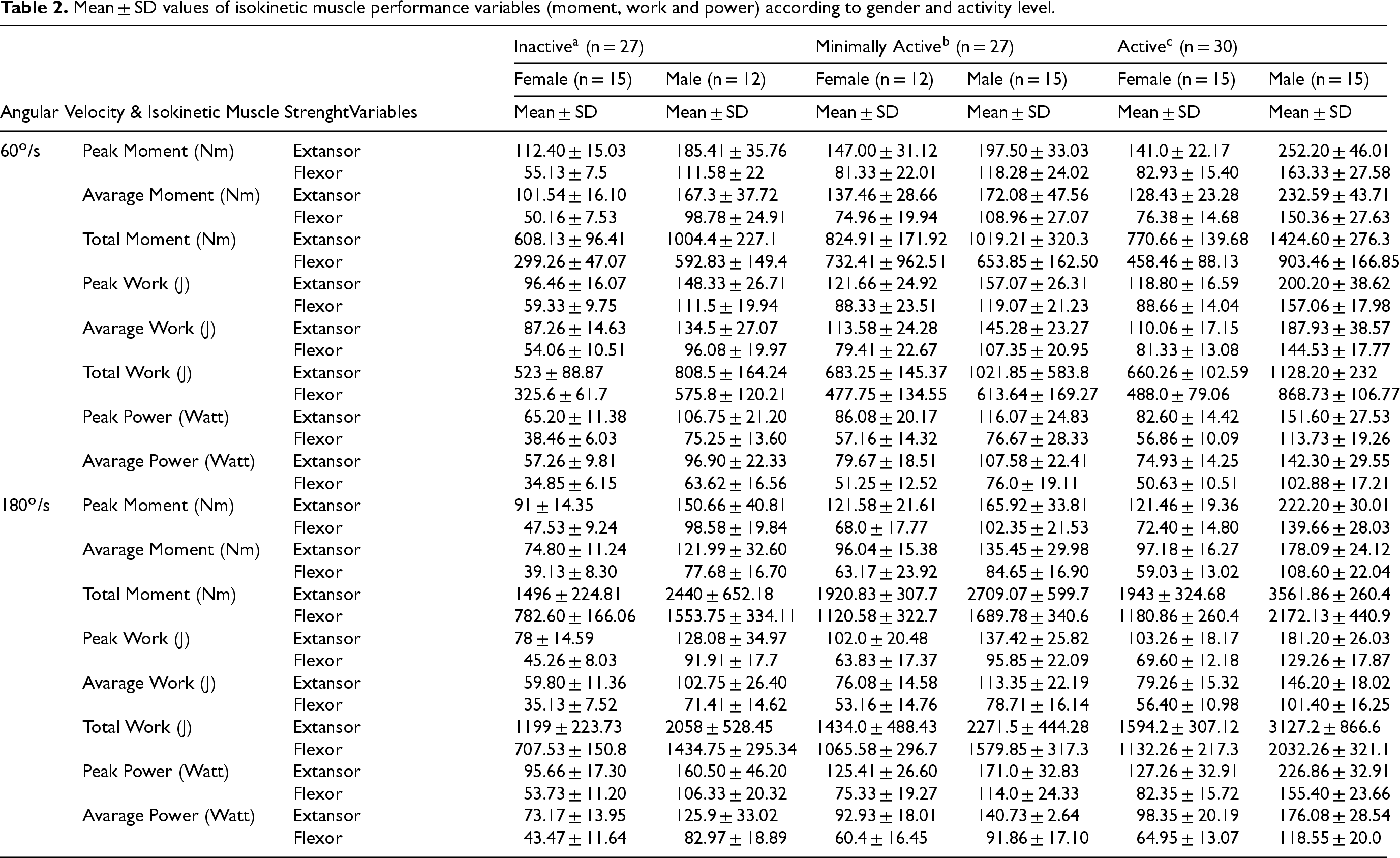
The mean values of isokinetic muscle strength parameters (moment, work and power) according to gender and activity level are presented in Table 2. According to the two way-ANOVA analysis, gender and physical activity level had a significant effect on all parameters for both extensor and flexor muscles (p < 0.05) Two-way ANOVA revealed significant main effects of gender and physical activity level on all isokinetic muscle strength variables, including peak moment, average moment, total moment, peak work, average work, total work, peak power, and average power at both angular velocities (60°/s and 180°/s) (p < .001 for most comparisons). These findings indicate that both gender and physical activity level independently influence muscle performance (Table 3).
Mean ± SD values of isokinetic muscle performance variables (moment, work and power) according to gender and activity level.
Two-Way ANOVA results of gender, activity level and interaction on isokinetic muscle performance variables (moment, work and power).
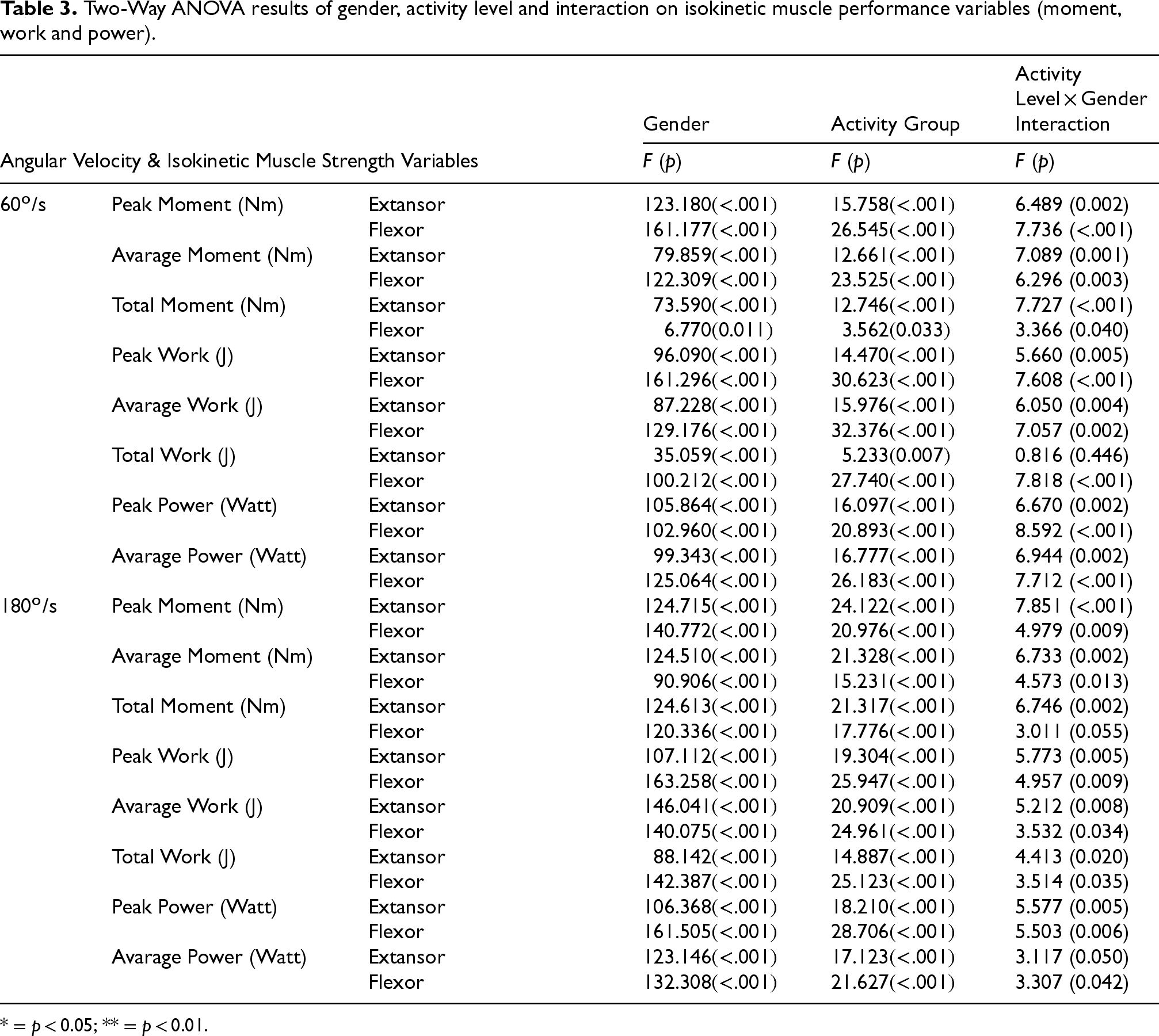
* = p < 0.05; ** = p < 0.01.
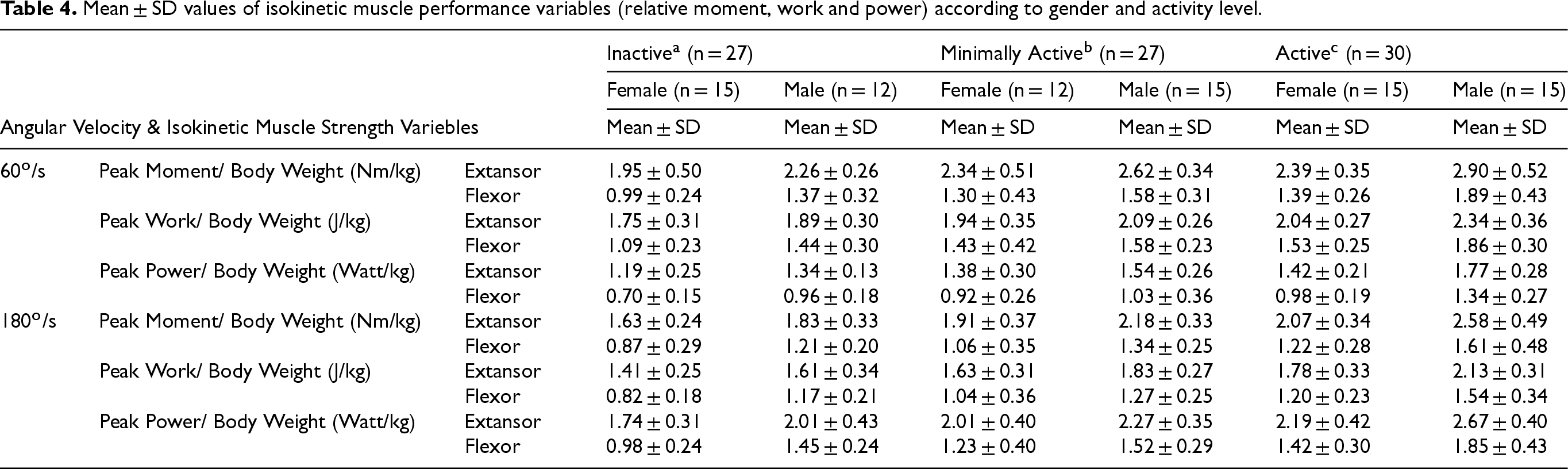
In Table 4, at both speeds, male participants demonstrated consistently higher relative strength values compared to females across all physical activity levels. This trend was observed in both extensor and flexor muscle groups, with the most notable differences evident in the flexor parameters. Two-way ANOVA results, at both 60°/s and 180°/s angular velocities, significant main effects of gender and physical activity level were observed across all relative strength variables (p < .001), for both extensor and flexor muscle groups (Table 5). Importantly, no significant interaction effects were found between gender and activity level for any of the variables (all p > 0.17). For instance, at 60°/s, interaction p-values ranged from 0.224 to 0.581, and at 180°/s, from 0.221 to 0.730. This suggests that the impact of gender on relative muscle strength did not vary significantly across different physical activity levels. In other words, gender-related differences in relative strength were consistent regardless of activity level. The strongest gender effects were observed in flexor strength, particularly at 180°/s, where peak moment/body weight yielded F = 20.871 (p < .001), and peak work/body weight showed F = 25.667 (p < .001). Similarly, activity level had the largest effect on extensor peak moment/body weight at 180°/s (F = 18.947, p < .001), reflecting greater strength development in more active individuals. These results further support the conclusion that while both gender and activity level significantly affect relative isokinetic muscle performance, they act independently, and their combined influence is not interactive.
Mean ± SD values of isokinetic muscle performance variables (relative moment, work and power) according to gender and activity level.
Two-Way ANOVA results of gender, activity level and interaction on isokinetic muscle performance variables (relative moment, work and power).
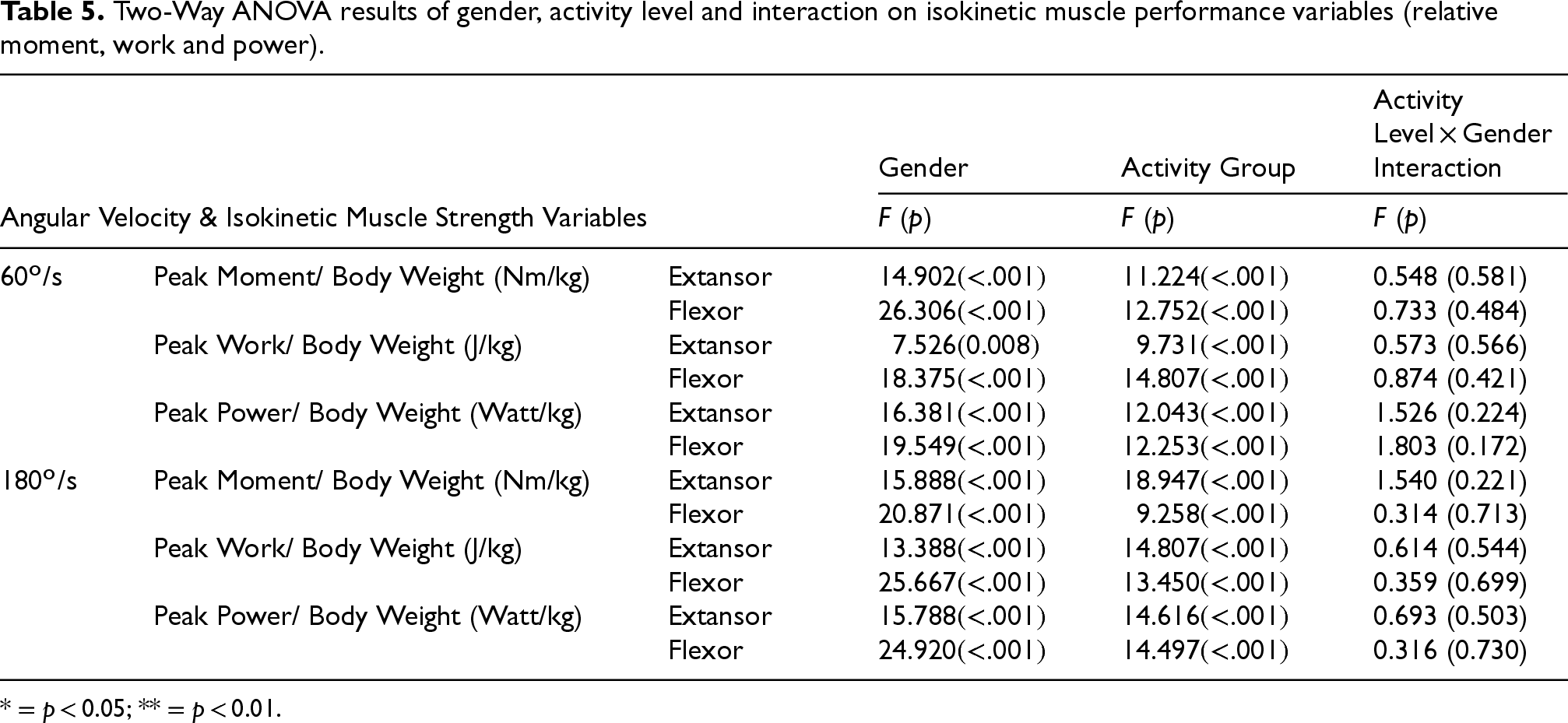
* = p < 0.05; ** = p < 0.01.
In Table 6, according to gender comparison by t-test results indicated that, in the inactive group, no statistically significant gender differences were observed in extensor strength across all variables at either velocity (p > 0.05), though small to moderate effect sizes were noted (Cohen's d = −0.43 to −0.75). In contrast, flexor strength values were significantly higher in males for all variables and velocities (p < 0.01), with large effect sizes (Cohen's d = −1.30 to −1.68), indicating marked gender disparities in flexor strength among sedentary individuals. In minimally active participants, gender differences remained non-significant in most extensor variables (p > 0.05), with moderate effect sizes. However, significant differences were found in flexor strength, particularly at 180°/s for PM/BW and PPw/BW (p = 0.029 and p = 0.045, respectively), again favoring males (Cohen's d = −0.83). In the active group, statistically significant gender differences were present across all variables and muscle groups at both angular velocities (p < 0.01 for most comparisons). Males demonstrated consistently higher relative strength than females in both extensors and flexors. Effect sizes were large (Cohen's d = −0.99 to −1.51), highlighting the pronounced influence of gender on muscle strength among highly active individuals.
Comparison of PM/BW, PW/BW and PPw/BW mean values between groups according to gender.
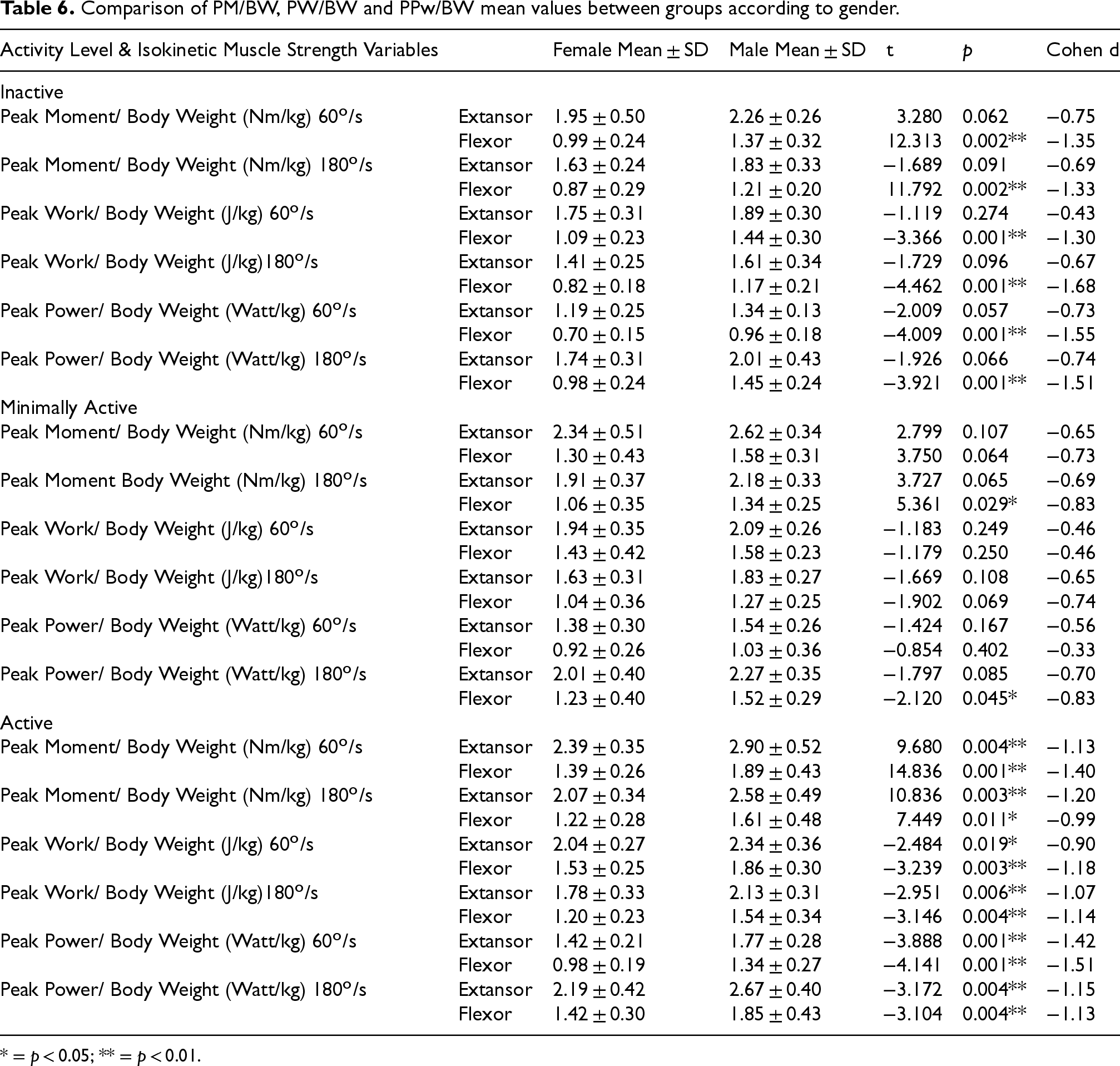
* = p < 0.05; ** = p < 0.01.
This study aimed to evaluate the isokinetic performance profiles of knee extensor and flexor muscles in inactive and active individuals, with a particular focus on defining the muscle strength characteristics of sedentary individuals and examining gender differences in these profiles. The results indicated that the absolute values of peak moment, work, and power for the knee extensor and flexor muscles were influenced by gender, with men demonstrating higher performance than women across all physical activity groups. However, when these values were normalized to body weight, the gender-related differences in the extensor muscle group were no longer statistically significant in the inactive and minimally active groups at both testing velocities. Significant differences remained only in the active group. This is the interesting finding from our results, as the level of physical activity increases, the gender-related differences in the relative PM/kg, PW/kg and PPw/kg an extensors and flexors also become more pronounced. To the base of knowledge, consistent with our result, isokinetic muscle strength absolute values of the peak moment, work and power have been previously shown to significantly higher rates in man than the women, for extensor and flexor muscles.20,21 However, when these values are adjusted relative to body mass, the statistical significance is often diminished. 20 However, Pincivero found that these parameters still were statistically significant. 21 Also, Musselman and Brouwer, 2005 reported that the relative values significantly higher in men than women. 22 In the obese subjects found that higher absolute values of the isokinetic values, but still lower relative values of muscle moment than lean subjects. 23 Enoka et al. found the maximal voluntary muscle force or power were fewer declines in women than in men in young people. 24 Moreover, one study showed that the absolute and relative knee flexor and extensor isokinetic muscle power evaluated were different in men and women including various training level. 25 This study's results are consistent with previous findings. However, our findings provide clearer evidence. Specifically, as the activity level increases, the relative extensor and flexor PM, PW, and PPw values show greater gender differences compared to the inactive condition. Moreover, flexor values are more influenced by angular velocity and gender differences than extensors.
Gender-related differences in muscular performance studies showed that men tend to experience faster fatigue and lower muscular index than women and women showed ore greater fatigue resistance during the isokinetic muscle contraction. 20 Also, men show smaller work output decrement and better isometric muscle performance post-fatigue, whereas women recover faster than men after isokinetic exercise at moderate velocities of contraction. 26 Avin, also showed that women were more resistant to fatigue than men in elbow, but not in ankle. 27 This maybe indicated that gender related of the fatigue resistance depend on the muscle group. Ayala, noticed that the hamstrings reaction time profile was different in the two genders, women had longer total reaction time, pre-motor time and motor time values than men. 28 However, we did not measure the fatigue index separately for men and women in our study. Nevertheless, in general, the relative flexor work capacity was higher in men, and sex-related differences were more pronounced in the relative flexor capacity compared to the extensor capacity in this study. One of the studies indicated that relative isokinetic strength and work values had no gender comparison, but the study participants were small and had no information about activity level as well. 20 The relative extensor and flexor work capacity, as well as the fatigue index, may show different results between women and men according to activity level. Therefore, a more detailed research is needed to further investigate these differences.
As previously study indicated, both among men and among women, in the parameters of absolute and relative knee isokinetic muscle power, the greatest statistically significant differences were obtained between physically inactive individuals and strength and power athletes in the gender comparison. 27 In line with the results of this study, our findings showed that relative power values differed by gender in the active group. However, in the inactive and minimally active groups, the relative extensor PPw/kg values were consistent, as PM/kg and PW/kg were not significantly different in gender comparison.
The majority of studies reported in the literature have not determined the leg muscle strength profiles of inactive or sedentary individuals in men and women as in our study. Only one meta-analysis study with 13,893 participants for adult nonathletic male isokinetic isometric knee extension strength values 1.34–2.23 (knee extension position), 2.92–3.45 (mid-range) and 2.50–3.06 (flexed angle) Nm/kg, while the flexors strength reported 0.85–1.20, 1.15–1.62, and 0.96–1.54 Nm/kg, respectively. In addition, adult nonathletic females obtained less strength to compare with men (1.01–1.50, 2.08–2.74, and 2.04–2.71 Nm/kg, respectively). 29 In addition to these findings, our results determined the isokinetic extensor relative PM values of 1.95–2.26 Nm/kg at 60°/s and 1.63–1.83 Nm/kg at 180°/s in both genders for a young inactive population. This differences maybe related the muscle fiber type, Furthermore, muscle contraction characteristics in women are typically characterised by a longer half-relaxation time and lower evoked twitch moment compared to men.30,31 This attenuation in contractile response aligns with the higher proportion of type I muscle fibers in women, 32 which are more involved in moment production throughout the entire range of motion. These fibers, which are adapted for endurance and sustained activity, contribute to the slower contraction and relaxation dynamics observed in females. Sexual dimorphism in muscle fibre type composition probably explains the differences in the relationship between absolute and relative angular velocities between men and women.
Our findings suggest that no significant gender differences exist in knee isokinetic relative extensor peak moment, work and power values among inactive groups. However, as activity levels increase, the gender differences become more pronounced. Additionally, the flexor values exhibited greater variability across genders. Therefore, these findings provide novel insights to the existing literature by highlighting the limited influence of gender on extensor muscle performance among sedentary individuals. Specifically, no significant gender differences were observed in extensor strength parameters such as peak moment (e.g., females = 1.95 ± 0.50 Nm/kg; males = 2.26 ± 0.26 Nm/kg at 60°/s), suggesting that gender-related disparities are minimal in untrained populations. In contrast, flexor strength showed clear and significant gender differences even within the inactive group (e.g., peak moment: females = 0.99 ± 0.24 Nm/kg; males = 1.37 ± 0.32 Nm/kg at 60°/s), indicating a persistent gender-related disparity in hamstring function. As the physical activity level increased, the magnitude of gender differences expanded across all isokinetic variables, especially in the active group. Here, males demonstrated substantially higher relative strength values for both extensors and flexors. For instance, at 60°/s, the peak moment for extensors was 2.39 ± 0.35 Nm/kg in females versus 2.90 ± 0.52 Nm/kg in males, and for flexors, 1.39 ± 0.26 Nm/kg in females versus 1.89 ± 0.43 Nm/kg in males. These trends suggest that training or habitual physical activity amplifies pre-existing gender-based differences in muscle performance, particularly favoring male participants.
Consequently, our results will be a reference for the studies performed with isokinetic dynamometer. Because isokinetic dynomometer has been widely used in scientific and application-based studies since 1968. 33 Since then, isokinetic testing has been widely used in both clinical and athletic populations. The main reasons for the continued use of this method include its high reliability, test safety and the provision of detailed information on joint function and muscle balance.34,35 Despite the increasing use of field-based assessment methods, isokinetic dynamometry is still considered the gold standard for the quantitative assessment of muscle strength, especially when accurate moment measurement is required. Isokinetic dynamometry is also widely used by clinicians, particularly in the fields of sports medicine and physical therapy, as a tool for assessing and managing musculoskeletal disorders. It plays a key role in both the diagnosis and rehabilitation of various neuromuscular conditions.
Furthermore, In the present study, participants classified as ‘inactive’ according to the IPAQ-SF were interpreted as representative of sedentary individuals. This classification is consistent with previous literature, where low IPAQ-SF scores have been used to identify sedentary behavior patterns.4,36 The absence of significant gender differences in relative extensor strength values (PM/kg, PW/kg, and PPw/kg) within this group suggests that these parameters may serve as normative reference values for sedentary young adults, regardless of gender. Similar findings have been reported by Douris et al. (2006), who observed minimal gender differences in isokinetic strength among individuals with low physical activity levels. 37 As physical activity level increased, however, gender differences became more pronounced in our study, indicating that activity level has a moderating effect on muscle strength, particularly in active populations. These findings underscore the importance of stratifying participants by physical activity level when establishing normative isokinetic strength values and developing gender-specific reference standards.
Although self-report questionnaires such as the IPAQ are valuable tools for assessing physical activity on a large scale, they have limitations. Recall bias, social desirability bias, misinterpretation of questions, individual differences, lack of objective validation, and cultural factors can all contribute to inaccuracies in the data. To overcome these limitations, researchers often recommend combining self-report questionnaires with objective measures such as accelerometry to improve the validity of physical activity data. 38 In accordance with this recommendation, in our study, we used the isokinetic dynamometer and assessed isokinetic muscle strength characteristics according to activity level, taking gender into consideration. A similar study was conducted by Miçaoğulları et al. (2016) using this scale in an isokinetic muscle strength study, but the study was conducted on a smaller group of Turkish amateur athletes. 39 As a result of the study, has found differences in peak moment values in groups divided into active and inactive groups. Similarly, in this study, we tested the range of muscle strength according to activity level on a larger population by using this IPAQ and isokinteic dynomometer together. This also constitutes the limitation of the study. Additionally, our study has several limitations. First, the sample size was relatively small, which may limit the generalizability of the findings. Second, isokinetic testing was performed only on the right leg, which may not account for possible asymmetries or differences in limb dominance. Future studies should consider larger, more diverse populations and include bilateral measurements to enhance the robustness and applicability of the results. Longitudinal research is also recommended to explore how changes in physical activity level over time may influence isokinetic strength profiles.
Conclusion
The present findings provide an additional reference for the evaluation and interpretation of muscle strength characteristics in both active and inactive young women and men. Specifically, one can expect a normalized dominant side extensor strength of around twice the bodyweight in both women and men.
Footnotes
Acknowledgements
The authors would like to thank Prof. Dr. Khalid Rahman, School of Pharmacy and Biomolecular Sciences, Liverpool John Moores University for editing language of the manuscript.

Ethical considerations
The study has been approved by Balıkesir University Health Sciences Non-Interventional Research Ethics Committee on October 12, 2021 (No: 2021/16) and all participants have signed an informed consent form.
Author contributions
Study plan: Zekine Punduk
Performance of work: Sedef Nizam and Zekine Punduk.
Interpretation or analysis of data: Sedef Nizam and Zekine Punduk
Preparation of the manuscript: Zekine Punduk.
Revision for important intellectual content: Sedef Nizam and Zekine Punduk.
Supervısıon: Zekine Punduk.
Funding
The authors disclosed receipt of the following financial support for the research, authorship, and/or publication of this article: The authors report no funding. Sedef Nizam received a scholarship from TUBITAK-2210/A during this study.
Declaration of conflicting interests
The authors declared no potential conflicts of interest with respect to the research, authorship, and/or publication of this article.
Declaration
This manuscript is derived from the author's master's dissertation, titled “Determination of sedentary concept according to muscle strength structure and characteristics”, completed at “Balıkesir University” in 2023.