Abstract
This study examines attitude polarization as a key determinant of the political viability of policy reforms, using Universal Basic Income (UBI) as a case in point. While public support for UBI is often high in aggregate, little is known about the extent and nature of underlying divisions. Drawing on a stratified online survey (n = 3076) conducted ahead of a local UBI campaign in Germany, we study who supports what type of basic income, and why. Methodologically, we extend conventional conjoint analysis to directly capture polarization over policy design, and complement it with open-ended responses to elicit respondents’ reasoning. Our findings show that polarization centers on the defining features of UBI – its generosity, unconditionality, and financing – yet also reveal areas of common ground for broader political coalitions. By combining a novel methodological approach with a focus on polarization, our study offers new insights into how public attitudes shape the political feasibility of policy reforms.
Keywords
Introduction
Contemporary welfare states face many pressures, such as scarce public funds and changing societies, that have led to increased calls for retrenchment and modernization. Universal basic income (UBI), which entails an income floor for all without conditions, constitutes one of the most radical proposals to maneuver these pressures (Parijs, 1992). To many of its advocates, UBI is a response to a variety of social problems such as poverty (Marchal and Marx, 2024), inequality (Parijs, 1992) or increased labor market risks, particularly those driven by technological advancements like automation, digitization, and artificial intelligence (Busemeyer and Sahm, 2022; Gamble, 2016; Reed and Lansley, 2016). It is also hailed as a response to the seemingly recurring crises of our times from pandemic crises (De Wispelaere et al., 2024; Forget and Frankel, 2024; Gray Molina et al., 2022) to economic crises (Standing, 2011) to the climate crisis (Howard et al., 2019). In post-growth debates specifically, UBI is portrayed as an ‘eco-social’ policy with the potential to overcome the growth imperative of a capitalist society (Bohnenberger, 2020; Buchs, 2021) and to nurture democratic participation (Hirvonen et al., 2024). An extensive academic literature and numerous pilot projects attest to the interest in and promise of UBI.
As for other social policies, the crucial role of public opinion for the implementation of UBI is uncontested (Wispelaere and Noguera, 2012). For those interested in the political viability of a UBI, studying political support is paramount because it allows us to identify the social groups that mobilize on behalf of UBI. Given its financial costs and significant effects on existing welfare state arrangements, it is unlikely that policy-makers would invest political capital to implement a UBI without the support of the public, even if they subscribe to the normative and economic desirability of the scheme. Previous literature has identified the young, low-income, benefit recipients and left voters as consistent proponents of UBI (Laenen, 2023; Rincón, 2021; Roosma and Van Oorschot, 2020; Schwander and Vlandas, 2020; Weisstanner, 2022; Yeung, 2024).
The political viability of a policy is not only shaped by average support levels but also by how strongly polarized public opinion towards the policy is. Polarization of mass attitudes, for instance, can have a detrimental impact on consensus-finding and democratic policy-making (Masch et al., 2023; McCarty et al., 2008; Traber et al., 2022). We extend the literature on public support for a UBI by investigating attitude polarization in relation to UBI support. Hence, we move the debate from a discussion about the drivers of the fundamental preference structure to a more specific debate about which elements of UBI prove to be most polarizing and on which aspects proponents and opponents might find common ground. Examining polarization around UBI is particularly relevant given the policy’s novelty. In contrast to older, established policies, where feedback effects and party cues have already influenced public opinion, public opinion on novel policies is usually weakly formed and any polarization can be more readily resolved.
We study opinion polarization using data from an original representative survey, which was fielded in Hamburg, Germany, in late 2023 ahead of the start of a local UBI campaign. First, we determine who the proponents and opponents of UBI are using a question about general support and explore to what degree they overlap with traditional economic and political divides. Second, we elicit information on why people support or oppose UBI with an open-ended question about arguments for and against UBI. This question design avoids imposing predetermined categories and follows recent trends towards qualitative data in survey research (e.g. Margalit and Raviv, 2024). Third, we explore what elements about UBI drive proponents and opponents apart. To accommodate the multidimensional nature of UBI, we use increasingly common conjoint designs, which are well-suited to study attitudes towards policy design (Gallego and Marx, 2017; Haeusermann et al., 2019; Hainmueller and Hopkins, 2015; Rincón, 2021; Rincón et al., 2022; Stadelmann-Steffen and Dermont, 2020). Studying variations in UBI designs is also important as different operationalizations have been put forward by scholars and practitioners alike, e.g. regarding the eligibility of non-citizens or minors, frequently deviating from a “maximalist” version of UBI (De Wispelaere and Morales, 2016). Overall, our research design allows us to understand how opinion polarization over UBI is rooted in divergent attitudes and arguments.
Our findings show that the focus on polarization is not only a conceptual shift but provides novel insights on the political viability of UBI. We find that debates strongly center on social justice arguments. In addition, opponents are particularly concerned about consequences for labor markets and fiscal policy, while proponents are especially hopeful about welfare state modernization and liberty promotion. With regard to attitudes, we find that proponents and opponents disagree on generosity and unconditionality, where proponents prefer policy designs close to existing welfare institutions. Proponents and opponents agree on limiting universality by excluding non-citizens. Opponent attitudes also suggest that lack of reciprocity (i.e. work incentives) and the excessive size of the welfare state are important barriers to support. Overall, our results suggest that there is currently no room for highly universal BI proposals and that common ground can only be found for BI proposals that deviate less from existing institutions in terms of size and principles. That being said, addressing underlying concerns and arguments, especially with regards to social justice, labor markets, and fiscal policy, might open up more room for more extensive BI proposals.
With this study, we make a number of contributions. First, we extend existing scholarship on UBI policy design and public opinion (Laenen, 2023; Laenen and Gugushvili, 2021; Rincón, 2021; Rincón et al., 2022; Stadelmann-Steffen and Dermont, 2020) by bringing the understudied aspect of polarization to the forefront, showing that it can lead to widely different conclusions about the viability of different policy designs than a look at average support levels. Second, we extend UBI research on the rationales of UBI support (Afscharian et al., 2022; Bay et al., 2024; Carroll and Engel, 2021; Gielens et al., 2023; Jordan et al., 2022) by studying arguments with an open-ended question design. The open-ended question design allows to accurately reflect the prevalence of arguments in public discourse without imposing any restrictions that might lead to blind spots. Our findings attest to considerable discrepancies between arguments discussed in academic and political circles and arguments advanced by the general public. Third, our findings speak to research about welfare state modernization (Parijs, 1992; Parijs and Vanderborght, 2017), showing that even among opponents of UBI, there is some openness to replace existing institutions with basic income schemes–albeit not universal. Proponents primarily see UBI as a complement to existing institutions, but echoing research on welfare chauvinism (Careja and Harris, 2022) also prefer a non-maximalist UBI that extends benefits to citizens but not all residents. Fourth, our conjoint analysis features a methodological innovation that allows us to study polarization in relation to policy design. Most conjoint analyses in political science focus on average effects, potentially brushing over differences between policy opponents and proponents in a way that mis-characterizes the political viability of different policy designs. Understanding attitude polarization is important because polarization and not average level of support shape the political dynamics around policy implementation. Polarization hinders compromise and hampers finding common ground and is therefore a significant obstacle to achieving democratic consensus.
The remainder of the study is organized as follows: We first discuss the literature on UBI with a focus on the scholarly knowledge on public opinion towards UBI. We outline our argument about the importance of opinion polarization and derive concrete expectations before delving into the question of citizens justifications of their position. We then elaborate on the research design including the case selection, the conjoint experiment and the measurement of the various variables and present and discuss the results from both the conjoint experiment and the open ended question on arguments in favor of and against UBI. The final section concludes.
UBI support and polarization
Numerous definitions for what exactly constitutes a UBI have been put forward. At its simplest, a UBI is a public program where the state provides everyone with an equal amount of money in a regular interval (Navarro, 2018: p. 45). The term ’basic’ refers to the fundamental idea of providing an income floor, though there is disagreement about the minimum level, on which individuals can build their lives (Parijs and Vanderborght, 2017: p. 10). Unlike traditional social assistance, a UBI is unconditional in three additional key ways: it is provided to individuals regardless of their household situation, it is not contingent on other sources of income, and it is duty-free with no requirements for willingness to work (Parijs and Vanderborght, 2017: p. 14). However, scholars disagree as to whether a UBI needs to be extended to all residents of a country or only citizens. Given these ambiguities, UBI is not one single policy but describes a set of policies that vary most importantly in their generosity and eligibility criteria.
Despite its radical departure from existing institutional arrangements, UBI enjoys considerable public support. According to Roosma and Van Oorschot (2020), an average of 54% of adult citizens in European countries supports the introduction of a UBI. Confirming standard assumption from political economy about the relevance of self-interest, UBI enjoys above average support among individuals that face high labor market risks, earn low incomes or among younger generations (Adriaans et al., 2019; Dermont and Weisstanner, 2020; Roosma and Van Oorschot, 2020; Vlandas, 2021). By contrast, UBI is opposed by those prioritizing existing welfare state arrangements (especially older, lower-educated, center-/right-leaning individuals, see Weisstanner, 2022). Apart from these material considerations, pro-migration and pro-egalitarian are positively linked to support for UBI (Bay et al., 2024; Laenen, 2023; Muñoz and Pardos-Prado, 2019). UBI is also more popular among individuals that think most current welfare recipients are deserving of help and do not positively evaluate the performance of the existing welfare system (Laenen, 2023; Rossetti et al., 2020).
In terms of political ideology, UBI is more popular among left-wing citizens. This is noteworthy because UBI is an ideological ambivalent social policy project as demonstrated by its combined historical roots in both liberal and progressive thinking. UBI appeals to those worried about the expansive reach of the welfare state or excessive state intervention in the economy as well as to those concerned with the repression of labor and its ‘unfreedom’ in a capitalist system (Chrisp and Martinelli, 2019; Parijs, 2018; Parijs and Vanderborght, 2017). Some also fear that a UBI might lead to a new division between those having to live on a basic income alone and those in classical types of formal employment on the other (Colin and Palier, 2015). Trade unionists too have good reasons to oppose the introduction of a basic income scheme such as potential pressure on wages and a decrease in formal employment (Vanderborght, 2006). In short, UBI attracts support from both the left and the right of the political spectrum (Chrisp and Martinelli, 2019) but is also contested within the left (Parijs, 2018; for an empirical analysis, see Schwander and Vlandas, 2020). This political ambiguity underscores the importance of understanding its support coalition.
Moving beyond the focus on determinants of generic UBI support, we argue that it is crucial to understand the polarization of public opinion on UBI. Drawing on the literature of public opinion polarization (Masch et al., 2023; McCarty et al., 2008; Traber et al., 2022), we argue that polarization rather than average levels of support is the critical issue for the implementation of public policies because a divided public represents a significant obstacles to achieving democratic consensus. When public opinion is deeply divided, it becomes challenging for policy-makers to find common ground and enact policies that have broad support. In a similar vain, Weisstanner (2022) argues that while general support for UBI has increased during the Covid pandemic, its political prospects have not improved due to persistent political divides.
Our contribution focuses on what separates proponents and opponents of UBI from each other, but also from those who remain indifferent. We first explore differences in how these groups reason about UBI, in particular the arguments they put forward in favor of UBI or against it. Arguments can play a particularly important role at early stages of policy formulation and for novel policy proposals like UBI, as the public opinion is only weakly formed and more malleable than for older, established policies. Second, we study attitudes towards different UBI designs to determine what aspects of a UBI are sources of disagreement between opponents and proponents. This allows us to better understand what versions of UBI are more likely to generate broad support. In the following, we revisit the existing empirical literature that is concerned with arguments and attitudes towards UBI. This literature guides the substantive focus of our exploration of polarization.
Arguments
The persuasive power of arguments to alter public opinion lies in their ability to present empirical evidence, logic reasoning, and emotional appeals that can shift an individual’s perspective on a given policy. Given that reasoning based on empirical evidence or, often emotional, expert testimonies is difficult because UBI has not been implemented apart from pilot studies, studying which arguments resound in the public either in a emotional or rational way is of utmost importance, although confirmation biases are to be expected. Moreover, collecting arguments also allows citizens to formulate their position in a more forceful way in private or public debates which might then persuade others and solidifies their own commitment to the cause. Political elites can employ popular arguments to sway public opinion in specific ideological directions (Druckman, 2004). For political elites it is therefore important to know which arguments are more likely to resonate within the public and in particular within the group of indifferents.
Empirical studies based on focus group research (Rossetti et al., 2020; Zimmermann et al., 2020) and content analyses of online discourse (Gielens et al., 2023) show that citizens endorse a wide set of arguments for and against UBI. Experimental studies have found mixed results regarding the effectiveness of arguments to sway support, suggesting that individuals might be more susceptible to negative than positive arguments (Jordan et al., 2022) and resistant on ideological grounds (Yeung, 2024). Reviewing existing empirical work, Laenen (2023) distinguishes two sets of arguments. ‘Principled’ reasons refer to beliefs that UBI will promote (or demote) general principles they value, such as freedom, emancipation or equality, while ‘practical’ reasons refer to beliefs about the specific personal, social or economic outcomes a UBI is believed to yield to. The idea that a UBI would incentivize work, limit welfare abuse or alleviate poverty or at least reduce anxiety about financial means are the the most important arguments for a UBI in the public while arguments about UBI being not affordable, to dis-incentivize work or violate social norms of reciprocity are most often voiced against UBI by the public (Laenen, 2023; Rossetti et al., 2020; Zimmermann et al., 2020).
To study the breadth of arguments for and against UBI, we draw on the classification developed by Afscharian et al. (2022). Their classification is based on a comprehensive review of historical and contemporary contributions to the UBI debate and organizes the plethora of arguments into broad but sufficiently detailed categories. The authors identify three main themes, with each several sub-themes. (1) (2) (3)
Attitudes
UBI is a multidimensional policy. In relation to other social policies, it is characterized by its universality and unconditionality, meaning that everyone is entitled to it without having to meet any requirements. These elements alone make it a more encompassing than most other social policies. In addition, UBI proposals vary in their generosity, or benefit level, ranging from minor cash supplements to full living wages. Although the cost very greatly, all UBI designs require considerable financial resources, making its financing another key dimension. While some regard UBI as a substitute to existing social policies that could at least partly be financed through the retrenchment of other benefits and services, other see it as a complement that is to be financed through new taxes or public debt.
Numerous empirical studies explore attitudes towards the multiple dimensions of UBI, primarily drawing on conjoint survey designs that are well suited for this purpose. These studies show that each of the dimensions mentioned above can have a sizable impact on the popularity of UBI proposals. The most consistent finding concerns the universality of basic income policies, which is generally disliked. In other words, individuals generally prefer a version of UBI that is restricted to natives (Rincon, 2023) or requires extended residency periods (Stadelmann-Steffen and Dermont, 2020). Similarly, some conditionality requirements, such as being unable to work or assuming care responsibilities, are usually preferred over full unconditionality (Laenen et al., 2023; Rincón et al., 2022). Individuals generally oppose minimal benefit levels and thus support more generous versions of UBI (Rincon, 2023; Stadelmann-Steffen and Dermont, 2020). Progressive funding mechanism, in particular taxes on capital and high incomes, have been shown to increase overall support while cuts to existing welfare programs are generally met with opposition (Rincon, 2023; Rincón et al., 2022; Stadelmann-Steffen and Dermont, 2020).
The current literature provides us with a good understanding of what elements of UBI policies increase or decrease their support on average. However, we do not know which elements of UBI are more or less contentious. In other words, which elements of UBI spur disagreements between proponents and opponents of UBI, and where is common ground to be found? In the empirical analysis, we set out to explore this question and show that moving the analytical focus from average support to polarization leads us to different conclusion about the political feasibility of different UBI proposals.
Research design
Case selection
We conduct a survey during a major UBI campaign in North-German city of Hamburg. The campaign, which is the first of its kind in the city, was initiated by a non-governmental organization. It seeks the launch of a publicly funded test project and the eventual introduction of a UBI, and entails a broad set of publicity initiatives, including a petition and referendum, to urge legislative action. The results of this study provide an uncontaminated picture of public opinion towards this novel redistributive policy ahead of major public and political debates.
The online survey was fielded in September 2023 in collaboration with a major market research company (n = 3,076). 1 Respondents were recruited in advance to provide a non-random quota sample of the city population. The average age in our sample is 45.8 year, with 54.4% female respondents, and a median net income between 2,500 and 3,999 EUR. Based on vote intentions, Social Democrats are the most popular party, with support from 24.8% of all respondents, followed by the Greens at 16.4% and the Christian Democrats at 15.3%, while 10.4% plan on not voting. 2 Further descriptive statistics of the sample, and how it compares to the population of Hamburg and Germany, are included in the Appendix (see Table A1). The survey begins with a number of demographic questions. Respondents are then asked about their views on UBI in general, the local campaign and their arguments in favor and against UBI as well as a conjoint experiment with pairwise comparisons of different UBI designs.
UBI support
We elicit support for UBI with a simple multiple choice question drawing on the established question in the European Social Survey. The question explains in one sentence the general features of a UBI as “a fixed amount of money that everyone is to receive from the state monthly, without any conditions” (translated from German), and then asks about support for the introduction of such a policy. Respondents answer on a five-point scale ranging from (1) strong opposition to (5) strong support. For the main analysis, we transform this variable into three categories, indicating either support (4-5), opposition (1-2), or a neutral stance (3).
Arguments
We consider surveying citizens a sensible approach to learn more about their rationale behind a specific position on UBI. Specifically, we are interested in the full range of possible arguments with which citizens justify their position to discover arguments on which opponents and supporter find common ground. Open-ended questions allow to uncover reasons and arguments that we as researchers may not have anticipated a priori and avoid selection biases by allowing respondents to frame their own responses without the influence of pre-selected options. To understand how people justify their support for UBI, our survey features therefore an open-ended question about what they perceive the most important arguments for and against UBI to be. Respondents can provide up to three short responses each for and against UBI. This allows not only to discern the arguments that are most appealing to the position of a respondents but also the that arguments appear most compelling from the other side.
Based on the framework by Afscharian et al. (2022), we code the arguments into seven categories: justice, liberty, economy, labor market, welfare state, fiscal policy, and democracy. The arguments are coded by two independent coders. To account for the linguistic ambiguity inherent to some respondent arguments, we only consider entries on which both coders agree in our analyses. The two coders agree on 80.3% of the entries and a Cohen’s
Attitudes
Previous research has shown that even though the idea of a UBI might be quite popular, the concrete proposals for a UBI are evaluated much more critically, depending on their actual designs (De Wispelaere and Stirton, 2004). Conjoint analyses allow researchers to measure preferences in multidimensional settings that are characterized by various and varying attributes of a policy (e.g. generosity, costs, eligibility criteria etc.) and are particularly apt to approximate real-world decisions compared to alternative survey experiments such as vignette designs (Hainmueller et al., 2014). UBI scholars add that conjoint experiments are particularly advantageous when analyzing preferences towards new or untested policies in a multidimensional setting making them a first choice for UBI scholars (Rincón, 2021; Rincón et al., 2022; Stadelmann-Steffen and Dermont, 2020). Apart from UBI research, conjoint experiments have been in social policy analysis on attitudes towards labor market reforms (Gallego and Marx, 2017), housing (Hankinson, 2018), old age pension reforms (Haeusermann et al., 2019), immigration (Hainmueller and Hopkins, 2015) or climate change mitigation policies (Baute, 2024).
Our conjoint experiment presents respondents with five pairwise comparisons of different policy designs (called profiles). These profiles vary across six different dimensions (or levels) on which each profile is randomly assigned one of several attributes. To avoid ordering effects, the dimensions are randomly ordered for each respondent. Respondents have to choose their preferred profile for each of the pairwise comparisons (
UBI profiles in conjoint analysis.
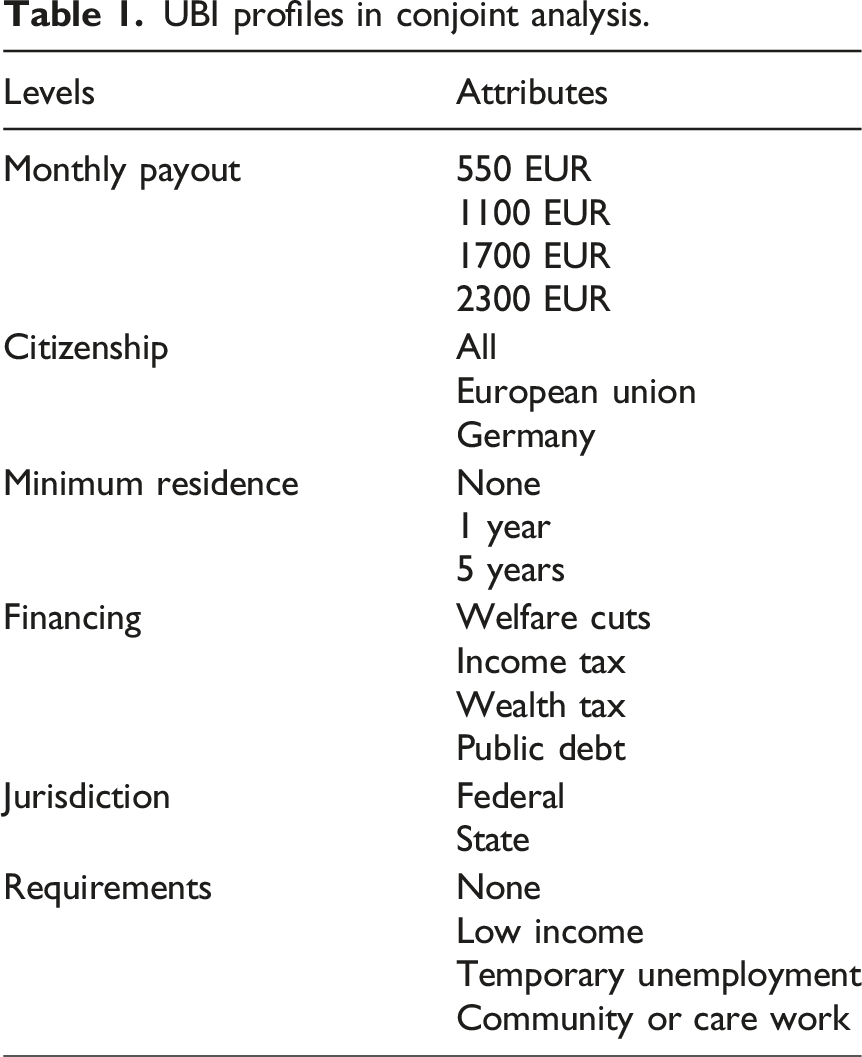
We also include two policy dimensions that have previously received less attention in UBI research. We assess the popularity of different financing mechanisms, including public debt, tax increases, and welfare cuts. This allows us not only to understand what sources of financing are preferred but also whether (universal) basic income schemes are seen as a complement or supplement to existing welfare institutions. In addition, we ask about the level of implementation, that is whether a basic income is implemented by the state or federal government. This dimension allows us to understand whether concerns about state capacity or regional redistribution affect individuals’ calculus.
Finally, we vary what conditionality requirements are attached to the policy. As a true UBI is unconditional, allowing for variation on this dimension enables us to assess in how far the often controversially debated unconditionality of UBI spurs attitude shifts and polarization.
Some might raise the concern that our empirical design departs from the strict definition of a universal basic income, as we vary primary features of a UBI in our empirical set up, most importantly the feature of universality and unconditionality. In this respect it is important to note that scholars disagree on eligibility criteria, many postulating a focus on citizens or long-term residents (De Wispelaere and Morales, 2016; Parijs, 2018). Besides, virtually all proposals put forward in our study far exceed current welfare arrangements in terms of generosity, unconditionality, and universality, even if they deviate from a maximalist version of UBI. In addition, numerous policy proposals and pilot studies labeled as UBI—such as those in Namibia, Alaska, Switzerland, Finland, the Netherlands, and Spain—have similarly deviated from the ideal-type, especially in terms of universality and scope (Gentilini et al., 2020; Laenen, 2023). Despite these variations, such initiatives are widely regarded as valuable within the academic UBI debate. As Laenen (2023) and others argue, studying a range of designs helps illuminate which features garner broader support and why, thereby justifying our approach.
Analysis
Our analysis proceeds in three steps. First, we present descriptive evidence on support patterns for UBI, based on ideology and material concerns. The dependent variable is the straightforward multiple-choice question measuring attitudes regarding UBI. Second, we analyze how proponents, indifferents, and opponents reason about UBI to determine where they agree or disagree in their arguments for and against UBI. Third, we use profile choice as the dependent variable in the main conjoint analyses. These are based on standard statistical tools to estimate the effects of the different attributes in the conjoint on support for a specific profile (i.e. basic income proposal). In the Appendix, we provide evidence that the results are consistent when using the profile score as the outcome. We then extend the conjoint analysis to estimate preference heterogeneity between UBI proponents and opponents.
Results
UBI support
We start with a descriptive analysis of UBI supporters to assess the extent to which their support aligns with traditional conflict cleavages. Consistent with previous studies, we find an overall high level of support for UBI. About 52% of respondents are supportive of UBI, whereas 22% oppose it and the remaining 26% are undecided. This is very close to the support levels that Roosma and Van Oorschot (2020) report. Based on data from the European Social Survey, they find that in 2016, approximately 54% of Germans support the introduction of a UBI, slightly less than the average support in European countries, which is at about 56%. Our data also attest to the political relevance of UBI support. Both proponents and opponents of UBI indicate a higher likelihood to turn out in a referendum (87.4% respectively 74.5%) than neutral respondents (63.6%). 3 To what degree does this varying support reflect conventional conflict lines?
Economic and ideological divides are key to understanding welfare politics. Figure 1 therefore dis-aggregates support for UBI by income groups (top panel) and by party affiliation (bottom panel). Support for UBI is high across all income groups but increasing with lower income levels. With over 60% it is highest among those with the lowest incomes and falls to about 38% in the highest income group. Inversely, those opposing UBI range from about 10% in the lowest income group to almost 40% in the highest. Indifferent respondents constitute about a quarter of each income group. While the overall support pattern aligns with material concerns, the high level of support even among the very rich is notable, suggesting that support for UBI is not only driven by material concerns. UBI support across different groups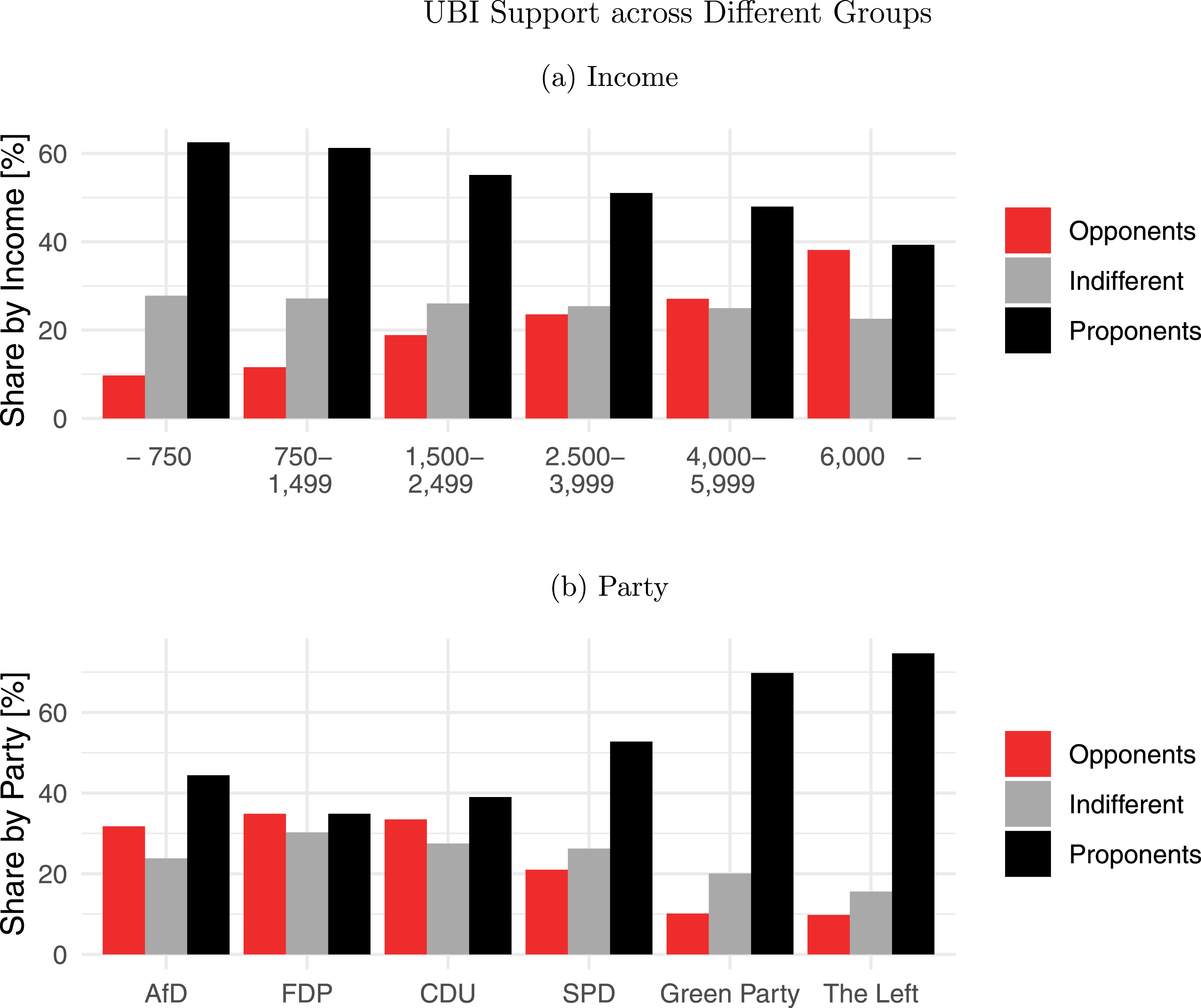
Turning to ideological divisions, the bottom panel of Figure 1 shows the distribution of support for UBI across the political parties currently represented in the Hamburger parliament (“Bürgerschaft”). The six parties are ordered from left to right on the ideological spectrum. The figure reveals that support for UBI increases and opposition decreases as one shifts from right-wing to left-wing parties, consistent with typical ideological alignments. That being said, among followers of the far-right AfD, support for UBI is higher than among the two center right parties, FDP and CDU. We also find that UBI proponents outnumber opponents in all parties, with the exception of the FDP, where they are at par. The electorate of the FDP also contains the highest share of undecided, closely followed by those of other right-wing parties. Levels of support among adherents of other, smaller parties (49.3%) as well as non-voters (42.9%) are similar to the electorates of right-wing parties (not shown).
Overall, we confirm that the preferences patterns towards UBI clearly reflects economic and ideological divisions that are known to play a prominent role in welfare politics. Nevertheless, we find considerable support for UBI across all economic and ideological groups. This shows that traditional divides do not (yet) dominate debates on UBI, possibly due to novel nature of UBI and the lack of attitude crystallization. At the same time, the relative preference heterogeneity within income and partisan groups also suggests a certain potential for UBI to overcome traditional political divides. It is therefore important to further unpack where opponents and opponents agree and disagree on UBI, irrespective of their ideological or economic position. We tackle this task empirically in the following two sections.
Arguments
Responses to the open-ended question show that respondents espouse a wide variety of argument both for and and against UBI. Figure 2 shows the type of arguments most frequently mentioned as important arguments for or against UBI. Clearly, normative arguments on the justice-dimension dominate the debate. Almost 40% of respondents mention at least one justice-related argument for UBI, most commonly its impact on poverty and inequality reduction. On the other side, about 15% of respondents identify justice arguments against UBI, most frequently in relation to pay equity and reciprocity. Prevalence of UBI arguments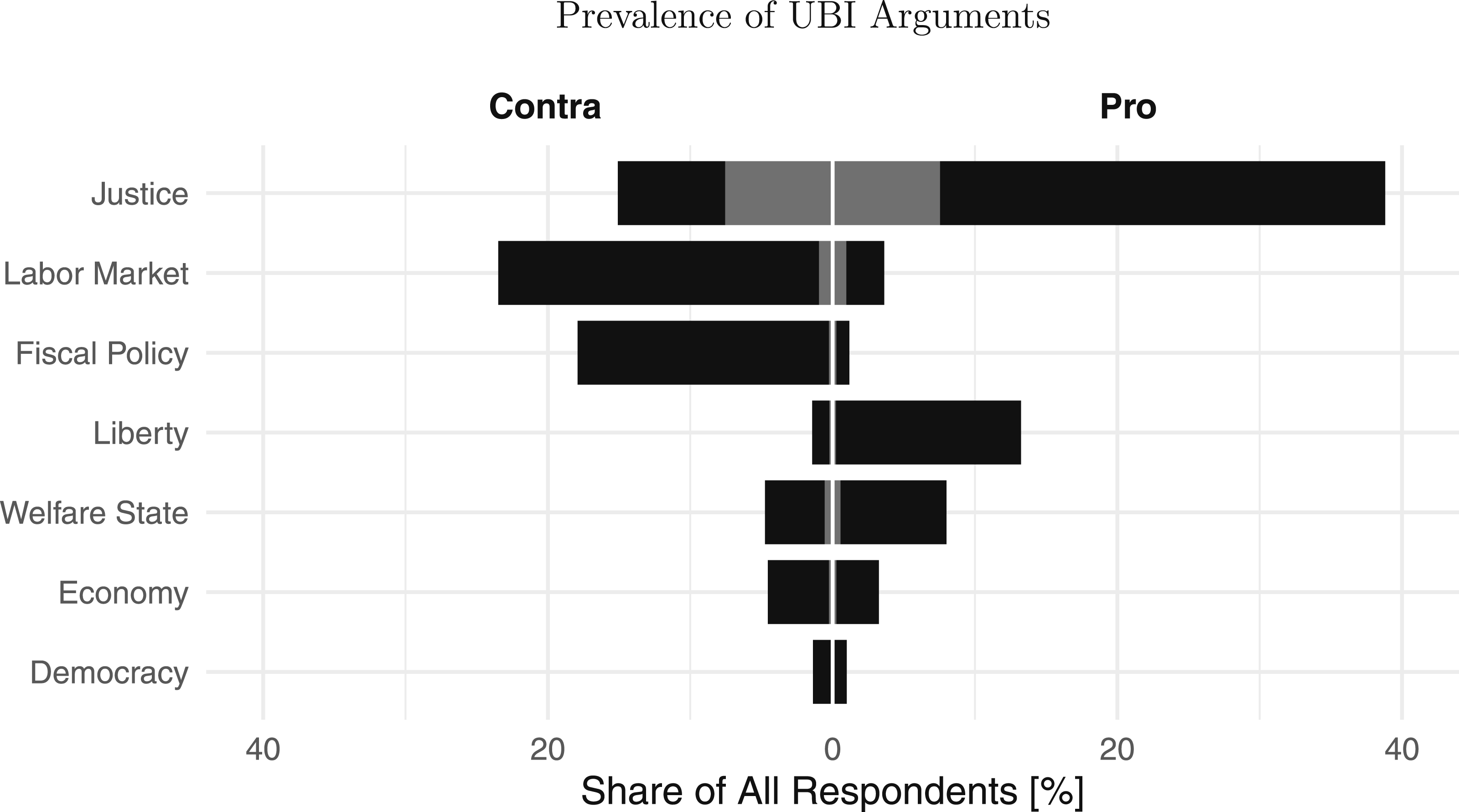
The labor market is the second most important category. This dimension is clearly dominated by contra arguments, which are mentioned by about 22% of respondent and typically emphasize reduced work incentives. By contrast, only a small number of respondents (about 4%) advance labor market arguments in favor of UBI. This is surprising given the frequent mention of labor markets flexibilization as well as labor power and standards in academic debates.
Fiscal policy arguments rank as the third most frequently mentioned category, primarily featuring counterarguments, with an endorsement rate of about 18% compared to just over 1% for pro-arguments. Here, concerns about fiscal viability and excessive tax burdens are predominant, while pro-arguments like new progressive taxes have little appeal. The fourth most common category pertains to individual liberty, which, like justice, is mainly supported by pro-UBI arguments; approximately 13% of respondents cite benefits such as personal development and stress reduction, while only about 2% view UBI as detrimental to liberty.
The remaining three categories of arguments, welfare state, economy, and democracy, are mentioned less frequently and display a more balanced pattern. While arguments related to the welfare state lean towards UBI (8% for vs 5% against UBI), negative impacts on the economy are slightly more commonly identified than positive effects (5 vs 3%), whereas the marginal category of democracy has just above 1% in either direction.
Do opponents, indifferents and proponents endorse different arguments? Figure 3 shows argument frequencies for the three groups. A first observation points to the relative importance of the different types of arguments is very similar for the three groups, with justice arguments topping the list. While it is no surprise that positive justice arguments outweigh negative ones for UBI proponents, opponents are almost equally as likely to acknowledge justice arguments for and against UBI. This shows that even UBI opponents recognize that a UBI has important justice-promoting elements. Prevalence of UBI arguments by general UBI support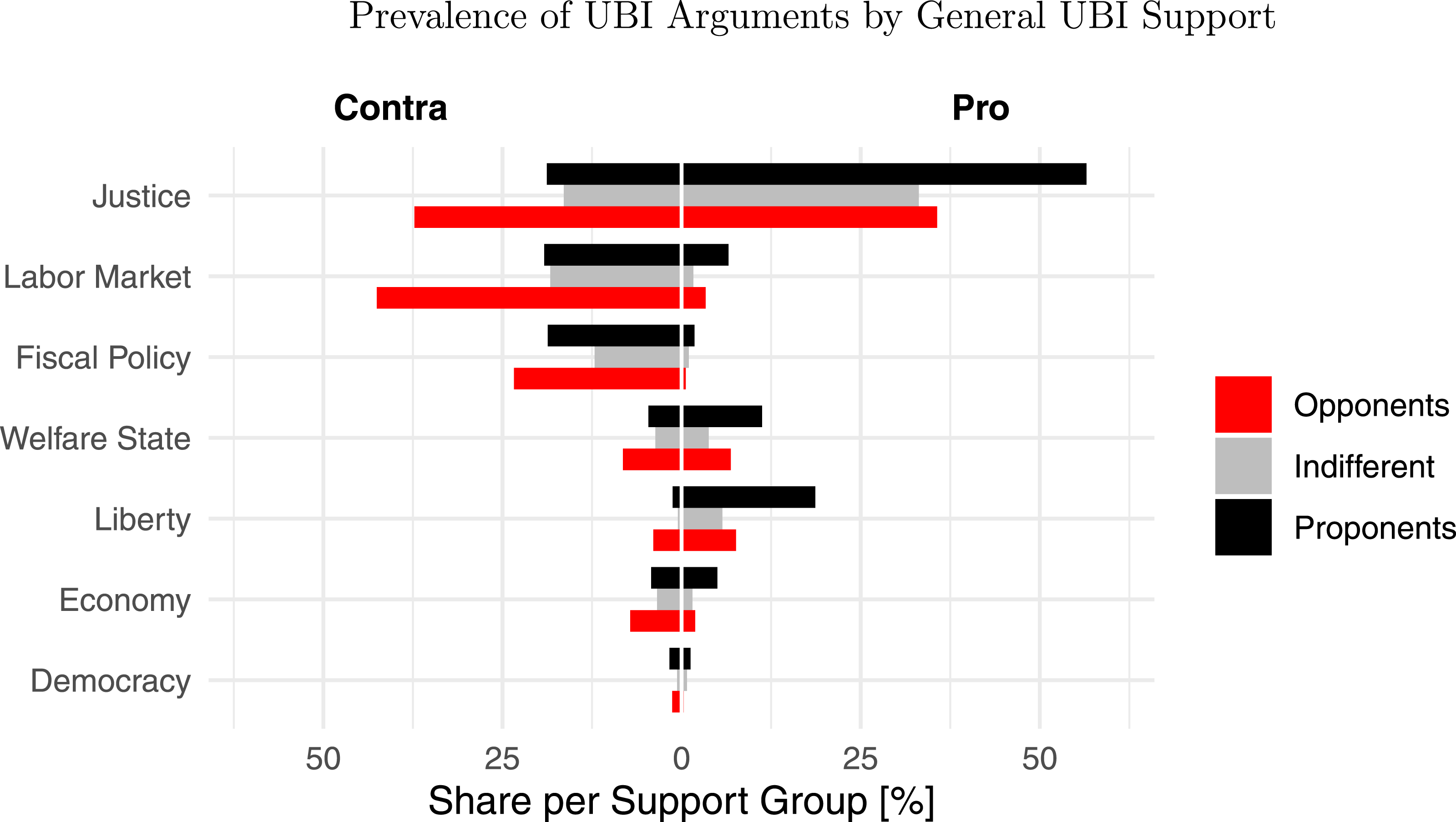
We show that the potential negative implications of a UBI on the labor market as well as fiscal limitations are acknowledged by proponents, indifferents and opponents. This suggests that both types of arguments can make proponents wary about their support, whereas among opponents, it is primarily labor market concerns and to a lesser degree fiscal policy implications that underpin attitudes.
Among the less frequently mentioned arguments, respondents seem to lean in line with general attitudes. Whereas proponents identify more positive arguments on the welfare state and the economy, opponents provide more negative ones with those indifferent towards UBI falling in between. With regards to liberty, the groups indicate more positive arguments, but opponents are more than twice as likely to do so. Finally, arguments about democracy are slightly more on the contra side in all groups.
Taken together a clear picture emerges and corroborates Jordan et al. (2022) who attest to the effectiveness of both value and policy-based arguments. Arguments about social justice dominate the public debate, resonating with both opponents and proponents of UBI, but pushing both groups in opposite directions. This attests to the importance of normative assumptions, specifically justice-based arguments in building support coalitions for UBI. At the same time, opposition to UBI is strongly rooted in concerns about the labor market and, to a lesser degree, fiscal policy. Overcoming such a concern is a primary challenge for any consensus-building effort. Arguments related to the welfare state and liberty stand to advance support for UBI among current proponents, and to some degree also opponents. However, the low frequency with which these arguments are mentioned suggests that they might only have a limited effect, which contrasts with the study by Gielens et al. (2023) on Dutch online discourse that finds welfare state and fiscal arguments to be highly relevant. Finally, arguments about the economy and democracy play only a marginal role and likely have a negligible impact in UBI debates.
Attitudes
In this section we present the results of our conjoint analysis. We first take a look at the preferences of the average respondent, mirroring the approach of prior studies of UBI attitudes. Figure 4 displays marginal means, which correspond to average probability that a policy package is selected if it contains the corresponding attribute. Marginal means, also called selection probabilities, above 50% indicate that the presence of the attribute increases the chance that a package is chosen, whereas values below 50 indicate a decrease. We present marginal means over more commonly used average marginal causal effects as they they are better suited to visualize preference polarization between subgroups (Leeper et al., 2020). The Appendix includes the AMCE estimates as well as marginal means of model that use the profile score as dependent variable. These alternative specifications corroborate the results of our main models. Conjoint analysis of BI design preferences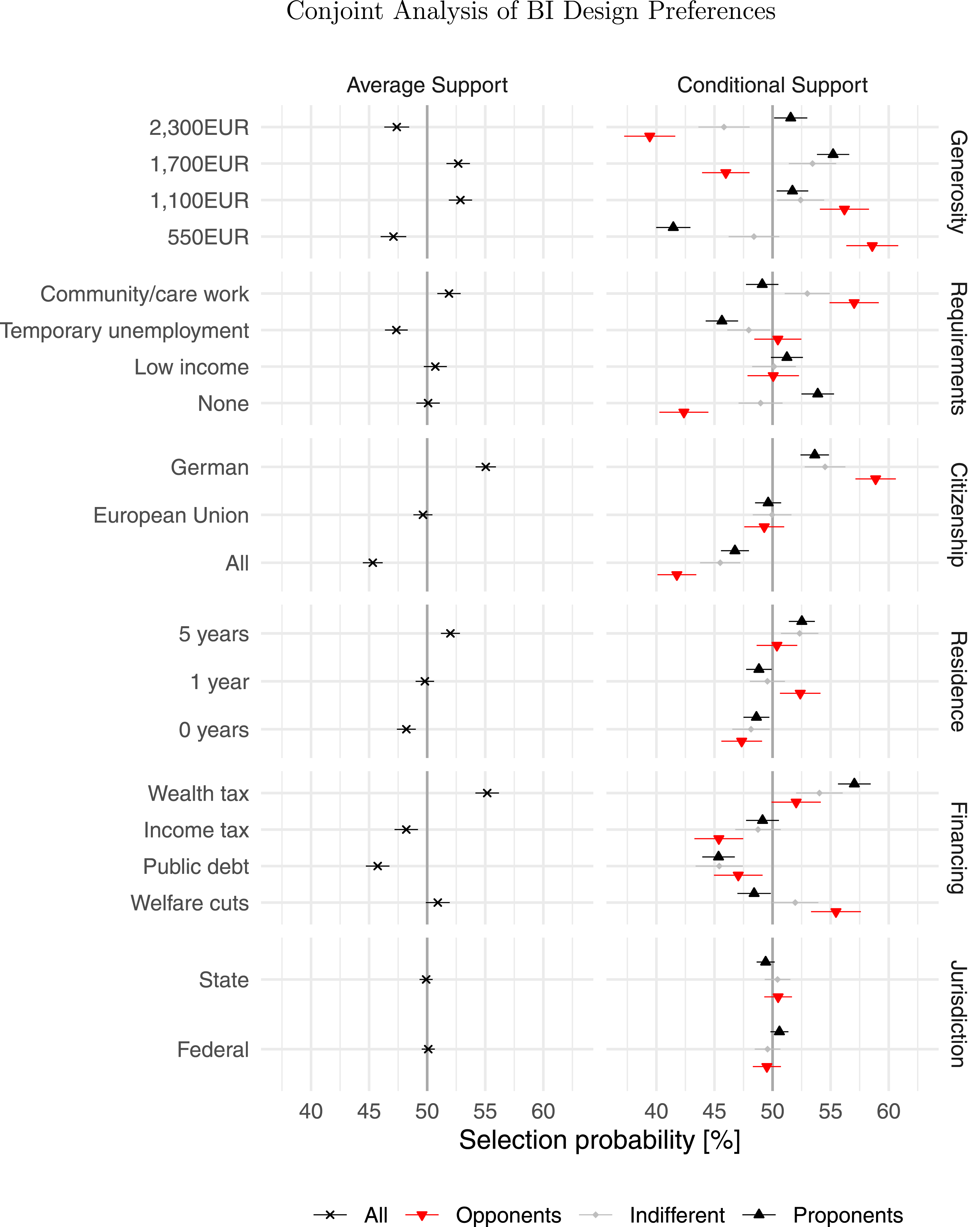
Average attitudes
The left panel of Figure 4 displays the average selection probabilities for different aspects in the entire sample of respondents. The estimate for generosity show that mid-levels of generosity increases the probability that a package is chosen, while the lowest (€ 550) and highest level (€ 2,300) lead to lower selection probabilities. This decline in support at higher levels contrasts with earlier studies, which typically report a monotonic relationship between generosity and average support (Chrisp et al., 2020; Laenen, 2023; Rincón et al., 2022; Stadelmann-Steffen and Dermont, 2020). The deviation observed in our study may be due to the omission of excessive generosity attributes in previous work. It underscores the economic rationality of the average respondent: Citizens do not seem to accept a basic income that will leave recipients well below the poverty line. At the same time, citizens are reserved towards an excessively generous UBI, either because of cost awareness of a more generous UBI in terms of social spending or economic competition or a perceived violation of fairness concerns.
Turning to conditionality as the second core characteristics of UBI reveals mixed results. We find that targeting persons with low incomes makes no difference in terms of average support (but see Laenen, 2023; Rincón, 2021), but targeting the unemployed generates lower support for a basic income compared to no requirements. In contrast, community and care work generate slightly higher support. While mandating employment-related obligations for those fit to work tends to increase support for welfare benefits generally (Buss, 2019), our results point to the additional relevance of socially desired activities (see also Atkinson, 1996). Nonetheless, while statistically significant these effects are rather small in size. Coverage, in particular citizenship, impacts attitudes more consistently. While respondents on average are neutral towards a BI scheme open towards EU citizens, support increases by about 5 percentage points when the basic income is limited to German citizens and decreases by the same amount when no citizenship restrictions are to be put in place. Similarly, the average respondent prefers higher minimum residence periods to be eligible for a basic income.
In line with previous research (Rincón et al., 2022; Stadelmann-Steffen and Dermont, 2020), our results suggest that financing is a key driver of average support. Respondents lower their support for BI proposals that are to be financed through income taxes and even more so through public debt. Financing through welfare taxes barely has any effect on average, but the introduction of a wealth tax increases support for a basic income package considerably (for a similar finding based on data from the UK, see Laenen, 2023). Finally, whether the BI is implemented by the state or federal government has no impact on the likelihood that the specific policy package is chosen.
Attitude polarization
Moving beyond the focus of prior studies on average attitudes towards UBI, we continue by investigating differences between UBI proponents and opponents. The results presented in the right panel of Figure 4 allow to identify the attributes inducing polarization and those characterized by consensus. Most generally, the widely different estimates on various dimensions clearly indicate that average effects brush over a large amount of preference heterogeneity questioning previous statements about the political viability of UBI.
The most pronounced differences in selection probabilities concern two of its most central aspects, its generosity as well as its conditionality. With regard to generosity, opponents become less likely to choose a policy the higher the level of the monthly pay-outs is. While this negative effect is not significant for a BI of € 1,100 (compared to € 550), higher pay-outs yield a large and statistically significant impact. In contrast, proponents are much more likely to choose policies with a payout above € 550, with the highest support going to € 1,700 and thus not the highest option available (€ 2,300). This result also attests to the importance of studying polarization. The analysis of average attitude attested to an equal popularity of BI of € 1,100 and € 1,700. However, the subgroup analyses show that high polarization between opponents and proponents makes BI of € 1,700 much more contentious than a BI of € 1,100.
Proponents and opponents also diverge significantly in their evaluation of the unconditional aspect of basic income proposals, while those indifferent to UBI fall between the two groups. First, having no requirements, and thus an unconditional scheme, increases the probability of a proposal to be selected by proponents but decreases it considerably among opponents. Second, among opponents requiring community or care work strongly increases the chances that a package is selected, while it does not affect choices of proponents. Third, proponents become less likely to choose a proposal that is targeted only at the unemployed, with no effects on opponents. Fourth, low income targeting has no significant effect on the choices of either group, which suggests that neither of them is concerned about excluding high income earners from receiving a basic income. As such, unconditionality strongly polarizes, while there is less polarization on specific requirements. The finding also shows that citizens have a clear understanding of the concept of UBI, with the core features of UBI being the primary source of polarization in attitudes.
Focusing on the universality aspect of basic income schemes, our results indicate that proponents, opponents and indifferents are significantly more likely to choose proposals that limit eligibility to German citizens and less likely to chose such that impose no citizenship restrictions, especially when it comes to extending benefits the benefit to citizens of non EU-member states. While this pattern is more pronounced among opponents, effects point in the same direction, suggesting limiting the eligibility of UBI as a potential common ground between opponents and proponents. We find similar results for residency requirements. Longer duration tend to be more popular among both group, though the effect on proposal choices are smaller and not always significant. Studies looking at average supports do find that the entitlement aspects matters for popular support (Bay et al., 2024; Laenen, 2023).
Both of these findings also link to research about pan-European solidarity. In line with our findings, this research emphasizes that Europeans are less inclined to show solidarity towards other Europeans than towards co-nationals, be it with regard to international redistribution (Afonso and Negash, 2024), or unemployment benefits (Kuhn & Kamm, 2019). A similar line of argument to explain such patterns pertains to welfare chauvinism, that is the idea that citizens wish to exclude migrants from being potential welfare beneficiaries out of a fear of (especially low-skilled) native population that newly arrived migrants will create competition for scarce welfare benefits and services (Andersen Bjorklund, 1990; for a recent review, see Careja and Harris, 2022). Attitudes towards migrations has shown to be a powerful explanation for preference towards UBI (Muñoz and Pardos-Prado, 2019). Migrants are also typically regarding as un-deserving of support (Van Oorschot, 2006) because they are argued to not have yet contributed to the host society. 4
The picture regarding the financing mechanisms is mixed. We observe divergent effects, and thus polarization, for welfare cuts, which decreases the probability that UBI proponents select a package but increase it for opponents. This suggests that proponents regard UBI as an expansion and not simply a restructuring of welfare. To the contrary, opponents are more likely to support basic incomes schemes that replace existing welfare institutions. We find no polarization for any of the other financing mechanisms, in particular public debt is unpopular among both groups, while a wealth tax makes both groups more likely to choose a proposal.
Finally, we find no evidence of polarization with regards to the jurisdiction. Choices of both opponents and proponents are not affected by whether a proposal is administered by the state or federal government. Generally, we read these findings as a sign that respondents did well understand to meaning of a UBI as it are precisely the defining features of a UBI that seem to be most polarizing (see Laenen (2023) for a discussion about the public’s understanding of the concept of UBI).
In conclusion, our conjoint analyses on the selection probabilities of different BI proposals among proponents, opponents and those indifferent towards UBI suggests that the defining features of a UBI are those with the strongest potential to polarize public opinion. Proponents and opponents disagree primarily over the level of generosity and the unconditionality of such a policy. The financing mode and in particular whether the funds for a UBI would come from cutting other welfare programs are also highly controversial. Advocates of UBI would be better advised to propose financing a UBI by means of a wealth tax as this is popular among all groups. Common ground can also be found with regard to universality of UBI, namely restricting entitlement to German citizens and demanding a certain residence before receiving a UBI. Other aspects such as the jurisdiction are not polarized and matter generally very little for the preference structure towards UBI.
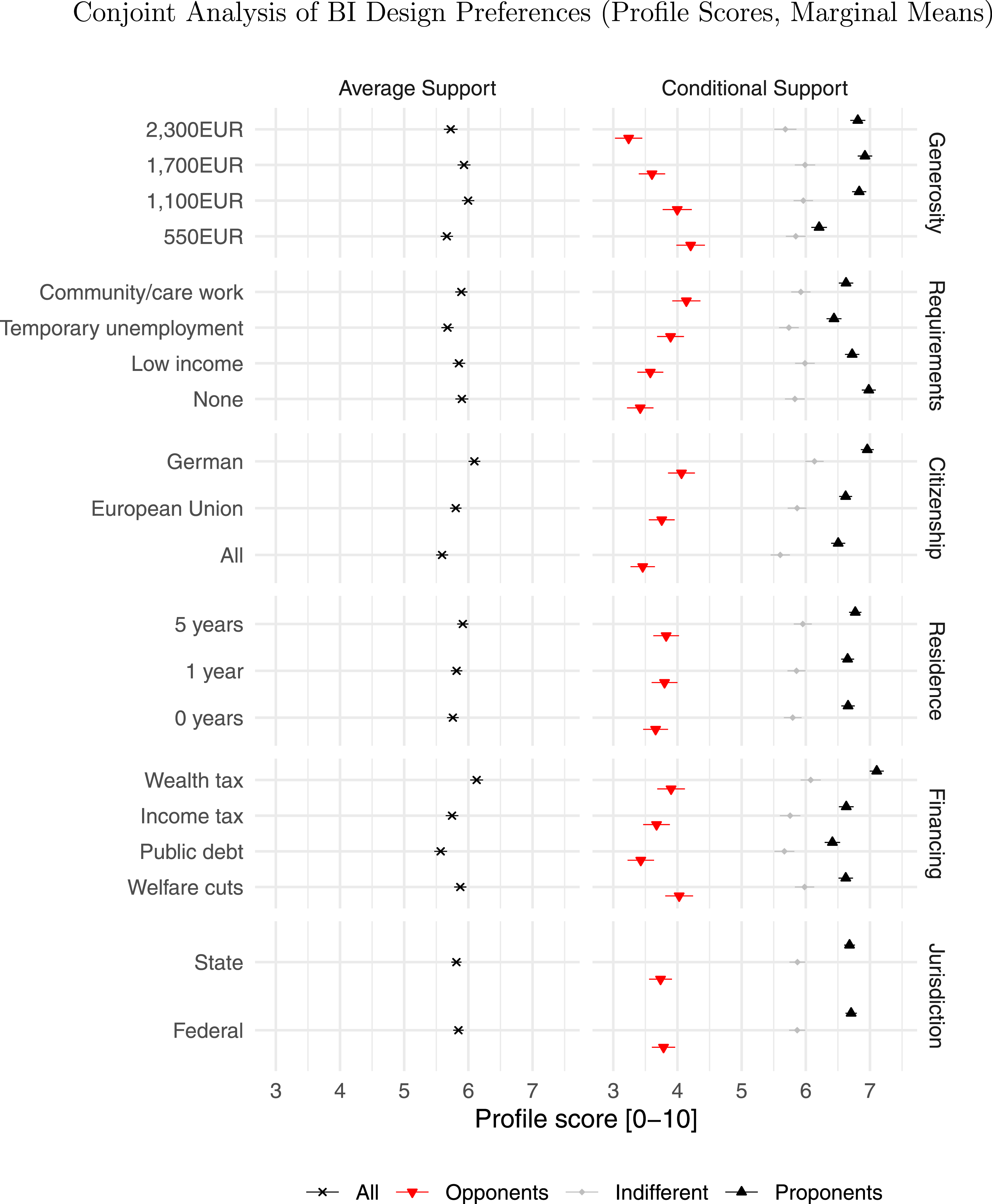
We read our findings as evidence that the public understands the nature of a UBI very well, as it are precisely the primary feature of a UBI that prove to be most polarizing. It is also important to note that while certain design bring proponents and opponents closer together, no UBI design overcomes the vast gaps in support levels: Even the least favored UBI designs will receive more support from proponents than the most favored ones among opponents. This can best be seen from a comparison of the scores respondents assign to each profile (see Figure A2). This finding also implies that UBI proponents would still be likely to accept a minimalist UBI whose design caters to the demands and preferences of UBI opponents.
Conclusion
A Universal Basic Income is a transformative social policy and as such highly contested in the public. In this study, we are interested in the possibilities of finding common ground between proponents and opponents of a Universal Basic Income. To this aim, we argue it is important to know which arguments for and against the policy proponents and opponents can agree on and which policy aspects of a UBI create the least polarization among opponents and proponents. Thus, our study investigates the extent of polarization between proponents and opponents regarding both the justifications for their individual stances on UBI and the specific policy design elements of a UBI. Based on a survey of a representative sample in the German state of Hamburg, where a campaign to introduce a UBI is currently running, we study who supports UBI, the arguments citizens give for why they support UBI or not and what elements of the policy prove to be most controversial. Importantly, our study consistently focuses on opponents and proponents towards UBI as the political viability of a policy depends on attitude polarization.
Our analysis unfolds in three steps. First, we link the preference structure regarding UBI to existing discussions on the conflict divides on the welfare state by providing descriptive evidence on UBI support patterns based on (party) ideology and material concerns (income). We find that preference patterns toward UBI mirror the economic and ideological divisions that are traditionally influential in welfare politics. However, we also observe significant support for UBI across all economic and ideological groups. This indicates that conventional divides do not (yet) dominate UBI debates, likely due to its novelty and the lack of firmly established attitudes. Simultaneously, the notable variation in preferences within income and partisan groups suggests that UBI holds some potential to bridge traditional political divides.
Second, we examine with open-ended responses how proponents and opponents reason about UBI to identify areas of agreement and disagreement in their arguments. We find social justice arguments touching normative concerns about fairness and justice clearly to dominate the debate with both proponents and opponents recognizing the potential benefits of UBI in addressing economic inequality and poverty. Concerns about the labor market and to a lesser extent fiscal sustainability, by contrast, remain significant barriers to broader acceptance, both among proponents and opponents of UBI. Overcoming such concerns would be a primary challenge for any consensus- building effort. Proponents and opponents disagree on how they link UBI to the existing welfare state and fiscal structure. Arguments related to the welfare state and liberty stand to advance support for UBI among current proponents, but only to some degree also among opponents. However, the low frequency with which these arguments are mentioned suggests that they might only have a limited effect, contradicting existing studies on the Dutch debate (e.g. Gielens et al., 2023).
Third, we study which elements of a UBI generates most polarization between opponents and proponents. We employ profile choice as the dependent variable in the main conjoint analyses extending the conjoint analysis to assess preference heterogeneity between UBI supporters and opponents. Our study reveals that the primary features of a UBI, namely the level of generosity and its unconditionality, incite most controversy between supporters and opponents. Disagreements arise also over the financing mode, particularly regarding whether UBI funds would come from cutting other welfare programs. Rather, advocates should consider a wealth tax for funding, as it is widely popular among both proponents and opponents. Echoing insights from scholarship on welfare chauvinism (Careja and Harris, 2022; Muñoz and Pardos-Prado, 2019), there is common ground between opponents and proponents on restricting entitlement to German citizens and requiring residency before receiving UBI. This also implies that a maximalist version of UBI that is inclusive irrespective of citizenship and residence does not lead to the highest support levels among proponents. That being said, it is important to note that our analysis could not cover all dimensions of a UBI. One important omission is the eligibility of children. Whether this and other dimensions offer more room for common ground or is marred by polarization can only be determined by future studies.
Our findings resonate with, but are broader than, existing literature on welfare chauvinism. While the exclusion of non-citizens and recent residents receives broad support among both UBI opponents and proponents—a pattern consistent with welfare chauvinist preferences—other interpretations are also plausible. For example, support for such restrictions among proponents may not necessarily reflect exclusionary attitudes, but rather strategic concerns about the long-term viability of the policy. Extending eligibility to recent migrants might be perceived as creating a strong pull factor, potentially jeopardizing the fiscal sustainability of the UBI. More broadly, our study contributes to the understanding of how different UBI design elements affect attitude polarization. Beyond citizenship and residency criteria, we find that intermediate levels of generosity and financing through wealth taxation are areas where preferences converge. These findings suggest potential pathways for reducing polarization in public debates about UBI design.
Our study enhances the study of public opinion on UBI in several ways. By focusing on polarization of attitudes rather than average support, we want to move the debate from a discussion about the drivers of the fundamental preference structure to a more specific debate about which elements of a UBI prove to be most polarizing and on which aspects proponents and opponents might find common ground. Hence, we contribute to the literature on UBI policy design and public opinion by emphasizing the importance of polarization, rather than merely average support levels, in determining the political feasibility of various policy designs. Here we find that it is precisely the defining features of UBI on which the public has polarized opinions. We read this as evidence that the public has a solid understanding of UBI, as its primary features are the most contentious. This finding presents an ambivalent picture: on the one hand, it is encouraging in that it refutes the common critique that public attitudes toward UBI are shaped by conceptual misunderstandings; on the other hand, it is sobering, as this conceptual clarity does not translate into greater consensus. The absence of confusion about the core idea of the UBI suggests a well-informed public, yet also highlights the depth of substantive disagreement, leaving limited scope for convergence.
At the same time, our findings complement the growing scholarship on UBI pilots and trials. A closer examination of both recent and more distant policy proposals and empirical initiatives–be it in Canada, Finland, Germany, Namibia, the Netherlands, Spain, or Switzerland–shows that a wide variety of differently designed basic income schemes and experiments exists under the label of universal basic income and which often diverge—albeit to varying degrees—from the ideal-typical concept of a basic income (Gentilini et al., 2020; Laenen, 2023). The scholarly interest is such that Laenen (2023) concludes by urging policy entrepreneurs to prioritize pilots over immediate implementation of full schemes, recognizing their heuristic and political value despite their conceptual limitations. Although caution is advised against inflating expectations about their broader policy impact (Neuwinger, 2021, see), this view is echoed by others (Chrisp and De Wispelaere, 2022). We take this as evidence that even policy proposals that do deviate from the UBI in a strict sense of speaking are insightful for the academic discussion on the UBI. They play a crucial role in shaping academic debates and informing public discourse around UBI, even when they fall short of the ideal-typical definition. We also take from the debate that existing policy schemes that fall under the label of UBI do vary considerably in terms of their adherence to the strict definition of UBI and are still considered insightful for the broader UBI debate. Particularly, Laenen (2023) argues that studying various variants of UBI–as we have done in this paper–allows to uncover which elements resonate with different groups, and which configurations gain broader support in an empirical setting that differs from the setting of survey experiments.
Our study further enriches the understanding of the rationales behind UBI support and opposition through the use of an open-ended survey question, which captures the full range of arguments without the constraints of predefined categories. Studying these rationales is important as it offers insights into the types of arguments that can be used in political framing to persuade citizens to endorse or reject the introduction of a basic income. Lastly, our conjoint analysis features a methodological innovation that allows us to study polarization in relation to policy design. Most conjoint analyses in political science focus on average effects, potentially brushing over differences between policy opponents and proponents in a way that fails to reflect the political prospects of different policy designs. Understanding attitude polarization is important because polarization and not average level of support shape the political dynamics around policy implementation. Polarization hinders compromise and hampers finding common ground and is therefore a significant obstacle to achieving democratic consensus.
Footnotes
Acknowledgements
We thank the Freiburg Institute for Basic Income Studies (FRIBIS) for providing generous financial support for this study. We are indebted to Julian Garritzmann, Nathalie Giger, Lukas Haffert, Simon Hug, Natalie Giger, Lars van Doorn, and the participants of CES (2024), DVPW (2024), FRIBIS (2024), and a research seminar at the University of Geneva for constructive comments and questions, and to Mika Bauer, Thomas Müller, Kevin Okonkwo, and Lina Wollgast for excellent research assistance.

Funding
The authors disclosed receipt of the following financial support for the research, authorship, and/or publication of this article: This work was supported by the Freiburg Institute for Basic Income Studies (FRIBIS).
Declaration of conflicting interests
The authors declared no potential conflicts of interest with respect to the research, authorship, and/or publication of this article.
Data Availability Statement
Replication materials can be accessed through Harvard’s Dataverse.
Notes
Appendix
Comparison of sample to population in Hamburg and Germany. Note: Hamburg and Germany refer to the respective population based on official statistics and election results. Vote choice for the sample captures voting intention for the next local election.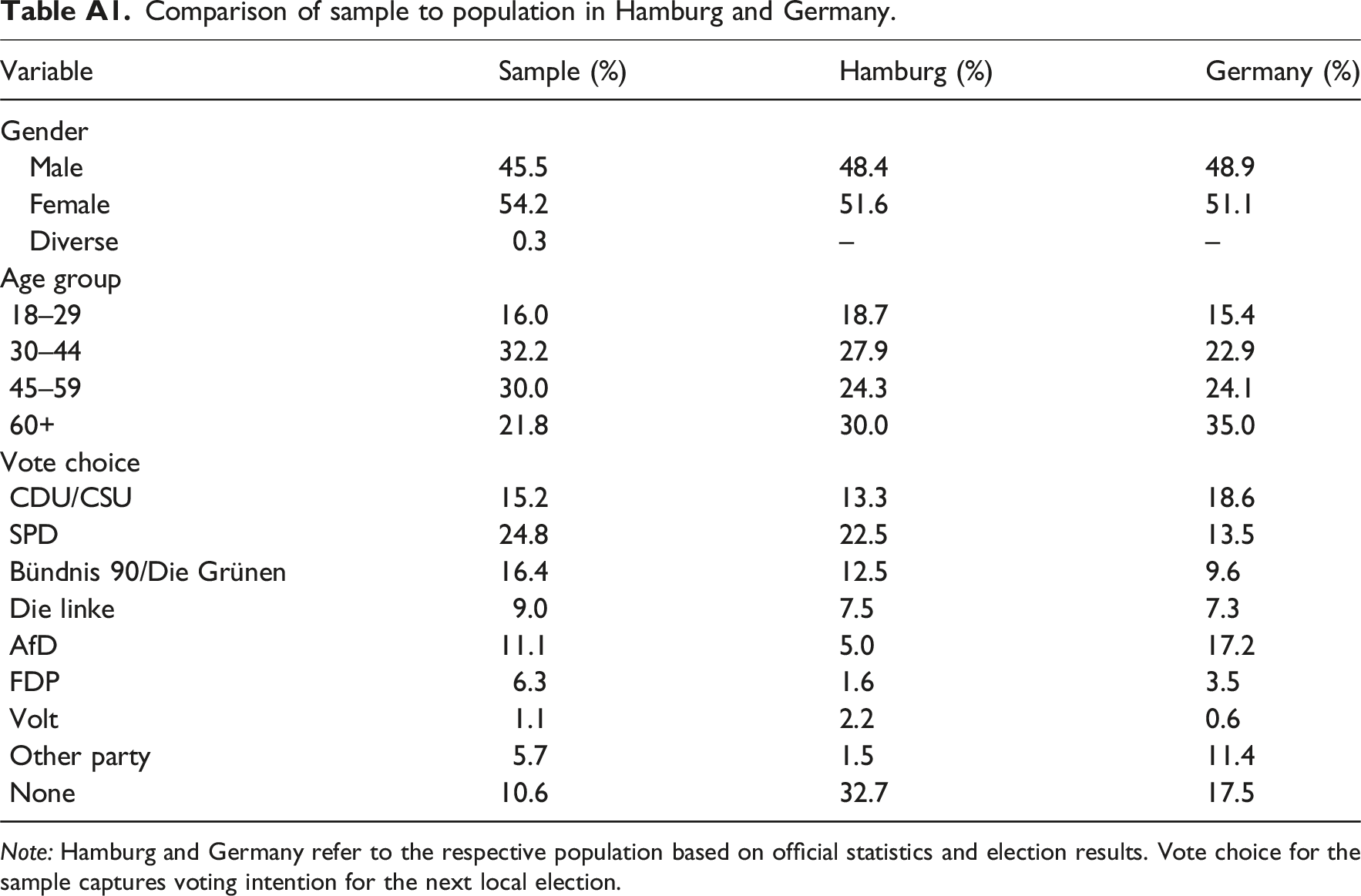
Variable
Sample (%)
Hamburg (%)
Germany (%)
Gender
Male
45.5
48.4
48.9
Female
54.2
51.6
51.1
Diverse
0.3
–
–
Age group
18–29
16.0
18.7
15.4
30–44
32.2
27.9
22.9
45–59
30.0
24.3
24.1
60+
21.8
30.0
35.0
Vote choice
CDU/CSU
15.2
13.3
18.6
SPD
24.8
22.5
13.5
Bündnis 90/Die Grünen
16.4
12.5
9.6
Die linke
9.0
7.5
7.3
AfD
11.1
5.0
17.2
FDP
6.3
1.6
3.5
Volt
1.1
2.2
0.6
Other party
5.7
1.5
11.4
None
10.6
32.7
17.5
Conjoint analysis of BI design preferences (AMCE estimates) Note: The AMCE indicates the change in the selection probability, in percentage points, relative to the reference category (indicated by null values). Left panels shows average effect based on complete sample; right panels shows conditional effect broken down by general support for UBI.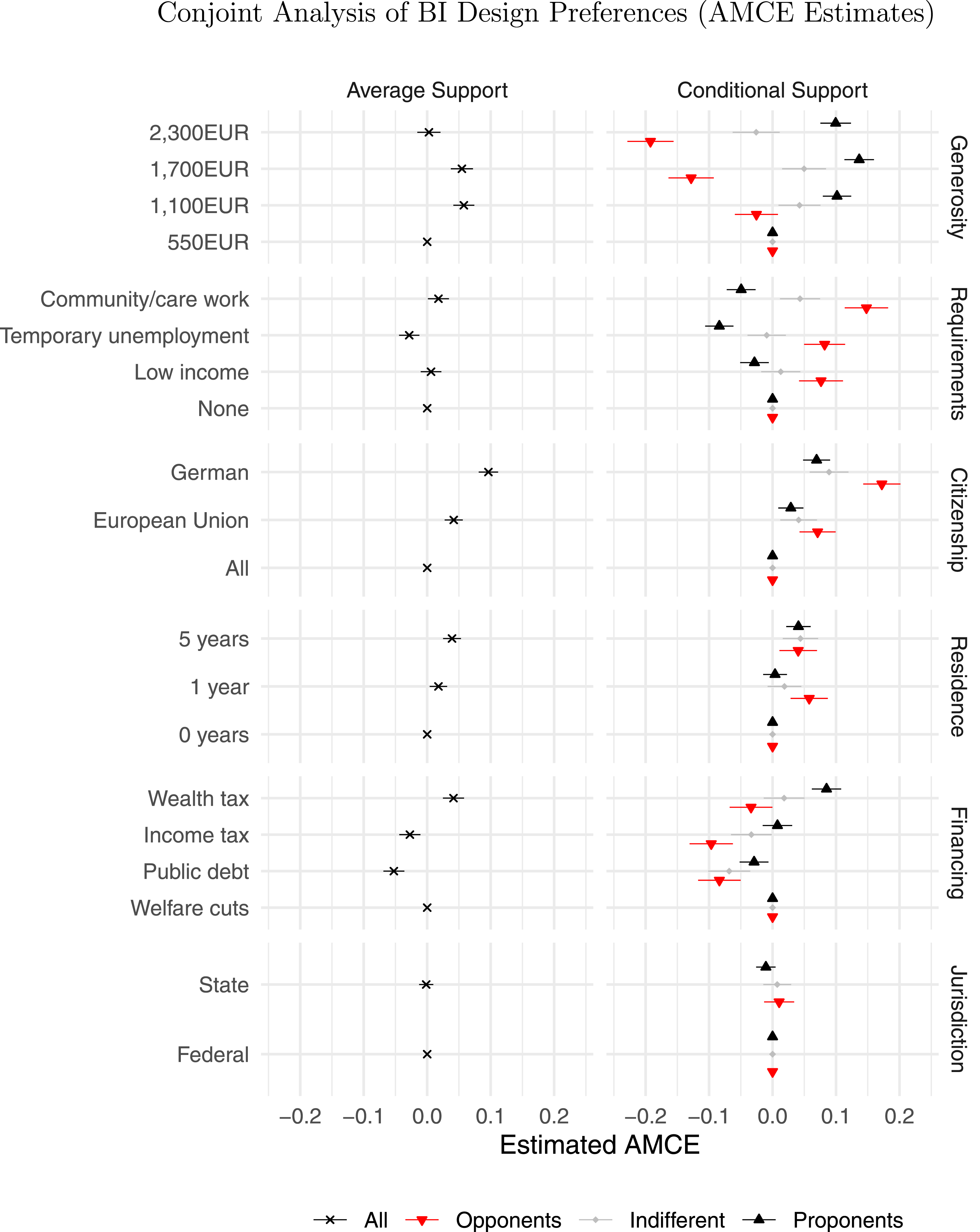
Conjoint analysis of BI design preferences (Profile scores, marginal means) Note: Profile scores correspond to the respondent rating of each individual profile. Left panels shows average scores based on complete sample; right panels shows conditional scores broken down by general support for UBI.