



Abstract
This article examines the capability of various welfare states to mitigate youth vulnerability, operationalized as a low NEET rate. It aims to complement existing empirical knowledge with a novel set of indicators and Europe-wide configurational comparison of youth welfare regimes. A QCA-based analysis of 26 European countries revealed two routes with different sets of compensatory and social investment policies that lead to the effective mitigation of the NEET rate. The study confirmed that generous social benefits for young unemployed people are a crucial element in every ‘route’ to keep the NEET rate low. Beyond this compensatory measure, successful policy configurations revealed the growing convergence of skills regimes in the pursuit of inclusive education policy design. We also found evidence that in mitigating youth vulnerabilities, housing support to young adults can compensate for active labour market policy measures. These findings have implications for policymakers who must take a holistic approach in devising policies and being mindful of the interplay between different policies. The study also provides insights into contemporary dynamics of the youth welfare regimes by making associations with growth regimes and housing regimes.
Introduction
Young people have been the cause of significant concern in Europe for more than a decade. Not only have they been disproportionately affected in economic terms by the COVID-19 pandemic, their dissatisfaction with life is also increasing to a worrying degree (European Commission, 2022). This raises questions about which policy configurations can better enable welfare regimes to cope with the social risks of the “yo-yo generation”?
From a macro perspective, concepts of youth transition regimes (Walther, 2006) and youth welfare citizenship regimes (Chevalier, 2016) provide important systemic insights into the complexity of young people’s lives across Europe. Chevalier (2016) operationalizes the concept of the “youth welfare citizenship regime” by social and economic dimensions and demonstrates how policy areas are interrelated and, as a result, form different combinations. Those policy combinations or youth welfare clusters can be contrasted to existing welfare regimes, which has been the main focus so far. Youth vulnerability, as a potential outcome of youth welfare regimes, has attracted much less attention despite its key importance in policy making. Academically, the gap in studying this outcome dimension can be explained by the complexity of the phenomenon: There is no easy answer to what qualifies as a ‘good’ model of transition from youth to adulthood. Existing welfare state research suggests that countries respond to similar challenges with different sets of policies. That means that in comparative welfare research, there is often a strong theoretical assumption of a configurational nature of associations between policies (Emmenegger et al., 2013). Previous research suggests that, there is likely no single combination of factors to enable successful youth transition but, rather, alternative institutional routes (Brzinsky-Fay, 2017; Lauri and Unt, 2021). This calls for the application of a configurational analysis to pursue the best fit between research epistemology and methodology (Ragin 1987; Thomann and Maggetti, 2020).
The current article argues that, on the one hand, both social benefits and education policies are crucial in reducing youth vulnerabilities, and on the other - these can be alternatively complemented by active labor market policies or support to youth home ownership. This implies different policy routes towards successful youth transition. In doing so, the article makes several contributions to youth transition research at the macro level. First, we show which policy configurations are associated with youth vulnerabilities. To this end, we reduce the complexity of the concept and focus only on one key vulnerability—that of being outside the education and labor market. The problems of young people not in employment, education or training (NEET) have been extensively studied at the micro level and there is solid knowledge of the individual characteristics that lead to this vulnerability (Furlong, 2006; Giret et al., 2020; O'Reilly et al., 2018). In contrast, this article examines the aggregated NEET indicator and asks which policies affect the NEET rate at the national level?
Second, we understand a particular NEET rate as the combined result of various area policies that interact with each other and can accelerate the vulnerability, or — in contrast — mitigate it. The analysis includes measures to reflect the social investment approach but also retains indicators of the conventional welfare state, such as social benefits for the unemployed.
Third, the article complements existing empirical literature with a Europe-wide comparison of youth regimes and their outcomes. Previous studies typically have covered only a limited number of Western welfare states (Brzinsky-Fay, 2017; Chevalier, 2016, 2020) while barely any macro-level analysis has been conducted of youth transition in Central and Eastern Europe (CEE). Broka and Toots (2021) tested the applicability of Chevalier’s (2016) framework on emerging welfare states in Eastern Europe but this study was limited to only six countries. This and some other studies (Helms Jørgensen et al., 2019; Hadjivassiliou et al., 2018) have revealed that CEE countries do not form a distinct post-communist cluster of youth welfare regimes. Further studies have shown that also the Nordic welfare model is not as uniform as often assumed (Knutsen, 2017; Kvist and Greve, 2011) Therefore, it may be worth going beyond ‘traditional’ welfare typologies to explore how European countries cluster in managing youth vulnerabilities, using the set-theoretical logic.
The article is structured as follows. Subsequent to a theoretical discussion of youth vulnerabilities and institutional contexts, hypotheses for the empirical analysis are formulated based on existing knowledge and set-theoretical methodology. We then present the outcome and explanatory conditions, before moving to the analysis and its findings. The concluding section relates the policy mixes leading to low NEET rates to the welfare regimes and proposes further research avenues.
State of the art: explaining youth vulnerability
Youth welfare citizenship regimes (Chevalier, 2016) are helpful in complementing traditional welfare regime research with a youth-specific focus. This concept has advanced the understanding of the diversity of ‘youth regimes’ and of the key institutions related to transition to adulthood. Nevertheless, the question of how to assess the combined effectiveness of youth-oriented policy-mixes in addressing youth vulnerability remains understudied.
Several studies (Fahmy, 2014; Ferragina et al., 2015) highlight that in most European countries income poverty is consistently higher among young people than in other age groups, which suggests that welfare policies appear less able to protect young people (Brady et al., 2009; Guillén and Pavolini, 2012). Rovny (2014) disentangled the effect of different social policies, finding that in 18 OECD countries, neither social spending nor family policies benefit the low-skilled young people at risk of poverty, yet active labor market policy (ALMP) does. Chevalier (2016, 2023) has studied a combination of various social benefits for which young people are eligible, such as social benefits, family allowances and tax reliefs, in different youth welfare citizenship regimes. He found that generous social benefits in “individualized” youth social citizenship models (as opposed to “familialized” models) seem to reduce youth poverty more effectively. However, despite recognition of links between youth poverty and institutionally embedded policy mixes, the literature remains vague on the comparative empirical test of the combined effectiveness of those policy mixes.
In the most recent literature, youth vulnerabilities are commonly interpreted through the lens of inclusion in the labor market or educational institutions (Plavgo, 2023), an indicator that we also use in this paper. The ratio of young people not in employment, education or training to the total population aged 15–29 (the NEET rate) has become a widely recognized benchmark for measuring countries’ performance in youth transition (Hadjivassiliou et al., 2018; Tosun et al., 2017; Walther et al., 2005) despite some criticism for including diverse subgroups of young people within one category typically associated with poverty and social exclusion (Mascherini, 2018). Indeed, this association of NEET with social exclusion does not hold universally, since some countries with high youth-at-risk-of-poverty rates do not have a large NEET population (O'Reilly et al., 2018). This suggests that the NEET phenomenon may be more complex than simply the productivist function of moving from education to the labor market. Previous literature that examines youth transition from the perspective of the labor market (Miguel Carmo et al., 2014; McDowell, 2020; Unt et al., 2021) needs to be complemented with the theories of growth regimes and skill formation (Garritzmann et al., 2022; Morel et al., 2011). Being understood as part of a social investment paradigm, skill formation policies have become central in the fight against youth unemployment (Brzinsky-Fay, 2017; Busemeyer, 2015). National approaches to skill formation are an important determinant of youth inclusion into employment and, thus, reducing the NEET rate. Education policies represent the core of any skill formation system. The first investment in successful labor market entry is made through initial upper secondary, tertiary or vocational education (VET). Institutional characteristics of initial education, such as the specificity of skills produced by VET (Capsada-Munsech and Valiente, 2020; Gangl, 2001; Raffe, 2014) or the stratification of the education system (Allmendinger, 1989) may explain the success of school-to-work transition. An inclusive skill formation approach provides skills for all; conversely, a selective approach represents a more elitist education system, enhancing the skills of the best (Chevalier, 2020). Comprehensive school systems that focus on general skills are usually more equitable but tend to have fewer connections with the labor market, and thus, bear a greater risk of unsuccessful school-to-work transition, at least for academically less able young people (Van de Werfhorst and Mijs, 2010). A well-established VET system could mitigate the risks related to school-to-work transition; but is often accompanied by a greater stratification of the education system (Busemeyer, 2015). This trade-off between equal educational opportunities and strong VET orientation is especially relevant in volatile post-industrial labor markets that value general skills which may remain underdeveloped if the focus is on specific skills (Durazzi and Geyer, 2022; Van de Werfhorst and Mijs, 2010). Thus, the stratification and standardization of education systems are crucial in identifying national variations in skill formation but their effect may depend on the permeability of tracks (Bol et al., 2014) and the presence of other supportive policies, such as study stipends or free education for disadvantaged youth (Kvist, 2017). Beyond initial education, ALMP can complement the skills learned in school with apprenticeship and labor market training (Bonoli, 2010). Chevalier (2020) distinguishes between inclusive (human-capital-oriented) and selective (labor-cost economy-oriented) approaches in school-to-work transition. However, the empirical evidence on the effect of these two approaches on youth vulnerability remains mixed (Cronert, 2023). Studies have revealed that even similar ALMP measures, including training programs, may achieve different outcomes due to a focus on different beneficiaries or programs (Caliendo and Schmidl, 2016; Tosun et al., 2017).
Housing has recently emerged as an important area in youth vulnerability research. Social policies —in interplay with the housing market, labor market segmentation and benefits’ generosity — have a substantial effect on the housing certainty of young adults (Meen and Whitehead, 2020). Housing uncertainty may postpone leaving the parental home and family formation (Bertolini et al., 2018; Tocchioni et al., 2021). The inability to choose a place of residence may limit job choices, especially for rural and disadvantaged youth (McKee et al., 2017). In the last decades, throughout all welfare models home ownership has gained more significance compared to the public rental sector. Therefore, housing policy analysis should not be limited to housing-related social benefits and services, but also include the regulation of home ownership via subsidies, tax deductions, state loan guarantees, and mortgage regulations (Dewilde and Haffner, 2022). Yet, policy support to home ownership frequently benefits the better-educated and highly skilled young people, while those in low-income groups struggle with access to rental and social housing, or rely heavily on family support (Filandri and Bertolini, 2016; Tocchioni et al., 2021). Increased uncertainty around housing, and its varying effect across welfare regimes and social groups argues for the inclusion of the institutional characteristics of housing policy in a comparative analysis of youth vulnerabilities.
Based on the discussed literature, we can make several assumptions regarding the policies that affect youth vulnerability, as measured by the NEET rate. First, institutional characteristics of the education systems are crucial in explaining young people’s vulnerability once they enter the labor market. Inequality in education leads to higher dropout rates and to a higher proportion of young people with lacking qualifications. In a knowledge economy, these low-skilled young people are more likely to find themselves in difficulty. Strong component of VET in education, at the same time, may have a twofold impact on NEET rate. Occupational skills are easily matched with employers’ expectations, which makes governments interested in financing VET. However, systems with strong vocational orientation tend to rely on early tracking, which is detrimental to educational equality. The education system’s capability to provide both, vocational skills and educational equality depends often on the interplay between social and education policies. Second, ALMP — as a component of youth economic citizenship together with education policy — is also important, since its explicit objective is to promote employment, and to ease the link between education and the labor market. Third, compensatory social policies can buffer youth vulnerability in any context of social investment since these provide income support and thereby contribute to the double-liability of the welfare state (Solga, 2014). For young people, the access to social benefits usually depends on whether they are seen as adults and can claim social benefits in their own right, or they are seen as members of their parents’ families, which prevents them from benefiting from social policies autonomously (Chevalier, 2023). Fourth, housing policy measures as embedded into labor market and welfare regime characteristics may facilitate or inhibit youth transition to adulthood and hence, effect the level of vulnerabilities (Beer et al., 2011; Fuller et al., 2020).
Set-theoretical approach, hypotheses and variables
QCA has emerged as a valuable tool for capturing institutional complementarities as it concentrates on combinations of explanatory dimensions that trigger the effect under investigation. This focus on combinations instead of net effects makes it well-suited for the analysis of welfare regimes where the contextual embeddedness of causal paths is assumed (Emmenegger et al., 2013). Moreover, recent empirical tests on the conjuncturality assumption have proven its value in the area of youth studies (Brzinsky-Fay, 2017; Lauri and Unt, 2021). Based on this knowledge and above-explained theoretical underpinnings, this article employs fuzzy-set qualitative comparative analysis (fsQCA) to explore the interplay between various public policy mixes and youth NEET vulnerability.
Usually, in a regression-based analysis to evaluate the effect of an independent variable on a dependent variable ceteris paribus, often each policy would lead to the formulation of a distinct hypothesis. However, such hypotheses do not sufficiently allow the adoption of a configurational perspective, which aims to reveal the mutual interplay between independent variables or conditions. Furthermore, regression methods and singular hypotheses struggle to grasp equifinality—the fact that different combinations of conditions can produce the same outcome. Hence, we propose instead a set of configurational hypotheses to increase the fit between our theoretical assumptions and the empirical data. Configurational analysis relies on a deterministic, rather than a probabilistic, conception of causality and follows the type-level (vs token-level) conceptualization of causality. Thus, causation is thought of in terms of necessary and sufficient conditions, that is the presence and absence of conditions is assumed to make a difference to the presence or absence of the effect (Rohlfing and Zuber, 2021).
We hypothesize, first, that no single policy is a necessary condition for the mitigation of youth vulnerability (H1). That means, different conditions have to interact to account for a low level of vulnerability, reflecting the idea of conjuncturality. Conjuncturality can mean two different things. It may imply that one policy offsets the effect of another (H2); that is, there is a compensation mechanism between the policies (Deeg, 2007). Or, instead of compensation, there is a complementing mechanism, meaning that a policy has an effect only when another policy is also present (H3). Finally, in terms of equifinality, we assume that different policy mixes may lead to the same outcome, that is, a low NEET rate (H4).
We analyze a 5-year period from 2015 to 2019 that captures the period between two recent crises (The Great Recession of 2008 and COVID-19 Pandemic). In this way, extreme periods that have radically increased youth vulnerabilities are excluded from the analysis and findings allow better seeing essential trends in youth transition. The target population (15-29 of age) was selected with reference to an ESPN report (Ghailani et al., 2021) and existing academic knowledge on transition to adulthood that highlights youth as a distinct period of the life course (Emirhafizovic et al., 2022; Lundahl and Olofsson, 2014; Unt et al., 2021). This is also the age range used in labor market statistics and for the NEET rate as a headline indicator of the EU Social Scoreboard (European Commission, 2021). In operationalizing the outcome and explanatory dimensions, we relied mainly on Eurostat and OECD data. For some indicators, a different age range was used based on available data (see Online Appendix 1).
QCA requests that raw data be transformed into set membership scores. This process of calibration entails the choice of three qualitative anchors for each outcome and condition: fully in (1), fully out (0), and the crossover point (0.50). Online Appendix 1 shows the measures and calibration used and Online Appendix 2 presents raw and calibrated data of all analytical dimensions. The sections below describe the rationale for choosing particular measures to operationalize our analytical dimensions and the calibration thresholds for each.
The Outcome dimension is measured by the ratio of young people not in employment, education, or training to the total population of young people aged 15–29 (NEET rate). Although it masks several important differences at the individual level, at the macro level it carries satisfactory explanatory power.
The average NEET rate for the period 2015–2019 was calculated giving a measure which ranges between 6% (the Netherlands) and 24% (Italy). While Southern European countries have more clustered around high NEET values, there is no clear-cut distribution along welfare regimes. There is evidence that post-2015 average NEET rates have stabilized around 12%–13% (Maynou et al., 2022). Therefore, for the QCA analysis, the crossover point was set at 13.2, giving a calibrated outcome with 17 positive cases that are successful in mitigating youth NEET vulnerability (see Figure 1 and Online Appendix1 1). The explanatory dimensions capture four policy areas: social protection, education, ALMP, and housing. Because of the data gaps, the United Kingdom and Cyprus were subsequently excluded from the analysis. Outcome and explanatory dimensions Sources: OECD, Eurostat (see Appendix 1 for details).Notes: Blue lines indicate the calibration thresholds of the explanatory dimensions (alternative thresholds tested in the robustness test, see Online Appendix 3).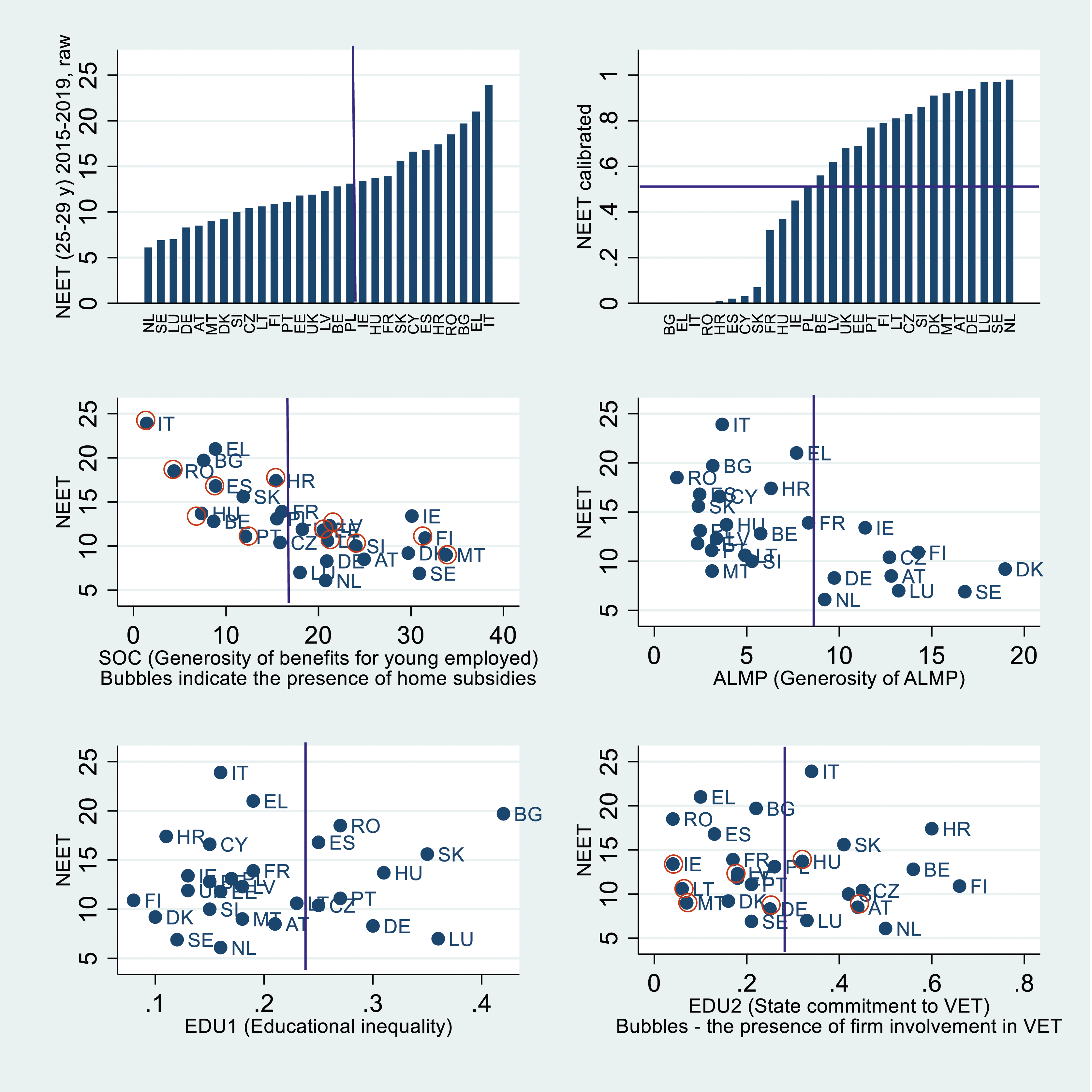
The Social protection dimension (SOC) is measured by the generosity of all social benefits available to a young person in case of unemployment. Generosity of benefits is defined as social benefits as a percentage of the national average wage. Figure 1 scatters the association between the social protection dimension and NEET (upper-left panel) and, as expected, shows a relatively strong negative correlation (−0.7) between the two dimensions. Thus, despite a strong social investment rhetoric, compensatory policies apparently still play a strong role in the effective ‘youth regimes’. Yet, a relatively high generosity of SOC can be found in both high and low NEET countries that justifies the configurational approach in revealing policy packages behind the effective mitigation of youth vulnerabilities. The crossover point between countries with generous and non-generous benefits is set at 17.3, giving a calibrated SOC dimension with 14 cases that offer generous social benefits to unemployed young people.
The Educational dimension includes two sets: EDU1 measuring educational equality and EDU2 measuring state commitment to VET. The distribution and formation of skills vary within the youth population and form an important part of economic citizenship. Equal access to education is indubitably a policy direction that mitigates youth vulnerability by lowering school dropout rates. EDU1 is operationalized by between-school variance in socio-economic background and measures the degree to which schools differ in the socio-economic composition of the student body, a measure often used to capture educational inequality at system level (Ferreira and Gignoux, 2014). EDU2 indicates state commitment to VET provision, operationalized as a combination of public expenditure devoted to VET programs (ISCED35, ISCED45) as a percentage of GDP, enrolment rates in VET programs (ISCED35, ISCED45) and firm involvement, operationalized as the share of students in combined VET programs. This combined operationalization captures the varieties of skill-formation systems by considering both public and private dimensions of state commitment in VET (Capsada-Munsech and Valiente, 2020). In calibrating educational equality (EDU1), a between-school variance of 0.22 was chosen as the threshold between relatively equal and unequal systems, a level well-aligned with the division between more comprehensive versus tracked systems (Eurydice, 2020). We use reversed calibration: the higher the measure of educational inequality, the lower the country’s membership in the set of educational equality. For the second educational set (EDU2), state commitment in VET, we, first, calculate the public commitment by multiplying indicators of public expenditure and enrolment in VET programs, and second, we calibrate this measure, and finally combine the public commitment with firm commitment by maximum rule (see Online Appendixes 1 and 2 for concrete values and steps). The resulting measure reflects high state commitment in VET meaning high enrollment and either high public or firm involvement in providing it. There are 17 such countries, the majority representing coordinated market economies (Figure 1). Overall, we have four types of educational ‘regimes’, with the highest number of countries having high scores in both dimensions (educational equality and state commitment in VET), some countries with high values in only one dimension, either in VET commitment (mainly continental-European countries) or in equality. Some countries do succeed in neither.
The Labor Market dimension (ALMP) is operationalized via financial resources devoted to ALMP instruments (Rueda, 2014). We measure the generosity of ALMP as per capita expenditure on ALMP categories 2–7. In calibrating the ALMP dimension, the crossover point is set at 9 - countries that spend at least 9000 EUR per capita are considered generous ALMP countries. Nine countries belong to this group (see Figure 1). The group includes different welfare regimes, and the correlation between ALMP generosity and NEET rate is weaker (−0.46) than for social benefits. This may be due to the fact that there is no measure of ALMP generosity for youth only, as it exists for social benefits.
For the Housing dimension we rely on a dichotomized measure because of limited data availability. The OECD statistical database on housing affordability and Eurostat data on households’ housing situation are not sufficiently comprehensive for calibration. The dimension should include measures for home ownership because housing allowances are already included in the SOC dimension. To construct a housing measure that reflects various subsidies for homeowners, qualitative data (Krapp et al., 2022; OECD housing affordability database, 2022) were used and calibrated as following: Countries with policy measures to support home ownership among young people (tax exemptions, off-budget government guarantees, monetary stimuli) score 1.0, while a value of 0.0 is applied to countries not meeting the criteria. This gives 15 countries with positive values (Figure 1) representing mainly tenure-oriented housing systems (Olsen, 2019).
The potential arbitrariness of thresholds was controlled by a robustness test with alternative thresholds and our results turned out to be non-sensitive toward those changes (Online Appendix 3).
Set-theoretical analysis of youth NEET vulnerability
The analysis was conducted using R packages QCA (Dusa, 2019) and SetMethods (Oana and Schneider, 2018). Following QCA standards, we start with the analysis of necessity, followed by the sufficiency analyses (Schneider and Wagemann, 2012). To assess the validity of findings, consistency and coverage parameters are considered in QCA. Consistency indicates the goodness of fit of a given set-theoretic claim 1 and coverage indicates the empirical relevancy of that claim 2 . These two indicators tend to be negatively associated: the stricter the consistency threshold, the fewer the cases explained and vice versa. At the same time consistency is measured first and coverage becomes relevant only if consistency meets the threshold criteria. For the necessity, the recommended consistency threshold is 0.9 and for sufficiency 0.75 (Oana et al., 2021) 3 .
We start with the necessity analysis and none of the analyzed dimensions meet the threshold (0.9) for the necessity (see Online Appendix 4). Thus, our first hypothesis (H1) is confirmed: No single policy alone can temper youth vulnerability. Yet, the generous benefits for unemployed and high state commitment to the VET have relatively high consistencies, that is are present in several ‘positive outcome’ (low NEET) countries. The absence of a single necessary dimension is relatively common in social sciences and strengthens the need for sufficiency analysis to test for the conjuncturality and equifinality assumptions.
The analysis of sufficiency based on the ‘truth table’ algorithm.
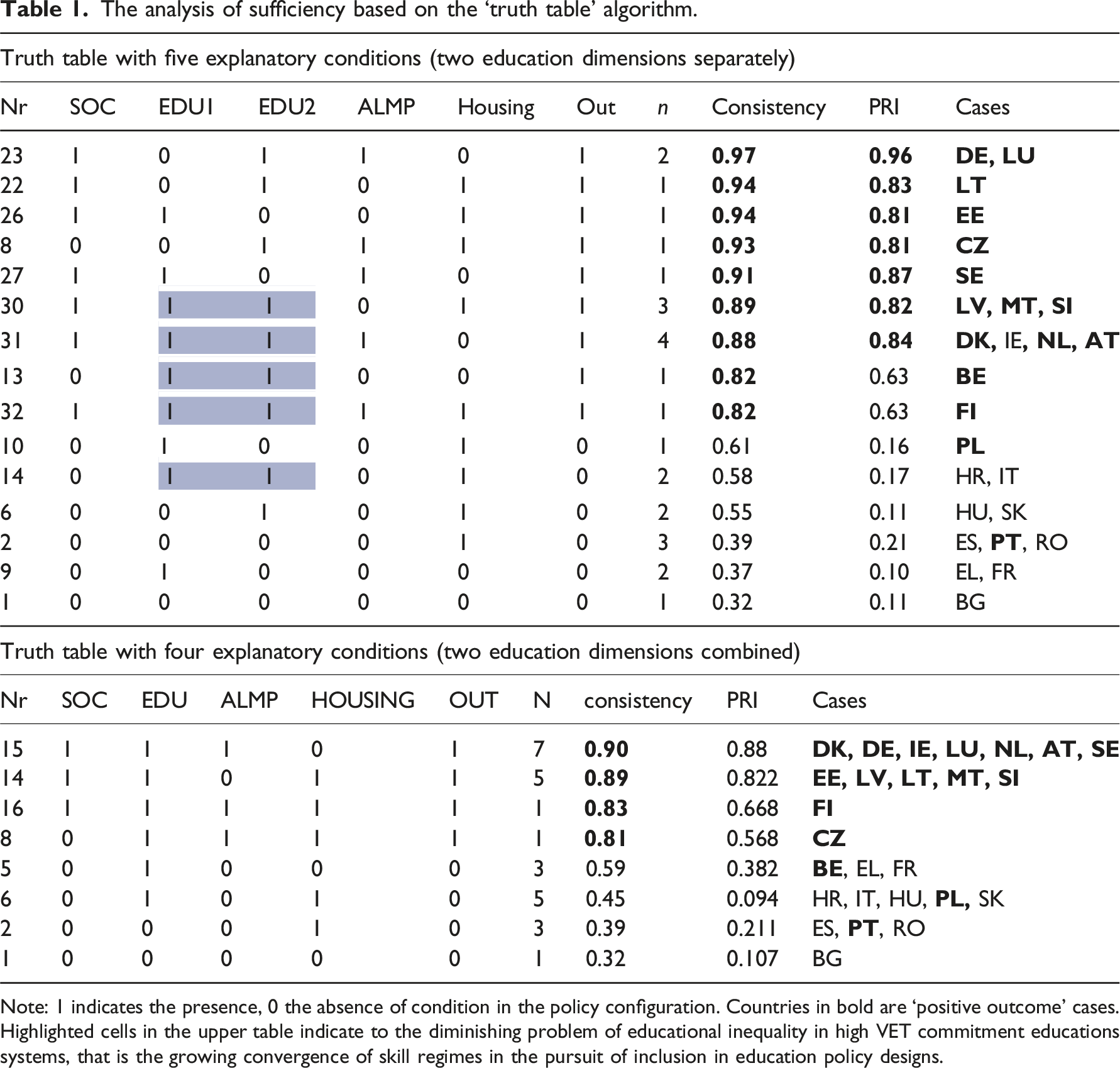
Note: 1 indicates the presence, 0 the absence of condition in the policy configuration. Countries in bold are ‘positive outcome’ cases. Highlighted cells in the upper table indicate to the diminishing problem of educational inequality in high VET commitment educations systems, that is the growing convergence of skill regimes in the pursuit of inclusion in education policy designs.
Nine configurations meet the consistency criteria for sufficiency (0.8). However, the problem of idiosyncrasy occurs as we have several configurations with only one empirical match, challenging the empirical relevancy of our analysis. Therefore, in the following analysis, we combine two dimensions of education, low level of educational inequality (EDU1) and state commitment in VET (EDU2) to diminish the problem of limited diversity. With this combination we still account for the varieties of skill regimes in mitigating youth vulnerabilities explained but acknowledge the growing importance of mitigating educational inequality in all types of educational regimes (Table 1 highlighted rows). The resulting ‘higher order concept’ of the educational dimension (EDU) considers countries satisfying the threshold if they have either low level of education inequality or high state commitment to VET, or both. Technically it means the combination with maximum rule (see Online Appendix 2 for concrete values).
Sufficient routes to a ‘positive outcome’.
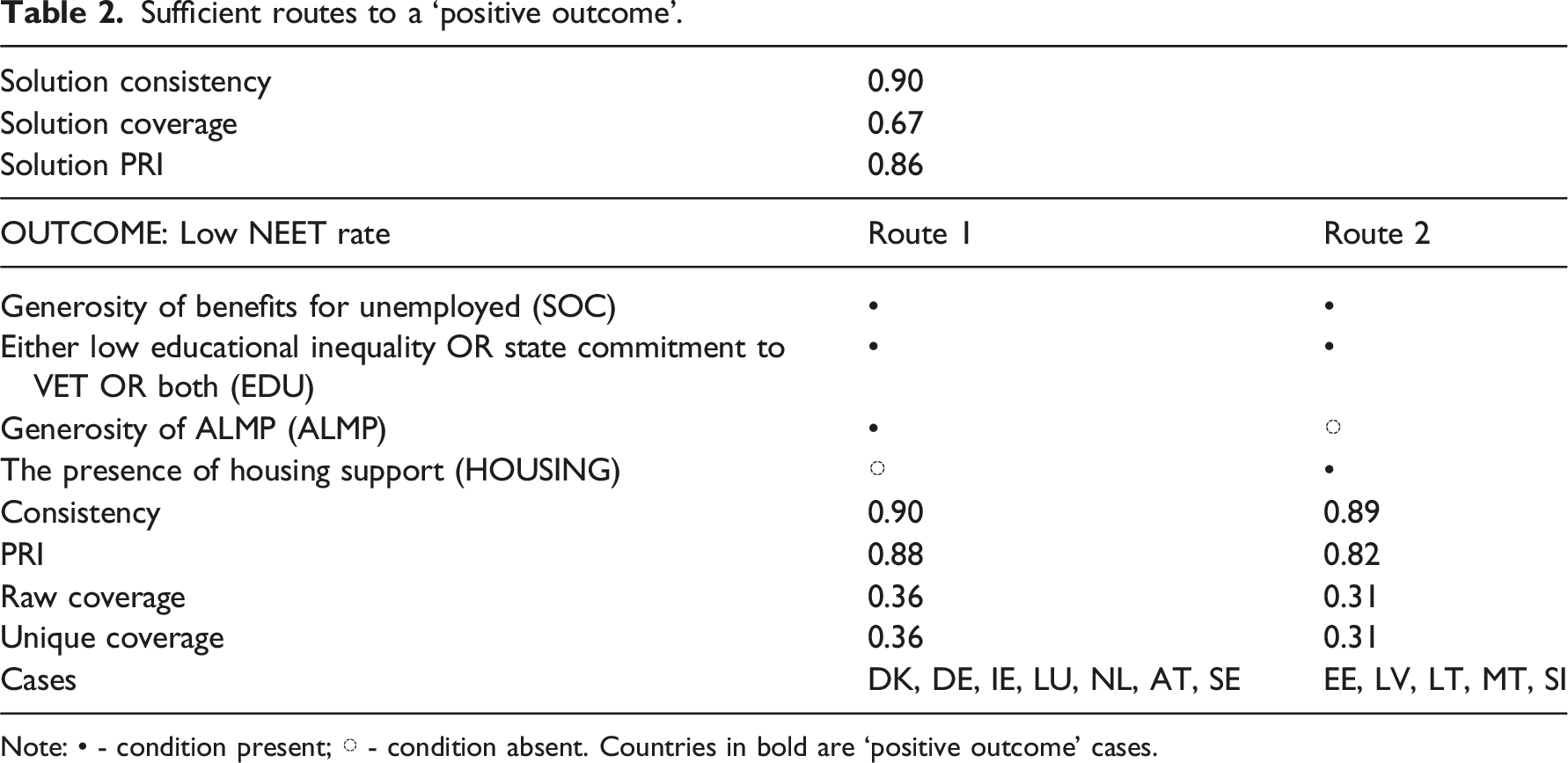
Note: • - condition present; ◌ - condition absent. Countries in bold are ‘positive outcome’ cases.
Figure 2 scatters the results by plotting the x-axis based on countries’ membership scores in one of the sufficient routes, and the y-axis by membership scores in ‘positive outcome’. 11 countries in the upper-right quadrant are those explained, that is, these countries follow one of the sufficient routes and have a positive outcome. Countries in the upper-left quadrant have a positive outcome but cannot be explained by the analyzed sufficient routes. Czech and Finland have a unique truth table row (Table 1) and were excluded due to limited empirical match. Belgium, Poland and Portugal are contradictory cases because they belong to the same configurations as countries with a negative outcome; therefore, these ‘truth table’ rows do not meet the consistency threshold. Ireland, the only country in the lower-right corner, belongs to a successful route (Route 1) but does not achieve a low NEET rate (i.e., positive outcome). Countries in the lower-left quadrant are irrelevant for our analysis as these do not have a positive outcome. ‘Explanatory power’ of youth welfare regimes analysed in article Notes: X axes – union of membership scores in one of the explanatory routes (X) in Table 2. Y – axes membership score in outcome (Y). Upper-right corner – countries ‘we explain’, that is have positive membership score in both X and Y. Upper-left – countries with positive outcome (Y) but we are not able to explain, that is not in any explanatory route. Lower-right corner – contradictory case, that is country with negative outcome but belongs in one of the routes in Table 2. Lower-left – ‘irrelevant cases’, that is cases with negative outcome.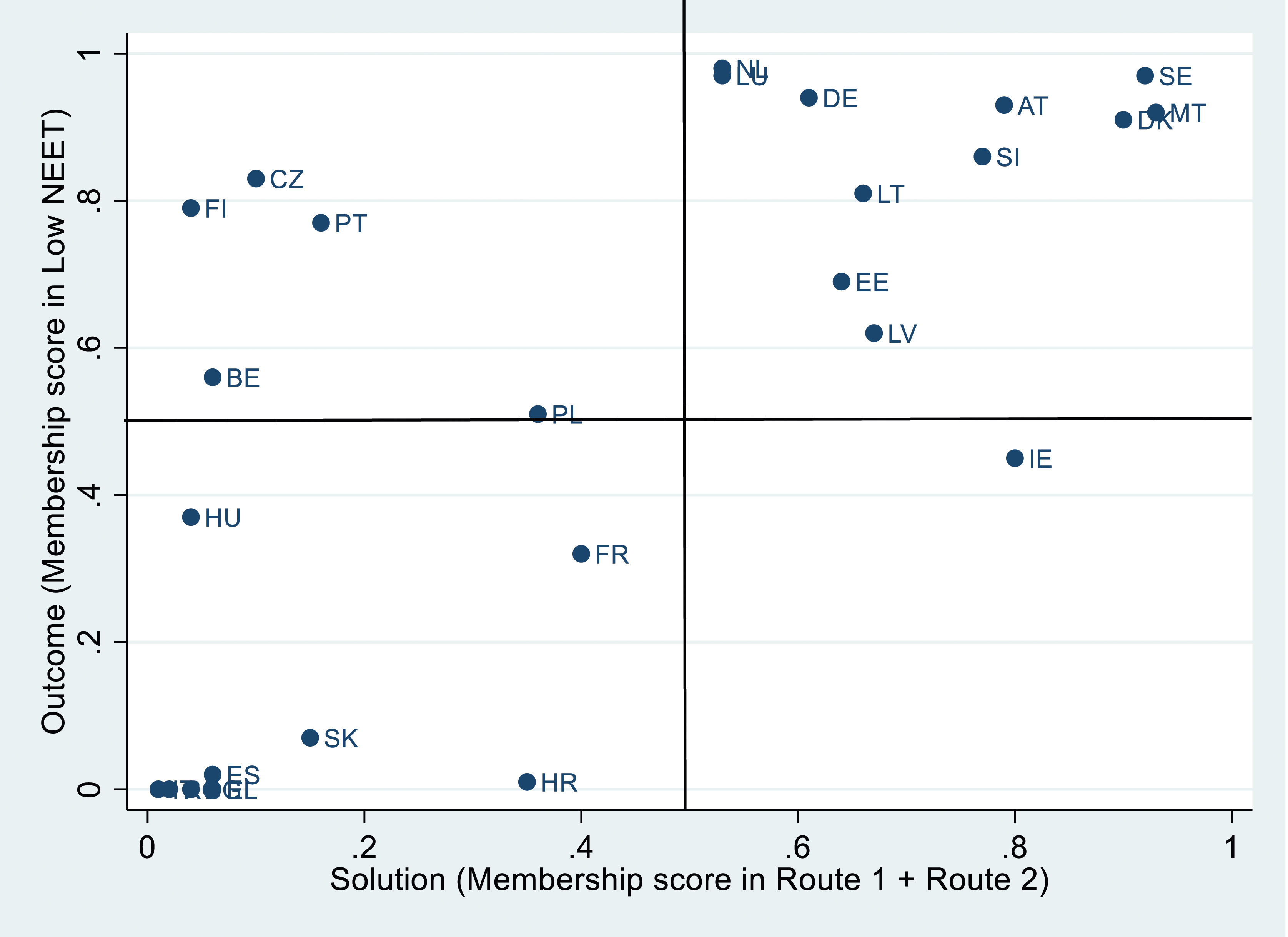
In light of our hypotheses, the compensatory (H2) and complementary (H3) policy effects revealed by Routes 1 and two reflect various interplays between compensatory and investment-oriented measures. More specifically, the interplay between generous benefits for unemployed young people and the importance of educational dimensions either in terms of low inequality or high state commitment (or both) is a must in a policy package to temper youth NEET vulnerability. The additional presence of generous ALMP makes the combination of social and educational dimensions sufficient to several Continental and Nordic countries (Route 1). This combination seems to be most effective in high VET commitment countries; in some countries (Germany, Luxembourg), it even compensates for high educational inequalities. This route shares several qualities of the ‘monitored youth citizenship’ (Chevalier, 2016). In the other group of countries (Route 2), sufficiency is gained by the presence of housing subsidies instead of generous ALMP. In terms of youth citizenship regimes, youth autonomy is actively emphasized here instead of ‘monitored youth citizenship’.
We also ran a robustness check to test the solutions’ sensitivity toward various thresholds as suggested by Skaaning (2011), for the consistency threshold and calibration threshold of explanatory and outcome dimensions (see Online Appendix 3 for details). Both routes turned out to be robust in the light of most tests. However, in case of very high consistency threshold (0.9) and stricter outcome calibration (crossover point of NEET rate at 11.5), only Route1 survives.
Conclusion and outlook for youth welfare regime studies
This article examined the capability of various youth welfare regimes to alleviate youth vulnerabilities in an era of insecure labor markets, social investment challenges and the financialization of housing. Epistemic communities need to adjust their conceptual and methodological toolkits to address these institutional complexities. The current article attempted to do so by studying the outcome of youth transition routes in 26 European countries. It provided a novel understanding of youth vulnerabilities, measuring NEET risks not just as a “productivist” dichotomy of school and labor market, but looking also at social investment components via education and housing measures. The key question was - which combinations of policy configurations effectively mitigate youth NEET vulnerability?
Set-theoretic QCA seemed an appropriate tool to solve this task. It revealed 11 countries with a positive outcome, clustered into two routes. The empirical analysis confirmed the set-theoretical assumption of conjuncturality (a low NEET rate can be achieved through the interplay of several policies rather than one single policy) and equifinality (a low NEET rate can be achieved by different combinations of policy instruments). It further showed that in different routes policy choices may either compensate or complement each other. As far as conjuncturality is concerned, education policies together with compensatory social benefits seem to be crucial in reducing the NEET rate, which would argue in favor of a Nordic understanding of ‘social investment’, articulating active and passive social policies (Morel et al., 2011). Concerning equifinality and youth welfare regimes, the article identified two main routes leading to low NEET rates confirming Chevalier’s (2020: 349) claim that youth welfare regimes “are congruent with specific growth strategies” of countries. Route 1 (Social buffer with vocational skills and generous ALMP) has the highest coverage of countries, both from the Continental occupational and the Nordic universal welfare model. As expected from the occupational welfare regime, state commitment to VET and generous ALMP contribute to a low share of NEET youth. However, some countries in Route 1 (Denmark, Netherlands and Austria) have an equal educational system and strong VET commitment at the same time, indicating that a strong commitment to VET skills is not necessarily a trade-off between skill specificity and educational inequality. Support for homeowners is not a policy preference here, in line with the domestically oriented growth regimes (Reisenbichler, 2021) and tradition of a substantial rental sector in housing (Olsen, 2019).
Route 2 (Social buffer with equal general skills and homeownership) includes emerging open market economies (the Baltic states, Slovenia and Malta) and is closest to the Anglo-Saxon welfare model, which pays more attention to human capital creation than labor market governance, and whose growth regimes tend towards an export-oriented service economy (Hassel and Palier, 2021). Analysis of the emerging welfare regimes on the edges of Europe provided novel insights into the contemporary dynamics of the liberal model. Estonia, Latvia, Lithuania, Malta and somewhat surprisingly also Slovenia represent home ownership housing regimes with dualistic and highly commodified rental sectors, which indicate how housing is becoming important in understanding youth pathways to adulthood. In open and service-sector-oriented economies with lean welfare support, “owning a home remains the aspiration of most young people – not only for sociocultural reasons but also because property is possibly the most attractive investment” (Vella, 2021:12). Our study thus is a valuable addition to existing youth welfare regime studies (Chevalier, 2020, 2023; Walther, 2006), where housing is only briefly mentioned as a marker of youth transition. Furthermore, our results support the trend highlighted by Di Carlo and Durazzi (2023) that in the era of knowledge economy a clear separation between skill formation regimes, based on VoC theory, is diminishing. Education policies that embed both, inclusiveness and specific skill orientation turn to be effective in mitigating youth vulnerabilities.
In future, this small-N comparative study could be complemented by in-depth case studies to further inform a theory of alternative routes to low NEET and to explain youth policies of those countries we were not able to explain. Future research might also consider including other policy areas to better capture the multidimensional character of contemporary youth vulnerabilities. One such potential area is health and long-term care. Mascherini (2018: 523) found that illness and disability cause a substantial number of young people to become NEET, while in Eastern Europe, family responsibilities pull young women out of education and the labor market. In Anglo-Saxon countries and Italy, the gender composition of the NEET is strongly polarized and could additionally be explained by structural barriers and family responsibilities. Yet, youth-specific comparable datasets in these areas are yet to be compiled. In sum, a knowledge of the interplay between policy domains is crucial in understanding the dynamics of the NEET rate.
Supplemental Material
Supplemental Material - Policy mixes and youth vulnerability in Europe: A qualitative comparative analysis of the NEET rate
Supplemental Material for Policy mixes and youth vulnerability in Europe: A qualitative comparative analysis of the NEET rate by Triin Lauri, Anu Toots, Tom Chevalier, Anna Broka and Dirk Hofäcker in Journal of European Social Policy.
Footnotes
Acknowledgments

Declaration of conflicting interests
The author(s) declared no potential conflicts of interest with respect to the research, authorship, and/or publication of this article.
Funding
The author(s) disclosed receipt of the following financial support for the research, authorship, and/or publication of this article: This work was supported by the COST (European Cooperation in Science and Technology); CA17114, “Transdisciplinary solutions to cross-sectoral disadvantages in youth (YOUNG-IN)”.
Supplemental Material
Supplemental material for this article is available online.
Notes
References
Supplementary Material
Please find the following supplemental material available below.
For Open Access articles published under a Creative Commons License, all supplemental material carries the same license as the article it is associated with.
For non-Open Access articles published, all supplemental material carries a non-exclusive license, and permission requests for re-use of supplemental material or any part of supplemental material shall be sent directly to the copyright owner as specified in the copyright notice associated with the article.
