



Abstract
This article examines the role individuals’ basic values about responsibility, uncertainty and child rights, have on willingness to accept state intervention in a family in a potential child protection situation. A key area within social sciences is how and when it is justified for governments to restrict individual freedom, for example allow authorities to intervene in the private sphere to protect a child from potential harm. In this article data from representative samples of the populations in six countries – Norway, Finland, England, Poland, Romania, and Czechia (total n = 6031) are analysed. Two main explanations are tested, first if individuals’ basic values explain willingness to restrict freedom, and second, if institutional context explains country differences. The results show that individuals who favour parental responsibility, accept uncertainty, and who have high ambitions on child rights, also favour interventions in the family to protect a child. However, sociodemographic variables nuance these findings. Institutional context sheds light on country differences. Our analysis show that people overall are positive to child protection interventions, and our findings accord with results within welfare state- and child protectionsystem research and provide increased knowledge about the relationship and connection between people’s value base and support for welfare policies.
Introduction
A central question in political science and welfare state research is what the state should be responsible for in terms of welfare and protection of citizens’ rights. How much service provision should a welfare state provide, and when and how is it justified that the state intervenes and restricts individuals’ freedom to secure other individuals’ welfare? Which interests should be protected by the state, and which actions should be sanctioned or restricted? Public opinion about these questions is key to understand the institutional arrangements in welfare states as well as the legitimacy of state interventions. In this article we examine if individual’s basic values and institutional context explains public opinion about the state’s responsibility for protection of child rights when their parents and family do not provide sufficient care and protection. Supranational regulations and international case law give some directions on how far the responsibility of the state should go, and how the state should balance child rights and parental rights. The UN Convention on the Rights of the Child (CRC), which is ratified by all countries in the world except the USA, obligates states to have a child protection system that intervenes if a child is maltreated or abused, and includes protection ‘from all forms of physical or mental violence, injury or abuse, neglect or negligent treatment, maltreatment or exploitation, including sexual abuse, while in the care of parent(s), legal guardian(s) or any other person who has the care of the child’ (United Nations, 1989: article 19). Child protection is a controversial and complex policy area, as it requires the state to sometimes restrict parental freedom to secure the child’s rights and best interest. There is a range of views and normative sentiments about what the threshold for legitimate interventions by the state in the family should be, what constitutes maltreatment, or what the best interests of a child might be, just to mention a few discussions (see e.g. Berrick et al., 2019, 2022a, 2022b, 2023a; Burns et al., 2021; Helland et al., 2018; Loen and Skivenes, 2023; Skivenes, 2021). However, there is limited research that seeks to explain and understand people’s views towards child protection, and differences and similarities between countries. We aim to expand this knowledge base. Following the idea that people have basic values that impact how they view others and government action, we examine three dimensions to understand acceptance of intervention into the family: (i) responsibility for an action, (ii) requirement for certainty (false negatives vs false positives), (iii) ambitions for the state in terms of child rights. To shed light on differences between country populations we examine the role of institutional context. Our data material is survey data from representative samples of the populations in Norway, Finland, England, Poland, Romania, and Czechia (total n = 6031).
The article contributes to three branches of research literature. First, expanding the knowledge on individuals’ basic values and the role they play in shaping people’s beliefs and preferences about welfare state responsibility. Second, contributing to the policy feedback literature on institutional context and how welfare state institutions impact populations’ views and values. Third, complementing the scarce literature on public views on child protection.
In the next section, theory and expectations are outlined, followed by method and result sections, before we discuss the results and provide final remarks.
Theory and expectations
There is a large literature within social sciences on how people’s values affect their decisions and behaviour (Feldman, 1988; Schwartz, 2012) or how populations’ cultural values explain behaviour or cross-societal policy differences (Hofstede, 1984). The psychologist Schwartz (1992), (see also, Fischer and Schwartz, 2011) describe values as inherent traits of individuals. Values are understood to be abstract beliefs regarding desirable objectives, which act as guiding principles when individuals assess situations, people, and actions. Fischer and Schwartz (2011) emphasise that individual core values are systematically connected to personality traits, attitudes, and behaviour, and they serve as standards or criteria based on which actions, policies, people, and events are judged or evaluated (Schwartz, 2012). Furthermore, there are some values that are present across cultures. The core value perspective highlights that the prioritisation of values will differ among individuals, and that for some there are values that are more important than others. We build on this platform although we do not apply the core values scheme of Schwartz. Instead, we draw from previous child protection research (Berrick et al., 2022a, 2022b, 2023a; Skivenes, 2021), using three values that we consider essential in child protection assessments, labelled basic values including: (i) individual responsibility, (ii) approach to uncertainty (false negatives vs false positives), and (iii) ambition for state responsibility for child rights. We test if citizens’ positions on these values affect their preferences regarding whether, and to what extent, the state should intervene in a family to ensure a child’s safety and protect their rights.
Basic value: responsibility
The first basic value is individual responsibility. The premise that individuals are responsible for actions they themselves are in control of is a sentiment that is widely known across liberal societies and is associated with the ideal of individual freedom and autonomy (Cappelen et al., 2007; Mill, 2002). Free and autonomous individuals can make their own decisions and should be perceived as responsible for the outcomes of those decisions. Individual responsibility is frequently discussed in welfare state research as what individuals should be held responsible for, and what role individual responsibility should be assigned in distributive policies (Cappelen et al., 2010). Deservingness theory poses that citizens perceive some welfare beneficiaries as more deserving than others (Appelbaum, 2001; Goerres et al., 2020; Kreitzer et al., 2022). There are several factors that influence citizens’ perceptions of deservingness, with the most important being control over neediness, that is, the person’s own responsibility over his neediness. We examine whether the perceived responsibility of a parent in a child protection case matters for the public’s support for intervention. Determining ‘what one has control over’ is not straightforward. Attribution theory states that people interpret behaviour in terms of its causes and these interpretations play an important role in determining reactions to a behaviour (Appelbaum, 2001). Peoples’ perceptions about control have been studied using experimental vignettes (Appelbaum, 2001; Gift and Lastra-Anadón, 2023; Skivenes et al., 2023; Wu, 2021), showing that when a subject is responsible for the situation they are in, respondents are more likely to blame the subject. When the subject is not at fault, respondents perceive them as more deserving of help and support redistributive policies. Sickness is an example of a condition that empirically is regarded as outside a person’s control, whereas unemployment is more often considered as something a person can control (Jensen and Petersen, 2017). Based on insights from this literature we examine if parental responsibility for a situation correspond with accepting an intervention within family and child protection policy area (Loen, 2024; Skivenes et al., 2023).
Basic value: approach to uncertainty (false positives and false negatives)
The second basic value we explore is people’s position on false positives (type 1 error) and false negatives (type 2 errors). This value is associated with decision-making under uncertainty, that is, in situations where there are multiple answers to the question ‘What will happen?’, and little knowledge about the likelihood of the possible outcomes (see Cappelen et al., 2023; Elster, 1979). Violations and abuse that happen in the private sphere is inherently difficult to prove and are situations with a high degree of uncertainty (Dickens et al., 2019; Rawls, 2001; Young, 1995). In child protection cases, there is uncertainty in terms of evidence, interpretations of situations and predictions about the consequences. Staff can find themselves in situations where they must decide whether to intervene or not (Berrick and Chambers, 2020), and a classic saying in child protection is that one is ‘damned if you do and damned if you don’t’ (e.g., Mansell et al., 2011; Kearney et al., 2023). The uncertainty in question is complex, because it relates to the facts of the case, but also the prospects of the child’s life. Additionally, there is uncertainty in the possibility of making the ‘wrong’ decision. Elster claims: when making decisions under uncertainty, one must compare the worst consequences for each alternative, and choose the best worst consequence (1979: 373). In these situations, some people will be more inclined to be lenient towards false positives or false negatives, for example, doing too much or too little. Cappelen et al. (2023) examined false positives and negatives among Norwegian and American respondents and found that when having to make a trade-off between giving some individuals more than they deserve versus giving others less than they deserve, they are more likely to give people more than they deserve (false positives). In situations concerning family, children and government interventions, with added complexities on measurements and a backdrop of possible intrusiveness, we believe that people hold a basic value related to tackling uncertainty. We examine if it is more acceptable to intervene, and make some mistakes, or to not intervene and make some mistakes.
Basic value: level of ambition on child rights in a state
The third basic value is related to individuals’ ambitions on behalf of a group or a society. We associate as a basic value the emphasis people have on ambitions and support of successful performance as a group or a society. People who are more supportive of the state prioritising its international obligations on the protection of human rights would fall into this category. Specifically, we ask about child rights policies and the ambitions on behalf of children, which may include prioritising child rights over parental rights.
Policy feedback literature and institutional context
Institutional settings and cultural values within a nation tend to mirror and exert influence on societal values (March and Olsen, 1989; Rothstein, 1998). This proposition finds support in empirical studies examining citizens’ attitudes towards welfare (e.g., Blekesaune and Quadagno, 2003; Diepeveen et al., 2013; Valarino et al., 2018). A fundamental premise is the notion that public opinion impacts politicians, and subsequently, the development of policies. However, in this article, public opinion is regarded as a dependent variable, wherein policies and welfare institutions shape citizens’ views on the role and status of welfare systems (Skivenes, 2021; also see Svallfors, 1996, 2012Valarino et al., 2018). The institutional framework governing responses to parental neglect or abuse within a nation pertains to the child protection system. We use type of child protection system (CPS) as institutional context (Helland et al., 2022; Skivenes and Benbenishty, 2022b; Skivenes et al., 2023).
The existing literature presents a global typology classifying child protection systems into five categories, including a conceptualisation of accumulative hierarchies of childhood risk, outlining typical approaches in each category (Berrick et al., 2023a). In institutionalised settings, encompassing high-income European countries, three systems emerge: child maltreatment-protective systems, child well-being-protective systems, and child rights-protective systems. Child maltreatment-protective systems aim to avert harm and ensure the child’s safety, characterised by stringent criteria for state intervention and limited family support services (resembling a risk-focused system elucidated by Gilbert et al., 2011). Czechia, Poland and Romania employ this system. Child well-being protection systems cater to the needs of families and children by providing ample support and services, thus maintaining a lower threshold for interventions (resembling the service-focused system expounded by Gilbert et al., 2011). The English system falls within the spectrum between a well-being system and a child maltreatment system (Thoburn, 2023). Lastly, there are rights-protective systems wherein the state safeguards the entirety of children’s rights, upholding the child as a bearer of individual rights within the private family realm. Norway, as characterised by Hestbæk et al. (2023) and Skivenes (2011), and Finland (Höjer and Pösö, 2023) align with this type of system.
The importance of confidence
Confidence is perceived as an essential component of state – citizen interactions (see Loen and Skivenes, 2023 for an overview). A range of studies find that when citizens trust authorities to act in certain ways, they perceive the actions of the authorities more positively and are more likely to accept and comply with the policies and decisions (see e.g., Jackson and Kuha (2016) on the police; Habibov et al. (2019) on willingness to pay taxes; Daniele and Geys (2015) on welfare state support; Loen (2024) on child maltreatment reporting). The interventions and decisions that the child protection agencies or courts make may constitute an extreme use of power over the affected citizens, and it requires a broad surge of support from the citizens, including parents and children involved in the services (Lehtme and Toros, 2020; Mason et al., 2020). The child protection services must be trusted by the population, that is, the expectations from citizens about certain outcomes must be upheld by the child protection system. Previous research has established that confidence in child protection services vary across countries and across different demographic groups (Juhasz and Skivenes, 2017; Loen and Skivenes, 2023; Skivenes and Benbenishty, 2022a, 2022b). We thus include confidence in the child protection system as a control variable.
Respondents that express confidence in the child protection system will favour stronger interventions to protect the child.
Data and methods
To examine if individuals’ basic values explain if and how they recommend the state should act in a child protection situation, we collected survey responses from representative 1 samples of the populations in six countries: Norway, Finland, Poland, England, Romania and Czechia in June 2021. The survey questions are developed by the authors, and Faktum Markedsanalyse collected the data. The survey has eight statements, an experimental vignette which presents a hypothetical child protection case, and sociodemographic questions. Details on data collection is presented in Loen and Skivenes (2023). An online appendix includes additional information and analyses to ensure transparency in research (https://discretion.uib.no/supplementary-documentation/#1552296903964-af7d19a0-9d4c), with figures and tables labelled with an ‘A’.
Dependent variable
To measure restriction of freedom, respondents could choose between five degrees of intervention, from no intervention (1) to an intrusive intervention (5) based on an experimental vignette:
‘Please consider the following situation:
Jon (11) and Mira (9) are living with their parents. The school is concerned about the children because both mother and father have a learning disability (X1) /mental health problems (x2) /substance abuse problem (X3). A psychologist has examined the children and has concluded that Jon and Mira have serious learning problems and lack basic social skills. The psychologist states that this is due to lack of stimuli and help from the parents, and the children need a lot of help and support. The parents do not want any help and cannot teach and show their children how to behave towards friends and other adults. The psychologist concludes that Mira and Jon are at significant risk of developing permanent social and emotional problems.
Based on the condensed information in this case, which option would you recommend the child protection authorities to take?’ 1. They should not get involved at all 2. They should monitor/visit the family, but not interfere unless the situation worsens 3. They should provide in-home services for the family, even if the parents do not want it 4. They should prepare for a care order to temporarily place the children with another family 5. They should prepare for a care order to permanently place the children with another family
Although an ordinal variable, we employ an interval variable ranging from 1 to 5, where 1 is no intervention and 5 is permanent restriction of parental rights, acknowledging that the intervals are unequal.
Independent variables
We have five hypotheses, of which three are about basic values. The first is about individual responsibility and we use the three types of parental problems to measure this (see vignette above). Learning disabilities (X1), mental health problems, (X2) and substance abuse problems (X3), are indicative of degrees of parental responsibility – with substance abuse (X3) displaying the most responsibility and learning disability (X1) displaying the least responsibility. 2 Previous research shows that these parental risk factors significantly increases the risk of children’s wellbeing and development (Cleaver et al., 2011; Krutzinna and Skivenes, 2020; Luhamaa et al., 2021), and that citizens evaluate X1–X3 as increasingly risky and with increased levels of responsibility (Loen, 2024; Loen and Skivenes, 2023; Skivenes, 2021; Skivenes et al., 2023). We randomly assign treatments X1–X3 to respondents, with around 2000 responses on each treatment (in total), and around 333 respondents at country level, ensuring that any effects we identify are due to the treatment. Randomisation is tested with one-way ANOVA for each country sample and total sample on three sociodemographic features (see Tables A2 and A3 in Online Appendix).
The second basic value is about uncertainty and the role of one’s position on false positives and false negatives. In child protection cases, we can think of decisions under uncertainty as either (1) deciding to intervene, with the worst-case scenario being a wrong intervention into the private sphere, or (2) deciding not to intervene, and the worst consequence is that a child is not protected against maltreatment. We present the following statement: ‘Child protection authorities should never intervene in a family unless they are absolutely sure a child is at risk, even if that means that some children will stay in a risky situation due to inconclusive evidence.’ This variable has the short title ‘Absolutely-sure’. The third basic value is about people’s position on the ambition level of the state, in terms of protecting children’s rights. We present the following statement: ‘Compared to other countries, the [country] authorities should be among the best at protecting children’s rights even when this override parental rights.’ Thus, the respondents must consider whose rights they find more important to protect. The short title for the variable is ‘Best-CR’.
For the two statements (‘Absolutely-sure’ and ‘Best-CR’) respondents could respond according to a scale of 1 (Very much disagree) to 4 (Very much agree), and ‘I don’t know’. 3 Agreeing to the ‘Absolutely-sure’ statement means that the respondent prefers that the CPS awaits the situation and does not intervene until they are absolutely sure, which we perceive as preferring less freedom for the child protection system to protect the child, and thus restricting its power. The variable was inverted so that it is coded in a substantially similar direction as the ‘Best-CR’ variable, where low values also equal less freedom and power for the CPS to protect the child, and high values equals more. In the result section, some findings use re-coded binary variables (with agree (‘agree’ and ‘very much agree’) and disagree (‘disagree’ and ‘very much disagree’)).
Confidence
Confidence in the child protection system is a control variable in our models, based on a five-statement index measuring different dimensions of confidence (inter-item reliability of 0.79). The dimensions are described in detail in Loen and Skivenes (2023), see also Tables A5 and A6 in Online Appendix for details on the reliability measurement.
Measuring institutional context
Child protection system is used as an indicator of institutional context and categorises countries according to the global typology of Berrick and colleagues (2023a) with Norway, Finland and England as child right /child well-being systems, and Romania, Poland, Czechia as maltreatment-oriented systems.
Background variables
The sociodemographic background variables are control variables and operationalisation are presented in Table A7 in Online Appendix, and include measures on gender, age, employment, education, children in household, marital status and self-reported political left-right orientation.
Analyses
Regression analysis: willingness to restrict parental freedom.
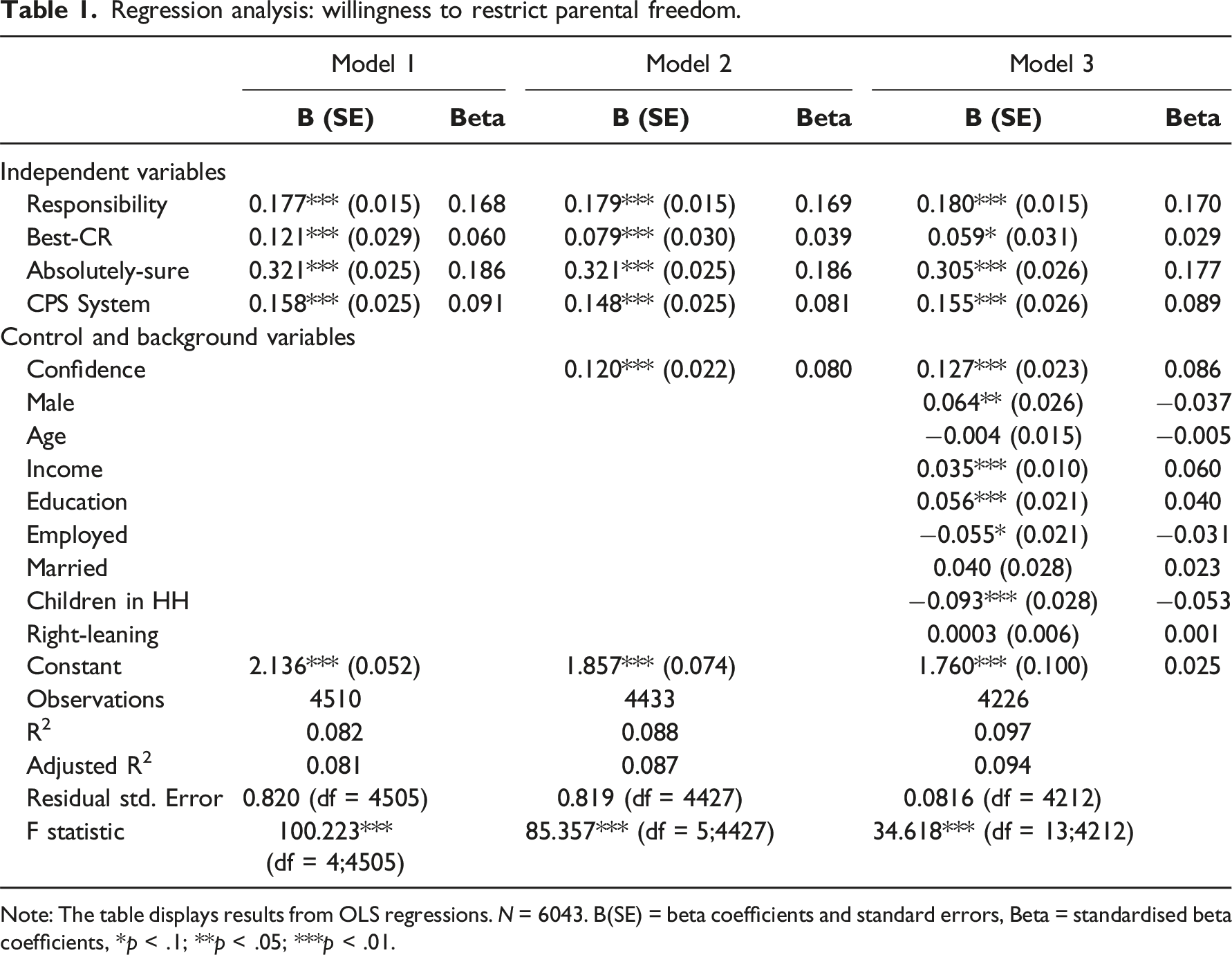
Note: The table displays results from OLS regressions. N = 6043. B(SE) = beta coefficients and standard errors, Beta = standardised beta coefficients, *p < .1; **p < .05; ***p < .01.
Results
Descriptive and bivariate analyses of dependent and independent variables
A bare majority (51%) of the respondents in the six countries believe that the child protection system should provide in-home services to the family, even if the parents do not want it (see Figure 1). About 21% of the respondents recommend a removal of the child, either temporary (14.9%) or permanently (6%). One quarter of the respondents recommend monitoring /visiting of the family, and 2.7% would not have any involvement by the child protection system. Recommendation to the child protection authorities for total sample and per country. Note: Distribution on dependent variable, willingness to restrict parental freedom, by country and for total sample, excluding the ‘I don’t know’-responses (N = 6031).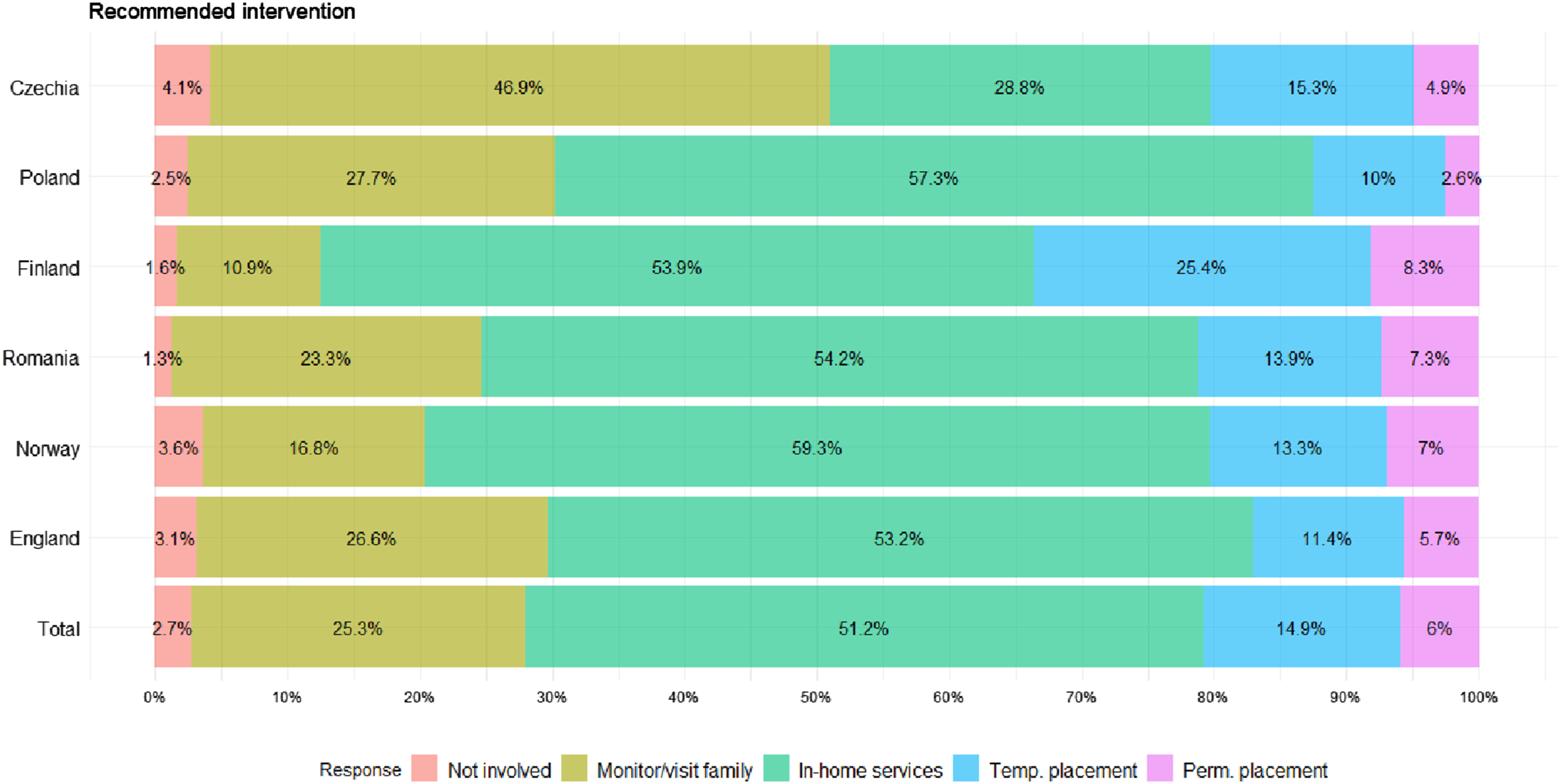
There are overall significant differences between the countries when it comes to recommended level of intervention (Kruskal-Wallis chi-squared = 324.18, p > .001), except between Romania and Norway, and between Poland and England (see Table A9 in Online Appendix). Respondents from Finland were most likely to suggest a service response to families (mean value 3.28), followed by Norway (mean value 3.03) whereas respondents from Czechia and Poland were somewhat more likely to suggest a monitoring response (mean values 2.70 and 2.82 respectively).
As to whether there are differences in how parental difficulties are assessed, the results show a significantly higher share of respondents who received ‘learning disability’ (X1) who wants a less invasive intervention, and oppositely, a significantly higher share of respondents who were prompted with ‘substance abuse problem’ (X3) who chose a stronger intervention alternative (Kruskal-Wallis chi-squared = 216.65, p < .001). The estimate between countries shows that the positive correlation appears in all countries, however the strength of the effect is weaker in England, Finland and Norway (see Figure 2). Estimated effects of responsibility on level of intervention for each country. Note: The figure displays the effect of responsibility (X1-X3) on recommended level of intervention by country, estimated through OLS regression (N = 6031).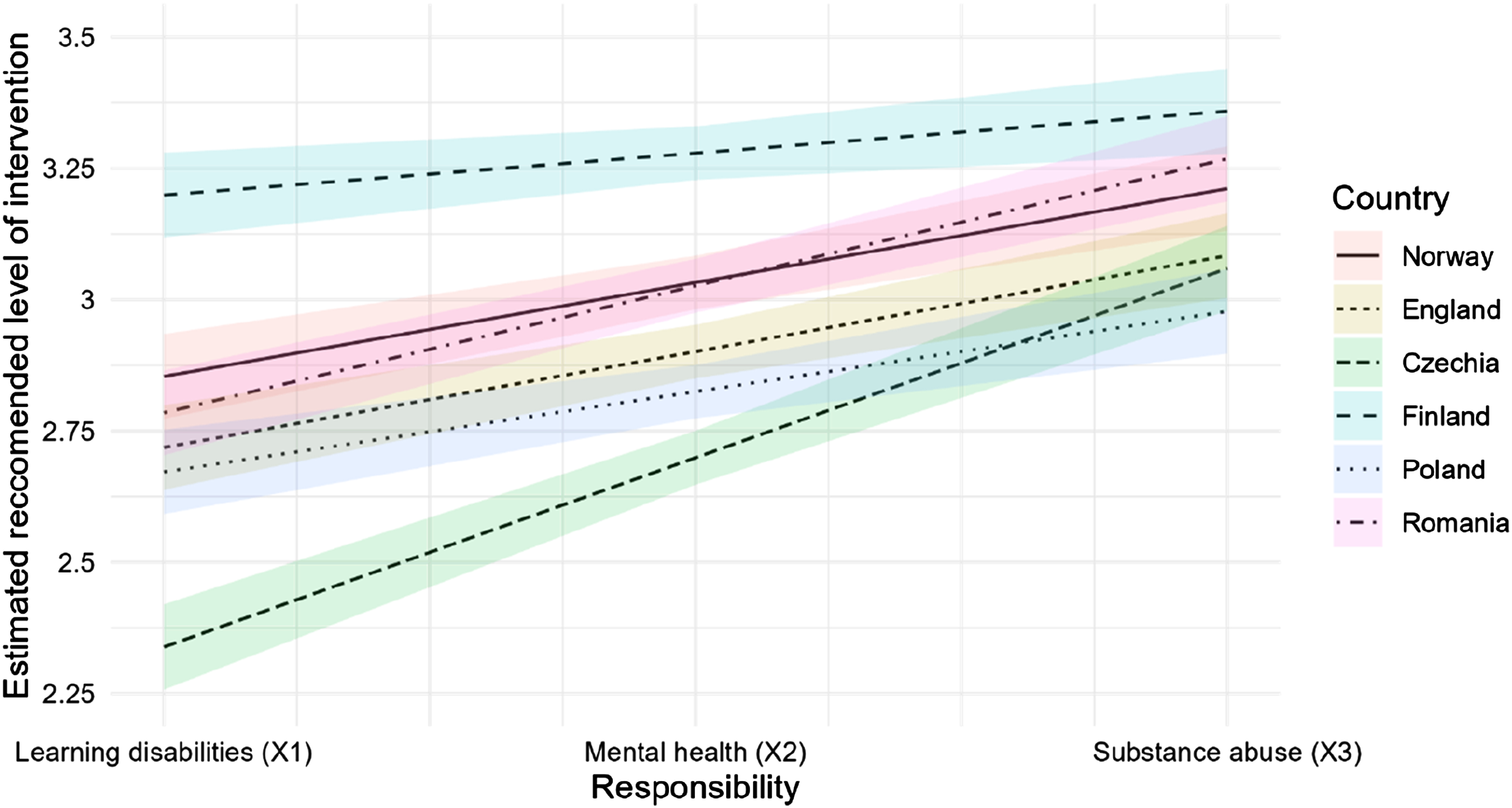
Descriptive analyses
5
for ‘Absolutely-sure’ and ‘Best-CR’ (see Figure 3(a) and (b)), shows that 43% favour false positive – 44% favours false negative, and 60% are supportive of their child protection system being best at protecting child rights, even when this overrides parental rights. We also tested for cross-country variation on the core values and find significant differences between country populations (see Table A10 in Online Appendix). Respondents from Norway and England tend to ‘somewhat agree’ to the ‘Best-CR’ statement, whilst the remaining countries score slightly lower – towards ‘somewhat disagree’. For the ‘Absolutely-sure’ variable, the mean score for all countries leans towards ‘somewhat disagree’, suggesting that they tend to favour false negatives. a–b: Responses on core values for total sample and per country. Note: Distribution on two core values, ‘Best CR’ (3A) and ‘Absolutely Sure’ (3B). Both graphs show the distribution of the core value for the total sample and by country, including ‘I don’t know’ (N = 6043).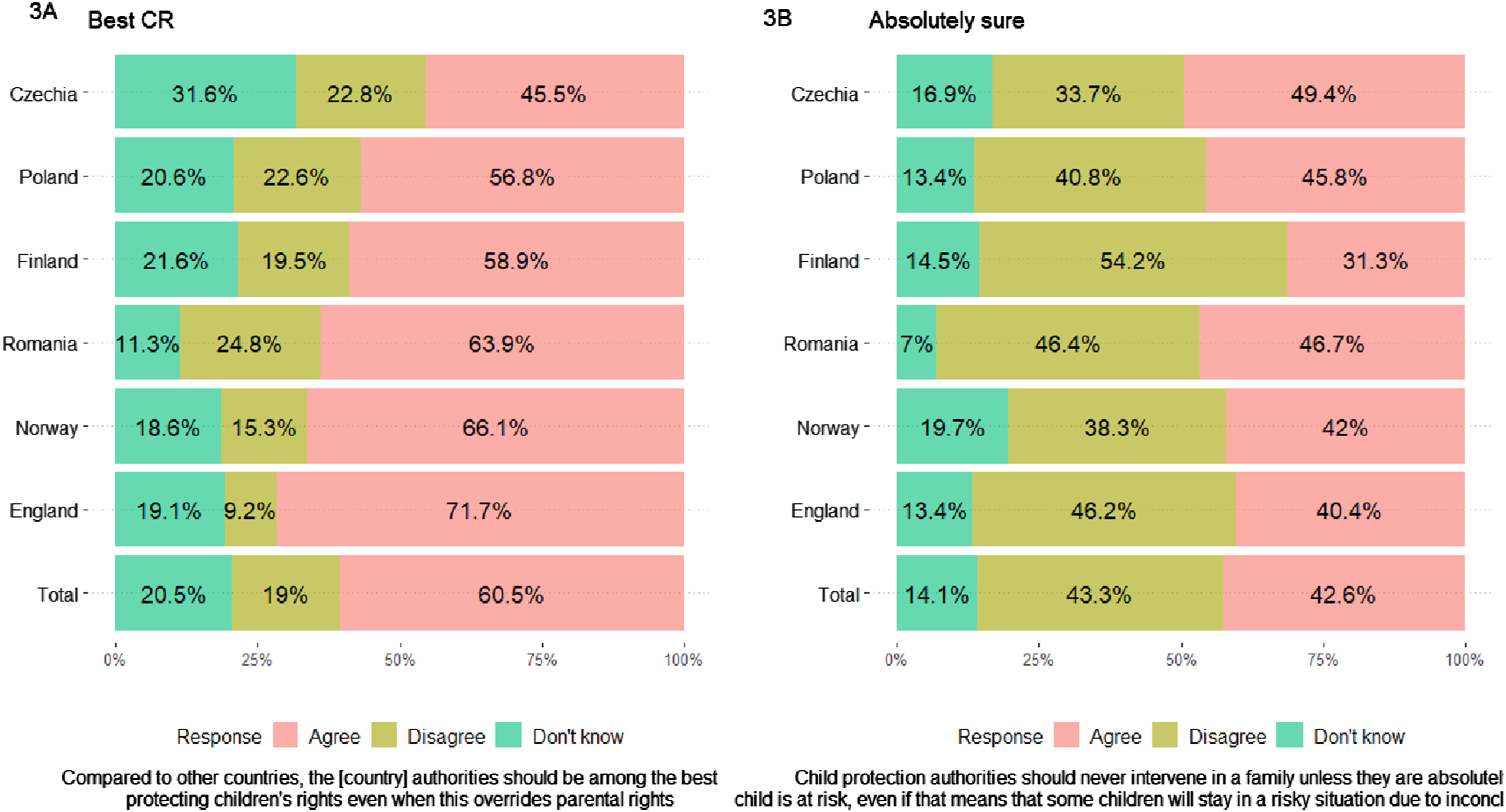
Regression analysis
The results from the regression analysis (see Table 1) show a positive effect of responsibility, suggesting that respondents are willing to recommend stronger interventions when parents struggle with substance abuse problems, followed by mental health problems. Respondents recommend less restriction of freedom to parents with learning disabilities (p > .001), supporting H1. Stronger interventions are also recommended when respondents have higher ambitions for the state to protect children (p > .1) and when they prefer false positives (p > .001) (H2 and H3). The former variable does not have sufficient statistical power in model 3, and we are therefore cautious about making any conclusions about the effect of ‘Best-CR’. The effect of ‘Absolutely-sure’ is over two times as large as the effect of ‘Best-CR’ and the effect remain statistically significant at 1% level in all three models, suggesting that respondents’ preference for false positives is important for their acceptance of intervention. There are evident differences between respondents in risk-oriented and family-oriented systems, in line with H4. Confidence has, as we expected, a positive effect on willingness to restrict parental freedom (H5). Background variables show that respondents that have higher income, have higher education, and have children living at home, are more in favour of stronger interventions.
Model 3 was run on subsamples from each of the individual countries (see Table A8 in Online Appendix), and results show that the effects of the independent variables vary across countries. The effect of ‘Responsibility’ is strongest among Czech respondents (b = 0.33, p < .01) and the weakest among Finnish respondents (b = 0.063, p < .05). ‘Best-CR’ is not significant in any of the country specific models. Among the Czech respondents, the direction of the effect has reversed (b = −0.030). The effect of ‘Absolutely-sure’ holds for all countries, but the effect varies in strength. It is strongest among Finnish (b = 0.442) and weakest among Polish respondents (b = 0.122).
Discussion
Through the child protection system, the state can assume parental responsibility or terminate all parental rights if parents are unable or unwilling to perform their parental obligations. A removal of a child is one of the most invasive and consequential decisions a state can make, and thus represents an immensely strong state power. Such decisions must therefore be legitimate in the sense that they are accepted by citizens (Suchman, 1995; Zelditch, 2006) and of high quality and can withstand public scrutiny (Habermas, 1996; Rothstein, 1998). Empirical studies about citizens’ opinions about child protection interventions are few, and rarely do studies examine the drivers for people’s support for child protection interventions. Our article contributes with knowledge on these dimensions, showing that a clear majority of the populations in six countries are supportive of child protection interventions even if the parents do not agree to such an intervention. This is in line with other populations studies (Berrick et al., 2022a, 2022b; Skivenes, 2021; Skivenes and Benbenishty, 2022a; Skivenes et al., 2023). Very few respondents would dismiss any form of state intervention. Given the controversies around child protection and much of the public debate, which leaves the impression that only a few are supportive of child protection interventions, this is an important finding to highlight. It is also clear that a majority of people have high ambitions for the protection of child rights, even when it may involve restricting parental rights and freedoms. This is found in all countries, except Czechia, indicating that child rights have a stronger support across Europe than what the public debates indicates (see Skivenes, 2021) and concurring with other research (Loen and Skivenes, 2023). Our findings, also in line with previous research, show that there are differences between countries, in which England, Finland and Norway have a higher portion of the population in favour of interventions and child rights, compared to Czechia, Poland and Romania (see Tables A9 and A10 in Online Appendix).
Our examination of drivers of citizens’ support for intervention is based on the theoretical insights about basic values and institutional context, and overall, our hypotheses were confirmed. We found that the higher degree of responsibility the parents had for the maltreatment situation, the stronger the acceptance for restricting parental freedom were (confirming Hypothesis H1). This result is not surprising, since being held responsible for your actions is a principle that applies within criminal law across the world (Crofts, 2023; Duff, 2007; Lacey, 2001) and is also seen in other studies of child protection (Berrick et al., 2024; Skivenes et al., 2023; Skivenes and Benbenishty, 2022a, 2022b) indicating that this is a value that has wide recognition. However, in child protection, in contrast to pension or social services which is based on deservingness, the reason for state intervention is concern for a child. Thus, higher concerns for a child are followed by stronger state interventions which imply restriction of parental freedom. The language we use is negative, in the sense that state intervention is portrayed as restriction of freedom even though a service provision may be portrayed as a positive provision to make family life better. Child protection systems are obligated to respect family life, as is for example set out in the European Convention of Human Rights, article 8, and some child protection systems (well-being and child rights) have explicit ambitions and provisions to support families to avoid intrusive interventions (see Berrick et al., 2023a). The concept of deservingness is thus less intuitive, and possibly less adequate, in the understanding of child protection, because it is normatively inappropriate to describe the situation of a removal of a child in terms of deserving or not deserving and, empirically because it does not capture the nuances in state responsibilities. However, the effect of responsibility is evident, and similar results are found in a global study of populations in 60 countries (Berrick et al., 2024).
Furthermore, the second hypothesis was confirmed, as results show that respondents who are allowing some uncertainty in the evidence if a child presumably is in danger – better safe than sorry – suggest stronger interventions. Within child protection, this is to our knowledge a topic only rarely discussed in research. An exception is Kahn et al. (2017) study of changes in standards for interventions and how these ‘seem to be driven by perceptions of the costs of Type 1 error (false positives) – that is, substantiating a report when no abuse occurred’ (p. 333, our addition in parenthesis).
The third hypothesis which stipulates that respondents that favour a strong state in terms of child rights, also will favour stronger interventions to protect the child, was not confirmed. However, our study shows that there is a connection between ambitions people have on behalf of state authorities and what they actually want to see the authorities do which has also been indicated in other research (Toikko and Rantanen, 2017). The fourth hypothesis, which stipulates that the institutional context of child protection systems will influence populations’ attitudes is supported. Respondents in England, Finland and Norway favour stronger interventions, compared to populations in Czechia, Poland, and Romania. Other studies have confirmed related findings (see above) and showcase the relationship between the child protection system and societal norms.
Our fifth hypothesis about confidence is confirmed, as expected from Loen and Skivenes’ (2023) study about legitimacy of child protection, using the same data material. Interestingly, our analysis suggests that the respondents’ positions on basic values work independently and in addition to confidence.
Our study breaks new ground by showing that basic values also matter in a situation in which there are competing and conflicting values about state responsibility in the private sphere. The importance of values corresponds with recent studies. For example, in Baniamin’s (2021) study of populations in 60 countries (WVS round 6) it was found that emancipative values and non-masculine values are associated with lower acceptance of parental corporal punishment of children. However, in a study of the populations in Norway and California, USA, basic values on equality, security and self-direction, did not explain differences in country attitudes (Berrick et al., 2023b). We believe that pursuing studies on basic values, such as responsibility and false positives/negatives, is important and relevant on issues about family and state responsibility as these values seem to be vital for understanding people’s views and attitudes about child protection.
Limitations
A vignette creates a similar scenario, and although empirically realistic, it cannot capture the complexity of child protection cases. Respondents may further focus on the concerning living situation for the children and disregard parental responsibility for the situation. Although we have empirical indications that people regard parental problems differently, we cannot be sure that substance abuse, mental health, and learning disability are interpreted as such – and there are blurred lines between the latter. There are five response alternatives, but respondents may wish for other alternatives. Although a representative sample, typically surveys miss out on respondents with lower education/income. The use of basic values is explorative, and we are aware that we have few statements to establish respondents’ positions. The positively formulated statements may have a acquiescence bias (Yao and Xu, 2021).
Concluding remarks
In child protection the state simultaneously challenges individual freedoms and the privacy and autonomy of family life (Brighouse and Swift, 2014; Shapiro, 1999), and the findings from our study of representative samples of the populations in six countries from both Eastern and Western Europe show that within all countries except Czechia, a majority supports some form of intervention in a suspected child maltreatment situation. This is an important contribution to the empirical knowledgebase on people’s views and attitudes about protection of child rights as policy discussions seem to be burdened with an adult-centric perception and approach. The reason lies much in the inherent practices, undergirded by tradition and cultures that focus on the rights of adults. Hence, the consequence is an under-communication of both the obligations states have to protect child rights, and the difficulties that inherently follow when the state must protect a child and make interventions against parents’ wishes and feelings. The seemingly strong support for child protection and child rights amongst people in Western and Eastern European societies that have very different child protection systems, welfare state models, and policies on families is worth examining further. Taken a step further, our results indicate that basic values are important drivers to increase our understanding of human behaviour, and as such may be influential on how decision makers will review a case and make decisions involving children and their best interests.
Supplemental Material
Supplemental Material - The value of responsibility, certainty, and child rights for supporting state intervention in the family – An empirical study of populations in six european countries
Supplemental Material for The value of responsibility, certainty, and child rights for supporting state intervention in the family – An empirical study of populations in six european countries by Mathea Loen and Marit Skivenes in Journal of European Social Policy.
Footnotes
Acknowledgments
We are grateful for help with check of translations from Prof. Tarja Pösö (Tampere University), Dr Malgorzata Cyndecka (University of Bergen), Prof. Gabriel Badescu (Babes-Bolyai University), Dr Victoria Shmidt (Karl-Franzens University of Graz), PhD Barbara Ruiken (University of Bergen). We have received comments and insightful feedback from participants at the seminars with the RDV and DIPA research groups at the University of Bergen in the spring 2021 (Solstrand 30.04.21, Bergen 27.05.21), as well as participants at the Conference on ‘Equity and Social Justice In Child, Youth And Family Welfare’ by the European Scientific Association on Residential and Family Care for Children and Adolescents (EuSARF) in Brighton, England, September 2023.
Declaration of conflicting interests
The author(s) declared no potential conflicts of interest with respect to the research, authorship, and/or publication of this article.
Funding
The author(s) disclosed receipt of the following financial support for the research, authorship, and/or publication of this article: This study is supported by the Research Council of Norway under the Research Programme on Welfare, Working Life and Migration (VAM II) (grant no. 302042).
Disclaimer
Publications from the project reflects only the authors’ views and the funding agency is not responsible for any use that may be made of the information contained therein. The project has been registered in RETTE, id number ID: R1431.
Open access statement
We wish for this article to be open access with a license CC-BY-NC-ND.

Supplemental Material
Supplemental material for this article is available online.
Notes
References
Supplementary Material
Please find the following supplemental material available below.
For Open Access articles published under a Creative Commons License, all supplemental material carries the same license as the article it is associated with.
For non-Open Access articles published, all supplemental material carries a non-exclusive license, and permission requests for re-use of supplemental material or any part of supplemental material shall be sent directly to the copyright owner as specified in the copyright notice associated with the article.
