



Abstract
Scholars have so far not paid sufficient attention to the role of attributed responsibility of countries when they need to explain variations of European fiscal solidarity. Do citizens consider the responsibility of other countries when expressing solidarity with them? This article advances the argument that individuals apply similar heuristics to countries as to other individuals. When expressing solidarity with another country, individuals rely on cues about deservingness. The role of responsibility attributions is tested in this article using logistic regression on survey data from 10 EU countries. Results show that citizens in rich welfare states reduce their solidarity for other countries if they deem them responsible for their own crises. This suggests that rich welfare states hinder the development of solidarity beyond their national boundaries. This research contributes to our understanding of the role of deservingness attributions in European solidarity, as well as to our understanding of the role of the welfare state in solidarity.
Introduction
Social policy scholars have dedicated much attention to the importance of the perceptions of deservingness and their effect in shaping individuals’ attitudes towards the welfare state and the support of social policies (e.g. Buss, 2019; Reeskens and Van der Meer, 2019; Van Oorschot, 2000). As Van Oorschot (2000: 38) points out, among issues of reciprocity and identity, ‘Why are you needy?’ is one of the most important questions ordinary citizens ask when having to decide whether to help somebody in need.
Little is known about whether Europeans ask the same question when asked to help other countries in Europe. Do responsibility attributions matter for European solidarity? In an international context, people would have to estimate the responsibility of countries, rather than the responsibility of individuals. To assume that citizens have the mental capacity and the interest to do this seems like an overly optimistic claim, given that most citizens’ familiarity with other countries is limited at best (see Lahusen, 2021).
Recent crises in Europe tell a different story. During the eurozone crisis, the general willingness to express solidarity with fellow European countries was arguably at an all-time low since the beginning of European integration (see also Reinl, 2020). Public discourse, notable in creditor countries, focused on the wrongdoings of public administrations in debtor countries (Chalániová, 2013; Genschel and Jachtenfuchs, 2021). In the early 2020s, during the COVID-19 pandemic crisis, citizens’ willingness to support each other in European solidarity had increased remarkably. EU leaders agreed on the adoption of NextGenerationEU, a €750 billion instrument funded by common European Union (EU) borrowing (Ferrera et al., 2021). The two crises differ in many aspects, but one important feature of the pandemic politics was the comparably low intensity of discussions of moral hazard (see Ignácz, 2021; Tesche, 2022).
This article argues that individuals develop responsibility attributions of other EU countries based on cues and stereotypes, and they rely on these attributions when asked to express European fiscal solidarity. Citizens do not need a profound understanding of macroeconomic interrelations. Rather, they apply similar deservingness heuristics (Petersen, 2015) to other countries as to other individuals. In this article, European fiscal solidarity refers to an individual’s ‘preparedness to share financial resources’ with people in other European countries who are worse off or in need, through actions and funds mobilized by state institutions, including the EU (see Stjernø, 2005: 2; for a more in-depth discussion, see Reinl, 2022). While the term ‘fiscal solidarity’ is also used in federalism research (see, for instance, Duff and Treichel, 2014), solidarity here is understood to be an individual-level attitude.
Based on survey data collected from 10 EU countries in 2019 by REScEU 1 (Donati et al., 2021), the analysis shows that in economically strong countries, as well as in countries with a strong welfare state, citizens consider the responsibility of potential recipient countries when they are asked to help them financially. Even if the data are from before the outbreak of the COVID-19 pandemic, the findings indicate that citizens evaluate the degree to which another country may be responsible for its situation, and they express their solidarity accordingly – just as they would when they are asked to help individuals.
The article is organized as follows: the next section presents the article’s argument and situates it within the existing literature. The subsequent section describes the research methodology and presents the empirical analysis. The final section provides the article’s conclusions.
Responsibility attributions as a shaping factor of European solidarity attitudes
The argument of the article is that citizens attribute responsibility to other countries in need of solidarity, and that these attributions inform those citizens’ willingness to express European solidarity. Citizens who believe that other countries are to blame for their own crisis are less likely to express solidarity than those who do not believe that other countries are to blame. Since the information to assess responsibility is complex, and the salience of EU topics is low (Hutter and Kriesi, 2019), citizens rely on cues when forming responsibility attributions. As with societal groups, citizens use heuristics to assess whether potential recipient countries deserve their solidarity. By using these ‘judgmental shortcuts’ (Petersen, 2015: 45), citizens avoid the mental burden of evaluating complex information. Essentially, they judge other countries just as they would judge other individuals.
Figure 1 provides a schematic overview of the theoretical model. As the figure shows, this article advances a model that suggests a heterogeneous effect of attributed responsibility. Because of the relevance of cues for the formation of responsibility attributions, we can expect that the macro-context moderates the effect on European solidarity. In countries with a high level of national income, and in those countries with a less extensive welfare state, costs and deservingness are cued, making responsibility attributions particularly relevant for citizens. Furthermore, a strong cosmopolitan European identity may trump responsibility attributions. For citizens who hold cosmopolitan values – notably the concern for the wellbeing of other Europeans – responsibility attributions are of less relevance because of their attitudinal character. The assumptions of this model will be elaborated in more detail below. A schematic overview of the proposed relationship between responsibility attributions and European solidarity.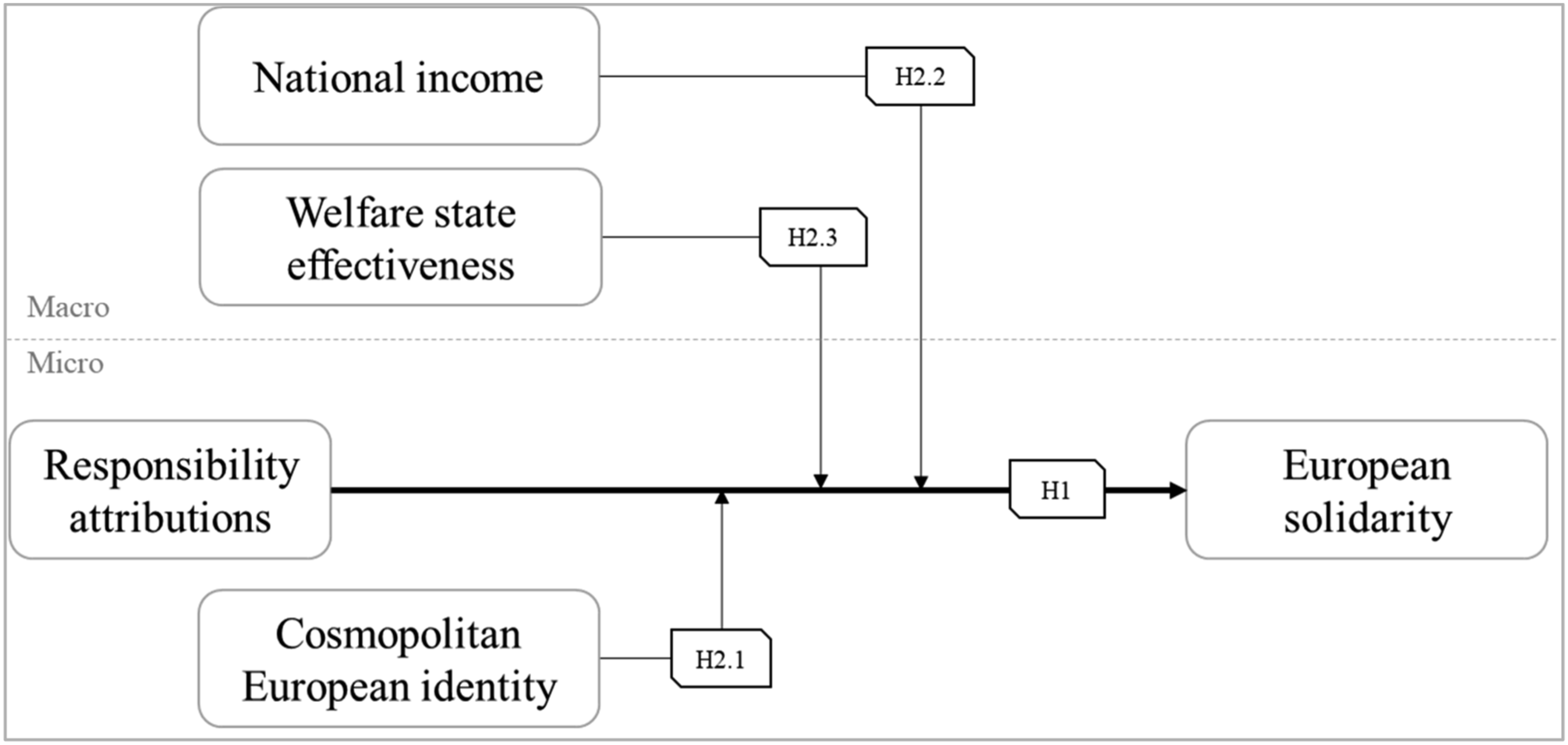
The argument of this article brings together two lines of research. The first line of research is on attitudes to European solidarity and EU fiscal policy. In broad terms, this line of research has identified ideological considerations (Kleider and Stoeckel, 2019; Pellegata and Visconti, 2022), values (Kuhn et al., 2018; Medrano et al., 2019), and social identity (Kanthak and Spies, 2018; Nicoli et al., 2020) as more effective predictors than self-interest (Armingeon, 2020; Bechtel et al., 2017; Mariotto and Pellegata, 2023).
The aim of this article is to contribute to this research by borrowing insights from a second line of research, on deservingness and social policy attitudes. According to Petersen (2015), humans use the heuristics of small-scale societies and apply them to today’s political questions of redistribution. The deservingness heuristic is a universal automatism that stems from evolutionary processes (Petersen, 2015). These deservingness attributions are shown to moderate individuals’ support for the welfare state in general (Van Oorschot, 2006) or their support for specific measures of the welfare state (Buss, 2019).
Van Oorschot (2000) identifies five deservingness criteria that people use to gauge the deservingness of others: control, need, gratitude, identity and reciprocity. Our understanding of the role of these deservingness criteria beyond the role of identity for the willingness to help other EU countries is, so far, limited. Reinl and Katsanidou (2023) show that citizens are more willing to support those countries that have shown solidarity in the past, and Afonso and Negash (2023) have shown that the need of a recipient country also influences the willingness to express solidarity. These findings suggest that citizens do evaluate the deservingness of other countries, and that they consider what happens to the money they contribute. This article focuses on the issue of control and, more specifically, on the effect of responsibility attributions on European fiscal solidarity.
Having established how the argument of the article is connected to current research, we can now turn to it in more detail and formulate hypotheses that are derived from the argument. Unlike national-level solidarity, European solidarity has little direct impact on individuals’ lives. Few citizens, even if interested in politics, can give a consistent assessment of matters such as the structure of public expenditure or the social conditions of other countries, even at times of high salience (see Baglioni and Hurrelmann, 2016). However, in line with Petersen (2015), ordinary citizens use heuristics such as stereotypes (Hjorth, 2016) to judge the responsibility of other countries, even in the absence of detailed knowledge of their macroeconomic conditions. One notable influence of stereotypes are the cues from political elites (Sierp and Karner, 2017) and from the media (Rothmund et al., 2017). During the eurozone crisis, much of the public debate in many creditor countries was about whether countries in acute fiscal need are deserving (Chalániová, 2013; see also Wallaschek, 2020). In these countries, the concern was one of moral hazard: if debtor countries would not take responsibility for the situation they were in and implement structural reforms, there would be a danger of permanent dependency and redistribution (for a more extensive discussion, see Matthijs and McNamara, 2015).
Responsibility attributions are stereotyped, and as such, they are vague. They apply to a given nationality, rather than distinguishing between decision-makers of a country on the one hand and its ordinary citizens on the other hand. For instance, the eurozone crisis led to lasting tensions between Greek and German citizens, with surveys showing that Greeks accused Germans of being unsympathetic to their economic difficulties (Stokes et al., 2017), while surveys in Germany showed that German citizens mistrusted Greeks and their commitment to fiscal discipline (Connolly, 2015). In the mental representations of other countries underlying these opinions, potential recipient countries of European solidarity form a homogeneous group. Taking these considerations into account, the main hypothesis is:
Individuals who think that other countries are to blame for their own economic disadvantage are less likely to express European fiscal solidarity than individuals who do not think so. This effect of responsibility attributions is heterogeneous. Citizens with a cosmopolitan European identity (Kuhn et al., 2018; Pichler, 2009) are expected to treat responsibility attributions differently. Cosmopolitans are outward looking, open to other cultures, and they value the interconnectedness with other political communities. They see themselves as citizens of the world and feel connected to supranational identities. They put less meaning on the limits of national borders, which leads them to share more concern with others outside their own community (Inglehart and Norris, 2016; Kuhn et al., 2018). Cosmopolitans identify more strongly with Europe and have a more open definition of Europe (Pichler, 2009). Policymakers with a cosmopolitan social identity have been shown to be more likely to oblige by international law (Bayram, 2017). Finally, cosmopolitans have been shown to be more willing to contribute to means of international redistribution (Kuhn et al., 2018; Medrano et al., 2019; Paxton and Knack, 2012). While those with a stronger cosmopolitan European identity are not more or less likely than others to think that other countries are at their own fault for being in a crisis, their concern for the welfare of others outside their own community overrides these responsibility attributions. Consequently, even if cosmopolitan Europeans think that other EU countries are at fault, they do not reduce their willingness to express European fiscal solidarity as severely as those individuals who value less the wellbeing of people outside their community. In contrast, those with less cosmopolitan values use the responsibility attribution as a mechanism to justify their unwillingness to express European fiscal solidarity. Since responsibility attributions depend on cues, differences in the national context – namely economic wealth and the extent of the welfare state – influence the relationship between responsibility attributions and European fiscal solidarity. Responsibility attributions become relevant when the costs of European fiscal solidarity are salient. In economically stronger countries, the contributions to the EU budget and the potentials of moral hazard are a politicized issue. In these countries, citizens expect to be at the giving end of a solidarity scheme (Kleider and Stoeckel, 2019; Vasilopoulou and Talving, 2020). In poorer countries, citizens are cued to perceive European solidarity to be in their sociotropic self-interest. Even when citizens in these countries consider that another country may be at fault for their crisis, they still consider it to be in their interest to support European solidarity. Finally, national welfare institutions shape the way citizens think about solidarity and about the concepts of deservingness, neediness and belonging (Jordan, 2013; Larsen, 2008). Responsibility attributions are primed when the welfare state is organized on a more selective basis. This highlights the ‘otherness’ of recipients and invites debate about their deservingness, which then ‘spills over’ to European solidarity attitudes. In addition, a less generous welfare state cues the scarcity of fiscal resources of the state, which makes citizens less willing to express solidarity with those in other countries. Hence, the model in Figure 1 suggests that in less extensive, more selective welfare states citizens make more use of responsibility attributions. While some studies show that citizens perceive European integration as a threat to the welfare state (Beaudonnet, 2015; see also Ferrera, 2005), Baute et al. (2019) find that high levels of support for the principles of the welfare state have a positive effect on attitudes to social Europe, including attitudes to European solidarity, as suggested here as well. The following hypotheses on the mediating role of the cosmopolitan concern for the wellbeing of others outside of one’s community and of the macro-context are derived:
The weaker the cosmopolitan concern for the wellbeing of others outside of one’s community of an individual is, the higher is the marginal effect of responsibility attributions on European fiscal solidarity.
The higher the national income of a country is, the higher is the marginal effect of responsibility attributions on an individual’s European fiscal solidarity.
The less extensive the national welfare system of a country is, the higher is the marginal effect of responsibility attributions on an individual’s European fiscal solidarity.
Methodology, data, and preliminary analysis
The empirical analysis uses REScEU’s 2019 survey data from 10 EU member states 2 with a total of 15,149 respondents, aged 18–70 (Donati et al., 2021). The survey is particularly useful for its inclusion of an item for the attributed responsibility of crisis countries that will be used as an independent variable. The survey used quota sampling for gender, age, education, and region of residence. Participants had previously joined the conducting company’s online panel and were interviewed using the CAWI methodology. In total, the sample includes 15,149 individual respondents. The next section presents the relevant variables included in the analysis and gives some preliminary insights, before turning to more advanced regression analyses.
Dependent variable
As the goal of this research is to identify whether there is an effect of responsibility attributions on European fiscal solidarity, the dependent variable is the willingness to express European fiscal solidarity. The following survey item captures the concept: To what extent do you agree or disagree with the following statement: All EU Member States, including [COUNTRY], should contribute to a common EU fund to help any other Member State facing potentially severe economic and financial difficulties in times of crisis.
Respondents answer on a fully labelled four-point Likert scale, or they indicate that they ‘don’t know’. Figure 2 presents the distribution of the dependent variable for all countries of the sample (%DK = ‘don’t know’). The lowest level of solidarity is found in Finland, with 47% of respondents indicating strong or some agreement. The highest level of solidarity is found in Greece, where 82% of respondents either strongly or somewhat agree. Level of support for a common EU fund and share of respondents who indicate that they don’t know, by country.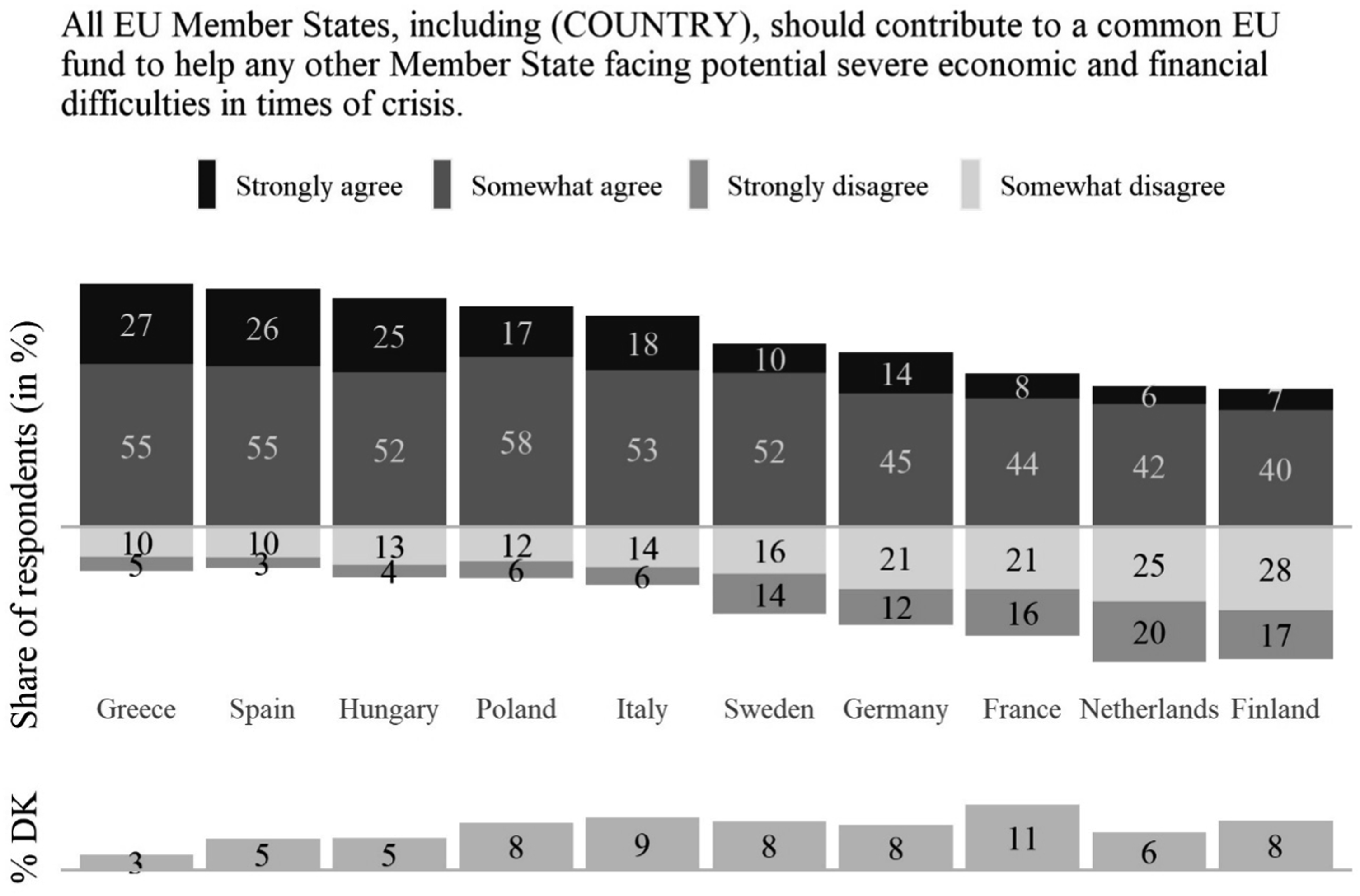
For further analysis, the response scale has been recoded to a binary variable where 1 indicates that individuals ‘strongly’ or ‘somewhat’ agree, and 0 means that individuals at least ‘somewhat’ disagreed. Subsequently, logistic regression is applied. The loss of information by this operation is limited. The advantage of this recoding is that it allows the threshold of the qualitative difference between agreement and disagreement to be estimated more precisely.
As a robustness check, the same models are run using an alternative dependent variable, based on a follow-up question in the survey. Respondents are asked if they would be willing to support a 1% increase in their income tax for the purpose of this common fund. For the alternative specification, only those respondents who agree with the creation of a common EU fund in the first question, as well as those who respond affirmatively to this second question, are considered as expressing solidarity. This alternative specification ensures that the solidarity measured here is more than just ‘cheap talk’.
Independent variables
Let us now turn to the independent variables. This section first introduces the individual-level variables and then two macro-level variables. Table A1 in the Online Appendix provides an overview of all concepts and related variables, Table A2 in the Online Appendix provides an overview of variables by country. The key independent variable, the ‘attributed responsibility’ of recipients, is captured with the following item: During the crisis some member states have done better than others (e.g. in terms of unemployment, poverty, or growth rates). Please indicate to what extent you agree with the following statement: The weaker member states have mismanaged their economy and public finances.
Respondents answer on a fully labelled scale from 1 to 4, where 1 signifies strong agreement and 4 means strong disagreement, or they indicate that they ‘don’t know’. The variable has also been recoded as a binary variable of agreement (1) and disagreement (0).
The wording of the survey items, however, has its own limitations, as it remains vague concerning which countries are supposed to be weaker and in what sense. Nevertheless, this item is the most appropriate approximation of the concept of responsibility attribution.
Figure 3 depicts the distribution of responses to this item for all sampled countries. Countries in which the overall level of European solidarity is highest tend to be those where agreement to this statement is lowest, although Greece and – to a lesser extent – France, constitute exemptions in this relationship. This is a promising first finding in relation to hypothesis H1. The proportion of respondents who strongly agree or somewhat agree ranges from 56% (France) to 74% (Finland). In Greece, where the crisis affected people the most, the ‘don’t know’ answers are at their lowest. In countries where the crisis had less of an impact – such as Germany or the Netherlands, or in non-eurozone countries like Poland and Sweden – the ‘don’t know’ answers are quite frequent. This suggests that ‘don’t know’ responses are an indicator of less-crystallized attitudes. In the context of EU public opinion research, this is unsurprising, given that many citizens are indifferent or ambivalent to EU politics (Stoeckel, 2013). This may also explain why the share of ‘don’t know’ responses is very high in France (21%). Level of agreement that weaker member states mismanaged their economy and share of respondents who indicate that they don’t know, by country.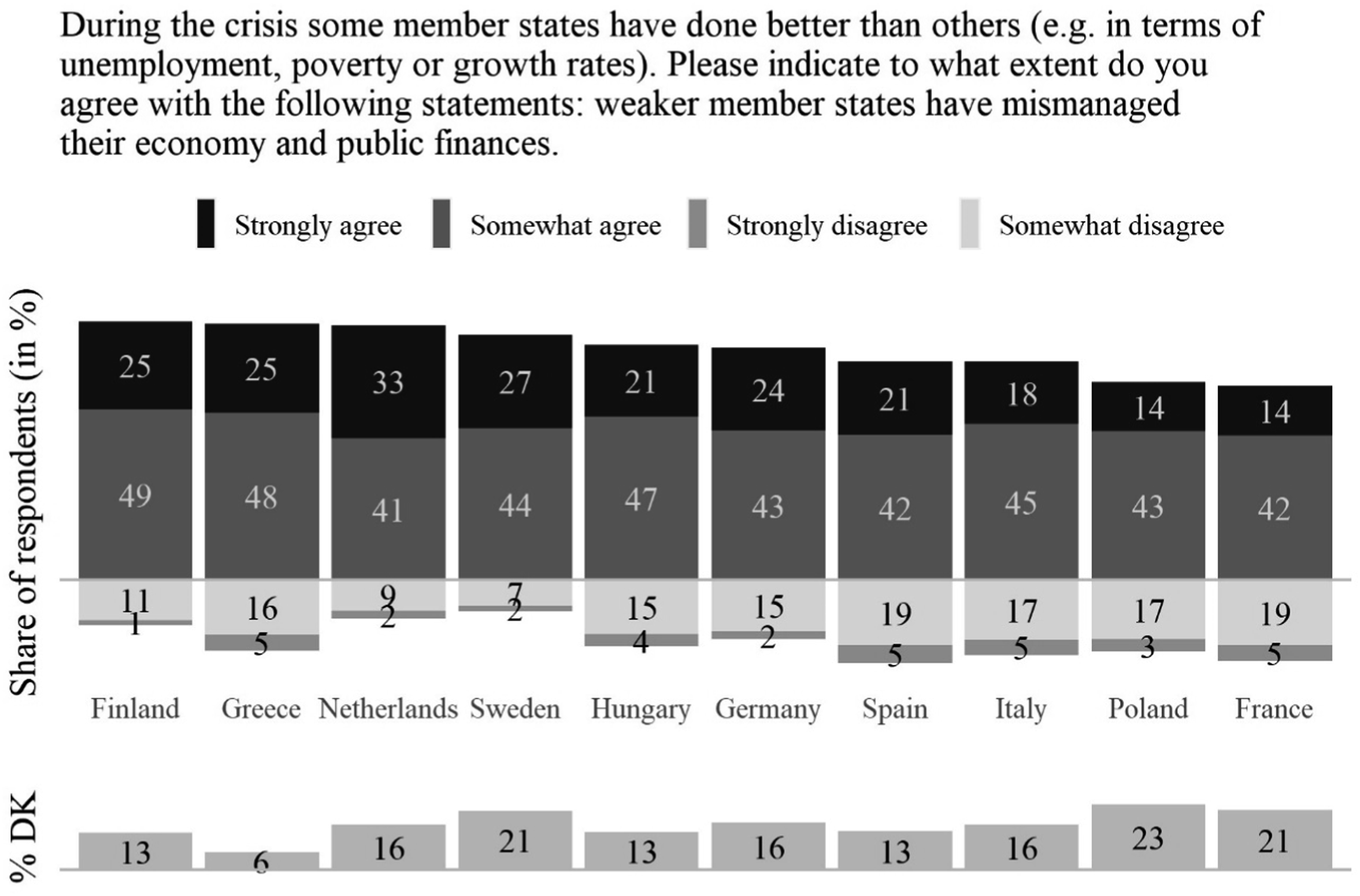
Methodologically, the ‘don’t know’ responses cannot be treated as randomly missing, since the appearance of their answers is not random, therefore simple random imputation for certain variables is applied in the regression analysis (see Online Appendix A2 for a more detailed description).
Cosmopolitan European identities are captured by a combination of three survey items. In line with De Vries (2018) and Kuhn et al. (2018), cosmopolitanism is operationalized using measurements of openness towards other cultures, and the concern for the wellbeing of others outside one’s own community, specifically in other EU countries. In addition, a measurement of the identification of respondents with the EU is also included.
Openness towards other cultures is captured by a survey item that asks whether respondents believe that cultural life is enriched by people coming from other countries. Respondents answer on an end-labelled scale of 0 to 10, where 0 stands for the belief that cultural life is enriched, and 10 stands for the belief that culture life is undermined. Respondents can refuse to answer and indicate that they don’t know.
The concern for the wellbeing of others outside their own country can only be captured indirectly. In one survey question, respondents are asked: The European Union does various things to support citizens’ rights, but some say that it could do more. Which of the following things would enhance your feeling of being a European citizen?
Seven options are provided. Respondents choosing the option of a Europeanized social protection system are assumed to be concerned about the wellbeing of others outside their community. While other options also refer to a Europeanized social protection, these options are either less concrete, or they make the personal benefits of such a scheme more salient. This is not a perfect measurement item, in particular because it may be argued that it introduces endogeneity. However, this item provides the best approximation of the concept of concern for others outside one’s community available in the dataset.
Finally, respondents are asked whether they are proud to be European citizens. They answer on a fully labelled scale from 1 to 4, where 1 signifies strong agreement and 4 means strong disagreement, or they indicate that they don’t know. The variable has been recoded as a binary variable measuring agreement (1) and disagreement (0).
These three responses are used to reflect the degree of cosmopolitanism and are kept as individual variables. While this is not the most elegant solution, the creation of a ‘cosmopolitanism index’ brings its own theoretical and econometric challenges. In addition, the theoretical assumptions suggest that it is the cosmopolitan concern for the wellbeing of others outside one’s community that mediates the effect of responsibility attribution, which requires this variable to be included individually in any case.
Macro-level data
As the theory includes expectations about the impact of the macro-context on individual attitudes, it is necessary to include such variables in the analysis. Given that the number of countries included in the study is limited to 10, it is necessary to keep the number of macro-level predictor variables to a strict minimum to avoid unreliable estimations.
The economic situation is captured by the Gross National Income (GNI) per capita in 2019, a common measure for capturing the standard of living in a country. This variable has been rescaled so that the highest value in the sample (Netherlands) is 1 and the lowest value (Greece) is 0. Data are from Eurostat.
The welfare state’s effectiveness is measured by calculating the ratio of people at risk of relative poverty (defined as having less than 50% of the national median income) before and after taxation and transfers. While this measure cannot capture the entire complexity of the welfare state, it avoids the complexities of welfare state typologies and considers the role of taxation in welfare distribution. Data are from the OECD.
Individual-level control variables
Demographics as well as political ideology are included in the analysis to control for potential confounding effects. Political ideology is measured in the form of a self-placement on a partially labelled scale from 0 to 10, where 0 indicates ‘Left’ and 10 indicates ‘Right’. For income, respondents are asked how comfortably they can live on their present income. They answer on a 4-point fully labelled scale. Education is measured in terms of formal educational degree. Responses are grouped in three categories: ‘Tertiary’, ‘Up to upper secondary’, and ‘Lower secondary’. As specification tests revealed that the effect of age is not linear, respondents were grouped in three age categories in the regression models: 18–34, 35–54, 55–70. Finally, gender is also included as a control variable.
Regression analysis
Logistic regression with cluster-robust standard errors for European fiscal solidarity, imputed data.
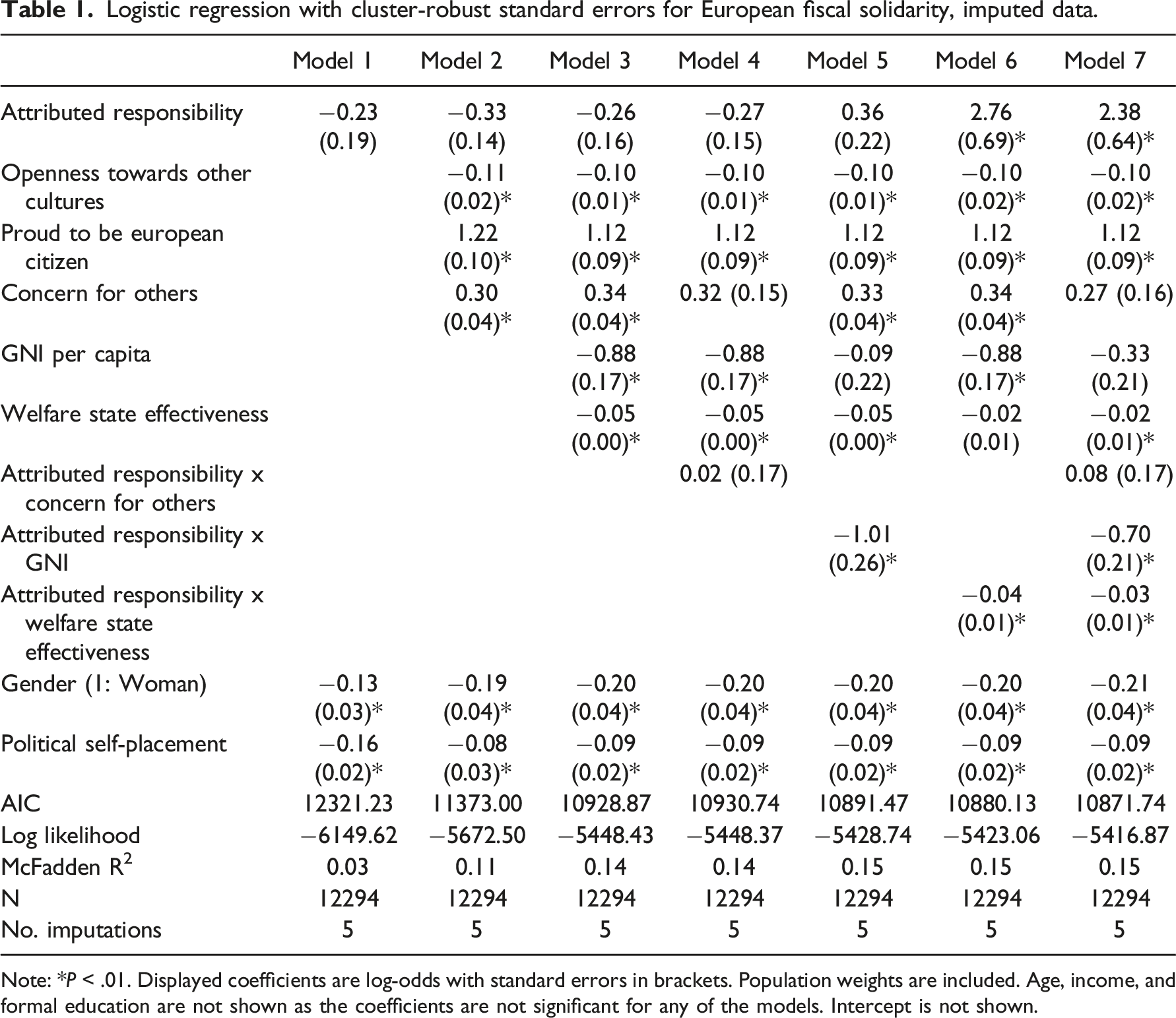
Note: *P < .01. Displayed coefficients are log-odds with standard errors in brackets. Population weights are included. Age, income, and formal education are not shown as the coefficients are not significant for any of the models. Intercept is not shown.
Interpretation of results
The central argument of the article is that responsibility attributions matter for the European solidarity of citizens (H1). Unlike the results that the preliminary analysis suggests, the regression analysis does not support such an all-encompassing statement. The effect of responsibility attributions is heterogeneous and depends on other factors. In the models with no interaction effect, the coefficient of the corresponding variable is statistically not significant. Only after interaction effects are introduced does the variable become significant and socially meaningful.
Figure 4 visualizes the results of the full regression model for the three interaction effects. Further, Table 2 provides an overview of the estimated average marginal effects of attributed responsibility at relevant values for the moderator variables. Interaction effects of responsibility attributions. Predicted probability of European fiscal solidarity with 0.99 confidence intervals, based on Model 7. (a) shows the interaction effect with the GNI per capita, (b) shows the interaction effect with the welfare state effectiveness and (c) shows the interaction effect with the concern for others outside of one's community. Average marginal effects of attributed responsibility in relation to moderator variables, based on model 7. Note: Standard errors are in brackets. Groups for ‘GNI per capita’ and ‘welfare state effectiveness’ are respective terciles of the distribution.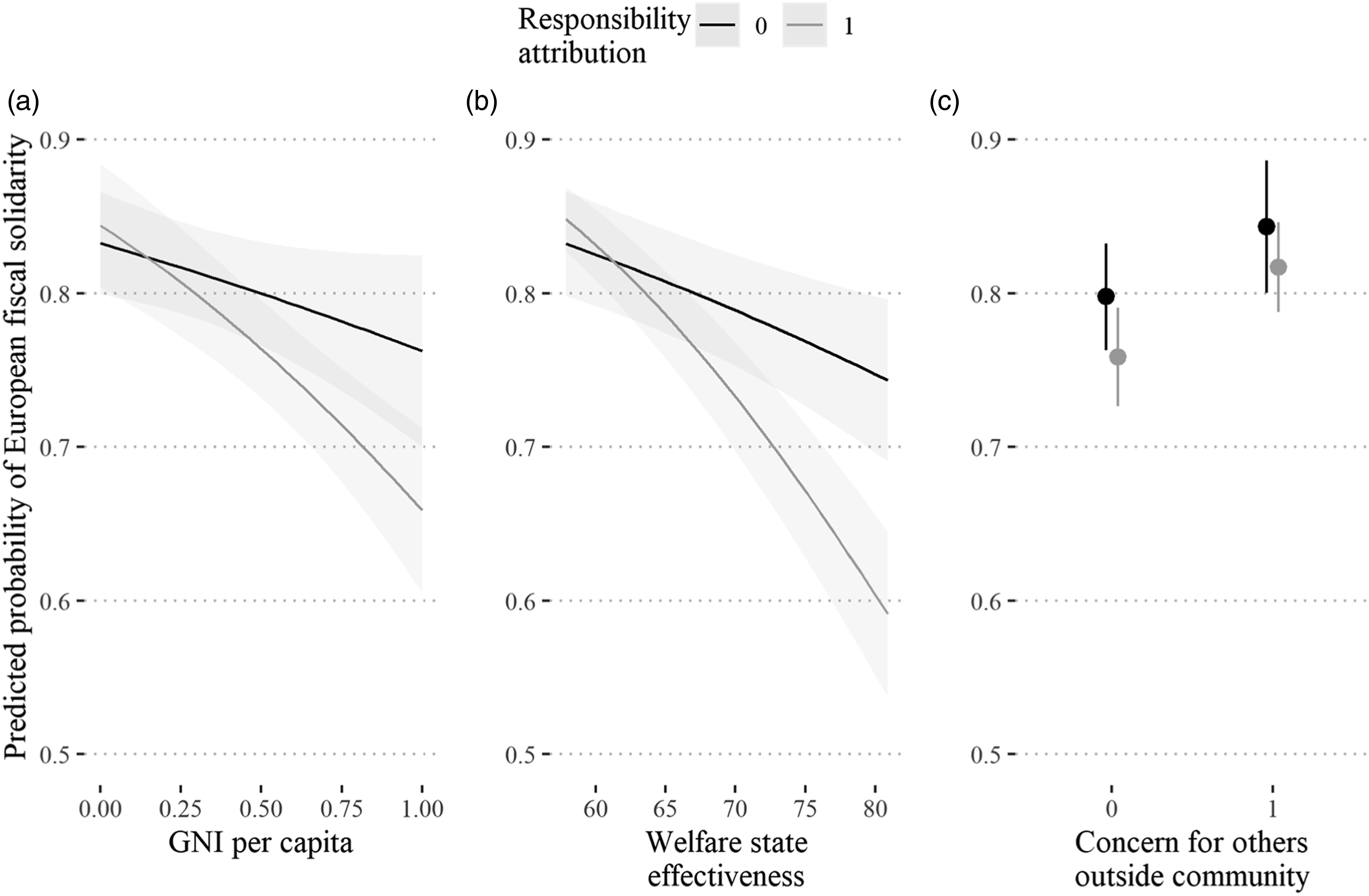
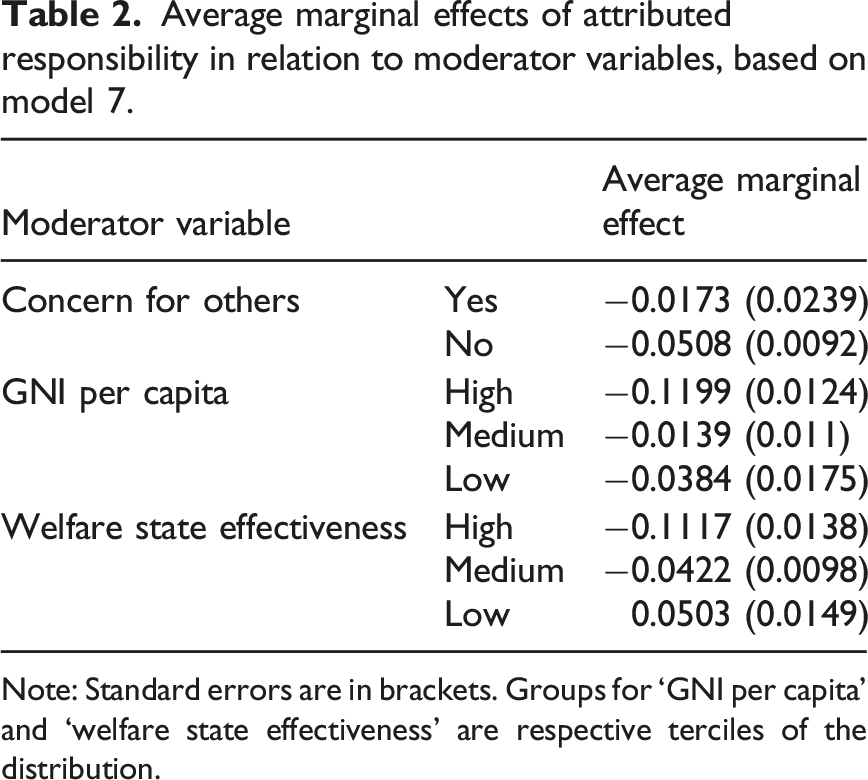
While citizens with a stronger cosmopolitan European identity are more likely to express European fiscal solidarity, the effect of a cosmopolitan European identity is largely independent of responsibility attributions, unlike theorized (H2.1). Table 2 shows that the average marginal effect of attributed responsibility is statistically significant and negative at about −5.1 percentage points for those who do not express concern for others, and that it is statistically non-significant for those who do have concern for others. But the formal tests reveal that there is no meaningful interaction between responsibility attributions and a concern for others outside one’s community. The interaction term is not significant, and its inclusion does not improve the model fit, as the Likelihood-Ratio test comparing Model 4 with Model 3 shows. A visual inspection of Figure 4(c) also does not allow us to conclude that there is an interaction effect.
The analysis suggests that responsibility attributions are more relevant in countries with a higher income than in countries with a lower income (H2.2). Figure 4(a) shows how the predicted probability of European fiscal solidarity changes as a function of national GNI per capita and responsibility attributions. Among individuals in economically less affluent countries, the effect of responsibility attributions on solidarity attitudes is non-existent. However, in richer countries, individuals who think that weaker countries have mismanaged their economies are much less likely to express solidarity than those individuals who do not think so. Table 2 shows that the average marginal effect of responsibility attributions is approximately 3.8 percentage points in the poorest tercile, about −1.4 percentage points in those that are in the middle tercile, and −12 percentage points in the richest tercile. These findings indicate that the economic position of one’s own country in Europe cues deservingness. Citizens in richer countries are less likely to express solidarity with other countries who – in their minds – are poorer due to weaker economic management. In poorer countries as well, many citizens also think that weaker countries have mismanaged their economies. But, unlike citizens in richer countries, these citizens are not cued to consider responsibility attributions. Even if citizens think that weaker countries are at fault, they do not lessen their willingness to express solidarity, because they consider that their own country ultimately benefits from European solidarity. The main effect of the GNI variable becomes insignificant once the interaction is introduced to the model. This suggests that the importance of responsibility attributions is a key difference between citizens of poorer and citizens of richer countries in the EU.
Finally, the analysis provides no support for the argument that weak welfare states prime citizens to consider the responsibility of other Europeans more strongly (H2.3). Regardless of whether citizens think that weaker member states have mismanaged their economies, their willingness to express solidarity with other EU countries goes down as a function of the effectiveness of the welfare state. In other words, the more extensive the welfare state, the less likely citizens are to express solidarity with other countries. Rather than having a socialization effect, the solidarity that welfare states create seems to come at the expense of solidarity with outsiders. With regard to responsibility attributions, there is an interaction with the welfare state, but in the opposite direction to hypothesis H2.3.
In the more extensive welfare states, attributed responsibility influences citizens’ solidarity more strongly. This finding is also supported by the average marginal effects presented in Table 2: in countries with a highly effective welfare state, the effect is measured at about −11.2 percentage points. In less effective welfare states, contrary to expectations, the effect of attributed responsibility is positive at about 5 percentage points. It seems that citizens perceive European integration – especially policy integration that requires the pooling of fiscal resources – as a threat to the national welfare system. This suggests that citizens perceive European solidarity to be in direct competition with the available resources for national welfare policies. Where the welfare state is more effective, citizens seem to feel that they have more to lose, and they therefore lessen their solidarity accordingly. To highlight just two cases, in Germany, a high-income country with one of the more effective welfare states among the sampled countries, the estimated marginal effect of responsibility attributions is −11.5 percentage points, compared with 7.1 percentage points in Greece, the poorest country in the sample with one of the least effective welfare states in the sample.
These findings imply that the solidarity of the welfare state has a destructive effect on solidarity with other countries, particularly with the emphasis on the un-deservingness of those other countries. Among citizens in countries with a strong welfare state, responsibility attributions have an important influence on European solidarity.
Conclusions
This article has made the argument that deservingness shapes citizens’ fiscal solidarity with other EU countries. Despite the complexity of public accounts, citizens can judge the responsibility of other countries towards their economic situation based on the heuristics they would also apply to other humans. Empirical analysis provides evidence that citizens use these responsibility attributions to inform their willingness to express European fiscal solidarity with other EU countries. The analysis shows that attributed responsibility is a key difference between those citizens in rich countries with a strong welfare state and those in poorer countries with a weaker welfare state.
One caveat is that the analysis of cross-sectional survey data allows for correlational conclusions, but not for causal inference. Based on the data here, a reverse causal effect cannot be excluded. To justify their unwillingness to express European solidarity, citizens may consequently be less willing to express the belief that others are deserving. Furthermore, it should be noted that the COVID-19 pandemic crisis affected attitudes of European solidarity by making the interdependencies in Europe salient. This critical juncture for European solidarity likely affects citizens’ attitudes, and has led, inter alia, to a further crystallization of attitudes.
This article highlights the relevance of deservingness in a European context. Citizens ask whether other countries are deserving of their support, and they come up with the answers to these questions. Based on these insights, research should dedicate more attention to issues of deservingness. Furthermore, research should strive to better understand what informs citizens’ mental representations of other countries and their relevant deservingness attributes. Finally, the role of the national welfare state in shaping European solidarity attitudes requires more research.
Supplemental Material
Supplemental Material - Treating nations like people: How responsibility attributions shape citizens’ fiscal solidarity with other EU countries
Supplemental Material for Treating nations like people: How responsibility attributions shape citizens’ fiscal solidarity with other EU countries by Patrick Clasen in Journal of European Social Policy.
Footnotes
Acknowledgements
The author would like to thank Maurizio Ferrara and Alessandro Pellegata for kindly providing me with the survey data from their REScEU project. The author is indebted to Achim Goerres for his constant feedback and guidance on the journey of writing this article. A previous version of this article was presented at the EPSA Annual Conference 2022 in Prague. The author thanks participants of that event, as well as Stefan Wallaschek, Jakob Kemper, Hayfat Hamidou-Schmidt, Teresa Hummler, Paul Vierus, Conrad Ziller, Laurin Berresheim as well as the anonymous reviewers for helpful comments and suggestions for previous versions of the article.
Declaration of conflicting interests
The author(s) declared no potential conflicts of interest with respect to the research, authorship, and/or publication of this article.
Funding
The author(s) received no financial support for the research, authorship, and/or publication of this article.

Supplemental Material
Supplemental material for this article is available online.
Notes
References
Supplementary Material
Please find the following supplemental material available below.
For Open Access articles published under a Creative Commons License, all supplemental material carries the same license as the article it is associated with.
For non-Open Access articles published, all supplemental material carries a non-exclusive license, and permission requests for re-use of supplemental material or any part of supplemental material shall be sent directly to the copyright owner as specified in the copyright notice associated with the article.
