



Abstract
What explains welfare chauvinistic policy reform, that is, targeted exclusion of non-citizens from welfare? Existing research suggest that contextual factors like far-right party success, perceived immigration pressures, party ideologies and institutions could spur such reform, but the processes behind reforms remain understudied. This article draws on public policy literature to call attention the critical role of agency and institutions in welfare chauvinist reform. It focuses on a law excluding migrant EU citizens from social assistance in Germany. Through process tracing and inductive reconstruction of the policy process, based on political documents, interviews, media reporting and descriptive statistics, we show that the policy proposal originated from German city administrations; that the city of Hamburg was key in pushing for exclusions; and that Hamburg’s success in doing so crucially depended on the city’s mayor. Several comparable German cities (in terms of party politics and levels of immigration) were equally concerned with ‘welfare immigration’ and complained about problem pressure, but only Hamburg had a committed mayor with the right political networks and institutional resources to lobby for welfare exclusions at the federal level.
Keywords
Introduction
Welfare chauvinism has mainly been analysed in relation to public attitudes and party positions. The ‘question of how and why welfare states have changed to include/exclude immigrants’ has received much less attention (Careja and Harris, 2022: 10). 1 A common assumption is that political preferences and agenda setting have bearing on policy, yet it is important to assess the actual connections between actors, welfare chauvinist ideas and preferences on policy output (see Careja et al., 2016). Welfare chauvinist policies may have little to do with such agendas or ideas, notably if welfare exclusions are unintended consequences of broader reforms. Equally, preferences to exclude migrants can be constrained, for example by non-discrimination laws (Careja et al., 2016; Koning, 2013).
Existing literature offers potential explanations for welfare chauvinist reforms. Most prominently, these relate to political ideology and competition from far-right parties, perceived problem pressure of immigration and associated fears of welfare magnetism, as well as institutional context. We do not contest the influence of such factors on policy output, but argue that these factors are not sufficient conditions for welfare chauvinist reforms.
To fully understand exclusionary welfare reforms, we propose to bring agency and institutions into the debate. Uncovering the role of specific actors and the way institutions condition their success, requires a closer analysis of the policy processes than is often the case in studies of welfare chauvinist reform. It demands careful reconstruction of the development of policy proposals and the reasons for their (lack of) success. To explain exclusionary welfare reform this article uses process tracing to scrutinize a welfare chauvinist policy reform in Germany. The law in question is not easily explained with reference to problem pressure or party politics. Instead, we identify a policy entrepreneur as crucial to the outcome. Moreover, we show that the success of this actor at both the agenda setting stage and in the decision-making process, was crucially conditioned by the multi-level German governance system.
The article focuses on Germany and a law adopted in 2016 that excluded economically inactive EU migrant citizens from social assistance (from now on ‘the 2016 law’) during their initial period of residence. This closely coincides with the lifting of transition agreements: in 2014, Bulgarians and Romanians gained full access to the German labour market, after which the numbers of EU migrants in Germany increased. Germany is a key country of destination for intra-EU migration (European Commission, 2017) and has a comparatively robust and rights-based minimum income scheme. In face of this institutional context, debates on free movement and EU citizens’ access to welfare have been shaped by ‘welfare migration’ fears (Barbulescu and Favell, 2020; Martinsen and Werner, 2019: 642–644). The success of the far-right party Alternative for Germany (AfD) occurring in parallel to these developments mirrors developments in other countries. Furthermore, social assistance is a most likely case for welfare chauvinist perceptions and reform attempts, considering that it is non-contributory and strongly associated with ideas of (non-)deservingness. Existing accounts of the 2016 law suggest that it was a response to political pressure resulting from the AfD’s electoral success (Gago and Hruschka, 2022: 10), and to a ruling by the German Federal Social Court which extended social assistance rights to EU migrant citizens (Martinsen and Werner, 2019: 643). Yet, we demonstrate that the legislative proposal to exclude EU migrant citizens from social assistance emerged from demands by German city administrations prior to the ruling. Moreover, we show that the city of Hamburg was key in pushing for exclusions, and that its success in doing so crucially depended on its mayor. While several other cities complained about (perceived) problem pressure from ‘welfare immigration’, they lacked a committed politician with the right political networks and institutional resources to channel their policy preferences. In other words, we show that the ‘usual suspects’ (ideology, party competition, and problem pressure) cannot satisfactorily explain the agenda setting that led up to the 2016 policy output. We argue that the mayor of Hamburg acted as a policy entrepreneur who was able to aggregate and purposely frame grievances raised by several cities within the agenda-setting process. He did so at various levels of the multi-level governance system while having access to key decisionmakers to lobby for welfare exclusions. The article adds to the literature by demonstrating the role of an individual policy entrepreneur in framing and shaping political and contextual pressures on welfare chauvinist policy output. The article further shows how his success was shaped by institutions.
Welfare chauvinistic reforms: Bringing agency and institutions back in
The exclusion of immigrants from welfare can be an intended or unintended outcome of a universal or a targeted reform (see Careja and Emmenegger, 2012; Careja et al., 2016). Most prominent among existing accounts of exclusionary policy change are political party explanations, following literature that establishes partisanship effects on social policy (for example, Korpi and Palme, 2003; Allan and Scruggs, 2004) as well as immigration policy (Akkerman, 2012; Alonso and Fonesca, 2012; Givens and Luedtke, 2005; Hinnfors et al., 2012). Particular weight has been placed on electoral strength of far-right parties (Chueri, 2021; Ennser-Jedenastik, 2018; Koning, 2013; Sainsbury, 2012). Where such parties are in opposition, they may push governments to pursue exclusionary welfare reforms (Bay et al., 2013; Martinsen et al., 2019); when in government, far-right parties have been shown to pursue exclusionary reforms (Rathgeb, 2021: 651). Electoral success of such parties correlates with restrictive changes in immigration and integration policy (Akkerman, 2012; Keskinen, 2016; Minkenberg, 2007). Nonetheless, whether and how far-right parties push other political parties to adopt welfare chauvinist agendas is highly dependent on the latter’s responses (Akkerman, 2015; Bay et al., 2013; Keskinen, 2016; Schumacher and Van Kersbergen, 2016).
‘Problem pressure’ has also been considered a possible driver of exclusionary policy reform (Harris and Römer, 2023). Koning (2013), however, finds little evidence that actual patterns of immigrant welfare dependence drive immigrant-excluding welfare reforms. Research on EU free movement similarly records no obvious connection between measurable macro-economic impacts and exclusionary welfare reform (Martinsen et al., 2019; Martinsen and Werner, 2019). Nevertheless, free movement and cross-border socioeconomic rights in an economically unequal Union could, in the eyes of policymakers, ‘allow for welfare-motivated’ (Martinsen et al., 2019: 87) migration, which subsequently can result in perceived policy pressures and underpin exclusionary welfare reforms (Kvist, 2004).
Institutional explanations have also been proposed. The design of the welfare state has been highlighted as a possible reason for (non-)reform, as it shapes problem framing (Koning, 2013), deservingness perceptions (Eick and Larsen, 2022), and perceived problem pressure (for example, Koning, 2013; Kvist, 2004). Other institutional constraints to welfare chauvinist reforms are legal (for example, Careja et al., 2016). Constraints tend ‘not to be public opposition but legal prohibitions on differential treatment embedded in national legislation and international treaties’ (Koning, 2013: ii). Finally, research has shown how political institutions shape the politics of immigration, emphasizing, for example, differences in local autonomy (Bruzelius, 2020).
Most research on welfare chauvinist reform establishes correlations between the theorized explanators and the outcome. This is, however, not sufficient to understand the drivers of policy output (see Careja et al., 2016), which is shaped by numerous factors (Kingdon, 1995). The ways in which various ‘objective’ problem pressures can shape policy output depends on such factors as framing, institutions, and power. To identify how they do so, we need to focus our analysis on the process dimension. Research that pays close attention to policy processes has established a link between policy outputs, welfare chauvinist ideas, and far-right parties’ policy preferences. Careja et al. (2016) examine the influence of the Danish People’s Party’s welfare chauvinist preferences on welfare reforms based on policy documents and media communication. Rathgeb (2021) traces the far-right Freedom Party of Austria’s policy preferences and shows that it promoted benefit cuts for non-citizens when in government (651). Jørgensen and Thomsen (2016) examine party programmes, position papers and policy proposals to trace the policy influence of welfare chauvinistic ideas in Denmark.
In this article we go one step further. We do not assume that the 2016 reform in Germany was primarily the outcome of the AfD’s preferences and pressure but trace the entire policymaking process to understand the role of actors and institutions. This is motivated by the limited attention to agency in functional, institutional and party-political explanations for welfare chauvinist reform. Policymaking is always shaped by a range of actors, but certain agents matter more than others for the definition and success of policies (Kingdon, 1995; Mintrom and Norman, 2009; Roberts and King, 1991). Policy entrepreneurs are actors who exploit opportunities to define problems and ‘present innovative policy solutions, build coalitions of supporters, and secure legislative action’ (Mintrom and Norman, 2009: 649). To achieve their goals, policy entrepreneurs engage in framing and coalition-building (Mintrom and Norman, 2009: 652–653). Agenda setting is the basis for any change in public policy and successful policy entrepreneurs invest much effort in garnering attention for their proposals (Cohen, 2016).
Successful entrepreneurship requires resources, like expertise, reputation, time, and material capacities (Kingdon, 1995: 179) but also institutional power and leverage. Research demonstrates that institutional environments can shape problem definitions on immigrant’s use of welfare and consequent welfare reform (Koning, 2013; Larsen and Dejgaard, 2013). However, such arguments focus on differences in welfare state design across countries. They do not pay attention to how democratic institutions condition the success of actors, and their problem definitions, per rational choice institutionalism (Hall and Taylor, 1996).
Realizing policy goals is also likely to depend on whether a ‘window of opportunity’ arises, which can consist of exogenous shocks like natural catastrophes or endogenous political change such as elections (Kingdon, 1995: 184–190). Importantly, policy entrepreneurs need not be brokers of collectively shared ideas and goals, like those of their political party or interest group, but can have strong visions of their own (Wenzelburger and Zohlnhöfer, 2021) and so shape policy outputs (Zohlnhöfer, 2010).
Legal and political context of free movement and social assistance
Based on the Citizenship Directive (2004/38/EC), economically inactive EU migrant citizens can be excluded from social assistance benefits in a Member State of destination for up to 5 years. After the 2004 EU enlargement, EU migrant citizens’ rights to access social benefits in the country of destination became a politically contentious issue in several Member States. Notions of non-deservingness have often been coupled with ideas of welfare magnetism. According to this idea, ceteris paribus, migrants could be attracted by generous social benefits in a country of destination, relative to the country of origin (Martinsen et al., 2019). As EU non-discrimination law inhibits national welfare reform that directly targets EU citizens, exclusionary reforms in response to free movement have often been indirect (Careja et al., 2016). For example, some countries have extended the number of years of residence required to access basic pension programmes (Kvist, 2004).
To understand the role of agency and institutions in the politics of social assistance and immigration, multilevel governance is important (see Bruzelius and Seeleib-Kaiser, 2021). Social assistance is a benefit that is often fully or partially funded at the local or state level, whereby the competence of defining eligibility criteria rests with the national government. Immigration and the lack of access to minimum benefits are most tangible at the local level in the form of social challenges, making local authorities potentially important political players. Thus, it is important to take sub-national levels and their political influence into account.
Methodology
Interviews.
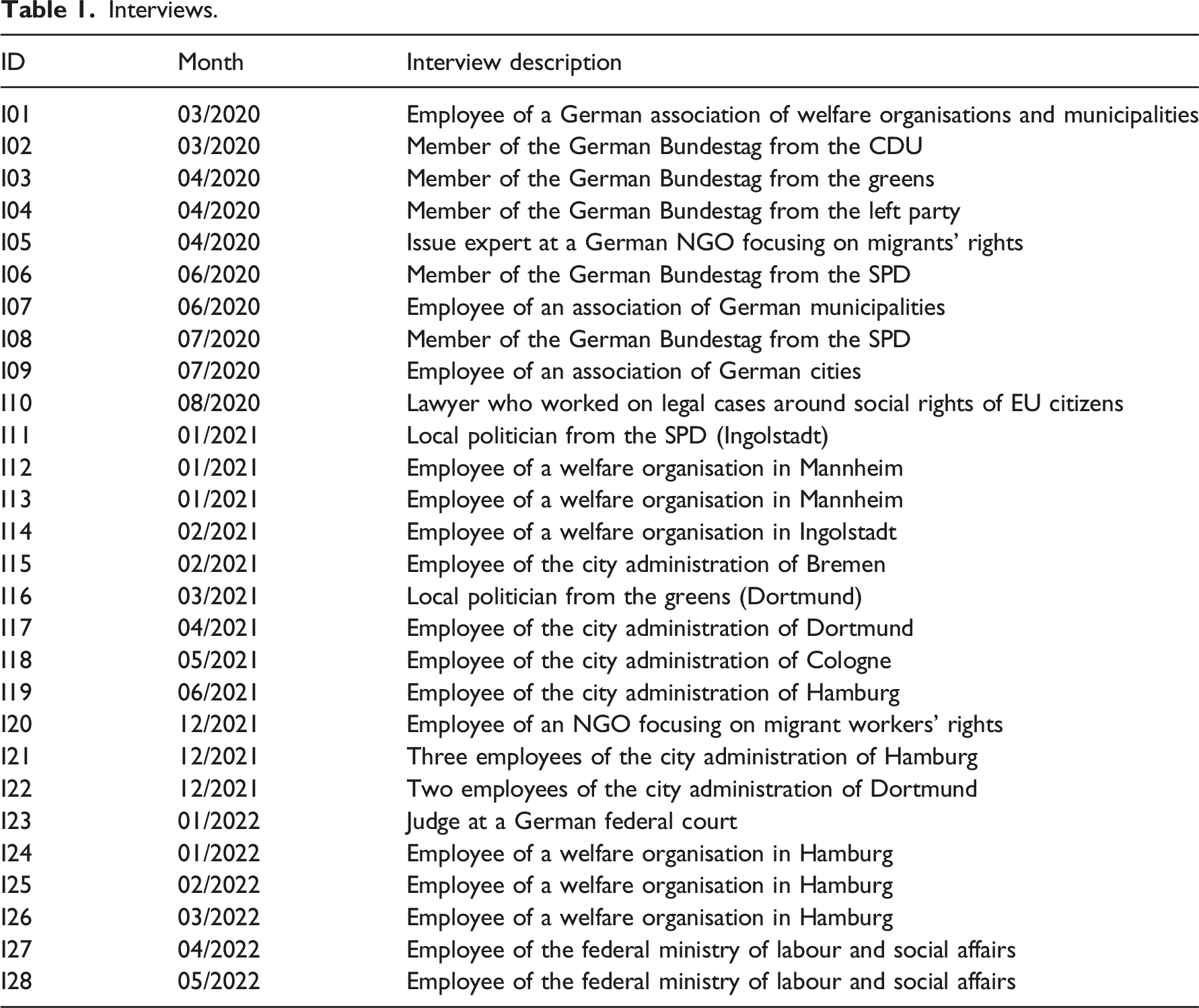
First, we reconstructed the policy process, tracing the policy proposal to exclude EU migrant citizens. Second, we carried out systematic process analysis (Hall, 2006) to assess existing theories more carefully. To trace the policy process, we first analysed debates, hearings, and position papers at the federal level, focusing on political parties and the federal parliament (Bundestag), finding that the 2016 law was not salient in federal parliament debates or party manifestos. Subsequently, we analysed the activities and influence of cities on policy formulation with special attention to the role of a working group organized under the umbrella of the German city association (Städtetag). 2 We also conducted in-depth analyses of debates and policy developments in selected cities, which served to verify information, reconstruct the policy process, and test existing theories. Hamburg, Dortmund and Offenbach were included as cities involved in the working groups with comparatively high EU-immigration. In the analysis at each level, attention was given to problem definitions (framing), policy proposals, and actors involved. We identified Hamburg as the key city behind the demand for social assistance reform and consequently analysed the city in depth. Hamburg’s former mayor was a key actor in the policy process, considerably contributing to the framing and selective aggregation of policy demands as well as effective lobbying at the federal level during the stage of agenda setting and the drafting of the law.
We then turned to common explanations for exclusionary welfare reform (problem pressure, political parties, and institutional explanations) to make sense of Hamburg’s role and the mayor’s actions. We operationalized problem pressure using GDP per capita, public debt per capita, unemployment rates, and migration rates. To assess political explanations, we considered local and federal election results, with particular attention to far-right electoral success, and political orientation of city governments. Concerning agency, we conceptualized policy entrepreneurship in line with the existing literature.
Social assistance exclusions of EU migrant citizens in Germany
Germany has two minimum income programmes for non-elderly needy people, one for jobseekers and workers on low income (social code II) and a second scheme for needy people who are unable to support themselves through work (social code XII). EU migrant citizens’ access to support under social code II was for several years a matter of legal dispute (Absenger and Blank, 2015; Martinsen and Werner, 2019: 643), due to the dual nature of the benefit as an instrument for labour market integration and a social assistance benefit. Eventually, the European Court of Justice ruled that Member States could deny EU jobseekers access to social assistance and left it to Germany whether to classify the benefits under social code II as social assistance (Absenger and Blank, 2015). In 2015, the German Federal Social Court then ruled that though it was acceptable to exclude EU migrant citizens from benefits under social code II, it would be unconstitutional to not provide persons in need with any social support. EU citizens should accordingly have access to social assistance under social code XII 3 after 6 months of de facto residence (Case B 4 AS 44/15 R). Before the ruling could be fully implemented at the local level, the German parliament passed a law that in principle excluded economically inactive EU migrant citizens from social assistance under social code XII for the initial 5 years of residence (Bundestag, 2016).
Prima facie the 2016 law could be interpreted as a federal response to the ruling by the Federal Social Court (Martinsen and Werner, 2019: 643). Even though the ruling was important for the legislator’s exclusionary response, it is only part of the story. Several cities and states had problematized local challenges as they felt overburdened by alleged ‘poverty immigration’ and left out of decision-making processes over EU enlargements. The cities and states demanded ‘legal clarifications’ concerning access to social assistance by EU migrant citizens. Hence, the 2016 law should also be seen as a response to deliver on these municipal demands (I28).
Explaining Hamburg’s actions
The possible explanations for welfare chauvinistic policy identified earlier seem insufficient for understanding Hamburg’s role. Objective problem pressures were rather small, as Hamburg was among the most prosperous German cities in terms of GDP per capita (Statistische Ämter des Bundes und Der Länder, 2019b; Appendix: Figure 2), had a moderate unemployment rate (Appendix: Table 1) and the lowest public debt per capita of the three German city states (Appendix: Table 2). Furthermore, Hamburg did not experience proportionally more intra-EU migration than other parts of Germany. Nevertheless, political debates focused on immigration from Romania and Bulgaria, although the share of citizens from these countries among municipal residents (0.69%) was much smaller than the share in many other German cities – for example, Offenbach am Main (6.14%), Worms (3.05%), or Straubing (2.91%) (all data for 2015; Statistisches Bundesamt, 2019; Appendix: Figure 1, Table 1). The number of benefit recipients also does not suggest pressure: in 2014, 15 Bulgarians and 17 Romanians received social assistance under social code XII in Hamburg (Senat Hamburg and Grunwaldt, 2016: 3; Senat et al., 2019: 10). What is more, other cities, like the much poorer Dortmund proposed to make federally funded schemes available for otherwise excluded, needy EU migrant citizens (I17; Zoerner, 2021). Similarly, Munich also pleaded to make social assistance more inclusive (München and Arge, 2021).
Our analysis of local political debates nonetheless suggests that perceived pressures shaped Hamburg’s actions, notably the increase of homeless EU migrant citizens. Furthermore, a cross-party consensus among the centre political parties existed on the potential impact of welfare magnetism (I19, I21; for example, Bürgerschaft Hamburg, 2013b: 5–6). But this does not make Hamburg unique, as similar concerns of local social pressures and perceived welfare magnetism existed across cities at the time (see Städtetag, 2013). In fact, Hamburg officials themselves stressed that other cities were much more challenged by EU immigration (Bürgerschaft Hamburg, 2013b: 3; I21).
Political explanations also seem inadequate for explaining Hamburg’s role. The first issue to note is that Hamburg had been governed by the Social Democratic Party (SPD), initially with an absolute majority of parliamentary seats, after having received 48.4% in 2011 and 45.6% of the votes in the 2015 elections (Statistikamt Nord, 2015). Other SPD governed cities and states did not push for social assistance exclusions. Notably, the SPD stronghold Bremen, with considerable EU immigration (Schmidt, 2019) and high problem pressure (unemployment and debt) did not make any similar demands (I25, I21). Moreover, Hamburg’s SPD held a restrictive line on immigration and access to social benefits by migrants, which resulted in a rift between them and other parts of the party, including the federal executive of the SPD (Unger, 2014). Coalition governments also do not account for the differences between SPD-led cities: Bremen was governed by a coalition between the SPD and the Greens at the time (Bundesrat, 2021), but the Greens also joined Hamburg’s government after the 2015 elections.
Pressure from right-wing populist parties similarly does not offer a sufficient explanation for Hamburg’s demands: Hamburg proposed to legislate social assistance exclusions already in 2012, as part of a Städtetag working group (I18, I19; Städtetag, 2013) – before the far-right AfD was even founded. Still, some argue that the AfD’s success of entering the local parliament in 2015 with 6.1% of the votes (Statistikamt Nord, 2015) was an important reason behind the 2016 law (Gago and Hruschka, 2022: 10). Yet, it does not set Hamburg apart from other cities or states (Figure 1): the AfD’s 2015 election success in Hamburg was far below those in other states (Bundeswahlleiter, 2021). More specifically, the AfD was successful in several states traditionally governed by the SPD, which ‘led to changing party-voter alignments and a strong politicization of immigration issues’ (Franzmann et al., 2020: 614). According to the far-right competition thesis, we could expect cities or states with weaker Social Democratic governments and a comparably stronger AfD to have pushed exclusionary social assistance reforms more strongly than Hamburg. Finally, an examination of 127 political documents from debates on intra-EU migration in Hamburg yielded only three contributions by the AfD until the end of 2016, suggesting that the issue was not of great salience for the party. Vote shares of AfD and SPD in national elections.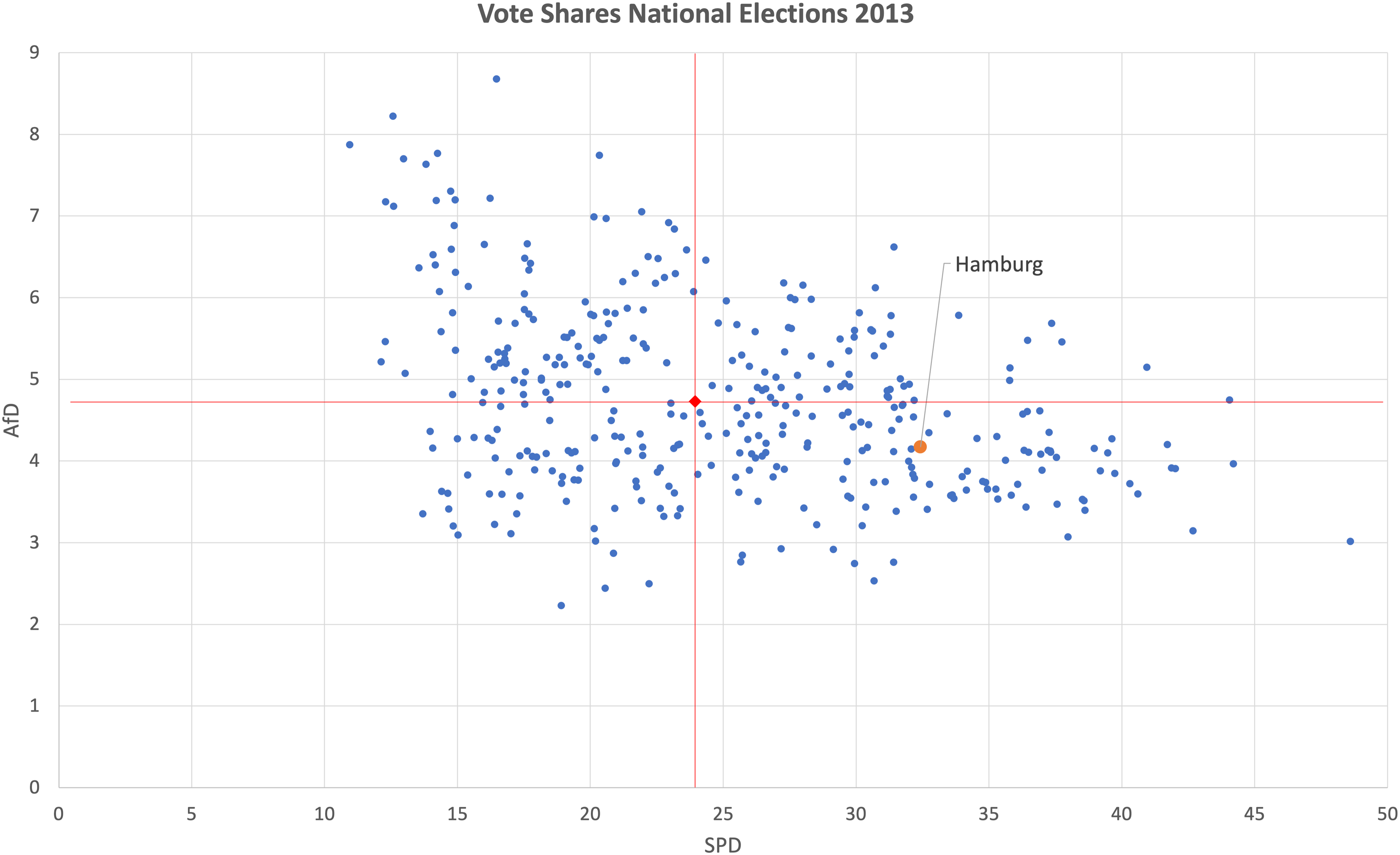
Finally, most institutional factors are ‘held constant’ in our study of one country and one type of benefit. Hamburg is a city state, which gives the city additional institutional leverage in lobbying the federal level. If this explanation was sufficient, the city states of Bremen and Berlin (which is also comparatively poor with high immigration rates) should have been similarly occupied with this issue. However, neither of these cities actively pushed social assistance exclusions. To sum up: none of the common theoretical and analytical approaches to explain welfare chauvinistic reform can sufficiently elucidate Hamburg’s demands.
The difference a well-connected policy entrepreneur makes
Fully comprehending (i) Hamburg’s influence on the 2016 law, and (ii) why the city pursued this policy line requires taking the pivotal role of policy entrepreneurs into account. In what follows, we illustrate that Hamburg’s mayor Olaf Scholz was crucial in the policy process. We demonstrate how the timing of key events coincides with Scholz’s own activism, how his institutional position and network helped him leverage policy preferences and how central the idea of welfare magnetism was to his entrepreneurship. Figure 2 illustrates the order of events. Order of events.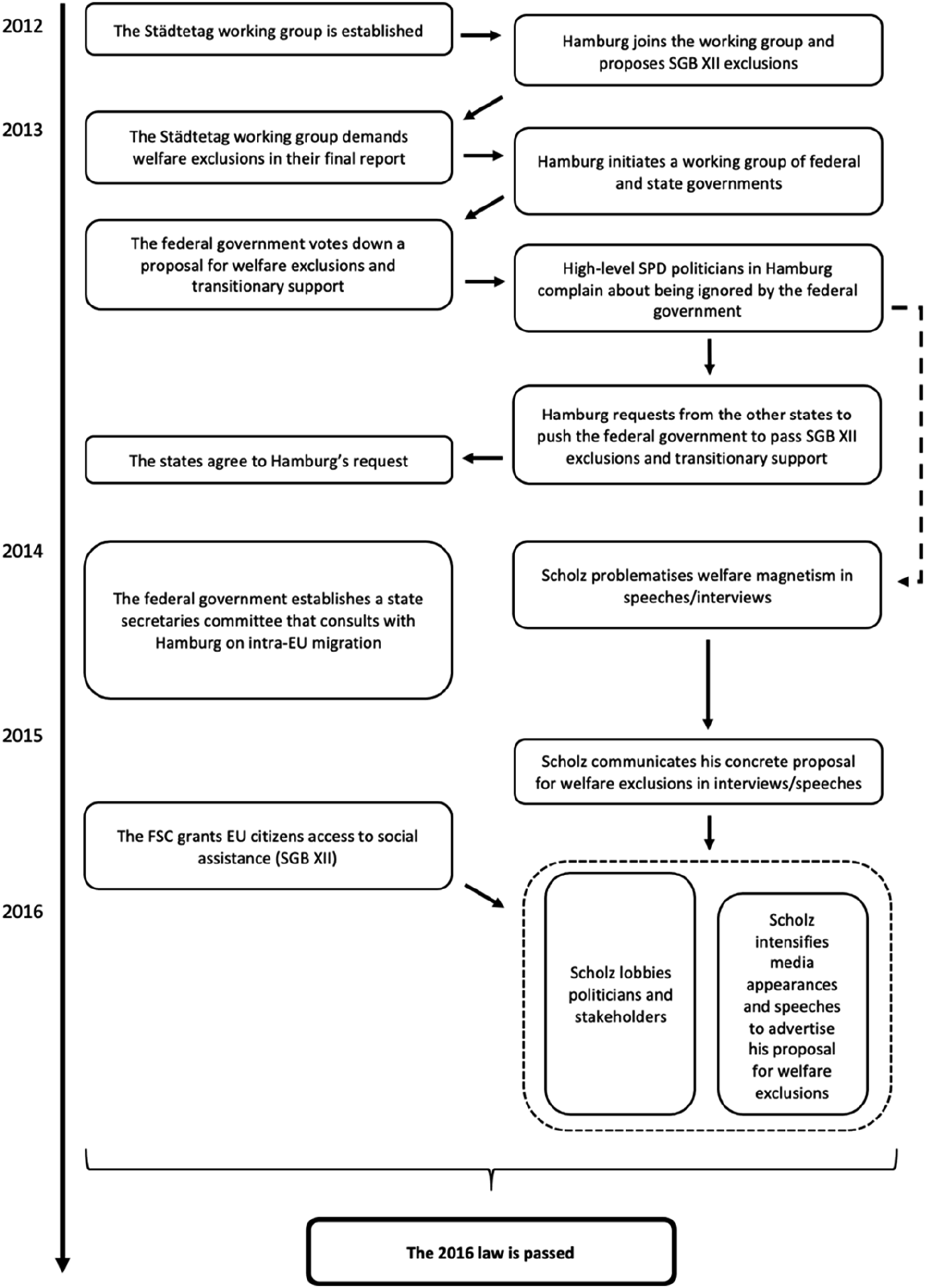
The Städtetag working group was established in 2012 (Dortmund, 2012: 2) to develop joint demands on matters linked to EU immigration. In their concluding report from 2013, the working group recommended several policy responses, one of which was social assistance exclusions (Städtetag, 2013: 8). Interviewees involved in the working group at the time reported that Hamburg was the city that placed social assistance exclusions onto the agenda (I18, I19). Others called Hamburg a ‘forerunner state’ in pushing for what became the 2016 law and providing concrete proposals for the legal text (I23, I24).
In Hamburg, legal uncertainties regarding EU migrant citizens’ access to social assistance were problematized as early as 2012: Hamburg’s social-democratic Senator of Social Affairs Detlef Scheele, a close associate of the Mayor, argued that legislative reforms were needed to reduce incentives for migrants without perspectives to come to Germany (Bürgerschaft Hamburg, 2013a: 5219). Also, the idea of welfare magnetism was central to local political debates on EU immigration and the city’s involvement in the Städtetag working group (I24, I26). Based on existing legal uncertainty, bureaucrats in Hamburg’s Office of Social Affairs considered it important to clarify through legislation that economically inactive EU migrant citizens were excluded from social assistance (I19; Städtetag, 2013).
In 2013, Hamburg’s administration initiated and chaired an additional working group, which included representatives from the federal government and the states, to push certain municipal demands within the system of multi-level governance. This group developed policy proposals for social assistance exclusions that were more specific than those by the city working group and included a number of provisions that were later incorporated into the 2016 law (Hamburg, 2013a: 13). However, these proposals were not supported by the federal government, arguing that existing exclusions were sufficiently clear (I28). Subsequently Hamburg’s Senator of Social Affairs placed the proposal onto the agenda of the Conference of State Labour and Social Affairs Ministers. He was able to garner support for a motion, committing state governments to lobby the federal government to support the proposed (but rejected) reforms of social assistance (ASMK, 2013: 37).
Irritated by the lack of policy reforms at the federal level, the SPD Senator of Social Affairs and Integration Detlef Scheele and his deputy complained that the federal level ignored them. In their view, the federal level did not offer any constructive solutions to the issues identified by the working group of the federal government and states (Hamburg, 2013b). However, the federal government set up a committee of state secretaries from different federal ministries, tasked to assess the situation of intra-EU migration in Germany (BMI/BMAS, 2014). The committee paid special attention to a few cities, of which Hamburg was one, and consulted specifically with representatives from Hamburg in separate, in-depth sessions on the demands voiced by the two aforementioned working groups (BMI/BMAS, 2014: 40–41). Again, the Committee’s recommendations did not immediately result in the policy changes Hamburg’s administration wanted, although some of them were subsequently included in the 2016 law (I19; I23; I24).
Framing and lobbying a problem
Starting around 2014, Olaf Scholz, the Mayor of Hamburg from 2011 to 2018, would give several public and non-public talks to increase federal attention on the matter and lobby for excluding EU citizens from social benefits. These demands included social assistance but went beyond social code XII – Scholz mostly used the catch-all term ‘social benefits’ (Sozialleistungen). The most consistent theme in his contributions was the idea that welfare magnetism was a major problem at the current state of European integration. He repeatedly argued that free movement and differences in levels of welfare provision across the EU are incompatible. In a speech at Harvard University and a speech to the public in Hamburg explaining the principles of his policy views (Scholz, 2014a; 2014b) he argued that national welfare states would have to be made ‘more compatible’ with each other in the face of potential intra-EU welfare magnetism, effectively meaning less access for EU immigrants.
In November 2014, Scholz gave a speech to the Federal Council (Bundesrat) explaining his views on welfare magnetism. The speech was given in connection with a federal legislative bill. The latter called for the introduction of temporary entry bans for EU citizens in cases of confirmed benefit fraud, the shortening of the duration EU mobile citizens could remain in Germany to search for jobs, and increased bureaucratic scrutiny when applying for child benefits (Bundestag, 2014). Scholz argued that the German welfare system was not designed for a European space of open borders and therefore required reforms (Bundesrat, 2014: 376). According to him, there would ‘never’ be a harmonization of social policy in the EU, and it was not ‘imaginable’ that weaker European welfare states could eventually catch up with Germany’s social security system. Thus, two potential policy pathways to address the underlying tensions between free movement and national welfare – EU-level social policy and upward social policy convergence – were perceived as unviable by Scholz.
From his perspective only two policy options to address welfare magnetism seemed possible: a) excluding EU migrant citizens from social support to prevent welfare magnetism or b) ending free movement. Scholz presented and developed his idea of excluding EU migrant citizens from social support in at least 28 speeches, interviews, and texts between 2014 and 2017. Concretely, he proposed to only grant EU migrant citizens social support once they have worked in the country of destination for at least 1 year in full-time employment at the national minimum wage (Sauga, 2016; Scholz, 2016c). Beyond changing German law, he proposed an ‘EU-wide’ agreement for this (Scholz, 2017: 52). This would entail changing EU law to introduce an ‘emergency break’ for states with high social benefit uptake by EU migrant citizens, very similar to the position taken by the UK Prime Minister David Cameron (Scholz, 2016c). Over the years, Scholz’s conviction that EU free movement and national welfare states were incompatible without welfare exclusions remained constant. Scholz did not adjust his policy agenda to changed problem pressures. Rather, he plugged various salient problems into his reasoning to move a proposed reform along onto the political agenda. Although Scholz explicitly stated that welfare exclusions ‘are not about saving’ money (Wenisch, 2016), he argued that excluding EU citizens from social support could prevent Brexit (Scholz, 2016a), protect Germany’s welfare state (Scholz, 2016e), defend freedom of movement (Scholz, 2015), and fix problems with the EU’s distribution of refugees (Gajevic, 2014).
Window of opportunity: A federal court ruling
The Federal Social Court’s 2015 ruling fundamentally clashed with Scholz’s and Hamburg’s proposals, establishing that EU citizens were constitutionally entitled to social assistance after 6 months of de facto residence, regardless of their economic status. In response, Scholz voiced his discontent with the ruling through various channels, as part of his efforts to push federal actors to respond to Hamburg’s demands. Ultimately, this allowed him to use the unexpected ruling as a window of opportunity to push through the demands previously made by Hamburg’s administration.
A week after the ruling, Scholz met the Court’s president and SPD member Peter Masuch at the party’s national convention to express his discontent with the ruling (I24; Flint, 2017), asking whether Masuch had lost control over his court (I23). Following this, it was agreed that Scholz would give a speech to the judges at the Federal Social Court in Kassel. In his speech on 10 March, Scholz argued that the lack of EU-wide social assistance schemes meant that the only way to prevent welfare magnetism was to build a fence around Germany’s borders: ‘The intellectual foundation of the latest ruling by the Federal Social Court is a fence. A fence around Germany that is difficult to get across by job seekers… Because only such a fence would guarantee that nobody can come to Germany who would end up being dependent on social support.’ (Scholz, 2016e: 4, authors’ translation).
He further called the ruling ‘cynical’ and condemned the judges, arguing that the changes brought about by free movement had ‘not yet sufficiently been legally and intellectually understood by some’ (authors’ translation) of them (Scholz, 2016e: 3). Until Scholz’s appearance at the court, it had been unheard of that a politician in office would go to the Federal Social Court to criticise a ruling (I23). Scholz also publicly remarked on the ruling in various interviews, including one with the weekly magazine Der Spiegel, where he repeated his ideas on granting social assistance only to those who had worked full time at minimum wage for 1 year (Sauga, 2016: 26).
The 2015 court ruling did not only challenge Scholz’s policy preferences, but also provided a window of opportunity to leverage his demand for exclusions. Prior to the ruling, Hamburg’s aim had been to create legal clarity on whether EU migrant citizens did have social assistance entitlements, with the aim of making sure they did not (I19). While the ruling contradicted that goal, the now formalized right to social assistance added weight to Scholz’s argument about the need for legislative reform – something that the Federal Ministry of Labour and Social Affairs had previously doubted (I28). Moreover, the ruling incited vocal complaints from several cities that called for federal action, lest they be financially overburdened (Wienand, 2016). A former employee of the Ministry of Labour and Social Affairs confirmed that pressure from SPD mayors prevented the responsible Minister Andrea Nahles from pursuing ‘more left-leaning policies’ (I27). Interviewees working at the ministry at the time confirmed that the law was a response to bottom-up pressure from cities (I27, I28).
While the ruling was a critical event, Scholz was a crucial policy entrepreneur. This seems clear when we consider not just the timing of events and speeches, but also his political resources which correspond perfectly to those of a successful policy entrepreneur. As the mayor of a city state, former Federal Minister of Labour and Social Affairs, as well as SPD Board Member and Chair of the important SPD committee responsible for drafting resolutions and party positions, Scholz politically could link the municipal, the state, and the federal level as well as state institutions and party organizations (see I23, I28). Interviewees from city administrations and welfare associations with insights into the policy processes leading to the 2016 law underlined that Hamburg’s status as a city state gave its officials a better overview and more influence at federal level than non-state cities (I18, I19, I21, I24). A newspaper article at the time even argued that Scholz ‘co-governed’ in Berlin (Meyer, 2016). Indicative of his network is also how Scholz organized a meeting with Angela Merkel and David Cameron to present his thoughts on the challenges of free movement, including proposals for social benefit exclusions (Meyer, 2016; Scholz, 2016c). More importantly for the law, however, is that Scholz was friends and had frequent exchanges with the then Minister of Labour and Social Affairs (Andrea Nahles) (I28, I24, I23), and personally knew the President of the Federal Social Court (Peter Masuch) (Scholz, 2016b) whom he himself had appointed (Mossig, 2016). One interviewee even described the 2016 reform as ‘a law ordered by Scholz’ (‘Bestellgesetz’) (I24). Another interviewee from Hamburg’s city administration confirmed that exclusions were ‘very close to his [Scholz’s] heart’ (I19).
Shortly before the law was passed, Scholz made his role in the 2016 law explicit in a lecture on economic and social affairs in Bonn where he said in connection to problematizing welfare magnetism in the EU that ‘we are on it and have made concrete proposals’ (Scholz, 2016f). He further stated during a lecture in Berlin: ‘I have already made a concrete proposal on how to link the entitlement to social benefits of EU nationals entitled to free movement more closely to work – this is all feasible and is currently being implemented with a law by Federal Minister Nahles’ (Scholz, 2016d, authors’ translation).
Even after the 2016 law had been passed, Scholz remained adamant about welfare exclusions and dedicated a full chapter in his 2017 book to the issue (Scholz, 2017: 64–93).
Assessing the evidence
Our analysis of the policy process behind the 2016 law first shows that though the 2015 ruling was important for eliciting a reaction by the federal legislator, the demand and concrete policy proposals had been developed over time and pushed bottom-up by cities. Hamburg, we demonstrated, was especially important to this process. In trying to understand why, our comparison with other cities suggests that neither actual or perceived problem pressure, nor the success of the AfD and its challenge to the SPD were unique to Hamburg. What set Hamburg apart, we argue, is the policy entrepreneurship of its mayor at the agenda setting stage and the decision-making process. Olaf Scholz was convinced of the importance of the matter, as conveyed in his speeches and lobbying efforts. He also had the right contacts and a powerful institutional standing, being the Mayor of a city state and Germany’s second largest city. While the latter does not explain why Hamburg was at the forefront in this policy process, it positively shaped Scholz’s ability to effectively lobby for certain problem definitions and policy preferences and potentially limited successful lobbying by other local level policy actors. This, as we discuss below, eventually allowed him to make immigration policy trajectories previously specific to Hamburg’s SPD appear dominant on the agenda of the federal party. Scholz could overcome limitations faced by other cities in voicing similar concerns by way of access to venues such as the Bundesrat, the working group between states and the federal government, the institutions of the federal SPD, and informal exchanges with key actors. The 2015 ruling by the Federal Social Court, while a failure for Scholz at first glance, turned out to be a window of opportunity, in that it offered leverage to one of Scholz’s core claims: the risk/fear of welfare magnetism.
We do not mean to suggest that Scholz was acting on his own or that the 2016 law necessarily reflected his personal preferences. Local politics, other politicians, and bureaucrats also played an important role. Yet Scholz was instrumental for making local political demands heard at the federal level. Seemingly persuaded by welfare magnet ideas, Scholz lobbied for the demands developed by his local Ministry of Social Affairs and pushed by Social Democrats within it. Over time, the federal SPD also moved closer to the restrictive immigration preferences of Hamburg’s Social Democrats. Previously, high-ranking SPD members rejected the idea of welfare magnetism and associated exclusions (Beck, 2012). By contrast, restrictive positions on migrants in general had long been internalized by Hamburg’s SPD (I24, I26). In broader migration debates, the party’s federal board was ‘disconcerted’ in 2014 about Hamburg’s Social Democrats being only welcoming towards refugees that integrated themselves, but not towards the neediest (Unger, 2014). Although concerning a different migrant group, the federal SPD’s tone had radically changed just 2 years later. As ministerial and parliamentary interviewees confirmed, the SPD’s Christian Democratic coalition partners at the time pushed even stricter welfare exclusions (I06, I28). Hence, with the SPD adopting a more restrictive stance internally, a potential hurdle towards restrictions was out of the way.
Much of Scholz lobbying happened behind closed doors and in informal settings and his precise role in the decision-making process cannot be reconstructed. However, interviewees at ministerial level confirmed that exchanges between Scholz and the Minister of Labour and Social Affairs Andrea Nahles occurred frequently at the time (I28; I27). The combined evidence hence strongly suggests that Scholz’s entrepreneurship was crucial for agenda setting and decision making.
The success of the AfD and the associated politicization of immigration in Germany (Franzmann et al., 2020) could of course have played an important role and might have been perceived as a potential threat. During Scholz’s time in office, Hamburg pursued a restrictive course on immigrants’ welfare more broadly. SPD members from Hamburg tried to block policy proposals discussed within the party to grant more social support to refugees (Unger, 2014); Scholz reportedly personally lobbied the SPD Party Chair Sigmar Gabriel to block these proposals. Politics indicating a restrictive take on immigration and an ambition to ‘save’ the German welfare state might have been part of Scholz’s bid for the federal office (see Meyer, 2016), indicating an instrumentalization of the idea of welfare magnetism.
This strategic instrumentalization is not to rule out that Scholz actually believed in welfare magnetism, something he never tired of highlighting in speeches and interviews. This also connects to past political achievements of Scholz and his local SPD: Hamburg’s SPD is proud of governing a wealthy city that fights social problems and of having reduced visible poverty (I24, I26). Furthermore, the provision of public housing was one of Scholz’s prestige projects and the pride of German Social Democrats beyond the city’s borders (Dohrn, 2021). Hence, homeless EU citizens who had no entitlement to housing but made poverty visible were seen as a challenge to earlier achievements, disproportionate to their numerical insignificance.
Conclusion
This article takes stock of the existing literature on welfare chauvinism and the still limited attention to when welfare chauvinist policy change occurs. We have argued, and sought to illustrate, the importance of close engagement with the policy processes to identify factors that help explain such reform and condition the influence of other aspects. In so doing, we have shown the importance of agency to identify the causes of welfare chauvinist reform. In addition, we have highlighted how the success of welfare chauvinist ideas can depend on the institutional context (see Koning, 2013). The article also exhibits the need for scrutinizing political dynamics below the national level to understand potential national exclusionary reform.
Our research confirms other findings, namely that exclusionary policies are often linked to anticipated and perceived problems, which in the EU context often relate to welfare magnet expectations (Kvist, 2004; Martinsen et al., 2019). What we add is the finding that these problems do not automatically need to translate into welfare exclusions, but that policy entrepreneurs can contribute to agenda setting by effectively garnering support in a multi-level governance environment. Scholz and his colleagues in Hamburg perceived welfare magnetism to be an actual problem and notably first reacted in response to what were not even formalized welfare entitlements for immigrants but in anticipation that such may materialize in the wake of a federal court ruling. Other cities were also concerned with welfare magnetism but lacked a resourceful policy entrepreneur like Scholz and institutional leverage.
What are the implications for the study of welfare chauvinism and for answering the broader questions raised in this special issue? For one, our research shows that we need to be careful in ascribing welfare reforms that exclude immigrants from welfare benefits ex post to the success of parties with welfare chauvinist agendas or widespread welfare chauvinist attitudes in the electorate (see for example, Careja and Emmenegger, 2012). Second, we have highlighted the importance of looking at policy processes and acknowledging how institutions allocate power. Future research should consider these factors when seeking to identify conditions for welfare chauvinist reform. Moreover, our findings demonstrate how politically powerful the idea of welfare magnetism can be in relation to restricting access to social benefits to EU migrant citizens.
Supplemental Material
Supplemental Material - Agency, institutions, and welfare chauvinism: Tracing the exclusion of European Union migrant citizens from social assistance in Germany
Supplemental Material for Agency, institutions, and welfare chauvinism: Tracing the exclusion of EU migrant citizens from social assistance in Germany by Dominic Afscharian, Cecilia Bruzelius and Martin Seeleib-Kaiser in Journal of European Social Policy.
Footnotes
Declaration of conflicting interests
The author(s) declared no potential conflicts of interest with respect to the research, authorship, and/or publication of this article.
Funding
The author(s) disclosed receipt of the following financial support for the research, authorship, and/or publication of this article: This work was supported by Fördernetzwerk Interdisziplinäre Sozialpolitikforschung/German Federal Ministry of Labour and Social Affairs.
Correction (September 2025):
Article has been updated with secondary affiliation of Cecilia Bruzelius, since its original publication.

Supplemental Material
Supplemental material for this article is available online.
Notes
References
Supplementary Material
Please find the following supplemental material available below.
For Open Access articles published under a Creative Commons License, all supplemental material carries the same license as the article it is associated with.
For non-Open Access articles published, all supplemental material carries a non-exclusive license, and permission requests for re-use of supplemental material or any part of supplemental material shall be sent directly to the copyright owner as specified in the copyright notice associated with the article.
