




Abstract
Minimum income schemes aim at providing citizens with a minimum living standard. In some EU countries, their regulation and provision takes place at the subnational level. This is the case in Spain, where minimum income schemes are a heterogeneous and complex collection of regional benefits designed and implemented at the regional level, by the Autonomous Communities. In June 2020, a complementary nationwide minimum income scheme was implemented. In this context, we use the European microsimulation model EUROMOD, together with microdata from the European Union Statistics on Income and Living Conditions, to comprehensively assess the performance of the whole minimum income system. We simulate a sequence of theoretical scenarios, considering different degrees of coverage and adequacy of these benefits and show that extending the coverage of the regional schemes would significantly alleviate poverty. However, it would not be sufficient to eliminate it and further increases in the benefit amounts would also be required. Furthermore, the new nationwide minimum income can potentially reduce the shortfall in income from the poverty line, if cost-shifting practices from the regional to the national budgetary level are limited. We discuss the importance of this case study in light of the decentralization of minimum income policies and derive some general policy implications. JEL classification: H53, H75, I38.
Introduction
Minimum income (MI) schemes aim at providing citizens with a minimum living standard. In line with the European Pillar of Social rights, they are a key feature of European welfare systems and the basic expenditure tool to fight poverty and social exclusion. In the presence of disruptive income shocks, these instruments take a renewed role in preventing fallout in extreme poverty.
In the European Union (EU) context, Spain stands as a case of very poor performance in terms of poverty reduction, as reflected in the successive country-specific recommendations of the European Commission asking for action in this matter (see, for example, European Commission, 2020). The at-risk-of-poverty rate in 2019 was 20.7% (EU27 average 16.5%) and social transfers (excluding pensions) reduce poverty by only 23% (EU27 average 32.4%). 1
Until 2020, the Spanish MI schemes were legally set and managed exclusively at the regional level by the Autonomous Communities (regions hereinafter 2 ), leading to a high degree of heterogeneity in terms of rules and outcomes. In June 2020, a new nationwide MI scheme (Ingreso Mínimo Vital), aimed at complementing the regional ones, entered into force. Its implementation is still at a preliminary stage and its interaction with the MI regional schemes – whether complementary or substitutable – will be crucial for enhancing or not these last-resort safety nets.
Although there are studies looking at the effectiveness of MI schemes in some regions (for example, Gorjón and Villar, 2019, for País Vasco), or at the national level (for example, Ayala et al., 2021), little is known about the budgetary and poverty effects of potential increases of MI coverage and adequacy across Spanish regions. Following Daigneault et al. (2021), the presence of diverse welfare states at the subnational level calls for a more thorough study of intra-country variations.
This article contributes to filling this gap by comprehensively describing and comparing the regional MI schemes in terms of their coverage and adequacy, as well as by assessing the budgetary and poverty effects of increasing both dimensions in a stepwise approach. By using microsimulation modelling, we show the heterogonous poverty-reducing effects of different regional MI schemes, using both national and regional poverty benchmarks. This methodology could be applied to other regionally framed countries (for example, Austria or Switzerland) or from a cross-country perspective (that is, what would be the poverty and budgetary impact of extending MI coverage and adequacy across EU countries).
In addition, we assess the budgetary and poverty effects of the introduction of the nationwide MI scheme and reflect on its potential impact in light of cost-shifting practices between different levels of governance. More generally, this analysis contributes to a better understanding of MI policies in ‘regionally framed countries’ (Kazepov and Barberis, 2013).
The article is organized as follows. The second section reviews the literature, focusing on the provision of MI support in regionally framed countries. The third section characterizes the Spanish regional MI schemes in terms of adequacy and coverage. The fourth section describes the methodology followed to evaluate those MI schemes, while the fifth section assesses the budgetary and poverty impacts of extending their coverage and adequacy. The sixth section simulates the impact of the new nationwide MI scheme, and the seventh section concludes.
Minimum income support in regionally framed countries
Poverty varies significantly both between and within countries. The geographical nature of this phenomenon is not only explained by the heterogeneous distribution of socio-economic conditions across territories but by the role of the different welfare states in poverty alleviation and social inclusion. Although national level comparisons prevail in the literature (Caminada et al., 2012; Fouarge and Layte, 2005, among others), within-country differences matter and pose important challenges for policymakers (Copus et al., 2015). National level comparisons might hide significant discrepancies between the worst and the best performing regions within a country (Rogge and Self, 2019).
The regulation and provision of MI schemes takes place in some EU countries at the subnational level and, as stated by Daigneault et al. (2021), ‘those interested in federal countries or unitary states with power devolution or multilevel governance arrangements, should reject “methodological nationalism” and pay closer attention to the possibility of distinct regimes below the national level’ (p. 247). Many of the EU countries are organized as federal or quasi-federal states. In these countries, the subnational or regional levels of government have significant importance and political independence from the central government to pursue their own socio-economic policies, among which are the regulation and provision of MI schemes.
Different attempts have been made to classify MI schemes according to their territorial configuration. Natili (2020) distinguishes three models, mainly depending on whether the regulation and financing takes place at the national or subnational level and classifies Spain, jointly with Italy, Austria and Switzerland as ‘uncoordinated decentralized models’. In the same vein, Hölsch and Kraus (2004) finds that Spain is among the most decentralized systems, together with Germany, Sweden, Italy and Austria.
Decentralization on the provision of social transfers for the poor brings both advantages and disadvantages (von Braun and Grote, 2002). On the positive side, subnational governments would better allocate the benefits to those in need given a greater knowledge about their preferences and socio-economic characteristics, vis-a-vis the central government. On the negative side, decentralization might generate tensions between territories if their income levels are very different. In fact, Ayala and Bárcena-Martín (2018) have shown how coverage rates vary widely across Spanish regions, motivated not only by the natural socio-economic differences among them, but also by the different financial and budgetary capacities of each region. Furthermore, Ayala (2016) proves that coverage rates are positively correlated with the GDP per capita of each region, with the richest regions providing a better coverage.
In this context, federal or quasi-federal countries face the so-called federalist’s dilemma by which ‘subnational governments therefore face opposite incentives […]; they have strong incentives to own such policies in order to signal relevance of their subnational jurisdiction, but they also have incentives to disown them because of their budgetary implications’ (Bonoli et al., 2019: 57). In the Spanish case, regions have definitely maintained their responsibilities over MI schemes and no discontinuity has occurred, as opposed to other countries’ experiences (see, for instance, the case of Italy in Natili, 2018). However, some sort of upwards cost-shifting to the national level has taken place, mainly through the subsidiary nature of the regional schemes, for instance by deriving potential beneficiaries of MI benefits onto national programmes for the long-term unemployed (Bonoli et al., 2019). Similar practices are documented in Switzerland and Germany as response to caseload increases (Bonoli and Trein, 2016). In general, cost-shifting practices arise in the presence of multiple layers of governance, and more concretely, in cases where the division of responsibilities in the provision of support to the poorest citizens is not clearly defined (Aguilar-Hendrickson and Arriba, 2020).
The study of the adequacy of decentralized MI systems is also relevant. Poverty lines are commonly used to evaluate their effectiveness to fight poverty (see Immervoll, 2012, for an analysis across OECD countries, or Nelson, 2013, for the European case). In countries where the regulation takes place at the subnational level, and thus the benefit amounts may vary across regions, the level of the benefit can be compared to a unique national poverty line or, alternatively, to regional poverty lines. Mogstad et al. (2007) show how regional poverty rates are sensitive to the choice of region-specific or country-specific thresholds. They find that, in Norway, the use of a single national poverty threshold skewed poverty rates downwards in urban areas, and upwards in rural areas. In Spain, Ayala et al. (2014) provided empirical evidence of a significant re-ranking of regions in terms of intensity and incidence of poverty when moving from national to regional poverty lines. The authors conclude that ‘these results might also be relevant for the adequate design of equality policies embedded in decentralization processes […] A robust table of regional poverty rankings is necessary both to evaluate the results of decentralization in terms of social welfare, and to ensure an adequate distribution of fiscal equalization transfers’ (p. 330).
Characterization of the Spanish regional MI schemes
All Spanish regional MI schemes are non-contributory, means-tested, top-up benefits, but their assessment units, eligibility conditions, benefit amounts, duration and conditionality clauses vary significantly across regions (see Supplementary Table A1 of the online appendix for a detailed description). These differences translate into regional discrepancies, in terms of adequacy and coverage, as illustrated by Figures 1 and 2. Adequacy of regional MI schemes (%), 2018. Source: own calculations based on EUROMOD with EU-SILC data. Coverage of regional MI schemes by different criteria of potential beneficiaries (%), 2018. Source: own calculations based on EUROMOD with EU-SILC data. Data on actual beneficiaries come from Ministry of Health, Consumer Affairs and Social Welfare (2019).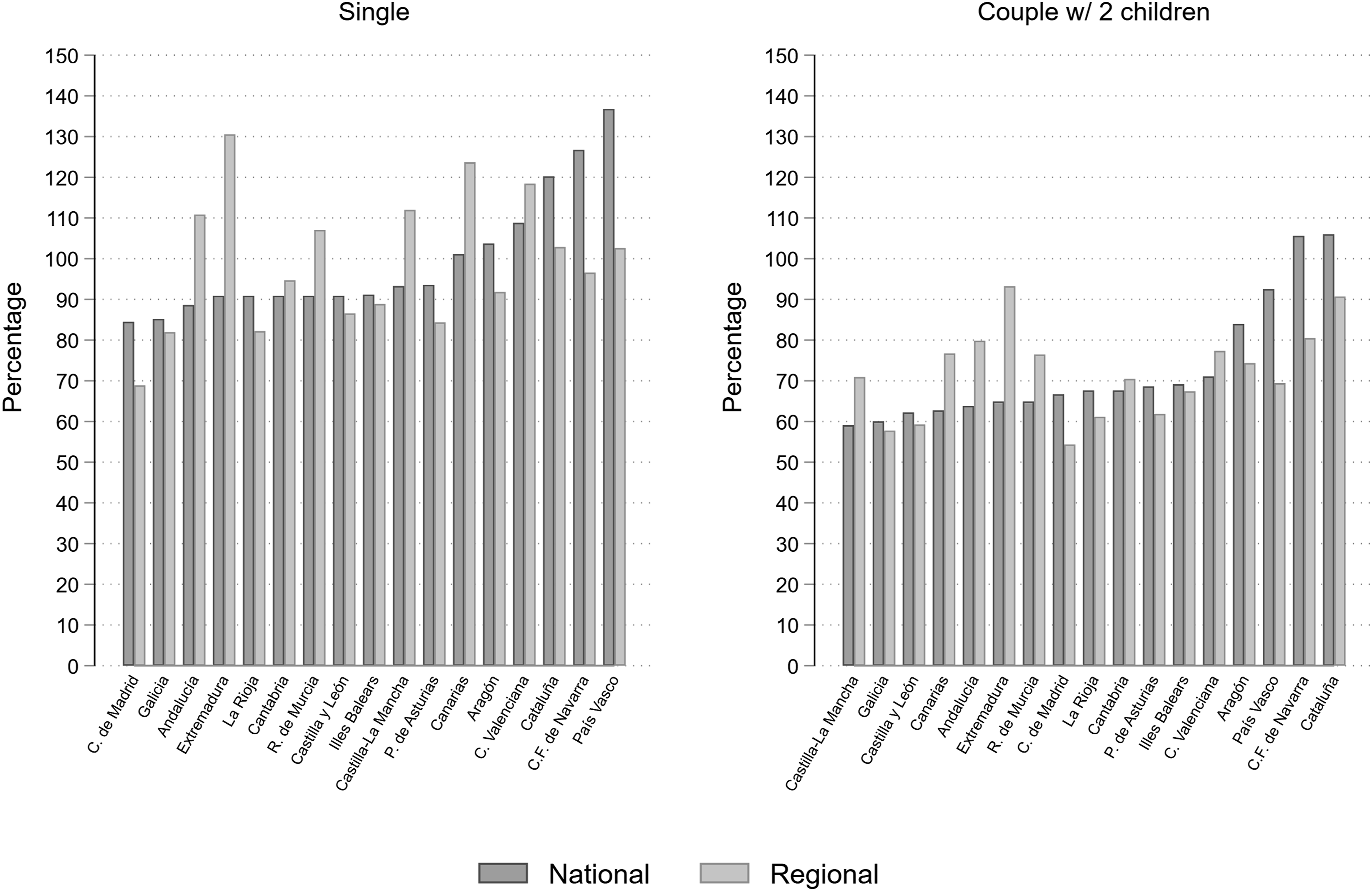
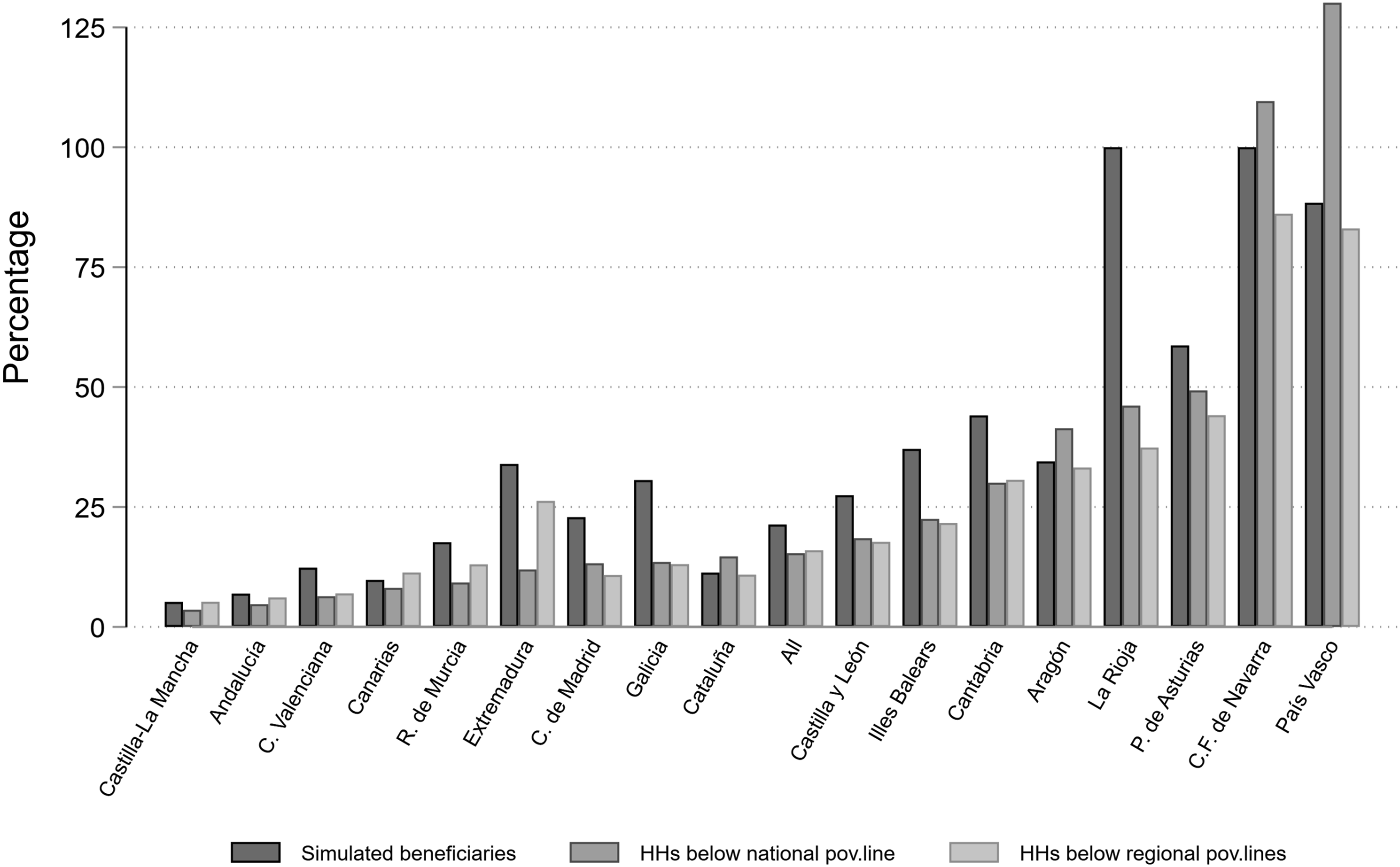
Figure 1 shows the adequacy of regional MI schemes, computed as the ratio between the guaranteed MI and the extreme poverty line. 3 Results obtained with the microsimulation model EUROMOD 4 are presented for two types of households: a single-adult household and a household composed of two adults and two children below the age of 14 years. Considering the national poverty line, singles without children show adequacy figures around 90% in most regions, and higher than 100% in six. The adequacy levels are much lower for couples with two children, ranging between 60% and 70% for most regions, and higher than 100% only in two (Navarra and Cataluña). These results are in line with previous studies, where Spain stands as one of the EU countries with lowest adequacy levels and lacking sensitivity for the size of the family (Frazer and Marlier, 2009, 2016).
A different ranking of regions emerges using regional poverty lines. Some regions for which MI amounts were not fully adequate (such as Andalucía and Extremadura, for singles) are now above that threshold. The opposite happens to País Vasco, Navarra and Cataluña. This result strikingly uncovers important discrepancies in income and poverty thresholds between Spanish regions (Ayala et al., 2014).
Figure 2 shows the coverage rates of regional MI schemes, calculated as the ratio between the actual number of beneficiaries and the number of potential beneficiaries computed using EUROMOD. Potential beneficiaries are defined as those who would be entitled to MI support according to three alternative policy criteria: (i) family units meeting the eligibility criteria simulated in EUROMOD, 5 (ii) households with an equivalized household disposable income below the national poverty line and (iii) same criterion with regional poverty lines.
In the first case, the coverage rates can be interpreted as effective coverage rates, while the two remaining cases would be ‘pseudo’ coverage rates (Immervoll, 2012). The figure shows that effective coverage rates are overall higher than ‘pseudo’ coverage rates, due to generally lower thresholds and non-income eligibility conditions in the actual MI schemes. Coverage rates are systematically below 100% in all regions, except Navarra and País Vasco, and very few regions show values above 50%. Castilla-La Mancha stands out as the region with the lowest coverage.
Methodology
We start from the 2018 tax-benefit rules simulated in EUROMOD and calibrate the model to tackle the overestimation of regional MI benefits. The overestimation of these benefits in EUROMOD results from the (i) non-simulation of some non-income conditions, due to the lack of information in EU-SILC, 6 (ii) demand side factors (non-take-up) and (iii) supply side factors (regional budget constraints, administrative arrangements and so on). The calibration algorithm aligns both the simulated number of beneficiaries and the expenditure by region with the figures obtained from official statistics. A technical description of this process and its validation can be found in Supplementary section A1.
After the simulation and calibration of the current regional MI schemes (called hereafter the baseline), we construct a series of sequential theoretical scenarios where coverage and adequacy (measured against the 40% poverty line) are increased. This is done in a stepwise approach. First, we define a legal coverage scenario that reflects the impact of the current legal framework at its full potential, that is, every entitled recipient would actually receive the benefit. Then, a full adequacy scenario is considered, keeping the same beneficiaries as in legal coverage, who now receive a benefit amount (‘adequate benefit’) that takes them to the 40% poverty line. Finally, a poverty elimination scenario grants an ‘adequate benefit’ to those individuals who, despite not being legal recipients in the previous two scenarios, are nevertheless below the 40% poverty line; that is, all individuals below the poverty line are taken to the poverty line. We also define a counterfactual scenario with no MI support for assessing the performance of the baseline scenario.
Towards a poverty elimination scenario: assessment of the impact of the regional minimum income schemes
With a national total of 297,000 MI recipients and an expenditure of €1,478 million, beneficiaries vary from barely 4,000 households in Castilla-La Mancha to around 75,000 in País Vasco, that is, 18 times higher in the latter than in the former for similar population sizes. The simulated at-risk-of-poverty rates greatly vary across regions as well. Moreover, the use of national or regional benchmarks yields very different results regarding the extent of poverty risks in each region. For instance, they vary between 1% in Navarra and 17% in Extremadura with the national criterion, changing respectively to 6.1% and 5.6% when moving to the regional criterion. 7
Starting from the baseline scenario, we simulate the theoretical scenarios previously defined. Given the unfeasibility of simulating some non-income eligibility MI conditions, the two intermediate scenarios (legal coverage and full adequacy) should be interpreted as upper bounds in terms of number of recipients and expenditure. However, this does not affect the baseline (due to calibration) and poverty elimination (since it only depends on income) scenarios. The four scatter-plots in Figure 3 illustrate the changes of sequentially moving across scenarios. For each scenario, we depict the equivalized disposable income of households before (x axis) and after (y axis) receiving the MI amount. Dots above the main diagonal are those receiving MI (their income increases), while those on the main diagonal are those households not receiving the benefit (their income remains the same). The dashed line represents the national poverty line.
8
Effects on households’ equivalized disposable income of the theoretical scenarios, national poverty line (EUR/month). Source: own calculations based on EUROMOD with EU-SILC data.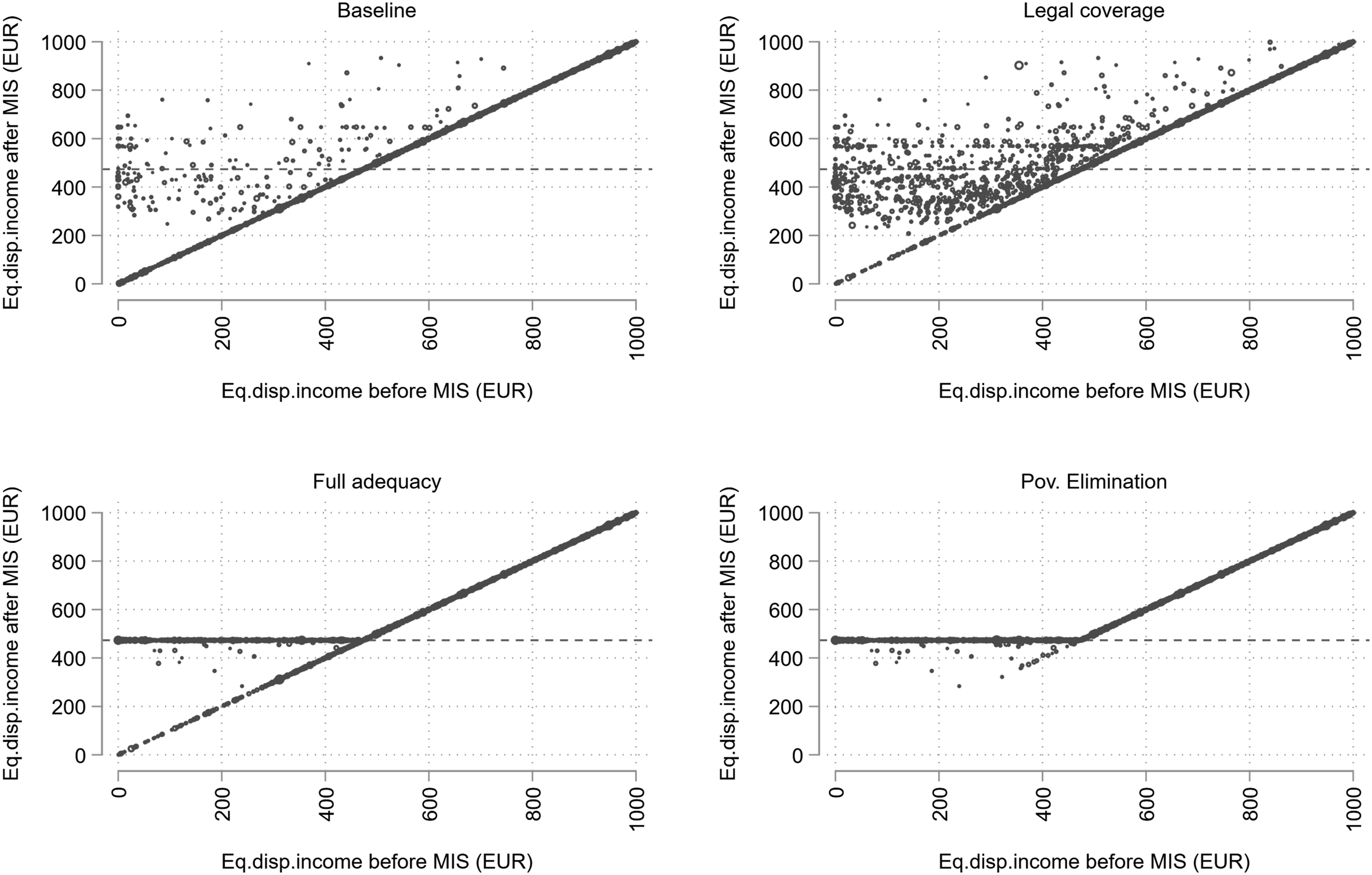
The limited coverage of the current regional MI schemes in Spain can be observed from the few households that deviate from the main diagonal in the baseline scenario (top left). This contrasts with the substantial impact that regional MI systems would have if extended to all households entitled to MI, as shown in the legal coverage scenario (top right). Both the baseline and the legal coverage scenarios produce a high dispersion around the national poverty line, reflecting the disparities in the degree of adequacy of the different regional MI schemes.
In the full adequacy scenario (bottom left side), all beneficiaries of the legal coverage scenario are moved to the poverty line. Notice that this scenario does not produce new entitled households and leaves out those households that are not eligible under the current rules, either because they are above the current guaranteed MI in each region, or because they do not fulfil non-income conditions (age, assets and so on). These households only reach the poverty line under the poverty elimination scenario. 9
We highlight that, although, in general, households cannot be worse off when moving to the next scenario, there are two exceptions. The first and most relevant case happens in regions whose MI adequacy is higher than the poverty line, so that when moving from legal coverage to full adequacy they will receive a lower benefit. 10 The second case corresponds to households that may lose entitlement to MI benefits because of the different definition of the family unit under legal coverage (legal definition) and full adequacy (household).
At-risk-of-poverty
Figure 4 illustrates the poverty reduction attained in each scenario, as a share of the total at-risk-of-poverty rate of a hypothetical situation without MI schemes
11
When measuring poverty risks against the national benchmark (left side graph), the existing MI schemes (baseline scenario) hardly reduce the risk of poverty in the majority of regions. For approximately half of the regions there is no impact, and the large majority of them attain reduction lower than 20%. The legal coverage scenario has only a negligible impact in most regions (Cataluña is a clear exception), denoting that the corresponding MI schemes are not designed to tackle the poverty line of 40%. For these regions the full adequacy scenario will have a bigger impact in reducing poverty risk, as long as the non-income eligibility conditions are not too restrictive, or the distance between the poverty threshold and the MI threshold is not very large (for example, Asturias). Otherwise, the poverty elimination scenario is, in most cases, the scenario that relatively achieves better results in tackling poverty risks (for example, Extremadura). At-risk-of-poverty rate reduction by region (relative shares by scenarios). Source: own calculations based on EUROMOD with EU-SILC data.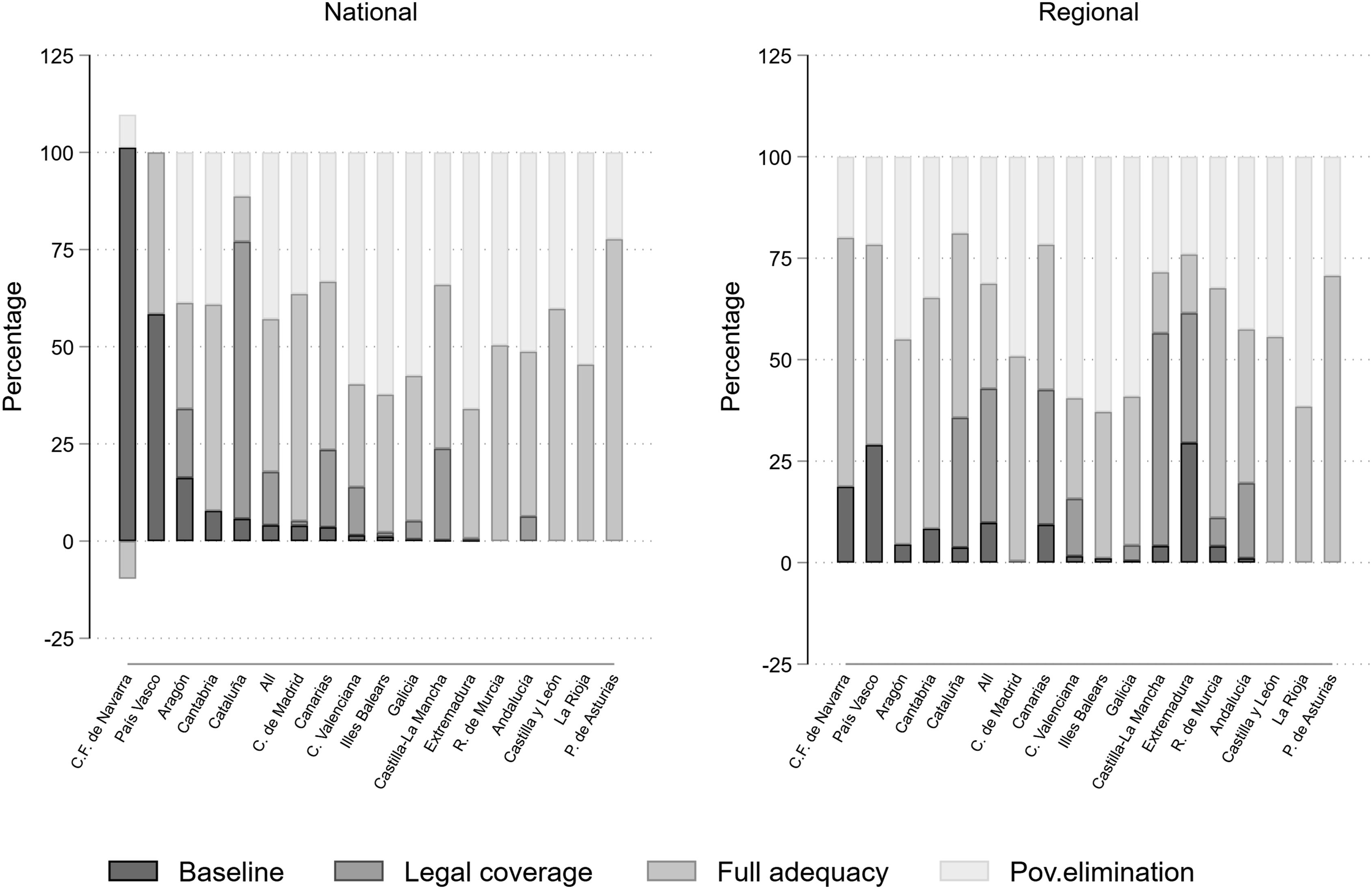
Switching to regional poverty lines (right side graph) would lead to a reduction in the impact of the current systems, being (slightly) higher than 25% in only two regions (Extremadura and País Vasco). As expected, the impact of the current system is higher (lower) for poorer (richer) regions. However, the results show that, in general, existing MI schemes are not well designed to tackle regional poverty.
Figure 5 examines the impact on poverty intensity (at-risk-of-poverty gaps).
12
Under the national criterion, only in two regions (País Vasco and Navarra) the current MI schemes reduce more than 50% of the total at-risk-of-poverty gap, and only three more are above 25% (Asturias, La Rioja and Cantabria). Broadening the coverage of MI schemes to all legally entitled results into substantial poverty intensity reductions for most regions. The most striking case is again Cataluña, where the at-risk-of-poverty gap would be almost fully offset, while in regions like Extremadura or Illes Balears the legal coverage scenario would not have such a high impact. Increasing the adequacy of the regional MI schemes has in general a significant impact as well, although smaller in those cases where the starting point shows already high adequacy (like Cataluña and Aragón). At-risk-of-poverty gap reduction by region (relative shares by scenarios). Source: own calculations based on EUROMOD with EU-SILC data.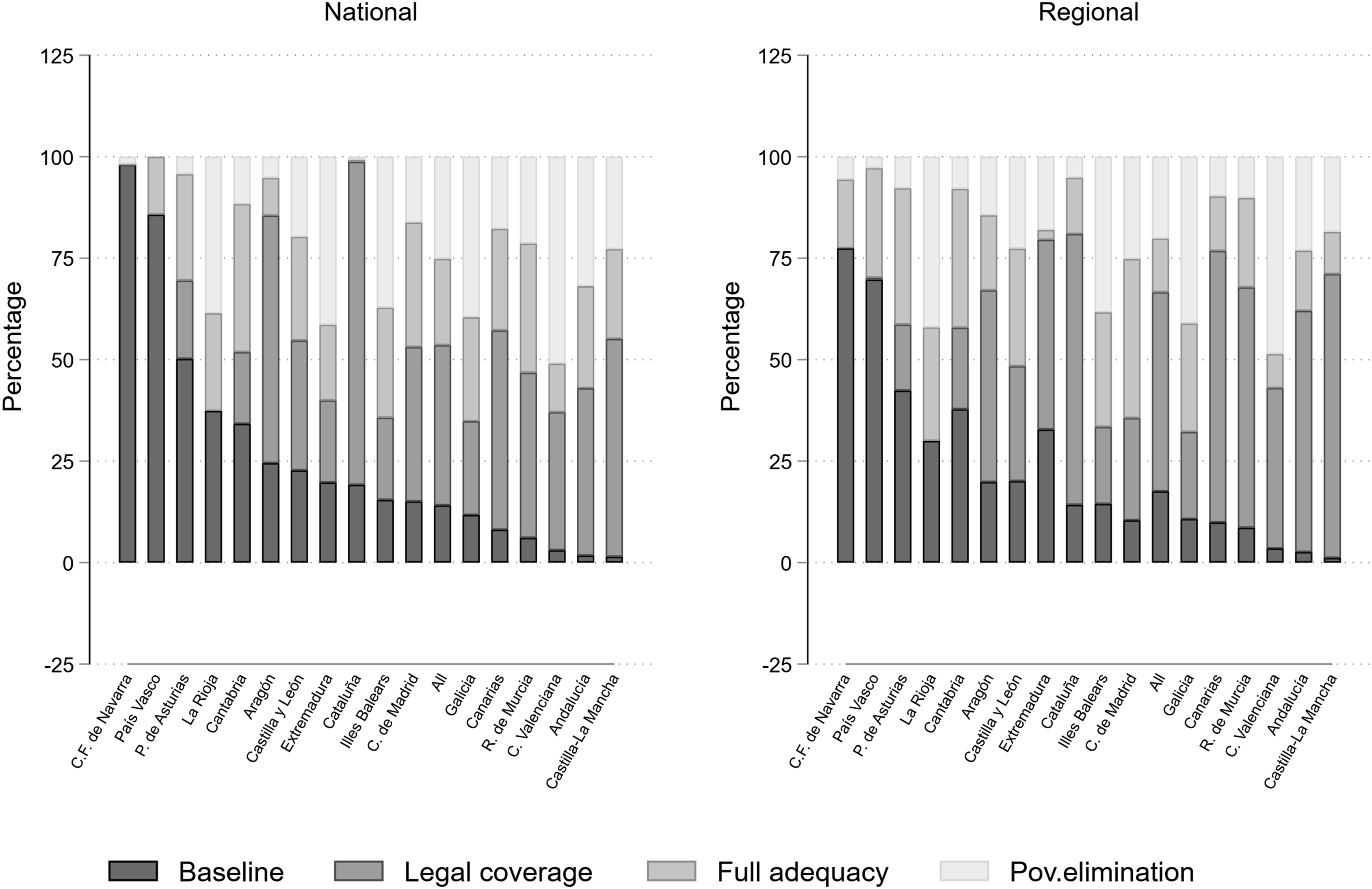
The relative importance of the legal coverage and the full adequacy scenarios varies when analysing their impact on poverty incidence or on poverty intensity. The full adequacy scenario is generally more effective at reducing poverty incidence, that is, relatively small increases in the amounts received by those legally entitled to MI in order to reach poverty lines allow many individuals to move out of poverty. In turn, the legal coverage scenario has relatively stronger effects on reducing the intensity of poverty, that is, many individuals may reduce their distance to the poverty line with broader coverage, even if the MI benefit is not large enough for getting them out of poverty.
Switching to regional poverty lines leads to a reduction in the variance of the impact of the current systems, since richer (poorer) regions perform worse (better) because their poverty lines are now higher (lower) than the national one. However, regions whose current MI systems reduced less than 25% of the total at-risk-of-poverty gap remain under that threshold when regional poverty lines are being used (except Extremadura).
Public expenditure
Figure 6 presents the results in terms of expenditure.
13
Under the national benchmark, and taking the baseline scenario as a starting point, the additional expenditure needed to eradicate poverty amounts to more than 50% of the total cost in most regions, being particularly large in regions such as Castilla-La Mancha or Andalucía (more than 90%). Expenditure in MI schemes by region (relative shares by scenarios). Source: own calculations based on EUROMOD with EU-SILC data.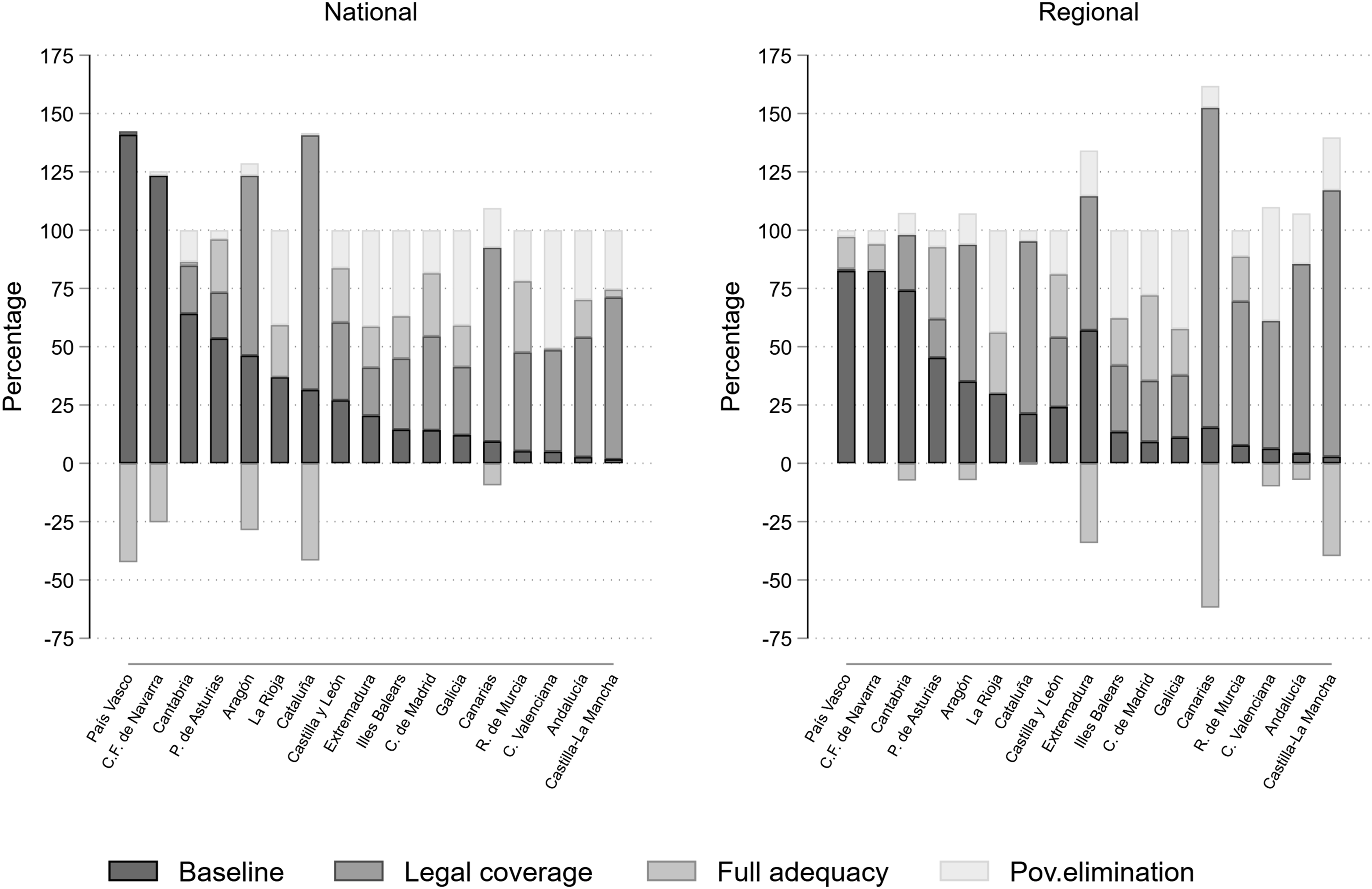
Enlarging the coverage results in substantial expenditure increases in almost all regions, especially in those with adequacy levels above the national poverty line (for example, Cataluña, Aragón). The benefit level in the baseline scenario also explains why in some regions (for example, País Vasco, Navarra) already providing an adequate benefit to those legally entitled to it (full adequacy scenario), might result in an expenditure reduction (see bars with negative results).
Once again, the above results are sensitive to the choice of the national or regional poverty lines. For example, the current systems of País Vasco and Navarra no longer reach 100% of the total cost needed to eradicate poverty, while for Extremadura this value would rise from less than 25% to more than 50%.
Shifting the cost on MI upwards? The new nationwide MI scheme
Our previous assessment showed the potential poverty and budgetary consequences of addressing European Commission’s recommendations by enhancing the existing regional MI schemes. However, the actual policy response was the introduction of a new nationwide MI scheme in June 2020, establishing a unified MI floor across Spanish regions. Although included in the programme of the central government, its implementation was moved forward due to the COVID-19 crisis.
Like the existing regional schemes, the national MI is a top-up benefit. The basic guaranteed MI for a single-person household coincides with the monthly value of the non-contributory old age pension (€462 in 2020), which is roughly 34% of equivalized median disposable income in Spain. The basic amount increases by 30% per each additional member up to a maximum of 220%. The total assets of the family, except the main residence, must be below €16,614 for a single person, increasing this threshold by 40% per each additional family member. Besides income and asset tests, the family member claiming the benefit must be aged 23–65.
The new national scheme operates jointly with the existing regional MI schemes. All regional schemes are subsidiary last-resort schemes (that is, claimants must have applied for all other possible benefits), but are also complementary to other benefits, as long as these are below the threshold of the MI scheme. This means that the new national scheme is applied first, but its amount is included in the income test of the regional scheme. As long as the beneficiary is entitled to both schemes, this entails a substitution of the regional scheme by the national one, partially if the adequacy of the regional scheme is higher, totally, otherwise. 14
Simulated number of beneficiaries, expenditure and poverty-impact of the nationwide MI scheme.
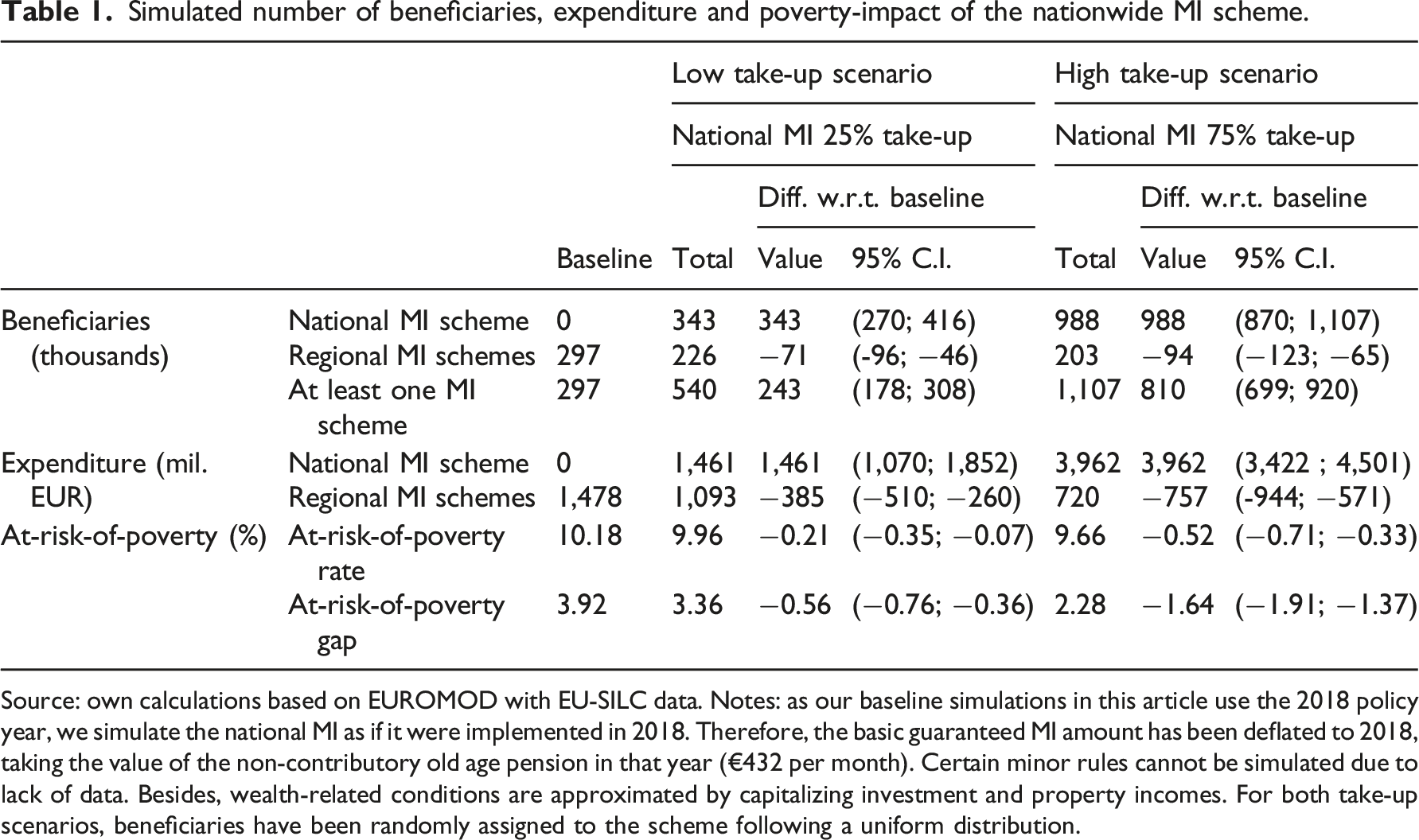
Source: own calculations based on EUROMOD with EU-SILC data. Notes: as our baseline simulations in this article use the 2018 policy year, we simulate the national MI as if it were implemented in 2018. Therefore, the basic guaranteed MI amount has been deflated to 2018, taking the value of the non-contributory old age pension in that year (€432 per month). Certain minor rules cannot be simulated due to lack of data. Besides, wealth-related conditions are approximated by capitalizing investment and property incomes. For both take-up scenarios, beneficiaries have been randomly assigned to the scheme following a uniform distribution.
Our results show that, in the high take-up scenario, the number of beneficiary families would be around 1 million, corresponding to a total expenditure of approximately €4,000 million. In the absence of regional legislative reaction, the total number of beneficiaries of the regional schemes would fall by 31% (94,000) and the total expenditure by 51% (around €757 million). As expected, the figures for the national scheme in the low take-up scenario would be approximately one third, while the reductions in regional schemes would be 23% and 26% respectively. In both scenarios, the remaining beneficiaries of regional MI schemes either keep the same amount (if they do not get the national MI) or receive a smaller amount (when they get the national MI but the adequacy of the regional MI is higher).
Given the low adequacy of the national scheme and its substitution effect, it would only reduce the at-risk-of-poverty rate in 0.52 p.p. even in the high take-up scenario, but would have a higher impact on the at-risk-of-poverty gaps (−1.64 p.p.). These figures are lower than those of the legal coverage scenario in the previous section (−1.37 and −1.78, see Supplementary section A2), but also at a lower cost (€4,000 million in both cases, but the national scheme induces a €757 million reduction in regional schemes).
Discussion and conclusions
An overall trend towards new forms of multilevel governance has been observed over the last years (Barberis et al., 2010). Although diverse, the regulation and provision of MI support takes place in some EU countries at the subnational level. Evaluating the performance of MI schemes in regionally framed countries is challenging but essential to understand the geographical distribution of poverty.
Different MI regulations and implementation practices across regions may translate into an unequal treatment of the poorest citizens depending on the region in which they reside. In this context, Spain is a case study with special relevance. Social assistance and social services are mainly in hands of subnational authorities, and until June 2020 MI support was solely managed by the regions.
Our simulations using the microsimulation model EUROMOD reveal a large gap between the potential and the actual number of regional MI beneficiaries in Spain, with a great heterogeneity across regions, probably due to both demand and supply side factors. However, the sheer size of these discrepancies might indicate that the supply side, represented by the differences in regional capacity constraints, must be playing a relevant role, since the very low coverage ratios might not be due only to voluntary non take-up. A more thorough study on the determinants of MI coverage rates would be a natural follow-up of our analysis.
Working on the full implementation of the current regional systems would significantly alleviate poverty, entailing, however, substantial budgetary implications. The main policy implication is clear: improving the micromanagement of access to MI matters, that is, maintaining the same legal rules but enabling a better access can have important poverty and budgetary consequences. Since interpretative discretion is more likely to occur in regionally framed countries (Kazepov and Barberis, 2013), a better coordination between the actors involved in the provision of MI support would be key to ensure that legally entitled families are not left behind.
Still, regional MI schemes working at its full potential would be far from eradicating poverty, as confirmed by our legal coverage scenario. The subsequent simulated scenarios, aiming to increase adequacy and to cover all those not legally entitled to MI support, achieve a greater poverty reduction but they would also require significant expenditure increases. Some policy messages can be also stressed in light of this result. First, MI guaranteed amounts would need to be significantly increased to lift households out of poverty. Second, the enforcement of non-income eligibility conditions (for example, age, assets and so on) excludes monetary poor households from income support. For instance, the existence of assets tests within MI support might generate a double poverty trap and people at risk of poverty ‘might end up accumulating too many assets to be excluded from public provisions while not actually having enough to make ends meet’ (Marchal et al., 2021: 59).
We show that the above results are conditioned by the way in which poverty is measured. Overall, regions with a regional poverty line higher (lower) than the national one achieve better (worse) poverty reduction results from MI schemes. Our results suggest that the budgetary and poverty-reducing impact of setting an adequate benefit at the national level would be substantially different as compared to a situation where the different living conditions existing across Spanish regions are taken into account. As pointed out by Kangas and Ritakallio (2007), relativization really matters, especially in the case of Mediterranean countries, and ‘national means tend to obscure more than they reveal’ (p.141).
Finally, our article also sheds light on the potential impact of the new nationwide MI scheme. The approval of this scheme in June 2020 mainly responds to the limited effectiveness of most regional schemes in reducing poverty and kicks in to fill this gap. Our preliminary simulations on the impact of the national scheme show its potential to reduce the poverty gap, yet its adequacy might not be sufficient to lift entitled families out of poverty. Importantly, the overall impact of this scheme might be limited if the regional schemes shift the cost upwards to the national level. This scenario would take place if the regional authorities, especially those providing the lowest adequacy, passively accept the subsidiary nature of their schemes and no action is taken to increase their adequacy. A more thorough analysis of the response of the regional schemes to the national one is needed when more data become available.
Supplemental Material
Supplemental Material - Moving towards fairer regional minimum income schemes in Spain for Journal of European Social Policy
Supplementary Material for Moving towards fairer regional minimum income schemes in Spain by Adrián Hernández, Fidel Picos and Sara Riscado in Journal of European Social Policy.
Footnotes
Declaration of Conflicting Interests
The author(s) declared no potential conflicts of interest with respect to the research, authorship, and/or publication of this article.
Funding
The author(s) received no financial support for the research, authorship, and/or publication of this article.
Author notes
The views expressed are purely those of the authors and may not in any circumstances be regarded as stating an official position of the European Commission or the Bank of Portugal. The results presented here are based on EUROMOD version I2.0+. Originally maintained, developed and managed by the Institute for Social and Economic Research (ISER), since 2021 EUROMOD is maintained, developed and managed by the Joint Research Centre (JRC) of the European Commission, in collaboration with Eurostat and national teams from the EU countries. We are indebted to the many people who have contributed to the development of EUROMOD. We make use of microdata from the EU Statistics on Incomes and Living Conditions (EU-SILC) made available by Eurostat (259/2018-EU-SILCLFS). The authors wish to acknowledge the helpful comments provided by the participants in several workshops and conferences (2019 JRC EUROMOD workshop, XXVI EEP, Eighth ECINEQ, REPS 2021, InGRID-2 Summer School ‘Reducing risk of poverty in the EU: Data and policies’). We are especially grateful to Noemí Villazán for her precious help in collecting region-specific information, and to Ana Agúndez, Salvador Barrios, Daniel Daco, Isabelle Maquet and Leonardo Pérez Aranda, as well as colleagues from JRC, DG EMPL and AIReF, for their valuable comments. We also thank the comments and suggestions by the editor and two anonymous referees, which help to improve the original manuscript.

Supplemental material
Supplemental material for this article is available online.
Notes
References
Supplementary Material
Please find the following supplemental material available below.
For Open Access articles published under a Creative Commons License, all supplemental material carries the same license as the article it is associated with.
For non-Open Access articles published, all supplemental material carries a non-exclusive license, and permission requests for re-use of supplemental material or any part of supplemental material shall be sent directly to the copyright owner as specified in the copyright notice associated with the article.
