




Abstract
In this study, we examine the trust placed by the populations of nine jurisdictions in their child protection systems. These systems protect children’s rights and grant authority for invasive interventions to curtail or even terminate parental rights and responsibilities. We have representative samples of the populations of each jurisdiction. The results show that about 40–50% of respondents express trust in the child protection agencies, social workers and judges who make decisions. There are clear differences between jurisdictions, with the Anglo-American countries at the lower end of the trust scale. Examining the impact of institutional context, we find that institutional context matters for the degree of peoples’ trust in the child protection system. This indicates that the typology of child protection systems has relevance, and more empirical studies are encouraged. Some demographic characteristics (age, having children, income, education) and ideological variables (political orientation) are also correlated with trust levels.
Introduction
In this article, we examine population-level trust in child protection systems. These systems are responsible for protecting children at risk of harm from or neglect by their caregivers or who may be at risk of harming themselves or others. 1 Child protection is under-researched within social policy research devoted to examining welfare state and welfare services and how living conditions of individuals in a society are influenced by public polices and practices (Titmuss, 1958; see also Lipsky, 1980). The responsibility of a child protection system is to ensure that children have a quality of life independent of their family circumstances, including protection from abuse and neglect when that is necessary. As such, child protection policy is at the core of social policy research. The importance of trust in governments and their abilities to respect the people and to provide them with services in a just manner has been formulated clearly by political scientist Rothstein (1998; 2009; see also OECD, 2017). His argument is simply put that the legitimacy of a political order is built on the quality of the government (2009), not only or solely on the electoral democracy.
This study is based on representative samples of populations in nine jurisdictions covering three types of child protection systems, including eight European countries (Austria, England, Estonia, Finland, Germany, Ireland, Norway and Spain) and California in the United States (US). Through a child protection system, the state can provide help and services to families, but also undertakes invasive interventions to curtail or even terminate parental rights and responsibilities (Berrick et al., in press; Burns et al., 2017; Gilbert et al., 2011). 2 The state’s intervention in families on behalf of children, therefore, questions and problematizes the normative and positive position of the family, a core institution of society. A child protection intervention can be extremely consequential for both parents and children. Thus, it is a system that must be trustworthy, that is, the system and its professionals must be perceived as competent, reliable and truthful, so that people can be confident that children’s and parents’ rights are protected (see Levi and Stoker, 2000). Trust in the child protection system is not only imperative for legitimizing the formal and social power of this system but also for its ability to receive information volunteered by the public about children in vulnerable situations and to cooperate with children, families and communities (see Bolger et al., 2021; Marien and Hooghe, 2011). Therefore, it is important to assess public trust in the child protection system and examine factors that may be associated with various trust levels.
There are numerous studies on populations’ trust in political parties, political institutions and public administration (see for example Kumlin et al., 2017; Levi and Stoker, 2000; Rauh, 2020; Zmerli and Newton, 2017). However, there are few studies on popular views on social services, social work and social care (McCulloch and Webb, 2020). A search of the literature on trust and child protection turned up only one published scientific empirical, cross-country examination of public trust in child protection systems and the degree of confidence in decisions (Juhasz and Skivenes, 2016). Data on public trust in child protection systems are also scarce. Thus, little information is available on which to base expectations for a study on public trust in child protective systems in multiple jurisdictions.
To fill some of the knowledge gaps in this area, we asked respondents in nine jurisdictions about their trust in their respective child protection systems. We believe that people may trust a public institution in principle but may have reservations about the decision makers and professionals operating in these institutions and vice versa. Therefore, we distinguished between trust in a child protection agency and in the professionals making the decisions (social workers and judges). A straightforward measure of trust is applied, asking respondents about their degree of trust in the child protection agency, social workers and judges. We examine two hypotheses: first, that a jurisdiction’s institutional context is significant in relation to the degree of populations’ trust in the child protection system and, second, that there is an alignment between a population’s level of trust in its government in general and in the child protection system in particular. Finally, we wish to discover whether sociodemographic characteristics are associated with respondents’ trust.
We believe our study makes four contributions to the research field. First, it analyses a unique data set of populations’ trust in child protection systems in nine jurisdictions. Second, it examines the role of institutional context in trust levels. Third, it reviews the literature on trust and confidence in child protection systems. Fourth, it adds to the ongoing discussion of measurement of popular trust in public institutions.
In the following section, we present our theoretical approach and hypotheses, followed by a methods section, findings and discussion.
Popular confidence in public administrative agencies and courts
Popular trust and confidence in government are core themes in political science, and trust is a fundamental value in the legitimacy of representative democracies (Dahl, 1971; Zmerli and Van der Meer, 2017) and a binding element in society (Putnam, 1993). However, peoples’ experience of and trust in public administration, the output side of a political order, may be equally important for the legitimacy of the democratic order (see Rothstein, 1998, 2009). Populations’ confidence and satisfaction in welfare state functions are likely to be influenced by a range of factors. This includes trust in the system as a whole, including policies and political aims, trust in the effectiveness of the system or interventions, as well as trust in the professionals responsible for them. Other factors that can influence citizen trust may be based on personal experiences with the government and the legacy of government handling of the authority entrusted to it. Based on the literature and previous research, we have developed hypotheses and expectations.
Institutional context
Our first hypothesis is based on institutional theory, whereby public opinion is regarded as an independent variable that explains or has an impact on politicians and the development of policy (see Kumlin and Haugsgjerd, 2017). However, one central component of studies on popular views on and attitudes around welfare state arrangements is that peoples’ opinions are regarded as a dependent variable; policies and welfare institutions influence peoples’ attitudes and their views on the role and status of welfare systems (see also Roosma and Van Oorschot, 2020; Svallfors, 1996, 2012; Valarino, 2017). In general, the welfare state has various components in place to protect children from maltreatment and neglect, including networks and groups of professionals such as the legal system, medical practitioners, law enforcement personnel, educators, social and welfare workers, as well as child protection agencies (Schmid and Benbenisthy, 2011).
Child protection systems in high-income countries are usually categorized into three types (Gilbert et al., 2011; see Berrick et al., in press): risk-oriented systems, family service-oriented systems and child centric-oriented systems. A risk-oriented child protection system has a relatively high threshold for intervention into the family, and its primary focus is on children’s health and safety. This is a system that is reluctant to dictate how families should raise their children, and have few services to offer individuals in need. In this system, parent’s rights have a strong standing compared to children’s rights. In family service-oriented systems, the aims are on a child’s health and safety, but also to provide help and support to families to prevent and reverse negative developments. Ideas of wellbeing and ethical norms of a good childhood and a good family life are prevalent, and the government’s responsibility for people is evident. Parents’ rights and children’s rights are equally protected. The child-centric orientation targets children’s health and safety, provide help and services, and also has a strong focus on children’s individual rights and needs. In this system the child is the primary focus when there are conflicting interests and rights at stake (see Gilbert et al., 2011). The Finnish and Norwegian systems are usually categorized as child-centric (Pösö, 2011; Skivenes, 2011), and those of Austria, Germany and Spain are family service oriented. Those of California, England, Estonia and Ireland are typically categorized as risk oriented; that is, their primary focus is on responding to child safety concerns and minimizing risk to children. The English system has been described as a hybrid, leaning toward a family service approach but reactive and risk oriented in response to high-profile cases (Berrick, 2011; Parton and Berridge, 2011; Thoburn, in press). A detailed presentation of these three child protection systems is presented by Gilbert et al. (2011). One dimension of these three child protection systems is the degree of intrusiveness into the family life and parental rights they allow for, authorizing the state with increasing power to intervene and to restrict freedom (for parents). Thus, we expect a relationship between the power delegated to these systems and peoples’ trust in the systems. This was also the result in a study published in 2016 about trust in the child protection system in four jurisdictions, in which people in Norway and Finland expressed greater confidence in the child protection system than their counterparts in California and England (Juhasz and Skivenes, 2016). Our assumption is that the type of child protection system reflects the level of state intervention ‘tolerated’ by a state, and thus we have the following hypothesis:
H1: Confidence in the child protection system is correlated with the type of system in place, that is, people have the highest degree of trust in child rights-oriented systems (Finland and Norway). People in family service-oriented systems (Germany, Spain and Austria) have in this context moderate trust, and people in risk-oriented systems (England, Estonia, Ireland, and California) have the least trust.
General trust level
Peoples’ trust in governments and public institutions is considered an important resource for a state. For example, if an arrangement or an agency is considered fair and/or legitimate, this is correlated with peoples’ compliance with the law (Bolger and Walters, 2019). The general trust level in a society may be an indicator of how specific institutions, such as the police or health sector, are trusted (Newton and Zmerli, 2011, see Rothstein and Stolle, 2008). Public trust in the child protection system and its associated practitioners may be considered a necessary condition for professional work on behalf of children and families. For instance, if the public distrusts the judgement of social workers and perceives them to be ‘child kidnappers’, community members who suspect child abuse may be reluctant to report their suspicion to professionals, fearing unwarranted child removal from the home (Skivenes, 2011). In child protection, there are many historical cases of institutional abuse and mistreatment of children in public care, combined with serious mistreatment of certain groups of people such as the Roma people, individuals with learning disabilities, unmarried mothers and ethnic minorities (see for example Morrison, 2004; Sköld, 2013; Sköld and Markkola, 2020). Historical oppression and mistreatment influence how public administration systems are understood and regarded. This may indicate that people in a country share common experiences and views on their government’s role and responsibilities, which inform their trust in public administration. Thus, our second hypothesis is based on the assumption that popular trust in the child protection system correlates with trust in public administration and the legal system in that country.
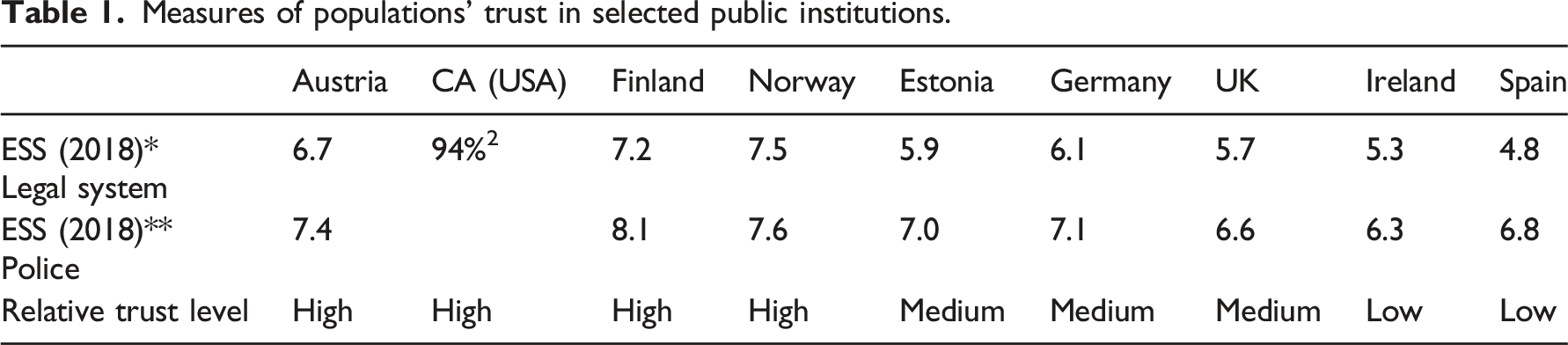
There are numerous survey studies of trust in politicians and in selected public administrative bodies such as the police, legal systems and local authorities (see for example the World Values Survey data series). Based on European Social Survey data from 2018 on popular trust in the legal system and the police (because they have the authority to undertake intrusive interventions) as well as data from the US, 3 we have categorized trust levels in each country as low, medium or high. The category is a relative measure for these selected jurisdictions. Based on this, we have the following hypothesis:
Measures of populations’ trust in selected public institutions.
In this study, we examine whether the public has a different level of trust of each component of the child protection system. In most countries, the child protection system has two main parts: first, frontline child protection staff and agencies that identify and intervene in cases of alleged abuse and neglect and, second, the judicial system, which has the final say in determining important decisions such as supervision orders, removal of children from homes and adoption from care (Berrick et al., in press). The public may have more confidence in the judicial system and judges than in social service agencies or vice versa. Furthermore, the public may have different levels of trust in agencies compared with the professionals working for them. In some countries, the public may perceive practitioners to be dedicated experts and therefore trust them more, while in other countries, the public may have reservations about the professional quality of practitioners or the extent of their commitment to the most vulnerable groups in society and trust them less. Thus, identifying the parts of the systems that the public trusts less can inform efforts to promote public trust in the child protection system. In this study, we explore this issue and distinguish between three components of the child protection systems. We ask separately about the confidence in child protection agencies, the social workers working in them, and in the judges, who play an important role in the decisions made by the protection system.
Finally, we expect individual characteristics to affect confidence in child protection, but we have little empirical research to draw on. Generally, in welfare state research, the demographic characteristics do not show a coherent and systematic pattern (Svallfors, 2012). In the comparative studies we have found on popular views of child protection systems (Juhasz and Skivenes, 2016), the following characteristics of respondents were correlated with higher confidence: a left-wing political orientation, lower age and higher education (Juhasz and Skivenes, 2016). A recent population study of Scottish views of social services (McCulloch and Webb, 2020) showed few significant correlations between sociodemographic factors and opinions on social services, except in relation to education. Respondents with lower education levels had more negative views of social services than those with higher education. In the present study, we explore whether trust is associated with gender, age, having a partner or child(ren), income level, education or political opinions.
Data and methods
Procedure
The study is based on online surveys conducted separately in nine jurisdictions in February–March 2020. A commercial data provider bureau, Response Analyse™, was responsible for implementing the survey questions developed by the researchers and managed the sample recruitment and data collection in collaboration with partners in each of the nine jurisdictions. All respondents received the survey questions in the official language of their jurisdictions. Questions were developed in English and translated by researchers in the field, using the common practices of translation with thorough reliability testing.
Sample
The total sample size was 12,328 respondents (Austria n = 1,022, England, n = 2,905 Estonia, n = 1,005, Finland n = 1,016, Germany n = 2,126, Ireland n = 1,007, Norway n = 1,210, Spain n = 1,027, and California n = 1,010). The respondents formed nationally representative samples of the adult population (18+ years old) on some demographic characteristics (gender, age and geography) in all countries except Estonia, where representativeness was only controlled for in relation to gender and age. This is because Estonia is a small country in terms of population and geography. In Norway, representativeness was controlled for in relation to gender and age within each region. The standard procedure for ensuring representativeness is that if a demographic is underrepresented in the sample, more respondents from this group are recruited. The samples are weighted so that representativeness is accurate based on given variables. Additional information about data from survey providers is available on the Centre for Discrtion and Paternalism website for supplementary documentation (Centre for Research on Discretion and Paternalism, n.d.).
Measures
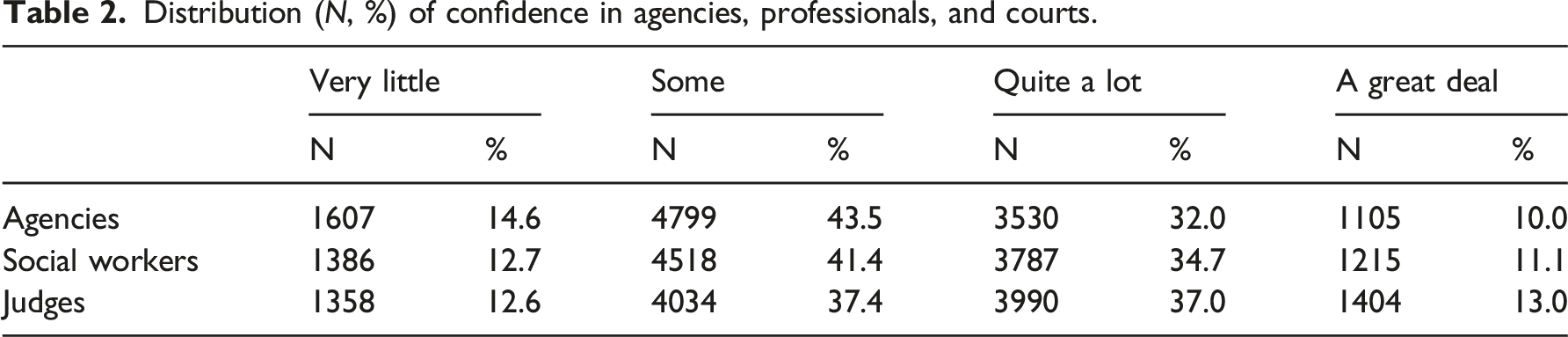
Respondents were asked 4 the following: ‘Please tell us how much confidence you have in: 1. The child welfare agencies that protect children; 2. The child welfare workers who work at these agencies; 3. The judges of courts that make decisions on child removals’. The response scale was: ‘(1) Very little’, ‘(2) Some’, ‘(3) Quite a lot’, ‘(4) A great deal’, and ‘(5) Unsure’. The proportion of uncertain responses ranged from 8.8% in response to the question on confidence in agencies to 10.8% to the question regarding confidence in judges. These respondents were coded as missing. An overall index of confidence was created by averaging the three separate scores (alpha = 0.85). The background questions related to gender, age, education level and income level used the standard formulation of the data provider. Questions regarding education, income level and political orientation were developed separately for each country and categorized by the local partners into low, average and high. Political opinions were categorized as left leaning, centrist or right leaning (see Skivenes and Benbenishty, in press, Appendix, Table A1 for details on variable values).
Analysis plan
We first conducted descriptive analyses of all study variables, merging ‘(1) Very little’ and ‘(2) Some’ into a ‘disagree’ score, and ‘(3) Quite a lot’ and ‘(4) A great deal’ into an ‘agree’ score. We conducted an analysis of variance with post-hoc comparisons, with the participating countries as independent variables and overall confidence as the dependent variable. We then conducted a two-way analysis of variance of countries’ areas of trust (agencies, workers and judges) and regime (a. risk oriented, b. family service, and c. child-centric system). Finally, we conducted a series of bivariate analyses (correlations, t-tests and ANOVAs) to examine the associations between overall confidence and sociodemographic background variables (for example, age, gender, education and income). Given the large sample size, the conservative significance level of p < .001 was used.
Findings
Distribution (N, %) of confidence in agencies, professionals, and courts.
Means and standard deviations (SDs) of overall confidence, by country.
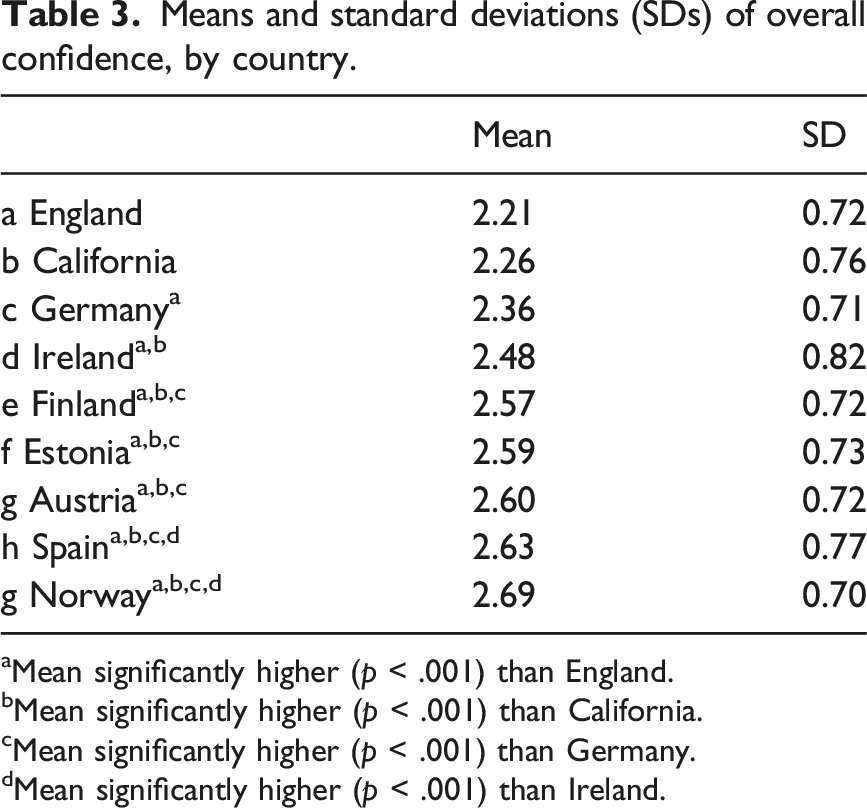
aMean significantly higher (p < .001) than England.
bMean significantly higher (p < .001) than California.
cMean significantly higher (p < .001) than Germany.
dMean significantly higher (p < .001) than Ireland.
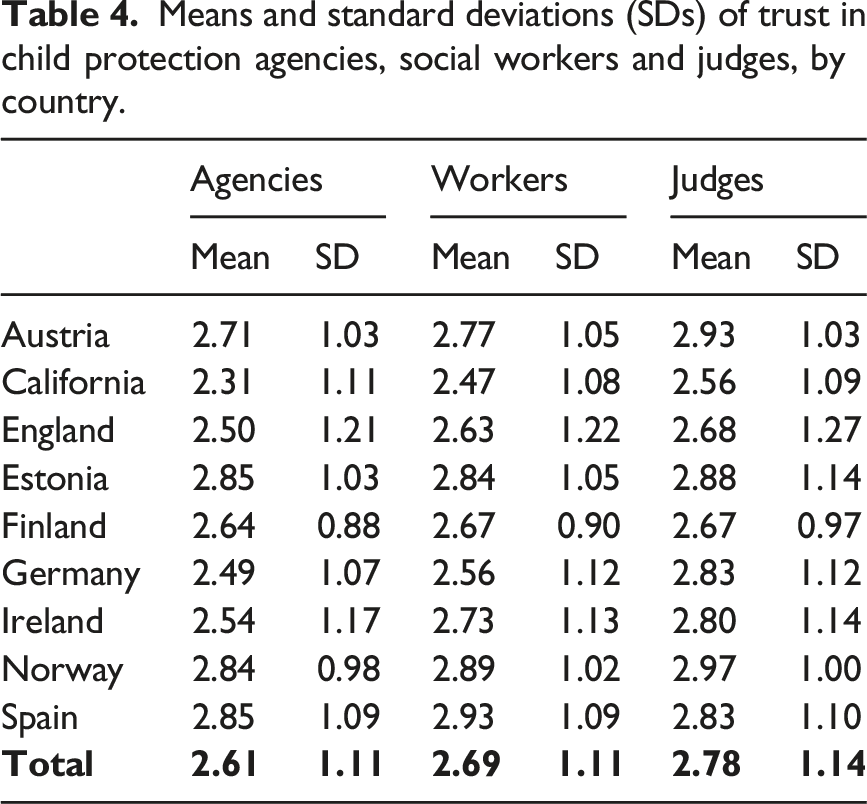
Means and standard deviations (SDs) of trust in child protection agencies, social workers and judges, by country.
Association between child protection systems and trust
Means and standard deviations (SDs) of levels of trust in agencies, social workers and judges, by type of child protection system.
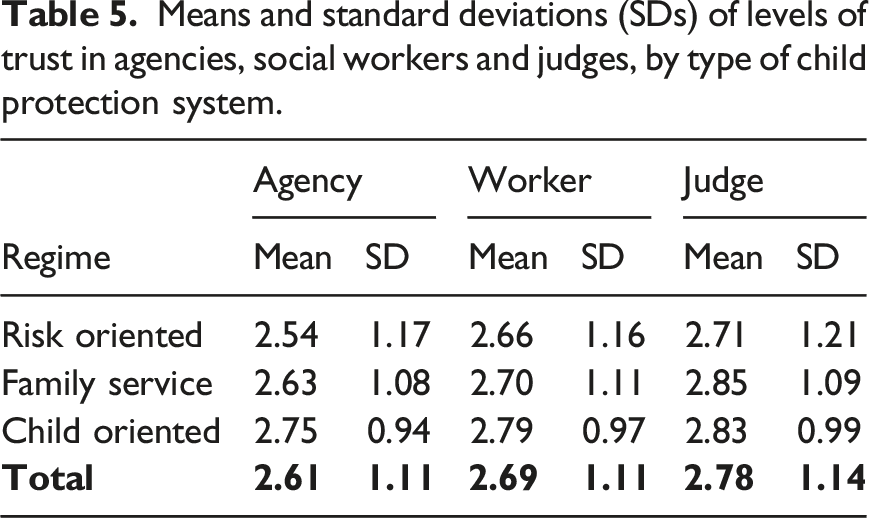
There was also an interaction effect (Wilk’s Lambda = 0.996, F (4.25336) = 13.26, p < .001) because whereas in family service and risk-oriented regimes there are large differences in trust in agencies (lowest), workers (medium) and judges (highest), in the family service and child-oriented regimes, levels of trust are similar across the three components.
Association between general confidence level and confidence in child protection
We hypothesized that levels of confidence in the child protection system in a country would align with general levels of confidence in the national government (see Table 1 above). This hypothesis was only partially supported. For three countries, there is some alignment – in line with the expectations, England was at the lower end of the trust continuum, and Norway and Austria at the upper end. However, California and Germany are at the low-confidence end in terms of the child protection system (while high in confidence in general) and Spain is at the upper end but was expected to be at the lower end, given the low general trust in government.
Association between confidence in the child protection system and sociodemographic characteristics
Means and standard deviations (SDs) of overall confidence in relation to sociodemographic characteristics.
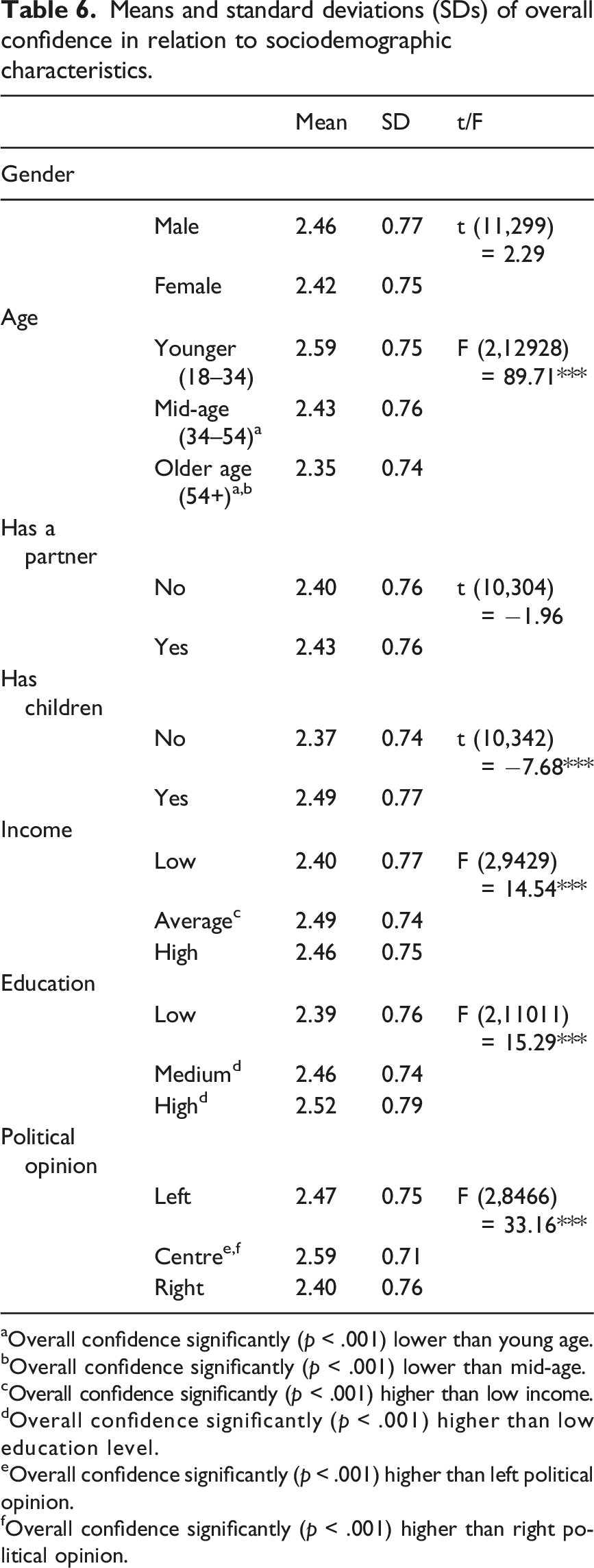
aOverall confidence significantly (p < .001) lower than young age.
bOverall confidence significantly (p < .001) lower than mid-age.
cOverall confidence significantly (p < .001) higher than low income.
dOverall confidence significantly (p < .001) higher than low education level.
eOverall confidence significantly (p < .001) higher than left political opinion.
fOverall confidence significantly (p < .001) higher than right political opinion.
Discussion
Trust and legitimacy are interwoven concepts and considered to be key components of political theory and democratic analysis. However, little is known about trust and confidence in the child protection system, which has major importance in the lives of some of the most vulnerable groups in our society. To fill some of the knowledge gaps in this area, we asked populations in nine high-income western societies about their trust in their child protection systems. Traditionally, studies about trust ask about a social institution in general. However, we believe that people may trust a public institution in principle but have reservations about the professionals who work in them, and vice versa. We therefore expanded the investigation and distinguished between trust in an agency and in the key decision makers in the system. Using a straightforward measure of trust, we asked respondents about their trust in three components of the child protection system – the agencies, the social workers and judges.
Our first hypothesis about trust level and type of child protection system is confirmed, as trust level in populations varies according to the type of child protection system in the jurisdiction. Risk-oriented child protection systems have the lowest level, followed by family service systems and then the children’s rights systems. This is interesting and important, as we assume that this finding reflects citizen alignment with and influence from their own welfare systems. An illustration of a similar finding on another policy area, is a study on child leave polices and popular preferences in Austria, Sweden, Switzerland and the US, in which the authors conclude that ‘the institutional and leave policy context significantly shapes individuals’ preferences regarding length of leave, preferred gender division, and leave financing source’ (Valarino et al., 2018: 120). Our findings regarding the relevance of institutional context require further empirical studies and theoretical elaborations, but in our view, it is a promising start and a finding that is worth further investigation.
The second hypothesis about alignment between general trust and trust in the child protection system is partly confirmed, as we find an alignment between populations’ overall trust in public administration, police and courts and their trust in the child protection system. This finding was not without exceptions, as trust in relation to child protection in some countries was markedly lower than the overall level of trust, for example, in California and Germany, and the converse holds for Spain, where we expected lower trust levels, but in which the findings show trust in the child protection system at the upper end. A possible explanation of these findings is that family autonomy is an especially strong norm in California and the US, in combination with a relatively low focus on children’s rights (Berrick, 2011; Meyer VN, 1923: 399–400; see also Berrick et al., in press). Furthermore, Americans tend to differ from Europeans in terms of having much lower expectations of welfare state responsibilities (Brooks, 2012). For Germany, a huge influx of unaccompanied migrants since 2014 may have overburdened the child protection system (see Meysen and Bovenschen, 2021), which in turn may have had an impact on peoples’ trust in that system. For Spain, it is not an obvious explanation. We do not have detailed explanations for our findings, partly because we have little empirical and theoretical research to build on, and suggest thus that this path be pursued further.
In our exploration, we find differences in trust in child protection agencies and their decision makers and show that judges receive greater trust than social workers, with the lowest trust placed in agencies. Although, we see that social workers overall receive significantly lower trust than judges, the difference is not great. In Finland, trust in social workers is on par with that of judges, and in Spain it is even higher than for judges. Speculating, this may indicate a relatively high status for the social work profession in Finland and Spain.
We were able to determine whether trust over time had increased or decreased in some populations, as we have data from 2014 that investigated the same questions. This includes California, England, Finland and Norway (Juhasz and Skivenes, 2016). Interestingly, in the 6-year period, we see that the trust levels in Finland and Norway increased significantly, and in California and England, it has decreased significantly. The latter trend may be due to increased polarization in these places (Silver, 2021, for the US, and Duffy et al., 2019, for England). In a recent published article on the motivation for fake news among American Twitter users, Osmundsen et al. (2021) note, among other findings, that partisan polarization is the strongest explanation for sharing fake news. For the increased trust level in Finland and Norway, both having child-centric child protection systems, may be indicative of a general trend toward a stronger child rights orientation in some societies (Pösö et al., 2014; Berrick et al., in press; Skivenes, 2011; see also Barth and Olsen, 2020).
The analysis of demographic variables shows that younger respondents have greater trust, which accords with the findings of a previous study of popular trust in child protection (Juhasz and Skivenes, 2016). However, in other studies it is the older respondents who have the most trust in public institutions. A meta-study of satisfaction with the police finds that older respondents are more satisfied, owing to a tendency to be increasingly compliant with conventions (Bolger et al., 2021).
Respondents with children have greater trust in child protection systems than those without, perhaps because parents have greater awareness of the necessity for a child protection system and/or children’s rights (see similar findings in Juhasz and Skivenes, 2016). This line of reasoning could also explain why individuals with low incomes and low education have less trust in the child protection system. This group of respondents feels less empowered in society, experiences more interventions by the child protection system, and thus may be more concerned about unfair treatment from the child protection system. We have not had data on race and ethnicity, and this is important to examine in future research. Personal experiences with the system may have a direct impact on trust, as the trust in the system by respondents with positive or negative experiences will differ from that of people with no personal experience. Future research should examine these issues. Such studies should also include in-depth qualitative studies to gain a deeper understanding of the reasoning behind different levels of trust.
In terms of political orientation, respondents who support the political centre have the highest confidence in the child protection system. This finding may reflect the fact that the child protection system is often under attack from two sides – those who feel that the government does not intervene enough in the lives of families to protect children and their safety and rights, and conversely those who feel that it is too intrusive and does not support the sanctity of the family and family rights. Perhaps those in the centre have a less critical view, but in other studies politically left-leaning respondents have held favourable attitudes toward child protection systems and children’s rights (Helland et al., 2020; Juhasz and Skivenes, 2016).
Limitations
This article explores an area that is under-researched and thus has few empirical studies on which to build. We have used a panel-based survey provider to collect data, weighted to make the sample representative. Typically, individuals on the lower end of education and income scales are under-representative in such panels. As with all surveys, we cannot verify that responses are a direct reflection of individual views, and the conceptual complexity of trust and confidence is also a challenge. Respondents may also interpret the term ‘trust’ differently. Similar to welfare state model research (Svallfors, 2012), it is challenging to find the key features of a type of system or model; however, there are significant differences between countries that have the same general system.
Concluding remarks
We have aimed to contribute to the literature on welfare states’ responsibility to their inhabitants and the role of institutional context. For the typology of child protection systems, it is an important result that institutional context matters for the degree of trust people place in them. This indicates that the typology has relevance, and more empirical studies are encouraged. The idea that the trust level in a country functions as a form of anchor resonates to some extent and should be further investigated in empirical studies. It is important to note that a majority of respondents express confidence in their child protection systems and their decision makers, and we belive this is showing that children’s rights have a strong standing (see also Barth and Olsen 2020). However, there are significant differences between populations. California and England stand out, with markedly lower popular trust in their child protection systems than in the other countries. We have touched upon partisan polarization as one reason for this, and there is probably a range of other factors that have driven this development, as trust in these two jurisdictions has been declining over the past 6 years. However, as we lack data to measure trust over time from many of the other countries, more empirical studies are required to understand the situation more thoroughly.
Supplemental Material
Supplemental Material - Populations trust in the child protection system: A cross-country comparison of nine high-income jurisdictions
Supplemental Material for Populations trust in the child protection system: A cross-country comparison of nine high-income jurisdictions by Marit Skivenes and Rami Benbenishty in Journal of European Social Policy.
Footnotes
Acknowledgements
We are grateful for the important and insightful comments from reviewers. Thanks to assistant John Lilletun who has been involved in recoding and preparing data material.
Declaration of conflicting interests
The author(s) declared no potential conflicts of interest with respect to the research, authorship, and/or publication of this article.
Funding
The author(s) disclosed receipt of the following financial support for the research, authorship, and/or publication of this article: This work was supported by the European Research Council (ERC) under the European Union’s Horizon 2020 research and innovation programme (grant agreement no. 724460) and from the Research Council of Norway under the Independent Projects – Humanities and Social Science programme (grant no. 262773).
Ethics

Supplemental Material
Supplemental material for this article is available online.
Notes
References
Supplementary Material
Please find the following supplemental material available below.
For Open Access articles published under a Creative Commons License, all supplemental material carries the same license as the article it is associated with.
For non-Open Access articles published, all supplemental material carries a non-exclusive license, and permission requests for re-use of supplemental material or any part of supplemental material shall be sent directly to the copyright owner as specified in the copyright notice associated with the article.
