




Abstract
Most quantitative, comparative welfare state research assumes that subnational welfare regimes are irrelevant or identical to their national counterparts. Many qualitative case studies, on the other hand, have underlined the differences between subnational and national regimes. In this article, we attempt to build bridges between these two strands of literature by examining the case for a Quebec model, that is, a subnational welfare state regime that is distinct from its Canadian counterpart(s). We reviewed seven publications from which we extracted 188 quantitative results relevant to the distinct subnational regime hypothesis. Although not all these results are independent nor based on conclusive evidence, they generally agree that a distinct welfare regime exists in Quebec. We conclude this article by discussing the implications of the Quebec case for the study of welfare regimes at the subnational and regional levels.
Keywords
Introduction
The publication of Esping-Andersen’s (1990) now paradigmatic (Emmenegger et al., 2015) The Three Worlds of Welfare Capitalism spurred a ‘welfare modelling business’ (Abrahamson, 1999). However, the comparative welfare state literature has suffered from ‘methodological nationalism’, that is, it has been built on the assumption that nation states are the only relevant unit of analysis (Ciccia and Javornik, 2019; Greer et al., 2015; Kazepov and Barberis, 2013). Comparative scholars have largely neglected welfare arrangements at the subnational level (Hudson, 2012; Isakjee, 2017), thereby ‘defin[ing] distinctive regional welfare arrangements out of existence’ (Greer et al., 2015: 409). Many scholars indeed assume that subnational welfare states do not differ significantly from their national counterparts (Hudson, 2012) or, perhaps, want to avoid the methodological challenges of comparing regimes at the subnational level.
To be sure, there is a growing literature of case-based studies of specific regions pursuing distinct welfare state development strategies, typically in the name of substate nationalism (Béland and Lecours, 2008; Greer, 2010; Greer and Elliott, 2019). However, this qualitative literature displays a positive bias toward the subnational welfare state and even ‘celebrates’ it (Greer et al., 2015: 412). Scholars from this case-based strand often assume that differences exist between subnational and national welfare regimes, and that these reflect broader differences in subnational politics, identity and state-building strategies. This is in part why the idea of specific subnational ‘models’ has emerged in both the scientific literature and regional political discourse (Béland and Lecours, 2008).
A case in point is the ‘Quebec model’, which has received considerable attention from scholars studying political economy, nationalism or social policy (e.g. Bouchard, 2013; Klein et al., 2013; Mathieu et al., 2020; Noël, 2020; Papillon and Turgeon, 2003; Vaillancourt, 2012). The Quebec model has three characteristics: (1) the Quebec State intervenes more in the economy and society than its North American counterparts; (2) the Québécois are deeply attached to the Quebec State, perceived as the defender of their economic interests and national identity; and (3) corporate interests, labour unions, community organizations, cooperatives and social enterprises play a significant role in governing the province with the state through neocorporatist arrangements. These studies suggest or assume that Quebec’s welfare state is significantly different (i.e. ‘distinct’) from both that of Canada and of other provinces in that it is more generous and more extensive.
Yet, the distinctiveness of the Quebec welfare state regime is an empirical question rather than an assumption – a question with broader theoretical and empirical implications for the study of welfare state regimes. To answer this question, we review the quantitative evidence regarding the Quebec case. We hypothesize that Quebec’s welfare state regime differs significantly from that of the rest of Canada, that is, of the federal government and of the other provinces. In testing the ‘distinct subnational welfare state regime’ hypothesis, we build bridges between two literatures which have developed in isolation: (1) the quantitative comparative welfare state literature, which tends to neglect subnational regimes, and (2) the mostly qualitative, case-based literature, which tends to magnify them.
In this article, we first argue that the comparative welfare state literature has generally neglected subnational welfare state regimes and explain why this matters. Second, we discuss the classification of Canada’s welfare state in comparative perspective, a necessary step in assessing the distinctiveness of Quebec’s welfare state (i.e. distinct from what?). Third, we describe our approach, methods and sample. We present our results in the fourth section before turning to a discussion of their implications for comparative scholars.
Bringing the subnational welfare state back in
An abundant literature has criticized and built on Esping-Andersen’s (1990) three-world typology (e.g. Bonoli, 1997; Powell et al., 2020; Scruggs and Allan, 2006). We argue that subnational welfare state regimes have been largely ignored within this comparative literature.
First, the subnational level of analysis is almost absent from The Three Worlds of Welfare Capitalism (Esping-Andersen, 1990). Although this is hardly surprising for welfare state scholars, a word analysis of the book confirms, and even reinforces, the erasure of the subnational (Table 1). Esping-Andersen (1990) focused on the national level, and occasionally on the supranational level (e.g. Scandinavian nations). The sole six occurrences of ‘local’ pertain to the historical formation of pensions and the extent of their coverage. ‘City’ only appears once in relation to an actual city (New York), even though cities play increasingly important roles in social policy through multilevel governance and devolved power arrangements. This national focus ignores power dynamics within federal states (e.g. Belgium) and within unitary states with powers devolved to subnational entities (e.g. the UK and Scotland). Most scholars have followed Esping-Andersen’s (1990) lead and overlooked subnational welfare states. For instance, the 21 reviews included in a ‘review of reviews’ (Powell et al., 2020) focus exclusively on the national level. If central/federal governments set the main parameters of welfare state regimes for comparative scholars, then subnational governments are irrelevant and even literally invisible (Ciccia and Javornik, 2019; Greer et al., 2015).
Occurrences of paired concepts in Three Worlds of Welfare Capitalism. a
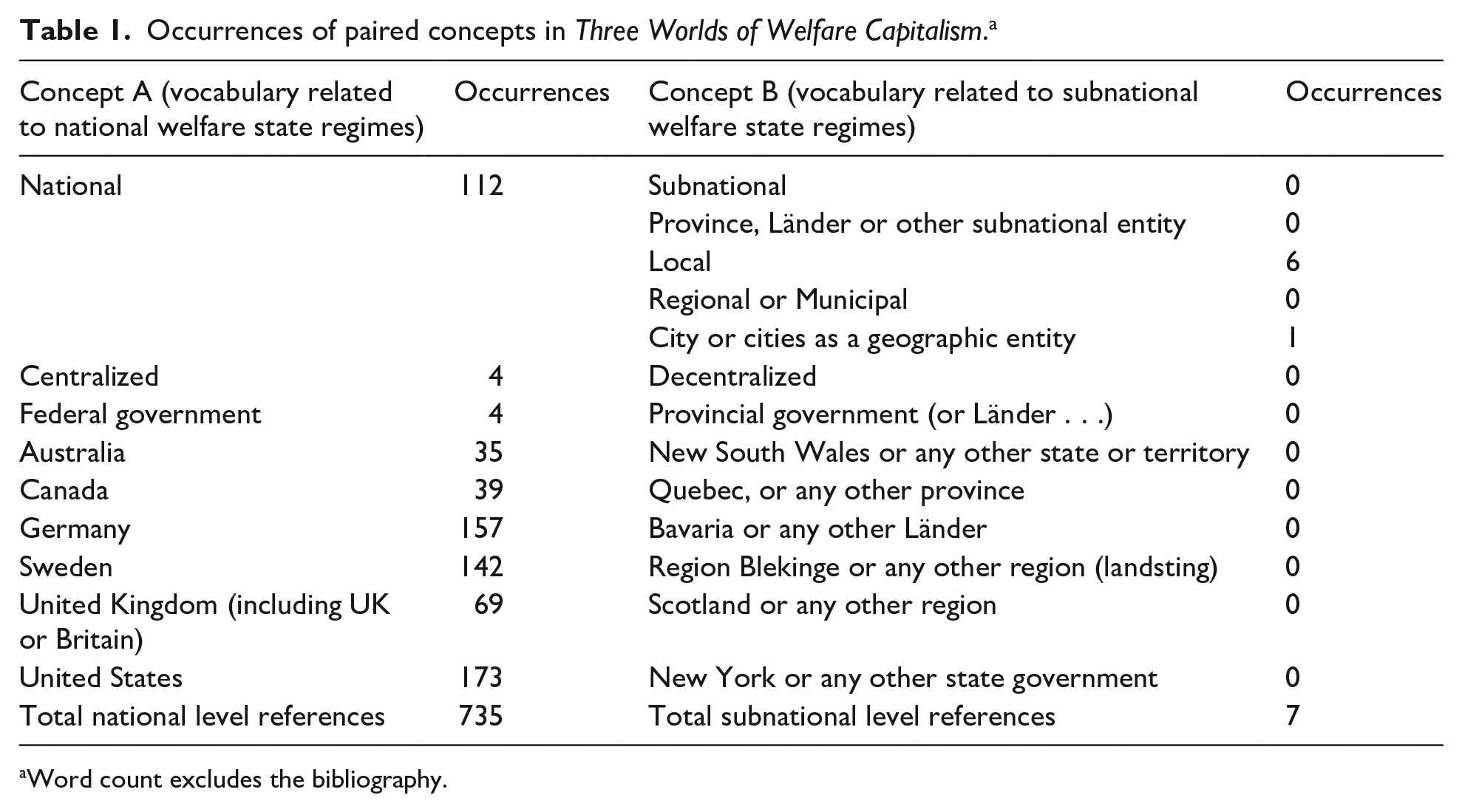
Word count excludes the bibliography.
Second, Esping-Andersen’s (1990) typology has neglected the subnational welfare state regime because it is based on three large cash benefits that are generally the responsibility of central/national governments, namely public pensions, as well as sickness and unemployment benefits. These large rights-based programmes epitomize a logic of social citizenship – ‘the provision of social benefits to citizens on uniform terms and conditions, irrespective of the region in which they live’ (Banting, 2006: 64). Banting (2006) underlined various factors why rights-based programmes are the central government’s responsibility, including: culture, nationalism, policy preferences and the formation of welfare states at a time when central governments were dominant constitutionally and fiscally (see also Béland and Lecours, 2006; Dufresne et al., 2014). He also discussed economic theories of federalism according to which central governments should be responsible for macroeconomic policy, stabilization and redistribution and local governments for the provision of public goods and services tailored to local realities.
Yet, the welfare state goes beyond these large right-based benefits. In fact, all important cash benefits (e.g. social assistance, child benefits, in-work benefits) and public services (e.g. healthcare, education, social care, active labour market policies) contribute to decommodification and defamilialization to varying degrees (Bambra, 2005; Hudson and Kühner, 2009; Jensen, 2008; Jensen and Lolle, 2013; Noël, 2020). For instance, in-work benefits aimed at ‘making work pay’ and alleviating child poverty are increasingly significant in Europe and North America (Daigneault and Macé, 2020; Ferrarini et al., 2013; Laun, 2019).
These social benefits and services – the ‘far side of the welfare state’ – are frequently the responsibility of subnational governments, which have considerable constitutional and financial autonomy with respect to defining and implementing them (Banting, 2006; Ciccia and Javornik, 2019; Kazepov and Barberis, 2013), leading to significant variations in subnational welfare arrangements. In Denmark, where welfare services are municipalities’ responsibility, Jensen and Lolle (2013: 350) found substantial intra-country variations in elder care, concluding that ‘such differences [. . .] undermine our notion of the existence of homogenous and uniform welfare state regimes’.
Similarly, Kazepov and Barberis (2013: 225) noted that exclusive responsibility for social assistance belongs to the subnational level in ‘regionally framed countries’ such as Italy, Spain, Switzerland and Germany (on Italy, see also Bertin and Carradore, 2016). With the exception of Germany, they found major intra-country variations in generosity and concluded that ‘subnational bodies have become increasingly important’ (Kazepov and Barberis, 2013: 244). Greer et al. (2015) studied the welfare effort of subnational entities in two liberal regimes, the US (a federal state where subnational states are responsible for one third of welfare spending) and the UK (a unitary state with power devolution). They found important intra-country differences in terms of the age-alignment spending ratio as a percentage of the GDP. Moreover, for spending on the ‘key American ALMP programme’ (i.e. Temporary Assistance for Needy Families), ‘the coefficient of variation is actually greater in the USA (0.58) than in the OECD overall (0.53)’ (Greer et al., 2015: 422). Daiger von Gleichen and Parolin (2020) presented similar results in their study of US family policy, a mix of cash benefits, health services and childcare services. Based on generosity and coverage, they identified four distinct state-level policy regimes ranging from ‘commodifying and familializing’ (e.g. Alabama, Idaho, Mississippi) to ‘highly decommodifying and defamilializing’ (i.e. Vermont). Moreover, these state-level variations, had a significant impact on the likelihood of poverty for single-mother households (Daiger von Gleichen and Parolin, 2020).
Decentralization is a necessary condition for the existence of subnational welfare state regimes, but intra-country variations can also be an unintended consequence of differences in cultural norms and citizens’ preferences rather than official policy. For instance, in Germany, despite a federal family policy adopted in the wake of the EU Employment Strategy that all children aged 1 year and older are entitled to childcare, the use of publicly-funded childcare for Länder and local jurisdictions located in Eastern and Western Germany differ by 23.7% (Mätzke, 2019: 50). These differences reflect both administrative capacity and institutional legacies, as well as different parenting norms in the two regions (Mätzke, 2019; see also Jensen, 2017).
Whatever their origins, intra-country variations matter. Using aggregate, national data may mask significant trends and more complex political, institutional and social dynamics in welfare state development at the national level (Greer et al., 2015). Moreover, because subnational entities are more numerous than countries, scholars can perform more powerful descriptive and causal quantitative analyses (Greer et al., 2015; Imbeau et al., 2000). More fundamentally, a crucial facet of the welfare state is obliterated by denying the possibility that regions, provinces, or municipalities have their own welfare state regime: It is not unreasonable to presume that cross-national variation will usually be greater than intra-national variation, but if a certain sub-national territory might reasonably be presumed to occupy a qualitatively different class or category to the rest of its nation, then we have a problem. Even then, if this is a one-off, then perhaps those interested in broad scale macro-level comparisons of welfare states can reasonably overlook it. However, if similar – or the same – types of sub-national territories occupy a privileged position in many or all of the nations under consideration, then a theoretically significant trend is at risk of being missed as key sub-national variations are masked. (Hudson, 2012: 456)
The Canadian welfare state(s) in comparative perspective
Let us now consider Canada’s welfare state regime, a necessary step in assessing the distinctiveness of Quebec’s welfare state regime (i.e. distinct from what?). At the central/national level, Esping-Andersen (1990) originally classified Canada as a liberal regime, a robust finding (Ebbinghaus, 2012; Ferragina and Seeleib-Kaiser, 2011; Powell et al., 2020). Yet the Canadian welfare state differs from a ‘pure’ liberal regime. Based on hierarchical cluster analysis of advanced democracies, Saint-Arnaud and Bernard (2003) found greater involvement of the Canadian welfare state in society and the economy, and thus concluded that ‘Canada is a liberal country, but. . .’ (p. 521). This finding is consistent with various studies. For instance, van der Veen and van der Brug (2012) found that Canada is more universalist in its social insurance coverage than liberal countries (but see Jacques and Noël, 2018). Moreover, Bambra (2005) found that Canada is closer to countries displaying a ‘medium’ decommodification score for both cash benefits and health services (i.e. Austria, Belgium, Denmark, France and Italy) than to liberal countries. Canada clearly differs from classic liberal welfare states offering meagre cash benefits and health services (i.e. Australia and the US) and leans somewhat closer (but not that much) to liberal regimes that provide extensive health services such as New Zealand, the UK and Ireland. In another study, Bambra (2006) concluded that Canada has more in common with Ireland, Italy, Germany, the Netherlands and Denmark than with liberal regimes. Scruggs and Allan (2006) found that Canadian programmes are more decommodifying than those of other liberal countries and classified Canada in a middle group of mostly conservative countries (e.g. Austria, France, Germany).
Canadian provinces have substantial constitutional and fiscal autonomy in social policy (Haddow, 2015; Imbeau et al., 2000; Noël, 2020). Constitutionally, Employment Insurance, the Canada Pension Plan and the Guaranteed Income Supplement are the only federally-operated major rights-based programmes, yet provinces are allowed to set up their own pension plan. Only Quebec has done so thus far because of nationalism and its substantially different policy preferences (Banting, 2006: 63). Except for Indigenous peoples and the military, the Canadian Constitution attributes social assistance, health, education and social services to the provinces, which raise substantial autonomous revenues from taxation. Though the federal government uses its ‘spending power’ to intervene in social policy through transfers to individuals and provincial governments (e.g. the Canada Social Transfer), the federal government’s role steadily declined such that, by the 1990s, Canada was ‘one of the most decentralized welfare states among western democracies’ (Banting and McEwen, 2018: 112). Moreover, variation in social expenditures (education, health and income support) as a proportion of GDP was greater among Canadian provinces than among OECD countries (Imbeau et al., 2000: 783). Similarly, Boychuk (1998, 2015) found important differences between provincial social assistance regimes (see also Noël, 2020). Furthermore, regional economic disparities as well as subnational governments’ social, cultural and demographic diversity influence both the population’s need for social welfare in each region and subnational governments’ capacity to deliver these services (Lecours and Béland, 2010). Therefore, significant variations in provincial welfare regimes are not only possible, but expected.
This expectation is stronger for Quebec. Indeed, compared to other North American subnational entities, Quebec has a larger welfare state and its governance arrangements lean toward neocorporatism; therefore, the province displays similarities with many European countries. Following power resource theory, working-class mobilization through a strong labour movement is a key predictor of welfare state development found in Quebec. Moreover, there is a strong connection between welfare state expansion and nationalist movements in subnational entities (Béland and Lecours, 2008). Furthermore, comparative work on Canada and the UK has demonstrated the relationships between economic inequality, decentralization and interaction effects based on territorial identity (Banting and McEwen, 2018). In fact, ‘there are reasons to believe [that] the linkage between national identity and culture on the one hand and the welfare state regime on the other is much more intimate than hitherto noted in the literature on the development of the modern welfare state’ (Van den Berg et al., 2017: 8).
Data and methods
We reviewed the literature to test the hypothesis that the Quebec welfare state is distinct (i.e. significantly different) from those of the federal government and of other Canadian provinces. We did not carry out an original study to test our hypothesis; we reviewed quantitative, comparative studies that analysed the welfare-state arrangements of Quebec, the federal government and other Canadian provinces.
Our approach was inspired by Arksey and O’Malley’s (2005) scoping review framework: (1) identifying the research question; (2) identifying relevant studies; (3) selecting studies; (4) charting the data; and (5) collating, summarizing and reporting the results. We assembled our sample using a ‘snowball’ strategy: we started with a few well-known studies, then added publications through backward and forward reference searching. Our final sample contains three journal articles (Bernard and Saint-Arnaud, 2004; Haddow, 2014; Raïq and Plante, 2013), four book chapters (Haddow, 2013; Plante and van den Berg, 2011; Proulx et al., 2011; Raïq et al., 2011), and two books (Haddow, 2015; Van den Berg et al., 2017).
We analysed each study and extracted data on objectives, hypotheses, data, methods, results and limitations. Extracting results relevant to the distinct subnational regime hypothesis was challenging because each publication contained numerous results (>25, on average) and because identifying what counted as an individual result was difficult (more below). For instance, when Quebec is compared to three other provinces in the same table/graph, as in Bernard and Saint-Arnaud’s (2004) study of welfare state regimes, does that count as one result? Whenever we found very similar results presented by the same authors in different publications (e.g. comparing the same cases using the same methods), we kept the most recent and/or extensive results and excluded the others to avoid double counting.
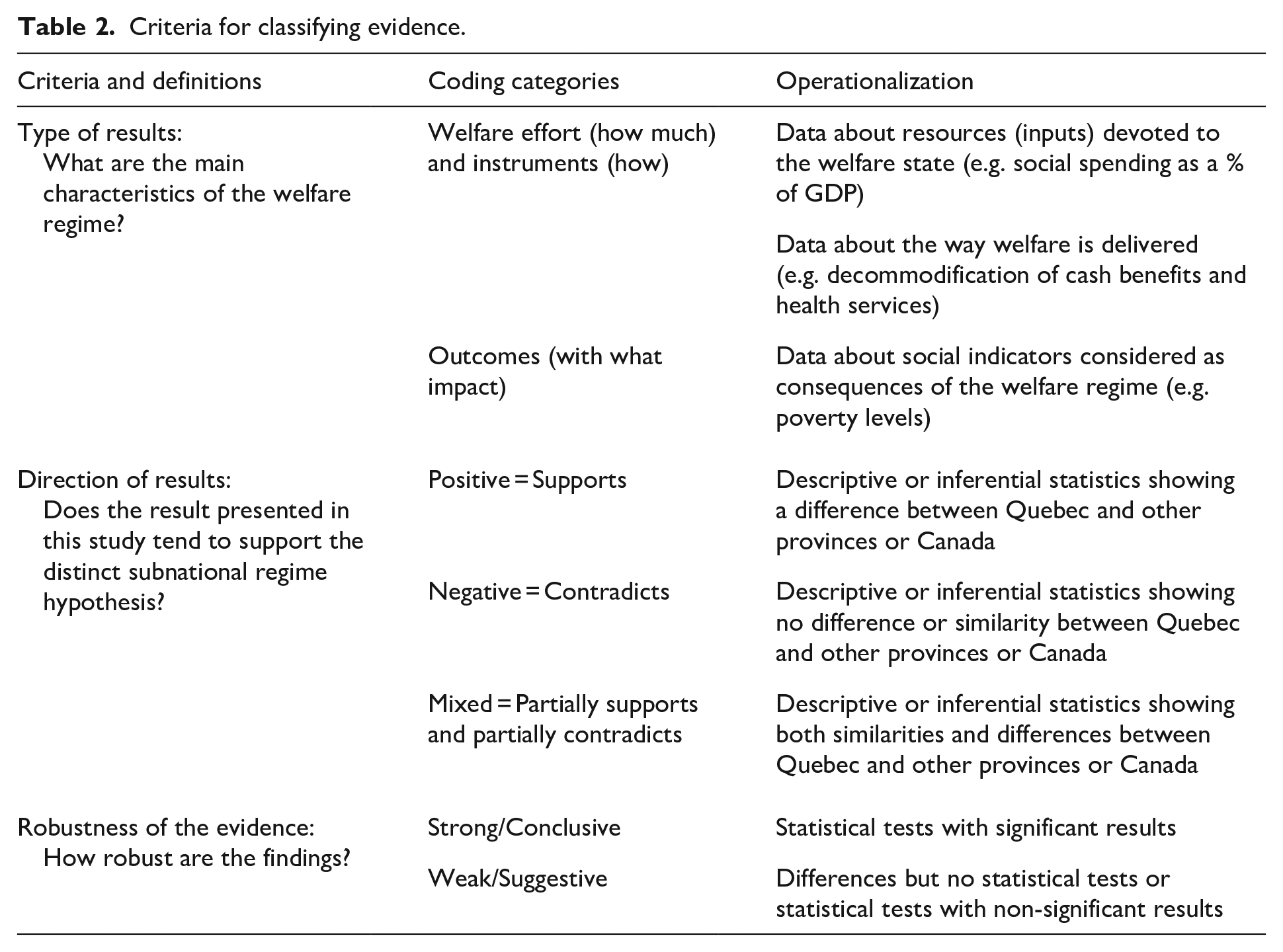
We then coded the results according to whether they reflected a direct or indirect approach to welfare state measurement (Table 2). Direct results refer to what welfare states do and how they do it (welfare effort and policy instruments), for instance, social spending on childcare measured as a percentage of GDP. Indirect results refer to the outcomes of a specific welfare state regime (e.g. poverty or inequality levels). 1 Moreover, we coded the direction results (i.e. positive, negative or mixed) and the strength of the evidence (i.e. is there a statistically significant test?).
Criteria for classifying evidence.
Results
Our final sample contained 188 results (the detailed list of results is presented as supplemental online material). Most (128, or 68%) of the results address the outcomes of welfare state regimes, primarily poverty levels measured through various indicators. Interestingly, only 14% of the results are exclusively based on a direct measurement approach of welfare states (i.e. welfare effort and/or policy instruments). The remaining 18% of cases are based on a mix of policy effort, instruments and outcomes. Most (63.3%) results are based on a weak/suggestive level of evidence. Most (87.2%) comparative work on the Quebec welfare state focuses on Canadian, mainly subnational, comparisons. Quebec is most often compared to Ontario, either exclusively (71 results out of 188, or 37.8%) or with other provinces and/or Canada as a whole (45 cases out of 188, or 23.9%).
The results in our sample generally support (76.1%) the distinct subnational regime hypothesis (i.e. the existence of a distinct Quebec model), while 14.9% contradict it and 9.0% offer partial support for it. Interestingly, while the weak/suggestive evidence supports the distinct subnational regime hypothesis in 69% of the cases, this rises to 88% with strong/conclusive evidence (Figure 1).
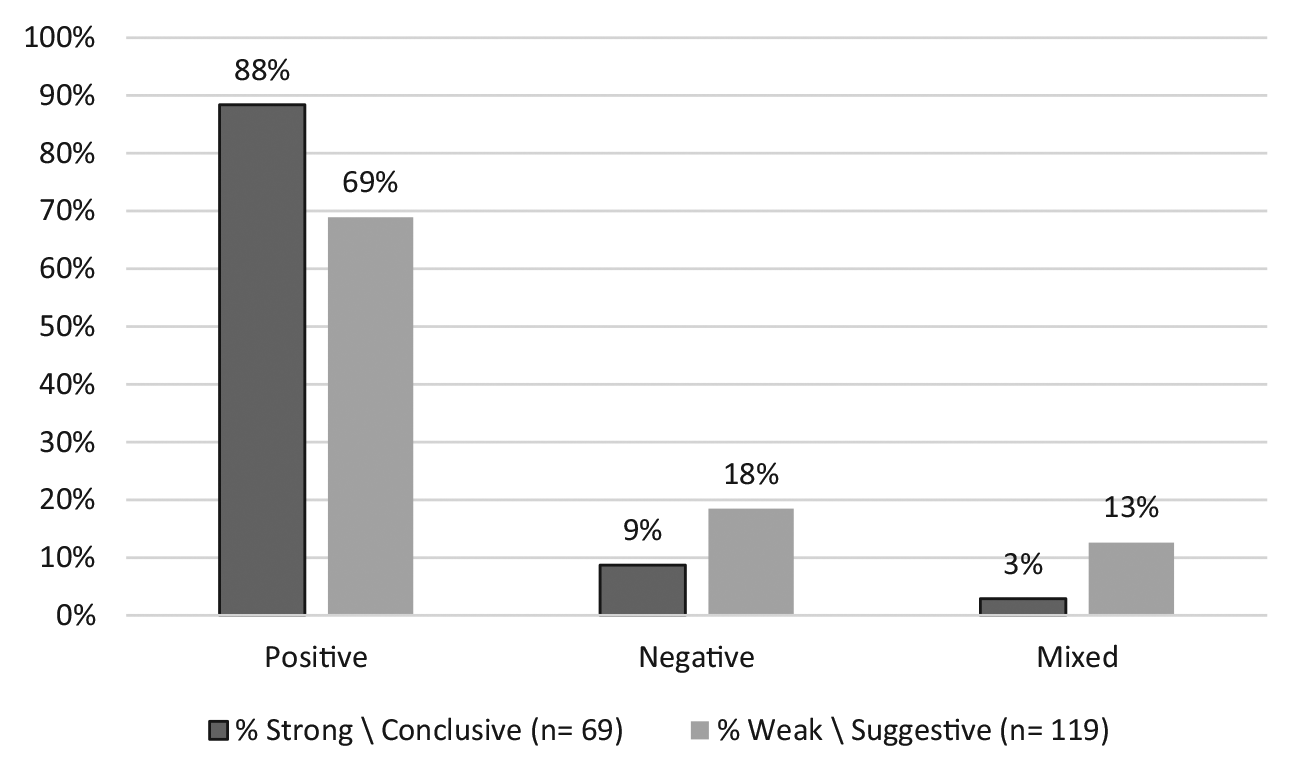
Evidence pertaining to the distinct subnational regime hypothesis.
An important caveat is that these results are not independent tests of our hypothesis because most of them are based on the same or on very similar indicators and data (e.g. poverty levels among a subset of the population). Therefore, contrary to what we intended, we could not perform statistical tests such as the Chi-Squared test or meta-analysis. Because explaining in detail the results and the methods is beyond the scope of this article, we opted for a brief illustration of each category of results. Suffice it to say that some analyses are basic, while others are sophisticated and control for confounding factors. An example of the latter is Van den Berg et al.’s (2017) comparison of poverty levels in Quebec, Ontario, British Columbia and Alberta. Controlling for demographic characteristics allowed the authors to conclude that ‘if Quebec had had Alberta’s relatively ungenerous anti-poverty regime, its poverty rate would have been over 16.8% in 2011, not 11.1%. In other words, Quebec’s regime is over 50% more generous than Alberta’s!’ (p. 159).
Welfare effort and/or instruments
Regarding the ‘how’ and ‘how much’ of welfare state regimes, 85.2% of results support the distinct subnational model hypothesis. Haddow’s (2015: 225–226) comparative analysis of Quebec and Ontario is a case in point. He found, among other things, that Ontario’s policy commitment for childcare is lower than Quebec’s, even after using regression analysis to control for socioeconomic differences between the two provinces. This result is statistically significant for two dependent variables in his model (i.e. childcare spending and childcare spaces). However, since the mid-1990s, Quebec has been consistently less generous with respect to social assistance provided to median beneficiaries (Haddow, 2015: 129). Although this latter result suggests that Quebec’s welfare state is distinct from Ontario’s, it contradicts the hypothesis that it is more extensive and generous. Globally, these different results suggest that the Quebec model is generous toward families, which is in line with the activation paradigm and social investment (see Daigneault, 2015). Families are perceived as being vulnerable and ‘deserving’, with the expectation that individuals who are able to, should fend for themselves in the job market rather than depend on social assistance.
Welfare outcomes
Most results (76.6%) support the distinct subnational regime hypothesis. For instance, Raïq and Plante (2013) studied the percentage of two-parent families who lived at least 1 year of poverty between 2002 and 2007 and found a lower and statistically significant proportion in Quebec (17.1%) than in Canada (20.9%), Ontario (21.3%), Alberta (23.6%) and British Columbia (23.6%). This tends to corroborate findings regarding welfare effort and instruments targeting Quebec’s families and children. Van den Berg et al. (2017: 104) offered an example of a mixed result related to social outcomes. They found that Quebec’s poverty rate for single adults has been generally lower than in Alberta and British Columbia, although generally higher than in Ontario, the US, Denmark, the Netherlands and France.
Welfare effort, instruments and outcomes
Many results in our sample are based on both a direct and indirect approach to measuring welfare state regimes. For instance, Haddow (2013: 395–397) analysed the redistributive impact of various policies throughout the Canadian provinces. He found that, overall, Quebec’s policies reduced inequality more effectively than all the other provinces, a result statistically significant at the 0.05 or 0.01 level, depending on the province. Bernard and Saint-Arnaud (2004) used hierarchical cluster analysis – an inductive method classifying cases according to their similarities and differences on given indicators – of the four largest Canadian provinces and 20 OECD countries, including Canada. The authors used three types of indicators: (1) public policy indicators (which pertain mainly to welfare effort), (2) civic participation and (3) social conditions/outcomes indicators. On one hand, the main result does not support the distinct subnational regime hypothesis. With four clusters, Quebec clearly belongs to a ‘North American liberal’ regime, as do other provinces, Canada, the US and Iceland. These authors had to force divisions and create 22 groups for Quebec to distance itself from the Canadian cluster (p. 224). 2 On the other hand, a closer look at Bernard and Saint-Arnaud’s results reveal that Quebec’s welfare state displays limited, but nevertheless, real differences from its Canadian counterparts: Quebec is, with Alberta, the province that differs the most from Canada as a whole. Moreover, of all provinces, Quebec is the most different from the US and the liberal regime, and is the most similar to both European social democratic and conservative regimes (p. 228).
Discussion and conclusion
In this article, we have mapped and taken stock of the quantitative literature on the Quebec welfare state regime with the twin goals of assessing its distinctiveness and the general relevance of studying subnational entities. Our results suggest that Quebec has a distinct welfare state that appears to be more generous and more extensive than in other provinces, especially for families. Although Quebec’s welfare state stands out, the work reviewed suggests that there are a few significant – albeit less pronounced – differences between the other Canadian provinces as well.
Two limitations of this study are, first, that our results are dependent on a small sample of published studies for which some authors are the same, second, that we did not synthesize these studies’ results through techniques such as meta-analysis. Nonetheless, these results confirm that Canadian provinces have enough constitutional and fiscal autonomy to build their welfare state in the direction they choose and that they have a real impact on socioeconomic indicators. Thus, subnational public policy matters a great deal, in Canada and probably in other states.
More generally, our results point to the need to study whether subnational welfare states within a given country are similar to each other and to the central/national/federal welfare state. Theoretically, this suggests that students of welfare state regimes, especially those interested in federal countries or unitary states with power devolution or multilevel governance arrangements, should reject ‘methodological nationalism’ and pay closer attention to the possibility of distinct regimes below the national level (Ciccia and Javornik, 2019; Greer et al., 2015; Hudson, 2012). Thus, a research agenda that explores subnational and regional welfare state regimes is clearly warranted. For instance, we could assess whether the welfare state regimes of German Länder have more in common with each other and the German federal welfare state than with other subnational entities in Europe. Scaling down may allow us to identify ‘new’ worlds or subworlds of welfare or, alternatively, to confirm the relevance of the three-world typology. By taking the subnational, regional and local levels of analysis seriously, we may well deepen and broaden theoretical understandings of welfare states, their determinants, impact and evolution.
Supplemental Material
sj-pdf-1-esp-10.1177_0958928721996651 – Supplemental material for Taking subnational and regional welfare states seriously: Insights from the Quebec case
Supplemental material, sj-pdf-1-esp-10.1177_0958928721996651 for Taking subnational and regional welfare states seriously: Insights from the Quebec case by Pierre-Marc Daigneault, Lisa Birch, Daniel Béland and Samuel-David BBélanger in Journal of European Social Policy
Footnotes
Acknowledgements
We presented a previous version of this article at the annual conference of the Canadian Political Science Association (CPSA) at the University of British Columbia, Vancouver, on 5 June 2019. We thank the conference participants, in particular Keith Banting, Olivier Jacques, Alain Noël and Charles Plante, for their insightful comments. We also thank Rachel Hatcher for copyediting the article.
Funding
The authors disclosed receipt of the following financial support for the research, authorship and/or publication of this article: the Fonds de recherche du Québec – Société et culture (FRQ-SC) and the Center for Public Policy Analysis (CAPP), Université Laval.
Supplemental material
Supplemental material for this article is available online.
Notes
References
Supplementary Material
Please find the following supplemental material available below.
For Open Access articles published under a Creative Commons License, all supplemental material carries the same license as the article it is associated with.
For non-Open Access articles published, all supplemental material carries a non-exclusive license, and permission requests for re-use of supplemental material or any part of supplemental material shall be sent directly to the copyright owner as specified in the copyright notice associated with the article.
