



Abstract
This thematic review essay focuses on the relationship between social inclusion and collective skill formation systems. It briefly surveys foundational literature in comparative political economy and comparative social policy that documented and explained the traditionally socially inclusive nature of these systems. It reviews how the literature conceptualized the current challenges faced by collective skill formation systems in upholding their inclusive nature in the context of the transition to post-industrial societies. It then discusses in detail a recent strand of literature that investigates the policy responses that have been deployed across countries to deal with these challenges. It concludes by providing heuristics that may be useful for researchers who seek to advance the study of the policy and politics of social inclusion in collective skill formation systems.
Introduction
The thematic review is motivated by a recent surge of interest in the relationship between social inclusion and collective skill formation systems 1 in comparative political economy (CPE) and comparative social policy (CSP) research (Bonoli and Emmenegger, 2020; Bonoli and Wilson, 2019; Carstensen and Ibsen, 2019; Di Maio et al., 2019, 2020; Durazzi and Geyer, 2020; Ibsen and Thelen, 2020). This is not necessarily surprising: the social inclusion ‘angle’ has long been present in the literature on skill formation (Soskice, 1994; Streeck, 1997). However, it is not until very recently that it has come front and centre in the study of skill formation systems. Yet, as this body of literature quickly grew, some seemingly conflicting findings began to emerge: a vast array of policies have been categorized under the broad notion of ‘social inclusion’ and they have been associated with different underlying political dynamics. But how exactly do the different policies identified in this literature deliver on their promise of furthering social inclusion? And under what circumstances are the various actors expected to matter in the underlying politics of policy change? At present, we lack appropriate theoretical tools to answer these questions because contributions to this fast-growing body of literature have built on case studies of specific policies and episodes of reform, each highlighting distinct policy measures and underlying political dynamics. The value added of this review stems from its endeavour to take a bird’s-eye view on the existing literature and to develop a framework that can accommodate theoretically the diversity in policy and variation of politics that existing contributions have focused on separately. Through the review, we therefore hope to provide a useful heuristic for this literature to move forward.
The article starts by reviewing some of the foundational work (the second section) that provide the broad framework within which the more recent contributions developed. It then delves into the recent literature (the third section). The fourth and fifth sections reflect upon the recent literature by advancing broad typologies of socially inclusive policies and the associated politics. The sixth section draws the conclusions. Before proceeding, a clarification on the scope of the article is in order: we focus on a recent set of CPE/CSP contributions that have come to form a coherent – and growing – body of literature over the last few years. This choice comes with the downside of excluding from the review contributions from neighbouring disciplines – such as sociology – that provide micro-level evidence on how different socio-economic groups transitioned into the vocational training system and from the vocational training system into the labour market (for example, Protsch and Solga, 2016; Solga and Kohlrausch, 2013). This literature provided crucial insights on the extent to which training systems deliver socially inclusive outcomes, but for the purposes of this review, we opt for an exclusive focus on the macro-policy and political level as per recent CPE/CSP contributions.
From social inclusion as a by-product of industrial employment to social exclusion as a side-effect of post-industrialization
Vocational training systems gained prominence in scholarly debates as part of broader research programmes aimed at shedding light on the diversity of capitalist countries (Hall and Soskice, 2001). A great deal of attention was particularly devoted to collective skill formation systems, where cooperation between employer associations and trade unions in the design of training standards led to a plentiful supply of workers whose skills fit firms’ needs (that is, they are specific skills) but are also broad enough to allow workers to move across firms within particular sectors (that is, they are also transferable) (Estevez-Abe et al., 2001). Moreover, these systems also appeared to be able to successfully integrate into the training system and, subsequently, the labour market, those pupils who are relatively less academically gifted, thereby combining equity and efficiency aims (Busemeyer, 2015; Iversen, 2005; Soskice, 1994).
Crucially, however, these analyses refer primarily to vocational education and training in manufacturing-dominated political economies. This structural feature is crucial to understanding why efficiency aims could comfortably sit alongside equity ones in collective skill formation systems; growing employment in the manufacturing sector meant that manufacturing firms offered plenty of apprenticeships, thereby absorbing a large number of school-leavers into their training system before offering them a job. In this context, applicants’ academic ability was not a central concern in firms’ selection process, given that industrial production was not relying at large on academically oriented skills. Hence, academically weak candidates – often from disadvantaged socio-economic backgrounds – could be successfully integrated in to the training system and the labour market.
As structural conditions changed, however, so did the ability of collective skill formation systems to perform a socially inclusive function. Two twin trends stood out in this respect: (i) the expansion of service sector employment vis-à-vis the manufacturing sector (Iversen and Wren, 1998; Wren, 2013) and (ii) the rise of knowledge economies (Diessner et al., 2021; Durazzi, 2019). The former took a toll on the sheer quantity of available apprenticeships, the latter heightened the skills requirements of apprenticeship seekers. The joint effect of these two parallel trends triggered exclusionary dynamics, decreasing the likelihood of academically weaker pupils to land an apprenticeship (Busemeyer, 2012; Martin and Knudsen, 2010; Thelen, 2014). What strategies did governments put in place to navigate this challenge? We turn to this question in the next section as we delve into the more recent literature.
Social inclusion front and centre of the analysis
The previous section discussed how social inclusion in collective skill formation has traditionally featured in the CPE literature, without, however, being at its core. This has changed over the last couple of years when several articles put social inclusion front and centre of the analysis (cf. Bonoli and Emmenegger, 2020; Bonoli and Wilson, 2019; Carstensen and Ibsen, 2019; Di Maio et al., 2019; Di Maio et al., 2020; Durazzi and Geyer, 2020). These articles share a starting point: social inclusion is a dimension of skill formation systems that deserves to be analysed in and of itself as opposed of thinking of it as a by-product of other dimensions.
An overview of socially inclusive measures.
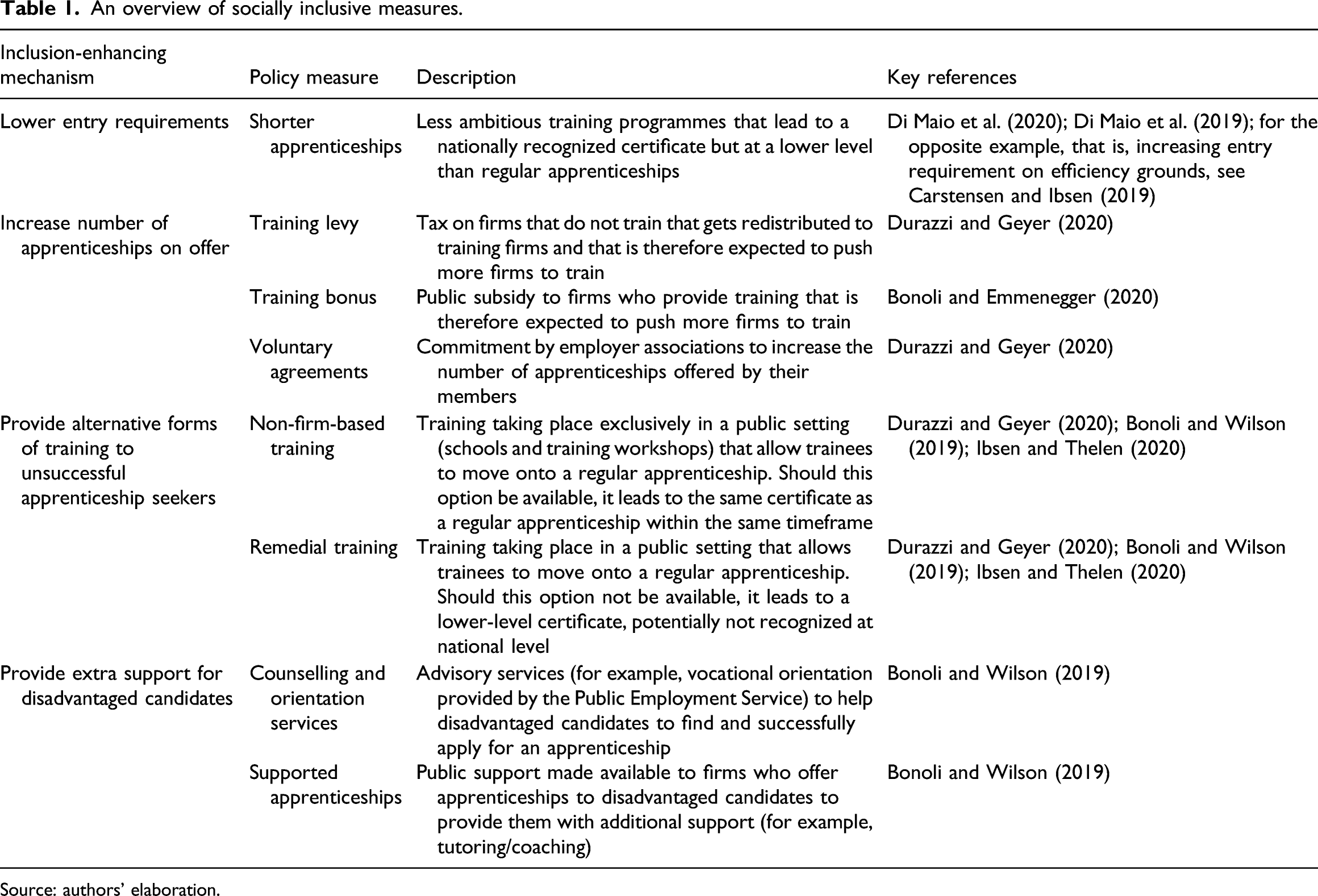
Source: authors’ elaboration.
Such a variegated picture of socially inclusive measures is matched by an equally variegated political landscape. The complexity of the politics of social inclusion in collective training systems is well illustrated in Carstensen and Ibsen (2019): their historical account of the reform of training in Denmark shows the rise and fall of equality-oriented coalitions, pointing at the complexity and instability of the coalitional politics. The articles that look at more recent instances of socially inclusive reforms confirm such complexity.
Bonoli and Emmenegger (2020) conceptualize the politics of social inclusion as a two-level game, in which employers ultimately retain the upper hand. The core contention is that business will consent to socially inclusive measures only to the extent that these measures do not threaten the self-governance of the system. They think of the politics of social inclusion as a balancing act between its labour market logic and its education system logic. In a labour market logic, employers retain full control over the selectivity of the skill formation system: it is up to employers to decide how many apprenticeships are to be offered and it is up to employers to select the best candidates for each apprenticeship position. In an education system logic, the integration of young people in the training system prevails over the labour market logic and governments might resort to one or more of the measures highlighted in Table 1.
The upshot of Bonoli and Emmenegger’s analysis is that business is in a position of structural advantage in the relationship with the government. Given that collective skill formation systems rest on the willingness of firms to train, business associations can use the anticipated behaviour of their members to extract concessions from the government by informing the government that their members will not comply with a given socially inclusive measure (see also Busemeyer, 2012). Even if governments successfully introduce a socially inclusive measure, individual firms can still quash its implementation. This is illustrated with the case of the German Ausbildungsbonus, which provided public financial incentives for firms to train. The policy was adopted despite business (and unions) voicing their discontent. But once the policy was adopted, firms simply did not use the bonus to the extent that was foreseen by the government. As the policy was severely underachieving its targets, it was discontinued by the government (Bonoli and Emmenegger, 2020; Geyer, forthcoming). Does this mean that socially inclusive measures can only develop to the extent that business consents to them? Not necessarily. Other contributions highlight that different political dynamics may also emerge.
Di Maio et al. (2020) show for instance that the introduction of two-year apprenticeships in Switzerland was the outcome of a process initiated by the government despite some initial scepticism from the business community. Nonetheless, they also show that the government was aware of employers’ preferences and anticipated them. This shaped a policy process whereby the government introduced two-year apprenticeships despite employers’ scepticism but quickly stepped back and left the newly introduced policy within the realm of the social partners’ self-governance. Di Maio and colleagues refer to this process as ‘polite employer domination’. This perspective suggests that governments might be able to strategically anticipate business preferences and achieve socially inclusive reforms by, for example, forcing employers’ hands in the political arena but then stepping back to preserve their self-governance, and therefore not antagonizing business, when it comes to implementing a given policy on the ground.
Finally, Durazzi and Geyer (2020) shift the focus away from business and governments to focus on the role of unions. This contribution suggests that a policy initiative strongly advocated by the unions, which found government’s political support, might be successfully implemented despite business opposition. The argument is based on the successful introduction of a non-firm-based training in Austria, which caters for unsuccessful apprenticeship seekers. This form of training – referred to as supra-company apprenticeship – offers a guaranteed training place to young people who cannot find a regular apprenticeship. It mimics a ‘normal’ apprenticeship insofar trainees share their time between practical and theoretical learning, and it leads to same certification as a regular apprenticeship. But the practical component takes place in a training workshop, rather than in-firm. This type of training is therefore ‘dual’ because apprentices receive theoretical and practical training, but not ‘collective’ because training is provided by public financed workshops and not private companies. 3 Durazzi and Geyer note that this solution was successfully pursued in Austria but similar arrangements were unsuccessful in Germany and they put this down to the strategies of trade unions that depend in turn on the institutional context within which they operate, which led to a pro-inclusion coalition between the unions and the government in Austria but not in Germany (see also Busemeyer, 2012).
At this point, two main aspects of the recent literature on social inclusion in collective skill formation systems should have become apparent: (i) the empirical focus is broad-ranging, covering a wide variety of policy measures; and (ii) partly as a logical consequences of (i), the explanations of success and failure of socially inclusive policies is equally variegated. The next two sections aim to systematically reorganize the findings of the recent literature on both the policy and politics fronts.
Policy: between selection and stratification
This section asks the following questions: Are the wide array of policy measures identified in the recent literature and summarized in Table 1 all equally inclusive? and Is a single dimension (more or less inclusion) enough to adequately capture them? We suggest that a two-dimensional classification might do a better job. To understand why two dimensions might be desirable, we need to combine one insight of the recent literature with one insight of the older literature summarized in the second section. The recent literature alerts us to the increasing problems that collective skill formation systems face when it comes to offering training places to disadvantaged candidates. But the older literature – when outlining the socially inclusive nature of collective skill formation systems – pointed not only at their ability to offer training to disadvantaged school-leavers but also at their ability of giving them good life chances.
In other words, to fully capture the socially inclusive nature of the policy measures, we should not only focus on the point of entry (that is, whether disadvantaged candidates are integrated into the training system) but also on the point of exit (that is, whether the certifications that they receive put them at a disadvantage in the labour market vis-à-vis graduates of the regular system). We capture the former in the weakly selective – strongly selective axis and the latter in the stratifying – de-stratifying axis in Figure 1. To locate a policy measure along the selection axis, we thus ask the following question: Does the given policy have built-in mechanisms to increase the number of training places to be provided and therefore make access to the system less selective? The assumption here is that the more places are offered, the easier it is for candidates to land an apprenticeship, making it more likely that (also) disadvantaged candidates are offered a place. If, conversely, the supply of apprenticeships shrinks, we expect disadvantaged candidates to be disproportionately affected. Policies that ultimately depend on firms’ willingness to offer training and do not alter their incentives to offer training are at the strongly selective end of the spectrum. Policies that either do not depend on firms’ willingness or that offer explicit incentives for firms to provide additional training are at the weakly selective end of the spectrum. The policy space of socially inclusive measures.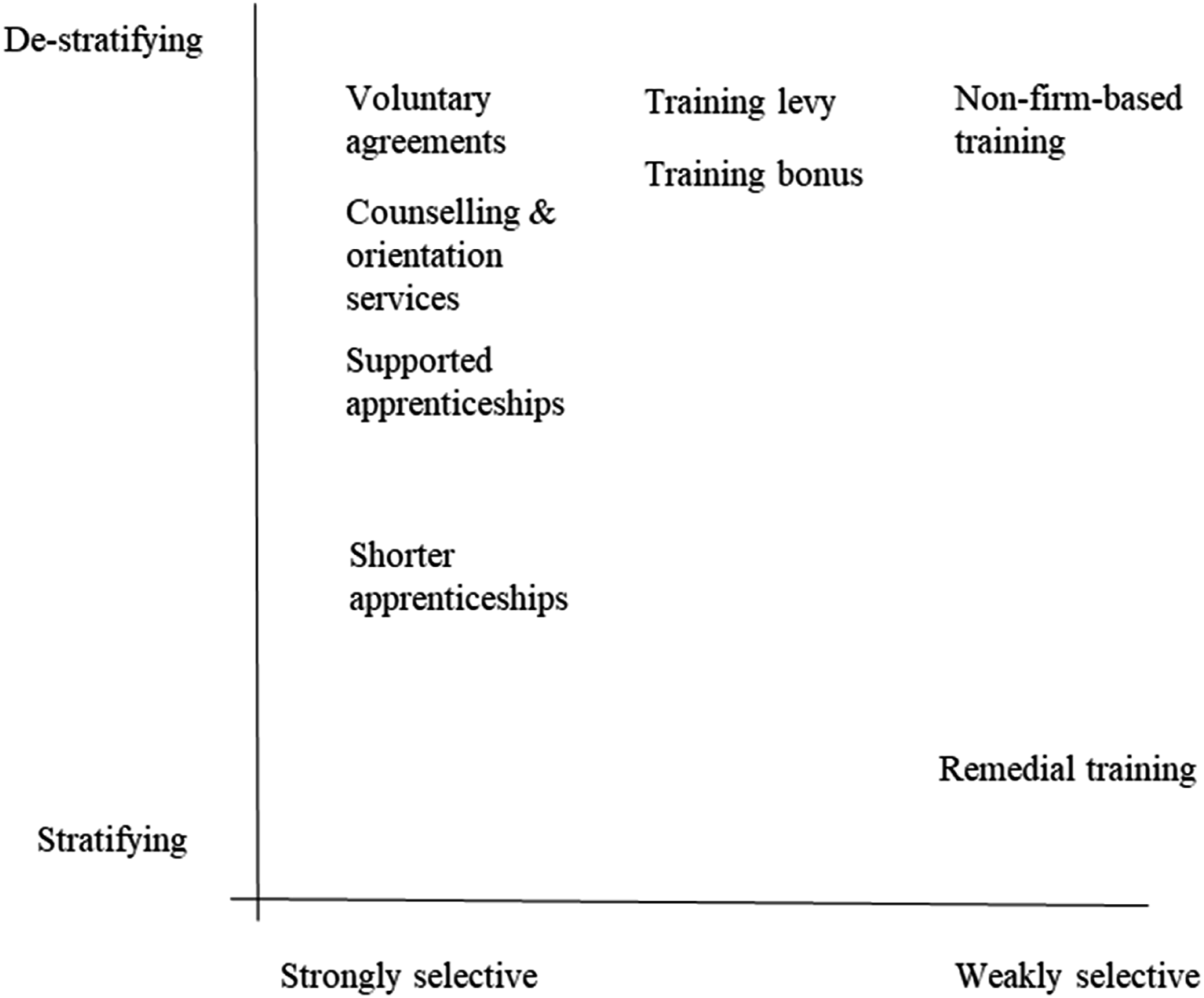
Turning to the stratification axis, we pose the following question: Does the given policy provide trainees with inferior certification or prolong their transition from school to employment compared to graduates of the regular system? If they do, then these policies locate at the stratifying end of the spectrum, if they do not, they will be placed at the de-stratifying end. Our conceptualization of (de-)stratifying measures builds in particular on insights from the comparison between the transition system and the regular firm-based system in Germany. The former does not lead to fully qualifying certifications and, for this reason, it has often been criticized as an unnecessary ‘waiting loop’ further disadvantaging those pupils who cannot find regular apprenticeships. Hence, if a measure leads to equal certification within the same timeframe as the regular firm-based system, we consider it de-stratifying. The actual implementation of these measures, however, returns a more complex picture. Equal certification provided outside the regular firm-based system is well-respected in the labour market in some cases (for example, Austria, cf. Durazzi and Geyer, 2020), while it is de facto considered of lower value in other cases (for example, Denmark, cf. Ibsen and Thelen, 2020). While recognizing this complexity, it still seems appropriate to place measures that provide equal certification at the de-stratifying end of the spectrum compared to measures that do not offer equal certification given that there are empirical examples demonstrating that the former can be designed in such a way as to play a ‘de-stratifying’ role, while the latter are ‘stratifying’ by design. Yet, the different de facto value of non-firm-based training in Austria and Denmark further testifies to the complexity of enhancing social inclusion in vocational training systems while maintaining their attractiveness in the labour market. Combining the ‘selection’ and ‘stratification’ dimensions, we are able to locate the various policy measures listed in Table 1 across the four possible quadrants of Figure 1.
The top-right corner features a policy that is both weakly selective and de-stratifying: non-firm-based training is weakly selective because it offers a guarantee, under-written by the state, of a training place for unsuccessful apprenticeship seekers, 4 and it is de-stratifying because training is of equal quality and duration as regular apprenticeships and it leads to the same nationally recognized certification as a regular apprenticeship. Located further to the left are levies and bonuses. They weaken selection because they provide explicit incentives for firms to train more, but they do so to a lesser extent than non-firm-based training because the final decision as whether to hire apprentices still remains with employers. Furthermore, they are de-stratifying because they aim at creating additional training places in the regular apprenticeship system.
The bottom-right corner features policy measures like remedial training that – similarly to the case of non-firm-based training – provide a state-backed guarantee of a training place but – different to the case of non-firm-based training – they lead to certificates of inferior quality. They are, in other words, weakly selective but also stratifying. This is one key difference between the Austrian supra-company training (that is, a case of non-firm-based training) and the German transition system (that is, case of remedial training).
Moving to the left-hand side of the figure, we find in the top-left quadrant a number of policies that potentially support the inclusion of disadvantaged candidates into regular apprenticeships by giving them extra support before or during the apprenticeship (in the case of, respectively, counselling and orientation services and supported apprenticeships) or through commitments on the side of firms to provide more apprenticeships. These measures are de-stratifying because beneficiaries would access the regular apprenticeship system – but whether they do access the system is a decision that remains firmly in the hands of business and there are no additional incentives provided by the state to increase the offer of apprenticeships (as in the case of levies and bonuses). They are therefore policies that are de-stratifying but also strongly selective.
Finally, the case of shorter apprenticeships is one of relatively strong selection and stratification when set in the context of the other inclusive measures: they are strongly selective because ultimately whether to offer these apprenticeships to disadvantaged applicants remains a decision for firms to make; and they are also stratifying because they offer a certification of inferior quality compared to a regular apprenticeship (although of higher quality compared to remedial training, hence they are placed above remedial training in the stratification axis). By resorting to the proposed bi-dimensional categorization outlined in Figure 1, we might therefore be able to get at a more fine-grained understanding of the policy measures that have been put in place in recent years to enhance social inclusion in collective skill formation systems. But what about the underlying politics? We turn to this question in the next section.
Politics: between intrusion and co-dependence
We suggest that the politics of socially inclusive reforms can be also meaningfully systematized by resorting to a bi-dimensional space. Time and again, the literature showed that employers vigorously fought off unilateral government intervention into vocational training and sought to preserve its self-governance through social partnership (Busemeyer, 2012; Bonoli and Emmenegger, 2020; Carstensen and Ibsen, 2019; Durazzi and Geyer, 2020). This is a crucial dimension of the politics of training that we capture in Figure 2 using the notion of intrusion (cf. Bonoli and Wilson, 2019; Bonoli and Emmenegger, 2020). Intrusive measures are those that weaken employers’ control over how many apprenticeships are offered. They can do so directly by altering the incentive-set underpinning employers’ decision to offer apprenticeships or indirectly by providing alternative pathways that might divert potential applicants away. If, on the other hand, the measures do not curtail firms’ ability to select candidates or do not enter in competition with the regular system, these are considered as low intrusion measures. The political space of socially inclusive measures.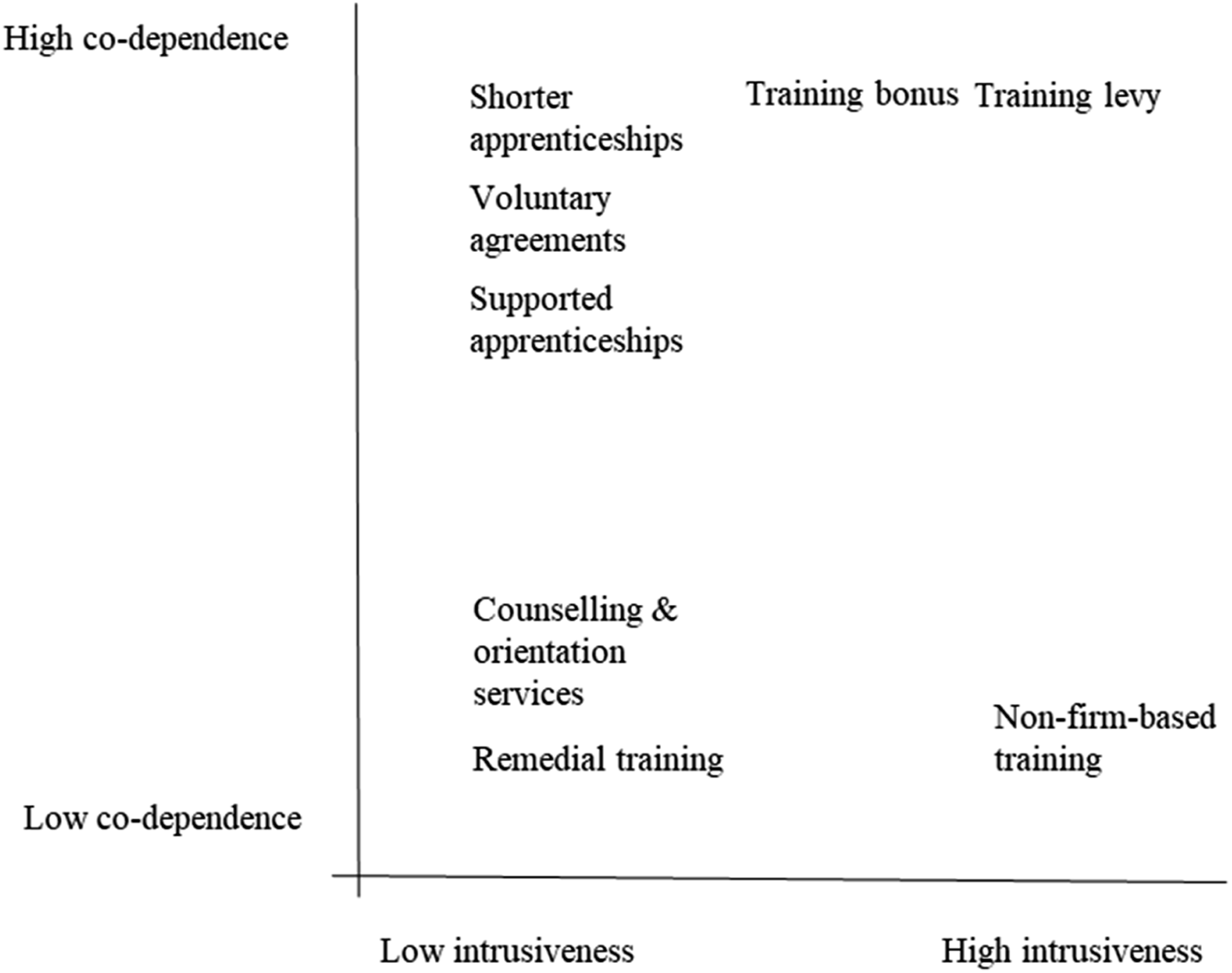
The second dimension qualifies the view that business is in a privileged political position (Bonoli and Emmenegger, 2020; Busemeyer, 2012). We suggest that this maxim is often – but not always – true. Using the notion of co-dependence (cf. Culpepper and Reinke, 2014), we note that not all the measures listed in Table 1 require business involvement for their implementation. At high levels of co-dependence, we hypothesize business buy-in to be necessary for a given measure to be successfully implemented or even adopted. But measures that do not depend on business’ involvement, that is, at lower levels of co-dependence, can be introduced even against business’ opposition. 5 Combining the two dimensions, we are able to locate the various policy measures listed in Table 1 across the four possible quadrants of Figure 2.
The top-right corner features those measures that are most difficult to pass or implement. These are training levy and, somewhat lower on the intrusiveness scale, training bonus. In both cases, government intervention is expected to alter firms’ incentive to train. As expected, firms have been strongly against any form of levy (Busemeyer, 2012; Durazzi and Geyer, 2020). Business opposes training bonuses less vigorously than levies because bonuses provide carrots (in the form of subsidies) but – unlike levies – they do not impose sticks (that is, the subsidies come from the public purse, not from firms who do not train). However, training bonuses are viewed as intrusive because financial incentives may lead firms to hire apprentices for short-term monetary gains, which employer organizations perceive as detrimental to the long-term stability of the training system (Bonoli and Emmenegger, 2020; Geyer, forthcoming). Importantly, business is in a privileged position to push back on these measures because the success of these measures depends on the continued willingness of firms to train. Moreover, high levels of co-dependence also make unions’ preferences less politically relevant. In the top-right corner, business is therefore the pivotal actor, and we expect business to exploit its pivotal position to quash intrusive measures at high-levels of co-dependence in line with the theorization provided by Bonoli and Emmenegger (2020). The political logic that applies in this quadrant is one of ‘business dominance’.
The picture is different in the bottom-right corner. Here intrusive measures have the potential to be adopted even without employer support because, given low co-dependence, business does not have an equally strong veto power. The typical intrusive measure with a low level of co-dependence on business is the establishment of non-firm-based training systems leading to equal certification as the regular system. This system is intrusive because, given equal certification, business might fear that it enters into competition with the regular system and siphon out potential applicants (but recall note 5 on the strategies that governments might adopt to ensure that non-firm-based training is complementary to – not competitive with – the firm-based training system). On the other hand, it does not depend on business: the practical component of training takes place in a public setting and not in-firm. This is the political context analysed by Durazzi and Geyer (2020), in which unions – not business – are the pivotal actor. A parallel system of non-firm-based training was established in Austria, where the unions sided with the government in favour of its establishment but not in Germany, where the unions sided with the employers against it. The reason for these different coalitions has been found in the different institutional contexts: in the Austrian context, the unions exert the same – if not higher – control over non-firm-based training as they do in the regular system; while in the German case, they perceived their control over training to be lower as training moved out of the regular system. The political logic that applies in this quadrant is therefore one of ‘competition’ between the regular training systems and alternative – equally qualifying – paths. We posit that the outcome of such competition between policies will ultimately depend on the stance that unions take.
The top-left corner, in turn, offers the opportunity for more cooperative solutions. Here employers have the upper hand because all these measures (shorter apprenticeships, supported apprenticeships and voluntary agreements) need their consent to be successfully implemented. In this case, however, it is conceivable that employers do consent to them because these measures neither enter in competition with the regular system (for example, because they offer lower qualifications) nor do they weaken business’ control over the system. This scenario is consistent with the notion of ‘polite employer domination’ (Di Maio et al., 2020), whereby business might consent to socially inclusive measures because these do not alter their pre-eminent role in the governance of the system. Business, in other words, is pivotal in this quadrant too, but it is not necessarily expected to use its pivotal position to torpedo inclusive measures. Moreover, this is also the quadrant that accommodates policy measures that reflect a political compromise. For instance, voluntary agreements in Germany have been proposed by business to ensure that the far more threatening option of a levy was off the table (Durazzi and Geyer, 2020; Geyer, forthcoming). The political logic that prevails in this quadrant is therefore one of ‘political exchange’.
Finally, the bottom-left quadrant is home to those policy options that are politically easiest to introduce. At low levels of intrusion and low levels of co-dependence, we expect social partners to let the government develop socially inclusive measures. The political logic that applies in this quadrant is therefore one of ‘facilitation’, 6 that is consisting of measures that are politically easy for governments to introduce. However, these also tend to be ‘weak’ measures because – going back to Figure 1 – they are either stratifying or tend toward the strongly selective end of the spectrum.
Conclusion
This article reviewed foundational literature that highlighted the socially inclusive nature of collective skill formation systems in industrial societies and documented the increasing difficulties in upholding this socially inclusive nature in post-industrial knowledge-based economies. It then focused on recent literature that placed social inclusion front and centre of the analysis, revealing wide variations in the policies that have been identified as socially inclusive and in the underlying politics that led to particular policy choices. To systematize such variations, the article proposed two broad heuristics: on the policy side, it advanced a bi-dimensional categorization based on the degree of selection and stratification that different policy measures display; on the political side, it delineated a bi-dimensional political space within which these policy measures develop, employing the concepts of intrusion and co-dependence.
As advanced capitalist countries strive to turn their welfare states into social investment states, vocational training systems have a potentially key role to play. But the social investment potential of vocational training systems can be fully unleashed only if their economic efficiency and social inclusion functions are successfully (re-)combined. It is therefore of paramount importance to understand the policy and politics that can nurture a symbiotic relationship between social inclusion and economic efficiency in collective skill formation systems. This thematic review hopes to further stimulate this line of research as well as to have provided useful analytical tools to be employed for its pursuit.
Footnotes
Acknowledgements
We would like to thank Patrick Emmenegger for insightful and encouraging feedback on the early idea of this thematic review as well as two anonymous reviewers and the journal’s editor Janine Leschke for helpful comments. Errors and omissions are ours.
Declaration of conflicting interests
The author(s) declared no potential conflicts of interest with respect to the research, authorship, and/or publication of this article.
Funding
The author(s) received no financial support for the research, authorship, and/or publication of this article.
