




Abstract
This study investigates whether generous family policies at the transition to parenthood reduce single and partnered mothers’ economic disadvantages later in the life course. Previous research usually focused on the immediate effects of family policies and disregards potential longer-term effects. In this study, we suggest taking a life-course perspective to study the relationships between family policy and mothers’ poverty risks. We empirically investigate how investment in child benefits, childcare services and parental leave measures at the transition to parenthood are associated with poverty outcomes at later life stages and whether these associations hold over time. We draw on pooled EU-SILC data, and an original policy dataset based on OECD expenditure data for child benefits, childcare and parental leave from 1994 to 2015. We find that mothers’ observed increase in poverty over time is slower in countries with high levels of spending for childcare at the transition to parenthood than in lower spending countries. The gap between partnered and single mothers was also diminishing in contexts of high childcare expenditure. For the other two policies, we did not find these links. These results do lend support to the claim that childcare is a prime example of a social investment policy with returns later in the life course and represents a life-course policy that seems to be able to disrupt economic path dependencies. The results for the other two policies suggest, however, a limited potential of family policy spending at transition to parenthood to reduce the poverty gap between partnered and single mothers over the course of life.
Introduction
The strong links between family policies and their immediate economic outcomes for different family types are well documented, but few studies examine their effects across different life stages. In this article, we expand on previous research, conceptualizing family policies as life-course policies and explore how family policies provided at different life stages play out for partnered and single mothers. We go beyond earlier arguments that view all family policies as examples for welfare states’ ‘investment’ in the future of their citizens by disentangling links between policies and economic outcomes for three types of family policies: cash benefits, parental leave and childcare. By doing so, we argue that links between family policies and families’ economic outcomes should be studied through a life-course lens, considering that policies may have longer-term effects, but that these may differ depending both on the type of policy and on when in the life course individuals are affected by them. In this article, we rethink the relationships between state and family from a life-course perspective and thus advance theorizing the role of family policies for socioeconomic outcomes.
Understanding family policy as life-course policy highlights the reach of policies beyond the time when people access them. One perspective is that social policies are risk management instruments that bridge insecure periods in the life course and support continuity (Leisering, 2003). Classic examples are social security and unemployment protection systems, which secure against labour market risks (Leisering and Leibfried, 1999). Family policies are rarely explicitly considered as life-course policies, nor assessed in terms of their immediate and longer lasting effects, respectively. Exceptions are recent approaches to classify family policies as social investment policies (Kvist, 2015). The claim is that family policies contribute more to building up future resources than other policies because they tackle early life stages, which are considered especially vulnerable (Esping-Andersen, 2002a).
Family policies more specifically cater for family-related risks. They provide rights for time, money and services to parents and children (Lewis, 2009), for negotiating the responsibilities around care and economic needs throughout the family life trajectory. The birth of a child and single parenthood are two examples of family-related life-course contexts with elevated economic risks. In both, risks are higher for women than for men. Women experience severe income losses when becoming parents while men often gain economically (Budig and England, 2001; Van Winkle and Fasang, 2020). The economic risks of single parenthood are also overwhelmingly felt by the mothers. In the large majority of cases, children stay with their mothers when parents do not live together or when they move apart (Nieuwenhuis and Maldonado, 2018b). Single mothers often struggle economically compared to mothers in couples. Their poverty rates are high and exceed those of two-parent families in most high-income countries (OECD, 2016). Such gaps are explained by often lower labour market endowments of women entering single motherhood and by stronger barriers to well-paid jobs for single mothers compared to mothers in couples.
Family policies can help improve the economic position of families and particularly of those headed by single mothers. There are two main channels: supporting employment with work–family policies and providing direct cash transfers with income support measures. Work–family policy measures commonly include childcare and parental leave, which have been shown to facilitate mothers’ employment (Ferragina, 2019) and reduce the poverty gap between single mothers and mothers in couples (Misra et al., 2012). Family allowances such as child benefits, on the other hand, are effective by supporting mothers’ incomes. If paid generously, such benefits lift single mothers above the poverty line, narrowing the gap between single and partnered mothers’ poverty risks (Chzhen and Bradshaw, 2012; Van Lancker et al., 2015).
In this study, we ask how child cash benefits, parental leave and childcare services, provided at the time when mothers transitioned to parenthood, affect poverty risks at later life stages and how these associations develop over time. We compare poverty risks between partnered and single mothers to gauge the benefit for mothers in different risk contexts. For our multilevel regression framework, we use a newly compiled longitudinal dataset of detailed family policy expenditure data from the time when mothers transitioned to parenthood until they were observed in the survey. We use cross-classified modelling to account for the complex data structure. Our approach provides a novel perspective on policies as moderators of family-related life-course risks and sheds light on the role of different types of family policies at the transition to parenthood for later economic positions of single and partnered mothers.
Theoretical background
For conceptualizing the impact of policies provided at certain life stages for mothers’ economic outcomes, we implement ideas from ‘life-course research’ into our comparative framework. While we do not adopt a fully-fledged life-course approach, we apply some of the concepts and insights from this empirical research field to inform our hypotheses. Key to a sociological life-course perspective is the acknowledgement that individual lives are dynamic processes embedded in macrostructural contexts including social policies. We contribute to theorizing on the question of how family policies early in the family life course moderate poverty risks of single and partnered mothers at later stages.
Family, employment and poverty across the life course
A broad literature has examined the associations between family events and economic outcomes such as employment and poverty from a life-course perspective (Fasang et al., 2016). While lacking theoretical models in a strict sense (but see Bernardi et al., 2019), this literature commonly draws on several theoretical principles, which guide the analytical approaches (Elder et al., 2003; Mayer, 2004). We draw on three central concepts: the principle of intertemporal dependencies in the life span; the principle of interdependencies between different life spheres and the principle of interdependencies between the individual and the contextual level. We use these principles as a framework for more systematically disentangling what drives poverty risks of single and partnered mothers in light of their life-course contexts.
The principle of intertemporal dependencies refers to linkages between social positions at different stages across an individual’s life course. Transitions such as moving out of the parental home or having a child set the pathway for future decisions (Huinink and Feldhaus, 2009). The concepts of path dependency and of cumulative advantage and disadvantage further illustrate this principle (Bernardi et al., 2019; O’Rand, 1996). Intertemporal dependencies in the life course imply that available resources at any one time are to some extent a function of earlier endowments. Families’ economic positions partially depend on past resources. People may be locked in to socioeconomic trajectories, or they may be able to depart from the set course.
Resources of single mothers crucially depend on the mothers’ ability to participate in employment (Millar and Rowlingson, 2001; Nieuwenhuis and Maldonado, 2018b). This relationship is usefully conceptualized by the principle of interdependent life spheres (Bernardi et al., 2019). The spheres of employment and family life are closely intertwined, especially so for women (Aisenbrey and Fasang, 2017). Events in one sphere create constraints and opportunities in the other. The transition to parenthood is an example that is central to our study because it often creates economic challenges. Particularly for mothers, it is commonly followed by labour market time-outs, which depress their career progression (Aisenbrey et al., 2009), and reduce their capacity to secure themselves against economic risks in later life stages. Research on poverty risks across the life course adds to this perspective. Poverty risks culminate at certain life stages (Aassve et al., 2006) and increase with crucial life events, such as job loss, childbirth and divorce (Vandecasteele, 2011; Van Winkle and Struffolino, 2018).
The interdependence of life spheres is particularly obvious in the case of single motherhood. The absence of a second adult and potential earner in the household is one example. Single mothers bear the sole responsibility to maintain their household. A related issue is the high care burden created by having the sole day-to-day caring responsibilities for children in the household, which limits single mothers’ ability to participate in employment. Custody arrangements can imply that non-resident parents are involved in the care of the child (Steinbach, 2019). That often means multiple living locations and a complex day-to-day management, which poses particular challenges compared to two-parent households.
Finally, we employ the idea that all of these aspects have to be considered in light of the socio-historical environment in which life courses are embedded (Bernardi et al., 2019; Mayer, 2004). Socio-historical settings include labour market structures, dominant norms about work and family and welfare state policies. The welfare state consists of a set of policies managing social risks across the life course (Leisering, 2003). As such, policies can be seen as moderators of economic risk factors in different life spheres. That means that welfare state contexts affect how specific life-course transitions or events play out for economic outcomes (Zagel, 2018).
Economic position, single motherhood and policy
Different policy strategies can reduce economic risks of families. One is to provide income support for directly lifting people out of poverty, and the other is to provide rights or services that reduce negative social and economic consequences of family responsibilities. The former strategy entails social security measures and other income transfer schemes. The latter one includes policies oriented at facilitating mothers’ employment. Extensive research shows that the two strategies actively shape families’ economic risks and particularly those of single mothers. Overall, policies effective in reducing poverty and supporting paid employment for all are effective in reducing poverty and supporting paid employment for single parents as well (Van Lancker et al., 2015; Van Lancker, 2018).
Comparative research has extensively assessed the effectiveness of family policies in reducing single mothers’ economic disadvantage (Bradshaw et al., 1996; Misra et al., 2012; Nieuwenhuis and Maldonado, 2018a). Central findings are that income transfers tend to lower poverty rates of single mothers and their children (Chzhen and Bradshaw, 2012). Child benefits in particular are an effective instrument for reducing poverty (Van Lancker et al., 2015; Van Lancker and Van Mechelen, 2015). As a trade-off, the impact of child benefits on employment is generally found to be negative (Nieuwenhuis et al., 2012). More generous child benefits seem to act as a disincentive for mothers to engage in paid employment (Jaumotte, 2003). That said, Koebel and Schirle (2016) found for Canada that universal child benefits actually increased the labour supply of divorced mothers while reducing it for married mothers.
By contrast, childcare and particular parental leave policies less ambiguously seem to improve mothers’ economic position by supporting their employment. Misra et al. (2007) find that childcare lowers single mother poverty risks, while long parental leave has more ambivalent effects. In a later study, Misra et al. (2012) verify that the effects of parental leave and childcare work through mothers’ increased employment. Similarly, Maldonado and Nieuwenhuis (2015) show that parental leave reduces single mother poverty by facilitating paid employment, but only if the parental leave is paid.
Previous research has overwhelmingly looked at associations between policy provision and mothers’ socioeconomic outcomes at one point in time, not explicitly considering family policy arrangements at earlier life stages. We extend this perspective to consider family policy at the transition to parenthood. We consider policy at the transition to parenthood (in the year of birth of the first child), assuming this is a stage when families are particularly susceptible to economic risks. This arguably addresses ideas promoted in the social investment literature, which states that providing policies at the ‘right’ time in the life course is favourable both regarding individual outcomes and for maximizing returns to social expenditure (Esping-Andersen, 2002b). In light of the discussed life-course principles, this means that we explore associations between particular macro-level conditions (policies) on the one hand and characteristic patterns of intertemporal dependencies (transition to parenthood and later outcomes) and interdependencies of life spheres (family and economic position) on the other hand.
Research questions and hypotheses
We address three research questions that guide our explorative analyses. Based on the theoretical considerations, we ask: What is the poverty risk for single and partnered mothers since transition to parenthood? (RQ1) Do child benefits, parental leave, and childcare provided at the time of transition to parenthood moderate this poverty risk? (RQ2) Do these associations hold regardless of how long ago the transition to parenthood was? (RQ3)
For the first research question, we have two competing hypotheses. First, after the transition to parenthood, poverty risks are particularly high and diminish over time with children growing older (adjusted for other children) (H1a). This is in line with ideas underpinning the social investment literature, which highlights that children’s early years are particularly vulnerable. Second, the reverse may also apply considering possible cumulative effects of economic difficulties. The transition to parenthood may initiate an economically adverse pathway that exacerbates over time. Hence, mothers’ poverty risks may increase after the transition to parenthood (H1b). While a substantial poverty gap between single and partnered mothers has been demonstrated in previous research, we will explore whether this gap tends to attenuate or increase over time.
For RQ2 and RQ3, we understand childcare and paid parental leave as policies that support mothers’ labour market participation, own income and employment experiences, all helping to avert poverty risks at later life stages. We expect that mothers exposed to generous parental leave policies, which grant paid care leave after childbirth, have lower poverty risks at later life stages (H2a). We also expect that generous childcare policies have a lasting effect (H2b). Both should be true for single and partnered mothers, but we expect stronger effects for single mothers. We assume that in welfare states that provide generous parental leave and childcare policies, the gap between single and partnered mothers narrows over time (H2c).
Data and methods
We use data drawn from the European Union Statistics on Income and Living Conditions (EU-SILC) database (Eurostat, 2020). EU-SILC provides detailed income, employment and household composition data as well as other socioeconomic background characteristics on individuals and households for all EU countries plus Norway, Switzerland and Iceland. In this article, we use pooled data from 26 countries in the EU-SILC, 2011–2015. The selection of countries and number of surveys pooled depended on the availability of data on spending on family policies, derived from the OECD Social Expenditures database (see below). This amounts to 227,892 households in 130 country-years (France is missing in wave 2012 of EU-SILC). Our sample is limited to mothers aged 25–45 living with a partner or single mothers living in a household with at least one dependent child below 18 years old (and possibly other adults or grandparents). Supplementary Table A1 in the appendix shows the countries included in our study, along with the number of observations after list-wise deletion of missing values.
Dependent variables
Poverty is measured as a binary indicator of relative income poverty (1 = poor). A household is defined as living in poverty if the equivalized net disposable household income is below a poverty line set at 60% of the national median equivalized household income (the European headline at-risk-of-poverty indicator) (see Atkinson et al., 2002). The net disposable household income equals the sum of the income of all members of the household, including social benefits, minus taxes and social contributions. This disposable household income is equivalized using the modified OECD equivalence scale to consider economies of scale and to render household income comparable across households of different sizes. The poverty rate for a given country is the headcount of individuals living in a household below the poverty line.
Independent variables
We focus on single and partnered mother families at different stages in the family life course. Single mothers are defined as a woman heading the household in which they are living with one or more dependent children below the age of 18 years but without a partner. Partnered mothers are defined as living with dependent children and a partner in the household. We use an extended definition of households, which means that older children, other adults or grandparents can be living in the household as well. A dummy variable extended is added to the models to control for the presence of these adults in the households. Ideally, we would like to include information on the actual transitions or life-course events single mothers experience over time. Unfortunately, such detailed data is not available in EU-SILC. For that reason, we adopt an alternative strategy. We operationalize the life-course stage of the mother by the age of the oldest child. The age of the oldest child indicates the time since the transition to parenthood. This information is used to link family policy measures in the year of the transition to parenthood to the family (see below). To adjust the estimates for the current life stage of mothers, we also include a categorical variable based on the age of youngest child living in the family. We distinguish between four groups: a youngest child under 3 years old (high care stage), between 3 and 5 years old (preschool stage), between 6 and 11 years old (primary school stage) and between 12 and 17 years old (secondary school stage). With this variable, we aim to capture the different intensities of care responsibilities which families are facing over the life course.
Employment is measured as household work intensity. It is operationalized as the ratio of the number of months worked during the income reference year by all working age household members to the number of months they could theoretically have worked. The advantage of using a household work intensity measure is that it considers employment by other members in the household, which is particularly relevant in the case of single mothers. Living in an extended household with other working adult members presumably impacts on her poverty risk. The measure takes a value from 0 (meaning that no one at active age worked during the preceding year) to 1 (meaning that everyone at active age was full-time full-year employed). We also tested alternative specifications of employment, adding a binary variable on employment of the mother and a binary variable of employment of the partner (if present) to the models. The interpretation of the results (not shown) does not differ.
We also adjust the models for other socio-demographic and economic characteristics of the household. These include the number of children in the household (categorical: 1, 2, 3+), the educational level of the mother (categorical: low, medium and high, based on the International Standard Classification of Education ISCED), marital status (binary: 1 if mother is separated or divorced) and age and squared age of the mother to account for non-linear effects of age.
We consider both work–family polices (childcare and parental leave) and income support policies (child benefits). Comparable data on family policies covering a long time period are difficult to obtain. To date, no database provides measures of the actual availability and generosity of the three family policy types over the whole period we consider and across the countries included in the EU-SILC. Given our sample definition of mothers with minor children from EU-SILC waves 2011 to 2015, we need policy data covering 1994–2015 to capture the transition to parenthood: children who were 17 years old in 2011 were born in 1994 while the youngest children in the dataset were born in 2015.
To have consistent and comparable measures, we draw on public spending as a proxy for generosity of family policies. We assume that higher levels of spending translate into more generous and accessible policies. This seems a strong assumption because spending will go up when needs increase without policies becoming more generous or accessible (Lohmann and Zagel, 2018; Otto, 2018). However, we are confident that our spending measures are appropriate proxies. We provide empirical support (including strong correlations between spending and policy generosity at different points in time) in section S1 in the appendix. We draw on the OECD Social Expenditure (SOCX) database (OECD, 2019), which includes detailed measures of spending on different types of family policies. We compiled a database with the actual spending on child cash benefits, childcare and parental leave measures for all 26 countries in our dataset over that whole period. Countries in the EU-SILC database, for which SOCX does not provide spending data from 1994 (Romania, Bulgaria, Malta and Cyprus), are dropped from our analysis. For some countries, we had to impute missing data points. The full database with imputation flags and detailed explanation of the operationalization is available from the authors. The spending measures are expressed as a percentage of gross domestic product (GDP). Supplementary Figure A1 in the appendix shows trends in spending on the three measures from 1994 to 2015. The substantial changes in the level of spending in this period in many countries provide us with sufficient variation to empirically examine the three research questions.
We also add spending on the three family policy measures in the year of the survey (i.e. ‘current spending’) in some of the models, to consider the current set of family policies which affect employment and poverty rates as well. We drop newborns from the sample so that current spending and spending at transition to parenthood are always at least 1 year apart (see appendix Supplementary Table A2 for a sample of the data structure).
Finally, we adjust for the economic conditions of countries at transition to parenthood and in the year of the survey, operationalized by GDP per capita (in 2015 US dollar purchasing power parities). We also add social spending expressed as a percentage of GDP to account for the overall generosity of the welfare state. In order to gauge the differences in the likelihood of becoming a single mother across countries and over time, we control for the crude divorce rate at transition to parenthood. This variable is expressed as the number of divorces per 1000 persons (see appendix Supplementary Table A3 for descriptive statistics and data sources for both household- and country-level variables).
Methods
We use regression analyses to estimate the poverty risk of single and partnered mothers and to estimate the moderating effect of spending on three family policy measures at the time of transition to parenthood. Since we assume that the poverty risk of mothers is influenced by both policies at the time of birth and policies at the moment of the survey, we fit cross-classified multilevel models. This approach enables mothers’ clustering in country-specific years of first birth and in country-specific years at the moment of the survey to be accounted for. For example, all women living in Sweden giving birth for the first time in 2005 were ‘exposed’ to the same family policies, while respondents to the 2015 EU-SILC survey in Sweden were exposed to the same family policies at the moment of the survey when their poverty risk was measured. As such, mothers at different stages in the life course may have the year of transition to parenthood in common with one group of mothers and the year of the survey with another group. Cross-classified models account for this complex non-nested clustering of the data and ensure the correct estimation of standard errors (Raudenbush and Bryk, 2002). This modelling approach has previously been used in migration studies where contextual factors associated with the country of origin and contextual factors associated with the destination country are modelled simultaneously (Huijts and Kraaykamp, 2012). To make the models as parsimonious as possible, we estimate cross-classified multilevel models with country-first birth years (n = 564) and country-survey years (n = 130) as higher levels. Country dummies are added to the fixed part of the model to account for nesting of both country-survey years and country-first birth years in countries. Following Breen et al. (2018) and Mood (2010), we estimate linear probability models (LPMs) instead of logistic models to estimate the probability to be poor because LPM coefficients are much easier to interpret compared to odds ratios or logit coefficients and LPM coefficients are close to average marginal effects derived from logit models. The models are fitted in Stata version 15.1 using maximum likelihood. Replication files are available from the authors.
We conduct the analyses in three steps. In the first step, we examine to what extent the poverty risk of single and partnered mothers differs by the time since the transition to parenthood. In a second step, we look at whether spending on family policies at the transition to parenthood moderates the poverty risk of single and partnered mothers by means of cross-level interactions between single motherhood and spending on child benefits, childcare and leave at first birth. Third, we test whether the association between spending at first birth and poverty is moderated by timing since first birth by means of three-way cross-level interactions between single motherhood, spending on child benefits, childcare and leave at first birth and time since transition to parenthood. Following recommendations by Heisig and Schaeffer (2019), we include random slopes on the lower-level variables when modelling cross-level interactions.
Results
Cross-classified multilevel linear probability models of poverty, summary of coefficients.
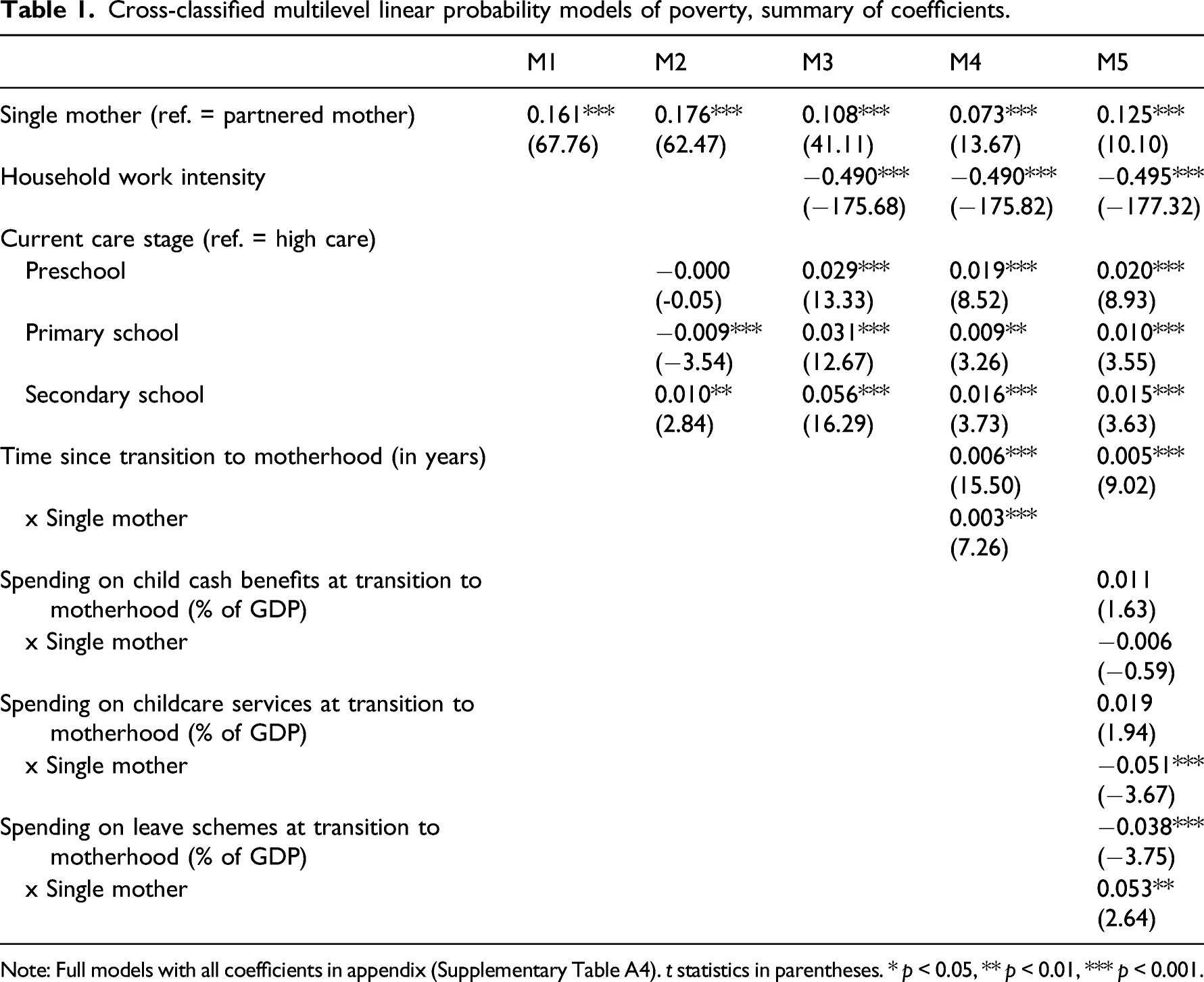
Note: Full models with all coefficients in appendix (Supplementary Table A4). t statistics in parentheses. * p < 0.05, ** p < 0.01, *** p < 0.001.
Mothers’ poverty risk and time since first birth
In the first step, we model the poverty risk of single and partnered mothers, stepwise adjusting for household, social and economic characteristics. Across countries and survey years, single mothers are 16 percentage points (p.p.) more likely to live in poverty than partnered mothers (Table 1, Model 1). Adjusting for household characteristics and for macro-economic and social conditions improves the model fit, but does not explain the poverty gap between single and partnered mothers (Model 2). The current care stage of mothers is relevant: mothers with a youngest child in primary school have a lower probability to be poor compared to mothers with younger children. In contrast, mothers with children in secondary school face an elevated poverty risk. Adding a measure of household work intensity reduces the poverty gap with 33% to 10.8 p.p. (Model 3). A substantial part of the elevated poverty risk of single mothers is related to their lower labour market attachment. The signs of the coefficients of the care stage change as well: controlling for employment reveals that having older children is associated with a higher poverty risk. It appears that higher poverty risks of households with the youngest children reflect their lower labour market attachment. We will return to the issue of reconciling paid work and unpaid care in the next section, which considers childcare services and parental leave policies. Finally, the poverty risk for all mothers increases with time since the transition to parenthood. The longer ago the transition to parenthood occurred, the higher the poverty risk tends to be, ceteris paribus (Model 4). Adding the variable time since transition to parenthood improves the model fit and reduces the poverty gap between single and partnered mothers with another 32%. Importantly, Figure 1 shows that the poverty gap between single mothers and partnered mothers tends to widen over time. Each additional year since the transition to parenthood is associated with a 0.6 p.p. increase in the poverty risk for partnered mothers and a 0.9 p.p. increase for single mothers. Contrary to H1a, and supporting H1b, the poverty risk is higher for mothers later in their lives. The poverty gap between single and partnered mothers increases over time. Predicted probabilities to be poor by timing since first birth. Note: predicted probabilities from Model 4 in Table 1 (full model in Supplementary Table A4 in appendix).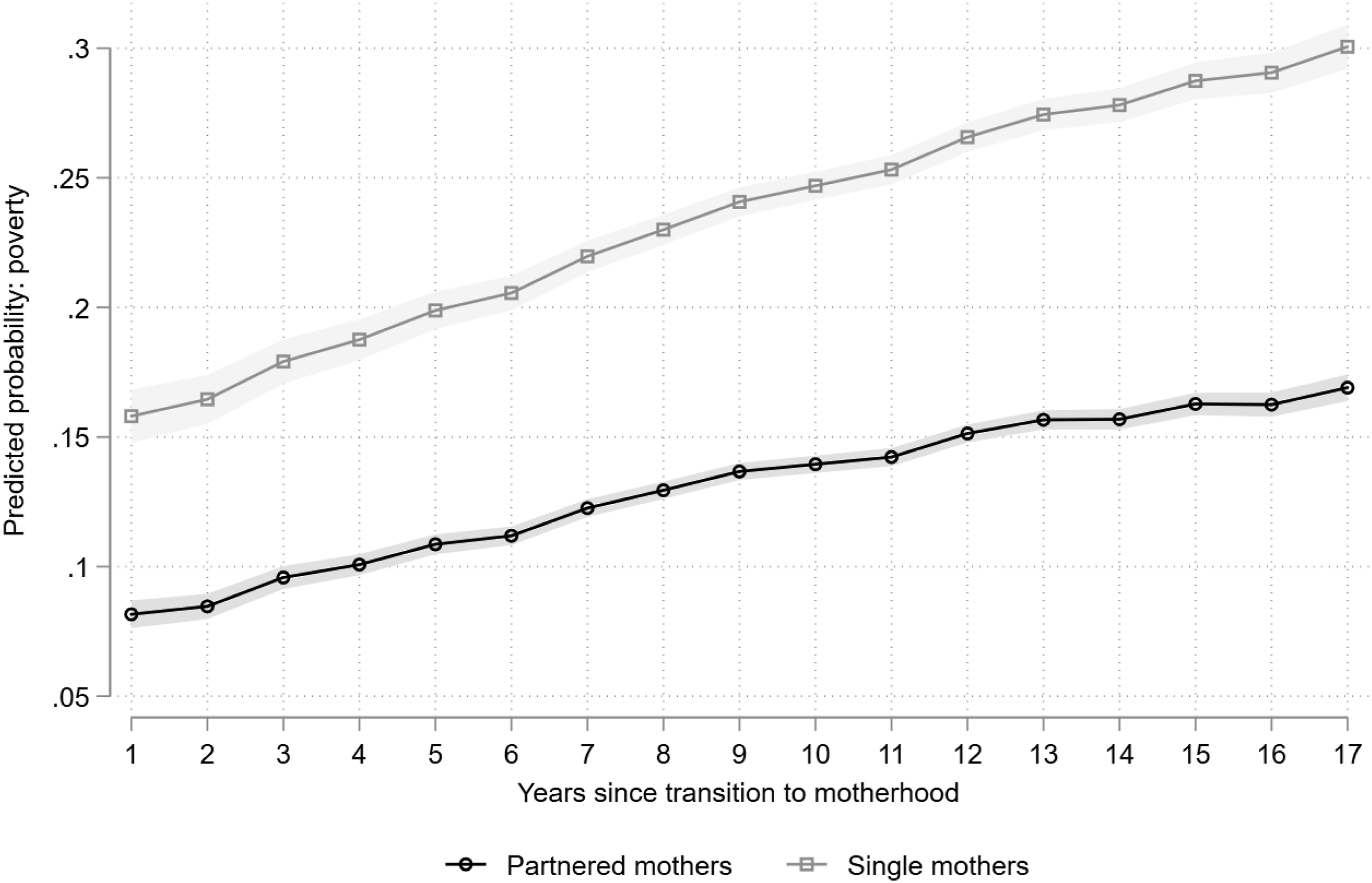
Spending at first birth and mothers’ economic position
This section examines how exposure to family policies at the moment of first birth affects both the poverty risk of mothers and the widening gap between single and partnered mothers over time. In Table 1, Model 5, we test the association between spending on family policies at transition to parenthood and poverty. The interaction effect between spending at transition to parenthood and single motherhood tests whether the association differs for single and partnered mothers. The coefficients are adjusted for household, social and economic characteristics, household work intensity and current spending on the three family policies. For ease of interpretation, the association between spending on family policies in the year of first birth with poverty outcomes today for single and partnered mothers is plotted in Figure 2. Predicted probabilities to be poor by family policy spending at transition to parenthood (% of GDP). Note: predicted probabilities from Model 5 in Table 1 (full model in Supplementary Table A4 in appendix).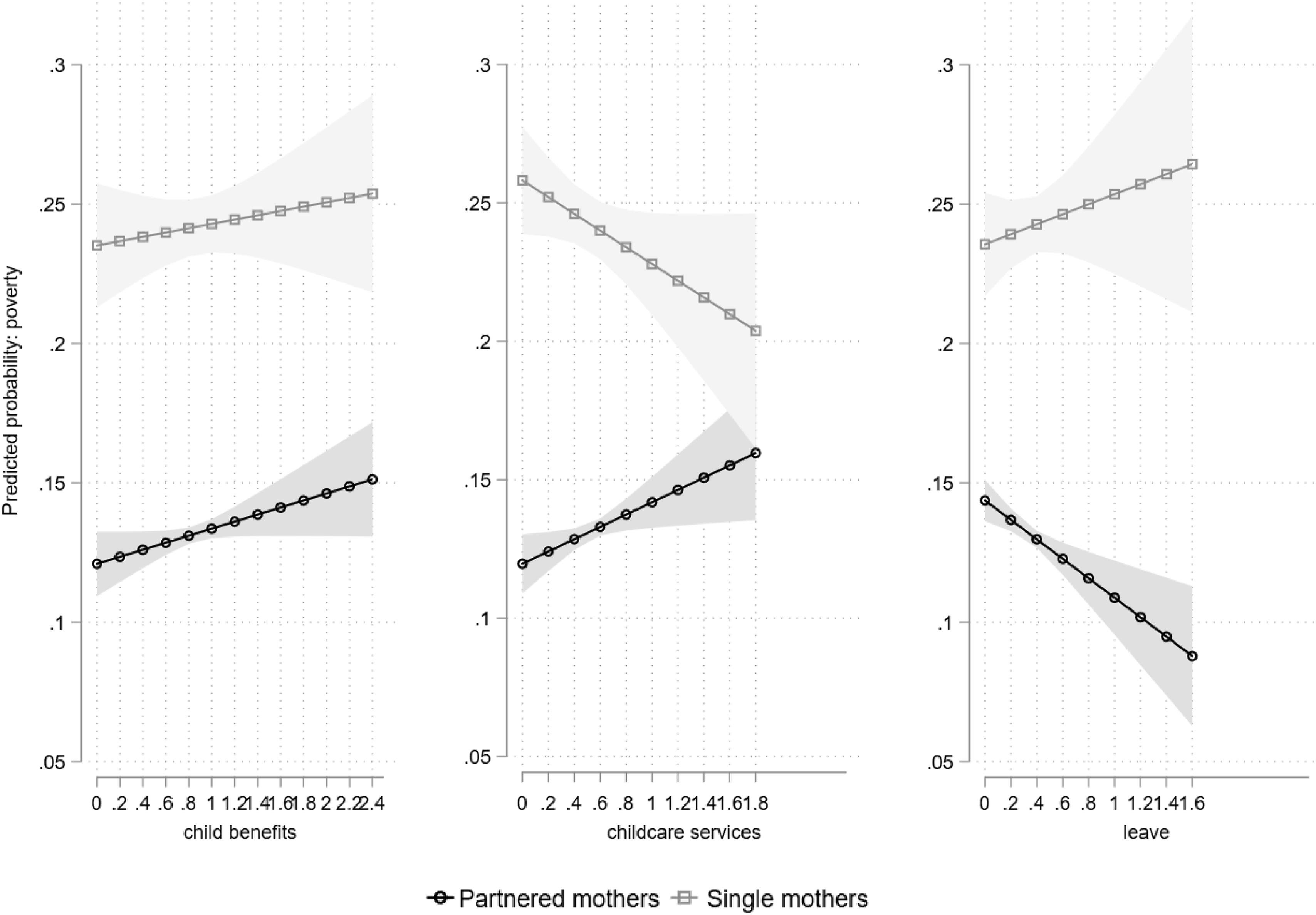
First, the results show that higher spending on child benefits at transition to parenthood is not significantly associated with poverty risks of single and partnered mothers today. The poverty gap between single and partnered mothers is similar in countries with low or high levels of spending on child benefits. We find no evidence for a moderation of later life poverty risk through child benefit spending earlier in life. If anything, the probability to be poor today is a little higher for mothers in countries where spending on child benefits was higher at the transition to parenthood. Second, higher levels of spending on childcare at transition to parenthood are associated with a significant and substantial lower poverty risk for single mothers today. In contrast, the poverty risk for partnered mothers is higher at higher levels of spending on childcare at transition to parenthood. Childcare spending moderates the poverty risk in different ways for single and partnered mothers, and the poverty gap between the two groups closes. Finally, spending on parental leave shows the opposite pattern. High levels of spending on parental leave at transition to parenthood is associated with a significant and substantial lower poverty risk for partnered mothers, while it is associated with a significant and substantial higher poverty risk for single mothers. H2b is hence supported for childcare policies, but only partially for parental leave, where higher spending particularly benefits partnered mothers.
Spending at first birth, timing and mothers’ economic position
In the final step, we test whether the association between spending at first birth and mothers’ poverty risk is moderated by timing since first birth, focusing on differences between single and partnered mothers. This is a more direct test of the principle of intertemporal dependencies.
For assessing the moderating role of time passed since family policy spending at transition to parenthood on poverty outcomes, we introduce three-way interaction terms between each spending measure, single motherhood and time since first birth, also controlling for all household characteristics and macro-level variables at the year of first birth and in the year of the survey. Because three-way interactions are difficult to interpret, Figure 3 displays predicted probabilities for three levels of spending: low (p10), median and high (p90) (see appendix Supplementary Table A5 for full models). Predicted probability to be poor by time since first childbirth (in years) at three levels (p10, median, p90) of family policy spending at transition to parenthood (% of GDP). Note: predicted probabilities based on Model 6, 7 and 8 in Supplementary Table A5 in appendix.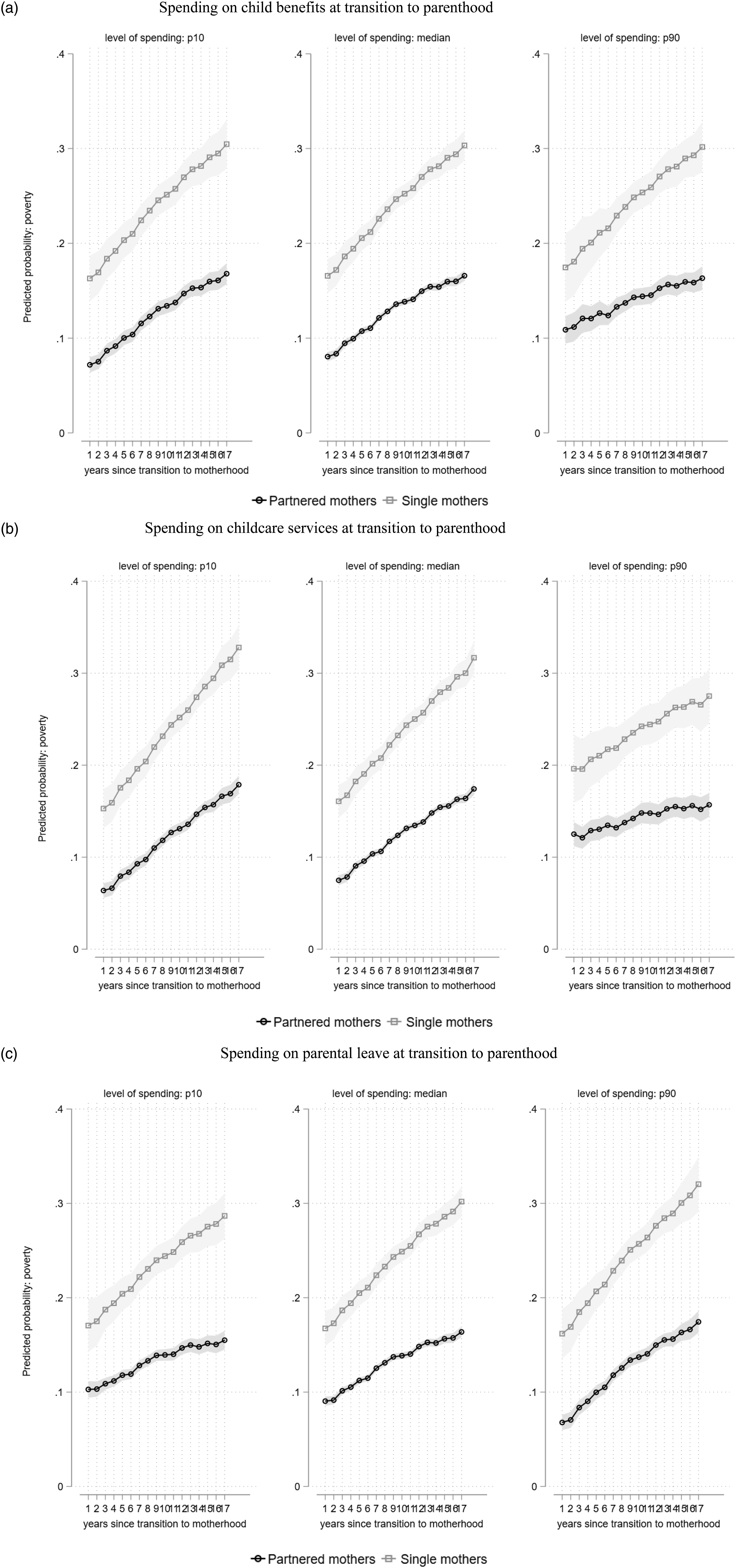
Figure 3 panel A shows that high levels of spending on child benefits at first birth seems to have a small effect on the increasing poverty risk of partnered but not of single mothers. In those contexts, the poverty risk of partnered mothers seems to be higher in the first few years after childbirth compared with lower spending countries. Our results suggest that child benefit spending does not diminish the potential for disadvantages to accumulate over time. These results do not contradict earlier studies on the redistributive effect of child benefits. While such studies usually compare the (counterfactual) poverty risk before to the poverty risk after adding child benefits (e.g. Bäckman and Ferrarini, 2010; Van Lancker et al., 2015), our study tests the association between the poverty risk based on disposable family income including child benefits. This suggests that the end result of the redistributive cycle is not necessarily more favourable in countries with generous child benefits. In fact, our results speak to previous evidence suggesting that child benefits are more important in countries in which child poverty rates are higher to begin with (Van Lancker and Van Mechelen, 2015).
Panel B shows that high spending on childcare does seem to counteract the upward trend in poverty risks by timing since first birth. Low or median levels of spending on the other hand do not counteract rising poverty risks over time. In line with the results presented in the previous section and supporting H2c, the poverty gap between single and partnered mothers is smaller; the trend of upward poverty since the transition to parenthood is more modest. As such, adding a dimension of timing shows that in the long run, childcare spending does matter to moderate long-term poverty risks.
Finally, panel C shows that, contrary to H2c, having a first child in a year and country with high levels of spending on parental leave schemes does not attenuate the gap between single and partnered mothers nor does it attenuate the increasing poverty risk over time. This shows how an assessment of policies is enriched by adopting a life-course perspective, since the results in the previous section suggested a negative association between poverty and spending on leave at transition to parenthood for partnered mothers. Considering timing of policies, the results demonstrate that high spending on parental leave is associated with a lower poverty risk for partnered mothers in the first few years after giving birth. In the longer-run, high spending on parental leave is associated with higher poverty risks for both single and partnered mothers.
Discussion
This article explored the role of family policies provided at the transition to parenthood for single and partnered mothers’ poverty risks across 26 European countries. The starting point was the observation that the links between family policy and mothers’ economic outcomes are widely studied, but we know little about how policies targeting the early family life course moderate later economic positions. This article is an original attempt to apply a life-course lens to comparative family policy analysis.
Our study demonstrates that considering family policies as life-course policies widens our understanding of their effects on families’ economic outcomes. We consider the transition to parenthood as a crucial life stage from which to follow up the development of poverty risks across mothers’ lives and the potential moderating role of family policies. Our initial analysis of how poverty risks develop after the transition to parenthood shows that mothers’ poverty risks increase over time, with elevated risks for single mothers. These findings raise questions about deeply held assumptions of families with young children being more vulnerable than those with older children. Particularly for addressing single mothers, disregarding economic challenges in later life stages seems ill-advised. The findings highlight the significance of intertemporal dependencies. Family events throw a long shadow on economic position by narrowing the corridor of opportunities for mothers to secure their households against poverty.
In order to investigate the role of family policies at the time when mothers had their first child, we considered public spending at this particular life stage. We address the idea that family policies at the transition to parenthood may be able to set the course of poverty risks over time. Our results shed light on the differential benefits of different types of family policies. We find that more generous spending for childcare at first birth primarily helped later single mothers to reduce poverty risks, while leave policies benefited partnered mothers. Generosity for child benefits at the transition to the parenthood life stage was not associated with later poverty risks. This suggests that different types of family policy shape intertemporal dependencies of mothers’ economic positions in particular ways. Leave policies are effective in moderating mothers’ income trajectories, but conditional on a particular (co-residential partner) setting. Childcare policies, on the other hand, appear to have a more equalizing effect between different family settings in the long run. Child benefits have a more immediate bearing on living standards.
Further tapping into the relationships between policy and mothers’ economic position across the life course, we considered the role of time since transition to parenthood. We find that poverty risks of women who made the transition to parenthood in countries with high levels of spending for childcare were increasing less than in lower spending countries. Also, the gap between partnered and single mothers was diminishing over time in contexts of high childcare expenditure. For the other two policies, we did not find these links. One interpretation is that leave policies do not provide leverage for weakening intertemporal dependencies because their conditionality on the labour market status before the transition to parenthood contributes to status maintenance. Our results do lend support to the claim that childcare is a prime example of a social investment policy with returns in later life. In light of temporal interdependencies in women’s life courses, childcare policies seem to be able to disrupt economic path dependencies. This comes with one condition: childcare expenditure needs to be high enough to provide childcare places for all children. It has to be noted that in general, the potential of family policy spending at transition to parenthood to reduce the poverty gap between partnered and single mothers over the course of life seems to be limited. Inequalities associated with intertemporal dependencies are deep-seated and family policies have to be seen as but one element among others for addressing them. One aspect that should be considered more explicitly in future research is the kinds of jobs mothers are able to undertake. They are often characterized by flat wage growth and limited possibilities for upward mobility, locking mothers into low-income trajectories (Nieuwenhuis and Maldonado, 2018a).
Looking forward, we want to note three limitations of our study that future research should aim to address. First, the generalizability of our findings may be limited in that we do not know whether economic positions would be better or worse if the expenditure had not been spent. This question would require a counterfactual framework, which may be possible to implement in future analyses. Second, another limitation of our study design is that we do not consider the social stratification of policy take-up. This means that we are not able to determine effects of inequalities in families’ use of work–family policies. Third, we cannot model the impact of family policy on actual life events such as childbirth and divorce in the lives of mothers, nor of previous income positions. Such approach would require longitudinal data, which is currently not available in a cross-country context over a long period of time. Our multi-country approach and data limit the possibility to truly consider single motherhood in the life course in terms of timing, duration and frequency of the family status. Being able to consider these factors would enable implications of policies and particular life-course dynamics on poverty to be better disentangled. These limitations reflect the starting point for exciting new research avenues that we hope the perspective of the current study has opened. Not least, this article has suggested a way to empirically investigate life-stage specific risks of single mothers compared to partnered mothers and demonstrated that these matter.
Supplemental Material
sj-pdf-1-esp-10.1177_09589287211035690 – Supplemental Material for Family policies’ long-term effects on poverty: a comparative analysis of single and partnered mothers
Supplemental Material, sj-pdf-1-esp-10.1177_09589287211035690 for Family policies’ long-term effects on poverty: a comparative analysis of single and partnered mothers by Hannah Zagel and Wim Van Lancker in Journal of European Social Policy
Footnotes
Declaration of conflicting interests
The author(s) declared no potential conflicts of interest with respect to the research, authorship, and/or publication of this article.
Funding
The author(s) received no financial support for the research, authorship, and/or publication of this article.

Supplementary material
Supplementary material for this article is available online.
References
Supplementary Material
Please find the following supplemental material available below.
For Open Access articles published under a Creative Commons License, all supplemental material carries the same license as the article it is associated with.
For non-Open Access articles published, all supplemental material carries a non-exclusive license, and permission requests for re-use of supplemental material or any part of supplemental material shall be sent directly to the copyright owner as specified in the copyright notice associated with the article.
