




Abstract
Young EU citizens are encouraged to enhance their ‘employability’ by taking advantage of intra-EU mobility, but, for many, moving to another EU country can instead generate disadvantages in the labour market. Drawing on a qualitative study on the experiences of university-educated young Nordics and southern Europeans working in precarious jobs in Brussels, we examine how their access to income support in the context of mobility shapes their access to financial independence. We argue that the variation in European welfare models regarding young peoples’ social entitlements impacts this access in multiple and complex ways. The article advances a tripartite approach that looks at the regulation and enforcement of conditionality of social entitlements on the levels of EU, their country of origin and their country of destination. The analysis shows how, in Belgium, precarious EU migrant citizens are denied access to income support due to the interplay between general welfare conditionality for all claimants and recently reinforced conditionality affecting EU migrant citizens in particular. In these situations, the de-familialising Nordic welfare models showed an aptitude for shielding their young citizens. The young southern Europeans, on the other hand, often had no access to income support in any country, which forced them to choose between family dependency and unfiltered exposure to precarity.
Keywords
Introduction
Young Europeans, with and without educational qualifications, face persistent difficulties in accessing financial independence through secure, full-time, regular and permanent employment (Buchholz et al., 2009). These difficulties have made intra-EU migration increasingly attractive, particularly for university-educated young people who are encouraged to access mobility through various programmes within the EU free movement framework (O’Reilly et al., 2015). However, although these programmes associate mobility with enhanced ‘employability’, moving to another EU country may instead generate further disadvantages in the labour market (Akgü and Beblavý, 2019), challenge young migrants’ financial security, and raise additional barriers to their access to independence.
The two principal ways in which young Europeans can achieve financial independence are by entering paid employment and by accessing social entitlements (Chevalier, 2016: 5). In practice, these two are intertwined, as access to entitlements demonstrably conditions young workers’ transition into and within the labour markets (O’Reilly et al., 2019). European welfare models vary considerably regarding the availability and conditionality of social entitlements meant to support young peoples’ transitions from education to gainful employment (Chevalier, 2016; Knijn, 2012). This article highlights how migration puts young EU citizens under the influence of several welfare models at the same time, making their access to social entitlements contingent not only on the welfare conditionality applied in their destination country, but also on the policies of their countries of origin. The variation between the welfare models can hence impact their access to independence in multiple and complex ways.
The article also draws attention to the institutional interplay between general welfare conditionality, defining the benefit systems of the destination country for all claimants, and specific conditionality affecting EU migrant citizens in particular. The latter issue is especially pressing, since recent policies in various EU countries have reinforced conditionality in EU migrant citizens’ access to social entitlements and even legal residence in ways that are expected to have negative consequences, both on migrants without jobs as well as those in lower-paid and less secure jobs (Dwyer et al., 2019; O’Brien, 2016). When national governments execute such restrictions in relation to EU law regulating EU citizens’ right to enjoy equal treatment in their destination member state, yet another set of conditionalities comes into play. To capture this problematic interplay, our approach considers the three parties that condition EU migrant citizens’ access to social entitlements: the EU, their country of origin and their country of destination.
The empirical section focuses on the experiences of young university-educated EU migrant citizens who moved to Brussels from either southern European (Italy, Spain) or Nordic countries (Denmark, Finland) with hopes of professional advancement, but who ended up living through periods of unemployment and working in precarious arrangements defined by temporariness, insecurity, irregularity and insufficient income. As such, they belong to a group whose ‘atypical’ career pattern represents a risk of insufficient social security coverage and therefore limited welfare access in some policy designs (Bonoli, 2006). We examine how their access to income support shapes their access to financial independence.
The analysis first addresses the barriers that the participants faced in accessing income support in Belgium. We show how these barriers often resulted from the interplay between the welfare and residency administrations that enforced various – complexly interlocked – types and levels of conditionality. The second analysis section adds a third level to the analysis to scrutinise how the welfare arrangement in the participants’ countries of origin further shaped their access to income support when they were unable to access such support in Belgium. We demonstrate how the variations in the arrangements in their respective countries of origin mitigated or exacerbated their dependence on their parents, their partners and/or their further involvement in precarious work. The argument is that domestic welfare systems enabling young peoples’ access to social entitlements are apt to buffer them against precariousness and thus facilitate their access to financial independence in the context of EU migration. In contrast, young migrants originating from countries with familialising welfare models risk being left unprotected and highly exposed to precarious work. The political neglect at the EU level regarding the implications of tripartite conditionality for different groups and individuals thus reinforces the stratification between young EU migrant citizens in terms of precariousness and access to independence.
Tripartite approach to welfare conditionality in the context of EU migration
Most of the literature on EU migrant citizens’ social rights concentrates on the interaction of EU law with national laws and practices in creating differential access to welfare in their destination country (Dwyer et al., 2019; Martinsen et al., 2019; Pennings and Seeleib-Kaiser, 2018; Shutes, 2016). Carmel et al. (2016) and Bruzelius et al. (2017) add a third level to these analyses by highlighting the significance of EU migrant citizens’ portable rights. Bruzelius et al. (2017) argue that the substantive social rights of economically inactive EU migrant citizens’ – in which category they include job seekers and pensioners – are dependent on their ability to export entitlements from their country of origin to that of their destination, especially during the initial phase of their residence. They show how, due to the substantial differences in the generosity of social entitlements in different EU countries, EU migrant citizens’ social rights are stratified according to the economic development and welfare state arrangements both in their country of origin and at their destination. This stratification among EU citizens further creates unequal opportunities for free movement and for settling in another member state. In this article we propose that it is also critical to look at the regulation and enforcement of the conditionality of social entitlements, and that this needs to be done regarding the interplay of (at least) three parties: country of destination, country of origin (and other EU countries where the migrant has lived and worked), and the EU.
The quality of social rights within welfare systems is often measured in terms of the individual’s ability to enjoy an acceptable standard of living independently of market participation (Esping-Andersen, 1991). Evidence shows that the reforms carried out to a varying extent across Europe since the 1990s have reinforced the conditionality of entitlements and added new forms of administrative control over workers and jobseekers, thus escalating the discipline of the market over them (Evers and Guillemard, 2012; Greer, 2016). As Dougan (2016) notes, it can be difficult to distinguish such general reforms from attempts to restrict social entitlements for migrants in particular. Mobile EU citizens’ ambiguous position as ‘migrant citizens’ makes this a particularly challenging task, as their social rights are complexly regulated on multiple and interactive governance sites and levels (Carmel et al., 2016). Indeed, welfare schemes across Europe increasingly emphasise citizens’ responsibility and contributions – as do recent policies towards EU migrants (Evers and Guillemard, 2012; Shutes, 2016). Together with labour market flexibilisation, such ‘workfarist’ policies demonstrably result in an intensification of insecurity for affected groups (Greer, 2016).
Nonetheless, in order to scrutinise the interplay of work-related conditionality increasing on various fronts (Shutes, 2016), we need to analytically separate specific conditionality that affects EU migrant citizens in particular, and general conditionality, which affects all the welfare applicants in migrants’ countries of origin and destination. Clasen and Clegg (2007: 171) usefully distinguish between three types of conditions that operate within contemporary welfare states in governing an individual’s access to social entitlements: conditions related to category, circumstances (i.e. eligibility criteria) and conduct (i.e. behavioural requirements). All these can also come into play when administrative actors determine EU migrants’ status and rights in their destination countries (Dwyer et al., 2019; Shutes, 2016).
Increasing conditionality in EU migrants’ access to social rights
A growing body of literature (Bruzelius, 2019; Dwyer et al., 2019; Jacqueson, 2018; O’Brien, 2016; Shutes, 2016) examines the recent efforts of member states to limit EU migrant citizens’ access to rights. Carmel et al. (2016) set out the plethora of regulatory conditions that must be taken into account if we wish to understand these limitations, including the dynamic interplay between residence conditions, migrants’ employment status and contributions and operational conditions such as procedural requirements and discretion.
Citizenship and residence are the most prominent examples of categorical conditionality, and the member states’ efforts to redefine EU migrant citizens’ status shows how the boundaries of such categories are socially and politically constructed and subject to change (Clasen and Clegg, 2007: 172). Currently, many EU countries are exploiting to the full their ability to produce increasingly restrictive interpretations of the key concepts regulating the access to rights for different categories of EU migrant citizens, and to impose specific, work-related conditions on their access to entitlements, existing in EU law and the case law of the Court of Justice of the European Union (ECJ; O’Brien, 2016; Shutes, 2016). A growing emphasis is placed on legal residence as the key to this access (Bruzelius, 2019).
To be sure, the right to settle in another EU country over 3 months, and thus receive equal treatment with the nationals of the member state, has never been formally unconditional, but is primarily reserved for those who fall within the categories of ‘worker’ or ‘self-employed’ (Directive 2004/38/EC). Also, a ‘family member’ of an EU worker is entitled to equal treatment regarding residence status and rights through the status of a partner. The rights of individuals classified as ‘job seekers’ are, however, subject to additional time limits, eligibility criteria and behavioural requirements related to employment and effective job seeking (Dwyer et al., 2019; Shutes, 2016). 1 Currently, many countries condition EU migrant citizens’ right to reside on the basis of their ability to provide evidence of their self-sufficiency, the stability of their employment, or their ‘genuine’ chances of finding employment (Jacqueson, 2018: 35; O’Brien, 2016). Particularly for many younger workers, providing this type of proof may be excessively difficult given their fragmented employment paths, with blurred boundaries between work, job seeking and inactivity (O’Reilly et al., 2019).
The variation in young people’s entitlements in European welfare states
A comprehensive understanding of young EU migrant citizens’ access to social entitlements presupposes an examination of the particular types of conditionality that shape young people’s social rights across Europe. Criteria related to age are a form of categorical conditionality, and the minimum age required for young people to become independently entitled to social benefits differs between welfare states (Knijn, 2012). Related to this variation, Chevalier (2016: 5–6) argues that the quality of young people’s social rights should be evaluated in terms of their (de-)familialisation effects. Originally developed to refer to the degree to which women were able to provide for themselves regardless of their family status (Saraceno, 2016: 317), this concept has subsequently been applied to young people’s social rights, to measure how their entitlements, or lack thereof, mitigate or exacerbate their dependency on support from their families (Arundel and Lennartz, 2017).
The welfare models in Europe also vary in how loosely or tightly an individual’s eligibility to social entitlement is conditional on contributions made in paid employment or, alternatively, on their degree of financial need (Clasen and Clegg, 2007: 173). In some policy designs, young people’s exposure to unemployment and precarious work, resulting in lack of (continuous) work experience, may fail to provide them access to entitlements due to their insufficient contributions (Madsen et al., 2013). Also, the definition of ‘need’ varies between countries according to perceptions of family obligations to support (Chevalier, 2016). Furthermore, under the influence of the spread of neoliberal workfare ideology, most EU countries have placed increasing emphasis on behavioural requirements, imposing constraints upon different types of benefit recipients through legislation or administrative guidance (Clasen and Clegg, 2007: 174). The most obvious examples are ‘activation’ measures that require unemployment benefit receivers to provide evidence of active job searching and/or participation in training programmes or counselling (Evers and Guillemard, 2012; Greer, 2016: 166). These requirements can target young people under a certain age limit, who need to show particular willingness to improve their ‘employability’ (Knijn, 2012).
Conditionality of income support in five EU countries
The empirical section examines the role of various welfare systems in conditioning young EU migrant citizens’ access to income support (unemployment benefits or social assistance), and cross-national variation in this access. We focus on one destination country (Belgium) and four countries of origin (Denmark, Finland, Italy, Spain), the welfare systems of which differ greatly regarding the availability, generosity and conditionality of support they provide for young people and recent graduates (Chevalier, 2016: 14). This section briefly summarises the conditions of the contributory and non-contributory income support available to under 35-year-olds in these five countries.
As Table 1 shows, the Italian and Spanish systems largely exclude young people from non-contributory benefits, which are oriented towards older people and families. In addition, the extensive requirements for employment hinder workers with short and fragmented experiences from accessing contributory benefits. In contrast, young people in Denmark, Finland and Belgium are eligible to non-contributory benefits, recent graduates have facilitated access to unemployment benefits and the duration of benefits is generally longer. This implies differences in the (de-)familialisation effects of these systems. Analysing the implications of these differences through EU migrant citizens’ lived experiences allows us to illuminate the ways in which migration intervenes in family support relationships, as well as the complexity of migrants’ own actions when confronted by policies of conditionality (Coldron and Ackers, 2009; Ehata and Seeleib-Kaiser, 2017).
Conditions for contributory and non-contributory income support available to under 35-year-olds in five EU countries.
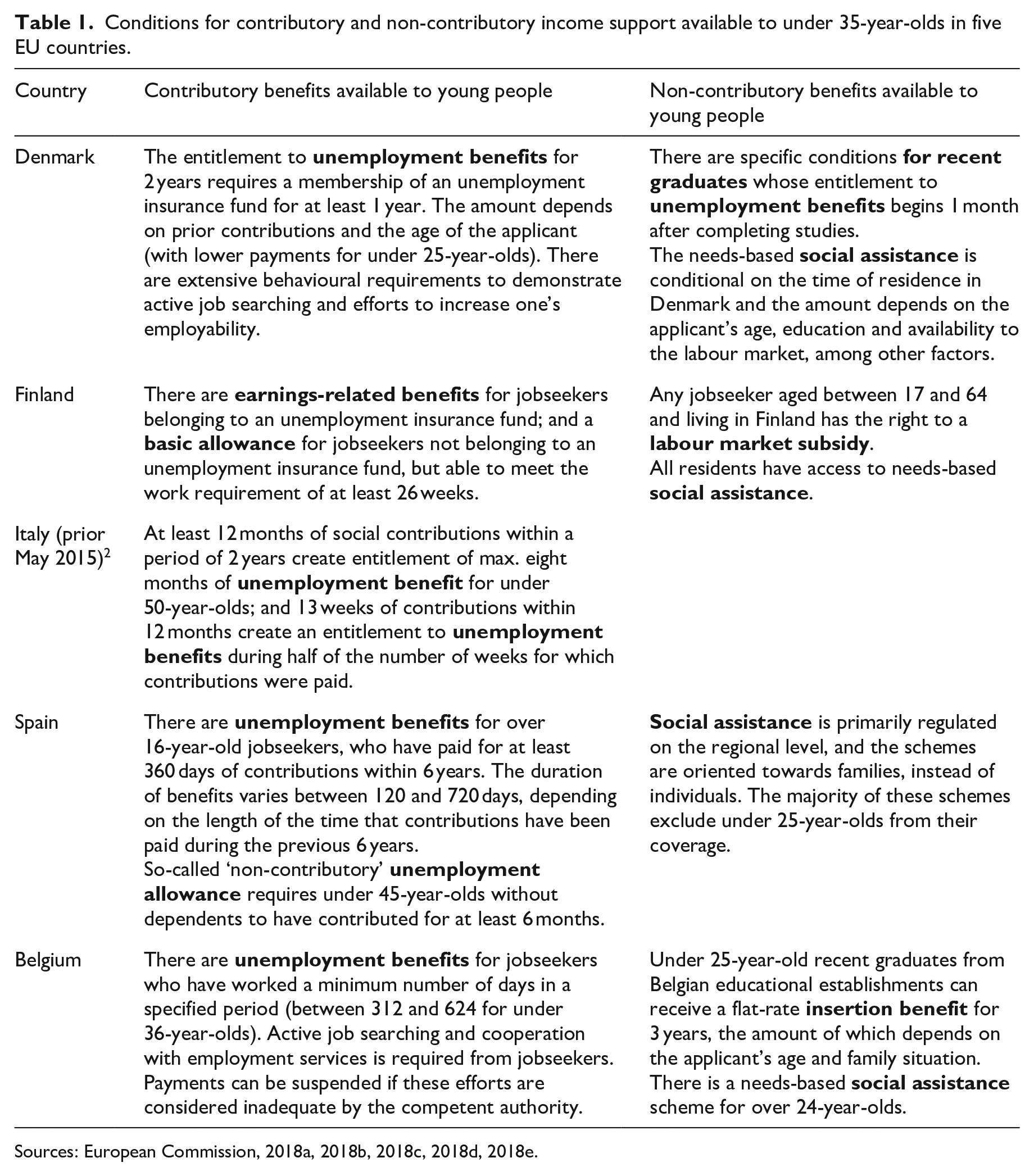
Sources: European Commission, 2018a, 2018b, 2018c, 2018d, 2018e.
Data and methods
The analysis builds on 27 interviews that the first author conducted in 2014 and 2015, the years that Jacqueson (2018: 28) defines as the beginning of the ‘age of limitations’ in EU citizens’ rights of free movement and equal treatment. The participants were university-educated young adults from Italy (10), Spain (eight), Finland (seven) and Denmark (two), who moved to Brussels with the intention to work, but subsequently experienced unemployment at some point during their stay. While the rising conditionality also affects other groups, young, university-educated EU citizens are the group most likely to be using their right to free movement, besides being highly exposed to unemployment and precarious work (O’Reilly et al., 2015). While education generally forms the best protection against precarious employment (Buchholz et al., 2009), focusing specifically on university-educated migrants allows us to observe the impact of being a migrant on their employment position. The international labour market in Brussels draws young, highly qualified workers from all around Europe but its attractiveness also produces intense competition for qualified jobs, making it a demanding environment for workers at an early stage of their careers (EURES, 2018). Belgium is one of the EU countries that have enforced restrictive conditionality on EU migrant citizens’ rights.
All the participants were in their late 20s or early 30s at the time of migration, except two Spanish participants who were under 25. By addressing an age group that extends to 34 years of age, the study seeks to cover both workers entering the labour market from university education, as well as the growing group of young workers who have already entered the labour market but not yet found a secure job (O’Reilly et al., 2019: 11–12). The participants’ gender distribution is balanced and their educational backgrounds represent a range of academic fields, with degrees obtained on Master’s or Doctoral level.
The deeply precarious labour markets in Italy and Spain generally offered very few opportunities for the participants from these countries, which encouraged their mobility, albeit not in a straightforward manner, as some of them had actually left permanent jobs to follow their dreams of an international career (Bartolini et al., 2017). In the Nordic countries, precarious employment is still relatively uncommon by European standards (Madsen et al., 2013), and although also the majority of the Danish and Finnish participants had been in temporary employment or unemployed when they decided to migrate, they generally had more opportunities in their countries of origin.
The participants were mostly recruited through social media, in addition to which snowball sampling was used. The interviews were divided into two sections. The first used the participants’ resumes as research material to invite free but detailed accounts regarding their employment and migration experiences. The second part of the interview was semi-structured: the participants were asked specifying questions concerning their experiences of working life and unemployment, their experiences with local bureaucracies, their awareness of their rights, the problems they faced in obtaining recognition of their rights, their financial subsistence and their future plans and prospects. The languages of the interviews were Spanish, Finnish and English. They were analysed using qualitative content analysis (Mayring, 2000) focusing on the participants’ accounts of (1) conditionality enforcement, (2) their interactions with the welfare system in their countries of origin and (3) the outcomes of the previous two accounts in terms of financial (in)dependence. Pseudonyms are used to ensure the participants’ anonymity.
Conditionality and barriers to young EU migrant citizens’ access to income support in Belgium
Young EU migrant citizens’ encounters with the Belgian welfare state
The majority of the participants lived through periods during which they had insufficient or no revenues, and were factually in need of income support. Many of them had initially arrived in Brussels either for an internship or through the Erasmus student exchange programme, and afterwards decided to look for jobs. Some finished their studies only after arriving in Brussels. While living in Brussels, they had all been in precarious work, ranging from short-term projects, internships, temporary agency work and involuntary self-employment (sometimes false self-employment for a single employer) in highly-skilled sectors, to low-paid and/or ‘on-call’ jobs – often undertaken without written contracts – in sectors such as hospitality and care. For some, their economic difficulties were due to inadequate remuneration (especially those in [a series of] internships), for others underemployment (especially the self-employed and those in ‘on-call’ arrangements), and for yet others because temporal work alternated with shorter or longer periods of unemployment. However, most of those who had made claims for income support in Belgium had been denied access, precisely because their work histories were inconsistent and composed of temporal and irregular arrangements, possibly both in Belgium and in the country where they had lived before their arrival in Brussels, and they thus lacked the contributions required.
In some cases, the unemployment benefits were denied ‘simply’ because the applicant had not met the general eligibility requirements in Belgium regarding the minimum number of work days within a reference period. An example of this is the Spaniard David, married to a Belgian, whose previous 2 years of work experience in Spain did not fall within such a reference period, and whose Belgian work experience, consisting of an internship and temporary job of 5 months, was insufficient to render him eligible.
The Belgian welfare system also poses additional conditions on immigrants. The insertion benefit for recent graduates is limited to persons graduating from Belgian educational establishments (European Commission, 2018e). Furthermore, while EU regulations 883/2004 and 987/2009 grant EU migrant citizens the right to transfer social entitlements and aggregate contributions made in different EU countries, Belgian rulings limit these rights. At the time of this study, access to the Belgian unemployment benefit system was conditional on having at least 1 day of work experience under a Belgian employment contract, the requirement of which was extended to 3 months in 2016. Additionally, since 2012, EU migrant citizens have not had access to social assistance during the first 3 months of their stay, and those categorised as a jobseeker upon arrival do not have access to social assistance as long as they retain this status (Meurens and Van Caeneghem, 2016: 16).
For some participants, their inability to meet the eligibility requirements resulted from these specific conditions imposed on migrants and their interaction with the general eligibility criteria. The requirement of 1 day of work experience under a Belgian contract formed an effective barrier to benefits for those who had adequate work contributions in other countries, but who had worked in Belgium only under foreign or EU contracts, internship contracts or without a written contract, and were therefore unable to aggregate contributions. Matia from Italy, who had a keen interest in working on EU-related issues, left his permanent job in Ireland for a 4-month paid internship in one of the EU institutions. When the internship ended, he found himself unemployed in Brussels: ‘I went to CPES [social services] and they told me I had not lived in Belgium long enough to get anything. And I went to ONEM [employment office] and they told me that I need this famous day of work in Belgium to get unemployment benefits. So, I realized it was better just to find a job that was not in my sector, just to keep going. I basically went to this interim agency and. . .they found me. . .a part-time job with the interim weekly contracts. . .At the same time, I kept applying and then. . .I got a job. . .[with] a one-year internship contract.’
Despite his continuous, year-long work experience in Ireland, Matia could not aggregate his contributions to access unemployment benefits in Belgium, because the welfare authorities did not recognise his EU internship as Belgian work experience. As a recently arrived ‘jobseeker’, Matia was also denied social assistance, forcing him to accept another paid internship contract of 1 year, although the work neither corresponded to his professional interests nor qualified him for unemployment benefits afterwards. This continued exclusion from social entitlements compelled him to take on subsequent temporary contracts for the same employer.
Many research participants described long, uncertain and confusing administrative processes, during which they were required to provide evidence of their work history from different countries (Meurens and Van Caeneghem, 2016: 17–18). As Johanna, from Finland, explains: ‘The advice they give you [at the employment office] is often contradictory. . . So, they told me that the previous officer had been wrong. . .that I should do it differently. I really didn’t know what to do, I had zero money and had to pay my bills and once I just started to cry in there. . . Even after this whole [eight-month] process I still didn’t know if I was entitled to this support or not.’
Even when the unemployment benefit was finally granted, such lengthy and uncertain bureaucratic processes often led to severe financial insecurity.
The interplay between welfare and residency administration
The residency administration forms another determinative site where conditionality is enforced on EU migrant citizens’ rights, with consequences for their access to income support in Belgium. The Brussels Capital Region is composed of 19 communes that administer residence registration under the direction of the Federal immigration office. EU citizens are required to report their presence at local town halls, where it is determined whether they are to be granted a residence certificate with a national registry number, a key identification document required in Belgium for most administrative transactions and access to services.
In 2011, Belgium made a restrictive interpretation of the Residence Directive (2004/38/EC) allowing member states to withdraw the residence permits of EU migrant citizens deemed to represent an ‘unreasonable burden’ on its social assistance system. Data exchange was established between the social security administration and the Belgian immigration office and, subsequently, an unprecedented number of EU citizens received orders to leave Belgian territory (Meurens and Van Caeneghem, 2016: 15). The initial requirements for registration also became more restrictive and conditional on proofs of consistent, paid employment. There is evidence that minimum thresholds regarding hours, remuneration and length of contract have been applied (Meurens and Van Caeneghem, 2016: 18–19; O’Brien et al., 2015), while the present data suggest that the administrative practices have been notably arbitrary and the requirements have differed between municipalities or even between officers (Simola, 2018). Many participants were unable to provide such proofs, and if they sought to register, they were usually classified as ‘job seekers’ but not granted the residence certificate. Several participants were told they had only 3 months to find employment, after which time they would have to leave the country, which contradicts the ECJ requirement of ‘no less than six months’.
Paula came to Brussels from Spain through the Erasmus programme, and her story is evidence of the interplay between the welfare and residency administration in enforcing various types and levels of conditionality. Paula decided to stay in Belgium after her graduation as she saw no professional prospects in Spain. However, she had difficulties in getting her professional diploma recognised. This process lasted several years, partly because Paula had problems paying for the administrative handling. She thus attempted to access the professional insertion benefit, aimed at buffering the finances of recent graduates in Belgium. However, although she belonged to the targeted age category (under 25-year-olds) and was able to demonstrate the extensive job searching that is required within this scheme, she was deemed ineligible as she had not graduated from a Belgian university. Instead, she was accused of abusing the system: ‘I was innocent enough to think that maybe, if I get positive evaluation [of the job search requirements], I could be entitled to something. But no, they even called me a “social parasite” [at the employment office]. . . It seems to me that the European Union is pulling my leg. You come here and there isn’t any kind of help for young people. I mean I just finished studying. How do they think I’ll survive?’
Paula survived on low-paid, short-term and ‘on-call’ jobs, mostly without written contracts, in the service and care sectors, and by teaching language classes. However, when she attempted to register at the city hall, an officer predicated that her work experience and job search efforts failed to form a basis for residency in the country: ‘I never had a contract longer than three months and that was not good enough. I had to go and ask, and they were telling me different things. Then when I returned [to the city hall] they gave me a paper saying, “If by this and this date you haven’t found work, expulsion from the Belgian territory.” And then I didn’t return.’
Belgian authorities have not released any information regarding the exact conditions under which Belgium enforces expulsions of EU citizens. Nevertheless, most of the participants whose employers refused to award written contracts or who worked in short and/or unremunerated arrangements knew that they could face difficulties if they were to approach the residence or welfare authorities. Thus, many of them had not sought to register because they were uncertain and concerned about the consequences. The effects of not registering, however, resembled the ‘administrative death’ that has been the real consequence of the actual expulsions, and formed an equally effective barrier to their access to social entitlements (Meurens and Van Caeneghem, 2016: 41; Simola, 2018).
Young EU migrant citizens’ access to financial independence in conditions of precarious work
The accentuated role of the welfare policies in the countries of origin
The data shows how the barriers confronted in obtaining access to income support in Belgium accentuated the importance of the policies in young migrants’ countries of origin, which conditioned their ability to draw on their domestic welfare systems while living abroad. In this respect, a critical difference appeared: in these situations, de-familialising welfare policies in the Nordic countries (Chevalier, 2016) showed aptitude in shielding their young citizens to some extent, as they were normally able to access contributory and/or non-contributory benefits. By contrast, the lack of access to such benefits for young people in Italy and Spain resulted in the young migrants not being entitled to income support in any country.
For example, Line was a recent graduate at the time she moved to Brussels, and therefore entitled to unemployment benefits in Denmark. She used her right to transfer these benefits to Belgium for her initial 3-month period of job searching, during which she found a job with a Belgian employer. However, in order to avoid the legal obligation to provide Line with an open-ended contract, her employer required her to take a 1-month break between her temporary contracts every 6 months. The employment authorities deemed Line’s employment period in Belgium insufficient for entitlement to unemployment benefits. During her first unemployment period, Line lived on her savings. Having learned from her previous experience, when the situation repeated itself after another 6 months Line decided to return temporarily to Denmark and register with the unemployment system so that she could receive benefits. Consequently, she also became subject to measures that obligated her to search actively for a job, thanks to which she found a new job in Belgium with an open-ended contract. Hence, Line was able to rely on the Danish welfare system at different points in her employment path, which significantly eased the insecurity related to her initial experience in the Belgian labour market.
Some of the Nordics, in fact, perceived their domestic welfare system as their primary safety net, and did not even try to engage with the Belgian system but instead returned to their countries of origin when they lost their jobs in Belgium (see Ehata and Seeleib-Kaiser, 2017). These decisions were also facilitated by the fact that the labour markets in these Nordic countries were perceived as offering more and better opportunities for young workers. Some others relied on their domestic unemployment benefits to be able to return to Belgium to search for new employment.
In contrast, the southern European participants, whose domestic work experiences were often entirely composed of internships, nonstandard temporal employment, and/or informal work, usually had no entitlement to unemployment benefits within their domestic welfare systems and were therefore unable to transfer benefits for the initial period of their stay. In most cases they had neither domestic work contributions to aggregate, nor access to unemployment benefits or minimum income support if they decided to return (Bruzelius et al., 2017). The few participants who had prior entitlement to unemployment benefits had exhausted the limited coverage period before they moved to Belgium.
Regarding labour market position, these disparities were reflected in the fact that none of the Nordic participants undertook work that was completely irrelevant to their education, even under precarious work arrangements. Their southern European peers instead often held multiple jobs in parallel, sometimes combining unpaid professional work with low-skilled ‘bread-and-butter’ jobs that nevertheless left them without an adequate income and highly dependent on private support.
The controversial role of family support: Between dependency and unfiltered exposure to precarity
The social backgrounds of the participants’ parents were not systematically solicited in the study, but the interviews indicate that there was significant variation among the participants’ parents, who ranged from working-class pensioners to affluent functionaries. As Saraceno (2016: 317–320) notes, in the southern European welfare states, the parents’ responsibility for adult children is not only a matter of legal obligation, it is also created through the absence of alternatives. Within this region, protracted dependence on parents has become the most common manner of coping with the risks that young people face in the labour market, whereas in the Nordic countries welfare state institutions are expected to buffer young people against such risks (Arundel and Lennartz, 2017). When experiencing low or no income, or delayed or denied access to social protection in Belgium, even the young Nordics were often forced to turn to their parents for financial support. However, long-lasting parental dependence was unusual and mitigated for them, particularly because of their wider options for relying on their domestic welfare systems or returning to their domestic labour markets.
For many of the Italian and Spanish participants, how much their parents were able to support them became one of the most important determinants of their financial security during migration. However, some of them explained that they were unwilling or unable to ask their parents for money, because of the financial strain their parents were under. To illustrate the complexity of familial interdependencies in the mobility context, we further examine Paula’s situation. Her parents relied financially on a subvention that was conditional on Paula, who was less than 25 years old, officially living in the family home in Spain. In the interview, she recounted how she had unintentionally de-inscribed her residence in Spain, with dramatic consequences for her family’s overall subsistence: ‘I got inscribed [in the Spanish consulate] [to] vote in the next elections. . . Problem: my mother called me asking, “What has happened?” Because they give her a little subvention since she’s unable to work. And together with my father’s [pension] they reach €400 per month. . . But I inscribed myself in [Belgium]. . .and they cut me off from the social security system in Spain, and I no longer was registered as resident in my home village. . . And I had to buy a plane ticket to Spain and run to re-inscribe me there so that my mother could apply for the subvention again. Because if not, very messed up situation for the whole family.’
Paula’s account not only illuminates how the participants sometimes felt forced to mislead the authorities in order to secure their own subsistence or that of their families (Coldron and Ackers, 2009). It also highlights the disparities between young migrants from different social backgrounds according to the resources of their families, which is reinforced by the policies of welfare conditionality.
Indeed, the parents of the southern European participants were sometimes only able to offer their children the possibility of returning home and being part of the family household (see Arundel and Lennartz, 2017). In practice, many of these children – and some of the Nordic participants – returned to their parents during a period of unemployment, often intending to return to Brussels when new job opportunities arose or to continue their job search. However, even in the southern European countries, very late home-leaving has become increasingly stigmatised (O’Reilly et al., 2015: 8) and the expectations related to mobility as a route to financial independence seemed to reinforce the sense of failure associated with ‘boomeranging’. In fact, many of the Italian and Spanish participants had initially made the decision to migrate at least partly to be able to move out of their parental home, and did not view returning as an option. Their reluctance to return was closely connected to the bleak outlook in their domestic labour markets (Bartolini et al., 2017). For instance, Marta had looked intensively for work in a field in which Italy offered her no opportunities. She did not register her residence in Brussels, where her subsistence was based on her minimal savings from a previous EU-funded internship grant.
‘I still have money for two months now. After that I don’t know. . . My mum asked me to come [home] right after. I said yeah yeah. I don’t want to go back. No no. . . Now I’m looking for even a part-time job in a restaurant. I don’t really care.’
With returning home a dead end, participants like Marta were forced to accept minimal incomes, living with friends or in cohabiting arrangements and settling for any work regardless of its conditions or content. Overall, the southern welfare model, in which family cohabiting arrangements are a principal means of support (Knijn, 2012), was little able to buffer the young workers from these countries against precarity in their destination country.
Financial and legal dependency on partners
In addition to parental dependence, we found another link between conditionality and familialisation that concerns both Southern European and Nordic participants and both men and women. While the research participants all sought employment in Brussels, for some an additional motivation for moving and staying there was their relationship with a Belgian person or with a person working in Belgium. After the move, they often became financially dependent on their partners to some degree. Working under precarious arrangements – with inadequate income and social protection contributions – did not remove such reliance. These situations appeared to be discordant with the participants’ expectations. Indeed, their involuntary statuses as ‘kept’ partners in their intimate relationships caused severe strain, at least for their own self-understandings. For instance, Lucia had ended up in a false self-employed relationship with a Spanish employer that provided inadequate income for Belgian conditions: ‘With my own salary I could not have survived. . . It’s very hard to think that any moment, if something happens, you see yourself completely unprotected. . . You work so hard and have your own business name and you’re still there like a parasite. . .depending on another person like when you were living with mummy and daddy.’
The data further confirms the observation of previous studies that there are major vulnerabilities in the familialised socio-legal position of ‘family member’ under EU law (Ackers, 2004; Shutes and Walker, 2018). The lack of individual social rights enforced breadwinner roles on intimate relationships with their associated risks, and in this study the relationship status was also critical in EU migrant citizens’ increasingly conditional access to legal residency. While some participants were unable to meet the eligibility requirements for residency independently, they held rights derived from their partners. As this was only possible if their partners were legally residing in Belgium and formally recognised through marriage or legal co-habitancy, a few of them actually formalised their relationships after their right to residence in Belgium had been questioned by the administration. However, even if participants were able to rely on their partners to alleviate their financial and legal insecurity, this did not fundamentally remove the insecurity.
Conclusion
We have examined how the interlocking conditionalities in mobile EU citizens’ access to income support play out on the level of young EU migrant citizens’ lives. The analysis offers important insights regarding the limitations of the EU’s legal framework in guaranteeing the social rights and protections of workers exposed to precarious work. We further show how this EU-level neglect leaves room for restrictive, protectionist national rulings and administrative practices, adding to the vulnerabilities of precarious migrant workers, for instance through socio-legal dependency on their better-off partners. Such dependency is particularly problematic for young people whose relationships can be expected to be relatively new and whose partners may themselves experience precarity.
We further argue that the variation in European welfare models regarding young peoples’ social entitlements impacts young EU migrant citizens’ access to independence in multiple and complex ways. Applying the tripartite approach to conditionality, we show how the welfare policies in the country of origin not only influence their access to income support through EU regulations on social security portability (Bruzelius et al., 2017; Carmel et al., 2016). When denied access to support in the destination country, EU migrant citizens may be forced to apply other strategies to secure their subsistence – or that of their families, including temporal returns to the country of origin to gain access to residence-based income support. In this study, the ability to formally and legally juggle between the systems was available only to those with access to income support back home, thus particularly for the participants from the Nordic countries where de-familialising welfare models prevail. In contrast, the young southern Europeans were more often forced to deploy informal strategies and bypass registration procedures to avoid the threat of a more fundamental withdrawal of their rights.
These disparities point to a stratification of young EU citizens’ opportunities to use free mobility to achieve financial independence. The restrictive conditionality imposed on EU migrant citizens, along with ‘workfarist’ welfare policies more generally, has augmented labour market discipline over young southern Europeans in particular, increasing their exposure to precarious work and therefore hindering their attempts to achieve self-sufficient incomes. To be sure, the southern European participants could have faced similar obstacles even if they had never migrated. However, their vulnerability appeared accentuated in the context of mobility, where their reluctance and/or inability to depend on their geographically distant families often left them directly exposed to the whims of the labour market.
Footnotes
Acknowledgements
We would like to thank the editor, two anonymous referees, Camilla Nordberg, Lena Näre and Roberta Perna for valuable comments on previous versions of this article.
Funding
The author(s) disclosed receipt of the following financial support for the research, authorship and/or publication of this article: This work was supported by Centre of Excellence for Research on Ageing and Care (RG 3 Migration, Care and Ageing, [grant numbers #312310; #336669]; Academy of Finland project ‘Citizenisation in the Local Welfare State’ [grant number 1273392]; Palkansaajasäätiö and the Faculty of Social Sciences, University of Helsinki.