



Abstract
This article puts contemporary debates about the relationship between immigration policy and the welfare state in historical perspective. Relying on new historical data, the article examines the relationship between immigration policy and social policy in Western Europe in the late 19th and early 20th centuries, when the modern welfare state emerged. Germany already had comparably strict immigration policies when the German Empire introduced the world’s first national social insurances in the 1880s. Denmark, another early social-policy adopter, also pursued restrictive immigration policies early on. Almost all other countries in Western Europe started out with more liberal immigration policies than Germany’s and Denmark’s, but then adopted more restrictive immigration policies and more generous social policies concurrently. There are two exceptions, Belgium and Italy, which are discussed in the article.
Keywords
The relationship between immigration policy and the welfare state is contested: some scholars, notably Freeman (1986), argue that generous social policies are incompatible with openness to immigration, while others disagree (see, for example, Sainsbury, 2012). Relying on new historical data, including original data compiled for this article, we put these contemporary debates in historical perspective by examining the relationship between immigration policy and social policy in Western Europe in the late 19th and early 20th centuries, when the modern welfare state emerged.
Concentrating on the 40-year period between 1880 and 1920, we wish to determine if immigration policies became more restrictive when social policies became more generous. We follow 10 Western European countries, studying the relationship between immigration policy and social policy, which is measured in terms of programme coverage, the number of programmes and the level of social spending. We do not treat the relationship between immigration policy and social policy as one of cause and effect. Since immigration policy and social policy are determined jointly in a political decision-making process, estimating the causal effect of one on the other seems futile to us, at least with the data we have available. 1 But we do present some preliminary explanations for our main findings.
These findings can be summarized as follows: (1) When the German Empire introduced the world’s first national social insurances in the 1880s, Germany already had more restrictive immigration policies than all other countries in Western Europe. Denmark, another early social-policy adopter, also pursued restrictive immigration policies early on. These two countries did not tighten their immigration policies further as they expanded their welfare states, but they remained more restrictive than other countries at least until the 1910s. (2) Almost all other countries in Western Europe started out with more liberal immigration policies than Germany’s and Denmark’s, but then adopted more restrictive immigration policies and more generous social policies concurrently. (3) There are two exceptions: Italy and Belgium, which did not adopt more restrictive immigration policies and more generous social policies concurrently before 1920. The Italian exception has a straightforward explanation: emigration, not immigration, was the main concern in Italy in the early 20th century. The Belgian case is more puzzling, but it should be noted that Belgium introduced much more restrictive immigration policies in the early to mid-1920s, just after the period we investigate.
It would be wrong to conclude from this evidence that generous social policies are necessarily incompatible with liberal immigration policies. In the late 20th century, countries with large welfare states in fact admitted more refugees per capita than countries with small welfare states (Boräng, 2015), so generous social policies have not always been combined with restrictive immigration policies – at least not when it comes to forced migration (a category of migration that was less clearly distinguished from labour migration in the period we examine than it is today). But when national social rights were first defined, in the late 19th and early 20th centuries, most Western European states either made it more difficult for immigrants to enter their territories or restricted the rights of resident migrants, or both.
National rights and international migration
In the last few decades before the start of the First World War, the modern welfare state, structured around social insurances, emerged in Western Europe. Before that time, in the poor-relief era, social policies were typically administered locally under broad enabling legislation (the ‘poor laws’). When social insurances were introduced, these patchworks of locally administered poor relief were superseded by more uniform national social programmes. 2
This shift in the locus of authority from the local to the national level is not the only difference between poor relief and social insurance. Unlike poor relief, social insurances are not means-tested: all those who qualify, through contributions or citizenship, have a right to support when they grow old, get ill or become unemployed. Moreover, whereas the recipients of poor relief were often removed from society, the beneficiaries of social insurances were not – indeed, one of the main points of social insurance is to enable the old, the sick and the unemployed to maintain their status in society.
For our purposes, however, it is the national character of social insurance that matters most, since the nationalization of social policy made the distinction between citizens and foreigners much more important than before (Caestecker, 2003: 131–132; Fahrmeir et al., 2003: 6; Torpey, 2003: 83). After the creation of the modern welfare state, membership in a national community came with social rights in many cases as a result of political demands from newly enfranchised national electorates (Esping-Andersen, 1990; Huber and Stephens, 2001; Korpi, 1983). Before the development of the modern welfare state, nation states had been relatively indifferent to foreigners; when national social policies became more generous, political decision-makers began to perceive immigrants as potentially costly recipients of transfers and services (Lucassen, 2003: 188). 3
There is a large scholarly literature on the relationship between immigration policy and the welfare state in the period after the Second World War. One prominent idea in this literature is the ‘welfare chauvinism hypothesis’, according to which immigration policy is more restrictive in countries with more generous welfare states. 4
The welfare chauvinism hypothesis comes in two forms, for states do not only decide who may or may not enter the country, but they also decide which rights immigrants enjoy once they have entered. Following Tomas Hammar, we can make a distinction between two main dimensions of immigration policy: admission policy, which concerns ‘the rules and procedures governing the selection and admission of foreign citizens’, and rights policy, ‘the conditions provided to resident immigrants’, with respect to, for instance, schooling, housing, labour-market participation and naturalization. Hammar referred to these dimensions as ‘immigration regulation’ and ‘immigrant policy’, but we find ‘admission policy’ and ‘rights policy’ more to the point. Within the second category, it is possible to make a further distinction between the procedures of naturalization and the rights of immigrants – the first is about the conditions for acquiring citizenship, and the second is about the rights of non-citizens (Hammar, 1985: 7–9).
The two main forms of the welfare chauvinism hypothesis are related to these two dimensions of immigration policy. According to the first version, countries with generous welfare states tend to have more restrictive and selective admission policies. According to the second version, countries with generous welfare states tend to have more restrictive rights policies. We refer to these two versions of the welfare chauvinism hypothesis as the ‘external exclusion hypothesis’ and the ‘internal exclusion hypothesis’.
Immigration laws can be differentiated further. For example, some laws exclude particular ethnic groups or countries of origin (such as the Chinese Exclusion Act, adopted by the United States Congress in 1882). Other laws exclude on economic grounds, encouraging the immigration of scarce labour but discouraging the immigration of paupers (such laws have been on the books in most countries). Some groups have been perceived as unwanted for both ethnic and economic reasons, resulting in laws that excluded certain migrants on both accounts (as in the case of Sweden’s exclusion of the Roma in 1914).
The welfare chauvinism hypothesis is debated in the literature. Some scholars in fact defend the view that welfare-state institutions counteract external and internal exclusions. Boräng (2015) has argued that welfare-state institutions foster the view that states should protect all individuals, including non-citizens. Guiraudon (2002) has argued that welfare-state institutions have improved the social integration of immigrants due to their inclusionary and non-discriminatory logics (see also Banting and Kymlicka, 2006; Crepaz, 2008), and Sainsbury (2012) has demonstrated empirically that countries with especially generous welfare states have extended more rights to immigrants than others.
But our main expectation is that the welfare chauvinism hypothesis holds for the particular period we examine: the late 19th and early 20th centuries. The reason is that the countervailing forces we discussed in the previous paragraph – the mitigation of distributional conflicts, the widening of social solidarity and the inclusionary logic of broad social-policy programmes – were weak when welfare states emerged. While citizens were still unaccustomed to the social protection offered by the welfare state, distributional conflicts are likely to have been more divisive, and social solidarity more limited, than in the post-war period.
Research design and data
Our method is comparative and historical. For a long time, single-country case studies and small-n comparisons were the preferred methods in empirical studies of immigration policy. Only recently, a new generation of studies based on large-n comparisons has emerged (Beine et al., 2015; Bjerre et al., 2013; Han, 2015; Koopmans et al., 2012; Peters, 2015; Wong, 2015). But these studies overwhelmingly concern recent decades. The period before the Second World War has been the preserve of historians, economic historians and historical sociologists, who have usually focused on only one country or locality, and who have often concentrated on one particular aspect of immigration policy, such as passport requirements (Fahrmeir et al., 2003; Robertson, 2010; Torpey, 2000). A small number of studies, especially from recent years, approach the topic from a comparative and historical perspective (FitzGerald and Cook-Martín, 2014; Peters, 2015; Shin, 2017; Timmer and Williamson, 1998). It is to this line of scholarship we wish to contribute. We are not aware of any previous cross-country comparative studies of the relationship between immigration policy and social policy in the late 19th and early 20th centuries.
Our study includes 10 Western European countries – Belgium, Denmark, France, Germany, Italy, the Netherlands, Norway, Sweden, Switzerland and the United Kingdom – and covers the period between 1880 and 1920. We begin with the introduction of the first social insurance programmes in the German Empire in the 1880s, and we end with the immediate aftermath of the First World War. The countries in our sample are included in most broad, comparative studies of the development of the welfare state in Western Europe (see, for example, Flora et al., 1983). We do not include Finland and Ireland, both of which became independent during or after the First World War. We also exclude the Austrian Empire.
Through a pioneering effort, Margaret Peters (2015) has made available data on immigration policies in a large number of countries, going back to the French Revolution. Most of the countries in Peters’ dataset are non-European, however, which makes it difficult to match her data on immigration policies with available data on the early development of the welfare state. We, therefore, combine Peters’ data with our own data on five Western European countries that are not covered in her dataset: Belgium, Denmark, Italy, Norway and Sweden. We have endeavoured to follow Peters’ coding conventions for all variables (we provide more details about the coding in the Supplemental Appendix).
Our main measure of immigration policy relies on seven separate indicators: (1) Universality by Nationality ranges from 1 (few or no nationalities allowed in) to 5 (all nationalities treated equally), (2) Universality by Skill or Income ranges from 1 (only very highly skilled workers are let in) to 5 (no skill restrictions), (3) Enforcement ranges from 1 (high spending on enforcement, severe sanctions and effective identification regime) to 5 (only basic police enforcement), (4) Citizenship ranges from 1 (citizenship only given through birth) to 5 (citizenship given to all children born in the state, naturalization is easy), (5) Immigrant Rights ranges from 1 (few legal rights) to 5 (parity to citizens), (6) Work Prohibitions ranges from 1 (immigrants not allowed in any industry) to 5 (only highly sensitive national-security positions restricted) and (7) Deportation ranges from 1 (many deportable offences, few administrative or judicial safeguards) to 5 (few deportable offences, clear judicial checks). Indicators I–III measure different aspects of admission policy, whereas indicators IV–VII measure different aspects of rights policy.
With no strong theory to guide the aggregation of these indicators, we have opted for a simple additive index (deriving an index from a factor analysis, as Peters does, yields substantively similar results). In Peters’ original dataset, low scores represent restrictive policies, whereas high scores represent liberal, or open, policies. We reverse the scale, so our measure of immigration policy ranges from 0 (very few restrictions on immigration, naturalization and rights) to 1 (very many restrictions).
The other main variable in our analysis is the average coverage rate of the four main social insurance programmes: occupational injury insurance, health insurance, pensions and unemployment insurance. The measure that we use in our study represents the average percentage of the labour force that was covered by these four social insurances (the sources are Alber, 1982; Flora et al., 1983). Following the analysis of the coverage rate, we also analyse the relationship between immigration policy and two other measures of the scope of the early welfare state: on the one hand, data on the sheer number of social insurance programmes introduced in each country from Rasmussen (2016), and on the other hand, data on social spending from Lindert (2004).
We end our analysis by discussing a few countries in greater depth. Two of the countries, Britain and Sweden, adopted stricter immigration policies and more generous social policies concurrently and thus exemplify the main pattern identified in the article. Two of the countries, Denmark and Germany, adopted strict immigration policies early on. The two last countries, Belgium and Italy, did not adopt stricter immigration policies and more generous social policies concurrently, and we wish to explain why. These final parts of the article draw on the literature we consulted when we compiled our quantitative data on immigration policy, and on other country-specific historical studies.
Main findings
As we mentioned in the previous section, we use three different types of data on social policies, which we match with our data on national immigration policies. We begin with social insurance coverage. In Figure 1, the x-axis represents the proportion of the working population that was covered, on average, by each country’s systems of occupational-injury insurance, health insurance, pensions and unemployment insurance, whereas the y-axis represents our combined measure of immigration policy. The last observation for each country, which is labelled with the country’s name, represents the year 1920. The first observation for each country (the start of each arrow) represents the year 1880.
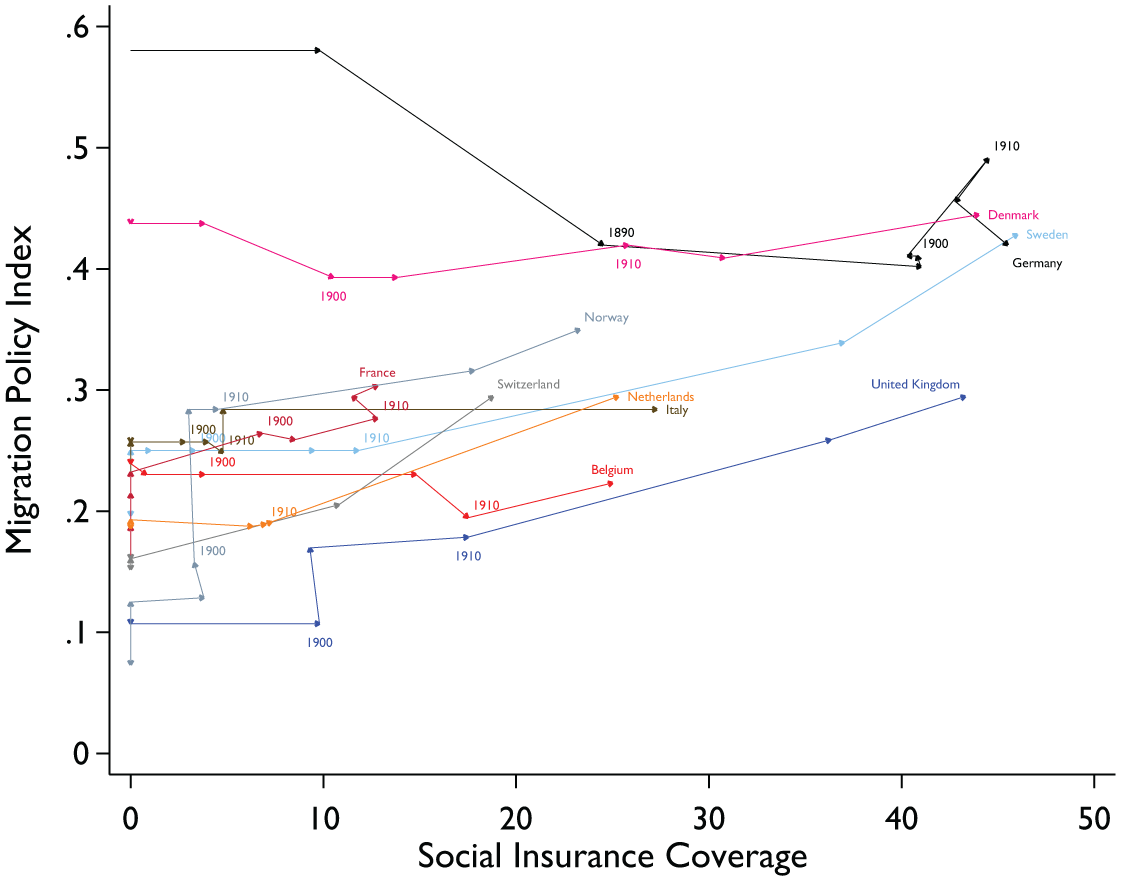
Social insurance coverage and immigration policy, 1880–1920.
The first thing to note is that Denmark and Germany, the two countries that expanded social insurance coverage the most between 1880 and 1910, had more restrictive immigration policies than other countries in Western Europe already in the year 1880. All other countries start out in the southwestern corner of the figure – with no social insurance coverage, few restrictions on immigration and few distinctions between the rights of citizens and the rights of migrants. Denmark and Germany do not start out in the southwestern corner of the figure: they start further up, as they introduce social insurances earlier. In these two countries, the expansion of the welfare state did not lead to a further tightening of immigration policies, but both countries remained more restrictive than the other countries in our sample until the end of the period we study.
Most of the other countries started out with liberal, or unregulated, immigration policies but adopted more restrictive policies as their welfare states expanded. France, the Netherlands, Norway, Sweden, Switzerland and the United Kingdom all fit this pattern. A closer look at the data reveals that immigration policy developments in these countries were not uniform, however, for some countries introduced internal exclusions while others introduced external exclusions. France restricted the rights of resident migrants while keeping the border relatively open. Switzerland did the opposite, introducing stricter admission regulations while only marginally limiting the rights of resident migrants. The Netherlands, Norway, Sweden and the United Kingdom did a little of both.
Belgium and Italy are the two exceptions: they did not make their migration policies significantly more restrictive as they expanded their welfare states before 1920. We will have more to say about these exceptions below.
Before we proceed to a discussion of individual countries, however, we would like to discuss some additional evidence on the nature and scope of the emerging welfare states in Western Europe in the period we consider, demonstrating that our findings are not specific to the measure of coverage we use in our main analysis.
One alternative approach is to simply count the number of social insurance programmes that had been introduced in each country. Using data on the introduction of social insurance programmes from Rasmussen (2016) – which do not only include occupational-injury insurance, health insurance, pensions and unemployment insurance but also maternity benefits – Table 1 describes the mean level of immigration policy restrictiveness (on a scale from 0 to 1, where 1 is the most restrictive) in 1890, 1900, 1910 and 1920, among countries with different numbers of social insurance programmes in place.
Social insurance programmes and immigration policy, 1890–1920.
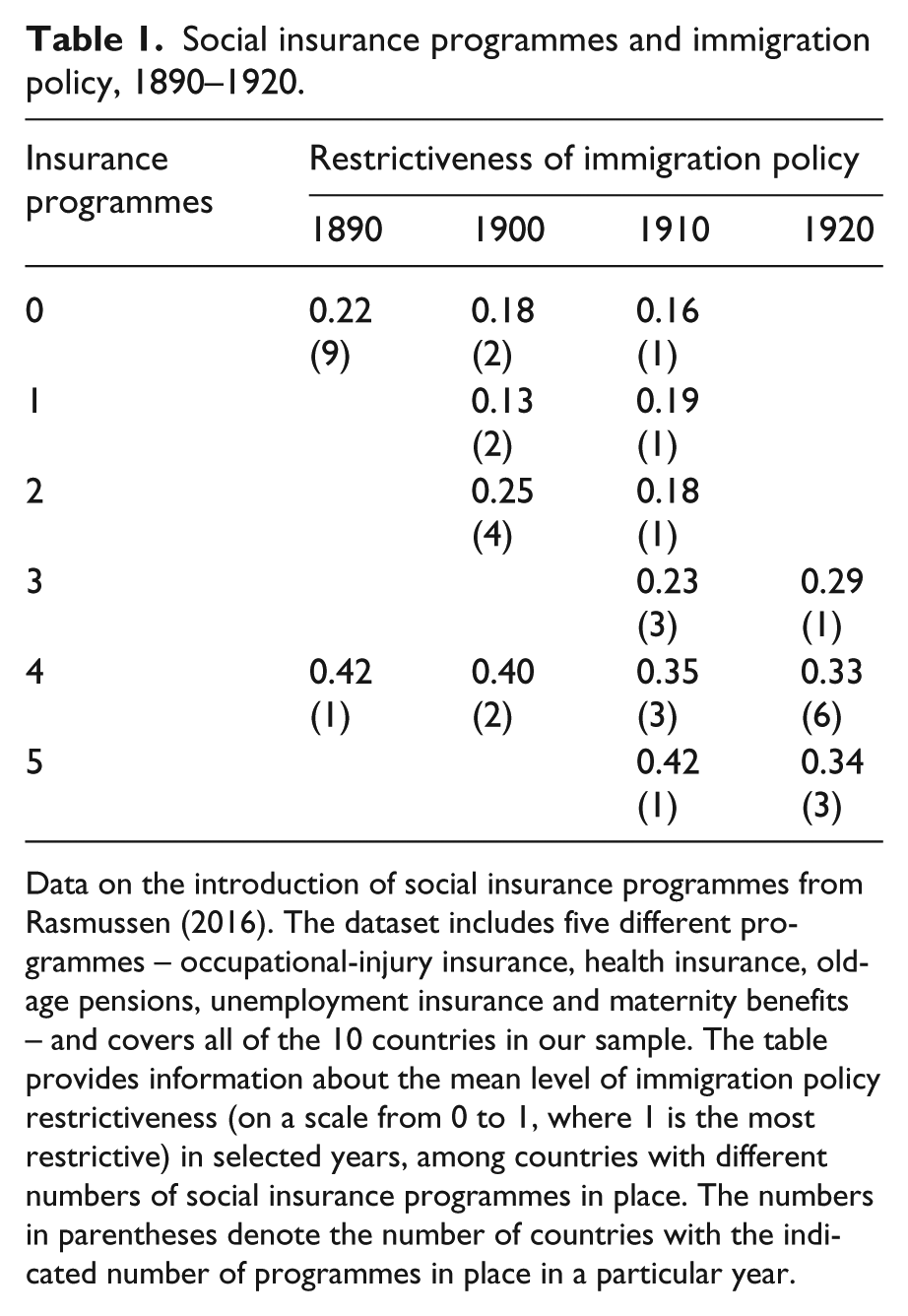
Data on the introduction of social insurance programmes from Rasmussen (2016). The dataset includes five different programmes – occupational-injury insurance, health insurance, old-age pensions, unemployment insurance and maternity benefits – and covers all of the 10 countries in our sample. The table provides information about the mean level of immigration policy restrictiveness (on a scale from 0 to 1, where 1 is the most restrictive) in selected years, among countries with different numbers of social insurance programmes in place. The numbers in parentheses denote the number of countries with the indicated number of programmes in place in a particular year.
Read from top to bottom, Table 1 reveals that both in 1890, 1900, 1910 and 1920, countries with more social insurance programmes in place tended to pursue more restrictive immigration policies. Read from left to right, the table shows that the level of immigration policy restrictiveness was fairly constant over time in countries with a given number of social insurance programmes (note, however, that the mean level of restrictiveness associated with four or five programmes declined somewhat over time, as other countries caught up with the two early social-insurance adopters, Denmark and Germany). Although it relies on a different measure of the size and scope of the welfare state, the evidence in Table 1 is thus consistent with the evidence in Figure 1.
The findings in Table 1 are not driven by one particular programme. With one single exception, the adoption of each type of programme included in Table 1 was associated with stricter immigration policies throughout the period between 1880 and 1920 (although the differences became smaller over time). There was a difference of 0.16 in immigration-policy restrictiveness, on a scale from 0 to 1, between countries with and without old-age pensions in 1900, and a 0.06 difference in 1920; the equivalent numbers for maternity benefits are 0.13 and 0.04, and the numbers for sickness benefits are 0.14 and 0.06. The only exception to the rule is unemployment benefits, for in 1920, countries with an unemployment benefit system in place in fact had slightly less restrictive immigration policies than countries without unemployment benefits. As in many other areas of welfare-state research, unemployment benefits thus appear to have had different causes and effects than other forms of social insurance.
Next, we examine some data on social spending. Lindert (2004) provides data on four types of public spending – welfare (including unemployment compensation), pensions, health and housing – for all countries in our sample except Germany and Switzerland. Since the first category, ‘welfare’, comprises many policies that antedate the modern welfare state, we begin by analysing combined spending on the three other categories.
As Figure 2 shows, the pattern we find when analysing the spending data is largely the same pattern we find when analysing data on social-insurance coverage. Denmark again stands out as a country that combined generous social policies with strict immigration policies during the entire period covered in the article. France, the Netherlands, Norway, Sweden and the United Kingdom all move upwards and to the right from the lower left-hand corner (in other words, they increased social spending and introduced stricter immigration policies concurrently). Belgium and Italy in fact seem less exceptional in Figure 2 than they did in Figure 1, for by the end of the period, the level of social spending was lower in these two countries than in the other countries in our sample, making it less surprising that they did not introduce stricter immigration policies.
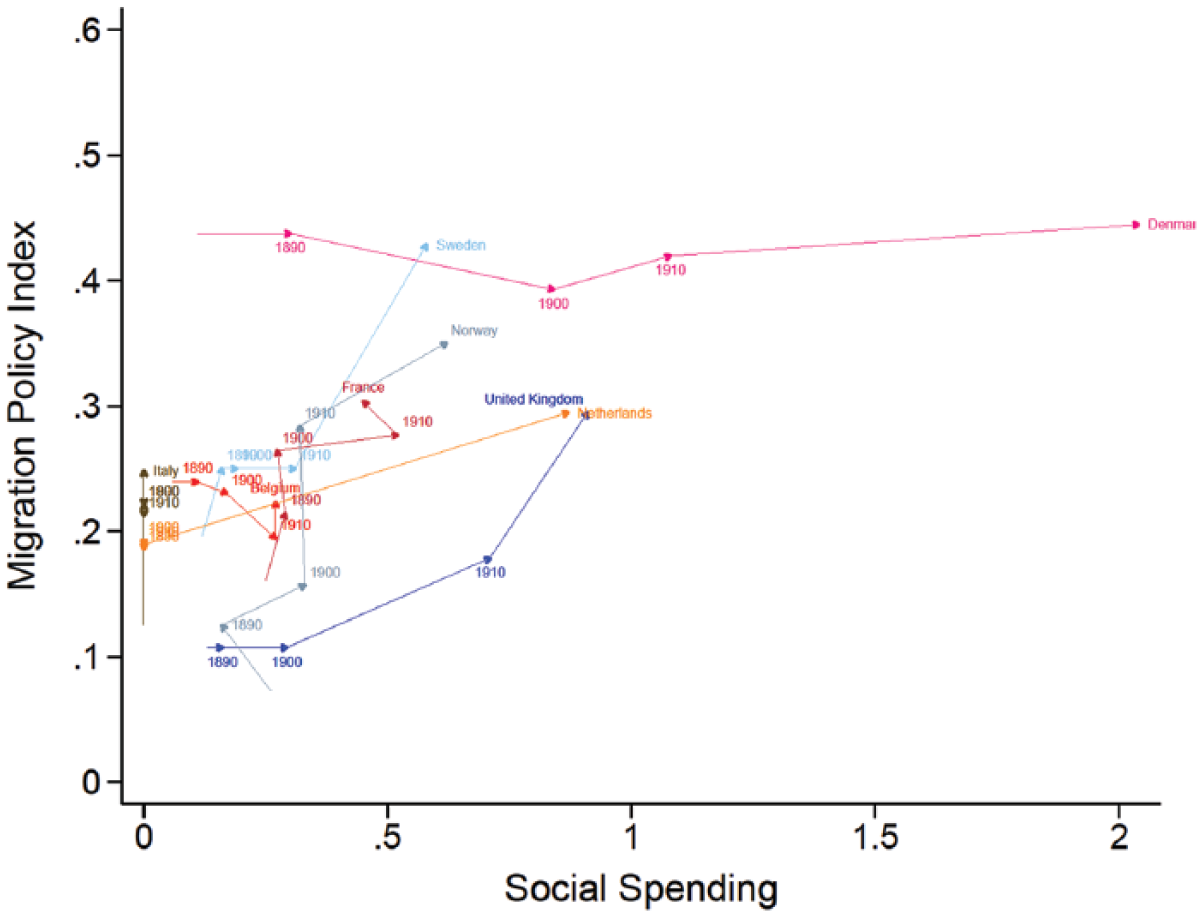
Non-welfare social spending and immigration policy, 1880–1920.
Figure 3 shows, by contrast, that spending on welfare payments to the poor and the unemployed are not empirically associated with immigration policies in the same way, for in the early 20th century, welfare spending decreased in most of the countries in our sample, even as immigration policies became more restrictive. One explanation is arguably that modern social insurances displaced older forms of welfare and poor relief. This evidence is consistent with the idea that policymakers perceived a trade-off between open borders and social rights regarding national-level social programmes – such as social insurance – and not regarding poor relief.
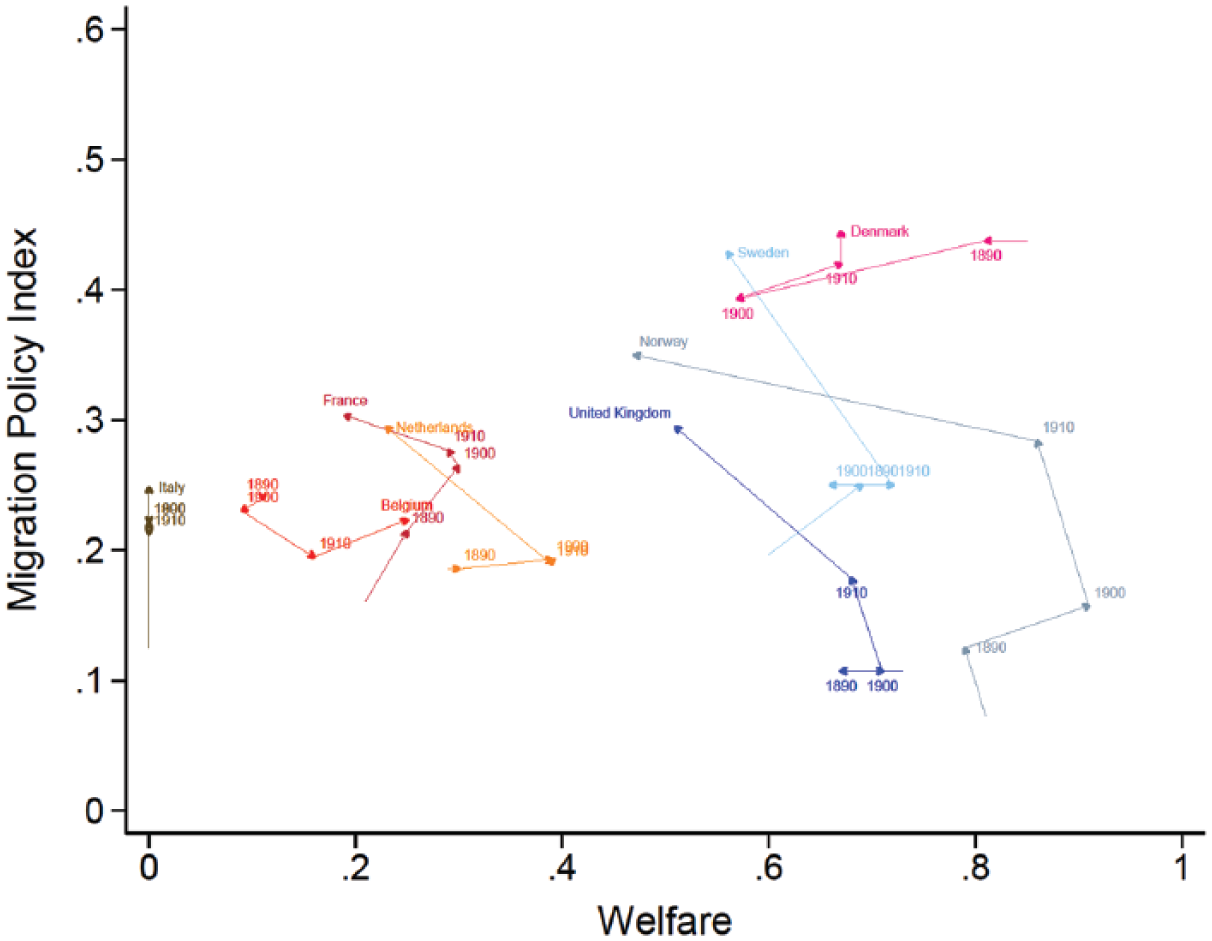
Welfare spending and immigration policy, 1880–1920.
Many of the social insurances that were introduced in the late 19th century were not funded through taxation, but through social insurance contributions. Germany, the pioneer of modern social insurances, is a prominent example. As Lindert (2004) notes, the social insurance programmes that Bismarck’s government introduced in Germany involved little spending from government budgets. In other countries, by contrast, social insurances were funded, at least in part, by general taxation. One might have expected these differences among countries to matter more for the relationship between social policy and immigration policy than the evidence in this section suggests. For example, one might have expected immigration policy to be more politically sensitive in countries with tax-funded insurances.
That argument, however, is premised on the idea that it is more difficult to exclude immigrants from tax-financed social insurance programmes than contribution-financed programmes, which is not obviously true. Consider the British National Insurance Act of 1911. The text of this legislation shows that policymakers were actively concerned about the implications of immigration for new welfare legislation, but it also shows that immigrants could be excluded from partly tax-funded welfare. Paragraph 45 in the National Insurance Act dealt with the status of aliens, and stated, among other things, that ‘[n]o part of the benefits to which such a person may become entitled shall be paid out of moneys provided by Parliament’. Moreover, if aliens were entitled to sickness, disablement and maternity benefits, those benefits were reduced to seven-ninths of the normal benefit for men and three-quarters of the normal benefit for women. 5 Interestingly, neither of the German social insurance laws from the 1880s contain any provisions about the rights of foreign nationals, and coverage is always defined in terms of occupation. In all likelihood, effective coverage was lower for foreign workers, but the reason was that it was de facto more difficult for those groups to qualify for benefits, not that they were excluded de jure.
It is not surprising, therefore, that we do not observe a stark difference between contribution-based and tax-based social insurances in our data. Another piece of evidence that supports this view is that Germany, with its contribution-based programmes, and Denmark, with its higher level of tax financing, were so alike – as we discuss in the next section.
Germany and Denmark
Like several other countries in our sample, Germany experienced high levels of emigration to the New World, particularly in the beginning of the period we consider. But it also received many immigrants. 6 For example, statistics from 1910 recorded that 1,260,000 foreigners were present in the country that year. The largest immigrant group was the Poles, who, in 1910, constituted the great majority of migrants from Austria-Hungary and Russia. There were also comparatively high levels of immigration from the Netherlands, Italy and Switzerland (Schönwälder, 2006: 79).
Almost three-quarters of the immigrants came to Prussia. The main impetus was the demand for cheap labour in agriculture, mining and industrial production. This economic interest was counterbalanced by the Prussian government’s fear of Polish national ambitions. The authorities believed that this risk would be minimized if the immigrants were not allowed to settle permanently, which is why Germany developed tightly monitored temporary labour regulations in the 1890s. The mass expulsion of Poles in 1885 was motivated by the same anxieties (Bade and Oltmer, 2011: 70; Fitzpatrick, 2015: 99).
Admission policy was tight even before the 1890s. In 1879, for instance, the government used emergency provisions in the German Empire’s passport law to impose passport and visa requirements on all travellers from Russia (Torpey, 2003: 80–81). Authorities also carried out various forms of removals. Deportations of individuals could occur for reasons of vagrancy, begging or criminality, all of which made a person appear ‘burdensome’ (Fitzpatrick, 2015: 5–6). Mass expulsions was also a recurring phenomenon. Some of them were implemented centrally, notably the expulsions of perceived enemies of the German empire, such as Jesuits and Socialists, in the 1870s. Others were implemented by individual states, exemplified by the expulsion of Poles from Prussia. The Länder had the power to expel non-citizens, but in actual practice, the decisions were often taken at the local level and then validated by the central Länder authorities (Fitzpatrick, 2015: 15–17).
Rights policies were also restrictive throughout the period. In particular, the road to citizenship was almost closed because of the application of a strict version of jus sanguinis (first by Prussia, then by Germany), which made it difficult for immigrants to naturalize (Brubaker, 1992: 114).
It is not straightforward to categorize the immigration policies of a federal state such as the German Empire, since immigration policy decisions were made at several different levels of government. But if one includes Prussia’s policies in the assessment of the empire’s policies – as Peters (2015) did in the dataset we rely on here – it seems uncontroversial to say that Germany had stricter laws on migration than other countries in Western Europe.
Another country with tough laws on admissions and immigrant rights was Denmark. Compared with neighbouring Sweden and Norway, relatively few Danes emigrated to the New World (Hatton and Williamson, 1998: 67–68). Meanwhile, Denmark, like Germany, received comparatively large numbers of immigrants. Ethnic Germans had been arriving since the 17th century, and in the late 19th and early 20th centuries, both Poles and Germans were employed in large numbers in the agricultural sector. By 1885, 8 percent of the population of Copenhagen were foreigners. As one commentator notes, ‘[t]here are no precise estimates of immigrant numbers for these early periods, but there is little doubt that they were considerable’ (Hedetoft, 2006).
The Alien Law of 1875, which was enacted before the start of our investigation, contained many restrictive provisions. It explicitly prohibited entry by the Roma, and it allowed for the deportation of anyone who was likely to become a public charge (Østergaard, 1983: 101, 187). Moreover, it forced immigrant workers to carry a kind of permit, an opholdsbog, which employers were obligated to check (Dübeck, 1987: 28). Subsequent legislation in 1908 required formal contracts for all migrant workers, specifying their salaries and employment conditions. Employers were also required to notify the police within 2 days of a foreign worker’s arrival. That law, referred to as the Polaklov, was directed against the Polish seasonal workforce (Pedersen, 1987: 161). It is indicative of Denmark’s restrictive immigration policies that neighbouring Sweden’s first stand-alone law on foreign immigration was adopted more than 50 years after Denmark’s.
Relative to other countries, Denmark also had a restrictive citizenship policy. In the late 18th century, ethnic Germans were very influential in the top state bureaucracy. Discontent over this fact made the king promulgate a law of infødsret (native right), which restricted access to top public positions to natives. Although citizenship law was formally based on jus soli, in practice jus sanguinis became influential, since only those who were born in Denmark from Danish parents acquired infødsret at birth (Ersbøll, 2015: 8–9). In 1908, access to public welfare was limited to people with infødsret (Vedsted-Hansen, 1987: 193–199).
Germany and Denmark had two things in common: they pursued restrictive immigration policies early on, and before 1910, their welfare states grew more than those of all other countries in our sample. Denmark stands out as a country with a particularly large welfare state regardless of whether the size of the welfare state is defined in terms of the number of social insurance programmes, the coverage of those programmes or social spending. The German case is a little more complicated, since Germany’s social insurances were not very redistributive and involved relatively small tax expenditures. Nevertheless, it seems uncontroversial to conclude that both Germany and Denmark introduced national-level social programmes early.
We cannot provide a definite explanation of these findings here, but we would like to mention two factors that seem to have contributed to them. First of all, as we have just noted, both Germany and Denmark experienced comparatively high levels of immigration. Second, nation-building was a major concern for governments in both countries, influencing both their immigration policies and, in all likelihood, their social policies. In Germany, according to Caestecker (2003: 121), the expulsion and exclusion of Poles were the direct results of the German government’s desire to create a homogeneous people for the new, unified German state. In the Danish case, as Kaspersen (2006) has shown, Denmark’s defeat against Prussia in 1864 contributed to strong nationalist sentiments, which played an important role in the early history of the welfare state. 7
Sweden and the United Kingdom
Two other countries, in addition to Denmark and Germany, reached an average social-insurance coverage rate of more than 30 percent by 1920: Sweden and the United Kingdom. In Sweden, the most important pre-First World War regulations of immigration were put in place in 1914. Until that time, Sweden pursued liberal immigration policies, although governments had long sought to avoid responsibility for the welfare of poor immigrants. 8 The Immigration Law of 1914 coincided with the outbreak of the First World War but was not precipitated by it. The preparatory work on the new law had begun in 1907, reflecting a change in opinion towards greater regulation of ‘unwanted’ immigration. It was motivated by an increase in the number of immigrants, racial anxieties, negative perceptions of foreign businessmen and the fear that competition from foreign workers would lead to unemployment (SOU, 1967: 40–41).
The 1914 regulations banned certain categories of foreigners from entering Swedish territory, notably prostitutes, pimps, gamblers, beggars and vagabonds. Moreover, all Roma were now prohibited from entering the country. This provision was justified with openly racial arguments (Ericsson, 2016: 165). A few years later, in 1917, passport requirements were reintroduced, after 60 years without passport controls, and a new government agency for the supervision of foreigners was created (SOU, 1967: 43–44).
In both Sweden and the United Kingdom, the social insurance system expanded particularly quickly in the 1910s. As we have seen, Swedish immigration policy became increasingly restrictive in the same period. In the United Kingdom, developments were similar. The British parliament adopted important legislation in the 1900s and 1910s that constituted a clear break with the liberal immigration regime of the 19th century. The Aliens Act 1905 prohibited immigrants who were likely to become public charges from entering Britain. It also provided that aliens who received public welfare benefits within 1 year of arriving in Britain could be deported. The Home Secretary was given broad powers to control immigration and to impose restrictions on immigrants. Some historians have also observed that the law was directed against Jewish immigration in particular (Lunn, 2011: 19).
The Aliens Restriction Act 1914 and the Aliens Restriction (Amendment) Act 1919 introduced further restrictions, reintroduced passport controls after many decades of open borders and regulated naturalization. As in Sweden, these new laws were introduced during, or just after, the First World War, but they contained many provisions that were not motivated by the war as such. The Home Secretary was now given even broader powers over immigrants inside Britain, including the power to require registration and the power to restrict residence and travel. Many of these provisions remained in force until the 1970s.
Belgium and Italy
We end by discussing two countries that did not introduce more restrictive immigration policies and more generous social policies concurrently before 1920: Belgium and Italy. For a long time, Belgium pursued more liberal immigration policies than most other European countries. For example, Belgium was one of the first countries that recognized a special status for refugees, which it did as early as 1885. As a result of this policy, ‘destitute aliens who were to be expelled had to be questioned as to whether they were pursued for political reasons … genuine refugees were to be tolerated in the country’ (Caestecker, 2000: 40–41). These sorts of provisions did not exist elsewhere in Western Europe at the time.
In the early 1900s, as Figure 1 suggests, immigration policies were liberalized further. Belgium became a labour immigration country in the early 20th century, and before the outbreak of the war, there was active recruitment of both low-skilled and highly-skilled workers (Caestecker, 2011: 46). In 1909, Belgian citizenship laws also changed. Ever since the creation of the state of Belgium in 1830, the basic principle of citizenship had been jus sanguinis paterni: nationality was inherited from the father. The children of foreign parents could claim Belgian nationality when they reached adulthood and aliens could obtain citizenship after 5 years of residence, but the naturalization procedures were drawn-out and costly. After 1909, the jus soli principle applied in addition to jus sanguinis: every child born in Belgium was now granted nationality, even if the parents were foreign (Caestecker, 2000: 15, 47; Foblets and Loones, 2006).
Immigrants were also granted other rights. The 1873 Poor Law made it easier for foreigners to qualify for social assistance. Although the law distinguished between Belgians and foreigners in principle, settled aliens were in practice granted the same conditions as Belgians. Subsequent legislation even provided that ‘all settled aliens were treated in the same manner as Belgians and became members of the welfare community’ (Caestecker, 2000: 44; see also 45–51). The time of residence required for being considered ‘settled’ was also reduced in 1891. But vagrants and beggars were not included in these provisions. On the contrary, an 1891 law stated that those groups did not have the right to appear before a court to be expelled; they could be forced out of the country directly (Caestecker, 2000: 34).
In other words, Belgium does not fit the story we are telling in this article. However, it is important to note that Belgium’s liberal immigration policies only lasted a few years into the inter-war period. In the course of the 1920s, as Caestecker (2000) shows, Belgium’s immigration policies became much more restrictive. In other words, while there is no evidence that immigration policies became tighter as the welfare state expanded before the year 1920, that is, what happened just after the end of the period we investigate. The increasing political prominence of the Belgian Labour Party in the 1920s – after many years of political dominance by the right-of-centre Catholic Party – was an important reason for this policy shift (Caestecker, 2000: ch. 3–4).
We now turn to the second exception, which is Italy. Italy had few restrictions on admittance, although, as in other countries, the Italian government was preoccupied with the movement of paupers and vagrants, targeting the Roma in particular (Illuzzi, 2014). There was also very little legislation on the books concerning the rights of immigrants. The Civil Code of 1865 gave foreign residents and citizens equal civil rights and provided for freedom of religion (Zincone, 2006: 5). But when it came to political rights and naturalization, there was preferential treatment of immigrants of Italian ethnicity, such as returning emigrants and their families. For naturalized members of this group, it was relatively straightforward to acquire voting rights, while it was much more cumbersome for others (Arena et al., 2006: 336). To acquire citizenship was also significantly less complicated for applicants of ethnic Italian origin (Pastore, 2010: 30–31).
The main explanation for the Italian exception is most likely that Italy experienced large-scale emigration much longer than other countries in Western Europe. Between 1900 and 1913, when emigration from most other Western European countries had declined, five million Italians left for the New World. Emigration to other European countries was also significant (Faini and Venturini, 1994: 70–71). Italy only became a significant destination country for immigrants in the 1970s, and its first immigration legislation dates from 1986 (Illuzzi, 2014). Most of the immigrants who arrived in Italy in the period we study were return migrants and their families. About 50 percent of Italian emigrants to North and South America in the decade before the First World War eventually returned (Bertagna and Maccari-Clayton, 2011: 110–111). In all likelihood, there was no perceived need to tighten immigration regulations when immigration was so small and most immigrants were co-nationals.
Conclusion
In the late 19th and early 20th centuries, when the modern welfare state emerged, most Western European states behaved in a manner consistent with the welfare chauvinism hypothesis. As countries introduced and expanded new social-insurance programmes, they also made their immigration policies more restrictive. Some governments made it more difficult for immigrants to cross the border. Others introduced new distinctions between the rights of citizens and the rights of immigrants. Some did both.
Research on the welfare chauvinism hypothesis on the basis of post-war data is at best inconclusive. Indeed, some Western European countries with large welfare states have pursued remarkably liberal immigration policies, at least for forced migrants – both when it comes to the rules of admission and immigrant rights (Banting and Kymlicka, 2006; Boräng, 2015; Crepaz, 2008; Sainsbury, 2012).
In the early days of the welfare state, however, there seems to be more support for the idea of welfare chauvinism. At that time, there was no previous experience of an encompassing welfare state, which would in later decades shape new norms regarding what the state can and should do, in a way that mitigated welfare chauvinism. The institutionalization of the welfare state most likely brought about a normative change, associated with universality and redistribution, that made it more difficult to justify outright exclusion, and before that shift in norms and perceptions, the exclusion of immigrants was considered more acceptable.
This study has also led us to reflect on another matter: in some European states, the emergence of the welfare state and the emergence of the modern nation state occurred in a context of large-scale emigration. This fact does not seem to have been explored in sufficient depth in the comparative literature on the welfare state (but see Karadja and Prawitz, 2017, for a recent in-depth study of Sweden). One of the reasons for the creation of the modern welfare state might have been to convince people to remain in their countries of origin. It is noteworthy, for instance, that the official study of emigration that was delivered to the Swedish government in 1913 recommended that Sweden should introduce German-style social insurances, since social reforms in Germany were seen to have contributed to lowering emigration, both indirectly (because of increased living standards) and directly (since those who emigrated lost all their social benefits and all their contributions) (Sundbärg, 1913: app. XIX: 108–109). In some of the countries we have investigated, we have also found that migration laws privileged co-nationals and people of the same ethnicity, encouraging them to return to their old homelands.
Finally, we would like to point out that even the most liberal regimes in Western Europe adopted restrictive immigration policies that were directed against certain groups. The Roma in particular were subject to both external and internal exclusions in most countries. Most governments also sought to control the movement of paupers and vagrants. Where labour migration was accepted, immigrants were often required to carry papers guaranteeing that they were not vagrants. The movement of paupers and vagrants was fought at many levels (Althammer, 2014). For example, many bilateral treaties at the time regulated inter-state deportation of this category, emphasizing that each state was responsible for its own destitute people. The trilateral harmonization of citizenship legislation between Sweden, Norway and Denmark is one of many examples (Ersbøll, 2015: 8–9). The period between 1860 and 1914 is known in migration studies as a golden age of liberal migration policies. However, there are some groups that governments controlled vigorously even then. There is a continuity, here, with our present era, when Western European governments are concerned with the immigration of beggars of Eastern European Roma descent.
Supplemental Material
Lindvall_Supplementary – Supplemental material for Immigration policy and the modern welfare state, 1880–1920
Supplemental material, Lindvall_Supplementary for Immigration policy and the modern welfare state, 1880–1920 by Sara Kalm and Johannes Lindvall in Journal of European Social Policy
Footnotes
Acknowledgements
We are grateful to Johan Ekstedt and Moa Olin for excellent research assistance. We are also grateful to Maggie Peters for generously sharing her data and helping us in our efforts to compile new data that are consistent with her original dataset. Finally, we are grateful to Frida Boräng, Carl Dahlström, Johan Davidsson, Carlo Knotz, Peter Starke, seminar participants at the University of Gothenburg, and the members of the STANCE team at Lund University for their kind help and advice.
Funding
The author(s) disclosed receipt of the following financial support for the research, authorship, and/or publication of this article: We received generous funding from Riksbankens Jubileumsfond (programme grant M14–0087:1) and the Swedish Research Council (grant 2017-01644).
Supplemental material
Supplemental material for this article is available online.
Notes
References
Supplementary Material
Please find the following supplemental material available below.
For Open Access articles published under a Creative Commons License, all supplemental material carries the same license as the article it is associated with.
For non-Open Access articles published, all supplemental material carries a non-exclusive license, and permission requests for re-use of supplemental material or any part of supplemental material shall be sent directly to the copyright owner as specified in the copyright notice associated with the article.
