




Abstract
The present study explores the potential of wild elephant grass (EG), for co-production of ethanol and xylitol. Alkaline H2O2-pretreated-EG was hydrolyzed by a tailor-made cocktail of recombinant bacterial crude cellulolytic and xylanolytic enzymes, used for co-fermentation. Candida tropicalis (MTCC 230) was adapted in medium having both C5 and C6 sugars. Three significant parameters, inoculum size, S:N in medium and orbital shaking speed (rpm), were optimized using response surface methodology (RSM) and artificial neural network linked genetic algorithm (ANN-GA) for bioethanol and xylitol production. The predictive capabilities of both models were compared. ANN-GA predicted optimum conditions were 10% (v/v) initial inoculum size, the S:N ratio 37.4 and rpm 250 gave 27.4 g/L (0.42 g/gglucose) ethanol and 5.1 g/L (0.44 g/gxylose) xylitol titres with KLa of 194 h−1. The ANN-GA optimized parameters gave 22.3% and 13.3% higher ethanol and xylitol yields, respectively, than those predicted by the RSM-based model. The current innovative method of co-producing ethanol and xylitol from EG offers a promising alternative to traditional bioethanol production.
This is a visual representation of the abstract.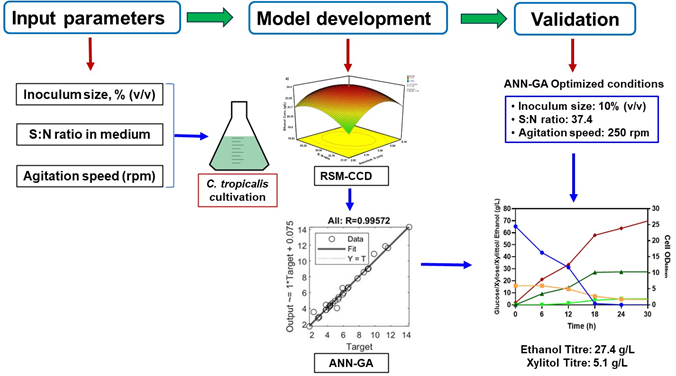
Keywords
Get full access to this article
View all access options for this article.