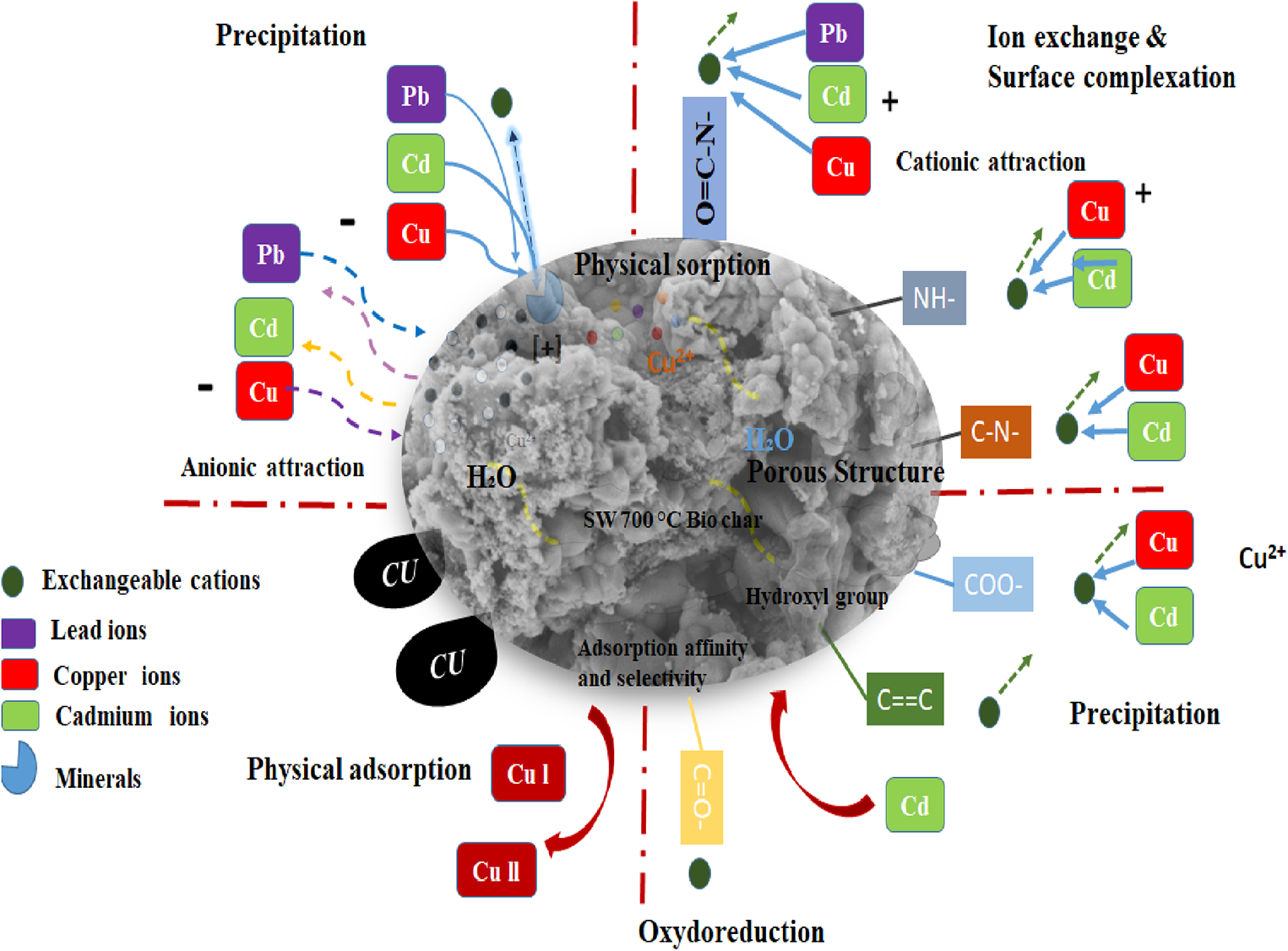
This study presents Sargassum duplicatum-derived biochar as an efficient solution for removing heavy metals from various water sources, addressing a critical sustainability need. Achieving a remarkable adsorption efficiency of 617 mg/g within 4 h at pH 5 and 150 rpm, surpassing previous findings, the biochar demonstrates exceptional efficacy. Impressively, it achieves removal efficiencies of 97.56% in tap water and 99.05% in seawater. Investigating various heavy metals, the study reveals differential adsorption and removal efficiencies across different water sources. Utilizing scanning electron microscopy, Fourier-transform infrared spectroscopy, and Brunauer–Emmett–Teller analyses, the study elucidates the biochar's porous structure and significant surface area, enhancing its effectiveness. Notable attributes include low-temperature sensitivity, pH 5 optimization, and excellent fits to Langmuir and Pseudo-second-order kinetics models. This research underscores Sargassum duplicatum-derived biochar as a chemically active material, offering a promising solution to water contamination challenges with innovation and remarkable efficiency.
DemirbasEDizgeNSulakMT,et al.Adsorption kinetics and equilibrium of copper from aqueous solutions using hazelnut shell activated carbon. J Chem Eng2009; 148: 480–487.
2.
LiNBaiR. Copper adsorption on chitosan–cellulose hydrogel beads: behaviors and mechanisms. Sep Purif Technol2005; 42: 237–247.
3.
KumarPPatelAKSinghaniaRR, et al.Enhanced copper (II) bioremediation from wastewater using nano magnetite (Fe3O4) modified biochar of Ascophyllum nodosum. Bioresour Technol2023; 388: 129654.
4.
ZhuYFanWZhangK, et al.Nano-manganese oxides-modified biochar for efficient chelated copper citrate removal from water by oxidation-assisted adsorption process. Sci Total Environ2020; 709: 136154.
5.
ZhouDMWangYJWangHW, et al.Surface-modified nanoscale carbon black used as sorbents for Cu(II) and Cd(II). J Hazard Mater2010; 174: 34–39.
6.
World Health Organization. Guidelines for drinking water quality. 4th ed. Geneva: World Health Organization, 2022, ISBN 978-92-4-004506-4.
7.
GoyalPTiwaryCSMisraSK. Ion exchange based approach for rapid and selective Pb(II) removal using iron oxide decorated metal organic framework hybrid. J Environ Manage2021; 277: 111469.
8.
XiaoXSunYLiuJ,et al.Flocculation of heavy metal by functionalized starch-based bioflocculants: characterization and process evaluation. Sep Purif Technol2021; 267: 118628.
9.
BilalMShahJAAshfaqT, et al.Waste biomass adsorbents for copper removal from industrial wastewater–a review. J Hazard Mater2013; 263: 322–333.
10.
WangZFernández-BlancoCChenJ, et al.Effect of electron acceptors on product selectivity and carbon flux in carbon chain elongation with Megasphaera hexanoica. Sci Total Environ2024; 912: 169509.
11.
PatelAKSinghaniaRRPalA, et al.Advances on tailored biochars for bioremediation of antibiotics, pesticides and polycyclic aromatic hydrocarbon pollutants from aqueous and solid phases. Sci Total Environ2022a; 817: 153054.
12.
LiuYWangDXueM, et al.High-efficient decomplexation of Cu-EDTA and Cu removal by high-frequency non-thermal plasma oxidation/alkaline precipitation. Sep Purif Technol2021; 257: 117885.
13.
PatelAKKumarPChenCW, et al.Nano magnetite assisted flocculation for efficient harvesting of lutein and lipid producing microalgae biomass. Bioresour Technol2022c; 363: 128009.
14.
KatiyarRPatelAKNguyenTB, et al.Adsorption of copper (II) in aqueous solution using biochars derived from Ascophyllum nodosum seaweed. Bioresour Technol2021; 328: 124829.
15.
BaoZFengHTuW, et al.Method and mechanism of chromium removal from soil: a systematic review. Environ Sci Pollut Res2022; 29: 35501–35517.
16.
HuangHChenYMaR, et al.Preparation of high performance porous carbon by microwave synergistic nitrogen/phosphorus doping for efficient removal of Cu(2+) via capacitive deionization. Environ Res2023; 222: 115342–115354.
17.
ZengYLinYMaM,et al.A review on the removal of heavy metals from water by phosphorus-enriched biochar. Minerals2023; 14: 61.
18.
OliveiraFRPatelAKJaisiDP, et al.Environmental application of biochar: current status and perspectives. Bioresour Technol2017; 246: 110–122.
19.
NguyenTKTNguyenTBChenWS, et al.Phosphoric acid-activated biochar derived from sunflower seed husk: selective antibiotic adsorption behavior and mechanism. Bioresour Technol2023; 371: 128593.
20.
YehSLeeC. Administration of hot-water extract of brown seaweed Sargassum duplicatum via immersion and injection enhances the immune resistance of white shrimp Litopenaeus vannamei. Fish Shellfish Immunol2006; 20(3): 332–345.
21.
Saberzadeh SarvestaniFEsmaeiliHRamavandiB. Modification of Sargassum angustifolium by molybdate during a facile cultivation for high-rate phosphate removal from wastewater: structural characterization and adsorptive behavior. 3 Biotech2016; 6: 51.
22.
PratiwiDPoeloengasihCDSuryaniR,et al.Adsorption of basic dye methylene blue by brown algae Sargassum duplicatum. In IOP Conference Series. IOP Conference Series: Earth Environ. Sci., 2020, March. IOP Publishing, 462(1), (Vol. 462, No. 1, p. 012038).
23.
TruongQMNguyenTBChenWH, et al.Removal of heavy metals from aqueous solutions by high performance capacitive deionization process using biochar derived from Sargassum hemiphyllum. Bioresour Technol2023a; 370: 128524.
24.
VijayaraghavanJRahmanDZThivyaJ. Sequestration of Pb (II), Ni (II) and Zn (II) biosorption onto brown seaweed Sargassum wightii: isotherm and kinetic modeling. J Ind Chem Soc2020; 97: 2224–2232.
25.
TruongQMNguyenTBNguyenTKT, et al.Hydrothermal and pyrolytic conversion of sunflower seed husk into novel porous biochar for efficient adsorption of tetracycline. Bioresour Technol2023b; 373: 128711.
26.
PatelAKKatiyarRChenCW, et al.Antibiotic bioremediation by new generation biochar: recent updates. Bioresour Technol2022b; 358: 127384.
27.
KumarPPatelAKChenCW, et al.Development of dopamine-based magnetite nanocomposite for effective harvesting of Chlorella sorokiniana Kh12 biomass. Environ Technol Innov2023b; 29: 103008.
28.
XieXGaoHLuoX, et al.Polyethyleneimine modified activated carbon for adsorption of Cd(II) in aqueous solution. J Environ Chem Eng2019; 7: 103183.
29.
YangYYeSZhangC, et al.Application of biochar for the remediation of polluted sediments. J Hazard Mater2021; 404: 124052.
30.
PrasannamedhaGKumarPSMehalaR, et al.Enhanced adsorptive removal of sulfamethoxazole from water using biochar derived from hydrothermal carbonization of sugarcane bagasse. J Hazard Mater2021; 407: 124825.
31.
ShimizuTOtaMSatoY,et al.Effect of pore structure on catalytic properties of mesoporous silica supported rhodium catalysts for the hydrogenation of cinnamaldehyde. Chem Eng Res Des2015; 104: 174–179.
32.
Gómez-OrdóñezERupérezP. FTIR-ATR spectroscopy as a tool for polysaccharide identification in edible brown and red seaweeds. Food Hydrocoll2011; 25: 1514–1520.
33.
HungCMHuangCPChengJW, et al.Production and characterization of a high value-added seaweed-derived biochar: optimization of pyrolysis conditions and evaluation for sediment treatment. J Analyt Appl Pyrolysis2021b; 155: 105071.
34.
GaoXWuLXuQ, et al.Adsorption kinetics and mechanisms of copper ions on activated carbons derived from pinewood sawdust by fast H3PO4 activation. Environ Sci Pollut Res Inter2018; 25: 7907–7915.
35.
NaveenkumarPParuthimal KalaignanGArulmaniS,et al.Solvothermal synthesis of CuS/Cu(OH)2 nanocomposite electrode materials for supercapacitor applications. J Mater Sci Mater Electron2018; 29: 16853–16863. Zhang L, Li W, Cao H, et al. -efficient sorption of Cu2+ and Pb2+ions by light biochar derived from Medulla tetrapanacis. Bioresour Technol 2019; 291: 121818.
36.
MusumbaGNakiguliCLubangaC, et al.Adsorption of Lead (II) and Copper (II) ions from mono synthetic aqueous solutions using biochar from Ficus natalensis fruits. J Encapsulat Adsorp Sci2020; 10: 71–84.
37.
HemavathyRVKumarPSKanmaniK,et al.Adsorptive separation of Cu(II) ions from aqueous medium using thermally/chemically treated Cassia fistula based biochar. J Clean Prod2020; 249: 119390.
38.
Hung CM, Huang CP, Hsieh SL, et al.Biochar derived from red algae for efficient remediation of 4-nonylphenol from marine sediments.Chemosphere2020; 254: 126916.
39.
Foroutan R, Peighambardoust SJ, Mohammadi R, et al.Development of new magnetic adsorbent of walnut shell ash/starch/Fe3O4 for effective copper ions removal: treatment of groundwater samples. Chemosphere2022; 296: 133978.
40.
JeffersonWAHuCLiuH,et al.Reaction of aqueous Cu–citrate with MnO2 birnessite: Characterization of Mn dissolution, oxidation products and surface interactions. Chemosphere2015; 119: –7.
41.
XiaoFChengJCaoW, et al.Removal of heavy metals from aqueous solution using chitosan-combined magnetic biochars. J Coll Interf Sci2019; 540: 579–584.
42.
PelleraFMGiannisAKalderisD, et al.Adsorption of Cu(II) ions from aqueous solutions on biochars prepared from agricultural by-products. J Environ Manage2012; 96: 35–42.
43.
YangGXJiangH. Amino modification of biochar for enhanced adsorption of copper ions from synthetic wastewater. Wat Res2014; 48: 396–405.
44.
KhanZHGaoMQiuW, et al.Mechanisms for cadmium adsorption by magnetic biochar composites in an aqueous solution. Chemosphere2020; 246: 125701.
45.
TongXJLiJYYuanJH,et al.Adsorption of Cu(II) by biochars generated from three crop straws. J Chem Eng2011; 172: 828–834.
46.
ReguyalFSarmahAKGaoW. Synthesis of magnetic biochar from pine sawdust via oxidative hydrolysis of FeCl2 for the removal sulfamethoxazole from aqueous solution. J Hazard Mater2017; 321: 868–878.
47.
HuYRGuoCWangF, et al.Improvement of microalgae harvesting by magnetic nanocomposites coated with polyethylenimine. J Chem Eng2014; 242: 341–347.
48.
KumarPKumar PatelARani SinghaniaR, et al.Development of a novel Fe@urea nanocomposite for effective harvesting of high lutein-producing microalgae biomass. J Chem Eng2023c; 480: 148117.
49.
WangQZhengCShenZ, et al.Polyethyleneimine and carbon disulfide co-modified alkaline lignin for removal of Pb2+ ions from water. J Chem Eng2019; 359: 265–274.