



Abstract
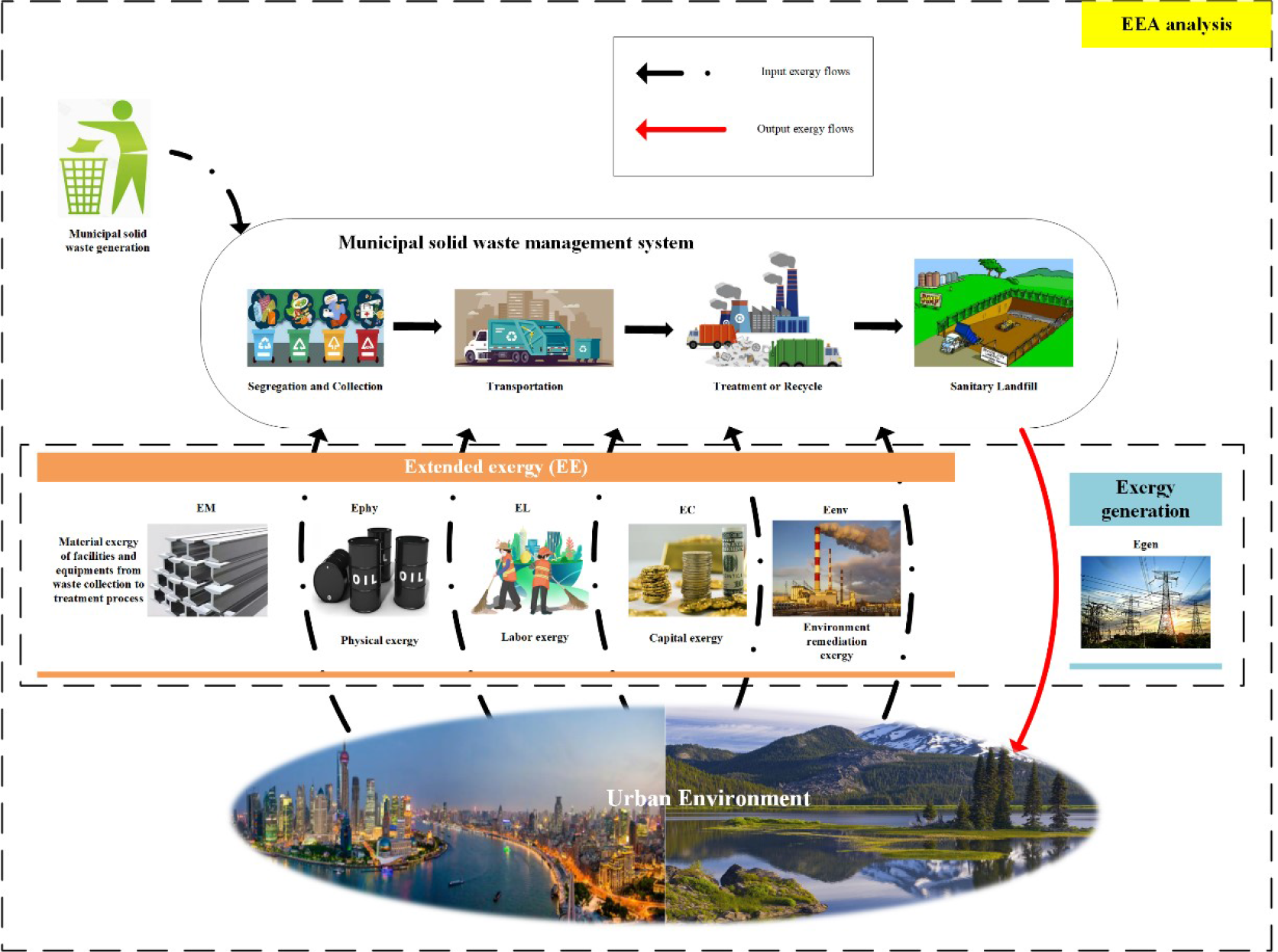
Waste-to-energy technologies can significantly alter urban metabolism and sustainability. This article proposes a multicriteria analysis framework based on the extended exergy accounting method to assess and plan a sustainable municipal solid waste management system from urban metabolism perspective. This framework includes three components. Firstly, an accounting model that integrates material, energy, social, economic, and environmental criteria was developed to identify the contribution of municipal solid waste management system to urban sustainability and to decide whether it is sustainable. Then, a multiperiod municipal solid waste management system planning model was developed to provide the optimal strategy for waste-to-energy facilities deployment and municipal solid waste allocation for different periods. Finally, multidimensional indicators were proposed for a sustainability comparative analysis in overdeployment, pressure on urban ecosystem and urban resource conversion efficiency. The proposed method was applied to the case study of household solid waste management in Shanghai and two scenarios were considered. Our comparison showed that the hybrid scenario (in which various waste recycling technologies were applied together) theoretically performs significantly more sustainable than the incineration scenario in terms of material investment, emissions, economic performance, resource depletion, and recovery. Sensitivity analysis of three parameters—the maximum deployment number of each unit waste-to-energy facility (
Graphical Abstract
Keywords
Get full access to this article
View all access options for this article.
References
Supplementary Material
Please find the following supplemental material available below.
For Open Access articles published under a Creative Commons License, all supplemental material carries the same license as the article it is associated with.
For non-Open Access articles published, all supplemental material carries a non-exclusive license, and permission requests for re-use of supplemental material or any part of supplemental material shall be sent directly to the copyright owner as specified in the copyright notice associated with the article.
