




Abstract
An important part of environmental pollution has resulted in energy consumption, the level of environmental pollution varies across sectors, and energy R&D investments have been strategic tools in this respect. Considering this fact, the research studies the role of R&D investments in energy on CO2 emissions by focusing on the USA case as pioneering R&D investing country in energy technologies. In this context, the study makes a disaggregated level analysis and performs various nonlinear methods to data between 1975/Q1 and 2020/Q4. The nonlinear empirical results demonstrate that (i) R&D investments have a strong dependency on sectoral CO2 emissions across times and frequencies; (ii) at higher quantiles, R&D investments in nuclear energy have a generally declining impact on power and building sector CO2 emissions, whereas R&D investments in renewable energy stimulate sectoral CO2 emissions; (iii) R&D investments are causally effective on sectoral CO2 emissions across various quantiles; (iv) R&D investments in total curb generally sectoral CO2 emissions. The research demonstrates that R&D investments in energy on sectoral CO2 emissions have a varying heterogonous impact based on time, frequency, quantile, and R&D types. Thus, USA policymakers should include time, frequency, quantile, R&D types, and sector-based differentiating impacts to curb sectoral CO2 emissions in re-formulating energy environmental policy framework as a critical issue for ensuring sustainable development. Accordingly, various policies (e.g. relying on nuclear R&D investments, re-balance distribution of the R&D investments among the alternatives, consideration of sectoral differences) are discussed.
This is a visual representation of the abstract.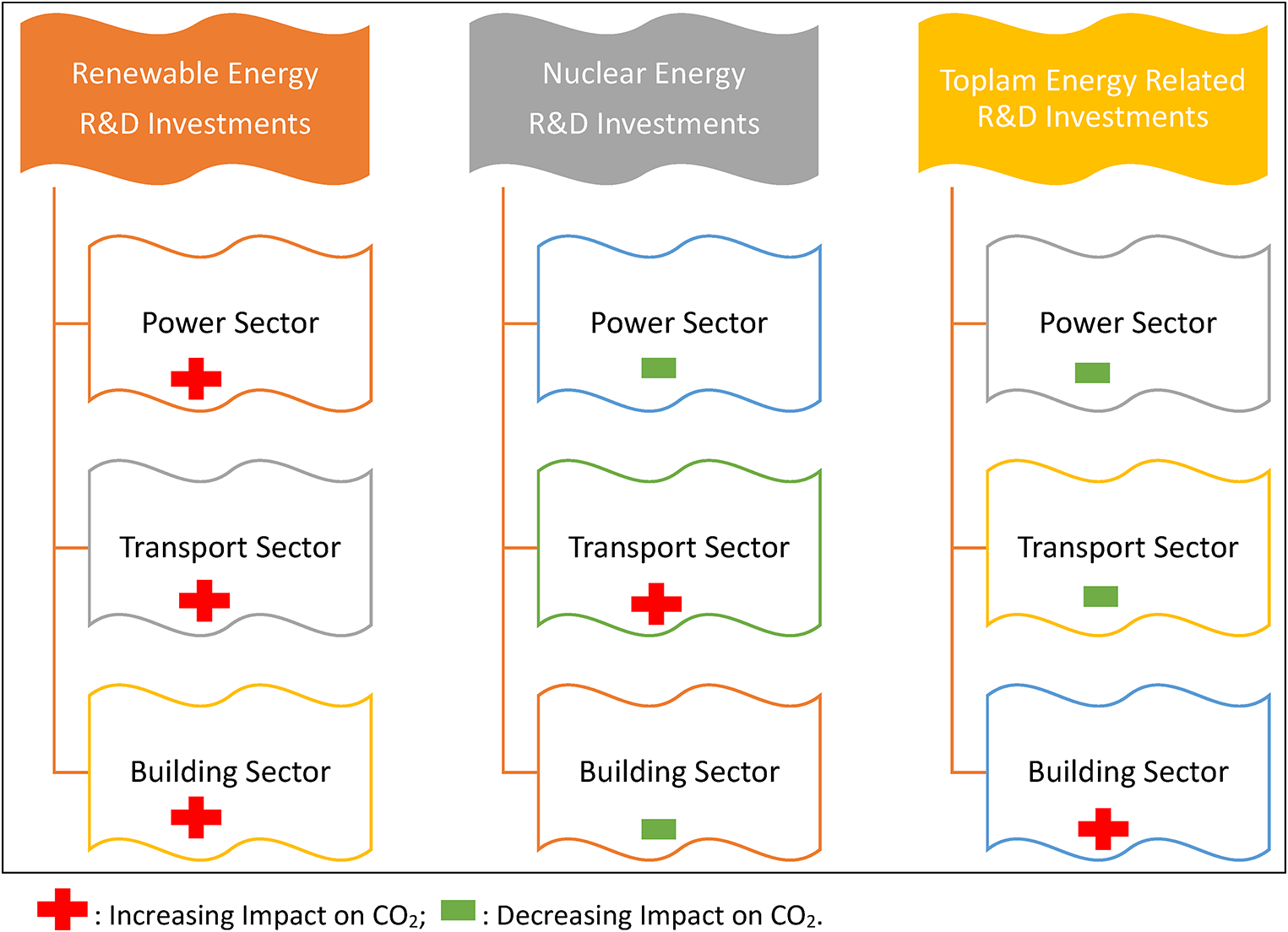
Get full access to this article
View all access options for this article.
References
Supplementary Material
Please find the following supplemental material available below.
For Open Access articles published under a Creative Commons License, all supplemental material carries the same license as the article it is associated with.
For non-Open Access articles published, all supplemental material carries a non-exclusive license, and permission requests for re-use of supplemental material or any part of supplemental material shall be sent directly to the copyright owner as specified in the copyright notice associated with the article.
