




Abstract
This research investigates the effects of income, total energy consumption (TEC), energy price index (EPI), crude oil price (COP), political risk index (PRI), and geopolitical risk (GPR) on environmental degradation. In this context, the study includes five Gulf Cooperation Council (GCC) countries, which are mainly oil-rich and have high fossil fuel energy consumption with increasing environmental degradation; considers monthly data from 2000/1 to 2021/12, and deploys novel quantile-based methods. The outcomes demonstrate that (i) an increase in income, TEC, and EPI stimulates environmental degradation in all GCC countries; (ii) PRI, COP, and GPR have mixed effects on environmental degradation; (iii) a causal effect from the regressors to CO2 emissions exists in all quantiles except for some middle (0.45–0.55) and higher quantiles (0.95); (iv) the power of effect and causal effect vary according to quantiles and countries; (v) the consistency of the results is validated based on robust model. The findings reveal that an increase in income, TEC, and EPI is generally harmful to the environment in the GCC countries; but, PRI, COP, and GPR have mixed effects. The results of novel quantile-based methods underline the significance of political stability and geopolitical risk effect as non-economic and non-energy factors on environment degradation by demonstrating quantile-based varying effects of the regressors on the environment in GCC countries. Accordingly, various policies, such as focusing on increasing political stability, benefitting from geopolitical risk as leverage, and enabling the transition to clean energy, are discussed.
This is a visual representation of the abstract.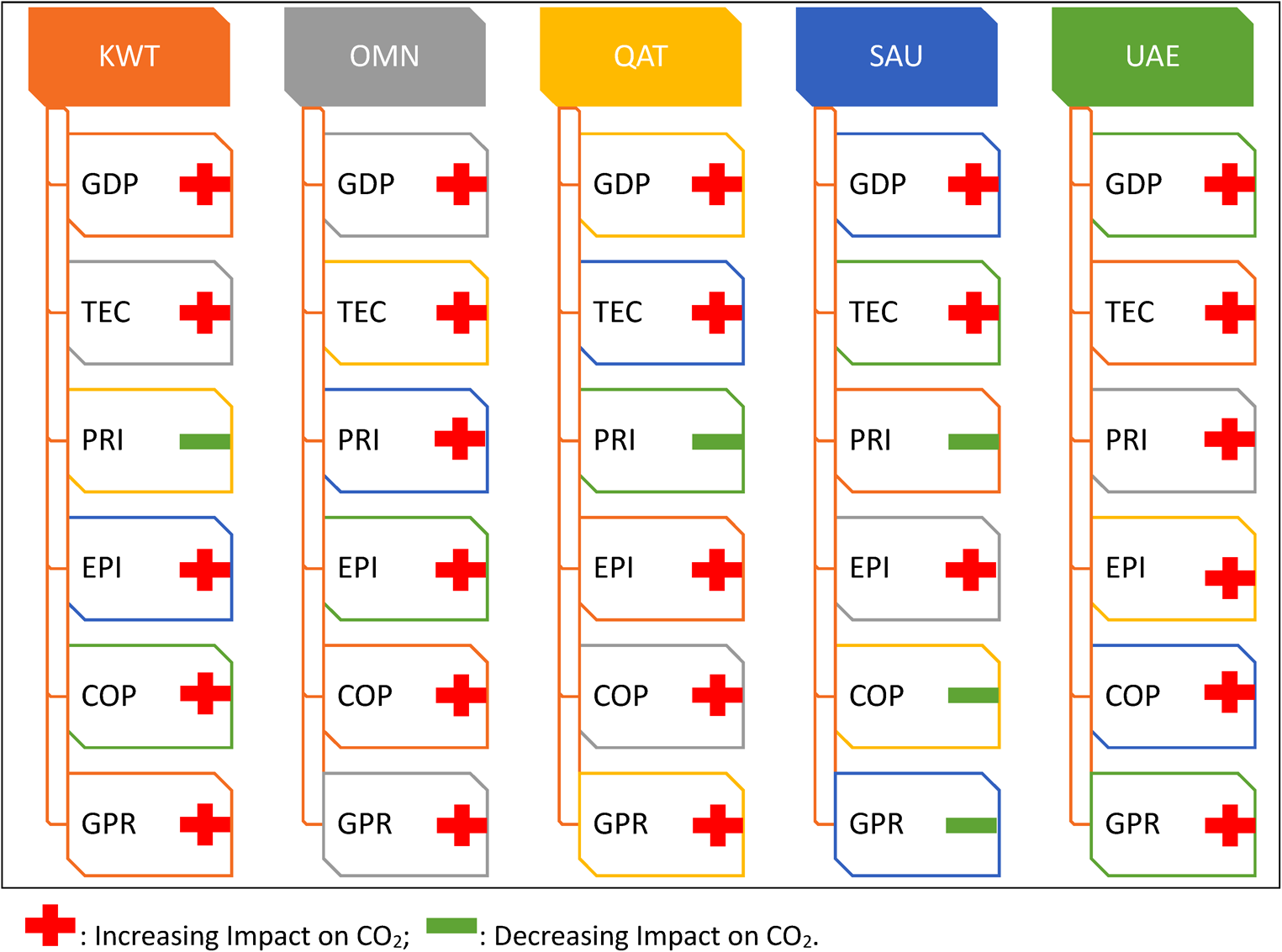
Get full access to this article
View all access options for this article.
References
Supplementary Material
Please find the following supplemental material available below.
For Open Access articles published under a Creative Commons License, all supplemental material carries the same license as the article it is associated with.
For non-Open Access articles published, all supplemental material carries a non-exclusive license, and permission requests for re-use of supplemental material or any part of supplemental material shall be sent directly to the copyright owner as specified in the copyright notice associated with the article.
