




Abstract
In response to the coronavirus disease 2019 pandemic, the Chinese government implemented blockade measures in Hubei, which largely affected the emission of pollutants. This work is aimed to explore the effects of epidemics on pollutants at different temperatures in Hubei, China. We applied for a panel nonlinear model with autonomous search thresholds to explore this, using daily average temperature as a threshold variable, and PM2.5 set as the explained variable, and the cumulative number of confirmed coronavirus disease 2019 cases set as the explanatory variable. An empirical analysis was conducted by running the proposed model and using nine cities in China most impacted by the pandemic. The results show that there was a non-linear negative relationship between the cumulative number of confirmed coronavirus disease 2019 cases and PM2.5. A more detailed non-linear relationship between the two was uncovered by the proposed panel threshold regression model. When the temperature crosses the threshold value (12.5 °C and 20.5 °C) in sequence, the estimated value was −0.0688, −0.0934, and −0.1520 in that order. This means that this negative non-linear relationship increased with increasing temperature. This work helps to explore the effect of coronavirus disease 2019 on pollutions at different temperatures and provides a methodological reference to study their nonlinear relationship.
Introduction
To fight the coronavirus disease 2019 (COVID-19) and effectively cut off the spread of the virus, governments of various countries have implemented lockdown measures.1,2 These lockdown measures have impacted on not only social and economic development but also on change in air pollutants3–5 to a large extent. Indeed, a growing number of scholars have been studying the relationship between COVID-19 pandemic and air quality.
Studies have shown that all studies evaluating the correlation between air pollutants (particulate matter, nitrogen oxides, hydrocarbons) and COVID-19 have found a statistically significant correlation.6–8 Adhikari et al. studied the relationship between air pollutants and newly confirmed cases in Queens, New York, and found a significant positive correlation between the two. 9 Fattorini et al. 10 found that for Italy, air pollutants are significantly related to the increase in the cumulative number of COVID-19 cases. Most studies assessed the correlation between the COVID-19 pandemic and multiple factors 11 related to air quality.12,13 For example, a comparative work by Li et al. 14 found a decreasing trend of atmospheric pollutants during this “time window” and 2019 based on the atmospheric quality index and atmospheric pollutants in Beijing-Tianjin-Hebei. Yang et al. 15 analyzed the secondary aerosol fraction in PM2.5 and the importance of regional transport during COVID-19 in Shanghai. Chen et al. 16 reported the effect of the restriction policies on private vehicles reduced the air pollution levels to some extent during COVID-19. He et al. 17 focused on the impact of COVID-19 epidemic to NOx emissions and put forward different control measures for different industries in reducing NOx emissions. However, the published work focused on the variation of the levels and the spatio-temporal patterns for air pollutants (PM2.5, PM10, SO2, NO2, CO, and O3) and the study sites were almost local area. 18 Some authors have assessed bivariate correlations,4,19,20 while others have considered potential environmental and regional confounders. Despite this discrepancy, the sum of available evidence suggests a causal relationship between COVID-19 and PM2.5, and it is not enough to evaluate in a bivariate manner and to make descriptive and relevant explanations.
Some researchers point out that further work on the relationship between the pandemic and air quality should consider other variables besides air pollutants, especially meteorological variables such as temperature.21–23 Wu et al. got the conclusion that the ambient temperature definitely affects the infectivity of COVID-19 virus but is not a decisive factor in preventing virus transmission. 24 Based on knowledge and experience with other coronaviruses, warmer weather favors a decrease in incidence and it is speculated that there may be a temperature range most suitable for the spread of new coronaviruses.25,26 This study proposes the hypothesis that as temperatures increase, the incidence of COVID-19 will be controlled, which in turn will have an impact on air pollution. Based on this idea, this study embeds temperature as a threshold variable to explore the nonlinear relationship between COVID-19 and air pollutants and temperature, to provide a more suitable nonlinear method for subsequent research, and to explore the effects of epidemics on pollutants at different temperatures. We discussed the relationship between the cumulative number of confirmed COVID-19 cases and PM2.5 in the 9 most severely affected cities in China. The study time frame ranged from January 23, 2020, the date of publication of the closure policy in Hubei Province, China, to March 23, 2020.
Data and methods
Data description
The samples used in this study are the 9 most severely affected cities in China, Wuhan, including Xiaogan, Huanggang, Jingzhou, Ezhou, Xiangyang, Huangshi, Yichang, and Jingmen. The data comes from the official website of the National Health Commission, 18 and the research scope is from January 23, 2020 to March 23, 2020. January 23 was when the blockade policy was released in Hubei Province. The next two months are considered to be a critical period for the development of the pandemic in China, 27 and it was used as a research scope to examine the impact of the pandemic on air pollutants.
As for the variables, the explained variable, according to the pollutant's situation during the pandemic period, selected PM2.5 as the air quality indicator, while other air quality indicators such as PM10, NO2, and CO were used as control variables. The data comes from the China air quality online monitoring and analysis platform. 28 The explanatory variable is the cumulative number of confirmed cases of COVID-19 to reflect the development of the pandemic, and is abbreviated as CASE. Studies 29,30 have shown that the COVID-19 pandemic is affected by temperature, and the daily average temperature (TEM) is used as the threshold variable.
Model settings
In order to investigate the impact of the pandemic on air pollution, the following basic linear model is constructed as equation (1).

In fact, the relationship between pandemic and air pollutants is usually not linear. 31 Although traditional linear models can describe the effect of the epidemic on PM2.5 to some extent, the effect of the cumulative number of confirmed cases of COVID-19 on PM2.5 may be different due to different effects of temperature. There may be one or more structural mutation points, showing a nonlinear trend of change.32,33 To deal with the nonlinear situation, the traditional processing method is to add the quadratic term of the explanatory variable to the original linear model or use the group regression method to subjectively judge the structural mutation point for estimation. However, models containing quadratic terms usually have collinearity problems, and artificial grouping is affected by subjective factors, which leads to serious errors in the estimation results. Obviously, traditional methods are not ideal when dealing with nonlinear problems.
The threshold effect model proposed by Hansen effectively avoids the above-mentioned problems. The essence of the threshold regression model is to use thresholds to divide the sample into two groups. The threshold regression model is used only when the estimated parameters of the two samples are significantly different. It uses Bootstrap to calculate the gradual distribution of statistics, and then autonomously searches for structural mutation points (threshold values). 34 According to the division of the threshold value, the nonlinear estimation of the variable relationship is realized. Drawing lessons from Hansen's model design ideas, combined with research works, 35 this study uses average temperature as the threshold variable, and sets the single threshold model of the pandemic and air pollutants impact as equation (2).

In equation (2), the subscripts i and t, respectively represent different cities and dates; variables Y, X, M, and K represent explained variable, explanatory variable, threshold variable, and control variables, respectively, and r represents the threshold value. When
Regarding the parameter estimation process, it is necessary to set the threshold estimation value to be known, substitute it into the model (2), and use the least square estimation (OLS) to obtain
The residual of vector regression is

The best estimate of the threshold is the parameter when

If there is a double threshold phenomenon, the model can be transformed into the equation (5).

Due to space limitations, the parameter estimation of the dual-threshold model is not being performed here, and the estimation process is consistent with the single-threshold model.
Model test
For regression models, it is generally required that the variables be stable. Therefore, first, the stationarity test of each variable, namely the panel unit root test, is performed. This study uses two types, the unit root test under the same root and the different root. If both types of tests reject the hypothesis that there is a unit root, it means that the series is stationary, otherwise it is not stationary.
LLC test belongs to the unit root test under different roots. The test process is mentioned in equation (6).

The unit root test under the different root is mainly combined with Fisher-ADF test. The Fisher-ADF test involves two combined

The second step is to test the significance of the threshold effect. The original hypothesis is that there is no threshold value. The bootstrap method is used to simulate its asymptotic distribution 36 to calculate the asymptotically effective probability value P, and judge whether the threshold effect is significant or not. Equation (8) is a likelihood ratio test.

The third step is to calculate the threshold value and test the significance of the threshold value. The original hypothesis is that the threshold estimate is equal to the true value. There are LR test statistics as mentioned in equation (9).

Results and discussion
The data used in this study comes from the data from January 23 to March 23, 2020, in 9 cities in Hubei Province, China, and has been logarithmically processed to reduce the impact of heteroscedasticity. Figure 1 shows the changes in PM2.5 in 9 cities. Before model regression, a unit root test is needed to test the stationarity of variables, and a cointegration test to avoid spurious regression. After that, the relationship between the pandemic and air pollutants was explored linearly and non-linearly.
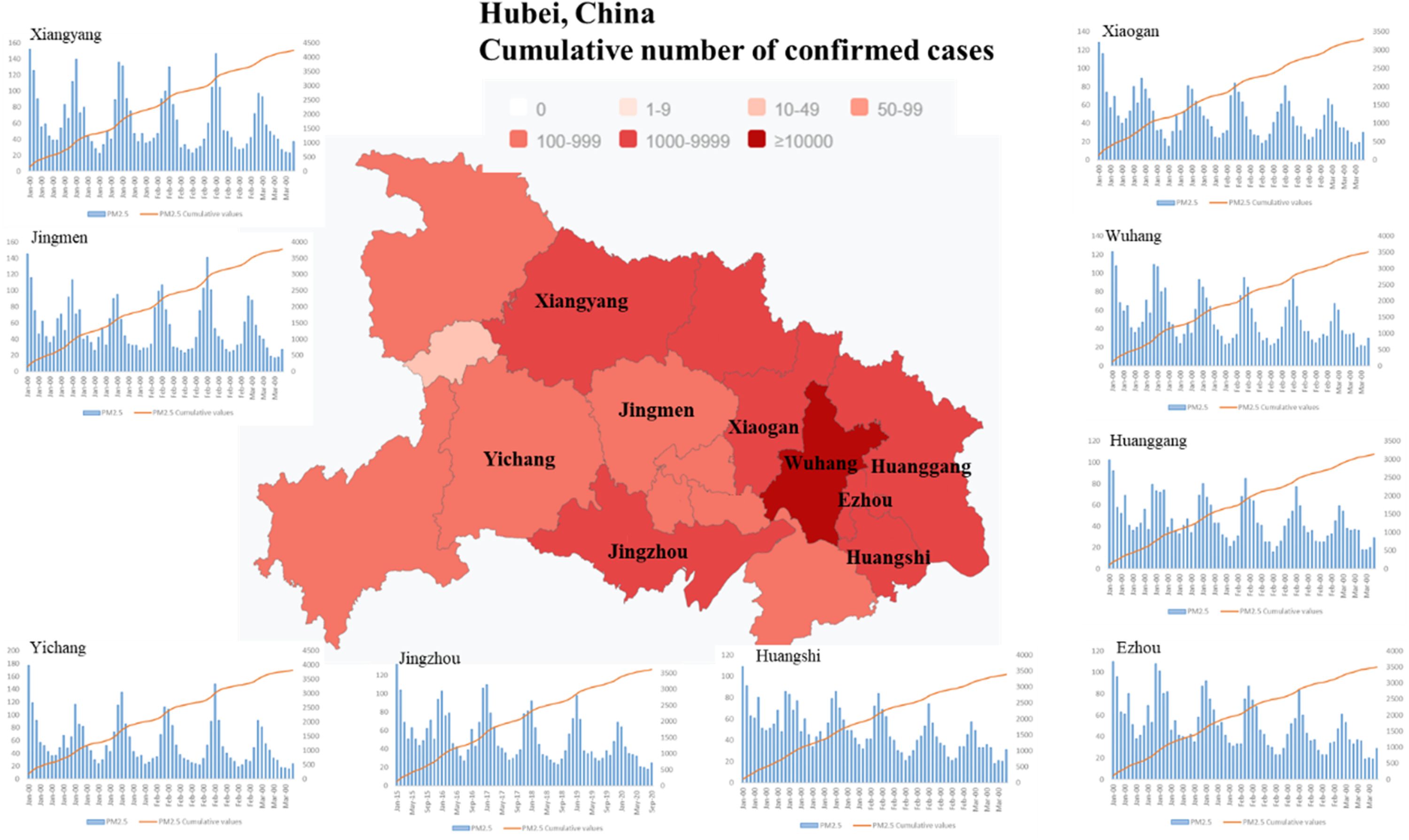
Changes in
Stationarity test
There are many unit root inspection methods for panel data. Two methods are used in this study to avoid different test results caused by the test methods. Table 1 shows the unit root test results of the first-order difference of each variable. It is found that the P values of the two methods corresponding to the eight variables are all significant. Therefore, there is no unit root and it is a single integer of the same order.
First-order difference test results of two methods.
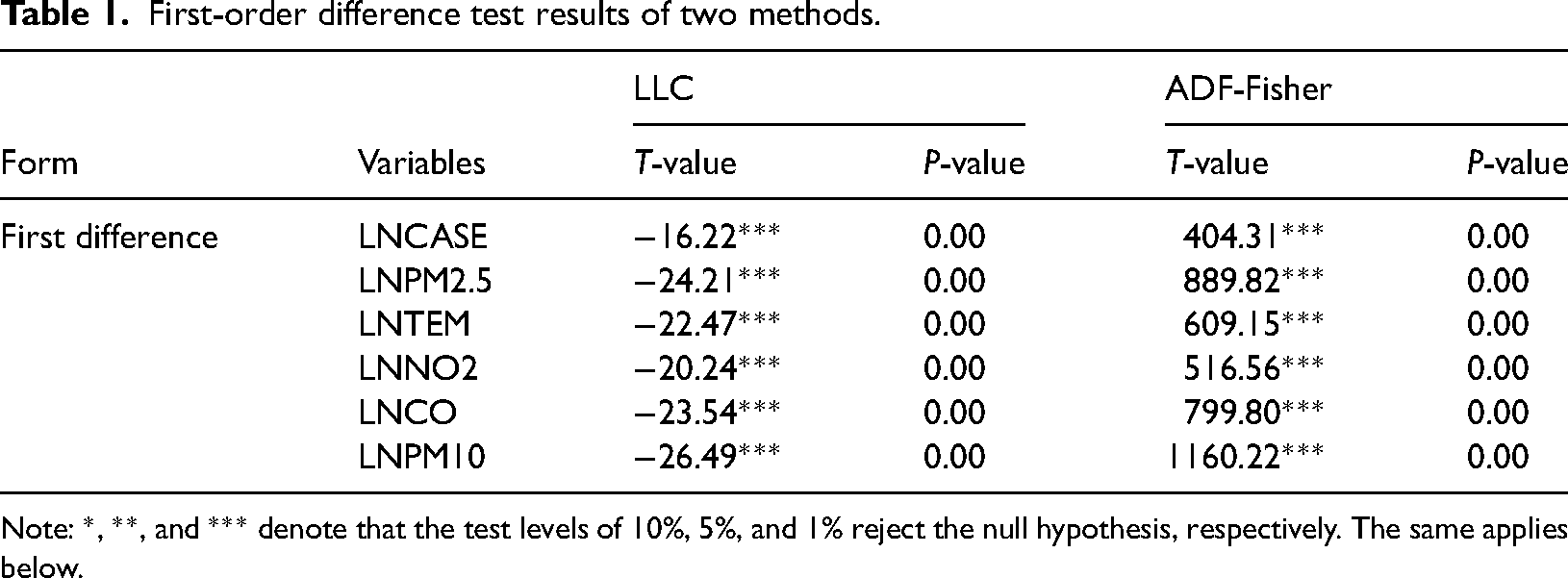
Note: *, **, and *** denote that the test levels of 10%, 5%, and 1% reject the null hypothesis, respectively. The same applies below.
Under the premise of integration of order one, the cointegration test needs to be further used to test whether the sacrificial variables are in a long-term equilibrium state. In this study, a homogeneous panel co-integration test, namely Kao test, was used. It can be seen from the results of the cointegration test in Table 2 that the P value is less than 0.05, and the original hypothesis is rejected. It is considered that there is a cointegration relationship, indicating a stable long-term relationship between the cumulative number of confirmed COVID-19 cases and PM2.5. Therefore, regression analysis can be performed on the model setting of the pandemic-to-air pollution research.
Kao cointegration test results.

Regression results and analysis
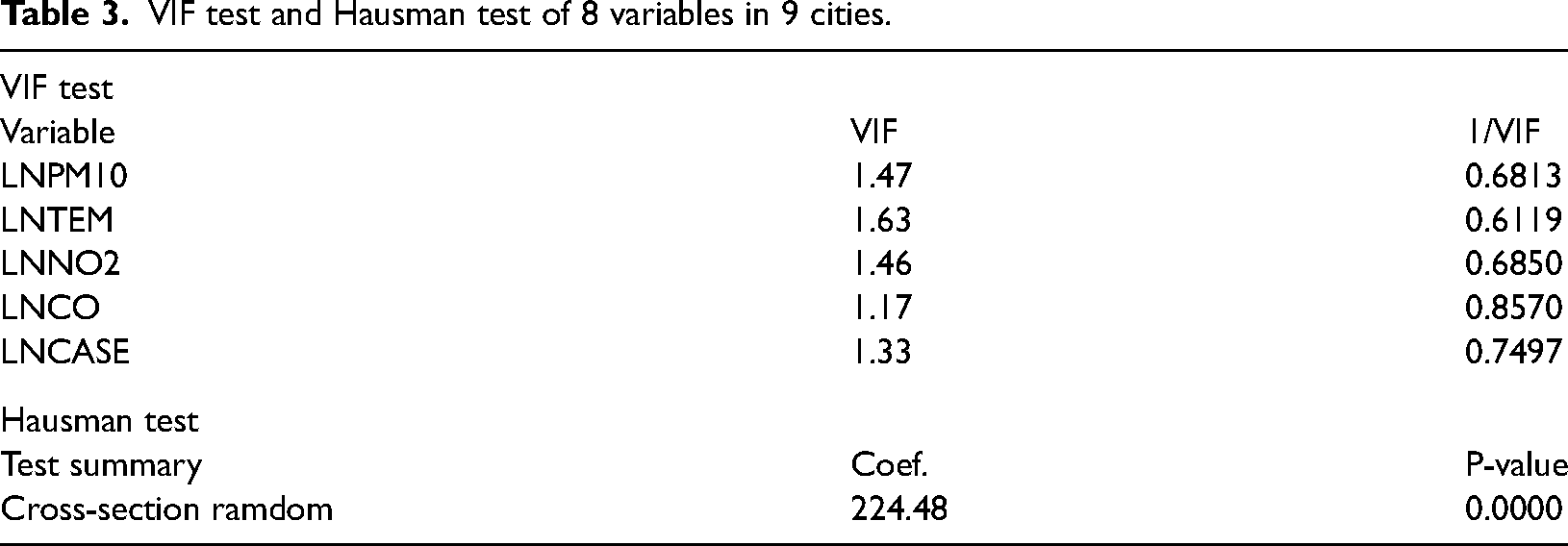
Panel Date models, including fixed effects models and random effects models, 37 are usually determined by the Hausman test. This study used the VIF test to eliminate collinearity, and established a variable coefficient random effect model to determine the choice of the Panel Date model. The test results are shown in Table 3. The results of the VIF test showed that the single variable VIF did not exceed 10 and the average VIF did not exceed 3, indicating that there was no collinearity. The Hausman test result rejects the original hypothesis at a significance level of 1%, so the fixed effects model was chosen for regression analysis. The specific fixed effects regression results are shown in Table 5, and the results indicate a negative correlation between the cumulative number of confirmed cases of COVID-19 and PM2.5.
VIF test and Hausman test of 8 variables in 9 cities.
In related studies exploring the impact of the pandemic on air pollutants, many studies have shown that temperature is an important factor. In this study, the daily average temperature was used as the threshold variable, and a panel threshold model was established to divide the impact of pandemic and air pollution into different temperature ranges. We used Bootstrap test to determine the number of threshold values (Table 4). The test results show that the dual threshold effect significantly rejects the original hypothesis at the 10% level, indicating that there is a dual threshold effect, this is, the impact of the cumulative number of confirmed COVID-19 cases and PM2.5 is non-linear. The threshold model is set as a dual threshold model, and the panel threshold regression is performed. The results are shown in Table 5.
Bootstrap test results of threshold effect.

Regression results of fixed effects model and threshold model.
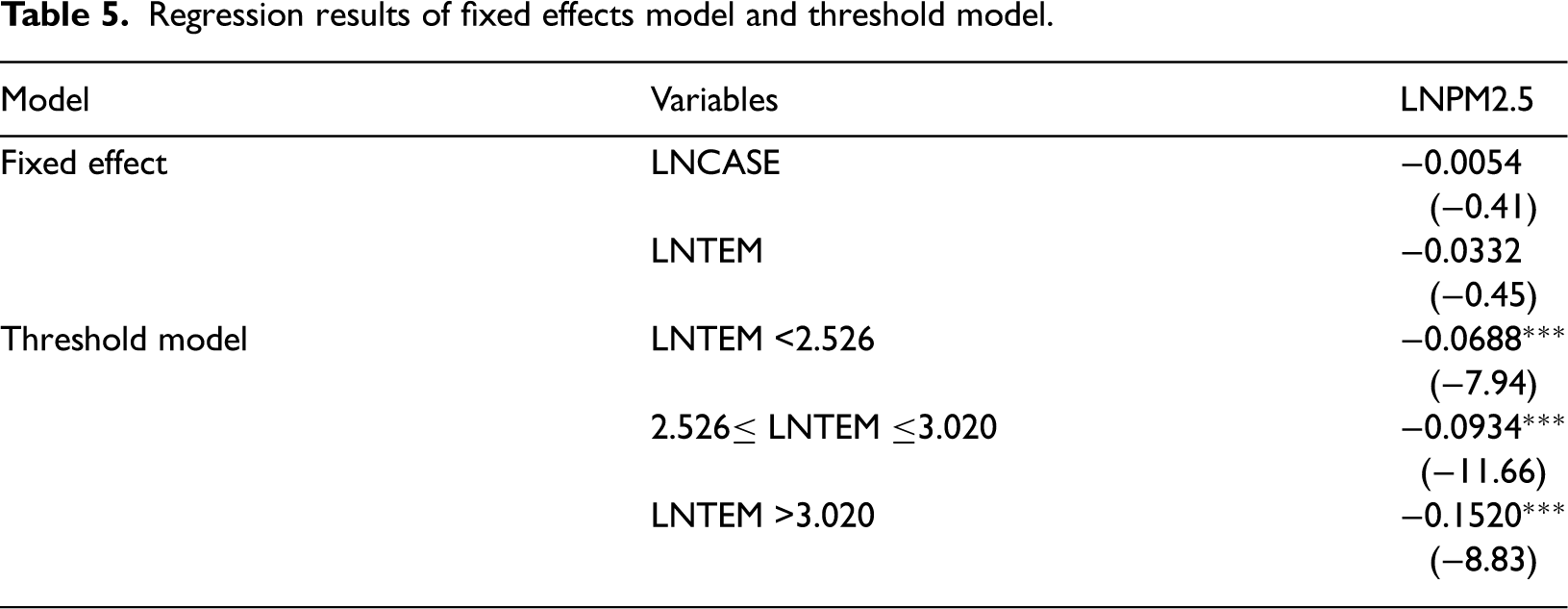
In the threshold model, the impact between the cumulative number of confirmed COVID-19 cases and PM2.5 is non-linear, with two mutation points and three intervals. Specifically, when LNTEM <2.526 (average temperature is lower than 12.5 °C), the elastic coefficient is estimated to be −0.0688, when 2.526 ≤ LNTEM ≤ 3.020 (average temperature is between 12.5 °C and 20.5 °C), the elastic coefficient becomes −0.0934. When LNTEM > 3.020 (average temperature is higher than 20.5 °C), the coefficient of elasticity rises to −0.1520. The coefficients of these three intervals are all significant at the 1% level and all are negative numbers, indicating that there is a very significant increasingly negative relationship between the cumulative number of confirmed COVID-19 cases and PM2.5. As far as the coefficient of elasticity is concerned, it shows that as the temperature rises, the improvement of air quality by the pandemic can be more obvious. With the arrival of spring and warmer temperatures, the control of the cumulative number of confirmed COVID-19 cases is expected to accelerate. On the one hand, combined with the high-temperature susceptibility of the virus itself, it may therefore have a positive impact on outbreak prevention and control along with the gradual warming across the globe. On the other hand, there may be a certain lag in the effect of temperature on the epidemic, and the use of the current day's temperature in the analysis corresponding to the new cases diagnosed on that day may also introduce some bias in accuracy.
This is mainly related to the lockdown measures taken by Hubei during the pandemic. Notably, China became the earliest epicenter of the outbreak in 2020 and enforced strict lockdown precautionary measures to limit the spread of the outbreak. From January to April 2020, stringent precautionary measures resulted in some key cities (including Wuhan) achieving the cleanest air quality on record during this period. Despite this, Chinese residents were still exposed to PM2.5 levels three times higher than the WHO annual guideline standard. The suspension of bus, subway, ferry, and long-distance passenger transportation, and the temporary closure of airports and railway stations have reduced air pollutant emissions and led to the improvement of air quality in Hubei during the pandemic.
In general, a conclusion similar to the above linear model can be obtained, that is, there is a negative relationship between the cumulative number of confirmed COVID-19 cases and PM2.5.
Conclusion
This study extends the existing research on the relationship between the cumulative number of confirmed COVID-19 cases and PM2.5, to quantify the nonlinear relationship between them. In this work, a panel nonlinear model with autonomous search thresholds was developed to explore the cumulative number of confirmed COVID-19 cases and PM2.5 with considering the temperature factor. The prosed model was used in 9 cities of China most severely affected by the pandemic.
In this proposed threshold panel regression model, PM2.5 (an indicator of environmental quality) was set as the explained variable, and the cumulative number of confirmed COVID-19 cases was set as the explanatory variable. Meanwhile, pollutant indicators such as PM10, NO2, and CO were used as control variables, and daily average temperature was used as the intermediary variable. The proposed model would not only enrich the application scope/research objects of the threshold panel regression model, but also provide a methodology reference for the quantitative analysis of the non-linear relationship between the cumulative number of confirmed COVID-19 cases and PM2.5. The results from the fixed effects model show there was a negative relationship between the change of confirmed COVID-19 cases has a negative relationship with PM2.5 in the 9 Chinese cities most severely affected by the Pandemic. And then, the results from the panel threshold panel regression model show that there are three thresholds between the cumulative number of confirmed COVID-19 cases and the change of PM2.5 concentrations. In particular, when LNTEM <2.526, the estimated value of the cumulative number of confirmed COVID-19 cases on PM2.5 is −0.0688, and when 2.526 ≤ LNTEM ≤ 3.020, the coefficient becomes −0.0934. When LNTEM > 3.020, the elasticity coefficient is −0.1520. Our empirical results indicate that the negative relationship between the cumulative number of confirmed COVID-19 cases and PM2.5 is nonlinear. Moreover, this negative nonlinear relationship was increased as the temperature rose.
Highlights
The relationship between COVID-19 and air quality was explored.
There is a negative relationship between epidemics and PM2.5.
The panel threshold model shows a double threshold effect.
As the temperature rises, an increasing negative relationship exists.
Footnotes
Declaration of conflicting interests
The author(s) declared no potential conflicts of interest with respect to the research, authorship, and/or publication of this article.
Funding
The author(s) received the following financial support for the research, authorship, and/or publication of this article: National Natural Science Foundation of China (Grant No. 72104246), the Fundamental Research Funds for the Central Universities(22CX04010B).
