




Abstract
High-energy consumption and high-emission industries contribute a lot to economic development, but their carbon emissions are also huge. In order to achieve the dual-carbon target as early as possible, it is necessary to reduce the carbon emissions of high-energy consumption and high-emission industries. This paper selected five representative factors (population, per capita gross domestic product (GDP), energy intensity, energy structure and carbon emission coefficient) and adopted the logarithmic mean divisia index (LMDI) method to decompose the driving factors of carbon emissions. Therefore, this paper uses Tapio decoupling model to analyze the decoupling relationship between the two factors with the greatest impact on carbon emissions and carbon emissions. The results show that: (i) There is a good decoupling between high-energy consumption and high-emission industries and per capita GDP, and the impact of per capita GDP on carbon emissions will gradually decrease in the future; (ii) The decoupling relationship between carbon emissions and energy intensity is poor. For some industries, the reduction of energy intensity can help reduce carbon emissions. Finally, this paper puts forward some suggestions to promote carbon emission reduction. This paper provides theoretical support for studying how to reduce carbon emissions and formulate relevant emission reduction policies in the high-energy consumption and high-emission industries.
This is a visual representation of the abstract.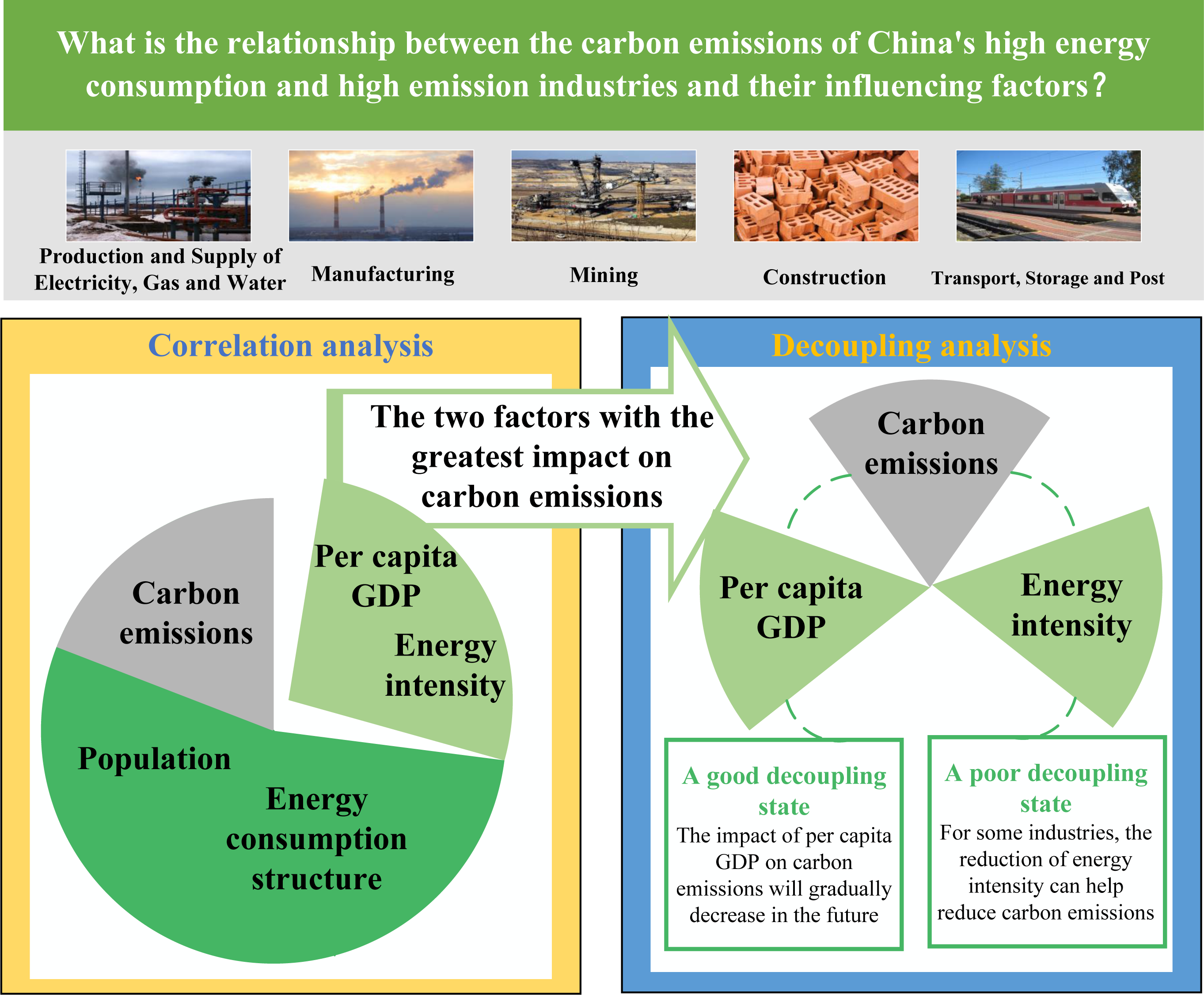
Keywords
Get full access to this article
View all access options for this article.
References
Supplementary Material
Please find the following supplemental material available below.
For Open Access articles published under a Creative Commons License, all supplemental material carries the same license as the article it is associated with.
For non-Open Access articles published, all supplemental material carries a non-exclusive license, and permission requests for re-use of supplemental material or any part of supplemental material shall be sent directly to the copyright owner as specified in the copyright notice associated with the article.
