




Abstract
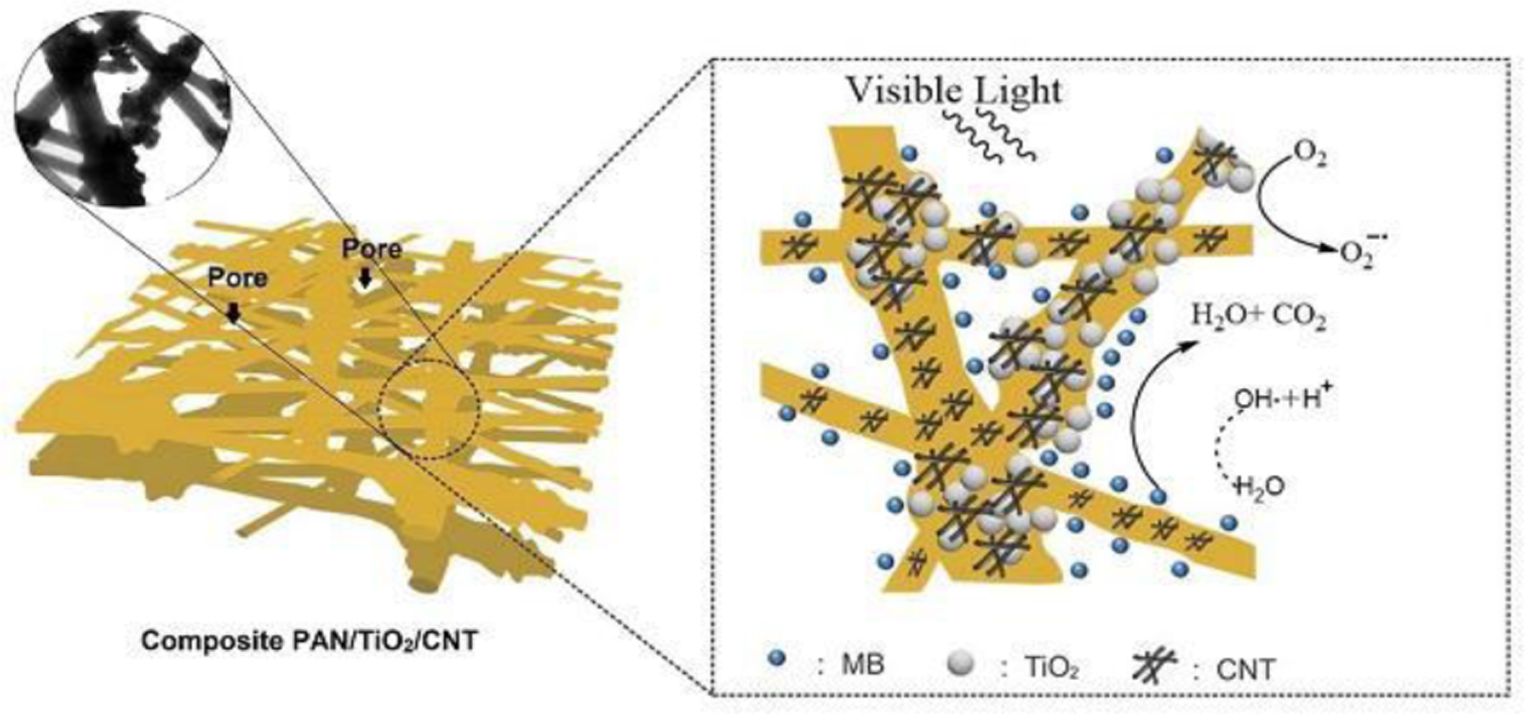
Incorporating TiO2 with CNTs and PAN nanofiber structures results in a photocatalytic membrane composite with an attractive response in the visible region. It offers an efficient process without post-treatment separation at the end of the photocatalytic treatment. The composite membranes were fabricated using electrospinning at 7 kV with 10 cm in the distance between needle tip and collector at a flow rate of 1 mL h−1. Polyacrylonitrile (PAN) was used as the polymer matrix. All the as-spun composites exhibited randomly oriented nanofibers. CNT increased the fiber diameters from 324 to 463 nm. The bandgap of TiO2 also shifted from 3.15 to 2.76 eV at the narrowest The color removal kinetics follow the Langmuir-Hinshelwood pseudo-first-order kinetics model with the highest rate constant of 0.0225 min−1 shown by PAN/TiO2/CNT 20%. More than 95% color removal of methylene blue after 100 min irradiation has been achieved using LED lamps of low energy visible light (43.5 W). Such a result is supposed to be the highest employing low energy lamps.
Get full access to this article
View all access options for this article.
References
Supplementary Material
Please find the following supplemental material available below.
For Open Access articles published under a Creative Commons License, all supplemental material carries the same license as the article it is associated with.
For non-Open Access articles published, all supplemental material carries a non-exclusive license, and permission requests for re-use of supplemental material or any part of supplemental material shall be sent directly to the copyright owner as specified in the copyright notice associated with the article.
