




Abstract
Eberhard Kranzmayer is arguably Austria’s most influential German dialectologist. The present article traces Kranzmayer’s Nazi years (NSDAP member number 8.061.495) in archival sources in Vienna, Graz, Munich, Klagenfurt and Berlin. This account reconstructs Kranzmayer’s role in the Nazi machine, especially his directorship of the ‘Institut für Kärntner Landesforschung’ [Institute for Carinthian Provincial Research]. Kranzmayer’s pan-German and völkisch orientations long predate his Nazi years; his studies under the Nazis are congruent with the positions he held pre- and, significantly, post-World War II. The new data presented here show that Kranzmayer’s second denazification proceedings was disingenuous. On the disciplinary level, Kranzmayer’s pan-German stance has had profound influence on the modelling of Austrian German, which today has caused many controversies; indeed, today, it seems tied inter alia to a ‘One Standard German Axiom’ (OSGA). It is argued that any materials that Kranzmayer collected, edited and published would need to be vetted by period historians for pan-German bias and mitigated before use.
Keywords
Introduction
In 1946, City University of New York linguist Max Weinreich published Hitler’s Professors, which offered a first assessment of the active roles of academics in the Nazi system. Weinreich, who wrote his dissertation under Ferdinand Wrede at the Marburg Sprachatlas, had intimate knowledge of German dialectology. Based on material secured by the US army, he delivered the initial assessment of the complicit role of university teachers in the war effort, concluding that ‘Before the world’s conscience, German Scholarship stands convicted’ (Weinreich, 1946, p. 242). Forty years would pass until linguists would look more closely at their field’s NS legacy (e.g. Maas, 1984; Simon, 1986).
While the past 20 years have seen such accounts in greater numbers and detail (e.g. Ash et al., 2010; Ash and Ehmer, 2015; Grabenweger, 2015; Hausmann, 2002; Maas, 2016; Pfalzgraf, 2019; Ranzmair, 2010), awareness of the long reach of conceptual presuppositions and data bias is still not widespread. As Hutton puts it:
The discipline of linguistics has in general preferred not to look at the central role played by ideas derived from linguistics in Nazi ideology, and the problem is often defined away in terms of a ‘confusion of linguistic and racial categories’ (Hutton, 1999: 2).
This paper is a case study of Eberhard Kranzmayer’s years in the Nazi system. It complements a previous study on Kranzmayer’s pan-German bias (Dollinger, 2023) and problematizes how the use of legacy data in linguistics, particularly within linguistic traditions from the early 19th century, inadvertently and against the best intentions may today produce hegemonic views in German dialectology and onomastics. There can be no doubt, however, that all European philologies are affected by such disciplinary filters, for example, English linguistics (e.g. Watts, 2011), which renders the problem as widespread.
In Hitler’s Professors, which only deals with major players in NS academia, Weinreich does not mention Kranzmayer, though his post-war peer Otto Höfler gets this dubious honour. Richard Wolfram, another close associate of Kranzmayer, is prominently discussed in Kater’s (2006) SS-Ahnenerbe (see, e.g. Dow and Bockhorn, 2004: 80–81). The present paper offers archival evidence that Kranzmayer’s doings in the Nazi period were comparable to the activities of Wolfram and Höfler and that Kranzmayer was, against his post-war claims, part of a Nazi group of Vienna Germanists. Academics who, in somewhat adjusted form, carried on their convictions, approaches and methodologies into democratic Austria, thereby instilling a bias on German dialectology for decades to come with repercussions for today. Kranzmayer was a central figure with considerable impact, ‘the most prominent and influential among the Viennese dialectologists’ (Penzl, 1986: 216) who ‘lastingly influenced Germanistik in Austria’ 1 (Fischer, 1980: 24).
Kranzmayer’s Nazi involvement, from possibly as early as the 1920s, but certainly from 1937, to 1945 and his post-war career necessitate a reassessment of pan-German and völkisch biases in the data collected by and under Kranzmayer for, among others, the Bayerisch-Österreichisches Wörterbuch and related projects. The Wörterbuch project has been ongoing since 1911 as a German-Austrian cross-border project in Vienna (WBÖ, Wörterbuch der bairischen Mundarten in Österreich,) and Munich (Bayerisches Wörterbuch). Current project leadership is presented with an opportunity to re-cast a project whose völkisch conceptualizations of German will have left traces in the data. 2
The present paper seeks to dispel today’s prevailing interpretations of Kranzmayer’s legacy, perpetuated by former students, as someone who ‘has accrued no guilt in the NS period, apart from working, from today’s perspective, in highly problematic institutions’ (Pohl, 2015: 13), 3 or who had ‘politically highly explosive connections’ [‘realpolitisch hochexplosive Verbindungen’] yet his data are ‘by themselves politically unproblematic’ [‘für sich genommen politisch unverfänglich’] ( www.dioe.at blog entry, 15 Apr. 2020). While Kranzmayer stated after the war ‘that my engagement happened far removed from the political arena’ [‘daß meine Tätigkeit sich fern von dem politischen Getriebe abgespielt hat’] (Kranzmayer 13 Oct. 1945, OeStA, qtd. in Jandl, 2022: 183), the archival work shows that he played in fact a vital role in a war-decisive NS Institute, in a role comparable with Parteifunktionär ‘party official’. As holder of such function and responsibility, Kranzmayer’s statements in his denazification proceedings were disingenuous.
Who is Eberhard Kranzmayer?
Eberhard Kranzmayer was born in 1897 as the youngest of six children in Klagenfurt, Carinthia, into a local family of copper smiths of old local lineage (KLA Nachlass Skudnigg, XIII/19 fol. 1-2). His father served in the Austro-Hungarian Imperial Army, where his life was saved by Aloisius Thaler, a Carinthian Slovene farmer, resulting in a ‘life-long friendship’ (KLA Nachlass Skudnigg, XIII/19 fol. 1-2). Kranzmayer was subsequently sent to the Thaler family to learn Slovene. (KLA Nachlass Skudnigg, XIII/19 fol. 1-2, KTZ 10.5.1975). Being conversant in both German and Slovene, Kranzmayer might have played a role in reconciling the two ethnic groups in Carinthia, not least in his position as the sole holder of a venia legendi for the Slovene language in the Third Reich. 4 Instead, he would choose the well-trodden path of amplifying German contributions at the expense of the Slovenes. Kranzmayer fought in two pan-German armed conflicts against Slavs, in Carinthia in May 1919 and in Upper Silesia in 1921, for which he received medals. 5
Kranzmayer is by far the most prominent member of the Wiener Dialektologische Schule (e.g. Wiesinger, 1983). With six festschrifts to his name to date 6 and a city street in his native Klagenfurt in his name, Kranzmayer has had influence beyond dialectology. He earned his doctorate in 1926 under Anton Pfalz – who would assume a high-profile NSDAP role at the University of Vienna – with a study on German dialect isolates in Northern Italy. In 1933, he was granted his Habilitation under Rudolf Much – of an infamous deutsch-national family in Georg von Schönerer’s circle –for ‘Geschichte der deutschen Sprache und deutsche Volkskunde’ [History of the German language and German ethnology], highlighting the connection between ethnology and language. This study would later be published as Kranzmayer (1944; Pohl, 2015: 13), which is one of Kranzmayer’s most extreme texts arguing for linguistic land claims in the name of Deutschtum (Dollinger, 2023: 75; Fritzl, 1992).
From 1918 Kranzmayer held numerous roles in the Vienna Chancery for WBÖ, working with Walter Steinhauser and Pfalz, who both were to become early and heavily involved NSDAP members, and with the Munich branch of the Wörterbuch, which included several work stints there. In 1938 he transferred from the Vienna to the Munich Chancery to assume directorship and an a.o. (außerordentliche) professorship at Munich University. From 1942 to 1945 Kranzmayer was director of the Institute of Carinthian Provincial Research, which was tied to an a.o. professorship at the University of Graz.
Kranzmayer was fired in June 1945 for his role in the NS system, but was rehired shortly after, only to be fired once more in 1946 by the British Occupation Forces and finally reinstated as of 1949 at the University of Vienna. For three and a half years after WWII, Kranzmayer was banned from work in academia. This period has been presented as an injustice that was remedied with his steep rise through the ranks, ‘perceived as gratification’ [‘als Genugtuung empfungen’] (Wiesinger, 1976: 3) after 1949 (e.g. Kühn, 1976: 43; Wiesinger, 1976: 2–3; Wiesinger and Steinbach, 2001: 118). Kranzmayer (1956–1958, 1956) published his key works in the mid-1950s based on the data that also informs the Wörterbuch. He would go on to examine about 160 PhD students in his 13 postwar years as a professor, students who would celebrate and defend him (e.g. Koß, 1999).
But this is not the whole story. In what follows I assemble information from previous studies by historians and Slavists, while bringing archival documents from Berlin, Klagenfurt, Graz, Munich and Vienna to the table, as well as an unknown published article by Kranzmayer. The evidence suggests that Eberhard Kranzmayer should never have been allowed to return to academia, a return that has had profound impact on the treatment of Austrian German by Kranzmayer’s virtual monopoly on knowledge creation in dialectology in postwar Austria. A monopoly that was, it will be shown, guided by großdeutsch ideas of German superiority.
Audio LPs for Hitler: ‘Die unverbrüchliche Treue zum Führer und zum deutschen Volk [griff] tief an unsere Seele’ 7
The 1939 April issue of Heimat und Volkstum, the journal of the Bavarian Academy that was ‘recommended by the NS Interior Ministry’ as of 1939 [‘ministeriell empfohlen’] (cover, 17(8), 28 April 1939), includes an article that dramatically clashes with Kranzmayer’s plea for clemency after 1945. The article is not listed in any of Kranzmayer’s bibliographies and shows one way of hiding evidence in plain sight. In the text, Kranzmayer informs the reader that he and Pfalz presented the Führer with a birthday present of recordings of Austrian dialects of German [‘es wurde denn unserem Führer zu seinem Geburtstag ein Werk geschenkt’] from a ‘freed Austria’ [‘befreiten Ostmark’]. The interviews were conducted immediately after Anschluss, as early as 5 April 1938. The result was a Lautdenkmal of the Ostmark that complemented the 1936–1938 Lautdenkmal reichsdeutscher Mundarten auf Schallplatten. This linguistic birthday gift for Hitler in 1938 was initiated by German bureaucrats (Reichsbund der deutschen Beamten) and conceptualized by Walter Mitzka and Bernd Martin from the Marburg Sprachatlas (Purschke, 2012).
Kranzmayer writes that the ‘Führer’s strong hand’ caused Austria’s ‘liberation’ with ‘the great joy of Anschluss’ (1939, p. 113) and proceeds to sketch the interviewing process and the selection of informants (see Figure 1):
When he [the informant] then heard eventually that the records would be a present for the Führer, the joy expressed itself over this unanticipated luck again and again. To witness such joy was the most beautiful moment for us [Pfalz and Kranzmayer] during the entire recording trip. It happened naturally that most of the people began to talk about their time as Illegal Nazis. All the heavy and depressing experiences which they had to endure, it all seemed already far removed from the current great joy of Anschluss, which became a reality for them over night, for people who had braced themselves for the most difficult, a pending civil war.
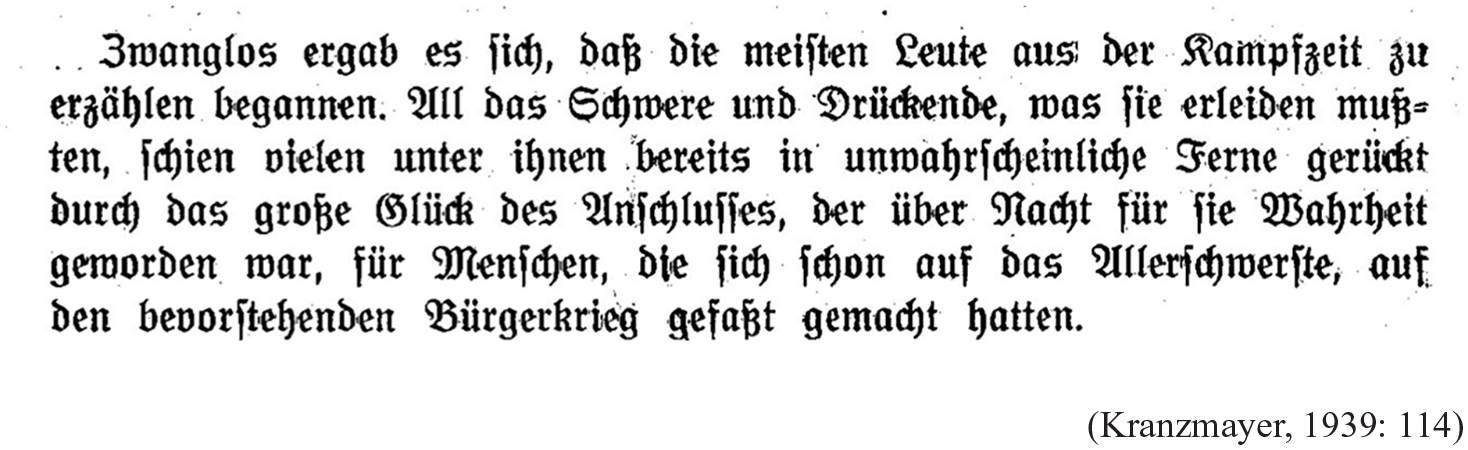
(Kranzmayer, 1939: 114)
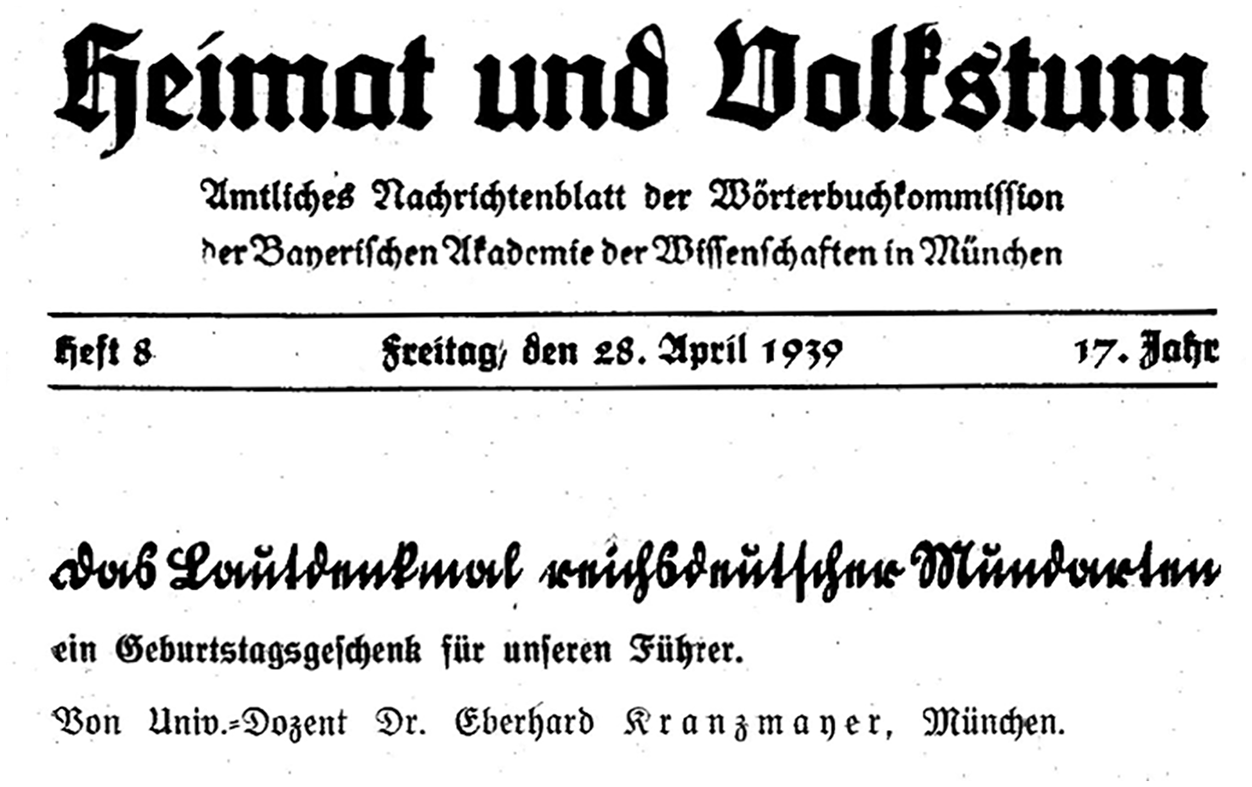
Kranzmayer’s (1939) ‘Lautdenkmal reichsdeutscher Mundarten: ein Geburtstagsgeschenk für unseren Führer’ (p. 114) above, and p. 113 below.
Kranzmayer’s mentison of Kampfzeit – fighting period – refers to the underground terrorist attacks by Illegal Nazis from 1933 to 1938. That Kranzmayer and Pfalz interviewed so many Illegals suggests their good contacts among the 164,000 illegal party members in March 1938 (Botz, 2016: 226) among an Austrian population of 6 million. Kranzmayer exuberantly reported on the hardships of Illegals and their tricks, who managed to hoist Swastika flags or, while forced by police to pick up swastika leaflets, to drop new ones (114–115). Such interviewee selection is a considerable bias that may be omnipresent in Kranzmayer’s data elicitation. As the data are the base for many projects, the WBÖ, its Bavarian sister dictionary, dialect atlases and academic work to this day, it raises the question of the data’s overall integrity for dialectological research and how such bias might be mitigated.
Kranzmayer’s correspondence with the deutsch-national historian Martin Wutte (Fritzl, 1992: 52–60) offers additional information for the time between 1928 and 1938 (KLA Wutte Martin NL Sch 1-73 Su). Wutte was celebrated by the Nazis (Wedekind, 2017: 1436) and around the time of Hitler’s Machtergreifung Wutte and Kranzmayer switched to the informal ‘Du’ and closer terms of address, for example ‘Mein lieber Wutte!’. Kranzmayer wrote in March 1933 that on the occasion of the installation of the Nazi Reichstag parades were held, schools were closed and flags flown [‘große[n] Umzügen, schulfrei, beflaggt’] and that the excitement was great and ‘hopefully also lasting’ [‘die Begeisterung groß’ and ‘hoffentlich auch anhaltend’] (Kranzmayer to Wutte, 22 Mar. 1933). The correspondence with Wutte expresses Kranzmayer’s hopes for lasting NS excitement, muted but clear and the close relationship he had built by 1938 with Wutte, who became a family friend who was always welcome in Kranzmayer’s home.
NSDAP application(s) and illegal NS activities
In the postwar period it was common to conceal one’s positions in the Nazi system. After initial denial, Kranzmayer admitted by 1947 that in ‘Juli oder August 1937’ he applied for membership in the NSDAP (UGA, PA Kranzmayer, Gesuch, 1947: 3). A date prior to 12 March 1938 makes him an Illegal Nazi, as from 1933 to 1938 the NSDAP was forbidden in Austria, and the strictest sanctions were reserved for Illegals in the post-war period. Kranzmayer explained his wish to relocate to the Munich Word Chancery, an effort which he had initiated in 1936 and for which the Dean of the Philosophische Fakultät expressed support though he ‘made me [Kranzmayer] aware that for a transfer, resp. transition . . . my membership in the NSDAP would be necessary’ 8 (UGA, PA Kranzmayer, Gesuch, 1947: 2). The Dean, Kranzmayer writes, dispelled his concerns about the illegal status of the NSDAP in Austria (UGA, PA Kranzmayer, Gesuch, 1947: 23) for an application that was ‘backdated for better optics to 1 Jan. 1937’ [‘aus optischen Gründen mit 1.1.1937 rückdatiert’]. From that point on, Kranzmayer referred to himself in his letters as ‘Pg’ (Parteigenosse – NSDAP party member).
In his 1947 plea for clemency, Kranzmayer performs rhetorical justifications to explain his party membership:
In the course of 1939 I was informed in Munich that my application for party membership was denied on account of insufficient political involvement. Im Laufe des Jahres 1939 erhielt ich in München die Verständigung, mein Aufnahmegesuch in die NSDAP. sei mangels Vorliegens einer politischen Betätigung abgelehnt worden. (Kranzmayer May 1947: 4)
Kranzmayer’s application, however, was not denied [‘abgelehnt’] but put on hold [‘zurückgestellt’]. The time line of his 1937 application is puzzling and it is unclear why the file would take three years to be dealt with. On 1 Aug. 1939, Vienna Gauhauptstellenleiter Kamba reports that Kranzmayer did not reside long enough at any one of his five Viennese addresses between 1933 and 1937 to allow for political assessment. 9 The Gauamt Wien confirmed on 29 April 1940, not in 1939 as claimed above, that Kranzmayer’s application should be put on hold (‘zurückgestellt’) until the member moratorium had ended ‘because the applicant has not been an NSDAP member and cannot prove sufficient illegal activities’ 10 (ÖStA, GA Kranzmayer).
The reason for Kranzmayer being put on hold is in all likelihood his Vaterländische Front (VF) membership. An archival source from October 1935 explains how the NSDAP would have known about Kranzmayer’s VF membership, as Kranzmayer himself reported a mysterious visit to his private residence in Vienna on 2 October 1935 to his University of Vienna superiors Dietrich Kralik and Anton Pfalz, shown in Figure 2 (Kralik, too, would join the NSDAP, Wiesinger and Steinbach, 2001: 86).
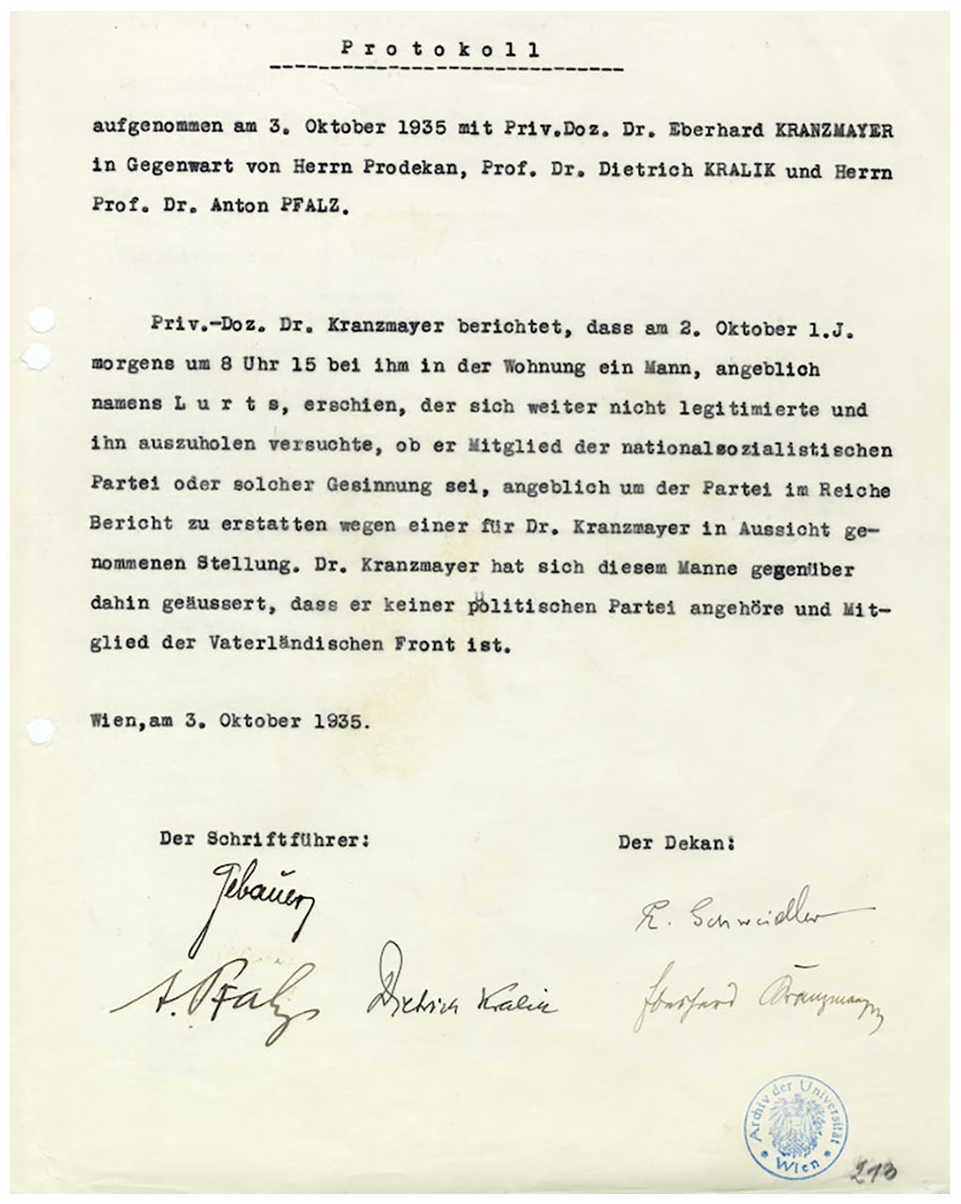
Kranzmayer’s 1935 affidavit on an unknown visitor inquiring about his loyalties to the Nazi party (UW Archives, Ph_PA_2301: 226, with kind permission).
In the incident, a man named Lurts is inquiring about Kranzmayer’s sentiments towards the Nazi party, claiming that a job opportunity was being vetted for him in the Third Reich. Kranzmayer replied that he was only a member of the Vaterländische Front. As the NSDAP was forbidden in Austria, this protocol must be seen as Kranzmayer covering his back. Any report of Lurts in the Nazi files would have complicated and bogged down Kranzmayer’s 1937 membership application. His membership in the VF is confirmed in a certificate ‘as of 1 April 1934’, membership number B 314.315 (UW Archives, PA_2301: 221).
In the postwar period, Kranzmayer would use these delays with his 1937 NSDAP application in his defence. He reports that he did not inform his Munich superiors of his being ‘zurückgestellt’ when he heard about it ‘in the course of the year 1939’ (Gesuch, 1947: 3). He claims to have soon felt repercussions in Munich as he was ‘immediately’ recruited for army service, from which he was released on 16.9.1940 for medical reasons [‘infolge eines Leber- und Gallenleidens’] (Gesuch, 1947: 3). Kranzmayer claims to have received ‘provisional membership’ [‘vorläufige Aufnahme’] in the NSDAP as late as 25.4.1941. His NS-registration card dates his NSDAP membership from ‘1.7.1940’ till ‘Mai 1945’ with ‘Mitgl.-Nr. 8.061.495 (rosa Karte)’ (KLA, Kranzmayer NS-Registrierungsblatt, Stadt Klagenfurt, Sch. 707, Nr. 1942), which gives reason to suspect more than one application. Given that extant files relating to an application are dated in the summer of 1939, it seems possible that Kranzmayer either attempted to remedy his earlier ‘zurückgestellt’ application in the winter or spring of 1939 or that he re-applied. Historians Baur and Gradwohl-Schlacher (2011: 156) consider Kranzmayer ‘doubtless a national socialist since 1 January 1937’. 11
The question of Kranzmayer’s status as an Illegal Nazi was an early conundrum, however. On 19 June 1946, a University Graz Sonderkommission interrupted its discussion of Kranzmayer’s case because it was unclear (‘nicht klar’) if Kranzmayer should be treated as an ‘Illegal Nazi’ or not (Jandl, 2017: 80). 12 There is today solid evidence, however, that Kranzmayer was a Nazi long before 1937. Kronsteiner (2016: 693) considers him as an Illegal as of 1933 and König (2003: 1005) identify him as a member of the National Socialist Teacher’s Federation (NSLB) – founded in 1929 (Schaller, 2002) as ‘not a lobby of teachers but a platoon for the take over by Adolf Hitler’ (Schäffer, 2006). 13 When he officially joined an NSDAP organization may be difficult to reconstruct today, but he was beyond doubt one of the Illegal Nazis in Austria, whether from 1937, 1933 or even the 1920s.
Regardless of the bureaucratic problems with Kranzmayer’s application(s), his character assessment by the NS Dozentenbund at the University of Munich is extant, shown in Figure 3. The NSDB considered Kranzmayer as ‘glowing’, from ‘the bottom of his heart’ with ‘love for German Volk and German soil’:
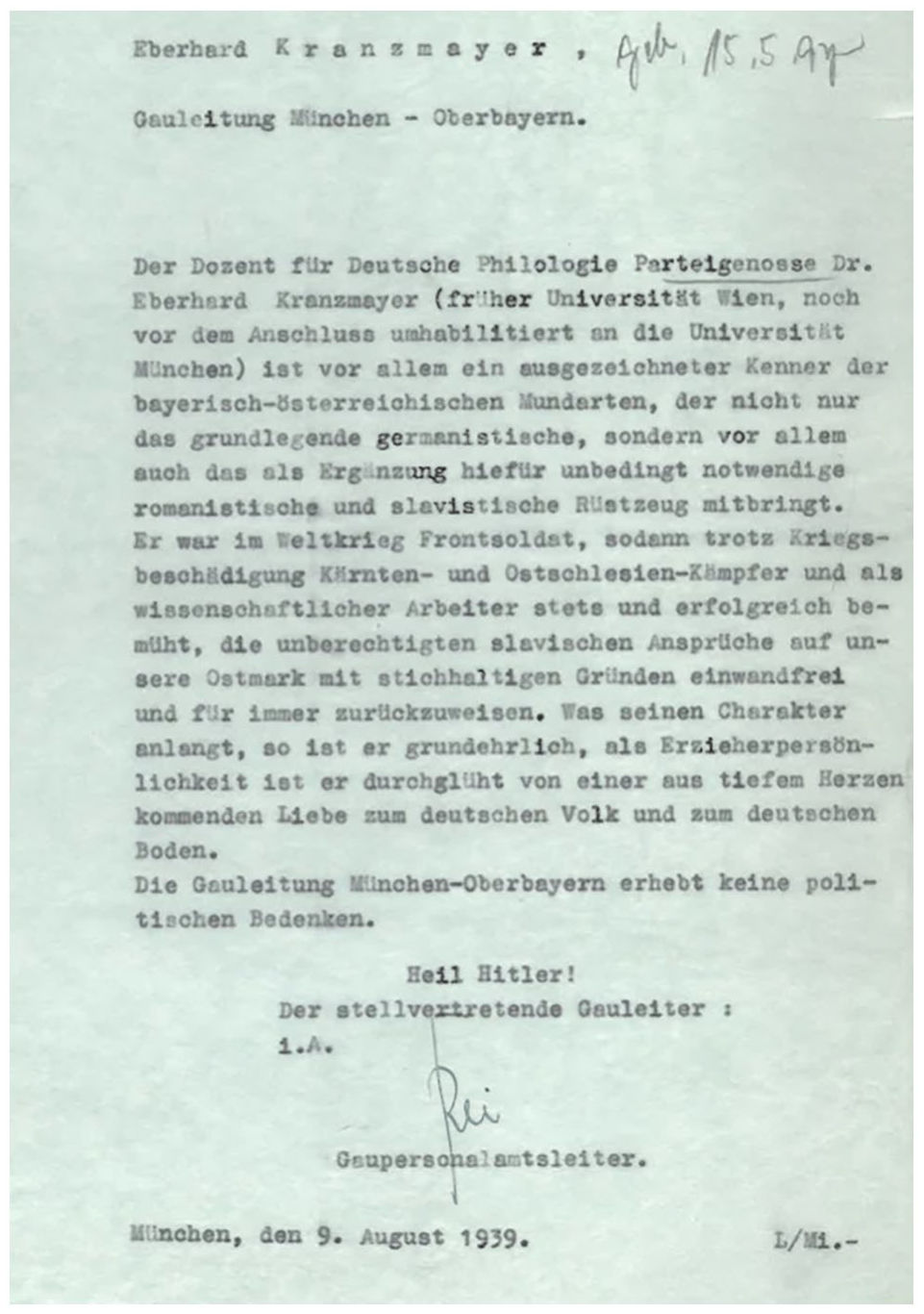
Gauleitung München assesses ‘Parteigenosse Kranzmayer’, 9. Aug. 1939 (BArch-R9361-II-572666 in compliance with Benutzerantrag 1 Feb. 2022).
Figure 3 casts a shadow on Kranzmayer’s post-war line of defence, in which he motivated his joining the party with job security and claimed to have used his membership, a common trope in denazification proceedings, ‘to help people in need’:
that my membership in the NSDAP was a purely formal membership and that financial worries have caused me to join. I have never gained any advantage from my membership and have never used it to cause anyone ill. On the contrary, I have aimed to help people in need. The kind of research I work on clearly shows my love for Austria. I have always tried to serve the state faithfully and I plan to prove this, from Day 1, for the democratic Republic of Austria. daß meine Mitgliedschaft zur NSDAP. eine rein formelle war und dass mich lediglich Existenzsorgen zum Beitritt veranlassten. Ich habe auch aus meiner Mitgliedschaft keinerlei Vorteile gezogen und dieselbe nie dazu missbraucht, irgend jemanden Schaden zuzufügen. Im Gegenteil war ich bestrebt in Not geratenen Menschen zu helfen. Schon die Art des von mir gewählten Fachwissens zeigt klar meine Liebe für Österreich. Ich war immer bestrebt dem Staate durch treue Mitarbeit zu dienen und habe dies auch der demokratischen Republik Österreich vom ersten Tage and, bewiesen. (Kranzmayer, 17 May 1947: 7)
After the war, university professors with NS involvement were treated leniently in Austria. The degrees of involvement were, as in Kranzmayer’s case, denied and advantages were often downplayed (e.g. Pfefferle and Pfefferle, 2014). In fact, the advantages of NSDAP membership were profound. Career-wise they included ‘by way of as close a cooperation as possible with Ahnenerbe’ 14 travel privileges into the occupied zones in Slovenia and Italy, including Kranzmayer’s research stay in the fall of 1940 in the Italian Kanaltal (BArch-NS21-1781: 1).
The Slowenen-Reichsinstitut called ‘Institut für Kärntner Landesforschung’
Despite its harmless name, the Institut für Kärntner Landesforschung was a unit that produced the ideological underpinnings of ‘Umvolkung’ (ethnic change) and Germanization in the Third Reich’s south. The Institute, a political research institution, was directed by Kranzmayer and was founded in the aftermath of the failed expulsion of Slovenes, which began with a directive by Heinrich Himmler. On 14 and 15 April 1942 ‘several hundred Slovenian farming families’ (Fischer, 1980: 45) were forced to relocate and leave Upper Carniola [Oberkrain], which triggered Partisan resistance in what would be the ‘only serious military resistance against the NS-regime in Austria’ (Fischer, 1980: 47, see also Pirker, 2010).
Subsequently, a plan was devised to implement Germanization among those who carried ‘enough German blood’ (in Himmler’s words, Knight, 2020: 58), while eliminating all others. Kranzmayer’s Institute, together with the conjointly founded Kärntner Wissenschaftliche Gesellschaft (1942–1944), played the key role of discriminating the ‘good’ Slavs (so-called ‘Windisch’ Slovenes) from the ‘bad’ Slavs (‘real Slovenes’). Kranzmayer was in charge of creating the scientific basis for a ‘re-Germanization of the Upper Carniola Slovenes’ (Kronsteiner, 2016: II: 693–694). Wedekind summarizes that
Even more fully than many of the other völkisch institutions, the founding of the Institute for Carinthian Provincial Research … on 10 Oct. 1942 was from its inception exclusively geared towards expansion and aggressive ethnic-political goals. stärker noch als im Falle zahlreicher anderer volkstumswissenschaftlicher Einrichtungen gehorchte die Gründung des Instituts für Kärntner Landesforschung in Klagenfurt . . . am 10. Oktober 1942 von Beginn an und ausschließlich expansions- und aggressiven bevölkerungspolitischen Zielsetzungen. (Wedekind, 2017: 1433)
The founding of the Institute is owed to NS plans of ethnic cleansing that were coordinated with the highest NS leadership level. Gauleiter Friedrich Alois Rainer (1903–1947) gave a ‘Führervortrag’ before Hitler on the Institute on 22 January 1942 in Rastenburg, with Heinrich Himmler and Martin Bormann present (Wedekind, 2017: 1434 & fn 6, Williams, 2005: 147, fn 318). On Hitler’s orders, the Institute was to be ‘established immediately’ [‘sofortige Errichtung eines Institutes’] because of its ‘war-decisive character’ [‘als kriegsentscheidende Einrichtung’] (Wedekind, 2017: 1434). Kranzmayer was to intensify and strive ‘for a collaboration as closely as possible of the Institute, which is of stellar importance in the fight against the Slavic political and cultural claims, with Ahnenerbe’ (Siegfried Fuchs, Rome, 31.3.1943 to SS-Sturmbannführer Dr. Plassmann, BArch-NS21-1781). 15
The Institute had been initiated by Rainer’s predecessor, Gauleiter Kutschera, who expressly harnessed ‘Wissenschaft’ to fulfil the ‘Führerbefehl’ (Führer’s order) to make Upper Carniola ‘deutsch’. Kranzmayer was named in the first personnel plan from March 1941, with ‘Kranzmayer – München’ added by hand (Ferenc, 1980: Dok. 89). In that document, Gauleiter Kutschera identifies the purpose of this ‘Wissenschaft’:
I assure you, Herr Minister, that the Führer’s order “Make the land [Upper Carniola] German for me” demands that Wissenschaft, as always so here as well, works beside the sword. Ich darf versichern Herr Minister, dass die Erfüllung des Führerauftrages, »Machen Sie mir das Land [Oberkrain] deutsch!« es erfordert, dass die Wissenschaft wie immer, auch hier, sich neben das Schwert stellt. (Gauleiter Franz Kutschera, 17 June 1941 to Reichminister Rust; Ferenc, 1980: Dok. 89)
The main research question was, in Kutschera’s words, ‘why Upper Carniola had a “racially excellent population”’ (Fritzl, 1992: 124). 16
There were financial problems as the war expanded to the East. On 20 March 1942, the secretary of the Reichsminister and Chef der Reichskanzlei, Dr. Lammers, informs Rainer of an austerity package, which resulted in personnel cut backs (BArch R 4901/13425, 143/333). At that time, Rainer, who had been Martin Wutte’s student at a Klagenfurt Gymnasium, repeated his urgent request to grant leave for Kranzmayer in Munich: ‘The Gau leader requests once more for Kranzmayer’s expedited leave’ (BArch R 4901/13425, 140/333)]. 17 Kranzmayer was essential for the Institute, he was its völkisch-intellectual anchor point.
In light of the funding problems, Rainer decided to start the Institute without further delay with bridge funding from the Gau in a downscaled version that was expanded and largely federally funded by 1943. The name of ‘Reichsinstitut für Kärntner Landesforschung’ was Reichsminister Rust’s idea (BArch R 4901/13425, 125/333), though the Institute was variously called ‘Slowenen-Institut’, ‘Reichsinstitut zur Lösung der Slowenenfrage’ [Reichs-Institute for the Solution of the Slovene Question], ‘Grenzlandinstitut’ and cynically ‘Forschungsinstitut für die deutsch-slowensichen Kulturbeziehungen’. Prof. Heinrich Harmjanz, who was Volkskundler at Uni Frankfurt/M, SS-Ahnenerbe scholar, and Beamter in the Ministry of Education (Kater, 2006: 74 & 95), summarized the Institute’s mandate on 13 Oct. 1941 for Rust:
The particular Institute is tasked with finding a practical solution to the problem of the Germanization of the Slovenes. This question is not [inserted by hand: “alone”] the task of a scientific Institute under the aegis of the Reichs Education Minister. Das in Frage kommende Institut soll die Eindeutschungsfrage der Slowenen praktisch lösen. Diese Lösung ist nicht [handschriftlich eingefügt: „allein“] Aufgabe eines dem REM [Reichserziehungsministerium] unterstehenden wissenschaftlichen Instituts. (BArch R 4901/13425, 65/333)
After a connection of the Institute with the Berlin and Vienna universities was vetoed by local politicians, a decision in favour of Graz was reached with Kranzmayer’s involvement:
On 16 July 1942 finally arrived a protocol from Berlin, from a meeting on 11 July 42 in Klagenfurt between K. Medwed and Harmjanz that the Institute should be linked to Uni Graz, Kranzmayer and Medwed (Reichs-Municipality Klagenfurt) agree. Am 16. Juli 1942 schließlich das Protokoll aus Berlin, von einer Besprechung am 11.7.42 in Klagenfurt zw. K. Medwed und Harmjanz dass das Institut an die Uni Graz angeschlossen wird, Kranzmayer und Medwed (Reichsstatthalterei Klagenfurt) haben sich einverstanden erklärt. (BArch R 4901/13425, 155-156/333)
Any university affiliation should be ‘under condition of complete independence’ [‘unter der Voraussetzung völliger Handlungsfreiheit’] of the Institute. Harmjanz called the university merely a ‘conduit for federal monies for the benefit of the Institute’ [‘Durchgangstelle der [Bundes] Mittel, die dem Reichsteil des Institutes zufließen’] as any tasks ‘can only be assessed and directed from Carinthia’ [‘nur von Kärnten aus beurteilt und gesteuert werden kann’] (Rainer to Rust 18.9.1942, 201/333).
The Institute as a political unit was central in occupied Yugoslavia and Italy and Kranzmayer was involved at almost every stage of its planning. In meeting minutes from 17 March 1942 in Munich, Kranzmayer partook in pre-planning with Gauleiter Rainer, Munich University President and SS-Ahnenerbe leader Wüst and SS-Ahnenerbe Secretary Sievert (Ferenc, 1980: Dok. 207). Later on, when put on federal payrolls, Kranzmayer would directly negotiate with minister Rust to further expand the Institute. For instance, he reminded Rust in the spring of 1944, with D-Day looming, of the war-critical nature of the Institute:
In the South, German Wissenschaft has acquired by order of the Führer via the Gauleiter in Carinthia, Dr. Friedrich Rainer, new tasks which must be dealt with by the Institute for Carinthian Provincial Research. Der deutschen Wissenschaft sind im Süden durch den Auftrag des Führers an den Gauleiter in Kärnten, Dr. Friedrich Rainer, neue Aufgaben erwachsen und müssen vom Institut für Kärntner Landesforschung . . . bewältigt werden. (Kranzmayer 24 Mar. 1944, to Reichsminister Rust, 320/333)
Such statements make Kranzmayer a perpetrator, a Täter, in a generously supported Institute for the academic justification of ethnic cleansing. The sums involved were substantial. Kranzmayer’s annual pay, for instance, was with living allowance plus children’s bonus annually 12,419 Reichsmark (RM; BArch R 4901/13425, 103/333); the annual institute budget was 47,740 RM for 1941 ([BArchR 4901/13425, 100/333] and 63,550 RM for 1942, with initial recruitment costs of 115,226 RM (BArchR 4901/13425, 109/333). Compared with an annual worker’s wages between RM 1400 (cleaner) and RM 2000 (janitor; BArchR 4901/13425), or the annual budget of RM 2700 for the German department at the University of Vienna in 1938 (Ranzmaier, 2005: 58), we see the exorbitant sums that were invested. The 1942 budget was delayed as Kranzmayer ‘was ill for some time’ [‘einige Zeit krank war’] (BArch R 4901/13425, 96 of 333), showing his central role as administrator of an NS institution.
The scope was considerable too. In 1943, 11 civil servants (of 13 budgeted ones) were on the Institute’s payroll (BArch R 4091/13425 p. 262–264/333): 3 außerplanmäßige professors (Kranzmayer, Georg Graber [Volkskunde], Viktor Paschinger [Geographie], 5 research posts, of which 3 were filled, Karl Dinklage [Prehistory], Günther Glauert [Geography], H. Friedl [Rassenkunde], 3 assistants (Georg Baumeister [Germanistik], Annemarie Richter [Geographie] and Oskar Moser [Volkskunde], with Rudolf Unger [Kanzleileiter] and Fritz Zopp [Bücherwart] and 3 (of 8 planned) further employees (Angestellte): Herta Kral (secretary), Franziska Novak (typist) and Johann Schischegg (janitor), for a total of 14 people.
While the austerity package in the spring of 1942 initially scaled the Institute down from 10 research positions to 5 (plus 3 support positions) and transformed it, as late as 18.9.1942 (BArch R4901/13425, p. 208) – less than a month before its opening on 10.10.1942 – from a Reichsinstitut für die Slowenenfrage into an Institute with a euphemistically harmless name. It was public knowledge, however, that the Institute was conducting ‘Volks-, Siedlungs-, Namen- und Mundartenkunde’ as well as ‘Rassenforschung. . .’ (Salzburger Volksblatt, p. 4 – Folge 121, 26 May 1942). Kranzmayer was in the position to pick personnel, requesting, for instance Volkskundler Klebel from Vienna (BArch R 4901/13425, 124/333), while Walther Wüst, in his function as SS-Ahnenerbe Curator, suggested names for useful race scholars [Rassenkundler] (139–140/333).
In the spring of 1944 Kranzmayer requested further funding to reach the Institute’s full capacity. He reminds Reichsminister Rust that the Institute
was founded despite the austerity decrees concerning new Institutes with consideration of the war-decisive tasks of German Wissenschaft in the annexed regions of Upper Carniola. trotz der Sparerlässe über Neugründungen mit Rücksicht auf die kriegsentscheidenen Aufgaben der deutschen Wissenschaft in den in den deutschen Staatsbereich einbezogenen Gebieten von Oberkrain geschaffen. (Kranzmayer 24 Mar. 1944, to Reichsminister Rust, 320/333)
Kranzmayer emphasized the war-decisive nature and purpose of his work, asking for an additional librarian (Kranzmayer 24 Mar. 1944, to Reichsminister Rust, 321/333) and, as late as December 1944, for a spatial planner (Raumplaner; BArch R4901/13425, 328/333) in connection with what should be called ‘linguistic land claims’ (see below). It is remarkable that Kranzmayer lobbied for the expansion of the Institute at a time when it was clear that Germany would not be able to win the war.
Kranzmayer was not only in charge of the internal workings of the Institute, but also of its representation [‘sondern auch dessen Vertretung nach aussen’] (KLA 643 C-37). At the grand opening ceremonies of the Institute on 10 Oct. 1942, the anniversary of the Carinthian referendum, Kranzmayer announced that ‘Between Carinthia and Upper Carniola a cultural border has neither existed nor exists now’ (qtd. in Williams, 2005: 147), thereby putting his linguistic land claims on the political stage. The claim was underscored by the opening exhibition ‘Carinthia as a German land for 1200 years’ (Fritzl, 1992: 142–147), which was based on Kranzmayer’s extenuated land claims (Dollinger).
In May 1943 Heinrich Himmler visited Carinthia and Upper Carniola, which brought Wutte and Kranzmayer face to face with the ‘Reichsführer SS’. Kranzmayer, we are informed, fed Himmler ‘interesting details about the linguistic research of Carinthia in relation to prehistory’ (Figure 4), supporting Kranzmayer’s claim of 1200 years of German settlement (e.g. Kranzmayer, 1941).
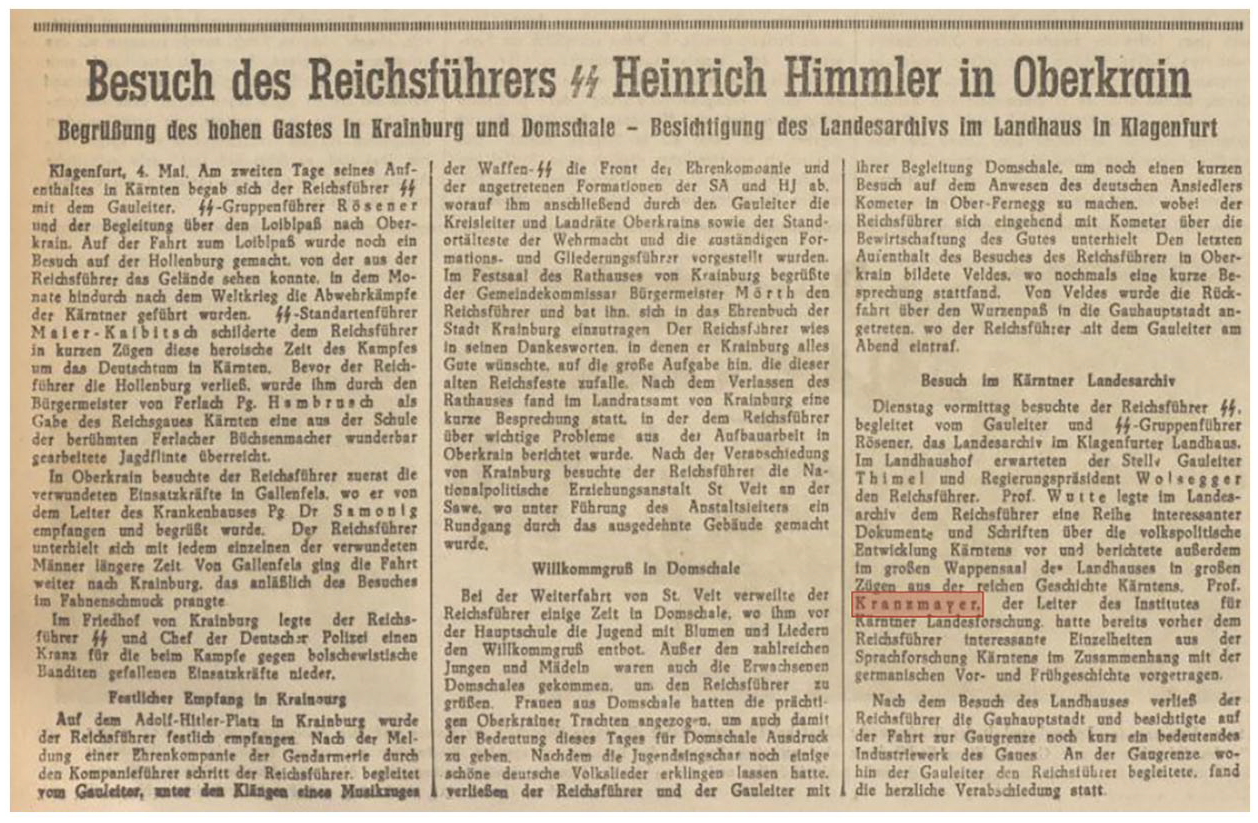
Alpenländische Rundschau, 8 May 1943, p. 4 – Folge 19.
Another widely reported event was Kranzmayer’s inaugural lecture in Graz, where he was appointed on 26.3.1943 (Personalblatt, REM, BArch-R9361-VI-1627) as a.o. professor for Dialectology and Borderlands Research [Mundartkunde und Grenzlandforschung], as the Völkischer Beobachter reported on 25 July 1943, p. 5 (Figure 5). He was promoted to a.o. Professor on 26 May1943 in Munich, which is the a.o. professorship he lists in postwar pleas for clemency, not the one from Graz where he delivered his racially most extreme views.
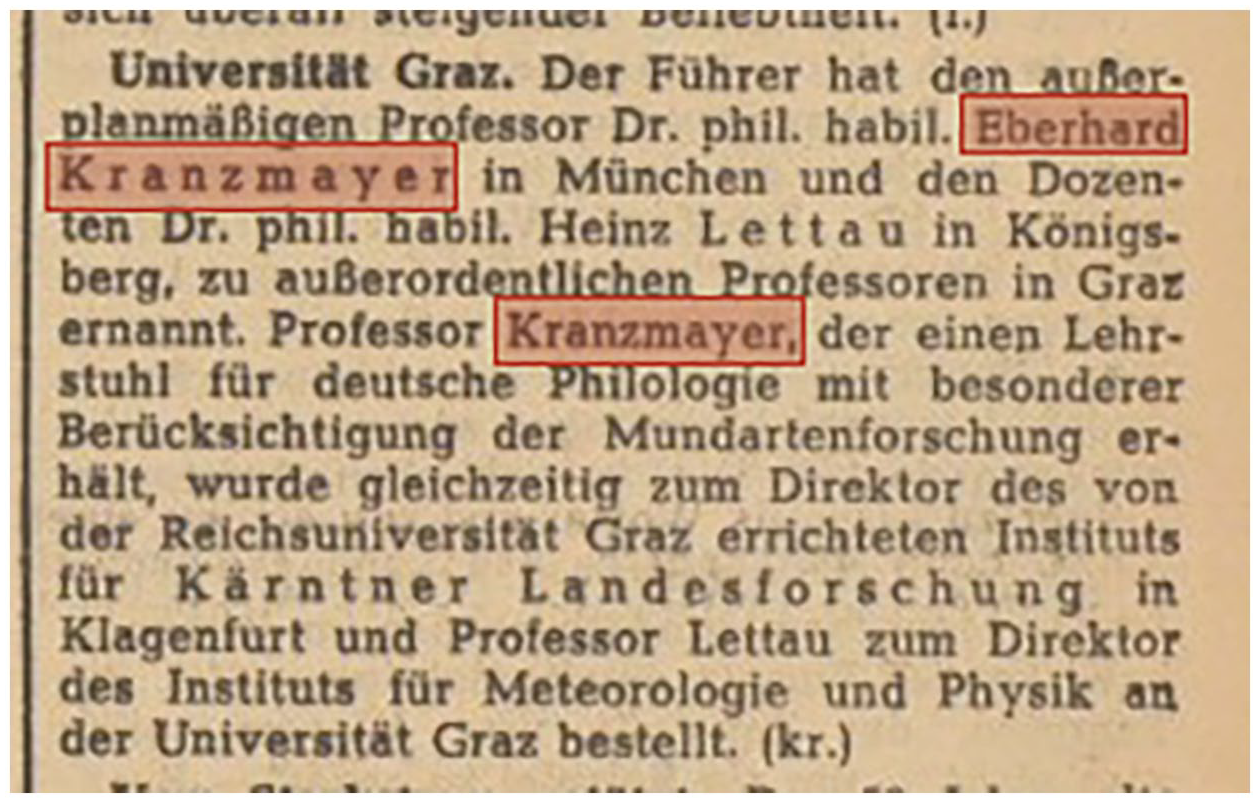
Kranzmayer’s a.o. professorship in Graz (Völkischer Beobachter, 25 July 1943, p. 5).
Linguistic land claims and a race-biological inaugural lecture
The inaugural lecture in Graz from June 1944 went further into ‘racial biology’ and forecasts Kranzmayer’s planned research direction. The Gaupropagandaamt Steiermark notes in its June 29, 1944 issue of Nachrichten aus dem steirischen Kulturleben that Kranzmayer suggested that ‘the sounds of the smallest local dialect, just like those of the great German people’s, appear to be the genetic-biologically determined result of the special characteristics of its speakers’ (Kranzmayer, qtd. in Baur and Gradwohl-Schlacher, 2011: 156–157, transl. SD). The political importance of the inaugural lecture can be gauged by NS-internal reporting. Gauleiter Rainer was sent the following summary of the inaugural lecture:
Kranzmayer views language as a unit and demonstrates its changes via its speakers’ hereditary laws. He will exemplify this new approach in a grand monograph, which can be revolutionary for German Studies. His research is of great importance. I’ll enclose a copy of the inaugural lecture. Kranzmayer sieht die Sprache als Einheit und weist ihre Veränderungen als Erbgesetze der Sprachträger nach. Er wird diese neue Schau in einem großen Werke ausarbeiten, das für die Germanistik revolutionär wirken kann. Seinen Forschungen kommt große Bedeutung zu. Ich lege einen Durchschlag der Antrittsvorlesung vor. (Klagenfurt 17 July 1944, anonymous to Gauleiter Rainer; AT KLA 643 C-37)
Like genes carrying genetic information, Kranzmayer seems to have claimed that changes in language are also inherited, which, given his völkisch orientation of German dominance, would be framed within Deutschtum. The mentioned verbatim copy of the inaugural speech, however, is missing in the archival files (note in this context that Richard Meister’s Gauakt has been missing since 2000 from the Austrian Staatsarchiv, Taschwer, 2015: fn 410) .
This lecture marks the end of Kranzmayer’s public speaking engagements in an openly völkisch tenor, which began in the early 1930s and included public lectures and radio addresses (e.g. a speech on German dominance summarized in Villacher Zeitung, 21 Jan. 1933, 12: ‘gerieten die Slawen bald unter den Einfluß der deutschen Nachbarn, die ihnen westliche Kultur und Zivilisation vermittelten’ [the Slaws were soon under the influence of the German neighbours, who imparted on them western culture]). In the Republic of Austria, Kranzmayer would promote the same concepts of dominance and subjugation in the frame of cultural exchange rather than völkisch superiority.
In an Institute whose Wissenschaft was ‘completely politicized’ [‘gänzlich politisiert’] (Kater 2006, 47), it is striking that no structural shifts in Kranzmayer’s argumentation can be discerned pre- and post-war (Dollinger, 2023). The NS-commissioned findings dovetail fully with Kranzmayer’s own understanding of völkisch research in all but one instance. When Kranzmayer was asked to present the Italian Friuli as German, he was not too pleased, which the Institute’s typist recounted to Fritzl (1992) in the late 1980s (p. 160). Kranzmayer (1943) would declare the Friuli as heavily German-influenced, much like the Windisch-Slovenes – but stopped short from making them German (Kranzmayer, 1944). Such interpretations were not encouraged in the NS state, which was known to ‘permanently hinder those who tried to interfere in the business that the party and ‘movement’ considered its core domain: the definition and weighting of central ideological concepts such as Volk, race, Aryan’ (Knobloch, 2002: 310). Repercussions, however, were mild. For instance, Josef Nadler, who preferred to concoct his own völkisch stances, would be ‘honorably discharged from party membership’ [‘ehrenvoll aus der Partei zu entlassen’] and publicly celebrated his subsequent 60th birthday (Bormann to Schirach, qtd. in Meissl, 1989: 139).
In the light of the new archival evidence, however, such disagreement is no longer proof that ‘Kranzmayer’s role was not one of an agitating NS bureaucrat but that he felt to abide as a scientist by scientific norms’ (Fritzl, 1992: 160).
18
In the new context it merely shows that Kranzmayer had his own völkisch convictions, which in this case he had some problems consolidating with Nazi demands. Kranzmayer displayed the subjectivity of his interpretations – which were qualitative, with no concrete sourcing (as criticized years later by Penzl, 1957: 468) – as seamlessly fitting with NS doctrines. While Institute researcher Karl Dinklage may never have been seen without his Nazi pin (Fritzl, 1992: 160), Kranzmayer strove to reconcile his own völkisch interpretations with the völkisch points of view of the Nazis in what were congruent approaches. He promoted the superiority of all things German from his first publication in 1925 and maintained this view in the postwar period. These ‘linguistic land claims’ (Dollinger, 2023: 71–79) reached their most forceful expression during his time at the Institute, however:
The linguistic as well as the extralinguistic evidence is overwhelming for German cultural influence, a fact that no one may seriously doubt. The settlement area of the Slovenes is in a certain sense part of the German cultural landscape. Es überwiegt sprachlich wie sachlich bei den Slowenen der deutsche Kultureinfluß, eine Tatsache, die niemand ernstlich in Abrede stellen kann. Der Siedlungsbereich der Slowenen ist in gewissem Sinne ein Stück deutscher Kulturlandschaft. (Kranzmayer, 1944: 26–27)
Kranzmayer’s ‘linguistic land claims’ for Deutschtum, such as above, are found throughout his writing career, from 1925 to the 1970s, and are carried out via the trope of dominance and cultural sophistication (as above), or with often dubious onomastic attestations of local place names (Ried- und Flurnamen), as below:
if traces of the oldest German can be found in them [local names], then they amount to indisputable evidence of local and near-by, land-bound German-ness. In these locations or in their immediate vicinity local Germans must have lived in bigger numbers. German or Germanized names of such villages therefore show beyond the shadow of a doubt earth-bound German-ness, which we may log in full confidence. wenn sich in ihnen Spuren ältesten deutschen Sprachlebens nachweisen lassen, so stellen solche unbestreitbare Zeugen einheimischen und auf die engere Landschaft bezogenen Deutschtums dar. In diesen Orten oder in ihrer unmittelbaren Nähe müssen ansässige Deutsche in größerer Zahl gewohnt haben. Deutsche oder eingedeutschte Namen solcher Siedlungen beweisen also einwandfrei bodenständiges Deutschtum, sie dürfen wir mit vollem Vertrauen auswerten. (Kranzmayer, 1936: 29)
The certainty with which etymological interpretations are presented as indisputable facts is widespread in Kranzmayer’s writings. In the context of an expansionist war, his focus on German cultural superiority is troublesome. Kranzmayer presupposes a strong German presence wherever he looks; counterevidence is brushed aside and if counterfactual data is found ‘then the facts of German influence are not doubted in and of itself; this way or that, German world views and culture are always behind linguistic change’ (Kranzmayer, 1944: 19). 19 Kranzmayer’s writing style would later be compared to a lecture ‘where documentation and specific evidence have been omitted’ (Penzl, 1986: 216), opening the doors for fabrication.
During his time at the Institute, Kranzmayer did not need to revise or reconsider his earlier writings, he simply continued as before. Going through the periods since the eighth century, Kranzmayer argued time and again for the superiority of German thought, culture and language in Carinthia. It is obvious how these lines of thought would dovetail with Nazi doctrine.
Denazification and post-war career
After the war, Kranzmayer would claim that both his moves to Klagenfurt and Munich were motivated solely by concerns for steady employment. His move to Munich, Kranzmayer claimed in 1947, was triggered by ongoing conflict with Anton Pfalz:
With my immediate superior Prof. Anton Pfalz I had continuously had problems since 1935. I consequently gained the impression that my remaining in Vienna would not be lasting in the career path I’d chosen, since Prof. Pfalz did not only not support my advancement but was rather inclined to hurt my career prospects. Mit meinem unmittelbaren Vorgesetzten Prof. Anton Pfalz hatte ich seit 1935 ständig Differenzen. Ich hatte den Eindruck gewonnen, dass infolge dieses Umstandes mein Bleiben in Wien in der von mir angestrebten Laufbahn nicht von Dauer sein werde, da Prof. Pfalz mich im Weiterkommen nicht nur nicht unterstützte, sondern eher bestrebt war, mir Schaden zuzufügen. (UGA, PA Kranzmayer, Gesuch, 1947: 2 of 8)
The statement that Pfalz would harm Kranzmayer is doubtful in light of their 1938 post-Anschluss interviewing for Hitler’s birthday present. Moreover, Pfalz was instrumental in Kranzmayer’s promotion to extraordinarius professor in Vienna, as a meeting protocol from 22 May 1937 shows:
As Pfalz stressed, Kranzmayer in his capacity as assistant of the Word Chancery of the Academy of Sciences has supported its work in very important ways. [. . .] Moreover Pfalz was able to favourably report on Kranzmayer’s unpublished works, especially a longer text that shows the interrelations between adjacent southern Bavarian, Ladin and Italian dialects. Wie Pfalz hervorhob, hat Kranzmayer als Assistent an der Wörterbuchkanzlei der Akademie der Wissenschaften deren Arbeiten in sehr bedeutsamer Weise gefördert. [. . .] Ueberdies konnte Pfalz über das erfolgreiche Fortschreiten der noch ungedruckten Arbeiten Kranzmayers berichten, besonders eines gross angelegten Werkes, das die sprachlichen Wechselbeziehungen zwischen der aneinander grenzenden südbairischen, ladinischen und italienischen Mundarten behandelt. (Dietrich Kralik, UAW, PA 2301 Eberhard Kranzmayer, p. 162–163).
Kranzmayer’s move to Munich must be considered an upwards career move, not a desperate side step, as he claimed in his post-war defense. About his relocation from Munich to Klagenfurt, Kranzmayer writes in his plea: ‘I only stayed in Munich until I found a suitable job (Unterkommensmöglichkeit) in Austria’ (UGA Gesuch 17 May, p. 6), foregrounding Austrian, not pan-German patriotism. However, as Kranzmayer wrote to Wutte in early 1938, in Munich he wore two hats:
As academic assistant and leader of the Munich Word Chancery and as docent for the History of the German language and German ethnology, with focus on German dialects. Als wissenschaftlicher Hilfsarbeiter [Assistent] und Leiter der Münchener Wörterbuch-kommission und als Dozent für Geschichte der deutsche[n] Sprache und für deutsche Volkskunde, im Besonderen für deutsche Mundarten (Kranzmayer to Wutte, 2 Feb. 1938, KLA Nachlass Wutte Sch 1-73)
Kranzmayer was the leader of the Munich Chancery from his arrival on 1 Jan. 1938 (and not merely ‘Assistent der Wörterbuchkommission’, as he claimed in 1947 [Gesuch, p. 7]). He would complete his rise through the ranks in the Nazi period. After having worked between 1926 and 1933 ‘alternating in Vienna and Munich’ and since 1933 contractually [‘vertragsmäßig’] in Vienna (BArch R9361-VI-1627), he became außerplanmäßiger Professor as of 8.10.1940.
In 1942 he reached the all-important ‘Uk-Stellung’ (Baur and Gradwohl-Schlacher, 2011: 156), which meant that he could no longer be removed from his post for army service. As a civil servant he was working for the Bavarian Academy, not the university (Wüst, 17.3.1942, in BArch R4901/13425, 131/333). In other words, Kranzmayer had secured steady research employment as the leader of the Munich Chancery and he was teaching Bavarian Dialects and Slovenian at Munich University (BArch R9361-VI-1627). He would have been able to ride out the war and the regime in this safe position, yet he went to Klagenfurt in a career move that lastingly implicates him with the NS war machine.
Kranzmayer’s denazification proceedings are, like his application process to the NSDAP, somewhat unusual. He reports that on 26.6.1945 he was suspended though the Staatssekretär für Unterricht, which was revoked on 30.1.1946 ‘durch die Landeshauptmannschaft für Steiermark, Zahl LAD 366 K 50 1946’, after which we worked until October 1946 at the University of Graz. He had originally been denazified on 26.9.1945 by the Sonderkommission, as he had claimed that he ‘never applied for membership in the NSDAP’ [‘er habe nie einen Aufnahmeantrag in die NSDAP gestellt]’ (ÖStA/AdR BMfU PA 102117, fol. 58, qtd. in Baur and Gradwohl-Schlacher, 2011: 157)]. He did apply, however, which means that he was first denazified on false testimony.
In October 1946, the British administrators in Graz spotted the (Austrian) error and fired Kranzmayer again.
20
No longer able to deny his NSDAP membership, Kranzmayer switched his tactics and made use of the leniency of the 1947 Verbotsgesetz, which strove to integrate all ‘minderbelastet’ party members into society (the lowest of four degrees of collaboration). Kranzmayer’s goal was to demonstrate his membership as the price for secure employment. His plea from 17 May 1947, a skillful and rhetorically interesting text, delivers just that (superseding a 10 Oct 1945 affidavit, Jandl, 2022: 183). From 1946 to March 1948, Kranzmayer worked as provisional curator at the Kärntner Landesmuseum. As of 9.6.1947 (rechtskräftig since 30.10.1947, NS-Registrierungsblatt), he was considered ‘minderbelastet’ (Baur and Gradwohl-Schlacher, 2011: 157). From then on, he was able to use his networks in academia and was able to tell the story of the ‘difficult years’ after WWII, which his students have been retelling, for example
The war years were followed by quiet years, years in which his [Kranzmayer’s] family had to fear for their livelihoods, years, in which Kranzmayer – as he said himself – forgot about his hunger while travelling his homeland and collecting dialect data. As late as 1949 Kranzmayer was allowed to return to Vienna for good. Dem Kriegsende folgten stille Jahre, Jahre, in denen seine [Kranzmayers] Familie um ihre Existenz bangen mußte, Jahre, in denen Kranzmayer die Heimat durchwanderte und im Sammeln von Mundartbelegen – wie er selbst sagte – seinen Hunger vergaß. Erst 1949 war es Kranzmayer beschieden, für immer nach Wien zurückzukehren. (Kühn, 1976: 41)
Kranzmayer’s networks were not merely operational, they were effective. On 24 May 1948, Richard Meister – Vice-President of the ÖAW and of deutsch-national orientation (Taschwer, 2015: 241 & 10) – wrote to the Ministry’s of Education’s Dr. Skrebensky, Sektionschef for universities. Meister reported unanimous support for Kranzmayer on 22 May 1948 by the Professorenkollegium of the Vienna Philosophische Fakultät (Figure 6).
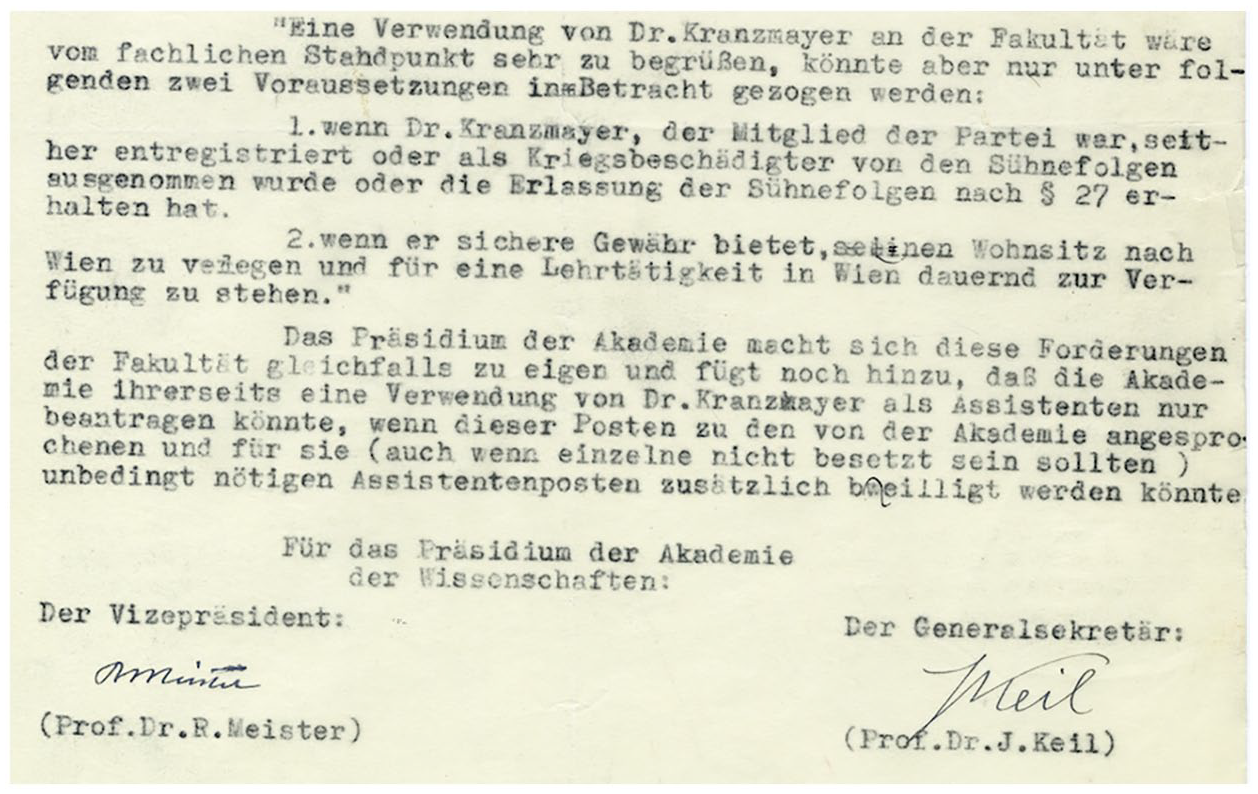
UW Archives – Ph PA 2301, p. 230 (with kind permission).
The collegiate of professors expressed (#1) as condition of Kranzmayer’s employment that he be ‘deregistered’ as a party member or exempt from reparations. As of 10 May, Kranzmayer had already been exempted from reparations (e.g. losing a third of his salary) on account of a letter by Viktor Geramb, who wrote many a letter for collaborators ‘without a lot of probing their NS careers’ [‘ohne großes Hinterfragen ihrer NS-Karrieren’] (qtd. in Jandl, 2017: 84).
Surprisingly, given Kranzmayer’s NS career, not one, but two Austrian universities, Graz and Vienna, were competing to employ him in 1948. Vienna won the race for the former NSDAP party member and NS-functionary in the Klagenfurt Institute. On 6 Dec. 1947, the Dean of the Philosophische Fakultät of the University of Graz stated, in the name of the Professorenkollegium, that Kranzmayer was considered as the only person capable of leading WBÖ [“erscheint heute als der einzige, das Wiener Wörterbuchunternehmen … weiterzuführen” (ÖStA, AdR, Personalakt Kranzmayer p. 82-83 )]. This statement suggests that no scholars chased away by the Nazis were considered by the Graz professors.
Nadler, Kranzmayer and the ‘One Standard German Axiom (OSGA)’
Having corrected Kranzmayer’s NS record and shown his deep involvement, it is now time to turn to the effects of his legacy that extend into the present and may affect linguistic research and practice. Today, in German linguistics the assumption of a categorical difference between (pre-)war and post-war linguistic concepts is widespread. In German literature the situation is rather different, however. Josef Nadler, the most pronounced NS-Germanist in Vienna, is today known as ‘Fall Nadler’ (Ranzmaier, 2008). A völkisch literature scholar, Nadler was part of Deutschkunde that placed a number of arguments into the hands of völkisch politicians. Nadler’s (1912–1928, 1938–1941) literary history was organized along German Stämme ‘tribes’, which were taken as the locus of all modes of being. This Stammeskunde, ‘tribal research’,
follows historical structure and historical change, therefore using the rich tools that are offered by settlement history, onomastics and local names, language development, archeology and ethnology. That which develops in such ways and which is called tribe is a natural, self-governed association of the primordial cells of life that are the foundation of every society. [. . .] A tribe is all that continues to exist in reality, a family-historical bond of blood. verfolgt ihren geschichtlichen Aufbau und ihren geschichtlichen Wandel, hat also gerade die reichen Hilfsmittel zu Gebote, die Siedlungsgeschichte, Ortsnamenkunde, Sprachentwicklung, Bodenfunde und Volkskunde ihr darbieten. Was so entsteht und was sie Stamm nennt, ist ein natürlicher, eigengesetzlicher Verband jener ursprünglichen Lebenszellen, auf die sich jede Gemeinschaft gründet. [. . .] Der Stamm ist das, was es in der Wirklichkeit allein noch gibt, ein familiengeschichtlicher Blutsverband (Nadler, 1934: 7–8)
According to Nadler, each Stamm develops in close interdependency with its topography (Landschaft) particular characteristics and contributes its share to deutsches Volk. The idea of Stämme working as ‘wechselnde Organe’ – alternating organs – in the Volks-body guarantees that the German people remains self-sufficient without the need for ‘foreign’ input. Nadler’s express goal was to do for literary history what had been done for language & anthropology in an ‘applied’ fashion:
Not less philology, but more of it, but of an applied type, dialect research, tribal research, family history, anthropology, a literary geography, that scour the earth for our needs. Our greatest yearning shall be to connect the history of written text to the great achievements of related, supporting, foundational disciplines. Nicht weniger Philologie, sondern mehr, aber angewandte, Dialektforschung, Stammeskunde, Familiengeschichte, Anthropologie, eine Literaturgeographie, die die Erde nach unseren Bedürfnissen suchend abgeht. Was unsere letzte Sehnsucht sein soll, Anschluß der Geschichte des Schrifttums an die großen Ergebnisse verwandter, fördernder, vorausgesetzter Disziplinen. (Nadler, 1912, Band 1: vii-viii)
The ‘yearning’ for more objective literary analysis is modelled after ‘foundational’ disciplines, which include dialect research and philology. The view of dialectology as an objective method because of its use of data is echoed to this day and it is the likely reason why Ranzmaier’s (2005) otherwise excellent account of the history of the University of Vienna German department considers the work by Anton Pfalz and Walter Steinhauser as largely independent of NS ideas. Ranzmaier writes of Pfalz as an example of ‘how little research and publication may reveal about the researcher’s political view points’ (Ranzmaier, 2005: 137). 21
If Ranzmaier’s finding were correct it would clear German dialectology, and indeed any data-based enterprise per definitionem, as ‘objective’, regardless of who collected and analysed the data and for which purpose. Such carte blanche, of course, does not exist. As Hutton points out:
The core/non-core distinction relates to the other key dichotomy, that between scientific and non-scientific (or ‘pseudo-scientific’). The implicit equation we are offered is that core Nazi equals ‘non-scientific’, non-core equals ‘scientific’ (though with perhaps a moral taint by association). This preserves disciplinary history intact, for it relegates Nazism to the non-scientific realm, to that of the methodologically aberrant. (Hutton, 1999, 78)
There is, however, very little structural difference between Nadler’s application of Stämme to literature and Kranzmayer’s to language. Post-WWII quotes confirm the relevance of Stämme in linguistics, as heteronomous to one kind of Standard German, in what I labelled elsewhere a ‘One Standard German Axiom (OSGA)’ (Dollinger, 2019: 14). Kranzmayer’s opus magnus Ortsnamenbuch expressly confirms the stamm-based model:
The prehistory of the Bavarians is in many aspects different from those of all other German tribes; the renowned Bavarian individuality in comparison with other German tribes will be easily understood: East Germanic cultural influences, migratory routes not from Germany but from outside, their history, which forms a sequence of resistance against imperial subjugation, but also their customs and dialect sufficiently prove that the Old Bavarians were from the outset special among the German tribes. Die Vorgeschichte der Baiern ist in vielen Dingen verschieden von der aller übrigen deutschen Stämme; ihre bekannte bairische Individualität anderen deutschen Stämmen gegenüber wird uns sehr gut begreiflich. Ostgermanische Kultureinflüsse, ihre Einwanderung, die nicht aus Deutschland, sondern von einem Außenpunkt herkam, ihre Geschichte, die eine Kette heftigen Widerstandes gegen die Unterwerfung unter die Reichshoheit bildet, aber auch ihr Volkstum und ihre Mundart sind Beweis genug dafür, dass wir die Baiern in Altbayern von Anfang an als etwas Besonderes unter den deutschen Stämmen zu betrachten haben. (Kranzmayer, 1956–1958: I: 106)
Kranzmayer’s stamm-based dialectology assigns special status to the Bavarians. The above post-WWII quote is immediately followed by a sentence on the special nature of the Austrian Bavarians, something that is a post-1945 addition for Kranzmayer.
There is little objectivity in such statements, however, and yet the approach stands as one of the continuities that Hutton (1999) mentions. Kranzmayer’s reconfirms the ‘purity’ of original Stämme, regardless of language contact phenomena, as the Franks’ [Fränkisch] or Saxons’ [Sächsisch] influence in medieval Carinthia did not affect the Bavarian language base (Kranzmayer 1956–1958: I, 107–108). There is a good deal of constructionism, such as the upholding of the unity of Austrian-Bavarian dialects as a central linguistic notion in German.
Stämme remain important explananda in German dialectology more generally. Whether in Wiener Schule (e.g. Kranzmayer, 1956–1958: I: 167–168; Pfalz, 1927: 56) or Marburger Schule (e.g. Mitzka, 1938; Schmitt 1967), a generation or two later (Scheuringer, 1990: 375; Wiesinger, 1995: 65–66) or today in Elspaß and associates’ work (e.g. Elspaß, 2020: 52; Elspaß et al., 2017: 73; Elspaß and Niehaus, 2014: 50): the stamm-based dialects seem to be conceptually stressed, defended and considered as important, more important than the standard varieties of Austria or Switzerland, as criticized in Muhr (1998: 41–53). I would add that the indiscriminatory use of ‘Standard German’, rather than ‘Standard Austrian German’ is an indirect, unintended consequence of the historical continuity from Kranzmayer’s time, which is the central message in Dollinger (2021).
Alternative approaches, which focus on sociologically younger correlates, such as the Austrian state border (e.g. De Cillia and Ransmayr, 2019; Dollinger, 2019; Huber, 2023; Muhr, 2017; 2023) and Austrian identity constructions (e.g. De Cillia et al., 2020; Wodak et al., 2009) are to this day not positively received in German dialectology & linguistics (e.g. Elspaß and Niehaus, 2014: 50; Langer, 2021).
I have argued elsewhere that the presumed unity of German is a result of the presuppositions of academic German dialectology. These presuppositions are rooted in a ‘One Standard German Axiom’, which is an ‘unreflected political concept underpinning linguistic approaches that negate the existence of a Standard Austrian German’ (Dollinger, 2019: 14) and other non-dominant standard varieties. In light of Hutton, German is predominantly modelled in the same way as Kranzmayer modelled it in the 1920s, as a thread that connects the ‘German people’ based on a political concept of pan-Germanness. This base is today not realized and not intended. It is, rather, an effect of the strong traditions in field of German dialectology today, the way how the standard is modelled and what dialects are subsumed under it.
I would therefore speak, in analogy to Fall Nadler, of a ‘Fall Kranzmayer’, of a researcher who was absorbed by cross-border Austrian-Bavarian dialects in a stamm-based, völkisch approach to preserve ‘the “linguistic treasure of the homeland” . . . in connection with the cultural-political dogma, to feed one’s own work into the “pan-German treasure of culture”’ (Meissl, 1989: 141, quoting from Pfalz). 22
Today, the maintenance of a single standard is no longer connected to such völkisch thoughts. The hegemonic notion of a single standard is carried over as a basic fact, via, as I claim, a foundational, discipline-internal notion of OSGA (One Standard German Axiom). The stamm-based dialect zones remain to this day the first order of organization below the implied single standard in German dialectology today (see, e.g. Schmidt and Herrgen, 2011 who do not use the term ‘Standardvarietät’). The existence of non-dominant standards is denied with models claiming objectivity (e.g. Ziegler, 2023; see Muhr, 2023 for a critique) that are based on categorical benchmarks (see Dollinger, 2019: 67–72), arbitrary thresholds of ‘enough’ differentiation (Dollinger, 2019: 72–74) and big data models and algorithms that are blind to social salience (Dollinger, 2019: 72–76), perpetuating the traditions of the field (Dollinger, 2019: 61–67). If not denied outright, the Austrian standard is considered as one ‘of fundamental evaluative frictions and incongruities’ (Koppensteiner and Lenz, 2020: 74) in studies that do not consider the basic notion of linguistic insecurity (Dollinger, 2019: 78–83; Preston, 2013). Without German models that recognize, integrate and in empirical study aim to mitigate linguistic insecurity, German dialectology will continue to carry forward a hegemonic perspective of standard language modelling that will fail to appreciate non-dominant standards and misread methodological & theoretical concerns with linguistic identity as outside the purview of ‘an academic soberly gauging the debate’ (reviewer, quoted in Dollinger, 2019: x). While German literature rejected the stamm-based conceptualization in Nadler, it is time to critically assess the continuing stamm-based organization of the German language and to make room for more recent developments to be appropriately reflected in the conceptualizations of German-language standard varieties. Considering that on average 85% of Austrians recognize more than one standard in German (De Cillia and Ransmayr, 2019: Abb. 36), this is not an unreasonable proposition.
Wiener Schule der Dialektologie
Biases may surface in the selection of interviewees, via data transcription, to the conceptualization of what is ‘German’ and what not or by claiming some groups as forebears (Bavarians, Swabians) while excluding others (Slovene bilinguals, Jiddish, Rotwelsh speakers). Kranzmayer’s intense involvement with WBÖ spanned over 57 years (not the mere eight years that Lenz et al., 2021 highlight). He operated in the pan-German milieu that the Wiener Schule originated from. Anton Pfalz, leader of the Vienna Chancery from 1920 to 1945, and Walter Steinhauser were the senior researchers. Pfalz and Steinhauser received NS honours ‘vom Führer’ in 1942 (Silbernes Treuedienstzeichen), which shows ‘in national-socialist perspective a good reputation at the university’ (Ranzmaier, 2005: 160). Both were immediately and lastingly let off in 1945 for their roles in the NS system; the former for leading the NS-Dozentenbund, the latter for illegal NSDAP membership as of 1932 and for disseminating Nazi print matter (Ranzmaier, 2005: 160).
Kranzmayer played a decisive role in both Chanceries, consolidating and establishing methodological frameworks as early as 1926; collecting on his own large swathes of data so that by 1937 he alone had collected 500,000 slips from 500 locations (UW Archives, Ph_PA_2301, p. 178]; many more were collected under his guidance so that by 1971 the collection for WBÖ amounted to 4.5 million slips (Dollmayr and Kranzmayr, 1971: 2: ii).
It is therefore surprising to see the contributions of the Wiener Schule considered as ‘spotless’ [‘einwandfrei’] (Ranzmaier, 2005: 135), when a völkisch unity of Germans was at the root of the early project. The opinion that the Wiener Schule der Dialektologie ‘despite its clearly nationalist foundations remained largely immune against the adoption of national-socialist ideology’ (Ranzmaier, 2005, 184), 23 however, is not the outcome of a thorough investigation of the material but a reporting of field-internal wisdom and needs to be read as such.
Historians and Slavists have so far been much more critical than Germanists, who are faced with conflicts of interest. Baur and Gradwohl-Schlacher (2011: 157) consider Ranzmaier’s assessment as ‘not tenable in this form’ [‘kann so nicht aufrecht erhalten werden’], Kronsteiner (2016: 694) criticizes the ‘school’s latent German-centric world view’ [‘latente germanozentrische Weltbild dieser “Schule”’], while Fischer (1980: 24) calls Kranzmayer a ‘representative of a German-centred and teutonic German Studies’ in post-war Austria [‘Repräsentanten einer deutschwissenschaftlichen und deutschtümelnden Germanistik’].
In Kranzmayer’s post-war publications, the superiority trope of the German Volk is readily discernible, while the onomastic method is praised as objective and unrivalled in what is de facto the construal of desired outcomes in linguistic land claims for Germandom:
Thanks to strict rule-governed regularities throughout history the language historian is in the position to identify long lost settlement patterns and processes that otherwise would be irretrievable. Dank der strengen Regelmäßigkeit durch alle Zeiten hindurch ist es dem Sprachforscher vergönnt, über die Namen Einblick in längst vergessene Siedlungsvorschläge zu nehmen, in Prozesse, die sonst gänzlich verschüttet erscheinen (Kranzmayer, 1956–1958: I: 205)
There are minor postwar adaptations to Kranzmayer’s method that language history is people (Volk) history to the degree that post-WWII texts mention an Austrian dimension:
Everything is tied up in a tight circle. Carinthia with its earth-bound people became a land of internal unity and has stayed that way. Its two languages have amalgamated in unprecedented ways in all its various shades, on a scale only comparable to two old spouses. . . . Folk art and local life are identical in both regions north of the border, it is the same rhythm, the same style. Its basic tenor is Austrian. Es schließt sich alles zum festen Kreis zusammen. Kärnten ist mit seiner bodenverwurzelten Bevölkerung ein Land innerer Einheit geworden und geblieben. Seine zwei Landessprachen sind in unerhörtem Maße in allen ihren Schattierungen ineinandergeflossen, so breit und fest wie das Wesen zweier altvertrauter Eheleute . . . die Volkskunst und das ganze Leben haben keine verschiedenen Formen in beiden Landesteilen nördlich der Karawanken, der gleiche Rhythmus herrscht und der gleiche Stil. Der Grundton alles dessen ist österreichisch. (Kranzmayer, 1956–1958: I: 198)
The trope from Kranzmayer’s 1942 opening speech of a border that never existed resurfaces after 1945 in the guise of ‘identical’ local life north and south of the Austrian-Slovenian border. Kranzmayer uses the myth of harmonic relationships between German and Slovene speakers, which was also employed by Wutte. The trope of harmony (‘same rhythm’), however, was a distortion by the deutsch-national tradition and heavily criticized by (language) historians (e.g. Fischer, 1980: 97–133; Fritzl, 1992: 53 & passim; Knight, 2020: 57 & passim).
The claim of Austrian-Slovene harmony should be seen as a post-hoc addition to the likely intended closing sentence: Der Grundton alles dessen ist deutsch [belie: österreichisch]. Knight (2020) identifies this tenor as ‘the central aspect of postwar politics to continue the NS attempt to dispense of Slovene language and culture, which is considered as subpar’ (p. 19). 24 After having contributed with his oeuvre from 1925 to the 1970s towards a climate of bilingual conflict, Kranzmayer adopts a postwar position of lip service, calling the Ortstafelsturm of 1972, in which bilingual signage was removed by an anti-Slavic mob, a ‘tragedy’ (Elisabeth Koller-Glück, Kärntner Tageszeitung 10 May 1975).
Conclusion: Höfler, Wolfram, Kranzmayer
Kranzmayer’s NS career casts in a different light the ‘great Austrian scholar of dialectology and onomastics’ (Pohl, 2006: 397). While Otto Höfler and Richard Wolfram are listed in Weinreich’s 1946 Hitler’s Professors or Kater’s 2006 SS-Ahnenerbe, Kranzmayer is not. Kranzmayer should be seen in the context of a pre-war Germanistik that has contributed to and shaped various NS-ideas. In Austria, almost all post-habilitation Germanists (Jandl, 2017: 6) were members of the NSDAP, and some of whom continued to exert, via Höfler and Meister, considerable influence after WWII.
While the field-internal pan-German bias is a contributing factor, some aspects of Kranzmayer’s NS time, especially his time in Klagenfurt, weigh heavily. Significantly, the foregrounding of German influence is not limited to a single work (Kranzmayer, 1944) and is not the result of ‘national-socialist zeitgeist’ [‘nationalsozialistischen Zeitgeist’ (Wiesinger and Steinbach, 2001: 117–118)], but should be considered as one of Kranzmayer’s core beliefs. It is time to systematically reflect on the biases that Kranzmayer’s view of German has meant for the treatment of Austrian German. There are parallels between Nadler and Kranzmayer, but in Kranzmayer’s case they may unintentionally carry on to the present, in Hutton’s sense. A pan-German bias is bound to have influenced the data collection for the Wörterbuch in the Chanceries in Vienna and Munich, data that would best be vetted by an independent historical commission.
This commission would need to assess the interviewees: are NSDAP members over-represented, as Kranzmayer’s statement suggests? Are members of minorities included at all? Questions such as these affect even the most abstract, data-driven linguistic research. Expressions of good intentions alone will not dehegemonize a field that is trailing in pluricentric approaches with multiple-standard perspectives. While a researcher may, asked about a possible bias in the material, be ‘happy with the data’ (a WBÖ researcher, question period, Methods in Dialectology XIII, Mainz, Germany, 4 Aug. 2022), Kranzmayer’s legacy seems over-towering to be defended in any categorical manner today.
Given that Kranzmayer’s research had real-life implications for at least 205,000 Slovenes (Wedekind, 2017: 1433), his anti-Slavic research in a political think tank he helped establish and directed needs to be assessed. Kranzmayer knew that his studies would be used as justification for ethnic cleansing and therefore accumulated personal guilt. Guilt of what kind? Is the leader of a Reichsinstitut for strategic (note: not operative) ethnic cleansing comparable to an Ortsgruppenleiter in a small town? Probably not, given the vast range of responsibilities of Ortsgruppenleiter as the ‘foundation of dictatorship’ (Reibel, 2002). However, we can no longer brush aside Kranzmayer’s armchair transgressions against humanity as a Schreibtischtäter of a lower order. How close did a family father have to be to Nazi elite such as Gauleiter Rainer, Reichminister Rust, SS-Ahnenerbe’s Wüst, Harmjanz and Sievers and, on at least one occasion, Heinrich Himmler, to ‘secure employment’, as he claimed? Did he have to create and dedicate a Lautdenkmal to Hitler?
No one in the field today would promote a ‘deutsche Wissenschaft’ or ‘Deutschkunde’ paradigm, as Auer (2013: 26) rightfully posits. If the presuppositions of the discipline, however, depend on a language ‘German’ unified under OSGA with perhaps, when pressed, occasional lip service to non-dominant standards, the field remains seemingly rooted in a frame that 85% of Austrian speakers report to clash with their perceptions of multiple standards in German (De Cillia and Ransmayr, 2019: Abb. 36). Kranzmayer’s approach has had a considerable share in the disciplinary sidelining of an Austrian standard variety of German, so much that Muhr (2021) calls for a stand-alone Austriazistik. Kranzmayer‘s Institut für Kärntner Landesforschung aimed to support – like the SS-Ahenenerbe – ‘a priori fixed axioms by way of processes that appeared to be scientific’. Its goal was, like in Ahnenerbe, to show ‘that the ‘Germanic tribes’, the forebears or grandchildren, exude a never-ending stream of mental and cultural superiority’ (Kater, 2006: 47). 25 German superiority is prevalent in Kranzmayer’s work to a degree that it should be considered, in addition to his pan-German mindset (Dollinger, 2023), a driver behind his research.
The Austrian Verbotsgesetz 1947 (paragraph 4e) forbade denazification for anyone who ‘actively collaborated towards the goals of the NSDAP and its sister organizations’. 26 As Kranzmayer’s völkisch ‘research’ as director of a Reichsinstitut delivered ‘war-decisive’ findings of German superiority (Wedekind, 2017: 1434), he should not, like Pfalz and Steinhauser, have been eligible for academic re-employment. However, in post-war Austria Kranzmayer exerted influence in the field of German dialectology and is a major factor, also via his many students, for the delayed and hypersceptical uptake of pluricentricity and Standard Austrian German in academic German linguistics (e.g. Ernst Pacolt, qtd. in Muhr, 1999: 11–12). Kranzmayer’s legacy looms large, as researchers today are faced with bias of a yet undetermined degree in more than 4.5 million data slips in the WBÖ collection that, coupled with a stifled reception since Pollak (1992) of the pluricentricity of German in opposition to the OSGA umbrella that seems to be limiting recent work (e.g. Langer, 2021; Scherr and Ziegler, 2023).
Footnotes
Archival abbreviations
KLA Kärntner Landesarchiv
UGA University of Graz Archives
ÖStA Österreichisches Staatsarchiv
UAW University of Vienna Archives
BArch Deutsches Bundesarchiv, Berlin Document Centre
Declaration of conflicting interests
The author declared no potential conflicts of interest with respect to the research, authorship, and/or publication of this article.
Funding
The author received no financial support for the research, authorship, and/or publication of this article.
Notes
Author biography
Stefan Dollinger is Professor of Linguistics at UBC’s Department of English Language and Literatures in Vancouver, Canada. and affiliate member at UVic Linguistics. His monographs include Creating Canadian English (Cambridge UP, 2019), a biography of the making of Canadian English. He has recently been probing cross-linguistic incompatibilities in the modelling of standard varieties (The Pluricentricity Debate: On Austrian German and Other Germanic Standard Varieties, Routledge, 2019) and Österreichisches Deutsch oder Deutsch in Österreich? Identitäten im 21. Jahrhundert (new academic press, 2021). He is chief editor of DCHP-2, the Second edition of A Dictionary of Canadianisms on Historical Principles (UBC, 2017;  ), and commenced a third edition, DCHP-3, to appear in 2025.