




Abstract
Parliamentary debates are beneficial political environments to study using discourse analysis and discursive psychology. However, there is limited discursive psychological research analysing arguments for and against the possibility of a second referendum concerning the UK’s EU membership status. We collected our data by transcribing a parliamentary debate where politicians discussed a second referendum and analysed it using a discursive psychological framework. Whether they supported leave or remain, politicians discredit their opposing position for supposedly lacking democratic values. As such, politicians portrayed their stances on Brexit as a requirement to uphold democratic principles. The main implication of the analysis demonstrated that politicians defined democracy depending on the positions they took regarding calls for a second Brexit referendum. The present study contributes to the growing discursive literature on Brexit discourse by showing how the meaning of democracy is contested and used as a tool to manage accountability.
Introduction
Overview
In June 2016, the United Kingdom held a referendum where citizens were asked to vote whether the country should remain in the European Union (EU henceforth). The referendum resulted in a divisive outcome with 51.89% opting to leave while 48.11% voted to remain. The divided nature of Brexit is also reflected by the contentious debates between both stances on Brexit – conventionally referred to as ‘Leavers’ or ‘Remainers’. Although the UK is no longer a member of the EU as of January 31st, 2020, this ongoing political fallout for both parties remain relevant and the impact of Brexit on British politics and economy are still debated (e.g. Keegan, 2024). Consequently, most UK citizens including leave voters have become disillusioned with Brexit because they believe it stifled the nation’s economic growth (The Economist, 2024). Therefore, Brexit related discourse remains valuable data to inform the contentious nature of political discourse. The time between the referendum and the UK’s departure from the EU was particularly antagonistic. This was when calls for a second referendum for the UK’s membership status were made by some politicians during parliamentary debates to see whether voters had changed their mind.
However, these calls for a second Brexit referendum were dismissed during parliamentary debates when pro-Brexit politicians appealed to the majority vote in favour of the UK’s withdrawal from the EU. Appealing to the majority vote meant that politicians could reasonably bypass the need to hold a second Brexit referendum. As such, delivering on the initial referendum result was treated as carrying out democratic due diligence. When debates concerning calls for a second Brexit referendum unfolded, both sides argued what it meant to uphold the UK’s democratic integrity. For example, Marsh (2023) briefly demonstrated how speakers discussing Brexit – in the context of the BBC1 debate programme ‘Question Time’ – invoked democracy to argue about the possibility of a second referendum. Despite the reoccurring nature of this debate within Brexit discourse, research has yet to demonstrate how democracy was invoked when discussing a second referendum during parliamentary debates. One example of democracy from a political science perspective defines it as a power belonging to the people who consent to their governments based on what they deem fair (Baradat, 1988). When political scientists explore democracy however, they treat it as a phenomenon with a fixed definition as indicated by their debates over what is truly democratic (e.g. Dryzek, 2006). By using DP, we can show the contested meanings of democracy in parliamentary debates. We demonstrate how politicians justify their arguments as carrying out representative duty for their constituents. We return to this point later.
Brexit discourse
We seek to build on the growing body of research into Brexit discourse in its various manifestations (see Marsh, 2023). Discursive psychologists have demonstrated that Brexit debates are valuable data for analysis. For example, Goodman and Narang (2019) examined online comments of a British newspaper article, Daily Mail, demonstrating that Brexit was used to justify prejudice against refugees. They demonstrated how discussions about child refugees transitioned into Brexit debates to justify arguing for the UK’s withdrawal from the EU.
Brexit discussions have also manifested the ways which group members discursively undermine their ideological opponents. For instance, Meredith and Richardson (2019) and Andreouli (2021) demonstrate how people invoking group categories of ‘Remainers’ and ‘Brexiteers’ would define each other negatively yet in ways that are distinct from pre-existing political identities (such as being of the Left or Right). Despite these fruitful analytical findings, Brexit debates have not been explored within the interactional context of parliamentary debates.
British parliamentary discourse
United Kingdom, although officially a constitutional monarchy with an unelected head of state, for all practical purposes operates as a democratic country. To this end, debate and discussion amongst elected members of parliament is a common feature of British politics. This takes place in the House of Commons, where adversarial debate is common and expected (Ilie, 2004).
Political discourse, especially within parliamentary debates, invokes intelligible language to help establish a connection between politicians and audiences (Edwards and Potter, 1992a). Audiences will then be more likely to identify with the arguments and positions of a politician (Billig, 1989). Politicians often rhetorically orient their arguments towards denial or shifting of accountability of a given topic (e.g. Edwards and Potter, 1992a). This way, politicians attend to criticisms aimed at their positions which helps frame stake and interest irrelevant to their arguments (Potter, 1996). The British parliament, particularly in the House of Commons where elected members of parliament (MPs) are based and debate issues such as legislation, is a prominent site of adversarial political discourse. The matter of a second Brexit referendum was frequently debated in this setting. Parliamentary discourse is not only action but also audience oriented, so the discourse of MPs is designed to be heard by those who are physically and non-physically present (Ilie, 2015). As such it is a worthy area of analytic focus, because of the wider democratic influence it can play a part in.
As an example of a discourse analytical approach to parliamentary debates, Robles (2011) demonstrated that, despite the rule dictating politicians must take turns to talk, it does not limit them to one argumentative strategy. Politicians talked around issues while addressing them through implicit strategies, MPs invoked institutional identities and discursively constructed certain emotional states in relation to a political issue. For instance, speakers began their arguments cordially then worked them up into more explicit criticism towards their political opponents. One example is the speakers raising their voices to emphasise their words as an additional critique of their opponent. Discursive analyses (e.g. Demasi, 2019; Potter, 1996) have argued that politicians formulate their disagreements as ‘correct’ versions of reality. These portrayals are also designed to undermine opposing views as insufficient or irrelevant political arguments (Billig, 1991; Burke and Demasi, 2019). Politicians, therefore, have a wide rhetorical repertoire to orient towards disagreeing and counterclaiming opposing positions.
British parliamentary discourse, then, attends to an audience while giving the speakers considerable rhetorical room to manoeuvre, even in the case of particular institutional rules of conduct. It is these rhetorical strategies and their public-facing nature that we investigate here. One of the pioneering works which have applied DP to a parliamentary setting was conducted by Antaki and Leudar (2001) and the study comprised data from the British House of Commons. Their analysis demonstrated that public records were used by MPs to gain leverage over political rivals when they used their words against them. These public records were considered rhetorical resources which politicians drew from to hold each another accountable. Politicians used the exact words of their opponents against them to frame their arguments as hypocritical; it indicated they previously went on record supporting a position which contradicts their initial argument. This, and other literature (e.g. Demasi, 2019; Potter and Edwards, 1990) demonstrate that politicians manage stake and interest by portraying their positions as factual (see also Potter, 1996) as opposed to their personal bias.
Parliamentary debates in the context of cultures outside the UK have also been demonstrated to be analytically fruitful. For example, parliamentary debates in the Netherlands were analysed by Verkuyten and Nooitgedagt (2019) who explored how politicians outlined the identities of MPs responding to Geert Wilders, the leader of the far-right party. When Wilders emphasised the responsibilities of MPs to represent the people as a justification of his position, politicians opposed this using various rhetorical strategies. For example, the far-right were questioned whether they accomplished their representative role and challenging the claim that the far-right represent the people. Membership categories of politicians, and the categories of either marginal and mainstream, were directly applied, negotiated and resisted in parliamentary debates concerning the far-right.
A similar observation can be made in the case in the context of Greek parliamentary debates as demonstrated by Figgou and Anagnostopoulou (2020). Their analysis indicated that Greek politicians from the governing and opposition parties mitigated the stake and interest of their policies by portraying them as representative of the national interest of Greece. Politicians from both positions invoked other current political standings across Europe and treated them as examples of civilised nations. As such, politicians argued their positions are consistent with the qualities of civilised European nations, while also criticising the stances of their opponents as uncivilised and outdated for lacking those same values (see Billig, 1996). Parliamentary debates have also demonstrated how humanisation can bolster the arguments which politicians make.
Whereas Figgou and Anagnostopoulou (2020) demonstrated how politicians, in Greek parliamentary sessions, dehumanise refugees and treat them as a national threat, Kirkwood (2017) analysed this political issue within the context of a British parliamentary debate. Consistent with the analytical work of Wetherell and Potter (1992), Kirkwood (2017) demonstrated how politicians rhetorically worked up their positions difficult to argue against. By explicitly labelling refugees as ‘human beings’, politicians held the government and citizens responsible to protect refugees. Doing so enabled politicians on either side of the refugee argument to alleviate themselves of moral responsibility by being heard as those addressing the issue.
Considering the above, matters of peace and conflict are demonstrated as contentious issues of discussion in the House of Commons. 1 For instance, Burridge (2018) explored how parliamentarians discussed the invasion of Iraq in 2003. Categories of ‘pacifist’ and ‘warmonger’ were invoked by politicians to undermine their opponent’s stance on the war. Those who opposed the war were criticised for being pacifists, while those in favour were disqualified as warmongers. These categories were used by speakers on both sides of the debate to indicate their opponents are ignoring realities of the war to further a personal vendetta.
Aims and rationale
So far, we have discussed some examples of parliamentary political discourse literature. These have entailed analyses of the various rhetorical strategies which politicians use to navigate parliamentary debates. We also explored how facts concerning issues like peace and conflict, resurgence of the far-right, immigration, asylum seeking and Brexit are discursive and rhetorical matters negotiated by politicians. However, there appears to be limited research examining how the notion of ‘democracy’ is used by politicians as a rhetorical strategy to argue within the context of a parliamentary debate. As some examples, Ellis and Kitzinger (2002) found that Australian politicians argued about the age of consent for homosexual people in terms of what could be considered democratic. Similarly, Summers (2007) found that Australian politicians constructed their arguments for and against the Lesbian and Gay Law Reform Act in a self-sustaining manner by appealing to democracy. Beyond parliamentary debates, other DP studies have also demonstrated the relevance of democracy through analysis of online comments (e.g. Michos et al., 2020) and public meetings (van Burgsteden and te Molder, 2022). So, there is precedent for a discursive study of notions of democracy but it has not been explored in the context of British House of Commons and Brexit.
Instead of regarding democracy as having a preordained meaning and political position attached to it, being ‘democratic’ is a matter of contention between politicians who construct different versions of it as they partake in political argumentation. There is also limited research exploring how politicians discussed calls for a second Brexit referendum in parliamentary debates. 2 The present study aims to analyse British parliamentary debates using discursive psychology (DP). DP approaches have already been used to analyse parliamentary debates (see above), however the present study expands upon existing research around British political discourse and parliamentary debates. By doing so, we aim to investigate how calls for a second Brexit referendum in the British House of Commons are argued for or against and how invocations of democracy play into this.
Method and data
The data for this analysis was a case study of a parliamentary debate. Billig (1989) argues that in-depth analysis of case studies reveal unique features and intricacies of discourse which have the potential to be explored in other contexts. Case studies have also been used regularly for the analyses of previous discursive studies (e.g. Burke and Demasi, 2021; Carr et al., 2019; Demasi, 2023). The debate took place on 17th December 2018, lasting 2 hours and 32 minutes. Politicians discussed whether a second referendum should be held to confirm if citizens of the UK wish to have the country’s EU membership revoked. The data involves the then UK Prime Minister, Theresa May, who addressed inquiries from MPs. We therefore chose this debate because the back-and-forth discourse between May and the MPs made clear which constructions of democracy, and arguments about a second referendum, were being oriented towards. They discussed the issue of whether a second referendum should be held 3 months before 29th March 2019, one of the previous deadlines for the UK to initiate Brexit and leave the EU (Lyons, 2019). Therefore, the topic of a second referendum was politically prominent at this point in time. Throughout this parliamentary debate, the political speakers often argued for and against positions in terms of how well they uphold democratic values.
We used discursive (Edwards and Potter, 1992a) and rhetorical (Billig, 1991) psychology to analyse the data. It is an ideal framework to explore how speakers rhetorically orient their speech to accomplish social actions (see also Goodman, 2017). Although speakers invoke and describe their psychological processes including their thoughts, feelings and attitudes, their descriptions of these do not necessarily reflect any inner cognitive states ‘under the skull’ (Potter and Wetherell, 1987: 177). Discursive psychology, instead, proposes that descriptions are constructed, situated to a specific social context and oriented towards accomplishing social actions, including but not limited to accountability management (Edwards and Potter, 1992b). People do things with words, by drawing from a ‘psychological thesaurus’ (e.g. memory and opinion) to perform these actions (Potter and Edwards (2003: 171). We argue that when politicians take a stance on contentious topics like Brexit, they maintain credibility by presenting their positions as beyond narrow sectional views. Politicians work up their positions as factual to avoid being accused of having a personal stake in taking their stance (e.g. Demasi, 2019; Edwards and Potter, 1992a) and often invoke a more extreme example to portray their position as a reasonable one (Billig, 1982; Goodman and Johnson, 2013).
The present study shows how the positions of political speakers are justified as democratic when they take a stance for or against the possibility of a second Brexit referendum. When politicians argue for and against positions, there is a particular tendency to bolster the factuality, the reality, of their arguments as means of making it harder for opponents to refute (Demasi, 2019; Potter, 1996). We demonstrate how discursive devices are used by politicians to justify their stance on Brexit aligning with democracy (Billig, 1996; Edwards and Potter, 1992a). We warranted our analytical findings by considering how both sides of the Brexit debate constructed democracy in relation to their arguments about a second referendum. We arrived at this focus after an initial reading of the data without a prior decision regarding an analytic focus, aside from a general interest in Brexit discourse. As is standard for DP analytic practice (Potter and Edwards, 1990), our analytic focus was ultimately determined by what the people in the data treat as the matter at hand. Hence, in our case, negotiating democracy.
Analysis – Using democracy to perform accountability management
The analysis focussed on how politicians challenged or defended the outcome of the 2016 referendum by discursively constructing themselves as advocates of democratic values and political integrity. Based on the notions of fact construction in political discourse (see above), we identified accountability management as an analytically relevant aspect from the data in relation to how versions of democracy were constructed. Throughout the analysis, we demonstrate the competing ways in which democracy constructed by politicians as they argue about the democratic implications of a second referendum.
Accountability revolves around how individuals, groups and organisations are constructed as sources of responsibility (Potter, 2005) – discourse, more generally, is attuned to the matter of accountability (Edwards and Potter, 1992a). Accountability works in two ways. One involving the speaker’s construction of agency in their account to indicate where the source of responsibility lies. The second involves a speaker’s version of their agency, which involves particular social actions through their accounts. These two are connected to allow speakers to construct their accountability through the construction of other speakers and vice versa (Edwards and Potter, 1992a). The actions, emotions and motivations of speakers can be discursively constructed to relate to their accountability (Locke and Edwards, 2003). As an example of how democracy is invoked to manage accountability, consider the following extract entailing the Labour MP for Cardiff South and Penarth, Stephen Doughty. He holds Prime Minister Theresa May accountable by presenting her prolonged Brexit negotiations as a detriment to the stability of jobs and businesses.
Extract 1
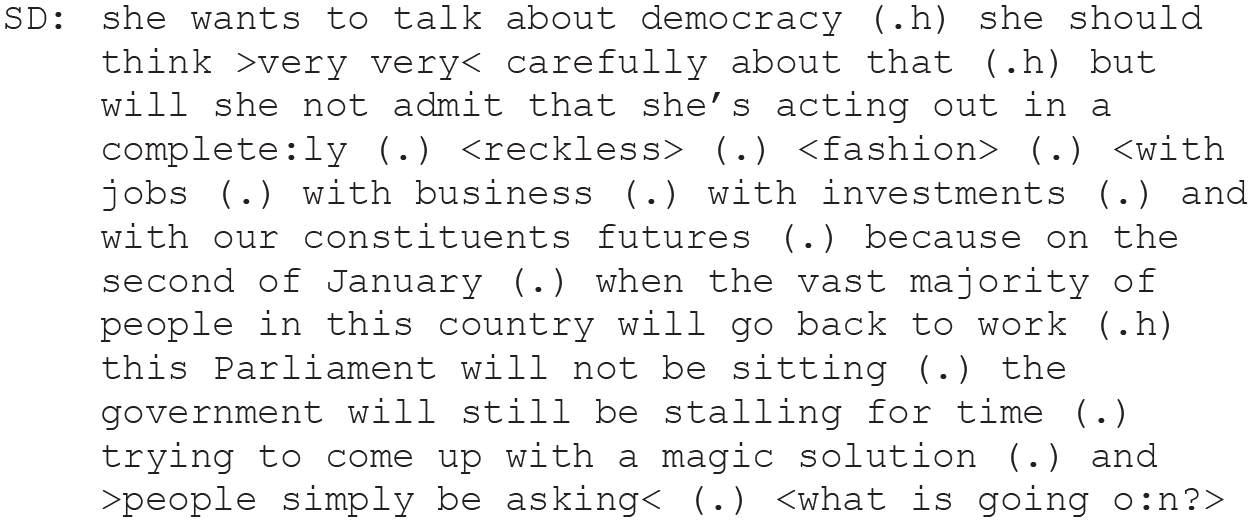
In lines 5–6, Doughty argues using lists and contrasts (Jefferson, 1990) which can bolster the rhetorical strength of a political argument (Bull and Fetzer, 2010; Rapley, 1998). Doughty listing the endangerment of ‘jobs’, ‘businesses’ and ‘investments’ (5) functions to hold May accountable for being a ‘reckless’ (4) Prime Minister. This presents May as a Prime Minister who lacks economic acumen, and perhaps competence too, by risking such matters, thereby, portraying her as ambivalent to the financial precarity of British citizens. As such, Doughty frames the financial precarity of citizens as relevant and in jeopardy to justify holding May accountable for a failure of political duty.
By prefacing his point with suggesting that May should ‘think very very carefully’ (1–2) about democracy, Doughty suggests a particular version of democracy. One that does not align with the Conservative party, and the invitation of careful thought by May suggests a tu quoque argument – Doughty suggests that it is ironic that May should talk about democracy. Doughty holds May further accountable on line 3 by asking; ‘will she not admit’. Here, Doughty uses an interrogative which serve to limit cases of questioning (Heritage, 2002). The interrogative functions to rhetorically suggest May’s deal risks compromising the livelihood of people. Doughty also holds May accountable by claiming ‘the vast majority of people’ (7–8) have responsibilities for the jobs they have obligations to. The government by contrast are portrayed by Doughty as futilely thinking of an implausible solution to issues concerning people’s jobs, investments and businesses. By alluding on line 12 people want to know how jobs will be impacted by Brexit, Doughty warrants arguing a ‘vast majority’ (7) of citizens are sceptical that Brexit benefits the UK economy. Thus, Doughty holds May accountable and frames his position as consistent with public and democratic values. The marker of competence, for Doughty and incompetence, for May, is framed in terms of a concern for financial matters and transparency towards the British public regarding the implications of Brexit on work. A financially stable and transparent Britain is suggested to reflect a successful democracy which the British public consent to.
At some points in the data, Brexit was portrayed as a threat to the UK’s economy to hold the government accountable. This is relevant in the next extract involves the then Conservative MP for Broxtowe in Nottinghamshire Anna Soubry challenging May on her plan to initiate Brexit. CP indicates the collective Parliament rather than an individual speaker.
Extract 2
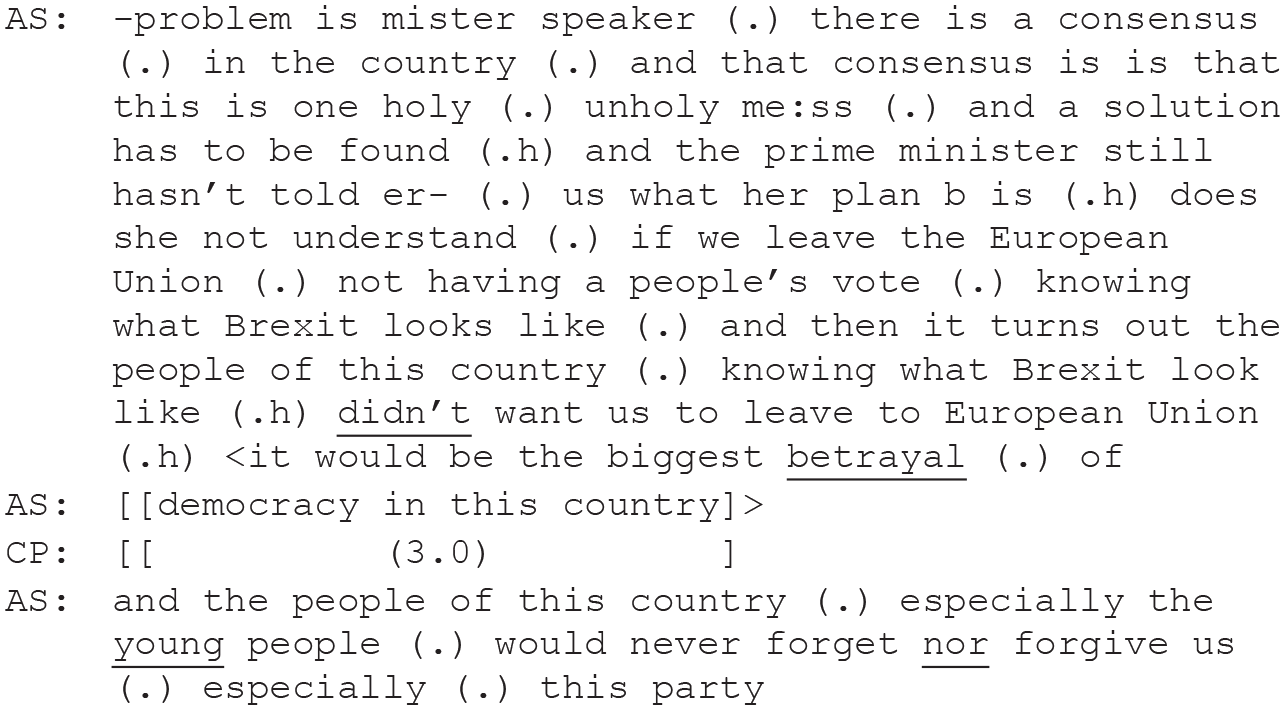
Soubry argues that May is committing to Brexit despite the latter’s claimed understanding of the consequences of the UK leaving the EU. Stating ‘knowing what Brexit looks like’ (7–8) puts forward the image that May knowingly insists on triggering Article 50 even if it contradicts what Britain citizens want. 3 Soubry holds May accountable for her lack of democratic values, by virtue of May’s claimed knowing of the consequences of Brexit, to discredit her pro-Brexit position. This is accomplished by using what Pomerantz (1986) coined as an extreme case formulation (ECF) when Soubry claims Brexit ‘would be the biggest betrayal of democracy in this country’ (11–12). The nature of ECF places emphasis on hyperboles such as Soubry using the category of ‘biggest’, which rhetorically exaggerates and bolsters her argument. Billig (1989) claimed speakers defend their arguments from dispute by strategically addressing the importance of values cherished by audiences. Here, the ‘betrayal of democracy’ is the value which Soubry portrays as morally breached by May. The use of the EFC allows Soubry to strengthen her argument as difficult to refute. Notably, ‘biggest betrayal of democracy’ is formulated to be heard by audiences that a correction is required. Namely, a second referendum is necessary to correct May’s breach of democratic integrity. This is bolstered by displaying May’s pro-Brexit position as compromising prospects for future generations.
Soubry also holds May accountable by claiming ‘the people of this country, especially the young people would never forget nor forgive us’ (14–15). Soubry works up the consequences of Brexit as severe for UK citizens when she addresses ‘the people of this country’. Although Soubry acknowledges the consequences still apply widely to other British demographics, the adverb ‘especially’ (14) lets Soubry emphasise Brexit threatens to negatively impact younger individuals the most. Thus, invoking ‘young people’ and how they would not ‘forget nor forgive us’ works up and legitimises the stakes attached to Brexit. The reference to young people also treats this as a long-term matter, suggesting that the problem of Brexit will outlast the current political generation. This construction implies that May will be responsible if younger voting demographics experience long-term ramifications of Brexit. As such, Soubry’s version of democracy demands that politicians should actively seek consent from the public before incorporating life altering policies like Brexit.
By repeating ‘knowing what Brexit looks like’ (9–10), Soubry portrays voters as reluctant about the future of a post-Brexit Britain. May’s accountability is cemented by Soubry’s implication that May also understands the consequences of Brexit (8). By portraying the matter as based on knowing, there are two implications. One, that information is withheld from the public. Second, that the matter itself is rhetorically framed as beyond rhetoric – all it takes is ‘mere reality’ (to know) to counter May’s political position. By portraying UK citizens as understanding the consequences of leaving the EU, Soubry justifies her support of a ‘people’s vote’ (7) as a democratic means of preventing Brexit. The mention of a people’s vote taps into a wider political controversy in Britain at the time, namely the closeness of the Brexit referendum. This has given Soubry in particular, and other British politicians in general, rhetorical room to manoeuvre around the result of the first Brexit referendum.
As an example of how these arguments were refuted in the debate, the following extract demonstrates how Theresa May justified rejecting a second referendum.
Extract 3
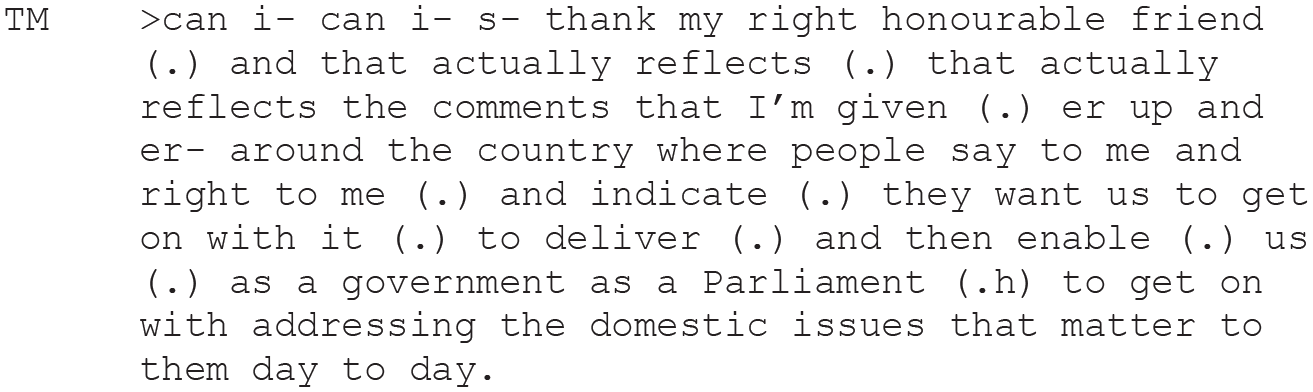
By working up consensus and corroboration (Potter, 1996), May argues delivering on the vote is something she hears from people ‘up and down the country’ (pp. 4–5). This bolsters May’s position as it portrays a consensus (Potter, 1996) concerning how many people support the UK leaving the EU within the context of the debate. May grounds her account on hearing this directly from people as claimed in lines 5–6. Claiming first-hand experience to the comments she heard around the country works up her position as difficult to challenge (Potter, 1996; Wooffitt, 1992). By showing she is well informed on what UK citizens want, May legitimises arguing it is her duty as the Prime Minister to deliver Brexit. May cements that she knows what people want by claiming they ‘want us to get on with it’ (5–6) – hinting at the futility of challenging her.
May’s depiction of Brexit as a priority serves to undermine an argument for a second referendum, as an obstacle which prevents May’s government from addressing ‘domestic issues’ (8). In framing her position as concerning what matters to the public, she holds supporters of a second referendum accountable for prolonging the Brexit debate, and thus preventing other issues from being addressed. May legitimises this as her position by aligning her pro-Brexit argument with ‘comments’ made by people ‘around the country’ (3–4). As such, she constructs domestic issues as more pressing matters to delegitimise the necessity of a second referendum.
Like above, the ‘will of the people’ is invoked to a construction of democracy. What is disagreed with, here, is what this will is. This echoes Billig’s (1996) point that often it is not the principle that is under debate, but, rather, what is the essence of the principle. The second referendum is contrasted with the wording ‘domestic issues’. This description implies a level of primacy to British matters, of which a second referendum would detract from. May manages her accountability by framing the denial of a second referendum as a position she arrived at after having spoken to the electorate. May’s rejection of a second referendum is depicted as means to address other issues that matter to people more than Brexit. Therefore, May is making a claim of relevance where domestic, national, matters take priority (see also Demasi, 2019, 2023). Stating as a ‘government’ and ‘parliament’ (7) is an explicit management of the collective parliament’s identity which adheres to a sense of responsibility and authority to act in the country’s best interest. Therefore, May alludes to a version of democracy where politicians act as civil servants who use voting results as instructions set by the public. Her closing expression emphasises this political tension. By using the expression ‘to get on’ (7) May suggests that the British government is being obstructed from doing their democratic duty, and serving the domestic interests of the British population, by talking about a second referendum. In essence, then, it is the advocates of a second referendum who are, according to May, not acting under democratic principles.
By contrast, the following extract shows how the Labour MP for Knowsley, George Howarth, criticises Brexit for threatening to impede the lives of future generations.
Extract 4
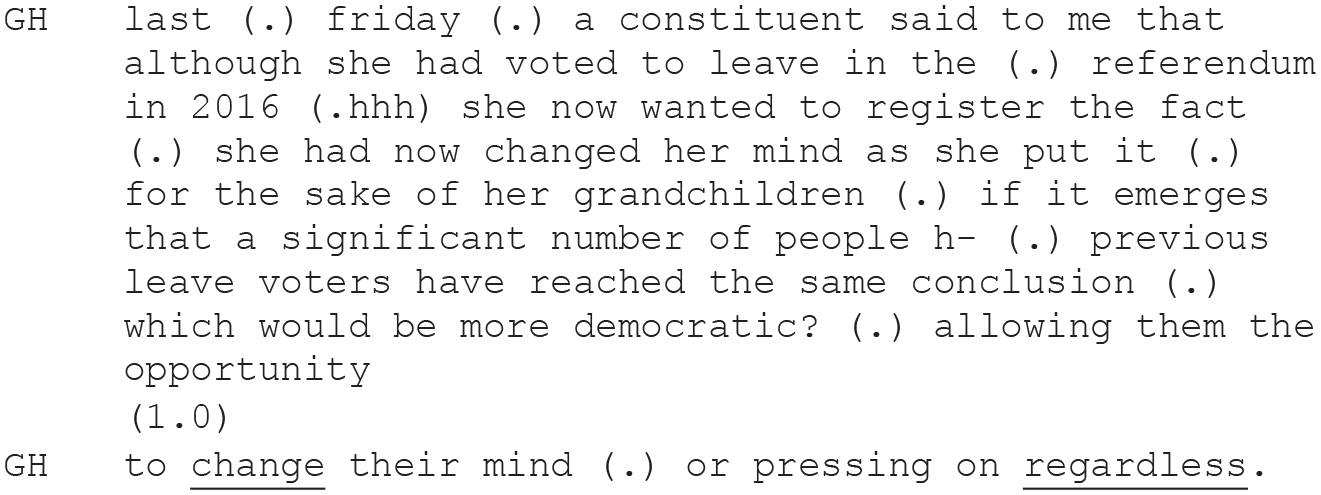
Howarth uses reported speech (1–4) to discredit Brexit by addressing a concern that was made by one of his constituents. Reported speech enables Howarth to manage his identity as an MP who speaks on behalf of his constituents by stating that one of them ‘had now changed her mind’ (3–4) as a so-called prototype of the other constituents he has spoken to. Howarth does not attribute the demand for a second referendum coming from himself. The footing (see Goffman, 1981) of Howarth’s account, with Howarth as the animator (one who utters the point) but not the principal (whose point of view is represented), presents it as a neutral report of events rather than a point he made for political gain. Therefore, Howarth positions himself to call for a second referendum while mitigating political accountability for it. In doing so, he constructs and appeals to a type of democracy where people are entitled to change their mind and this should be taken under serious political consideration.
Howarth also consolidates himself as an advocate of democracy by portraying a second referendum as the democratic decision as opposed to Brexit. By invoking the grandchildren of his constituent, Howarth bolsters the democratic urgency of holding a second referendum. Thus, the future of younger generations is treated as being at stake because of Brexit (5). From being an advocate of one constituent, Howarth raises the stakes by addressing the possibility that most people also agree with him that initiating Brexit is problematic (5–7). Howarth holds the government further accountable by stating they are ‘pressing on regardless’ (11), which portrays them revoking its membership from the EU as a possibility which hinges on the intentional denial of democratic principles. Grammatically this (8–9, 11) appears as a question between two options, but the second option is hearably absurd (Antaki, 2003) which turns this question into a rhetorical one. The answer is treated as obvious by implying that a second referendum adheres to democratic principles, whereas its absence does not.
Like the findings by Demasi (2019), Howarth further cements the position of holding a second referendum by offering a hypothetical scenario. A second referendum is presented as feasible if people have changed their minds about the outcome of the previous referendum. The position is arrived at by first portraying himself as an MP seeking to represent what his constituents want. Howarth’s accountability work here, then, mitigates (Edwards and Potter, 1992a) his claim from coming across as having an axe to grind (Potter, 1996). The implication of Howarth’s point is that if people have changed their minds, then it is logical to have a second referendum.
On the other hand, May argued that Brexit upholds the national interest of the UK to not only perform accountability management, but to also justify herself as democratic. This was evident in the final extract where May claims delivering Brexit is the responsibility of UK politicians.
Extract 5
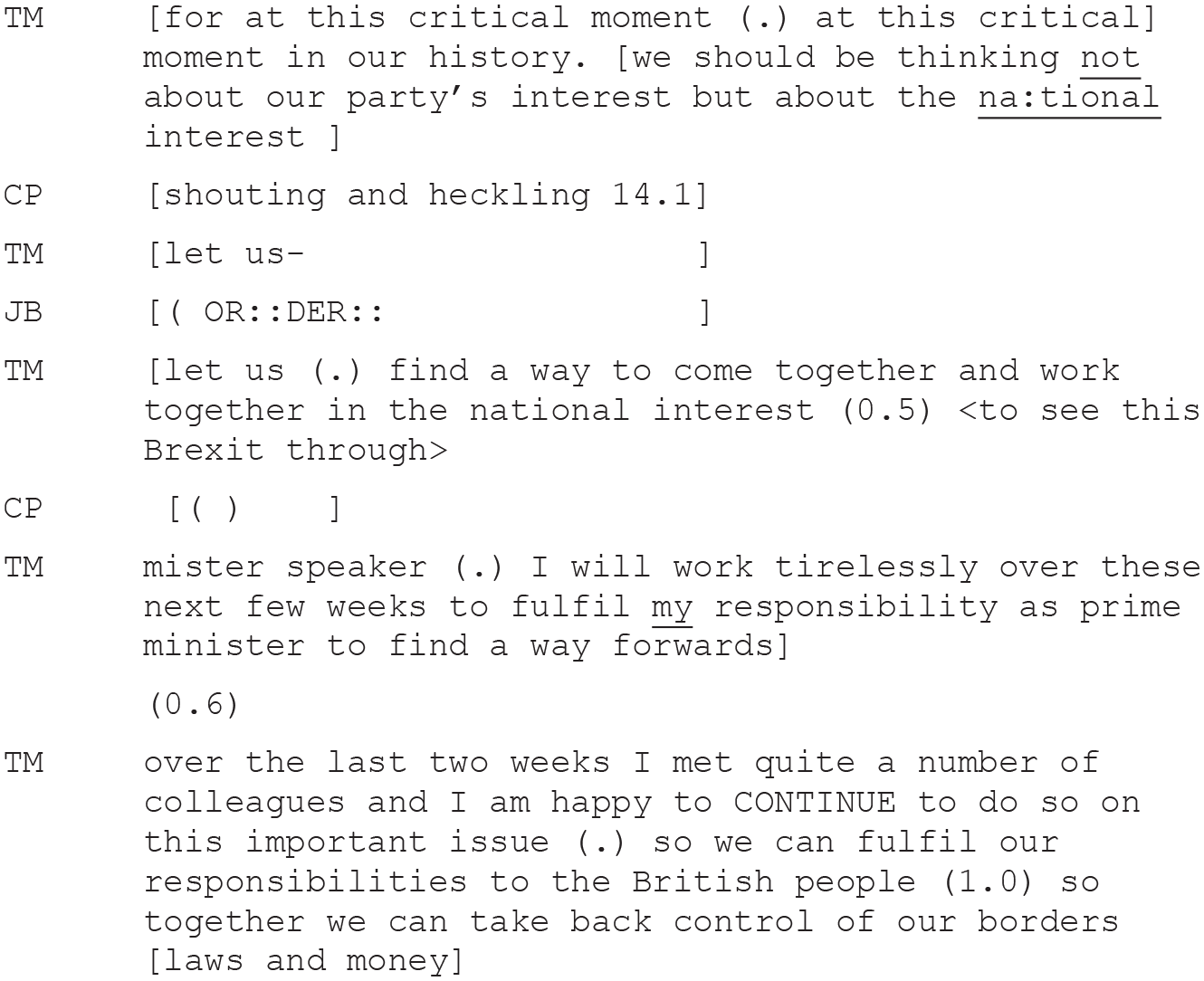
Morality can be an essential feature of accountability management because it helps characterise a speaker’s position as righteous (Tileagă, 2010). Here, May presents her argument as one concerning a type of normative morality where national interest should take precedence over those of any political party: ‘we should be thinking not about our party’s interest but about the national interest’ (2–4). Here, May exemplifies herself as a reasonable leader who stands above party politics – like the appeal for the greater national good demonstrated by Figgou and Anagnostopoulou (2020). Furthermore, this appeal to being practical is a means of exonerating May of blame, and to hold her political opponents accountable for any dissent (Figgou and Anagnostopoulou, 2020). May also uses footing to bolster her statements by using inclusive pronouns such as ‘we’, ‘us’ or ‘our’ (2–3, 8, 12, 28). Thus, audiences both in and outside of parliament are portrayed by May to agree with her arguments (Bhatia, 2006).
Consistent with as the findings of Chaemsaithong and Kim (2021), May works up a consensus to reinforce her argument that initiating Brexit is in the country’s best interest. May works up consensus and corroboration (Potter, 1996) by implying the deliverance of Brexit is something people want (26–27). This attends to her identity as Prime Minister while also resisting accountability. By implying that the delivery of Brexit is the will of the people, May shifts attention away from the possibility that leaving the EU furthers her political party interest. Telling her peers that it is her responsibility to act upon the interests of the people constructs her position as having the authority and obligation to see Brexit though. This mitigates any implication that stake and interest factors into May’s decision to reject a second referendum.
May uses various strategies to strengthen her position. She states that she ‘met quite a number of colleagues’ (24–25) to establish that the issues of Brexit have been thoroughly discussed with her peers. May’s position is bolstered by using three-part listing when she addresses ‘borders, laws and money’ (28–29). Three-part listing is used to establish the apparent comprehensiveness of a position a speaker has taken (Rapley, 1998) while conveying events and actions as conventional and normal (Jefferson, 1990). Invoking the category of ‘control’ (28) permits May to work up the UK’s ‘borders, laws and money’ (28–29) as issues of contention. Specifically, May implies that the EU has unreasonable influence over the UK’s political actions. – a common trope and point of contention of UK/EU discourse (Henkel, 2021). Therefore, May rhetorically strengthens her argument by portraying Brexit as a solution to the UK’s lack of autonomy over said borders, laws and money. Therefore, the invocation to ‘take back’ (28) features being a rallying cry for British Euroscepticism (Henkel, 2021; Syrpis, 2016) – to uphold democratic values.
Conclusion
The present study used DP to examine how politicians used ‘democracy’ as an argument to strengthen the credibility of the positions they took concerning calls for a second Brexit referendum. We demonstrated that politicians within the context of a British House of Commons parliamentary session managed their accountability by arguing their stances on Brexit as upholding democracy. When arguing for or against a second referendum, politicians speak accordingly to mitigate and resist blame while simultaneously working up the credibility and sincerity of their position. Politicians arguing for what was democratic functioned to mitigate the implication that the interests of a politician’s party came first as a stance for or against Brexit was justified. This ensured that politicians could legitimise themselves as public figures who uphold democratic values. Therefore, accountability was and managed by politicians as they rhetorically appealed to various versions of what they treated as democracy. The dataset was promising for the exploration of these feature in British parliamentary discourse on the notion of democracy. There has been some discursive work that has looked at democracy (e.g. Marsh, 2023; Michos et al., 2020; Summers, 2007; van Burgsteden and te Molder, 2022), and we contribute to this literature within the context of Brexit discourse in parliamentary debates.
In our case, the analysis of the present study has demonstrated that, while debating calls for a second Brexit referendum, politicians construct different versions of what counts as democracy to support their respective political positions. One version treats people’s will as something that should be listened to and respected by politicians, especially if they have changed their mind about Brexit. Meanwhile, the counterargument of democracy assumes that politicians should respect the first referendum as expressive of people’s will because most voters initially opted for the UK to leave the EU. As they contested the meaning of democracy in this debate, they argued it was necessary to actively and repeatedly seek consent from the British public to initiate Brexit. The politicians’ various rhetorical strategies and constructions of democracy orient to who knows best about the will of the people. When politicians debated the possibility of a second referendum, they used their competing versions of democracy to argue whether the will of the people is enduring or flexible. What counts as ‘democratic’ when it concerns parliamentary debates on Brexit, then, is a double-edged sword, with neither side of the argument, at least for now, able to find the last word (Billig, 1996).
These are prime examples of the dilemmatic position of ideologies and common-sense positions (e.g. Billig, 1991; Billig et al., 1988). We need to appreciate the ideological aspect of Brexit discourse. Henkel (2021) argued that fact-checking, although exposing untruths of anti-EU discourse, has not been effective at countering the presence of anti-EU discourse in Britain (see also Demasi, 2020). This is because such discourse, first and foremost, is about delivering an ideological message (Henkel, 2021). Even if factual claims are a prominent part of such discourse (Burke and Demasi, 2019; Demasi, 2019), the effectiveness of such discourse can often rely more on authenticity (Montgomery, 2017) than truthfulness to be effective. What is at stake, then, is not whether one side is or is not ‘really’ democratic. Rather, it is an ideological argument over relevance; it is not a matter of whether democracy is or is not desired, it is a matter of how one is to be democratic. In essence, the debate for the meaning of democracy, in the context of our data, is rooted on various rhetorical constructions of what people really want.
This warrants a final observation. We have demonstrated that invocations of the will of the people can be used for political accountability and legitimisation. However, we caution against taking this to be an exclusive cornerstone of democratic political discourse. There is nothing to stop authoritarian politicians from using this same language. There are instances where politicians of questionable political power, such as Vladimir Putin, can, and do, invoke the language of democracy and the people’s will for their own political justification. What this means, then, is that politicians of all ilk can use the discourse of democracy to their own political ends. With this in mind, future researchers into discourses of democracy should not take it for granted that invocations of the will of the people, democracy and so forth always function in the same way. Political context is key.
Footnotes
Declaration of conflicting interests
The author(s) declared no potential conflicts of interest with respect to the research, authorship, and/or publication of this article.
Funding
The author(s) received no financial support for the research, authorship, and/or publication of this article.
