




Abstract
This article discusses the ways in which participants in Indonesian political interviews address and refer to each other. Drawing on Raymond Williams’s concept ‘structures of feeling’, it proposes levelling and differentiation as mechanisms by which interview participants orient to a common feeling. Levelling and differentiation form a dialectical process characterised by tension that emerges through positioning of the self and the addressee relative to social categories and social orders. Such positioning involves exploiting the semantic contrast between kin terms, which denote relationality, and pronouns, which individuate, in addition to mobilising other linguistic resources including names and titles. The article suggests that the differentiation made between how those in the highest office and politicians below them are addressed and referred to is indexical of a shared consciousness about the relevance of rank.
Keywords
Introduction
Brown and Gilman’s (1960) paper on address in Indo-European languages has usefully shown how changes in the way people address each other can reflect changes in the structure of social relations. The present paper proposes that one of the fundamental insights of the study, that concerning ‘feeling’, merits further attention. In Brown and Gilman’s study, feeling is broadly equated with ‘attitude’ and identified as a motivation for pronoun variation. Such variation may be transient, performed in response to local dynamics or may gain a wide appeal and develop into a new norm of address. Feeling has not been the analytical focus of contemporary address studies, but recent scholarship on affect, notably in the field of cultural studies (see e.g. Sharma and Tygstrup, 2015), have shown that it can be productively drawn upon to explain diverse social phenomena. If Brown and Gilman are correct in their assumption that feeling motivates variation in address terms and such variation is suggestive of social change, it is pertinent to ask what dimensions of feeling are involved. This paper explores this question through a study of address and interlocutor reference in Indonesian. Interlocutor reference (henceforth, reference) concerns reference to speaker and addressee. I take as the point of departure the assumption that social relations as mediated by language are characterised by a dialectical process involving what are here called levelling and differentiation. Levelling involves self- and other-positioning relative to social categories and social orders, while differentiation concerns the amplification of differences between positions.
This paper draws on Raymond Williams’s concept ‘structures of feeling’ to consider levelling and differentiation as organising mechanisms around which acts of address and reference revolve. Williams draws evidence from literature and art to show how forms and changes in their materialisation can be revealing of the dynamics within the organisation of viewpoints and relationships. As such dynamics extend beyond individual preferences, the organisation of forms could also be revealing of a social history (Williams, 1980: 26). Though Brown and Gilman also draw on social history to explain changes in address practices, they do so by articulating a unidirectional shift from a past practice based on power relations to a present practice attuned to solidarity. Williams (1977) stresses that experiences of change are historically specific but are felt through the present (also see Coleman, 2018). This paper is a synchronic study of address and reference in Indonesian political interviews that seeks to show that the present organisation of forms in this institutional talk is indexical of a structure of feeling.
This study draws examples from three interviews: a one-to-one interview with the Indonesian president and two panel interviews involving politicians of various ranks. These interviews are part of a larger corpus comprising 12 interviews, most of which are concerned with the topic of the general elections. In total, the interviews are approximately 370 minutes long, each being approximately 1 hour in length. All interviews were recorded between 2018 and 2019 and in 2023 and are available publicly through YouTube. 1 In these interviews, where the participants employ a wide range of terms in address and reference, and where alternations are common, structures of feeling cannot be described in terms of changes in the choice of address terms conditioned by a temporary attitude towards the addressee as the European cases described by Brown and Gilman suggest. Rather it requires attendance to the relationship between political interviews as institutional talk, social orders and social categories, the participants’ biographies and the linguistic resources made use of to accomplish address and reference.
Structures of feeling
Raymond Williams developed the concept ‘structures of feeling’ by drawing on literature and art to suggest that ways of writing or ‘style’ could emerge as collectively experienced formative structures. Such structures are not concerned with the identification of particular feelings or affects or with personal or incidental experience of change but constitute a shared experience or consciousness. Williams explicates the concept in several publications and particularly in his book Marxism and Literature (1977) and clarifies it in an interview as follows.
That it does relate first to intensely felt and experienced elements of life. And it’s not just thought. I mean, you get the idea of a pattern of thought in a particular period, pattern of ideas. That’s very important. But in all the arts, quite clearly something else is happening beside this. Quite intense kind of feeling. Now, at the same time, it doesn’t seem to me that this is just, as it’s often called, a personal feeling. Of course, it has to be personal, or it wouldn’t be felt. But that the very interesting thing happens that you find groups of writers or artists sometimes emerging in particular periods in a distinctive way, who seem to have not just certain feelings in common but a certain structure of feeling, that is to say, the feelings relate to each other within something that you can see as a figure, you know, it’s a shape by which you identify it. Now that’s a hypothesis. Where you look for it, and I was forced to the concept by finding something like this. Where we might now look for it is not necessarily just in the overt manifest feelings of particular works, but very often in things like the shape of a particular novel or a particular kind of poem, or the conventions of a certain kind of play. Sometimes the way the plot of a novel is constructed and it’s not just a matter of plot. There is a certain relation of some things to others, certain strong feelings, the point at which you break a life of or take it out again and again. And it is this sense that you can discover in actual literary works or something which this commonheld and socially important phenomenon, not just at the level of thought or ideology but at the level of feeling, a common feeling.
2
To Williams (1977), artistic and literary forms can serve as evidence that a new feeling is emerging: ‘The idea of a structure of feeling can be specifically related to the evidence of form and conventions—semantic figures—which, in art and literature, are among the very first indications that such a new structure is forming’ (p. 133). By forms Williams (1980) meant not linguistic expressions employed in a literary work but the organisation of viewpoints that such expressions represent, changes of which are suggestive of changing social relationships, what he describes as ‘changing structures of feeling’. Structures of feeling are ‘emergent’ or ‘pre-emergent’ in the sense that they are prior to institutionalisation (p. 25).
And what seems to me especially important in these changing structures of feeling is that they often precede those more recognizable changes of formal idea and belief that make up the history of consciousness, and that while they correspond very closely to a real social history, of men living in actual and changing social relations, they again often precede the more recognizable changes of formal institution and relationship, which are the more accessible, indeed the more normal, history. (Williams, 1980: 25)
Critics have objected that structures of feeling as a concept is too imprecise to be methodologically useful. Eagleton (1976: 17) writes, for example, that it ‘lacks the theoretical terms which might specify the precise articulations of that structure’. For Simpson (1995: 40), the basis of the concept in literature prevents ‘any detailed engagement with nonliterary historical data’ and thus ‘allows Williams to float the structure of feeling as a prototheoretical concept that never quite takes on a sharp outline’ (1995: 40). Huels (2010: 420) states that the problem is not that it generates critical attention to the ‘mushy gushy world of subjective emotions’ but ‘by definition it names an ambiguous configuration of the social that has not yet fully emerged’. However, as Coleman (2018) points out, Williams proposes a study of society and culture that is ‘concerned with meanings and values as they are actively lived and felt’ in the present (Williams, 1977: 132, cited in Coleman, 2018: 606). Williams (1977) also stresses that the historical specificity of a structure of feeling is about ‘practical consciousness of a present kind, in a living and interrelating continuity’ (p. 132). This focus on the present has rendered the concept relevant to the study of various social phenomena, including temporality in digital media (Coleman, 2018), fashion as an expression of affect (Highmore, 2016) and language policy (Zhang and Perez-Milans, 2019).
Filmer (2003: 200) identifies two characteristics that are constant across references to or elaborations of the concept in Williams’s works. The first constant is empirical historical specificity. Structures of feelings are specific in that it is ‘always a structure of feeling, tied to the particularity of collective historical experience and its real effects on actual individuals and groups’ (2003: 200). The second is that, although a structure of feeling may be found in the histories of thought of those not in dominant positions or whose interests are served primarily by established institutions, it is most noticeable in the art and literature of a period. The relation between the two constants suggests that structures of feeling are produced through ‘the imaginative interactional social and cultural practices of initiation and response – quintessentially social practices of reflexive communication of experience which are at the root of the stability of and changes in human societies’ (2003: 201). Filmer’s point resonates with the basic methodological premise in studies on language and social interaction that understanding meaning requires consideration of minimally two turns at talk (or ‘initiation and response’ in Filmer’s terms). It also resonates with studies in anthropological linguistics that recognise reflexivity as an activity that human beings frequently engage in when communicating with each other (Agha, 2007). This study aligns with these premises; however, given space limitation, reflexivity is not discussed here.
Brown and Gilman and structures of feeling
Brown and Gilman’s (1960) paper, easily the most cited work in the voluminous literature on address, traces the ‘semantic evolution’ of address terms in major Indo-European languages (Latin, French, Italian, Spanish, English), arguing that changes in the pattern of address in these languages are indicative of shifts in social relations. They show that in the earlier pattern, someone of a higher status would employ a T form when speaking to a person of a lower status and in return would receive a V form. This pattern gradually gave way to a new pattern in which the choice of address terms is based less on the social status of the interactants and more on solidary feelings, as indicated through the symmetrical exchange of T or V. Brown and Gilman (1960) discuss feeling in interpersonal terms as a speaker’s emotion or attitude towards an addressee, changes of which are indicated in shifts in language behaviour, such as pronoun choice: ‘The general meaning of an unexpected pronoun choice is simply that the speaker, for the moment, views his relationship as one that calls for the pronoun used. This kind of variation in language behavior expresses a contemporaneous feeling or attitude’. (p. 273). Note here that Brown and Gilman (1960) do not specify what feeling or attitude is involved. Similarly worth noting is they assert that the interpretation of feeling or attitude, ‘depends not only on the pronoun norm he upsets but also on his attendant words and actions and the total setting’ (p. 274). In other words, feeling or attitude is discerned through consideration of pronoun choice as part of a semiotic activity in which the choice is a sign among other signs.
Early studies after Brown and Gilman have similarly discussed variable uses of address terms as an expression of temporary feelings towards an addressee. Brown and Ford (1964) for example, argue that in US English, changes in the term by which a person addresses an interlocutor (e.g. from a title and name to first name) suggest shifts in the degree of formality or intimacy between the speaker and the addressee. Geoghegan (1970) similarly argues that among the Samal Balangingi of the Philippines, changes in address terms are cues of the speaker’s temporary moods. Based on a set of ‘marking rules’ represented through tree-like schemas, Geoghegan explains feelings in binary terms. He describes anger, for example, as ‘the absence of “positive” affect’ and hence, as ‘momentary attitudes or emotions, “anger” and “positive” affect are incompatible with each other’ (1970: 21–22). Anger also ‘implies a definite
Feeling also underlies much of the literature on politeness. Kádár and Haugh (2013), for example, point out that politeness is not only concerned with linguistic terms as older studies on the topic present it but ‘covers something much broader, encompassing all types of interpersonal behaviour through which we take account of the feelings of others as to how they think they should be treated in working out and maintaining our sense of personhood as well as our interpersonal relationships with others’ (p. 1). They propose that politeness is more appropriately considered as social practice that needs to be described with reference to time and space. Politeness, they argue, is not only grounded in rationality and states of mind but is ‘inherently emotive’ (Kádár and Haugh, 2013: 209). Concurring with Locher and Langlotz (2008; cited in Kádár and Haugh, 2013: 224), they suggest that politeness and emotion are intertwined through intentionality. Politeness is concerned with interactants taking each other’s feelings into account in following or violating a social practice.
Like Brown and Gilman, Kádár and Haugh’s concern is with interpersonal feelings, though Brown and Gilman also go beyond the interpersonal to suggest that variation in a speaker’s choice of pronoun may not be a matter of personal style but are ‘departures from one’s own custom and the customs of a group in response to a mood’. (Brown and Gilman, 1960: 273). ‘Mood’ in their sense is not simply the addressee’s mood to which the speaker is responding but is commensurate with what Raymond Williams calls a ‘common feeling’, the feeling underlying variation in the pattern of address that is suggestive of social change. Nevertheless, as pointed out by Djenar and Sidnell (2023), Brown and Gilman’s focus on the addressee and on pronouns as linguistic expressions of social relations is problematic for the study of address in non-Indo-European languages where lexical nouns such as kin terms, names, titles are the preferred resources for enacting address and reference. This difference is far from trivial as it implies differences in the way social relations are construed, as the following elaborates.
Address and reference in Indonesian political interviews
What is termed ‘political interviews’ in this paper encompasses two subgenres of the news interview, namely, interview with a single public figure and the panel interview (Clayman and Heritage, 2002; also called ‘debate agenda interview’, see Lauerbach, 2007). The latter includes a minimum of two guests who are expected to express opposing viewpoints. Such expectation is driven by the need to generate liveliness and confrontation to fulfil the purpose of the broadcast to be both informative and entertaining (Clayman and Heritage, 2002: 335; Lauerbach, 2007). The one-to-one interview has been a familiar subgenre in the Indonesian media broadcasts for decades, whereas the panel interview is a new addition, introduced to the Indonesian audience possibly between 2008 and 2009, as judged by the birth dates of long-running interview programmes on air (e.g. Mata Najwa, Indonesia Lawyers Club) which follow this format. As with panel interviews in the US, Indonesian panel interviews do not attract the most senior public figures such as the president and senior officials in the cabinet. As noted by Clayman and Heritage (2002: 299), those figures tend not to participate in debates and are generally interviewed individually.
Political interviews, whether involving a single interviewee or a panel, are institutional talk in the sense that it involves participants whose goals are commensurate with as well as constrained by their institutional roles of interviewer and interviewee (Heritage, 1997) and where all talk produced is for the benefit of the public (Clayman and Heritage, 2002). I argue that the various ways in which linguistic resources are employed in the Indonesian interviews can be considered as part of the organisation of ‘forms’ in Raymond Williams’s sense, by which is meant the ordering of viewpoints and relationships in expressing a common feeling. Such ordering constitutes a collective orientation towards a particular pattern of relating within an institutional framework.
Address and reference can be distinguished structurally by the position of the terms employed. An address term is generally positioned outside the clause, either prepositionally (e.g. Mum, it’s fine) or postpositionally (e.g. It’s fine, mum), whereas in interlocutor reference the term refers to an argument within the clause (Mum likes that). In Indonesian political interviews, participants are addressed and referred to as addressee with a range of terms, including pronouns, kin terms, names and titles. Except for pronouns, which are only used in interlocutor reference, the other terms can be used in address or reference. Kin terms can be shortened, as in pak ‘father’ (from bapak, a term used for addressing or referring to one’s father or an adult male in fictive kinship) in (1a). A kin term is often employed twice in an intonation unit, pre-positionally and post-positionally, as in (1b). This ‘doubling up’ on address terms can be found, for example, in contexts where a speaker is urging the addressee to do something (see Ewing and Djenar, 2019).
When a kin term is employed in reference, it may refer to the speaker, the addressee or a third party, depending on who speaks and to whom, as illustrated in (2). The discussion in this paper is mainly focused on interlocutor reference, though the examples include third party reference.
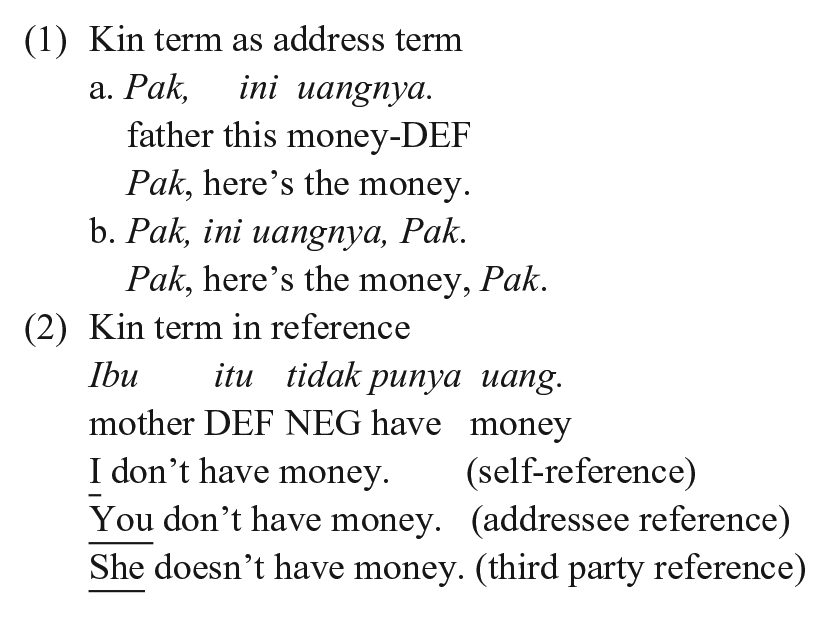
In the interviews studied here, differentiation is found between the way the president (and vice president) and those below them are addressed and referred to. The president and vice president are invariably addressed and referred to with a parent term (ibu ‘mother’, bapak ‘father’). In contrast, ministers and other politicians below them (as well as journalists) are addressed or referred to with a wider range of terms, including parent terms, sibling terms, grandparent terms, names, titles and pronouns (including anda ‘2SG’, kau ‘2SG’, kamu ‘2SG’, (e)lu ‘2SG (Hokkien/Jakarta Indonesian)’ and English you ‘2SG’). In self-reference, use of the pronouns saya ‘1SG’ and kita ‘1PL (inclusive)’ are the norm among the president and former presidents, while those below employ a wider range of pronouns, including saya ‘1SG’, aku ‘1SG’, kita ‘1PL (inclusive)’ and gua/gue ‘1SG (Hokkien/Jakarta Indonesian)’. As noted by other studies (e.g. Djenar et al., 2018; Manns and Musgrave, 2020), Indonesian speakers make use of terms from different languages, including ethnic and foreign languages, when they speak Indonesian. It is sometimes assumed that use of an ethnic term indexes the speaker’s or addressee’s ethnic background. However, no such consistent correlation has been found. When there is such correlation, the ethnic term is generally used to highlight the addressee’s or one’s biography for the purpose of advancing a point. This is consistent with Bucholtz’s (1995: 369) argument that ethnic identity is a ‘constructed product of self-presentation’, and as I would suggest, also of another-presentation. It also accords with Van Dijk’s (1991: 29) description of ethnicity as ‘a special dimension of socio-economic positioning’. The Indonesian expression saudara-saudara kita ‘our siblings’, for example, is commonly used by public figures to refer to a marginalised group or those impacted by some form of misfortune (e.g. natural disasters).
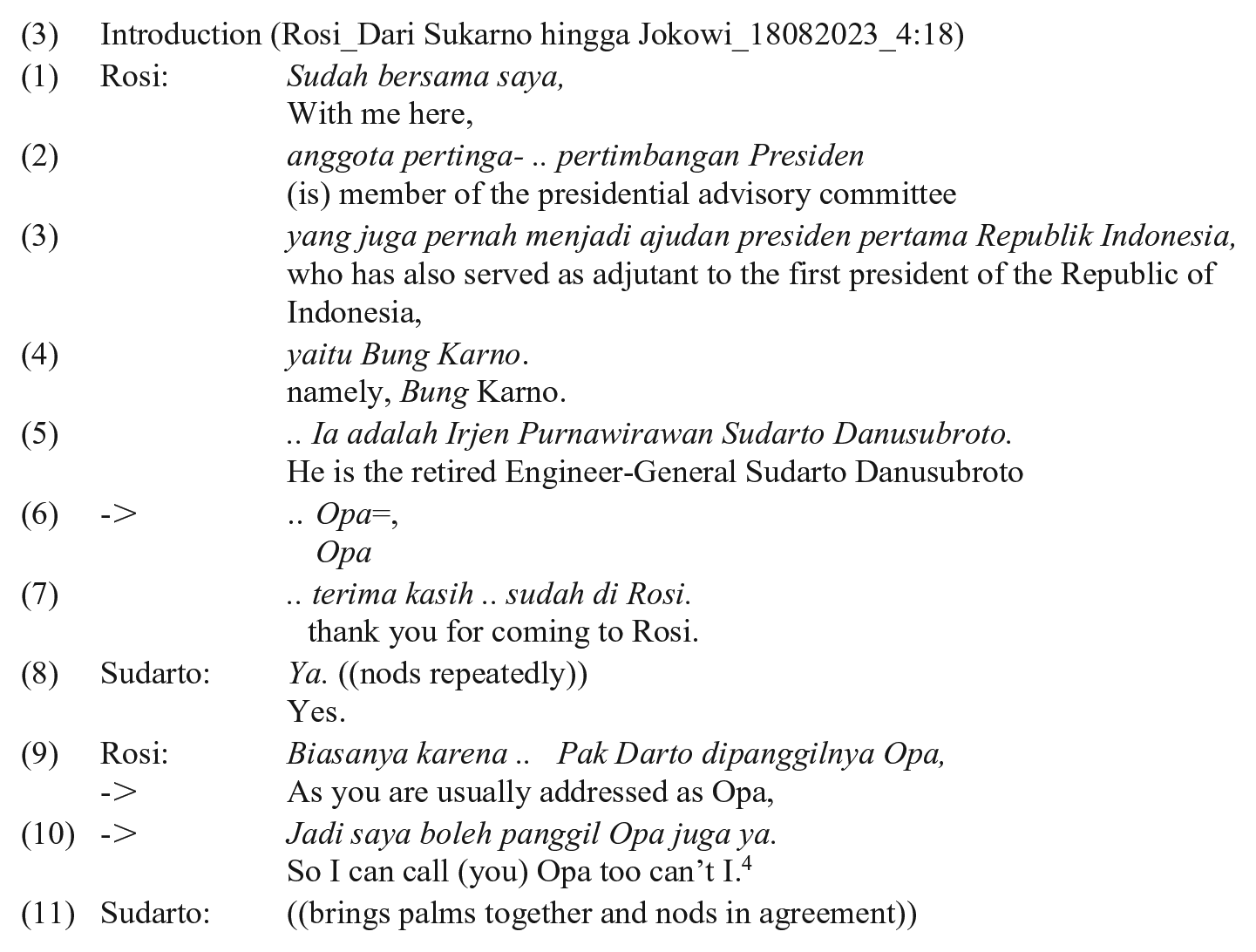
The widespread use of kin terms in the interviews suggests that address and addressee reference involve more than identifying the recipient of an utterance that use of pronouns can accomplish. Kin terms, which encode relative age, generation and sometimes gender, offer a rich characterisation of speaker-addressee relationship. By virtue of their semantics, use of such terms can invoke affective resonances linked to family relationships (Djenar and Sidnell, 2023: 7). Through such use, interview participants relate to each other not as atomic individuals but as members of a network of fictive kin, having the rights and responsibilities that such form of kinship may entail. 3 Kin terms often serve as the focus of metasemiotic activities. For example, journalists often begin an interview by negotiating with an interviewee on how they should be addressed, and kin terms are inevitably involved in such negotiation, as shown in (3). Journalist Rosi Silalahi is introducing Sudarto Danusubroto by addressing him with the grandparent term Opa ‘grandpa (Dutch)’, justifying her choice by saying that she is following the practice of others (lines 9–10).
Unlike kin terms which identify the referent relationally (x is sister to y), including in fictive kinship (x is like a sister to y), pronouns identify an individual or a collective and semantically bear no association with relationality. The juxtaposition of and alternations between kin terms and pronouns can give rise to a semantic tension between relationality and individuation respectively. In what follows I discuss how interview participants exploit this tension and produce levelling and differentiation effects as they do so.
Levelling and differentiation in the interviews
In linguistic typology and related fields, the term ‘leveling’ is associated with dialect levelling, which refers to the reduction in dialectal variation or diversity of linguistic features. Levelling as intended here is a process of positioning the self and the addressee relative to co-present or non-co-present others, social categories and social orders. Levelling does not correspond to sameness of social status or a symmetrical use of terms, though choice of terms may serve as a cue that levelling is being done. In differentiation, interlocutors relate as social actors with different positions. Differentiation may coincide but does not correlate with asymmetry in the use of address and reference terms.
Brown and Gilman (1960) define power and solidarity semantics as ‘covariation between the pronoun used and the objective relationship existing between speaker and addressee’ (p. 252). Levelling and differentiation are different from these in the following way. The relationship between forms and social relations as considered here is not a one-to-one relationship. Such relationship is mediated by ideas people have about ‘figures of personhood’ (Agha, 2007) which associate socially recognisable personae with social types through semiotic acts performed, time and place (historical specificity), the language resources available and the institutional framework they operate under. Brown and Gilman state that pronoun variation may be interpreted as a response to a ‘mood’, by which is implied that through an uncharacteristic address term the speaker expresses alignment with a new collective feeling. In an Indonesian interview a participant may be addressed or referred to with different terms, but it does not follow that the alternations indicate responses to different moods. Rather, they suggest the different ways resources are mobilised as interactants orient to a common feeling.
Bucholtz and Hall (2004) formulate the twin concept of ‘adequation and distinction to explain the mechanisms by which relations of sameness and difference are produced in acts of identity, identity being defined as “the social positioning of self and other”’ (p. 18). Adequation and distinction emerge through suppression of social differences in the construction of sameness and suppression of similarities in the construction of difference, respectively. Building on these notions, levelling and differentiation are coined to suggest that constructions of sameness and difference are linked, through lamination, to relations of hierarchy and parity (see Sidnell and Shohet, 2013) such that positioning always involves a consideration of a participant’s membership to a network of fictive kinship in addition to identification as an individual (or a collective). As conceptual categories, institutional role and kin role may be independent of each other. For example, the role of interviewee may be distinguished from the role of mother. However, a politician inhabiting the institutional role of interviewee is by default also a member of a kin-like network of relations. Similarly, two journalists moderating a panel interview may view themselves as equal by institutional role (as interviewer), but their conduct may orient to kin hierarchy which positions them as a junior and a senior within a network of fictive kin relations. In this way, levelling and differentiation necessarily involve tensions between hierarchy and parity, and between sameness and difference. In what follows I offer examples from the interviews to show how these are put to work.
Addressing and referring to the president in the news interview
The Indonesian president is typically addressed and referred to with a parent term. Name or title may follow (e.g. Bu Megawati, Pak Presiden). Example (4) illustrates how levelling and differentiation effects emerge as these terms are deployed in the news interview. The example is taken from an interview with President Jokowi, conducted during the first year of the pandemic. The government had issued an instruction for Pembatasan Sosial Berskala Besar (PSBB) ‘large scale social restrictions’ affecting several provinces and cities, but the instruction was slow to take effect. 5 Journalist Najwa Shihab is asking the president to comment on the situation. Najwa addresses and refers to the president with (ba)pak ‘father’, pak and title, and in turn is addressed with mbak ‘elder sister’ followed by her familiar name, Nana (line 2).
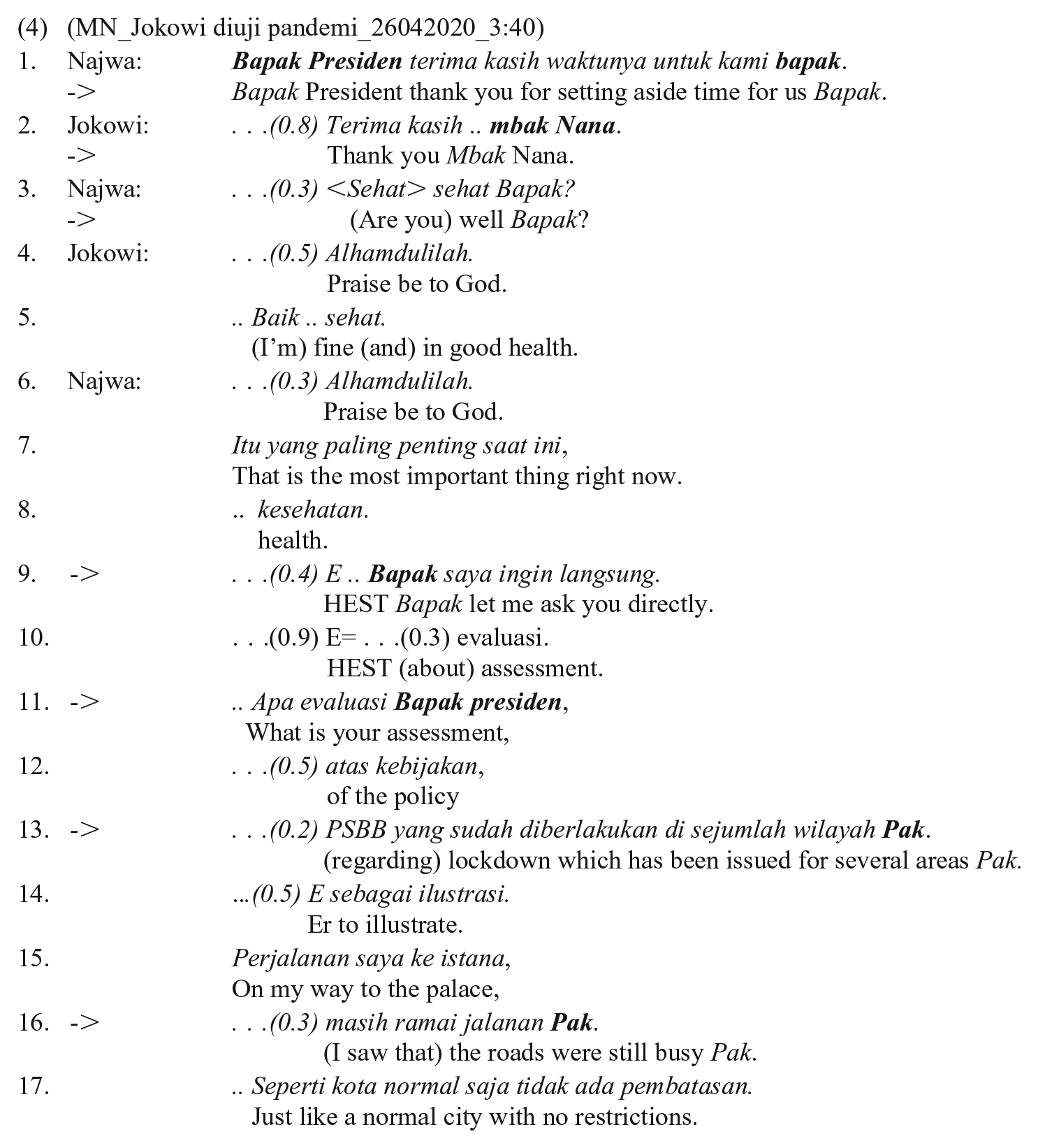
Najwa begins by greeting Jokowi with bapak presiden, a ‘categorical term’ that applies uniquely to the addressee (Lerner, 2003: 184). She first employs it as an address term, prefaced to her action of thanking (line 1). The second time she deploys the term is in addressee reference (line 11) to explicitly identify the president as the party she is requesting an answer from. Najwa employes the truncated address term pak ‘father’ twice in postposition to advance her agenda. The first is appended to the premise of her claim that the president’s instructions have not been heeded (line 13), and the second is attached to the evidence she furnishes to support the claim (line 16).
Levelling emerges in this example as Najwa identifies her addressee by generation and institutional role, thus indexically linking them to seniority. This addressee-identification is differentiated from Najwa’s self-identification as kami ‘1PL (we, excluding you)’, a pronoun denoting a collective, free of association with hierarchical structures. 6 Further differentiation emerges between the journalist’s self-identification as witness of people’s disregard for the president’s instructions (lines 15–16) and her identification of the addressee as the party to bear responsibility for it. This example illustrates that levelling and differentiation do not work independently but are intertwined and in tension with each other as different linguistic resources are put to work.
Address and interlocutor reference in the panel interview
The panel interview typically involves a journalist and a minimum of two guests. A recent variation of the genre includes multiple journalists interviewing a minimum of two guests, as the example below shows. A wider range of terms are employed in this genre, including parent terms, grandparent terms and sibling terms, in addition to pronouns, names and titles. Unlike in the interview with a single public figure, professional titles are rarely used.
Example (5) is taken from the introduction part of an interview presented in the format of a video podcast, involving three journalists and several guests. The podcast typically opens with the journalists, Budi, Arie and Toriq, talking to the guests about various topics before the guests are formally introduced. The current three guests are senior journalist and politician, Panda Nababan, former member of the DPR ‘People’s Representative Council’, Zulfan Lindan, and academic and political commentator, Adi Prayitno. Arie is reminding his co-hosts that they need to do the introduction before talking further. Budi concurs that their senior-senior ‘seniors’ (line 70) need to be introduced and instructs Toriq to do it. Arie’s reminder signals to the audience that they are listening to an institutional talk delivered in a casual style. Signs that the hosts orient to a casual style of interviewing are indicated as follows. First, Toriq insists that introducing the guests is necessary even if it is simply for formal-formalan ‘playing formal’ (line 69). Second, when Toriq begins the introduction with a formulaic phrase (lines 72–73), Budi cheers him on with jia=, an interjection typically used to index an utterance as performative, treating Toriq’s introduction as a necessary formality.
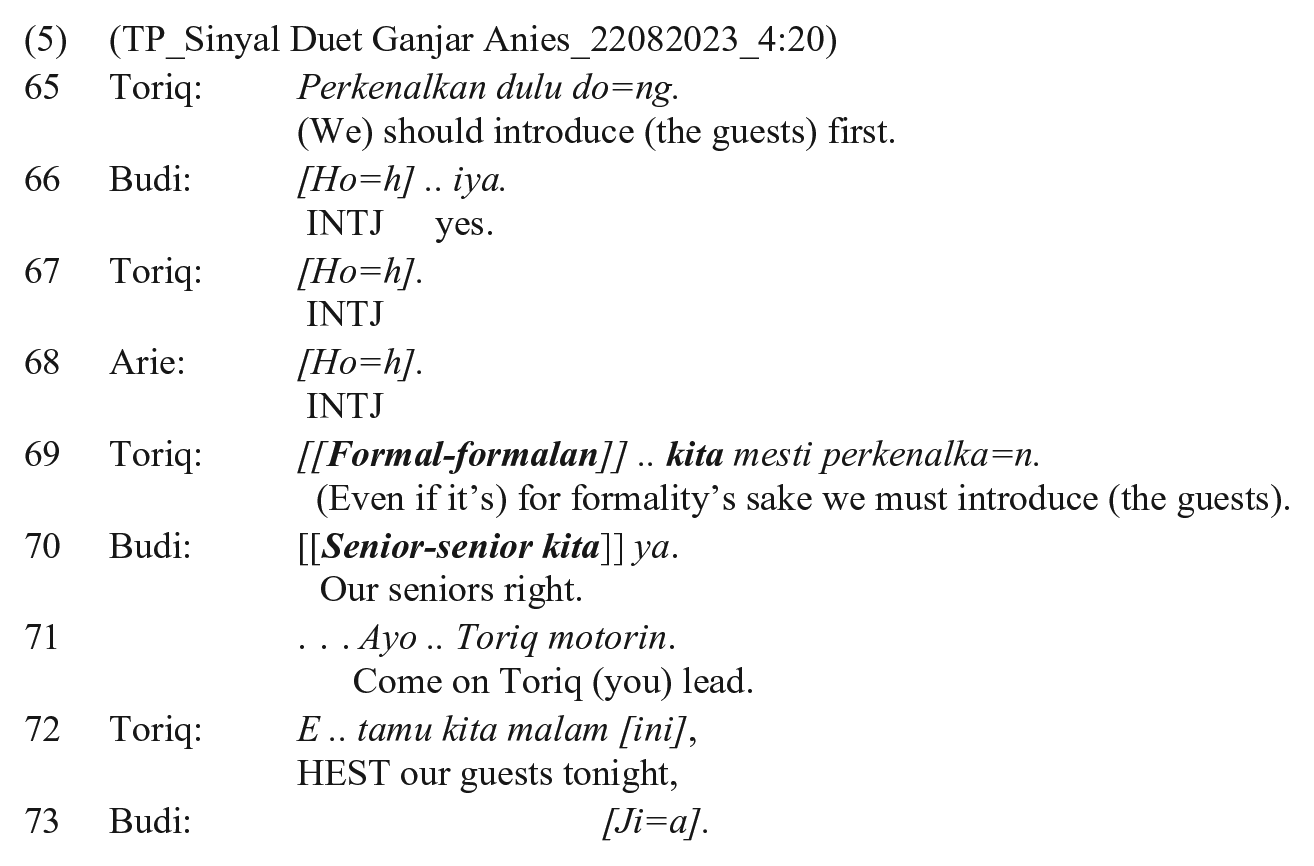
Levelling is involved firstly as Budi refers to the guests as ‘our seniors’, thus positioning them higher on social hierarchy relative to himself and his co-hosts, whom he refers to with the pronoun kita ‘1PL (‘we, including you’)’. Through this self-reference, Budi indexes his position to be on a par with his co-hosts, differentiated from the guests.
Panda Nababan is the first introduced. Toriq describes him relative to his rank within his political party then offers him two alternatives for how he would like to be introduced (line 75). Arie offers abang ‘elder brother’ as a candidate, to which Toriq responds by pointing out that it is the term used by a TV host to address Panda, which Panda confirms. Upon hearing that Panda was addressed as abang, Budi remarks that the TV host is ‘ignorant of history’ (line 80).
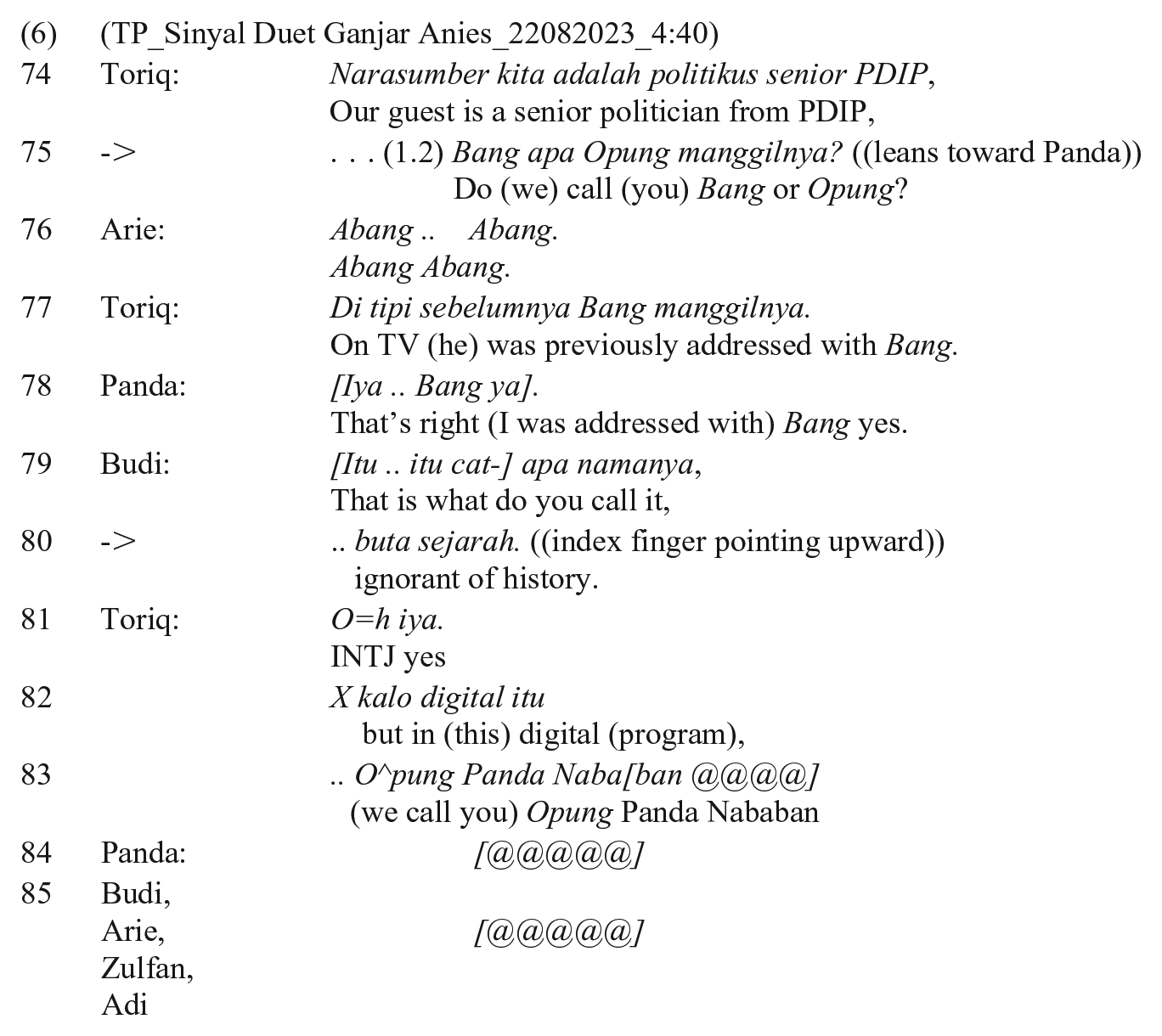
The significance of Budi’s remark (lines 81–82) cannot be appreciated without a consideration of how the other guests, Zulfan and Adi, are addressed and referred to. In this interview, they are addressed and referred to with (a)bang ‘elder brother’, the same term the TV host employed to address and refer to Panda. Budi’s remark about the TV host being ‘ignorant of history’ suggests that not differentiating Panda from other interviewees amounts to ignorance about Panda’s seniority. In labelling the TV host in that way, Budi also differentiates himself, and by extension his co-hosts, from the TV host. Toriq, in alignment with Budi, engages in further differentiation by identifying their programme as ‘digital’ (line 84), implying that the TV programme is not, and gives the full name by which Panda will be addressed and referred to in their programme, Opung Panda Nababan (line 83). 7 Addressing Panda with Opung is marked in the sense that it departs from the default practice (see Enfield, 2007) of addressing a male interviewee with abang ‘elder brother’, and this is evidenced by the metasemiotic activity of negotiating how 79-year old Panda would be called and the recognition that such negotiation is relevant and amusing to all, as indicated by the shared laughter (lines 36–37). Opung is a Batak kin term, deployed here as a sign of recognition of Panda’s biography. Though Panda’s Batak background is not explicitly mentioned in this interview, use of the term suggests to the audience that something else other than age and gender is being signalled. This example, as with Example (3) earlier, suggests that biography matters in address and reference in political interviews, and guest introduction is one of the environments where this is highlighted.
Kin terms and pronouns in the panel interview
The panel interview involves guests who are expected to express opposing viewpoints. The next four examples are taken from a panel interview in which heated disagreement occurs between two opposing sides: Jhony and Max on one side, and Jansen and Herman on the other. All four guests are members of the Partai Demokrat ‘Democratic Party’, previously led by former president Susilo Bambang Yudhoyono, better known as SBY. Levelling and differentiation effects are produced as these participants contrast each other’s positions by drawing on sibling hierarchy, generation and life experience, employing kin terms, names and pronouns in address and reference.
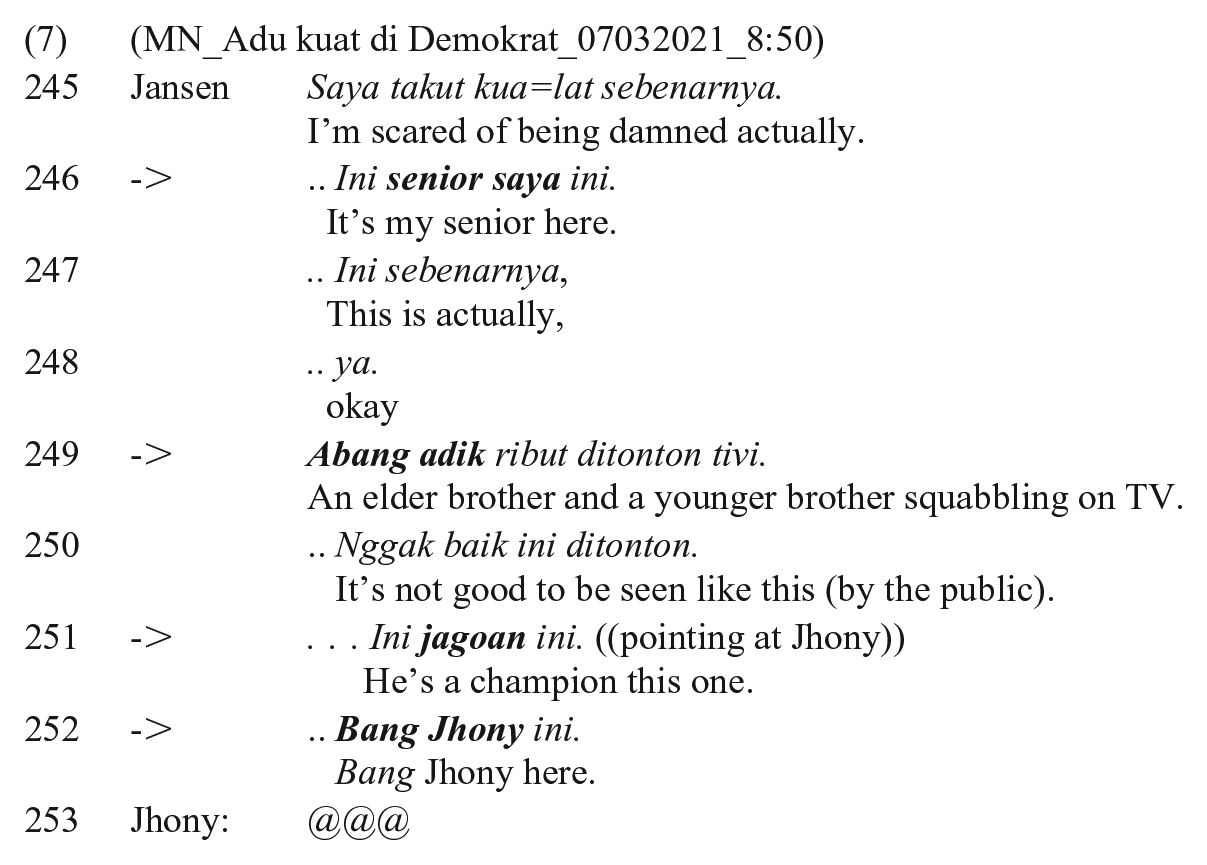
Jhony and Max are disgruntled high-ranking party officials who have acted against the party’s rule by holding a congress to elect a new leader outside of the party proper. They maintain that the reason they did so is because SBY has neglected the interests of party members. Meanwhile, as shown in (7), Jansen, a party faithful, insists the party cannot survive without SBY’s leadership. Levelling emerges as Jansen, who is directing his talk to Najwa, refers to Jhony as senior saya ‘my senior’ and describes his relationship with him as abang adik ‘elder brother (and) younger brother’. He also refers to Jhony as Bang Jhony and describes him as jagoan ‘champion’ (line 251) as he expresses his concern that his conflict with Jhony is being displayed to the public (lines 249–250), thus indicating to the audience that what they are hearing is not a private conversation but an institutional talk. Jhony, who recognises that Jansen has just performed a referent-elevating act, responds with laughter (line 253).
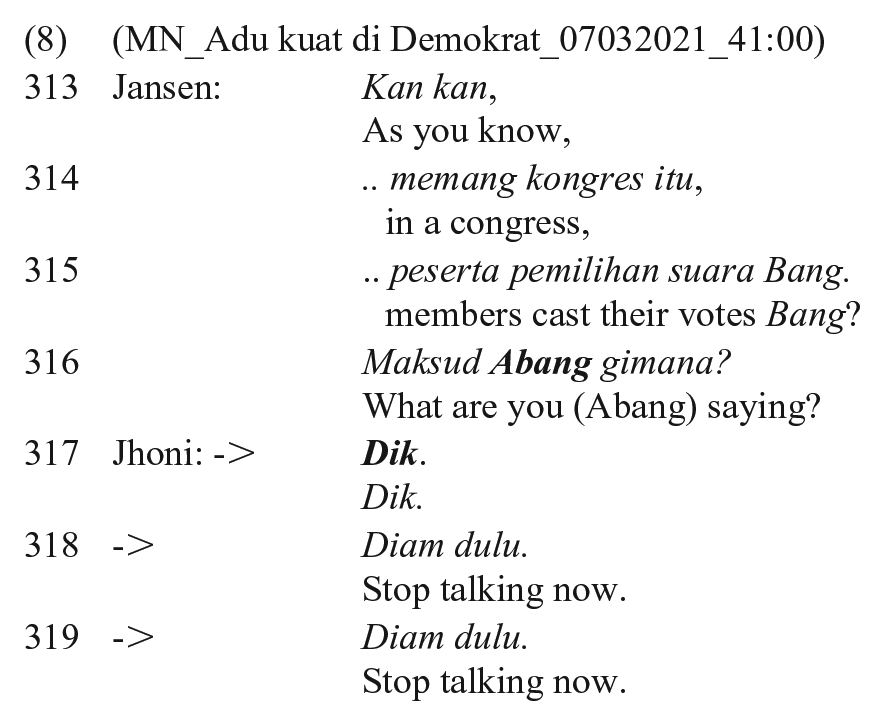
Example (8) below shows how Jhony takes up the elevated position. Jansen is responding to Jhony’s complaint that some members were not allowed to vote at the previous party congress by reminding him that only eligible members can vote. He is now asking Jhony to clarify his position. However, instead of giving clarification, Jhony takes up the role of an elder brother and addresses Jansen with dik (from adik ‘younger sibling; line 317), and through inhabiting this role, he exercises authority by instructing Jansen to stop talking twice in succession (lines 318–319).
Jhony’s rebuke continues moments later. Jansen is claiming that the Democratic Party would not be what it is today without SBY, and that even Jhony has benefitted from SBY’s leadership. Hearing the claim, Jhony, with right forefinger pointing at Jansen, interrupts and instructs Jansen to stop talking, as shown in (9), addressing him this time with pak ‘father’ followed by Jansen’s surname, Sitindaon, instead of dik ‘younger sibling’ as he did previously.
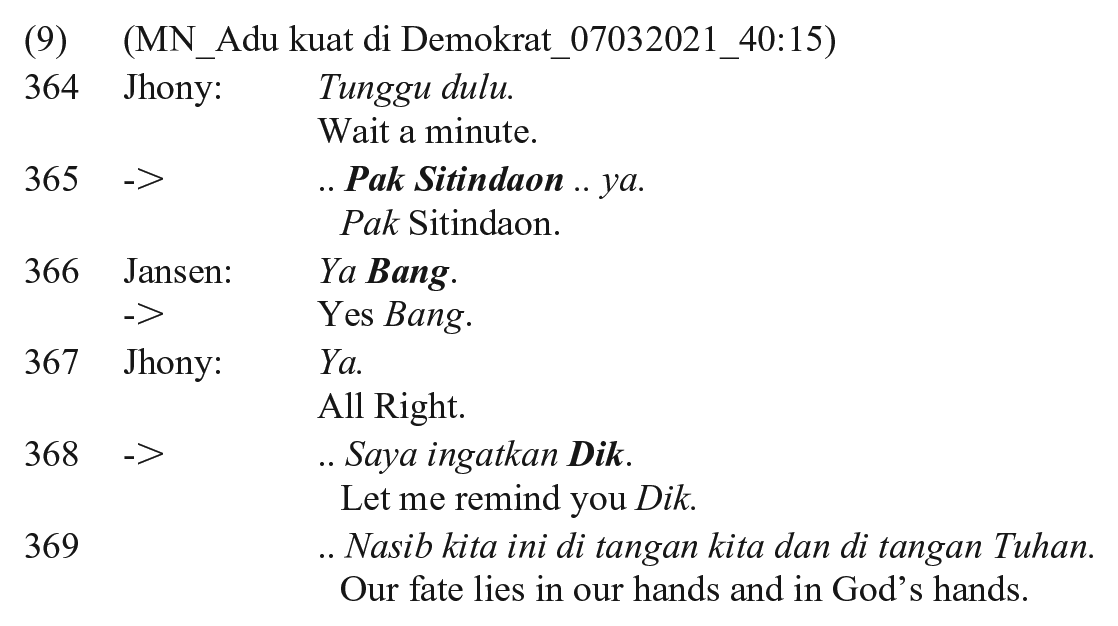
Enacted within a response to Jansen’s long spiel praising SBY’s leadership, the alternation from a sibling term to a parent term performed by Jhony indexes a shift in levelling. The addressee, previously treated as a junior, is now positioned relative to his claim to knowledge about party leadership. Jansen responds to this shift by maintaining his orientation to sibling hierarchy, as indexed through his addressing Jhony with bang ‘elder brother’. Jhony acknowledges Jansen’s response (line 367) before rebuking him once again, this time addressing him with dik ‘younger sibling’ (line 368), thus re-orienting to hierarchy, in alignment with Jansen’s positioning of him.
Levelling and differentiation through use of pronouns
Up to this point, we have discussed how levelling and differentiation arise through acts of address and reference which exploit the semantic contrast between relationality and individuation denoted by kin terms and pronouns respectively. What follows discusses how such effects can be similarly produced through use of pronouns alone, with the support of co-occurring elements.
Example (10) is taken from the same interview as (7)–(9). Max, who supports Jhony’s position, joins Jhony in rebuking Jansen for claiming that the Democratic Party’s achievements are all due to SBY’s leadership. Max’s rebuke is structured as follows. He first makes a reference to past time as a preface to the rebuke. He differentiates between Jansen, whom he refers with the pronoun kau ‘2SG’, and himself and Jhony, whom he refers to with kami ‘1PL (we, excluding you)’, by drawing on age and experience. Max claims that Jansen was still in high school when he and Jhony were already working for the party. Following this preface, he alternates to using anda ‘2SG’ to refer to Jansen (line 409), thus differentiating between the young Jansen whom he referred to with kau and the adult Jansen whom he is treating as the target of rebuke in the here-and-now (line 409). The alternation in addressee reference from kau to anda thus indexes a shift in temporal reference, from the past to the present, and from referring to the addressee relative to place and life stage (di SMA ‘at high school’) to referring to them relative to the claim he has just made. In this way, levelling and differentiation effects emerge through the juxtaposition of the pronouns and the other, co-occurring elements.
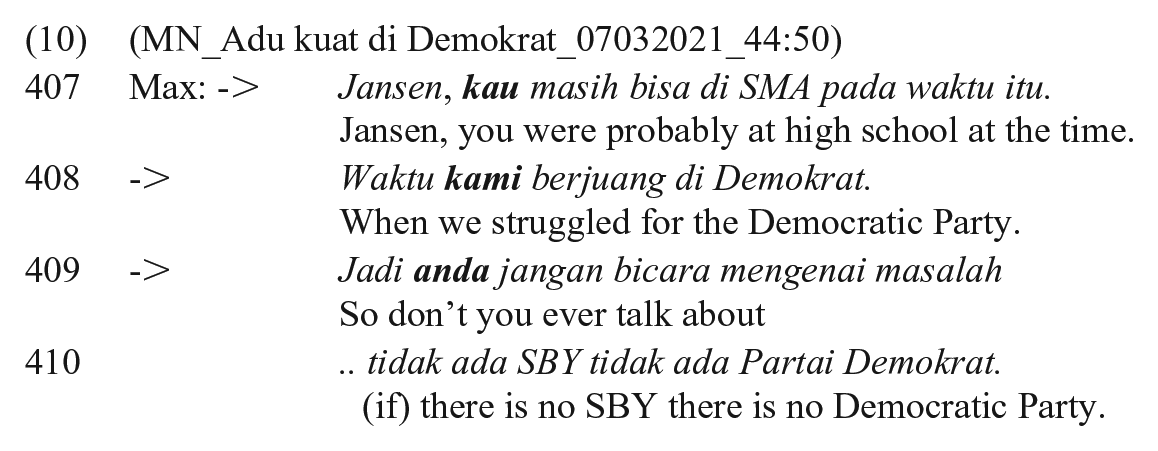
The foregoing examples illustrate the following pattern of usage, or the organisation of ‘forms’ in Williams’s sense. The use of kin terms and pronouns for indexing self- and addressee positioning exploits the semantic contrast between relationality on the one hand and individuation on the other. Levelling and differentiation are characterised by tension that emerges through positioning of the addressee relative to hierarchical order linked to kinship, and the speaker as an individual (or a collective), free from association with hierarchy. 8 Where pronouns are the main resource for accomplishing reference, levelling and differentiation effects can emerge through positioning which identifies the interlocutors relative to social and other categories such as time and place (or life stage). The difference in the kind and range of linguistic resources mobilised to address and refer to senior politicians (e.g. the president) in the one-to-one interview and those applied to and by other politicians in the panel interview suggests a collective orientation to rank-based social differentiation.
Conclusion
In his critique of Raymond Williams’s works, Terry Eagleton remarks that ‘structures of feeling’ lacks the theoretical terms that can specify its articulations. Based on a study on address and interlocutor reference in Indonesian, this paper has offered levelling and differentiation as candidates for such articulations. Levelling and differentiation form a dialectical process made palpable in acts of address and interlocutor reference through the mobilisation of linguistic and other resources for stance purposes. The method adopted in this paper for determining whether levelling and differentiation are involved requires a consideration of how the speaker addresses or refers to an interlocutor and to themselves.
Williams (1980: 26) considers literary forms as indications of viewpoints and suggests that changes in forms can tell us about ‘changes of viewpoint, changes of known and knowable relationships, changes of possible and actual resolutions’. This paper is a study of the organisation of forms in Indonesian interviews. Instead of examining changes, it has focused on the organisation of forms in the present to show how differing points of view orient to a common feeling. The varied ways in which the interview participants make use of available resources to relate to each other in public are part of what Williams calls ‘style’, that is, different ways of using linguistic devices to express points of view. This style, which exploits the semantic affordances of kin terms, pronouns, names and titles, is constrained by the institutional character of the interviews which prescribes that all talk be produced for the benefit of the public. I have pointed out the differentiation between the way the Indonesian president and those below them are addressed and referred to and have suggested that this stylistic arrangement is indexical of a shared consciousness about the relevance of rank.
Footnotes
Abbreviations
1SG/PL first person singular/plural
2SG/PL second person singular/plural
HEST hesitation
INTJ interjection
Transcription symbols (Du Bois et al.,1993)
@ laughter
.. short pause (about 0.2 seconds or less)
. . . medium pause (between 0.3 – 0.6 seconds)
. . .(N) long pause (0.7 seconds or longer)
X undecipherable syllable
(( )) researcher’s comment
= prosodic lengthening
^ primary accent
(.) final contour
[ ] speech overlap
(-) truncated word
(–) truncated intonation unit
Declaration of conflicting interests
The author declared no potential conflicts of interest with respect to the research, authorship, and/or publication of this article.
Funding
The author received no financial support for the research, authorship, and/or publication of this article.