




Abstract
This paper develops the notion of metonymy scenarios by exploring the social and cognitive dimensions of various creative uses of metonymy in a collection of digital banners created for the Global Climate Strike movement. The paper argues that the banners exploit existing metonymic relationships to activate dominant anthropocentric discourses in society, and to subvert them via processes of recontextualisation and reappropriation, in order to challenge system conventions and normative attitudes regarding climate change. The literature to date has not adequately considered metonymy as a dynamic and scenario-activating cognitive operation, nor has it thoroughly investigated the relationship between metonymy and irony. However, the data analysed here show that several creative uses of metonymy, including twice-true metonymy, metonymy in combination with metaphor, and the juxtaposition of different metonymies are markers of what this paper posits as metonymic mininarratives or scenarios.
Introduction
Inspired by movements such as Fridays for Future and the UK Student Climate Network, the Global Climate Strikes (GCS) encourage people across the globe to ‘strike’ from school or work to demand governmental action against climate change. In view of the proliferation of creative and critical discourses around climate activism ever since 2018 – what has been named a ‘watershed’ year for environmental activism (Pickard et al., 2020: 251) – this paper explores the ways in which a dataset of posters created for the ongoing GCS systematically exploits a variety of creative uses of metonymy (Littlemore, 2022; Littlemore and Tagg, 2018) to perform climate protest activity.
The main contribution that this paper makes to the cognitive linguistic theory on metonymy (Barcelona, 2004; Ruiz de Mendoza and Otal Campo, 2002) and figurative language from a discourse analytic perspective is the argument that one of the key features of creativity found in the data is the activation of mininarratives/scenarios by metonymy. This concept builds on Musolff’s (2006) metaphor scenarios and Ritchie’s (2010) story metaphors (see also Montesano-Montessori and Morales-López’s (2015) multimodal narratives in protest slogans and Biernacka’s (2013) metonymic processing of stories and scenarios). The examples analysed to develop the notion of metonymy scenarios have ironic overtones and largely function by pairing conventional expressions and pop-cultural allusions with unexpected twists, to develop a rhetoric of resistance to dominant anthropocentric ideologies and discourses that are embedded in mainstream society and culture. The strategies adopted to create this authorial discourse, and which, it is argued, may result in triggering metonymy scenarios, include recontextualisation and reappropriation of fixed expressions, idioms and familiar cultural allusions, for a climate activist agenda.
Metonymy can be defined as a domain-based cognitive operation that makes salient one aspect of experience in relation to another, contiguous aspect. In this sense, metonymy involves a domain-internal conceptual mapping (e.g. ‘have a glass to celebrate’ makes use of a
Since metonymy operates at the levels of the phrase (Littlemore and Tagg, 2018) and clause as well as that of the word, 2 it is effective in making intertextual allusions to other discourses, and by highlighting a contrast between the allusion (which may be particularly meaningful for a specific culture or discourse community) and an alternative context. As the data analysed in this study illustrate, the effect of contrasting different contexts can rely (among other strategies relating to form) on exploiting the same conceptual knowledge network (often termed idealised cognitive model (ICM), domain, domain matrix or frame) to construe different discourse-level metonymies that are nevertheless identical at a more schematic (i.e. abstract) level of conceptualisation. 3 Alternatively, a speaker may exploit via metonymies a contrast between more than one ICM.
Littlemore and Tagg (2018) and Littlemore (2022) have identified previously the roles of ICMs in real-world creative uses of metonymy. The present analysis proposes, however, to draw together Littlemore and colleague’s observations with the concept of metaphor scenarios advanced by Musolff (2006). The metonymy scenarios which, it is argued, can be seen to characterise the creative combinations of metonymic mappings analysed in section ‘Analysis’ also reflect how the discourse indexes (mini)narratives (Montesano-Montessori and Morales-López, 2015; Musolff, 2006; Ritchie, 2010). In this paper, the term ‘mininarratives’ refers to conceptually rich snippets of event-based, embodied and culturally embedded experience – similar to what has been termed ‘cognitive frame’ (Lakoff, 1996, 2010; Montesano-Montessori and Morales-López, 2015; Stibbe, 2015). Mininarratives potentially involve simulations of previous experiences (Barsalou, 2008; Ritchie, 2009) and can be activated, for example, via
The paper begins by presenting the theoretical framework for analysing creative uses of metonymy and for advancing the concept of metonymy scenarios. The section maintains a focus on figurative language as social practice and rooted in socio-cognitive mechanisms. The following section explains the data and method of analysis. The next section analyses key examples from the dataset to develop the arguments proposed earlier and to elucidate the creative, socio-cognitive processes of meaning construction that characterise the data. The paper concludes with a discussion and suggestions for further research.
Theoretical framework
The aim of this section is to present the framework for a view of metonymy (especially as used in discourses of protest or resistance) as socially and cognitively motivated, prone to creativity, and as a potentially scenario-activating cognitive operation, which frequently combines with other metonymic relations and forms of figurative language (e.g. Goossens, 1995; Ruiz de Mendoza and Galera-Masegosa, 2011) to imply mininarratives.
Metonymy and creativity
The language of protest banners and slogans is frequently highly creative, since it demonstrates a form of resistance to a specific power. Since creativity is key to transcending (socio-political) boundaries and is typical of discourses of resistance generally (Carter, 2004; Hidalgo-Downing, 2020; Romano, 2013, 2021, 2022), a framework for metonymy which incorporates creativity is needed. Littlemore’s (2022) taxonomy for creative uses of metonymy (developed from Littlemore and Tagg (2018)) is useful for analysing metonymy from functional and cognitive perspectives for several reasons. Firstly, Littlemore’s (2022) framework is comprehensive but grounded in cognitive linguistic theory; it considers schematic/high-level patterns of conceptual thought, such as the role of ICMs in creative uses of metonymy, as well as patterns of metonymic expression that operate at the more specific, lower levels of conceptualisation, such as that of modality and the immediate co-text. To this extent, Littlemore’s (2022) framework is broad enough to accommodate interactions with other kinds of figurative language or other metonymies. Furthermore, it accounts for variation in the forms and contexts in which metonymy can be identified. Finally, it recognises metonymy as operating at the levels of the phrase and clause as well as at that of the word. As such, Littlemore’s (2022) framework can be usefully applied to the analysis of discourses that differ by genre or communicative function.
Littlemore (2022) identifies two broad (but not mutually exclusive) categories for creative uses of metonymy: meaning-based and form-based. These two types frequently inter-relate and often represent two sides of the same coin. Meaning-based creative uses can involve six types. Firstly, the juxtaposition of two established metonymic relationships, which may evoke a contrast between two different meanings. Secondly, the extension or elaboration of an established metonymic relationship, such as a metonymic chain (where one metonymy leads to another). This second type may also involve a conceptual blend (where two or more metonyms are conceptually integrated to yield a new, blended meaning). 4 Thirdly, the combination and/or juxtaposition with metaphor, where a sense of ambiguity between a metonymic or a metaphoric reading may also be the creative crux of an expression. Fourth, a metonymy may be ‘twice-true’, in the sense that it involves creative exploitation of an expression for its simultaneously figurative (metonymic) and literal meanings. Fifth, a metonymy may fulfil the function of personification (e.g. where politicians represent nations in political cartoons (Negro Alousque, 2013)). Sixth, discourse-level creativity, which relies on contrasts between the lexical and discourse levels, such as unexpected use of a word based on the context.
Form-based creative uses of metonymy, on the other hand, can be achieved through (a) repetition or parallelism, such as the satirical Twitter account, @PPEinPPE, which mocks populist strategies used by UK politicians who studied Philosophy, Politics and Economics (known as the acronym, ‘PPE’) at the University of Oxford, and who have been captured by the press wearing personal protective equipment (also known as ‘PPE’); (b) wordplay, such as through polysemy; and (c) manipulations of specific parts of speech, such as using an adjective as a verb, or a noun phrase as an adjective (e.g. ‘files have been higgledy-piggled into spaces too small’).
Overall, Littlemore (2022) maintains that no matter how creative the rendering of a particular metonymic expression, the relation is always traceable to an existing, wide-scope (i.e. higher-level) conceptual mapping – an argument which challenges the notion of novelty in discussions of metonymic and metaphoric mapping creativity (Brdar, 2021; Pérez-Sobrino et al., 2022). In this way, the conceptual structures underpinning metonymic creativity are akin to those underpinning metaphoric creativity. Thus, the commonly assumed dissimilarities between creative metonymic and metaphoric conceptualisation are perhaps less striking than frequently supposed.
Scenarios and mininarratives
Given the closeness of this relationship between metonymic and metaphoric thought, the following paragraphs introduce two further theoretical notions: metaphor scenarios (Musolff, 2006) and story metaphors (Ritchie, 2010, 2017a). The aim is to suggest the transferability of these concepts to metonymic thought by focusing on the shared domain-based nature of metaphor and metonymy. Such an approach can reveal ways in which clusters of metonymic mappings are creatively exploited in the dataset to trigger mininarratives and evoke irony and humour. To this extent, the section also discusses Montesano and Morales-López’s (2015) article on narratives in protest slogans.
Musolff (2006: 36) defines metaphor scenarios as ‘focal areas of source domains’ triggered in discourse, which ‘enable the speakers to not only apply source to target concepts but to draw on them to build narrative frames for the conceptualisation and assessment of socio-political issues’. For example, in public discourse,
Ritchie (2009, 2010, 2017a, 2017b) has also developed interesting notions related to the narrative dimension of metaphorical conceptualisation – particularly in relation to perceptual simulation theory (Barsalou, 2008) – which he calls ‘story metaphors’ and ‘metaphorical stories’. For Ritchie (2010), metaphors can imply stories and stories can also be metaphorical. Stories often invoke specific time periods, events or conventions widely acknowledged in a particular culture or community. Processing stories may trigger partial simulations of relevant perceptual experiences, which support the metaphor’s communicative and social functions. For example, ‘metaphorical stories’ may involve reactivating or elaborating familiar idioms, allegories or metaphorical expressions, such as ‘we’re all in the same boat’, to advance an argument or enhance social connection. ‘Story metaphors’, on the other hand, may involve puns and wordplay (e.g. ‘vulture capitalist’ instead of ‘venture capitalist’) or vivid mental images (e.g. ‘bull in a China shop’). The perceptual simulations involved in processing metaphors in terms of stories may be reinforced by ‘story indexes’ (Ritchie, 2010: 125). Although ‘story indexes’ receive the least attention in Ritchie’s work, they are closely related to this paper, since they function as metonymies. For example, in a conversation between some American Latinos in which speakers collectively remember their childhood experiences of parental discipline, Ritchie (2010: 134) identifies references to ‘the belt’, and ‘the chanclas’ (Spanish for the ‘sandals’), which he argues enable cultural memories to be activated and shared between discourse participants in a vivid way. As noted by Littlemore and Tagg (2018), some fixed expressions and phrases can also be metonymical. For example, ‘let’s hit the trails’, might be used by communities who practice outdoor activities to refer to going hiking or skiing in a
Finally, according to Montesano and Morales-López’s (2015: 207) research on recent social protests in Spain (called 15M), the slogans used by protesters can be seen as ‘micro-narratives’, because they both reference and recontextualise important narratives within the socio-political context of the protest. For example, use of wordplay may simultaneously reference and disparage the behaviour of certain politicians, whilst relying on common Spanish idioms and cultural knowledge. For example, in the slogan, no hay pan para tanto chorizo (there isn’t enough bread for so much sausage), the word, chorizo, refers to politicians’ deceits as well as the traditional food, and pan, meaning ‘bread’, is used as a figurative reference to public money but also to what one would eat with chorizo. By juxtaposing culture and context-specific narratives in this way, the authors argue that narratives enable the construction of ‘new mutual relations’ between ‘identities and concepts’ by ‘rearticulat[ing] the status quo’ (Montesano and Morales-López, 2015: 207). I argue that metonymy does the work in indexing those mininarratives (‘mininarratives’ because they are snippets of lived/culturally embedded experience). Forming new cognitive relations via creative discourse strategies is potentially, therefore, a characteristic feature of protest/activist discourse as it allows the discourse user to create space for new ideologies amidst the one they are resisting.
Figurative language as social practice
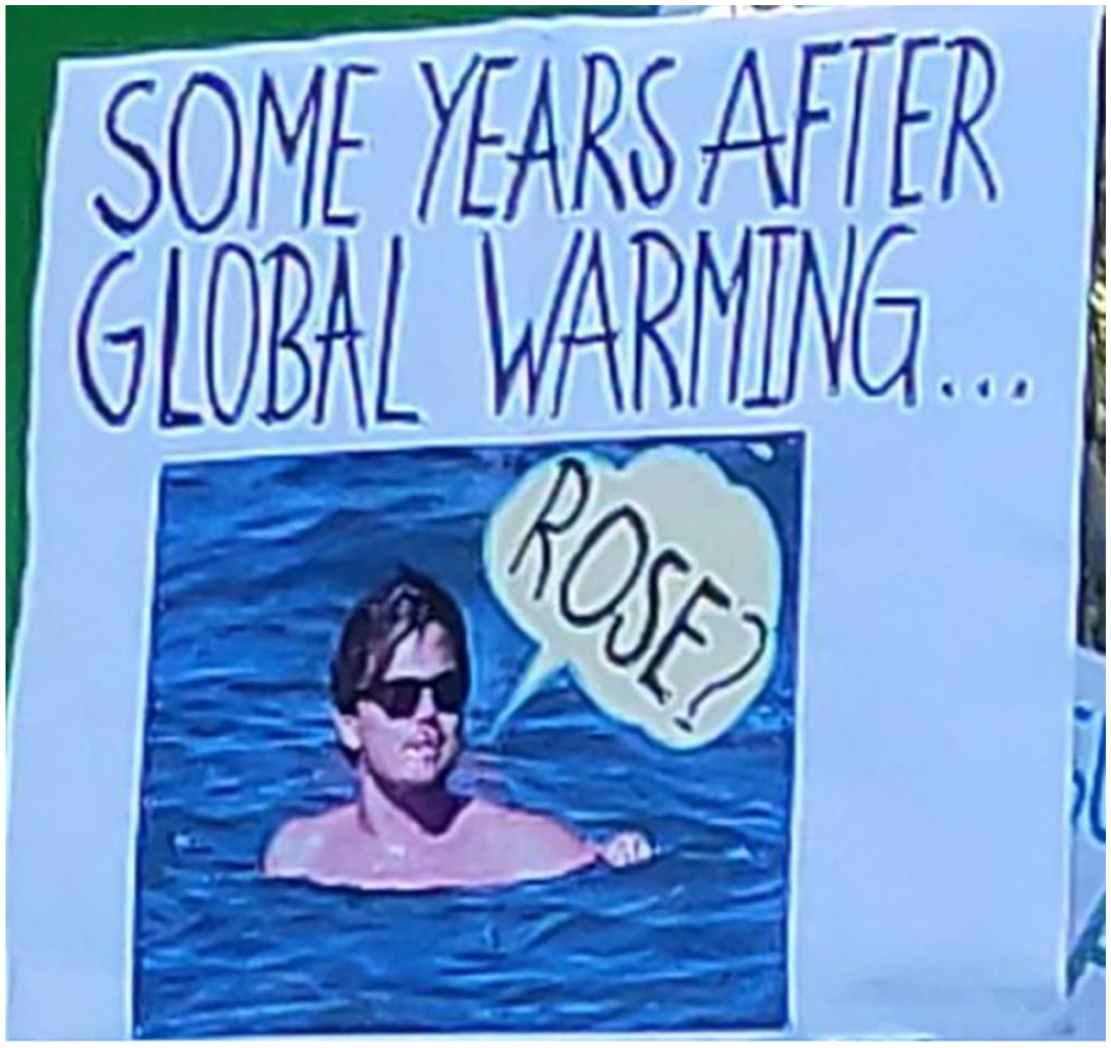
The deeply social and pragmatic functions of figurative language use are well-acknowledged in the literature (e.g. Barcelona, 2004; Colston, 2015, 2022; Colston and Rasse, 2022; Dyrmo, 2022; Gibbs, 2021; Gibbs and Cameron, 2008; Gibbs and Colston, 2007; Kövecses, 2008, 2015; Ritchie, 2004, 2005, 2010). Irony, in particular, has been thoroughly investigated for its various roles in the social dimensions of language use and communication (Athanasiadou and Colston, 2017; Gibbs and Colston, 2007; Wilson and Sperber, 1992; Witek, 2022). An important observation in this regard relevant to the use of irony in climate protest discourse concerns irony’s function in performing evaluation (e.g. via valence altering processes, discussed in Burgers et al., (2011) and Burgers and Steen (2017); see also Ritchie’s (2005) discussion of frame-shifting) so as to generate a subversive relationship between two evaluative frames. As regards the present study, the communicative effects of irony may be useful in discourses of resistance, especially when seeking to defuse tension, which may be emotional, social or political (Ritchie, 2005). Scholars have noted that uses of humour and irony in protest slogans and banners can serve an alleviating function (Romano, 2021; Vivero, 2011). Irony may also represent a powerful tool for challenging social norms and transgressing the status quo in ways that are emotionally rewarding and lead to a heightened sense of solidarity and bonding among the in-group (Colston and Rasse, 2022). Figure 1 shows a placard displaying a humorous use of multimodal irony displayed at a Fridays for Future protest in Madrid in 2019.
@fridaysformadrid.
The banner pictures Leonardo DiCaprio bathing in the sea in a presumably warm and enjoyable climate. The speech bubble saying, ‘Rose?’ refers directly to the famous scene in James Cameron’s (1997) film, Titanic, where DiCaprio and Kate Winslet, starring as lovers Jack and Rose, fight for their lives in the icy Atlantic Ocean because the Titanic ship is sinking. Jack dies in the freezing water but Rose survives. The caption, ‘some years after global warming. . .’, suggests therefore an ironic imagined future in which DiCaprio’s character pleasantly survives the event.
Both irony and metonymy, then, can occur in discourses of resistance, facilitating strategies of recontextualization and reappropriation (Linell, 2009; Romano, 2022). The referential or indexing function of metonymy can, as this paper shows, facilitate the making of intertextual or cultural allusions, and invoke the discourses, ideologies or practices of the out-group. These may imply mininarratives which can then be recontextualised and subverted in ironic commentary. As previous research suggests, similar strategies can be employed as a means of criticising and overcoming particular social and cognitive frames, generating space for ‘new one[s] of emancipation and social action’ (Romano, 2022: 634). As such, the critical functions of figurative language use can overlap with its social and cognitive functions. As seen in the present study, the combination of metonymy, irony and metaphor is productive in this sense.
Data and method
The data analysed in this paper 5 are a collection of posters created by the climate activist, satirist and influencer, Oli Frost (@olifro.st), followed by one hundred thousand Instagrammers at the time of writing. The posters are designed to capture attention on social media and rally people prone to joining the climate strikes. Many were intended as resources for the first global climate strike in March 2019 and later for other organised climate strikes and political events, including Fridays for Future and the 2019 UK general election.
Romano (2022) has claimed that protest slogans should be seen as a text-type in their own right, as one of the particularities of protest slogans in contrast to other forms of creative discourses used for activism (e.g. visual or performance art) is that they must also conform to the limitations of space provided by a placard or banner. Therefore, Protest banners and slogans are typically multimodal as they generally rely on different colours, fonts and images to support creative expression and grab attention.
The posters by Frost were initially identified by searching on Instagram for images of banners from recent organised climate protests, which make use of figurative operations. Around (N = 20) banners from the complete dataset were identified on the Instagram account, @globalclimatestrike. The full collection of Frost’s posters (available at https://olifro.st/posters), intended for sharing on social media or for printing out for physical demonstrations, was then explored. A total of (N = 56) posters were retained for qualitative analysis on the basis that they have the potential to trigger metonymic and/or metaphoric operations. 6 For consistency, posters containing images were discarded as these were limited. However, the posters retained are multimodal in the sense that they make use of different colours, fonts and typesets.
Metonymy was considered a mapping of contiguity between domains and metaphor a cross-domain mapping. Littlemore’s (2022) framework of analysis for creative uses of metonymy was then applied to the most prominent cases of creative metonymic talk in the dataset. These were subsequently examined for irony and for their potential to trigger mininarratives and metonymy scenarios. This method of analysis was repeated across the dataset on a total of (N = 22) cases or until the observations made were sufficiently rich to support the notion of contrasting mininarratives/metonymy scenarios. The analysis emulated recent developments in cognitive science which espouse an ecological and dynamic view of metaphor and metaphor performance, where social, cognitive and environmental factors are entangled and impact the metaphoricity or metonymicity of an utterance (Colston et al., 2022; Gibbs, 1999, 2022; Gibbs and Cameron, 2008; Jensen, 2017; Jensen and Greve, 2019). This view is compatible with the specific argument developed across this paper, suggesting that metonymy triggers meaning dynamically by leveraging knowledge in creative ways from different contexts and experiences.
Analysis
The following section presents four different perspectives from which metonymy scenarios potentially emerge in the dataset (origins in the same ICM, extension of fixed expressions, form-based and meaning-based combinations and figurative complexes). I analyse representative examples from each perspective according to the socio-cognitive constraints which potentially motivate them. Each perspective is treated as a broad marker for triggering metonymy scenarios rather than as a discrete category. Therefore, providing quantitative data on the corpus is beyond the scope of this paper, but could be an avenue for further research.
Origins in the same ICM
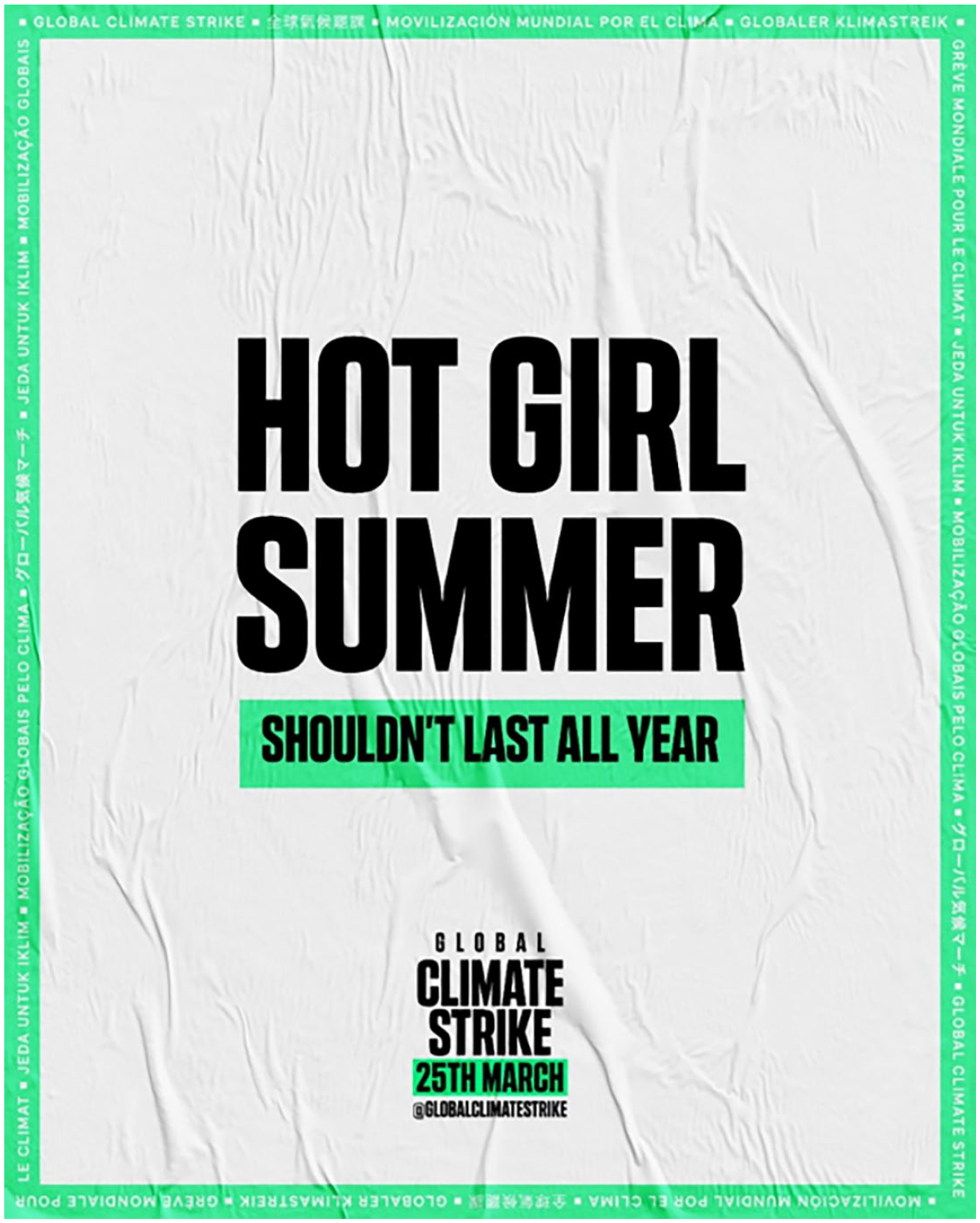
Following Genovesi’s (2020) ‘twice-true’ metaphors, Littlemore (2022: 23–24) describes ‘twice-true’ metonymies as triggering simultaneously literal and metonymic meanings. In the present dataset, twice-true metonymies are effective for condensing witty double-entendres into a limited space, maximising meaning. The double meanings typically set up two scenarios based on the same ICM: one is ironically elaborated in the proceeding text whilst the other is undermined. Figure 2 triggers a twice-true metonymy that exploits the causation ICM by contrasting two
@olifro.st.
The phrase, ‘hot girl summer’, alludes to the title of the pop song by Megan Thee Stallion released in 2019 and the viral meme it triggered,
7
where people (mostly girls) would post ‘hot’ pictures of themselves (i.e. feeling attractive and confident) in summertime. Neither the song nor meme were intended to remark on climate change originally. However, the banner reappropriates the lyric and adds, ‘shouldn’t last all year’, in order to imply that climate change will lead to a permanent summer season. The noun-phrase ‘hot girl summer’ is employed as adjective in both the song and the banner and is motivated by embodied correspondences related to the experience and sensations of heat.
8
These underlying correspondences motivate the figurative and literal senses of ‘hot girl’ (i.e. figurative in terms of sexy, as originally promoted by the song, and literal in terms of temperature, as emphasised by the banner). They also underpin the
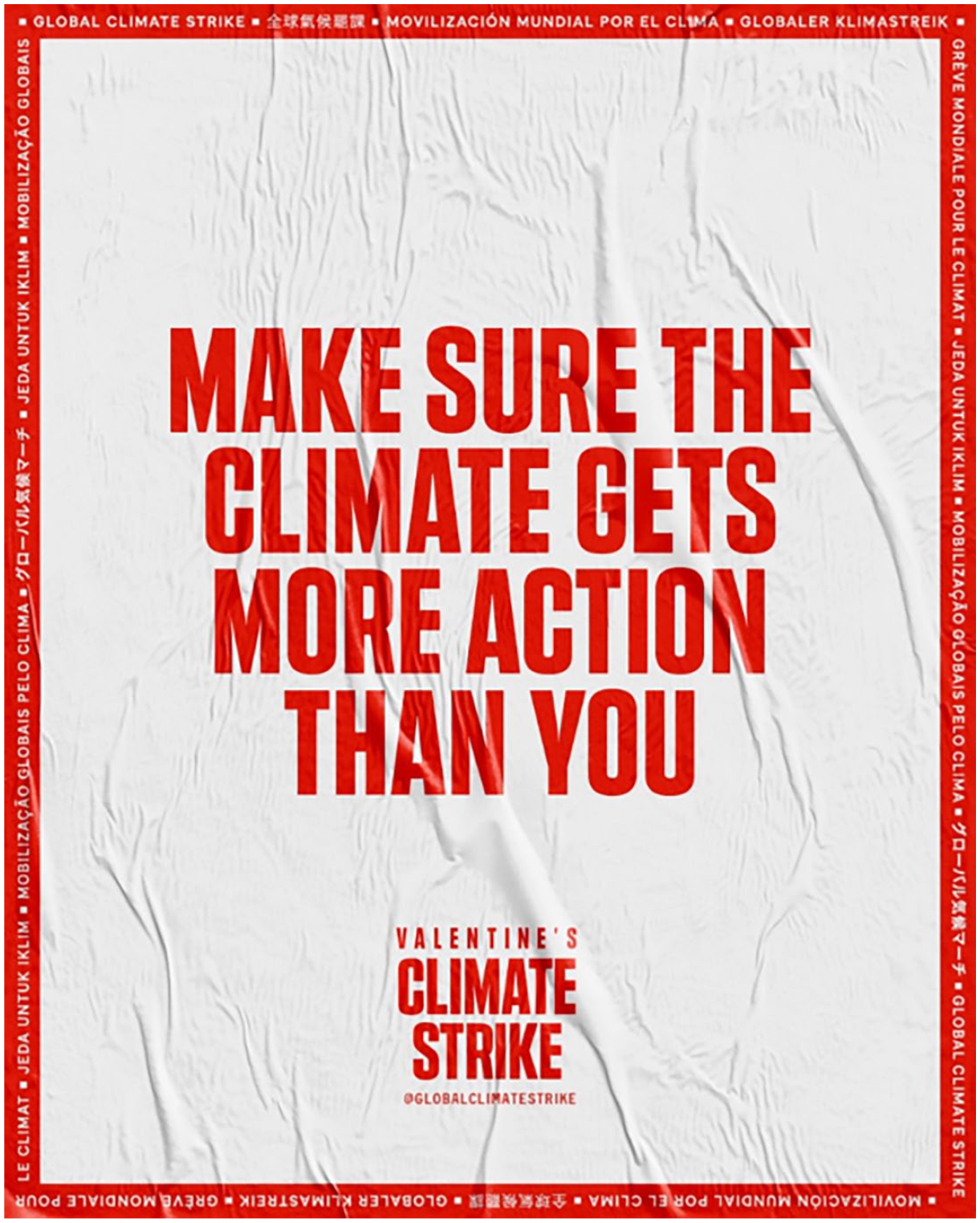
As for Figure 3, the meaning also originates in a twice-true metonymy but exploits the
@olifro.st.
Extension of fixed expressions
One of the key strategies exploited in the dataset, of which we have already seen a glimpse in Figure 2, is the juxtaposition or pairing of fixed or well-known expressions (and established metonymic relationships) in English with unexpected twists. This particular strategy may involve introducing an additional clause that subverts the original expression. Alternatively, it may modify from within a fixed expression (and by implication, elaborate or extend it (Littlemore, 2022)). This affixes a new meaning to the original phrase and has the effect of transgressing conventional expectations and assumptions. The effect of such kinds of subversion can be seen to drive banal expressions to acquire new relevance in context. Superseding the original meaning with a new and unexpected one may be socially incentivising from the perspectives of humour and enhanced emotional relevance for the audience.
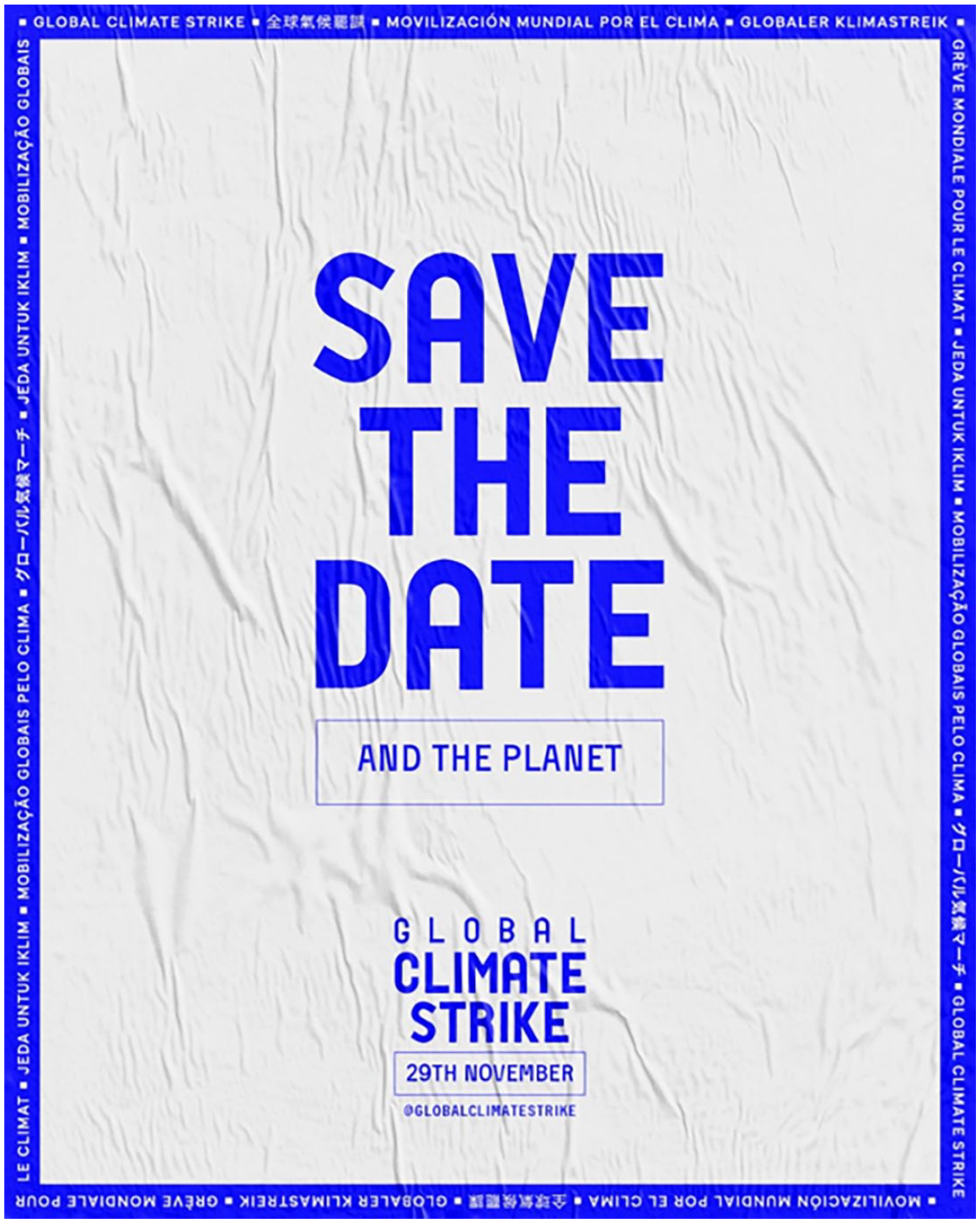
As seen in Figure 4, ‘save the date’ is a conventional metaphorical expression used to highlight attention to an event in the future and often functions as a kind of pre-invitation.
@olifro.st.
Although the metaphorical use of ‘save’ in this context is well entrenched in English and therefore unlikely to be recognised explicitly as a metaphor, when placed in parallel with a literal use of the word, such as ‘[save] the planet’, the difference between the figurative and the literal is starker. Multimodality is also important in this sense. ‘Save the date’ is emphasised by the large font size and central alignment on the banner, whilst ‘and the planet’ is relegated to a small box below, suggesting an afterthought. The irony lies in that in practice, the ‘afterthought’ is the priority. The date, in comparison, is a means to an end. In the context of the poster, it refers to the organisation of the next climate strike – a mundane but necessary arrangement in the greater scheme of protecting the planet from climate change. In this sense, the fixed expression, ‘save the date’, may metonymically stand for its somewhat banal function of day-to-day scheduling and the ordinariness of common parlance. By way of contrast with the comparative urgency of saving the planet, therefore, an ironic shift between the relative significance of these two imperative clauses possibly triggers a shift in valence. Moreover, this parallels another shift from figurative to literal. The effect of downplaying the apparent importance of saving the planet sets up two mininarratives which contrast in an ironic sense and a figurative-literal sense. In context, ‘save the date’ may imply a reference to the usual routines involved in planning special events (
Form-based and meaning-based combinations
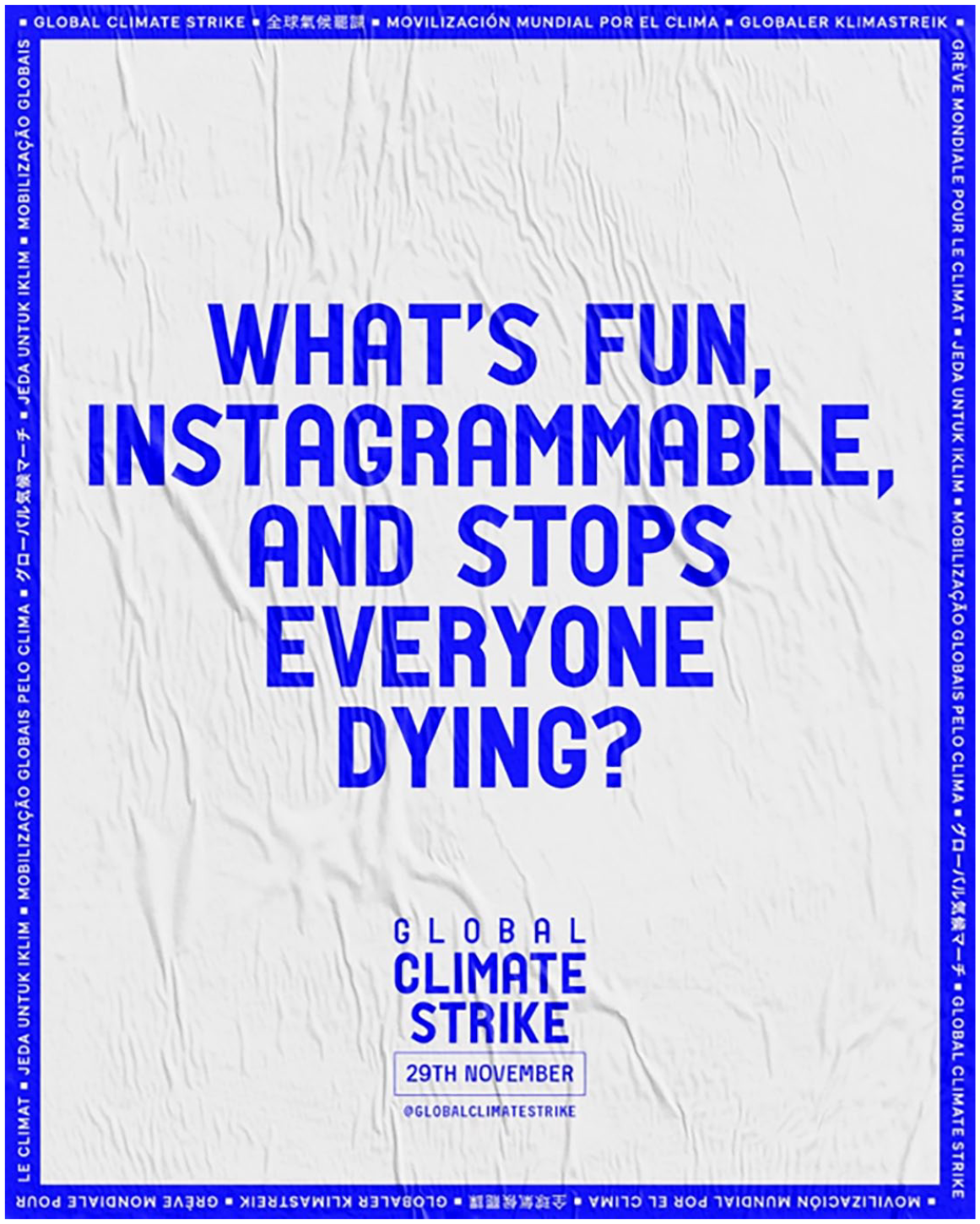
Emotive connotations can be attached to a well-known slogan or fixed expression in the present dataset via the creative use of form-based metonymy and prepare for an ironic valence-shift (triggered by
@olifro.st.
Arguably, there are at least five metonymic relationships at play in Figure 5, of which three are chained:
Figurative complexes (metaphor, metonymy and irony)
The final example to be discussed focuses on the co-occurrence of metaphor, metonymy and irony. Here, the recontextualisation and reappropriation of anthropocentric discourses trigger related mininarratives, which motivate the arousal of a subversive political humour.
Through creative use of polysemy, Figure 6 implies a slippery parallel (either metonymic or metaphoric) between the way in which one can save both money (on purchases, in the economic sense) and people (in the humanitarian sense). In this way, the banner calls to mind the domain of materialism and the domain of humanitarianism by playing on the double meaning of the word ‘save’. The effect could be seen to trigger an ironic contrast between conflicting ideologies that drive capitalist culture on the one hand and climate activism on the other. In this sense, the banner could be argued to reappropriate the discourse of Black Friday sales and (via metonymic expansion (Ruiz de Mendoza and Díez Velasco, 2002) of capitalist and materialist culture in general) to place it in an ironic relation of contiguity (or comparison) with climate activism. The mapping deliberately links these two domains, which are usually ideological opposites, and emphasises the irony evoked. It is also feasible to interpret this contiguity as implying a causal relationship between the narratives of capitalism and climate change; the overall effect suggests that capitalist culture is (at least partially) responsible for the climate crisis. 11 The mininarratives activated by, firstly, the metonymic reference to Black Friday discourse, and secondly, the humanitarian goals of climate activism, are emphasised by the figurative blur between the two, the contrasting meanings of ‘save’ in context, and the irony that emerges as a result.

@olifro.st.
Discussion and conclusion
This paper has tried to capture ways in which creative uses of metonymy in a dataset of posters used for climate protests could be seen to operate conceptually in terms of mininarratives or scenarios. The analysis suggests that a metonymy scenario consists of the activation of at least two, usually contrasting, mininarratives by means of two or more metonymic relationships. In the examples analysed, the metonymies are exploited in creative ways and frequently co-occur with metaphor and/or irony. As such, metonymy scenarios may exploit different aspects of the same ICM, or juxtapose or combine different metonymies and metaphors to exploit a contrast between several ICMs. As Littlemore (2022: 114) notes, form-based and meaning-based creative uses of metonymy can co-occur. In fact, this is unsurprising ‘given the tight-knit nature of the relationship between form and meaning’. The analysis of the GCS posters suggests that metonymy scenarios can be seen to emerge from the co-occurrence of these two categories. Shared formal characteristics between distinct metonymic relationships may trigger different meanings, which in turn may entail contrasting mininarratives and constitute a metonymy scenario.
Metonymy scenarios reveal how different arguments, ideologies and evaluative meanings are connected creatively via metonymic mappings in the protest discourse analysed. Metonymy scenarios may be specific to discourses such as protest slogans or banners that convey rich messages (mininarratives) in a limited space. These function to capture attention, resist, reframe and arguably delegitimise social and cultural norms to exploit a kind of social connectedness (Colston, 2022) among climate activists. In this way, protest and activism discourse must also be acknowledged to belong to a wider narrative concerning its specific socio-political context. In their research on climate communications (not limited to protest discourse), Morris et al. (2019: 33) advise that to ‘maximise the likelihood of action-taking. . . enrobing the presentation of information in story structure’ is beneficial. Through connecting different mininarratives and evaluative meanings in metonymic and metaphoric talk, the posters rely on shared socio-cultural knowledge to develop meaning creatively, either within the same ICM or across several ICMs. At the same time, protest discourse may use humour and irony to attempt to delegitimise the out-group in ways that are emotionally rewarding for the in-group. Such strategies may help to sustain the emotional labour involved in (climate) activism (Brown and Pickerill, 2009; Jasper, 2011) and therefore be particularly effective and relevant in these contexts.
Previous research shows that interpreting figurative meaning relies on possessing the relevant socio-political and cultural knowledge (El Refaie, 2009). For the GCS posters to effectively trigger humorous and persuasive effects, therefore, the audience must share (at least partially) the identity of the specific in-group that they appeal to based on shared political, social and ecological values, or must at least know enough about the group’s identity and values. That said, it is important that researchers do not take for granted their own interpretations, since participant-led research has revealed the highly context-dependent and flexible nature of figurative interpretation (El Refaie, 2009; Ritchie, 2004; Winter et al., 2020). In the case of discourse data such as the GCS posters, the effect of multiple figurative operations converging simultaneously may further complicate the processes of interpretation and reasoning involved. Current debates surrounding the simultaneous processing of, for example, metaphor and irony indicate the complexity of the task of understanding how audiences construe and make meaning out of densely figurative passages (Barnden, 2021; Musolff, 2017).
Future research should investigate metonymy scenarios or mininarratives in other discourses and contexts. If they emerge elsewhere, it should be explored why and how. It should also be investigated what functions metonymy scenarios perform, what their boundaries are and how they are interpreted by audiences.
Footnotes
Acknowledgements
The Author would like to thank Mario Brdar, Ljiljana Saric and Jeannette Littlemore for their helpful comments on earlier versions of this paper.
Declaration of conflicting interests
The author declared no potential conflicts of interest with respect to the research, authorship, and/or publication of this article.
Funding
The author received no financial support for the research, authorship, and/or publication of this article.
