




Abstract
This paper investigates the discursive strategies employed by Oduduwa secessionists to construct polarization and otherness on Twitter. Using the socio-cognitive approach to CDA combined with social media CDA, the study illustrates how socio-cultural and spatiotemporal contexts are embedded in digital performances of resistance. Findings show that the secessionists employ four main discursive strategies, namely: (1) vitriolic socio-cognitive labels and coinages; (2) generalization and ethnocentrism; (3) language of threat; and (4) use of Yoruba language to legitimize their resistance, accentuate their ideological stances, construct polarization and otherness, and do social mobilization. These strategies are achieved via discursive, linguistic, and stylo-orthographic resources made available by digital technology. The paper concludes that the discursive strategies employed by the secessionists do not directly reflect polarization but are simply constitutive of it.
Introduction
The Internet is a digital market square that has revolutionized and created new forms of communication, interaction, and social intercourse across the world. This digital market square has reinvigorated key features of online interaction, such as anonymity, accessibility, and openness (Mayfield, 2008), which allow users from different virtual communities to express themselves without fear of censorship or repression. This has given these users the license to challenge existing power structures as well as firmly express dissenting views. This way, the Internet, through virtual communities as the social media, has become a powerful tool for resistance and (de)legitimization of ideologically packed arguments (Ajiboye, 2020). I, therefore, argue that the social media is a digital tool for resistance, where the attributes of physical and offline resistance in the form of protests, civil disobedience, strikes, sabotage, and armed resistance take an online form marked by various discursive strategies. This online form of resistance can be referred to as digital resistance.
The term ‘digital resistance’ has been used in various ways – for instance, as a form of online activism and protest (Castells, 2012), as a way of amplifying marginalized voices via the Internet (Nakamura and Chow-White, 2013), a way of evading surveillance and censorship (Bennett and Segerberg, 2013), as a form of hacktivism (Jordan and Taylor, 2013), and as a response to neoliberalism on social media (Fuchs, 2014). The earliest possible reference, however, to digital resistance is Castells (1996), who defines digital resistance as the employment of digital technologies to oppose established power structures. Cervi and Divon (2023), however, suggest that digital resistance is the utilization of digital technologies to amplify citizens’ disapprovals for the cause of social and political changes. Castells (1996) further contends that because digital technologies are decentralized and adaptable, social actors, through technological networks, can challenge and resist the influence of established institutions. He adds that because of internet technologies, there is the availability of new types of advocacy, civic engagements, protest movements, and social movements.
Although Oduduwa secessionists imbibe social practices similar to protest movements, the use of ‘social movement’ to typify the secessionists in this paper is intentional. It is worth-noting that, according to Opp (2009) and Adeniyi (2022), social movement is different from protest movement. While social movement is a large protest organization that is more formally (or hierarchically) organized and operates for a longer period of time, protest movements have a brief organizational lifespan of less than a month and a more loosely structured organization (Adeniyi, 2022). The secessionist group in consideration has existed since Nigeria’s post-colonial period with clearly identifiable leadership and with the support of socio-political institutions. They employ both online and offline strategies to publish their arguments, enact their stances, and reconstruct their identity (see Aminu and Chiluwa, 2022; Aminu and Uyah, 2023). Chiluwa and Ifukor (2015) characterize social movements that only operate online as passive movements. Therefore, the Oduduwa secessionism is an active social movement since it is not only defined by a technologically enabled activism and the employment of digital media affordances to draw international attention, but it also has a track record of global physical protests.
The secessionists, in their protests, employ discursive strategies to project and legitimize their arguments. The reason behind the use of these discursive strategies can be understood from the standpoint of framing paradigm (Benford and Snow, 2000). According to Benford and Snow (2000), the process of framing involves picking out and emphasizing certain aspects of events or problems, as well as drawing links between them to project a particular interpretation, assessment, and solution. Hence, the deployment of certain discursive strategies, which can be produced through various lexico-semantic and discursive resources, contributes to the framing of certain issues (Nartey and Yu, 2023). By the use of framing in different topics, certain information is intensified and over-emphasized while other ideas are suppressed and silenced.
Extant literature and research gap
Overtime, the efficacy and employment of social media for advocacy, social debate, and civic engagement has received substantial attention in communication and linguistic studies (see Cervi and Divon, 2023; Chiluwa and Adegoke, 2013; Earl and Kimport, 2014; Ezeh and Mboso, 2020; Loader et al., 2014; Nartey and Yu, 2023; Unuabonah and Oyebode, 2021; Vromen et al., 2016). These studies examine different ways digital resistance has persisted through different digital media affordances, such as through tweets and Facebook posts, online videos, hashtags, images and drawings, and online petitions. Chiluwa and Adegoke (2013), for instance, examine how Twitter is employed to engage, report, and debate the Boko Haram uprising in Nigeria. They submit that Twitter is a powerful tool for citizen journalism and for challenging dominant narratives about the terrorists. They argue that tweets reflect Nigerians’ political and ideological commitments, including expressing support for or opposition to the government’s response to the conflict. Similarly, Ezeh and Mboso (2020) examine Nigerian youths’ response on social media to President Muhammadu Buhari’s representation of Nigerian youths as ‘lazy’ at the Commonwealth Business Forum. The authors argue that the social media is an easy platform where dominant media narratives and assertions are maintained, challenged, or defeated. The study claims that whereas Facebook and WhatsApp were filled with insults and hateful remarks in the youths’ discussion of the President’s representation of the Nigerian youth, Twitter was more objective in its discussion of the issue.
Social media platforms like Instagram, TikTok, and YouTube provide social actors the affordances to record and post real-time videos, and scholars have also researched digital resistance through video production. Using critical technocultural discourse analysis, Childs (2022) examines how Black women challenge, contest, and resist antiblackness in the makeup industry through Instagram and YouTube. She argues that it is largely as a result of the resistant videos of Jackie Aina and Nyma Tang that cosmetic brands have begun to extend makeup kits to suit Black women’s complexion. In this sense, not only do Instagram and YouTube offer a way to understand minoritized communities, but they also promote social change through resistant strategies. Cervi and Divon (2023) also explore the acts of resistance Palestinian TikTok users engaged in as the conflict between Palestinians and Israelis heated up in May 2021. They argue that on TikTok, playful activism turns users’ ritualized performances into potent political tools and increases peoples’ relatability, sense of reality, accessibility to democracy, and civic engagement.
Chiluwa and Ifukor (2015) discuss the potency of social media in civic engagements through hashtag. They analyze the #BringbackOurGirls campaign on Twitter and Facebook, where virtual social actors engaged in a fierce campaign for the release of the Nigerian schoolgirls that were abducted by the Boko Haram terrorist group. Owing to the potency of the physical protest (rather than just the online campaign), they argue that without practical offline activism, social media campaigns often lead to passive results. While employing a multimodal critical discourse analysis approach, Unuabonah and Oyebode (2021) examine internet memes as rhetorical-discursive strategies that contest the COVID-19 reportage of the Nigerian news media. The authors argue that these memes represent a political protest that achieves the desire of the social actors to challenge the Nigerian government and accuse them of corruption and deceit. The memes exemplify the fact that many Nigerians communicate their dissatisfaction through multimodal discursive practices on WhatsApp. It should be noted, however, that the social actors that employed memes as a resistant strategy in Unuabonah and Oyebode’s (2021), for instance, represent a protest movement rather than a social movement since their campaign lasted for a relatively short period of time.
Although there are many discourse studies on digital resistance, many works on secessionism and digital resistance in the African contexts are largely found in cultural (see Adibe et al., 2017; Green, 2013; Lu, 2022; Njoku, 2002), historical (see Englebert et al., 2002; Kiser and Sacks, 2011), political (see Daddieh and Shaw, 1984; Jega, 2000; Laitin, 2001), and sociological (see Hunziker and Cederman, 2017; Nafziger and Richter, 1976; Tir, 2005) contexts. In addition, research that consider the discursive practices of secessionist (or resistant) groups on digital platforms in Nigeria are quite insubstantial. Most of these studies have only considered Biafran sessionists (see Ajiboye, 2020; Chiluwa, 2012; Igwebuike and Akoh, 2023) even though there is significant evidence of secessionist groups from every geographic region of the country, such as Niger Delta from the South, Arewa Nation from the North, and Oduduwa Nation from the West. By taking a discourse-analytical approach to investigate the Oduduwa secessionists’ digital resistance discourse, this study contributes to the linguistic studies on digital resistance in Africa, extends the scope of work in this field of inquiry, and presents post-analytical implications of linguistic investigations on digital resistance in Africa. Specifically, in this study, I demonstrate how Oduduwa secessionists employ discursive devices to implicitly project a sense of exclusion and otherness. I argue that Oduduwa secessionists not only employ social media technologies to have decentralized access to discursive power (KhosraviNik, 2022), but they also employ stylistic tools to project a sense of polarization between them and other Nigerians.
Context: social media and Oduduwa secessionists
Ilana Omo Oodua, an umbrella organization of the Yoruba self-determination struggle, calls for the secession of the Yoruba ethnic group from the Federal Republic of Nigeria. The Oduduwa secessionist group is led by Professor Banji Akintoye and visibly supported by renowned individuals like Professor Wole Soyinka, Sunday Ighoho, Gani Adams, and Pa Ayo Adebanjo (Akinlotan, 2022; Olumide, 2023). The primary motivation for their call for secession is the perceived marginalization, discrimination, injustice, oppression, and economic deprivation the Yoruba people in Nigeria have sufferred under the leadership of the Nigerian government.
This perception the secessionists have about the government dates further back to the colonial era, where power and wealth were placed in the hands of the northerners by the British government (Centre for Development and Conflict Management Studies [CDCMS], 2003). The Yoruba people as well as the Igbo had this perception. Hence, the Igbo have also been agitating for a secession from the Nigerian state (see Omaka, 2018) – this secessionist group is known as Biafra. Owing to the similar ideology and goals shared between Biafra and Oduduwa secessionists, the groups have supported each other by physically campaigning side-by-side (see Figure 1), as well as retweeting and reposting each other’s social media posts.
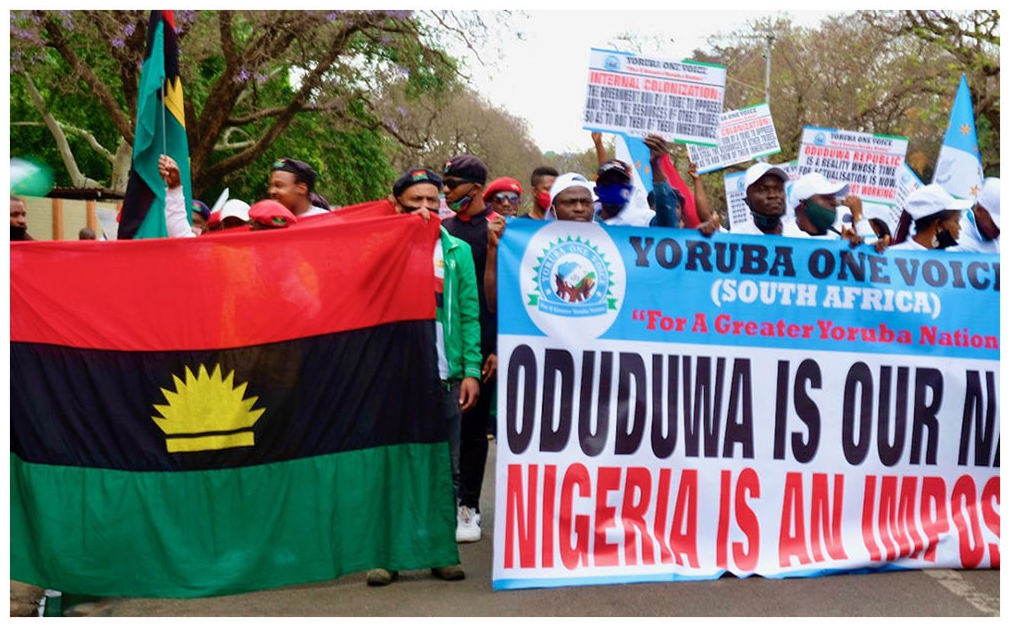
Oduduwa and Biafra secessionists protesting together.
Since social media has become an integral part of communication and information sharing in Nigeria, it is not surprising that the Oduduwa secessionist group employs it to its advantage. The secessionists’ campaign on social media started gaining momentum in late 2020. This was the period President Muhammadu Buhari’s administration refused to enforce law and judgment against Fulani herders who had been abduction, maiming, assaulting, and murdering cattle in Southwestern Nigeria (Yoruba land). The government’s refusal to pronounce the herders terrorists resurged the Oduduwa agitation (Nwanike, 2022). Sunday et al. (2021) submit that the secessionists see this as an act of nepotism because both the Fulani herders and a huge percentage of officials in the Nigerian government are either Hausa or Fulani.
Today, with over 700,000 followers, the secessionists have active social media accounts on Twitter, Facebook, Instagram, and TikTok. On these platforms, they accentuate their ideals, project their arguments, present their goals, show solidarity with members as well as disparity with non-members, and legitimize their resistance (see Aminu and Chiluwa, 2022). Generally, the secessionists use social media for mobilization and coordination (Osisanwo and Akano, 2023), communication and recruitment (Aminu, 2022), propaganda and information warfare (Aminu and Chiluwa, 2022), and international visibility and support. The group primarily employs Yoruba, English, and Nigerian Pidgin English as well as adopt various multimodalities (i.e., texts, images, audio, memes, and videos) in their posts.
Critical discourse analysis
Critical discourse analysis (CDA) is the methodological approach adopted in this study (Fairclough, 1995; van Dijk, 1993). CDA is concerned with discourse reproduction and sustenance of hegemonic and discriminatory social relations (Nartey and Ladegaard, 2021). By analyzing discursive constructions and strategies in text or talk, CDA identifies how language use reinforces, challenges, and resists existing power relations. Consequently, in this paper, I draw conclusions from the Oduduwa secessionists’ tweets in their construction of polarization and otherness. Three key components of CDA that are particularly relevant to this paper are ‘polarization’, ‘otherness’, and ‘social media’. I begin by explaining ‘polarization’ and ‘otherness’.
Polarization and otherness are socio-cognitive resources in discourse that indicate divergent interests, ideals, or goals. Broadly speaking, these resources are rooted in van Dijk’s (1993) socio-cognitive approach to CDA; specifically, they stem from Van Dijk’s (1998), Van Dijk (2000) ideological square, which emphasizes two major categories: positive self-representation and negative other representation. In this sense, the concepts of polarization and otherness refer to an imposed status of distinctiveness and divisiveness that stems from binary, dualistic thinking that divides people into two opposed categories – that is, ‘I’ versus ‘you’, ‘we’ versus ‘them’, ‘self’ versus ‘other’ (Van Dijk, 1998). This discursive tactic involves a binary opposition that emphasizes the positives and mitigates the flaws of the in-group while projecting the weaknesses and downplaying the strengths of the out-group (Van Dijk, 2011). This strategy is capable of reinforcing stereotypes as well as negotiating social boundaries and identities among social actors.
I now explain the third component of CDA relevant to this paper – ‘social media’. The socio-cognitive approach to CDA adopted in this study is combined with social media critical discourse studies approach (SM-CDA). According to KhosraviNik (2017), whenever there is communication, discursive power, and ideological stances are enacted. This does not only imply that discursive power and ideological stances are at work on social media, but it also connotes that since online and offline communication contexts are two different worlds or levels (see KhosraviNik, 2017), it is unavoidable to have intertextual and interdiscursive relations between these two levels of discursive practices. Hence, the beliefs and ideological biases of social actors in the offline world can be transposed to the online world and vice versa. It is essential to note, however, that though SM-CDS incorporates ideas from the digital technology, discourse – rather than technology – is the primary subject of analysis. Hence, it is interested in the digital performances of identity, resistance, solidarity, ideology, conflict, power relations, and stance (Nartey, 2022). The incorporation of polarization and otherness with SM-CDS approach enables a detailed and comprehensive analysis of the contextual production (or reproduction) and interpretation of meaning on social media.
Data and method of analysis
The overall data for this study comprise tweets, retweets, and mentions of @OduduwaR, @oduduwajourney, @ActionOodua, @Yorubanationnow, and @YorubaNation. The tweets selected in this study were published between October 2020 and May 2023. This timeframe was selected because the Oduduwa campaign became seriously active from October 2020 both online and offline. The reason for their activeness within this period was as a result of the Buhari government’s refusal to provide any solution to the abductions, maiming, and assaults done in Southwestern Nigeria (Yoruba land) by the Fulani herders (Sobechi, 2021). The secessionists believed that the government’s purported defiance was triggered by the Hausa/Fulani ethnicity that it shares with the herders.
It should be noted that there are several other accounts that are owned and controlled by the secessionists, but the selected Twitter accounts were employed because they were primarily used to propagate their arguments. Many of the other accounts served as platforms for making announcements and projecting Yoruba history, culture, and values. Certainly, the secessionists use Facebook as a platform for protest, though it mostly comprises posts of images and videos. On Twitter, however, there are available and retrievable ‘written’ texts; hence, it is used for this study. Owing to the textual nature of analysis done in this paper, tweets that involve multimodal designs were not selected. I chose to concentrate on tweets from the secessionists’ Twitter account for the illustration of digital performances of resistance on a specific social media platform. The tweets examined in this study were posted and openly available on a public domain – Twitter; hence, no explicit permission was obtained from its tweeters for data retrieval.
One thousand tweets in total were carefully complied and assigned numbers TWT 1 to TWT 1000, where TWT stands for ‘tweet’. The tweets selected for analysis in this paper were numbered chronologically (i.e., TWT 1, TWT2, TWT 3, and so on). The number of tweets analyzed in this study deemed adequate for a thorough analysis of small corpora utilized in discourse analysis (see Bhatia, 2008). Given the scope of the paper, retweets and mentions were not considered for analysis. Though English is Nigeria’s official language as well as its lingua franca (Udofot, 2010), I discovered that the secessionists preferred to use Yoruba language in certain situations. I suspect this is done to be different from the ‘typical Nigerian’. Nonetheless, given the author’s positionality as a Nigerian and as a Yoruba native speaker, the Yoruba data were adequately transcribed to English. Our study focuses on discursive strategies used by the secessionists to construct polarization and otherness in their tweets. Given the method adopted for analysis in this paper – SM-CDS – I show how the tweets themselves, the intertextual and interdiscursive contexts in which they were produced, and the larger historical, socio-cultural, and political contexts in which the discursive strategies employed in the tweets are embedded. Thus, our analysis examines both the micro-communicative and macro-discursive structures around the tweets. I also interpret digital manifestations of collective action with socio-cultural contexts that embed digital mediation.
Data analysis and discussion of findings
The analysis revealed discursive strategies employed to construct polarization and otherness in tweets published by Oduduwa secessionists. The strategies identified in this study are (1) vitriolic socio-cognitive labels and coinages, (2) generalizations and ethnocentrism, (3) language of threat, and (4) use of Yoruba language. I argue that these strategies do not directly reveal the ‘we’ versus ‘other’ polarization but are rather constitutive of it. Specifically, while these strategies (or devices) illustrate the secessionists’ ideological stances, the ideological stances attributed to each of these devices portray polarization. Hence, it is not the strategies that directly show the polarization per se, but the ideological stances behind the formation of these strategies (see Ochs, 1992). In addition to the fact that these strategies are constitutive of polarization and otherness, they realize digital performances of resistance aimed at raising critical awareness, accentuating the group’s arguments, and demanding social change on social media. Social media (or in this study, Twitter), therefore, facilitates social movements such as the Oduduwa secessionists to build coalitions and oppositions, and can be useful in implementing creative discursive strategies in line with their goals and arguments. The tweets analyzed in this study elucidate that the Hausa and Fulani ethnic groups (or more broadly, Northerners) in Nigeria primarily constitute the ‘Other’ of the Oduduwa secessionists.
Vitriolic socio-cognitive labels and coinages
The secessionists foreground the Other’s flaws through vitriolic labels and coinages. Vitriolic labels and coinages designed and/or wielded by social groups are unavoidably backed up by ideological orientations, consisting of sociocultural norms, values, and collective attitudes. Vitriolic labels and coinages are discursive devices that can reflect and reinforce social presumptions, prejudices, and ethnic stereotypes (Ajiboye, 2020; Koller, 2004). They perform socio-cognitive functions and are instrumental in forming polarization and constructing a sense of otherness and stereotype for social groups. In the following tweets, Oduduwa secessionists utilize labels and coined terms to enact polarization and construct otherness. By coinages, I do not insist that the secessionists coined the term, but the fact that they use them in forming social boundaries implies that they share in the assumptions associated with the coined terms. The tweets below illustrate the secessionists’ use of vitriolic socio-cognitive labels and coinages to construct polarization and otherness:
TWT 1: Buhari’s 8 years of SHAME will haunt him for the rest of his life. The blood of innocent children, mothers & fathers brutally murdered by Fulani demons will cry out for revenge. You & your children will pay for the wickedness you unleashed on Nigerians. You will not know peace.
TWT 2: Fulani manic obsession to infiltrate Yorubaland continues. Shameless buhari wants to hurriedly complete a sham census to increase feral fulanis on Yoruba soil. DON’T ALLOW HIM TO GET AWAY WITH IT. The vice president & Yoruba governors are gone. They’ve sold out their people. Shame
TWT 3: Fulani will continue to drive their hegemony in Yorubaland because our leaders have sold their soul to the devil. From toothless Osinbajo to the governors & Obas, they’re all suffering from the Stockholm Syndrome. Yoruba youths, rise & take back your land from the wicked nomads
TWT 4: Fulani terrorists masquerading as herdsmen continue the daily slaughter of human lives without any consequence. They’re never arrested & never punished. The fake democracy with a new set of clueless politicians will not stop the criminals. Breaking up Nigeria is the only solution
TWT 5: The Fulani fake election is on today. As the nonentities reshuffle each other into positions of power in which nothing will improve for the masses, even non-Nigerians know this is an exercise in futility. An untenable situation cannot be sustained indefinitely.
TWT 6: This is the Fulani plan of using the 1999 constitution to develop Nigeria. It’s sad any person will buy their lie. Another election cannot fix the problem. It’s a waste of time. Only the Fulani gain 4 more years to unleash their wickedness on you. Don’t let them. Reject 2023 lies
TWT 7: Just try deleting Nigeria mentality from your brain because it’s full of virus.
TWT 8: Idiotic people are fighting for their pocket because of politics not Yoruba land. Fulani’s are real enemies not Igbo’s, let’s that sink.
TWT 9: Anything outside Yoruba Nation and Biafra is a foul.
The use of nomination strategies like ‘our leaders’, ‘the vice president’, ‘Fulani terrorists’, ‘herdsmen’, ‘politicians’, ‘Yoruba governors’, and ‘Fulani’ establishes the referents the secessionists generally identify as the Other. As seen in these labels, the use of ‘politicians’ and ‘Yoruba governors’ implies that the secessionists regard any individual that works with the Nigerian government as an Other. Specifically, the use of ‘Yoruba governors’ to label ‘politicians that have sold their soul to the devil’ in TWT 3 already discredits the Yoruba governors from the secessionists’ in-group even though they belong to the same ethnic group. Negative, polarizing labels such as nouns like ‘shame’, ‘demons’, ‘obsession’, ‘nomads’, ‘nonentities’, ‘lies’, ‘virus’, ‘foul’, ‘enemy’ as well as adjectives like ‘manic’, ‘wicked’, ‘feral’, ‘idiotic’, ‘shameless’, ‘toothless’, and verbs like ‘unleash’, ‘infiltrate’, ‘slaughter’ targeted at the Fulani people are socio-cognitive markers that immediately portray the Fulani people as the primary Other. Indexical markers such as ‘you’, ‘they’, ‘them’, and ‘their’ referring to the Fulani people reinforces the polarization between the secessionists and the Fulani people. By foregrounding a feature of the Nigerian government – SHAME – the secessionists employ the use of capitalization in TWT 1. This stylo-orthographic device is also present in TWT 2, where the group suggests retaliation on President Buhari. In TWT 1, there is evocation of emotional effect by the use of the phrase ‘The blood of innocent children, mothers & fathers’ typed alongside other lexical and phrasal expressions like ‘brutally murdered’, ‘unleash’, ‘revenge’, and ‘wickedness’. This strategy portrays a sense of victimhood for the secessionists. Importantly, polarization is amplified in TWTs 1, 2, and 3, where the group employs a name-and-shame mechanism that specifies certain Nigerian politicians like President Muhammadu Buhari and Vice President Yemi Osinbajo. To narrow the focus, this strategy uses the shift from a macro construction of the government as the Other to a micro construction of politicians as the enemies of the secessionists. This naming technique is utilized to reveal distasteful traits of acclaimed social actors (Koliev, 2018). Nonetheless, although the name-and-shame strategy is usually accompanied by the application of discursive evidentiality, TWTs 1, 2, and 3 do not. TWT 5 is an inter-discourse of the assumption that the Nigerian government is primarily controlled by the Fulani people. The use of ‘reshuffle’ to characterize the nature of politics, political leadership, and political assignment in Nigeria is an indication that the secessionists still hold on to the history and past leadership of the country, especially since Nigeria’s past leadership has largely been northern-dominated and northern leaders still appear to wield more political power in the country (Bouchat, 2013). This negative affect is not limited to political leadership in Nigeria but also the national rule of law in TWT 6, where the group attributes the failures of the constitution to the ‘Fulani’ government. The use of these vitriolic labels on the Fulani (including the Nigerian government) legitimizes the secessionists’ resistance. That is, the secessionists recognize that they are being oppressed by constituted authority and try to make a change by constructing a polarization, which indicates that the government does not work in favor of every ethnic group in the country.
TWT 10: If care is not taken, Northern fulani’s are going to rule Nigeria again, we’re telling all Yoruba’s enough is enough let’s leave this shit amalgamated British company.
Expectedly, this sense of polarization the secessionists have for the Fulani people further extends to Nigeria. Nigeria is labeled a ‘shit amalgamated British company’ in TWT 10. This negative frame invigorates inter-discursivity and polarization. It can be inferred that the secessionists believe the 1914 Northern and Southern amalgamation is motivated by entrepreneurial factors that benefited the British, and that the amalgamation was not even supposed to happen. The negative reference to Nigeria in TWT 10 further shows that the secessionists do not consider themselves citizens of Nigeria.
TWT 11: ‘One’ Fraudgeria is the devil in all your scriptures.
TWT 12: To hell with Bokohari and his crew. Oduduwa Nation shall come to pass.
TWT 13: My dear Biafran and Oduduwa, Never allow yourself to be discouraged by the defeatist mindset of the average ‘One Nigerianist’. They are ruled with fear, Ignorance and Insha Allah. They have succumbed to Fulani pressure to forever remain 2nd or 3rd fiddle in Zoogeria.
Due to the force of appeal derived from exaggeration, and ideological presentation and polarization, metaphors are significant rhetorical resources for argumentation and persuasion (Charteris-Black, 2005). While the coinage of ‘Fraudgeria’ (blend of ‘fraud’ + ‘Nigeria’) in TWT 11 embellishes the secessionists’ belief that Nigeria is built on fraud, ‘Bokohari’ (blend of ‘Boko Haram’ + ‘Buhari’) in TWT 12 connotes the assumption that President Buhari worked with the Boko Haram terrorists, and ‘zoogeria’ (blend of ‘zoo’ + ‘Nigeria’) metaphorically implies that Nigeria is inhabited by animals. The metaphorical comparison of fraud to Nigeria, Boko Haram to President Buhari, and zoo to Nigeria are powerful indicators that enable a reconceptualization of issues as well as the construction of polarization and otherness, whereby anything Nigerian or Fulani is negatively represented. In this case, there is an indication of framing where the secessionists try to foreground the negatives of Nigeria and silent the positives of the country. The term ‘One Nigerianist’ refers to social actors that clamor for a united Nigeria. Additionally, the use of ‘zoogeria’ in TWT 13 is an entextualization of its use in the Biafra secessionists’ discourse (see Chiluwa, 2012). This entextualization, the use of the endearment term ‘dear’ to qualify the Biafrans, and the collocation of Biafrans and Oduduwa secessionists in the same phrase is a membership decategorization strategy that is used to include Biafrans as in-group members. ‘Insha Allah’ in TWT 12 is an indexical reference to the Fulani ethnic group in Nigeria. Because most Fulani people are Muslims (Donaldson, 2020), the term is used to encode their ethnicity in the tweet. In addition to the fact that linguistic strategies such as coinages encode ideological stances and socio-cultural contexts embedded in them, Miranda et al. (2016) submit that coinages allow social actors establish conflictual relationship with their ‘enemy’, indicate peaceful relationships with their comrades, and legitimize their stances to demand social change. In digital resistance discourses where there is a limit on text characters in individual posts, coinages are useful in communicating, in limited characters, the experiences, views, and demands of social groups, and can be a pragmatic framework in challenging institutions and authorities.
Generalization and ethnocentrism
Discursive tactics that are instrumental in creating polarization include making generalizations and applying them to a group based on stereotypes as well as assessing other ethnicities using prejudices derived from one’s own standards and conventions. The tweets below portray that Oduduwa secessionists employ generalization and ethnocentrism to project polarization and otherness. This is not surprising as Nigeria itself is socio-cognitively divided along ethnic lines (Chiluwa, 2012; Uzochukwu et al., 2021). Nigeria has over 500 ethnic groups, and the divisiveness across these groups has contributed to a complex web of social, economic, and political challenges, which have fueled hatred, conflict, and violence. The resultant hatred, conflict, and violence are largely consequent upon stereotypes, generalizations, and ethnocentric assumptions made about certain groups of people by another group. Interestingly, these stereotypes among Nigerian ethnic groups vary depending on the group constructing the stereotype and the group for which the stereotype was made. For instance, in a study conducted by Ogionwo (1980), he discovered that while most Yoruba respondents in his study agreed that Igbo people are boastful, most Hausa respondents viewed Igbo people as progressive. Additionally, while most Yoruba respondents viewed the Hausa people as unintelligent, inefficient, backward, and dirty, most Hausa respondents consider the Yoruba people to be dirty, wicked, dishonest, untrustworthy, and sly. Ogionwo (1980) argues that this obvious polarization between the Yoruba and Hausa can be traced to the post-colonial era, when the Hausa took control of the socio-political welfare of the country. This divisiveness, as much as it can easily be noticed offline in synchronous social actor interactions, is also portrayed on Twitter. Hence, there is evidence of intertextuality and interdiscursivity between the ideological orientations of social actors offline as well as online in this case. Unsurprisingly, there has been coupious recent research on the ethnic banters and slanders among Nigerians on social media (see Ngwainmbi, 2022; Nwozor et al., 2022; Sanda and Targema, 2022).
TWT 14: Hausa/Fulani are cursed set of people and they must leave our land. #Arewamustgo
TWT 15: AMOTEKUN inaugurated in Ogun state. Nobody will tell others to follow suit. Initially @dabiodunMFR was forming Jagaban. Just little film they showed him, he’s shaking. . . Fulani must perish!
TWT 16: Fulani generation is full of mad people.
TWT 17: Fulani conquered the Hausa tribe & made them slaves. Fulani migrated from the Sahel & infiltrated the politics of Nigeria via enlisting Fulani into the Army. They’re now promoting terrorism & paying them ransom. No Boko Haram or bandits are in Jail. Their mission is to conquer.
TWT 18: I knew this Adamu Garba @adamugarba is a terrorist breed, you want Nigeria to move forward with all these terrorist in power, I’m sorry that will result to backwardness. Shameless, irrelevant, stup!d, idiotic mad people.
TWT 19: Fulani’s are taking our land & forest, killing innocent people, make many people homeless, kidnapping our people & brutalized them. Some bigotry will come on twitter fighting for Politicians not Yoruba land. If you say it doesn’t concern you it will happen to you very soon.
The use of words like ‘Fulani’ and ‘Fulanis’, and phrases such as ‘Fulani generation’ and ‘Fulani people’ denote generalization. The authors employ attributional strategy to characterize the entire Fulani group with the features and wrongdoings of the Fulani herders (or ‘terrorists’). This presupposes that the secessionists indirectly name the Fulani ethnic group ‘terrorists’. This strategy cognitively evokes a sense of otherness toward the Fulani people. Similarly, lexicalization strategy involving the choice of lexical expressions that depict negative affect, such as ‘cursed’, ‘perish’, ‘mad’, ‘slaves’, ‘terrorist breed’, ‘irrelevant’, ‘stupid’, ‘idiotic’, ‘killing’, and ‘kidnapping’ to describe and represent the entire Fulani group socio-cognitively portrays them as the secessionists’ enemy. The dichotomy in this characterization is quite reflective of the attitude the secessionists wish to semantically convey. This lexicalization tactic depicts the underlying cultural and ideological assumptions that embed the secessionist group. The lexical items employed are dangerous stereotypes capable of reinforcing cognitive biases and unhealthy ideology about the Fulani group (Van Dijk, 2011).
The reference to ‘jagaban’, a Nigerian term used to refer to people of affluence, influence, and/or dexterity, is an indication of how linguistic choices can be influenced by sociocultural contexts as well as how social media can draw on local discursive devices to achieve spatiotemporal contextualization. I argue that the use of ‘jagaban’ contextualizes the semantics of the tweet as well as adduces local dialect sentiments on its audience. Hence, digital resistance discourses are likely more persuasive when they reflect local sentiment and linguistic traits specific to regional audiences and groups (Nartey, 2022). Interestingly, there is another evidence of capitalization employed in TWT 15, where the author capitalizes ‘AMOTEKUN’. I suspect that this strategy is applied to foreground the main topic of the tweet as well as to project an ethnic identity. Amotekun is the military force in charge of ensuring security in the southwestern (Yoruba) states (see Adegboruwa, 2023; Momoh, 2023 for more information on Amotekun).
It is important to note that TWT 17 is not produced in isolation, it is rather a manifestation of interdiscursivity in discourse. Specifically, the author makes reference to the migration chronicle of the Fulani people. The author tries to evoke evidentiality, but also embellishes the tweet with hyperbole and irony to take on a more sinister dimension. This is largely because there is no discourse that supports the view that the Fulani people serve as slaves to the Hausa. On the contrary, in fact, Barkow (1974) establishes that a significant number of Hausa people intentionally try to share a similar identity with the Fulani group as a sense of brotherhood and vice versa. In TWT 18, the group employs an accusatory strategy on Adamu Garba, a northerner, and an active politician in the President Buhari administration. However, this accusation is an ethnic stereotype meted out to him because there is no substantial evidence that supports the assertion that Adamu Garba is a terrorist or ‘terrorist breed’. Furthermore, in this context, the group hastily attributes their negative impression of Adamu Garba to the Fulani people by generalizing the Fulani people as ‘shameless’, ‘stupid’, ‘idiotic’, and ‘mad’ people. I argue that the tweeter’s use of ‘people’ in the tweet is an equivocation strategy used to encode the Fulani people.
Language of threat
The term ‘language of threat’ refers to verbal or written threats that are deliberate, coercive actions that send a message that someone intends to do something that the addressee will find hostile or that the addresser intends to intimidate the addressee (Chiluwa et al., 2020; Fraser, 1999). I define language of threat as expressions that convey a sense of danger, harm, or aggression toward a referent or addressee. It usually involves intimidation, force, or manipulation and can be interpreted differently across audiences and contexts (Storey, 2013). These contexts could depend on the tone of the speech, syntax, and semantic content of the threatening language, as well as the socio-cultural factors that shape its use and reception. Scholars have concluded that language of threat is a potent discursive strategy for constructing polarization in discourse (see Cap, 2018; Chiluwa et al., 2020; Gagliardon et al., 2015; Reinke de Buitrago, 2015). Similarly, Oduduwa secessionists employ language of threat as a significant rhetorical-discursive strategy to convey polarization and othering. Below are some tweets that exemplify language of threat:
TWT 20: Fulani herdsmen threat to ODUDUWA REPUBLIC and BIAFRA is like cockroach threatening Chicken. You’re dead while thinking of attacking us.
TWT 21: Fulani brought war and the war they shall get!!!!!!!
TWT 22: This time around it is battle to FINISH.
TWT 23: Peace can never be in the region that took away peace from the indigenous people’s region. They killed by guns, they shall die by Guns.
TWT 24: It is time to start chasing the NORTHERNERS from the SOUTH. Ahhhhhhhhhhhhhhhh! We have had enough of them.
TWT 25: Smoke out Hausas in Imo. Smoke out Fulanis in Akwa Ibom. The Hausa/Fulani in Oyo, Ogun, Osun, Ondo, Ekiti, Lagos must be smoke out of our land. We are tired!
The use of lexical and phrasal expressions as ‘threat’, ‘threatening’, ‘dead’, ‘attacking’, ‘war’, ‘battle’, ‘FINISH’, ‘guns’, and ‘smoke out’ is capable of instilling fear in the minds of Fulani people, especially innocent Fulani or Hausa people resident in non-northern states in Nigeria specified in TWT 25: ‘Akwa Ibom’, ‘Imo’, ‘Oyo’, Ogun’, Osun’, ‘Ondo’, ‘Ekiti’, and ‘Lagos’. The use of multiple exclamation marks in TWT 21 conveys the group’s emotions and attitudes to their threats. Specifically, the multiple exclamation marks express the group’s anger for their enemy while also expressing their intention to wage war against the Fulani people. Similarly, the elongated ‘Ahhhhhhhhhhhhhhhh’ in TWT 24 illustrates a typical Nigerian English expression, though more enregistered to the Yoruba people, that communicates frustration. Hence, the secessionists express affective commitment by intensifying threats directed at the Hausa and Fulani people. Expressions like ‘You’re dead while thinking of attacking us’ and ‘Fulani brought war and the war they shall get!!!!!!!’ communicate implicit performativity. These expressions convey negative intentions of the secessionists toward their enemy as well as unavoidably construct polarization between the secessionists and the Fulani and Hausa people. In addition, the group employs simile as a rhetorical resource (i.e., comparing cockroach to chicken in TWT 20) to situate a sense of social dominance, superiority, and fear in the minds of the Other.
The secessionists also construct a sense of victimhood as a strategy for legitimizing their threats. For instance, they assert that ‘Peace can never be in the region that took away peace from the indigenous people’s region’ in TWT 23. Though this assertion is a presupposition that the Fulani and/or Hausa people took away the peace of the Yoruba people, it is also an implicit threat connoting that war and violence would be brought upon the northern region of Nigeria by the secessionists. Moreso, ‘We are tired!’ in TWT 25 constructs the secessionists as victims. Evidently, in these tweets, the secessionists try to hide the actors or performers of these threats by applying a subtle stance that does not directly show that the secessionists are responsible for the threats they themselves communicate. In TWT 24, for example, the group declares that ‘It is time to start chasing the NORTHERNERS from the SOUTH’, but there is no direct reference to who will be doing the chasing. Similarly, they posit that ‘The Hausa/Fulani in Oyo, Ogun, Osun, Ondo, Ekiti, Lagos must be smoke out of our land’, but there is no direct reference to who will be doing the smoking. This pattern is apparent in TWT 20, TWT 21, TWT 22, and TWT 23, where the secessionists commit to an action but fail to back it up with an epistemic stance indicative of authority that establishes credibility and personal connection. This pattern is clearly different from the style employed by the Biafra secessionists in Nigeria in their discourse (see Chiluwa et al., 2020). The lack of an authoritative stance in the Oduduwa secessionists’ threats implies that their threats lack a strong ideological framework for action. Nonetheless, although there is no clear authority made in the tweets, the secessionists clearly construct the Fulani/Hausa people as their Other. Although a vast majority of the referents implied in the threats of the secessionists may not have access to the tweets, the threats could create a negative cognitive bias in those who read them, and this bias could transpose into violent actions that could potentially be meted out to the original referents of the tweets.
Use of Yoruba language
The Oduduwa secessionist group is not only a group of socio-political actors but is especially motivated by its ethnic identity. As earlier stated, the secessionists were organized as a result of the perceived marginalization of the Hausa aristocrats. Hence, language and cultural identity are significant ideologies they express in their tweets to project exclusionism and polarization (see TWT 26 and TWT 27). I contend that though in speech, linguistic features across phonetic and phonological levels (as opposed to individual languages) are used to construct identity (see Bucholtz, 1999; Calder and King, 2022), because social media does not provide such affordances in text form, individual languages can be used not just as a form of resistance but as an index of identity in multilingual societies. This explains the secessionists’ copious use of Yoruba on Twitter.
TWT 26: Yoruba people’s your true identity is your language which is YORUBA LANGUAGE. Value it.
TWT 27: Dear Yorubas, Be proud of your mother tongue
Their use of Yoruba language signals a difference, distinction, and polarization between them and ‘typical Nigerians’ (Aminu, 2022). Therefore, the use of Yoruba language marks a ‘we’ versus ‘them’ construction – while the ‘other’ Nigerians use English on social media, ‘we’ use Yoruba language. Accordingly, there are some social media accounts controlled by the secessionists on Twitter and Facebook that only (or mostly) post in Yoruba language. Such accounts include @Arole_Oduduwa and oduduwa nation republic. In addition, Yoruba language is a tonal language with diacritics on its vowel letters. Speakers who communicate in Yoruba on social media do not necessarily include the diacritic in their texts. However, on the secessionists’ handles, the simplest details involving diacritic markings are recognized in most cases. This same strategy is used in their audio and video recordings. Heightened discourse attention such as this paid toward their use of the language goes beyond just legitimizing their use of Yoruba as their native language but also serves as a tactic of indexing their identity and ideological stances. Cases where they communicate in Yoruba language on Twitter are provided below:
TWT 28: Ati mule lati ri wipe imupadasipo ipinle Yorub wa sáyé. Ìpinu ara ẹni je oun aigbodo mase, Ipinle Yoruba sini ìdáhùn náà – ‘We have sworn to restore Yoruba Nation. Self-determination is a must and Yoruba Nation is the answer’.
TWT 29: Ani ojúṣe láti ṣíṣe to idasile ipinle Yorùbá to da dúró, ile àlàáfíà fun àwọn ọmọ Oduduwa – ‘We have an obligation to work for the creation of a sovereign state Yoruba State, a peaceful home for the descendants of Oduduwa’.
TWT 30: Kòsí ọ̀nà míràn to dára jùlọ láti fi ìfẹ hàn ju ka sọ ìran Yorùbá di ọ̀kan, àti láti mú padà bọ̀ wá sípò ogún awọn ọmọ Yorùbá àti ìpínlè Yorùbá nípase eléyìí. Òponu ni Ẹnikẹ́ni tó bá sọ fún yín pé #PMB ló ń darí orílẹ̀-èdè yí. – ‘Yoruba race and restoring the heritage of the Yoruba people. And by doing so, creating Oduduwa Republic. Anyone who tells you that #PMB is unting the country is a fool!’
TWT 31: Awa ni eyin oju eledumare, awa ọmọ Oduduwa. Awa ni imọle ati ogo adulawo. Yoruba Nation now! – ‘We are the apple of God’s eye, we are the children of Oduduwa. We are the light and glory of the Black race’.
The above tweets provide some of the obligations and objectives of the group. The use of Yoruba language to communicate these obligations perform two main functions: firstly, to convince and recruit new Yoruba members to the group; secondly, to remind the secessionists of their identity, root, cause, and culture. The use and consistent use of the deixis ‘we’ in the tweets presupposes that the secessionists are Yoruba people and are interested in ‘restoring Yoruba Nation’, ‘self-determination’, ‘creating a sovereign Yoruba state’, and ‘restoring the heritage of the Yoruba republic’. The tweets also illustrate some of the attributes of the Oduduwa secessionists – ‘descendants of Oduduwa’, ‘apple of God’s eye’, ‘children of Oduduwa’, ‘light and glory of the Black race’. By using Yoruba language to affirm these attributes, the authors legitimize the existence and cause of the group. The group also employs metaphor as an important resource for evoking emotions and conveying deeply rooted traditional images and referents that stem from ideological presentation. The emotional effect evoked by this metaphor has the power to remind the secessionists of their identity, history, and ancestry as well as how different and unique they are from Others. Metaphor is also applied in TWT 31, where the authors employ the lexical expression ‘Elédùmarè’. The concept and meaning of ‘Elédùmarè’ vary from Yoruba native to non-native speakers because it connotes a socio-pragmatic meaning. For the Yoruba non-native speakers, ‘Elédùmarè’ simply refers to the ‘Judeo-christian God’ in Yoruba; for the native speakers, however, it refers to the God of the Yoruba people, who is believed to have created the universe (Adeyinka Olaiya and Brazil, 2020). According to Olusegun (2017), ‘Elédùmarè’ is a divine entity, different from the Christian God, and creator of other smaller deities (i.e., Orisha) in the Yoruba tradition like sango, ogun, and obatala.
TWT 32: Aye eyin Hausa ati fulani o ni da – ‘The lives of the Hausa and Fulani will not be good’.
Though the secessionists mostly use Yoruba to signal social identity and negotiate social boundaries, they also use it in making explicit polarization by making specific reference to their enemies (see TWT 32). In TWT 32, the author employs a nomination strategy to identify the referent of the hostile wish – ‘Hausa and Fulani’. Hostile wishes such as this reinforce the exclusion of the Hausa/Fulani ethnic group from the membership of the Oduduwa group as well as perpetuate a culture of aggression and violence capable of normalizing and underpinning negative attitudes cognitively.
Conclusion
This study has examined the rhetorical-discursive strategies employed by the Oduduwa secessionists on Twitter. This study further shows how these rhetorical-discursive strategies construct polarization and otherness in discourse. These strategies include: (1) vitriolic socio-cognitive labels and coinages; (2) generalization and ethnocentrism; (3) language of threat; and (4) use of Yoruba language to legitimize their resistance. These strategies are constructed via discursive (i.e., victimization, entextuality, intensification, lexicalization, nomination, and inter-discursivity), linguistic (i.e., metaphor, local dialect use, and morphological blending), and stylo-orthographic (i.e., capitalization and multiple exclamation marks) resources. These strategies did not directly show the polarization between the secessionists and the Hausa/Fulani people; rather, it is the ideological stances that motivate the formation of these strategies that illustrate this polarization. Essentially, these strategies are merely indicative of these ideological stances, which, in turn, constructs polarization and otherness. Furthermore, these strategies were applied in a way that favored and legitimized the secessionists’ resistance, while disfavoring and delegitimizing the Hausa and Fulani people. Importantly, this study illustrated how the secessionists’ Other was expanded from the northern-dominated government in Nigeria to the two dominant ethnic groups in the country, Hausa and Fulani, and then to the entire northern part of Nigeria. This is largely a result of the ethnic rivalry between the Yoruba and the Hausa/Fulani. It is, therefore, highly crucial to tackle the issue of ethnic rivalry in Nigeria, as it can be a leading factor in violence and instability and can have negative impacts on the social, economic, and political welfare of the country.
Additionally, this article shows how social movements find innovative ways to construct their identities, challenge dominant structures, and resist systemic inequalities on social media. The practice of challenging dominant structures, however, can instigate and promote the use of threats and hate speech in society. Threats and hate speech have the potential to incite and exercise feelings of anger, victimhood, and mass violent attacks by creating a cognitive bias toward individuals and organizations that belong to the out-group. Even though the threats produced by the Oduduwa secessionists clearly lack a strong ideological framework for actualization, the perpetuation of tribal stereotypes and ethnic divisiveness through constant negative reference may impact youths and leave a legacy of hostility and mistrust that could be passed down to successive generations. This paper holds strong implications for the burgeoning scholarship on digital resistance – that is, the affordances of social media to empower social groups in resistance strategies. Beyond the analysis, this article provides valuable insights into the ways language is used to navigate digital technologies and resist authority in the African context. It sheds light on the linguistic strategies, discursive tactics, and communicative practices employed by social actors in efforts to challenge power structures, advocate for rights, and promote cultural heritage. It, therefore, contributes to a deeper understanding of the intersectionality and multidimensionality of language, technology, and social change, ultimately informing contextually relevant digital solutions in Africa. Notably, this paper builds on the literature on the interactions between socio-cognitive CDA and social media CDA by highlighting linguistic analysis that can shed light on digital resistance and secessionist groups in Africa. Importantly, the problem earlier stated in this study – that there is an insubstantial amount of research on the discursive practices of secessionist (or resistant) groups on digital platforms in Africa – has, to an extent, been satisfied by this paper.
Footnotes
Declaration of conflicting interests
The author declared no potential conflicts of interest with respect to the research, authorship, and/or publication of this article.
Funding
The author disclosed receipt of the following financial support for the research, authorship, and/or publication of this article: This research was funded by the Dietrich School of Arts and Sciences, University of Pittsburgh, USA.
