




Abstract
This paper provides a comparative critical discourse analysis of news discourse on terrorism with respect to the coverage by two Swedish and two UK broadsheet newspapers of the terrorists attacks that took place in Stockholm and in London respectively in the year 2017. The research goal is to investigate the type of discourses mobilized that help enact a ‘politics of fear’, and to compare the constitutive elements of this rhetoric within the same, and across the two national contexts. The findings point to three major representations as points on a continuum of discourses that emphatically affirm, give rise to, but also resist and counteract, a politics of fear. The paper sheds light on processes of normalization at work in the routine discursive practices of press coverage, but also to the rise of counter-discourses that resist, downplay, or take a critical stance toward the core elements of a politics of fear. It is argued that these latter discursive practices may work in the opposite direction, namely to de-normalize or marginalize a dominant politics of fear.
Keywords
Introduction
The politics of fear is a rhetoric consistently mobilized in contemporary authoritarian right-wing populism. Political parties across countries appropriate narratives of threat to ‘us’ and the nation as a justification of, and call for, radical policy measures to restore the social order. Ethnic out-groups are typically accused as a scapegoat and constructed as the dangerous other (Béland, 2020; Wodak, 2015; Wojczewski, 2020).
Research confirms the critical role of news journalism in the propagation of the politics of fear (Altheide, 2002). The news agenda provides favorable contexts for the articulation of the rhetoric by interested political actors. Even more importantly, the news discourse may serve to normalize elements of a politics of fear and legitimize authoritarian policies. The tendency of news media to reproduce stereotypically negative views on ‘immigrants’, ‘refugees’, and ‘Muslims’ as a threat in news about crisis, crime and disorder is widely documented (Baker et al., 2013; Esses et al., 2013; Georgiou and Zaborowski, 2017; Kopytowska and Chilton, 2018; Krzyżanowski, 2018; Richardson, 2004).
However, more research is required on processes of normalization and de-normalization at work in news discourse. Research on the language of news is essential to explain the politically constitutive role of the news media; it is also arguably beneficial for those professionals working to improve reporting practices in journalism. Ultimately, the normalization of a politics of fear is in conflict with the liberal democratic order that journalism relies on and claims to act as a watchdog for (Ekström et al., 2020; Krämer and Langmann, 2020).
This study focuses on news reporting on terrorist attacks. Fear is a rational reaction of those affected by these events. However, fear is also constructed, negotiated and exploited in discourse. This study makes two main contributions. First, we explore contrastive discourses constructed in relation to the three constitutive elements of the politics of fear: (1) the amplification and generalization of threat; (2) the scapegoating of ethnic out-groups; (3) the call for radical measures (Altheide, 2019; Béland, 2020; Wodak, 2015; Wojczewski, 2020). Second, we analyze the implications of these discourses as regards the processes of normalization and de-normalization in news journalism.
Normalization essentially refers to the social and discursive constructions of ideas and actions as normal, natural and expected. Processes of normalization encompass transformations over time and between contexts (recontextualizations), through which ideas previously treated as deviant and controversial appear as increasingly normal elements of a public discourse (Ekström et al., 2020; Krzyżanowski, 2020a). However, in this study we do not examine changes over time, but, rather, how normalization operates in news discourse at a particular moment in time. More specifically, we focus on practices of normalization that are manifest on two levels of news discourse.
‒ First, normalization at the local level of words and sentences is operative in the ways in which elements of a politics of fear are represented as being natural and justified. In analyzing the language used in different news articles, media and genres, we recognize how ideas normalized in one context are represented as disputable and controversial in other contexts.
‒ Second, normalization involves the reproduction of ordinary and dominant discourses. We explore the existence of dominant discourses of a politics of fear, as well as the interplay between contending discourses that counter and de-normalize those politics.
In the following sections, we relate to previous research and present our data and methodological approach.
Media reporting on terrorism and the ‘politics of fear’
One of the most widely propagated emotional appeals in the media is the ‘fear appeal’, or ‘scare tactics’ (Tuman, 2010). Academic inquiry into the representations of terrorism in political and media discourse has typically uncovered contending discourses, inextricably linked to the enactment of socio-culturally situated ideological formations, that construct the rhetoric of a politics of fear. Some examples are the interpretative frameworks and discourses applied by the media in coverage of the Northern Ireland conflict (Bigo and Guittet, 2011), George W. Bush’s use of ‘security discourse’ in his speeches to the nation to promote a preventive war strategy in Iraq (Ferrari, 2007), and the US newspaper reports following the 9/11 attacks (Altheide, 2006). For Altheide (2006: 19), the politics of fear refers to the promotion and use of audience beliefs about risk and fear to discourage criticism and promote legitimate processes of social control (e.g. public surveillance, ID checks). Combined with the amplification of terror and uncertainty in news reports of physical disasters and war conflicts (Hoskins and O’ Loughlin, 2008), the discourse of fear has become ‘a dominant motif for news and popular culture’ (Altheide, 2006: 20). One of its main features is that it represents social problems through stereotypes and simplistic characterizations of victim and villain (Crawley et al., 2016; Patrona, 2018: 89).
Research on media and terrorism has demonstrated the tendency of news media to reproduce stereotypes of Muslims and other ethnic minorities as likely terrorists (Ahmed and Matthes, 2017; Parker et al., 2019; Spencer, 2017). In his seminal book on (mis)representations of Islam in British broadsheet newspapers, Richardson (2004: 75) identifies four ‘archetypal argumentative strategies – or topoi’ through which Muslim people are typically represented in a negative light as threat, one of which is the ‘threat of “Muslim political violence” and extremism’. However, research also indicates that terrorist attacks can create an untypical news discourse, which emphasizes solidarity and civil inclusion rather than cultural distinctions between the natives and foreigners (Luengo and Ihlebæk, 2019; Thorbjørnsrud and Figenschou, 2018).
Finally, research suggests that social crises, including terror attacks, tend to activate uncritical news reporting in which the watchdog role of journalism is circumvented, whereas the voices of the government and public authorities are prioritized (Thorbjørnsrud and Figenschou, 2018).
Data and analytical approach
We examine the press coverage of the two terrorist attacks in Stockholm (7 April, 2017) and London Bridge (3 June, 2017). The cases were selected based on the principle of a most-similar comparative approach, to reduce the risk of any findings being skewed by differences in the nature of the events being analyzed. In both cases, the perpetrators deliberately drove into pedestrians in a crowded area. Five and eight people were killed respectively, and many more were injured. In both cases, the perpetrators carried fake explosives and Islamist extremist motives for the attack were claimed. One difference is that the two perpetrators in London were killed immediately following the attack, while the individual perpetrator in Stockholm was arrested by the police.
The publications analyzed represent major newspapers with a liberal/right and center/left affiliation in each country. In the UK, these are The Telegraph (henceforth, TT) and The Guardian (TG), and in Sweden Dagens Nyheter (DN) and Aftonbladet (AB). The corpus comprises news reports and op-eds in the print edition of the newspapers based on the following criteria: (1) all articles reporting on the terrorist attack for a period of 1 week after the incident and (2) articles focusing on the political reactions to the attack 1 month after the attack. In total, in the Swedish newspapers, the corpus includes 225 articles, while in the UK publications, 277 articles.
We have analyzed the articles focusing on the above-mentioned three elements of a politics of fear. Informed by Critical Discourse Analysis (Reisigl and Wodak, 2015; van Dijk, 1993; van Leeuwen, 2008), we analyze how journalism produces meanings about the world, with particular attention to how certain views appear as natural and are justified in discourse.
The construction of threat is analyzed with reference to the reproduced narratives and the framing of events in headlines, lead paragraphs and the organization of main topics and sub-topics in the news text. We analyze the representation of the main actors, with respect to how they are named and linguistically referred to, what stereotypical qualities are attributed to them, how actors are represented as individuals and/or collectives, and how relations between individuals and groups are constructed. With regard to the call for political action, we analyze the representation of political voices and how new political measures are articulated, justified or critically examined.
Three contrastive discourses
The research findings point to three contrastive discourses that are enacted in the press coverage of the two terrorist attacks. We have labeled these (1) the ordinary enactment of a politics of fear; (2) a counter-discourse critically questioning a politics of fear; and (3) a radical discourse that emphatically affirms and reproduces a politics of fear. Table 1 presents an overview of these discourses and their distribution across genres and news media.
Contrastive media discourses on the politics of fear.
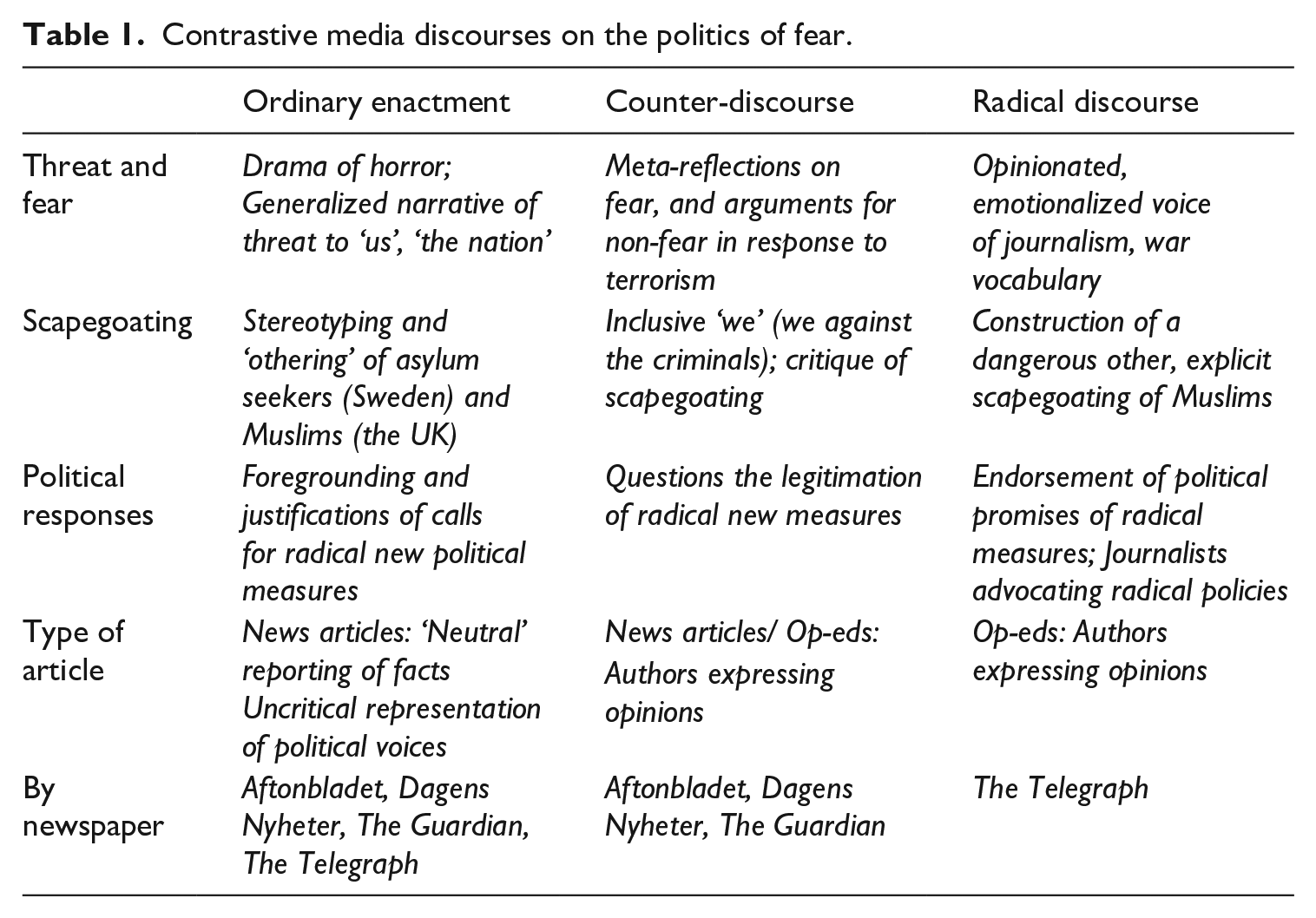
In the following sections, we analyze how these discourses are manifested in the press articles.
The ordinary enactment of a politics of fear
Characterizing the ordinary enactment of a politics of fear is the routine reproduction of what appears as a self-evident meta-narrative of generalized threat to ‘us’ and ‘the nation’. This is constructed through the following three recurring discursive practices in the description of the events and the perpetrators, and in uncritical representations of radical measures as necessary solutions.
The drama of fear and threat
In the aftermath of the attacks in London and Stockholm, fear is extensively reported in the news through eyewitness stories, dramatic images and news headlines: ‘Attacks out of the blue trigger panic in the capital’ (TT 04-06-2017); ‘On Friday afternoon, Stockholm became a city in horror’ (DN 08-04-2017). Witnesses tell how people ‘scream in fear and panic’ in a city that for a few hours was in ‘shock, chaos and fear’ (AB 08-04-2017).
Central to the framing of the events, is the reproduction of the appalling episodic drama of generalized threat. In Sweden, Aftonbladet published a series of articles framed by the overall headline in bold ‘Sweden under attack’. Metaphorically, the headline represents the event as an ongoing act of war, an organized activity threatening the country from outside. The headline is a recontextualized statement by the Swedish Prime minister (Stefan Löfven, Social Democrat). The rhetoric of the Prime minister, frequently quoted in the news, constructs a distinction between ‘them’ or ‘you’ (the terrorists) and ‘we’ (the Swedish people): ‘The terrorists can never defeat Sweden’, ‘You can never win’ (AB 08-04-2017). The journalists uncritically foreground these statements in the reporting, reproducing what appears to be a consensual understanding of the events. Before knowing the perpetrator’s motives, the attack is related to other attacks and explained as an almost natural consequence of a more general development: ‘Terror has reached Sweden. The only question was when, where and how’. (Lead paragraph, DN 08-04-2017).
In the aftermath of the London Bridge attack, both the news reports and op-eds reproduce the story of a generalized ‘war on terror’. In The Telegraph, terrorism is understood as exclusively Muslim terrorism, and is cast as a ‘modern curse’: ‘. . .in the war against the modern curse of Islamist terrorism’; ‘Islamist terror plots’ (TT 05-06-2017). Op-eds make explicit and metaphoric references to a war that must be waged (‘to take the gloves off’, ‘to combat’, ‘struggle’, ‘battle’, etc., TT 05-06-17, 06-06-2017). The deontic modality of prescriptive discourse is deployed for that purpose.
Because of the timing of the London Bridge attack right before the 2017 UK general election, the narrative of threat is typically politicized and embedded in a political rhetoric in the UK broadsheets. The framing is therefore different to that in the Swedish newspapers. In The Telegraph, Theresa May’s speech and declaration that ‘enough is enough’ is quoted and referred to as evidence of readiness to fight and protect Britain in the war against terrorism. While the Labor leader, Jeremy Corbin, is portrayed as a Marxist tyrant-to-be who colludes with terrorists, the PM is praised for clearer (anti-Islam) talk and announcement of decisive counter-terrorism policies. In The Guardian, however, May’s speech was quoted and criticized, constructing a counter-discourse to the politics of fear (see section below).
Scapegoating and constructions of ‘otherness’
The question of who the perpetrators are permeates a large part of the news reporting. In Sweden, the news constructs the mysterious image of a person described as a father of four, from Uzbekistan, divorced, unemployed and a drug addict. Although indicated as an extreme Islamist, people who knew him are also quoted, describing him as ‘empathetic’, ‘apolitical’, a ‘quite ordinary family-man’, and who never talked about religion (AB and DN 09-04-2017, 10-04-2017).
In the UK, similar reports about the attacker contribute to the construction of a mysterious identity. He is described by locals as ‘polite’, ‘normal’, ‘nice’ and ‘friendly’, but friends and family also describe him as ‘radicalized’, with ‘extremist views’ (TT and TG 04-06-2017, 05-06-2017, 06-06-2017). In the news reports, he is referred to as a ‘terrorist’, but also an ‘Arsenal-loving family man’ (TT 05-06–2017). The recurrent representations of the perpetrators by indicators of collective normality paint the image of the dangerous other living as an ordinary person next door; an unsuspected ‘enemy within’, even more dangerous because of his apparent invisibility, as one of us, but really one of ‘them’.
The normalized validation of a politics of fear is characterized by the scapegoating of ethnic and religious out-groups, implied in collective representations of ‘otherness’. Below, we present examples that illustrate differences in the instantiations of scapegoating between Sweden and the UK.
In the news reporting on the Stockholm attack, a collective identity is invoked in the construction of the perpetrator as one of a large group of foreigners who pose a major threat to Swedish society. The perpetrator is identified as an asylum seeker staying in the country after his applications were rejected. Citing and recontextualizing the number of people with rejected applications helps shape sensational news in the Swedish tabloid. In propositions linguistically designed as factual depictions of the situation, the news constructs a category stereotype of an alarmingly dangerous out-group (‘hidden’, ‘wanted’, ‘illegal’, ‘potential terrorists’). This amplifies the threat associated with the category, while the various reasons why people stay in the country after rejected applications are left out of the over-simplified narrative. In the news, the reference to numbers signals a state of emergency, as in:
Headline: 12,000 are wanted. Large picture: Rakhmat Akilov in a police car looking into the camera with a smile. Subheadings: Rakhmat, 39, one of thousands who have disappeared after being deported. ‘The Migration Agency’s forecast: there will be more’. (AB 10-04-2017)
In their comprehensive study of national daily newspapers in the UK (1998–2009), Baker et al. (2013: 275) conclude that Muslims were frequently constructed as a homogeneous group. The news media typically represent Muslims as belonging to a distinct community which is in conflict with non-Muslims (‘The West’). The present corpus lends evidence to a similar finding. In TT, constructions of ‘otherness’ and stereotyping of Muslims are instantiated through recurrent references to ‘jihadists’ or ‘jihadis’ (also as ‘jihadist cause’, ‘jihadist plotters’, ‘London jihadist’ etc.) in headlines and lead paragraphs (05-06-2017). Citing of the numbers of ‘extremists’, ‘terrorists’ and ‘jihadists’ reported to still reside in the UK works as an evidential device that validates the narrative of threat (TT 05-06-2017; 06-06-2017). Thus, central to the news reporting in the UK is the direct association of terrorism to Islam, and extremism as a central trait of the Muslim culture, religion and community. In TG, by contrast, the news reports on differences and confrontations between ‘anti-extremist Muslims’ and ‘the extremist mindset’ of the terrorists (TG 06-06-2017, 07-06-2017).
Terrorism is framed as an outcome of cultural divides and a threat to British values. The neighborhoods where the terrorists have lived are described as ‘highly-segregated and heavily Muslim areas’ (TT 05-06-2017). Muslims are stereotypically portrayed as victims of ‘anti-British narratives’ and conspiracy theories propagated by their religious leaders. This is related to the problem of Muslim segregation in the UK, and May is quoted urging Muslims to endorse allegedly universal ‘British values’: “It’s important to have people recognizing extremism, recognising radicalisation and call it out so that these people can be challenged if they are not abiding by British values”. (TT 06-06-2017).
Foregrounding and justification of radical new measures
In the aftermath of the attack in Stockholm, the need for tougher measures and stricter legislation was recurrently articulated in the newspapers without being critically discussed. New political solutions were framed as uncontroversial and expected in the light of the associations made between the terrorist and the anonymous collective of 12,000 wanted immigrants (see above).
The urgency of political measures is foregrounded in the headlines ‘Should be deported - now the politicians will get more people to leave Sweden’ (AB 10-04-2017). The presupposition that foreigners with pending deportation are potential terrorists is built into the framing of the questions asked to politicians. One article presents the answers from a number of politicians to the following two questions:
How do you see the fact that the 39-year-old was not expelled from Sweden even though there was a decision about it?
There are 10,000 people who are to be deported but whom the police do not find. What needs to be done more specifically for those decisions to be enforced?
The topical agenda and the presuppositions built into the questions, as well as the answers uncritically represented in the news indicate a general political agreement that this category of people poses a threat.
The party leader of the Sweden Democrats was interviewed and quoted blaming the government for being naive in their immigration policy and, therefore, responsible for the terrorist attack (DN 09-04-2017, 07-05-2017). 1 However, the need for stricter immigration policy was also frequently articulated by other politicians, including the Government. These responses to the terrorist attack were generally framed as expected, without the journalists holding politicians accountable and adopting a critical stance (DN 10-04-2017).
In the UK, Theresa May’s speech and immediate promises of ‘new anti-terrorist laws’, ‘toughening measures’ and ‘zero tolerance’ in response to the attack made headlines in the newspapers. Her commonplace statement ‘enough is enough’ and the statement of ‘far too much tolerance for extremist views’ are repeatedly quoted. Moreover, the foregrounding of May’s prescriptive discourse on ‘the superiority of British values’ contributes to the normalization of ‘otherness’ and exclusion (TG and TT 04-05-2017, 05-05-2017). In this respect, the two British newspapers occupy opposite positions as regards the journalistic reproduction of and stance toward the prime minister’s statements.
In The Guardian, May was criticized for politicizing a tragic event, making claims without evidence and ‘confusing extremism with terrorism’ (TG 04-05-2017). In The Telegraph, the call for tougher measures and the scrapping of human rights laws are legitimized in the quoting and endorsement of May’s statements. Authorial stance is transparent in the placement of quotes and the choice of reporting verbs, such as ‘promises/pledges to’ in headlines of news reports: “May promises to scale back human rights laws to monitor terrorism suspects” (TT 07-06-2017) “New laws on beating terror to begin on day one if I’m back at No. 10, pledges May” (TT 07-06-2017)
Overall, through the meta-narrative of generalized threat, the ‘othering’ of Muslims, and calls for radical counter-terrorism policies, societal consensus is constructed in the UK press articles in favor of adopting a decisive and also retaliatory ‘fight fire with fire’ (TT 05-06-2017) mentality in response to terrorism. However, contrastive news discourses were also activated, as will be explored in the following section.
Mobilizing a counter-discourse to the politics of fear
In op eds, and to some extent also in the news articles, journalists mobilized a counter-discourse explicitly opposing the elements of a politics of fear. This counter-discourse includes critical reflections on threat and fear, representations countering distinctions between ‘us’ and ‘them’, and criticisms of the calls for radical new policies. As shown below, these discursive practices are frequently encountered in Aftonbladet, Dagens Nyheter and The Guardian, but not in The Telegraph.
Critical reflections on threat, fear, and scapegoating
The attack in Stockholm triggered a journalism of meta-reflections on fear, and a normative discourse proclaiming non-fear in response to terrorism (AB 13–04-17). The stance against fear is expressed in various modalities: ‘We choose not to be afraid’, ‘The terrorists will not succeed. . .’, ‘We must not . . .’ (DN and AB 08-04-2017). It is assumed that the goal of the terrorist act was to create chaos and fear, and the message from journalism is that it has failed. Moreover, a number of op-eds and debate articles explicitly questioned the scapegoating of out-groups, for example: ‘But not surprisingly, there was a parallel hunt for long-sought scapegoats. Some shouted in the usual order that the government “should have done more” . . . The racists accused the entire immigration as such’. (AB 13-04-2017).
In the UK, a counter-discourse was mobilized in response to the scapegoating of Muslims. In The Guardian, op-eds repeatedly criticize the tendency to associate terrorism to Islam, and target criticism at the media, especially tabloid media, for fanning Islamophobia and hate crimes against Muslims, while also focalizing ‘the threat from the far right’ (TG 20-06-2017). May is criticized for using a language that ‘lumped together murderers and peaceful Muslims’ (TG 04-06-2017). The clash between ‘us’ and ‘them’ is vociferously challenged in: ‘“Westerners” and “Muslims”, of course, are groups of significant overlap. They are not in opposition, but extremists on both sides want them to be’. (TG 21-06-2017).
Moreover, opinion pieces are authored by Muslims formulating an opinionated counter-discourse to the politics of fear, as in the op-eds entitled: “Dear Theresa May, come and meet some Muslims. It might help if you knew us.” (TG 20-06-2017)
The recurrent ‘othering’ of Muslims is also undermined in news reports of more than 130 Muslim Imams refusing funeral prayers to the London Bridge attackers (TG 05-06-2017).
An inclusive, all-encompassing ‘we’
A central element in the counter-discourse is the representation of an inclusive ‘we’. Stockholm is depicted as a cosmopolitan city where the inhabitants, regardless of cultural origin, unite and show solidarity. An article with the headline ‘The city where we help each other’ (AB 08-04-2017) describes people on site. One of them is Muhammad: ‘. . . a Moroccan who turns 18 in a few days and who . . . has applied for asylum in Sweden because he is gay, but was rejected’. Note that he is one of the asylum seekers with rejected applications stereotypically constructed as a threatening out-group in the news discourse presented above. The news article ends with the journalist describing Stockholm as a ‘cosmopolitan’ city with ‘Conversations everywhere . . . in Swedish, English, Polish, Russian, Arabic and African languages that I could not identify’, a city where ‘no terrorist can create chaos’.
The discourse of solidarity and inclusion is also reproduced in the framing of news of public events to honor the victims. People in the street are quoted expressing solidarity and worries that xenophobia may increase in the aftermath of the attack. The descriptive language of the news is mixed with a prescriptive language in editorials, explicitly urging people to show compassion and tolerance, and resist the hatred and fear that terrorism seeks to create (DN 09-04-2017).
This inclusive ‘we’, encompassing all citizens united against criminal terrorists, is also recurrent in The Guardian as a resource for articulating a counter-discourse that emphasizes unity, solidarity and compassion in the aftermath of the attack, as in the op-ed entitled: ‘The Guardian view on the Finsbury Park attack: terrorism will not divide us’ (19-07-2017).
This is also achieved through the structuring of quotes. In a news report of Southwark Cathedral re-opening after the London Bridge attack (11-06-2017), the bishop of Southwark is quoted saying: ‘. . . what has happened, terrible as it is, will not undermine the trust, friendships and goodwill which bind us together, and we celebrate our remarkable diversity, especially across different faiths, as a rich blessing’.
Criticism of the call for radical new policies
In Swedish op-eds, journalists critically discuss the scenario of a larger threat and the related justification of an increasingly repressive policy (DN 10-04-2017, DN 11-04-2017). Journalists warn against quick decisions on new legislation: Headline: ‘Take it easy - fear does not create good laws’ (AB 11-04-2017). The Sweden Democrats are criticized for taking advantage of the situation politically: Headline: ‘The xenophobes go straight into the IS trap’ (AB 11-04-2017). The attack in Stockholm thus inspired critical op-eds, where the political discourse that was uncritically propagated in the news was vociferously countered.
A corresponding counter-discourse is articulated in The Guardian op-eds. Exclusive, anti-immigration views and radical new policies, such as ‘automated censorship of the Internet’, ‘invasions of privacy’ and abolition of the Human Rights Act, are criticized, and so is their legitimation by the media that propagate such views, most notably tabloid media.
In the op-eds, authors deconstruct May’s statements as a political strategy used to achieve political gains (TG 04-06-2017). In a TG news report entitled: ‘May: I’ll rip up human rights laws that impede new terror legislation’ (06-06-2017), authorial stance is encoded in the choice of an aggressive verb (‘I’ll rip up’) and in the attribution of ulterior motives to the prime minister, namely gaining a competitive advantage in the upcoming general election: “Theresa May has declared she is prepared to rip up human rights laws to impose new restrictions on terror suspects, as she sought to gain control over the security agenda just 36 hours before the polls open.”
In sum, through the selection and reporting of the quotes of political actors, radical new counter-terrorism policies are critically interrogated and refuted.
A radical discourse of a politics of fear
The Telegraph (but not the other newspapers studied) published a number of articles, in which a radically opinionated discourse of the politics of fear is enacted. Not only are May’s declarations of radical new measures quoted and endorsed, but journalists also take a stand in favor of these measures, legitimizing them through rhetorically resonant narratives of threat and ‘otherness’. These findings echo Richardson’s (2004: 22) analysis of the ‘othering’ of British Muslims through the representation of Islamic violence, in which Islam is offered as an explanation of the reported violence in the vast majority of newspaper articles and where Islam and Muslims are constructed through binary oppositions as either a ‘single, monolithic bloc, static and unresponsive’, or as ‘diverse and progressive, with internal differences’.
In our data, the core argument is foregrounded in the headlines of news articles, as in: ‘A drastic change is needed in dealing with Islamist murderers’ (TT 05-06-2017, see also TT 06-06-2017). Here, the attack is described as a result of hatred that has ‘infected a group of young Muslim men’, and in the final paragraph, the journalist poses a rhetorical question which suggests that Muslims are responsible for not taking the danger within the families and community seriously: ‘Are their families, friends and acquaintances doing enough to identify them and alert the police to the dangers they pose?’
Even more pronounced is the radical politics of fear articulated in a series of opinion articles. As an example of this, in The Telegraph of 05-06-2017, the headline and lead paragraph signal a state of emergency that justifies the call to the politicians for turning hard talk into hard action: “The attack that came too close to home . . . by an evil enemy that must be destroyed” “London Bridge terror attack: No more platitudes, please. Politicians must now turn their tough talk into tough action against extremists”
In the article, the author, columnist Allison Pearson, enlists highly emotionalized arguments, as illustrated in the extracts below. She uses contrastive pairs and a lexicon of war to paint vivid images of a battlefield and an enemy that must be combatted: “[. . .] And now that place which teems with life has become a battlefield littered with corpses in a war we hardly know we’re fighting, a war that our leaders don’t want to name because, if they give the enemy a name, they may unleash forces they have no idea how to control.”
Moreover, she voices an emotionally charged, personalized call to the government to implement radical measures: “He [my son] demanded to know why something wasn’t done to clamp down on these murderous bastards.”
She also criticizes the Chief constable of Great Manchester’s response to the attacks, in which he ‘urged people to have a “proportionate response” to the events at London Bridge’ as ‘the hopeless complacency of the Establishment’. Advocacy of radical new measures is thus here co-articulated with a populist critique of mainstream politics.
The author constructs a stark dichotomy between two communities, US [the Britons] versus THEM [the Islamists]. Her emotionalized arguments draw on images of extreme violence and are couched in a tone of righteous indignation, illustrated in this example: “Try explaining to a furious 17-year-old why the civil liberties of Islamic extremists trump the right of Britons like him to not be hacked to death. I sure as hell couldn’t.”
The narrative of a dangerous ‘other’, and the division between ‘them’ – Muslim communities – and a threatened British ‘us’ are amplified and interwoven with a radical critique of mainstream politicians.
In the Telegraph, the amplified narrative of threat and fear following the London Bridge attack draws consistently on the construction of an evil other as ‘a lethal threat’, echoing the Manicheism identified in Bush’s rhetoric following the 9/11 attacks in 2001 (Ferrari, 2007; Tuman, 2010).
Conclusion
This study provides evidence of three contrastive discourses that are constituted in the press coverage of the two terrorist attacks in Stockholm and in London in 2017. These can be conceptualized as points on a continuum in terms of the intensity of enacting and reproducing, or, conversely, critically questioning and resisting the dominant rhetoric and core elements of a politics of fear.
Our analysis thus confirms seminal conceptualizations of discursive strategies and narratives associated to the politics of fear (Wodak, 2015), and provides additional evidence of the tendency of news media to cultivate the ‘othering’ and scapegoating of ethnic out-groups, thus indirectly legitimizing anti-immigration policies when reporting on various topics, including terrorism (Baker et al., 2013; Richardson, 2004; Spencer, 2017).
However, it also demonstrates significant tensions among different media discourses. These tensions are manifest on different levels, and enable journalists to take positions and contribute to what is, ultimately, a struggle of meaning over the legitimacy of authoritarian politics.
Firstly, we identify tensions within the genre of news reporting. This is because in the same newspaper we find news articles overwhelmingly foregrounding inclusiveness and unity, and carefully avoiding the ‘othering’ of refugees or Muslims, alongside articles representing the same communities as dangerous out-groups through stereotyping, recontextualization of numbers, and alarming headlines.
Secondly, we identify a tension between newspaper genres. Alongside the news discourse that justifies a politics of fear, voices in op-ed journalism frequently construct a counter-narrative that questions the narratives of threat and the calls for radical new measures. Authors take issue with the rhetoric of far-right politics, but also with the discourse circulated in specific (tabloid) news media. This tension is manifest in three of the four publications analyzed here, the exception being the right-wing UK newspaper, The Telegraph.
Finally, the tension is highly politicized across media outlets, in this case The Telegraph and The Guardian. This is visible in each newspaper’s political orientation toward the three core elements that make up the politics of fear, and how the newspapers and the journalists position themselves in the actual political environment and toward the confrontations and debates in the ongoing election campaign.
These tensions, most pronounced at critical moments like terrorist attacks, are played out and articulated in a continuous struggle for hegemonic discursive formations, namely those that gain consent and legitimation in the public sphere (Chouliaraki and Fairclough, 1999; Wodak, 2015). As this study indicates, it is a struggle that involves the interplay between the rhetoric and strategies of political actors, political allegiances and press partisanship and journalistic discursive practices within different news genres.
The contrastive discourses documented here have different implications for the normalization of authoritarian politics (Krzyżanowski, 2020b). By recurrently circulating narratives of generalized threat and the (potentially) dangerous ‘other’, apparently ‘neutral’ news reporting validates radical new anti-immigration politics, by framing them as basically uncontroversial; as a mainstream and warranted political response to a terrorist attack. However, by deploying rhetorical resources to amplify fear, construct the dangerous ‘other’ and emphasize the urgency of radical measures to secure the British people, op-eds in The Telegraph appear as a case of radically opinionated journalism, which, in effect, legitimizes and promotes far-right authoritarian politics.
Our analysis offers insights into the dynamics of the different discourses involved in processes of normalization as points on a continuum. That said, studying normalization also involves an examination of discursive change, of discourse in its diachronic dimension (what has been ‘moved’ from one discourse to other, what has become normalized that previously was not). Although this is beyond the scope of the present paper, it is recognized that subtle modulations, even combinations, of the three discourses identified here can be operative even within the same media outlet.
To conclude, our study also shows how counter-discourses are mobilized in opposition to a politics of fear. These latter discursive practices appear to work in the opposite direction of normalizing practices, namely to de-normalize a politics of fear. Yet, these counter-discourses are activated in response to extraordinary circumstances, and alongside the recurrent circulation of narratives that give rise to the politics of fear, even if in their more moderate form. Therefore, as critical analysts, we need to take caution so as not to overestimate the implications of these counter-discourses for effectively thwarting normalization of a politics of fear.
Footnotes
Declaration of conflicting interests
The author(s) declared no potential conflicts of interest with respect to the research, authorship, and/or publication of this article.
Funding
The author(s) disclosed receipt of the following financial support for the research, authorship, and/or publication of this article: This research was funded by the Swedish Research Council, project reference 2016-02071.
