




Abstract
Past approaches to ideological commemorative street naming have taken for granted the concept of ideology, focusing on the policy decisions and the debates surrounding individual and more concerted resemioticisations. In this paper, we demonstrate that the concept of ideology in the context of commemorative street renaming is by no means unequivocal by illustrating how different decisions on what is or is not an ideological street name change influences the shape and the scope of ‘the ideological robe of the city’ (Zieliński, 1994). More specifically, we report on methodological decisions and their implications for representational politics in two towns, Zbąszyń in Poland and Annaberg-Buchholz in Germany, during consecutive waves of regime changes since the First World War. We rely on a complex data-set consisting of maps, town hall documents, street directories, newspapers and interviews with administrative officials. Visualisation of geographical patterns allows us to illustrate the outcomes of different definitions of ideology and explore how these definitions affect our analysis. Our primary aim is to arrive at systematic, and thus supra-locally operationalizable, analytical procedure for distinguishing ideological from non-ideological street naming practices.
Keywords
Introduction
European medieval street naming was mostly motivated by topography and function, being customarily coined on the basis of geographical features (Upper, Lower Street), the predominant resident businesses (Butchers’ Street) or architectural and topographic landmarks (Castle Street, Church Street). If personal names were used, they mostly referred to the names of saints (St. Martin’s Street by St. Martin’s Church) or of kings (cf. Anders, 2006; Azaryahu, 2016). Following the enlightenment, the value of street names as a measure of control over the cityscape became gradually more important than mere pointers helping inhabitants and visitors orient themselves in the city space. As Vuolteenaho and Berg (2016: 4) point out ‘in the nineteenth century, in particular, cartography, statistical record-keeping, and the associated gathering of national toponomies became ‘the business of the state’ (Harley, 1992: 244) as various rising nation-states ‘consolidated their authority and eased their governance through archives and registers of people, places and things’ (Nash, 1999: 457)’.
Yet, the function of street names goes beyond increasing the efficiency of administering the city; they may also serve as public sites of ideological work. As research on critical toponymy reveals, street naming has been recruited as a discursive practice for the construction and expression of identity and collective memory. This role becomes most transparent during shifts in political systems, when the semiotic landscape is (re)constructed for the ideological needs of the present and street names become ‘propaganda carriers’ of the new regime (Azaryahu, 1986: 581–7). Consequently, street renaming for commemorative purposes is a hegemonic/ideological process serving as a public demonstration of changes in political identity while at the same time being part of it (cf. contributions in Rose-Redwood et al., 2018).
Earlier studies in critical toponymy (Berg and Vuolteenaho, 2016) and the politics of street names (see the papers in Rose-Redwood and Alderman, 2011; Rose-Redwood et al., 2018) have been qualitative in nature (with the notable exceptions of Pinchevski and Torgovnik, 2002 and Rose-Redwood and Kadonaga, 2016), referring to one location and offering in depth discussions of the controversies arising from the renaming as well as its power to revise old and create new identities. The majority tend to focus on one of two types of contexts: those in which the colonial heritage is questioned and revised 1 and those which rewrite their identity after the fall of communism 2 . Both of these research foci tend to be diachronically relatively narrow (Pavlenko and Mullen, 2015, Van Mensel et al., 2017), which is also the case for another recent research focus in critical toponymy, i.e. the more or less subversive incursion of capitalist forces into the city text (Rose-Redwood and Alderman, 2011; Rose-Redwood et al., 2018).
Our project differs from these studies in that we aim to investigate the ideological weight of commemorative renaming during changes in state regime as they find expression on the street signs of Poland and what is now Eastern Germany 3 over a time span of over a hundred years. Analysing the waves of street renamings as they impact on ‘all signs in one place over time’ (Pavlenko and Mullen, 2015: 115) allows us to observe the odonymic transformations related to the revival of Poland in 1919/1920 and the shifting of national borders, the outbreak of Nazism (in Germany since 1933) and Nazi occupation (in Poland since 1939), the Communist period (1945–1989) and the post 1989 transformation into liberal democracies with capitalist market economies. The present paper focuses on two small towns, one in each country, Zbąszyń (Poland) and Annaberg-Bucholtz (Germany). As such it provides us with a proof of concept for a larger-scale studies, in which we aim to measure and compare the scale of ideological marking in two countries and over a century. Such comparative analyses require the development of an analytic procedure for determining which changes are ideological in nature and which are not. Our aim is thus to operationalise the concept of ideology for quantitative research in order to establish a comparative, transferable epistemology. A unified conceptualisation will allow us to measure the frequency of ideological and non-ideological renamings in the urban landscape, a prerequisite for mapping geospatial patterns in ‘the ideological robe of the city’ (Zieliński, 1994: 195). Unlike earlier qualitative studies, we do not select the most symbolically charged areas of the city (cf. Chloupek, 2019; Drozdzewski 2018) or analyse the debate surrounding one case of renaming (cf. Alderman and Inwood, 2018), but rather analyse every change in the streetscape during the selected time span, aiming to explore the geographical, spatial and diachronic patterns of inscribing and reducing ideology in the street name semantics. In this approach, what we mean by insertion of ideology in street names is that the number of explicitly ideologically marked streets increases. When ideology is reduced in the street names, the number of explicitly ideologically marked streets decreases (cf. Figure 5 below).
The procedure we propose combines qualitative and quantitative research. First, we qualitatively analyse the meaning of individual names. Then we discuss idiosyncratic naming patterns characteristic of each location, such as naming streets after minerals in a mining town of Annaberg-Bucholz. As a next step, we code all streets as ideological or non-ideological according to the same criteria applied to the two locations. Finally, these qualitatively informed decisions are converted into numerical tables, which serve as the basis for the quantitative analyses and visualisations. The first stage of developing the procedure is to arrive at a clear understanding of the concept of ideology, and in particular of those forms of ideology which are most relevant to our locations, which we do in the following section. The review of different approaches to ideology and to the use of the concept in critical toponymy (Berg and Vuolteenaho, 2016) and political street renaming (Rose-Redwood et al., 2018) leads us to propose
Defining ideology
The concept of ideology is researched within many disciplines in the humanities and social sciences, each having its own tradition of approaching the meaning, structure and function of ideology. Originally, the term was introduced by Antoine Destutt de Tracy in 1796 as a label for the science of ideas, but this understanding differs from the one prevailing today (Colas, 2011: 1143, McLellan, 2013: 457). The contemporary use of the term originates in the work of Marx and Engels, for whom capitalist ideology was a means of deception of the masses, drawing them away from the reality of the relations and modes of production. This approach was further developed by Gramsci, who proposed the concept of cultural hegemony, or the ruling with the ‘consent of those over whom it rules’ (Gramsci, 1971: 244). Cultural hegemony under this viewpoint explains why the working class are misled to believe that the worldview of the ruling class is the norm 4 (Nascimento, 2005: 229). The sociologists of the Frankfurt School (Adorno, Horkheimer, Marcuse, Habermas) stress the role of the mass media and of public discourses in the reproduction of the dominant ideology (Forchtner, 2011: 5–8). Foucault and Derrida with their focus on language further extend the meaning of the concept by viewing ideology as a means of oppression not so much of social classes but of each individual. Their conceptualisation of hegemony thus goes beyond political state ideologies like capitalism, communism or Nazism, proposing to view sexism or heteronormativity as ideologies (Nasciemento, 2005: 231). Althusser, inspired by Lacan, takes this understanding to the ultimate level by stating that ideology is not a fallacious view of reality, but that reality itself is ideological. As we grow up in a socio-cultural world, we cannot have access to a reality that is independent of the ideological relations and normalised presuppositions we are embedded in (Lamarche, 2007: 731). Bordieu points to the educational system as promoting the ideological status quo, since it habituates pupils to view it as natural and given (Colas, 2011: 1144). Mannheim shares Althusser’s position and sees ideology in terms of Weltanschauung: it is a total view of ideology in which socio-cultural life is by definition ideological (Freeden, 2003: 14). For our approach, such an all-encompassing definition of ideology is not very helpful, as it is only some street names that are prone to change – and more specifically changing towards a denotation that is more aligned with the official values promoted by the new regime. It is these streets and the semantics inscribed in them that are of particular interest to us and for which we need to develop a quantificational strategy in order to capture their impact comparatively across time, scale and space.
The relationship between ideology, language, public discourses (esp. by the mass media) and education has been further developed by linguists within Critical Discourse Studies (Fairclough 1989, 2006; van Dijk, 1998; Wodak 1989, 1996) and later also by Cognitive Linguists (e.g. Dirven et al., 2007, Koller, 2014). This linguistic approach to ideology, which we also ascribe to in our project, defines it as systems of beliefs, shared by a social group, with the power to evaluate and explain the social world. Ideologies thus function as an identity-enhancing and cohesion-inducing strategy, motivating groups to joined action. As such, ideologies are constructed, critiqued and transferred through language. Van Dijk (1998), who gives the most comprehensive and most frequently referred to linguistic account of ideologies, considers them as expressed, reproduced and thus inherently intertwined with the discourse practices of a group and, as such, with the structuring of cognition (2006: 115). He stresses that ideologies form cognitive models in the minds of the members of a given social group and provide systems of values which shape their worldviews. Ideologies are thus grounded discursively: they originate, are debated, resisted, affirmed and reproduced through discourse, but they reside in the minds of discourse participants.
In our study, we consider street naming as one of the discursive strategies normalising underlying ideologies, which we define as discourses enhancing the in-group cohesion through reference to common values and shared perspectives on history. In urban text, the inscription of ideologies often takes the form of street names invoking these very values (cf. Tiananmen Square ‘Gate of Heavenly Peace’ in Beijing, China vs Union Square in Washington, DC, the USA), historical figures who are considered as the epitomes of these values or role models to emulate, and dates that metonymically stand for events deemed important for the shared history. In more recent renamings, these values go beyond appealing to the national spirit and may include other ideologies, such as gender equality or social justice.
Van Dijk (1998: 264) stresses that ‘the same discourse structure may function ideologically in one context and not in another, depending, for instance, on the intentions, goals, roles or group membership of the participants’. As a result, the ideological charge of street re-naming may differ, depending on their geographical location, time or intensions of the social agents involved in the process. For example, Berg (2011: 14–15) draws our attention to the ‘banal naming’ strategies of new housing estates in Vernon, BC, Canada as a form of ‘ongoing colonialism’ hiding the ‘socio-spatial relations of dispossession’. In this context, nature-related banal names, like Desert Cove Estates or Turtle Mountain ‘lend a sense of the everyday to processes that reinforce the effacement of this dispossession and marginalisation of the Aboriginal people’ (Berg, 2011: 20) on whose grounds they are being built. By ‘symbolically and materially solidif[ying] current (and historical) processes of capitalist accumulation’ (Berg, 2011: 20) these naming processes thus contribute to the normalisation of a post-colonial, neoliberal ideology, strengthening social inequality related to ethnicity and income. And while Berg strongly argues that such discursive processes be viewed as ideological, supporting ‘belief systems that . . . control cultural attitudes . . . about general cultural values . . . relevant for the group’ (Van Dijk, 2006: 116), he soberly observes that ‘these processes of dispossession are never remarked upon – often even by the very people being dispossessed’ (Berg, 2011: 21). The dispossession of the first nations – and the usurpation of ancestral land – is an ideological issue typical of the post-colonial situation which finds no direct correlate in Central and Eastern Europe. Thus, while nature-related names in the context of geographical dispossession described by Berg (2011) can be considered ideological, the flower and tree related names we discuss in the following section in Zbąszyń and Annaberg-Bucholz are not.
In the context of the two locations we investigate in this article, other processes within the symbolic politics of naming are at stake, namely the obliteration of ‘the discredited past from the public sphere [and the (re)production of values that legitimate the] . . . beginning of a new era’ (Azaryahu, 2012: 387). Given the rapid turn-over of state-imposed ideologies in Eastern and Central Europe, our analysis relies on the nation-state as a central element. While such an approach is by no means uncontested (see i.e. Anderson, 2006; McNeil’s, 1986; Robinson, 2005; Smith, 1998: 199 inter alia), nationalism evolved as a key ‘cultural construct of the European writers and intellectuals . . . [and] proved to be the single most powerful European political ideology of the nineteenth and early twentieth centuries’ (Turner, 2014: 155, 159). Ideological state apparatuses (Althusser, 1970 [2014]) such as the press, philological studies, national political histories, histories of literature and art, the rise of national museums, and the relatively newly established educational systems function as fundamentally cohesive instruments, either of ‘nation building’ 5 , or – in polities subscribing to a more federalist ethos – as instruments of regional identity building (see below). The expression of these ideological processes – that is, the inscription of systems of beliefs that serve the promotion of certain endogenous groups or entities – in the symbolic politics of street naming are thus the focus of our two case studies. We hope, however, that the procedures we develop and the discussion of challenges we encountered may prove useful, not only in the analyses of larger Polish and German cities where symbolic and representational power is more paramount, but also in other polities experiencing changes in political regime or Weltanschauung, where street names or other symbolic material are recruited for the public accumulation of ideologies related to different ethnicities, genders or other under-represented groups (consider Rubdy to appear for an analysis of the odonymic reverberations of the Saffron revolution in India).
The analytic procedure for coding street renamings
The present paper is part of a larger project which models the ideological processes that continue to shape the linguistic landscapes of Eastern and Central Europe over the past 100 years. We investigate the discursive practices and geospatial outcomes resulting from the ideological appropriation of the urban landscape for the purpose of building and supporting transformations in national identities as manifested through the changing street names.
The investigated period covers three (for Germany) and four (for Poland) successive regime changes between 1916 and 2018. The data on which we test the analytic procedure were collected from historical and contemporary maps, town council documents, newspaper articles, address books and literature devoted to the history of Zbąszyń and Annaberg-Buchholz. Every street (in 2018, N = 105 in Zbąszyń; and N = 369 in Annaberg-Buchholz) was coded by hand by two separate researchers across the entire time span, demarcating every change for the process and the outcome of the change (as well as other factors to be examined in detail below).
The resulting maps, which help us determine whether the number of ideologically marked streets increased or decreased over a given period of time, crucially depend on methodological and theoretical decisions made at the outset regarding the type of information we choose to code for and visualise. In Figure 1, we present the analytic procedure we have used for evaluating the ideological weight of (re)naming practices. As this figure illustrates, we have documented a variety of ideological commemorative street renaming practices, which we define – as outlined above – as the replacement of a personal name/event/place (e.g. battle field/date/institution/value important for the collective memory).
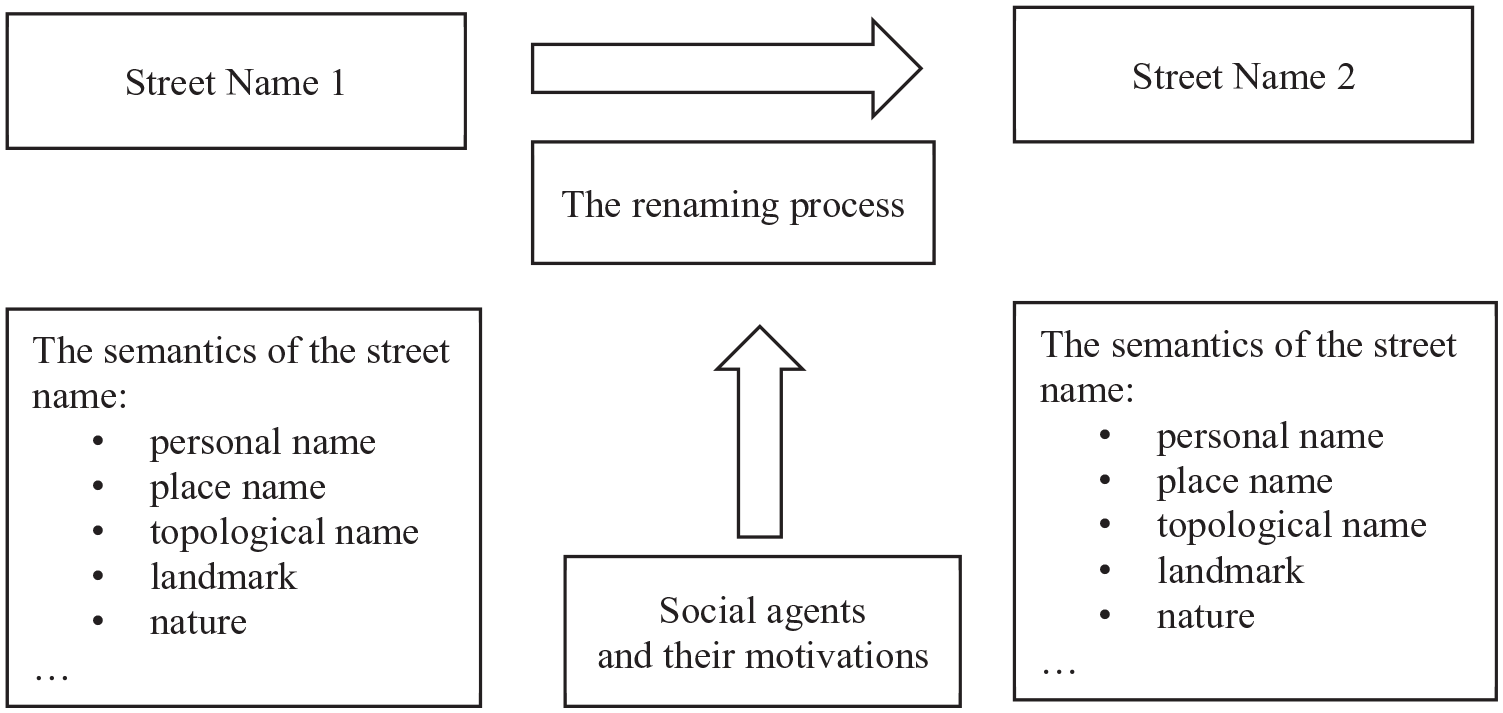
An analytical procedure for coding ideological name changes.
Our analyses differentiate, on the one hand, the semiotic potential of the street name in terms of the semantics of its referent (people, events etc.) and on the other hand, the process of renaming. This is particularly important since we need to distinguish between the process of renaming, which may be ideological or not, from its result – the new name – which may have a more or less heavy ideological weight and thus result in an increase or decrease of publicly displayed ideology. For example, Annaberg-Bucholz houses a square, which was called Humpelplatz (‘Humpel’s Square’) at the beginning of the investigated period after a general who fought in the religious wars of 1618-1648 (Thirty Year War). In 1949, after the introduction of the Communist rule in East Germany, the square was renamed Platz der Jungen Pioniere (‘Square of the Toung Pioneers’, commemorating a communist youth organisation). In 1991, after the fall of Communism, it was called Ahornplatz (‘Maple Square’). These changes nicely illustrate the distinction we consider vital for the understanding of the ideological marking of the streetscape. Both the change in 1949 and in 1991 were ideologically motivated. The first aimed at inscribing the name of the communist youth organisation in the streetscape, the second aimed at erasing it. For people visiting the square or those whose home address is Platz der Jungen Pioniere (the name given to the square between 1949 and 1991), the commemorative semantics would be clearly endorsing and legitimising the then current government. Hence the result of the ideologically motivated renaming process would be an ideological square name. Yet, after the (ideologically motived) renaming process of 1991, the situation is different: For people who visit the square or live at Ahornplatz, the name would not be ideological, as the maple tree does not have any ideological symbolic meaning in Germany. Hence, while the process of change is ideological, the resulting square name is, in fact, non-ideological. The validity of this distinction can be observed in the opinions of the representatives of the town administration (cf. Frank Dahms p.c., 25.09.2018). It is also supported by the inhabitants’ comments on social media, both in Annaberg-Bucholtz as well as during a recent renaming wave in Poznań in 2018, where many of the commentators opined that nature-related street names have no ideological associations and therefore were more permanent and ‘safe’. The discourses surrounding (post-)communist naming strategies is thus different from the ideological banal naming as proposed by Berg (2011) as discussed above.
Our approach, therefore, differs from K. Palonen’s (2018: 31) assumption that ‘all naming of streets is politicising, independently of the content of the names’ by distinguishing between the process and the result of street renaming. The difference between our two approaches can be illustrated with the following example. For K. Palonen, ‘even the replacement of the communist culture of naming in Eastern Europe by seemingly apolitical names may be a politicising move as the deconstruction of the regime, which renders the naming both less ritualistic and more open to invention, as compared to a replacement by opposite ‘heroic’ names.’ We agree with K. Palonen that decommemoration is an ideologically motivated change and in our analytical procedure we mark the replacement of explicitly political with apolitical names as an ideological
The semantics of the street name
‘The semantics of the street name’ in Figure 1 requires analysing the meaning of the historical figure, event, date, etc. that are odonymically commemorated. In this paper, we take a cognitive linguistic perspective on ‘the semantics of the street name’ and see it as a prototypical category (Lakoff, 1987: 5–67, Taylor, 2003: 41–83). On this view, the ideological weight of the name is a gradable, context-dependent phenomenon. For our evaluation of the ideological weight of the name, we thus consider the geographical scope of recognition of the commemorated element. As we discussed above, street names often symbolise political ideologies promoted by the state, such as nationalism, Nazism, communism. Some of the commemorative names have a smaller geographical scope, however, being more local in nature. As Azaryahu (1996: 326) points out, the issuing of honorific names has been very often ‘biased in favour of local history’. Similarly, Vuolteenaho and Ainiala (2016: 230) emphasise that ‘. . . any account of name-planning legacy in Europe would be incomplete without recognising a persistent presence of locally derived names’. Our approach follows Kłoskowska (1996) and Kurczewska (2016), who stress that identity building practices are produced and reproduced at various levels of social aggregation: ideologies related to at least the levels of local, regional and national processes of in-group identity building (see also Hagen, 2011 for a scalar understanding of odonymic encoding).
Crucially, the geographical scalarity of commemorative practices relates in important ways to the profession of the person commemorated in the sign: nationally revered politicians and military leaders tend to be more ideologically loaded than local mayors, entrepreneurs or teachers. For example, in Zbąszyń, one of the streets is named after Czesław Prządka, a musician who constructed folk musical instruments and taught children to play them. He is known only to a small group of people – the pupils, their parents and folk music fans from Zbąszyń. Prządka thus scores low on the ideological intensity, as most visitors to the town would have no idea who he was and what values he stands for. Another street in Zbąszyń is named after King Sigismund I the Old. He would be placed on the ‘more ideological’ end of the scale, being mentioned in Polish history textbooks and thus recognised by all Polish visitors of the town as standing for a strong centralised Polish state.
The relationship between a person’s profession and their geographical scope of recognition means that the dimension upon which we considered street names as ideological or non-ideological is gradable. Thus, as shown in Figure 2, a king such as Sigismund is a symbol of the national ideologies whereas a local musician such as Czesław Prządka encodes in-group cohesion at a more local level 6 . When attempting to operationalise this scalar value (Hagen, 2011) in the smaller localities, we initially coded for three levels (local, regional or state). 7 The visualisation of Zbąszyń in Figure 3 illustrates the outcome of an analysis that employs these three levels of coding.
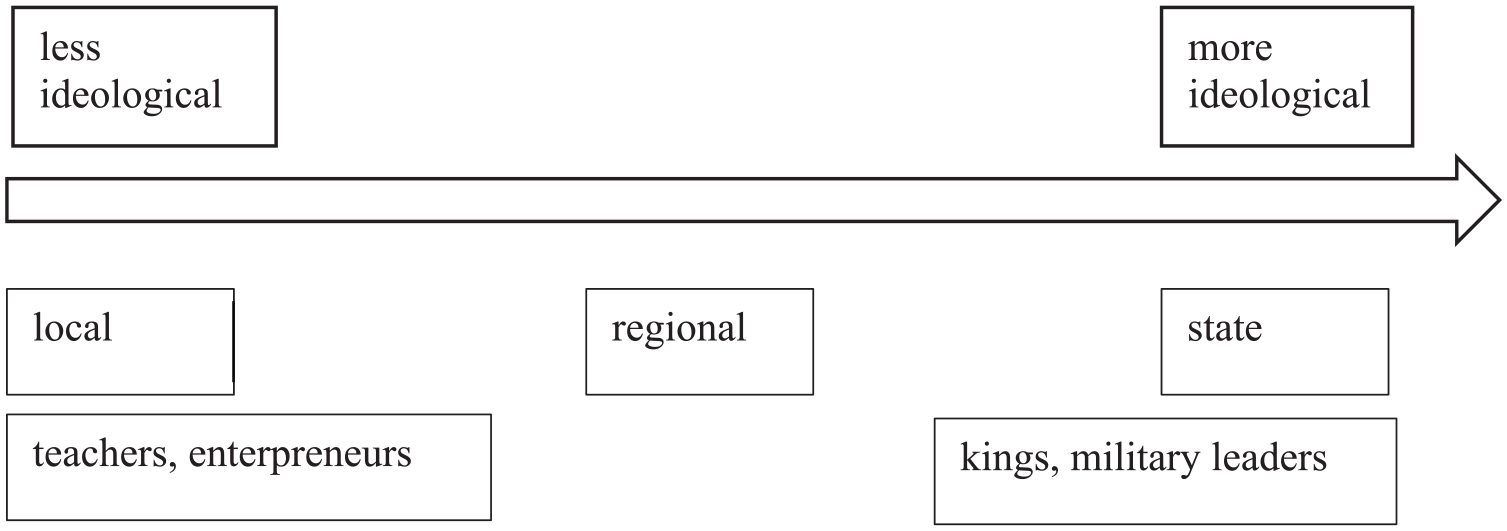
Gradable nature of the ideological weight of the ‘semantics of the street name’.
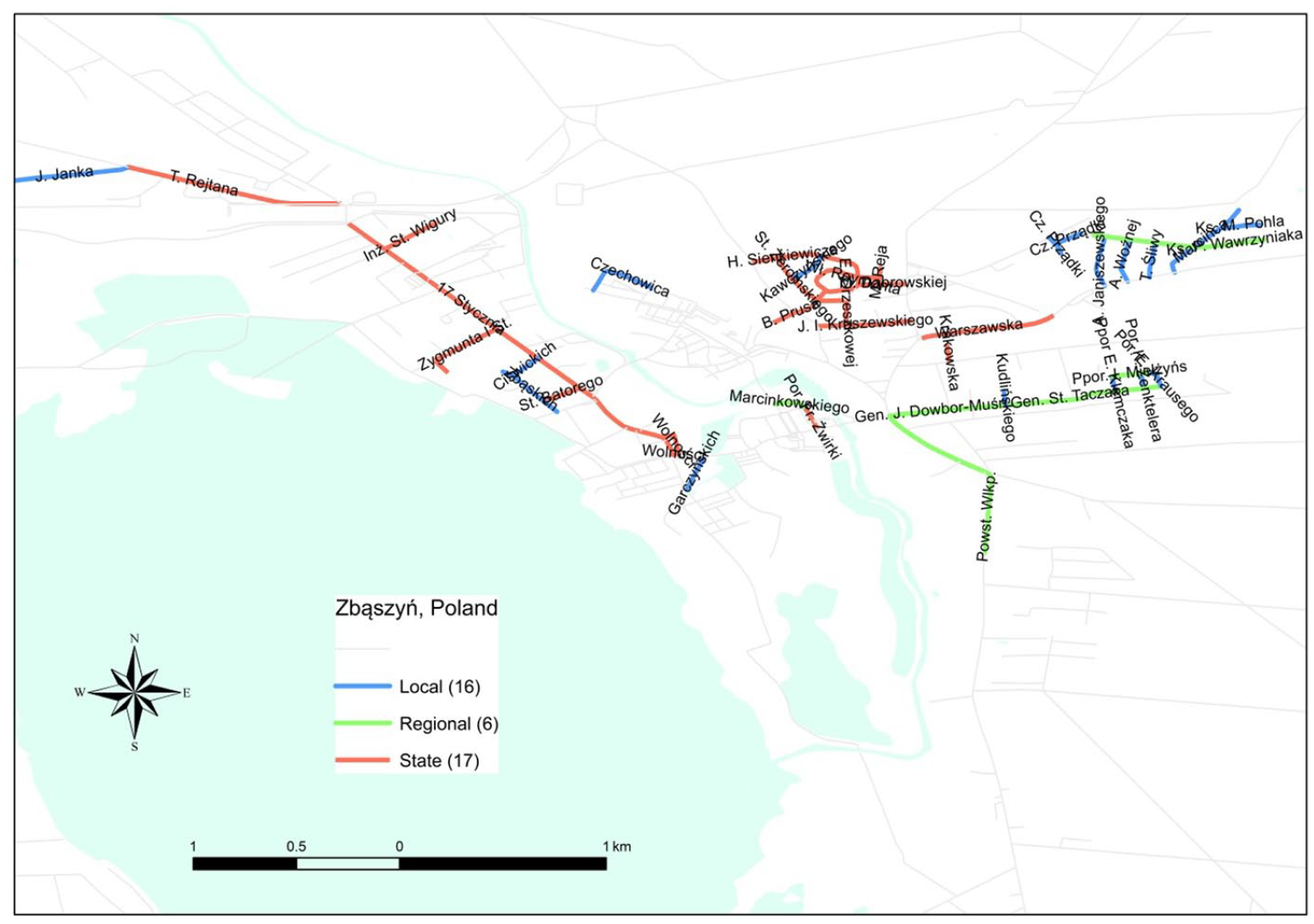
The pattern of the ideological robe of the city relative to the local, regional or state importance of the commemorated personages and events.
The streets marked in blue are named after people or events of local importance (N = 16, 41% of all ideological renamings), those marked in green are of regional importance (N = 6, 15% of all ideological renamings) and those marked in red are important at the state level (N = 17, 44% of all ideological renamings). The visualisation poses the question whether we should focus on those street names that would be easily recognised as ideological, because they commemorate historical figures of state importance, or whether we also include those of regional and local importance even though the names may carry little meaning for the town inhabitants who are not interested in local history, and be completely unrecognisable for visitors. As Figure 3 demonstrates, such decisions concerning inclusion or exclusion of streets commemorating lesser known personages of local importance would change the visual representation of the ideological marking of the city: discounting the local and regional level would reduce the number of streets considered as ideological by more than a half and therefore thinning the ‘ideological robe of the city’ (Zieliński, 1994).
The renaming process
When developing a stringent analytic procedure for street renaming, it is important to consider the fact that the renaming process may, but does not necessarily have to be, motivated by ideological reasons. For example, when two small mining towns in Eastern Germany, Annaberg and Bucholz, were united to form a single municipality in 1945, some of the street names would necessarily appear twice in the now united town of Annaberg-Bucholz. Such was the case with Marktplatz ‘Market Square’, only one of which was retained, while the other was renamed to Rathausplatz ‘Town Hall Square’. This change was purely practical in nature, its only aim being to retain unambiguous name–place relationships. To uncover the ideological weight of the street names we analysed city council documents, which often explain (i) why an old name was changed and also (ii) why a new name was selected. Another source of information were newspaper reports about the renaming process and – for more recent renamings – interviews with city officials. The motivations of the social agents in the renaming process might be ideological (i.e. when Grosse Kirchhausgasse was renamed Adolf-Hitler-strasse) or indeed non-ideological, as in the example with Marktplatz being renamed Rathausplatz.
Figure 4 depicts the four combinational possibilities that evolve from the semantic potential of the street name before and after the change, as well as the nature of the renaming process.
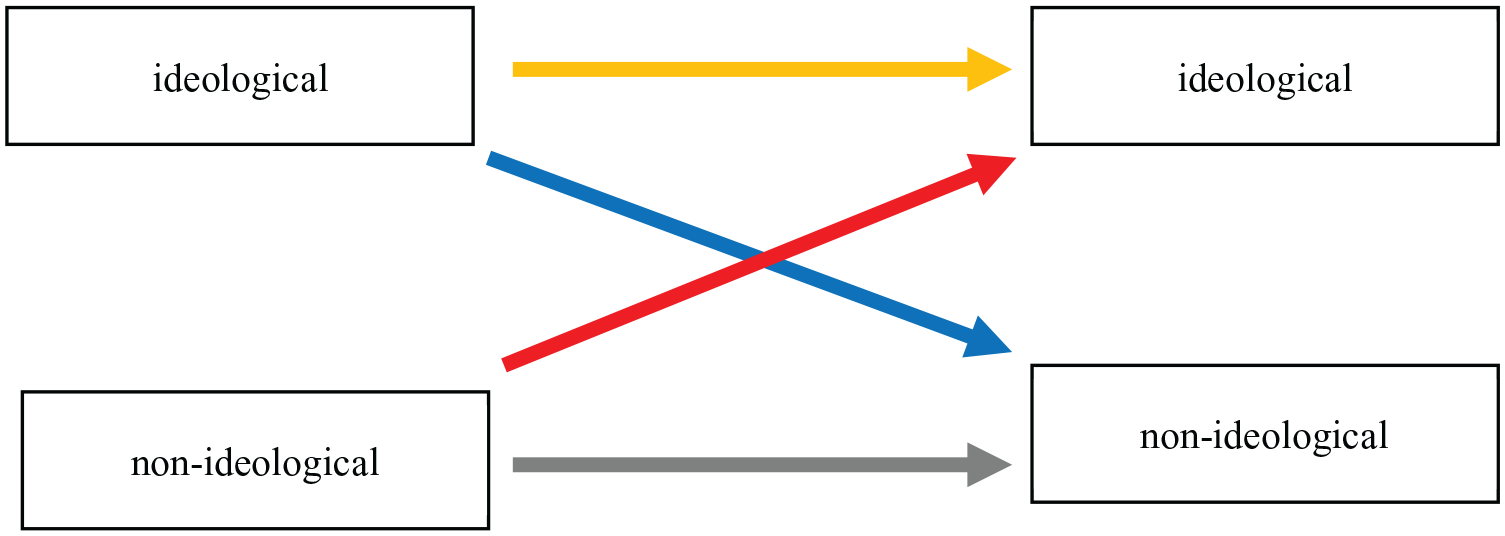
Types of renaming processes (before ➔ after).
The boxes on the left depict the ideological or non-ideological weight of the semantics of the street name before the change and the boxes on the right the weight of the street name after the change respectively. The arrows represent the process of the renaming, which may be ideologically motivated or not. If one ideology is exchanged for another (top horizontal arrow in yellow), the process of change is ideological. The process of replacing a non-ideological name with an ideological one (the upwards pointing arrow in red), is ideological, resulting in an increase of the number of ideologically loaded street names. Following K. Palonen (2018, see above), we also consider the replacement of an ideological name with a non-ideological name (the downwards pointing arrow in blue), as ideological, the intention being to erase the old ideology, even if it results in the decrease of the number of ideological street names on the map. If a non-ideological name is changed into a non-ideological name, then the renaming process is generally practical in nature and not ideological (bottom horizontal arrow in gray). Figure 5 below illustrates the types of changes for the most recent 1989–2018 wave of renamings in Annaberg-Bucholz.
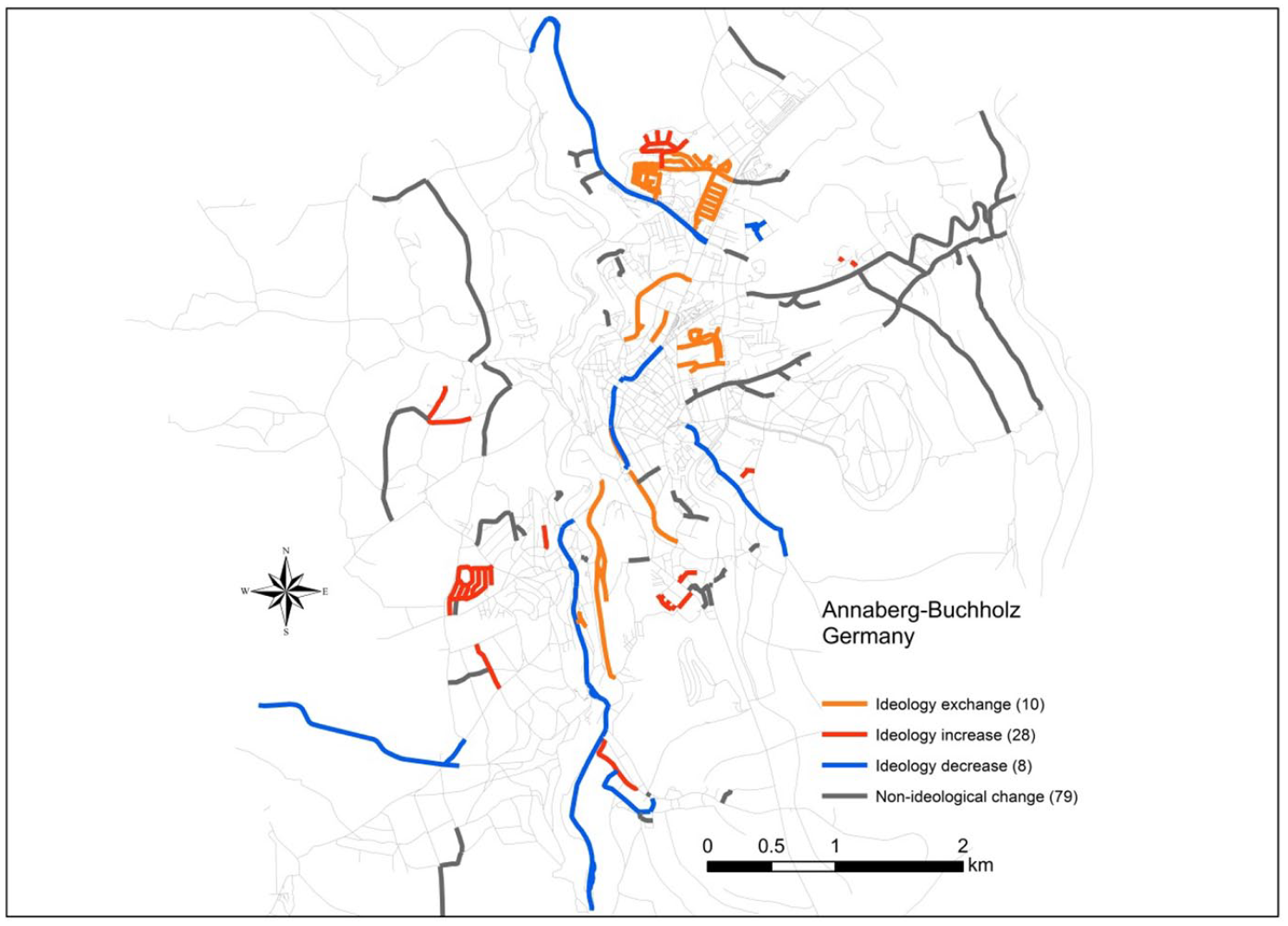
Annaberg-Buchholz. Changes in the ideological robe of the city pertaining to the ideologically vs non-ideologically marked street names in 1989–2018.
The visualisation in Figure 5 allows us to trace the respective in- and de-crease in the ideological robe of the city during the post-socialist period 1989–2008 in Annaberg-Buchholz. While the vast majority of street names remains constant with respect to their ideological weight (N = 244, 66%), there were overall 125 changes (34%). A total of N = 79 (63%) of these changes were non-ideological and thus purely practical in nature. However, more than one third (N = 46%) of all renamings that occurred during this time period affected the ideological robe of the city. Most frequently, namely in N = 28 cases, (22% of all renamings), the number of explicitly ideologically marked street names increased, whereas in N = 8 (6%) of all changes, the number of explicitly ideologically marked street names decreased. Also note that there are 10 cases where one ideological street name is being exchanged for another one that indexes a different ideology. Figure 5 thus illustrates the difference between the ideological nature of the process of change and the ideological weight of the name, related to its semantics. The coloured streets (yellow/red/blue) indicate the results of renaming processes that were ideological, while non-ideological name changes are shown in bold grey. Simultaneously, the colours yellow and red mark the streets, where the street name after the change has ideological weight, while the colours blue and grey mark those streets where the resulting names are non-ideological.
Challenges and solutions in the coding of ideological street renamings
Street names which refer to toponymic place names
As we pointed out above, medieval street names tended to be topographic, referring indexically to the places/institutions they led to (Rose-Redwood and Alderman, 2011). This can be illustrated by a street in Annaberg-Buchholz, which was initially leading, as it does again, to a city called Chemnitz, 34 km away. Once Chemnitz changed its name to Karl-Marx-Stadt in 1953, the name of the street followed suit. While the street renaming is obviously indexical, changing concomitantly with the teleological end-point of the street, we coded this change as ideological, not only because the name of Karl Marx is emblematic for socialist ideology but also because the city of Annaberg-Buchholz could have chosen to continue commemorating the old city name. Similarly, when Karl-Marx-Stadt changed its name back to Chemnitz in 1990, so did the street name in Annaberg-Buchholz, another indexical but concurrently ideologically-motivated change that occurred in 1990. Note in this respect that this ideological act of reverting to the old name and purging the street of its ideological name resulted in a reduction of the ideological robe of the city.
A related case from Zbąszyń is the renaming, in 1920, of a street to Warszawska (‘leading to Warsaw’). This looks like another non-ideological topographical street name. Yet, if we consider that it was not the first naming, but a renaming of German Neutomischlerstrasse, it seems that there is more to the renaming than a translation from German to Polish. If it were just a translation, the street would be called Nowotomyska, as it leads to Nowy Tomyśl (a Polish version of German Neutomischel, a town 17 km away). Renaming it Warszawska 8 (Warsaw is 384 km away) thus does not seem to be motivated by an attempt at helping visitors orient themselves in space. Rather, the choice of the name seems to stress the political affiliation and geographical connectedness of Zbąszyń with Warsaw, the capital of Poland. In this sense, the name change can be considered ideological as it inscribes a new national geography into the cityscape. Before 1920, Warsaw was in the Kingdom of Poland, part of the Russian empire, while Zbąszyń was in Provinz Posen, part of Prussia, and thus in a different state altogether. The renaming in 1920, when the region containing Zbąszyń became a part of Poland thus shows that every decision concerning the status of change as ideological or non-ideological needs to be informed by and is thus fundamentally contingent on the socio-cultural and historical context of the situation of the renaming.
Vuolteenaho and Puzey (2018: 85) note a similar tendency of recruiting place names for street naming purposes to construct and reconstruct the changing national geographical imagery in Berlin. During the Nazi regime street names referred to what is now Rheinland-Palatinate, in the extreme west of the country – and thus close to the areas lost to France as a result of the Versailles treaty – while under communist regime streets were named after places in much closer geographical proximity. Vuolteenaho and Puzey (2018: 85) consider these scalar inscription of territorialities as ‘[a] very conventional tool of homeland-making – the symbolic socialisation of the urban population towards ‘spatial identification with the territorial state as home’’ (Kaiser, 2009; Paasi, 1996)’. Hence, while the Nazis expanded the national geographical imagery represented in the capital city to the demilitarised zone to draw the attention of the public to German territorial losses of 1919, the communists were ‘shrinking’ the geographical imagery of the nation to places ‘with genuinely domestic underpinnings’ (Vuolteenaho and Puzey, 2018: 85).
Time-dependent interpretation of commemorated person or value
In our bilateral project, the actual interpretation of changes in the ideologies encoded in the street scape relies primarily on the two research teams but our analysis is triangulated with commentaries from librarians and city council officials regarding the meanings encoded in the individual street names. While the majority of cases are unproblematic, there are a few instances in which the semantic potential of street names necessitates discussion because it is dependent on the political era during which the commemoration took place. Furthermore, as we have discovered during our project, an analyst’s definition of ideological might not be the same as a layperson’s understanding of the term.
The German Democratic Republic was a ‘socialist state of workers and farmers. It is the political organisation of the workers . . . under the leadership of the working class and their Marxist-Leninist party’ (Art.1 of the GDR Constitution). 9 Socialist ideals of working class political culture are epitomised by the person of the miner (Klubock, 1996; Kesküla, 2012 inter alia) and it was no surprise that the SED régime relied on mining ‘to promote greater discipline, accelerate economic output, and generate wider acceptance of political reorientation’ (Evans, 2005: 355). Surprisingly, perhaps, we find very little commemoration of mining-related referents in Annaberg-Buchholz during GDR times. But we interpret the renaming of Kirchgasse (‘Church Alley’) to Glück-Auf-Straße (a typical miner’s greeting) in 1951 as ideologically motivated since it serves to impress an iconic signifier of the political regime onto the linguistic landscape. After the fall of the wall, and in an attempt to avoid ‘overtly ideological street names’ (Frank Dahms, city council member, p.c., 25.09.2018), the community of Annaberg-Buchholz resorted to naming new streets after mining-related referents. The resulting Eisenspatweg (‘Siderite Way’), Kobaltweg (‘Cobalt Way’) and Nickelweg (‘Nickel Way’, all named in 1995) as well as a flurry of streets commemorating aspects of the regional mining heritage are meant to avoid the chronological instability of personal names (Christian Sieber, city council member, p.c., 28.09.2018). They are, however, not free of ideological connotations. Rather than encoding a state ideology upon the landscape, these streets celebrate the regional cultural heritage and thus contribute to a more local sense of belonging. This smaller-scale commemorative activity in the linguistic streetscape is also found elsewhere. As Vuolteenaho and Ainiala (2016: 231) point out, in order to eschew too elitist or explicitly ideological connotations ‘neighbourhoods and their parts [in postwar Finland were given] motifs that range from folk music to agricultural livelihoods and more modern professions, [local] aspects of Finnish wildlife, physical geography and culture’ (see also Faraco and Murphy, 1997; Pinchevski and Torgovnik, 2002 for other localities). In the case of Annaberg-Buchholz, this means that we interpreted the commemorating of mining-related terminology during GDR-times as a state-ideological act with political intent, whereas (re-)namings since 1989 were coded as a local act of commemorating local cultural ideology. Notably, as critical typonomy research has amply demonstrated, folkloristic markings in the cityscape tend to be part of a marketing strategy, supporting touristic and commercial interests, in this case supporting the merchandising of Annaberg-Buchholz as a mining town.
The relativity of interpretation according to the number of referents available during certain times in history has come to the fore in a street that was first named after an honorary citizen of Annaberg-Buchholz, Dr. theol. Christian Heinrich Schumann (1787–1858), the founder of the local high school and the teacher training college (Frank Dahms, city council member, p.c., 25.09.2018, see also http://www.annaberger.info/Politik/15_Ehrenbuerger/15_ehrenbuerger.html). The Nazi regime brought the arrival of an eponymous personage with commemorational potential (Horst Schumann, a doctor born in 1906 in Halle, a city 150 km away, and infamous for his mass sterilisation and castration experiments at Auschwitz), which resulted in a potential ambiguity of the street name Schumanstraße. After a lengthy debate in the city council, the street was disambiguated in 1946 by adding a first name to the pre-modifier. Interestingly, this did not result in a Christian-Heinrich-Schumann-straße (presumably because the theologian was not well-known enough to clearly distance him from the Nazi doctor) but in a Robert-Schumann-straße, commemorating the composer and pianist who was born in 1810 in nearby Zwickau. Some voices in Annaberg-Buchholz continue to complain about the fact that rather than restoring the historical referent of the street name (‘rediscovering’ or ‘unmasking’ in Azaryahu’s terms 2016: 61–63), the original street name is being distorted and the original referent entirely masked.
A continued ambiguity related to common surnames persists in Zbąszyń, resulting in an interesting twist during the latest wave of renamings following the parliamentary Bill of 2016 which bans the propagation of communism. The street in question is listed in the town hall documents as ul. Dr. Piotrowskiego (‘Dr. Piotrowski’s Street’) or just simply ul. Piotrowskiego, commemorating a local doctor held dear in the memory of his patients and their families (p.c. town hall employee, p.c. librarian, 04.07.2018.). Students of the professor of local history tasked with the preparation of the list of street names requiring renaming by the 2016 decommunisation Bill added this name to the list send to the Institute of National Remembrance (IPN) for vetting due to its eponymy with a communist security forces officer by that name. Only after the professor’s protests did the IPN agree that this street did not require renaming. Hence, and despite the ideological turmoil that the name’s ambiguity caused, we coded it as non-ideological.
Conclusion
In this article, we have shown that what we understand as ideological street naming may differ, depending on the conceptualisation of the ideology we use, in particular if we focus on the meaning (potential) of particular street names or the nature of the renaming process. 10 We started with a review of the meanings of the concept in the social sciences, pointing out that the prototypical definition links ideology with the political power of the nation-state and the social classes within it. Mid-20th century approaches (Foucault, Althusser) extend the concept to include the normative power of ideologies that oppress not only the social classes, but rather other social groups and individuals defined by their race, gender or sexual orientation. In the research reported here, we focus especially on political ideologies more narrowly defined as they operate at various scales, exploring the ways in which they get encoded in the semiotic landscape of two towns: Zbąszyń (Poland) and Annaberg-Bucholz (Germany). As our project evolves to include larger cities (Leipzig and Poznań), issues of race and gender may become more relevant and will require an extended definition of the concept of ideology.
Yet, even in the two towns under investigation, we were able to show that there are two important analytic categories that any investigation of ideological street (re)naming needs to consider: (1) the semiotic potential inherent in the street name (=the ideological weight of the street name) and (2) the nature of the renaming process. This distinction allows us to differentiate between what a city inhabitant or a visitor may experience as an explicit ideological marking of the streetscape at a given moment in time, and what a regional historian or a researcher interested in changes over a longer period of time may see as ideological. In looking at these two aspects of ideology and street naming separately, we make it clear that the impression that the ‘ideological robe of the city’ (Zieliński, 1994) leaves on a layperson at a certain moment in time is different from understanding the ideological processes behind the (re-)naming. The present paper illustrates how the distinction between these two categories facilitates a comparative exploration of street naming practices. We discussed a number of problematic cases which show the relativity in time and space of the parameters operationalising ideology for quantitative research. This context-sensitivity, we would like to argue, necessitates a clear, consistent procedure for analysing the social processes resulting in the encoding of ideologies in the city text.
By specifying the categories that need to be considered in quantifying ideologies in urban toponymy, our proposal serves as a springboard for a more comprehensive understanding of the nature of commemorative street renaming during times of socio-political change. As such, the analytical model we propose facilitates the comparative quantitative analysis of commemorative street renaming. Drawing on a mixed methods approach that relies on critical discourse studies, onomastics and social geography, our article contributes to the critical understanding and theorising of social changes in commemoration politics as reflected in the city as text.
Footnotes
Declaration of conflicting interests
The author(s) declared no potential conflicts of interest with respect to the research, authorship, and/or publication of this article.
Funding
The author(s) disclosed receipt of the following financial support for the research, authorship, and/or publication of this article: This project has been funded by the Beethoven funding strand, a collaboration of the Polish National Science Centre (NCN, 2016/23/G/HS2/00827) and the German Research Foundation (DFG, 2902/3-1), project title: ‘Memory and ideology in the linguistic landscape. Commemorative (re)naming in East Germany and Poland 1916-2016’.