




Abstract
The promotion of human rights has faced challenges in recent years in the United States and elsewhere. In this study, human rights discourses are examined in the context of strategic foreign policy rhetoric by the United States. The routine of foreign policy statements is meant to create audiences receptive to U.S. foreign policy aims, but also reveals underlying ideologies and assumptions. The analysis examines U.S. State Department Human Rights Country Reports between 2000 and 2019. The results show that the assumed ideal model of human rights is heavily based on U.S. political tradition. The performance of other countries is evaluated against the ‘exceptionalist’ U.S. model without consideration of different cultural or societal contexts. Linguistic choices are made to highlight the agency of authorities and events, which can be seen as a strategy of diplomatic face-saving. In some cases, countries are evaluated on an unequal basis based on political expediency.
Keywords
Introduction
In recent years, the human rights movement has faced challenges from developments and trends throughout the world, including terrorism, right-wing nationalism, and authoritarianism. In 2018, the United States withdrew from the UN Human Rights Council under the administration of President Trump. While the historical U.S. record as a champion of human rights has been less than spotless, its leaders have in recent years advanced policies both domestically and around the world that can be seen as emboldening actors perpetrating human rights abuses (Margon, 2018).
At the same time, human rights are not only a legal concept, but also require political, cultural, and societal negotiation both in national and international realms (Freeman, 2017). This article examines human rights discourses in the context of the United States in the 21st century, using the annual human rights report produced by the U.S. State Department as a case study. The reports, disseminated through diplomacy, academic research, and the media, represent a powerful and widely used tool for advancing U.S. foreign policy priorities. They also serve to uncover the underlying ideologies informing how human rights are conceptualized in U.S. diplomatic efforts. This study asks the following questions: What areas of human rights are highlighted, and have they changed over time? Who or what is given agency? Are standards for condemning human rights violations applied equally? And finally, to what extent do U.S. cultural traditions inform the framework used to evaluate the performance of other countries?
The material for the analysis consists of executive summaries for country reports for twenty years and five countries. Previous studies in discourse analysis have focused on representations of human rights discourses in the media, on war, and in legal contexts in various countries. The U.S. State Department reports have received limited attention despite their extensive use. The results of this study demonstrate that the framework of human rights used in the reports draw heavily from U.S. political tradition. The narrative on how the basis for human rights is created and what rights are treated as central strongly reflect U.S. narratives. Certain linguistic structures such as the frequent use of passive voice and nominalization suggest that an effort is made to avoid assigning direct responsibility for abuses on other states – a strategy of diplomatic face-saving. At the same time, a distinction is drawn between citizens as victims and authorities as enablers and perpetrators. In certain cases, choices in phrasing show an unequal application of standards when countries are judged, for example in connection with responses to terrorism.
Ideology, foreign policy, and human rights in discourse
Foreign policy discourse as ideology
Public diplomacy, by its nature, is meant for public consumption but can take a variety of forms in the modern media environment, from official political communications to events and even films (McEvoy-Levy, 2001: 2). The human rights reports analyzed in this study can be placed in the context of the routine of public foreign policy statements that are not only exposed but designed for media analysis, with the purpose of disseminating views and creating ideological ecologies sympathetic to U.S. foreign policy aims, both domestically and internationally, among the elite and the general public (McEvoy-Levy, 2001: 2–4). At the same time, such statements can also reveal representations of the surrounding world as well as meta-representations about other actors, referring to beliefs U.S. actors hold about other non-U.S. actors’ intentions and motivations (Chilton, 2004).
McEvoy-Levy (2001: 13–14) describes the creation of foreign policy rhetoric as a process involving a variety of competing stakeholders and both presenting and shaping policy decision making. This process shares similarities with the production of media texts, which often involve multiple contributors and editors (Bell, 1991: 34–35). While easily dismissed as nothing more than a ‘smokescreen’, public diplomacy and foreign policy rhetoric is a form of political action as well as a tool for promoting strategic diplomatic aims (McEvoy Levy, 2001: 8). The statements and views promoted by the government are typically prioritized in the media (Richardson, 2007; Van Dijk, 2001), providing fertile ground for promoting sympathetic ideological ecologies.
This study defines ideology as social beliefs or ideas held by a group of individuals that form a common basis for social belief systems or representations (Van Dijk, 2001: 12). Ideologies are expressed and reproduced in many forms of social interaction, but they are made most explicit in discourse (Van Dijk, 1998: 177–179). Discourses are constitutive, reproducing and transforming aspects of society (Fairclough, 1992: 65). Texts and discourses have a circular relationship, with texts maintaining, modifying, and challenging discourses (Chilton, 1996: 42).
The effect of political language on policy decision making has been demonstrated in previous research in discourse analysis. Both Chilton (1990) and Flowerdew (1999) have analyzed the concept of face in international relations. Flowerdew found that failures in cross-cultural communication as well as culturally relative conceptualizations of face played a role in escalating relations. Chilton used politeness as a frame in analyzing face-saving and threatening strategies in mediating communication between sovereign states. Chilton (1996) also studied metaphors in the context of international relations, focusing on Cold War discourses, and security metaphors in particular. His analysis demonstrated, for example, how metaphors used by political leaders and their advisers in the United States after World War II affected how people in key positions conceptualized entities such as nation states and their relationships with the postwar world; and how these conceptualizations, in turn, affected these people’s decision making in foreign policy matters (Chilton, 1996: 127–131). Chilton argues that metaphors used in key texts can be disseminated and reinforced through communicative networks and can ultimately result in profound and even unintended consequences in foreign policy decision making (Chilton, 1996: 153–155).
Human rights in discourse analysis
Human rights have been covered in previous discourse analytical studies in a variety of contexts. Studies from recent decades can be roughly divided into three categories: those focusing on the representation of human rights in the media (see, e.g., Le, 2002; Seu, 2010; Yin, 2007); those focusing on human rights discourse in the aftermath of war or national atrocities, such as Achugar (2007) in the case of Uruguay, Anthonissen and Blommaert (2007) on South Africa, and Wodak (2007) on the legacy of war crimes in Austria and Germany; and human rights in institutional and legal contexts, such as the study by Cortese (2003) on treaty ratification for the rights of children and Pinto (2011) on the rights of disabled people in Portugal. Some of these studies are discussed in more detail in this section.
The texts examined in this study serve a function in ideological community building in a primarily transnational context. A somewhat similar approach has been previously adopted by Cortese (2003) in studying the treaty ratification process of the UN’s Convention on the Rights of the Child. Cortese traced the diplomatic negotiation of human rights discourses from multiple culturally different viewpoints in ‘a process of dialectical adjustment of systems of belief’ (Cortese, 2003: 365) meant to result in common, binding discursive practices in human rights law between nations.
However, such practices must then be translated into national contexts. On media discourse, Le (2002) examined French media representations of human rights violations by Russian forces in the Chechen war in 1999–2000, while Yin (2007) compared news reports on the Chinese human rights situation in the United States and China. Both studies highlight the importance of interculturality in the negotiation – as well as the potential conflicts – of human rights discourses in the context of international relations. Discourses on human rights are translated through discourses on national identity and thus often result in mutually incompatible interpretations. Such conflicts can ultimately hinder the promotion of universal human rights when criticism of human rights violations is translated through different sociocultural contexts.
Seu (2010) explored the reception of human rights appeals in audiences targeted by media campaigns and found a trend of media distrust that also affected audience reception of human rights campaigns. Achugar (2007) conducted a diachronic analysis of the human rights discourses in texts produced by the military in Uruguay, finding that national narratives of events from a period of dictatorship were subsequently transformed to justify committed atrocities. Achugar’s research highlights the role that texts play in maintaining institutional identities and the importance of intertextuality in analyzing discursive practices.
The human rights reports produced by the U.S. State Department have a transnational focus, but the reports are not subject to negotiation by transnational actors. Rather, due to its global position and influence, the United States is in a better position than perhaps any other country to impose its definitions of human rights on the rest of the world. Some of the criticism aimed at the reports have been not on the reported abuses but rather on the definition of human rights itself, as analyzed by Yin (2007) in the case of China. The following section will address human rights in the context of the United States in particular.
Human rights and the United States
Human rights and American exceptionalism
Human rights are legally codified in the articles of the United Nation’s Universal Declaration of Human Rights, established in 1948. The United Nations (2020) summarizes human rights as follows:
‘Human rights are rights inherent to all human beings, regardless of race, sex, nationality, ethnicity, language, religion, or any other status. Human rights include the right to life and liberty, freedom from slavery and torture, freedom of opinion and expression, the right to work and education, and many more. Everyone is entitled to these rights, without discrimination’.
While the most prominent, the Universal Declaration of Human Rights is neither the sole nor the first legal framework for international human rights. Starting from the 19th century, laws originally regulating war and slavery have expanded to cover issues such as labor standards, women’s and children’s rights, torture, and racism, to mention only some of the areas covered, and the expansion has been particularly rapid since the 1940s (Elliott, 2011). Human Rights Watch (2020), a prominent human rights organization, currently lists a wide range of topics on its website under the umbrella of human rights, including rights for LGBTQ people, refugees and migrants, business and health, free speech, and the environment.
In the United States, conceptualizations of human rights in political discourse are linked to the concept of American exceptionalism – defined as the belief in the moral superiority and unique origin of the United States (McEvoy-Levy, 2001: 23). In the U.S. domestic context, human rights discourses can be linked to specific political movements and domestic issues, such as health care and economic equality (see, for example, Hertel and Libal, 2011). However, until the 1960s, the U.S. approach to human rights on the international stage was marked by racism and apathy (Burke, 2010: 146–147). Within the United States, the concept of universal human rights has also been largely applied to the international realm while domestically similar issues have instead been framed in terms of constitutional rights, reflecting the idea of American exceptionalism (Libal and Hertel, 2011: 1–2). U.S. discourses on personal rights have also emphasized negative and individualistic rights (Libal and Hertel, 2011). Freedom of speech, as codified in the First Amendment of the U.S. Constitution, has received critical attention (see, e.g., Downing, 1999), as an individualistic view of freedom of speech is seen to ignore the disenfranchisement and exclusion of minority groups from the public sphere.
In connection with his remarks on the release of the 2018 Country Reports on Human Rights, Secretary of State Mike Pompeo placed the reports in the context of U.S. constitutional rights and political traditions and described international human rights as originating from U.S. constitutional rights:
‘America is founded on those self-evident truths that each of us is endowed with the rights that cannot be forfeited. They are the ones upon which no government anywhere in the world should be allowed to tread. Our Constitution codified those rights into law, and with time, they became not known as American rights, but more fundamentally across the world as human rights’. (Pompeo, 2018)
The adoption of a concept of universal human rights has not been an easy or straightforward process. International adoption of human rights law has been met with concerns over cultural relativism, (neo)colonialism, unilateral imposition of Western values, and external monitoring of human rights violations – voiced not only by other nations against Europe and the United States, but at times also by Western nations themselves (Burke, 2010). By the 1990s, several countries, including China, had denounced universal human rights as a tool employed by Western countries to attack other nations (Burke, 2010: 143–144).
In his study of the emergence of the politics of human rights, Cmiel (1999) describes the formation and shifting focus of human rights organizations from grassroots level activism in the 1960s and 1970s to influence and lobbying – both of political leaders and public opinion. ‘Human rights was preeminently a politics of the information age’, Cmiel (1999: 1235) notes, and there was great demand for information on human rights in the media, in academia, and among political decision makers. The human rights reports produced by the U.S. State Department were the result of a requirement imposed by the United States Congress, but the reports have subsequently been widely cited by the media not only in the United States but also elsewhere in the world (Cmiel 1999: 1236).
The U.S. State Department Human Rights Reports
The U.S. State Department first published its human rights reports in 1977, covering the year 1976. Since then, the country reports have been published annually and have expanded over the decades to cover a larger group of countries, numbering nearly 200 by 2019. Notably, however, the reports do not cover the United States itself. Countries that receive particularly critical reports have often heavily criticized the U.S. government on its self-assumed authority to impose such evaluations on others (McMahon, 2009; Yin, 2007), and China in fact publishes an annual report of its own on the United States (McMahon, 2009).
Nonetheless, the reports are used widely not only by the U.S. government in its diplomacy and foreign policy efforts, but also by human rights groups and as data in academic research (Apocada and Stohl, 1999; McMahon, 2009; Poe et al., 2001). The U.S. country reports are among ‘the most widely distributed and read sources of information on countries’ human rights practices’ (Poe et al., 2001: 653). Thus, their importance in influencing and informing discourses on human rights not only in the United States but all over the world should not be underestimated.
The human rights reports have been frequently accused of unfairly critiquing certain countries and favoring others based on U.S. interests (see, e.g., Apocada and Stohl, 1999: 188; McMahon, 2009). A comparison of the U.S. State Department reports and Amnesty International reports between 1977 and 1996 conducted by Poe et al. (2001) found that while in earlier decades the reports have indeed shown bias, the two reports have since converged in their assessments, a change the study attributed likely to improvements made by the U.S. State Department in response to criticism. However, the study also identified new potential emerging forms of bias related to U.S. trading partners.
Material and method
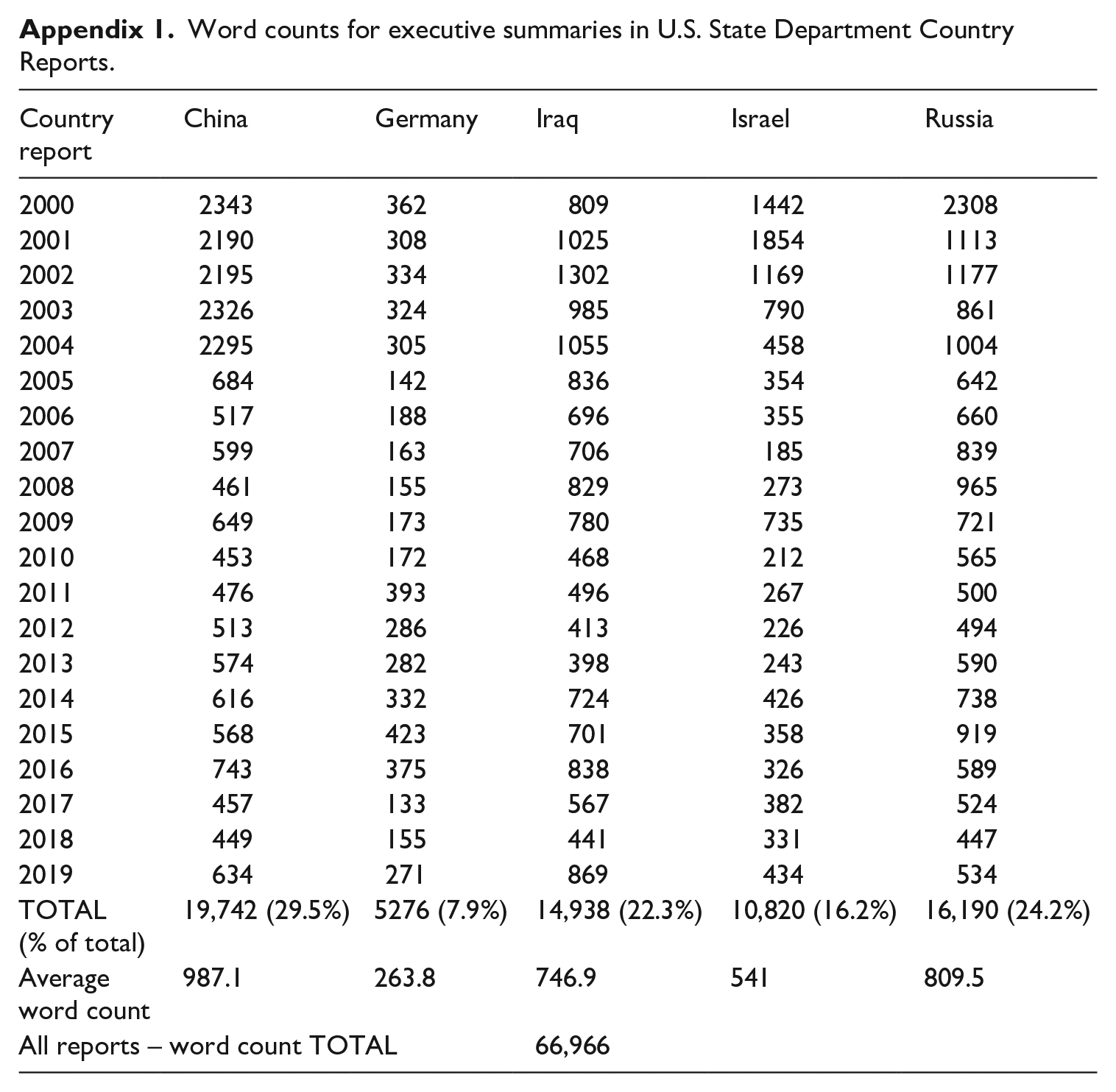
The material analyzed in this study consists of the executive summaries of human rights country reports produced by the U.S. State Department between 2000 and 2019. This timeframe covers two decades and significant developments impacting U.S. foreign policy, from the 9/11 terrorist attacks and the subsequent War on Terror to the more recent rise of authoritarianism and antidemocratic movements. Summaries have been included for five countries: China, Germany, Iraq, Israel, and Russia. The analysis is comparative and diachronic, and the countries examined have been selected because of their varying relationships with the United States: some are long-term allies (Germany, Israel), some current adversaries (China, Russia) and one whose relationship has been transformed by war (Iraq). Only the executive summary for each report has been included for analysis, representing areas of human rights that are particularly highlighted. This amounts to 100 executive summaries and a corpus of approximately 67,000 words (word counts for each individual report as well as the total word counts are in Appendix 1).
The length of the summaries varies not only between executive summaries for different countries but also between different years for the same country. While a more detailed analysis of how the summaries are structured and what has changed over the years is covered in the analysis, it can be noted here that China’s executive summaries are the longest in both total and average word counts, while Germany’s are the shortest. In the case of China, Russia, and Iraq, the executive summaries were typically longer until the 2004 country reports and have subsequently became shorter.
Due to the complicated nature of the geopolitical conditions involved, some points about the countries in question should be noted. Firstly, the country report on China also includes sections on Hong Kong, Macau and, in later reports, Tibet; Taiwan is listed separately and has a report of its own. In the case of Israel, the country report included a separate section on what the reports identified as the ‘occupied territories’ between 2000 and 2016, and afterward as Golan Heights, West Bank, and Gaza. Finally, Iraq’s relationship in the timeframe covered is noteworthy for the fact that the United States was engaged in war against it in 2003.
The analysis covers several aspects of the reports. The overall structure of the executive summaries is examined. The inclusion and exclusion of areas of human rights is analyzed to identify themes that are represented as central as well as those that have been added or discontinued over time. Narratives of human rights, particularly those describing the ideal and advancements made towards it, are examined. Additionally, particular attention is given to the representation of actors and agency, both in its grammatical and sociological forms (as discussed by van Leeuwen, 1996: 33–34), as well as identifying who specifically is given or denied agency in the reports. Finally, due to the centrality of the War on Terror in U.S. foreign policy in the 21st century, the themes of terrorism, insurgency, and extremism are paid particular attention, focusing on their role in justifying human rights abuses.
Analysis
The analysis in this section proceeds in three parts. The first part gives an overview of the structure and themes in the reports. The second part focuses on investigating agency, analyzing who and what is afforded an active role, and how responsibility for abuses is represented. The third and final part of the analysis examines the role of terrorism, insurgency, and extremism, and the extent to which these themes have become valid justifications for limiting or abusing human rights.
Structures and themes of freedom
All analyzed executive summaries follow a similar general structure. The summary begins with a brief introduction to the country in question, briefly presenting its governing model and central actors, central political leaders and decision-making bodies, as well as internal security forces and structures. The summary then proceeds to discuss the status of a variety of topics connected to human rights. In some cases, specific examples or events are discussed. Such examples may include the arrest of a prominent human rights activist or a destructive terrorist attack.
Structurally, the executive summary sections stay quite similar from year to year. The introductory part covering the government model and leaders is typically repeated almost word for word (discounting exceptional developments, as in the case of Iraq and the ousting of Saddam Hussein). In other sections, similar phrasing is often also repeated from one year to the next when covering the same continuing situation. (1) and (2) show one such example from the summaries for Russia for two consecutive years (the repeated phrasing is shown in italics for the reader’s convenience):
(1) ‘The conflict between the government and insurgents, Islamist militants, and criminal forces in the North Caucasus led to numerous human rights violations by all parties, . . .’ (Russia, 2010; emphasis added).
(2) ‘Rule of law was particularly deficient in the North Caucasus, where the conflict between the government and insurgents, Islamist militants, and criminal forces led to numerous human rights abuses by security forces and insurgents, . . .’ (Russia, 2011; emphasis added).
Thematically, the areas of human rights covered in the reports have remained similar. Emphasis is placed on developments in the judicial system and the equal and transparent application of the law as well as issues in religious freedom and the treatment of religious minorities, freedom of speech, and freedom of the media. Freedom is a core phrase: religious freedom, freedom of speech, freedom of the press, free and fair elections.
The basis of the freedoms mentioned above is assumed to be legislative and the existence of a constitution or a constitution-like set of laws is often explicitly noted (as in (3)). The independence of the judiciary from political control is tracked from year to year, as are legislative developments that hinder or support the enaction of certain areas of human rights. The assumed ideal is judiciary independence from other branches of government (4–5), though the ideal can be corrupted or impaired. Labels drawn from branches of U.S. government such as ‘judicial’ and ‘executive’ are frequently used. In the case of Iraq, following the Iraq War, the removal of Saddam Hussein, and establishment of new political Iraqi leadership, legislative advances ‘set a course’ for advances towards the ideal (6).
(3) ‘The Constitution and laws provide for fundamental human rights; however, these protections often are ignored in practice’ (China, 2000).
(4) ‘The judiciary is independent and sometimes ruled against the executive, including in some security cases’ (Israel, 2005).
(5) ‘The judiciary, although seriously impaired by a lack of resources and by high levels of corruption, continued to show signs of limited independence and was undergoing reforms’ (Russia, 2001).
(6) ‘The law provided a structure for advances, and despite the violence the government set and adhered to a legal and electoral course based on respect for political rights’ (Iraq, 2005).
Thus, the reports heavily reflect terms and narratives drawn from U.S. political tradition. The expectation, sometimes stated explicitly and sometimes implied, is that an appropriately established constitution or similar legislative basis will ensure the protection of human rights for citizens. The reports do not, however, reflect upon cultural or societal aspects or legal traditions that might be incompatible with the default structures and practices drawn from the U.S. context.
The types of freedoms that this legislative basis is meant to promote are similarly rooted in U.S. political tradition, reflecting those outlined in the First Amendment of the Bill of Rights: freedom of religion, freedom of speech and press. These freedoms are often also covered in tandem with each other in the reports (7–8). Treatment of religious minorities is given particular attention; the treatment of Uighurs, for example, is routinely highlighted in reports on China (8).
(7) ‘The government generally respected the human rights of its citizens. The government limited the freedoms of speech, press, assembly, and association for groups deemed extremist. There was governmental and societal discrimination against some minority religious groups’ (Germany, 2009).
(8) ‘There was severe official repression of the freedoms of speech, religion, association, and assembly of Uighurs in the Xinjiang Uighur Autonomous Region (XUAR) and of Tibetans in the Tibet Autonomous Region (TAR) and other Tibetan areas’ (China, 2015).
These findings are also in line with a study by Pavlick (2019) on discourses on freedom used in school history textbooks in the United States. Pavlick found a similarly strong link with the freedoms drawn from the Bill of Rights as well as an emphasis on religious freedom. This common pattern in texts from two different fields also highlights the strong overall influence of the U.S. political tradition in informing conceptualizations of the world and history across different areas of society.
Reports from 2000 to 2004 also pay attention to the economic status and development of the countries examined. In the case of Germany and Israel, this typically amounts to a one-sentence note of an ‘advanced’ or ‘well-developed’ economy (as in (9)). In the case of Iraq, China, and Russia, progress towards a Western-style market economy and standard of living is tracked instead. In the case of China and Iraq, attention is given to reforms to move away from a state-controlled, centralized economy (10); in the context of Iraq, these reforms take place after the Iraq War. In the case of Russia, the country’s economic growth, GDP development, employment, and economic corruption is tracked.
(9) ‘A well-developed industrial economy provides citizens with a high standard of living’ (Germany, 2000).
(10) ‘The country’s transition from a centrally planned to a market-based economy continues. Though state-owned industry remains dominant in key sectors, the Government has privatized many small and medium state-owned enterprises (SOEs) and allowed private entrepreneurs increasing scope for economic activity’ (China, 2001).
Such a focus with economic development also strongly implicates a connection between human rights and economic prosperity afforded by a Western model of economic liberalism. While highlighted between 2000 and 2004, the theme subsequently disappears from all country reports. This change coincided with the shortening of some country reports, particularly China’s. However, the timing does not coincide with the change in presidential terms, which might have implied new political directives brought by a new administration.
Finally, certain other areas, such as women’s rights, are addressed consistently but in a limited manner. Women’s rights are mainly covered from the point of view of sexual trafficking and violence while other areas, such as women’s participation in the political process or access to education, are not mentioned. The rights of sexual minorities have been briefly addressed in reports for Germany and Iraq since 2010 and explicitly termed as LGBTQ rights in those reports since the mid to late 2010s. Internet censorship and control are mentioned in the context of freedom of speech for Russia and China. Environmental human rights issues, for example, are addressed in none of the covered reports.
Agency and responsibility
As discussed above, the human rights reports produced by the U.S. State Department are meant for a variety of audiences in the United States and beyond, ranging from the media to academic researchers and other governments. One aspect of discussing human rights abuses is the assignment of responsibility. Thus, it is important to examine how agency is represented in the reports and what kinds of discursive choices have been made to mediate the challenges that the foreign policy context imposes. This includes an examination of grammatical structures such as choices of subjects and the use of active and passive voice, but also evaluations of responsibility and blame that may be realized in less grammatically distinct ways.
Firstly, the texts frequently use constructions that avoid attributing direct, overt responsibility for specific violations to state actors. These constructions include the frequent use of passive voice (11), nominalizations where events or developments appear in a subject position (as in (12), attributing agency to ‘disappearances’ and ‘extrajudicial killings’), and the repeated use of verbs that allow for failure or neglect over active malice (the government’s failure to respond, (13)).
(11) ‘Other significant human rights problems were reported. . .’ (Iraq, 2014; emphasis added).
(12) ‘While disappearances declined overall, extrajudicial killings increased in Ingushetiya’ (Russia, 2008; emphasis added).
(13) ‘The government failed to adequately protect refugees. . .’ (China, 2006; emphasis added).
These strategies are among those mentioned by Van Leeuwen (1996) in manipulating linguistic representation through the exclusion or inclusion of specific social actors. In this case, the textual choice to avoid assigning direct responsibility can also be attributed to diplomatic face-saving, as described by Chilton (1990), whose analysis showed U.S. and Soviet leaders using rhetorical strategies to push back or reject each others’ assertions while at the same time avoiding stating direct accusations that might have prompted a negative reaction from the other side.
The use of passive voice and nominalization are also structures found frequently in newspaper reporting (Van Dijk, 1988: 10–11) and academic texts (see, e.g., Biber and Gray, 2013). A combination of considerations may therefore be at work here: the human rights reports avoid direct accusations of culpability on other countries due to diplomatic face-saving while using linguistic constructions favored in academia and the media, two major end-user communities for the published reports.
However, while these strategies are used to avoid direct accusations of responsibility, a distinction is also drawn between governmental authorities and the people under their power, as in (13). Through their actions, governmental actors may enable or restrict the freedoms that are assumed to be the rights of all people. Sometimes represented violations are cases of governmental suppression and restriction in the lives and rights of citizens, reflecting a view of freedom as the absence of interference rather than the presence of support. (14) illustrates this contrast: a general policy of respect for human rights is juxtaposed with limiting the freedoms of certain groups. The presence of and impact upon the citizenry are often only implied, as in (15) and (16), where the public authority’s actions are aimed at ‘dissent’ or ‘detention’ as much or more than the people dissenting or being detained.
(14) ‘The government generally respected the human rights of its citizens. The government limited the freedoms of speech, press, assembly, and association for groups deemed extremist’ (Germany, 2008).
(15) ‘These abuses stemmed from the authorities’ extremely limited tolerance of public dissent aimed at the Government, . . .”’ China, 2000).
(16) ‘The authorities routinely used arbitrary arrest and detention, prolonged detention, and incommunicado detention, and continued to deny citizens the basic right to due process’ (Iraq, 2000).
While the role of the government and public authorities is examined in the case of all countries, this focus is pronounced in the case of China, where ‘the government’ and ‘authorities’ are cited as the main perpetrators of human rights abuses, as in examples (13) and (15) above. In the case of Iraq, the government of Saddam Hussein was frequently referenced as a ‘regime’ prior to the Iraq War and even in some cases afterwards, as in (17), to contrast Iraqi governments prior to and after the Iraq War.
(17) ‘The Interim Government, reversing a long legacy of serious human rights abuses under the previous regime, generally respected human rights. . .’ (Iraq, 2004; emphasis added).
The 2002 country report for Iraq was the longest executive summary included for that country (1302 words), and the word ‘regime’ was particularly prevalent. The release of the 2002 U.S. State Department human rights reports closely coincided with the launch of the Iraq War in March 2003. Departing from the general tone of the reports, Iraq’s 2002 country report uses an overtly critical wording starting from its opening sentences (18):
(18) ‘Under the provisional Constitution of 1968, Iraq claims to be a democratic republic. However, political power has rested exclusively in a harshly repressive one-party apparatus dominated by Saddam Hussein al-Tikriti and members of his extended family’ (Iraq, 2002; emphasis added).
The 2002 Iraq country report is particularly illustrative of the fact that the reports are in some cases quite explicitly impacted by U.S. foreign policy considerations.
Terrorism, insurgency, extremism: Violations of human rights
Reports for all countries included in this analysis discuss the impact of terrorism, insurgency, or extremism in relation to the human rights abuses taking place in those countries. Sections where these three themes appeared in the executive summaries are examined and compared. The focus is particularly on instances where attempts are made to justify human rights abuses and ways in which evaluations on the validity of these attempts are signaled.
Not all countries are touched equally by these three challenges. In the context of Germany, only extremism is discussed to a limited extent in connection with the rise of right-wing nationalism from 2006 onwards. For Russia, terrorism is discussed in connection with attacks by Chechen rebels, while right-wing extremism is periodically discussed in the latter half of the analyzed material. In the case of China, the reports mention terrorism and, to a lesser extent, extremism in connection with the Uighur minority. Terrorism is present throughout the reports for Israel as a human rights issue, with abuses described against and by the Israeli state. Finally, insurgency and terrorism are highlighted in the case of Iraq after 2004 and the removal of Saddam Hussein, with unrest caused by sectarian violence and terrorist organizations like Al-Qaeda and ISIS.
In U.S. political discourse, terrorism as a theme has risen to prominence following the events of 9/11 and the subsequent War on Terror. The usage of the term ‘terror’ and ‘terrorism’ has been examined among others by Bailey (2007), who examined changes in U.S. political discourse before and after 2001 and found a significant increase in their use after 2001. However, connecting international terrorism to human rights abuses is not new in U.S. foreign policy decision making and has at times been used to justify U.S. support even to antidemocratic regimes (Apocada and Stohl, 1999). Yin (2007) showed that justifications for potential human rights abuses can be applied unequally in media reports depending on the country in question. This section of the analysis also examines whether similar inequalities can be observed in the country reports and how in some cases human rights abuses are downplayed or justified as a valid response to terrorism.
(19) and (20) provide two contrasting examples of an attempt to justify human rights abuses. In (19), a clear evaluation is made that the provided justification is a ‘pretense’ and therefore not valid, while in (20) the impact of terrorism and insurgency is instead an imposed ‘handicap’ on the government. The former example is of China, whose appeals to combating terrorism often receive a similarly critical evaluation in the reports. The latter is from Iraq, which after the fall of Saddam Hussein is initially given the benefit of the doubt.
(19) ‘Chinese government officials justified the camps under the pretense of combating terrorism, separatism, and extremism’ (China, 2019; emphasis added).
(20) ‘. . .the government’s human rights performance was handicapped by insurgency and terrorism that impacted every aspect of life’ (Iraq, 2005; emphasis added).
In Iraq, the continuation of sectarian violence and terrorism does eventually lead to a somewhat harsher evaluation of the government’s actions as ‘undermining’ the protection of human rights (21):
(21) ‘Security forces and armed militias committed serious human rights abuses as rising levels of terrorist violence, corruption, and organizational dysfunction undermined effective protection of human rights’ (Iraq, 2013; emphasis added).
In light of this criticism, the case of Israel provides a contrast. United States and Israel are established and long-term allies and the two countries share close ties in many areas. 9/11 promoted a closer relationship between the two countries, but relations somewhat cooled during the Obama administration (Freedman, 2012). While the Israeli response is viewed as valid and justified throughout the reports, there is an evolution in how Palestinians in particular are placed in relation to Israel. In (22), Palestinians are an external attacker, as ‘Israeli’ and ‘Palestinian’ are juxtaposed (note the lack of the use of ‘government’ or ‘authorities’ discussed above). Palestinians are an actor external to Israel. By 2014, under the Obama administration, terrorism remains an issue, but the presence of ‘Arab citizens of Israel’ is also explicitly recognized (23), shifting the frame from a country facing an external enemy to recognizing a discriminated minority.
(22) ‘During the year, a total of 76 Israeli civilians and four foreigners were killed as a result of Palestinian terrorist attacks in Israel and the occupied territories, and 41 members of the Israeli Defense Forces were killed in clashes with Palestinian militants. During the same period, more than 800 Palestinians were killed during Israeli military operations in the occupied territories’ (Israel 2004; emphasis added).
(23) ‘The most significant human rights problems were terrorist attacks targeting civilians and politically or religiously motivated societal violence; institutional and societal discrimination against Arab citizens of Israel, many of whom self-identify as Palestinian, including the Bedouin, in particular in access to equal education and employment opportunities; societal discrimination against women; and the treatment of refugees, asylum seekers, and irregular migrants’ (Israel 2014; emphasis added).
However, the Trump administration has since set a different course, recognizing Jerusalem as the capital of Israel as well as Israel’s sovereignty over the Golan Heights (as also noted in the 2019 country report). In country reports between 2017 and 2019, Arab citizens are no longer referenced, and indeed even the phrase ‘occupied territories’ has been removed. Furthermore, the 2017–2019 reports include a striking sentence that calls into question even some of the abuses described in the reports themselves (24):
(24) ‘. . .this report contains data drawn from foreign government officials; victims of alleged human rights violations and abuses; academic and congressional studies; and reports from the press, international organizations, and nongovernmental organizations (NGOs) concerned with human rights. In the context of the Israeli-Palestinian conflict, some of those sources have been accused of harboring political motivations’ (Israel 2019; emphasis added).
Such examples are found nowhere else in the analyzed material and can be assumed to implicitly invalidate criticism of Israeli actions in particular.
Conclusion
This study has examined human rights discourses in the context of the United States, focusing on the annual human rights reports produced by the U.S. State Department. These reports serve as a strategic tool in promoting U.S. foreign policy objectives, but a discursive analysis can also reveal underlying ideologies on human rights – what rights are relevant, how they are meant to be promoted, and who carries out and who are impacted by human rights abuses. How the U.S. cultural context affects the way these rights are conceptualized is also a consideration, as the United States is in a uniquely powerful position of influencing discourses on human rights on the global stage.
The analysis shows that the way human rights are approached in the reports heavily reflects U.S. political tradition. The foundation of human rights in the reports echoes the narrative also put forth by Secretary of State Mike Pompeo in 2018: the establishment of a constitution-like legal basis that ensures citizens’ rights are respected. The assumed origin of international human rights in values codified in the U.S. constitution is also reflected in the reports. The rights most central to the evaluation of other countries’ human rights performance are those found in the United States Bill of Rights, with freedom of religion being particularly highlighted. For a time, the economic performance and progress along what is seen as a path of liberal economic development is also tracked.
The U.S. model is thus adopted as a benchmark against which the performance of other countries is evaluated. Because of this basis, the areas of human rights examined remain largely static. There is no reflection on the appropriateness or suitability of the U.S. model in evaluating countries with different cultural and societal traditions and conditions. The reports make a distinction between public authorities and ordinary citizens: the former serve as enablers or perpetrators of human rights abuses; the latter remain largely invisible but are assumed to yearn for the freedoms that the U.S. model provides.
The reports also exemplify the strategic functions of the texts. Linguistic choices such as nominalization and passive voice are used, in practice obfuscating responsibility for human rights abuses. This is a tool of diplomatic face-saving so that other countries are not directly accused of violations. However, these linguistic choices also echo genres of academic and media texts, giving the impression of impartiality and objectivity. Additionally, there are examples where political priorities have had a clear impact on the wording of the reports, as exemplified by the cases on Iraq, China, and Israel on responses to terrorism. This is not to say that the violations described are unimportant or invalid; however, while the framework of human rights is standard, it is in some cases applied unequally based on political expediency.
Footnotes
Appendix
Word counts for executive summaries in U.S. State Department Country Reports.
| Country report | China | Germany | Iraq | Israel | Russia |
|---|---|---|---|---|---|
| 2000 | 2343 | 362 | 809 | 1442 | 2308 |
| 2001 | 2190 | 308 | 1025 | 1854 | 1113 |
| 2002 | 2195 | 334 | 1302 | 1169 | 1177 |
| 2003 | 2326 | 324 | 985 | 790 | 861 |
| 2004 | 2295 | 305 | 1055 | 458 | 1004 |
| 2005 | 684 | 142 | 836 | 354 | 642 |
| 2006 | 517 | 188 | 696 | 355 | 660 |
| 2007 | 599 | 163 | 706 | 185 | 839 |
| 2008 | 461 | 155 | 829 | 273 | 965 |
| 2009 | 649 | 173 | 780 | 735 | 721 |
| 2010 | 453 | 172 | 468 | 212 | 565 |
| 2011 | 476 | 393 | 496 | 267 | 500 |
| 2012 | 513 | 286 | 413 | 226 | 494 |
| 2013 | 574 | 282 | 398 | 243 | 590 |
| 2014 | 616 | 332 | 724 | 426 | 738 |
| 2015 | 568 | 423 | 701 | 358 | 919 |
| 2016 | 743 | 375 | 838 | 326 | 589 |
| 2017 | 457 | 133 | 567 | 382 | 524 |
| 2018 | 449 | 155 | 441 | 331 | 447 |
| 2019 | 634 | 271 | 869 | 434 | 534 |
| TOTAL (% of total) | 19,742 (29.5%) | 5276 (7.9%) | 14,938 (22.3%) | 10,820 (16.2%) | 16,190 (24.2%) |
| Average word count | 987.1 | 263.8 | 746.9 | 541 | 809.5 |
| All reports – word count TOTAL | 66,966 | ||||
Declaration of conflicting interests
The author(s) declared no potential conflicts of interest with respect to the research, authorship, and/or publication of this article.
Funding
The author(s) disclosed receipt of the following financial support for the research, authorship, and/or publication of this article: This work was supported by the Finnish Cultural Foundation (Grant number 00200587).