




Abstract
Societies are undergoing enormous upheavals in the wake of the COVID-19 pandemic. High levels of psychological distress are widespread, yet little is known about the exact impacts at the micro-level of everyday life. The present study examines the ordinary activity of buying bread to understand changes occurring early in the crisis. A dataset of over 50 social interactions at a community market stall were video-recorded, transcribed and examined in detail using multi-modal conversation analysis. With COVID-19 came an orientation to a heightened risk of disease transmission when selling food. The bread was placed in bags, a difference which was justified as a preventative measure and morally normalised by invoking a common-sense prohibition of touching produce. Having the bread out of immediate sight was a practical challenge that occasioned the expansion of turns and sequences to look for and/or confirm what was for sale, highlighting a normative organisation between seeing and buying. The analysis shows how a preventative measure related to the pandemic was adjusted to interactionally. More broadly, this research reveals the small changes to daily life that likely contribute to the overall negative impacts on health and well-being that have been reported.
Keywords
Societies have been economically and socially unsettled by the COVID-19 pandemic. At the time of writing, over 4 million people have died from coronavirus (World Health Organization, 2021) and lockdown measures around the world have restricted people’s everyday activities. The psychological impacts of the pandemic are profound. High levels of stress, anxiety and depression are being documented around the world (Serafini et al., 2020). Social isolation, economic hardship and fear have negatively impacted health and well-being (Polizzi et al., 2020). The present study aims to better understand the social and psychological upheavals caused by COVID-19 through a detailed examination of how an ordinary aspect of life changed as an early response to the developing crisis. Our focus is the everyday activity of buying bread at a community marketplace. The bread for sale was displayed differently; put in bags as a hygiene measure. We examine the impact the bags had on the sales encounter, showing how people established and maintained a sense of a ‘world of daily life known in common’ (Garfinkel, 1967: 35) at a moment when daily life was changing quickly, thus deeply uncertain.
Our research begins from the ethnomethodological standpoint that ordinary life is an accomplishment (Garfinkel, 1967). In daily life, people manage to make themselves understood and achieve co-ordinated actions with others. This remarkable everyday achievement relies on common practices for realising intersubjectivity and building intelligible actions. Because the common practices for accomplishing everyday life are taken-for-granted, deviations are noticeable and sanctionable, making social life morally accountable. Participants’ affective responses and explanations orient to normative expectations (Garfinkel, 1967), showing that everyday practices are subject to evaluative enquiry (Antaki, 1994; Potter and Wetherell, 1987). In a pandemic, the functioning of this mundane morality is more visible than ever because of the substantive and rapid impacts on daily life.
Community markets are sites of routine sales interactions where a sense of belonging and community well-being can be supported. As people buy and sell products locally, they construct and share values and identities in a form of what Cavanaugh (2016) called economic sociability. Markets are also perceptually rich environments in which sensorial engagements such as noticing, touching and tasting regularly occur (see Stukenbrock and Dao, 2019). Buying and selling involves core psychological matters such as knowledge (Fox and Heinemann, 2015) and sensation (Cekaite and Mondada, 2020; Mondada et al., 2020b) as people negotiate their relationships to each other and the material environment (Haakana and Sorjonen, 2011; Harjunpää et al., 2018; Sorjonen and Raevaara, 2014). The meaning of routine actions like touching products or exchanging money have become interactionally relevant in a pandemic world.
In this paper, we investigate how sales encounters in a community marketplace were accomplished in the early days of the pandemic. People had begun managing infection risks through practices such as configuring bodies and objects differently in space to manage new norms like physical distancing or avoiding touching cash (Mondada et al., 2020b). In the bread stall under investigation the produce was put in bags. Thus, adjustments had to be made to the seemingly simple activity of buying bread. Examining how the changes were managed turn-by-turn provides a unique perspective on social practices and human relationships at a time of uncertainty and social change.
The pandemic highlights the materiality and vulnerability of human bodies (Katila et al., 2020), changing how bodies are configured in space and come together to interact (Mondada et al., 2020a). We extend studies of social interaction during the current pandemic by examining how products for sale are constituted as both material objects that can harbour the virus and social ones whose potential as a site of contagion must be managed in the sales encounter (cf. Mondada et al., 2020a). The analyses show how participants orient to the bread not merely as a food item for sale, but as a possible vector for contagion. Thus, the bread becomes a kind of bio-social object through participants’ talk, bodily configurations and sensorial engagements. We examine how participants’ orientations to change unfolded and how the morality of living in a pandemic world was invoked.
The pandemic acts as a kind of naturally occurring breaching experiment (cf. Garfinkel, 1967), a challenge to established methods of sense-making that can reveal aspects of the fundamental organisation of social interaction. For example, usually unremarkable actions like hugging or shaking hands have become objects of negotiation with alternative forms of greeting like elbow-bumps treated as new and extraordinary (Katila et al., 2020; Mondada et al., 2020a). In the current study, placing the bread in bags was noticed, challenged, accounted for and adjusted to, revealing a normative organisation between seeing, touching and buying.
Data and method
All encounters between customers and a seller at an artisan bread stall during core business hours (10 am–1 pm) were recorded on a weekly market day at a New Zealand university campus. Three video cameras were used to capture the interactions from different angles to enable detailed views of gaze direction and other embodied behaviours. A radio-microphone was attached to the seller to get quality audio recordings. The result was comprehensive footage of more than 50 interactions between the seller and customers.
Data collection coincided with the acceleration of the COVID-19 pandemic worldwide. The market was held on Wednesday 18 March 2020, just over a week after the World Health Organization declared a pandemic. At that time, New Zealand had just 27 confirmed cases of the virus (Ministry of Health, 2020) and the government had banned large outdoor gatherings (although schools and universities were exempt). Case numbers grew rapidly, and on 25 March (when the next market day would have been held), New Zealand entered national lockdown in which the populace was directed to stay at home, travel was severely restricted, and all non-essential businesses were closed.
Ethics
The university ethics committee granted approval for the research. The seller provided written consent to have her interactions with customers recorded. Prominent signs informed customers that recording was taking place for university research. After completing an interaction with the seller, customers were approached for their verbal consent and given an information sheet about the research.
Analytic procedure
Our analytic approach uses discursive psychology, which draws upon ethnomethodology and conversation analysis to examine how the rapid social changes associated with COVID-19 impacted on what would in typical times be an ordinary aspect of everyday life – selecting what bread to buy at a local market.
We transcribed the recordings using conversation analytic conventions to capture features of talk (Hepburn and Bolden, 2017; Jefferson, 2004) and where relevant to the analytic argument, embodied conduct (Mondada, 2018). Recordings and transcripts were viewed multiple times in close detail. During that process we noticed that participants regularly commented on the bread being in bags or adjusted their behaviours because of them. We formed a collection of those cases which clearly occurred in just under half of the interactions. Each of those cases were examined for what they showed about participants’ joint understanding of the threat of COVID-19 and how it shaped the temporal unfolding of the encounter.
Analysis
We begin by presenting clear examples of how a measure to prevent possible viral transmission at the market stall was treated as accountable. That is, the first section shows how the newly introduced practice of putting the bread in bags was rendered intelligible and legitimate by the participants. Then we present evidence of a normative organisation of seeing and buying that was revealed by the visual barrier made by the bags.
The accountability of selling bread during COVID-19
In the first extract there are explicit formulations of an uncertain future of the market stall due to COVID-19 and selling food as a site of possible contagion. The seller (SELL) explains the bread in bags as a preventative measure the business has taken. This change is normalised which Garfinkel (1967) identified as one of the regular sense-making moves in his breaching experiments. In this case normalisation occurs by evoking a shared common-sense morality regarding touching food for sale.
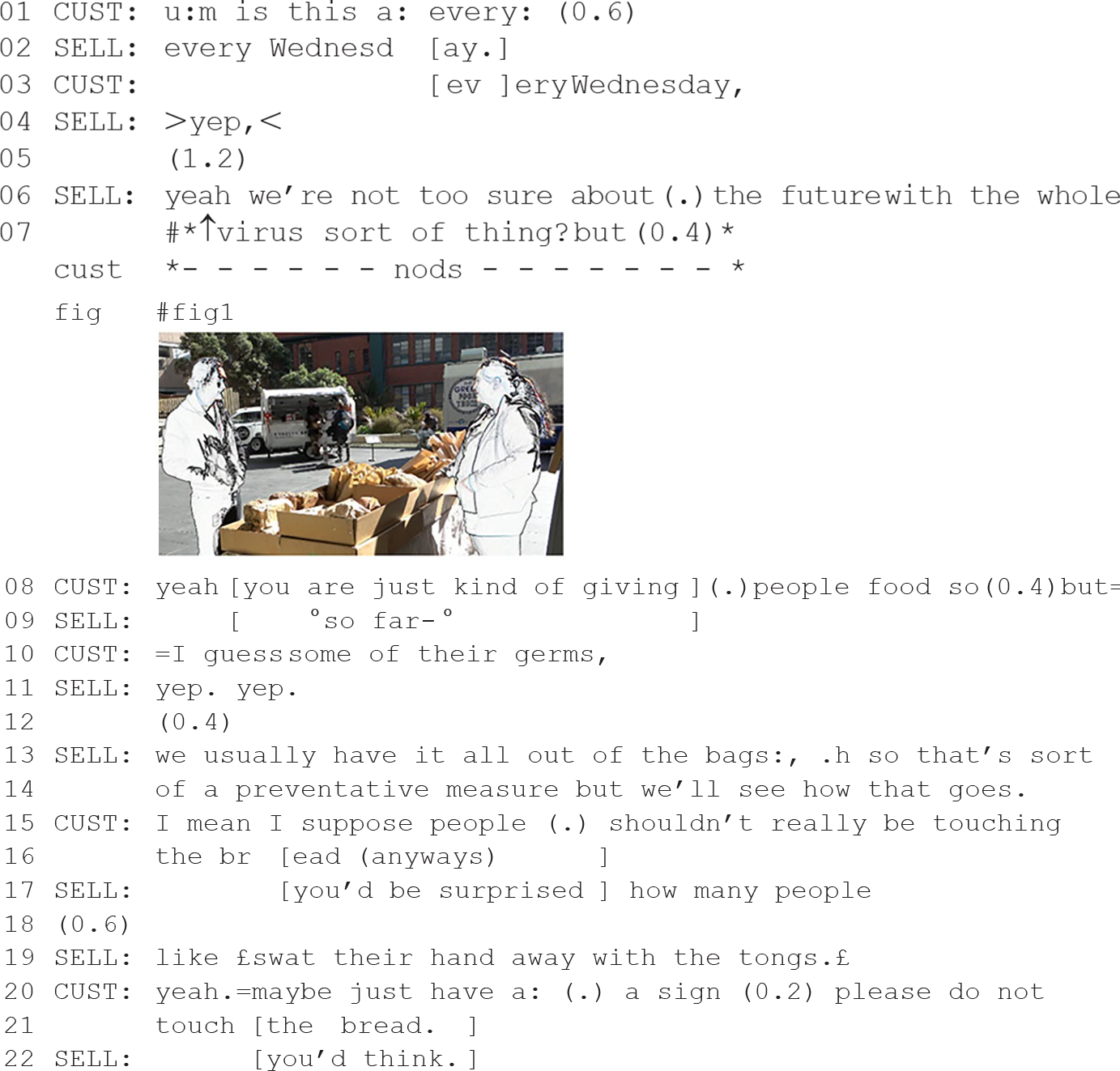
The first sequence of turns (lines 1–4) addresses the customer’s inquiry about which day of the week is regularly market day. However, the spectre of uncertainty about the market being held is raised in the following talk. Using the plural pronoun ‘we’ to speak on behalf of the business (see Heritage, 2004), the seller claims they are ‘not too sure about (.) the future’ (line 6). She attributes these doubts to ‘the whole ↑virus sort of thing’ (lines 6–7). This vague formulation assumes general knowledge about the pandemic is shared with her recipient. Indeed, the customer nods just as the seller says ‘virus’ (line 07), which is an embodied practice for claiming a joint stance (Stivers, 2008), in this case about the uncertainty of whether the market will continue.
Having established some shared understanding of a pandemic world in common, the participants explicitly address the accountability of what they are doing. The customer assesses that there are risks involved in ‘giving (.) people food’ due to ‘their germs’ (lines 8–10) which constructs bread as a biological object with the potential to transmit the virus. Through the inferential logic of membership categorisation (Sacks, 1972), the reference to ‘people’ (line 8) is hearable as customers, a category organised in relation to the seller and the business who are indexed with ‘you’ (line 8). The seller’s ‘yep.yep’. (line 11) claims agreement but indicates less than full affiliation (which would be done with an upgraded assessment; Pomerantz, 1984). Repeating ‘yep’ gives the turn the form of a multiple saying which Stivers (2004) found is a practice for indicating a course of action should be halted. In this case, it seems reasonable that a fuller consideration of the market stall as a site for virus transmission is being deterred. After a silence (line 12) where the customer could select as next speaker to initiate a relevant action such as a purchase request, the seller continues speaking to address the responsiveness of the business to the pandemic. Using the plural pronoun ‘we’ (line 13), the seller continues to speak as a representative of the business to explain having the bread in bags as ‘a preventative measure’ (line 14). This explanation treats the customer’s prior turn as a potential accusation because it justifies continuing to operate in a way that is legitimate and safe.
Yet the customer shows that his comments were not designed as an accusation. He uses ‘I mean’ (line 15) to show that the seller misunderstood his prior turn. Schegloff (1987) identified that turns of talk prefaced in this way regularly perform repair in third position and function to correct an understanding that a complaint is being made. The customer goes onto make a general claim that ‘people (.) shouldn’t really be touching the bread’ (lines 15–16). Repeating ‘people’ (lines 8 and 15) ties his two turns together to counter the interpretation that he was accusing the seller of acting unsafely. Using the modal verb ‘shouldn’t’ (line 15), the customer articulates a general rule that prohibits touching food before buying it and positions customers as responsible. The seller shows a shared stance, claiming customers touching the bread is more common than he might think (line 17) and jokingly describing her agency in disciplining wayward customers by ‘swat[ting] their hands away with tongs’ (line 19). The customer offers an alternative solution by suggesting a ‘please do not touch the bread’ sign (lines 20–21).
Extract 1 thus shows an example where uncertainty due to the pandemic was explicit. The risk of the bread as a source of contagion was addressed by invoking a shared common-sense morality prohibiting touching food for sale. Extract 2 shows an embodied orientation to a rule about not touching the bread. The extract begins by highlighting the embodied action of one of two customers who have approached the stall together. The focus is the customer (cust) in the foreground (see Figure 1) who reaches towards the bread but then retracts his hand.
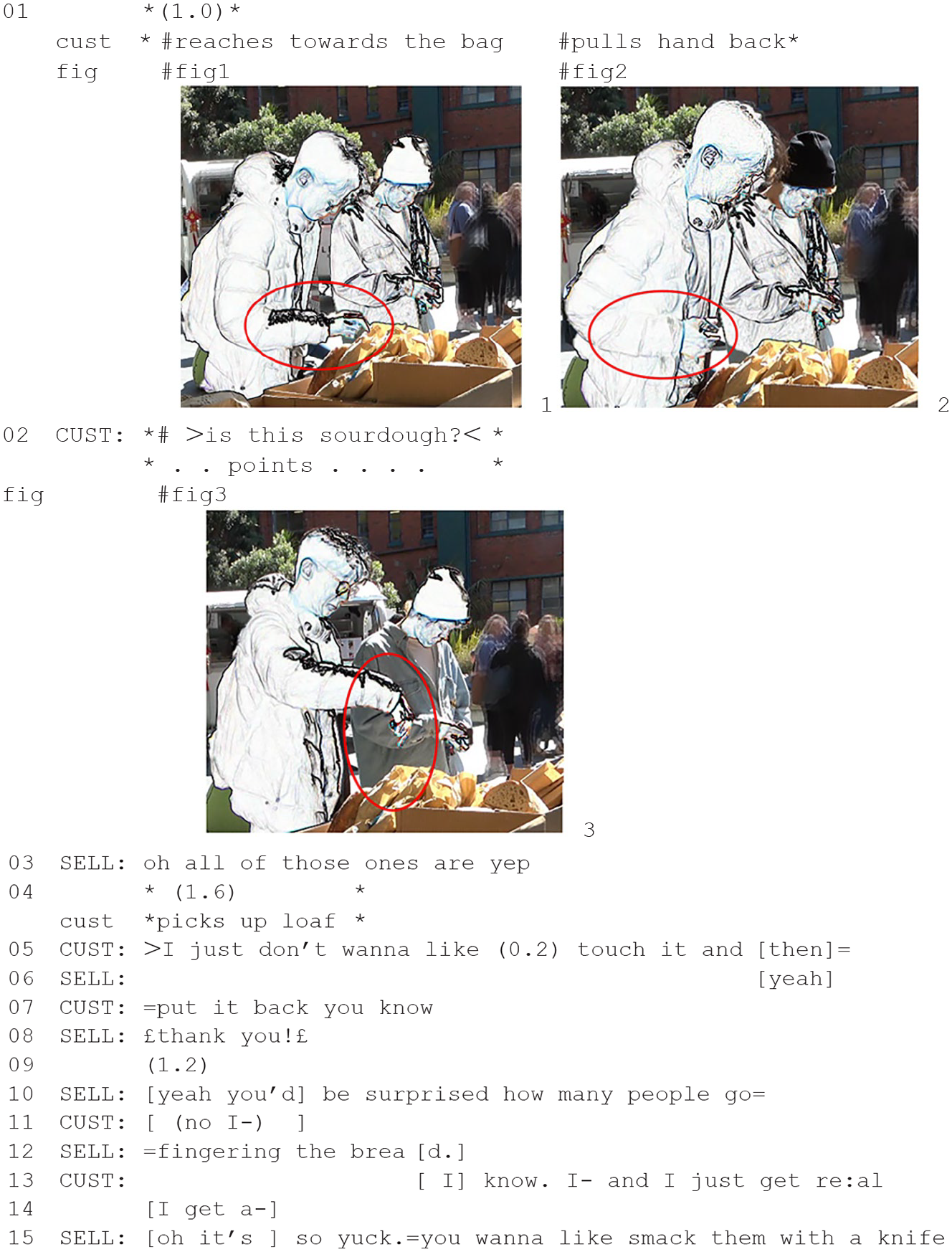
The customer’s embodied and verbal actions show an orientation to a prohibition of touching bread. He reaches his right hand towards a bag with bread in it (Figure 1) but then interrupts that trajectory of action and retracts his reaching hand at a speed faster than its initial extension (Figure 1). The abrupt change is the customer’s embodied orientation to a trouble with touching what initially was being reached for. He then moves his arm and transforms his hand into a pointing gesture well above the bag (Figure 1). The pointing gesture occurs at the same time as he requests confirmation that the target of his attention is a sourdough loaf (line 2). The format of the question is tilted for a positive response and claims some epistemic authority (Heritage, 2012) by specifying the kind of bread it is. The question also shows the customer has been unable to determine if the bread is sourdough by sight. Only after receiving confirmation (line 3) does he resume picking up the bag – an embodied orientation that the prohibition of touch no longer applies.
The customer explicitly accounts for his actions, explaining them in terms of personal agency and responsibility ‘I just don’t wanna like (0.2) touch it and then put it back you know’ (lines 5–7). His explanation makes explicit an understanding that touching is only legitimate when buying is being progressed, with touching and then returning items being morally accountable. Using ‘you know’ (line 7) invokes this relationship as shared common-sense knowledge (Stokoe, 2012). The seller aligns and legitimates the customer’s perspective with her agreement (line 6) and a smile as she thanks him (line 08), showing appreciation.
As in Extract 1, the seller informs the customer that many people do in fact touch the bread. She suggests the customer would ‘be surprised’ (line 10) by how many people violate the norm he has just articulated. The formulation ‘fingering the bread’ (line 12) upgrades the customer’s use of ‘touch’ (line 5), displaying a shared assessment of the undesirability of handling the produce before purchase. The customer’s explicit claim of knowledge ‘I know’ (line 13) further endorses a shared stance (Mikesell et al., 2017) about the illegitimacy of touch. He begins to formulate what is projectable as a negative emotional stance ‘I just get re:al I get a-’ (lines 13–14) but ends his turn incomplete as the seller delivers the disgusted assessment ‘oh it’s so yuck’ (line 15). The seller thus displays an affective stance towards people who touch the bread and, like Extract 1, describes sanctioning such acts by physical admonishment, this time formulated in terms of a desire that would be commonly shared ‘you wanna like smack them with a knife’ (line 14).
In Extracts 1 and 2 the risk of the market stall as a site of virus transmission and the responsibility for mitigating that risk is managed by invoking a shared moral stance where touching the bread is prohibited prior to progressing a purchase. In Extract 3, the bags are also rendered intelligible as a response to possible contagion by ensuring hands don’t touch the bread. The extract begins as the customer notes the presence of the bread stall (lines 2–4).
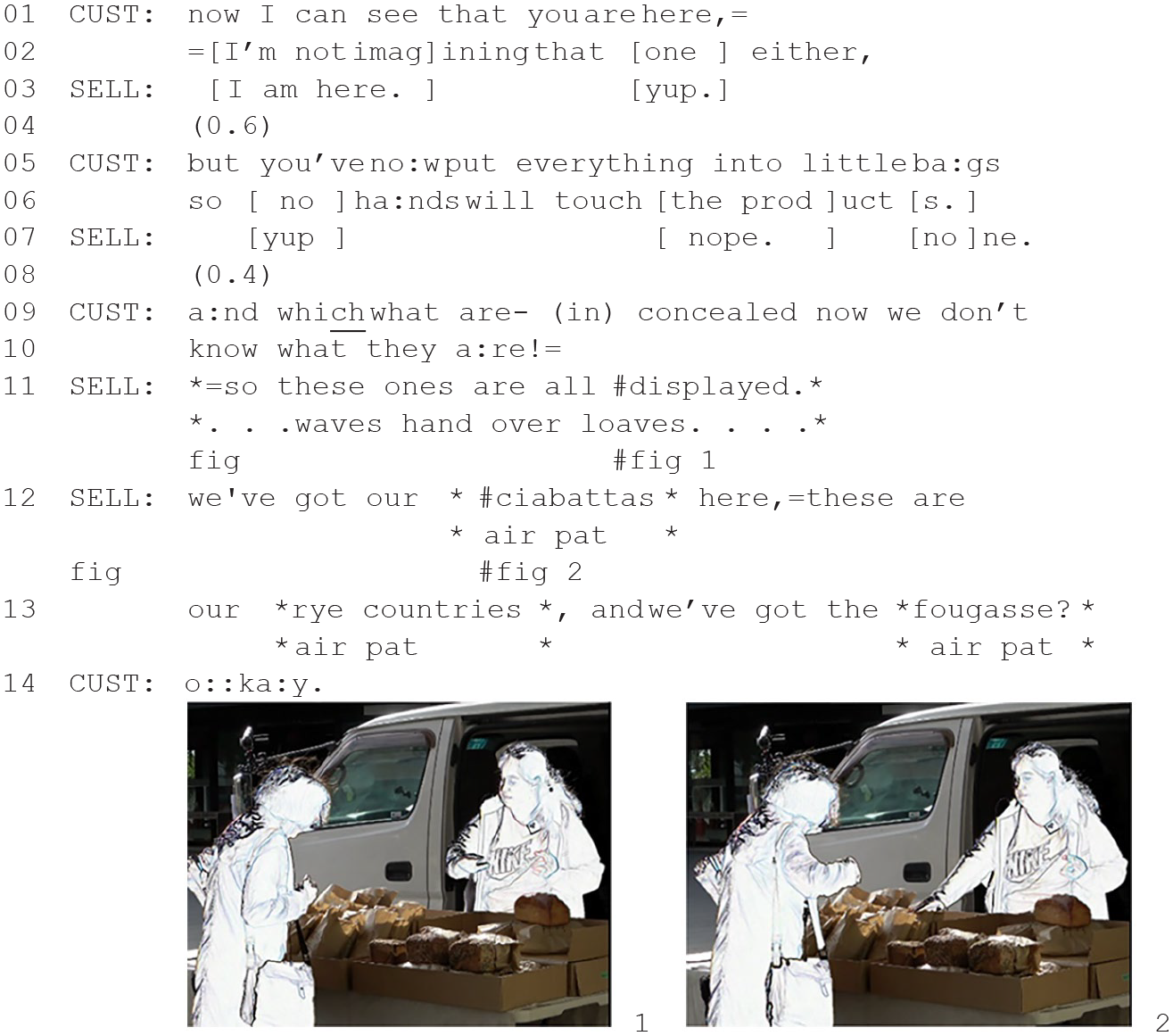
The customer notices a change in how products are displayed ‘you’ve no:w put everything into little ba:gs’ (line 5). Using the temporal marker ‘no:w’ shows an understanding that this is a new practice that deviates from business-as-usual, which could also be a covert reference to the pandemic. Noticing highlights an otherwise background feature of the environment and makes it accountable (Raymond and Stivers, 2016). The customer produces the reason herself, articulating the upshot, ‘so no hands will touch the products.’ (line 6), a more overt but still implicit reference to the pandemic. Regardless, the utterance shows that having the bread in bags is intelligible. The seller confirms the joint intelligibility in overlap (line 7). Although not explicitly referenced, the spectre of the pandemic is inferentially available as the cause of the change.
The customer begins a request for information about the types of bread that is interrupted by a self-repair ‘a:nd which what are-’ (line 9). ‘Which’ is replaced by ‘what’, then the question is abandoned to account for the necessity of its asking; the bread is ‘concealed now we don’t know what they a:re!’ (lines 9–10). Thus, the customer shows her trouble is not with knowing about the types of bread, but not being able to see what it is that she can buy. The negative formulation ‘don’t know’ builds this as a possible complaint and the plural pronoun ‘we’ shows it is a problem that affects all customers, calling the business into account. The seller responds by indicating to the display loaves (Figure 1) and then names and points to the different kinds of loaves in bags. Her verbal and embodied conduct thus display her understanding that the bags pose a practical problem for seeing what to buy. Her conduct is one orientation to a normative order of seeing before buying which we explore in more detail in the following section.
A normative organisation of seeing and buying
In the first extract in this section, the customer sees the seller putting the bread in the bag and placing it on the display table. Thus, in contrast to the cases that follow, the customer in Extract 4 serendipitously sees what she is going to buy.
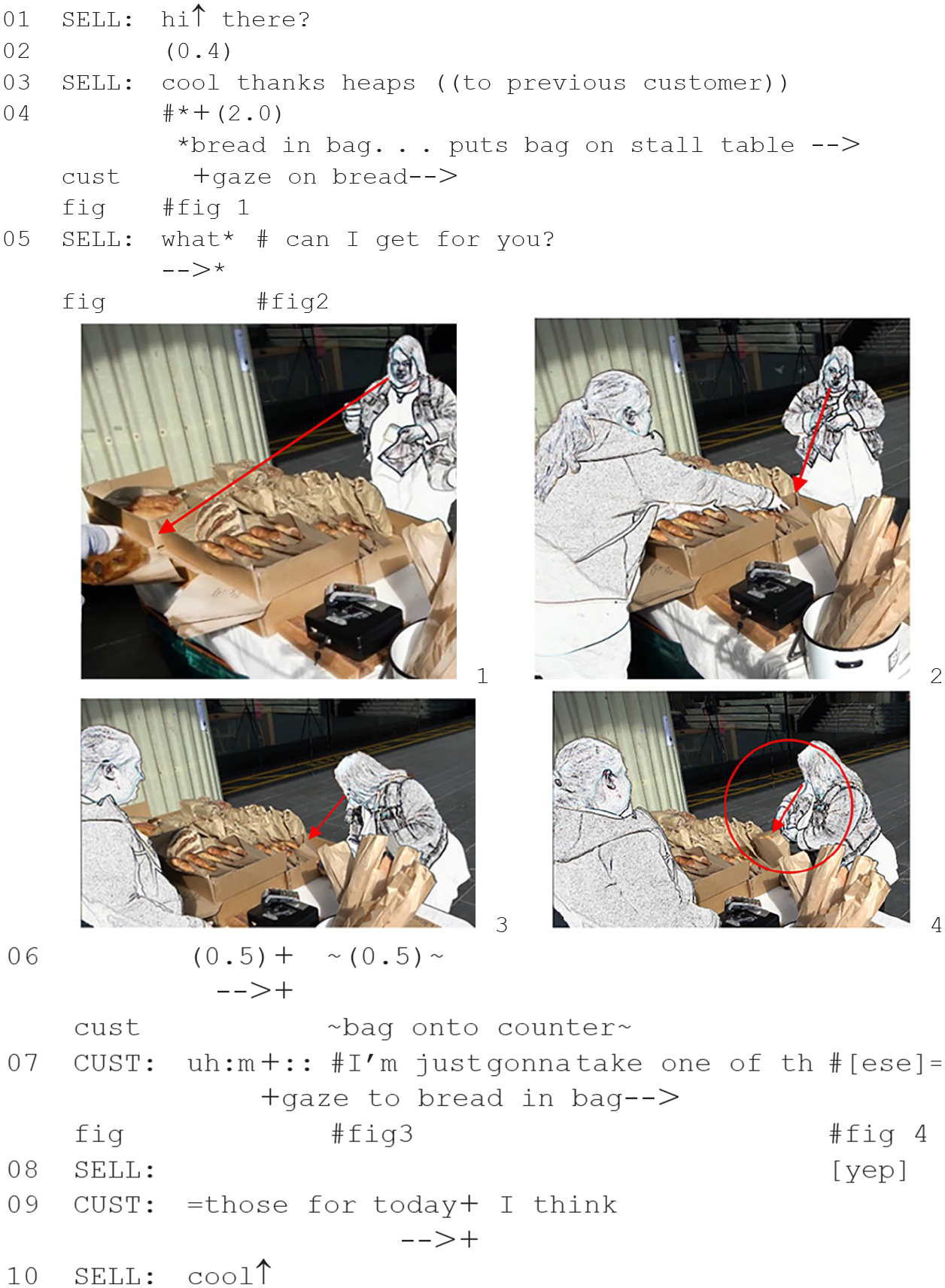
Walking towards the market stall, the customer gazes directly at the seller who is placing a loaf in a bag (line 4; Figure 1). As the customer arrives at the stall, her gaze follows the seller’s action of placing the bagged loaf on the counter directly in front of her (Figure 1). The seller’s embodied action is completed as she launches a request solicitation ‘What can I get for you’ (lines 4–5). The customer sets down the bag she was holding to access her wallet which shows a preparedness to pay as she says ‘I’m just gonna take one of these’ (line 7; Figure 1). The embodied action and the declarative form of the verbal response projects a progression to purchase.
An entitlement to touch comes with the displayed commitment to buy. As the customer pulls the paper bag towards her, there is a slight perturbation in her course of action. This is visible in the talk with the repair from ‘these’ to ‘those’ (lines 5–7; Figure 1) where she shifts from indexing a close relationship between herself and the object to one of greater distance. The perturbation is also visible in her embodied conduct. The repair segment coincides with her visual check of the loaf inside the bag. She pulls back the paper bag and gazes down at the loaf inside. This visual check for confirmation extends the interaction.
Despite the customer initially having visual access to what she was buying, the product being in the bag still impacted on the progression of the encounter, albeit minimally with a visual check about the contents of the bag. In Extract 5 below, the impact is more significant. The extract begins as two women approach the stall, gazing at the counter. Watching their approach, the seller has stood up to serve them. The customer’s side-to-side gaze indicates a visual search of what is for sale.
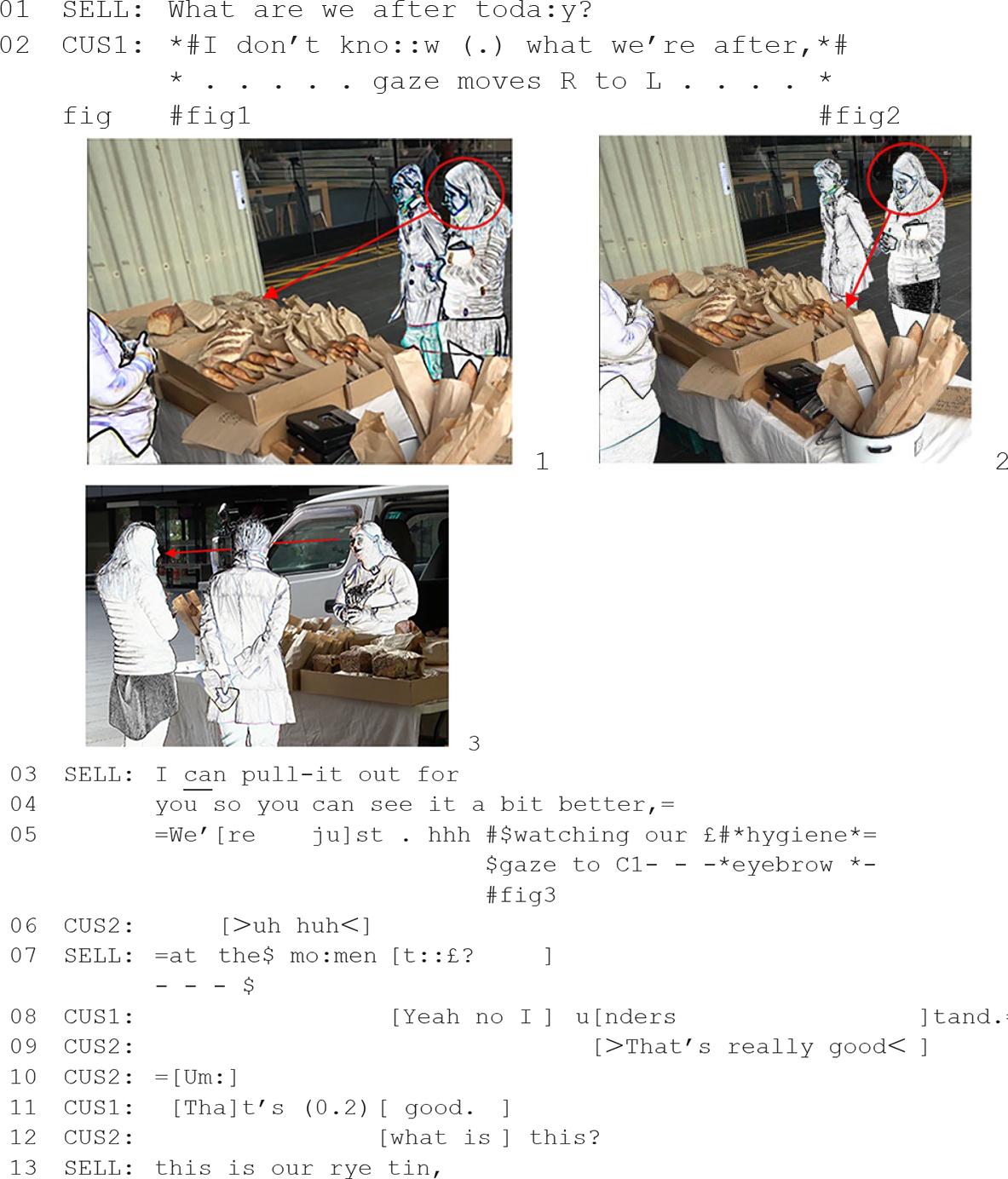
The seller’s request solicitation ‘what are we after today’ (line 1) assumes the customers know what they want. However, the first woman to speak (Cus1) demonstrates not knowing through her verbal and embodied conduct. She claims she doesn’t ‘kno::w what (.) we’re after’ (line 2) as she shifts her gaze from right to left across the bagged produce (Figure 1). This embodied display of looking but not seeing is recognisable as a search and can be understood as a trouble finding something (Kendrick and Drew, 2016). This is a moment where not seeing and not knowing what to buy co-occur.
The seller’s response retrospectively casts the bags as a reason for the customer’s visual search and not knowing what to buy. Her offer to remove the loaves from the bags so the customers can ‘see it a bit better’ (lines 3–4) displays an understanding that seeing properly precedes buying. Before the customers can respond to the offer, the seller continues her turn with the account, ‘we’re just.hh watching our hygiene at the moment’ (lines 5–7). As she delivers the account, she gazes directly at Cus1 (Figure 1) and raises and lowers her brows on the first syllable of ‘hygiene’. Eyebrow flashes can flag newsworthiness (Han and Zhu, 2018) or pursue an affective stance in response to a telling (Peräkylä and Ruusuvuori, 2012). The eyebrow flash here, along with the temporal marker ‘at the moment’ (line 7), mark the bags as a deviation from business as usual. The seller’s facial expression also works to solicit affective stances from the customers who both issue positive assessments (lines 9 and 11). Although the reason for increasing hygiene vigilance is not specified, Cus1’s claim of understanding (line 8) displays this does not need to be explicated (cf. Weatherall and Keevallik, 2016). The seller thus orients to the dilemmatic properties of the bags to the economic encounter which is further evident by the second customer’s request for identification for one of the loaves of bread (line 12).
The analysis so far has established that the bags are at once a visual barrier to overcome that extends the sales encounter interaction, and a hygiene measure that allows for the safe functioning of the market. This complexity is also evident in Extract 6 where the customer arrives at the stall, formatting her request by naming the bread while visually searching for it.
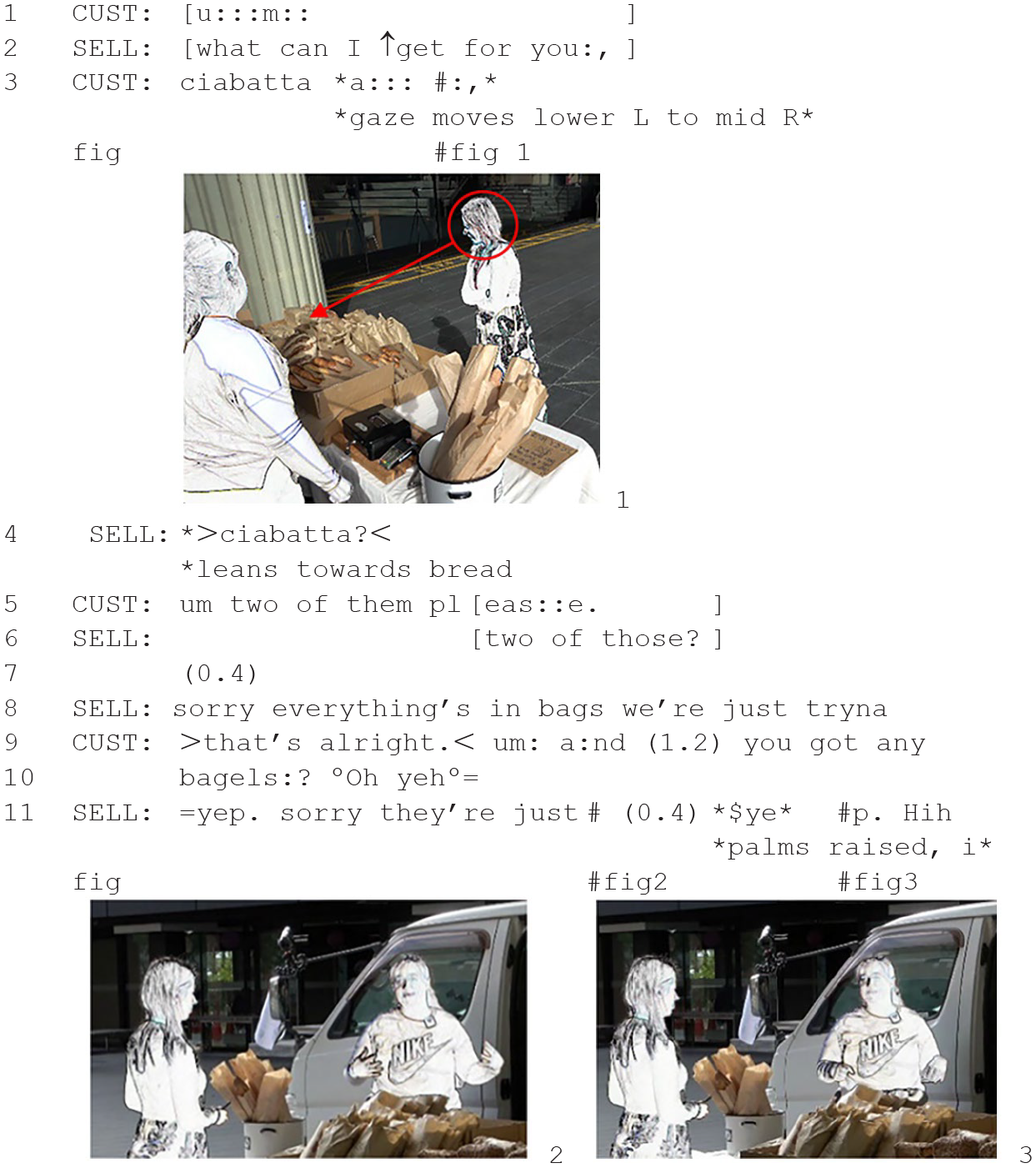
The customer advances the sales encounter by requesting the bread by name. However, visual access is impaired because the bread is in bags. Her stretched ‘u:::m::’ (line 1) projects a turn of talk in overlap with the seller’s request solicitation (line 2) and verbally displays she is engaged in a search. The word ‘ciabatta:::’ (line 3) is similarly stretched as the customer scans the counter from left to right (Figure 1). In this case the search is visual because the verbal production of the lexical item is sufficiently progressed as to be recognisable.
The lack of visual access caused by the bags prolongates the verbal request and thus slows the progression of the sale. The seller confirms ciabatta are available and moves to select one for the customer (line 4). However, the customer actually requests two loaves (line 5). The organisation of this request shows that the customer first established whether ciabatta was available (by attempting to look and then requesting) before producing her request for two ciabatta loaves. Thus, being unable to see the bread expands the request sequence – there is a pre-sequence confirming availability of the bread, necessitated by a lack of visual access, before a further specification of the quantity being requested.
The customer’s next request for bagels is also disrupted by being unable to see them. She shows another request is forthcoming with ‘um: a:nd’ (line 9), a recurrent practice to link multiple activities together (Heritage and Sorjonen, 1994). Once more, the sound-stretch and visual scan of the stall show her attempt to see if the to-be-requested item is available. When her search proves unsuccessful, she asks the seller. Her request for information is designed as a yes/no interrogative ‘you got any bagels:?’ (lines 9–10). Including ‘any’ displays the customer’s expectation that a likely answer is ‘no’ (see Heritage, 2012). After all, she has unable to see bagels, making it likely they are unavailable. The seller confirms bagels are available, providing verbal confirmation ‘yep’ (line 11) and pointing to indicate that the bagels are stored in the van behind her.
The seller treats the customer’s inability to see the products as accountable, apologising after each request. The first apology, ‘sorry everything’s in bags’ (line 8), names the bags as the transgression and begins an explanation ‘we’re just tryna’ (line 8) but this ends incomplete as the customer accepts the apology and begins her next request (line 9). The second apology ‘sorry they’re just’ (line 11) is punctuated with a double handed flicking movement at the pinnacle of the gestural flow depicted in Figure 1, indexing an explanation previously given. Having indicated to the customer that the bagels are in the van, the seller treats this knowledge as shared rather than further explicating it. By apologising, she displays her understanding that seeing products rightfully precedes buying them.
In the final case below, the seller projects the problem of uncertainty. In moving to pre-empt trouble before it occurs, she displays an understanding that not seeing products will impede the accomplishment of the sale.
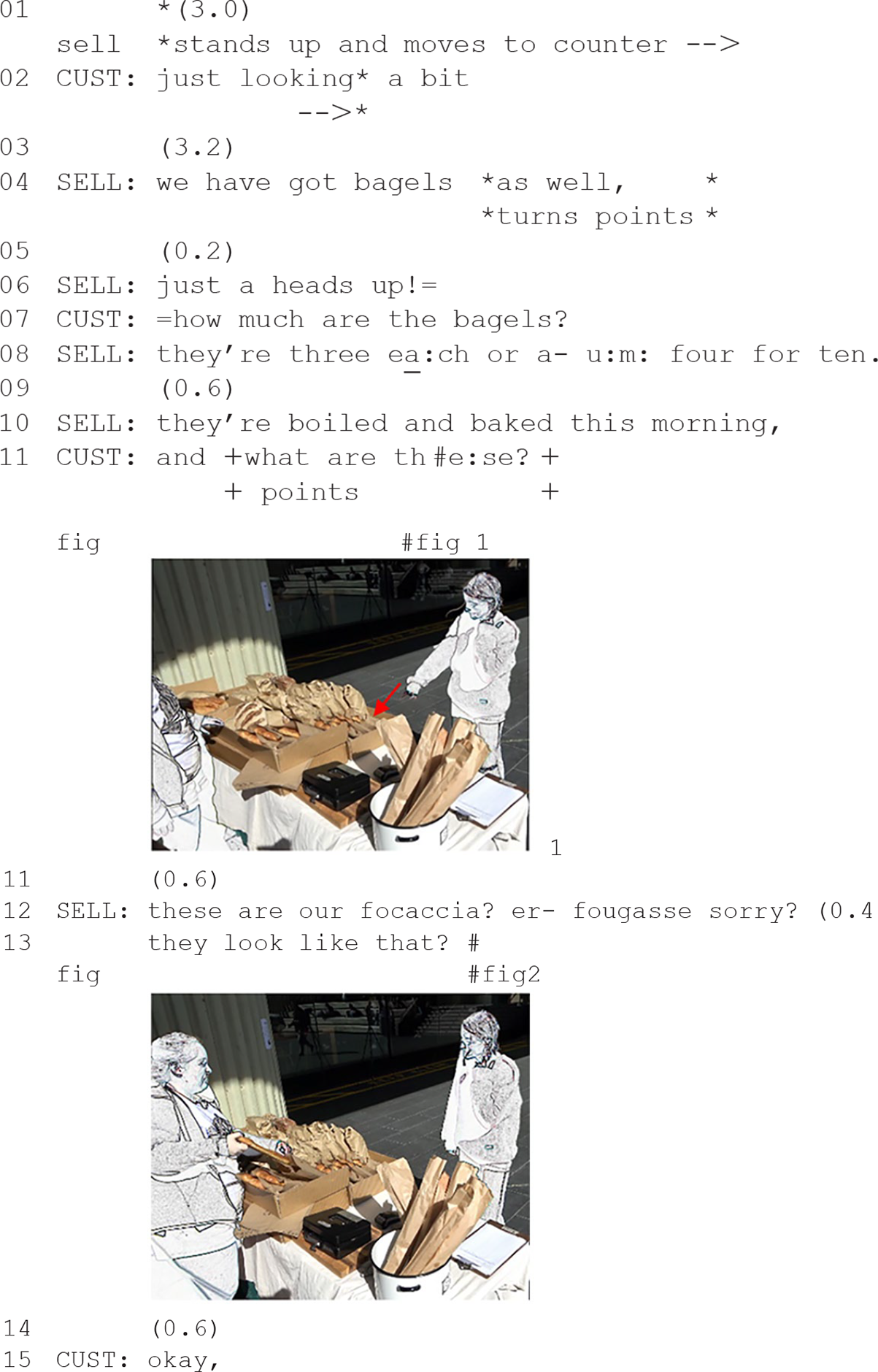
As the customer approaches the stall, the seller displays her readiness to serve by standing up and moving to the counter (Harjunpää et al., 2018). However, the customer indicates she is not yet ready to buy with the disclaimer ‘just looking a bit’ (line 2). The seller looks at the customer as she gazes at the counter where information about the bakery is displayed. Just as the customer’s gaze begins to shift towards the bagged loaves, the seller informs her, ‘we have got bagels as well,’ (line 4). This informing is about products that cannot be seen. The seller infers that without seeing bagels, the customer will not know to buy them. The seller’s turn at line 6, ‘just a heads up’ functions to disclaim other possible interpretations of the informing, such as peddling or hawking. The customer then asks about the price of the bagels which the seller answers (line 7) adding a description about their production ‘boiled and baked this morning’ (line 10) which ironically could be understood as doing the action that she has disclaimed.
Immediately following what is inferentially available as promoting the bagels, the customer asks about other loaves while pointing at the counter (Figure 1). Her question ‘what are the:se?’ (line 11) is responded to by the seller with both verbal and visual information. She names the bread, albeit with a trouble in speaking that occasions a replacement repair (‘focaccia’ with ‘fougasse’) a mistake that is explicitly marked by the addition of an apology (line 12). As she is naming the bread, she reaches towards a bagged loaf on the counter and uses tongs to pull it out of the bag for the customer’s visual inspection (Figure 1). This response treats knowing what the loaf is called and what it looks like as important before buying – which does eventually come later in the encounter (not shown).
In sum, the seller treats the bagels in the van and the bread in bags as impediments to a possible sale. Managing these problems by informing and showing displays the seller’s understanding of the common-sense organisation of seeing before buying. Overall, the analyses show that making the bread less visible posed a practical problem for the parties that impacted on the sales encounter by prolonging it. Having the bread in bags (and the bagels in the van) brought the otherwise taken-for-granted organisation of seeing and buying to the interactional surface.
Discussion
Life in a pandemic is characterised by rapid change and uncertainty. Our analyses show how these are consequential for the micro moments of daily life. Participants in this study marked that previously taken-for-granted expectations about the future (such as the market happening every Wednesday) were now contingent possibilities. There was also a change in the organisation of the market stall with bread being in bags. As in Garfinkel’s (1967) breaching experiments where an expectancy about a shared world in common was disrupted, so too at the bread stall changes to business-as-usual revealed shared expectancies about how the market should operate.
Having the bread on display in bags was a hygiene measure occasioned by the risks associated with marketplace trading in the early days of the COVID-19 pandemic. Customers and seller legitimised this practice and rendered it intelligible by invoking shared norms about touch. The norm that touching produce is permissible only after a commitment to buy speaks to the moral aspects of the normative organisation of the marketplace. Our analyses are part of an emerging body of interactional research on sensation and perception as embodied, intersubjective phenomenon (see Cekaite and Mondada, 2020; La and Weatherall, 2021) offering an original and distinctive perspective on seemingly subjective phenomena. In the context of a bread stall in the pandemic, touch is salient for not only its haptic and sequential properties, but for the risks of virus transmission (cf. Mondada et al., 2020b).
This study reports on a hitherto undocumented normative organisation of purchasing food. Seeing what is for sale properly precedes buying. Deviations reveal a normative organisation (Garfinkel, 1967). The visual barrier of the bags disrupted – and thus and rendered visible – expectancies about normative organisations of seeing and buying. Apologies and complaints displayed participants’ understandings that the background expectancy of having visual access to produce had been violated. The practical problem of having the bread in bags impacted on the sales encounter by prolonging it, albeit in different ways. For example, in Extract 3 the seller identified each bread for a customer who would have otherwise recognised them on sight; in Extract 6, the customer extended the sound of the name of the bread as she visually searched for it. A variety of actions were mobilised to accommodate to the change. The seller used informing, pointing, and showing to let customers know what was for sale.
Basic human sense-making involves people establishing shared understandings of a world in common. This is particularly challenging at a time of social change. The interactions we analysed occurred at a liminal time in New Zealand when the country was yet to feel the full effects of the pandemic. The business decision to put bread in bags was one of many ad-hoc adaptations to the growing threats of the pandemic, before national-level responses were standardised in government advice (Cheng, 2020). Our study thus documents the interactional relevancies of preventative measures (also see Mondada et al., 2020b).
Changes to everyday expectations can be exhausting (Polizzi et al., 2020). Our work points to one reason why coping with change is so psychologically challenging. The seemingly simple change of putting bread in bags changed routine practices and posed new practical problems that were additional ‘work’ in so far as they required additional actions which meant extended turns and or sequences of talk. It seems likely that the kind of adaptations seen in the present study are incremental contributors to the high rates of psychological distress reported (Serafini et al., 2020). Although adjusting to one practical problem may only take a few seconds, when amplified over the course of thousands of daily interactions, it can be substantial. Our study thus illustrates the small but profound changes that can make life in a pandemic so unsettling.
Footnotes
Acknowledgements
We would like to acknowledge the work of Emily Sutton, Holly Rattray and Latisha Kumar who assisted with the field work and transcribing, developing their own analytic lines of inquiry in the process. Thank you to everyone who attended our weekly Discursive Psychology, Studies in Social Interaction research group meetings and offered insights into the data that are analysed in this paper.
Declaration of conflicting interests
The author(s) declared no potential conflicts of interest with respect to the research, authorship, and/or publication of this article.
Funding
The author(s) received no financial support for the research, authorship, and/or publication of this article.