




Abstract
Critical discourse analysis (CDA) increasingly recognises the role played by multiple semiotic modes in the discursive construction of social identities and inequalities. One embodied mode that has not been subject to any systematic analysis within CDA is gesture. An area where gesture has been extensively studied, and where it is shown to bear significant semiotic load in multimodal utterances, is cognitive linguistics. Here, we use insights from cognitive linguistics to provide a detailed qualitative analysis of gestures in a specific discursive context – the anti-immigration discourse of Nigel Farage. We describe the gestures that accompany a range of rhetorical tropes typical of anti-immigration discourses and critically analyse their role, alongside speech, in communicating prejudice and legitimating discriminatory action. Our analysis suggests that gesture is an important part of political discourse which is worthy of further investigation in future CDA research.
Introduction
Critical discourse analysis (CDA) has increasingly come to recognise and investigate the role played by multiple modes of communication in the discursive construction of social identities and inequalities (e.g. Chovanec, 2019; Richardson, 2008; Richardson and Wodak, 2009). Within multimodal CDA, embodied semiotic modes including hand shapes, facial expressions, body postures, proxemics and gaze, are recognised as ideologically significant (Machin, 2007). Such modes, however, have tended to be studied with a focus on the way they are represented in images. Here, we focus on ‘co-speech gestures’ – that is, gestures used as a communicative resource alongside concomitant speech – in dynamic video texts capturing the situated performance of political discourse. Specifically, we draw on gesture research in cognitive linguistics to investigate hand movements produced in the anti-immigration discourse of Nigel Farage.
CDA identifies a number of rhetorical moves characteristic of anti-immigration discourse whose ultimate function is the legitimation of discriminatory practices, where legitimation is defined as the act of ‘attributing acceptability to social actors, actions and social relations within the normative order’ in contexts of ‘controversial actions, accusations, doubts, critique or conflict’ (Rojo and van Dijk, 1997: 560–561). Legitimating strategies identified include denial, othering, proximisation and quantification, among others (Cap, 2019; Rojo and van Dijk, 1997; van Dijk, 1992; Van Leeuwen, 2007; van Leeuwen and Wodak, 1999). We provide evidence that these discursive strategies are multimodal, enacted through gesture as well as speech. We show that Farage exploits a diverse range of gestures as part of these discursive strategies to construct immigration as a threat to ‘the British people’ and to thereby legitimate more restrictive immigration policies. We focus on anti-immigration discourse as a staple topic of investigation in CDA. However, our analysis suggests the communicative import of gesture in the situated performance of political discourse more generally and therefore calls for further gesture research within CDA.
In section 2, we provide an introduction to gesture as it is viewed in cognitive linguistics and as it has been studied to date in political communication. In section 3, we introduce the data that forms the basis of our analysis and our method. In section 4, we present our analysis of multimodal legitimation in the anti-immigration discourse of Nigel Farage. Finally, in section 5, we offer some conclusions.
Background
Gesture
Research in cognitive linguistics and gesture studies points to both the prevalence and the significance of gesture as a means of communication. As McNeill (2000: 1) notes, if you watch someone speaking, under nearly all circumstances you will see what appears to be ‘a compulsion to move the hands and arms in conjunction with the speech’. From this perspective, gesture is not treated as ancillary to language but is seen as integral to it. Kendon (2004) characterises gestures as utterances performed through visible actions or as the visible action component of utterances, where utterances are defined as ‘any ensemble of action that counts for others as an attempt by the actor to ‘give’ information of some sort’ (p. 7). Gestures are therefore distinct from other bodily actions that might be performed in the course of discourse, such as scratching one’s head, which are not normally recognised by audiences as communicative. In other words, gestures are those bodily actions, typically though not exclusively performed by the hands, that display the qualities of ‘manifest deliberate expressiveness’ (Kendon, 2004: 15), and which are therefore perceived by audiences as fulfilling some communicative purpose rather than having been conducted in the service of a more practical aim. 1
Chiming with the notion of a ‘multimodal ensemble’ in social semiotics (Kress, 2010: 28), speech and gesture are seen as working together in ‘composite utterances’ (Enfield, 2009; see also Clark, 1996). McNeill (1992: 23) argues that speech and gestures should be analysed within a unified conceptual framework as instantiations of a single underlying process. Indeed, researchers across the cognitive sciences now recognise the fundamental unity of language and gesture and approach them together as a tightly integrated system for communication (Alibali et al., 1997: 444–445). In cognitive linguistics, for example, gesture is incorporated into the system of symbolic units or ‘constructions’ said to be constitutive of language (Kok and Cienki, 2016; Steen and Turner, 2013; Zima and José Ruiz de Mendoza, 2017). This is motivated by research which shows that co-speech gestures frequently reflect aspects of conceptualisation encoded by the verbal expressions they accompany (see Cienki, 2013 for overview). For example, the temporal unboundedness of event-conceptualisations encoded by progressive verb forms is reflected in gesture repetition and duration (Duncan, 2002; Hinnell, 2018; Parrill et al., 2013) and when people talk about numerical quantities they produce metaphorical gestures that highlight the size of the implied quantities (Winter et al., 2013; Woodin et al., 2020). In cases such as these, speech and gesture are co-expressive, with the forms in each mode mirroring some aspect of meaning conveyed by the other. However, gestures may also be complementary, expressing meanings that are not directly verbalised (Cienki and Müller, 2008; Goldin-Meadow, 1999; Winter et al., 2013).
Gesture in political communication
Despite the general significance of gesture, there are relatively few studies that investigate gesture in political contexts of interaction (e.g. Cienki, 2004; Lempert, 2011; Streeck, 2008). This is surprising given that shifts in political communication strategies and media practices have made the embodied performance of politicians more visible or more accessible to audiences, and therefore a more salient feature of political discourse, especially populist political discourse (Cienki and Giansante, 2014). Though political discourse has always been inherently multimodal, as Streeck (2008: 156–157) observes, ‘the pervasive presence of television coverage has made the bodily expression of politicians central to their relationship with the public and their effectiveness as communicators’. 2
Early studies of gesture in political discourse focussed on the role of hand movements in eliciting and controlling applause (Atkinson, 1984; Bull, 1986). Bull (1986) analysed videotape footage of speeches delivered by several British political figures, including Arthur Scargill (then President of the National Union of Mineworkers). Scargill was found to be especially successful in arousing applause, which he achieved through rhetorical devices like three-part lists that were typically accompanied by synchronised hand gestures. Scargill was also observed to use hand gestures to quell the applause ‘so that he actually seems to conduct his audience’ (p. 103). More recently, Chilton (2004: 92–109) studied interaction in the UK parliament, noting in several places the importance of gestures for parliamentary performance and in the execution of parliamentary protocols around turn-taking. In both these studies, the focus was on gesture as a means of managing the structure and organisation of the ongoing dialogic exchange of which they were a part.
Streeck (2008) studied the gestures of contenders for the presidential nomination of the Democratic Party during the 2003 primary debates in the United States. Streeck found that the contenders relied on a limited shared gestural code that consisted overwhelmingly of ‘pragmatic gestures’ which, rather than conveying semantic content, were used to mark speech acts and information structure, thereby facilitating the parsing of extended utterances into their constitutive rhetorical acts or moves. Based on a detailed analysis of the gestures used by Barack Obama and Hilary Clinton, Lempert (2011) argues that politicians use gestures not only to draw specific attention to aspects of what they are talking about, but to communicate something about the point they are making and possibly also to signal something about themselves. Lempert understands this in terms of ‘orders of indexicality’ (Silverstein, 2003) and argues that gestures have first-order indexicality (e.g. pinching the index finger and thumb together to focus the audiences’ attention on a specific stretch of discourse), second-order indexicality (e.g. pinching to indicate that the point being made in a specific stretch of discourse is a particularly sharp or effective one) and potentially third-order indexicality (e.g. pinching to brand oneself as an argumentatively sharp or effective speaker).
Cienki (2004) analysed gestures produced by George Bush and Al Gore in the 2000 US presidential debates for evidence of the strict father versus nurturant parent conceptual metaphors argued by Lakoff (1996) to underpin right-wing Republican versus left-wing Democratic values respectively. Cienki found that Bush’s gestures reflected the strict father model. By contrast, Gore’s gestures, in line with the observations of Streeck (2008), were used more for discourse structuring purposes.
From a different perspective drawing on cultural and linguistic anthropology, Hall et al. (2016) examined the gestural style of Donald Trump and the contribution this may have made to his successful 2016 primary campaign. Trump’s gestures present a radical break with the type of normative gestural behaviour displayed by other presidential candidates. For example, Trump used a ‘pistol hand’ gesture accompanying the verbal performative ‘you’re fired’, a multimodal discursive move co-opted from his earlier career on the television show The Apprentice. Hall et al. interpreted this, and other similarly iconic gestures performed by Trump, as part of a uniquely comedic political style that ‘accrues entertainment value as it opposes the usual habitus associated with US presidential candidates’ (p. 74).
Casasanto and Jasmin (2010) examined the gestures produced alongside positive versus negative speech during the final debates of the 2004 and 2008 US presidential elections. These debates involved two right-handed politicians (Kerry, Bush) and two left-handed politicians (Obama, McCain). Casasanto and Jasmin found that the right-handed speakers were more likely to use right-hand gestures when talking about positively valenced concepts and left-hand gestures when talking about negatively valenced concepts, while the reverse was the case for the left-handed speakers. Casasanto and Jasmin interpreted this finding as evidence for what they call the ‘body-specificity hypothesis’, according to which the different embodied experiences of right-handers versus left-handers leads to different associations between left/right and good/bad.
Finally, Winter et al. (2013) and Woodin et al. (2020) analysed numerical gestures in political discourse, focusing on politicians, political commentators, and news anchors seen across different American TV news channels (CNN, FOX News, CSPAN etc). In a large-scale analysis of more than 500 speakers they showed that people on the TV news produce gestures about 80% of the time when using expressions such as ‘tiny numbers’ (Woodin et al., 2020). For example, they describe an instance in which the American conservative pundit Glenn Beck lowered and raised his gesturing hand to map out different health care figures in vertical space, in line with the known conceptual metaphor more is up (Lakoff and Johnson, 1980; Winter et al., 2013).
The studies summarised above are united in providing detailed descriptive accounts of gesture in political communication. None of these studies, however, are conducted from an explicitly critical perspective. That is, they do not analyse gestures to consider, from a normative standpoint, their potential in communicating prejudice and legitimating discriminatory practices. In the analysis that follows, we interrogate the meanings conveyed by gestures from the perspective of CDA, accounting for their role in discursive processes of identity construction and (de)legitimation. With the exception of Hall et al. (2016), the studies cited above are also all focussed on political figures that are not characterised as populist. In analysing the discourse of Nigel Farage, we contribute to the literature examining the discursive performance of right-wing populism (e.g. Kelsey, 2016; Wodak, 2015) by providing a multimodal perspective that demonstrates the importance of gesture in the communication of right-wing ideologies.
Data and method
Although never elected as a member of the UK parliament, Nigel Farage is a key figure in British politics (Crines and Heppell, 2017). As leader of the UK Independence Party (2006–2009, 2010–2016) and the Brexit Party (2019–2021), Farage has been instrumental in charting the course of British politics over the last decade and a half, culminating in the 2016 vote to leave the European Union. A persistent campaign issue for Farage has been immigration to Britain, which he regularly claims is excessive or out of control, thereby constituting a threat to ‘the British people’, and so must be curbed (Cap, 2019). Farage has traded on an image of himself as a ‘man of the people’ in contrast with ‘elite’ politicians and as a ‘saviour’ on a mission to regain control of Britain’s borders and to reinstate ‘lost British values’ (Kelsey, 2016). This presentation of himself has earned him the status of an ‘every day celebrity politician’ (Wood et al., 2016) who is widely regarded as possessing the quality of ‘charisma’ (Ford and Goodwin, 2014: 3). 3 As such, alongside leaders such as Heinz-Christian Strache (Austria), Viktor Orbán (Hungary) and Donald Trump (United States), Nigel Farage represents a canonical example of a right-wing populist politician who blurs the boundaries between politics and entertainment (Wodak, 2015). Farage has his own YouTube channel that features short videos made specifically for this channel. These videos take a range of forms but include a documentary-style series Nigel Farage Investigates, which borrows interdiscursively from the genre of investigative journalism to offer critical exposés of current affairs issues, thus further blurring the boundaries between politics and infotainment.
We analyse the multimodal rhetorical moves made in a sample of data representing the anti-immigration discourse of Nigel Farage (see Table 1). The data spans a 7-year period from 2013 to 2020. It is made up of four speeches delivered as leader of the UK Independence Party and the Brexit Party and a video from Farage’s YouTube series Nigel Farage Investigates addressing the ‘migrant crisis’. With the exception of one speech, all data was accessed via YouTube.
Total set of videos analysed in this paper, including date, title of video, URL and code that will be used to refer to each video throughout the paper.
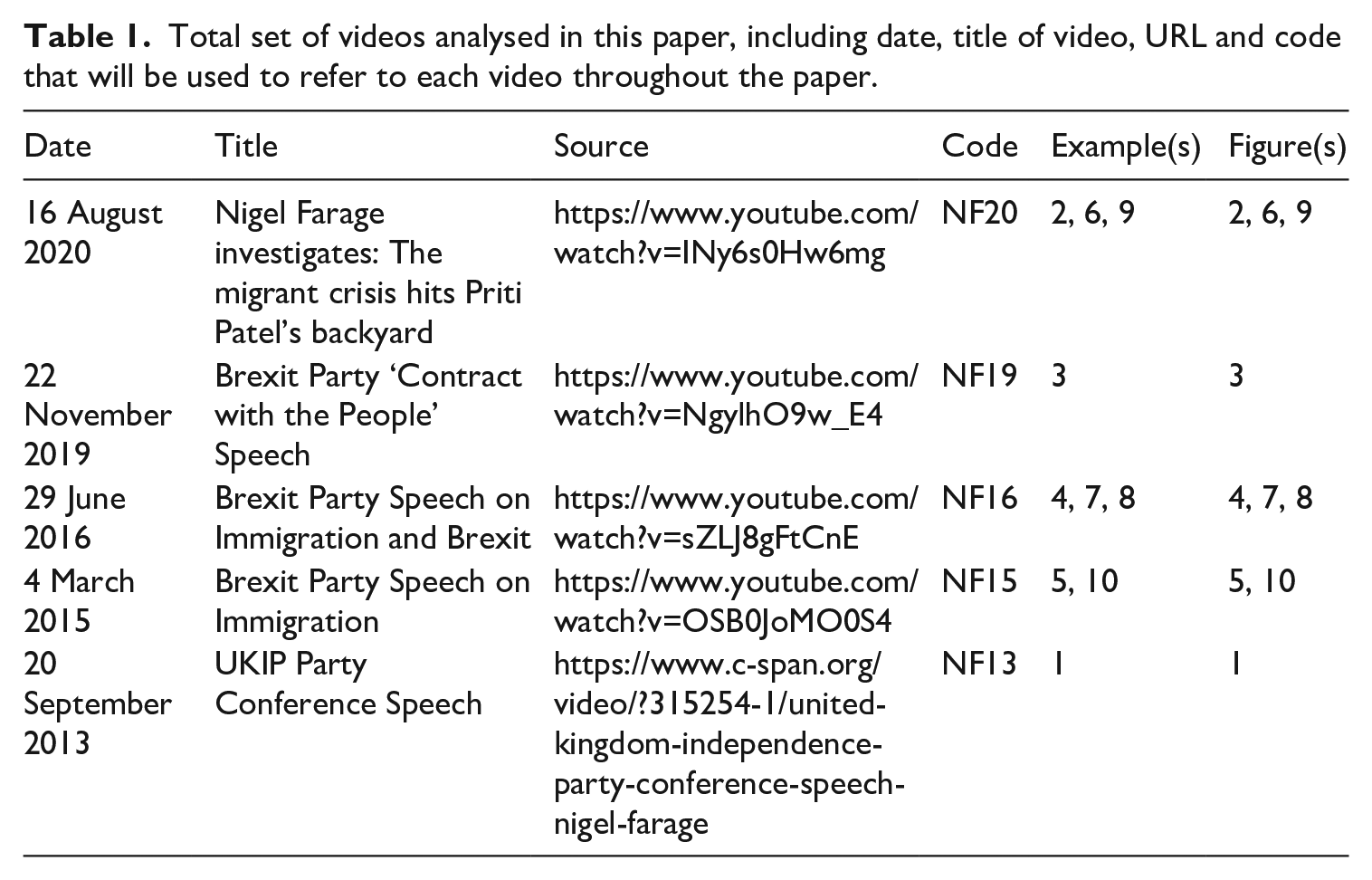
Since our concern here is anti-immigration discourse in particular, only those parts of the texts relating to immigration were analysed. In some cases, such as the Nigel Farage Investigates video, this meant that the whole text was considered. In other cases, it meant that only certain sections of the text were considered.
The selected data was then analysed qualitatively combining insights from cognitive linguistic research on gesture and CDA. A number of legitimating strategies characteristic of anti-immigration discourse are identified in CDA, including denial, othering, proximisation and quantification (Cap, 2019; Rojo and van Dijk, 1997; van Dijk, 1992; Van Leeuwen, 2007; van Leeuwen and Wodak, 1999). We analysed the gestural components of such moves as they occur in our data. We do not provide an exhaustive account of all the gesture-speech combinations that feature in the data. Instead, we took an immersive approach, identifying salient instances of gesture which, based on their contexts of use, appeared to function as part of a multimodal rhetorical move aimed ultimately at legitimating tighter immigration controls. Our analysis therefore focussed on topic gestures rather than interactive gestures (Bevelas et al., 1992). Interactive gestures are those that relate directly to the interlocuter, for example, by orienting them in some way towards the content of what is being said, by marking information units, or by managing turns in a dialogic exchange. Topic gestures, by contrast, relate to the semantic content of discourse. We also did not include in our analysis ‘beat’ gestures – rhythmic movements associated with stress and emphasis.
It should be recognised, at this point, that gestures may fulfill more than one function at the same time (Kendon, 2004: 84). However, as Cienki (2017: 139) notes, ‘one can at least begin with what the researcher sees from the context as the primary function of the given gesture’. In our analysis, we focussed on what we perceived to be the primary function of gestures as part of multimodal legitimating moves. Finally, because this paper focuses on making gesture relevant to CDA and political discourse analysis more generally, we did not conduct a detailed frame-by-frame micro-analysis of gesture and instead focussed on key moments of gestural activity that coincided with specific rhetorical strategies recognised in CDA as constitutive of anti-immigration discourse.
Analysis
Denial
Van Dijk (1992) shows that politicians expressing prejudiced sentiments or seeking sanction for discriminatory actions must take discursive steps to counter the potential accusation that their opinions or proposed actions are racist or extremist and to present them instead as rational and legitimate. There are several ways that speakers can achieve this that amount to acts of denial (van Dijk, 1992). Consider, for example, the utterance by Farage whose verbal component is given in example (1).
(1) The establishment have done everything they can to close down debate on this issue and the decry anybody that dares to discuss the issue somehow as being bad and racist. And we will not have that. This issue must be debated. And I say that I mean we’re a nation that has always been open minded to immigration. Of all the countries in Europe, we’ve been that most open to people from different cultures coming here from around the world. But it is, of course, a question, ladies and gentlemen, of scale because more people have settled in this country in 2010 than came here for the previous 1000 years. It is totally and utterly out of control.
In (1), Farage is careful to argue that he is not against all immigration. He performs a series of rhetorical moves associated with denial strategies in discriminatory discourse, including positive self-presentation and concessions to the positive contributions of some immigrants (cf. van Dijk, 1992). He also issues an outright rebuttal or refutation of the charge that he has just relayed.
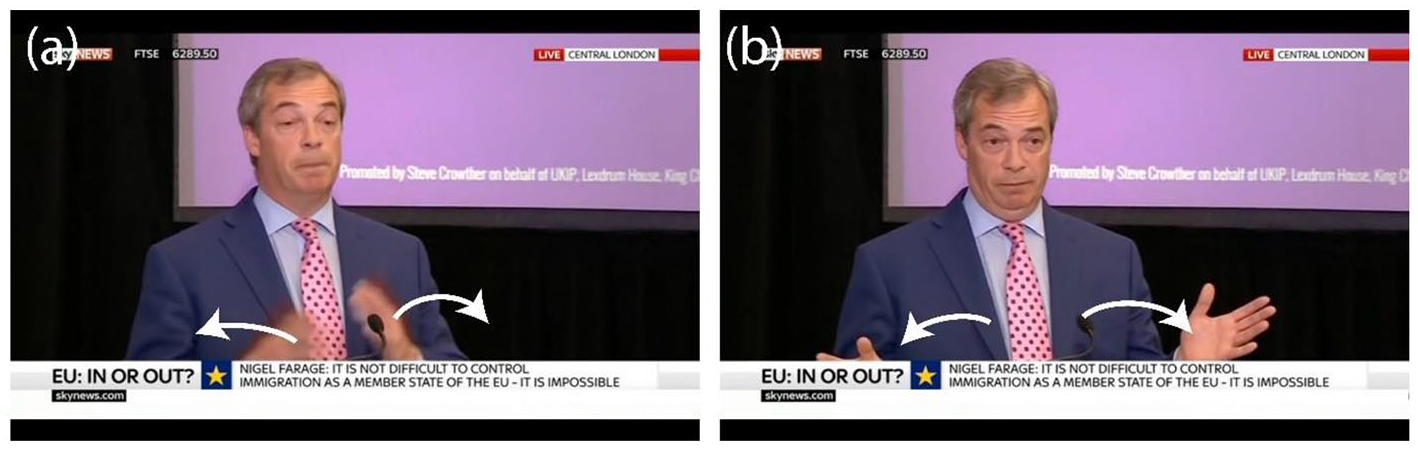
The excerpt in (1), however, represents only the spoken component of a composite utterance, which also includes a gestural component. As Farage utters the refutation, ‘now I’m not against immigration’, he performs an open hand prone (or ‘palm down’) gesture in which the hands move from the centre of the podium outward through the horizontal plane towards the corners of the podium, as shown in Figure 1. He repeats this same gesture as he utters ‘far from it’. This gesture is an example of a ‘performative’ gesture which are used to ‘indicate the kind of speech act or interactional move a person is engaging in’ (Kendon, 2004: 159). Just as speakers are able to perform speech acts through spoken language, so they can confirm, deny, accept, dismiss, refuse, reject etc. through gestures. The gestural form accompanying example (1) is one associated with acts of denial and negation (Kendon, 2004: 248; see also Bressem and Müller, 2014). Both components of the utterance occurring as part of example (1) therefore carry the same illocutionary force. In other words, they collaborate in the performance of the speech act so that the composite utterance constitutes a multimodal embodied enactment of denial.
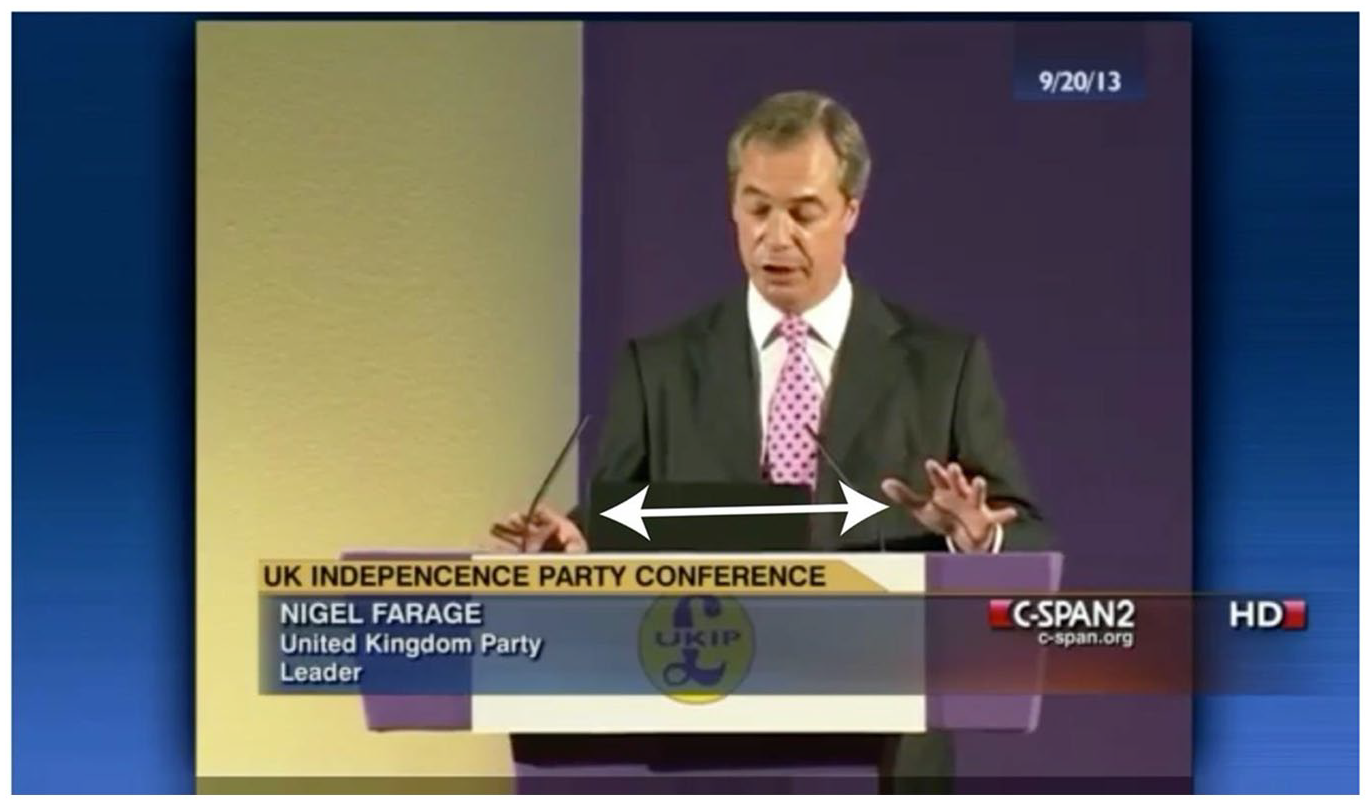
Palm-down gesture coinciding with the phrase ‘now I’m not against immigration. Far from it’. Farage’s hands move outward on two distinct phrases: first ‘I’m not against immigration’, then again with the same movement repeated on ‘Far from it’ (Example 1).
Othering and spatial proximisation
A fundamental move in discursively constructing prejudice and legitimating discriminatory actions is othering – the act of establishing a dichotomous contrast between ‘us’ versus ‘them’ (Chovanec, 2019; Chovanec and Molek-Kozakowska, 2017; Reisigl and Wodak, 2001). For Reisigl and Wodak (2001), othering is the ‘simplest and most elementary form of linguistic and rhetorical discrimination’ which involves ‘identifying persons or groups of persons by naming them derogatorily, debasingly or vituperatively’ (p. 45). There are various ways in which the other can be distinguished from the in-group, for example, along cultural and linguistic lines. Perhaps the most basic way of defining an other and the one that is most likely to be performed gesturally is through de-spatialisation, where people are defined as coming from or belonging to a different place (Reisigl and Wodak, 2001).
In legitimising immigration control, anti-immigration discourses often also rely on a spatial proximisation strategy in which the other, constructed as physically and culturally distant, is construed as moving towards and arriving in the country of the in-group to present a threat to their corporeal selves and/or their cultural identity (Cap, 2013, 2019; Chovanec, 2019; Hart, 2010). For Cap (2019: 74), proximisation is ‘a forced construal operation meant to evoke closeness of an external threat, to solicit legitimisation of preventive means’. There is an inherently deictic dimension to this pattern of conceptualisation as the scenario is presented from the perspective of the self, situated socially as a member of the in-group as well as geographically in the location of the in-group (Chilton, 2004). Othering and spatial proximisation are exemplified in example (2), where the other, represented by the de-personalising metonymic noun phrase ‘these little dinghies’ (cf. Littlemore, 2015), is construed in the verb phrase as infiltrating the territory of the in-group.
(2) And yet, every day, we’re seeing
Othering and proximisation are simultaneously realised in the gesture accompanying (2), shown in Figure 2. When Farage uses the phrase ‘these little dinghies’, his left hand is far removed from his torso, while his line of sight extends past his hand, as if looking into the distance. This part of the gesture explicitly establishes a distal location from where immigrants are construed as coming. Then, when using the phrase ‘landing on our beaches’, Farage moves his hand closer towards his body. This gestural sequence involves two distinct strokes. Gestural strokes are the most effortful phases of a gesture and are often closely aligned with their lexical affiliates both temporally and semantically. In this particular case, one stroke moves away from Farage’s torso while a second stroke moves back towards it, thereby constituting a two-part sequence where the other is depicted as moving from a distal location towards the in-group. The complete gesture may therefore by analysed as a manual realisation or enactment of othering plus proximisation which is simultaneously expressed in the spoken component of the utterance. Crucially, this gesture also involves an element of metonymy, where Farage’s body stands metonymically for the territory of the in-group. This provides a deictic point of reference relative to which the other is defined and their movement is construed.
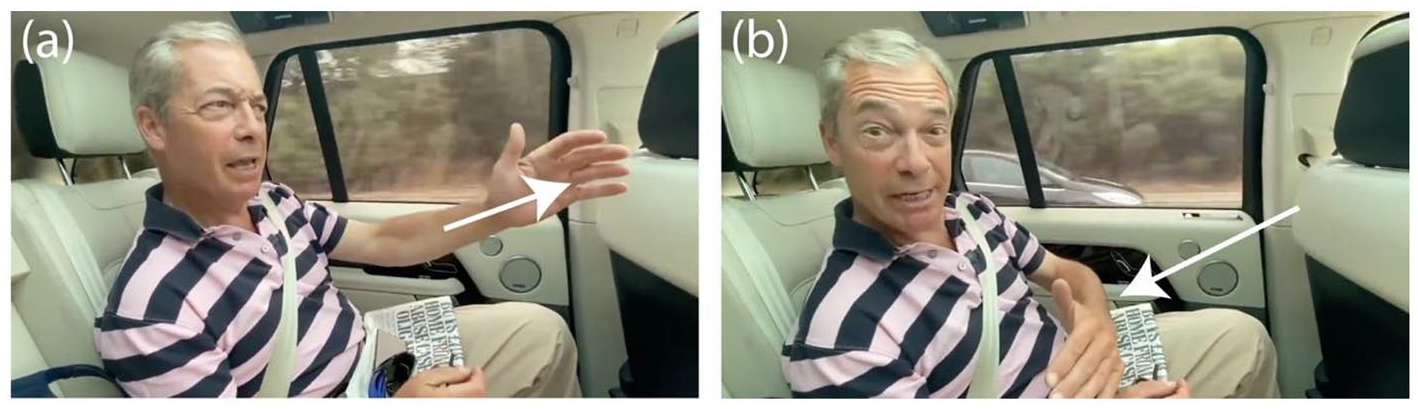
(a) The left hand is far away from torso on the phrase ‘these little dinghies’ and (b) moves towards the torso with the phrase ‘landing on our beaches’ (Example 2).
This type of composite utterance, representing a multimodal enactment of othering plus proximisation, is not an isolated instance within our data. For example, (3) presents a similar pattern: (3) Even today, there are boats coming across the English Channel. And we all know that the Border Force
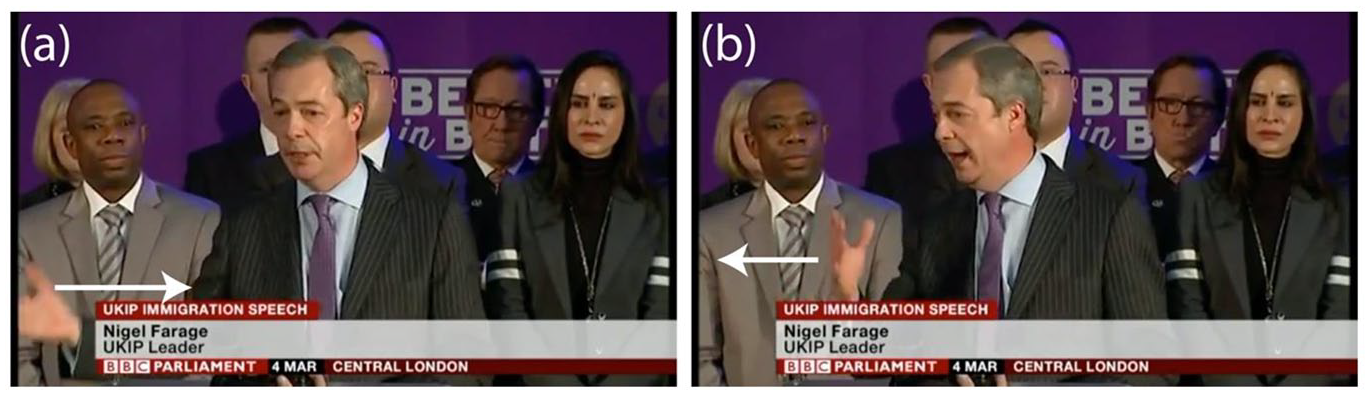
As with the previous example, othering and proximisation are also enacted in the gestural component of the utterance. Coinciding with the critical phrase ‘bring them in’, Farage performs the two-handed gesture shown in Figure 3 in which his hands similarly move from a distal position back towards his torso. In both of these examples, then, the image, constructed multimodally, is of an alien other arriving at and entering the territory of the in-group.
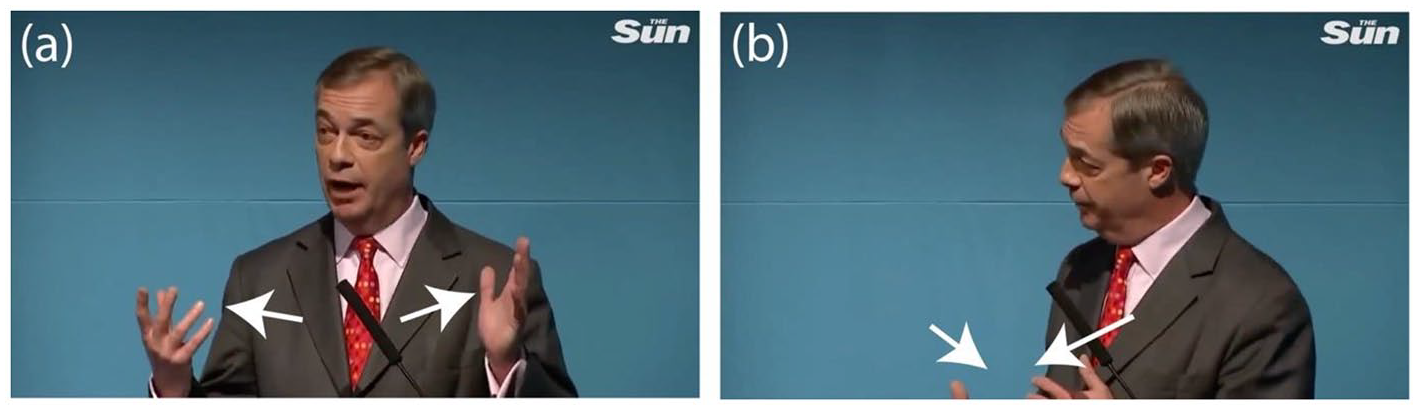
(a) Extended hands on the phrase ‘and we all know’ that are held apart while saying ‘that the Border Force (. . .)’ and (b) The hands move towards each other and closer to the torso with the phrase ‘(. . .) bring them in’ (Example 3).
Exposing the body politic
The gestures accompanying examples (2) and (3) rely on a conceptual metonymy in which the body stands metonymically for the country. Cooperrider (2014) shows how gesturers often point to their own body to metonymically imply bigger groups that include themselves, such as the citizens of a country. In situated performance, the body may therefore also stand metonymically for the nation. This metonymy is perhaps motivated by, and interacts with, an underlying conceptual metaphor commonly found to structure political discourses, namely the body politic metaphor in which the nation is construed as a body (Musolff, 2010). An entailment of the body politic metaphor is that nations, like bodies, are vulnerable to harm. This entailment is frequently exploited in discriminatory discourses where it serves to justify policies of exclusion or expulsion (Musolff, 2010, 2016). We find examples of it in the gestures of Nigel Farage. For example, the gesture accompanying example (4) relies on a body for nation metonymy as part of a multimodal rhetorical move that may be analysed as appealing to the body politic metaphor.
(7) How can you plan forwards for public service provision when you have
The gestural component of this composite utterance, shown in Figure 4, is co-timed with the phrase ‘open-door immigration’. Coinciding with this verbal metaphor, Farage performs a gesture in which he moves his hands apart along the horizontal axis in an action resembling opening. The gesture is similarly metaphoric in that it draws on the domain of space, and specifically the open/close element of the container schema, to conceptualise the abstract notion of a country in terms of a container that can be opened or closed. 4 In this metaphor, the country is a container and its people (i.e. the nation) are the contents of the container (Cap, 2019; Hart, 2010). In the situated and multimodal performance of this metaphor, the nation is represented metonymically by the body of the speaker and this metonymy, in turn, interacts with the body politic metaphor to create a sense of threat. The logic is as follows: if the nation is conceptualised as a body (the body politic metaphor), and in the gesture performed alongside (4) Farage’s actual body stands metonymically for the nation, then by exposing his body in the open-arms gesture, connoting vulnerability to harm, Farage implies that the nation is similarly vulnerable to harm from immigration.
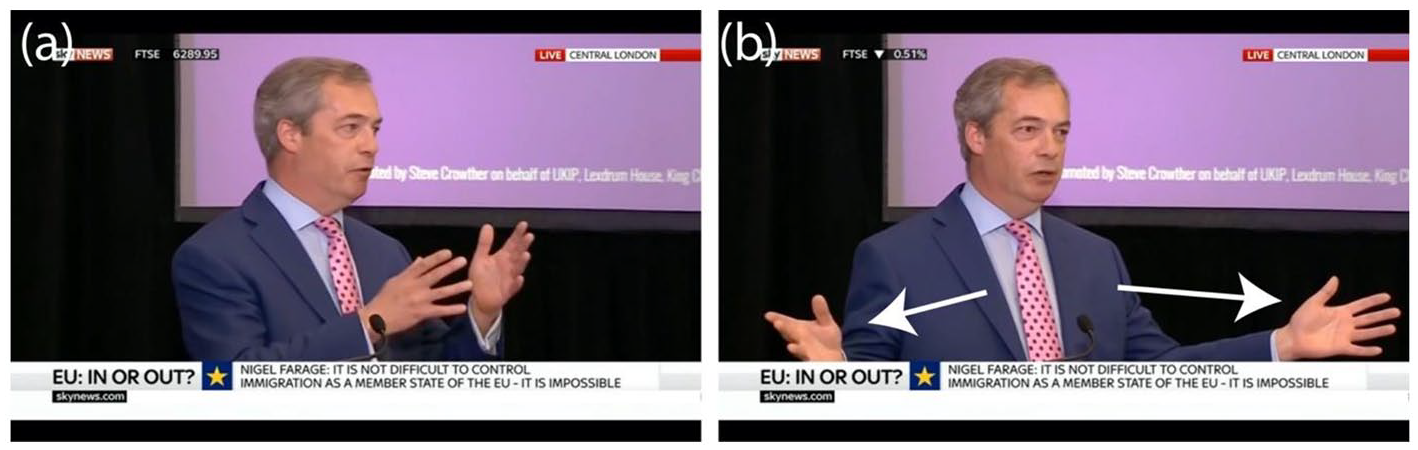
(a) Hands held in front of Farage’s torso during the phrase ‘how can you plan forwards for public service provision when you have (. . .)’ and (b) the hands move outwards on the phrase ‘(. . .) open-door immigration’ (Example 4).
Evidence that the open-arms gesture accompanying example (4) is indeed metaphoric, and is not a performative gesture associated, for example, with the illocutionary force of questioning or part of a beat gesture, comes from the fact that a gesture involving a similar ‘opening’ movement occurs with the same phrase elsewhere in the data within a different illocutionary context. For example, the verbal phrase ‘open-door immigration’ is repeated in example (5) where it is accompanied by the open-arms gesture shown in Figure 5. This suggests that the gesture is semantically bound with the phrase ‘open-door immigration’ rather than occurring as part of a speech act or regular rhythmic movement.
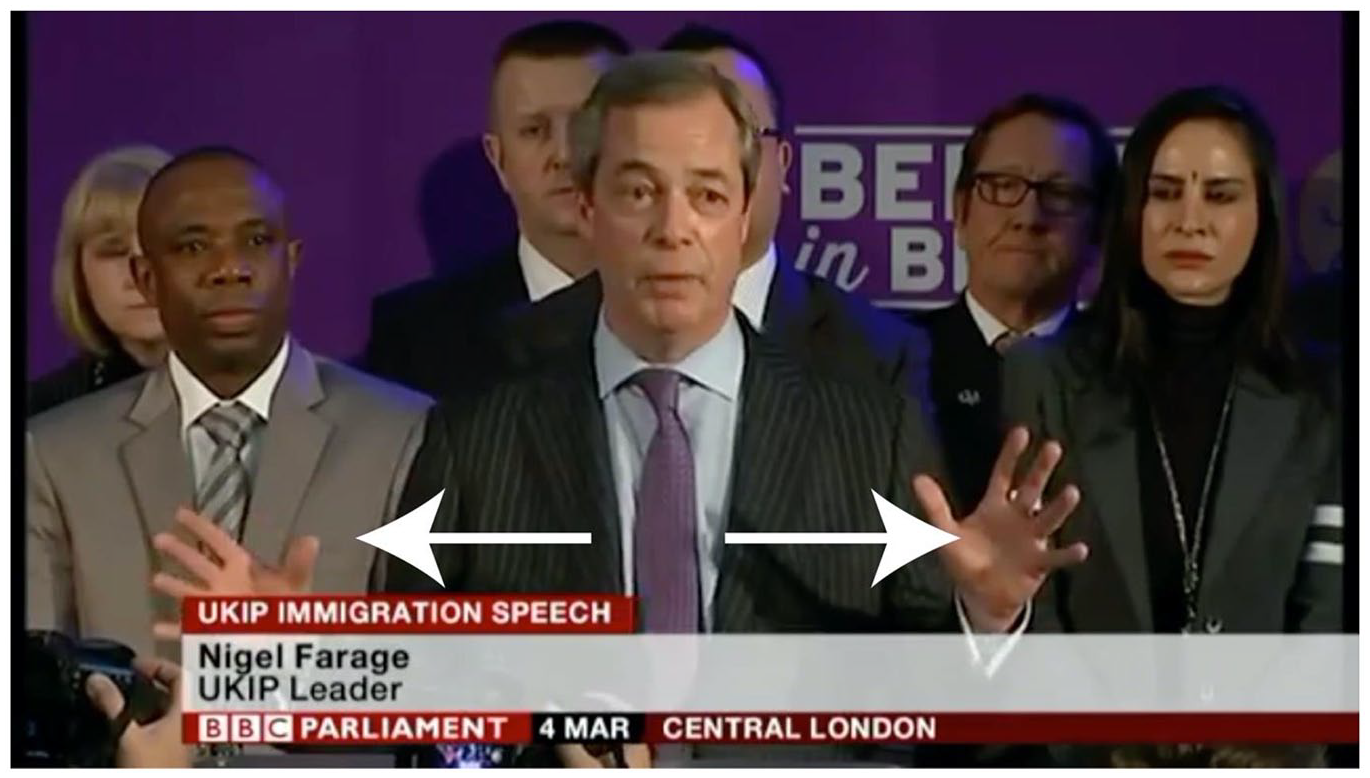
Another open-arms gesture exposing the body coinciding with phrase ‘open-door immigration’ (Example 5).
(5) Many big businesses have increased their profits by keeping wages artificially low. And I know that it’s been a boon for the rich. Because if you’re very wealthy,
Quantification
A typical way that immigration is constructed as a threat is through quantifications realising a topos of number, where immigration is described as occurring in large and unsustainable numbers, often in support of a claim that immigration leads to social and economic problems (Gabrielatos and Baker, 2008; Reisigl and Wodak, 2001; van Dijk, 2018). In argumentation, topoi are defined as content-related warrants or conclusion rules which justify the transition from a premise to a conclusion based on common-sense reasoning (Reisigl and Wodak, 2001; van Dijk, 2000). They may be formulated as conditional statements so that the topos of number may be expressed as: if there is too much of something, such that it causes problems, then action should be taken to reduce it. Quantifications may be expressed indirectly through words that include large quantities as part of their meaning (e.g. ‘flood’, ‘pour’) or directly through explicit reference to degrees of magnitude.
Research in cognitive linguistics has shown that when we talk about magnitudinal domains like quantity, weight, duration and pressure we often refer to degrees of magnitude in terms of physical size or extent in space (Lakoff and Johnson, 1980; Winter et al., 2015). Thus, we describe quantities as ‘large’ versus ‘small’ and periods of time as ‘long’ versus ‘short’. Cognitive linguistic studies of gesture have shown that such metaphoric conceptualisations of magnitude, across different domains, also receive gestural representation. For example, Woodin et al. (2020) found that, for greater versus lesser quantities, speakers are more likely to gesture using an open rather than a closed hand configuration, using two hands rather than one, with an outward rather than an inward movement, and with a wider distance between the gesturing hands. This pattern was found to be particularly pronounced for gestures accompanying expressions containing extreme adjectives, such as ‘huge number’ versus ‘tiny number’.
In our data, we find several instances of quantification in which Farage characterises immigration as excessive or as leading to excessive numbers of people in the country. Consider (6) and (7): (6) What it looks like is that, not just the midlands and the north anymore, but because of the (7) Now there are many other things that we simply can’t put a cost on. Social cohesion. A sense in our cities or market towns that we are one community living together. That of course has become increasingly divided, fragmented, segmented within our towns and cities, because the
Example (6) refers to the quantity or amount of people, conceptualised in terms of volume, migrating to Britain while example (7) refers to the rate at which they have been coming. Both domains, quantity and rate, are magnitudinal. Verbally, the degree of magnitude in each case is construed as extreme through the adjective ‘sheer’. In both instances, coinciding with ‘sheer’ and lasting the duration of the noun phrase, Farage also performs a gesture of the kind associated with extreme degrees of magnitude, with the palms open and facing each other, held wide apart as shown in Figures 6 and 7. 5 Thus, the gestural component in (6) functions alongside ‘sheer’ to express large quantity or amount while the gestural component in (7) functions to express a rapid rate in the iterative process of immigration. Of course, quantity and rate are related such that, in the case of immigration, a rapid rate of immigration leads, within a given time frame, to a larger number of people in the country. Thus, the topos of number relied on in (6) and (7) is realised multimodally through gesture as well as speech with the gesture providing a tangible, visual representation of scale that indicates excessive levels of immigration.
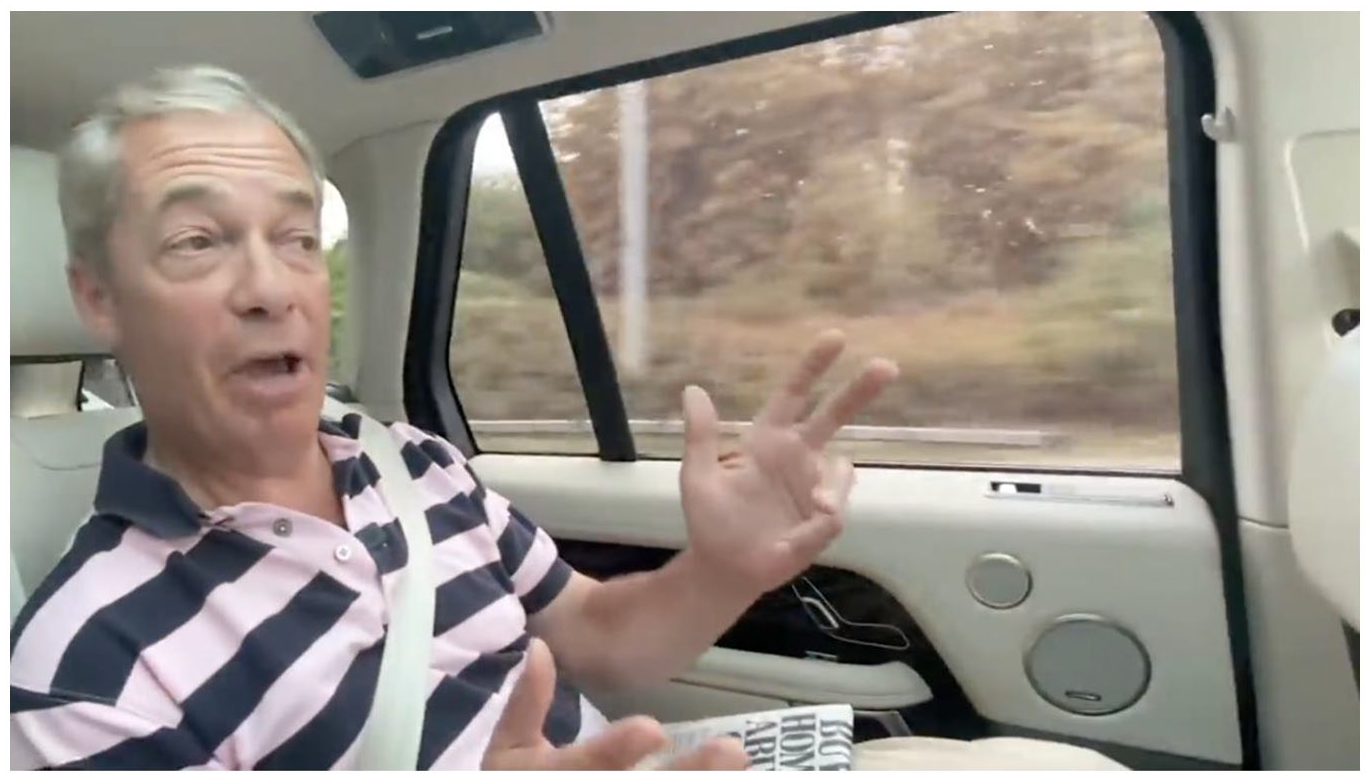
Open hand gesture coinciding with phrase ‘sheer volume of people’ (Example 6).
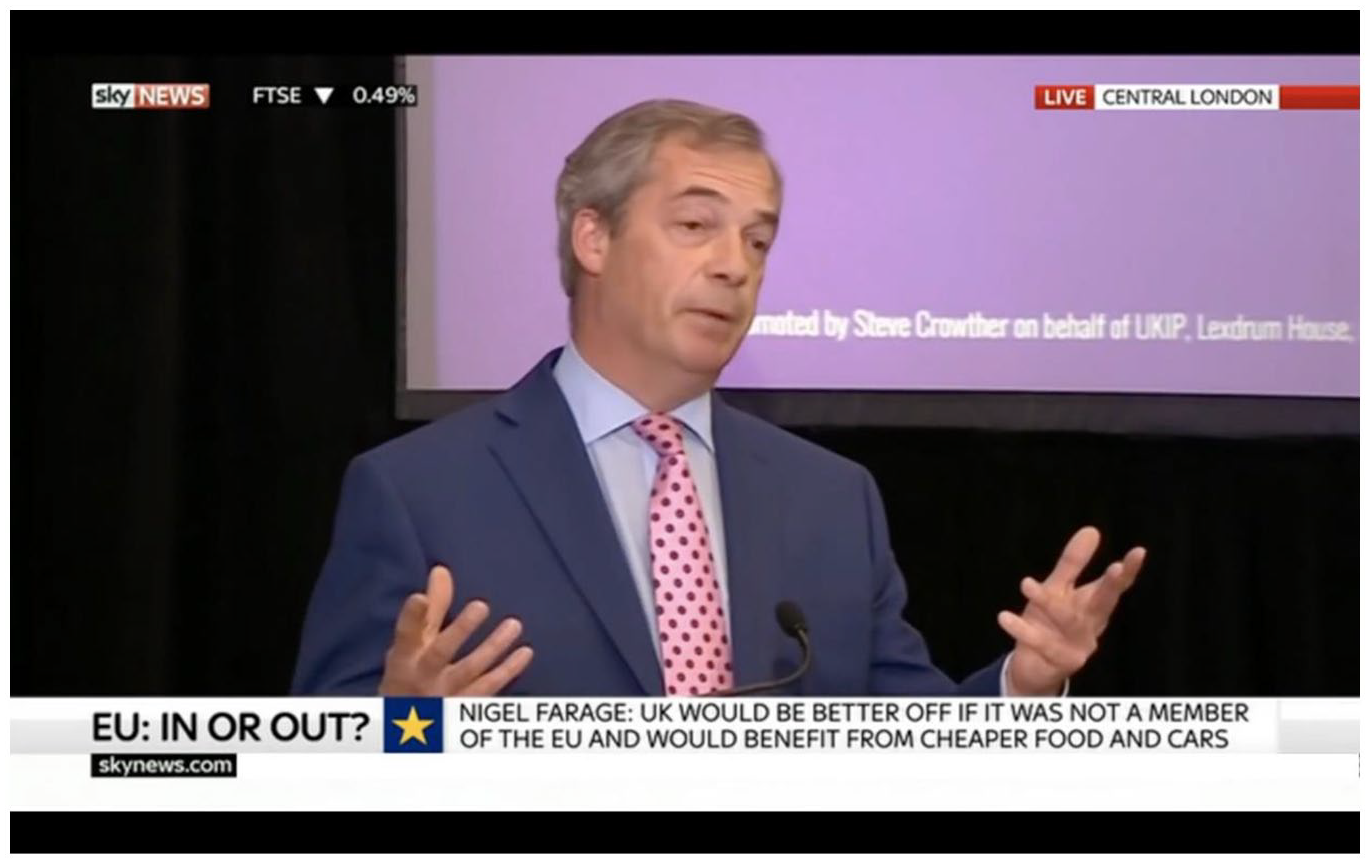
Open hand gesture coinciding with phrase ‘sheer pace of people’ (Example 7).
While the gestures accompanying examples (6) and (7) express a magnitude is size metaphor the gesture accompanying (8) expresses a metaphor, co-expressed in speech, that is richer in imageability and which explicitly realises a topos of threat as well as a topos of number.
(8) And what about primary school places? With
The phrase ‘explosion’ in example (11) could be seen as a frozen metaphor that no longer has any figurative sense. However, the concomitant gesture, which is shown in Figure 8, clearly presents the metaphorical source domain, thus indicating the active figurativity of the conceptualisation underlying the verbal phrase (cf. Müller, 2008). As Farage utters ‘an explosion’, he performs a gesture in which the hands move quickly up and outward in a way that is iconic of an actual explosion but which here is functioning metaphorically to characterise a rapid increase in numbers. As explosions burst outward in a violent and abrupt fashion, often causing damage, this metaphoric gesture construes current immigration levels as having harmful effects.
Movement of hands up and outward coinciding with phrase ‘an explosion’ (Example 8).
Aspectising
Closely connected with quantification is aspectising. Aspect concerns the way an event or processes is construed as unfolding through time (Comrie, 1976). A primary distinction is between perfective aspect, in which events and processes are treated as bounded and complete, and imperfective aspect, in which they are treated as unbounded and ongoing, either in the sense of being continuously in progress or in the sense of regularly reoccurring (Langacker, 1987; Talmy, 2000). In anti-immigration discourses, immigration is usually construed as a present and, crucially, ongoing issue. That is, it is construed with imperfective aspect, which ‘conveys greater immediacy’ (Radden and Dirven, 2007: 190) and implies that a situation will continue to endure unless some interventionist action is taken (Fausey and Matlock, 2011). In this sense, imperfective construals realise a rhetorical strategy of temporal proximisation by presenting the problem as current and accumulating, thereby suggesting the need for immediate mitigation (Cap, 2013; Hart, 2014).
In English, imperfective aspect is marked by various lexical and grammatical means, including progressive verb constructions (e.g. ‘is verbing’), periphrastic verb constructions (e.g. ‘keep verbing’, ‘continue to verb’) and adverbial phrases (e.g. ‘continuously’, ‘over and over’, ‘every few seconds’). Cognitive linguistic studies of gesture have shown that aspectual distinctions are also reflected in co-speech gestures (Duncan, 2002; Hinnell, 2018; Parrill et al., 2013). For example, imperfective-marked speech is associated with gestures that are of longer duration and greater complexity, for example, involving repetition, than gestures associated with perfective-marked speech (Duncan, 2002). In the situated discourse of Farage, the construal of immigration as an ongoing problem is enacted multi-modally through gesture as well as through speech. For example, in the spoken component of example (9), migrants are described as arriving at regular and uninterrupted intervals.
(9 Today is day eleven of migrants coming into Dover. That’s
In the gestural component of example (9), immigration is similarly construed imperfectively. Hinnell (2018: 794) shows that ‘continue’ in periphrastic constructions ‘continue to verb’ and ‘continue verbing’ is marked in its gestural asynchrony where gesture onset precedes the onset of the target utterance. In relation to the example in (9) immediately preceding ‘continuous days’, Farage performs the gesture shown in Figure 9 in which the hands rotate forwards along the sagittal axis. Hinnell (2018) shows that cyclic gestures of this kind are associated with imperfective aspect where they are taken to ‘indicate an uninterrupted event progression’ (p. 9). This is perhaps motivated by the fact that, culturally, cyclical motion is associated with continuity (Jamalian and Tversky, 2012).
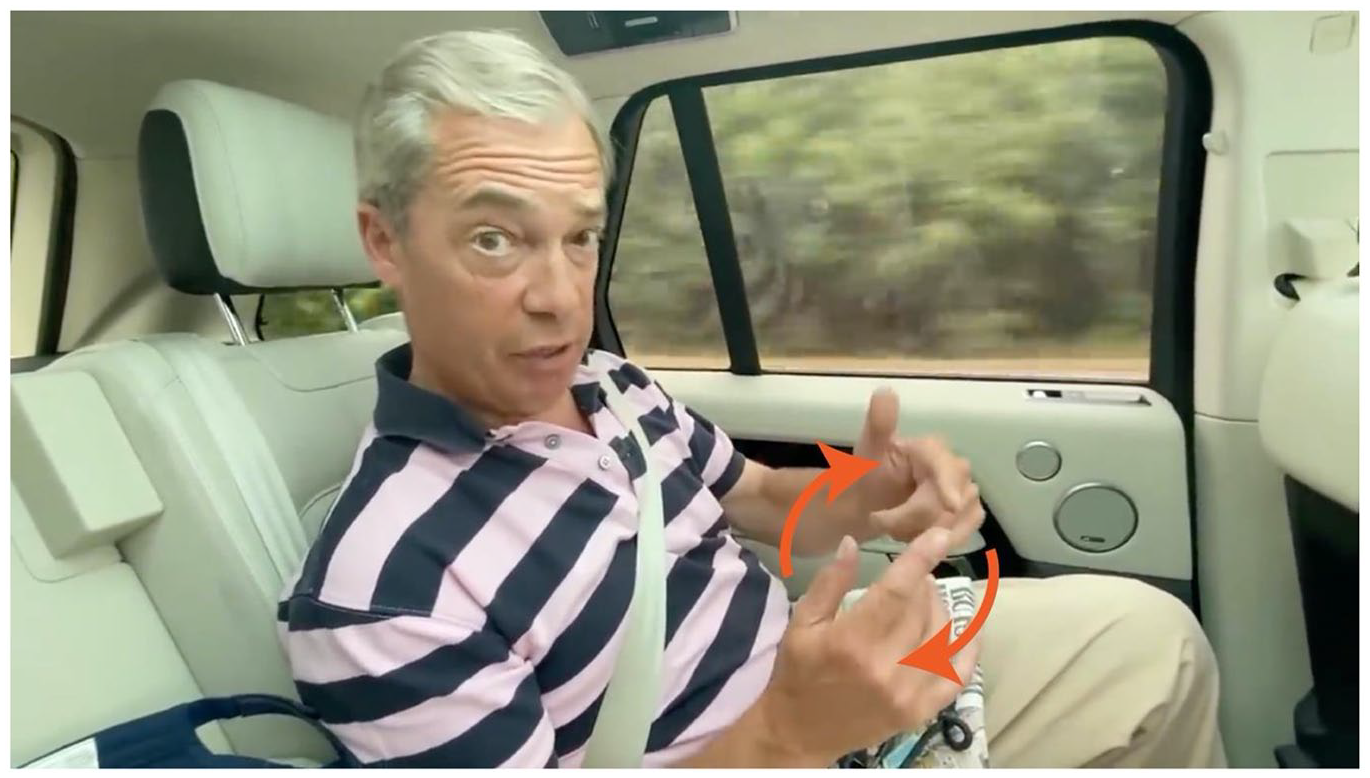
Cyclic gesture immediately preceding phrase ‘continuous days’ (Example 9).
Hinnell (2018) shows that repetition of gestures is also a feature associated with imperfective aspect and especially with the periphrastic keep construction. The gesture performed alongside example (10) may therefore similarly be analysed as expressing imperfective aspect and thus construing immigration as an enduring issue.
(10) And above all I think what’s been felt by millions of ordinary, decent, working families is wage compression. An
As Farage utters ‘unlimited supply’, he performs a sweeping gesture, shown in Figure 10, which he repeats three times in the course of the co-timed verbal expression. Thus, while in the spoken component of example (10), ‘unlimited supply’ suggests the potential for continuous, open-ended immigration, in the gestural component, this potential is presented as the current reality via a gesture whose meaning, in this context of use, is interpretable as something like ‘keeps coming’. In the context of immigration discourse, aspect is linked with quantification and legitimation where the imperfective aspect implies a perpetual enlargement of the immigrant population unless some interventionist action is taken.
(a, b) Repeated sweeping gesture coinciding with phrase ‘unlimited supply’ (Example 10).
Conclusion
In this paper, we have analysed gestures produced in the situated performance of anti-immigration discourse with a focus on the discourse of Nigel Farage. The study therefore makes a significant contribution to CDA by highlighting and investigating a previously unattended to feature of discriminatory discourse. We have shown that Farage exploits a range of gestures as part of a multimodal effort to attain legitimation for more restrictive immigration policies. Our analysis, thus, points to gesture as a significant semiotic resource relied on in discursive constructions of prejudice and in the legitimation of discriminatory action.
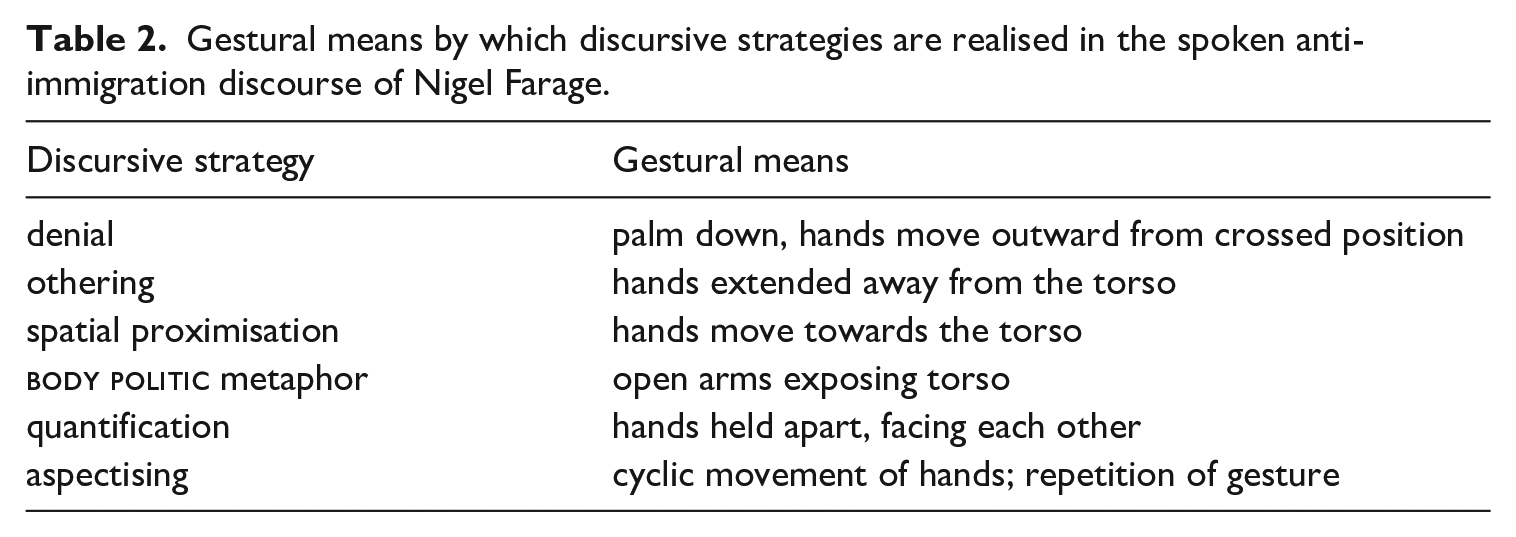
CDA identifies a range of specific rhetorical moves fundamental to the communication of prejudice and the legitimation of discrimination and exclusion, including denial, othering, proximisation and quantification. We have shown that, in the context of spoken discourse, gesture is an integral part of these moves. Though there are no exclusive, one-to-one correspondences between gestural forms and discursive functions, we have nevertheless shown some of the specific gestural forms that are involved in the multimodal realisation of particular discursive strategies. This is summarised in Table 2.
Gestural means by which discursive strategies are realised in the spoken anti-immigration discourse of Nigel Farage.
Although confined to a particular case study, our analysis demonstrates the communicative import of gesture in political discourse more generally and suggests that failing to take proper account of gesture in political discourse means neglecting some of the semiotic means by which social identities and relations are discursively constructed. It is therefore our hope that this paper will invite further research into gesture from a critical semiotic perspective.
Footnotes
Declaration of conflicting interests
The author(s) declared no potential conflicts of interest with respect to the research, authorship, and/or publication of this article.
Funding
Christopher Hart received no financial support for the research, authorship, and/or publication of this article. Bodo Winter was supported by the UKRI Future Leaders Fellowship MR/T040505/1.