




Abstract
Since the onset of the coronavirus pandemic, there have been thousands of articles on the use of metaphor to describe the crisis. A Google search yields more than 7000 hits. Indeed, an avalanche of metaphors has already been used to describe the Covid-19 pandemic. From war and oceanic metaphors to the dreaded phrase ‘ramping up’, the language and images used by politicians, journalists, scientific experts, commentators, artists, comedians, and meme-makers to understand the crisis are not neutral constructs. But far more disappointing than the use of inappropriate or politically incorrect metaphors is the fact that there is no single scholarly article that systematically studies the influence of the pandemic on cognition, especially metaphorical conceptualization. That is, how has the coronavirus pandemic changed the meaning of home, love, Halloween, social media platforms, and so on for us? Technically speaking, how has the crisis triggered, prompted, or simply facilitated the selection and employment of particular conceptual metaphors or their linguistic and non-linguistic manifestations? This article, based on a large-scale corpus of political cartoons, aims to answer that question – how the pandemic itself becomes a metaphor. I show that various different metaphor targets (including WAR, ISRAEL, TURKEY, DONALD TRUMP, BENJAMIN NETANYAHU, ARAB DICTATORS, THE KUWAITI NATIONAL ASSEMBLY, THE JORDANIAN CABINET, THE IRANIAN REGIME, MILITANT GROUPS, POVERTY, RACISM, CALENDAR, CORRUPTION, INJUSTICE, RUMORS, POLITICAL ASSASSINATIONS, THE GLOBE, THE UNION JACK, THE EUROPEAN UNION, THE US FAR RIGHT, THE 50 STARS OF THE AMERCAN FLAG, US-RUSSIAN RELATIONS, HOUSEWIVES, PERSONAL BELONGINGS, LOVE, QURBAN BAYRAM, CHRISTMAS, HALLOWEEN, ARABIC DRAMA, SCHOOL BAG, AWARENESS, and SOCIAL MEDIA COMPANIES such as Facebook, among many others) are all explained with reference to coronavirus-related terms or the source domain of CORONAVIRUS/VACCINATION. The sheer frequency of occurrences of CORONAVIRUS metaphors (a total of 175 out of 497 relevant multimodal cartoons, that is, more than 35%) demonstrates and makes a case for the necessity to examine the effect of context, in particular topical news and physical circumstances, in the cognitive linguistic study of creative metaphor. In short, the results provide initial evidence that new viruses and diseases such as Covid-19 have a negative and significant effect on cognition (or shape societies’ worldviews).
Keywords
Introduction
In the current deepening virus crisis, the interesting question is apparently how the global pandemic is metaphorically conceptualized (e.g. Craig, 2020; Nerlich, 2020; Nerlich and Jaspal, 2021; Semino, 2021, and references therein). But far more interesting is how the coronavirus pandemic is influencing the selection of novel or unconventional metaphors in discourse – or, to put the question differently, how it is changing the way we understand our world. There has been an extensive scholarly discussion regarding the vocabulary and images used to describe the coronavirus crisis (for Latinx political cartooning during the pandemic, see Rutherford, 2020; for Covid comics and metaphors, see, e.g. Saji et al., 2021; for political narratives in coronavirus memes, cf., e.g. Saint Laurent et al., 2021), but to my knowledge there is no single paper that systematically studies the influence of the pandemic on metaphorical creativity or conceptualization. This article, based on a large-scale corpus of political cartoons, is intended to do just that – to examine the question of how the pandemic is shaping worldviews.
In so doing, I will focus on the role of topical news or physical events and their consequences in the choice and use of particular metaphors in discourse. There are surely many other motivational forces that commonly produce creative and novel metaphors (for comparisons of metaphor types between men and women talking about depression, cf. Charteris-Black, 2012). According to what has been known as contextualist theory of metaphor (Kӧvecses, 2010, 2015, 2020) or dynamic systems theory (e.g. Cameron et al., 2009; Deignan and Cameron, 2013), metaphor production is motivated and constrained by different types of context, including situational, linguistic, conceptual-cognitive, and bodily factors (on the differences between the two proposals, cf. Kövecses, 2020). For van Dijk (2014), however, the creation and interpretation of metaphor requires a much more sophisticated theoretical framework, including different cognitive terms (such as situation models, context models, sociopolitical knowledge, ideologies, etc.). Importantly, it is not the communicative situation itself that influences the production and understanding of metaphor, but the context model – that is, the specific kind of mental experience model that subjectively represents ‘the ongoing definition of the communicative situation by the participants and as occasioned by the affordances of the situation’ (van Dijk, 2014: 54; italics in the original). Besides the typical categories of a spatiotemporal Setting, Participants (and their identities, roles, and relations), and Goals (Hymes, 1972), van Dijk has added one important category of Knowledge to explain all dimensions of common ground, presuppositions, and the basic mechanisms of interaction, communication, and discourse, as forms of information management. One problem with context models as cognitive constructs, however, is that they remain, in the long run, subject to experimental demonstration that has not yet been provided.
Initially, I will provide a brief review of metaphors of viral contagion, as well as of some of the findings on the types of metaphor used by cartoonists and comics artists. I will then explain in more detail the methodology that I use. In section 4, I then move on to corpus analyses. Section 5 lists some general conclusions and suggests some future directions for health communication and social cognition scholarship.
From ‘computer virus’ to ‘go viral’
One aspect of construal is the level of specificity and detail at which an entity or event can be described (Langacker, 2008). One can describe a patient by saying that he/she is seriously ill, but also – with progressively greater precision – by saying that he/she has a viral disease or contracted a virus, a coronavirus, or Covid-19. The lexical meaning of coronavirus is specific in some respects: it refers to any of a group of RNA viruses that have a lipid envelope studded with club-shaped spike proteins, that can cause diseases in birds and many mammals including humans, and that include the causative agents of MERS, SARS, and COVID-19. In humans, the viral disease typically causes respiratory infections (=in the nose, throat, or chest) that may not be serious, but that can sometimes cause more serious illnesses that can kill individuals. Scientists also work around the world to determine the likely cause and origin of Covid-19 or the truth of claims that the novel coronavirus was manmade. For some, suggestions that the pandemic is a hoax or was started deliberately are the latest chapter in a tale of blame, disinformation, fake news, and finger-pointing. Information linking the coronavirus to 5G telecoms or Chinese labs, even if false, is widely shared on social networks. We also know that measures such as social distancing, face masks, and potential vaccination programmes can slow coronavirus spread (for social representations of key coronavirus limitation measures, see Jaspal and Nerlich, 2020; Nerlich and Jaspal, 2021).
Illness metaphors have been widely applied to society (Meisenberg and Meisenberg, 2015; Sontag, 1989), sometimes stripped of their malign associations in the process (compare ‘computer virus’ with ‘go viral’). My hypothesis is that the Covid-19 pandemic has a profound effect on people’s cognition or metaphorical conceptualization. As an illustration, consider the 8 August 2020 Guardian headline ‘Cricket has been infected with a bad decision-making virus this summer’, where the VIRUS source domain was chosen by the journalist, Matthew Engel, probably as a result of the (then) still far-reaching physical and psychological consequences of the Covid-19 crisis (or of lockdowns, social distancing, and self-isolation) for all of us. The same applies to the 13 June 2020 Guardian sub-headline ‘Germans have a word for “working off the past.” Though not a vaccine against racism, facing history is a necessary beginning’, by moral philosopher Susan Neiman, where the noun vaccine was selected. Writing in the New Yorker, Elie (2020) argued that ‘the ubiquity of virus as metaphor may have left many of us unprepared to recognize and fear the lethal literal viruses circulating among us, and to prepare ourselves and our societies against them’ (para. 1).
At this point, we need to distinguish between creative metaphors (Black, 1979) (sometimes, unfortunately, referred to as ‘image metaphors’ (Lakoff and Turner, 1989: 89)), triggering novel or original, one-off mappings from a source domain to a target domain (like Kuwaiti cartoonist Ahmed Rahma’s English caption ‘Trumpism virus vaccine’ (i.e. a vaccine against the virus of Trumpism)) and structural (conventionalized/dead) metaphors or ‘metaphors we live by’ (Lakoff and Johnson, 1980), naming correspondences that lay bare how one thing is systematically understood in terms of another (such as ‘war against cancer’, a phrase that first appeared in the British Medical Journal in 1904) (=CANCER AS WAR) (for metaphorical creativity, see, e.g. El Refaie, 2014a; Hidalgo-Downing and Mujic, 2020). One major strand in Forceville’s (1996, 2002, 2009a, 2012) work focuses on the visual and multimodal manifestations of the first type. The main genre within which he has examined creative metaphors is commercial advertising, but more recently his ideas have also been applied to other visual or multimodal genres, such as graphic illness narratives. Focusing on the graphic illness narrative genre, El Refaie (2019) proposes that ‘some genres are more centrally concerned with the human body than others, and that each genre exploits the affordances of its modes and media in unique ways’ (p. 15). In her data, she has indeed identified some pictorial metaphors that do not fit into any of Forceville’s five categories of pictorial metaphor (hybrid metaphor, pictorial simile, integrated metaphor, contextual metaphor, and verbo-pictorial metaphor) (see also El Refaie, 2017), including examples of what she has termed ‘body modification’, where (parts of) the human body are represented in some altered or distorted shape for metaphorical effect or so as to activate metaphorical meaning (p. 84). Because this latter subtype of pictorial metaphor has not been found previously in any other nonverbal genre, El Refaie suggests that ‘it may be particularly suited to the visual representation of meanings relating to the illness experience’ (p. 100). As illustrated by this cognitivist, an example of a body modification metaphor can be found in Belgian comics artist Vanistendael’s (2012) fictional story about a cancer patient, David, who in his bookshop after having undergone a course of chemo- and radiotherapy appears to his grownup daughter, Miriam, as a skeleton. As I will show in section 4, however, many of El Refaie’s subcategories (including ‘transformational’, ‘body modification’, and ‘typo-pictorial’) (for a summary, see El Refaie, 2019, Table 3.1: 117) can also be found in my corpus of political cartoons (for linguistic metaphor across different media genres, cf. Musolff, 2015).
For now, though, it is worth briefly discussing two political cartoons that exemplify ‘body modification metaphors’. The cartoon shown in Figure 1a, by Jordanian cartoonist Mahmoud El Refaie (Tomato Cartoon, 7 September 2020) depicts a doctor in a messy room, with syringes and debris on the floor, as a skeleton. The doctor thus looks more ‘living dead’ than fully alive. Ironically, the patient is more normal and healthier than the health professional. The caption reads: ‘Public hospitals’. The cartoonist’s message is probably that his country’s hospital service is miserable. Another possible interpretation is that the doctor has worked him/herself ‘to death’. Knowledge (including reports of major shortages of medicines, equipment and staff at Jordanian hospitals and cases of extreme negligence on the part of doctors or hospital staff) is a condition for the interpretation of the cartoon. Similarly, the cartoon by female Egyptian cartoonist Doaa Eladl (Figure 1b) features a human skeleton addressing another, saying ‘Look into my eyes! Do you think I have been infected with “coronavirus”?’ The cartoon could be an implicit rejection of the argument that the virus is a hoax. The humorous irony, however, is also that the talking skeleton (=a metonym for Egyptian citizens) is scared to death of catching coronavirus, although he already has no eyes and is damaged and unhealthy. In Egyptian culture, skinniness is also linked to poverty. The metaphor at work in both cartoons is BODY AS SKELETON, where there is an ostentatious alteration or distortion of the human body.
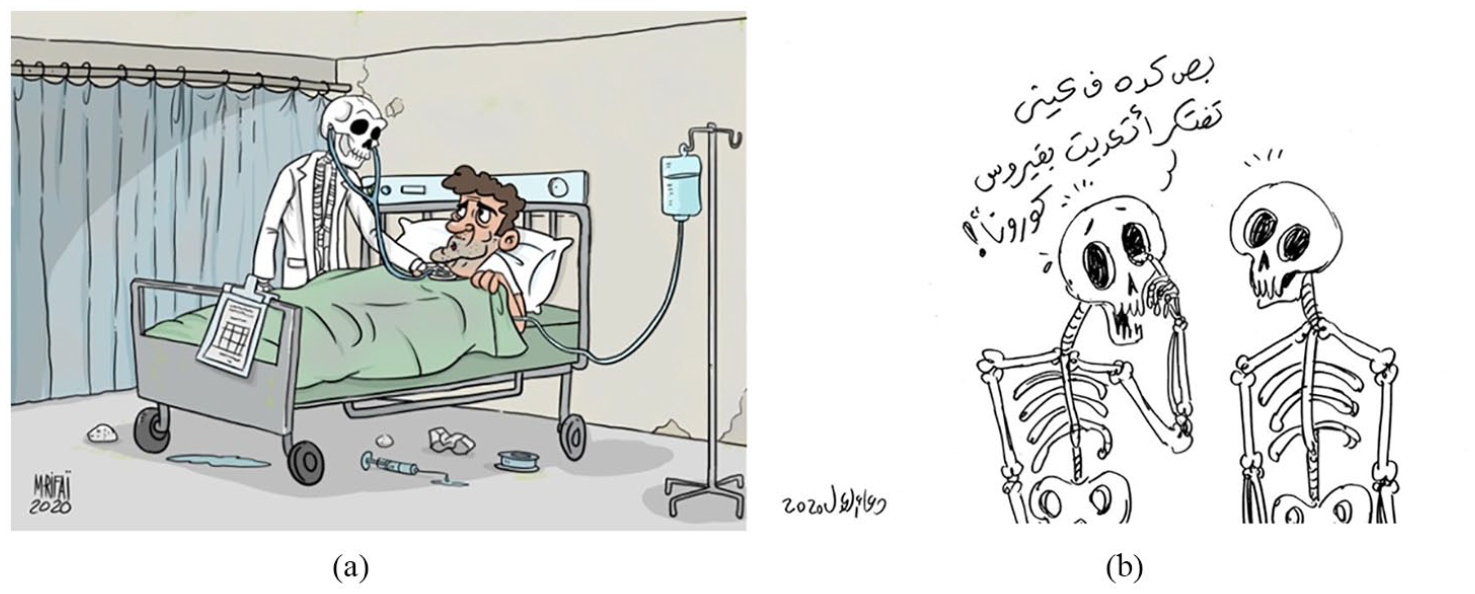
‘Body modification’ metaphors. (a) Tomato Cartoon, 7 September 2020. Cartoon by Mahmoud al-Refaie. DOCTOR AS SKELETON. (b) Tomato Cartoon, 1 February 2020. Cartoon by Doaa Eladl. CITIZEN AS SKELETON.
More interestingly, there are also some visual metaphors in political cartoons (such as ‘metaphsimile’ and ‘shadow-reflection’) that fall outside El Refaie’s (2019) new taxonomy for the different forms that pictorial metaphor may take in graphic illness narratives. I will use the term ‘shadow-reflection’ to describe any instances in which the anchoring rule of the required similarity between a caster and its shadow or between someone or something and their reflection in a mirror or on any reflective surface is violated.
For instance, a cartoon by male Libyan cartoonist Muhammad Gajoum (Mo Gajoum Cartoons, 22 February 2021) depicts a red-eyed man with a coronavirus-like head (or a head with crown-like spikes protruding from its surface) as the shadow of a dark-eyed man grinning cheerfully and opening his arms to a give a warm hug, with a thought balloon floating above his head displaying the image of a blue love heart. The incongruity in this cartoon is caused by the fact that an entity that is not a coronavirus casts the shadow of a coronavirus. At play in the picture is the metaphor HYPOCRITE AS CORONAVIRUS. That is, the shadow reveals the ‘true nature’ of its caster (the topic of the message) (for rhetorical shadows, cf. Schilperoord and Van Weelden, 2018).
Similarly, male Egyptian artist Maher Rashwaan (Tomato Cartoon, 5 April 2020) cartoons the globe as a healthy man looking at his reflection, a man with a coronavirus-like head, in the mirror (THE GLOBE AS CORONAVIRUS). The caption says, ‘Covid-19 is spreading around the globe’. The incongruity in this cartoon, however, differs from that in the previous example in that the person and his reflection are the same entity but that entity is represented in different ‘qualities’ ‘roles’, or ‘manifestations’. Strong implicatures include typically that the epidemic has gripped the world. In ‘metaphsimile’, on the other hand, we have both ‘hybrid metaphor’, where two things are fused together, and ‘pictorial simile’, in which the two things are presented side by side in a way that draws attention to their resemblance, at work simultaneously (e.g. see § 4).
Corpus and methodology
For the compilation of the corpus, 620 coronavirus-related political cartoons were randomly selected from the digital archive of the first Arab satirical magazine Tomato Cartoon, which also brings the cream of foreign cartoonists to Arabs (https://www.tomatocartoon.com/, accessed 24 March 2021). For ease of analysis, images from Brazil, Turkey, Spain, France, Germany, and other non-Arab countries were excluded. This yielded 497 images for analysis, or 80% of the total. Each of the 497 political cartoons was analyzed for usability in the study. The analysis was restricted to cartoons that included coronavirus-related terms as metaphor source domains. Excluding the images without coronavirus as a metaphor source yielded 175 political cartoons to be included in the main analysis of interest (Figure 2). The cartoons, by 52 Arab cartoonists (45 male, 7 female), were published between 1 January 2020 and 23 March 2021. Note that the number of women working in male-dominated professions such as political cartooning is slowly increasing. The male subcorpus contained 114 cartoons, compared to 61 cartoons in the female subcorpus. In any case, the present study focused on the role of physical circumstances, not gender, in the production of metaphors (for a detailed discussion of gendered metaphors in cartooning, see Abdel-Raheem, 2021a; for politics, gender, and linguistic metaphor, see Ahrens, 2009; Shaw, 2020). I hypothesized that the coronavirus pandemic might have influenced the selection of metaphors in the corpus data.
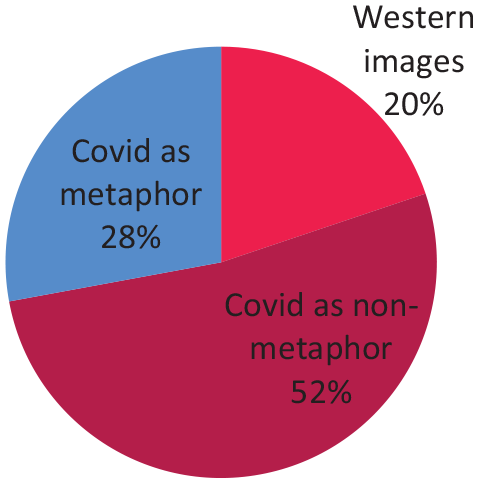
Corpus data.
Although there are some approaches to visual/multimodal metaphor identification and analysis (e.g. Šorm and Steen, 2018), this question remains a controversial and contentious theoretical issue (for a critical review, Abdel-Raheem, 2021b). Interestingly, while the direction of meaning transfer from a vehicle (source) to a tenor (target) is generally not ambiguous, this is not necessarily the case in other visual or multimodal genres (El Refaie, 2019). Since this paper aimed at identifying metaphors that used the source domain of CORONAVIRUS, the following approach was taken: First, possible keywords and symbols for CORONAVIRUS were identified: For example, virus, coronavirus, Covid, pandemic, vaccine, vaccination, stay home, social distancing, syringe, phial, surgical mask, goggles, face visor, double gloves, surgical gown, hand sanitizer, spread of infection, and so on. Then, I identified which keywords or symbols were being used literally and which were being used metaphorically, based on a context models approach. Specifically, I assessed what ‘scenario’ was (verbo)visualized in a cartoon, and then registered if, and if so what, deviated from this scenario, determining who depicted what to whom under what conditions, why and in what way. In the same way, metaphor targets were decided based on the context. Following standard conventions in cognitive linguistics, conceptual domains, metaphors, and metonymies were written in small capitals, for example, ISRAEL AS COVID-19. While ‘mapping features’ is what happens in metaphor, things like ‘shifting perspective’, ‘zooming in on’, and ‘focusing on’ appear to be more appropriate descriptions of what happens in metonymy (e.g. Forceville, 2009b; Littlemore, 2015). Though simplified, this view suited our purposes in this paper.
There were two stages to the analysis: a qualitative phase to identify metaphor in context and a quantitative phase to identify the most frequent metaphor targets. Both were done manually. All the images were analyzed in depth, but the author is only able to present few instances in this article; these were chosen as they were particularly striking and explicit in terms of the motivational basis of metaphor.
The effect of coronavirus on metaphor use
How has the coronavirus impacted on how people see, think, and act on the world? Or, to put the question differently, to what extent can one argue for the reversibility of target and source domains in Covid-19 metaphors? Just as with previous pandemics, coronavirus or Covid-19 (a shortening of coronavirus disease 2019) has given rise to new vocabulary, such as WFH (working from home), social distancing, self-isolation and self-quarantine, lockdown, etc. As a verb, ‘to zoom’ now also has a new definition owed to the popular videoconferencing platform of that name. People with serious underlying health conditions, such as pulmonary or cardiac dysfunction or already compromised immune systems, were further initially advised to shield, a modern secular use of the transitive verb that usually requires a shielder (God) and a shieldee (a faithful person), as Guardian columnist and language enthusiast Steven Poole also noted. In visual arts, we have also noticed a rise in the use of coronavirus- and vaccine-related metonyms that have become symbols, such as little glass vials of vaccine, syringes, homes, ventilators, and personal protective equipment (PPE), including surgical masks, gloves, gowns, visors or goggles, alcohol wipes, and bottles of hand sanitizer.
In this section, I will show that like a moth to a flame, we are drawn to Covid-19 to explain ourselves. Technically speaking, the virus (and its engineered vaccines) has become a very salient source domain at the moment – which is transferred to a myriad of target domains. The diagram below summarizes the findings for the frequency of metaphor targets in my corpus (Figure 3).
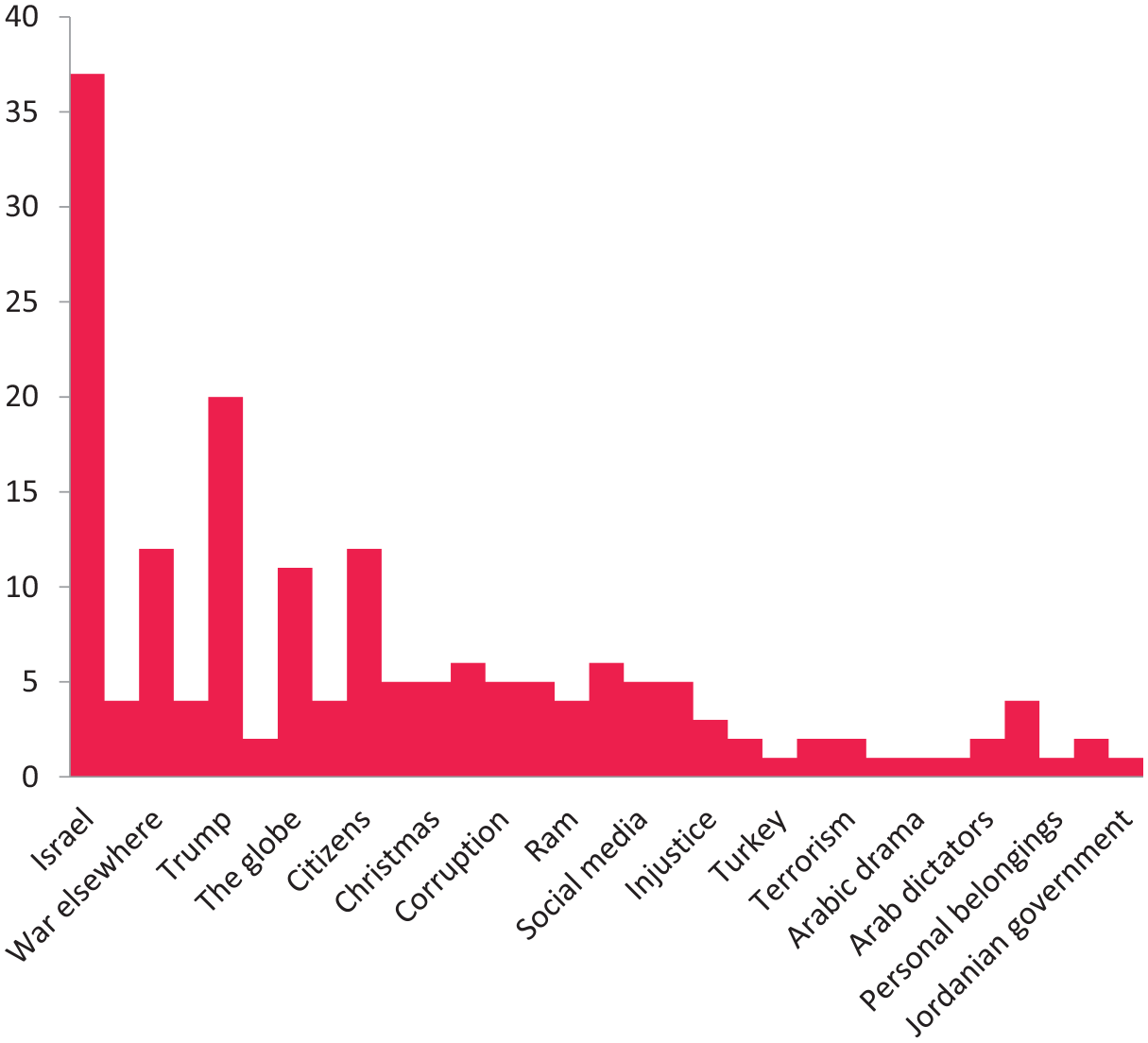
The frequency of metaphor targets in my data.
From ISRAEL to CHE GUEVARA
The number of articles discussing why it is misleading to apply military metaphors to medicine has grown exponentially since the start of the coronavirus pandemic (e.g. Hauser and Schwarz, 2020; Magaña, 2020; Sontag, 1989; for explanations for the striking lack of WAR metaphors in the coverage of Severe Acute Respiratory Syndrome (SARS), cf. Wallis and Nerlich, 2005; for relative absence of military metaphors in the German public discourse, in contrast to US and UK data, around Covid-19, cf. Jaworska, 2021). But why do WAR metaphors have such traction in medicine? From a cognitive linguistic perspective, conflict metaphors are in the human body (i.e. they draw from basic, embodied, sensorimotor experiences) and hence must also be in the brain (e.g. Coulson, 2008; Feldman, 2006; Gallese and Lakoff, 2005; Lakoff, 2008). Cognitively oriented neuroscientific research arguably assumes that the co-activation of two groups of neurons in the brain (the source and target domains) yields the so-called ‘simple’ or ‘primary’ metaphor (Grady, 1997: 170), for example, DIFFICULTIES AS OPPONENTS.
Frank (1995) distinguishes between three types of illness narratives (‘restitution’, denoting the ill person’s own desire to be healthy again; ‘chaos’, the opposite of restitution, where a lack of hope for improvement leads to the absence of narrative order; and ‘quest’, where illness is accepted and the ill person seeks to use it), and depending on which narrative type dominates ill people’s story at a particular moment, metaphors are selected (El Refaie, 2014a). Given their schematic structure (with a clear beginning, middle, and end), journey and battle metaphors, argues El Refaie (2014a), are ‘a perfect fit for narratives revolving around a restitution or quest plot’ (p. 155; see also Sopory, 2017). Nevertheless, framing a pandemic in terms of a war is not the same as framing a war in terms of a pandemic (for possible bidirectionality in metaphor, see El Refaie, 2019; Freeman, 2017).
The effect of physical events and their consequences on metaphorical conceptualization is well demonstrated by a series of political cartoons by male and female Arab artists who depict Israel’s occupation of Palestine as the coronavirus. For instance, a cartoon by the Palestinian artist Muhammad Sabaaneh (Tomato Cartoon, 5 July 2020) features a Palestinian wearing a mask that reads ‘No to coronavirus’ and holding a ‘No to annexation’ sign that resembles a fabric face mask. In another cartoon, also by Sabaaneh (Tomato Cartoon, 14 May 2020), the piece of elastic attached to the top parts of a slingshot (often used by a Palestinian protester to hurl stones at Israeli troops) is replaced with a face mask (SLINGSHOT AS FACE MASK), and Israeli construction cranes are portrayed as the coronavirus (ISRAEL AS THE VIRUS). The caption reads: ‘A face mask to protect against the occupation’.
In a third Sabaaneh cartoon (Tomato Cartoon, 17 March 2020), an Israeli tank, rushing behind a Palestinian pedestrian carrying a baby, is depicted as the coronavirus. Later on, Sabaaneh (Tomato Cartoon, 24 March 2020) caricatures an Israeli soldier leading a Palestinian prisoner by a rope as the coronavirus. In cartoon no. 5, by Sabaaneh (Tomato Cartoon, 26 January 2021), the coronavirus is substituted for the blade of an Israeli bulldozer. The bulldozer is tearing down an olive grove (a metonymy for Palestine) wearing a face mask that appears to depict the Palestinian flag. Cartoon no. 6, also by Muhammad Sabaaneh (Tomato Cartoon, 24 January 2021), shows a syringe (a metonym for vaccination) containing or filled with a Palestinian holding a slingshot. Then the caption says: ‘A vaccine against the occupation’.
On 6 December 2020, Sabaaneh further posted a cartoon on Facebook depicting Palestinian disunity as the coronavirus (DISUNITY AS CORONAVIRUS), with unity or reconciliation among Palestinians as the vaccine (UNITY AS SYRINGE FOR VACCINE). Cartoon no. 8 (Sabaaneh, Tomato Cartoon, 3 May 2020) shows a Palestinian man hanging from a tree labeled ‘Israel’ and bearing coronavirus that grows from its upper part (ISRAEL AS TREE PRODUCING CORONAVIRUS). Then-US President Donald Trump (who, via both metaphor and metonymy, can stand conceptually for America) waters the tree (ISRAEL AS A CORONAVIRUS-PRODUCING TREE THAT IS CAREFULLY NURSED BY AMERICA) and says ‘The virus was made in China’.
Earlier that year, on 14 March 2020, Sabaaneh had cartooned Israel’s demolition of Palestinian homes as a coronavirus with three hammers (INSTRUMENT FOR AGENT) emanating from it (ISRAELI BULLDOZERS DESTROYING PALESTINIAN HOUSES AS CORONAVIRUS). The caption says: ‘Occupation coronavirus’. Cartoon no. 9, by Palestinian cartoonist Alaa Allagta (Tomato Cartoon, 17 March 2020), further depicts the Star of David (a metonym for Israel) as the coronavirus (THE STAR OF DAVID FOR ISRAEL AS CORONAVIRUS). The caption reads: ‘The virus that most endangers humanity’. Moreover, consider a cartoon by Muhammad Sabaaneh posted on Facebook on 24 February 2020. The cartoon shows a heavy, coronavirus-shaped Israeli settlement sliding into the ground, causing serious environmental harm (ISRAEL’S SETTLEMENT CONSTRUCTION AS VIRUS; PALESTINIAN SOIL AS VICTIM). The caption says, ‘The virus of settlement building’.
Another Sabaaneh cartoon (Tomato Cartoon, 25 September 2020) shows the Dome of the Rock in Jerusalem (DOME OF THE ROCK FOR JERUSALEM) located between a massive green helmet of an Israeli soldier and a giant green coronavirus (ISRAEL AS COVID-19). The caption reads: ‘Jerusalem between two viruses’.
The characterizations of Israel as the CORONAVIRUS dominate the Sabaaneh sample: they account for 23 occurrences, out of a total of 40 cartoons. These are also represented in Egyptian, Jordanian, and Kuwaiti samples, but the number of occurrences (14 across the overall corpus) appears to be too small to be indicative of any sociocultural trend (compare ISRAEL AS CANCER (Sontag, 1989)). (Note: the location where events take place also plays an important role in relevance: events that happen in one’s own country are more likely to have an influence than ones that take place far away.) For instance, a picture by Jordanian cartoonist Naser Jafari (Tomato Cartoon, 2 February 2021) features a lorry marked with the Israeli flag carrying a coronavirus-shaped Israeli settlement (ISRAELI SETTLEMENTS AS CORONAVIRUS).
As in the previous examples, for readers to interpret the Jafari cartoon, they need to have and activate knowledge about the shape of the virus (a spherical particle with red spikes), although there is little consensus about the color (Weaving, 2020). The red spikes of the virus are mapped onto red buildings. In the case of hybrid phenomena, as here, two different concrete entities are visually amalgamated into one figure that is perceived as a single gestalt (Forceville, 1996).
Similarly, male Turkish-Kuwaiti cartoonist Ahmed Rahma (Tomato Cartoon, 2 August 2020) caricatures Israel and Palestine as two arm wrestlers (ISRAEL AND PALESTINE AS ARM WRESTLERS). The head of Israel is a fusion of a settlement and a coronavirus (ISRAEL AS CORONAVIRUS). The Palestinian man wears a tent-like face mask (TENT FOR REFUGEE CAMP; PALESTINE AS POTENTIAL COVID VICTIM). The depiction of a face mask in such a way that readers are reminded of a tent pitched on a man’s mouth and nose is an example of an integrated metaphor, describing examples where an entity is portrayed in a way that strongly suggests a different object (El Refaie, 2019). The caption reads: ‘Confronting the ‘annexation and settlement building’ coronavirus’. (The same metaphor, ISRAELI SETTLEMENTS AS CORONAVIRUS, is also found in a cartoon by male Jordanian artist Osama Hajjaj (Tomato Cartoon, 4 December 2020)).
Another Jafari cartoon published on 16 February 2021 by Tomato Cartoon depicts Israel as a coronavirus marked with a no entry sign, in reference to the news that the nation state of Jewish people has blocked Covid vaccines from entering Gaza. Part of understanding this metaphorical blend involves appreciating analogy mappings between variants of coronavirus that are resistant to current vaccines, signs forbidding the entrance of particular people, and Israel blocking vaccines from entering Palestine. Consider also the cartoon shown in Figure 4a (by female Egyptian cartoonist Doaa Eladl, 3 July 2020), in which a deadly coronavirus marked with the Israeli flag attacking a Palestinian and the Covid-19 virus hunting the globe are depicted next to one another. The left-hand panel is captioned ‘Israeli sweeping attacks on West Bank’; the right-hand panel, ‘Coronavirus is spreading rapidly across the globe’. The cartoon is a good example of visual figurative emphasis or what I may call ‘metaphsimile’ because it falls into both ‘pictorial similes’, where both the source (the spread of coronavirus) and target (Israel’s military incursion to the West Bank
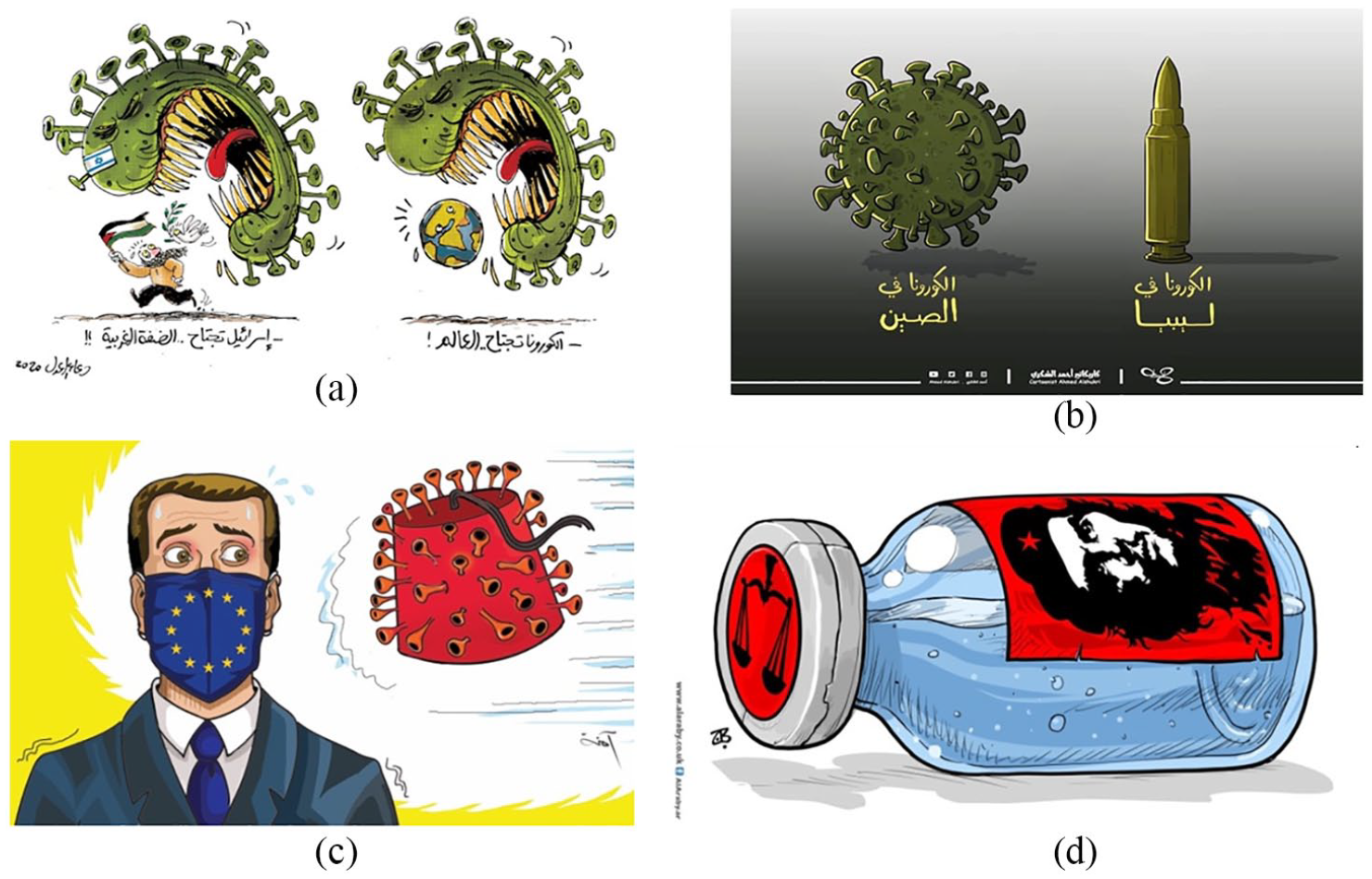
CORONAVIRUS as a metaphorical source domain (1). (a) Doaa Elad, 3 July 2020. (b) Libyan Cartoons, Ahmed Alshukri, 19 February 2020. (c) Tomato Cartoon, Amna Alhammadii, 12 March 2020. (d) Tomato Cartoon, Emad Hajjaj, 4 February 2021.
On 14 May 2018, for example, the Guardian’s editorial team wrote: ‘Channelling a reckless Donald Trump, Israeli ministers appear to have adopted a dangerous mindset: to destroy the national aspirations of the Palestinians by military force. [. . .] Israel’s army evinced no shame in committing what looks like a war crime’. A year later, ‘[t]housands have bullet wounds through their legs. The streets of Gaza are filled with people limping or in wheelchairs. Children, journalists and medics have been killed, even when they were standing far back from the fence. The UN has said Israel’s military may have committed war crimes, deliberately targeting civilians’ (Holmes and Holder, 2019, para. 4).
And yet there is another parallel: both the coronavirus and Israel are causing a lot of social isolation. For more than a decade, the tiny Gaza Strip has indeed been in an artificial state of lockdown under a crippling Israeli blockade. The Israeli blockade and restrictions on Gaza thus correspond to strict Covid restrictions. The low- or specific-level mapping ISRAEL AS CORONAVIRUS also answers questions such as how the virus transmits, how to protect oneself and others from coronavirus infection, whether a vaccine or treatment is available, whether it is possible to eradicate Covid-19/Israel, and so on. Strong implicatures include typically that unless the Arab world works to eradicate the coronavirus/Israel, new (variant) strains are bound to emerge. Illness metaphors may be hard to resist for those wishing to register indignation (Sontag, 1989). In the heat of despair over the American war in Vietnam, Sontag (1989) herself once wrote that ‘the white race is the cancer of human history’. But patients are also hardly helped by hearing the name of their disease ‘constantly being dropped as the epitome of evil’ (p. 85).
Another example of ‘metaphsimile’ is a cartoon by Sabaaneh (Tomato Cartoon, 27 March 2020) showing a Palestinian man squeezed between a coronavirus-like Israeli settlement, from which emanate guns held to his stomach, and the coronavirus. The caption reads: ‘Palestine between coronavirus and occupation’. That is, a person (NATION AS PERSON) is caught in the gears of two forces of some kind (CORONAVIRUS AND ISRAEL AS COGWHEELS) and his existence is threatened. Gears are rotary forces conveyed via their teeth. The teeth here are weapons and buildings, and the Covid’s spike proteins, responsible for spreading infection (ISRAELI SETTLEMENTS are like CORONAVIRUS). The two forces or phenomena juxtaposed are thus Zionism or policy and contagion. Because we are familiar with the Palestinian headdress, the keffiyeh, and the settlement issues in Israel, and because we are familiar with Covid-19, we see why they threaten the man’s wellbeing.
In sum, both the coronavirus and Israeli settlements are cogwheels of a progression, each with teeth to match the agent of their impact. The progress of Zionism is working together with the progress of Covid contagion to form an existential threat to Palestinians. The Palestinian man is unarmed and trying to resist being pulled in. Caught in cogs, the man can be crushed to death. What concerns us here is that the cartoon exemplifies both a pictorial simile (ISRAEL is like COVID-19) and a hybrid metaphor (ISRAELI SETTLEMENTS AS CORONVIRUS). To my knowledge, ‘metaphsimiles’ have not been identified previously in any other pictorial or multimodal genre.
Sabaaneh (Tomato Cartoon, 13 July 2020) also cartoons a sad, desperate Palestinian child as crouching down, and wrapping his arms around his frail body, caught between coronavirus and a tank (its wheel in close-up) bearing the words ‘Annexation plans’ in reference to Israel’s pledge to annex large parts of the occupied West Bank. The physical resemblance between the tank treads and Covid-19 spikes is reinforced by the way the tank has been depicted. The juxtaposed phenomena can be understood in terms of pictorial simile rather than in terms of hybrid metaphor. The properties identified as among those that are mappable from the domain of CORONAVIRUS on to the domain of TANK can be rephrased as the predicates ‘has a pattern of prominent protrusions, raised lines or a set of short, pointed pieces’, ‘is a lethal threat’, etc. Pictorial similes where the coronavirus and associated phenomena (vaccines, face masks, etc.) serve as source domains are frequent in the corpus data. A cartoon in the same series (Alaa Allagta, 4 September 2020) juxtaposes the coronavirus and representatives of the rival Palestinian factions sitting around the negotiating table. The simile is also in part motivated by physical resemblance, where the roundness of table and coronavirus and the heads of people sitting at the table and the spikes of the virus are strikingly similar. The ‘symmetric alignment’ (Schilperoord et al., 2009; Teng and Sun, 2002) of Palestinians and the coronavirus is also found in a cartoon published in Lebanese newspaper Algomhuria on 14 April 2020. In addition, a cartoon by Alaa Allagta (Tomato Cartoon, 15 January 2021) features a Palestinian crouching down, arms wrapped around himself, and rounded body stabbed with six daggers – four of which bear the words ‘Israeli war crimes’, ‘Arab deafening silence’, ‘The international community’s collaboration with Israel’, and ‘Normalization with Israel’. The stabbed, crouching man bears a striking similarity to Covid-19. Indeed, the shadow of the man is the coronavirus. The caption reads: ‘Coronavirus upends lives of Palestinian prisoners in Israeli jails’. Unlike in other examples, the cartoonist thus counsels viewers to call for the release of Palestinian prisoners from Israeli prisons and jails, through which the coronavirus rages. Releasing prisoners not only slows or curbs coronavirus spread, but it also gives effect to their human rights. In short, the PALESTINIAN PRISONERS IN ISRAELI JAILS AS CORONAVIRUS metaphor (‘shadow-reflection’) highlights the misery suffered by Palestinians, while the ISRAEL AS CORONAVIRUS metaphor laments the impact of the ‘vicious virus’ (Israel). In essence the first interpretation also applies to two pictures by Doaa Elad: one cartooning a house visited by relatives as coronavirus (Tomato Cartoon, 27 May 2020), the other (Tomato Cartoon, 6 March 2020) depicting the globe gradually transforming into the virus. This latter type of metaphor is termed ‘transformational’ (El Refaie, 2019: 91). After all, the crucial point is that the connotations mapped from source to target are context-dependent. (Note: our corpus also has four occurrences of the HOUSE AS PROTECTIVE FACE MASK metaphor: three by female Emirati cartoonist Amna Alhammadii, and one by male Iraqi cartoonist Ahmed Falah; the reader is asked to stay at home to protect themselves from the risk of contracting coronavirus.)
A further example of pictorial simile with a Covid-19 source domain is Figure 4b, by Libyan cartoonist Ahmed Alshukri (Libyan Cartoons, 19 February 2020), in which the Chinese coronavirus and the Libyan war are juxtaposed for the sake of noting similarities (BULLET FOR WAR IN LIBYA AS CORONAVIIRS). The caption beneath the bullet (a metonym for war) reads: ‘The coronavirus in Libya’. The caption under the picture of coronavirus says: ‘The coronavirus in China’. Similarly, Turkish-Kuwaiti cartoonist Ahmed Rahma (Tomato Cartoon, 10 November 2020) depicts Yemen as a man located between a coronavirus particle bearing the word ‘Corona’ (in English) and a coronavirus-like tank displaying ‘War’ (WAR IN YEMEN AS CORONAVIRUS). The investigation of such examples, then, shows that not only is reversibility from CORONAVIRUS AS WAR (e.g. Semino, 2021) to WAR AS CORONAVIRUS possible (for metaphorical bidirectionality, see Freeman, 2017), it demonstrates how the circumstances under which a picture is made can influence metaphorical conceptualization.
Jordanian cartoonist Emad Hajjaj also uses CORONAVIRUS metaphors when referring to WAR. Specifically, he caricatures President-elect Joe Biden (a metonym for America) wearing a face mask bearing the words ‘The two-state solution (for Israel and Palestine)’ (THE TWO-STATE SOLUTION AS FACE MASK), and facing Israeli prime minister Benjamin Netanyahu (a metonym for Israel), who wears a face mask that appears to be a peace dove stuffed into his mouth (which implies that he is forced to make peace with Arabs) (DOVE OF PEACE AS FACE MASK). The cartoon appeared on the website of Tomato Cartoon on 3 February 2021. To understand the picture, the reader needs political knowledge about, say, Biden’s (who became President of the United States after Trump, in January 2021) desire to revive the Palestine-Israel two-state solution that the Trump administration and Netanyahu’s government have fractured badly.
Moreover, a cartoon by female Emirati cartoonist Amna Alhammadii (Tomato Cartoon, 5 February 2021) features two juxtaposed coronavirus particles (one red, displaying ‘Corruption’, the other yellow, carrying the inscription ‘The coronavirus’) using axes to chop down the cedar of Lebanon (a metonym for the country). The various aspects of similarity (such as performing the same action of cutting down the cedar) invite the reader to equate corruption and coronavirus. However, unlike in the two previous examples of ‘metaphsimile’, the target concept (‘corruption’) is rendered textually. Eliminating the text here results in the disappearance of the metaphor. Still, the cartoon arguably exemplifies two categories – a multimodal simile and metaphor (Forceville, 1996; for multimodal simile, see Lou, 2017). One cartoon by Sabaaneh, published by Tomato Cartoon on 7 March 2021, further depicts Pope Francis wearing a face mask and standing looking at an Iraqi citizen who is crucified on the cross of corruption (CORRUPTION AS VIRUS; CORRUPTION AS CRUCIFIXION), where the penultimate letter, alif ‘aa’, of the Arabic four-letter word fasaad ‘corruption’ is made to resemble a cross. The picture is a visual comment on the pope’s visit to ruined churches in the wrecked center of Mosul; in another picture, also by Sabaaneh (Tomato Cartoon, 25 February 2021), the second letter, siin ‘s’, of the word fasaad itself also takes on explicitly visual properties, in the sense that it is made to look like a recognizable object, three syringes (SYRINGE FOR VACCINE), which in turn adds metaphorical meaning to the cartoon; the cartoon is a reference to the scandal over early vaccination of Palestinian officials; this subtype of pictorial metaphor is termed the ‘typo-pictorial’ metaphor (El Refaie, 2019).
A similar cartoon by Doaa Eladl, entitled ‘Poverty and coronavirus’ (Tomato Cartoon, 22 April 2020), also depicts a poor man bitten by two coronavirus particles (one displaying ‘poverty’ and biting the man’s arm, the other bearing the word ‘coronavirus’ and attacking his leg). Eladl (Tomato Cartoon, 6 April 2020) has also drawn a man in tattered clothes with coronavirus particles in place of his eyes (EYES AS CORONAVIRUSES). The caption says: ‘The victims of coronavirus are mostly poor’. The striking visual metaphor can in fact be interpreted in different ways, depending on whether the coronavirus particles are considered as covering or as replacing the poor man’s eyes. In the case of the former, the metaphor would be an original take on the conventional conceptual metaphor UNDERSTANDING AS SEEING, suggesting that the poor now see/understand everything through the distorting filter of their disease. The metaphor target of understanding is thus presented as a challenging process fraught with difficulties rather than as an objective state. If, by contrast, it is assumed that the coronavirus particles have replaced the poor man’s eyes, vision itself becomes the metaphor target. The resulting mapping could be then verbalized as EYES ARE CORONAVIRUSES, which would entail that the poor are unable to see/understand anything at all, since coronavirus particles clearly cannot function as organs of vision (for analysis of a similar example depicting breasts in place of eyes, see El Refaie, 2014b). The substitution of something unexpected (coronavirus) for the eyes (an expected element) is sufficient to invite a metaphorical reading. This may be an example of a ‘contextual metaphor’, where the coronavirus (the source) is depicted in a context in which something different (the eyes) would normally be expected.
The cartoon shown in Figure 4c, by female Emirati cartoonist Amna Alhammadii, further depicts a red fez (a metonym for Turkey) as the coronavirus (TURKEY AS CORONAVIRUS), with the European Union as a white man in a suit wearing a face mask displaying the EU flag (a metonym for the European Union) to protect himself from the virus (THE EUROPEAN UNION AS POTENTIAL VICTIM). One implication of the cartoon is that Turkey must be ‘eradicated’. Relevant, then, is the old or presupposed knowledge that the United Arab Emirates’ relations with Turkey are at a low ebb because of its support for the Muslim Brotherhood and its plan for supremacy in the Middle East. In a similar fashion, male Jordanian artist Emad Hajjaj cartoons a glass vial with a label showing both a picture of Ernesto Che Guevara – the Argentina-born revolutionary who helped topple the Cuban dictator Fulgencio Batista – and the scales of justice. The glass vial used for a vaccine is a metonym for the vaccine, Guevara stands for rebelliousness, and the scales are a symbol of justice (Figure 4d). The metaphor could be verbalized as CHE GUEVARA AS VACCINE AGAINST OPPRESSIVE REGIMES. This is in tune with Sontag’s (1989) observation that illnesses have always been employed as ‘metaphors to enliven charges that a society was corrupt or unjust’ (p. 72).
From TRUMP to SOCIAL MEDIA CHANNELS
The DONALD TRUMP AS CORONAVIRUS metaphor is also frequently used by both male and female cartoonists (20 occurrences). For example, the picture displayed in Figure 5b (by Sabaaneh) features Uncle Sam (=the United States of America) taking a nasal swab coronavirus test (AMERICA AS COVID PATIENT), with the cartoon balloon flouting above portraying Trump as the coronavirus (TRUMP AS COVID-19). The caption in the bottom right-hand corner reads: ‘US elections.’ Trump is a ‘virus’ because of his policies, such as detaining citizens, deporting immigrants, and draconian measures targeting Palestinians. The same metaphor occurs in two cartoons by female Egyptian cartoonist Doaa Eladl. It is also used by cartoonists like JERC, Ali Al-Samikh, Abdullah Derkaoui, Hamza Hajjaj, Osama Hajjaj, Fabian Sotolongo, Pete Kreiner, and Sunnerberg Constantin, among others. For instance, the Al-Samikh cartoon, published on 5 February 2020 by Tomato Cartoon, fuses Trump and a coronavirus particle together, thus establishing relationships of equivalence between the two distinct entities. The hybrid of Trump and coronavirus is captioned ‘Trumpona’. This and other cartoons presuppose that the reader also knows that Donald Trump announced he had tested positive for the coronavirus on Friday, 30 September 2020, and that he has repeatedly refused to concede defeat in US presidential elections and to commit to a peaceful transition of power, thus plunging the country into a constitutional crisis. Ahmed Rahma (Tomato Cartoon, 24 January 2021) further cartoons Trump as Covid-19 (TRUMP AS COVID-19), with Joe Biden as the vaccine (BIDEN AS A VACCINE AGAINST TRUMP CORONAVIRUS). In a similar fashion, Osama Hajjaj juxtaposes a Trump-octopus wrapping its tentacles around a red upholstered chair (a metonym for office) with a coronavirus particle having liquids injected into its head by a syringe (Tomato Cartoon, 23 November 2020). The words “the world finds a viable coronavirus vaccine” float in the air above the dying virus, and the words “the world is failing to find a vaccine to wrest Trump from power” above the octopus Trump.
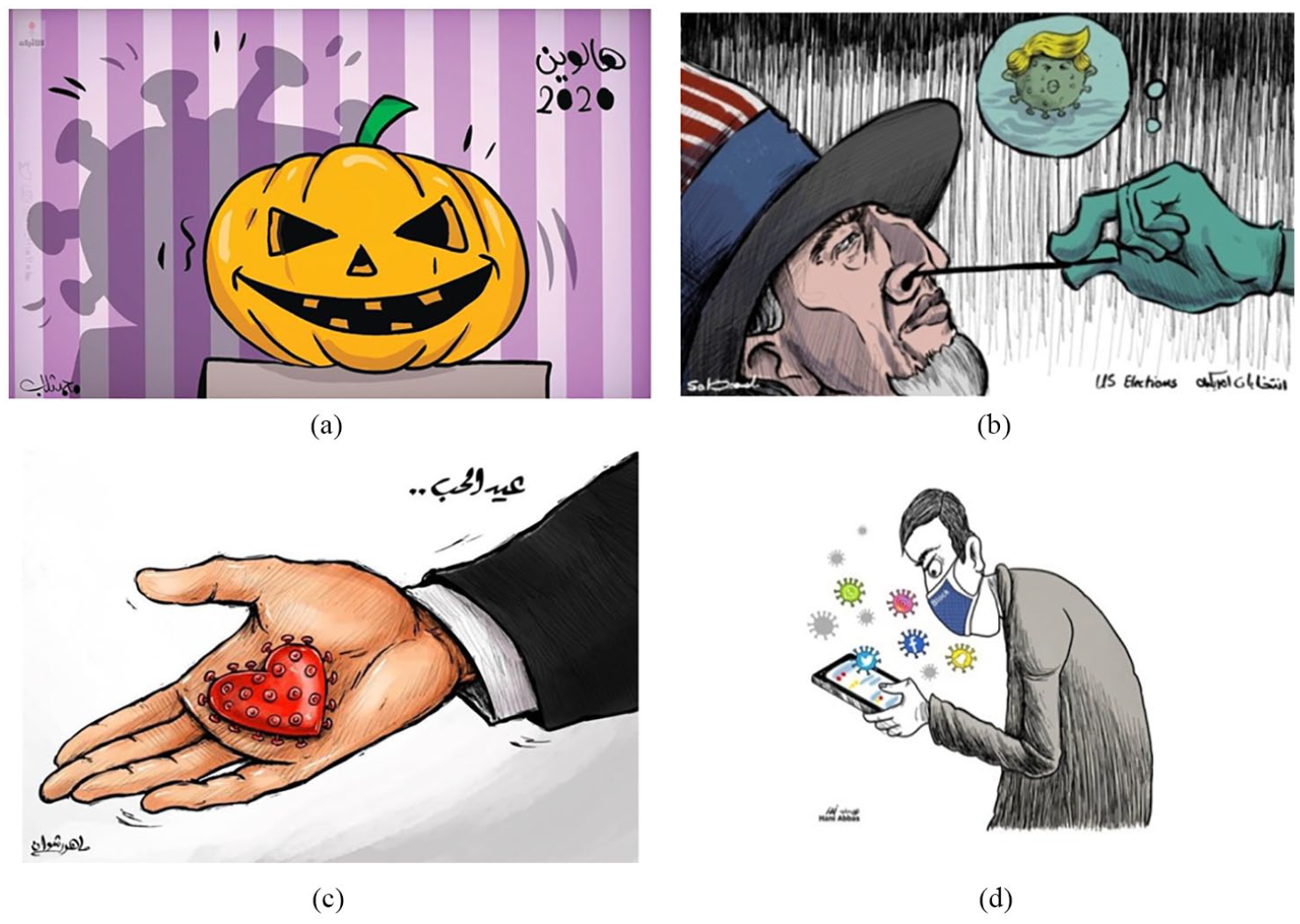
CORONAVIRUS as a metaphorical source domain (2). (a) Tomato Cartoon, Muhammad Thalaab, 20 October 2020. (b) Sabaaneh Cartoon, 4 November 2020. (c) Tomato Cartoon, Maher Rashwaan, 14 February 2021. (d) Tomato Cartoon, Hani Abbas, 16 February 2021.
The metaphor IRANIAN REGIME AS CORONAVIRUS also occurs, but with low frequency. Hypocrites, militant groups, Arab dictators, and American tyranny wielding excessive force with batons are also conceptualized by means of the CORONAVIRUS metaphor. For instance, a cartoon by Amna Alhammadi (Tomato Cartoon, 11 March 2021) depicts corruption, racism, and terrorism as three coronaviruses, with the Earth as a man wearing a face mask and holding a no entry sign. The caption reads: ‘Virulent, untreatable viruses’. Moreover, metaphorical descriptions of an ordinary citizen as a CORONAVIRUS occur frequently in the corpus data (with 12 occurrences), but these have a different meaning (people are more likely to fall seriously ill, and that they must be put under strict Covid lockdown) from, for example, the Trump examples (where the cartoonist is trying to convey the idea that Trump has attacked US democracy, defying the will of the people, and so he must be forced out of office). They are found in cartoons by Egyptian artists Doaa Eladl, Hani Tolba, and Amr Fahmy, among many others.
But there are two potentially sexist cartoons by male Libyan cartoonist Alajili Elabidi. One of those two, published on 23 October 2020, shows a woman seeing herself in the mirror as a coronavirus (WOMAN AS CORONAVIRUS) (a ‘shadow-reflection’ metaphor). The other, published on Facebook on 27 March 2020, depicts an angry housewife with hair that resembles the coronavirus spike protein (HOUSEWIFE AS CORONAVIRUS). The woman is sitting down to eat, hands crossed, while her sad husband is standing about a meter from her with thought bubbles above his head displaying the images of coronavirus and a red love heart. The sign on the dinner table alerts the husband to stay home. One implication here is that husbands must take some precautions against their ‘coronavirus wives’ to reduce exposure and transmission. However, the cartoon hides the fact that the unusual coronavirus effect baffles all women – regardless of whether they are working from home, working outside the home, or not working at all – and that men may bring coronavirus home, thus transmitting infections to their families.
Various other metaphor targets, including POVERTY, RACISM, QURBAN BAYRAM, POLITICAL ASSASSINATIONS, BENJAMIN NETANYAHU, JORDAN’S CABINET, IRAN’S REGIME, THE KUWAITI NATIONAL ASSEMBLY, US-RUSSIAN RELATIONS, THE UNION JACK, THE EUROPEAN UNION, AMERICA’S FAR RIGHT, THE 50 STARS OF THE AMERCAN FLAG, ARABIC DRAMA, RUMOURS, CALENDAR, AWARENESS, SCHOOL BAG, CHRISTMAS, HALLOWEEN, VALENTINE’S DAY, PERSONAL BELONGINGS, and SOCIAL MEDIA PLATFORMS have also frequently been understood in terms of CORONAVIRUS-related concepts (e.g. Figure 5). The shadow shown in Figure 5a, a coronavirus particle, reveals the ‘true nature’ of its caster, a pumpkin (a metonym for Halloween) (PUMPKIN AS CORONAVIRUS) (a ‘shadow-reflection’ metaphor). The cartoon, by male Kuwaiti cartoonist Muhammad Thalaab, was published on 20 October 2020 on the website of Tomato Cartoon. The two objects, pumpkin and coronavirus particle, are also fused into one hybrid visual image (by Sabaaneh, Tomato Cartoon, 1 November 2020) which expresses the metaphor PUMPKIN AS CORONAVIRUS. In another Sabaaneh cartoon (Tomato Cartoon, 30 April 2020), Arabic drama is depicted as a coronavirus-like arm emanating from a television screen (ARABIC DRAMA AS CORONAVIRUS).
Similarly, the cartoon in Figure 5c, by male Egyptian cartoonist Maher Rashwaan (Tomato Cartoon, 14 February 2021), depicts a red love heart as the coronavirus. ‘Valentine’s Day,’ says the caption in the top right-hand corner. Another cartoon by Rashwaan (Tomato Cartoon, 1 March 2021) features a man dressed in rags (PATCHES AS CORONAVIRUS) being injected with a baguette (BAGUETTE AS VACCINE). The same metaphor of PATCHES AS CORONAVIRUS is also used by Doaa Eladl (Tomato Cartoon, 13 April 2020). The caption reads: ‘Coronavirus in Africa, the dark continent’. The belief that Africa, albeit arguably the world’s richest continent in terms of natural resources, has some of the world’s poorest people is used and presupposed as general, socially shared knowledge rather than as subjective belief. It is then important to notice the rich metonymic content of the cartoon: THE DARK SKIN OF THE MAN FOR AN AFRICAN and PATCHES FOR POVERTY.
Furthermore, the Kuwaiti National Assembly is cartooned by Maher Rashwaan as a coronavirus-shaped swivel chair (CHAIR FOR NATIONAL ASSEMBLY; NATIONAL ASSEMBLY AS CORONAVIRUS) (Tomato Cartoon, 19 June 2020). Likewise, the Jordanian cabinet is depicted by cartoonist Rafat Alkhatib (Tomato Cartoon, 10 March 2021) as a coronavirus, where the spike proteins are replaced by rostrums at which the prime minister and ministers swear their oaths of office (JORDANIAN CABINET AS COVID-19). Finally, male Egyptian artist Sherif Arafa cartoons then-US President Joe Biden and his Russian counterpart Vladimir Putin wearing facemasks, marked with their respective national flags, and standing facing each other and maintaining the 2-m physical distancing rule, as indicated by a red arrow. The red arrow bears the words ‘Diplomatic distancing’. The metaphor may be construed as TROUBLESOME ALLY AS INFECTIOUS PATIENT/POTENTIALLY INFECTED PERSON, or as something like BAD US-RUSSIAN RELATIONS AS PHYSICAL DISTANCING. Conversely, reference to physical closeness may indicate good relations. Some might simply suggest that the cartoon, originally published on 23 March 2021 by Tomato Cartoon, is based on the conceptual metaphor LOVE AS PHYSICAL CLOSENESS (Kӧvecses, 1986). But then this may not entirely justify the use of the face masks, the red arrow, and the expression ‘diplomatic distancing’. The cartoonist selected the metaphor at a time when a coronavirus pandemic was sweeping the world. After all, for people to be able to interpret this political cartoon, they need to activate and apply vast amounts of generic and specific (historical) knowledge about politics, US-Russian relations, the Biden-Putin relationship, coronavirus, etc.
In a cartoon entitled ‘Abide (by recommendations from public health officials) to win (coronavirus battle)’ by Amna Alhammadi (Tomato Cartoon, 12 September 2020), two children are shown wearing surgical masks and playing on a ‘face mask’ swing (THE SWING AS FACE MASK) – everyday life with children will also be totally facemasked, even the swing. In two other cartoons (one by Palestinian cartoonist Sabaaneh; the other by Cuban artist Osval), Cupid is depicted wearing a face mask (CUPID AS POTENTIAL CORONAVIRUS PATIENT) and shooting syringes (=vaccines) at people (CUPID’S ARROWS AS SYRINGES). In the time of coronavirus, Santa Claus has also commonly been depicted either as Zooming (SANTA AS PARTICIPANT IN ZOOM MEETING) or as a Covid patient (SANTA AS COVID PATIENT). In other Tomato Cartoon pictures, surgical masks are substituted for Christmas presents (CHRISTMAS PRESENTS AS SURGICAL MASKS). Santa Claus has further been caricatured carrying a green coronavirus-shaped sack of presents (SACK OF CHRISTMAS PRESENTS AS CORONAVIRUS); the white bobble on top of his red pointed hat has also been replaced by a coronavirus particle (POMPOM AS CORONAVIRUS). The evening before the Muslim festival of sacrifice, Eid al-Adha or Qurban Bayram, artists like Doaa Eladl and Muhammad Thalaab also cartooned a ram as a coronavirus (RAM AS CORONAVIRUS). Furthermore, a cartoon by Naser Jafari (Tomato Cartoon, 25 February 2021) depicts a tear-off calendar hanging on a wall, with a man tearing off a sheet every day. Each sheet of the calendar is marked with the coronavirus (DAY AS CORONAVIRUS). At a time when the United States was a hotspot for coronavirus, Tomato Cartoon published a Doaa Eladl cartoon of the US flag, with coronavirus particles instead of the stars. This instance fits Forceville’s definition of a contextual metaphor, in the sense that it is based on the replacement of an anticipated entity (the US stars) with an unexpected one (the coronavirus particles) (but see El Refaie, 2019). The import of all these cartoons (i.e. their message) is that a major Covid-19 crisis means social consequences human beings never foresaw and painful shifts from their everyday habits and practices to unusual and digital ones – what citizens miss most in a crisis is each other, as also suspected by Guardian columnist Gaby Hinsliff. Cautioning against reopening schools, cartoonist Ahmed Rahma (29 October 2020) also caricatures a primary school pupil carrying a coronavirus-like bag (SCHOOL BAG AS CORONAVIRUS). At work in a cartoon by male Latvian artist Zemgus Zaharans (Tomato Cartoon, 23 July 2020) is also the SCHOOL BAG AS CORONAVIRUS metaphor.
Finally, in two cartoons by Syrian-Palestinian cartoonist Hani Abbas, the logos of Facebook, Twitter, Instagram, Snapchat, Tumblr, WhatsApp, and other social media platforms (LOGO FOR COMPANY) are portrayed as coronavirus particles. For instance, Figure 5d depicts a young man using a mobile phone from which emanate social media coronaviruses (SOCIAL MEDIA CHANNELS AS CORONAVIRUES) and wearing a blue face mask reading ‘Block’ (BLOCKING AS FACE MASK). There is initial evidence that overall use of social media affects mental health. In particular, nighttime-specific social media use is associated with poorer sleep quality, lower self-esteem, and higher levels of anxiety and depression (e.g. Scott et al., 2021; Scott and Woods, 2018, 2019; Woods and Scott, 2016).
The sheer frequency of occurrences of CORONAVIRUS metaphors (35.2%) is in itself regarded as evidence of the role of physical events and circumstances in shaping what people know and how they think about the world. These findings have certain implications for a variety of issues both for conceptual metaphor theory (CMT), according to the standard version of which metaphors arise from embodied experience, and the study of multimodal discourse and human cognition in general. For an especially powerful theory of metaphor, I, following Kӧvecses (2020), claim that the creative role of contextual influence needs to be recognized and social, pragmatic, and emotive functions should be added to metaphorical conceptual content.
Conclusion and future directions
The aim of this paper was to show how new viruses and diseases such as Covid-19 may influence people’s social-political understanding, especially metaphorical conceptualization. This turned out to be a serious and regrettable gap, given the then (still) focus of coronavirus studies on metaphorical descriptions of the pandemic, especially as a war. I tested my hypothesis using a large-scale corpus of Arab political cartoons. Not only did I find strong evidence to support the hypothesis, but I also identified some pictorial metaphors in political cartoons that did not fit into any of other scholars’ taxonomies, including instances of what I called ‘metaphsimile’ and ‘shadow-reflection’.
This research adds to the very small but growing literature on the production aspect of metaphor use. In Kӧvecses’ (2020) words (p. 93), this aspect ‘has [in fact] received hardly any or, in any case, a lot less attention over the years in CMT’. Worse, CMT’s tendency to focus on the embodied aspect of metaphors and to have less interest in their socio-cultural dimension is one of the reasons why research on the closely related trope ‘symbol’ is scarce (Forceville, 2013; see also El Refaie, 2017). Moreover, raising awareness among health professionals, psychologists, and social scientists of the powerful role of both verbal and non-verbal metaphors in shaping social behavior, how people think and act, and possibly also how human brains are structured cannot be overestimated (El Refaie, 2019). More importantly, a new virus or disease does not just attack the human body but changes the way we understand our world. Indeed, using the pandemic as a metaphor imposes horror on other things (see also Sontag, 1989).
Footnotes
Acknowledgements
I would like to thank Brigitte Nerlich, who provided particularly valuable feedback which shaped the final version of the article. But it remains the privilege of the author to be solely responsible for all mistakes and controversial opinions.
Declaration of conflicting interests
The author declared no potential conflicts of interest with respect to the research, authorship, and/or publication of this article.
Funding
The author(s) disclosed receipt of the following financial support for the research, authorship, and/or publication of this article: The work on this research was made possible by a grant to the author from the University of Bremen (CRDF-Positions No. 23 and 24).