




Abstract
In this article, we explore how the discourses around gender are evolving at the core of Brazilian politics. Our focus lies on the discourses at the public hearing on the bill 3.492/19, which aimed at including “gender ideology” on the list of heinous crimes. We aim to identify the deputies’ linguistic representation of social actors as pertaining to in- and outgroups. In addition, the article analyzes through Critical Discourse Analysis how the terminology gender is represented in this particular hearing. The analysis shows how some of the conservative parliamentarians give a clearly negative meaning to the term gender, by labeling it “gender ideology” and additionally connecting it with heinous crimes. We propose that the re-signification of “gender ideology,” from rhetorical invention to heinous crime, is not only an attempt to undermine scientific gender studies but also a way for conservative deputies to gain more political power.
Keywords
Introduction
Recently, right-wing politicians throughout the world have been using the concept of gender synonymously with “gender ideology,” which has strong negative connotations in their discourses (Corrêa and Kalil, 2020). In Brazil, many parliamentarians from conservative right parties continuously launch bills and laws where the term gender is filled with any (negative) meaning that may be appropriate for their political goals. For instance, gender may be associated with anti-Christianity and Marxist indoctrination (Junqueira, 2017, 2018; Lionço et al., 2018). The idea of a threatening “gender ideology” is used as a strategy to attack policies that defend sexual diversity and extended women’s rights (Kalil, 2019).
In this paper, we examine a 50 minutes long discussion about the term “gender ideology” at a public hearing 1 in Brazil, on December 10th, 2019 concerning the bill 3.492/19, which aimed at including “gender ideology” on the list of heinous crimes, alongside with murder of children and adolescents. 2 The bill, which was authored by Bia Kicis, Carla Zambelli and Eduardo Bolsonaro (all from the extreme right-wing party PSL), was proposed as a response to the assassination of the 9-year-old boy Rhuan Maycon 3 committed by his mother and her girlfriend on May 31st, 2019. Two years earlier, the boy was emasculated at home without any anesthesia. The mother Rosana and her partner Kacyla said, when asked by a police officer, 4 that Rhuan wanted to become a girl and they decided to help him. The assassination of the boy occurred, according to Rosana and Kacyla, because the boy had become a hindrance for their relationship. 5
One month after the assassination of Rhuan, deputy Filipe Barros (PSL) called for a public meeting at the Commission of Human Rights and Minorities to discuss how the state could prevent future crimes similar to the one committed against Rhuan. At this meeting, some conservative right-wing deputies called the assassination of the boy a “gender ideological crime.” Deputy Carlos Jordy (PSL) said: “The perception that we parliamentarians have here is that this is a crime involving the issue of gender, it is a crime involving the ideology of gender. Maybe that’s why it’s not being reported in the mainstream media.” 6 Following a similar line of thought, deputy Júnior Bozzella (PSL) declared: “In my view, this is a crime of homophobia in reverse. For me this is a crime of gender ideology.” 7 Deputy Marcel van Hattem (NOVO – right) declared that it was unfortunate that the “human rights people” were not present at that public meeting. The reason for this absence, he said, was due to the fact that the victim’s life was “taken by a couple of homosexuals.” 8 Finally, deputy Bia Kicis (PSL) highlighted that “the cruelty of gender ideology” was the major cause of the crime. On June 12th, 2019, Kicis and her party colleagues Zambelli and Eduardo Bolsonaro authored the bill 3.492/19.
Before any bill is voted, a public hearing organized by the Commission of Constitution, Justice, and Citizenship (CCJC) 9 is required. Previous to that public hearing, two left-wing deputies, Petrone (PSOL) and Ananias (PT) opposed to the content of the bill and asked CCJC to call for a vote for its removal from the day’s agenda. The discussions around the removal or the approval of the bill 3.492/19 are explored and analyzed here.
It is important to highlight that this is not the first time Brazilian parliamentarians table anti-gender bills. In 2015, for instance, a bill (3235/2015) was authored by pastor Marco Feliciano (PSC – Christian conservative right), who intended to eliminate from educational-pedagogical materials expressions such as “sexual orientation, gender identity, gender discrimination, gender issues and similar”, as well as prohibit the publication of guidelines, plans and programs that intended to disseminate, encourage or induce “gender ideology”. 10 At the time of writing this article, there are more than 15 anti-gender bills being processed in the National Congress. Eight of them were presented in the first half of 2019. 11
The reason why we chose to focus on the particular bill 3.492/19 is that it is the first bill that actually aims to include “gender ideology” on the list of heinous crimes, even though the deputies that authored the bill never attempted to define the term. The expression “gender ideology” has been embraced by Brazilian far-right politicians for a long time (Corrêa and Kalil, 2020) but now, the term could be given an even more decidedly negative meaning once connected to heinous crimes. The attacks against “gender ideology” would no longer be merely rhetorical but also result potentially in legal punishment.
The aim of this article is to explore through Critical Discourse Analysis (i.e. van Dijk, 1995, 1999) how Brazilian (ultra)right-wing deputies build their discourses around the notion of gender. To do that we focus on how social actors and actions are represented and how this representation contributes to the construction of in- and outgroups (van Dijk, 1999). The analysis includes the discursive aspects of political (de)legitimation, the general basis of norms and values, argumentation resources, and some semantic strategies. By analyzing discourses pronounced at the Chamber of Deputies, we may understand important aspects of parliamentary action. The issues debated by the deputies and the discourses in those debates can reflect their priorities and ideological positions as well as the expectations of those who voted for them (Miguel et al., 2017). In this way, we propose that the re-signification of the term gender as heinous crimes is a way for conservative deputies to gain even more political power.
A brief context on the origins of the term “gender ideology”
Although there is some disagreement regarding when the term “gender ideology” was first introduced, the prevailing version is that the expression appeared in conjunction with the Fourth World Conference on Women in Beijing in 1995 (Corrêa, 2017, 2018, 2020). At that time, the notion of gender was employed by feminist activists and official countries delegations, to talk about the situation of women and their reproductive and sexual rights (Francoise, 2008). But for the clergyman Revoredo, the Conference in Beijing was the birthplace for a “campaign” to disseminate the “revolutionary” vision of “gender feminists,” which posed a threat to humanity (Revoredo, 1998: 1). From that moment the expression “gender ideology” gained popularity within the highest leadership of the Catholic Church (Rosado-Nunes, 2015: 1246). The attacks against gender hence started as “a Catholic counteroffensive to the UN Conference in Beijing” (Miskolci and Campana, 2017: 738). According to Butler (2004: 185), the Vatican wanted to reaffirm biological differences between women and men and reinforce the roles assigned to them traditionally.
Junqueira (2018) sustains that although the term “gender ideology” is a Vatican invention, it also seems to be a strategy adopted by the conservative sectors of society to fight advances of social rights, sexual and reproductive rights in particular. One important conservative actor in this context is the American journalist and writer Dale O’Leary. O’Leary (1997) equals feminists to Marxists and describes feminism as an ideology that disrespects biological differences and strives for “the abolition of human nature.” Another important conservative social actor is the evangelical groups, who adopted the term “gender ideology”, in the Brazilian context, “as an accusation category related to the teaching of gender and sexuality, especially in public schools” (Kalil, 2019: 116).
As early as 2003, during the government of Luis Ignacio Lula da Silva, the catholic deputy Elimar Máximo Damasceno (PRONA – right-wing party) proposed the suppression of the expressions ‘gender and sexual orientation’ in the bill 007/2003, with the following justification: Gender and sexual orientation’ are neologisms to consecrate homosexuality, which is contrary to the traditions of Brazilian society. The homosexual person deserves the same respect as every human being, but homosexuality or its apology cannot be backed by the state.
12
In 2005, Damasceno proposed the creation of a psychological support project for people who decided to “voluntarily leave homosexuality” (bill 5.816/2005). 13 Since then, many other Christian politicians have intensified their actions in the National Congress against gender perspectives in the field of education, health, and Human Rights (Lionço et al., 2018; Machado, 2018).
Brazil has experienced a confrontation on the one hand, between feminists and LGBT+ movements, and on the other hand Christian segments, a confrontation that replaces “the ancient dispute between the religious and scientific spheres about truth and/or how to think about human relations and the social order” (Machado, 2018: 1). It is a dispute about meanings, in which social actors in the religious sphere appropriate certain ideas from the scientific field to give the moral authority to conservative Christians to define the social and legal standards of society (Machado, 2018: 1).
The book Gender Ideology: Neo-totalitarianism and death of the family, published in Brazil (2012) by the Argentinean catholic lawyer and bioethics teacher Jorge Scala argues, among other things, that gender theories are not more than ideologies. Moreover, Scala (2012: 11) sustains that “gender ideology” is the “most radical ideology of history, since, if imposed, it would destroy the human being in its innermost core and at the same time would end society”. According to Butler (2017), this might have been the turning point for how gender is understood by the conservative right in Brazil and Latin America.
Miskolci and Campana (2017) states that the term “gender ideology” became widely spread in Brazilian society as a response to Federal Supreme Court (STF), who recognized that gay marriage had the same status as heterosexual marriage. The campaign against “gender ideology” intensified when Jair Bolsonaro (no party at present) ran for president. In his speech on the inauguration of the presidency on January 1, 2019, he stated: We are going to unite our people, embrace the family values, respect the religions and our Judeo-Christian tradition, fight against gender ideology, while preserving our values. Brazil will become a country free from ideological ties.
14
Bolsonaro’s rhetoric is the total rejection of what he as well as many (ultra)conservative social actors call “gender ideology.”
The composition of the Chamber of Deputies and the relevance of its parliamentarians
The Brazilian Chamber of Deputies has 513 members elected democratically. The deputies are responsible, between other things, for writing, approving, or banning bills; supervising the use of public resources; and legislating on matters of national interest. 15
Based on the foundation that the discourses of the deputies reflect their ideological positions, it is crucial to present the composition of the Chamber of Deputies with regard to the representation of political parties and their ideological alignment (Table 1). We follow the classification of political parties made by the Inter-Union Department of Parliamentary Advice (DIAP, 2019). 16 We are aware that the political space is more complex than the dichotomous separation between left and right. Since the 2016 impeachment process against the then-president Rousseff, the traditional political establishment appears to be in decline in Brazil (Kalil, 2019). Parties such as the third-largest PSDB (Brazilian Social Democracy Party), which is traditionally identified as right-wing is now commonly identified as “extreme left” or accused of being “communist” by Bolsonaro’s supporters (Kalil, 2019: 17). Albeit aware of these ambiguities in the perception of the Brazilian political parties, we decided to use the traditional denomination “right” and “left” poles for most of the parties (for further reading on this matter see, i.e. Madeira and Tarouco, 2013a, 2013b; Ducroquet, 2019; Vasconcellos, 2019). Because of its ultraconservative agenda, the Social Liberal Party (PSL) has been classified as an extreme right-wing party throughout this whole work. The main characteristics of the extreme right in Brazil are the idea of the Christian family as the guarantor of moral values (Mudde, 2019); the repressive ideology expressed by the cult of police violence (Löwy, 2015); the rejection of democracy and the growth of the demand for the return of the military dictatorship (Chauí, 2016); the hatred of human rights (Ribeiro, 2015) and the exclusion of gender discussions from the school curriculum (Faganello, 2015).
Composition of the members of the Chamber of Deputies in 2019 according to their ideological alignment.
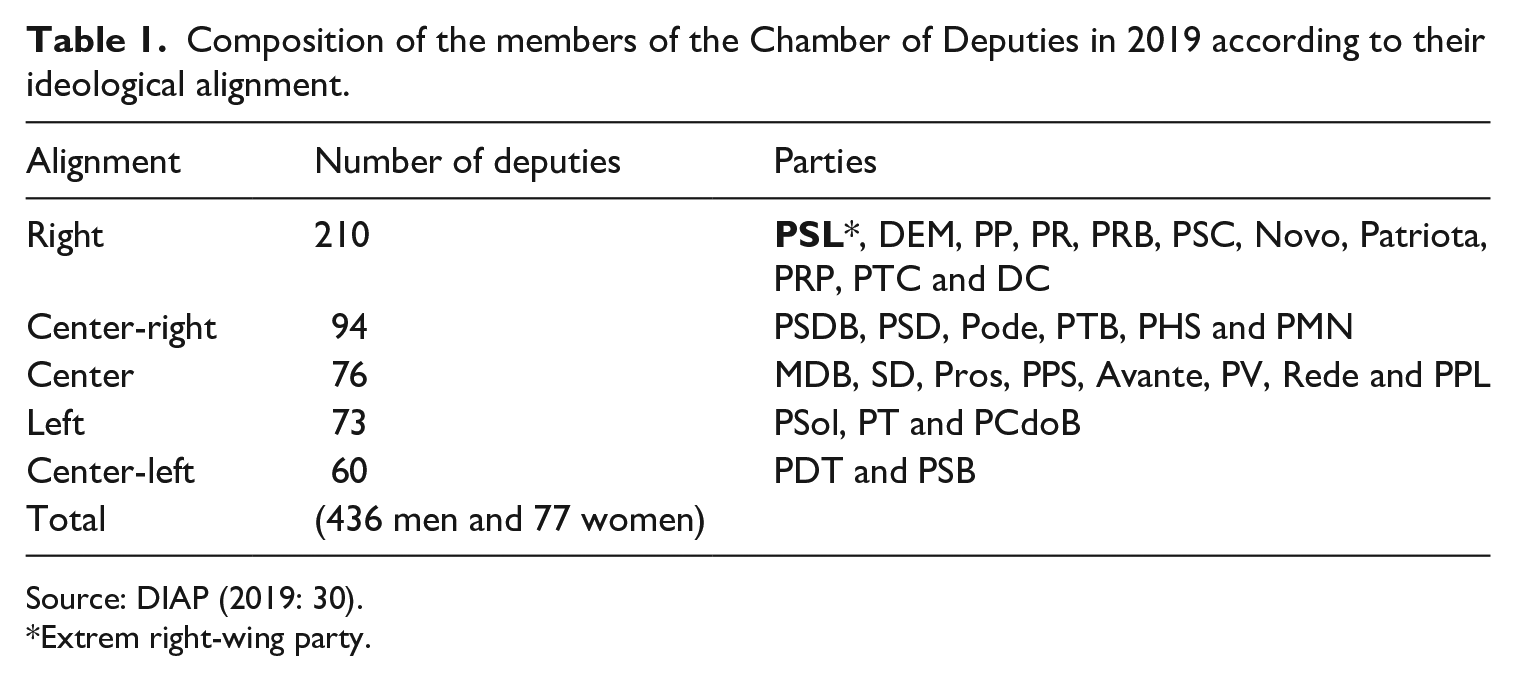
Source: DIAP (2019: 30).
Extrem right-wing party.
It is relevant to mention that besides the party affiliation, there are also supra-party blocs, which are common interest groups independent of political parties. These groups have the objective of seeking to influence decisions in favor of the public policies they defend. At present, there are seven such groups: Business, Relatives, Union, Female, Rural Caucus (also called Beef), Evangelical (also called Bible) and Security (also called Bullet), in Portuguese known as the BBB blocs: ‘Boi (Beef), Bíblia (Bible) and Bala (Bullet)’. These last three blocs, composed by 223 deputies, strengthened and grew, due to the fact that their ultra conservative political agendas are supported by President Bolsonaro (Prandi and Carneiro, 2018 and Quadros and Madeira, 2018). For a more developed analysis on the extreme contours politics assumed in Brazil in the last few years, see (Faganello, 2015; Viana, 2015).
Theoretical and methodological framework
Critical Discourse Analysis (from now on CDA) is “a type of discourse analytical research that primarily studies the way social power abuse, dominance, and inequality are enacted, reproduced and resisted by text and talk in the social and political context” (van Dijk, 2001: 352). There is a general consensus that CDA should be seen as an approach that includes different theoretical and methodological perspectives and not as a single method (i.e. Chilton, 2005; Chilton and Schäffner, 2002; Fairclough, 1995; van Dijk, 1993, 2009 and Wodak, 2001). Based on this foundation, the methodology of this study is grounded on a multidisciplinary theoretical framework pertaining to discourse, society, and social cognitions such as beliefs, values, and ideologies. The conceptual notions of discourse, ideology, and power are essential to this approach.
Discourse is here understood as social practice or a dialectical relationship between social actors and social realities (Fairclough, 1992). As the discourses analyzed here take place in a parliamentary arena, it is relevant to place them in the scope of political discourses. From the interactional viewpoint of discourse analysis, political discourses have to be located in the public sphere, where not only the politicians participate in the communication but even various actors, such as the voters, the citizens, and other groups in the society (van Dijk, 1997). In a parliamentary arena, political issues, ideological definitions, and discursive practices are constructed and legitimated (Dörner and Vogt, 1995). Political discourses are therefore a form of social action and, as Giménez’ (1981: 126–127) suggests, “it is not so much aimed at ‘convincing’ the adversary, as traditional rhetoric implies, but at recognizing, distinguishing and confirming supporters and attracting the undecided”, even more in polarized environments.
Another central conceptual notion for CDA is ideology, here understood as: basic frameworks of social cognition, shared by members of social groups, constituted by relevant selections of sociocultural values, and organized by an ideological schema that represents the self-definition of a group. Besides their social function of sustaining the interests of groups, ideologies have the cognitive function of organizing the social representations (attitudes, knowledge) of the group, and thus indirectly monitor the group-related social practices, and hence also the text and talk of members (van Dijk, 1995: 248).
Power is about relations of difference, and particularly about the effects of differences in social structures: who takes the floor, who controls, who defines what is good or bad? (Wodak, 1989; Wodak and Meyer, 2015). “Language only gains power in the hand of the powerful; language is not powerful ‘per se’” (Wodak, 1989: xv). The way power relations are exercised and negotiated through text and talk is very important for CDA, for instance how relationships to others are articulated in discourse and how interests are defended and legitimated.
This way of understanding ideology and power allows us to engage in critical discourse analyses that examine the ways ideologies may be expressed more systematically. To engage in this kind of analysis we need to be clearly aware of the properties in discourse that express opinions, perspective, positions, or any other discursive resource that represents a conflict of interests articulated with an us (ingroups) versus them (outgroups) dimension (van Dijk, 1995: 22). The polarization of us and them characterizes shared social representations and their underlying ideologies (van Dijk, 1998). Positive Self-Presentation of the dominant ingroup and Negative Other-Presentation of the dominated outgroups can be found in all levels and structures of text and talk, for example in contrastive topics, local meanings, syntactic forms, lexicalization, metaphor, and hyperbole (van Dijk, 1993, 1998). In addition to these general discourse strategies, there are also other important analytical dimensions to be mentioned:
Semantic strategies
Discourse meaning realizes underlying beliefs and ideologies of speakers. The semantic strategies used to represent us and them should therefore be accentuated. The ideological-political discourse will: Emphasize positive things about us. Emphasize negative things about them. De-emphasize negative things about us. De-emphasize positive things about them (van Dijk, 2000).
Actor description
The representation of social actors (van Leeuwen, 1996) has been incorporated into this work and may help us to see the strategies used by the deputies to make the representation of in- and outgroups. The fundamental categories are exclusion and inclusion, within which other sub-categories take shape. For instance, the Left may be included or excluded from the debate on gender, they may be represented in specific or more general terms, named negatively or positively or even unnamed (van Leeuwen, 1996).
De(legitimation)
The concept of (de)legitimation (van Leeuwen, 2008: 105–106) contributes to explaining how political actors build strategies to reinforce their discourses. The two categories of (de)legitimation 17 suggested by van Leeuwen, that are relevant to this study are: authorization, that is, the legitimation by reference to the authority of tradition, custom, law, and/or persons in whom the institutional authority of some kind is vested, and moral evaluation, which is the legitimation by reference to value systems.
Argumentative structures
The purpose of argumentation is to resolve a difference of opinion “by means of exploring the relative justification for competing standpoints” (van Eemeren et al., 1987: 218). Argumentation plays a functional role in political discourses as they are conducted between parties that not rarely are in opposition. Arguments and the various strategies of supporting them presuppose shared sociocultural knowledge, beliefs, and attitudes about Self and the Other (van Dijk, 1997: 42). More concrete argumentative categories are i.e. exemplification, disclaimer, and fallacy.
Counterfactual arguments
Argumentative moves based on imaginary situations, normally constructed for the purpose of better predict expected negative consequences that are used to persuade the audience of the necessity of specific policy measures. Counterfactuals are frequently formulated in ‘if . . . then . . .’ sentences (van der Valk 2003: 320).
We have particularly focused on the discourse-analytical dimensions of the data under study. Other structures are considered as far as they fulfill a supportive function.
Analysis and discussion
We start the analysis with a more overall view about the reasons why the deputies wanted or not wanted the withdrawal of the bill 3.492/19. The majority of the parties who opposed the bill argued that the text had to be reformulated due to inconsistencies in relation to the Brazilian Penal Code, for instance, the proposed penalty of 50 years for the crime, when the highest penalty in Brazil is actually 30 years. Ananias and Misasi (PV – center) raised another problem: the lack of consensus about the meaning of “gender ideology.” Deputy Petrone (PSOL – left) focused upon another problem, that in her opinion was a major one, namely the fact that the authors of the bill ignored scientific studies on gender.
The deputies who wanted the bill to be approved, in its majority, presented reasons related to the preservation of moral and ethical values within the Brazilian society. For these deputies and from a critical discursive perspective, the bill is legitimated by moral evaluation (van Leeuwen, 2008). It is possible to assume that these parliamentarians want to impose rules of moral decency of persons. Deputy Orleans e Bragança (PSL – extreme right) for instance, emphasized the subversion of moral values and the importance of protecting family. Zambelli (PSL) highlighted that the bill intended to preserve good moral values in society. We can see an ideological conflict, that consists of the antagonism about how the deputies understand the notion of gender.
It is interesting to observe that even though the extreme right-wing deputies want a controversial terminology to be included in the Brazilian Criminal Code, they never attempt to develop a comprehensible definition of the expression in the text presented at the CCJC. The deputies seem to assume that there is no need to do it as if the term was already well established in society. One could also hypothesize that these parliamentarians want the expression to remain as open as possible so that it can be filled with the meaning that most fits their political agenda. “Gender ideology” would remain as Kuhar and Zobec (2017) said a “multi-purpose enemy, which can be shaped in different ways to fit into the concrete goal of a political protest” (Kuhar and Zobec, 2017: 31).
The vote finishes when deputy Pedro Lupion (DEM – center), who is the main responsible for formulating the bill, agrees with its withdrawal from the agenda, sustaining that he would change the text “making it clear that the typification would be in the case of murder, torture and private imprisonment motivated by gender ideology, that is, not the criminalization of gender ideology itself.” 18 Lupion, hence, continues to connect “gender ideology” with crimes.
As a matter of fact, during the discussions, deputy Enrico Misasi (PV – center) asks his fellow deputies to better explain what they mean by “gender ideology.” Misasi called the term “vague” and sustained that he was concerned that if the deputies did not clarify its meaning, the Supreme Federal Court would do it instead. 19
Although some parliamentarians seek to find a consensual definition of gender, to be used in the context of the creation of projects, bills, and laws, others try to re-signify the terms according to what they believe is correct. This attempt of defining or adapting terms occurs when the deputies present their ideological positions about social actors and actions. The use of semantic strategies helps us mapping the way social actors and actions are represented as they are construed in the texts that we analyze. It is therefore important to show how actors are inscribed as in- and outgroup in the discourses of the deputies, while they express themselves about gender. Table 2 summarizes the main semantic features that the deputies present in the construction of opposing groups:
Representation of ingroup and outgroup.
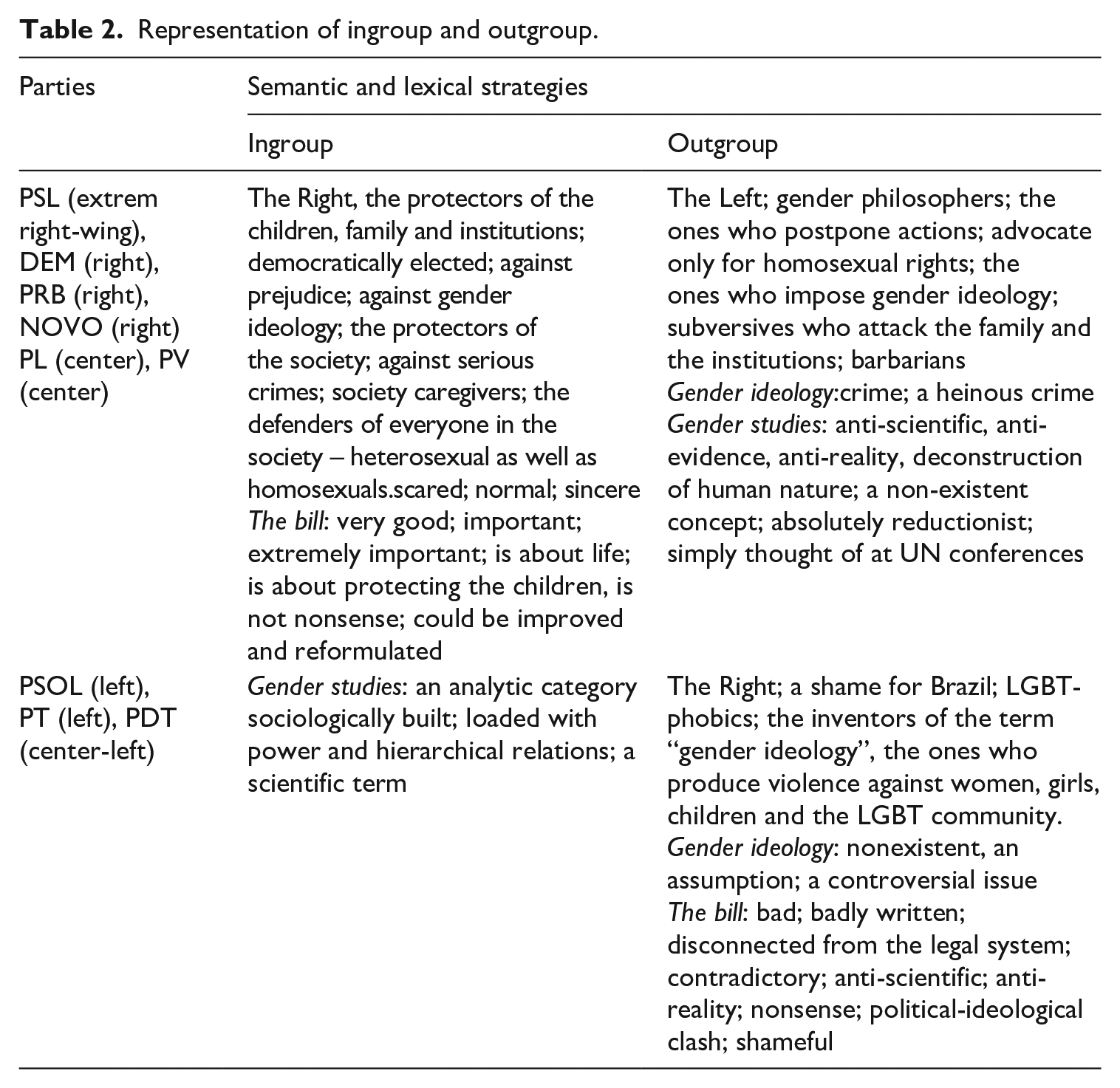
When it comes to semantic roles of propositional arguments (i.e. Agent, Patient), the right-wing and extreme right-wing deputies represent themselves as agents of positive acts and non-responsible patients of negative acts of the Other. The left-wing deputies prefer not to focus on their own acts, instead, they concentrate on the negative acts of the Right. Concerning the selection of word meaning through lexicalization, the representation of outgroups is loaded by evaluations, which serve the purpose of indicating the low moral or ethical level of the Other. Both right- and left-wing deputies make the representation of the outgroup as deviant, shameful, prejudiced and subversive.
The left-wing deputies try to delegitimize the expression “gender ideology” sustaining that instead of debating on a nonexistent term, they should be focusing on well-established scientific studies on gender. But, this legitimacy is questioned by the deputies of the ultra-conservative party PSL, which means that gender studies should be seen with skepticism and “gender ideology” as a legitimate expression that stands, in this case, for crime.
In what follows we present the discourses of the deputies more broadly and we provide an analysis that shows more in-depth the way the deputies construct their points of view and the representation of social actors. We start with examples 1 and 2 as follows
20
(see attachment 1 for the originals): (1) (2)
In examples 1 and 2, deputies Petrone (PT – left-wing) and Kicis (PSL – extreme right-wing) use semantic resources to construct their standpoints on gender through judgment and evaluations. In example 1, deputy Petrone tries to validate gender studies by incorporating authorized voices, such as scientific studies and statistics that legitimate (van Leeuwen, 2008) her position. “Gender ideology”, she says, does not exist, but it is a concept created by those who do not know better. Likewise, Petrone affirms that historical and cultural inequality produce violence against women in Brazil.
On the other hand, deputy Kicis (PSL – extreme right-wing) constructs her discourse by selecting word meanings that represent her ingroup as protectors of the victims and who have to fight against the acts of the ‘outgroup’, namely, the left and/or the deputies who defend scientific studies on gender. Kicis uses the adjective [scared], to describe the impact that the arguments presented by deputy Petrone had on her. Gender, according to Kicis, is nothing more than “gender ideology”, which is the same as “[turning] a boy into a girl.” The deputy construes her argument on the basis of the assassination of Rhuan and she re-contextualizes the whole concept of gender as something abnormal, that can lead to monstrous crimes. We can see in this discourse, the way deputy Kicis introduces the idea of moral panic (Cohen, 2011), by sustaining that “while some philosophizes and asks for more time to study the case, another child may be being murdered”.
Examples 3 and 4 show how the deputies Petrone (PSOL – left-wing) and Tonietto (PSL – extreme right-wing) present their viewpoint creating differences among in- and outgroups, through a particular perspective that reinforces that their own way of seeing gender is the valid one.
(3) (4)
From both sides there is a predominance of terms that encode (de)legitimation of authority (van Leeuwen, 2008) such as “anti-scientific”; “anti-evidence”; “anti-reality”, expressions used by both Petrone and Tonietto. Petrone reinforces the statement that the right “invented the term gender ideology” to “dialogue with common sense.” The implicit message is, everybody else knows about the scientific consistency behind gender studies, and so should you.
Tonietto replies by saying that gender theory (singular) is already deconstructed by the medical association. The right-wing deputy reiterates the same terms used by Petrone, in order to discredit her arguments. In her sayings, “gender theory is totally anti-scientific; anti-evidence; anti-reality; has no support in science; (stands for the) deconstruction of human nature; (has) no scientific endorsement; (is) not even an accepted concept; absolutely reductionist.” Deputy Tonietto uses what Garbagnoli (2014) calls “labeling strategy”, which means a deformed way of making the representation of the Other. The deputy distorts, stigmatizes and delegitimizes the work created in the field of Gender Studies naming it “gender ideology” and connecting it with negative epithets.
Tonietto also takes the opportunity to praise her own party PSL which, according to her is “against prejudice”; yet, she exclaims that PSL is against “gender ideology.” The two sentences fit perfectly in the sense that it is appropriate for a right-wing deputy, from a moral and traditional point of view, to be in opposition to “gender ideology.” Another reading would be that Tonietto is actually redefining what prejudice is, once she is saying that “gender ideology” can be prejudiced against boys who want to be boys; against traditional families.
To put Tonietto’s assertions in a broader perspective, it is important to mention that there are other important social actors in the Brazilian society that sustain similar ideas. As an example, we can mention the Brazilian Minister of Foreign Affairs Ernesto Araújo, who said in a public hearing that “gender ideology is a harmful ideology because it contradicts science, which has proven that there are only men and women.” 21
Moreover, deputy Tonietto declares that “gender theory is a deconstruction of human nature, loved and created by God.” This argumentative line on gender is similar to that used by the Vatican and conservative social actors, such as O’Leary (1997). Deputy Tonietto also says that gender theories were designed by an external actor, namely the UN. According to Serrano-Amaya (2019: 158), this narrative associates the use of the term “gender ideology” with “a project of feminism oriented to erase the ‘natural’ sexual difference as a social foundation, and to impose it in a global order promoted by international organizations.” In this way, it is reiterated “a record of suspicion, falsehood, threat, and colonialism that often appears in the ‘gender ideology’ literature” (Serrano-Amaya, 2019: 158).
Example (5) shows how deputy Pedro Lupion (DEM – right) tries to defend the idea (as he portrays) behind the project, which is not according to him, to put “gender ideology” on the list of heinous crimes; even though, the bill effectively proposes the modification of the “Article 1 of Law No. 8072 of July 25, 1990, to include murder against child and adolescent
(5)
Lupion states that those opposing the bill did not really understand what it is about. The opponents to the bill, Lupion means, exaggerate when they affirm that the purpose of the bill is to classify “gender ideology” as heinous crimes. The term “gender ideology” is presented as a synonym to “sex change” and even something that is harmful to innocent children, who are not able to defend themselves. In this way, the expression can be explained as an umbrella term or a “symbolic binder” (Serrano-Amaya, 2019: 158) that creates a shared meaning among large audiences. At the same time, it can also be understood as an “empty signifier” (Kuhar and Zobec, 2017), “since it contains a great variety of elements that can articulate the action of a political subject that was not present before in the public debate” (Serrano-Amaya, 2019: 158). The example above shows how deputy Lupion shapes the term “gender ideology” with a signifier that fits his conservative political agenda, that is, to classify “gender ideology” as a heinous crime.
Another example of the plasticity of the meaning of “gender ideology” is the one shown in the example 6: (6)
The main author of the bill, deputy Zambelli (PSL – extrem right-wing) tries to defend the bill by presenting the idea that even the LGBT+ community would benefit from it. It is interesting to point out that many of the deputies, who defended the bill 3.492/19 highlighted the fact that the two women, who committed the crime and who are lesbians, followed some kind of “gender ideology” agenda. That would be the main reason why the crime against Rhuan happened in the first place. In example (6), the deputy construes her discourse on the basis that the imposition of “gender ideology” is not only when homosexual parents want their children to change sexes and kill them for that, but even when “normal” parents (meaning heterosexual parents) force their children to remain heterosexuals and if not, kill them. The fact that Zambelli evaluates heterosexual parents as “normal” reinforces her criticism toward the “deviant” group, namely the homosexuals. The ingroup (PSL – extreme right-wing) is presented as a community that is free from prejudice, and the outgroup (the Left) is invited to become as tolerant and accepting as the Right, by voting yes for the project. The strategy used by deputy Zambelli is to sustain that the Left is immoral and tends to defend homosexuals to a greater extent than heterosexuals. She builds a scenario with a counterfactual argument (van der Valk, 2003), based on an imaginary situation where the murderers are heterosexual parents who cannot accept their children’s homosexuality. At the end of her speech, one might get the impression that the bill 3.492/19 is actually a project that opposes prejudice and could potentially protect members of the LGBT+ community. It seems that anything can fit in the concept of “gender ideology.” Zambelli gets the approval of the president of the (CCJC) Francischini (PSL - extrem right-wing), who evaluates the bill in the following way: “It is a very good project. That is why it is on our agenda, Mrs. Carla. Congratulations on the project!”
The reaction of Patrus Ananias (PT – left) comes quickly. See example 7: (7)
Patrus wants Zambelli to elucidate what she means by highlighting “gender ideology” as a crime and her first reaction is to deny that it is so. Zambelli implies that “gender ideology” has to be fought, because homosexual parents killed a child trying to change his sex. Then, the deputy uses a disclaimer [we do not want to criminalize gender ideology. . . I’d like to. . . but not on this project] to finally agrees that she wants to criminalize “gender ideology”, which makes many deputies laugh, including herself. This last statement is then replied by Ananias with a rhetorical question “It’s embedded in the bill then, isn’t it, Deputy?”
The discussion confirms the polarization between the two groups (Left and Right), since the deputies and their party colleagues have opinions about gender that oppose them to each other. This conflict becomes even clearer when Zambelli insists that the Left is eager to defend homosexual rights. If so, Zambelli argues, then the Left should also defend the homosexuals now because heterosexual parents could also commit the same kind of crime. Zambelli, once again, appeals for a counterfactual argument.
In example 7, the deputy changes the way she evaluates heterosexual parents from “normal” (see example 6) to “traditional, conservative father and mother.” It is interesting to note that when Zambelli hypothesizes the situation, the crime of killing a child becomes “psychopathy”, but when it comes to the real crime, it is directly connected to “gender ideology.” Zambelli finishes her speech by presenting her ingroup as a community that defends children and shares human values, while the Left is concerned only with the rights of the LGBT+ community.
The last example (8) shows how deputy Orleans e Bragança (PSL – extrem right-wing) reproduces the idea of the internal enemy (or the enemy who lives inside the Brazilian society): (8)
The deputy uses metaphors of a society that is highlight and make coherent certain aspects of our experience [. . .] metaphors may create realities for us, especially social realities. A metaphor may thus be a guide for future action [. . .] this will, in turn, reinforce the power of the metaphor to make experience coherent. In this sense metaphors can be self-fulfilling prophecies.
Metaphors play a very important role in the construction of social realities (Koller, 2005). Van Dijk (2005) says that few semantic-rhetorical figures are as persuasive as metaphors, since abstract meanings can be made more familiar and concrete. Given that metaphors create ways of understanding the world, the dominant groups might make their metaphors the prevailing ones. When individual cognition turns into social cognition, people start relying in metaphors unconsciously and the metaphors become part of what they believe and cannot be easily resisted (Lakoff and Turner, 2009). In example 8, Orleans e Bragança talks about a national enemy that threatens families and those who have moral values accepted by his ingroup. Serrano-Amaya (2019, 162) sustains that “those who produce the internal enemy reinforce the perception of insecurity, abnormality, and collective fear that justifies the need for private security. A security that can be offered by the same groups that produce such fears.”
Regardless of the legal inconsistencies found in the bill 3.492/19, Orleans e Bragança still thinks that it is an important bill, that has to be approved by all Congress members. He then presents himself as a good citizen, who wants to protect children and adolescents from a major threat. According to his discourse, the bill has to be seen as a security measure that provides the protection of the family and all institutions that he and his inner group “care so much” about. With other words, Orleans e Bragança presents gender in the scope of a bad ideology, that induces children and adolescents to make their own judgment on issues involving their sexuality.
Finally, the deputy reinforces the idea of moral panic (Cohen, 2011), by declaring that most of the “gender ideologies” aims at proposing children to make the wrong choices about their sexuality. The deputy creates a discourse that emphasizes a “threat to the social order itself or an idealized conception of some part of it” (Thompson, 2014: 8). As Junqueira (2018: 461) says, to create moral panic it might be enough for the accuser “to maintain the alarmist attack, combining it with vague and imprecise discourse in defense of something supposedly indisputable, such as the life and well-being of children.”
Conclusions
The overall aim of this paper was to explore, through Critical Discourse Analysis (i.e. van Dijk, 1995, 1999), how the discourses around gender are evolving at the Chamber of Deputies in Brazil. We focused on the discourses about gender at the public hearing on the bill 3.492/19. In order to provide linguistic evidence on the deputies’ representation of events and its participants we analyzed their linguistic representation of social actors as pertaining to in- and outgroups and we also investigated how the notion of gender is defined and evaluated.
The discourses analyzed in this article show how some of the conservative parliamentarians give an unequivocally negative meaning to the term gender, by connecting it with heinous crimes. One of the most obvious discursive strategies, regarding the representation of social actors is the labeling of the other. The outgroup (the Left, homosexuals, “gender ideologists”) is represented with epithets such as “deviant”, “threat”, “subversives” and even “barbarians.” The answer provided by the leftist deputies to these accusations was that the Right is actually “LGBT+ phobic”, “a shame”, “the ones who produce violence against women, girls and children.” As we could see, while the left-wing deputies focused particularly upon the negative representation of their opponents, the right-wing deputies put their focus on a positive self-representation of their own groups, as the ones who “protect children, family, society and institutions”.
Another feature of the discourses from both sides is the calling for evidence on science. The deputies from left and right try to prove that their own way of thinking is based on science. Petrone (PSOL - left) draws attention to the fact that gender is a “sociological term scientifically used to explain historical and cultural inequalities that affect men and women.” The right-wing deputies (especially from the extrem right-wing PSL) claim that science has proved precisely the opposite, that there is no such a thing as gender theories. The correct expression would be “gender ideology”, a term that some deputies want to include on the list of heinous crimes. This term, according to the discourses analyzed, could be anything that goes against moral and conservative values, such as gender and sexuality education, same-sex marriage, feminism, or LBGTQI+ rights.
By introducing new laws, dominant societal norms and moral principles may be altered significantly (Habermas, 1986). Including “gender ideology” on the list of heinous crimes, may thus affect public opinion to become more hostile toward gender. The re-signification of “gender ideology”, from rhetorical invention to crime, is not only an attempt to undermine scientific gender studies but also a way for conservative politicians to gain even more political power.
As mentioned above, there are more than 15 bills being processed in the National Congress in Brazil that aim to criminalize gender. On May 12th, 2020, president Bolsonaro promised a group of children, present at the flag-raising ceremony at the Palácio da Alvorada, that he would send to Congress a federal bill with constitutional urgency against “gender ideology”. 23 He criticized the Federal Supreme Court, that in a unanimous decision on April 25th, 2020 declared unconstitutional the Law 1.516/2015, which prohibited the dissemination of material with reference to “gender ideology” in the municipal schools of Novo Gama in Goiás.
As the bill 3.492/19 is waiting for its appreciation, it remains to be seen whether or not the mutable term “gender ideology” will be finally defined in legal terms and who will be entitled to appropriate the definition of this politically explosive concept.
Footnotes
Declaration of conflicting interests
The author declared no potential conflicts of interest with respect to the research, authorship, and/or publication of this article.
Funding
The author disclosed receipt of the following financial support for the research, authorship, and/or publication of this article: This work was supported by the Swedish Research Council under grant number 2018-01757.
Notes
Author biography
Attachment 1 – Originals
(1) (2) (3) (4) (5) (6) (7) Eu até gostaria, mas não é nesse projeto, tá? Esse projeto só fala. . . [risos] Eu vou ter que ser sincera, desculpe-me. Eu acho até que deveria ser crime. Ananias – Está certo. [risos] Está embutido no projeto então né deputada? (8) Eu gostaria que todos os Deputados aqui estivessem sensibilizados com a incapacidade de os adolescentes e as crianças fazerem julgamento próprio quanto a essas questões que envolvem sua sexualidade, ao menos tão cedo assim, como é proposto por várias dessas ideologias de gênero. Qualquer coisa que proteja as crianças e os adolescentes nesse período formativo é importante.