




Abstract
The capability to accurately model fluid flow within rotating Taylor–Couette systems has a primary role in informing computational investigations of rotating machinery. There is considerable uncertainty regarding selection of modelling approach, including a suitable turbulence model, that can accurately resolve turbulence within such complex flows while remaining computationally feasible for industrially relevant applications. This paper presents a numerical comparison of axisymmetric and three-dimensional unsteady Reynolds-averaged Navier–Stokes (URANS) turbulence models within ANSYS Fluent. The CFD geometries are representative of ones for which there are published experimental measurements. For the Taylor–Couette study, investigation into inner cylinder start-up procedure, based on previous published findings, confirmed that the final state of the flow is highly dependent on the initial conditions and acceleration rate. Once Taylor vortices form and stabilise, they are not disrupted by small steps in inner cylinder speed, allowing computationally efficient accelerations. Investigations into applying rotational periodicity were unsuccessful, resulting in a significantly reduced core velocity. Axisymmetric predictions provided reasonable agreement with experimental data only at low rotation rates. A good prediction of the velocity flow field was obtained for three-dimensional simulations of the full 360° domain with differences of less than 5% for radial velocities. Among the URANS models, the standard k-ω model and baseline Reynolds stress model (BSL-RSM) provided the closest agreement to published experimental data. In the paper, the developed Taylor–Couette turbulence modelling methodology is extended to a bearing chamber geometry. Analysis of the secondary vortex flow field is compared both qualitatively and quantitatively to published bearing chamber experimental measurements. Overall, whilst a good agreement is still found using the standard k-ω turbulence model, discrepancies arise with the BSL-RSM. However, for this more complex bearing chamber environment compared to a Taylor–Couette flow, the shear stress transport k-ω turbulence model provided the closest agreement and is recommended for future bearing chamber modelling.
Keywords
Introduction
To inform the subsequent bearing chamber investigations of Nicoli et al.,1,2 the fundamental focus of the present study is concerned with the numerical modelling of turbulent Taylor–Couette flows. The Taylor–Couette system of interest for this paper involves the fluid flow confined between two concentric cylinders, for which the inner cylinder rotates, and the outer cylinder remains stationary. Within the field of engineering this type of Taylor–Couette flow is of great significance for industrial applications, especially for turbomachinery such as within bearing chambers3–6 and also journal bearings. 7
Under single-phase conditions, an aeroengine bearing chamber can be reduced to a Taylor–Couette system when simplified to a rotating inner shaft and a stationary outer cylinder. The single-phase experimental bearing chamber investigations of Gorse et al.3,4 have revealed the significance of the shaft rotational speed on the secondary airflow field. Gorse et al. 3 demonstrate that under low sealing airflow rates, the strong influence of the rotational shaft speed causes the secondary airflow structure, in the axial-radial plane, to form a pair of counter rotating Taylor vortices. Gorse et al. 3 refers to this flow behaviour as the rotational speed driven mode, which eventually transitions to a sealing air driven mode, when the bearing chamber sealing airflow rate is increased.
Inside a bearing chamber, the flow is characterised as turbulent with the high-speed shafts transferring momentum to the core airflow. Furthermore, within a bearing chamber, the detailed oil physics may be broken down into two distinct but interacting regions as shown in Figure 1. Firstly, the shear and gravitational forces drive a segregated flow regime consisting of laminar wavy oil films, on the outer casing walls, ranging from thin to thick. Secondly, the turbulent gas flow transports a dispersed flow region, formed of oil droplets varying in diameter. To understand the flow behaviours near the wall, experimental studies focus on monitoring the film thicknesses and velocities, especially close to the sump region where thick, three-dimensional, oil films are observed. However, the film formation on the outer casing wall is formed predominantly by the impingement of droplets shed from the bearing. Within the core region, these droplets gain momentum from the airflow, and as demonstrated by Gorse et al, 8 their trajectories can be heavily influenced by the secondary airflow field structure. As such, numerically, it is important to accurately capture the core airflow in order to be able to correctly determine the droplet trajectories and subsequent impingement on the outer casing walls. Typically, within bearing chamber simulations, droplets are injected into the domain based on very simplified conditions, such as a fixed diameter and velocity based on the shaft speed, and furthermore, little to no account of the secondary airflow field is taken.
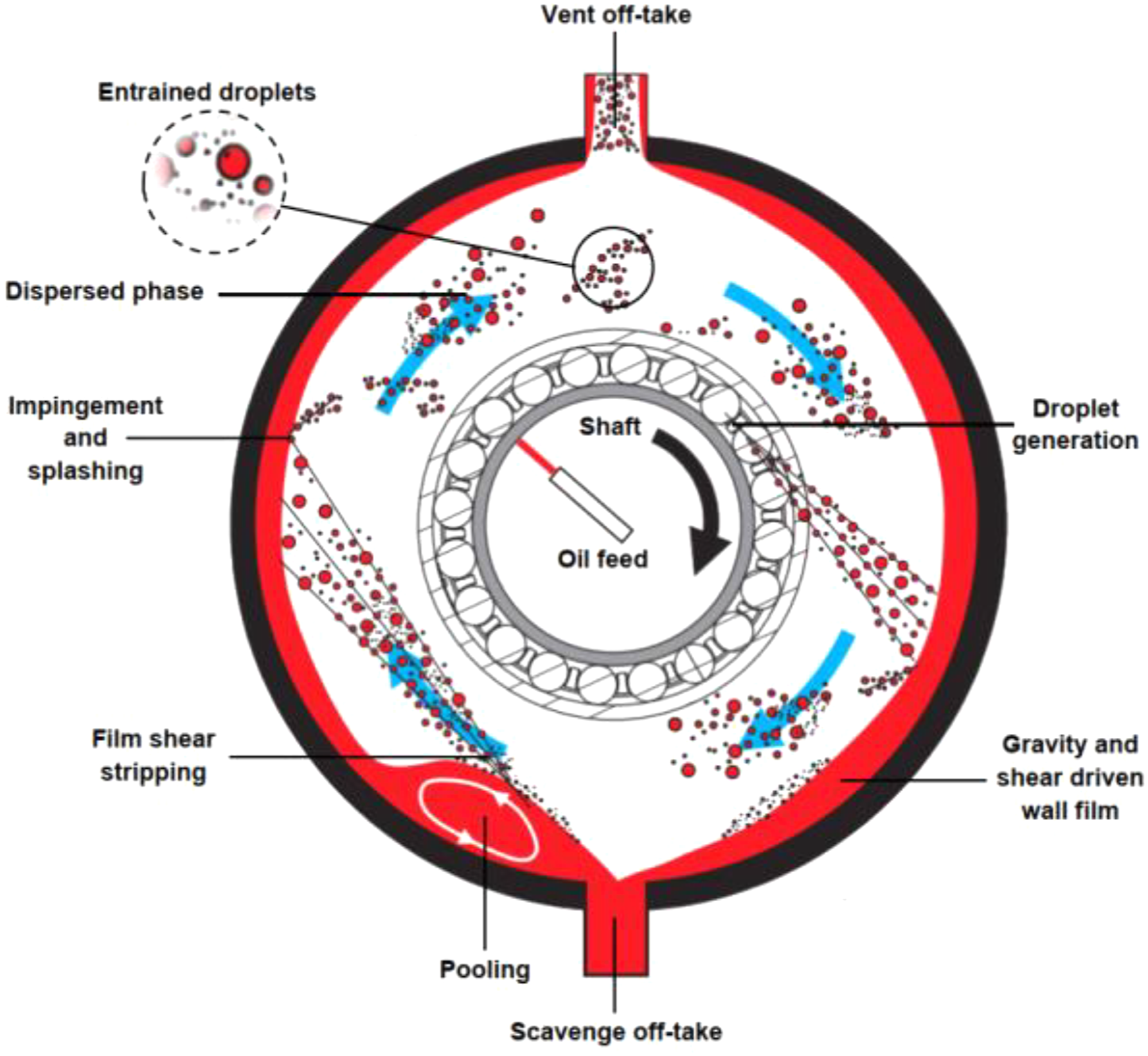
Simplified aeroengine bearing chamber flow physics, modified from Ref. 17.
The current industry best practice is to model turbulence quantities and account for turbulence effects using URANS based turbulence models. Considered as the state-of-the-art URANS approach, the shear stress transport (SST) k-ω turbulence model has been predominantly used within bearing chamber applications,9–12 demonstrating the ability to capture the large vortical and swirling structures which dominate the flow. However, previous bearing chamber computational investigations have also investigated capability for the k-ϵ model13,14 and its re-normalisation group (RNG) variant. 10 In addition, several studies have been performed using the Reynolds stress model (RSM).5,15,16 In the literature, whilst there have been a wide range of URANS turbulence modelling applications, currently there is no systematic data available which benchmarks the performance of these different turbulence modelling approaches available and their capability to capture the secondary airflow field.
Taylor–Couette studies
To date, there are very few combined CFD and experimental studies of rotating Taylor–Couette flow; in particular, investigations into the effect of the turbulence closure model selection on the predictions of Taylor–Couette systems are scarce. In recent years, the application of direct numerical simulation (DNS) to rotating Taylor–Couette flow has been the focus of many numerical studies for Reynolds numbers as high as 300,000. 17 However, DNS is very computationally expensive and is not currently viable for industrially relevant geometries, highlighting the need for a modelling approach that is industrially applicable to rotating Taylor–Couette flows.
Wild et al. 18 performed axisymmetric CFD simulations on narrow gap geometries, using the k-ϵ and RSM turbulence models. Comparison with experimental results showed that both the standard and RNG k-ϵ models over predicted results by at least 10%; whilst the RSM was found to perform poorly, over-predicting results by as much as 40%. More recently, Adebayo and Rona19,20 investigated the velocity and pressure distributions for wide-gap Taylor–Couette flows using the realisable k-ϵ turbulence model. Within the weakly turbulent Taylor vortex flow regime, comparison of axial and radial velocity profiles against PIV data showed good agreement, with results inside the uncertainty band.
Batten et al.
21
extended the work of Wild et al.
18
with the use of the low Reynolds number k-ω turbulence model, over a range of axisymmetric geometries. For the narrow gap cases,
Wang
22
compared CFD data obtained from axisymmetric steady-state simulations with PIV experimental data up to the turbulent Taylor vortex flow regime. Due to the strong dependence of the Taylor cells on start-up conditions, as demonstrated by both Coles
23
and Koschmieder,
24
Wang defined a start-up protocol for their geometry,
The results of Wang 22 are consistent with the numerical study performed by Poncet et al., 25 who considered turbulent Taylor–Couette flow for a wide-gap geometry. The authors investigated a range of modelling techniques, such as the URANS RSM model, large eddy simulation (LES) techniques, including an SST k-ω SAS approach, and DNS. Out of the models investigated, the SST k-ω SAS model performed the worst, failing to predict the mean tangential velocity with a large overestimation compared to the experimental data. Surprisingly, all of the numerical approaches undertaken failed to reproduce the experimental mean tangential velocity and angular momentum profiles. Both the RSM and DNS provided the closest agreement to the experimental data, although failed to predict the shear stress components.
Experimentally, Coles
23
and Koschmieder
24
both demonstrate the significance of the device aspect ratio on the Taylor–Couette flow, including the number of vortices formed and the vortex axial wavelength, highlighting the influence of both the column length and the gap sizing. However, within bearing chamber applications, due to both the constrained axial length and gap size of the geometry, the space only permits a single vortex pair to form, as demonstrated by Gorse et al.
3
As such, this parameter space is not explored within the Taylor–Couette flow investigations carried out in this work. It is also important to consider that many experimental and numerical studies of Taylor–Couette flow consider very long column lengths, such that when measurements are taken at the cylinder mid-gap, end effects become negligible. As such, the study on short aspect ratio Taylor–Couette devices is limited and the application within the turbulent Taylor vortex regime is even more scarce. This becomes important considering that aeroengine bearing chambers are essentially short aspect ratio systems. Burin et al.
26
experimentally investigated a short aspect ratio device,
From the literature reviewed, there have been limited applications of URANS turbulence modelling to Taylor–Couette flows; the literature points to the possibility that the RSM may be an adequate choice, although the results are still inconclusive. A limitation of most two-equation models is that the individual Reynolds stresses are not calculated and the three principal components (
Objectives
In general, for bearing chamber simulations, to date, whilst there have been a wide range of URANS turbulence modelling applications, currently there is no justification as to which is the most suitable URANS turbulence modelling approach. Furthermore, it is not well understood how geometrical and operational parameters influence turbulence within these systems. In an effort to better understand the complex bearing chamber environment, the geometry is first simplified to a Taylor–Couette domain. Within this configuration, a greater understanding of the turbulence modelling approach and the sensitivity to start-up conditions can be ascertained. Subsequently, this modelling capability will be extended to a bearing chamber geometry, in order to improve understanding surrounding the turbulence modelling approach and establish a solid foundation for future aeroengine bearing chamber investigations.
An objective of the current work is to, therefore, first perform a numerical comparison of both axisymmetric and three-dimensional URANS turbulence modelling approaches for a Taylor–Couette system. Due to considerable uncertainty within the literature, an objective of the work is to provide a best practical approach for the more advanced URANS turbulence models available. Furthermore, the sensitivity of results to the start-up conditions is of specific focus. The Taylor–Couette geometry under investigation corresponds to the configuration employed by Wang. 22 Experimental measurements from the particle image velocimetry (PIV) data of Wang 22 and the hot-wire results of Smith and Townsend 27 are used for comparison. Following this, the bearing chamber geometry of Gorse et al. 3 is investigated and results are compared to the corresponding single-phase 3D laser Doppler anemometry (LDA) measurements presented by Gorse et al. 3
Taylor–Couette investigations
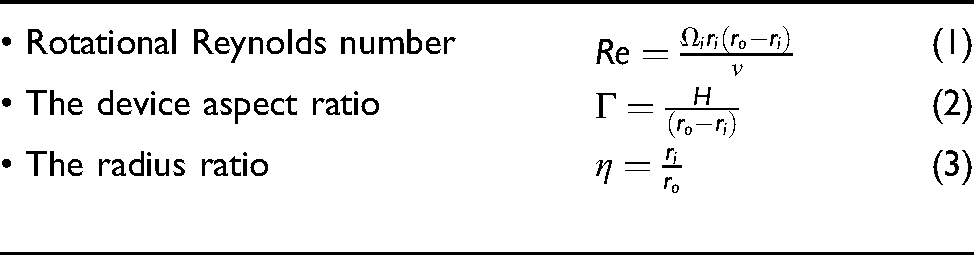
Where
The geometry, shown in Figure 2, represents the computational domain based on the experimental apparatus used by Wang
22
and consists of two concentric cylinders with inner and outer radii of 0.0349 and 0.0476 m, respectively. The length of the cylinders is 0.432 m, such that the aspect ratio of the geometry is 34, based on the gap size, 
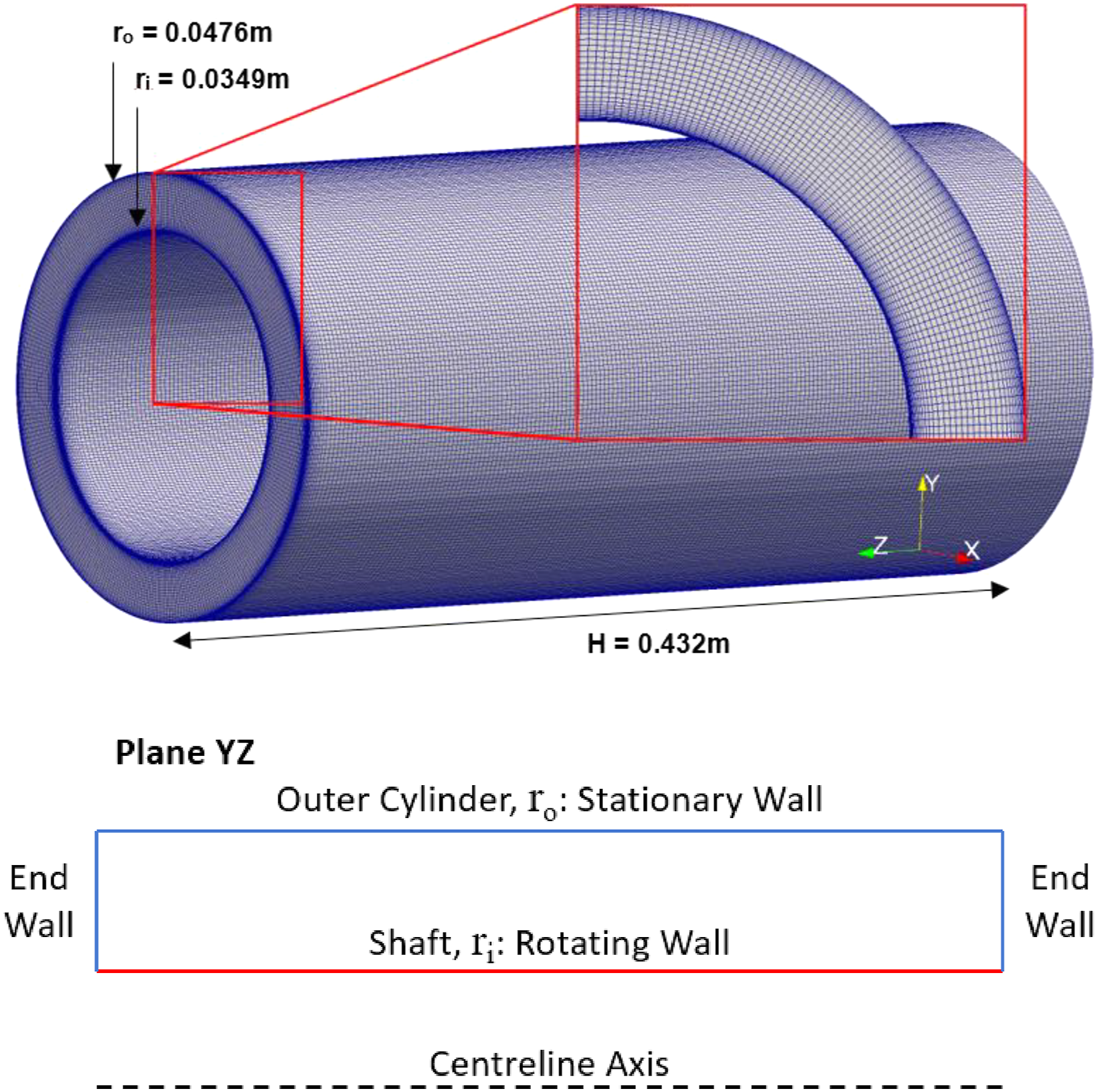
Computational domain and boundary conditions of Taylor–Couette geometry under investigation.
Wang 22 focuses on only inner cylinder rotation. Through a specific start-up procedure, Wang 22 ensures a fixed number of 14 Taylor vortex pairs formed at each rotation rate investigated. This was achieved through accelerating the inner cylinder from rest to a speed of 17.27 rad/s, at a constant angular acceleration of 0.0314 rad/s2, and then maintaining this speed until 14 stable Taylor vortex pairs form, excluding the end cells. Subsequently, the inner cylinder is then either accelerated or decelerated at a constant rate of 0.314 and 0.126 rad/s2 respectively, until the final desired state is reached. Wang 22 maintained this final angular velocity for a short period before collecting PIV data. The measurements described were made over flow Reynolds numbers from 335 to 18,392, corresponding to Reynolds number ratios of 4–220; this covers the laminar Taylor vortex flow regime up to the weakly turbulent Taylor vortex flow regime. The fluid used by Wang 22 has a density of 1055 kg/m3 and a dynamic viscosity of 1.097 × 10−03 kg/ms.
Numerical methods
The finite volume incompressible solver, ANSYS Fluent 17.1, was used for all numerical calculations presented. The Semi Implicit Method for Pressure Linked Equations (SIMPLE) was chosen within the pressure-based solver, for which the PREssure STaggering Option (PRESTO) discretisation scheme was chosen due to the nature of the problem, based on the Fluent recommendations for high-speed rotating flows. 29 The solver was implemented with double precision and for time discretisation, a bounded second order implicit temporal discretisation scheme 29 was chosen to improve the accuracy and stability of the solution. All residuals were monitored and converged down to a minimum of 10−6.
Unsteady Reynolds-averaged Navier–Stokes turbulence modelling
Wang 22 concluded that the RSM with standard wall functions was the most suited to model the flow field. Whilst it was found that for low rotation rates, the RSM predicted the mean velocity field with a reasonable degree of accuracy, at higher shaft speeds, there were large discrepancies. The computational results of Wang 22 suggest that depending on the rotation rate, a number of different turbulence models are satisfactory to model the flow field, with the RSM giving the best agreement. However, at higher shaft speeds, for example, at R = 220, maximum radial velocities were over predicted by as much as 40%. In addition to this, Wang 22 provides very limited details of the numerical investigation and based on the literature surveyed, there is inconclusive evidence as to which turbulence model yields the most satisfactory results. Hence, for this paper, a study into advanced turbulence models is conducted.
Several of the advanced URANS turbulence models available within ANSYS Fluent are investigated, to assess their suitability for Taylor–Couette flows, as well as more conventional models for comparison. These include the standard, realisable and RNG k-ϵ turbulence models; the standard, baseline (BSL) and SST k-ω turbulence models and the linear/quadratic and stress-omega/BSL Reynolds stress models. A more detailed analysis of the governing equations for each of the turbulence models presented can be found within the ANSYS theory guide 29 as well as the work of Versteeg and Malalasekera. 30
The k-ϵ model is regarded as the simplest of the two-equation models, it is a semi-empirical model based on the equations for the transport of turbulence kinetic energy (k) and its dissipation rate (ϵ). However, the RNG k-ϵ and the realisable k-ϵ model have shown to have an improved accuracy over the standard k-ϵ model without a significant increase in computational cost, especially for flow features involving strong streamline curvature, vortices and rotation. 29 The re-normalisation group (RNG) model includes the effect of swirl on turbulence and the accuracy for rapidly strained flows is improved through the addition of an extra term in the ϵ equation. The realisable k-ϵ turbulence model includes a modified transport equation for the dissipation rate (ϵ) and the turbulent viscosity has an improved formulation that varies the Cμ coefficient.
Two additional variants of the k-ω model exist, the baseline (BSL) k-ω model and the SST k-ω model. The standard k-ω model can exhibit a strong sensitivity to freestream conditions and as such the BSL k-ω model was developed, which blends the k-ω model in the near-wall region with the k-ϵ model in the freestream. The SST k-ω model includes the improvements of the BSL k-ω model; however, it also accounts for the transport of the turbulence shear stress. This results in a more robust formulation than the standard and BSL k-ω models, that is accurate and reliable for a wider class of problems. 29
The Reynolds stress model (RSM) solves a transport equation for each of the Reynolds stresses, in addition to an equation for the dissipation rate. This has the advantage of being inherently anisotropic and therefore is more complex and computationally expensive compared to the k-ε and k-ω models. Within Fluent, the default RSM is based on the ϵ-equation and uses either a linear or quadratic model for the pressure–strain term. The ω variants of the RSM both use a linear model for the pressure–strain term and however solve the scale equation differently. The stress-omega model derives from the ω-equation, whereas the stress-BSL model solves the baseline (BSL) k-ω scale equation, consequently removing the freestream sensitivity found with the stress-omega model. Both the ω-equation based variants are advantageous for modelling flows over curved surfaces and those involving swirling flows. 29
For all ϵ-equation based turbulence modelling, the enhanced wall treatment (EWT) approach is used. The EWT is an alternative near-wall modelling method that combines a two-layer approach suitable for finer meshes
Axisymmetric modelling
The experimental apparatus of Wang
22
was modelled initially as an axisymmetric case within Fluent using a structured grid, based on the suggestions from the literature reviewed. The computational domain is enclosed within the stationary outer cylinder and end walls while the inner cylinder rotates; at the walls, a no-slip condition is applied. The CFD domain represents a 2D slice of the Taylor–Couette experimental geometry, which greatly reduces the computational cost. It is possible to reduce the axisymmetric computational expense even further by simulating only one Taylor vortex pair through applying either periodic or symmetry boundary conditions at either end. Wang
22
adopted a different approach whereby one quarter of the domain was modelled, incorporating one end wall and a symmetry boundary, resulting in the formation of only 3.5 vortex pairs. However, as the Reynolds number was increased further, the number of vortex pairs still varied such that Wang
22
had to optimise the axial length for each rotational speed investigated. In this study, initial simulations showed that, whilst the domain maintains central symmetry, a
Axisymmetric grids for mesh independence study.
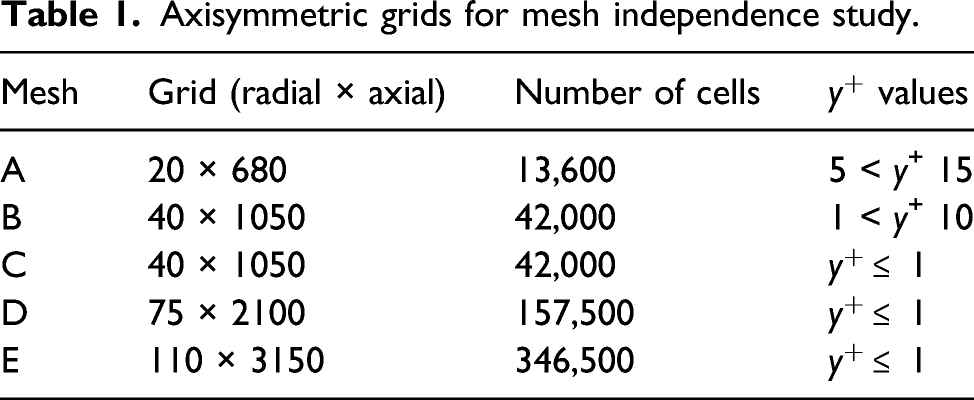
Whilst a fully mesh independent solution was not reached for all simulations, it was judged that sufficiently low mesh dependence was achieved for the purpose of this study. Table 2 presents the computed non-dimensionalised shaft torque,
Axisymmetric mesh independence study results for the standard k-ε and standard k-ω turbulence models.
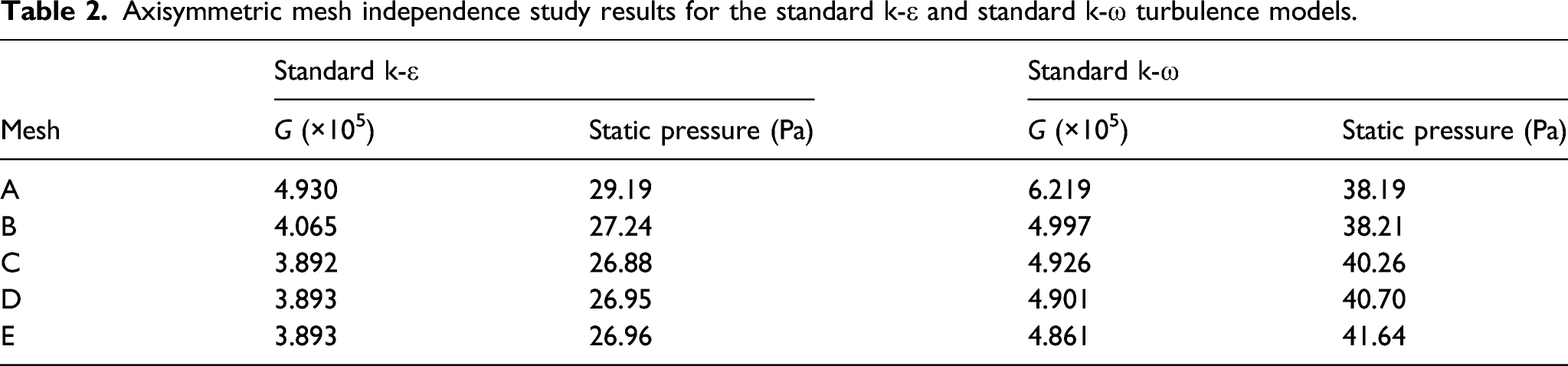
Overall, across both turbulence models, there was a percentage difference of
In the following sections, axisymmetric CFD results are compared to the radial velocity profiles of Wang 22 and for all simulations, results were time averaged over a duration of six inner cylinder rotations.
Start-up procedure
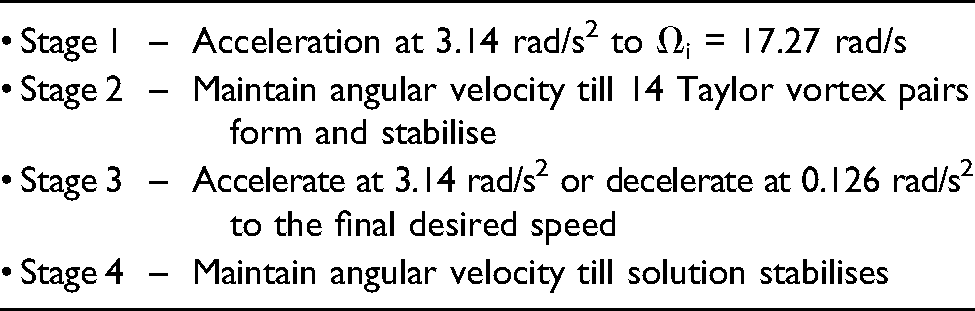
Figure 3 presents the velocity vector field for a typical Taylor vortex pair formed after the steady acceleration procedure as described above; here, the rotation Reynolds number ratio is R = 220.
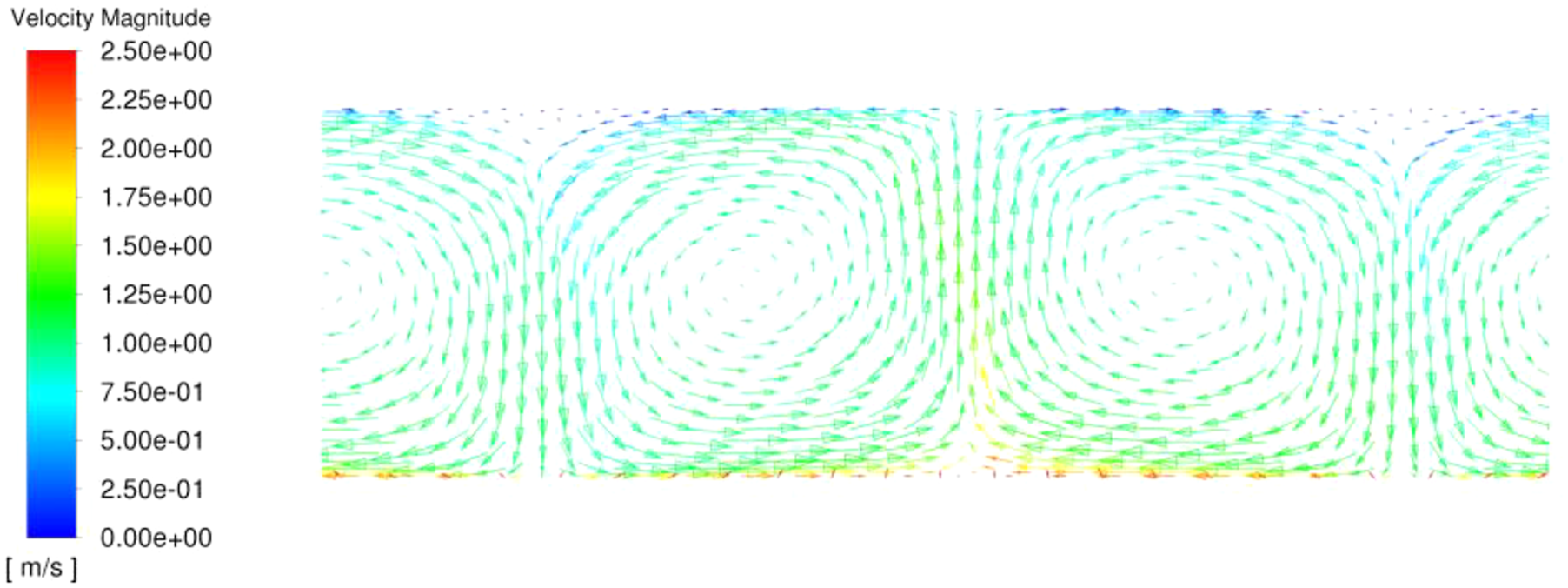
Velocity vector field for a Taylor vortex pair at R = 220 after the steady acceleration procedure.
Figure 4 shows a comparison of the different non-dimensional wavelengths, λ, obtained for the rotational Reynolds number ratios ranging from 4 to 220. The wavelength is defined as the axial extent of one Taylor vortex pair and this is non-dimensionalised by the gap size,
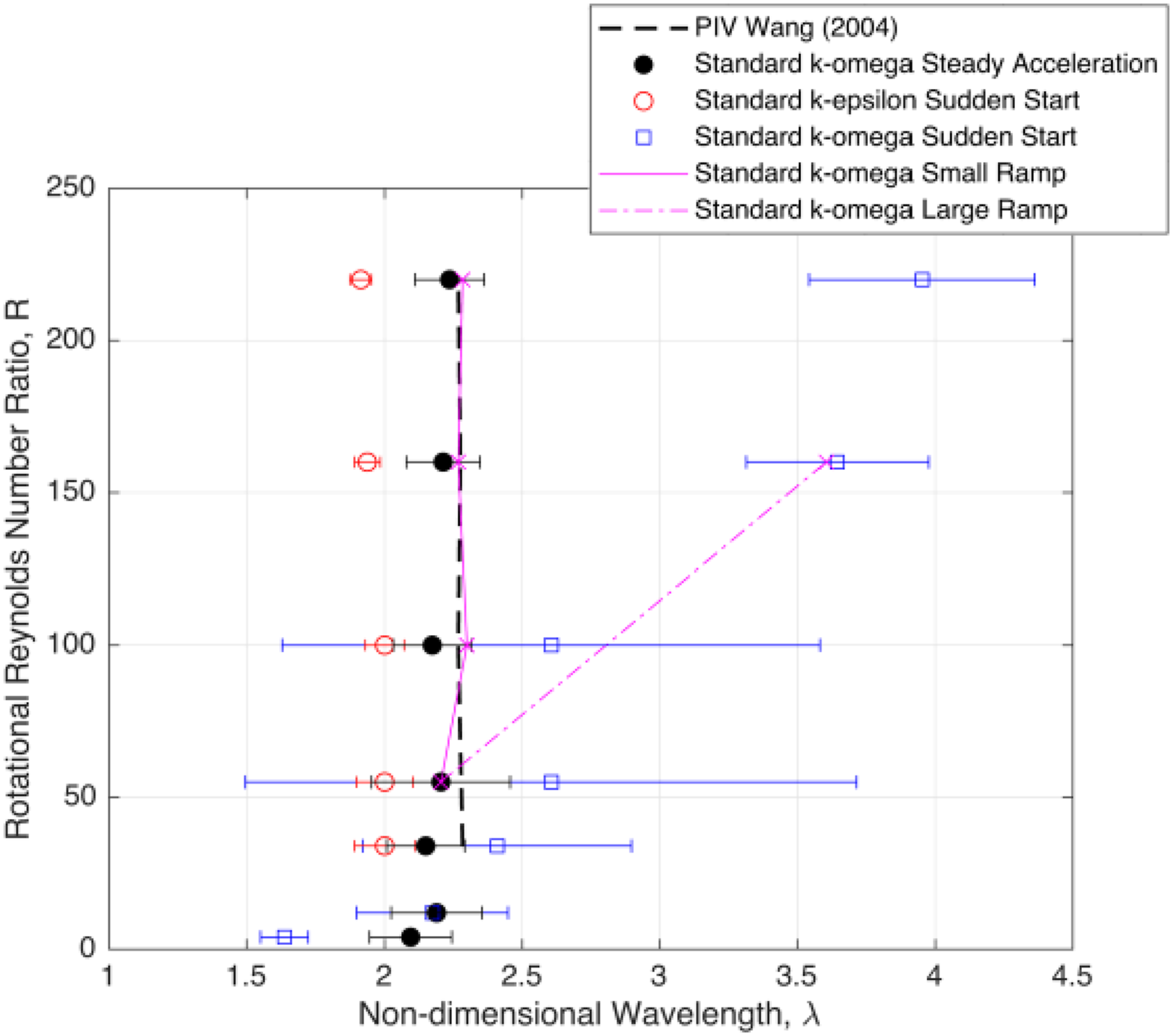
Axial wavelengths for sudden start and steady acceleration procedures.
The average wavelength recorded for sudden start cases is displayed, with the red circles representing the standard k-ϵ turbulence model and the k-ω turbulence model shown with blue squares. For each data set, the error bars represent the standard deviation in the axial wavelength. Immediately, it is clear that there is a significant difference in wavelength obtained based on the turbulence model used. In general, the k-ω turbulence model produced Taylor vortices with a larger average wavelength than the PIV data, meaning the number of Taylor vortex pairs was less than the desired value of 14, for example at
The simulations performed for the steady acceleration procedure, depicted by the solid black circles, were carried out for both the k-ϵ and k-ω models; between the two models, there was a negligible difference in results; hence, only the results from the standard k-ω model are shown in Figure 4. At all of the rotation rates investigated, 14 Taylor vortex pairs were formed following the steady acceleration period; furthermore, the PIV data of Wang
22
falls within the standard deviations for all cases, resulting in a percentage difference in average wavelengths of 1.4 to 5.9%, with the greatest difference occurring at the slowest speed at
Figure 4 also shows a comparison of the non-dimensional axial wavelength following either a small or large step in the rotation rate of the inner cylinder once the
Overall, these results show that by using an appropriate start-up approach it is possible to obtain good agreement on the number of Taylor cells compared to the experimental data of both Wang 22 and Koschmieder 24 for wide-gap geometries. This gives confidence in the steady acceleration procedure employed computationally, showing that it is possible to achieve the same time-averaged number of Taylor vortices reported in the experiment in the turbulent Taylor vortex flow regime.
Unsteady Reynolds-averaged Navier–Stokes turbulence modelling
The turbulence models described in the Start-up Procedure section are compared against the PIV non-dimensional velocity profiles of Wang 22 including both maximum and minimum radial velocities. The aim of this study is to determine the most appropriate turbulence modelling strategy applicable to a rotating Taylor–Couette geometry.
Firstly, the results from the turbulence models at
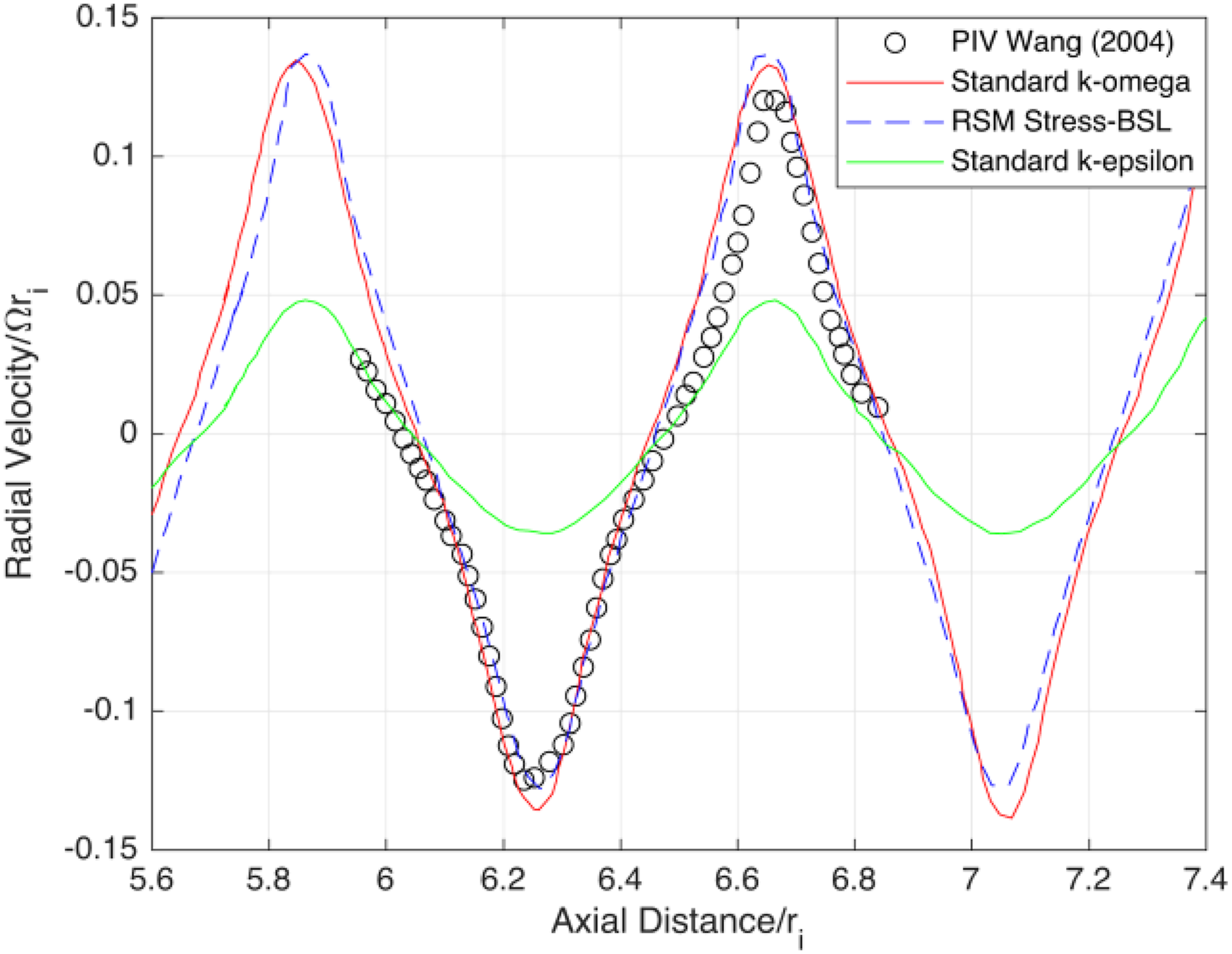
Comparison of non-dimensional radial velocity profiles at R = 3.94 cm and R = 100.
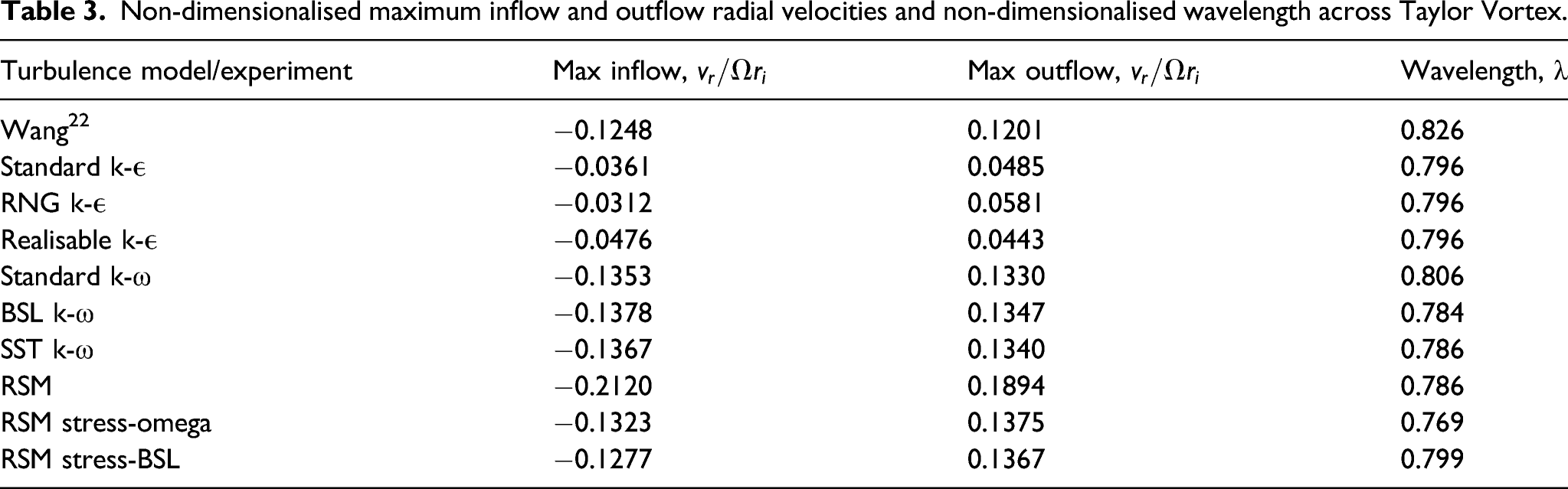
Furthermore, Table 3 provides the non-dimensionalised maximum Taylor vortex inflow (negative
Non-dimensionalised maximum inflow and outflow radial velocities and non-dimensionalised wavelength across Taylor Vortex.
Percentage difference (%) in both non-dimensionalised average velocity and wavelength across Taylor vortex.
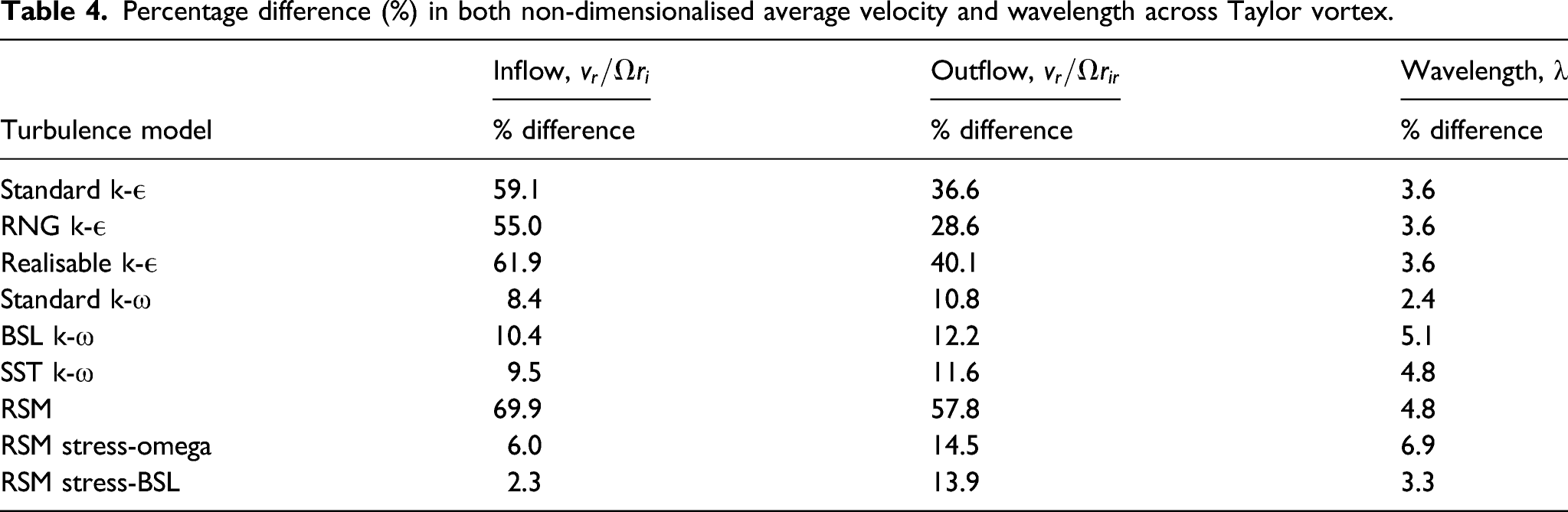
Results obtained for the standard, RNG and realisable k-ϵ turbulence models showed a significant deviation from the PIV measurements of Wang 22 in terms of radial velocities. It should be noted that, when comparing the results of the ϵ-based turbulence models against each other, there was very little deviation in radial velocity profiles; whilst the models all predicted a similar profile, the peak values differed by as much as 60% from the experimental measurements, as shown in Table 4. This is also highlighted in Figure 5 for the standard k-ϵ turbulence model. Overall, from the investigation into ϵ-equation based turbulence modelling, it was clear that the none of the models investigated produced satisfactory results.
In contrast, the standard, BSL and SST k-ω turbulence models all produced a much closer agreement with the experimental data, however the standard k-ω turbulence model provided the most accurate results in terms of radial velocity profiles, evident from Table 4. Both the BSL and SST k-ω models produced reasonable agreements compared to the standard k-ω model, although as highlighted in Table 4, the axial wavelength of the Taylor vortex pairs was slightly worse, here, over-predicting by approximately 5%, resulting in smaller end cells.
An investigation into the RSM variants was also carried out. The standard RSM, which relies on the underlying assumptions associated with ϵ-equation modelling, was found to be inappropriate in predicting the flow field for both the radial velocity and mean velocity distribution across the gap, with results similar to those produced by the standard k-ϵ model, shown in Table 4. Interestingly, the quadratic-pressure strain model failed to produce any Taylor vortex structure over all of the rotational Reynolds number ratios investigated. However, the ω-based variants of the RSM showed significant improvements with the best results obtained using the RSM stress-BSL model, as opposed to the RSM stress-omega variant, which in relative comparison, over-predicted the axial wavelength, Table 4.
As the rotational Reynolds number ratio is increased, the differences between the computational and the experimental results of Wang
22
start to become apparent. This is evident from Table 5 which summarises the percentage difference in the non-dimensional maximum inflow and outflow radial velocities, averaged over each of the 14 Taylor vortex pairs, for each rotational Reynolds number ratio investigated. At
Percentage difference in non-dimensional radial velocities across Taylor vortex in/outflows.
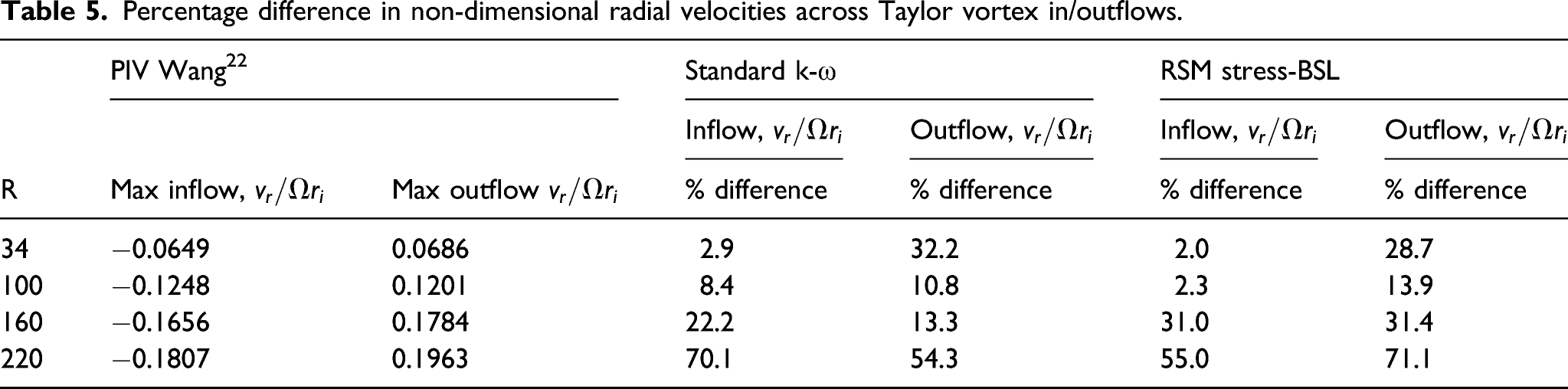
In conclusion, the axisymmetric URANS turbulence modelling study has shown the standard k-ω model provides satisfactory results and is able to capture the key characteristics of the flow, although at large Reynolds number ratios, this agreement is poor in terms peak radial velocities. The RSM stress-BSL model provides comparable results to the standard k-ω turbulence model, although at a significant increase in computational cost. However, as the rotational Reynolds number is increased, poor agreement is found for both models suggesting that as turbulence increases, an axisymmetric approach is unsuitable. It is suspected that the axisymmetric modelling methodology starts to break-down, as a result of not being able to predict the three-dimensional structures typically found within turbulent Taylor––Couette flows, such as Görtler vortices27,31 present within the boundary layers; as opposed to the lack of capability within the turbulence models. As such, subsequent modelling will apply the axisymmetric modelling methodology developed to a three-dimensional domain for both the standard k-ω and RSM stress-BSL turbulence models.
Three-dimensional modelling
Following the results of the axisymmetric URANS study, the start-up procedures and turbulence models used were applied to a three-dimensional model. As such, the operating conditions and fluid properties were kept the same. From the axisymmetric simulations, it has been observed that there are a number of three-dimensional effects that may be suppressed by axisymmetric modelling. As such, it is still unclear whether the axisymmetric turbulence modelling approach is still applicable when applied to three-dimensional modelling.
For 3D Taylor–Couette simulations, Brauckmann and Eckhardt 32 showed simulation complexity could be heavily reduced through applying both axial and rotational periodicity. Brauckmann and Eckhardt 32 demonstrated that in general the modelled geometry could be heavily simplified through simulating only one Taylor vortex pair with a rotational symmetry of order six. However, more recently, the DNS study carried out by Ostilla-Mónico et al. 33 suggests that applying both axial and rotational periodicity imposes constraints on the flow field, which, despite generating accurate velocity data, can affect the overall bulk statistics. The results from Ostilla-Mónico et al. 33 did not reach an independent solution and recommendations are made to determine the extent to which the domain can be limited to produce accurate velocity and pressure fluctuation statistics in addition to higher order moments. The results from this current work suggest that for accurate velocity and turbulence data, the whole domain may need to be modelled. This will be investigated by carrying out a study into applying rotational periodicity to the three-dimensional domain and comparing to the available experimental data.
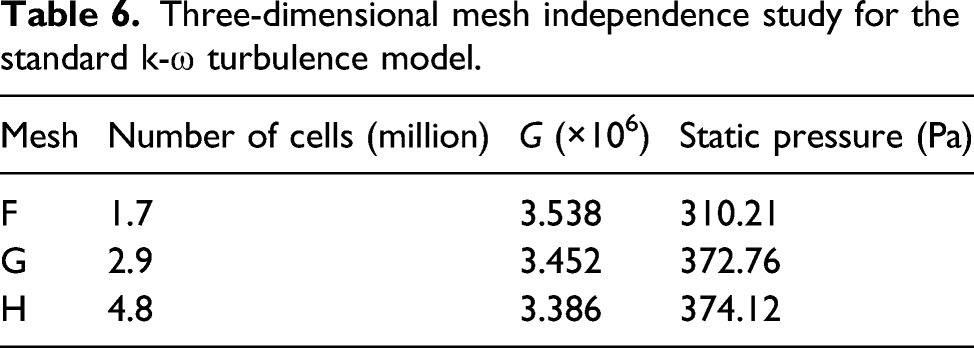
Similar to the axisymmetric URANS study, a three-dimensional mesh independence study was first carried out. An equivalent numerical method and solution procedure was retained. Whilst Mesh D was chosen to be appropriate for the axisymmetric modelling, the coarser mesh, Mesh C was chosen as a starting point for the three-dimensional modelling. To begin with, the radial and axial grid spacing of Mesh C was transformed through 360° about the axis of rotation, resulting in a mesh of 1.7 million cells. Through removing the axisymmetric assumption, it is deemed appropriate to start the three-dimensional meshing from a coarser grid and subsequently refine the mesh until a mesh independent solution is achieved. Although a fully mesh independent solution was not obtained, through monitoring torque values and static pressure on the outer cylinder wall, a relatively low mesh dependence was observed. A final mesh containing 4.8 million cells with a wall spacing of
Three-dimensional mesh independence study for the standard k-ω turbulence model.
Start-up procedure
The results obtained from the axisymmetric investigation into the start-up procedure were also investigated for the three-dimensional configuration. It was observed that the outlined start-up procedure remained accurate for three-dimensional simulations and as such a new UDF was developed and linked within Fluent. This new UDF included the previous steady acceleration to
The purpose of modifying the UDF was to remove the substantial computational cost associated with slowly accelerating from
Rotational periodicity study
In order to see if the computational cost associated with the three-dimensional simulations could be reduced further, a study into applying rotational periodicity was carried out. Brauckmann and Eckhardt
32
suggest that a rotational periodicity of
A sample of the results are shown in Figure 6, which includes the result obtained from the standard k-ω turbulence model for the
In addition to this, similar problems were also experienced with the
Analysis of the non-dimensional velocity magnitude profile across the annular gap with the hot-wire data of Smith and Townsend
27
at an equivalent gap spacing and a similar Reynolds number ratio of
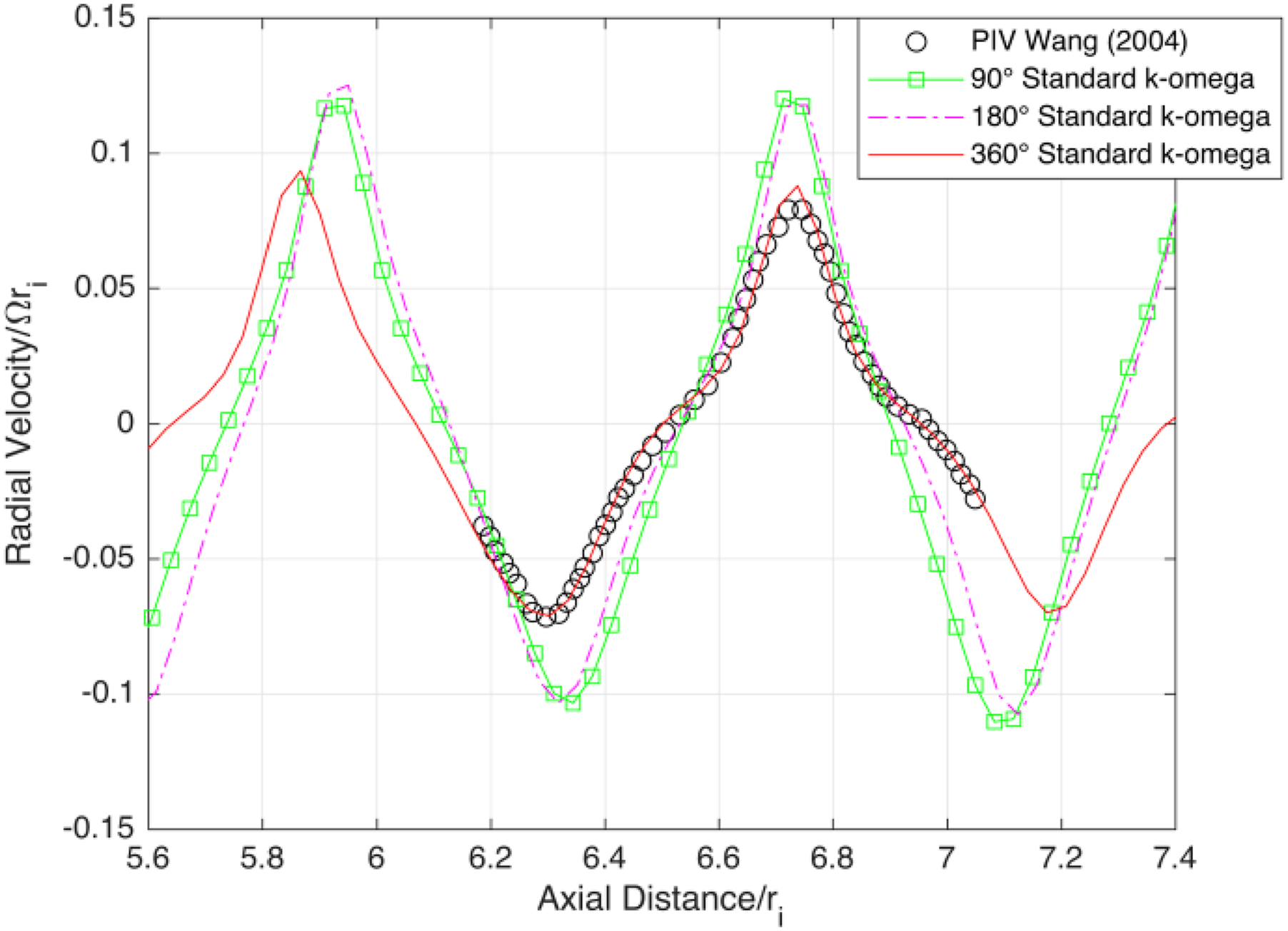
Comparison of non-dimensional radial velocity profiles at a radius of 3.94 cm and R = 220 when varying the domain rotational periodicity.
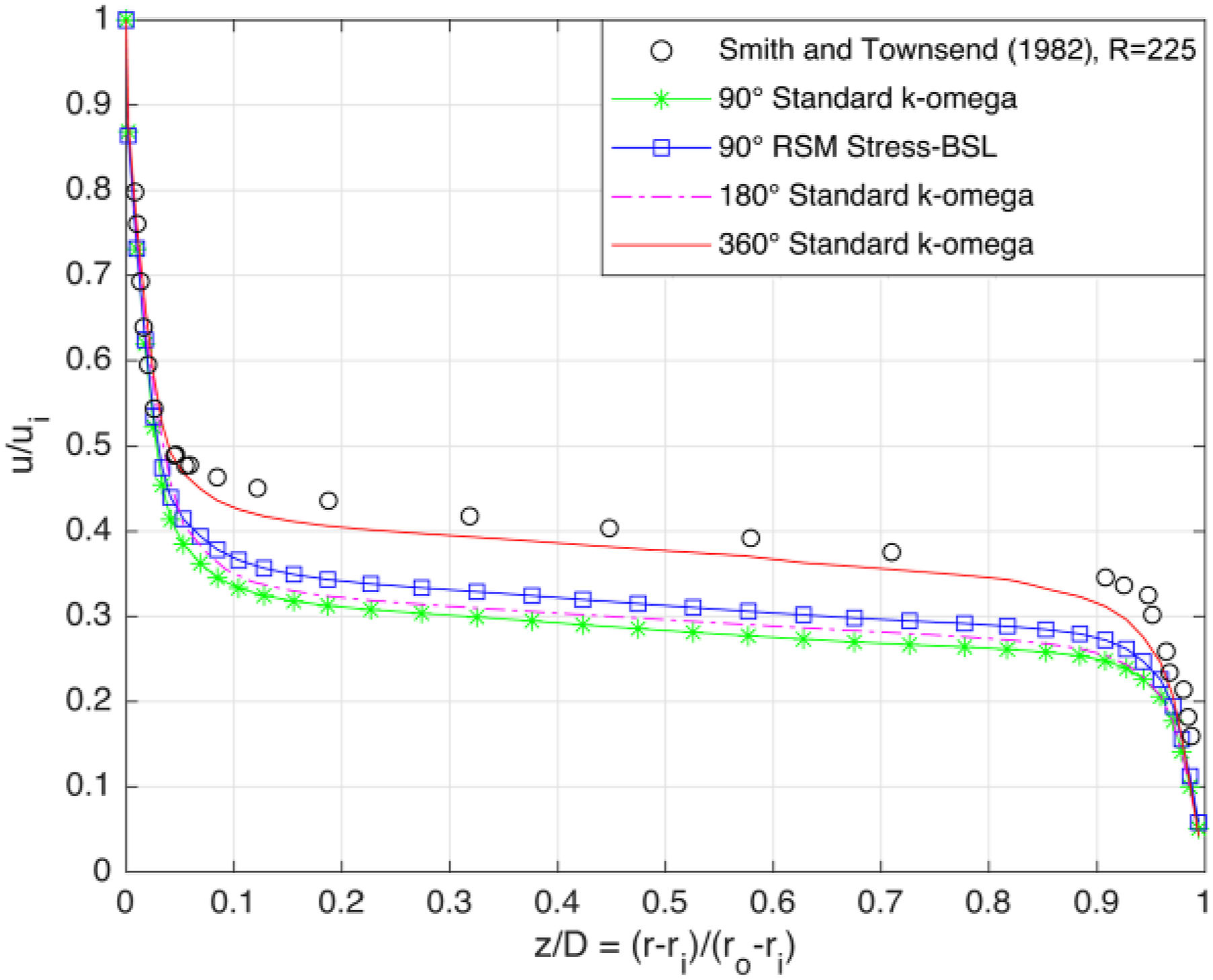
Non-dimensional velocity magnitude across annular gap at R = 220.
Within Figure 7, the results of both the
These results contrast with the findings from the DNS study of Brauckmann and Eckhardt
32
relating to using rotational periodicity. For the current geometry with a URANS turbulence modelling approach, applying rotational periodicity is not feasible and results in a significantly reduced core velocity. This implies that for three-dimensional URANS turbulence modelling the full
Three-dimensional results
Within a fully developed turbulent flow, the turbulent structures and generating processes are inherently three-dimensional. Therefore, it is important to re-assess if the conclusions drawn from the URANS axisymmetric turbulence modelling study still remain valid. As such, a turbulence modelling study was again performed for the three-dimensional configuration.
Unlike the axisymmetric study, all of the ϵ-equation-based turbulence models severely over-predicted both radial and axial velocities, with maximum radial velocities over-predicted by as much as 85%. Figure 8 shows an example of the standard k-ϵ turbulence model compared against the PIV data of Wang. 22 In contrast, good agreement was still found for the ω-equation turbulence models and the inferences on model effectiveness from the axisymmetric simulations remained valid. As such, for the three-dimensional simulations, the numerical modelling strategy outlined in the Axisymmetric Modelling section was carried forwards using both the standard k-ω and RSM stress-BSL turbulence models. For both turbulence models, results were again time averaged over a duration of six inner cylinder rotations.
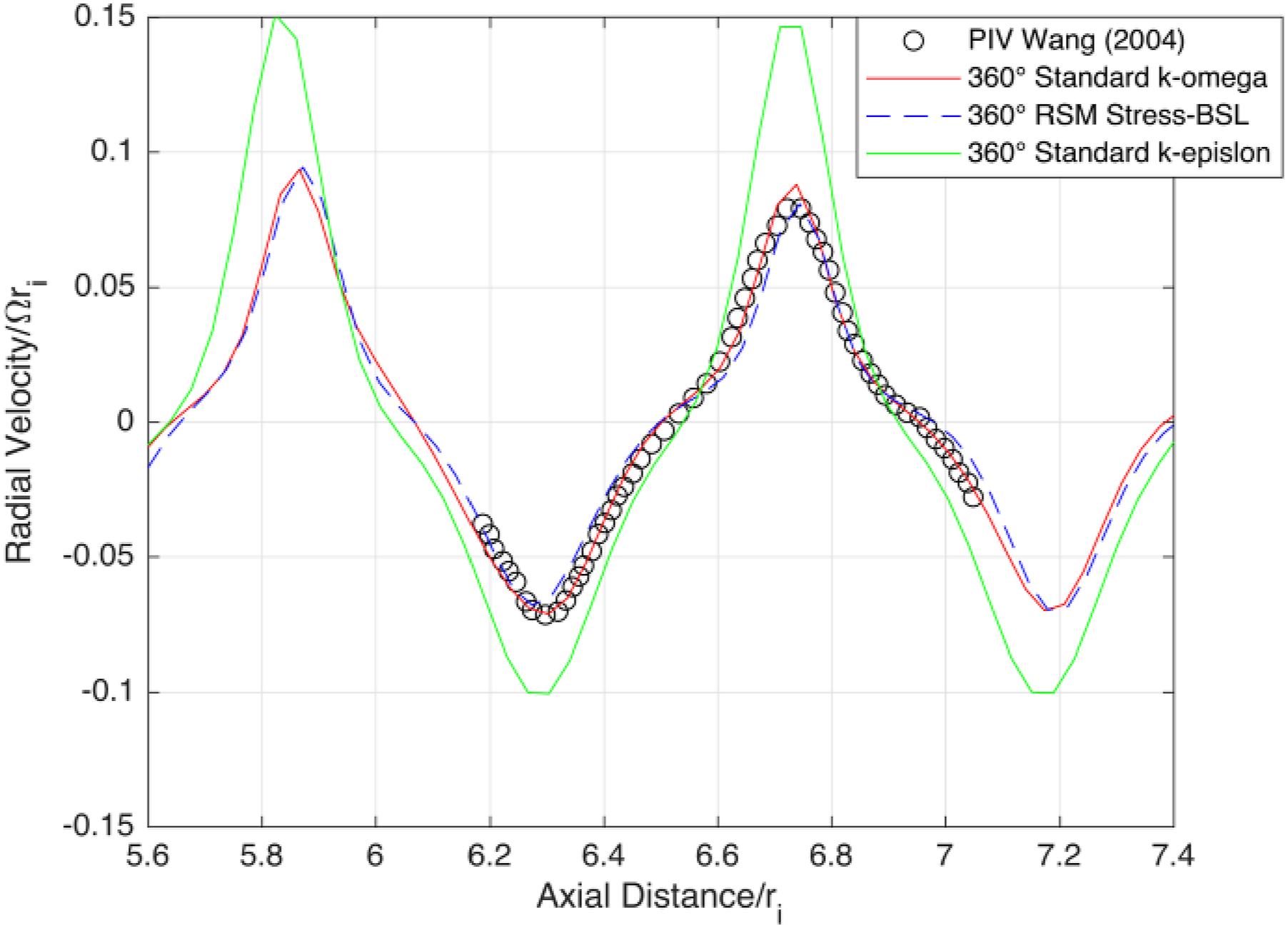
Comparison of non-dimensional radial velocity profiles at a radius of 3.94 cm and R = 220 for the full 360° domain.
The radial velocity profiles shown in Figure 8 illustrate that both the standard k-ω and RSM stress-BSL turbulence models provide excellent agreement with the PIV data of Wang
22
at
Comparison of velocity magnitude profiles across the annular gap with the hot-wire data of Smith and Townsend,
27
shown in Figure 9, reveals that there is negligible difference between the two turbulence models. Both turbulence models predict a slightly reduced non-dimensional core velocity of 0.371 at the non-dimensional distance of 0.581 which results in a percentage difference of less than 5% when compared to that of 0.390
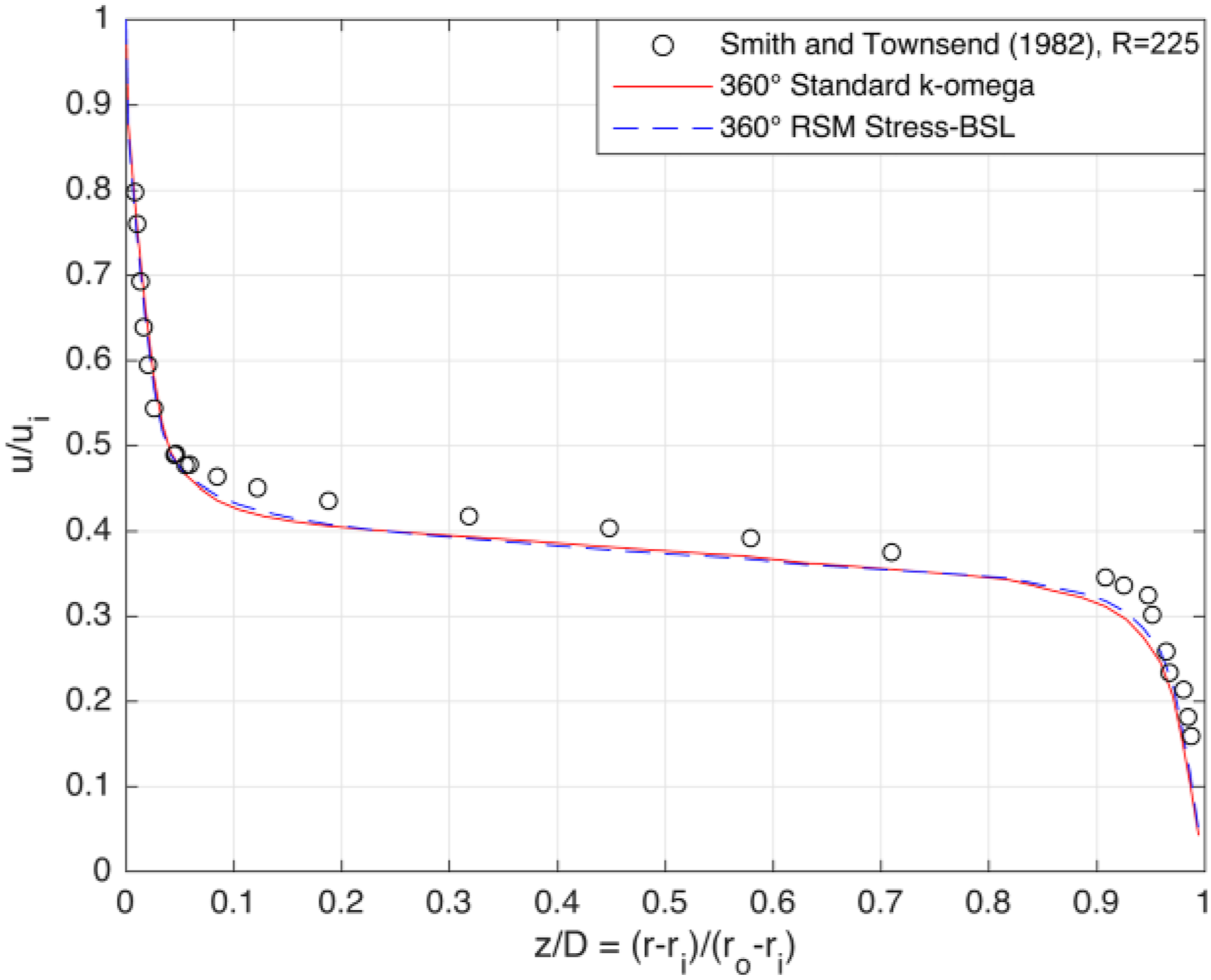
Non-dimensional velocity magnitude across annular gap at R = 220.
Bearing chamber investigations
Following the Taylor–Couette URANS turbulence modelling investigation, the methodology is extended to an aeroengine bearing chamber application. A study into the single-phase airflow is conducted with comparison to the experimental 3D Laser Doppler Anemometry (LDA) measurements performed by Gorse et al. 3 on a high-speed bearing chamber test rig. The experimental configuration of Gorse et al. 3 focuses purely on the influence of airflow within the chamber, highlighting the dependence of secondary airflow structures on both the rotational shaft speed and sealing airflow rates in the absence of oil. A cross-section of the front bearing chamber under investigation is shown in Figure 10. The chamber consists of a shaft throughout the length of the domain, with a diameter D = 128 mm. The resulting diameter and axial length of the bearing chamber are 1.73D and 0.34D, respectively. In relation to the Taylor–Couette analogy, this results in a radius ratio, η = 0.577, and a device aspect ratio, Γ = 0.47, therefore, a small aspect ratio, wide-gap system.
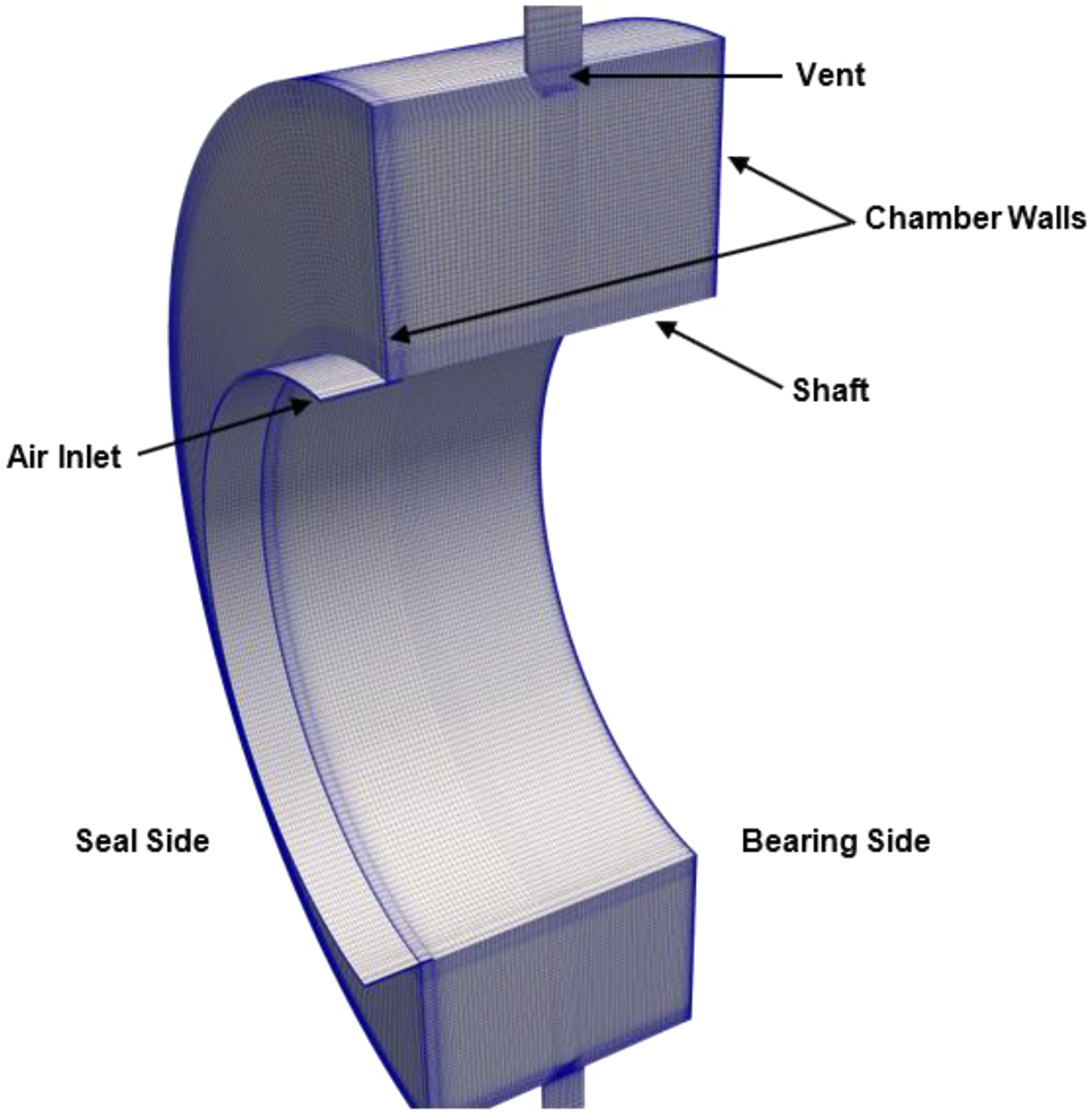
Computational cross-section of the Gorse et al. bearing chamber.
Within the experimental test rig, the shaft is supported by a roller bearing simulator. A bearing simulator was used to suppress the oil flow entirely, avoiding the two-phase dispersed flow typically found in bearing chambers resulting from the airflow interactions with droplets generated from the bearing. Compared with a roller bearing, the simulator forms one single non-rotating part. Gorse et al. 3 reported that the simplifications resulted in a negligible difference due to the relatively small size of the cage compared to the bearing chamber. At the opposite end of the chamber, air enters via a pressurised labyrinth seal, with a tip clearance of 0.7 mm. Two vent pipes, located at the top and bottom angular locations, discharge the airflow with a diameter of 10 mm.
Boundary conditions and mesh
The boundary conditions implemented within the computational domain are depicted in Figure 10. Air enters from the left-hand side of the domain, though a small 12 mm long channel, ensuring a fully developed airflow profile upon reaching the main chamber. The gap has a clearance of 0.7 mm, representative of the labyrinth seal found experimentally. This computational representation of the labyrinth seal has successfully been demonstrated in the previously investigations of Peduto et al., 13 Bristot et al. 9 and Singh et al. 12 Based on their investigations, a mass flow inlet boundary condition is chosen, with a recommended swirl angle of γ=50°. The shaft is specified as a rotating wall such that when viewed from the front of the bearing the shaft is rotating in a clockwise direction. At both the top and bottom vent pipes, a pressure outlet boundary condition is applied. On all the other surfaces, a non-slip wall boundary condition is imposed.
In the present study, a non-uniform structured grid based on the previous work of Singh et al. 12 is used. For the Gorse et al. bearing chamber investigation, a mesh independence study resulted in a final grid with 2,205,854 cells.
A suitably low mesh dependency was obtained through monitoring non-dimensional torque values and static pressure on the outer cylinder wall; resulting in a percentage difference of less than 1% in the computed non-dimensional torque values and approximately 2% in the static pressure. This mesh is depicted in Figure 10, for which Table 7 presents the computed non-dimensionalised shaft torque, G, and static pressure at H/2 on the outer cylinder wall at the rotational shaft speed of 9700 rpm, which was used to assess mesh independence.
Three-dimensional mesh independence study for the Gorse et al. bearing chamber.
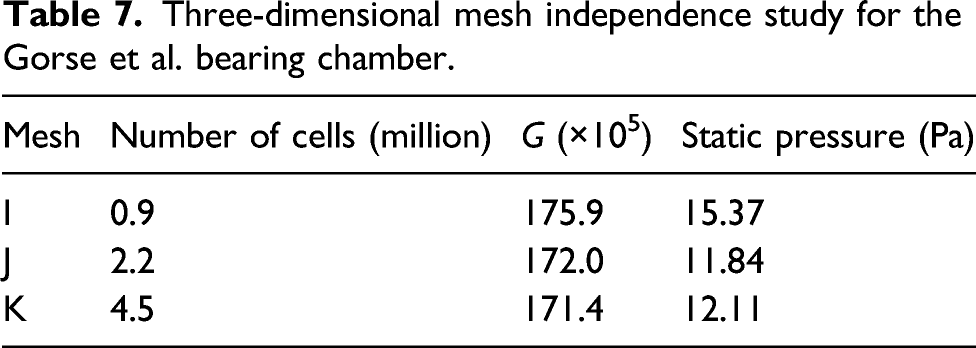
Operating conditions and fluid properties
Within the bearing chamber investigation, the operating conditions and fluid properties are derived from the experimental work of Gorse et al. 3 and listed in Table 8. Experimentally, the shaft speed is varied between 3000 and 13,000 rpm; however, visualisation results are presented at a shaft speed of 9700 rpm and sealing airflow rates from 4.2 to 16.9 g/s. For all cases investigated, the chamber was kept at a constant pressure of 2.5 bar and an air temperature of 298 K.
Operating conditions and fluid properties.

Numerical methods and solution procedure
In accordance with the Taylor–Couette investigation, the finite volume incompressible solver, ANSYS Fluent 17.1, was used for all calculations presented. Initial simulations used the SIMPLE algorithm for the pressure–velocity coupling method; however, due to convergence issues, instead, the coupled algorithm was implemented based on the recommendations of Singh et al. 12 The PRESTO discretisation scheme was chosen for the pressure equation and a second order upwinding scheme was used to discretise the remaining equations. For time discretisation, again, a bounded second order implicit temporal discretisation scheme was chosen. After convergence, results were time-averaged for a duration of 0.5 s.
Within bearing chamber applications, the airflow is highly turbulent due to the presence of a rotating shaft throughout the domain, much like a Taylor–Couette flow; however, typically the operational shaft speeds are significantly greater. As such, the previous Taylor–Couette URANS turbulence modelling is extended to the bearing chamber under investigation. The Taylor–Couette study demonstrated that for a full 360° domain, either the standard k-ω or RSM stress-BSL turbulence model was most suited, although it is important to assess whether the conclusions drawn still remain valid, and therefore, a more selective turbulence modelling study is presented.
In addition to the standard k-ω and RSM stress-BSL turbulence model, simulations are also performed for the k-ϵ RNG and SST k-ω turbulence models. For the Taylor–Couette study, all of the investigated ϵ-based turbulence models severely over-predicted both radial and axial velocities. However, for a bearing chamber application, the k-ϵ RNG model has previously been successfully implemented within Volume of Fluid (VOF) investigations such as that demonstrated by Krug et al. 10 Krug et al. reported good prediction of scavenge quantities, although the results for oil distribution were less successful. In addition, the SST k-ω turbulence model has been widely used in bearing chamber applications and is said to represent the state-of-the-art modelling approach, although to date, there has been no attempt to justify this statement.
Bearing chamber operating modes
Within a bearing chamber configuration, Gorse et al.
3
report that the secondary airflow vortices can either be categorised into a rotational speed driven mode (RSDM) or a sealing air driven mode (SADM), with a transitional mode occurring between the two. When the sealing airflow rate is small, the RSDM is present, and as the sealing airflow rate is linearly increased, the flow transitions to a SADM. The ratio between the speed of the shaft and sealing airflow can be used to define the transition
Gorse et al.
3
report that when the velocity ratio drops below 4.2, the SADM is present, whereas above which the RSDM dominates. Figures 11(a)–(c) show the secondary flow velocity vectors observed experimentally by Gorse et al.
3
for a shaft speed of 9700 rpm. Figure 11(a) highlights the RSDM, with two counter rotating vortices analogous to a Taylor vortex pair; closest to the seal, a slightly larger vortex is observed due to the sealing airflow resulting in the left vortex having an indefinite centre location. As the sealing airflow rate is increased beyond the critical value, the secondary flow pattern begins to transition to a SADM, shown in Figure 11(b); here, the left vortex becomes much smaller and is forced to the upper left-hand corner, such that the vortex separating line no longer resides on the rotor; this is referred to as the transitional mode. Finally, within Figure 11(c), as the sealing airflow rate is increased further, one large dominating vortex is observed due to the strong influence of the sealing airflow causing the left-hand vortex to disappear. Within the bearing chamber, Gorse et al.
3
define non-dimensional axial (Z) and radial (Y) positions as
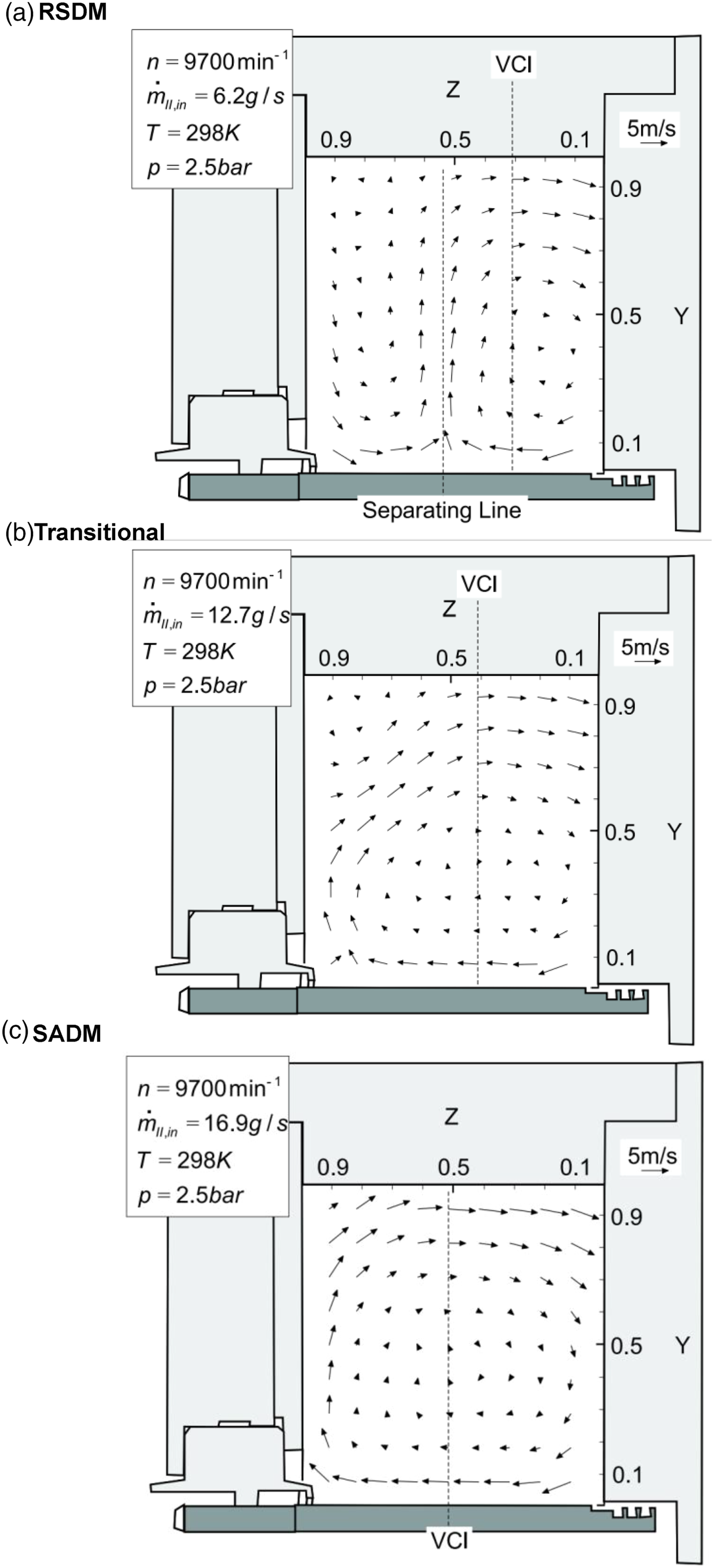
LDA data from Gorse et al. 3 showing: (a) RSDM, (b) transitional and (c) SADM secondary flow fields.
In order to benchmark simulations, calculations are therefore first performed without a sealing airflow, to achieve a pure RSDM. After which, the sealing airflow rate is gradually introduced until the flow transitions into a SADM.
Rotational shaft driven mode
Computationally, within the bearing chamber, much like the Taylor–Couette flow, it was observed that the vortical structure is extremely dependent on the initial conditions; even in the absence of a sealing airflow. Initial simulations at moderate shaft speeds, that is, below 9000 rpm failed to reproduce the Taylor vortex-like structure observed experimentally. Instead, depending on the turbulence model employed, either only one large rotating vortex was present or for some cases a vortical structure resembling the SADM, shown in Figure 11(b), was observed. Gorse et al. 3 provide no information regarding the start-up conditions employed experimentally, which therefore computationally, becomes extremely difficult in providing a start-up procedure as recommended in the Taylor–Couette study. Therefore, in order to accurately reproduce the flow structure, several different start-up conditions were tested computationally. The results showed that, across all turbulence models, the only case in which a flow structure resembling the RSDM was achieved was when the simulations were first initialised to the highest shaft speed of 13,000 rpm. Subsequently, it was observed, that after the Taylor vortex structure formed and stabilised, it was possible to preserve the structure by reducing the shaft speed in small steps down to 9700 rpm following the optimised start-up procedure methodology outlined within the Taylor–Couette study; here, a small step of 1000 rpm was deemed suitable. Following this technique, the RSDM was preserved and two counter rotating vortices were identified, as shown by the time-averaged velocity vectors Figure 12. Here, as expected, due to the lack of a sealing airflow, two equally sized, counter rotating vortices are observed with distinct vortex centres.
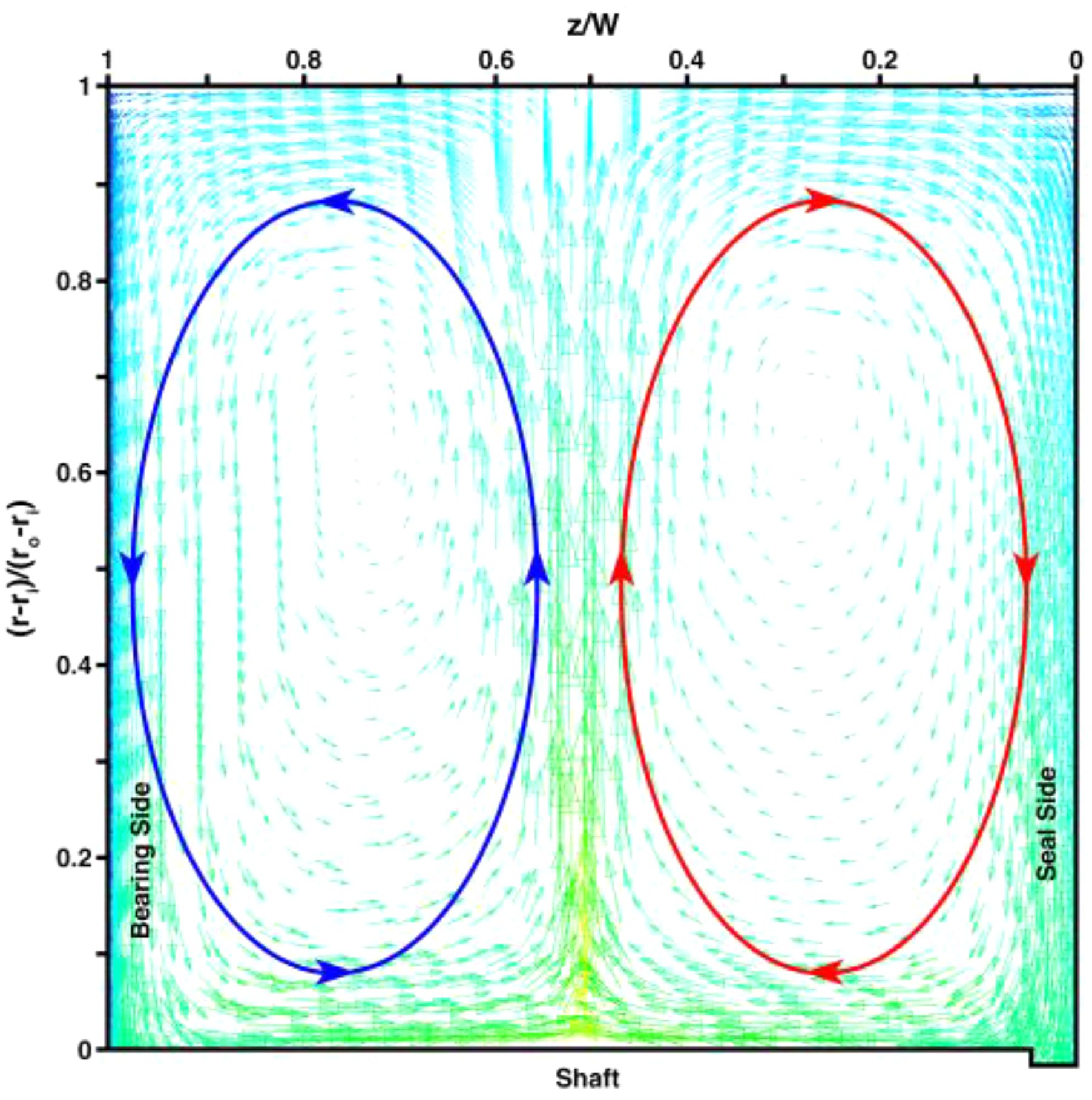
In-plane velocity vectors for RSDM at Ma= 0 g/s and n = 9700 rpm.
Interestingly, over all of the turbulence models investigated, the only case to not reproduce the RSDM was the k-ϵ RNG turbulence model, even at 13,000 rpm. Instead, one large rotating vortex is observed, with a very small counter rotating corner vortex as shown in Figure 13. It is important to consider the formation of this corner vortex, since a sufficient grid resolution close to the wall will be required in order to accurately determine both its shape and size. The k-ϵ turbulence model can completely fail to predict the effects of corners when very coarse grids near the walls are employed
29
; however, as shown in Figure 10, care has been taken refine the corners to a value of
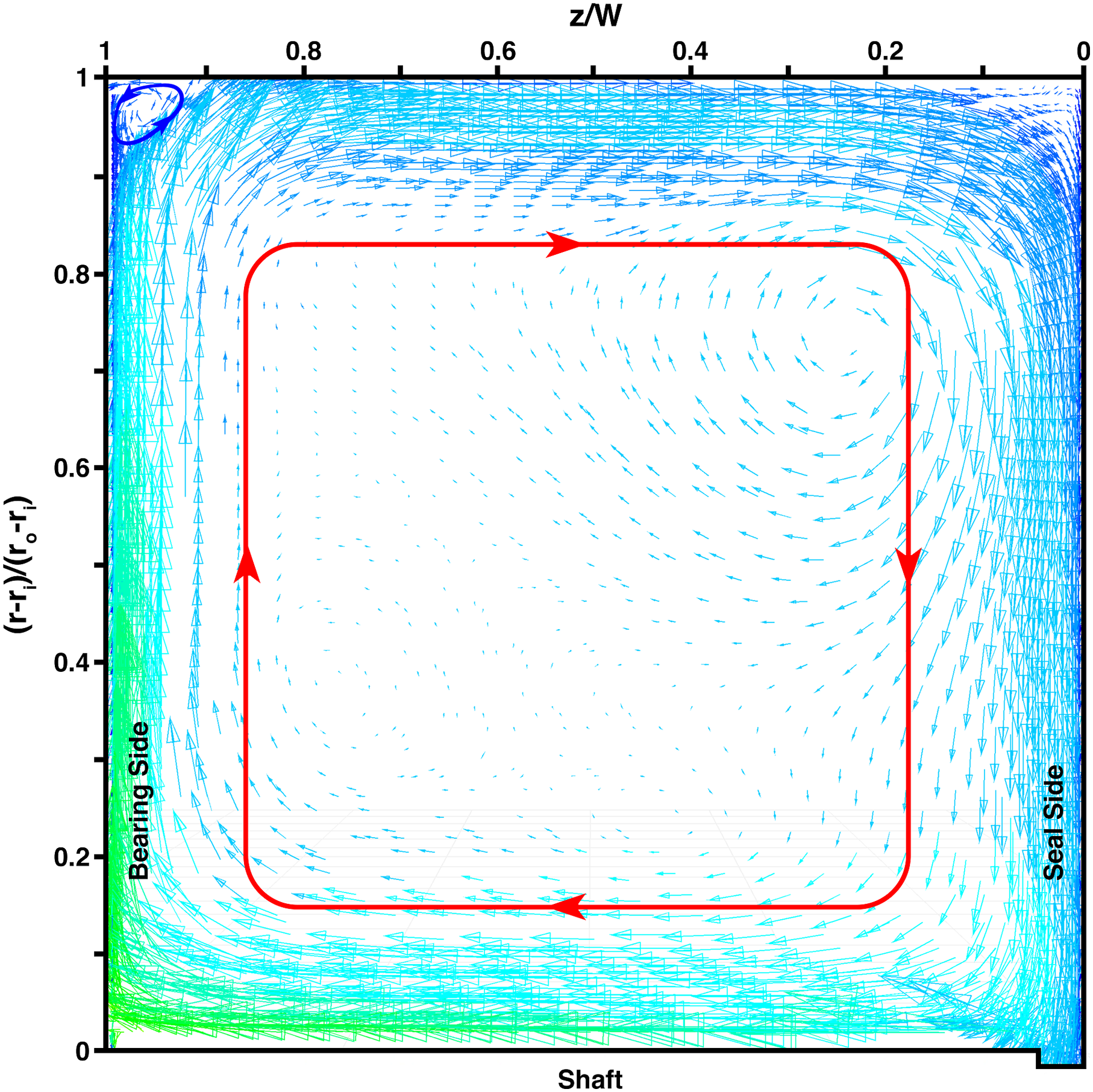
K-ϵ RNG in-plane velocity vectors for RSDM at Ma= 0 g/s and n = 9700 rpm.
Computationally, once the stable counter rotating vortex pair had formed, at the shaft speed of 9700 rpm, a sealing airflow was subsequently introduced. As the sealing airflow rate is gradually introduced, computationally the right-hand vortex, closest to the seal, gradually increases in size causing the left-hand vortex to diminish in size. The first available experimental measurement point to compare to is at a shaft speed of 9700 rpm and an airflow rate of 6.2 g/s. At this operating condition, all of the turbulence models investigated struggled to fully reproduce the RSDM presented by Gorse et al., 3 as shown in Figure 11(a). Both the standard k-ω and RSM-BSL turbulence models predicted very similar secondary flow patterns, whereby a large, dominating, right-hand vortex forms, with substantially smaller counter-rotating vortices forming at both the top and bottom on the left-hand side of the chamber. This can be seen in Figure 14(a)), which shows the secondary flow field pattern for the RSM stress-BSL turbulence model at 9700 rpm and an airflow rate of 6.2 g/s, an almost identical pattern is seen for the standard k-ω turbulence model. However, this flow field pattern, whilst similar, is still noticeably different to that of the SADM presented by Gorse et al. 3 in Figure 11(b). Within Figure 14(a), it can be seen that the vortex separation line still remains attached to the shaft unlike the experimental SADM results.
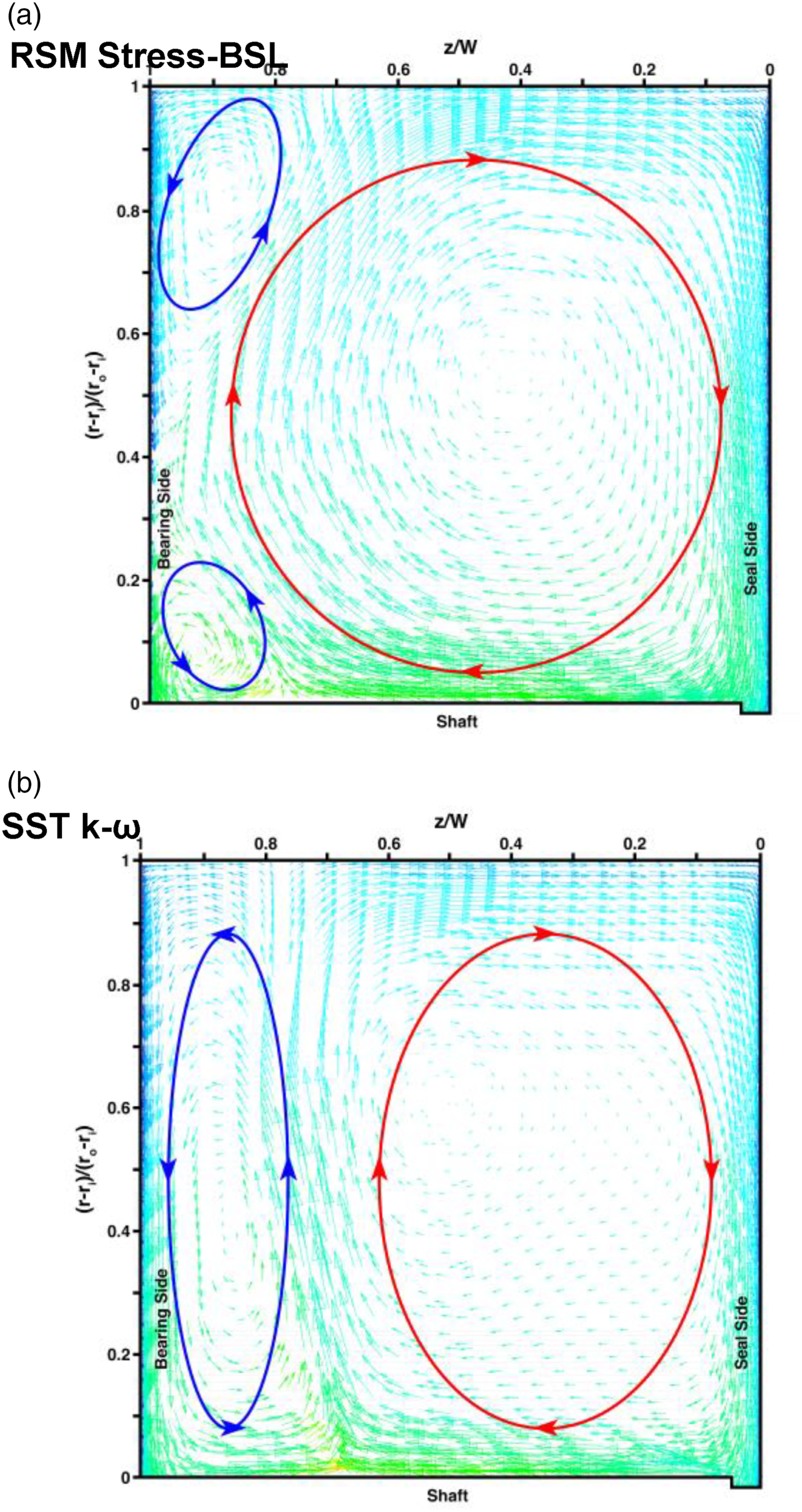
(a) RSM stress-BSL and (b) SST K-Ω in-plane velocity vectors for RSDM at Ma= 6.2 g/s and n = 9700 rpm.
The closest agreement found to the RSDM presented by Gorse et al. 3 was with the SST k-ω turbulence model, for which the averaged secondary flow field vectors are presented in Figure 14(b). Here, the turbulence model is able to capture the counter rotating Taylor vortex-like structure; however, compared to the results of Gorse et al., 3 a greater right-hand vortex is observed. Experimentally, the vortex separation line occurs at a non-dimensional distance of Z = 0.55, measured from the sealing side of the chamber, whereas computationally, this occurs at the non-dimensional distance of Z = 0.70.
These results are somewhat surprising since both Bristot et al.
9
and Singh et al.
12
successfully demonstrated the capability to capture the RSDM using the SST k-ω turbulence model on the bearing chamber geometry of Kurz et al.
6
The bearing chamber employed by Kurz et al. is almost identical to the test rig presented by Gorse et al.
3
except that the axial extent of the chamber is 1.4 times longer. Both Bristot et al.
9
and Singh et al.
12
used the same sealing airflow boundary condition presented in this current computational investigation, using a swirl angle of 50°. For the shaft speed and sealing airflow rate investigated by Bristot et al,
9
the velocity ratio was
A modified version of the Gorse et al. chamber is presented in Figure 15, in which the bearing chamber is re-meshed with a new axial width of 1.4 times the original chamber width,
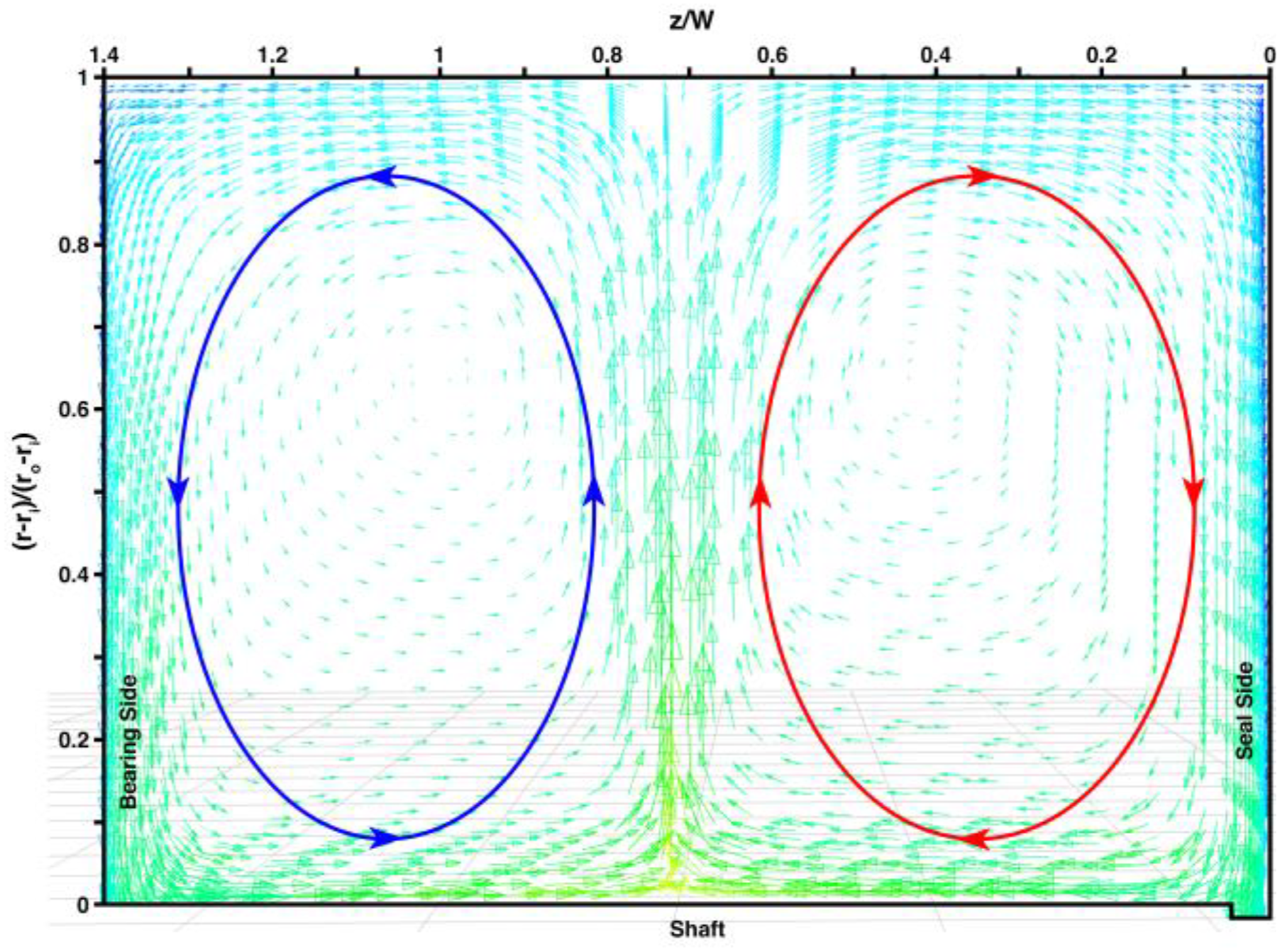
In-plane velocity vectors for RSDM at Ma= 6.2 g/s and n = 9700 rpm, for the chamber geometry of Gorse et al. 3 modified to an axial width of 1.4 W.
Overall, the results clearly demonstrate that due to the increased chamber axial length, the SST k-ω turbulence model is able to predict the RSDM, suggesting that the location of the vortex separation line is very sensitive to the sealing airflow input. By extending the chamber axial length, at the chamber centreline location, the same sealing airflow rate will be relatively weaker, causing the shaft rotation to drive the flow field. However, with the reduced chamber length, the same sealing airflow rate causes the vortex centreline location to be pushed further axially into the chamber.
Transitional mode
As the sealing airflow rate is increased, the flow state transitions from a RSDM to that of a SADM; Gorse et al. 3 show that this first starts to take place at an airflow rate of 12.7 g/s, as shown in Figure 11(b). Experimentally, at this flow rate, the vortex separating line becomes detached from the rotor surface and moves up the bearing chamber left-hand wall. At a shaft speed of 9700 rpm and an airflow rate of 12.7 g/s, this separation line occurs at the non-dimensional radial distance of R = 0.60 from the shaft. As a result, the left-hand vortex reduces in size significantly and is forced into the top left corner of the bearing chamber, with the vortex centre located at the non-dimensional location R = 0.90 and Z = 0.88.
Figure 16 shows the averaged secondary flow field vectors for each of the turbulence models investigated at a shaft speed of 9700 rpm and a sealing airflow rate of 12.7 g/s. The results for the k-ϵ RNG turbulence model are not shown since under these operating conditions, there was no change in the secondary flow field and an identical vortex structure as previously shown in Figure 13 was observed. Overall, within the bearing chamber geometry, the k-ϵ RNG turbulence model completely failed to capture the flow field patterns reported by Gorse et al. 3 over all of the shaft speeds and airflow rates investigated and is therefore not shown.
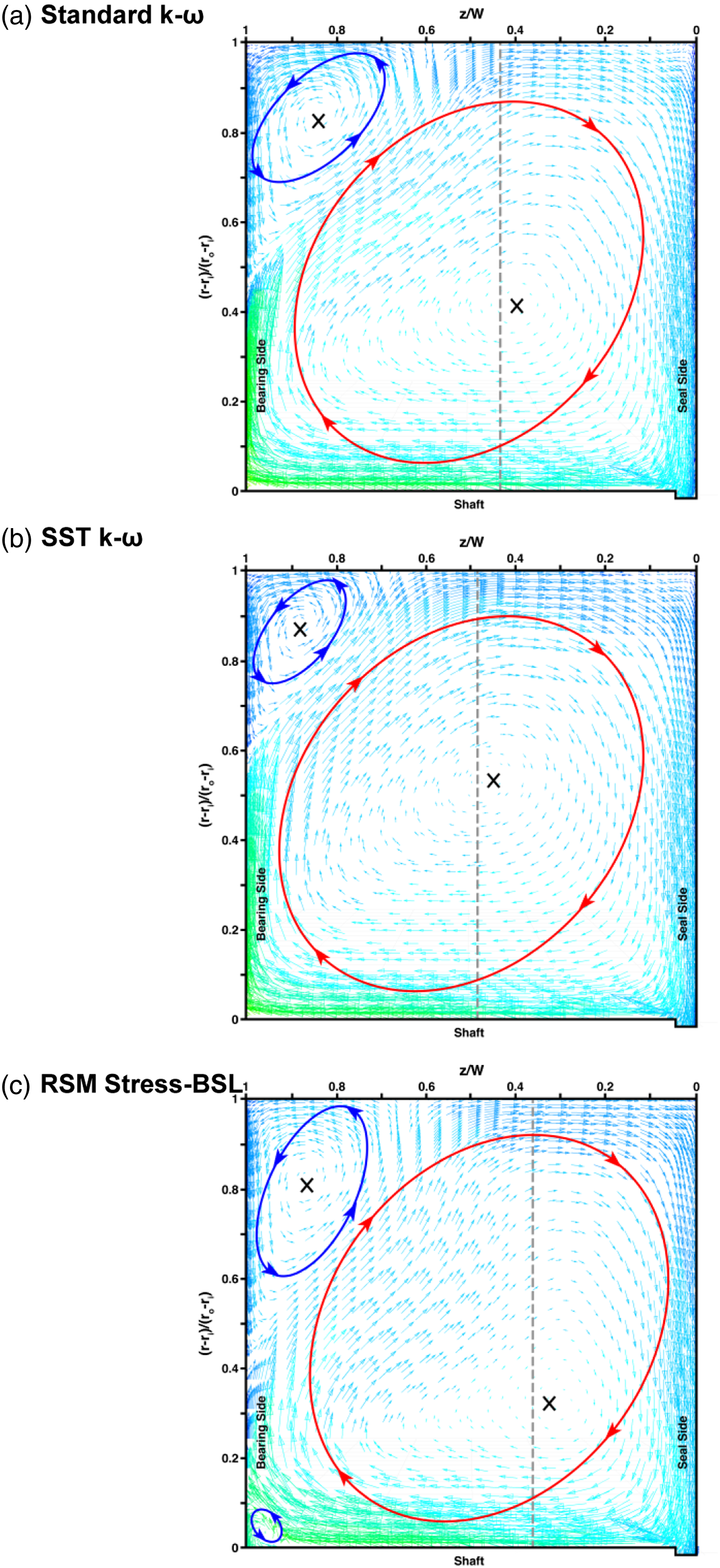
In-plane velocity vectors for the transitional state at Ma= 12.7 g/s and n = 9700 rpm a) Standard k-omega turbulence model, b) SST k-omega turbulence model, c) RSM Stress-BSL turbulence model.
Figure 16(a) shows the results of the standard k-ω turbulence model; here, the transitional mode is fully captured with the vortex separating line occurring at the non-dimensional location R = 0.47. As a result, a slightly larger corner vortex is observed when compared to the experimental results of Gorse et al. 3 Similarly, the results of the SST k-ω turbulence model are shown in Figure 16(b). With the SST k-ω turbulence model, a closer agreement to the experimental data is observed, with the vortex separating line located at R = 0.61, and therefore, a similar sized vortex is found at the top left corner of the chamber. Finally, the results of the RSM stress-BSL turbulence model are shown within Figure 16(c)). Here, whilst a comparable transitional vortex structure is observed, visually, the most noticeable difference is the presence of two vortex separation lines, one located at R = 0.44 and the second attached to the shaft at Z = 0.9.
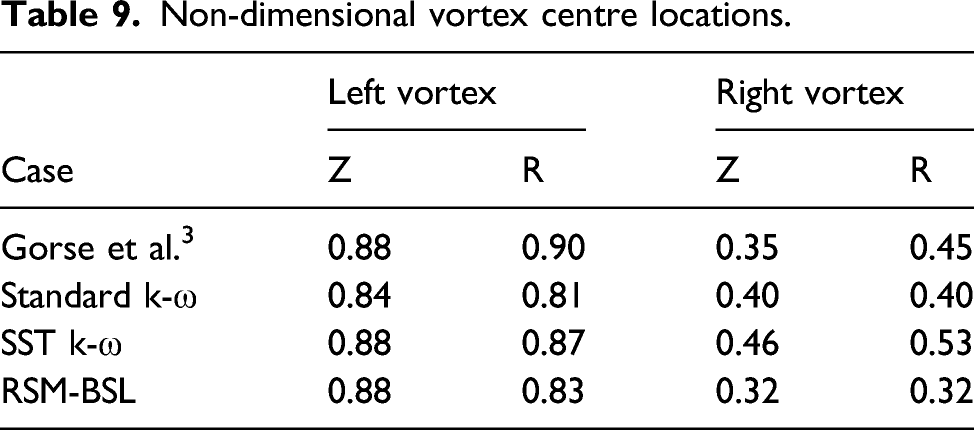
Table 9 summarises the centre location of the each of two main vortices compared to the results of Gorse et al. 3 The axial location of the left-hand vortex remains fairly consistent over all of the turbulence models investigated; however, the greatest difference lies within the radial co-ordinate, resulting from the difference in separation lines and hence the vortex size as previously discussed. The closest agreement to the experimental data is found with the SST k-ω turbulence model; however, when considering the right-hand vortex, all of the turbulence models showed a much greater variation from the experiment, with percentage difference in the region of 20%.
Non-dimensional vortex centre locations.
Under these operating conditions, Figure 17 shows the non-dimensional radial profiles of the mean tangential velocity at the axial positions defined by the dashed line within Figures 16(a)–(c). The axial locations are taken just off-centre of the right-hand vortex, in line with the experimental method presented by Gorse et al. 3 Across all cases, the mean tangential velocity is non-dimensionalised by the shaft speed. Whilst the transitional mode was not achieved using the k-ϵ RNG turbulence model, a comparison is also made.
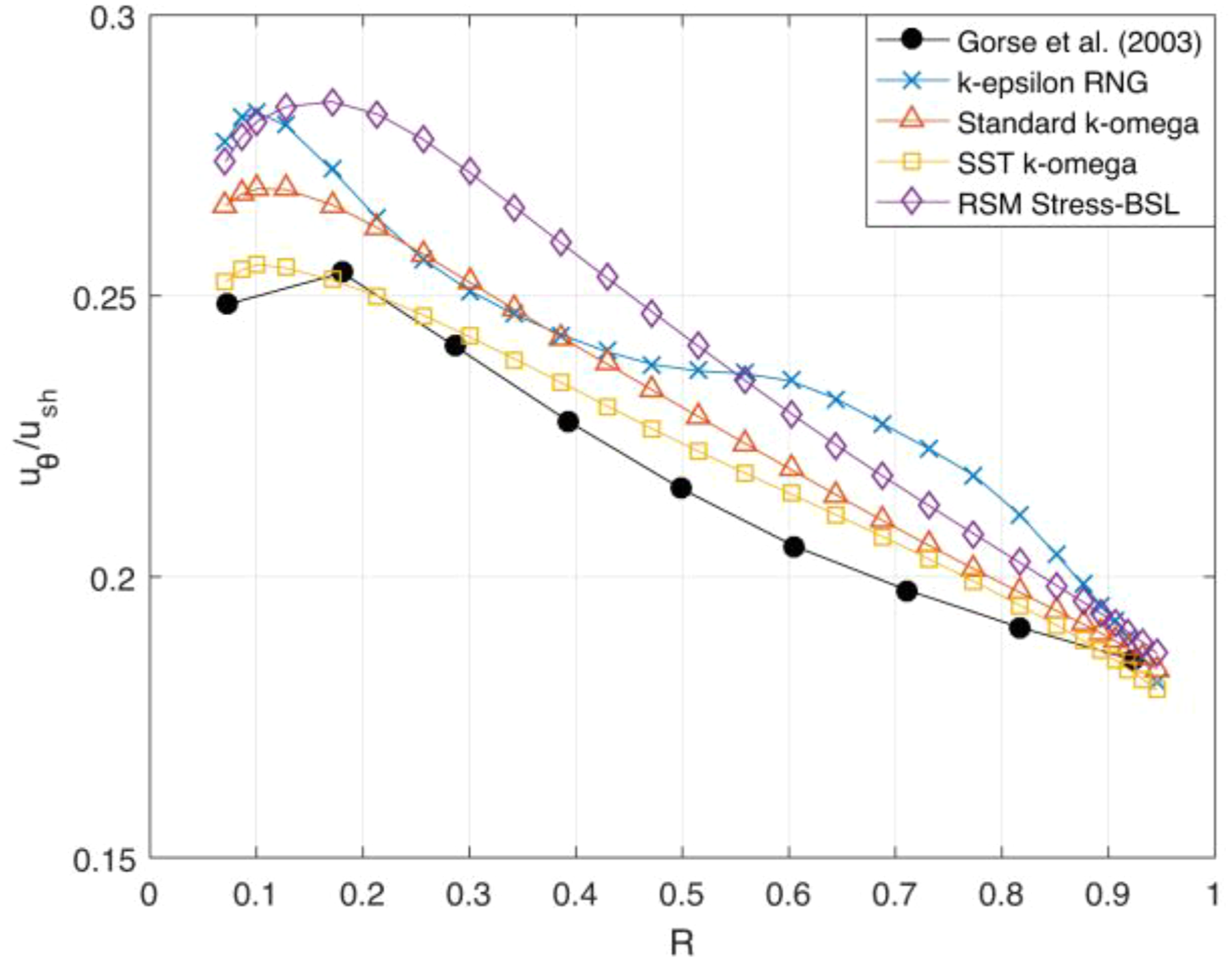
Radial profiles of non-dimensional tangential velocity at Ma= 12.7 g/s and n = 9700 rpm.
Within Figure 17, it is clear that across all of the turbulence models investigated, the SST k-ω turbulence model provides the closest agreement to the experimental measurements. This can be associated with the model’s ability to accurately capture the secondary flow field as evident in the comparison to the LDA data of Gorse et al. 3 For the SST k-ω turbulence model, the greatest discrepancy occurs over the non-dimensional radial distance of R = 0.4 to R = 0.8; however, over this range, the maximum percentage difference in the tangential velocity was less than 5%. In contrast, the RSM stress-BSL model produced the greatest deviations from the experimental measurements, with a maximum percentage difference of 12%, occurring at R = 0.18.
The recommended turbulence modelling methodology presented in the Taylor–Couette study suggested that the most appropriate models were either the standard k-ω or RSM stress-BSL. However, it was noted that whilst the SST k-ω model predicted very similar velocity profiles to the standard k-ω model, the biggest difference occurred within the axial wavelength of the Taylor vortex pairs. For the SST k-ω model, the size of the Taylor vortices was approximately 5% larger, resulting in smaller end cells. Within a bearing chamber, due to the constrained axial length of the geometry, this phenomenon does not present a problem since the space only permits a single vortex pair to form. Surprisingly, the RSM stress-BSL model, unlike in the Taylor–Couette study, performed quite poorly especially when comparing velocity profiles. In addition, due to the more complex nature of the RSM formulation, as expected, simulations were considerably more expensive; numerically taking up to five times as long to reach the same flow time, compared to the two-equation models. As such, for the bearing chamber geometry under investigation, it is clear that both quantitatively and qualitatively the SST k-ω model is the most suitable URANS turbulence model.
Sealing air driven mode
As the sealing airflow rate is increased further, the flow state moves fully into that of a SADM; the LDA results of Gorse et al. 3 demonstrate this at an airflow rate of 16.9 g/s, as shown in Figure 11(c). Experimentally, at this flow rate, the presence of counter-rotating vortices is completely wiped out and the flow is driven by one large vortex due to the dominance of the sealing airflow. Figure 18 presents the averaged secondary flow field vectors using the SST k-ω turbulence model for the shaft speed of 9700 rpm and 16.9 g/s. Much like the experimental visualisation results in Figure 11(c), numerically one large dominating vortex is observed; however, two smaller corner vortices are observed at the top left-hand and right-hand locations. The recognition of these corner vortices is important for bearing chamber investigations; their size and shape may heavily depend on the grid resolution and therefore may require further refinement to accurately capture. Within a bearing chamber, a thin oil film will form on this top wall that is, the outer casing wall, and these vortices may influence the oil film distribution. For example, the top left-hand vortex will push oil away from the centre of the outer casing wall toward the left-hand chamber wall. Subsequently, this will result in the oil film being redistributed away from the sump. Conversely, the presence of a thick oil film, which can have a length scale in mm, for example, 1–2 mm demonstrated by Bristot et al, 9 can completely wipe out these corner vortices as highlighted by the in-plane velocity vectors of Bristot et al, 9 in which the VOF iso-surfaces of oil are also superimposed.
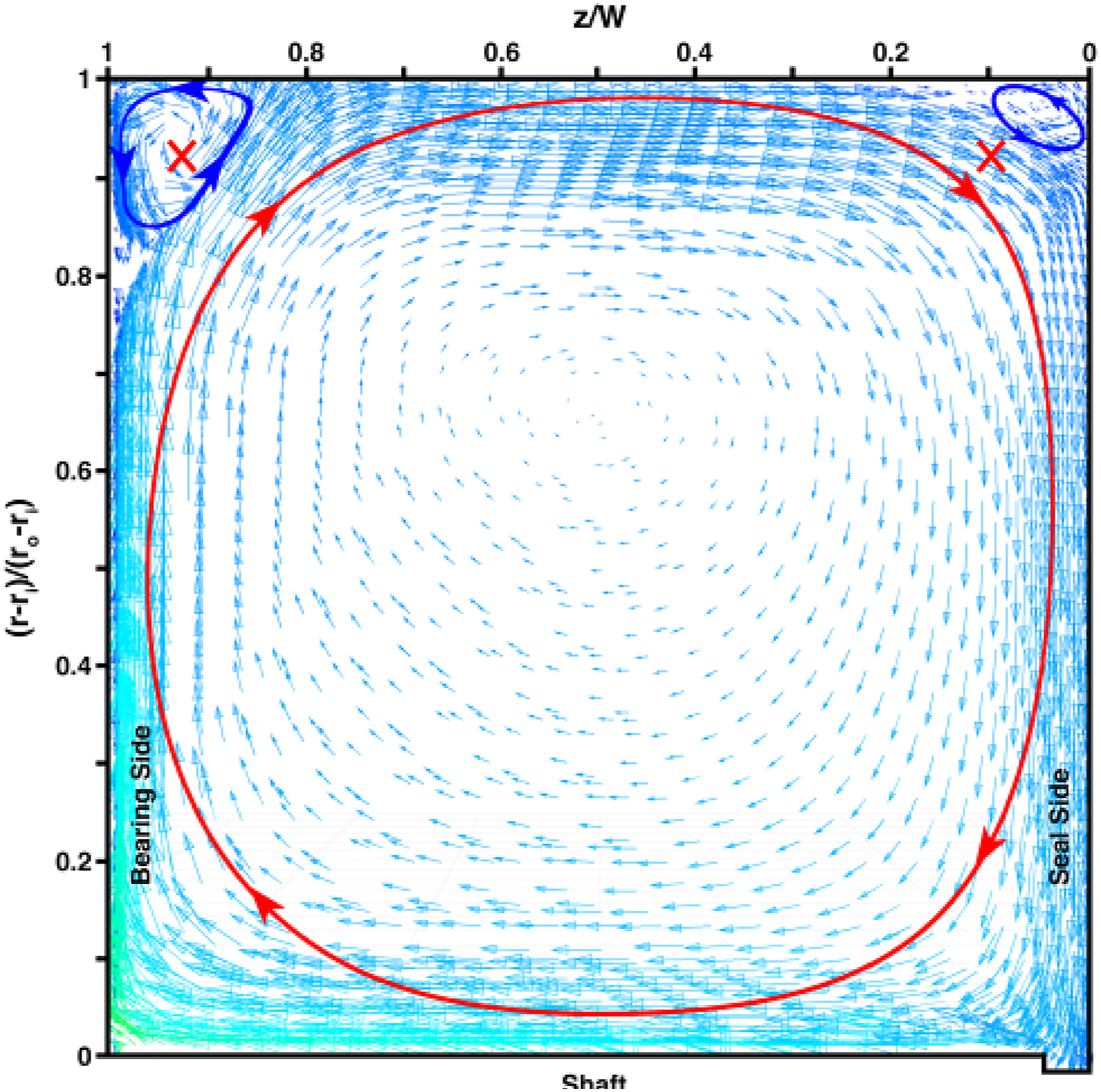
In-plane velocity vectors for SADM at Ma= 16.9 g/s and n = 9700 rpm.
In general, it is suspected that the resolution of the LDA method employed by Gorse et al 3 may not capture these corner vortices. For example, within Figure 11(c), the visualisation images of Gorse et al. 3 only depict one large dominating vortex, with no corner vortices. However, in Figure 11(c), the top-most left-hand measurement point is 3.5 mm away from the side wall and 3.5 mm from the top wall; similarly, the top right-hand measurement point is 4.5 mm away from the side wall and 3.5 mm from the top wall. These measurement locations are indicated by the red crosses in Figure 18. Close inspection shows that at these measurement locations the flow is travelling in the same direction as that depicted in Figure 11(c), This suggests that the numerical results are in good agreement with the LDA data of Gorse et al. 3
Variation in shaft speed
Based on the results achieved throughout the RSDM and SADM, the effect of varying the shaft speed on the secondary airflow field is explored using the SST k-ω turbulence model, for a fixed airflow rate of 12.7 g/s. Due to the difficulties of reproducing the counter rotating Taylor vortex-like structure within the RSDM, a higher sealing airflow rate is investigated; however, the RSDM parameter space is still explored. The main reason for this is due to the lack of available experimental data to compare to, both qualitatively and quantitatively, since Gorse et al.
3
only presents results at a fixed shaft speed of 9700 rpm. Numerically, the rotational shaft speed is varied from 3000; 6000; 9700 and 13,000 rpm, which corresponds to velocity ratios of
Figures 19(a)–(d) show the secondary flow field vectors for each of the corresponding shaft speeds investigated. Figures 19(a) and (b) represent the SADM, where one large central vortex is observed, and two smaller corner vortices form. Between Figures 19(a) and (b), some difference in the size of these corner vortices is observed, but largely, the overall flow field is very similar. Compared to Figure 18, which demonstrated good agreement for the SADM with the experimental visualisation of Gorse et al, 3 Figures 19(a) and (b)) present a similar secondary flow field structure; however, again some differences are observed in the size and shape of these corner vortices. The top-most left-hand and right-hand LDA measurement locations for Figure 11(c), as previously discussed, are depicted by the red crosses in Figures 19(a) and (b)). At these measurement locations, the centre location of the corner vortices lies closer to the wall than these LDA points. As such, when comparing the direction of the numerical secondary flow field velocity vectors with that of the vectors of Gorse et al, 3 in Figure 11(c)), the results are in good agreement.
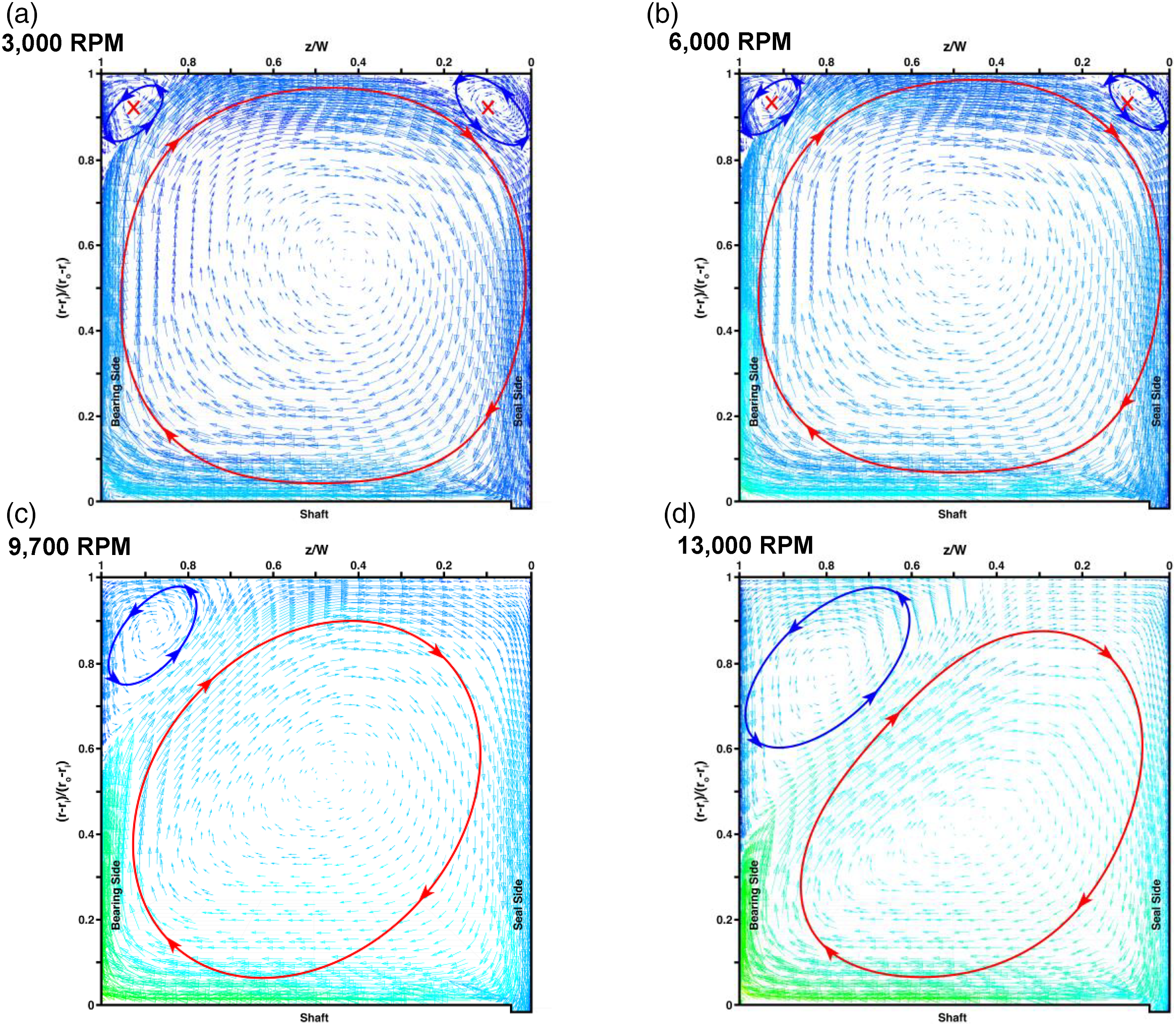
In-plane velocity vectors for different shaft speeds at Ma= 12.7 g/s: (a) 3000 rpm, (b) 6000 rpm, (c) 9700 rpm and (d) 13,000 rpm.
Figure 19(c) represents the transitional mode previously investigated in Figure 16(b), whereby the transition from the SADM to the RSDM is beginning to take place. Here, the vortex separation line becomes attached to the bearing chamber left-hand wall instead of the rotor surface. As shown previously, good agreement with the experimental data is observed both visually and quantitatively at this shaft speed.
Finally, as the shaft speed is increased to 13,000 rpm, shown in Figure 19(d), the velocity ratio
Conclusion
Axisymmetric and three-dimensional CFD modelling of Taylor–Couette flow within the turbulent Taylor vortex flow regime was analysed and compared to available experimental data with a view to establishing a methodology applicable to future bearing chamber modelling. The conclusions are as follows: • Start-up: An optimised steady acceleration start-up is indicated for future modelling. An investigation was performed into the start-up procedure. Sudden starts of the inner cylinder were compared to results obtained following a steady acceleration procedure. Through sudden starts, a large variation in the wavelength of Taylor vortices was obtained, resulting in different configurations in the number of Taylor vortex pairs. However, through a steady acceleration procedure, it was possible to achieve a final desired state over the whole range of rotational Reynolds number ratios investigated. Once the Taylor vortices form and stabilise after a steady acceleration procedure, it is then possible to increase the speed of the inner cylinder in small steps whilst still preserving the same number of Taylor vortex pairs, allowing the computational cost of simulations to be reduced over accelerations to large rotational Reynolds numbers. • Axisymmetric modelling: Axisymmetric modelling is inadequate for bearing chamber modelling. An axisymmetric URANS turbulence modelling study was performed on an axisymmetric grid. Good agreement was obtained for both the standard k-ω and RSM stress-BSL turbulence models at low rotational Reynolds number ratios. However, it was observed that as the speed of the inner cylinder is increased, the agreement between CFD and experimental results became poor. This is suspected to be as a result of not capturing the three-dimensional structures present within turbulent Taylor–Couette flow, such as boundary layer Görtler vortices. • Three-dimensional modelling with rotational periodicity: Rotational periodicity is unlikely to be adequate for bearing chamber modelling. The axisymmetric CFD methodology was extended to modelling in three-dimensions building on the previous knowledge acquired. A study into applying rotational periodicity was carried out in order to reduce the computational cost. Poor agreement was achieved over all of the rotational periodicities investigated. The radial velocity profiles were overestimated, and a much-reduced core velocity was observed when comparing the velocity magnitude across the gap. • Recommended methodology: A full 360° model with either the standard k-ω or RSM stress-BSL turbulence model is recommended for the bearing chamber study. Finally, the full
Subsequently, the three-dimensional Taylor–Couette turbulence modelling methodology has been expanded and applied to a bearing chamber geometry. Numerical studies are conducted over a range of shaft speeds and sealing airflow rates. A qualitative and quantitative analysis of the secondary airflow structure is carried out and compared to the experimental measurements of Gorse et al. 3 Initial calculations determined that it was necessary to include a start-up procedure, as highlighted by the Taylor–Couette study. As such, simulations were first initialised to 13,000 rpm after which the rotational shaft speed was reduced in small steps to the final desired state.
Qualitatively, without a sealing airflow, all of the turbulence models investigated were able to fully capture the RSDM, except for the k-ϵ RNG model. For all of the experimental operating conditions investigated, the k-ϵ RNG turbulence model performed poorly producing only one large rotating vortex structure. At low sealing airflow rates, all of the turbulence models struggled to capture the RSDM presented by Gorse et al. 3 The closest agreement was found with the SST k-ω turbulence model although compared to the experimental measurements, a larger than expected right-hand vortex was observed. At moderate sealing airflow rates, the transitional mode was predicted well by both the standard/SST k-ω models and also by the RSM stress-BSL turbulence model, all accurately capturing the vortical structure presented by Gorse et al. 3
Quantitatively, at the transitional mode, a comparison of vortex central locations revealed good agreement across all of the turbulence models. For the left-hand vortex location, the closest agreement was achieved using the SST k-ω turbulence model, as a result of accurately capturing the vortex separation line. However, for all of the cases investigated, the central location of the right-hand vortex was not captured well. Normalised tangential velocity profiles radially across the gap were also compared to the available measurements of Gorse et al. 3 Again, out of all of the turbulence models investigated, the closest agreement was observed for the SST k-ω turbulence model, with local percentage differences no greater than 5%. Surprisingly, the poorest agreement was found with the RSM stress-BSL model, with percentage differences as large as 12%.
Within the SADM, the SST k-ω turbulence model was able to accurately reproduce the secondary flow field observed visually, demonstrating one large dominating vortex. Numerically, two counter rotating corner vortices are identified at the top of the chamber. These are not identified experimentally due to the resolution of the LDA measurement locations. Finally, the effect of varying the shaft speed on the secondary flow field is investigated at a fixed sealing airflow rate, highlighting the transitional process from the SADM to the RSDM.
The results of the bearing chamber investigation differ slightly to that of the Taylor–Couette study. Within the Taylor–Couette methodology, the standard k-ω and RSM stress-BSL turbulence models were recommended as the most suitable choices; although for the bearing chamber investigations, the best results were achieved using the SST k-ω turbulence model. The Taylor–Couette modelling revealed that whilst similar to the standard k-ω model, the SST k-ω model over predicted the vortex axial wavelengths. However, it is clear that within a bearing chamber geometry, this is not as significant, due to the constrained chamber axial length. Overall, a good agreement is instead presented with the SST k-ω model.
The present work has demonstrated the performance of URANS turbulence modelling applications to a bearing chamber geometry, benchmarking the performance of different turbulence modelling approaches. The best practical approach for bearing chamber applications is the SST k-ω turbulence model. As such, the SST k-ω turbulence model is recommended for all future bearing chamber simulations. Due to the sensitivity of the secondary flow field, numerically, procedures should be taken to reproduce the start-up conditions employed experimentally.
Footnotes
Acknowledgements
The authors are grateful for access to the University of Nottingham High Performance Computing Facility. In addition, the authors acknowledge the use of Athena at HPC Midlands+, which was funded by the EPSRC on grant EP/P020232/1.
Declaration of conflicting interests
The author(s) declared no potential conflicts of interest with respect to the research, authorship, and/or publication of this article.
Funding
The author(s) disclosed receipt of the following financial support for the research, authorship, and/or publication of this article: This work was supported by the Engineering and Physical Sciences Research Council grant number EP/P020232/1.
