



Abstract
This article is part of a wider project investigating the theory and practice of song translation and performance. It derives – specifically – from my own desire to attempt to translate Ne me quitte pas into English. (See: Appendix.) It is designed as an investigation into the tenacious misconception that certain English-language versions of Brel's songs are translations thereof. Using Peter Low's typology, many of these versions can more accurately be described as adaptations or as replacement texts. One objective of this comparative study is to draw attention to the need – in theory – to distinguish between translation and adaptation. This work also calls for more precision in attributing authorship to the lyrics or texts sung by different performers. Examination of eight English-language versions of Ne me quitte pas – an exceptional corpus made up of texts sung by Rod McKuen, Scott Walker, Marc Almond (×2), Momus, Arnold Johnston, Des de Moor and The Black Veils – seeks to illustrate and discuss the history of approaches to rendering this song in English. That is one sense in which this article aims to put the record straight. This aim might also hint at the idea of respecting (high) ‘fidelity’ to the original. However, whether translation, adaptation or replacement text, any Target Text – even if assessed by criteria provided by Song Translation Theory – can only ever be interpreted subjectively. Thus, imagining a single way of putting a record straight is futile. Comparison of versions of Ne me quitte pas can, however, illustrate how different strategies and priorities can ‘succeed’ differently. Understanding the potential for ‘queering’ Ne me quitte pas was a by-product of research and close reading of the texts themselves. As this appears to pertain significantly in a handful of versions in the Anglophone world – but not, seemingly, in Turkish versions – this article seeks also to open up the ‘queering’ (or not) of Brel, in particular, as an avenue of future inquiry.
Prelude
Such is the commitment to Jacques Brel demonstrated by artists discussed in this article that we might conceive of Brel Translation Studies as a substantial offshoot of Song Translation Studies. In 1981, Scott Walker released his 9-track album, Scott Walker Sings Jacques Brel (and he recorded many more of Brel's songs). Five years later, Momus released his version of Ne me quitte pas alongside his takes on Jacky and Voir un ami pleurer. Marc Almond would ‘cover’ 12 Brel songs in his eponymous homage to Jacques (1989) – and he recorded his version of Jacky, two years later. The 14-track album Rod McKuen Sings Jacques Brel was released in 1992. Arnold Johnston's translations of more than 80 Brel songs alone constitute a significant body of work. To consider only the Anglophone world's take on Brel, this corpus swells if we include – just two examples – the performances of David Bowie and contemporary gigging band Dead Belgian. 1 Together – and alongside consideration of the ‘mythology’ of Brel (See: Cordier, 2014; Hawkins, 2000; Looseley, 2016; Marc and Green, 2016; Poole, 2004; Tinker, 2005a) – there is indeed material enough for an area of study that might be styled as Brelology. 2
Significantly, analysis of Brel's chansons has played a primordial role in the development of Song Translation Theory generally in the Anglophone world. (See: Apter & Herman, 2012, 2016; Fernández, 2015; Low, 1994, 2003a, 2003b, 2005, 2008, 2013; Tinker, 2005a, 2005b). Whether this derives from Brel's popularity, researchers’ personal tastes, the number of versions of his songs in English, or from other factors, Brel seems to be the go-to artist for afficionados of French-English song translation. The present study will focus on Ne me quitte pas because there are no fewer than eight versions of this song in English that are relevant to this study. In a metatextual twist, they will be compared in light of theories that Brel's work has – in part – been used to construct. 3 The corpus – outlined below – spans 41 years (1966–2007) and thus allows for analysis in light of the ‘Age of Re-Translation’ (Gambier, 1994; Collombat, 2004).
Given that Brel's work is used so often as a matter for theoretical discussion of song translation, it is perplexing how so little attention tends to be paid to the texts that are sung. It seems cavalier to minimise discussion of concepts such as meaning and accuracy, even – or especially – if readings depend on subjective interpretation. Seeking to examine the texts themselves is not a retrograde step with a view to adding to ‘the few examples of criticism which address the relationship between Brel's songs and their English adaptations [that] tend to highlight rather disparagingly the difficulty of translating lyrics faithfully’ (Tinker, 2005b: 180). It is, however, a closer look at the texts with attention to aspects of translation, ranging from age-old notions of ‘semantic fidelity’ to relatively unexplored strategies of ‘queering’. 4 Thus, consideration of the music – in this study – is minimal: firstly because it is redundant in cases where versions are something other than translations, and not least because I am not a musicologist.
This study examines versions by McKuen, Walker, Almond and de Moor, as these artists have been used previously by other academics – notably Low and Tinker – in discussing Brel in English. To these are added versions by the artist Momus (Nick Currie), the academic Arnold Johnston and The Black Veils. All versions are only loosely understood to be ‘covers’. 5 The corpus is skewed gender-wise only because I have not been able to find any other versions (penned by a woman, for example). That in itself is intriguing and worthy of further investigation. Another avenue for research lies in uncovering – and comparing 6 – what happens when Brel is sung in languages other than English. 7 Öztürk Kasar (2019) began this work in analysing four versions of Ne me quitte pas in Turkish. 8
One objective of this comparative study is to draw attention to the need – in theory – to distinguish between translation and adaptation. This work also calls for more precision in attributing authorship to the lyrics or texts sung by different performers. Understanding the potential for ‘queering’ Ne me quitte pas was a by-product of research and close reading of the texts themselves. As this appears to pertain significantly in a handful of versions in the Anglophone world – but not, seemingly, in Turkish versions – this article seeks also to open up the ‘queering’ of Brel, in particular, as an avenue of future inquiry.
Adapting Brel
Tinker (2005b: 181–9) eschews discussion of the translation of Brel in favour of examining their adaptation. His analysis – identifying three distinct approaches to adapting Brel in English – is useful in assessing the approaches of the versions examined in this study. Complementing Tinker's analysis, Peter Low's work places more importance on the words, meaning and accuracy in song translation. By way of providing some theoretical context, we can begin by reviewing the findings of Tinker and Low, whilst bearing in mind that their approaches are different. 9 Thereafter, in the wake of studies such as that of Perle Abbrugiati (2010) – which gives a textual comparative analysis of Italian-language translations of the songs of Brassens – we can compare and discuss the texts themselves.
Characterised as ‘aimed primarily at mainstream domestic audiences’ (Tinker, 2005b: 181), the first approach to adapting Brel is ‘commercial’. Tinker illustrates this approach through analysis of McKuen's If You Go Away (Ne me quitte pas) and Seasons in the Sun (Le Moribond): Viewed in their own terms, McKuen's middle-of-the-road adaptations of these Brel songs appear to offer little insight into the French source text. However, when the French and English versions are compared, some of the specificities of chanson become more apparent: for example, the emotional honesty and intensity of Brel's ‘Ne me quitte pas’. (Tinker, 2005b: 181)
The first approach erases or dilutes complex emotions and taboos in the name of (‘mainstream’) commercial success. The second approach resists simplification (but seeks refuge in some oppositional – or ‘minority’ – tradition). Tinker identifies a third approach which ‘crosses, blurs and challenges […] cultural divisions’ (Tinker, 2005b: 181) – this he detects in the work of both Walker and Almond. In examining their versions of La Mort, La Chanson de Jacky and Au suivant, Tinker (2005b: 189) suggests that they ‘succeed in capturing something of the inherent postmodern qualities of French chanson – a “popular” yet “serious” art form’. Given the subtitle of the present article, one might presume that it is in this ‘postmodern’ approach that ‘queer(ing) translation’ would most happily find a home…
McKuen sang his own version of Ne me quitte pas. However, Walker and Almond recorded their versions loosely ‘using’ the text created by McKuen. This is crucially important: the approaches identified by Tinker are independent of the lyrics that are sung in lieu of the original text. Tinker's analysis clearly transcends Translation Studies. Yet much of his analysis shares an interest in questions relevant to Translation Studies: who are the intended (or target) audience, how are linguistic and cultural issues dealt with? Furthermore, what is the function of translated texts in new contexts, when sung by different people, over a period of some 40 years? In this light, is it a mere coincidence that many of the Anglophone artists drawn to Ne me quitte pas are associated with the LGBTQ+ community? For example, McKuen was bisexual (Stewart, 2014: 10), and Almond is a ‘dandy’ known for his ‘queering antics’ (Hawkins, 2009: 12).
Low (2005) – more interested in the rendering of lyrics – developed the ‘pentathlon principle’ in Song Translation Studies. Incorporating his theory of ‘singability’, this principle is based on four more intertwined criteria: sense, naturalness, rhythm and rhyme. As all of the songs examined in this study have been sung, it is presumed that we are dealing with more or less singable versions. Elsewhere, Low discerns three strategies regarding ‘sense’: translation, adaptation and replacement. These map – very roughly – onto Tinker's postmodern/chanson, alternative/oppositional and commercial categories. But where Tinker examined ‘adaptations’ of Brel's songs, Low defined adaptation as a distinct strategy.
For Low, the first strategy – translation – is exemplified in Blau and Shuman's ‘Old Folks’ (Les Vieux). Low (2013: 231) applies the term ‘song translation’ to ‘texts where there is extensive transfer of material from the ST, with a reasonably high degree of semantic fidelity, particularly with respect to its main features’. This is translation as it is commonly understood.
Low uses the example of Blau and Shuman's ‘Timid Frida’ (Les Timides) to illustrate what he sees as adaptation (and how that differs from translation ‘proper’): Already common in translation studies, this term [‘adaptation’] denotes ‘a TT [Target Text] that draws on an ST [Source Text] but which has extensively modified it for a new cultural context’ (Munday 2009:166). An adaptation is less equivalent to the source text than a translation, since the adaptor has made extensive and wilful deviations from the original. (Low, 2013: 231)
Thirdly, Low sees in Blau and Shuman's ‘Carousel’ neither a translation nor an adaptation of ‘La Valse à mille temps’. It is, rather, a replacement text
11
: In the context of songs, a ‘replacement text’ will be defined here as a song lyric created to be used with a pre-existing melody, yet manifesting no semantic transfer from the text previously sung to that melody. (Low, 2013: 231)
Ne me quitte pas – Jacques Brel (1959)
Before examining the English-language versions, let us review Brel's original ST, with a brief discussion of performance and the music. Brel's performance of Ne me quitte pas arguably changed according to whim or mood. Listening to – and comparing – Brel's recordings of this song from 1959 and 1972 should reveal that they are subtly different. The tone of the latter might seem less impassioned, for example. However, this could be explained by age, fatigue, nostalgia, repetition and the overall change in context. 12 Nonetheless, this observation allows for – if not encourages – a plurality of readings or interpretations. 13 Whether we receive Ne me quitte pas sympathetically as a love song or more cynically as the words of a coward 14 , it remains a highly emotional and moving song. 15 Significantly, the text sung by Brel in his lifetime does not change – for the sake of simplicity, we can consider the text of his first recording as the ST.
Low (2005: 201) explains that the emotion
16
of the song develops – through the five verses – in five stages:
plea for forgetfulness/forgiveness promise of impossible gifts promise of exorbitant language metaphorical argument about renewal pathetic self-abasement.
Poole (2004: 18) describes this development as the ‘descent in total abnegation of the lover desperate to avoid abandonment’. For Tinker (2005a: 103), the conflict in this dramatic song can only be understood by appreciating Brel's performance. Indeed, this ‘descent’ can be seen in Brel's physical (theatrical) performance. In a recording of one such performance, we see Brel's face in close-up: sweating from beginning to end, his desperate descent is communicated by his eyes (which variously reach out imploringly or turn away, embarrassed, look up to the heavens and increasingly blink), the lips (at turns, smiling and quivering) and shakes of the head.
17
For Hawkins (2000: 137–49), the song is a ‘desperate plea in exquisitely precious poetic language’ and Brel performs it ‘with touching dramatic intimacy’. Despite the famous words of Edith Piaf 18 , Brel's choice is to reveal – through his performance of the words – male impotence and subservience (Dollander and Tychey, 2002: 101). Interestingly, more women than men have recorded versions of Ne me quitte pas in French: among them are to be found versions by the Anglophones Nina Simone (1965), Sandie Shaw (1967) and Alison Moyet (1987). Ne me quitte pas would seem to hold a certain attraction, irrespective of an artist's gender. Whether unwittingly or deliberately, Simone, Shaw and Moyet ‘queer’ the song by promising to make the addressee – as Brel does – a queen. As a song ostensibly designed along heteronormative lines, it has the potential – in translation, in adaptation and in performance – for contesting heteronormative essentialism. 19
Track 1: If You Go Away – Rod McKuen (1966)
Hawkins (2000: 57) has observed that McKuen's version ‘retains the melody if not the delicate poetry of the words’. Tinker (2005b: 181–82) goes further: Some of the pitiful displays of self-abasement in Brel's interpretation, notably the male narrator's image of himself walking in the shadow of his lover's dog, are erased from McKuen's translation of Brel's lyrics.
As with the title, McKuen modulates the final imperative (Let me become…) and turns it into a conditional clause. In so doing, a portrait of self-abnegation becomes a snapshot of self-pity.
Brel's character makes extravagant promises. They are unconditional. Brel sings of impossibly rare gifts, building a domain and inventing meaningless words that his love will understand. In contrast, McKuen's (less extravagant) promises – ‘I’ll talk to your eyes that I love so much’ – are conditional. Verses 2 and 4 begin with the words ‘But if you stay’… Rather than undying, unconditional love, McKuen is proposing an exchange. McKuen also adds a few self-centred questions: ‘For what good is love without loving you?’ Can I tell you now, as you turn to go, I’ll be dying slowly ‘til the next hello?’ Brel's resignation – however desperate – is revealed slowly, implicitly, as it passes from the present (Il faut oublier) via the future (je t’offrirai, je creuserai…), to settle more prosaically in some near future (Je ne vais plus pleurer). McKuen, on the other hand, accepts the departure of his lover quite openly and quickly: ‘Then if you go, go. I won’t cry’ (verse 2).
Based on this analysis, and according to Low's theory, McKuen's lyrics constitute a replacement text. The dichotomous structure of his song – alternating negative hypotheses (‘if you go away’) with positive (‘but if you stay’) – changes the evolving nature of Brel's original. Moreover, the natural images of the ‘perles de pluie’, ‘volcan’ and ‘terres brûlées’, the references to royalty (‘domaine’, ‘roi’, ‘reine’), the notion of a quest (‘je creuserai la terre’) and the promises based on orality (‘je t’inventerai des mots insensés’, ‘je te parlerai’ and ‘je te raconterai’) have all disappeared. The only image that survives is that of the dog.
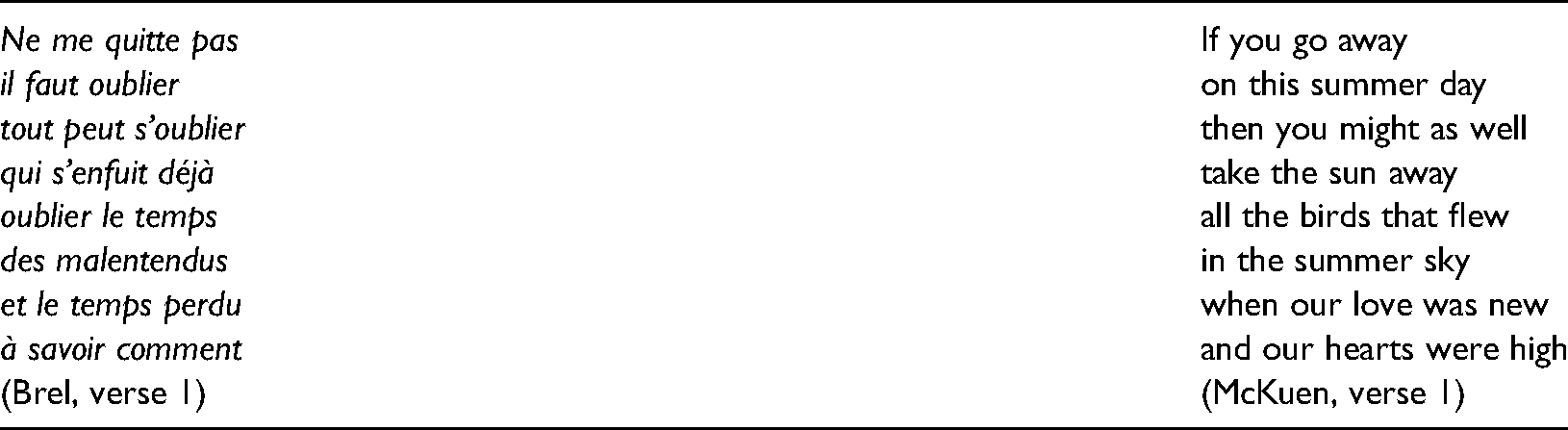
Brel's injunction to forget everything is replaced by the opposite of forgetting: a series of memories (based on birds, the sky, summer and heat).
We can also observe that McKuen generally uses monosyllables – perhaps because they facilitate easier rhyming and make the song more easily singable. But it should be clear that McKuen is not singing a translation of Brel's song: the meaning (or range of possible interpretations) has changed extensively. In this light, it is futile to measure this song as a translation according to Low's other criteria. That said, the very success of this version could – in part – derive from McKuen's ability to satisfy those criteria other than sense: the simplicity of the rhymes, the easy rhythm, the naturalness of the language and its evident singability clearly made for a (commercially) successful song.
20
But is it right that this is constantly hailed as a translation? Indeed, as the translation of Ne me quitte pas? Rather, we are in the realm of borrowing, the association of ideas, and perhaps – even – the appropriation of a certain mythology. Despite all this, Franzon (2008: 380–81) is right in suggesting that even if: McKuen's versions of Jacques Brel's songs ‘Seasons in the Sun’ (1963) and ‘If You Go Away’ (1966) preserved merely a few phrases from the original French lyrics, they still carved a place for Brel in the international music industry, familiarized audiences with his music, and paved the way for closer renderings some years later.
Tracks 2, 3 & 4: If You Go Away (Again?): Scott Walker and Marc Almond
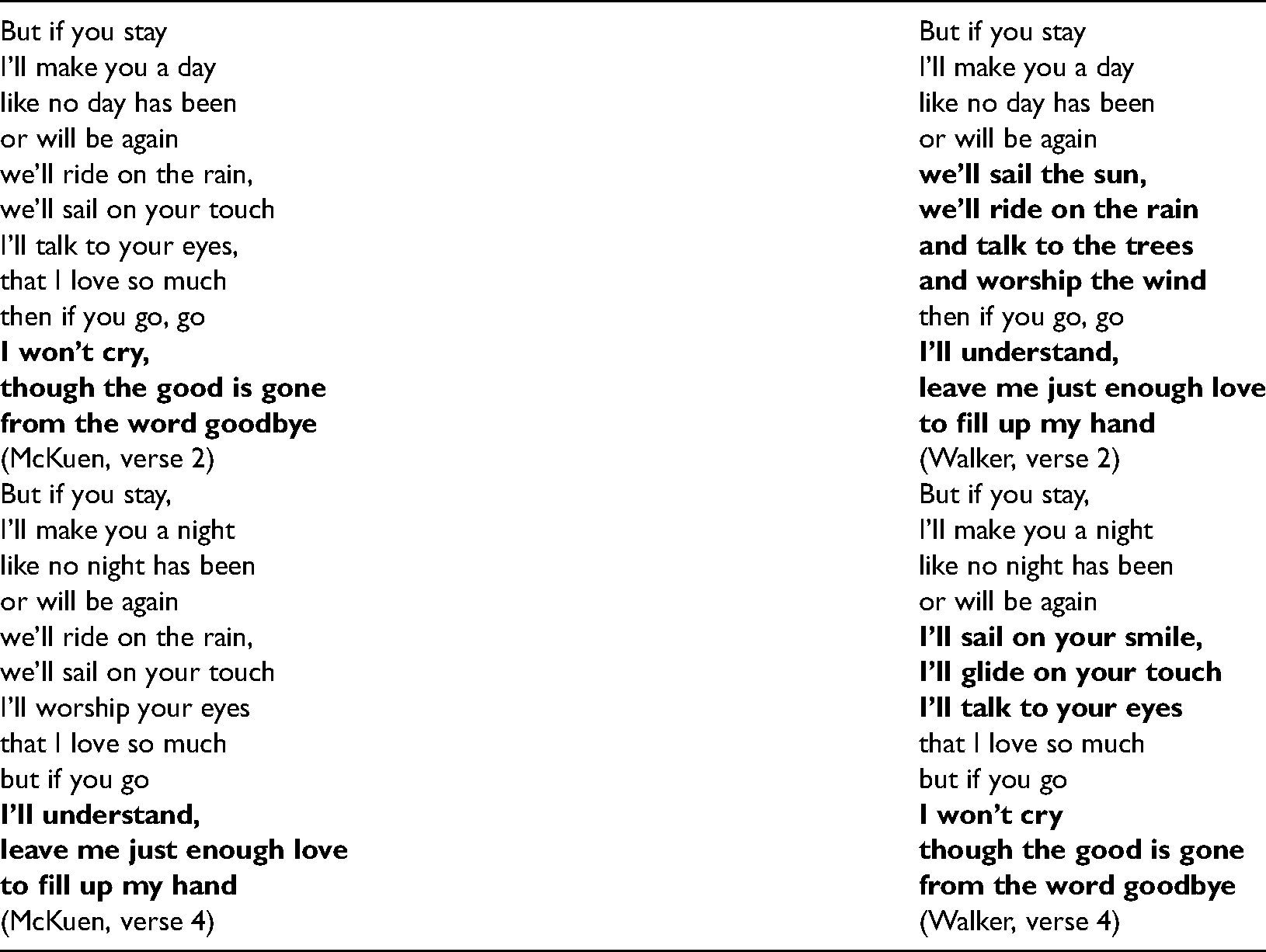
The changes that Walker makes to McKuen's text are superficial and – above all – structural. Walker reproduces or borrows the notions – absent from Brel's original – of ‘riding on the rain’ and ‘sailing on your touch’… But not necessarily in the same order. For example, Walker inverts the order of the words ‘ride’ and ‘sail’.
The only logic seemingly guiding Walker's re-structuring would relate to rhyme. Brel's ‘perles’ and other treasures, regal references (verse 2), the ‘ancien volcan’ and ‘terres brûlées’ (verse 4) remain absent: we might, therefore, see the text that Walker sings as a decoupage of McKuen's text. Where McKuen uses his own rhymes – ‘I won’t cry… the word goodbye’ (verse 2); ‘I’ll understand… fill up my hand’ (verse 4) – Walker borrows these but swaps them round. The apparent interchangeability of these lines would point to a method owing more to that of William Burroughs than to any desire for (increased) respect for Brel's song. If Walker's text could be said to improve McKuen's, in any way, it is perhaps in introducing (in verse 2) the close rhyme ‘wind/hand’, and in the repetition of the word ‘turning’. Even so, by Low's criteria, Walker's version is the adaptation of a replacement text.
Things get even more complicated when we examine different versions recorded by Almond. His versions – the first released in 1982, the second in 1989 – attribute authorship of the sung text to McKuen. And yet, Almond's 1982 version is a mixture – another cut-up à la Burroughs – of McKuen's text and that sung by Walker. Verses 2 and 4 structurally resemble Walker's version more than McKuen's: despite attribution of the lyrics to McKuen, in the third verse Almond reproduces Walker's addition of the word ‘turning’ – this clearly indicates that Almond has ‘used’ the text sung by Walker and not, in fact, that of McKuen. In this case, we are in the messy territory of listening to Almond's adaptation of a replacement tex mash-up.
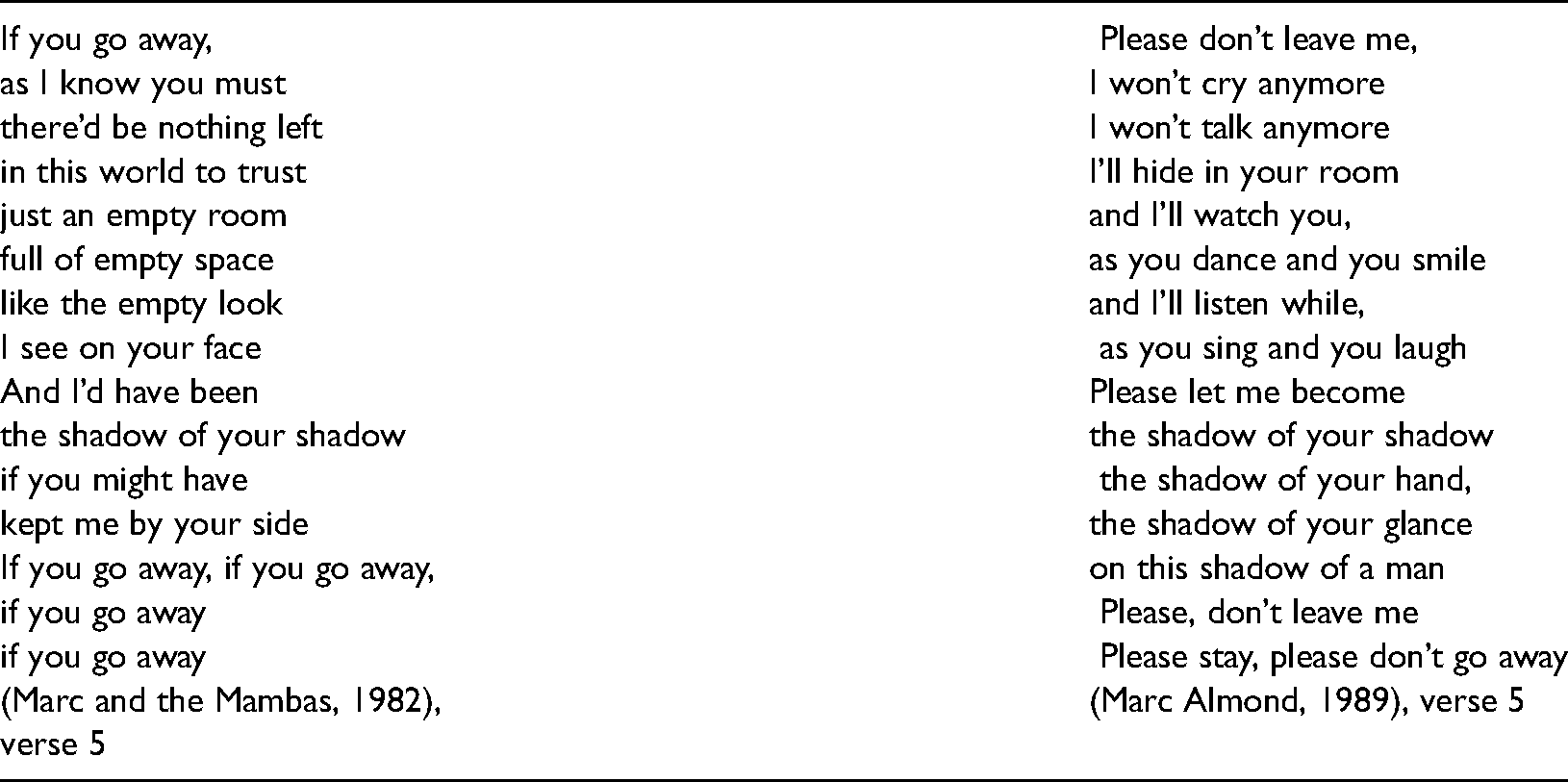
Almond's 1989 version is clearly not McKuen's or even an amalgam of that and Walker's. It is much ‘closer’ – semantically – to the text of Brel's song. In fact, it constitutes an anonymous, unattributed translation 22 – it restores the imperative (‘don’t leave me’) and has generally followed the meaning (images and development) of the ST. This version also reproduces the repetition of the image of the shadow, although ‘l’ombre de ton chien’ becomes – ambiguously – ‘the shadow of your glance on this shadow of a man’. 23 In this light, it is startling that McKuen is credited as the author of both these texts.
Track 5: Don’t Leave – Momus (1986)
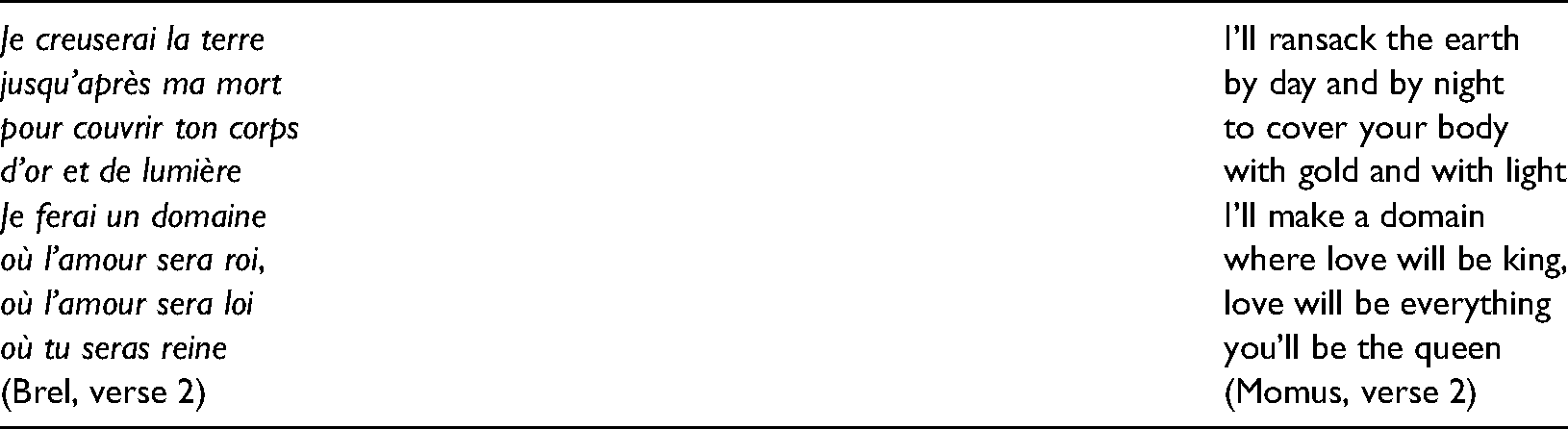
The poetic luxury of Brel's original – with rhyme (‘mort’, ‘corps’ and ‘d’or’), and the purr of the ‘r’ consonant (‘où l’amour sera roi’) – is perhaps impossible to reproduce whilst seeking to prioritise ‘semantic fidelity’. However, unlike McKuen's replacement text, that of Momus manages to reproduce the images quite literally. It also follows the logic (the five stages) of Brel's text. More than this, Momus has made an effort to rhyme most of the lines – ‘night/light’, ‘king/everything’ and the near-rhyme ‘domain/queen’ – whilst respecting the original meaning(s).
To consider rhythm, as an aspect of ‘singability’, we can note that for the nine syllables of the last line of the third verse – ‘de n’avoir pas pu te rencontrer’ – Momus uses thirteen: ‘who died without meeting you, died without knowing you.’ This has an impact on how the line is sung, but it can be understood as a side-effect deriving from the translator's desire to produce a fairly literal (‘semantically faithful’) translation.
Momus nonetheless changes the meaning of the text – in three places. Firstly, the verb ‘offrir’ – for Anglophones – is a ‘faux ami’. In English, it is not the done thing to offer someone a present. The standard translation – in this instance – is ‘to give a present to someone’.

Brel's character seeks to convince by invoking the necessity – on a cosmic scale – of the marriage of night and day (the black of the night sky, the red of the setting sun) as a condition (pour que) for the sky to ‘blaze’ (flamboyer). In a probable mis-read of the original, the images of union, unity and heavenly joy give way to a more prosaic – and more pessimistic – statement suggesting hopelessness in death (‘they never touch as they die’). However inadvertently, this possible mis-translation arguably adds to the pathos of the song. 24
Thirdly, just as Almond will go on to do in 1989, Momus transforms ‘l’ombre de ton chien’ into ‘the shadow of your man’. Unlike the two preceding changes, this transformation is most likely deliberate. The cover of Circus Maximus – an album by Momus from 1986 – features Saint Sebastian: Pierced or unpierced, Saint Sebastian has endured in the popular imagination as the patron saint of homosexual men, a figure who winkingly seems to mock religious ecstasy as an erotic put-on. (Kaye, 1996: 86)
Track 6: Don’t Leave Me – Arnold Johnston (1997)
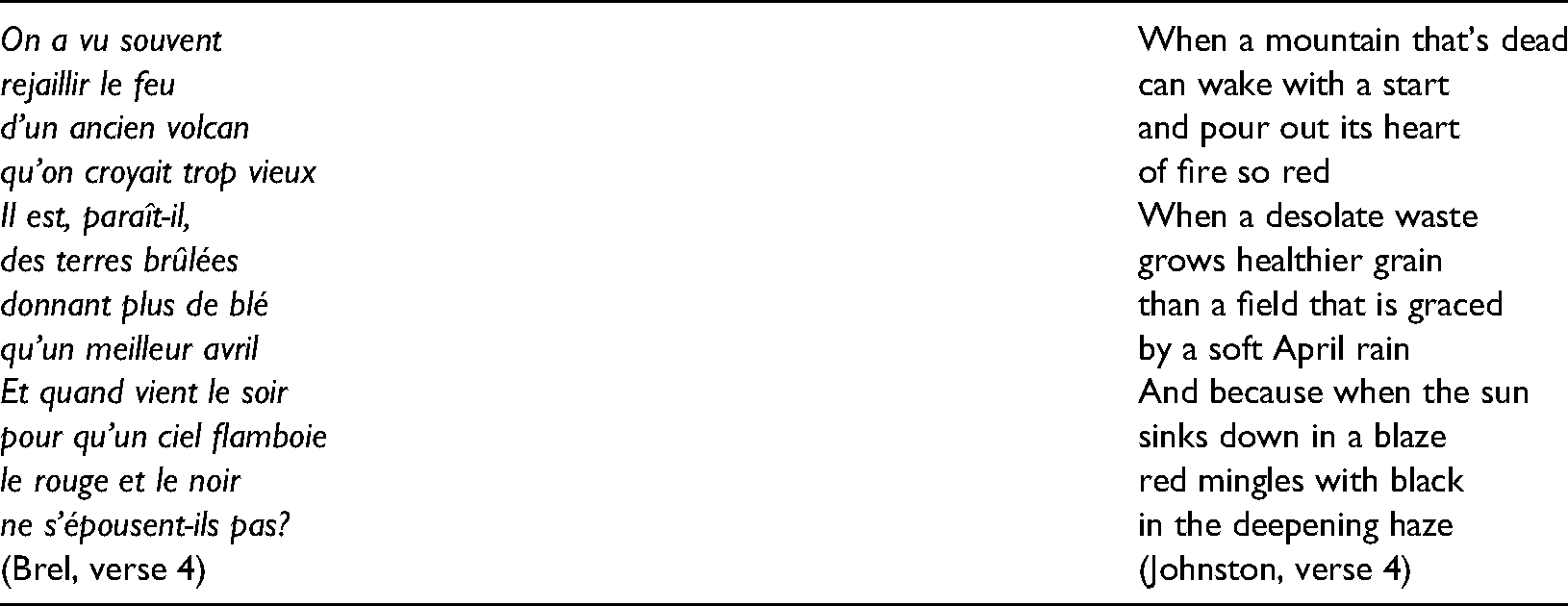
In the main, Johnston successfully matches the dense alternate rhyming of the original – ‘dead/red’, ‘start/heart’, ‘waste/graced’, ‘grain/rain’ and ‘blaze/haze’. In order to achieve this, Johnston creatively re-formulates the original. For example, the image of the volcano is evoked poetically through description of a dead mountain pouring out ‘its heart of fire so red’. Importantly, this reproduces the image of re-birth, and it achieves this in a rhythmic, rhyming, poetic manner. The same can be said for the sophisticated re-working of the image of ‘a desolate waste’ (terres brûlées) yielding ‘healthier grain’ (plus de blé) than ‘a field that is graced by a soft April rain’ (un meilleur avril).

The tetrasyllabic ‘explanations’ (/ˌek.spləˈneɪ.ʃənz /) potentially upsets the rhythm – as well as naturalness and rhyme – owing to unnatural stress on the final syllable. Even so, Johnston's sound technique can be seen in the marrying of semantic fidelity and concise expression through de-nominalisation of ‘malentendus’, now expressed as a verb (‘we misunderstood’). And if – in the original – time was lost or wasted (‘le temps perdu’) in searching to understand the hows and whys (‘à savoir comment’), we can see that Johnston's solution re-formulates this idea very neatly. The unfortunate stress of ‘explanations’ is perhaps the price to be paid, sometimes, for such re-formulation.
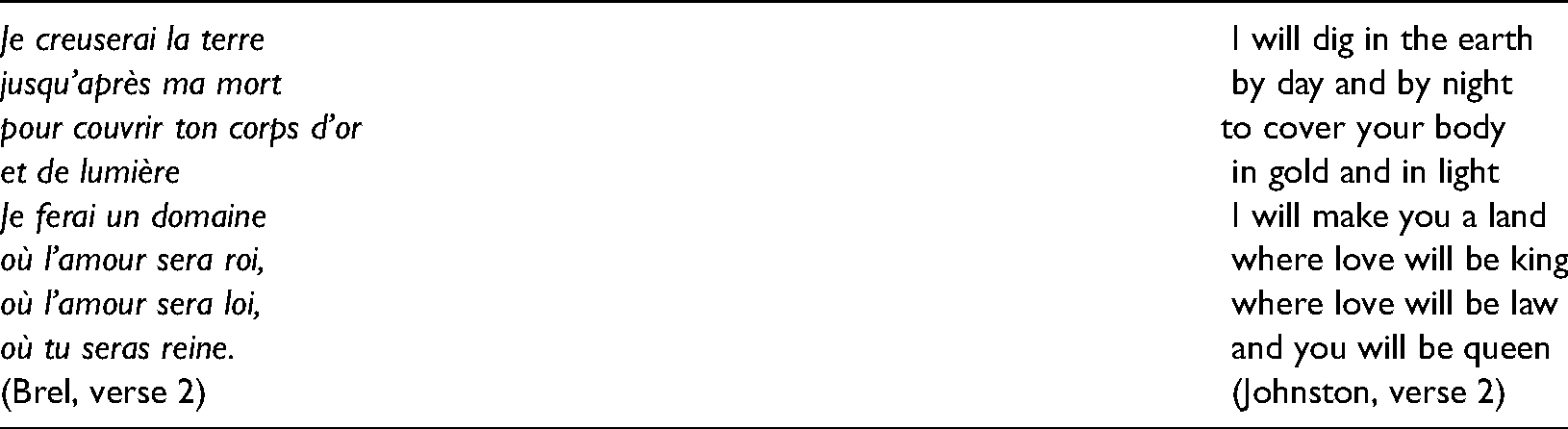
Rendering the verb ‘creuser’ as ‘to dig in’ affects sense and the poetry thereof. The idea in the ST is that the singer is prepared to tirelessly mine the earth (or even to hollow out the planet) in order to find the gold (and other jewels) with which to cover the other's body. Owing to its connotations, digging in the earth might conjure up a more squalid, less romantic, image.
In verse 2, Johnston's text strays slightly from the literal meaning of the original, but it loses none of the ST's illocutionary force, and it gains in rhyme: ‘by day and by night’ captures the sense of ‘jusqu’après ma mort’ in emphasising tireless activity. Similarly, avoiding the obvious cognate of ‘domaine’ in favour of ‘land’ is perfectly valid, as the words are synonymous. On the other hand, the bisyllablic ‘body’ in this excerpt stands out, for unnatural stress is placed on the second of its syllables. Nonetheless, in this instance, the loss of rhyming per se does not detract from the singability of the translation.
Track 7: Don’t Leave Me Now – Des de Moor (1999)

The translation of ‘domaine’ as the very literary (archaic?) ‘demesne’ (/ dɪˈmeɪn /) is here forced to half-rhyme with ‘queen’ – but this is far from jarring when the song is sung. That aside, it can be observed that de Moor's text uses just three polysyllabic words (everything, volcanos and overhead) where Johnston's text features five polysyllabic words (misunderstood, explanations, desolate, healthier and deepening). As discussed, above, so de Moor's text arguably contains an infelicity deriving from unnatural stress (on the final syllable of ‘everything’). A similar issue arises with the lines ‘from ancient volcanos / we thought were too old’ (De Moor, verse 4). Musically, the stress falls (unnaturally) on the final syllable of ‘volcanos’ – this perhaps compromises rhythm and naturalness.
For Tinker (2005b: 181), de Moor's approach to ‘adapting’ Brel was emblematic of ‘a more alternative if not oppositional Anglophone cabaret tradition’. But in his case – as in Johnston's – it would perhaps be more accurate to see de Moor's work as a translation rather than as an adaptation.
Track 8: Don’t Leave Me – Black Veils (Alfonso/Heller, 2007)
If the solitary aim of the Black Veils had been to introduce Brel to their young public, they could have sung the text of any pre-existing version of the song. Whether for reasons of copyright, authenticity or embracing the challenge of creating an original version, the fact that they recorded a new translation is revealing. Respecting the evolution and imagery of the song, the Black Veils’ version can indeed be seen as another translation. The strategy seems to be to simplify the language even more than de Moor managed to achieve, whilst seeking to respect the original meaning at the level of lexis. Only two trisyllabic words feature in this translation (crucify and volcano), and the rest of the language is overwhelmingly monosyllabic. This helps in avoiding unnatural stress.
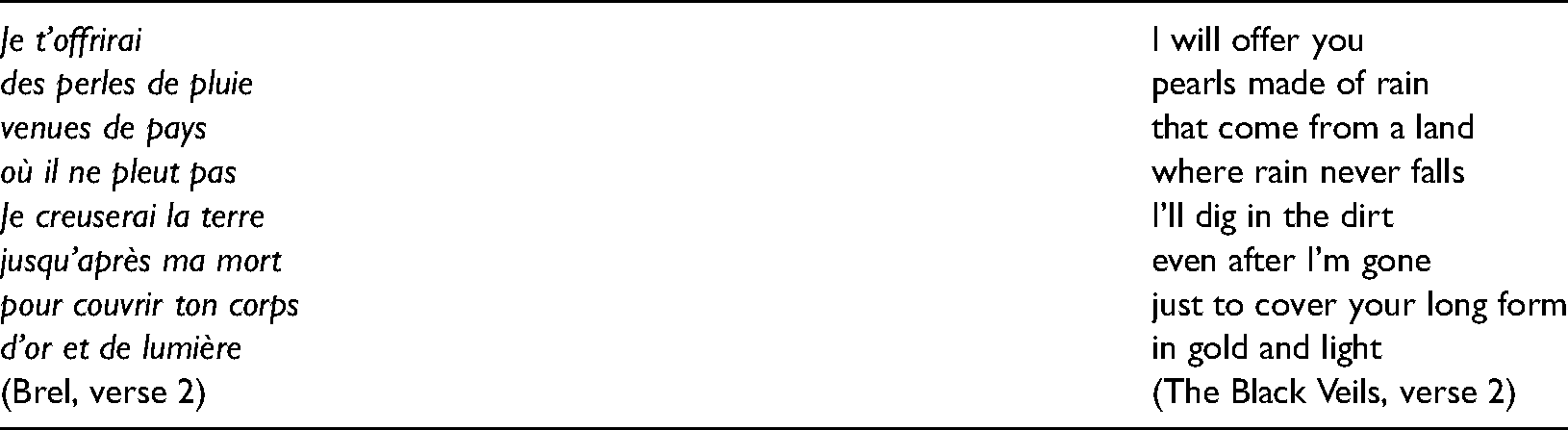
The absence of rhyme in this verse and the rather jumpy rhythm – with lines variously of four to seven syllables – arguably makes this version less singable than, for example, de Moor's version. Perhaps seeking to avoid any unnatural stress on the word ‘body’ (as a literal translation of ‘corps’), the solution – ‘your long form’ – might strike the reader/listener as unidiomatic, and thus unusual.

Particularising the verb ‘tuer’ as ‘to crucify’ introduces Christian imagery. This is compounded, quite coherently – and, through alliteration, quite stylishly – by the presence of the ‘cross’. Given the context, suitably powerful and dramatic, this rendering is idiomatic and concisely poetic.
Conclusion
In the particular case of Ne me quitte pas, we have seen that McKuen ‘replaced’ Brel's text and produced a different song with a different story. Historically, it is McKuen's version that has most often been presented – and received – as the English-language version or translation of Brel's original: whilst rare – on the radio, for example – any attribution regarding the lyrics typically takes the form of ‘Translated by Rod McKuen’. For a period of 20 years, McKuen's initial replacement text spawned hundreds of its own covers and adaptations. But a replacement text is not a translation. Nor is an adaptation (of a replacement text). However, we can review this in terms of one of the aims of ‘queer(ing) translation’, which is to: productively destabilize not only traditional models of representation, understood as mimesis, reflection, and copying, but also the authorial voices and subjectivities they project. (Baer and Kaindl, 2018: 1)
Analysis of the flip side to replacement has revealed noticeable differences in translation (and adaptation) strategies. Certain differences are quantifiable and can be assessed by means of linguistic analysis: for example, we can count syllables, consider stress and compare meanings. However, appreciation of any of these versions – provided they more or less satisfy Low's pentathlon principle – must be subjective: and overall appreciation will depend on other factors such as a singer's voice and the arrangement of the song. Whilst variety in the translations reveals differing skills, priorities and motivations, it also testifies to the necessarily creative aspect of song translation.
In rejecting the ‘commercial’ approach, it would seem that the song's translators (Momus, de Moor, Johnston and The Black Veils) rally under the banner of the ‘alternative’ or ‘oppositional’. It is this approach alone – and not that espoused by Almond and Walker – that has focused on what Tinker (2005b: 189) sees as the defining aspects of Brel's chanson: ‘the foregrounding of lyrics, the honesty of emotion, the readiness to tackle taboos.’ Ironically, Walker and Almond – notionally more ‘faithful’ to chanson – rely overwhelmingly on the (commercial) lyrics of McKuen. In performance, Walker strips his version of emotion, where Almond (in the Marc and the Mambas version) exaggerates and amplifies it – but far from tackling taboos, they sing the same banalities as McKuen. Nonetheless, in ‘queering’ the song – as Almond, for example, might do in performance – it would seem that even a replacement text can evoke chanson.
Momus produced a personalised translation of Brel's song – his (deliberately ‘queered’?) version has different meanings in line with his own life and artistic project. 25 His ludic appropriation of Brel is even clearer in his translation-cum-adaptation (or domestication) of Jacky: titled Nicky, Momus (Nick Currie) sings his own life story on Brel's model. 26 Similarly, Momus knowingly re-frames Ne me quitte pas – in transforming the dog into a man – to produce a song with ‘queered’ connotations. Given Brel's famous homophobic remark about Bowie 27 , one might suppose that this strategy is born of revenge. Alternatively, for Momus – and other artists – armed with ‘theatricality, camp, and irony’ (Hawkins, 2009: 12), Brel's œuvre perhaps ‘provides the male performer with recourse to self-expression in restricted zones that fall outside the confines of “normative” masculinity’ (Hawkins, 2009: 116). To update this idea (embracing queer theory), we might suggest that it provides all performers – irrespective of gender identification – with the opportunity to explore the extra-normative.
Interestingly, in the study led by Öztürk Kasar (2019) – whilst based on only one translation and three adaptations/replacement texts according to the criteria of the present study – ‘queering’ Brel in Turkish has not been explored as an option: all four versions are aligned with heterosexual norms. Indeed, the texts sung by women unambiguously make the addressee of the song a male. And it would appear that the texts sung by men – in line with Piaf's (toxic?) ideas of masculinity – downplay the ‘femininity’ or any sense of submissiveness in Brel's original song (Öztürk Kasar, 2019: 292).
The present study has discerned a certain evolution – in the Age of Re-Translation – in strategic approaches to ‘covering’ Ne me quitte pas. The tendency – in this case – has been towards a progressive increase in semantic fidelity and simplification of language. But to pinpoint any translation as definitive is meaningless – the lesson of the Age of Re-Translation is that quality and interpretation are relative, mutable (Desmidt, 2009: 670). In that sense, the record can never be put straight. Furthermore, the variety in approaches to Brel is indicative of what artists do when they ‘cover’ other artists: any approach will be part of a personal (hi)story, thematics or artistic project – artistically, there might be something sterile in an utterly ‘faithful’ version that merely strives to copy an original. In incorporating Brel into their own work, artists do allow new audiences to discover his work, but they also offer up new interpretations in new and changing contexts. Queer(ing) interpretations – as seen in the work of Momus, in particular – have the capacity to domesticate chanson, but they also have the potential to critique an original, to re-imagine it or even to re-purpose it: not all ‘covers’ need be ‘tributes’ 28 (Plasketes, 1992).
Footnotes
Acknowledgements
I thank colleagues in the School of Languages, Cultures, and Societies at the University of Leeds for their support, those who participated in a research meeting to discuss this paper, especially – Catherine Kaiserman, Diana Holmes, and Jeremy Bradford (no relation). Particular and profound thanks are owed to Catherine Gravet (Université de Mons) and Katrien Lievois (Universiteit Antwerpen) whose patience, generosity, and unstinting eye for detail greatly contributed to the finished article. Finally, thanks to Francis Laveleye of La Fondation Brel for kind support and encouragement regarding the fruits of the collaboration with Jeremy Bradford.

Notes
Author biography
Appendix
This article has sprouted from an on-going project in collaboration with a colleague (singer-songwriter and recording artist, Jeremy Bradford): we are interested in what happens in the process of song translation and performance of French-language music in English. 29