




Abstract
Sylvain George is one of the most interesting French filmmakers working today. He has made a series of poetic, experimental documentaries about migrants and refugees around Calais and has brought together migrant figures and Occupy movements in his two ‘city symphonies’, Vers Madrid (The Burning Bright) (2012) and Paris est une fête (2018). The principal theoretical influence on George's cinema is the work of Walter Benjamin. This article shows how certain essential Benjaminian concepts can help us understand George's films as they seek productive alignments and collisions between contemporary mobilisations and the history embedded in urban spaces. But it also argues that, even as they point towards a renewal of fundamental European political traditions, they show that a politics no longer limited by national belonging remains to be found.
Although relatively little known by a broader cinema-going public, Sylvain George is one of the most interesting filmmakers working in France today. Since 2009, when his Pages Arrachées, was released he has made a series of poetic, montage-driven documentaries which have brought him international festival recognition and a growing reputation as an important committed filmmaker. His work responds to some of the urgent questions of the moment, migrants and urban political protests being its two privileged themes. But it also mobilises an array of cultural and historical references which, even without the rich complexity of his style, clearly differentiate his filmmaking from more mainstream reportage on similar topics. In what follows, I will concentrate on his Vers Madrid, the Burning Bright (2014), and his Paris est une fête: un film en 18 vagues (2017), two films which, partly but not only because of their city settings, speak to some of the research interests of Nick Hewitt, a tremendously erudite and eloquent scholar of Paris and Marseille as they have figured in the cultural imaginary.
Nick Hewitt never wrote on Sylvain George to my knowledge but would almost certainly have been drawn to him. His Montmartre: A Cultural History (2017) and his Wicked City: The Many Cultures of Marseille (2019) are as deeply rooted in the urban fabric as George's two city films. In their very different ways, the two men share a sense of the histories embedded in urban spaces and in their cultural memory, monuments and built environments. A more specific connection can be found in the figure of Walter Benjamin, a key reference for Sylvain George, not least because of his Master's study of his work. The great German thinker is only mentioned in passing in Hewitt's Montmartre book, but is a significant figure in his Wicked City, Marseille having inspired Benjamin to write two essays, the later one under the influence of hashish, as well as being a staging post for him as he sought to flee to the United States in 1940, his journey ending tragically on the Spanish border (Hewitt, 2019: 138–140; 167–168). The first essay, simply titled ‘Marseille’ is composed, Hewitt notes (2019: 138), in a style reminiscent of cinematic montage. It comprises ‘a series of ten paragraphs – impressions, snapshots or sound-bites – evoking locations … sensations … and urban features’. Hewitt then brings another Marseille visitor into the picture, the Hungarian modernist László Moholy-Nagy who shot a montage-driven film, Impressions of Marseille's Old Harbour (1929) around the port area. Hewitt comments that the film, ‘in its sequence of apparently unconnected shots of the landscape and the Vieux-Port, creates the same ‘impressions’ as Benjamin's ‘Marseille’ article, which could easily serve as a story board for the film itself’. Although short, the film, Hewitt suggests (2019: 142), can be seen as part of a flowering of modernist city ‘symphonies’, including Walter Ruttman's Berlin, Symphony of a Great City (1927), Dziga Vertov's legendary Man with a Movie Camera (1929) and Jean Vigo's A propos de Nice (1929). All these films were driven by a sense that only a cinema of montage could capture the bewildering complexity, myriad connections and fleeting sensations of the modern city. George can be seen as a descendant albeit an indirect one of these great modernists, his own Madrid and Paris films in their way being city symphonies, although far more focused on specific figures and mobilisations in urban space and less on a drive to capture the city as a whole.
In what follows, I will first consider the importance of certain key Benjaminian concepts for George. I will then look at how these can help us understand the director's practice in his two city films. I will move on to consider how, bringing together variations on the Occupy movement (Toma la Plaza, Nuit debout) with the movements of migrants across the city and other forms of precarity, the films use the particular dynamics and embedded histories of city space to probe what a reinvention of foundational political values might look like.
Sylvain George and Walter Benjamin
George frequently draws names like those of Jacques Rancière or Michel Foucault into interviews about his work. Nonetheless, much his most frequent reference is to Walter Benjamin, someone whom he acknowledges as a key influence on his films. This comes out, for example, in the booklet that accompanies the French DVD release of his Paris est une fête. In an interview with Raquel Schefer, he initially talks about how, through his montage, different scenes ‘viennent se téléscoper’, this bringing into contact and reworking of the coordinates of the near and the far, in space and in time, having strong Benjaminian resonances (Schefer, 2018: 7). 1
Evoking a similar temporal disruption, George brings another key Benjaminian concept into play, the dialectical scene or image, when talking of the centrality and recurrent appearance of the Place de la République in his film. He describes the location as ‘un lieu comme une scène dialectique, où se retrouvent convoqués des éléments du passé proche ou lointain comme du present, oubliés, enfouis, négligés, et dont la rencontre permet de créer de nouvelles configurations …’ (Schefer, 2018: 6). Continuing on this temporal theme, and drawing on a closely related Benjaminian concept, the constellation, he evokes the German's desire to bring disparate and perhaps neglected elements into new alignments so as to disrupt the smooth linear continuity of official histories and open the way towards potential new configurations. He talks of his own wish to: Documenter des histoires, réaliser des récits multiples, pluriels, qui s’inscrivent dans une historiographie fondée non sur le rêve scientiste de la continuité et de l’empathie / identification et donnant de la valeur au connu, mais sur le réveil matérialiste des discontinuités, et de la valeur à ce qui est inconnu; c’est-à-dire qui articule tel événement du présent le plus urgent avec l’image d’un passé qui s’impose, en une fulgurance, au moment du péril (Schefer, 2018: 8).
Unsurprisingly, when George turns to the question of his film's treatment of the figure of the migrant, he again evokes a disruptive and productive Benjaminian temporality, and a linked imagery. He rejects any fixed notion of origin as a belonging rooted in territory that would exclude the outsider and instead suggests a rethinking of it as a continuing process of origination. Swirling together past and present as if in a whirlpool, origin as a concept thus loses its solidity and is opened to the future.
3
As George says, un philosophe comme Walter Benjamin a redéfini ce concept [l’origine] comme processus, possibilité de redéfinition permanente, et il utilise pour cela, l’image magnifique du tourbillon. Le présent, comme le passé, sont perpétuellement interrogés, creusés par l’origine-tourbillon. Celui-ci déploie, dans le temps et l’espace, des images, des vagues d’images, d’images-tourbillon … (Schefer, 2018: 9). The painter maintains in his work a natural distance from reality, whereas the cinematographer penetrates deeply into its tissue. The images obtained by each differ enormously. The painter's is a total image, whereas that of the cinematographer is piecemeal, its manifold parts being assembled according to a new law (Benjamin, 2008: 35).
But this sense of the need, through some form of montage, to disrupt existing experiences and smooth linear histories in order to allow new, liberatory possibilities to become perceptible is also implicitly present in Benjaminian concepts like the dialectical image, the whirlpool-origin or the constellation, all of which assume the repositioning of elements of the past (unredeemed wrongs, unrealised liberatory urges) alongside contemporary struggles in a way which responds to present crises and opens new futures.
Benjaminian montage also has a clear affinity with the city, and it was clearly not an accident that his unfinished masterwork, The Arcades Project or Passagenwerk (1927–40), as well as preparatory projects like Paris, Capital of the 19th Century (1938), constituted ambitious montage-like readings of the experience of the modern metropolis. With its arcades, as temples of commodity display, and its world fares, with their celebration of the ‘mythic powers’ of industry and technology, and the apparent promise of ‘a future world of peace, class harmony and abundance’, the city seemed to offer a ‘phantasmagoria’ or mythical vision of progress (Buck-Morss, 1989: 86). Yet the same space also contained historical memories and decaying objects which retained the capacity to break through the pacified and commodified surface of urban modernity. As Buck-Morss puts it, ‘In the era of industrial culture, consciousness exists in a mythic, dream state, against which historical knowledge is the only antidote. But the particular kind of historical knowledge that is needed to free the present from myth is not easily uncovered. Discarded and forgotten, it lies buried within surviving culture, remaining invisible precisely because it was of so little use to those in power’ (Buck-Morss, 1989: x). 4 It falls to the materialist cultural historian to gather this historical debris and to place it, in a process of montage, in new contexts, confident in its ability to retain its capacity to disrupt and demythify. Montage was thus to be governing principle of The Arcades Project. As Benjamin himself put it, ‘This work must develop to the highest point the art of citing without citation marks. Its theory connects most closely with that of montage’ (Benjamin cit. Buck-Morss, 1989: 67).
If montage was key to Benjamin's approach, so too was allegory, a topic which he had famously explored in his 1928 work, The Origin of German Tragic Drama (Benjamin, 2003) but which is also of clear relevance to the later and better-known works, and indeed to George's Benjamin-inspired filmmaking. Benjamin's understanding of allegory can perhaps best be initially approached through the contrast with the romantic symbol. Essentially nostalgic in its impulse, the symbol yearned for a time when moral truth seemed available, unmediated by convention, in the world of beauty. Allegory, in contrast, is condemned to conventionality and the arbitrariness of signs. Yet, it is precisely this that explains its ability to function in a fallen world in which we are exiled from the truth (Cowan, 1981: 114). The Baroque allegory described by Benjamin typically focused on life as it decayed, on the skull beneath the skin. By so doing, it showed that mortal life could hold no transcendental meaning nor be entire unto itself but found any truth it had in a world beyond our world. As Cowan puts it, ‘the profane world is robbed of its sensuous fullness, robbed of any inherent meaning it might possess, only to be invested with a privileged meaning whose source transcends this world’ (Cowan, 1981: 116). When Benjamin turned towards his own decidedly unorthodox brand of Marxism, he did not abandon his theory of allegory but expanded and reoriented it (Cowan, 1981: 120). He made the ruins and debris generated by capitalism speak, not of human transience in general, but, as Buck-Morss explains, of ‘the transitoriness and fragility of capitalist culture [and] also its destructiveness’ (Buck-Morss, 1989: 164). Stripped of its newness, removed from contexts in which it seemed magically whole, the capitalist commodity could speak the truth of capitalist production: private dreams hollowed out by commodification (Buck-Morss, 1989: 181–182) and the repetitive and essentially static reproduction of the same beneath the promise of the new (Buck-Morss, 1989: 293).
5
Unsurprisingly, given his Benjaminian inspiration, George pays close attention to the debris of consumption and the traces of the urban past in his work weaving their allegorical potential into his montage. Focusing on one particular dimension of Paris est une fête, its filming of migrants, for example, Debarati Sanyal writes: The camera accompanies the rhythms of their quotidian experience, as they set up mattresses outside on old carpets strewn with leaves, or smoke, eat, exercise and sleep, or pack up as the police disperses their encampments. Walter Benjamin's influence is palpable in these scenes. The cinematic gaze is like Baudelaire's poet as rag picker (chiffonier), gathering up what the city discards, framing them as choses vues, and charging certain images with an ironic or allegorical resonance: a refugee lies on a plastic bag labelled ‘Dis merci’ … (Sanyal, n.d.)
Complicating things still further, we should also pay attention to some of the salient features of George's style. He overwhelmingly uses black and white images but sometimes turns to colour, often when evoking some moment from the past: these choices serve to disrupt the normal association of black and white with pastness or colour with the present in a way which enables the kind of historical connections that George's cinema drives towards. He also turns quite often to slow motion shots or freeze frames, two choices that emphasise particular moments or objects and prevent shots being subsumed into a smooth narrative flow that would limit their potential resonance. Furthermore, he will often use voice-over citation of poetic and other texts (Saint Augustin and the poet Henri Michaux, for example, in Paris est une fête) in a way which again disrupts narrative flow and creates the potential for broader cultural or historical connections of the sort which are an essential part of his filmmaking. Finally, in their overall structure, while the Paris and Madrid films both have a loose overarching temporal structure drawn from the progression of the social movements that they respond to, neither has anything even vaguely approaching a conventional linear, cause-effect structure. Speaking of Paris est une fête, for example, George speaks of using three image regimes (régimes d’images). The first, he notes, are those images which may resemble conventional documentary footage, but which can provide evidence which counteracts dominant narratives. There is a second strand which still has documentary elements but also draws upon the imaginary. Here, George evokes scenes filmed with Mohamed, his main migrant figure, who revisits familiar spaces, restages experiences, recounts events, beatboxes and so on. Thirdly, there is an allegorical or poetic strand driven by the filmmaker's own reaction to events and which brings together the imagination, dreams, and memory work (du travail de la mémoire). The film works through the complex interaction, brought about through montage, of these three regimes or lines. As George explains: Ces trois lignes viennent dialoguer entre elles, parfois se contredire, mais oeuvrent communément à une sorte de pensée critique – et poétique donc – qui vient tenir à distance et mettre en crise le cosmos organisé, les images d’ordre, le principe de cohésion organique, la communauté comme corps constitué (Speno, 2017)
Paris est une fête
In the aftermath of the murderous 13th November 2015 terrorist attacks in Paris, the city seemed to come together as one. Bedecked with flowers, candles and messages, the statue of Marianne in the Place de la République became a temporary shrine to the victims. Interviewed on BFMTV, A seventy-something retired lawyer, Danielle Mérian, recommended that everyone read Ernest Hemingway's famous posthumously published, autobiographical text, A Moveable Feast (Paris est une fête, 1964). The book instantly became a bestseller and a symbol of the capital's defiant spirit in the face of attack. 7 Picking up on the phenomenon, the city launched a ‘Paris est une fête’ social media and poster campaign to encourage people to go out again, even as the city's cultural establishments pushed a ‘ma place est dans la salle’ campaign and hospitality industries mobilised the Parisweloveyou slogan to encourage the return of tourists. 8 The city seemed united in a consensual celebration of its familiar image as city of light, love and culture. It was to this context that George's film, as its title signalled, would constitute a response.
The film begins as if it were part of the celebratory consensus. A montage of shots of pixelated lights, neon signs, a mechanical Santa, an illuminated ‘I heart’ sign (the third word hidden), a Christmas market, fast then slow-motion shots of skating, a boy taking penalties in a fair booth, a ferris wheel both separately and with the Place de la Concorde Obelisk behind it: all seem to point to a harmonious, festive cityscape. Certainly, there are slightly discordant elements. The up-tempo electronic music is reminiscent of the sound of a firework display but its intermittent presence and abstract quality feel dry and alienating rather than warm. Shots of the heads of statues and startled, prancing horses against the night sky feel discordant and there is something at once familiar but also potentially menacing about the shot of Star Wars poster with Darth Vader pointing towards the onlooker with the words ‘your empire needs you’ underneath. The sense of unease builds when we see low angle, slow motion shots of armed soldiers patrolling the Place de la Concorde. Over a shot of the Ferris wheel, a harsh warning horn is heard, innocuous enough, but worrying in the context. More festive shots of illuminations return before we see a woman and a child looking as if they are bedding down for the night in front of the shop window of luxury brand, Kenzo (Figure 1). We then see a low angle shot of the French tricolour, again isolated against the night sky. Two shots follow of the façade of the Madeleine Church before a colour shot of the colours of the French flag against some brickwork.
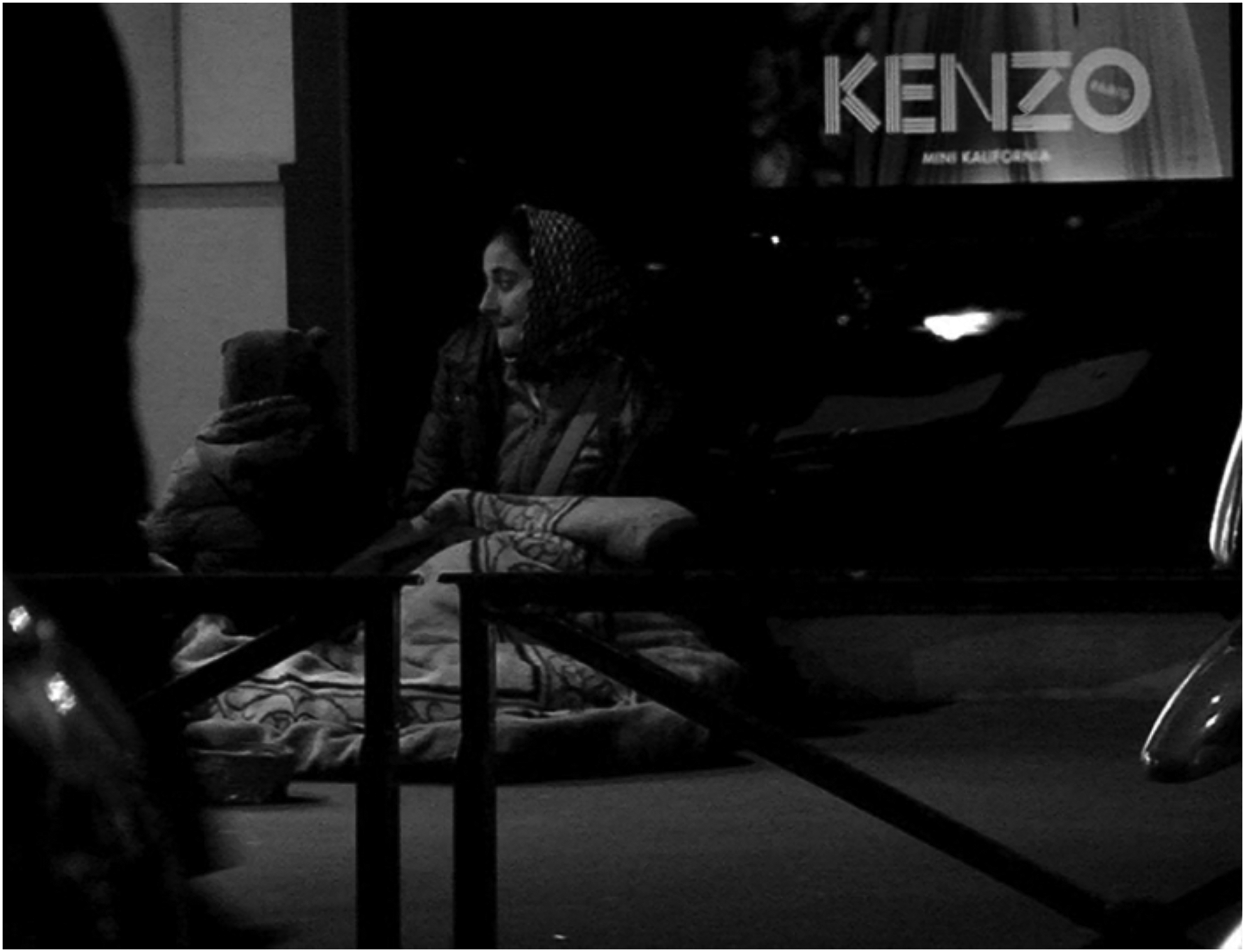
‘Paris est une fête: The montage in the shot of precarity and luxury’.
We already have a sense that George's Benjamin-inspired filmmaking practice is at play here. He assembles the elements of the phantasmagorical Paris of official communication or tourist guide. But he gives them to us in such a way that they are hollowed out from within and start to tell us of a different, less reassuring city and of things they would otherwise paper over. Placed alongside the festive images, the soldiers with guns strip the former of their innocence. Placed next to the same soldiers, the image of Darth Vader suggests a real rather than fictional menace. Tourist objects and locations are made to speak not simply of a consensual Paris but of what the production of that consensual imagery occludes. The spontaneously occurring montage-in-the-shot of the mother and child sleeping rough in front of the luxury shop repurposes the brand's display of luxury as a comment on inequality and exclusion, something that is made to serve as a commentary on France more broadly when the next shot shows us the flag. Other stylistic choices serve to disrupt the potentially smooth flow of consensually positive images; the unsettling and uneven soundtrack; the use of slow-motion images; the brief turn to colour. By fragmenting his film in this way, George makes its elements available for the construction of a much less consensual and rather more disturbing story, just as Benjamin had done when he took elements of official history or consumer culture and made them speak of what they obscured or of hopes they disappointed.
After the very diverse opening montage, the film moves towards something more approaching reportage to show first a series of individual rough sleepers and then a group of migrants in their improvised city centre encampment and their dispersal when police move in. There is no attempt to develop any of those shown as ‘characters’, as so many documentaries now do, or tell their stories in a sustained way. The camera instead observes their actions and the urban context in which they are trying to survive. The first figure shown is a woman in a dark anorak, rummaging in rubbish strewn on the street, like a Benjaminian ragpicker. We cut to a close-up of a soiled and crumpled newspaper. Under the rubric ‘tourism’, a headline says, ‘le secteur hôtelier a connu un été 2015 très encourageant’ (Figure 2). A ragpicker himself, George has found a piece of detritus that, having shed its newness, can speak of the irony of a flourishing hotel sector in a city full of rough sleepers. The next sequence begins with a long shot past more rubbish of an isolated figure sleeping on a mattress. This gives way to a sequence showing a male figure painstakingly constructing a bed in a doorway before settling down, presumably for the night. We cut to two low angle shots, the latter in close-up, of a statue, silhouetted against the blackness of the sky, of a mother lovingly holding an infant. 9 Detached from its immediate context by the low angle and the surrounding blackness and thereby freed to be associated with the images of rough sleepers, the statue becomes a comment about care denied as much as care given, of a harshness underneath any sentimentalised account of the capital.
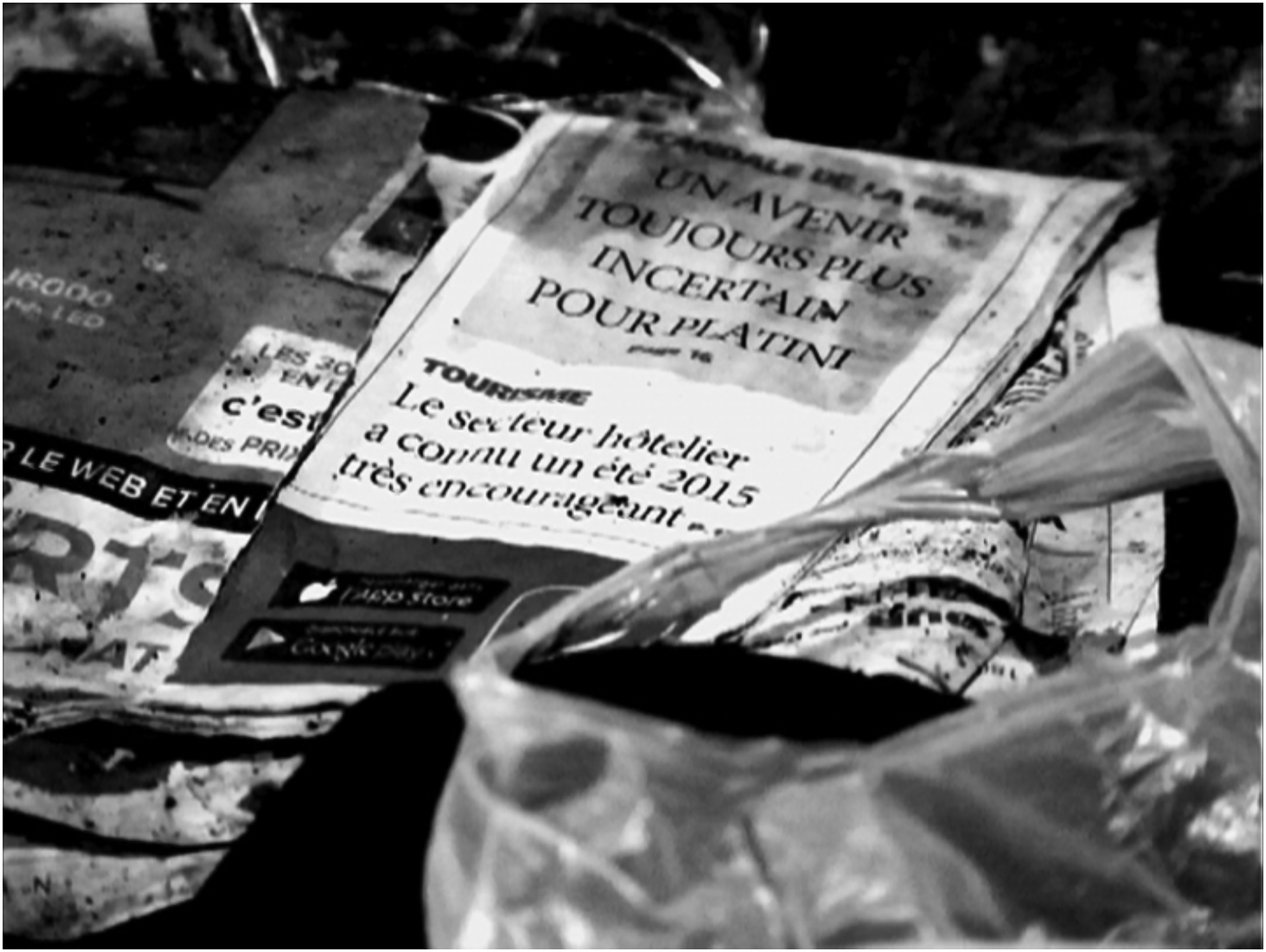
‘Paris est une fête: the filmmaker as ragpicker: making the city's detritus speak’.
After the sequences with the rough sleepers and the migrant group, there is a sequence with Mohamed, a young male migrant whose appearances punctuate the film to whom we will return, and another of sunflowers, a flower with clear benjaminian resonances. 10 After that, the film moves to two contrasting memorial sequences. The first, composed of static or slow-moving shots, and accompanied by haunting electronic music, takes us into a series of close-ups of the modest monument, in the Parisian suburb of Clichy-sous-bois, to Zyed Benna (17) and Bouna Traoré (15), two boys electrocuted when fleeing from the police and having sought to hide in an electricity sub-station (Figure 3). The sequence is shot in an eerily deserted nocturnal space. The next sequence is also nocturnal but otherwise very different. The music is replaced by ambient sound, typically of human voices, but also of traffic and sirens. We are at the shrine to the victims of the Paris terror attacks that appeared around the monument to the Republic in the Place de la République in the aftermath of the events. While there was a starkness to the banlieue shots, with the simple memorial and the empty space around it, here there is an overflowing of objects and messages and a quiet activity that speaks of an ongoing attention: a multitude of candles with hands lighting them; still, silent shots of photographs of individual victims with messages; images of first one Eiffel Tower, with a dove, and then multiple Eiffel Towers, as if painted by a class of schoolchildren. There is a handwritten placard with Liberté, Egalité, Fraternité and the homophones, penser and panser underneath, France, as we know, being the country of critical thought. There is a stereotypical poster of lovers kissing with the words ‘vous n’aurez pas notre haine’ written on it. As the sequence continues, the monument itself comes more into view. A small child is shown looking at up the bronze lion which guards the urn symbolising universal suffrage. We see Mohamed who is also in the square, part of the collective mourning. The sequence ends with a long shot of the whole monument with the shrine around it (Figure 4). The camera tilts up towards the statue of Marianne. But because the bronze statue is much darker than its stone plinth, all we see is blackness, as if Marianne were somehow not there. The shot fades to black. A detonation provides a sound bridge to the next shot, which, in broad daylight, is of a line of police with riot shields as, under a hail of missiles, they advance towards demonstrators before disappearing into white smoke or tear gas. The next shot shows us that we are still in the square.
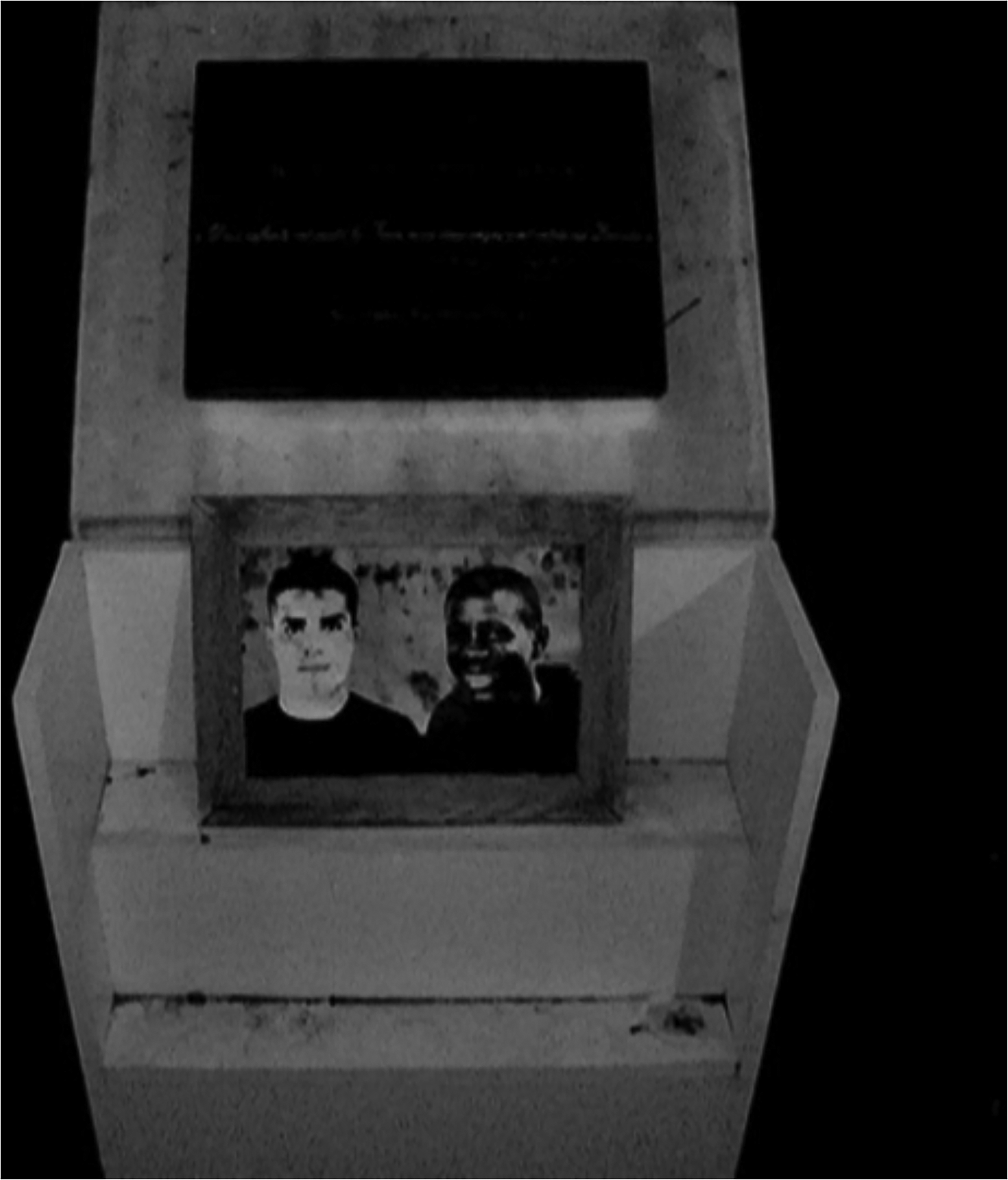
‘Paris est une fête: the isolated monument to Zyed Benna and Bouna Traoré.
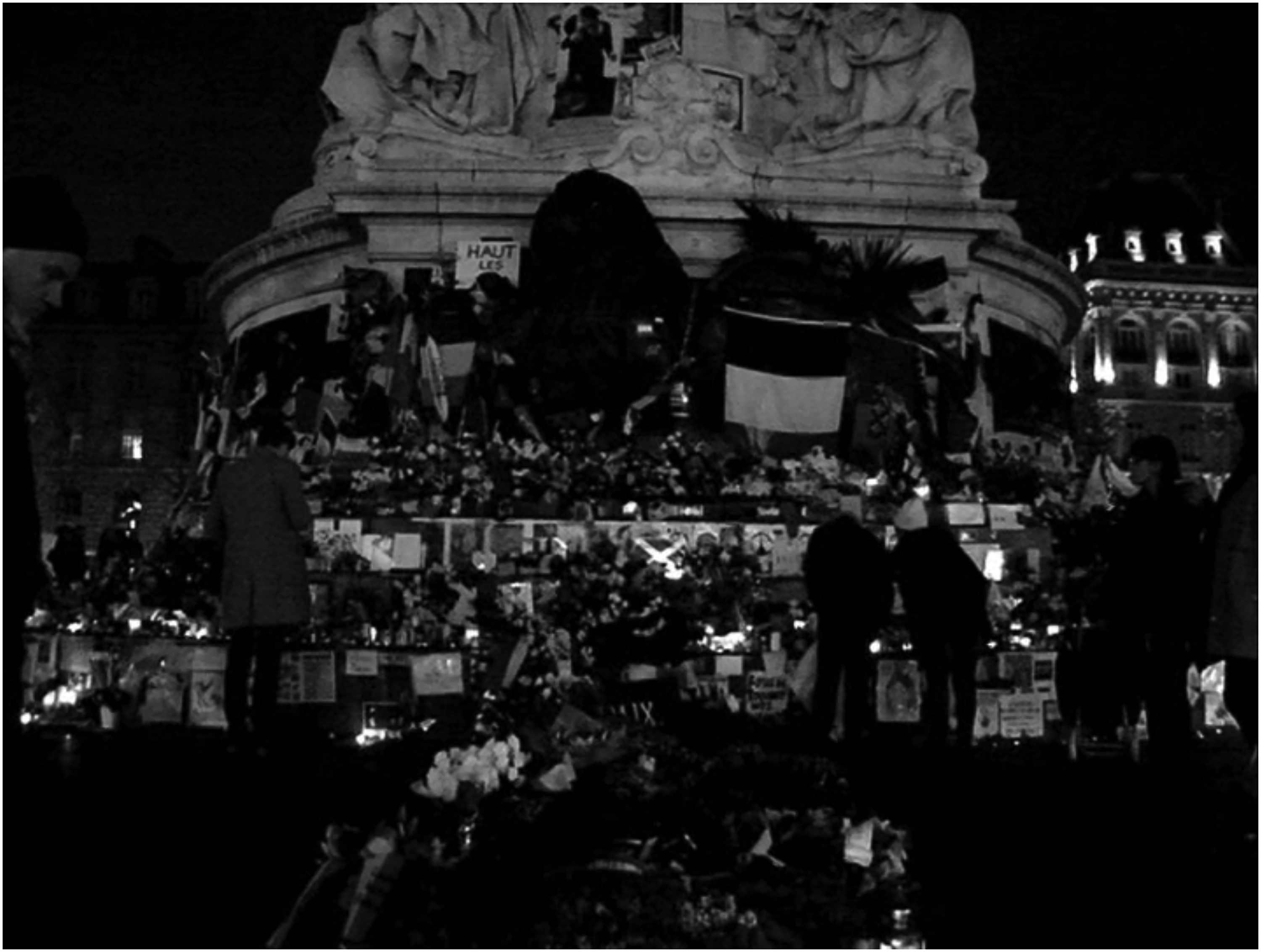
‘Paris est une fête: the temporary shrine to the terror victims around the permanent Republican monument’.
In some ways, all the work here is done by the montage. On the one hand, it invites the contrast between the shrine-like memorial in a highly symbolic location in the city centre and the isolated one in a nondescript location in the capital's periphery. There is the clear if implicit suggestion that Republican France may not mourn all lives equally. On the other hand, it juxtaposes the serene reverence around the Place de la République shrine with the violent confrontation that takes place shortly afterwards in the same location: France is less united than it might for a moment have convinced itself. But the construction of the shrine sequence itself is also worth looking at: as it moves us upwards from the temporary memorial through the permanent monument towards the statue of Marianne it seems not simply to stitch a contemporary image of national unity (the shrine) into an idealised and pacified incarnation of national history (the monument), but to reveal the construction itself, in a way that is emphasised by what comes before (the deaths in the banlieue) and after (the city centre protests and their repression). In Benjaminian terms, we might say that the constructed dream of unity is a phantasmagoria which, placed in the right context, can be made to speak of what it hides.
For a good proportion of the film's remaining minutes, the Place de la République is the site of a series of occupations and demonstrations; a migrant encampment set up in the square but demolished by the authorities; the Nuit Debout evening gatherings which began on 31st March 2016; the protest on the 9th of April 2016 against the Loi Travail (or Loi El Khomri); the impromptu march (‘L’Apéro chez Valls’) on the residence of then Prime Minister Emanuel Valls on the following day. Because these occupations and demonstrations take place in, or start from, the Place de la République, they confirm the sense that, far from universally agreed upon as it had appeared after the terror attacks, the meaning of the Republic is deeply contested. Its values are not applied or people are excluded from their remit. Ramming the point home, the film repeatedly finds traces of the consensual view of the Republic and the capital amidst the outpourings of dissent. Thus, for example, sequences of confrontation between the CRS (the Compagnie Républicaine de Sécurité) and demonstrators cut more than once to a shot of the upper part of the statue of Marianne, the olive branch of peace in her hand. After the migrants and refugees have been cleared from the square and all traces of them erased, in a way followed in detail by the film, we are given a shot of a large panel with the latin motto of Paris, Fluctuat nec Mergitur (‘she is rocked by the waves but does not sink’), a motto which came to symbolise the city's resilience after the attacks but whose consensual meaning is here challenged by the removal of a vulnerable group from the city's centre. 11
Sometimes the film produces collisions through its own montage. Sometimes, it captures an existing collision of elements, a kind of montage in the shot, through judicious camera position and framing. A section of the first demonstration sequence provides a particularly telling example of how these two things work together. There is a shot with demonstrators front left shouting ‘liberté, liberté’, facing a line of riot-shield bearing CRS front right, with the monument to the Republic rear centre (Figure 5). The angle changes and we move closer to frame some demonstrators, with the monument behind them, carrying a banner saying, ‘la vie du peuple avant l’avis des dirigeants’. We cut to a shot of the lion guarding the democratic urn before cutting again to a decorated heart with candles, presumably part of the shrine to terror victims. Another shot shows two placards of handwritten messages with flowers, doves and hearts before we cut again to a detail of the monument, the statue representing liberty, with her mouth taped over. A slow-motion shot shows hands rearranging candles around the shrine before a series of shots shows it being trampled, mainly by the CRS. Another shot captures the sound of a rubber bullet or gas canister being fired from close to demonstrators. As they retreat, the camera pans to a banner citing Pericles, ‘Il n’est point de bonheur sans liberté ni de liberté sans courage’. The frame freezes on the banner before we cut to a shot of a helicopter flying over the demonstration. A few shots later, the camera pans rightwards across a temporary-looking structure with an enormous ‘Paris, je t’aime’ painted on it to find a line of CRS standing ready. The film's capture and production of these collisions obviously challenges the idealised image of Paris and of the Republic which seemed so consensually shared after the November attacks. But just as importantly, it also shows a still live struggle over the meaning of values such as democracy, liberty or equality, and asks whether these things are simply slogans to be wielded by official bodies or values that can be reinvented by those on the ground. This is part of the film's Benjaminian exploitation of the city and the constellation-like collisions between past and present which it generates. Monuments are not simply shown to highlight the pacification of the past or the hypocrisies and exclusions of the Republican present: their juxtaposition with contemporary struggles suggests that they embody past aspirations (to democracy, liberty and so on) which can open onto a different future.
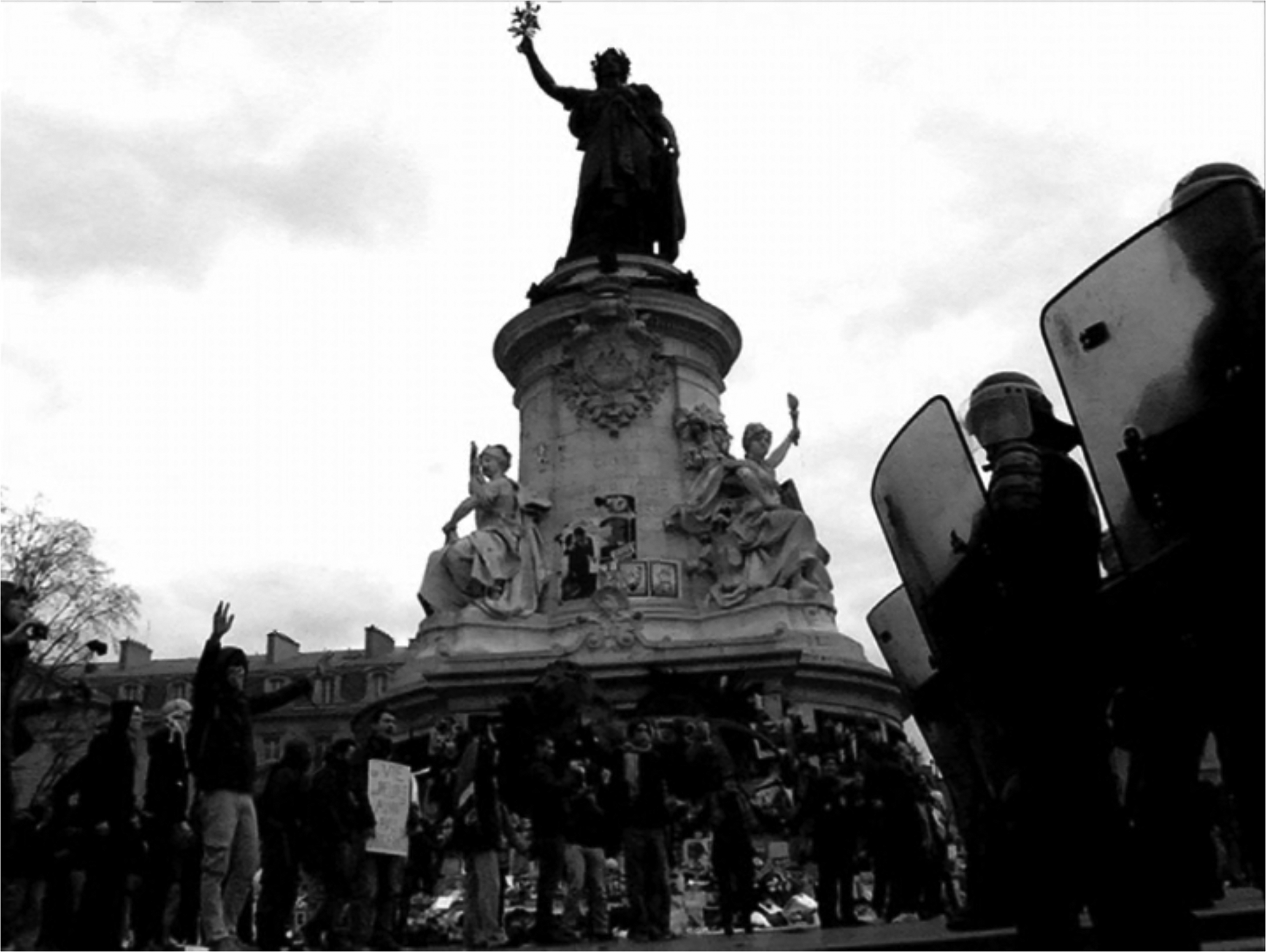
‘Paris est une fête: the demonstrators facing the CRS in front of the shrine and the monument’.
Vers Madrid
Unsurprisingly, Vers Madrid has much in common with Paris est une fête. The former in many ways establishes a template that the latter will follow in terms of its refusal of conventional documentary storytelling, its complex use of montage to engineer collisions and generate new meanings, and its other stylistic choices such as the general use of black and white with an occasional turn to colour. It is also very similar in how it interweaves an individual migrant's memories and movements around the city with the development of an Occupy movement seeking to renew democratic forms. However, in the case of Vers Madrid, the migrant was added later, after various earlier versions of the film had been screened, an addition which signalled what George called the crystallisation of the film's form (Débordements). Obviously too, while both films sought out or constructed Benjaminian alignments between past and present, the history turned to was a different one due to the different national contexts. In both its images and its structure, Vers Madrid pays homage to the great poet, Federico García Lorca, a man sympathetic to the left and murdered by the fascists in circumstances which still remain unclear. We see several shots of the statue of Lorca in the Plaza de Santa Ana in Madrid. The film's three movements or parts, Romancero del sol, Romancero del pueblo, and Romancero del fuego, take inspiration from the title of Lorca's 1928 poetry collection, Romancero gitano. 12 The film moves away from Madrid for a sequence in the Valle de los Caídos, the Francoist Civil War monument where the dictator was himself buried until the decision was finally taken to move his body to a private grave in 2017. There is also a sequence shot in Seseña, the location of possibly the most notorious of many housing developments left unfinished and barely or partly occupied in the wake of the speculative wave that spread through the Spanish property market before the 2008 crash. In a typical way, George, the Benjaminian ragpicker, sifts the wreckage left behind by contemporary capitalism to make it speak the truth of its destructiveness and disregard for real human need. At various stages, the film also foregrounds a Catholic or Christian iconography, the giant cross dominating the Valle de los Caídos being the most obvious but far from only example. George's film thus engineers collisions between a specifically Spanish Nationalist and Catholic past with its latent authoritarian potential and the progressive agitation taking place in 2011–2012 around Spain's Occupy movement.
The film opens, however, with images not of Spain but of the Parthenon in Athens. This could partly be a nod to the Greek Syntagma Square mobilisations which began a year before the Spanish ones. But it is more a deliberate Benjaminian move to frame the Spanish movement as a renewal of the foundational actions and gestures of European democracy. As George put it: A Madrid, j’avais constamment le sentiment d’évoluer dans des espaces d’images dialectiques et d’être confronté aux lignes et aux principes fondateurs de notre civilisation grecque et judéo-chrétienne: le pouvoir du verbe, l’acte de nomination, les notions de logos, demos … Cette place, comme une espèce de dispositif dialectique, mettait en jeu, en intensités, en images, le présent le plus immédiat comme le passé le plus lointain, formait une sorte de constellation dialectique (Débordements, 2014).
The taking of voice in the occupation is not simply to do with speech narrowly defined. Like Paris est une fête, but even more so, the film gathers shot after shot of posters or placards combining drawing and the (hand)written word, individual productions which together form a collective but not uniform utterance. The demonstrators also express themselves and their celebration of their being-together through music and dance (Figure 6). Twice, we witness mass drumming on a metal fence as an expression of the movement's sense of its power. When they march, they chant slogans like: ‘el pueblo unido jamás será vencido’; ‘si, se puede’; ‘no nos vamos’; ‘viva la Republica!’; ‘no nos representan’. In addition, their occupation of the Puerta del Sol, the symbolic central point of Spain (its kilometre zero) and their protest march on the Congreso de los Diputados (the Spanish lower house) are both expressive of a relationship to space and a political position taking and thus make collective statements. Taken in the round, their enunciatory capacity is a collective, non-fusional and semiotically plural phenomenon that cinema's own plural semiosis (its ability to capture facial expression, gesture and movement, sound and music, written and spoken word) is uniquely equipped to record (O'Shaughnessy, 2019) (Figure 7).
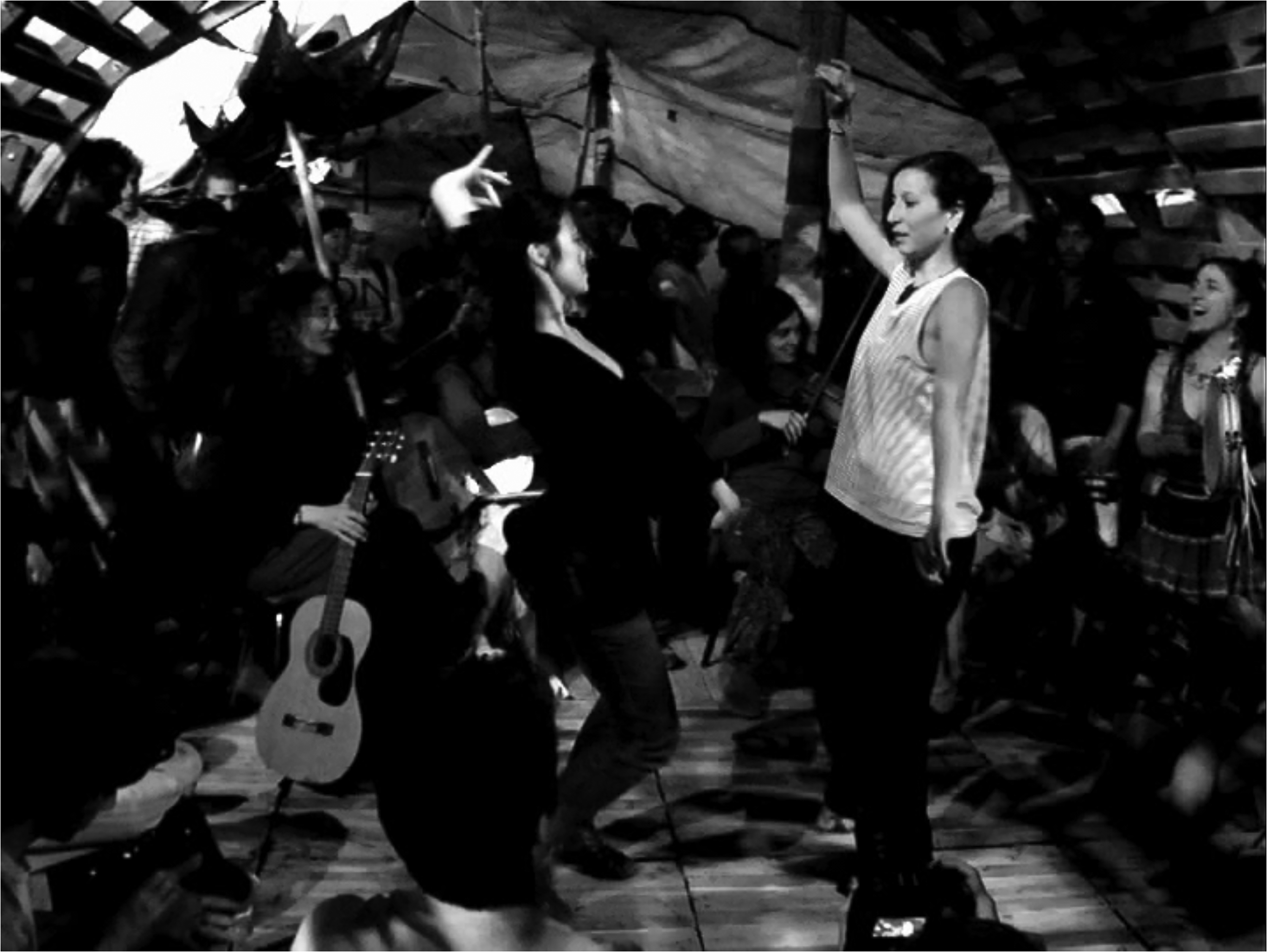
‘Vers Madrid: the joy of being together expressed through music and dance’.
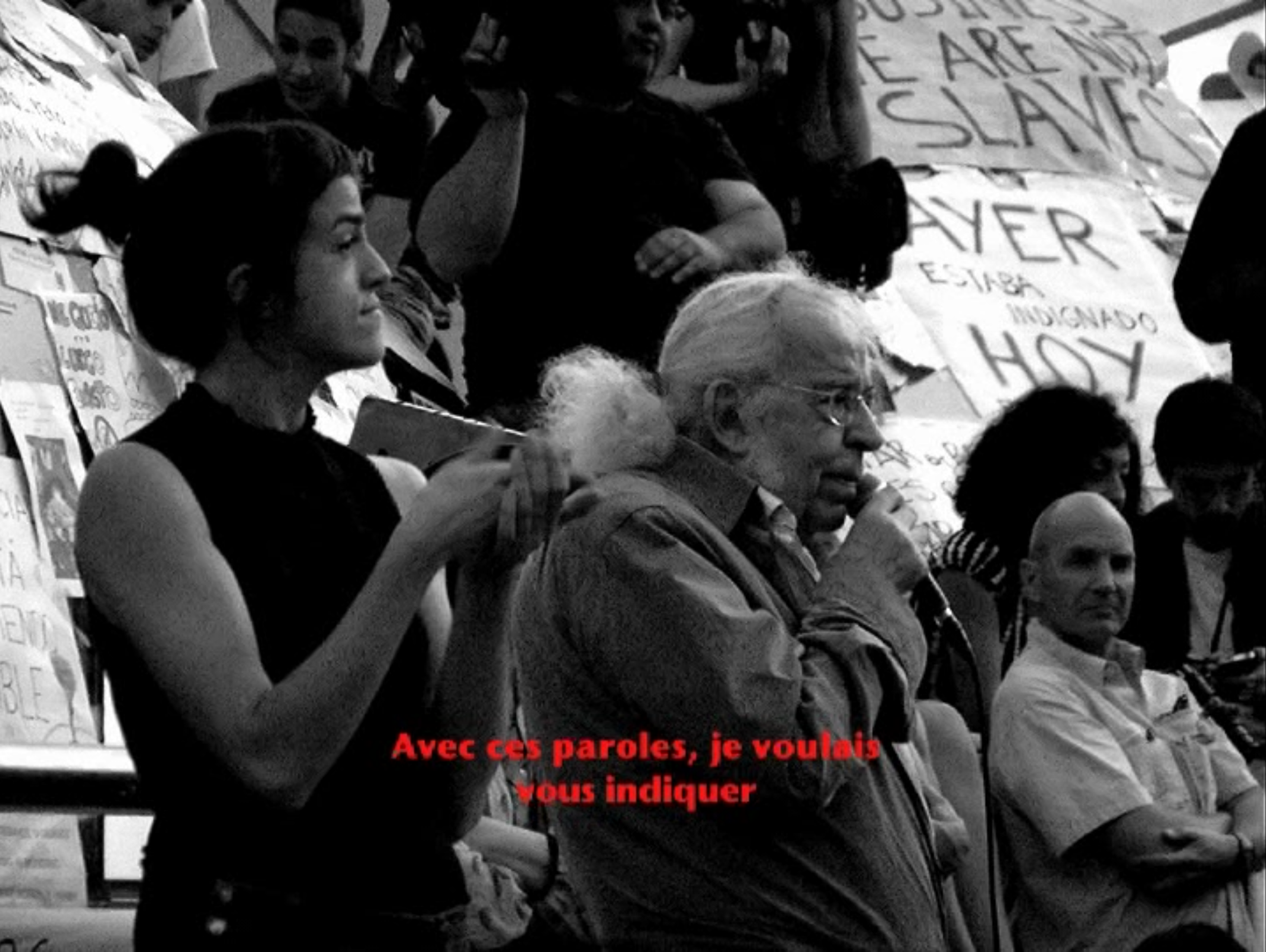
‘Vers Madrid: the signer, the speaker and the proliferation of posters’.
Discussing Paris est une fête, George evokes what he calls Frantz Fanon's fête de l’imaginaire. He describes it as: Des fêtes réalisées avec peu de moyens, se basant parfois sur les seules ressources du corps, et qui opèrent des déplacements, des jeux de bascule entre les plans majoritaires et minoritaires dans nos sociétés – des fêtes qui créent ou désignent des formes nouvelles d’existence, des experimentations esthétiques et politiques improbables … (Speno, 2017)
13
In the same way as Paris est une fête brought a pacified, consensual understanding of history and French Republican values into collision with a reopened sense of historical possibility and a revitalised understanding of democratic values, Vers Madrid pits the vibrant, participatory process in the square against a more pacified and restricted official democracy. A series of shots towards the end of the film condenses this opposition. As the film's second section, the Romancero del pueblo, finishes, and after a series of bitter confrontations with the police, we have a series of three static, nocturnal shots of the stone lions guarding the parliament building (Figure 8). An intertitle then indicates that the film's final section is beginning. After a sequence of colour shots of violent confrontations with the police, and shots with the texts of an email exchange between Sylvain George and an increasingly disillusioned correspondent in Spain, a sequence picks up the protestors as they prepare to surround the parliament. We see a banner being made ready with an image of one of the lions. A little later, with the march in movement, we have two shots of a similar banner, again with a lion (Figure 9). Placed in proximity to each other through the editing, the stone and painted lions enter into an implicit dialogue, with the former now suggesting a democratic power that has become frozen or detached but which at the same time guards its prerogatives fiercely (the police repression), and, on the other, a living, insurgent street-level counter-power seeking new forms of democracy. Shots of police helicopters way above the demonstration reinforce this sense of a vertical or top-down form of power confronting a more horizontal one.
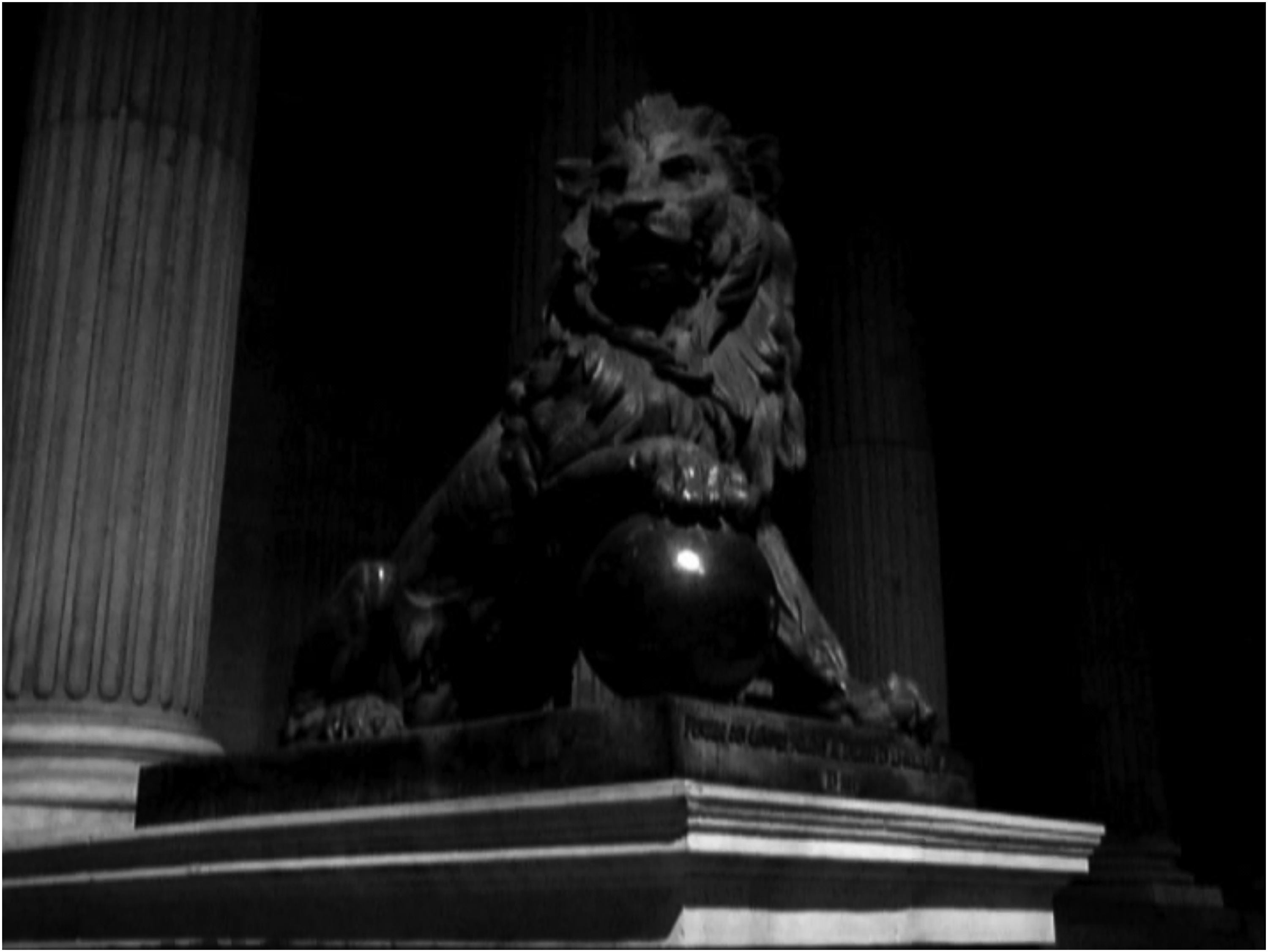
‘Vers Madrid: the contrasting lions and their completing claims’.
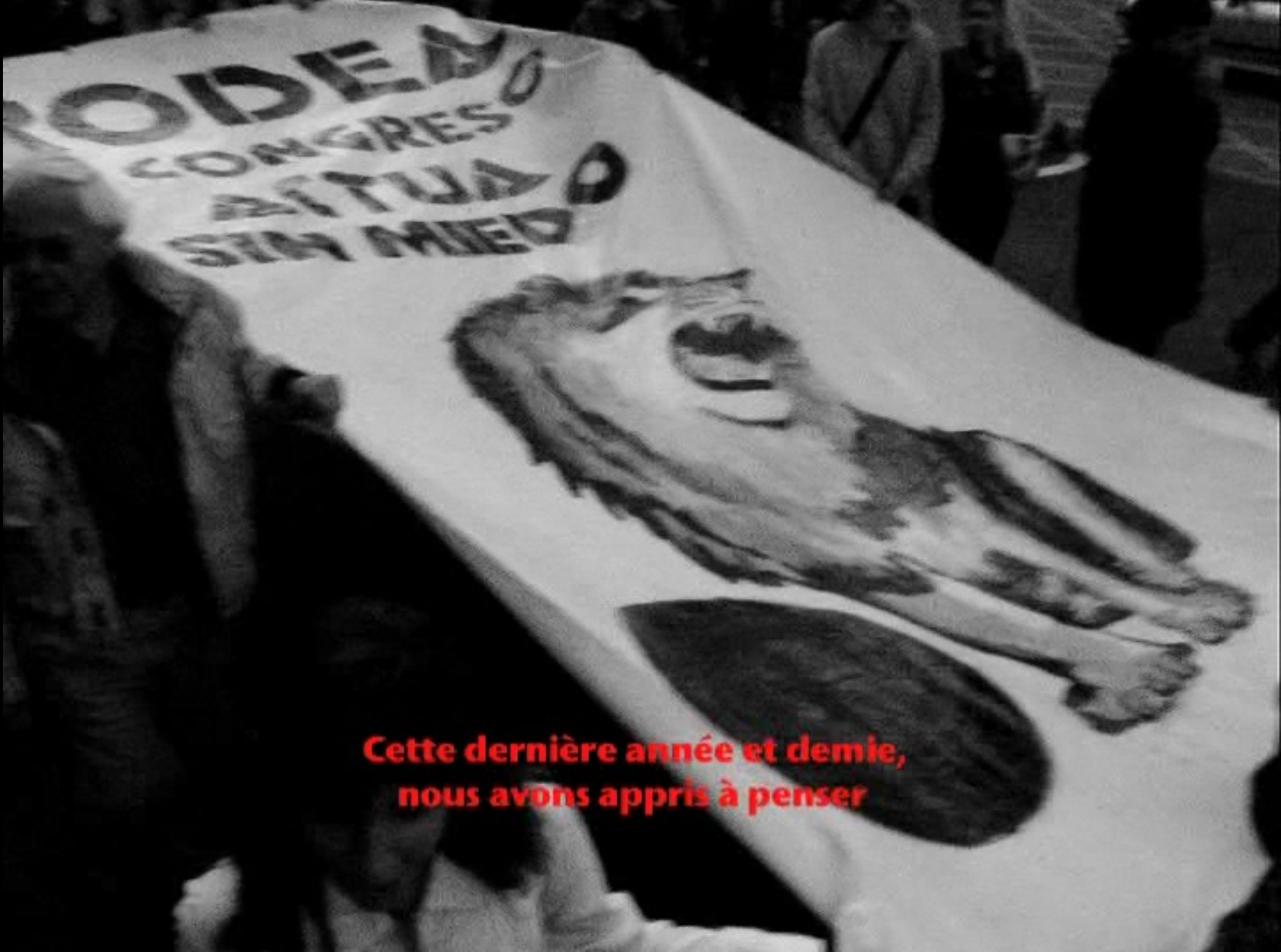
‘Vers Madrid: the contrasting lions and their completing claims’.
Conclusion
In the first part of Vers Madrid, away from the occupation, we see migrant street sellers forced to pack up and take flight as the police arrive. Like the Occupy protesters, they face police harassment and economic precarity without their situation or their relation to urban space ever being the same. When the little working group discusses what the occupiers’ line should be with respect to migrants, the film's central migrant figure, Bader, is there, but does not join in, his voice not yet able to blend with the other voices of the occupation. The film cuts away from the square to show him in his small room as he explains his difficult and dangerous journey to Madrid. Later, we will follow him as he walks in empty spaces in the nocturnal city. Later still, after the final march on the parliament, the film picks him up again, an isolated figure selling cold drinks in urban spaces returned to normal. By showing him with the demonstrators, and moving between the occupation and his life, the film is forcing us to think a renewal of politics that exceeds its usually territorial limitations and includes his needs and his voice. But, at the same time, by making us feel his non-incorporation into the movement and showing us his very different trajectory and relationship to the city, the film reminds us that the needed convergence has not yet taken form. The dynamics in Paris est une fête with respect to Mohamed are very similar. By moving back and forth between Mohamed and the different mobilisations, the film asks us to think a politics that exceeds national belonging. But his precarity is shown not to be the same as that of the Occupy demonstrators and his relation to the city and its spaces is shown to be different. As with Bader, the camera follows him, an isolated figure in empty, marginal spaces as he reconstructs his search for somewhere safe to sleep at night and carefully lays out his silver survival blanket on the ground. The film places us in and among the demonstrators and in and very close to the aggressive repression they face, but, by giving the prominence it does to Mohamed, and by going out to the monument to Zyed Benna and Bouna Traoré in the banlieue, it also holds the city centre demonstrations at a questioning distance. As the film ends, Mohamed is still alone on the street (Figure 10). This is the power of the films’ benjaminian montage. By bringing the consensual, pacified or reactionary meanings embedded in the city's fabric into collision with contemporary protests, they make those embedded meanings speak of their limits and exclusions as well as their potential for radical rearticulation. But by juxtaposing the protests themselves with what and whom they do not yet take adequate account of, they also make the protests speak of their own limitations.
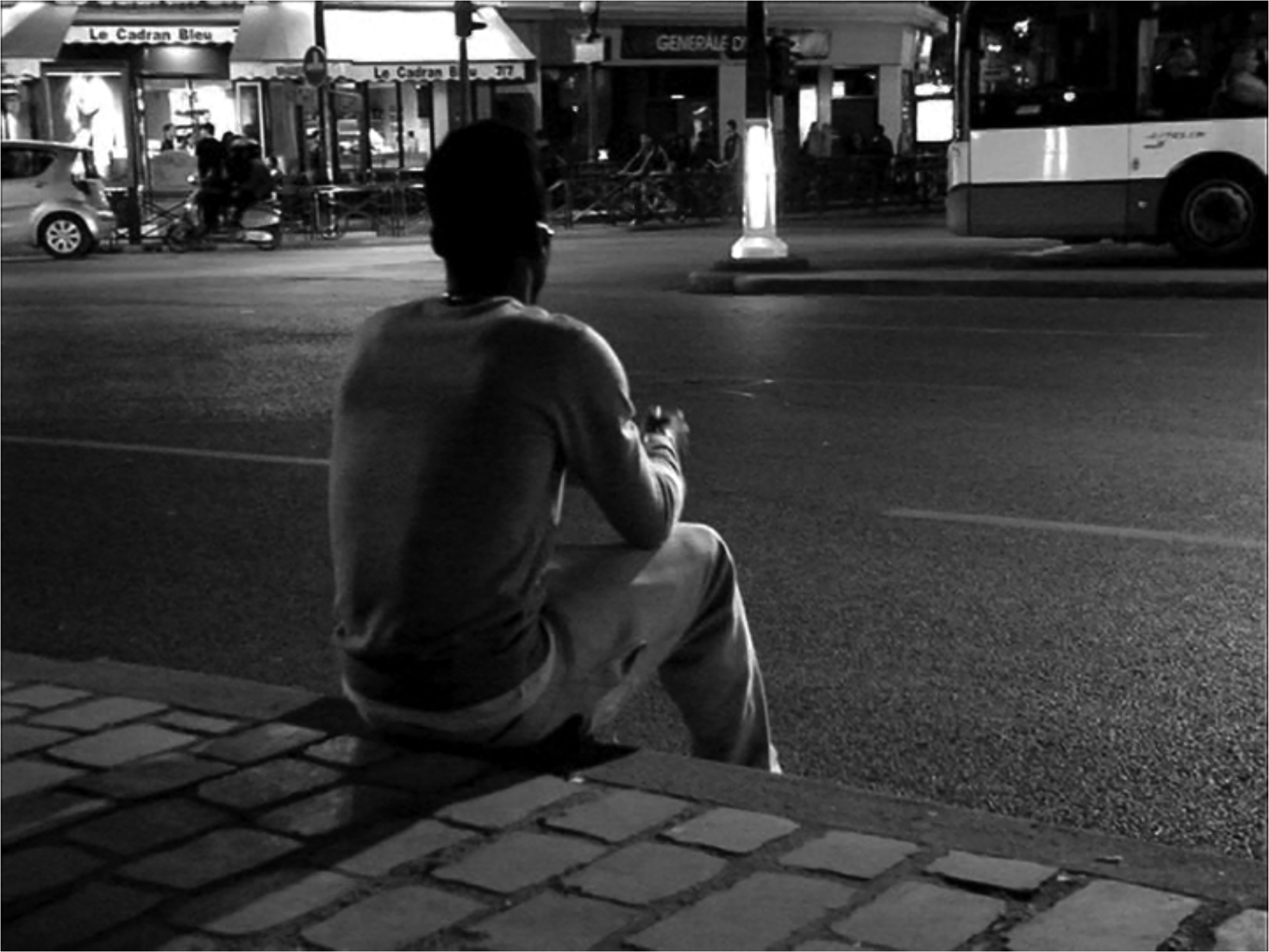
‘Paris est une fête: Mohamed alone on the street’.