




Abstract
This article deals with the concept and practice of haute couture, of the designing and making of high-quality fashion clothes, and haute couture's contemporary engagement with the virtual worlds of the ‘metaverse’, a shared virtual environment that features online gaming and augmented reality. The article is an encounter with these virtual worlds, particularly as they are manifested in the haute couture of the French haute couturier Julian Fournié. To understand Fournié's haute couture, and thus to build a foundation for an interpretation of his most important fashion ideas, it is argued that researchers need to explore Fournié's engagement with virtual worlds and augmented reality from the perspective of German philosopher Martin Heidegger's phenomenological explanation of thinking and rethinking, and then at how Fournié develops and revises the meaning of haute couture.
Introduction
Haute couture is a central concept in the study of the history of French high sewing, of select, custom-tailored, fashion, and luxurious dress, both as an indicator of innovative handcrafted creations and as a guide to superior and costly clothes. However, this article offers readers an original encounter with the idea of rethinking haute couture because, it is argued, increasingly today, haute couture includes modes of thinking that contain visual representations and calculating, typified by a dependence upon computerized technologies. These modes of thinking, it is claimed, accord with dissolving haute couture's intricacies, history, and philosophy of French high sewing into technoscience. Accordingly, given that this article is primarily concerned with the idea of rethinking haute couture, with visual representations, calculation, computerized technologies, and technoscience, it is appropriate to understand such phenomena through Martin Heidegger's crucial writings (e.g. Heidegger, 1976, 1977: 3–35) on and questioning of what it means ‘to think’ (Denken). In what follows, therefore, contemporary technoscientific calculating thinking and computation are subjected to Heideggerian critique. Nevertheless, the intention is to demonstrate that haute couture is not a concept or a practice that can be managed or computed within a fixed horizon. Thus, it is argued that haute couture must be rethought not only because it is one of the most important forms of human creativity concerning choice custom-fitted outfits but also because it is theoretically and practically incompatible with contemporary technologically produced visual representations which have no autonomous capacity to transcend their fixed horizon or to reflect on it since, unlike haute couturiers, visual representations cannot think. Genuine philosophical thinking about haute couture consequently involves asking questions about thought, human originality, and imagination in high fashion. Yet, the questions posed in this article concerning haute couture's growing reliance upon contemporary technologically produced visual representations that have no independent ability to rise above their predetermined horizon or to contemplate it are concrete in the sense that they are situated within a particular event wherein haute couture is being rethought as visual representations. It is for this reason that the article explicitly thinks through and questions the work of the twenty-first century French haute couturier Julien Fournié's futuristic journey into technologically produced visual representations, namely, the virtual worlds of the ‘metaverse’ – the network of 3D virtual worlds centered on social connection such as video games. In so doing, the article questions Fournié's virtual thinking, his language of autonomy, overcoming, the boundless horizon, and haute couture rethought as visual representations, his analysis of the video game, and his theorization of the metaverse as a new terrain for haute couture and haute couturiers to discover. The article concludes that Fournié no longer offers an idea of haute couture as a conception of human presence but as a conception of human absence. But let us begin by defining the concept of haute couture.
Haute couture
Haute couture is an essential but multifaceted concept with a complex and still open history, which in itself expresses the complexity of French high sewing and its history (Farnault, 2014; Sadek and de Laubier, 2016). Haute couture is used on the one hand, as in its early usage, to denote the creation of exclusive custom-fitted clothing and so by extension to high-end fashion (as in descriptions of haute couture as being constructed by hand). On the other, haute couture is used to mean high-quality dresses or related practices that, in their very forms and meanings, define often unusual fabrics as hand sewn with attention to detail rather than technologically produced. Occasionally this second meaning is then generalized to produce accounts of the spirit of haute couturiers (e.g. Christian Dior) or haute couture as a whole. Haute couture is therefore used to signify individual styles of high-end fashion or the nature of hand finishing, to expensive or high-quality developments in rare and occasionally strange materials, to the expressive life and traditions of haute couturiers, to sewing with care for detail or finishing by experienced sewers. People talk about haute couture as time-consuming, as hand-executed techniques, as French dressmaking, as fashion, as sewing, or as needlework (Nudelman, 2016).
One method of researching haute couture is through an account of its French usage over the last three centuries. I suggest that in its most extensive use haute couture has referred in the nineteenth, twentieth, and twenty-first centuries not merely to ‘haute’ as ‘high,’ to haute couture garments made for specific clients, for the wearer's measurements and bodily stance, to copious amounts of time, money, and skill being allotted to each completed piece, and to haute couture clothes as having no price tag but also originally to the budgetless world of Charles Fredrick Worth (1825–1895). Worth was the English fashion designer who originated the House of Worth in Paris, one of the leading fashion houses of the nineteenth and early twentieth centuries, and who is also thought by many fashion historians to be the modern initiator of haute couture and a pioneer in the business of fashion (DePauw et al., 2015; Trubert-Tollu and Tétart-Vittu, 2017). Indeed, Worth allowed his clients to select colors, fabrics, and other details before ever starting his design process, which was unprecedented at the time. The concept haute couture has nonetheless been comprehended and valued in dissimilar ways. Traditionally, haute couture is seen as embodied in modern France as a protected name that may not be used except by fashion houses that meet specific well-defined standards and valued above ‘commercial’ or ‘popular’ fashion whether it is produced in Paris or in other fashion capitals such as London, Milan, New York City, or Tokyo (O’Byrne, 2008), to which some deny any genuine haute couture status.
Of significance to this view, as to other less traditional standpoints, is the attitude taken towards mass or industrial fashion ‘haute couture’ houses, or, in the twenty-first century, fashion designers that create exclusive and often trend-setting fashions for advanced consumer society (Baudrillard, 1998). Debates about haute couture and the fashion created in this sense have accompanied and been stimulated by the socio-economic development of the French legal status of the concept haute couture since the nineteenth century. In France, the concept haute couture has consequently been defined concerning this historical form of socio-economic development. Certainly, in France, the concept haute couture is protected by law, defined by the Chambre de commerce et d’industrie de Paris (the regulating commission that controls which fashion houses are qualified to be genuine haute couture houses), and also duty-bound by the Chambre's rules, which assert that only those companies cited on the list prepared each year by a commission domiciled at the Ministry for Industry are permitted to avail themselves of the label haute couture. In 2021, the list comprised Adeline André and Alexis Mabille, Atelier Gustavolins, Bouchra Jarrar, Chanel, Christian Dior, Christophe Josse, Giambattista Valli, Julien Fournié, Franck Sorbier, Maison Martin Margiela, Maurizio Galante, Stéphane Rolland, Yiqing Yin, and Rabih Kayrouz. Similarly, the Fédération française de la couture is the governing body for the French fashion industry and is an extension of the older trade association (which still exists within the Fédération), the Chambre Syndicale de la Couture Parisienne, which was established in 1868 and which is an association of Parisian couturiers that arose from medieval guilds. But, today, the Fédération regulates its members regarding the counterfeiting of styles, the dates of openings for collections, the number of models presented, relations with the press, questions of law and taxes, and promotional activities. The creation of the Chambre Syndicale de la Couture Parisienne was the work of Charles Fredrick Worth. An allied school was organized in 1930 named L’Ecole de la Chambre Syndicale de la Couture. The school educates new designers for the couture houses that are still present today. Since 1945, this school has worked within the Fédération Française du couture, and du Pret-a-Porter des Couturiers et des Createurs de mode. More demanding standards for haute couture were inaugurated in 1945. To secure the right to call itself a haute couture house and to use the concept haute couture in its advertising and any other way members of the Chambre Syndicale de la Haute Couture Parisienne must follow four specific rules: (1) designs must be made to order for private clients, with one or more fittings; (2) members must have an atelier (workshop) in Paris that employs at least fifteen staff full-time; (3) members must have as a minimum twenty full-time technical people, in no less than one atelier; and (4) present a collection of at least fifty original designs to the public every fashion season (twice, in January and July of each year), of both day and evening clothes. The subsequent defense of traditional haute couture as equal or necessary to the authentic meanings or the spiritual values of dressmaking activities sets, for example, the work of Charles Fredrick Worth – predominantly a selective tradition of haute couture production founded on fashion salons and European royalty, monied society, and innovative dress design in everyday life – against the machine-driven and materialist order of industrial society.
So described, as in the fashion designs of Rose Bertin - the seventeenth century French fashion designer to Queen Marie Antionette, and who is generally credited with bringing fashion and haute couture to French culture - among others, haute couture is rallied to serve a monarchical conservative ideology (Langlade and Langlade, 1913). However, a comparable defense has also informed the opposition to ‘masstige’ (mass-produced, relatively inexpensive goods which are marketed as luxurious or prestigious) or perhaps ‘basse qualité’ couture of Marxists such as Theodor Adorno of the Frankfurt School (Adorno, 2001; Bataille, 2017). In both traditions the valued haute couture dressmaking is that of a minority of stylish people or an elite dressed in the latest Parisian fashion, though the couturiers and individual clothes and accessories may be as diverse as the fitters and dressmakers, the garments, establishments, and the separate people involved in the haute couture clothing fashion industry who make outfits to order for private clients. In a reverse assessment, perhaps the ‘popular’ ‘haute couture’ of Vivienne Westwood, the British fashion designer and businesswoman, largely responsible for bringing punk and new wave fashions into the mainstream, may be favored to any of the above, especially given that Westwood is a couturier making what some do believe is haute couture. Westwood is not, though, an haute couturier in the sense of being a member of Chambre de commerce et d’industrie de Paris since she engages patternmakers and machinists for her clothing production, owns and employs others in her exclusive boutiques, and is a kind of self-employed contemporary female entrepreneur. This ‘popular’ haute couture includes a radical, contemporary change of definition and of the terms of valuation set out by the couturier Charles Fredrick Worth in the nineteenth century. Yet, all these views share the supposition that haute couture can have an energetic, formative effect upon philosophies of fashion, attitudes towards sex and music, and experiences of revolutionary cultural politics (Armitage and Roberts, 2016: 1–22). Westwood, for instance, came to public notice when she made clothes for Malcolm McLaren's boutique in London's King's Road, which became famous as SEX. It was McLaren and Westwood's capability to fuse clothing and music that molded the 1970s UK punk scene, led by McLaren's band, the Sex Pistols. Westwood was enthused by the shock-value of punk before going on to open four shops in London, finally growing throughout the UK and the world, selling an increasingly wide-ranging variety of merchandise, some of it related to her political causes such as the Campaign for Nuclear Disarmament, and climate change and civil rights groups (Westwood and Kelly, 2016). As such, Bertin's, Adorno's, and Westwood's views contrast with the materialist position that sees haute couture as subordinate to and as a reflex of other processes in the society and the economy, which are thought to be more determining than haute couture itself (Lehmann, 2018). This latter belief is allied with an economistic Marxism which, even in more sophisticated forms, still resorts to the Marxist model of an economic base and ideological-cultural superstructure, which the majority of critics feel it necessary to address.
However compound, then, the definition of haute couture is fundamental to ideas of the objects of study of the academic discipline of fashion theory (e.g. Rocamora and Smelik, 2019). Its use and meanings in this context must be coherent, explanatory, and evaluative. Moreover, the investigation of haute couture can never be free of assumptions of value or of an immersion in meaningful, value-making activities, such as dressmaking, on the part of researchers or the garments or the aesthetics of the couturiers being studied. One useful conception of haute couture, particularly in fashion theory, is my own definition of haute couture fashion design as the world of a small socio-cultural creative group, of a specific design-led life-world – including the group's surrounding well-heeled world of customers, its shared world of portfolios, and the designed world of ‘luxurious selves’ – which is lived in a situation of the fashionable self as supermodel, client, and couturier (Armitage, 2020).
My work is developed below from neither the monarchical-conservative tradition of the house of Rose Bertin nor the Marxist tradition of Adorno but from a critical engagement with the phenomenological philosophical tradition of Martin Heidegger (1962, 1971a: 163–186). I see a convergence of the idea of haute couture as a world (Heidegger, 1962: 78–168) of specified colors and fabrics and its connection with high-quality garments and the activity of producing tailor-made dresses. What unites these emphases, I argue, is the idea of haute couture as a conception of human presence, through which necessarily a socio-cultural world of ateliers, individual tailoring, and uniqueness is lived in, out of, for, with, and against. This Heideggerian (1970; 1976) thinking of human beings as the presence of human beings can help to rethink the creative work of haute couture clothing and industrial practices as constituting rather than expressing that socio-cultural world and encourage new directions in fashion theory through a thorough reappraisal of the forms that fashion theory can take.
In what follows, it is proposed that there is no consensual definition of haute couture or of its fashion houses in the contemporary period; even that my own idea of haute couture fashion as a world is unlikely to be unanimously accepted. Some may respond by offering an alternative definition of haute couture design: haute couture design not as a world but as the world of a small elite group of workers and customers. Other fashion theorists may critique my notion of established haute couture and haute couture houses in terms of the fact that the world of haute couture establishments and designers that it depicts does not provide the content of the sense of living of ordinary people but only that of Adeline André or Alexis Mabille. Furthermore, some may raise misgivings about my possibly homogenizing conception of ‘the world’ and ‘small’, or the socio-cultural desire for this, in the sphere of haute couture fashion houses as in other groups. Yet, the variant meanings of haute couture and its houses can be readily appreciated as the necessary expression of a variety of expensive conceptions and production practices across different encounters with collections, activities, shows, and discourses of design. In the next section, therefore, I present a phenomenological Heideggerian conception of haute couture as a world that is here for show, that is a world that people should be concerned about, and which is a source not merely of sales and making money, publicity, and luxury branding, but also of meaningfulness, with a view to engendering further debates.
Rethinking haute couture
Haute couture is a concept in need of rethinking because, increasingly today, it incorporates forms of thinking that consist in visual representations and calculating, epitomized by reliance upon computerized technologies (Moriwaki and Genova, 2016). These forms of thinking, it is maintained, coincide with dissolving haute couture's complexities, history, and philosophy of French high sewing into technoscience (Heidegger, 1978: 431–449). Nevertheless, I insist, the technoscientific forms of thinking haute couture, of thinking the invention of select custom-fitted fashion, are quite unsuited not only to a description of haute couture but also to thinking the presence of people who make it physically. Rethinking haute couture means rethinking the presence of those people who produce high-grade clothes and, crucially, their human presence as practitioners, as people who shape and give significance to frequently remarkable materials. Visual representation here can be taken as, for example, hand sewing with devotion to detail, as something visually internal to the minds of couturiers or as what is visually present to their consciousness (Lee, 2016). In the present period, such consciousness is progressively either a visually technologically produced representation or founded upon one. Even so, the meaning of the spirit of a haute couturier such as Christian Dior cannot be visually represented or represented as the presence of a particular person because attempting to think the presence of the person of the haute couturier in this way reduces it to a precise individual, such as Dior, and, indeed, typically to the haute couture fashions that they produce, such as Dior's 1947 collection, ‘Corolle’ (literally the botanical term corolla or circlet of flower petals in English), later re-named the ‘New Look’ by Carmel Snow, the editor-in-chief of Harper's Bazaar (Müller, 2017). So, too, while the number of haute couture garments is a human presence of a sort (i.e. they are produced by and for human beings), the human presence of personal designs and high-end fashion themselves are not numbers, as attempts to think human presence by calculating would have to suppose. Even ‘expense,’ if not regarded as reducible to calculation in the context of haute couture, is based upon assertions concerning superior, extraordinary, and sporadically unusual fabrics, referring to meaningful states of affairs and relations, but human presence itself is reducible to none of the latter or to the character of hand finishing, to the traditions of haute couturiers, to sewing with attentiveness to detail, or to finishing by knowledgeable sewers. Hence, traditionally logical thinking about haute couture or even dialectical thinking concerning laborious hand-accomplished methods, taking its bearings from logic, can be a barrier to genuinely thinking human presence – and not merely the human presence of French dressmakers, fashionable sewers, and embroidery workers.
Rethinking haute couture thus entails a critique of the contemporary spirit of computerized technological thinking and its French practice in the present period. Indeed, I propose that the gradually widespread usage of computerized technological thinking in haute couture today is, if not a ‘will to power’ (Nietzsche, 1974), then what I shall call a ‘will to control.’ I am arguing that to rethink haute couture people must not lose sight of the fact that outfits made for exclusive clients, for the human wearer's human dimensions, and human physical posture, must involve genuine thinking in the sense that such thinking is unrelated to wealth but crucially related to the contemplation of time, to a correspondence between human abilities, the accomplishment of pieces, and haute couture garments. This is not a nostalgic contention that yearns for the return of the most likely mythical costly world that now surrounds the aura of Charles Fredrick Worth. Rather, in making a case for rethinking haute couture as a Heidegger (1970: 58–90) ‘not willing’ or as a ‘letting things be’, I am arguing for a conception of haute couture fashion design as an act that is ‘higher’ than many other worldly activities, for a contemporary world wherein the fashion house lies, strictly speaking, outside the historical distinction between haute couture activity and passivity insofar as the historical distinction pertains to the will to control and insofar as the letting things be is not something that haute couturiers, however innovative or business-savvy, can awaken of themselves through haute couture fashion. Rethinking haute couture is letting things be in the sense of couturiers being released into the abiding expanse wherein clients and the choice of colors, textiles, and the design process are present and absent. For it is this open region of haute couture that, by letting couturiers into it, lets them genuinely think and value haute couture, lets them let it be. Just as the open region of the traditional house of Worth in nineteenth-century Paris was an abiding expanse of distinct criteria and values, so genuine high-fashion rethinking today concerning custom-fitted clothing, high-fashion rethinking that is not the offspring of the will to control is, like the open region of haute couture itself, not a ‘place’ but a movement along a path (Heidegger, 1991).
From a Heideggerian viewpoint, if not from other less philosophical perspectives, it is not the approach taken towards mass or industrial fashion ‘haute couture’ houses, or to contemporary fashion design in advanced consumer societies that matters but the approach taken towards technoscience. For discussions about haute couture fashion and its relationship to socio-economic development or to the French legal status of the concept miss the growing significance of technoscience within haute couture, particularly as contemporary technoscience cannot and therefore does not think, let alone rethink. In this sense, haute couture is gradually being rethought in the present period of socio-economic development to the extent that genuine thinking is more and more being confused with technoscience. Genuine thinking concerning haute couture does not solve legal riddles, produce usable or practical wisdom about commerce, industry, or regulation, or even endow haute couturiers with the capacity to act within fashion houses, sets of rules, businesses, committees, and ministries. Far from being presupposition-less about haute couture and haute couturiers, genuine thinking about fashion should go straight to its presuppositions concerning the industry and its trade associations, its history, legal and financial regulations, its membership, its styles, temporalities, collections, personnel, press and profile-raising activities, and engage them (Heidegger, 1976: 164). So, too, rethinking haute couture is more intent on reconsidering the importance of human presence as such rather than drawing out the implications of assertions about the human presence of particular people such as Charles Fredrick Worth (Heidegger, 1986: 28). The path of rethinking haute couture is not concerned with rethinking its schools, its organization, or, for that matter, anything related to new designs or designers that exist in advance of its questioning. Simultaneously, while beating its path by questioning haute couture and its houses in advance, rethinking haute couture does not leave the unblocked path behind but propels it onward into the future (Heidegger, 1976: 174). Nonetheless, rethinking haute couture is never total. This is because an abyss separates its problematic nature, not, for example, from pret-a-porter creations, but, rather, from its growing faith in computational technological thinking. For while computational technological thinking concentrates on entities and their relations under some inevitable presumption of what it means for them to be, genuinely rethinking haute couture attempts to think the presence of haute couturiers, that is, the history of their presence as an haute couturier not as something to be deployed in advertising copy but as an ‘event’ that opens up a clearing for haute couturiers to be present to themselves (Heidegger, 1986). In this way, rethinking haute couture is less a form of rethinking rule-making and design, clients, fittings, and ateliers, and more a form of ‘commemorating’ haute couturiers and thanking them for their unique designs. Rethinking haute couture commemorates the fashion season and greets haute couture garments, which, once begun, still come toward people as traditional haute couture, as the otherwise soon-to-be-forgotten authentic meanings and historical destiny not only of the spiritual values of couture but also of the activities and work of people such as Charles Fredrick Worth (Heidegger, 1976). Rethinking haute couture should not become a way of expressing gratitude for the gifts of monarchs and the wealthy in society but for the gift of what is most worth thinking and rethinking, the presence of what there is as ground-breaking dress design in daily life. But any genuine rethinking of haute couture does not necessarily require a leap beyond the mechanical, the material, and industrial society but a leap into what lacks any basis, which is the abyss of the presence of haute couturiers themselves.
So rethought, and nothing to do with the fashion designs of Rose Bertin and the cultural politics of monarchy, conservativism, and ideology, I want to determine the essence of rethinking haute couture in terms of its nearness to the language of poetry, which Heidegger (1977: 10; original emphasis), drawing on Ancient Greek, calls ‘poiesis’ or a ‘bringing-forth.’ Still, for Heidegger, the bringing-forth of verse, the fashioning of the judiciously shaped speech that people usually use the word ‘poetry’ to describe, is only one sort of such bringing-forth. For there is another kind of bringing-forth. Unlike, for instance, thinking ‘masstige,’ any genuine rethinking of haute couture must be a kind of ‘composing’. Indeed, any rethinking of the presence of people such as haute couturiers must not be conducted in the manner of couturiers turning to mass production, low-cost garments, marketing, and the abandonment of luxurious dressmaking and admired clothes but in the primordial manner of composing. For composing, in the wider senses of art and literature as would be comprehended by Adorno, and the constricted particular sense of haute couture, is at heart not merely a tradition or value but a thinking that is repeatedly open to rethinking (Heidegger, 2002: 200–241). Like genuine thinking, the poetic character of haute couture fashion design is concealed from or unknown to haute couturiers. Lee (2016: 196; original emphasis), for example, writes of haute couture's poetic character and concealment as a ‘state of unknowing: the experiential knowledge is ‘in process,’ in a constant state of deferral, as is the self-in-process.’ In spite of that, ever more, fashionable people are attired not according to thinking in the form adopted by Parisian and other couturiers but according to the growing hegemony of thinking in the form of computing and visual representations of individuals and accessories, that is, what is only by virtue of being subject not to the dressmakers of haute couture clothing but to a contemporary conception of individual subjectivity premised on an idea of pure ego and of a consciousness of apparel and establishments, the fashion industry, and privileged customers in general (Heidegger, 1962: 24; 106; 224; and 382). The perspective adopted here is thus not that of a reverse evaluation of haute couture but an alternative evaluation of haute couture. Here, for instance, the ‘popular’ ‘haute couture’ of Vivienne Westwood is rethought not as domination but as poetry, as fashion design not thought of in terms of commerce but in terms of a rethinking that appears as a contemporary utopian poetic understanding, of haute couture as a poetic thought or truth that, initially for Westwood at least, marked out a new topology in the history of fashion and which introduced a new human presence into the mainstream called punk, but also named a new ‘place’ where punk could essentially unfold as a genuine rethinking if not of haute couture then of fashion design. However, while Westwood's poetic rethinking of fashion design was originally ‘anti-commercial’ if not anti-industrial or anti-capitalist, and was itself poetic in its approach to garment production, it is arguable that her current thinking, of the boutique and of the contemporary female form, for example, dwells on a separate plane, as is evidenced in Lorna Tucker’s (2018) documentary film Westwood: Punk, Icon, Activist, in which the once countercultural dissident of the boutique SEX has become today's respected female establishment figure, in the shape of a Dame appointed by Queen Elizabeth in 2006. Today, Westwood's dream encompasses a conservative, contemporary shift of characterization of haute couture and of her earlier terms of punk evaluation that she specified in the 1970s. Nevertheless, while as a minimum some of Westwood's contemporary beliefs share the assumptions and conceptions of haute couture as an expression of the human soul of fashion, of clothes as lived experience, individual or collective, it is possible to rethink haute couture beyond such thought. This is not to deny that haute couture is a lived experience or that it's poetry is the external product of an inner human experience, whether that of its creators, such as Westwood, or that of its interpreters, or even that it owes its essence to human subjectivity. Yet, in rethinking haute couture, I want to depart from these widespread conceptions to understand it not as something that shapes or influences ideas of fashion but as a fundamental poetic event wherein the historically formed human activities, outlooks, and experiences of haute couturiers’ human presence bring themselves to themselves, not in, say, Westwood's sexual semiotics, music, or revolutionary cultural politics, but in the poetry of clothing, in the value of its ‘composure’, but also in its creativity and creation (of punk fashion in the case of Westwood). Poetry in this connection is not a characterization of haute couture in the manner of something on-hand, such as Westwood's boutiques, sales, produce, and political causes, but in the manner of making haute couture apparent by pointing to the mystery of its changing history and the human presence of the groups of people that constitute it. A Heideggerian view thus not only diverges from those of Bertin, Adorno, and Westwood but also with those of a materialist persuasion. By not flinching from the history of haute couture, and the people that produce it, the task of what I call the ‘poetic approach’ to haute couture is not to bring-forth its socio-economic or ideological-cultural dimensions. Rather, the task of the poetic approach is to bring-forth the concepts of haute couture and the haute couturier and thus not only to establish them with histories and populate them with historical and contemporary people but also as precisely events that open entities such as haute couture up to haute couturiers and to other human beings where the presence of both people is no longer concealed to themselves in the process.
In rethinking haute couture, the poetic approach to it thus rethinks, at least in part, the objects of study of the academic discipline of fashion theory. For the poetic approach to haute couture points to its histories and points haute couturiers out to other human beings but not as ‘things’ that are of ‘use’ or fully formed, meaningful or determinate, calculating or independent of the poetic creation of haute couture itself. Where the poetry of clothing breaks off, not only things of value and meaning, but also the histories of dressmaking activities and the people who produce haute couture attire descend into forgetfulness (Heidegger, 1971b). Nonetheless, while the poetic approach to haute couture finds people called haute couturiers by rethinking the importance of the human presence of the haute couturier, the poetic approach to haute couture is neither aesthetic nor random. For what makes the poetic approach to haute couture so helpful in rethinking haute couture is not just that it is contemporary or critical or, along with Lee (2016), that it declares that what is to be discovered in haute couture fashion design is hidden but also that it is always already disclosing the world of a small socio-cultural creative group of human beings to people, a particular design-led life-world certainly, but one that is in fact the nearest of all worlds (Heidegger, 1996). The poetic approach to haute couture is a resolute endeavor to uncover the histories and people of this affluent world and, as this, the essential experience that is the histories of clienteles and collections, design, and the presence of these groups of human beings, their surrounding and shared world of lavish personalities, which is lived in a situation of chic identities ranging from highly paid fashion models to customers and to haute couturiers themselves.
Anticipating my work below on Julien Fournié, the French fashion designer and CEO of his own haute couture house founded in 2009, I want to reiterate that this article is an analytical engagement with Fournié's fashion design from the standpoint of the phenomenological philosophical tradition of Heidegger. This is because Fournié, the former creative director of the Paris-based haute couture fashion house Torrente and, subsequently at Ramosport, creative director for ‘casual chic’ ready-to-wear womenswear, menswear, and accessories, has a conception of haute couture that offers its customers and commentators a world – a world of accessories, embroidered materials, and luxury costumes – through his activities as a producer of tailor-made and ready-to-wear outfits. Yet, increasingly, I propose, Fournié no longer offers an idea of haute couture as a conception of human presence but an idea of haute couture as a conception of human absence. Thus, Fournié's preceding socio-cultural world of all-black or pregnant casts of human models, of distinctive colors, clothes, and individuality is progressively no longer lived in, out of, for, with, and against a conception of human presence in the world. Heideggerian thinking of human beings as the presence of human beings, I submit, can assist in rethinking Fournié's imaginative designs, such as his prior investigation of the contemporary meaning of haute couture clothing and his manufacturing practices focused on made-to-measure styles and designs. Such a rethinking does not currently comprise Fournié's socio-cultural world. My aim below, then, is to stimulate new directions in fashion theory through a rigorous re-valuation of the forms that haute couture can take, which also influences the forms that fashion theory can take.
In the next and final section, I suggest that contemporary critical fashion theorists be aware of Fournié's and other contemporary haute couturiers’ rethinking of haute couture fashion and its houses. This last is important because, in the contemporary era, haute couture fashion houses such as Fournié's are merging their world of a small elite group of workers and customers with the very different world of the large mass groups of workers and customers in the contemporary video gaming industry. Will the union of haute couture and the video gaming industry's digital platforms be generally accepted? Fournié (Gee, 2022: 1–5) reacts by proposing that both haute couture and video gaming are about dreaming. This alternative rethinking of haute couture design as an upgraded web experience will, I propose, potentially revolutionize the world of haute couture as a small elite group of workers and customers since this is no more their world but the world of a large mass of video game designers and/or a mass group of video gaming customers. Fashion theorists are thus obliged to constructively critique the melding of haute couture with video games. What are they to make of a well-known haute couture house such as Julien Fournié partnering with leading Chinese multinational technology conglomerates such as Tencent and its popular ‘PlayerUnknown's Battlegrounds’ or ‘PUBG’ Mobile game? (Figure 1).

Guillaume Hauet, modelling Julien Fournié “First Squad”. Photograph by Delphine Royer. Copyright and by kind permission of Julien Fournié SAS.
Perhaps Fournié's brave new world of haute couture centered on video game design does, as he claims (Gee, 2022: 1–5), depict the life of ordinary people as a celebration of their ‘individuality’? Conversely, fashion theorists could present qualms regarding Fournié's contention that video games offer ‘the freedom of choosing who you could be in an ideal world’ given that the homogenized aesthetics of video gaming ‘characters’ is so prevalent. What is clear is that the world of video gaming is anything but small since it reaches billions of mainly young people who may or may not have a socio-cultural longing for haute couture. Patently, the various senses and significance of the haute couture fashion house are changing once more. But, in the wake of Fournié working with technoscientific giants such as Apple and Dassault Systèmes, for example, such changes and their huge implications are not as yet easily understood. Concurrently, Fournié's recent real, as opposed to virtual, collections, such as his ‘First Squad’ collection, display the influence of video games wherein the chief expressions focus on the creation of video game characters or their ‘alter egos’. Conceived as ‘the gangster’, ‘the Hollywood star’, and ‘the Superhero’, to name but three, these ‘looks’ are inspired by the production and practices of war, by Fournié's encounter with the streets, and by showing his earlier collections on the red carpet (Figure 2).
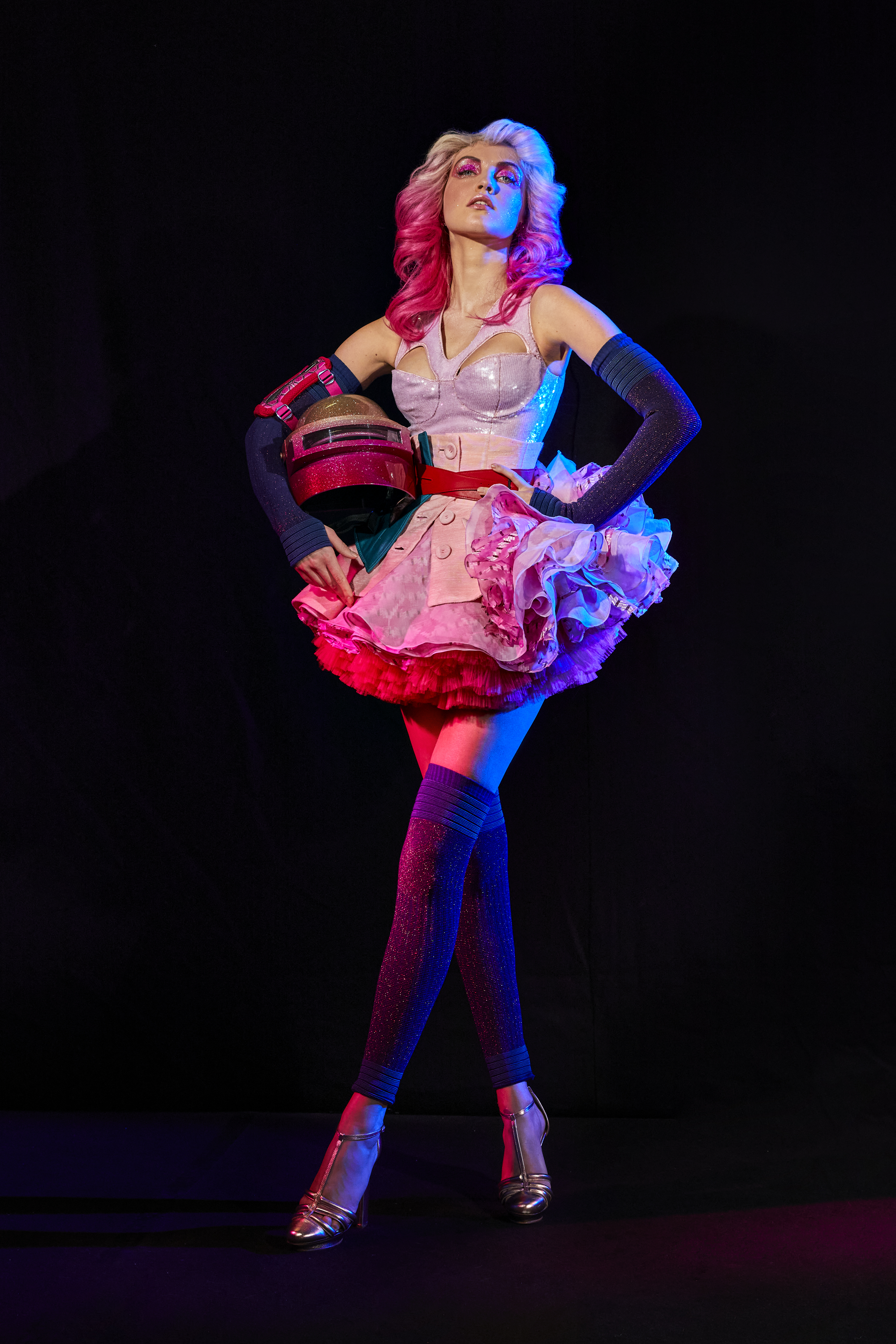
Michaela Tomanova, modelling Julien Fournié “First Squad”. Photograph by Delphine Royer. Copyright and by kind permission of Julien Fournié SAS.
However, for all Fournié's activities, shows, and discourses of haute couture design, it is important to remember that a phenomenological Heideggerian conception of haute couture, whilst in this instance concerned with Fournié's virtual worlds of the metaverse, is primarily concerned with how Fournié's world on show in his diverse collections is also a world that real people should be concerned about because it is one of the sources of their everyday meaningfulness and debates about, for instance, the mixing of gendered codes in real and virtual life.
Julien Fournié in the virtual worlds of the metaverse
For Julien Fournié, haute couture is a concept that demands rethinking since, for him, the future of haute couture fashion will pass through the virtual worlds of the metaverse – the network of 3D virtual worlds focused on social connection such as video games that is also a hypothetical iteration of the Internet as a single, universal virtual domain facilitated by the use of virtual and augmented reality headsets (Cailleaud, 2021: 1–3). Fournié's rethinking thus resides in visually representing haute couture fashion in virtual worlds. Determining that video games and the future of metaverse are new territories for haute couture to explore, and perhaps conquer, Fournié is already designing his collections for virtual worlds that depend on computerized technologies. Fournié's ideas, I argue, accord with dissolving haute couture into the technoscience that are online multiplayer mobile video games. But what does Fournié's technoscientific idea of haute couture mean for the presence of people who construct haute couture garments? Does it mean rethinking the idea of the haute couture fashion designer, of the haute couture house, and the haute couture appellation? Is the real world of the people whose human presence and practices give structure and value to dresses and fabrics dissolving into the virtual world? For a visual representation in a virtual universe, or a consideration of the digital, is something visually interior to the mentalities of video game developers but visually exterior to the mentalities of couturiers: what is visually present to the consciousness of the former is not visually present to the consciousness of the latter. This is because the consciousness of the video game developer is, if not a visually technologically produced representation, instituted upon the need to produce mobile video games that are far removed from the meanings generally produced by haute couturiers To imagine Dior's 1947 collection ‘Corelle’ is quite different from imagining a collection of visual representations of clothing that do not address the presence of particular people but, instead, the computer generated or absent ‘avatars’ or graphical visual representations of video game players or the players’ ‘character’ or ‘persona’. Thus, whilst the person of the haute couturier dresses an individual customer, the video game developer does not since what is being ‘dressed’ is not the customer (i.e. the video game player) but their haute couture avatar. What is being produced, therefore, is not an haute couture collection but a visual representation of an haute couture collection. Accordingly, the issue is not about the number of haute couture clothes in Fournié's collections, his individual style, or his standing in luxury fashion, but, rather, about how his rethinking of the world of the haute couturier is increasingly downgraded to the world of calculation when, in fact, neither haute couturiers nor anyone else is reducible either to calculation or to logical and dialectical thinking.
Consequently, if Fournié genuinely wanted to rethink the work of haute couturiers and haute couture itself, he would spend less time and effort highlighting video game creators and more time rethinking the present-day spirit of computerized technological thinking and its usage that such video game creators represent in the current period. Fournié does, of course, enter into discussions about haute couture as a know-how that video game creators do not yet possess, such as haute couture fashion designers’ expertise on the rendering of fabrics (Franceinfo, 2021: 1–5). Nevertheless, the credibility of the computerized technological ‘shine’ or ‘color’ of virtual haute couture clothes is a trustworthiness that is based on a will to control. For Fournié's rethinking of haute couture has less to do with real specific patrons, with genuine thinking and the consideration of time, and more to do with a will to control through virtual generic characters or ‘skins’ that can be visually represented as, and used for, almost anything given enough financial resources (Figure 3).
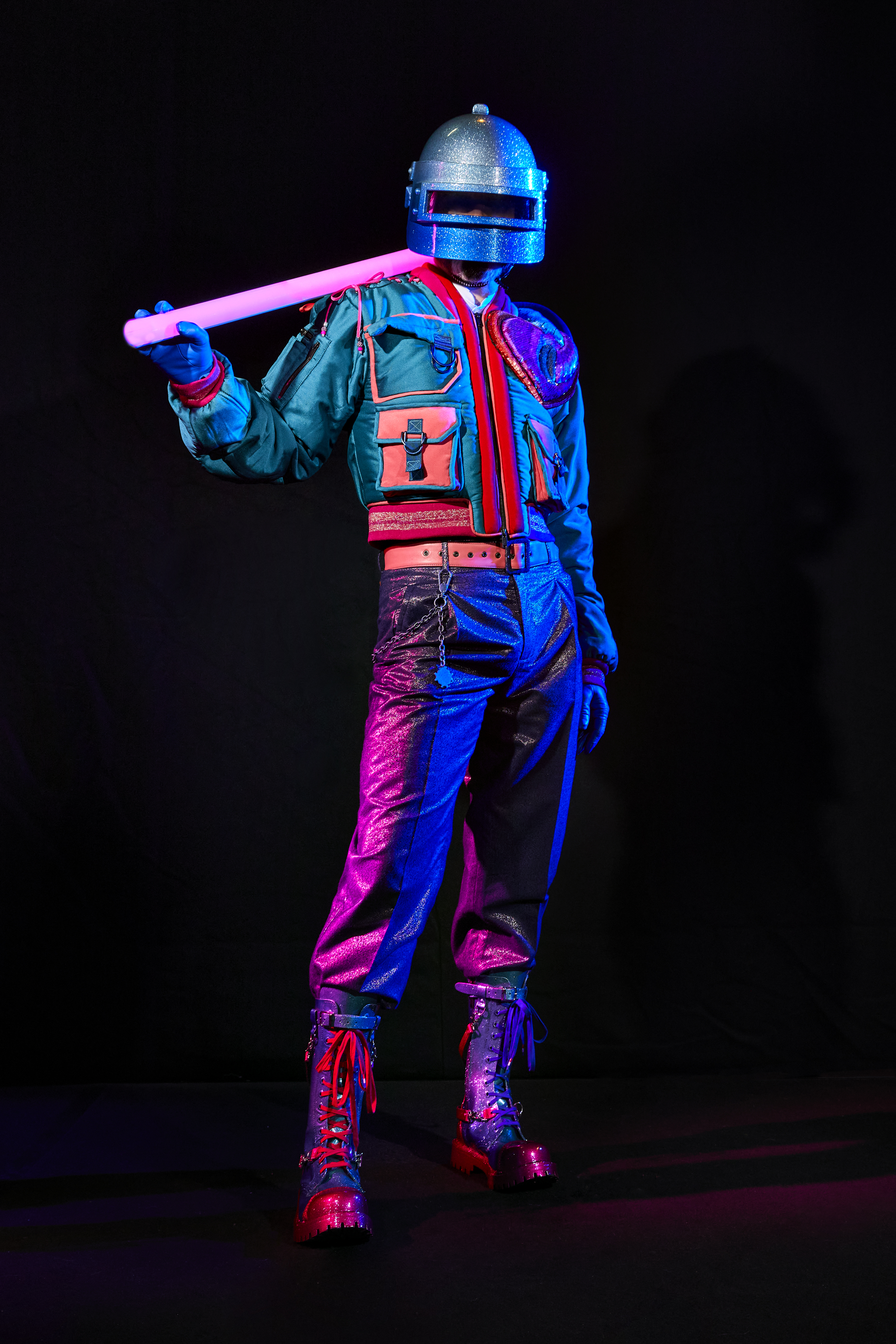
Julien Fournié, modelling Julien Fournié “First Squad”. Photograph by Delphine Royer. Copyright and by kind permission of Julien Fournié SAS. The outfits in Figures 1, 2, and 3 were available in real life for Fournié's haute couture customers and for players' avatars in the PUBG Mobile Battle Royal videogame.
Naturally, in a wholly technological and commercial world of logos and luxury branded goods and services, the idea of not willing or letting clothes be is of little interest because they have no palpable commercial value. What does have commercial value in the contemporary metaverse are forms of creativity that are sentimental, that hunger for the reappearance of a mythical world of haute couture that today encloses the atmosphere of Gucci, for example, which itself already collaborates with video games such as The Sims (Armitage and Roberts, 2019: 227–246). Evidently, the argument for rethinking haute couture as a letting things be is a world away from Fournié's desire to meet the ‘needs’ of the future metaverse. Indeed, whereas the contention here is that haute couture fashion design is an undertaking and high art that is historically distinct, Fournié claims that people must prepare for the future of haute couture because the will to control extant social networks is already showing its technological limits. Eschewing the letting things be of haute couture, Fournié is primarily enthralled by ‘the future’ promoted by the world of video games and the next metaverse. Yet letting things be is not something that haute couturiers can arouse in themselves through haute couture fashion, let alone through Fournié's recent work for software publishers such as Dassault Systèmes. Rethinking haute couture for Fournié is the antithesis of letting things be, as his creation of ‘Julien Fournié Digital’, a new branch of his haute couture house demonstrates. For Fournié, what is increasingly important is not the sensation of couturiers being released into the abiding expanse of letting things be but meeting the ‘needs’ of the metaverse, not the simultaneous presence and absence of the open region of haute couture but the ability of people to buy a ‘look’ for their avatar which can travel in different virtual worlds. Letting couturiers let things be in the open region, in the abiding expanse, is a refusal of the will to control that is the metaverse since the open region of haute couture is a movement along a path through the real world not an interchange among the networked vectors of the virtual world.
Of import to a Heideggerian position is the stance Fournié takes toward the technoscience of the metaverse. Undeniably, for Fournié, the mounting impact of technoscience within haute couture, a technoscience that cannot and so does not think, is such that he believes that the metaverse can have positive effects on the development of people. Here, Fournié's ongoing rethinking of haute couture does not amount to genuine thinking since his thinking increasingly misperceives the technoscience of the metaverse with its ability to help ‘people who feel harassed in life’ (Franceinfo, 2021 : 1–4). But what has genuine thinking about haute couture to do with people ‘who want to freely express their personality in virtual worlds’? For Fournié, ‘thinking’ about the metaverse entails ‘thinking of women who dream of taking part in grand balls and who would like to wear princess dresses’ (Franceinfo, 2021 : 1–4). Yet questions must be asked: what presuppositions are at work here and how is Fournié engaging them? What, for example, does rethinking haute couture have to do with what Fournié calls the human presence of '"bubble children"' suffering from cancer’ and who can allegedly ‘escape’ their illness thanks to the technoscience of the metaverse? Certainly, Fournié's dream of the future of haute couture not only incorporates a variety of people not normally associated with it but also a direction that rethinks haute couture as a technological project wherein its future is envisioned as the merger of the haute couture house with its supposed digital counterpart – the metaverse. For this reason, Fournié's rethinking of haute couture and enthusiasm for the metaverse appears unaware of the abyss that divorces genuine thinking from a developing confidence in the computational technological thinking visually represented by, for instance, the Battle Royale video game PUBG mobile. For while Fournié's computational technological thinking focuses on video games under some foregone technoscientific belief of what it denotes for them to be, genuinely rethinking haute couture tries to think the presence and history of haute couturiers dressing wealthy clients as an event that, unlike the metaverse, can open up a clearing for haute couturiers to be present to themselves and to their clients. This also why rethinking haute couture ought not entail an honoring of mobile video games but a commemoration of and giving thanks to haute couturiers whose novel designs are a world away from video game players ‘acquiring’ ‘clothes’ and ‘accessories’ for their avatars. As Fournié (Franceinfo, 2021 : 1–4) readily acknowledges, video game designers ‘know how to make avatars but it's not their job to make clothes’, which is another reason why rethinking haute couture as a form of commemoration and greeting haute couture fashions is not something that needs to be ‘remedied’ by propelling traditional haute couture into the metaverse. For the authentic meanings, history, and, crucially, spiritual values of haute couture dressmaking can only be found in the pursuits and labor of haute couturiers rather than in the future virtual world on which digital giants including Facebook are currently working. Rethinking haute couture from a Heideggerian standpoint is a way of articulating appreciation for the gift of what is most worth thinking and rethinking, which is the presence of haute couturiers and their innovative clothing design for real human clients rather than for video game avatars. Fournié's inauthentic rethinking of haute couture in the metaverse does, needless to say, take a leap into a video game form that, at present, lacks any established aesthetic foundation. The question is: can any genuine rethinking of haute couture actually take place inside a video game? Virtual haute couture is a leap into an entity that has a technoscientific foundation; it is not the abyss of the presence of the haute couturier, but the groundless ground of the absence produced by the video game developer.
Fournié's determination of the essence of rethinking haute couture is then constructed in terms of its nearness to the language of avatars, ‘players’, and ‘video game actions’ that cannot be performed in ‘real life’ (Franceinfo 2021 : 1–4). The language of avatars and the like is, not surprisingly, a far cry from the Heideggerian language of poetry, poesis, and bringing-forth. Moreover, Fournié's determination of the essence of rethinking haute couture concerning its immediacy to the language of avatars is an illustration of how far removed his rethinking of the presence of people such as haute couturiers is from the elemental manner of composing. This is important because, for all the recently invented ‘traditions’ of avatars and the values of the players, video game actions can only be ‘rethought’ within the technological confines of the fixed parameters of the video game; in other words, whilst Fournié is correct that video game actions cannot be performed in real life, it is equally correct that real life thinking that is continually open to rethinking cannot be performed in video game actions, actions which are limited by whatever software is programmed into the video game. Furthermore, and unlike anything players discover about themselves and the relationships they establish with other players online, the poetic quality of haute couture dressmaking is such that the thinking and discoveries of haute couturiers about themselves and the relationships that they establish with clients in real life are hidden from or unknown to the couturier and the client. Therefore, whilst Fournié is accurate that avatars and players can, to some extent, enter a dreamlike dimension within video games, the distinction that makes a difference is that real haute couturiers are not players, not dream weavers whose thoughts are restricted by the limitations of software, but poets whose state of unknowing and experiential knowledge are unrestricted because, like themselves, they are forever in-process. Thus, Fournié's viewpoint has increasingly less to do with the traditional vocabulary of haute couture, with real private clients, and more to do with the new vocabulary of computer-generated notions of refinement, visual representations of sophistication, and individualized elegance. For Fournié, the contemporary conception of video games opens the door to the new virtual worlds of the metaverse. Nonetheless, in reality, such a contemporary conception is a perception of technology that reopens the door to the oldest of all subjective worlds, that of the pure ego. Unlike Fournié's desire to offer his ‘mad imagination’ to people, and to bring more style to the world of ‘geeks’, the alternative assessment of haute couture presented here, much like the early Vivienne Westwood, rethinks it as a contemporary ideal poetic appreciation, thought, or truth that questions Fournié's new geography of ‘virtual places’ (Franceinfo, 2021: 1–4). Fournié's virtual places, then, do not offer the world new real human presences (such as Westwood's’ punks) but, rather, virtually ‘embodied’ characters with something called ‘identities’. In this new virtual ‘place’, real people are not transformed by real clothing but, instead, transformed by 3D virtual clothing so that they can ‘embody’ themselves in the metaverse. At this juncture, Fournié's inauthentic rethinking of haute couture in virtual places adds up to the replacement of the world of really thinking beings with newly cast and embodied characters whose identities are not the product of fashion design but of video game design. It is, without doubt, possible to make a case for the poetry of avatars and skins. Conversely, it must be emphasized that any such case resides in a different world from that of real haute couture because virtual avatars and skins are computerized exemplifications, symbols, and visual representations that merely appear as a character within a video game. Fournié's contemporary views thus share the suppositions concerning video recordings and ideas of virtual images. To be sure, there is apparently little in Fournié's belief system that relates to haute couture as a manifestation of the human soul of fashion, only to virtually fabricated visual reproductions of clothes as unlived experience. Then again it is feasible to rethink haute couture outside Fournié's virtual visual reproduction of, for instance, the flickering of sequins that change according to the light (Gee, 2022: 1–5). Additionally, rethinking haute couture does not normally entail the lived experience of ‘geeks’, engineers, and computer modelers, the exterior results of their inner human experience, such as the video game, or their human subjectivity and sensitivities. Instead, rethinking haute couture can be understood as a vital poetic event where historically shaped human activities, aesthetic attitudes, and elegant experiences of haute couturiers’ human presence bring their refined selves back to themselves. This is because the poetry of clothing and the value of its composure can never be found in the avatars and characters of video games. In fact, the originality and manufacture of video games is based on a wholly different philosophy to that of haute couture, which, for video games, is that of the philosophy of ‘play’, or intrinsically motivated human activities done for video game related recreational pleasures and enjoyment. The poetry of haute couture, equally, is not based on things that are on-hand, such as video games, but on making haute couture visible by indicating the mystery that pervades its varying history and the human presence of the collections of people that not only comprise haute couture but also preserve that mystery, which is simultaneously out of sight and in view as it continually appears as remembrance and disappears as forgetfulness. Intrinsically, any Heideggerian interpretation differs from that of Fournié since what the poetry of haute couture signposts and makes visible is not video games on-hand, but the central mystery and still open history of the entity that is haute couture. For, like haute couturiers themselves, fashion theorists must be free not only for that openness that is indispensable to the truth of haute couture but also for that hiddenness that is equally indispensable to it. By not recoiling from the history of haute couture, and the people that create it, the job of the poetic approach to haute couture is not, in the vein of Fournié, to bring-forth its technological or digital aspects. Sooner, the job of the poetic approach is to bring-forth the hiddenness of the concept of haute couture and the haute couturier that are essential to their truths since the unhiddenness of haute couture and the haute couturier presume an openness between haute couturiers that is itself hidden (Heidegger, 2002: 200–241). The words haute couture and haute couturier consequently not only found them with histories and fill them with historical and modern-day people but also as specifically events that open entities such as haute couture up to haute couturiers. However, the hiddenness that is involved in experiencing the truth of haute couture as un-hiddenness is the hiddenness not just of the haute couturier but of all entities, inclusive of the metaverse. In other words, for the presence of haute couturiers to be no more concealed to themselves, the hiddenness of haute couture, it's genuine non-truth, must be accepted as something that is much older than every manifestation of virtual worlds.
In rethinking haute couture, therefore, the poetic approach to it, unlike Fournié's, which is centered on virtual images, also rethinks the objects of study of the academic discipline of fashion theory. For the poetic approach to haute couture identifies its histories and points haute couturiers out to other human beings but not as things, such as video game characters in the gigantic virtual world of the metaverse that are of use, separate from the poetic fabrication of haute couture itself. Where Fournié's development of the concept of haute couture and the words haute couturier diverge into video games, the histories of couture activities and the people who generate haute couture attire fall into the unconsciousness of characters in huge virtual spaces. However, whereas the poetic approach to haute couture discovers people named haute couturiers by rethinking the meaning of the human presence of the haute couturier, the poetic approach to haute couture neither conforms to Fournié's aesthetics of virtual ‘freedom’ and virtual identity nor to the arbitrariness of his virtual fashion branding. For what causes the poetic approach to haute couture to be so constructive in rethinking haute couture is not only that it is ongoing or critical or that it asserts that what is to be discovered in haute couture is hidden but also that it is always already disclosing the world of a small socio-cultural creative group of human beings to people, an exclusive design-led life-world certainly, but one that is actually not distant like the energy-intensive technology that is the video game but the closest of all worlds. The poetic approach to haute couture is therefore an effort to uncover the histories and people of this prosperous world and, as this, the essential phenomenon that is the histories of Fournié's and others’ customers and portfolios, blueprints, and the presence of these groups of human beings, their adjacent and communal world of opulent selves, which is resided in a state of stylish selves extending from haute couture models to clienteles and to haute couturiers themselves.
Conclusion
Haute couture is a fundamental concept in the investigation of the history of French high sewing, as a gauge of ground-breaking handmade garments, and as a steer to high-class and expensive apparel. Yet, the originality of this article is the notion of rethinking haute couture for, it has been contended, more and more, haute couture comprises forms of thinking that include visual representations and calculating, characterized by a reliance upon computerized technologies. These forms of thinking, it has been established, are in harmony with dissolving haute couture's complexities, history, and philosophy of French expensive clothes of original design and high quality into technoscience. Employing Heideggerian thinking to rethink haute couture and its relationship with visual representations and calculation, computerized technologies, and technoscience, haute couture has been understood, questioned, rethought, and critiqued from a perspective that is not restricted to the traditional menu of concepts or practices that are managed or computed within a fixed horizon. On the contrary, it has been maintained that haute couture, as one of the vital means of human ingenuity regarding superior custom-fitted garments, should be rethought because it is theoretically and practically irreconcilable with contemporary technologically created visual representations that have no self-directed capability to go beyond their preprogrammed horizon or to contemplate it as, unlike haute couturiers, visual representations cannot think. By contrast, an authentic or a genuinely viewpoint-free philosophical investigation into thinking and rethinking haute couture knows only the matter of leaping into what lacks any basis. Furthermore, such matters as human ingenuity and resourcefulness in haute couture are, from a Heideggerian perspective, simply possible bases, and causes of questioning thought and of the development of the respects wherein they are to be questioned. Answers to questions concerning haute couture's mounting dependance upon contemporary technologically produced visual representations are not settled propositions: any answer regarding the incapacity of visual representations to surmount their computer programmed horizon or to envisage it is an answer just when it knows how to vanish from that specific event in which haute couture is being rethought as visual representations in the correct way. Any answer relating to thinking and rethinking the work of a French haute couturier such as Julien Fournié drives questioners into more questions about the future, about the character of a voyage, about technology, visual representations, virtual worlds, the metaverse, networked social media, and video games. A philosophy of haute couture is philosophizing, not a corpus of facts about Fournié's virtual thinking. Moreover, as questions pertaining to Fournié's language of autonomy, transcendence, the endless horizon, and his rethinking of haute couture as visual representations expand, so too does the questioning proceed to his examination of the video game and to his hypothesis that the metaverse is a novel environment for haute couture and haute couturiers to uncover. What a philosophy of Fournié's conception of haute couture contends with discloses itself only in and from a transformation of human presence into human absence.
Footnotes
Author biography
John Armitage is Visiting Professor of Media Arts at Winchester School of Art, University of Southampton, UK. He is the co-editor, with Joanne Roberts, of The Third Realm of Luxury: Connecting Real Places and Imaginary Spaces (2020) and a member of the editorial board of the Journal of Visual Culture.