




Abstract
Although Jean Renoir’s oeuvre has been extensively debated since the emergence of the politique des auteurs in the pages of Cahiers du cinéma, his representation of gender relations has sustained less discussion than his signature formal style. This article posits that Renoir’s films provide a valuable means of identifying how gender, specifically female identity, affects temporal trajectories in cinema. First, it illustrates Gilles Deleuze’s understanding of crystallisation and situates it in relation to current scholarship on gender representation in the director’s work. Second, it conducts a close analysis of the relationship between female identity and crystallisation based on the central female characters of La Règle du jeu (1939) and The Golden Coach (1952). This article ultimately argues that whether these characters belong to an upper-or lower-class stratum, they are subordinated to male power, which plays a determining role in the range of potential futures available to them.
Introduction: Renoir, Deleuze and gender
Jean Renoir (2005) once declared that ‘[l]es auteurs de films ou de livres étant en général des hommes, ils racontent des histoires d’hommes. Moi j’aime décrire les femmes’ (p. 155). Yet despite his reputation as the quintessential French auteur, Renoir’s portrayal of women is inconsistent at best. Noël Burch and Geneviève Sellier (2013), in their exhaustive survey of gendered relations in the classic French cinema, praise the director for lucidly illustrating the relationship between class and gender in La Règle du jeu (1939) and for privileging a female viewpoint in The Golden Coach (1952), choices that ran contrary to the misogynistic gender paradigms of the 1930s and post-Liberation years, respectively (pp. 73–81, 319–327). However, Burch and Sellier also associate Renoir with some of French cinema’s most regressive patterns in gender representation. In particular, they criticise the ‘barrage of hatred’ that La Chienne (1931) directs towards women through the protagonist’s castrating wife and the cruel prostitute with whom he falls in love (Burch and Sellier, 2013: 30), and they even argue that the garce (or ‘bitch’) stereotype in cinema, already present in other cultural forms, was inaugurated by his then-wife Catherine Hessling’s performance as Nana (1926) under his ‘curiously sadistic direction’ (p. 48). Furthermore, they posit that he directed his resources in French Cancan (1954) and Eléna et les hommes (1956) towards ‘the most reactionary conception of relations between men and women’ (p. 291). Martin O’Shaughnessy (2000) extends Burch and Sellier’s thesis to Renoir’s entire filmography and similarly identifies ‘a general but evolving pattern of marginalisation and female stereotyping’, often in the figures of destructive femmes fatales and castrating mothers, which is ‘punctuated by the more progressive representations [. . .] found in the mid-1930s’ during Renoir’s public commitment to the Front populaire (p. 230). 1
A key challenge involved in any discussion of Renoir’s female characters is their ambiguous position within his narratives, which has provoked scholars to interpret his films alternately as progressive and regressive in their depiction of women. French Cancan (1954) is a case in point. Janet Bergstrom (1996) offers a highly critical interpretation of Renoir’s ‘retrograde depiction of sexual politics’ in the film (p. 460). Conversely, Raymond Durgnat (1974) describes the dancers in the climactic cancan scene as a ‘light brigade of sexual suffragettes’ (p. 314), and Ginette Vincendeau (2013) argues that the dancers’ athleticism and charisma contradicted the division of sexual labour between male/public and female/private spheres that prevailed in French society during the 1950s (p. 263). Le Déjeuner sur l’herbe (1959) offers a similar point of contention. Whereas Burch and Sellier (2013) suggest that this homage to Impressionist nudes painted by Manet and Renoir père provocatively portrays a neurotic man who is ‘unable to enter into a true relationship with members of the opposite sex’ (p. 291), Vincendeau (2013) argues that Renoir’s film ‘offers his truly most retrograde vision of gender: the “natural” woman (emerging naked from a river) as ultimate refuge against modernity’ (p. 66).
This article specifically discusses the agency of Renoir’s female characters. This involves building on the work of gender-focused Renoir scholars including Bergstrom, O’Shaughnessy and Vincendeau on one hand and, on the other hand, the temporal dimension of Renoir’s narratives, as conceptualised by Gilles Deleuze. To this end, the present analysis is divided into two main stages. First, it illustrates Deleuze’s understanding of temporal crystallisation and situates it in relation to current scholarship on gender representation in the director’s work. Second, it conducts a close analysis of the relationship between female identity and crystallisation by drawing on La Règle du jeu and The Golden Coach. This article ultimately argues that Renoir’s female characters, whether they belong to an upper- or lower-class stratum, are subordinated to male power, which plays a determining role in limiting the range of opportunities available to them.
Deleuze’s film philosophy constitutes an essential point of reference, not only because his vision of cinema provides a useful framework for theorising the relationship between Renoir’s mise en scène and the futures available to his female characters but also because he lends the auteur a privileged status within his two Cinéma volumes. Deleuze’s understanding of Renoir’s films and the temporal regime that structures their narratives derives largely from his Bergsonian vision of time. For Deleuze (1985), time splits incessantly into two dissymmetrical jets, one of which is inflected towards the future and constantly allows the present to pass, the other of which falls continuously into the past, where it remains permanently stored in a region of memory (p. 108). Whereas this bifurcation is masked by the classical narrative style that structures the movement-image, it breaks to the surface of the time-image, particularly in crystalline states, which enact two particular processes for the spectator. First, corresponding with Deleuze’s understanding of time, they juxtapose actual images (images located in the present) with virtual images (correlative images potentially located in the past). In La Règle du jeu, for example, this aspect of Renoir’s style ‘fait coexister l’image actuelle des hommes et l’image virtuelle des bêtes, l’image actuelle des vivants et l’image virtuelle des automates’ (Deleuze, 1985: 114). Second, they allow the spectator to simultaneously witness the ongoing present and the co-existent, stultifying influence of the past. Whereas the perfect crystal crafted by Max Ophüls (La Ronde, 1950; Lola Montès, 1955) precludes the creation of a genuinely new future, Renoir’s contains an inherent crack that frees characters from the ‘rôles gelés, figés, tout faits, trop conformes’ (p. 116) that are played out in various surroundings such as the prison camps in La Grande illusion (1937) and the Indian home where Harriet spends her childhood years in The River (1951). Key to Renoir’s crystalline state, according to Deleuze, is the director’s signature staging of events in deep space, which creates a visual ‘point de fuite’, making it clear that ‘quelque chose va fuir au fond, en profondeur, [. . .], par la fuite’ (p. 113). This escape from oppressive circumstances may be literal, as in the case of the French officers who repeatedly escape from German prisons in La Grande illusion, or figurative, as in the case of Harriet, who outgrows her adolescent infatuation with a war veteran.
Despite focusing on the evident capacity for productive change in Renoir’s worlds, Deleuze essentially ignores the import of gender towards this possibility. In fact, although Deleuze’s taxonomy illuminates the complex relationship between cinema and the human experience of time across films featuring some of the most famous female-centred films in cinema history – among them All About Eve (Mankiewicz, 1950), Lola Montès, Cléo de 5 à 7 (Varda, 1962) and Vivre sa vie (Godard, 1962) – it generally disregards questions of gender. Indeed, prior to the release of the English translations of Deleuze’s Cinéma volumes, Keith Reader (1987) had already noted ‘Deleuze’s seeming blindness to questions of gender’ (p. 102), and since then, D. N. Rodowick (1997) has similarly observed that Deleuze’s film-focused work has ‘little to say’ on issues of sexual difference (p. xiii), while Elizabeth Grosz (2008) cautions that ‘Deleuze is no feminist’ (p. 216).
2
This absence is particularly surprising since Deleuze and Félix Guattari argue the following in Mille plateaux: Il est indispensable que les femmes mènent une politique molaire, en fonction d’une conquête qu’elles opèrent de leur propre organisme, de leur propre histoire, de leur propre subjectivité [. . .]. Mais il est dangereux de se rabattre sur un tel sujet, qui ne fonctionne pas sans tarir une source ou arrêter un flux.
3
(Deleuze and Guattari, 1980: 337–338)
In doing so, they suggest that women in particular must constantly forge new opportunities to extricate themselves from patriarchal forces that subjugate them within society’s intrinsically sexualised binary hierarchy.
Deleuzian studies of Renoir similarly tend to overlook the relationship between gender and agency in the director’s work. Richard Rushton (2011) pertinently likens the crack in Renoir’s crystal to the imaginary, whose liberating force constitutes ‘an openness to what happens to one, even beyond one’s imagination, that one could not foresee’ (p. 258). However, he ignores the extent to which such possibilities and their related outcomes are moulded (and possibly restricted) by a given character’s gender. In a recent monograph, I illustrate how socio-political and economic structures such as class hierarchies and capitalism force Renoir’s characters to repeatedly identify possibilities of altering oppressive circumstances across each phase of his career in various urban and rural settings. Key to my methodology is the intersection of Deleuze’s discussion of Renoir’s temporal ‘point de fuite’ in Cinéma 2 with Deleuze and Guattari’s (1980) theorisation of a spatial ‘ligne de fuite’ (pp. 15–37) which volatile molecular forces may pursue to disrupt hegemonic molar forces that striate space (Nevin, 2018: 16–19). Although I demonstrate the value of this framework to Renoir’s silent films, his most famous films of the 1930s, his Hollywood output and post-war costume dramas, my approach, like Deleuze’s philosophy and Rushton’s analysis, tends to overlook the place of gender, leaving the relevance of Deleuze and Guattari’s observation on women’s ‘politique molaire’ to Renoir’s crystalline narratives open to question.
Remedying such approaches is a particularly inviting avenue of enquiry because Renoir frequently portrays women who are victimised by ageing patriarchs (Estelle in Le Crime de Monsieur Lange (1936) and Séverine in La Bête humaine (1938)), endure unhappy marriages (Josefa in Toni (1935) and Peggy in Woman on the Beach (1947)) or are exploited by opportunistic male players in the political sphere (the eponymous Polish princess of Eléna et les hommes), but Deleuze implies that Renoir holds this oppression in tension with the potential emergence of a genuinely new future, liberated from patriarchal shackles. This capacity notably contrasts with Ophüls’s perfect crystal (Lola Montès), Federico Fellini’s seed crystal (8½, 1963) and Luchino Visconti’s crystal in dissolution (Death in Venice, 1971), all of which withhold such an opportunity from their fictional characters, regardless of their gender (Deleuze, 1985: 111–113, 117–128).
La Règle du jeu and The Golden Coach have been selected from Renoir’s substantial and diverse output for four reasons. First, both were made at different phases of Renoir’s career: La Règle du jeu was famously shot and released in France on the eve of the Second World War, whereas the second was a Franco-Italian co-production shot over 10 years later in Rome’s Cinecittà studios during Europe’s post-war reconstruction. Second, although each links the inextricable relationship between life and theatre with questions concerning class and etiquette, the two films differ substantially from a stylistic perspective: La Règle du jeu, as Deleuze implies, arguably marks Renoir’s most complex deployment of lateral camera mobility, composition in depth and off-screen space, all of which would later secure the film’s crucial position within André Bazin’s theories of realism; by the time Renoir was directing The Golden Coach, on the other hand, he was relying considerably more on stationary camera set-ups and Technicolor, and had become, in his own words, ‘un passionné de l’artificiel’ (Renoir, 2005: 246). Third, while Burch and Sellier consider these films relatively complex examples of Renoir’s approach to gender relations, the broad scope of their study prevents them from performing a close textual analysis of Renoir’s mise en scène and leaves the conceptual point of conjecture raised by Deleuze open to discussion. Fourth, women and their respective relationships with the numerous male suitors are central to both films, as evidenced by plot summaries of each film. In La Règle du jeu, aviator André Jurieux (Roland Toutain) ruptures Christine de la Chesnaye’s (Nora Grégor) domestic tranquility by criticising her disloyalty during a radio broadcast following his arrival at Le Bourget airport. Her childhood friend, Octave (played by Renoir), asks Christine and her husband, Robert (Marcel Dalio), to invite Jurieux to an upcoming retreat at their country estate, La Colinière. Over the course of the celebrations, Christine is pursued by a number of suitors including Jurieux, Octave and another guest, Saint-Aubin (Pierre Nay). In The Golden Coach, Camilla arrives with fellow members of her commedia dell’arte troupe in colonial Peru. While there, her perennial dilemma between her life and her art is aggravated by her inability to determine which of the three men who vie for her attention is her ideal partner: Felipe (Paul Campbell), a solder in the Spanish military; Ramon (Riccardo Rioli), a toreador; or Ferdinand (Duncan Lamont), viceroy of the colony, who carries the promise of greater wealth than Camilla has ever encountered, chiefly in the form of his newly acquired golden coach. A critical goal for the female protagonist in each film is to forge a new future for herself within a world striated by binary (and hierarchised) understandings of gender.
‘On te regarde’: La Règle du jeu (1939)
Interestingly, although La Règle du jeu is often considered the apogée of Renoir’s entire body of work, Deleuze (1985) considers the film highly uncharacteristic of the director’s style because ‘il est pessimiste et procède par violence’ (p. 114). Deleuze’s justifiably declinist view of the world of La Règle du jeu is particularly apt from a gendered perspective if we focus on Christine: by the end of the film, despite serious intentions to elope with other men, she remains with her husband, a fate that mirrors that of her maid, Lisette (Paulette Dubost), and which evokes Deleuze’s emphasis on ‘[le] système de rimes entre maîtres et valets’ (p. 114) within the metaphorical reflections generated by Renoir’s crystalline narratives. To a large extent, the fate shared by two women occupying such disparate social positions reflects contemporary social realities of womanhood. In May 1919, the Chambre des députés voted for full political rights for both sexes and France was on the brink of joining 21 previously all-male polities including Britain (although such rights were granted exclusively to women over 30 until 1928), the United States and Germany. However, this proposal was blocked by the Senate in 1922 and several similar bills were repeatedly defeated over the course of the interwar period by a comparatively small number of extremely influential men (Reynolds, 1996: 207–11). In reactionary fashion, the French government ratified the pro-natalist Code de la famille on 29 July 1939, 22 days after the film’s Paris premiere, aggravating conditions governing women’s lives which had already been enforced by the 1804 Napoleonic code.
Christine’s socio-economic dependence is illustrated by two scenes that follow Jurieux’s outburst, the first of which is set in her boudoir, the second in Geneviève’s apartment. Although the opulent furnishings and many mirrors of Christine’s room indicate her material preoccupations, this décor provides an ironic counterpoint to her inability to support herself financially: French laws prevented married women from owing their own property without their husbands’ permission and no indication is given that she has retained assets in Austria since the Anschluss (1938). Saint-Aubin’s comments in Geneviève’s salon inform us only that although Christine lives with Robert, she was ‘brusquement [. . .] obligée’ to leave her native Austria, where she grew up with Octave and lived with her father, who was a famous orchestra conductor. Moreover, Christine’s Germanic roots place her in a doubly compromised position, impeding her admittance to the haute bourgeoisie, as evidenced by Geneviève who, discussing Robert’s potential disclosure of their own affair, caustically remarks that ‘Christine est restée très de son pays; une Parisienne comprendrait, elle pas’. Indeed, Christine herself is aware of how she is perceived, suggesting to Octave that if Jurieux is ignored and reacts dramatically, ‘on parlera de “la main de l’étranger!”’ As an exiled, scorned woman, Christine has more to gain by marriage to a French citizen and, by the same token, more to lose without him than the other characters of her ilk. Hence, Christine’s attractive boudoir is not just a symbol of her class or, as observed elsewhere, of her attempt to establish an emotional bulwark against anti-German sentiment proliferating in the capital in the wake of the 1937 Exposition Universelle (Nevin, 2018: 55–56); it is also a concrete expression of her subjugation to patriarchal society within a marriage that affords her an opulent lifestyle.
Ironically, Robert is equally reliant on Christine despite the superior social status bestowed upon him by the Third Republic. More specifically, Robert requires her to uphold his masculine veneer as he contends with rampant anti-Semitism in French society and his wife’s potential dissatisfaction with their marriage. Robert is master of ceremonies but his Jewish background has even become a topic of gossip among his servants, one of whom condescendingly interjects, ‘La mère de La Chesnaye avait un père s’appelant Rosenthal et qui arrivait de Francfort’ during a conversation with his servants. The La Chesnayes’ Paris residence and La Colinière both lend Robert a stronger sense of security in his position within the haute bourgeoisie, as revealed when he refuses to abandon Christine for Geneviève and fails to counter the latter’s tirade against his attachment to his chateau. The marriage itself is suspiciously courtly, prompting Reader (2010) to observe that Robert’s apparent desire for Christine may be intended ‘only to maintain the façade of their marriage’ (p. 34). Although Christine herself never clarifies the nature of their relationship, her comments indicate her awareness that their marriage is characterised by lack. In her boudoir, during the film’s opening scenes, she asks Lisette questions regarding how long she has been married, if she has any lovers, what they tell her, if they kiss her and if they hold her hand, as though lacking any experience in these respects and attempting to live vicariously through Lisette in response to her sexually undynamic marriage of necessity.
The formal design of La Règle du jeu appears markedly preoccupied with the contradictory demands visited upon Christine. While the film is universally lauded for its virtuoso camera mobility and composition of events in depth, Renoir, in fact, strategically integrates static, shallow photography to contrast Christine’s tranquil life in Paris with her effort to negotiate prying public eyes and to retain the status critical to acceptance within her milieu later in the film. As Christine walks towards the foreground to turn off the radio in her boudoir during her first appearance, the background blurs, allowing us to contemplate her own moment of reflection on Jurieux’s outburst for a moment before she walks back to Lisette (Figure 1). Apart from signalling a specific interest in Christine, the intimacy that this visually shallow image grants us establishes a pertinent counterpoint to the fluid, deeply composed shots in which Christine receives Jurieux at La Colinière and is subject to her peers’ intrusive collective gaze. The framing of the latter scene differs strikingly, evoking Bazin’s (1952) oft-cited description of the camera’s movements as those of ‘l’invité invisible, se promenant dans le salon et les couloirs, regardant avec curiosité mais sans autre privilège que son invisibilité’ (p. 25). The loquacious Madame la Bruyère abruptly stops talking to Christine when she notices the newly arrived Jurieux in the doorway and withdraws her spectacles. While she does so, the camera pans left. As the lovelorn aviator approaches Christine, Cava (Nicolas Amato), a rarely discussed character, looks in through a doorway located in the midground and draws Jurieux’s presence to the attention of another guest within the same room, implicitly evoking the possible arrival of other onlookers beyond the camera’s frame (Figure 2). Mirroring their curiosity, Saint-Aubin, whom Christine later considers a worthwhile suitor, tartly observes to the general (Pierre Magnier) upon Jurieux’s arrival that ‘ça se passe en famille’. Realising that Berthelin (Tony Corteggiani) is staring all too brazenly at Christine embracing Jurieux, Cava grabs him by the arm and escorts him away. Dick’s and Charlotte de la Plante’s inquisitive faces, framed together in a shared close-up, exude a stifling curiosity as they echo the sentiments of everybody else in the room. ‘Enfin, ont-ils ou n’ont-ils pas?’ asks Dick. ‘Ils ont’, sighs Charlotte, raising her eyes. Aware of her obligation to face public scrutiny, Christine offers a tantalisingly platonic explanation for Jurieux’s success in a vain effort to deny her guests’ right to further speculate on her relationship with the aviator and to preserve her marriage to Robert: Nous passions de longues heures ensemble, des heures très agréables, des heures placées sous le signe si rare de l’amitié. Il me racontait ses projets et je l’écoutais. C’est quelque chose de savoir écouter. Dans ce cas, ça n’a pas été inutile. J’en suis très fière, et j’ai éprouvé le besoin de vous le dire maintenant.
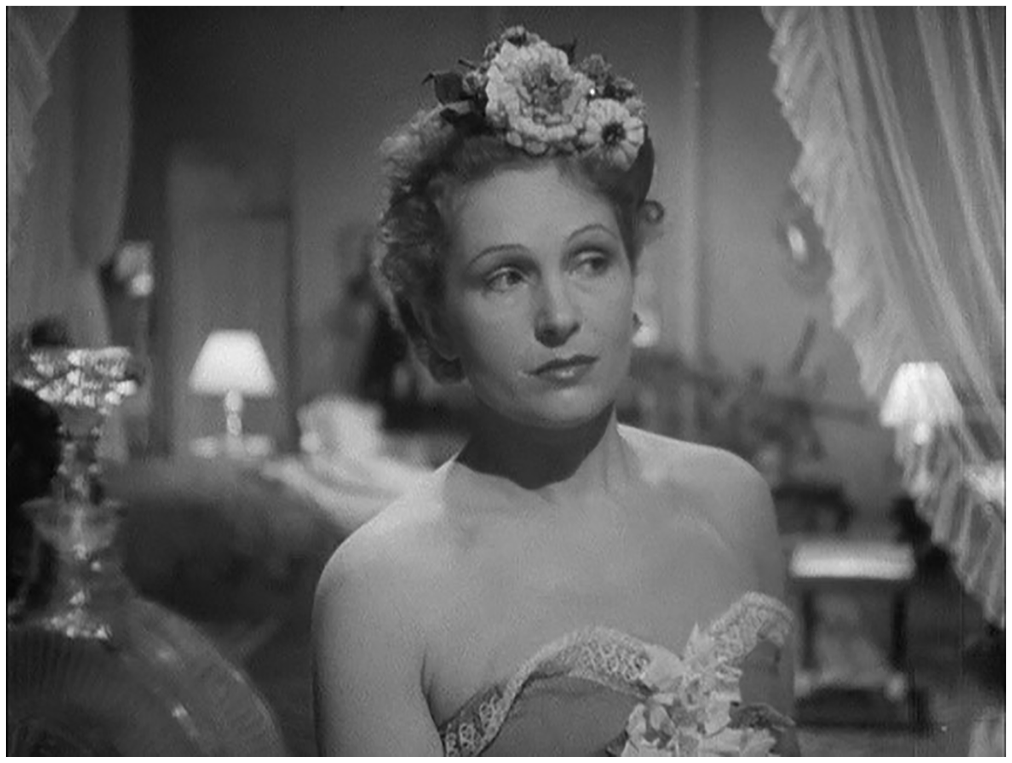
In a shallow shot, Christine switches off her radio and reflects on Jurieux’s outburst.
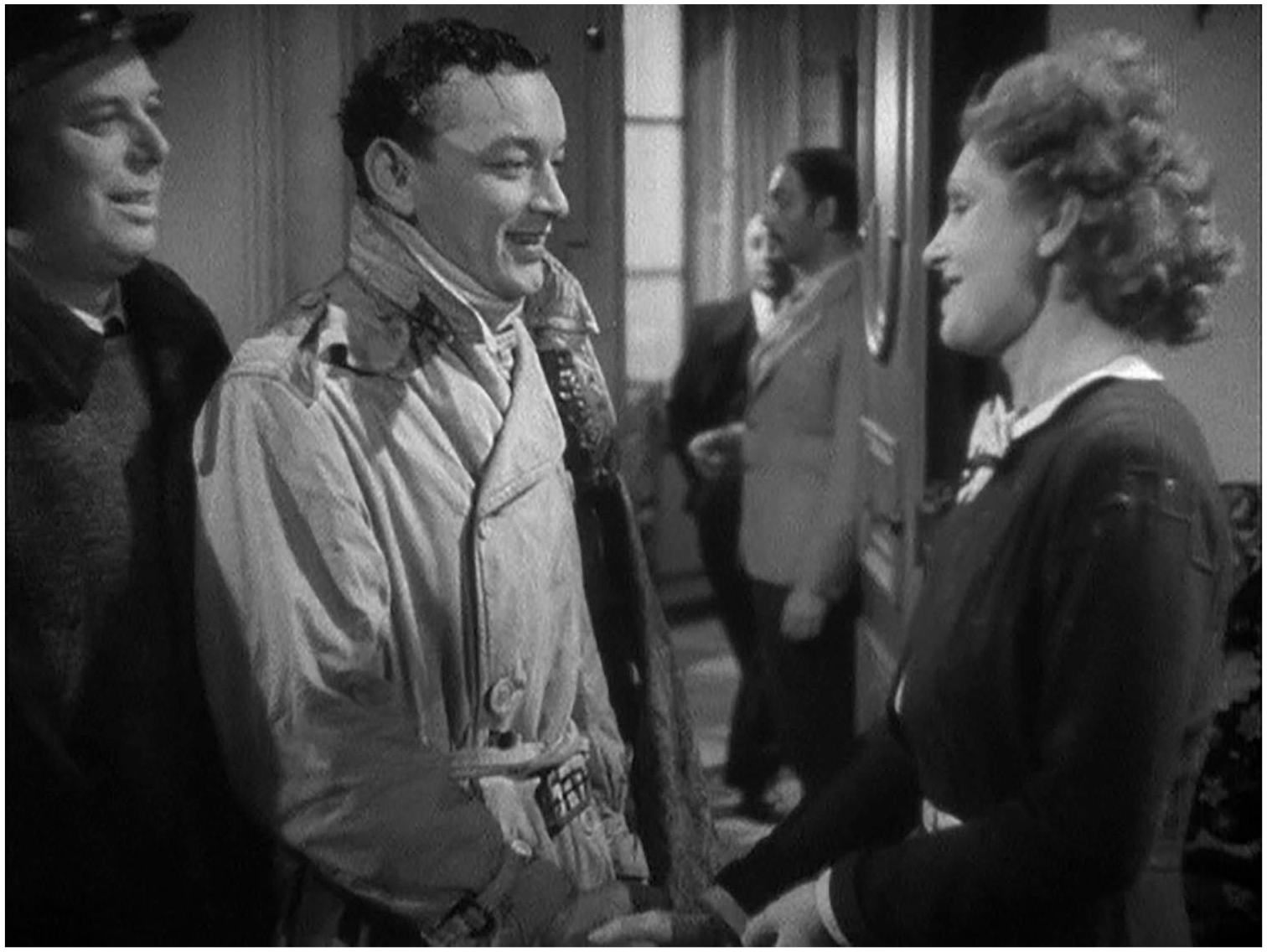
Christine welcomes Jurieux to La Colinière as Cava looks on.
Two elements of this narrative sequence, apart from our inability to determine the veracity of her statement (or, consequentially, the layers of theatricality involved), are particularly important to the connection that the film forges between gender and crystallisation. First of all, Octave and Robert linger in the background of the final shot, listening to Christine with amusement and distancing us emotionally from her intended effect while granting us closer insight into how sceptical those closest to her are of her version of recent events (Figure 3). Yet both men are far removed from conventional, monolithic constructions of masculinity. Robert, as noted earlier, is not necessarily involved in a physical or romantic relationship with Christine. As for Octave, Burch and Sellier (2013: 77) argue that his lack of sexual differentiation is underscored by his childlike manners, and Daniel Serceau (1980) similarly describes his relationship with Christine as ‘une forme d’amour en apparence totalement désexualisée’ (pp. 142–143). Hence, from a gendered perspective, this scene emphasises what is already apparent in her relationship with Robert: that the social strictures prohibiting illicit dalliances on Christine’s part subjugate her to men who embody the fragility and failings of contemporary French masculinities.
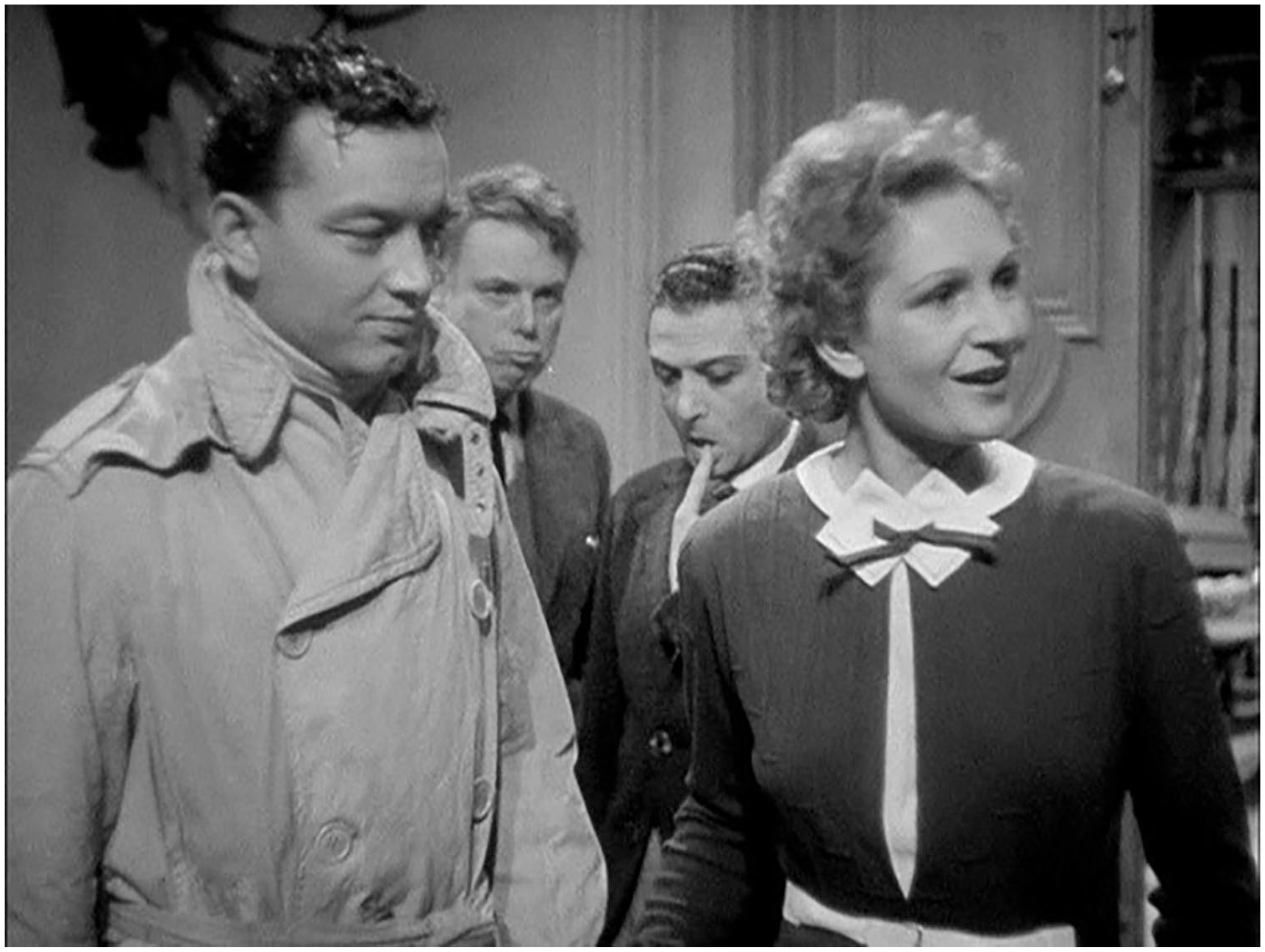
Octave and Robert undermine Christine’s version of her relationship with Jurieux.
The second element of this scene that demands further analysis is its visual style. Bazin, as already noted, suggests that Renoir’s techniques anthropomorphise the camera’s frame, and T. Jefferson Kline (2010: 42–44) argues that Christine might have obtained a more contextualised and accurate vision of Robert and Geneviève’s relationship had she the context provided by composition in depth and camera mobility. Yet we can also view this style and Christine’s gradual transition from subject to object of her peers’ gaze in this fluidly staged sequence from a Deleuzian feminist perspective. From this point of view, the camera’s style not only imitates and exposes the ocular limits inherent to the vantage points assumed by characters at La Colinière (as Bazin and Kline respectively argue) but also registers the impact of such surveillance on Christine’s imprisonment within a ‘rôle gêlé’ designed by the patriarchal body politic. A key intermediary between Deleuze’s philosophy and the strictures exposed by Renoir’s films is Michel Foucault who, in his discussion of structures of surveillance in everyday life, identifies a panoptical project in hierarchically organised groups, particularly the police in eighteenth-century France. Linking Jeremy Bentham’s panoptical prison with matters of spectatorship and the quintessentially Renoirian motif of theatricality, Foucault specifically compares individual cells in Bentham’s architectural design to confined theatres that proffer the prisoner to the prison guard’s disciplinary gaze: ‘on peut saisir de la tour [. . .] les petites silhouettes captives dans les cellules de la périphérie. Autant de cages, autant de petits théâtres, où chaque acteur est seul, parfaitement individualisé et constamment visible’ (Foucault, 1975: 202). Foucault’s explicit analogy between prisons and theatres evokes Deleuze’s description of Renoir’s crystal as a restrictive locus whose pre-established range of roles must be tried out by actors. 4
In light of this comparison, it becomes clear that when Christine arrives at La Colinière, she enters a Foucauldian theatre, for she is among characters who are associated with a predilection towards observing at various stages of the narrative. Berthelin, before lending his viewing glass to Christine, remarks that this ‘compagne indispensable’ is so small that it can always be carried, suggesting that he is possibly wearing it at any given moment. The likelihood of being watched persists even during Robert and Geneviève’s solitary exchange in the Sologne, during which the frequent noise of horns indicates the potentially intrusive proximity of other guests. Later, in a rarely discussed shot, as Schumacher walks Lisette across a bridge and offers her the coat that will lead to a fatal case of mistaken identity, one of the guests is looking at them from a window on the upper floor of the chateau (Figure 4). After the rabbit-hunt, Octave and Christine are both associated with this compulsion for viewing, the latter refusing on two counts to lend the eyeglass to her childhood friend, who twice insists that it is his turn to use it before she famously spies Robert and Geneviève’s embrace. Most tellingly, Christine has provided the focal point of her milieu’s gaze for some time: Jurieux never actually mentions Christine’s name on the radio, but her peers (and possibly the spectator) nevertheless suspect an affair. Christine’s admission after the hunt that ‘je crois que je n’aime plus la chasse’ is no surprise since her own position in the haute bourgeoisie’s panoptical milieu, by then, is already all too clear to her.
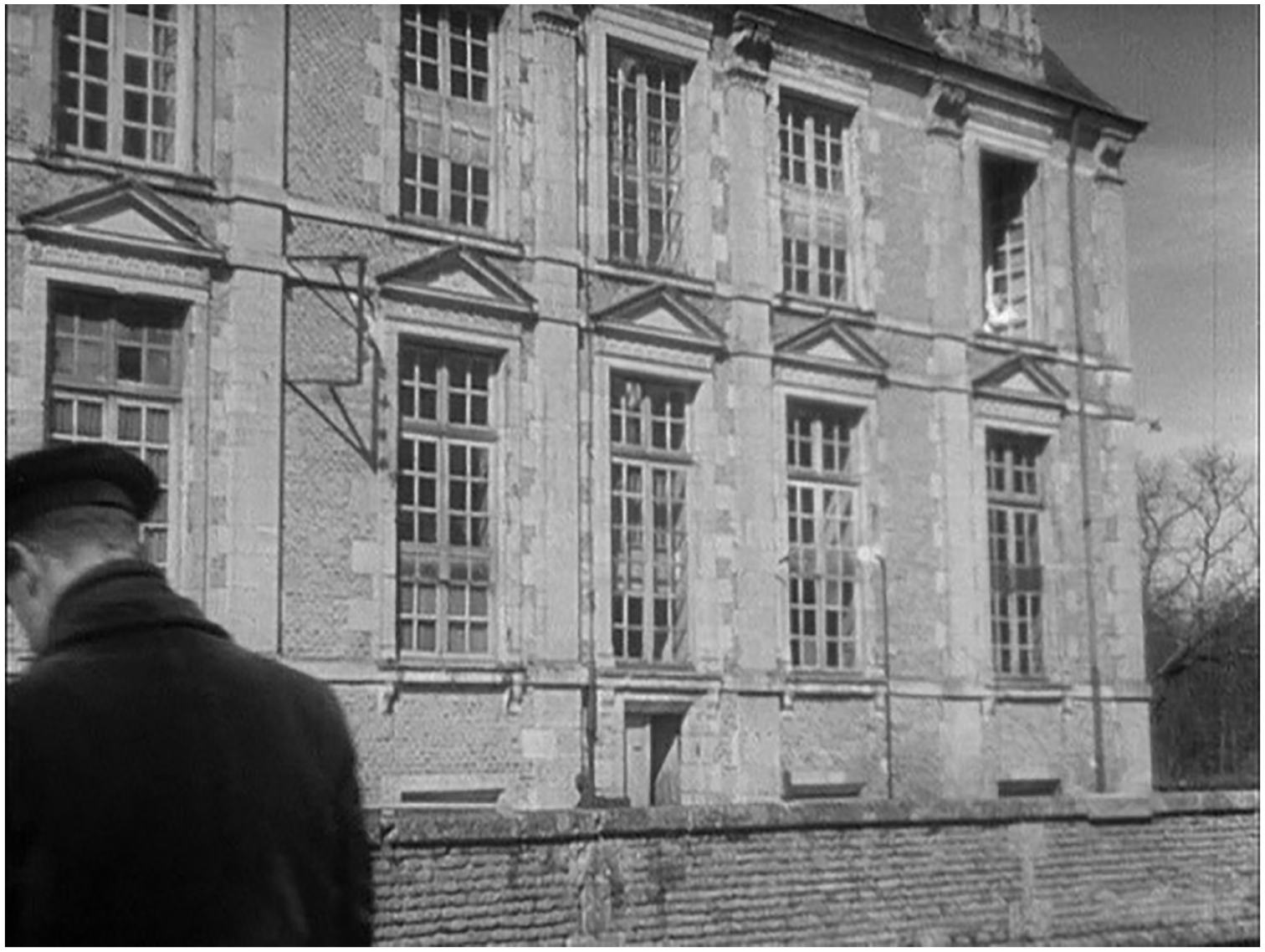
Barely visible, a guest in the top-right window looks out on Schumacher and Lisette as they walk towards the chateau.
Deleuze remains correct in his assertion that the film remains uncharacteristically pessimistic within the context of Renoir’s body of work, for Christine’s world ultimately remains closed to the potentially liberating capacity of the virtual. Her glimpse of Robert and Geneviève’s romantic adieu rocks the foundations of her newly found position in French society, prompting her to embark on drunken dalliances with Saint-Aubin and Jurieux and to discard the remarkable composure that she displays during Jurieux’s outburst in the opening scenes, his arrival at La Colinière and the moments that immediately follow her discovery of Robert’s affair with Geneviève. However, by the end of the film, Christine has resorted to her subjugated position in society. Even after she faints in response to the aviator’s death outside the greenhouse, her awareness of the haute bourgeoisie’s gaze and protocol remains acute. As Lisette escorts Christine’s niece, Jackie (Anne Mayen), back to the chateau from the site of the murder, Jackie declares ‘oh, je ne peux plus, je ne peux plus’. Christine placidly approaches her niece’s side and, looking straight ahead, coolly advises her, ‘Jackie, on te regarde’, summarising the drama of vision that has moulded her own behaviour at La Colinière. Christine’s courteous farewell in front of her guests at the film’s close complements Robert’s own ‘rôle gêlé’, delusively bolstering his confidence in his ability to recast threats to their marriage and milieu as outlying events willed by fate. Regardless of the opulence of her surroundings and the film’s penetrating criticism of the haute bourgeoisie, Christine is ultimately a victim, compelled by her precarious position to refrain from forging her own ‘politique molaire’ and from extending her identity beyond an ossified configuration of French society.
‘A lover of suitable rank’: The Golden Coach (1952)
The Golden Coach relies far less on the technical virtuosity of Renoir’s 1930s style, which constitutes the fulcrum of Deleuze’s most systematically argued analysis of Renoir’s work. Nevertheless, the philosopher argues that it is in this film that the exchanges enacted by the virtual-actual circuit ‘seront portés au plus haut point’ (Deleuze, 1985: 113). This distinction is largely a result of Camilla who, like Christine, embodies the intersection between theatre and life that Deleuze identifies in Renoir’s crystal, indulging in fantasy while endeavouring to escape from the cracked crystal, and declaring to the viceroy, ‘where does the theatre end and life begin?’
Camilla’s entrenchment in theatricality is matched by countless other characters in the palace, the theatrical troupe and the general public, not least her three suitors: the viceroy’s colourful costume, wig and etiquette mark him as a player on a political stage; although Philippe does not participate in the troupe’s performances, the saturated colours of his outfit brand his military position as another Deleuzian ‘rôle gêlé’; as for Ramon, the toreador is Camilla’s closest competition for public admiration, whether during his bullfights or when his arrival at one of the troupe’s performance is celebrated by the public as yet another spectacle. The characters’ shared imprisonment within Renoir’s world-as-theatre is emphasised by the film’s vivid colour palette, visibly false décor and the proscenium arch that bookends the narrative. However, the narrative outcome allots these individuals emphatically different places: whereas the three men, like almost every other character, disappear from the stage of life in the film’s final scene, Camilla remains confined within a proscenium arch, beheld by the troupe’s leader, Don Antonio (Odoardo Spadaro) (Figure 5). As Deleuze (1985) observes, ‘trois personnages auront trouvé leur rôle vivant, tandis que Camilla restera dans le cristal, mais pour y essayer encore des rôles dont l’un lui fera découvrir peut-être la vraie Camilla’ (p. 116). Much like the men and women of La Règle du jeu, the characters’ trajectories in The Golden Coach must be understood not only in relation to the theatrical qualities Deleuze associates with Renoir’s crystalline state but also from the interrelated perspective of gender inequality.
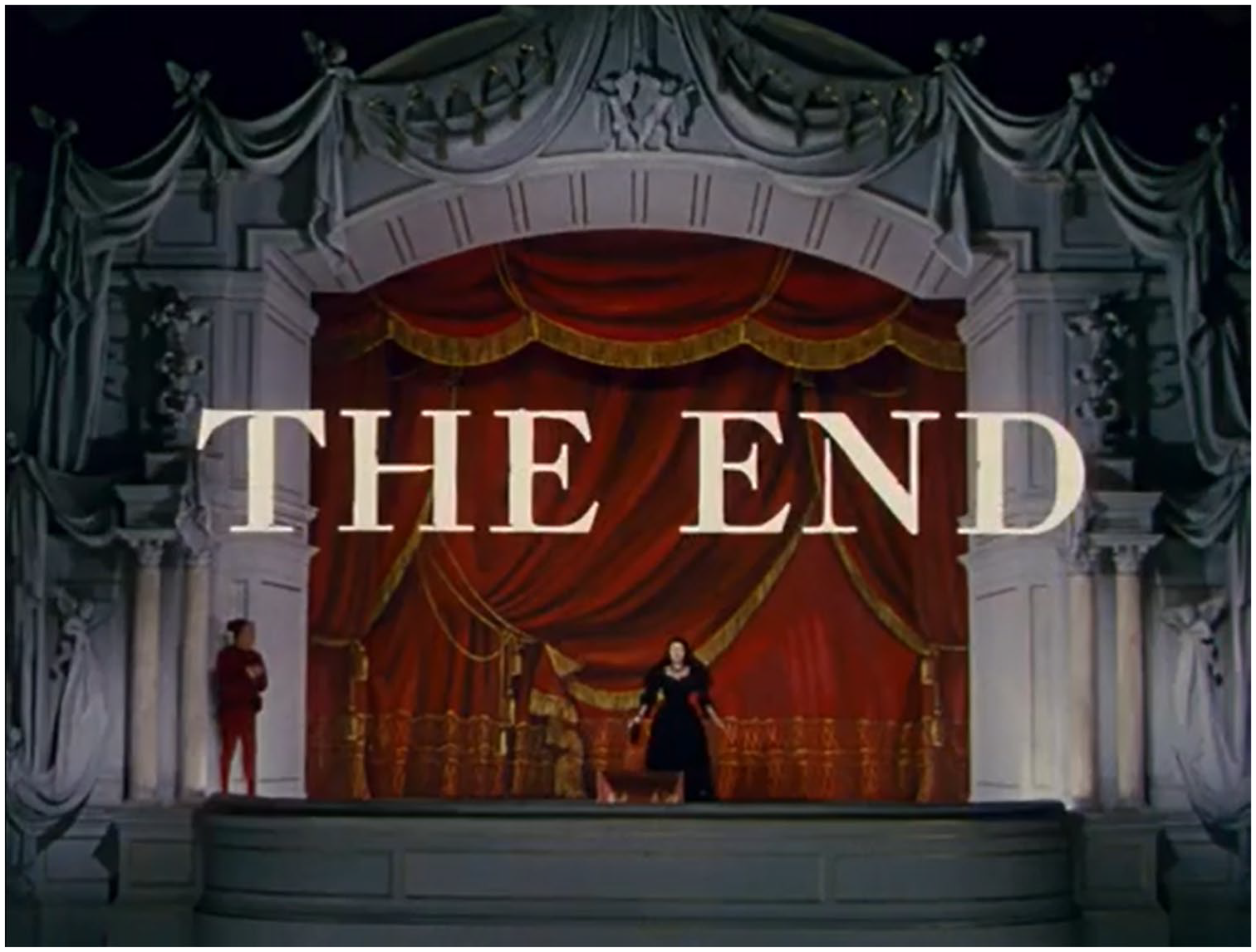
Camilla remains on stage, supervised by Don Antonio (left).
The world of the colony is repeatedly linked with male control and continuity in patriarchal rule. Members of the viceroy’s ageing, all-male cabinet decide not only how money is spent but also who is permitted to enter the palace, as when they insist on all residents being descended from at least eight lines of noble ancestry in order to extrude Camilla. The viceroy in particular plays a major (and often effortless) role in determining what is accepted within the palace. After the troupe performs ‘The Birth of Harlequin’ to a largely unreceptive audience, he claps and the court applauds in response, but he subsequently admits that he was unable to understand the Italian script so simply presumed it was excellent. The viceroy’s power to bestow wealth and agency on women is made clear when he offers Camilla the coach, while the contrasting spheres occupied by women and men are succinctly illustrated when Camilla remains in a bedroom as the viceroy, standing in an adjoining room leading to the board-room, kisses her and proceeds to his conference (Figure 6). Crucially, his position in the colony is obtainable only by men who, as the credits indicate, are appointed by the bishop, who works within the patrilinear tradition of the Catholic Church.
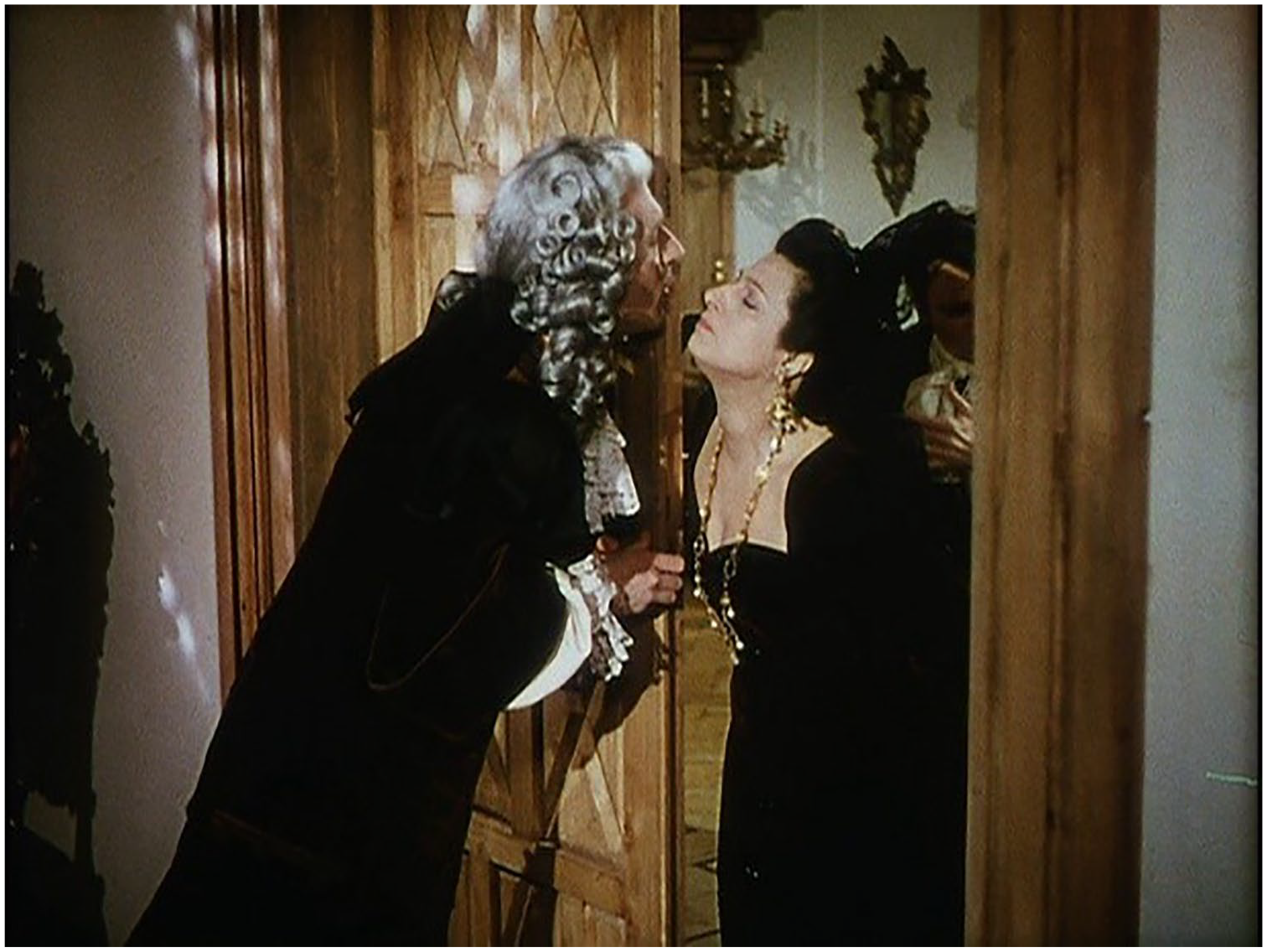
The viceroy consigns Camilla to a bedroom within the palace before tending to official matters.
Although the anthropomorphic effect of Renoir’s shooting style in La Règle du jeu is not evident in The Golden Coach, Foucault’s (1975) theorisation of ‘un regard [. . .] qui transforme tout le corps social en un champ de perception’ (p. 249) remains pervasive within the society portrayed. Many members of the court carry eyeglasses and the viceroy’s aide, Martinez (George Higgins), frequently eavesdrops from behind closed doors. Such obsessive inquisitiveness is facilitated by the architecture of the palace. From a palace window, the marquise (the viceroy’s main suitor within the court, played by Gisella Mathews) spies on the partially concealed viceroy when he attends one of the troupe’s public performances. Later, when the viceroy talks to Camilla after their performance in the palace, Martinez closes the curtains over the archways leading from the ballroom to the balcony. However, after they leave to go to the coach, the marquise remarks that ‘he actually removed his perruque before her’, indicating that she nevertheless managed to spy on them during their conversation. Later, as Camilla waits in a bedroom for the viceroy to finish his board-meeting, a window allows her to view the marquise in a parlour even though they are separated by two rooms. Doors, windows, walls and curtains offer little more than a false sense of security to those aiming to elude detection.
Recalling Christine’s temporary subversion of haute bourgeoisie protocol, Camilla determinedly deviates from the court’s regulations, embarking on a dalliance with the viceroy even though she is doubly forbidden by her foreign nationality and lower-class origins. Her central goal involves acquiring upper class privileges without sacrificing her integrity as a performing artist. Interestingly, the viceroy suggests that women are uniquely well placed to rise in colonial Peru: It depends on which sex you are. The country lout remains that always. His unwashed childhood pierces the perfume of gold and good living, but the weaker sex have that extraordinary talent of completely adapting themselves. Give her a good manicure and perhaps a dancing master that knows his business, and of course a lover of suitable rank. With these and a gifted woman, one can create the most elegant of duchesses.
Despite the viceroy’s emphasis on the possibilities available to women, he explicitly points to the importance of an elite male companion to such a social ascent, a view that runs contrary to Deleuze and Guattari’s warning against sacrificing female ambition to pre-existing patriarchal molar configurations. Camilla’s provisional acceptance of precisely such an alternative aggravates the tension between life and theatre that Deleuze identifies at the centre of Renoir’s crystal. As Serceau (1985) remarks, ‘Camilla voulait devenir une image [. . .] Elle la réalise dans un cliché’ (p. 297). It is important to also acknowledge that the viceroy is more insightful than many of his peers, unhesitatingly reducing his court’s practices to ‘a few tricks of speech now and then, one or two different gestures, a few rules’, and is even anti-conformist to the extent that he forces the court to accept his unorthodox decisions. However, he is acting in Camilla’s interests with the expectation that she will satisfy his own romantic desires. Moreover, he plays an active role in her imprisonment within the cracked crystal because by exercising his alleged ability to transform Camilla, he turns her into an image of the very class that he rejects, ironically on grounds of its pretentiousness.
The importance of the intersection between gender and class to Camilla’s confinement within the Deleuzian crystal becomes apparent if we compare her with the two most prominent secondary female characters, the marquise and the duchess (Elena Altieri). Following the troupe’s performance of ‘The Birth of Harlequin’, the marquise declares to the duchess that ‘we two should unite against a real enemy’, indicating her capacity for solidarity with those whom she considers her social equals. She elaborates, specifying ‘this dreadful mania of his highness for trying to mix with the rabble, [. . .] inviting these low comedians to the palace’. The implicit focal point of these insults is Camilla. Predominant bias among the court’s women against Camilla’s lower class and (possibly) her foreign nationality are later flagrant when she returns to claim the coach. ‘The new driver’, declares one female member of the court. ‘Arriving for her orders’, the duchess retorts. ‘Or to collect her wages’, the first woman laughs. Their comments indicate that, as in La Règle du jeu, the main target of the panoptic gaze is viewed by a network comprising both men and women. Yet it is also clear that these female members of the court are victims of the men who occupy positions of power. More than once, male members of the court refer to the marquise’s enviable silver mines. In fact, the viceroy has already sent her husband to Cuzco, where Indians killed him, and he possibly did so with the goal of marrying her and exploiting her assets to his own advantage. Clearly, patriarchal hegemony has produced an environment in which women of all classes must scramble for economic securities contingent on marriage and male upper-class favour.
The theatre’s influence as a vehicle for patriarchal control over Camilla only becomes clear after the bishop informs the court of her renunciation of the coach and the camera recedes, granting us a view of the proscenium arch that opened the narrative. Don Antonio declares his desire to stage a play but notices that Camilla is not present. He commands his lead actress: Camilla, on stage. Don’t waste your time in the so-called real-life. You belong to us, the actors, acrobats, mimes, clowns, mountebanks. Your only way to find happiness is on any stage, any platform, any public place, during those two little hours when you become another person, your true self.
Like both Deleuze and Camilla herself, scholars tend to underestimate the extent to which gender conditions her trajectory: Burch and Sellier (2013) describe the closing scene as Camilla’s recourse to ‘the protective world of the stage’ (p. 325), while Bergstrom (1996) writes that the actress makes an independent decision to sacrifice her three suitors for the world of the stage and describes Don Antonio as ‘a benign, elderly man who reminds her gently from the wings that her real love is performing for an audience’ (p. 485). However, the fact remains that Camilla’s retreat also involves subjugation to an artform under the aegis of a male manager who, in one of their productions, reductively describes a character played by Isabelle (Nada Fiorelli) as ‘tender yet perfidious, like all women’, and observes Camilla’s entrapment throughout the complex closing sequence. When Don Antonio asks her whether she misses her suitors, Camilla briefly pauses and calmly responds, ‘a little’, but her restrained words contrast sharply with the dominant note of grief and humility that she emotes, and constitute yet another performance in the coalescence of the virtual and actual that characterises the film’s crystalline narrative. As for the proscenium arch, far from leaving Camilla’s future open to the truly new, it operates as the film’s most concrete expression of male impediments in her chosen profession to her creation of a genuinely new future.
Conclusion: (en)gendering Renoir’s cracked crystal
The foregoing analysis began with two interlinked aims: first, to examine how Renoir’s mise en scène conveys the relationship between female identity and the possibility of generating a genuinely new future; second, to extend current understandings of the Deleuzian cracked crystal to questions of gender in cinema. As though to invite readers to embark on the latter of these goals, Deleuze (1968) himself argues in Différence et répétition that concepts ‘doivent intervenir [. . .] pour résoudre une situation locale and that ‘[i]ls changent eux-mêmes avec les problèmes’ (p. 3). This is clearly the case of the relationship between gender and Renoir’s cracked crystal: aligning Deleuze’s work on cinema with the place of women within Renoir’s worlds reveals the value and potential centrality of this fundamental social category to the philosopher’s conceptualisation of time in cinema.
As Deleuze’s analysis suggests, characters, décor and, especially, theatricality all operate as crystalline motifs. What is equally clear is that such images are not just signifiers of possibilities or the elusiveness thereof, but also form part of implicitly gendered systems of demarcation operating in the world viewed. Ornately furnished rooms and the proscenium arch also connote oppressive aspects of the gendered experience, signalling the challenges facing the two women who seek to alter their current circumstances. Furthermore, both La Règle du jeu and The Golden Coach repeatedly emphasise Christine and Camilla’s victimisation within a dynamic and extensive system of observation populated by unworthy men and, at times, unhelpful women. What is most troubling about this combination of signs is that they render the likelihood of a change in circumstances for either woman distant at best, whereas the latter film grants new possibilities to the actress’s male love interests whose own ‘politique molaire’ ultimately remains unperturbed by Camilla, whether they serve the court or public spectators. In other words, although women may pursue a ‘ligne de fuite’ from Renoir’s crystal, patriarchal molar segments ‘ne cessent pas de colmater, de boucher, de barrer les lignes de fuite’ (Deleuze and Guattari, 1980: 273).
Given the wide spectrum of opinions on Renoir’s portrayal of women, it is important to note that this analysis contests Vincendeau’s assertion that many of Renoir’s pre-war female characters ‘all fall within “old” female types. [. . .] Nor do even Renoir’s most complex films excel at expressing a woman’s point of view’ (Vincendeau, 2013: 266). Rather, each film clearly takes issue with female identity’s patriarchally sanctioned association with social conformity and lack of economic agency while also addressing how the intersection of gender with concerns regarding class and nationality compromises both female protagonists’ respective attempts to discard their ‘rôles gelés, figés, tout faits, trop conformes’. Although this gendered approach to two of the director’s most complex films has identified parallels between matters of gender across both, the diversity evident within each suggests that more remains to be said of the nerve centre of Deleuze’s treatise on cinema and of the relationship between agency and female identity in Renoir’s work.
