




Abstract
This article will examine representations of the Liberation of France in the war reports of Lee Miller, an accredited photographer and correspondent for American and British Vogue during the Second World War. Miller’s frontline reports framed Liberation France in idealised images of feminine beauty and elegance, making use of fashion as a primary conduit for understanding the war and occupation for readers on the home front. As this article will argue, examining Miller’s choices and perspective as a female photographer sheds new light on the intersection of fashion, war photography and the female body. In Miller’s work, fashion becomes a site for imagining liberation in ways that foreground the gendering of war experience and the legacies of conflict for women. By charting Miller’s representations of French women at the Liberation, and above all the chastised figure of the femme tondue, this article will analyse how French women function as carriers of multiple messages about war, liberation and reconstruction in Miller’s work. Unlike the sensationalist images of the femmes tondues published in the British picture press and newspapers in the summer of 1944, Miller’s war reports in Vogue construct an empathic relationship with such underprivileged female subjects. Miller’s work opens a space, therefore, for speculation on the role of fashion in shaping how the Second World War was understood by a first generation of female memory producers and consumers.
As France was liberated from German Occupation in late 1944 and early 1945, still and moving imagery produced by Allied photographers and cameramen provided some of the most influential stories of invasion. Images of Allied soldiers greeted rapturously by newly liberated French villagers; defeated German prisoners of war filing past in solemn columns; or the military might of the invading army tanks rolling down Normandy’s hedgerow lanes all offered powerful cultural markers of the initial success of Operation Overlord. They projected a vision of the forward momentum of the Allied campaign on the Western Front and formed an important element of war reporting on Liberation France. However, such positive stories were also shadowed by other war stories: ones that gestured at anger, violence and retribution after four years of repression under German and Vichy rule. The story of the femmes tondues was one such story, where punishment for alleged collaboration with the German occupiers was writ large on the female body in a ritual act of head shaving.
This article will examine representations of the femmes tondues in the war reports of Lee Miller, an accredited photographer and correspondent for American and British Vogue during the Second World War. One of only a handful of female war correspondents to accompany Allied troops across Western Europe in the summer of 1944, Miller’s frontline reports were published simultaneously in British and American Vogue. Her articles and photographs framed Liberation France in idealised images of feminine beauty and elegance, making use of fashion as a primary conduit for understanding the Liberation of France for readers on the home front. Reading Miller’s work today, her choices and perspective as a female photographer offer a reflection on the intersection of fashion, war photography and the female body. Fashion becomes a site for imagining liberation in ways that encouraged a largely female civilian readership to recognise the gendering of war experience and to empathise with underprivileged female subjects, such as the femmes tondues. Whilst only one of Miller’s photographs of the femmes tondues appeared in Vogue in 1944, this chastised figure is connected to other visual and written representations of women in war, highlighting Miller’s fascination with what Jean Gallagher terms ‘the gendered body in conflict’ (Gallagher, 1998: 74). In Miller’s work, French women, and above all the femmes tondues, challenged the Vogue readers of 1944 to see and understand war differently as a woman.
The article will begin by evaluating the history and post-war interpretations of the femmes tondues. What did period witnesses ‘see’ in Liberation France? How have post-war historians and commentators understood the phenomenon of head shaving? What role has photography played as visual evidence to inform such debates? The article will then contextualise Miller’s war reporting and photography of the femmes tondues by comparing her approach to that of two British newspapers of the period, the Daily Mail and the Daily Herald, and the picture magazine, the Illustrated London News. How did these publications represent such ‘foreign bodies’ as part of their war stories of patriotic liberation? Lastly, the article will analyse Lee Miller’s war reports in British Vogue, with comparative reference to its sister publication American Vogue. It sets out the war context for magazine publications in Britain and explores the brand of Vogue as a fashion magazine. As Dominique Veillon notes in her study of fashion in occupied France, ‘fashion is an expression of every aspect of life; it is a way of existing and behaving, and is, in fact, an observation point from which to view the political, economic and cultural environment of an historical period’ (Veillon, 2002: vii). As this article will argue, the ‘observation point’ of fashion creates a complex set of relationships between women, the female body and war in Miller’s work. By examining these war reports and photographs of Liberation France in Vogue, the article will speculate on how fashion shaped the ways in which the Second World War was understood by a first generation of female memory producers and consumers.
Seeing the femmes tondues: views from the war front
As the German occupiers left France, a wave of retributions took place against French women. These events had their origins in gendered punishments meted out following the First World War in France and reproduced in civil war conflicts elsewhere, such as the Spanish Civil War. Women accused of collaboration were rounded up in villages and towns and had their heads shaved in a display of popular justice, often with little or no due legal process. While July and August 1944 appear to have been the height of the phenomenon, a second wave of head shavings – far fewer in number – occurred in early 1945 at the same time as the return of French prisoners of war and concentration camp survivors. Fabrice Virgili estimates that over 20,000 women had their heads shaved and that such retribution took place in every département of France (Virgili, 2002: 1). Such public acts drew large crowds of spectators who urged on the proceedings and were accompanied in many cases by forms of sexual violence, in public and in private. Those who undertook the head shavings were often connected to local resistance groups or claimed such affiliations, while the femmes tondues were mostly single, usually young and often poorly educated. They may have worked for the German occupiers in domestic or clerical roles; acted as translators; frequented Germans in groups or had a sexual relationship with a German soldier that was transactional (prostitution) or more personal (romance) (Duchen, 2000: 235). Such women were, however, invariably associated with sexual collaboration, although such an accusation ignored a broader spectrum of sanctionable activities, such as aiding the enemy, denouncing resisters or supporting the Vichy and German authorities (Virgili, 2002: 15).
For contemporary Allied observers, the public spectacle of the head shavings became one of the hallmarks of Liberation, a drama that played out in village squares, town halls and public spaces to their discomfort and sometimes disgust (Vinen, 2011: 353–5). The head shavings appeared to confirm negative stereotypes about French people, above all for American troops who had had little contact with France before the Second World War (Brossat, 1992: 32). While some observers interpreted the act as an understandable explosion of anger, the act itself had repercussions beyond the Liberation. Head shaving impacted on French women’s civic rights and responsibilities. Those femmes tondues who were convicted of ‘national degradation’ through emergent local and regional courts lost their new-found voting rights. Their treatment was indicative of a broader process of confinement for women that historians such as Hanna Diamond and Kelly Ricciardi-Colvin have charted across the political, social and cultural landscape of immediate post-war France (Diamond, 1999; Ricciardi-Colvin, 2017).
Historians have understood the head shavings differently over the post-war period. Early interpretations read the head shavings as a cathartic act that allowed the national community to come together in a ritualistic purging of guilt. The head shavings offered a safety valve for the community, targeting women in ways that ‘saved’ other lives (Novick, 1968). More recently, political scientists have read the head shavings as a means for the local and national community to ‘project the abyss outwards’ (Duchen and Brandhauer-Schoffmann, 2000: 9), scapegoating women and thereby avoiding confrontation with individual and collective crimes of collaboration. For others, the head shavings served a symbolic purpose and allowed communities to reclaim a patriotic identity and a Republican tradition that had been outlawed under the Vichy regime (Virgili, 2002: 93). In this framing, the Revolutionary imagery of decapitation and the Terror are shadowed in the public act of cutting off hair. For feminist historians such as Corran Laurens the head shavings can be read as ‘an attempted reversal of women’s emergent power and an exorcism of the image of threatened masculinity from public memory’ (Laurens, 1995: 177). The figures of the femmes tondues were a salutary warning to other French women of the perils of undermining the re-establishment of French patriarchy damaged by military defeat and submission to the occupier.
Throughout these historical and cultural interpretations of the head shavings, photographs take centre-stage as evidence or illustration. These photographs are either the work of local French photographers or were taken by the advancing Allied forces, primarily the British Army’s No. 5 Film and Photographic Unit, the American Signal Corps or embedded freelance photographers, such as Robert Capa and Lee Miller. 1 Such photographers were not innocent bystanders. They frequently acted as witnesses and chroniclers of the act and were the ‘framing eye’ for whom the main male protagonists performed, most strikingly in the posed post-event group photographs of femmes tondues and their tondeurs (Virgili, 2002: 83–5). As Alison M. Moore has discussed in her work, the recirculation of these photographs in recent scholarly work on the Vichy past has distorted the historical memory of the femmes tondues. For Moore, such photographs have been ‘complicit in a post-war mythologization of collaboration as specifically feminine and as uniquely sexual’ (Moore, 2005: 658).
Yet, in the summer of 1944, an interpretation of the head shavings centred on collaboration was by no means the sole frame of reference for French and Allied observers. To understand more about the production and interpretation of such photographs, the viewer today needs to be sensitive to what Deborah Poole terms the ‘visual economy’ of the period (Poole, 1997). Such considerations must take account of the history and biography of the photographer, the composition and aesthetics of the image, as well as the cultural practices that allowed such images to circulate. These range from the editing, cropping, captioning and layout of images alongside printed text to the decisions determining which images were selected for publication in which news outlets and at which time. 2 Reinserting the first photographic images of the femmes tondues into British wartime publications throws up a more diverse set of meanings than those clustering around a sexualisation of French collaboration and help contextualise the work of Lee Miller in Vogue. These images and the war stories that surround them require careful re-examination as part of a ‘visual economy’ of war where French women were carriers of multiple messages about war, Liberation and reconstruction for readers abroad.
Interpreting the femmes tondues: views from the home front
In 1944 Britain, photographs were one medium in a plethora of visual materials used to represent the invasion of France. These ranged from front-line photographs to advertisements and technical designs and defied a clear separation between event and representation. As Tom Allbeson and Pippa Oldfield have commented: ‘Photographs are not mere illustrations or records of battles: rather images and their circulation are part of the tools and practices of warfare’ (2016: 97). Photography was a vital medium to help tell war stories that supported a re-positioning of France in the new world order. These stories cast the French nation as an ally and wartime victor, rather than the victim and collaborator of German Occupation. Whilst morale-boosting stories of French fortitude and resilience were the dominant narrative, other darker war stories also circulated in the British press incorporating the figure of the femme tondue. In researching this article, a selection of British newspapers and picture magazines were examined for photographs of the femmes tondues from June 1944 to January 1945. No images of the femmes tondues were found in the picture magazines Punch, Picture Post, The War Illustrated or in the newspapers The Observer, Sunday Dispatch and The Times. Photographic images and stories were found in two newspapers, the Daily Mail and the Daily Herald, and one picture magazine, the Illustrated London News, and it is these features that this article will examine. 3
Two of the earliest photographs of the femmes tondues are reproduced in the Daily Mail on 7 July on its inside page.
4
A woman, identified as ‘Grande Guillotte’, is photographed before and during the head shaving, with the following short text:
Revenge: these are not the most pleasant pictures to look at but they are news and important because they show in what hatred the Germans and all those who collaborated with them are held by the great mass of French people. Now, in liberated Normandy, the many patriots are routing out the few and taking their revenge. Traitors have been shot, collaborationists shorn of their office or driven from home – and these pictures show what is happening to young women who forgot the Germans were the enemy of France (Daily Mail, 1944: 3)
Here, the femme tondue stands in for a range of offences linked with collaboration. The story takes a sensationalist turn, as if from the pages of popular fiction, and points to the distaste that the British viewer might feel in viewing the images: ‘not the most pleasant pictures’. What was a private crime has become publicly visible, with national identity and sexuality represented as inextricably linked. The voyeuristic dimension of the scene and its sexual charge is evident, with a tone of ribald moral sanction linking together age, gender and sexuality in the condemnation of ‘young women who forgot the Germans were the enemy of France’.
In the Daily Herald on 18 July, the page layout and captioning of a feature on the femmes tondues connect the head shaving directly to the political turmoil and uncertainty of Liberation (see Figs 1 and 2). The short feature on the femmes tondues is not front-page news. Instead, this is reserved for Field Marshal Montgomery receiving flowers from two small French girls, a recurrent trope of the welcome and hospitality of liberated French towns and villages. Rather, on page 3, American Signal Corps photographs are used in a story titled: ‘And this is happening in Normandy’. The short text makes clear that the Daily Herald does ‘not approve’ of such images, identifying the photographs as American. The short feature compares the treatment of the women to ‘the exhibitionist punishments that were popularised by the Nazis in Germany’ and calls upon the United Nations and the ‘French National Committee of Liberation’, as well as leaders of the Resistance, to make it clear that ‘they discountenance such practices’ (Daily Herald, 1944: 3).
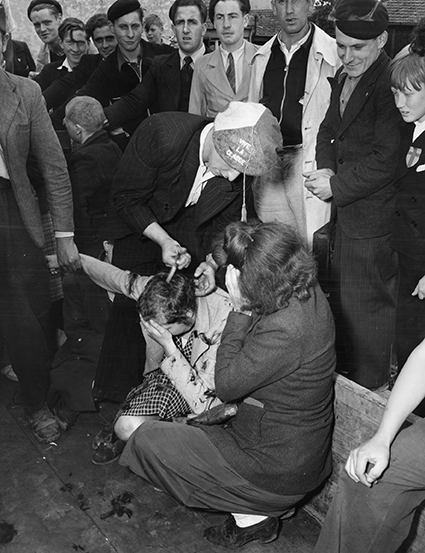
Daily Herald (1944) ‘And this is happening in Normandy’. © Imperial War Museum (EA 29763).
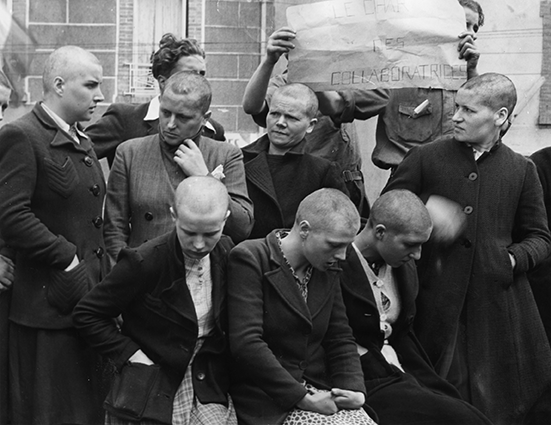
Daily Herald (1944) ‘And this is happening in Normandy’. © Imperial War Museum (EA 29765).
As with the Daily Mail, the editors distance the British reader from such practices, erecting a cordon sanitaire around the head shavings as the reprehensible practices of other nations. Yet, the surrounding images and features on this page suggest that this story of war sits within a matrix of other gendered war stories that go beyond France. Next to this feature is another (with no images) entitled ‘She laughed – and her lover killed her’, the story of a crime passionnel, while a Gilbert Wilkinson cartoon positioned directly beneath the femmes tondues shows a smartly dressed mother and housewife accompanying her sailor husband from the front door, besides her little son playing in a sandpit. She muses: ‘Darling why don’t you take Peter to the Beachhead for the day. He’ll amuse himself!’ as if the Normandy landings are now a holiday trip (Daily Herald, 1944: 3).
Similar patterns of reporting are evident in the picture press. The Illustrated London News reproduces the now infamous image by Robert Capa of a femme tondue holding her baby as she is marched through the streets of Chartres, with the caption, ‘How France treats women collaborators: two women and a baby by a German soldier, their heads shaved, passing the jeering crowds’ (Illustrated London News, 1944b: 269). Over this two-page montage, the Illustrated London News creates a sharply delineated image of Allied masculine agency (British, American and Canadian troops alongside their armoured tanks and jeeps) and French female submission and disgrace (the femme tondue).
What is common to the visual and written representations of the femmes tondues in these British newspapers and illustrated magazines in the summer and autumn of 1944 is a fascination with the sexual transgression of the women accused and punished. These women are either caricatured (‘la Grande Guillotte’) or anonymous women, photographed as representative of French women collectively and conforming to the age-old associations of women with sex and sin. In terms of pictorial composition, the bodies of the femmes tondues literally exceed the photographic frame, as in the Daily Herald, where the viewer is positioned as someone within the circle of persecution, close-up and confronting the accused. Captions and exhortations to recognise the foreignness of the women and their crimes reinforce the sense of otherness and a distinctly British distance from the moral ambiguities of a French society in transition from war to peace.
Yet, the integration of such features and photographic images alongside home-front war stories for British women, including domestic violence (‘She laughed and her lover killer her’) suggest that the femmes tondues were not as foreign as they might have seemed. As Sonja O. Rose (2003) discusses in her work on building national identity in wartime Britain, while women were actively recruited via advertising campaigns to take up war work in sectors and roles that had previously been closed to them, the British government also attempted to placate fears that British women would be irrevocably changed by their wartime roles. In such war stories, the female body, in and out of uniform, was one privileged locus for anxieties over wartime gender norms. The figure of the femmes tondues offered, therefore, a lens through which British and American female civilian readers could decipher the gender politics of war and Liberation. If that lens was generally one of condemnation and distance in the British newspaper and picture press, Lee Miller’s empathic gaze on the damaged bodies of the femmes tondues constructs a quite different narrative of women in war.
Fashioning the femmes tondues: Lee Miller in Vogue
Although not directly regulated by the Ministry of Information, Vogue, like other wartime women’s magazines, was implicated in the ‘carefully concealed conventions’ of British wartime propaganda (Holman, 2005). The Ministry of Information and its various divisions negotiated with wartime publishers on the development, production, translation and sales of their publications and their direct and indirect propaganda value to the British war effort. The Ministry of Information was responsible for the allocation of paper supplies and rationing and its support was a key factor in deciding what could be published. Print runs were determined by paper rations calculated as a proportion of pre-war circulation figures, and such practical matters impacted on profit margins. In many instances, government ministries were also the principal source of revenue for women’s magazines placing adverts for wartime campaigns that were central to sustainable financial modelling. Ministry of Information officials had regular meetings with magazine editors who recognised their role in disseminating messages on the contribution women were making to the war effort (Waller and Vaughan-Rees, 1987: 122–3). Women’s magazines were, therefore, one of the many agencies of persuasion operating at the borderline between propaganda and autonomous culture in wartime Britain.
Integral to British Vogue’s wartime role and contribution was its brand as a fashion magazine. As Beth E. Wilson notes in her work analysing the corporate creation of the photo-journalist during the Second World War, while readers were drawn in by colourful stories, researchers ‘would do well to look long and hard at the ideological work being done through these popular narratives’ (Wilson, 2016: 249). Certainly, editors at British Vogue were aware of the impact of their corporate brand of fashion glamour on readers’ perceptions of their wartime selves. Prior to the Allied campaign in Europe, British Vogue had focused exclusively on the domestic home front with series and photographs demonstrating how women could adapt to wartime in features, such as ‘dresses work overtime’, as the lexis of war infused every aspect of the magazine (Vogue, 1944). ‘Beauty was a duty’ in the pages of Vogue as neatness and good personal grooming became synonymous with wartime morale and resilience.
Lee Miller had worked as a staff photographer for British Vogue from 1940 and had been instrumental in producing arresting images of women on the home front undertaking military and civilian roles to support the war effort. Miller’s relationship to war photography and reporting for Vogue was one shaped by her personal history as an interwar muse and surrealist living in France who had subsequently gained a profile as a respected professional photographer. Her work within the pages of Vogue adapted surrealist and art-historical practice and was sensitive to the incongruities and disruptions wrought by war on women and the female body. 5 In preparation for D-Day, Miller was one of a small group of women correspondents officially accredited to report on the Allied invasion of Europe. 6 Women reporters were not permitted to be present in the combat zones and only to be in the field as far as the most forward nursing corps or designated comparable unit. Yet individual women correspondents demonstrated ingenuity in making individual arrangements to accompany front-line units. 7 Americans Lee Carson and Martha Gellhorn were both able to make a short séjour in France via an air reconnaissance trip and a return journey on a hospital ship on D-Day itself (Caldwell Sorel, 1999: 224–34). Lee Miller was, however, the only woman war correspondent to follow the Allied campaign across Europe for the duration. Her journey took her from the beaches of Normandy to Paris, across to Luxembourg, Belgium, then Alsace, the crossing of the Rhine and into Germany.
Miller’s reports were filed and published in both British and American Vogue, often simultaneously, but with differences in terms of the exact narrative used and the photographs selected. Miller was Vogue’s sole European correspondent and her reports marked a radical departure from the culture and aesthetic of the magazine, providing a viewpoint that, for Becky Conekin, made her ‘a sort of conscience for Vogue at times during World War II’ (2006: 109). However, in analysing her published war reports, it is important to pay attention to editorial decisions and the choices of the production team. In producing the published version, British Vogue editor Audrey Withers and photographic editor Alex Kroll shaped Miller’s war reports, determining how they would be read and received. Indeed, Miller’s son and biographer Anthony Penrose credits Kroll with achieving the startling visual effects that would be the legacy of Miller’s war work. 8 In terms of the page layout, the selection and cropping of images and the juxtaposition with other images on the page, above all fashion features and advertisements, British Vogue obliged readers to consider the connections between women, beauty and a home war culture.
Lee Miller’s first published war assignment for British Vogue was ‘Unnamed warriors’ in the September 1944 issue (Miller, 1944a). This was a lengthy feature on American field evacuation hospitals near Omaha beach in the American zone. 9 In common with other war correspondents in these early critical days, Miller’s report is a ringing endorsement of the surgical skills of the medical teams. She focuses on the wonder drug of penicillin and the reportedly low risks of infection for wounded soldiers, as well as the speed of repatriation to Britain. The report is propagandistic in tone but not afraid to challenge traditional narratives of battlefield heroism and glory: ‘the wounded were not “knights in shining armour” but dirty, dishevelled, stricken figures … uncomprehending’ (Miller, 1944a: 8). Photographic sequences focus on the collective effort of the medical teams, above all the female nurses, all in uniform or surgical scrubs. The black-and-white chiaroscuro effects and the close-ups of patients, nurses and surgeons demonstrate how Miller chose to align her reports with the viewpoint of Allied troops and service personnel on the ground. She does this by photographing the operation itself and positioning the camera at the level of the operating table with patient and surgical team all in the frame: no one is left out. Stark lighting contrasts the heightened luminosity of white scrubs against the shadow of the surrounding hospital tent so that the precision of the operating procedures jump out from the page. Proximity to action and her physical presence as a photographer-witness become ‘signature’ effects of Miller’s reporting in France. 10
Miller’s next set of war reports for British Vogue (Miller, 1944b: 84), cover two different arenas of war: the siege of St Malo by the American 83rd Division and the Liberation of Paris. The latter is divided into a series of short features, focusing on the re-emergence of haute couture and Miller’s reunion with the Parisian intellectual community: Picasso, Paul Éluard, Boris Kochno and Bébé Béraud, whom she left behind in 1939. In an exhilarating mix, British Vogue interweaves the story of the siege of St Malo with the sophistication of Paris’s first fashion shows and ‘high hat resistance’ (Benito, 1944). It is from this doubled vision of sites of war (the battlefield and the fashion show) that Miller encourages her female readers to identity with the war experiences of French women, and the body of the femme tondue.
Miller’s war report on St Malo is aligned with the perspective of the American ground troops (Miller, 1944b). They are attempting to force the surrender of the German forces living in underground bunkers in the fortress complex surrounding St Malo. The incongruity of modern warfare and the medieval history and architecture of St Malo is rendered ironically in Miller’s use of italicised vignettes in French in her article. It is as if Miller and her American compatriots were on a ‘Grand Tour’, swapping the sophistication of eighteenth-century travel for the spectacle of twentieth-century destruction. Miller provides a multisensorial war report, highlighting the sights, sounds and smell of the siege, and brings into violent contact the discourse of fashion and war. American troops have ‘grenades hanging on their lapels like Cartier clips, menacing bunches of death’ (1944b: 84), while General Auloch, the captured German commander, attempts to avoid Miller’s camera lens ‘and flushed little red spots in each cheek like rouge’ (1944b: 90).
As in her feature on American field hospitals, Miller’s attention is drawn to the gendering of war experiences. A two-page photo-montage focuses on women and young children. These groups become synonymous with the refugee experiences and the civilian dangers of war. The largest photographic image is of a group of nuns, stepping down from a lorry after evacuation, with the caption: ‘Nuns come out from the chateau during a truce.’ Their fantastically sculpted wimples look incongruous against the backdrop of an army lorry. Women are here associated with a sisterhood of caring, in this case a spiritual body rather than the secular model of American army nurses as in Miller’s first feature on army hospitals. A photograph of two little girl refugees playing with a white rabbit, captioned: ‘Among the refugees, pixie twins like the Cistine Madonna’s imps’ accentuates the association between femininity and iconicity, situating the war within a broader Western narrative of female adornment and allegorical representation. Yet in one of the most intriguing departures from its American counterpart, the editorial team at British Vogue do not include a lengthy sequence devoted to the interrogation of a woman accused of collaboration.
In American Vogue, in an article entitled ‘France free again (Miller, 1944e), this section of the war report from St Malo is the first intimation of French war experience that does not connote suffering and penury but rather greed and self-interest. The woman collaborator is mother of three girls, although there is no photograph reproduced of her or her children. She is accused of passing military information to the enemy. Neighbours corroborate her dubious morals with stories of German officers who visit at night. To accompany this feature on the siege of St Malo in American Vogue, a photomontage accompanies the written narrative with the only Lee Miller photograph of a femme tondue reproduced in either American or British Vogue. 11
This photomontage is a sequence of eight images, organised in such a way as to give a gendered reading of Liberation France. In the top right-hand corner of the sequence, Allied male military glory is embodied by Major Speedie, the American officer in charge, now in clear occupation of his German counterpart’s headquarters as he stands behind his desk, a portrait of Hitler staring out at the reader on the wall behind him. Diametrically opposed is the femme tondue, positioned bottom left, a symbol of her relegation to the margins of history (Fig. 3). The photograph of the femme tondue has the caption: ‘Interrogation of a Frenchwoman who had her head shaved for consorting with Germans – note her earrings’. The femme tondue is associated with criminality. The woman in the image appears to have her hands held or cuffed behind her back. She is being interrogated for ‘consorting with Germans’ and the image suggests a prison regime as she stands before her interrogators/gaolers. The captions bring out the incongruity of female collaboration and idealised images of womanhood, making use of the discourse of fashion as her earrings provide the jar or shock of otherness. The figure’s sombre dress and downcast look refuse the sensationalist excesses evident in the photographs of groups of femmes tondues reproduced in the Daily Herald in July 1944. Their personal distress is graphically presented as they attempt to shy away from the camera (see Figs 1 and 2). In contrast, Miller’s image is of the moment of judgement in huis clos and rejects the public spectacle of popular justice and humiliation for the more meditative space of legal redress.
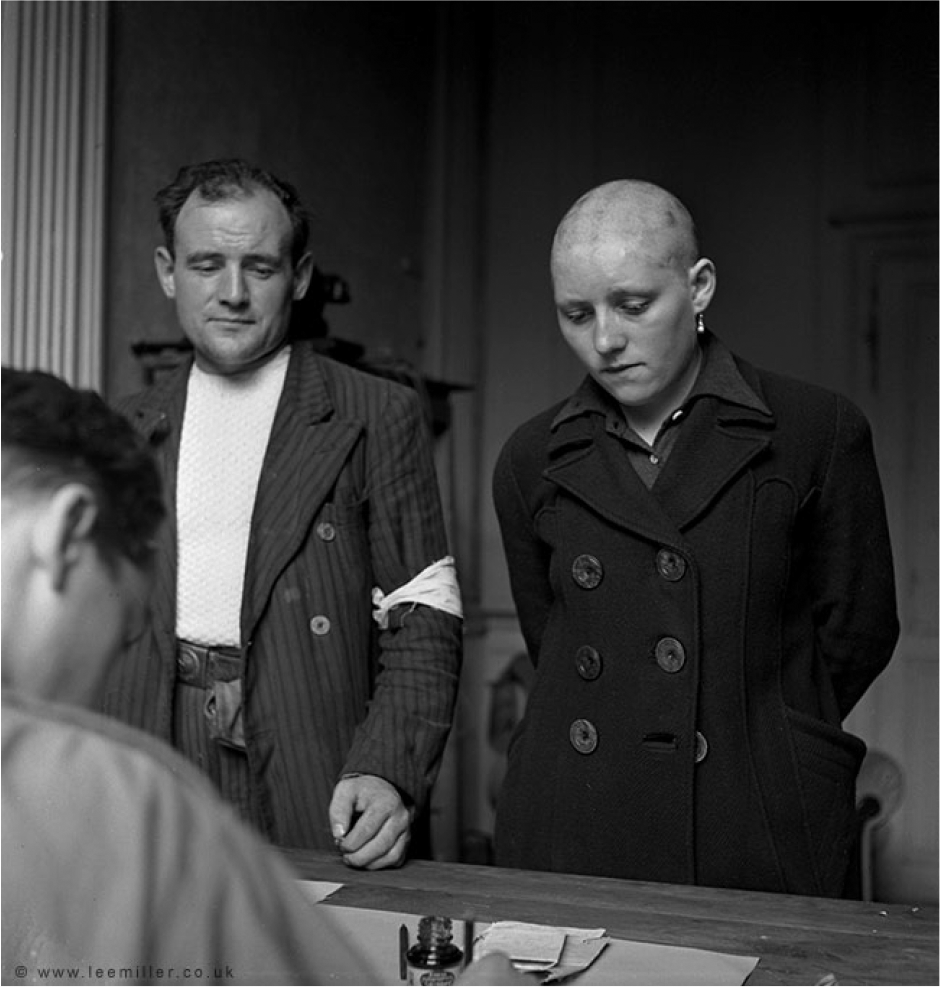
‘Interrogation of a Frenchwoman who has had her hair shaved off for consulting with Germans, Rennes, France 1944’, by Lee Miller [5925-329]. © Lee Miller Archives, Farleys House & Gallery Ltd, Farley Farm, Muddles Green, East Sussex, BN8 6HW, UK, 2018. All rights reserved. www.leemiller.co.uk.
If British Vogue avoids a direct confrontation with the photographic image of the femmes tondues, this chastised woman emerges indirectly in Miller’s reports on Paris fashion, hair and hats. For Janet Flanner, a fellow American journalist in Paris at the Liberation, the public spectacle of fashion and the celebration of youth and French verve offered a much-needed antidote to the experience of unheated buildings, continued rationing and disrupted public transport and electricity supplies (Flanner, 1965: 9). By reporting on and photographing Paris fashion, Lee Miller shared Flanner’s fascination with the ‘look’ of young Parisian girls:
Everywhere in the streets were the dazzling girls, cycling, crawling up tank turrets. Their silhouette was very queer and fascinating to me after utility and austerity Britain. Full, floating skirts, tiny waist-lines. They were top-heavy with built up pompadour front hair-dos and waving tresses: weighted to the ground with clumsy, fancy thick-soled wedges. (Miller, 1944d: 27)
Such extravagant clothing and hair dazzled Allied troops who were conditioned to view acceptable fashions via the optics of austerity England. Contrasting experiences led to misinterpretation and a belief, reproduced in some British news outlets, that the French had not really suffered under Occupation or that they were frivolous or hedonistic in their response to Liberation. 12
Yet fashion had been one of the battle grounds of the Occupation. This was best exemplified by the zazous, young people whose zoot suits, tailored skirts and slicked hair were a youthful riposte to the militarist look of the occupying forces (Veillon, 2002: 134–6). In her Paris reports for British Vogue, Miller is sensitive to the role of fashion as an ‘observation point’ for translating French war experiences for her readers. In her article ‘Paris regained’ (1944c), Miller declares the French fashion industry and its extravagance to be patriotic gestures; excess was a calculated transgression aimed at disrespecting German directives to save fabric and economise. 13 Hats and hair were central to this narrative of fashion as resistance in France. In her feature on ‘high hat resistance’, British Vogue columnist Carmel Benito emphasises how French women had defied the authorities to create their extravagant look, using any materials available: from felt to chiffon to straw and braided paper. ‘High hat resistance’ became a marker of moral victory over the Germans: ‘You see, hats have been a sort of contest between French imagination and German regulation’ (Benito, 1944: 36). To accompany this focus on hats, British Vogue made much of the resurgence of Paris milliners and the lengths to which Parisian hair stylists would go to ensure that their customers were well served at a time of electricity shortages. Miller’s photographs of the Gervais salon’s ingenious set-up to heat hairdryers was not only profiled in British Vogue in November 1944 but also in Picture Post (1944). Half-clothed men on bicycles are photographed in the salon basement pumping up hot air to the hair dryers above with pedal power. Here male figures facilitate female fashion through their physical exertion, in sharp contrast to those men who would have judged similar women through head shavings.
While there is no photographic image of the femmes tondues in Miller’s war reports for British Vogue, the magazine confronts this gendered body in conflict in its written script. In an article in the October edition, Lee Miller (1944d) meets her close friend Picasso to reflect on the war years. For Picasso, these were times of near starvation and penury but also a time of creative freedom. It is Picasso who brings up the subject of the ‘shaved women’, whom he associated with prostitution and the crime of falling in love with the enemy. As Picasso relates to Miller:
In the ‘House’ near his studio, there had been a girl who had a kraut as an amant de cœur, and the day of the Liberation she was paraded through the streets shaved and hissed and booed by all her colleague whores who had themselves entertained countless Huns. (1944d: 96)
The betrayal reported here is emotional rather than sexual; doomed romance and not ideological belief or self-interest is the primary explanation and no connection is made between the femmes tondues and national politics. Rather, the crime is presented as an unfortunate personal choice, visible on the streets of Paris as popular spectacle. An ambivalent relationship is created with the unknown femme tondue whose violated body draws empathy from the artist rather than condemnation, modelling a comparable response from British Vogue’s female readers.
Conclusion
How can we interpret the intersection of fashion, war photography and the female body in Lee Miller’s war reporting published in British and American Vogue in late 1944? Firstly, Miller’s work highlights how French women became carriers of multiple messages about war, Liberation and reconstruction. In British Vogue, the femmes tondues are represented in widely circulating narratives of women and emotional and/or sexual betrayal of the community. However, these representations of the femmes tondues need to be contextualised and connected to other ‘gendered bodies in conflict’, such as the ‘high hat’ resister, pictured with flowing hair and celebrating the revival of French fashion and elegance. The resistant girl on her bicycle and the femme tondue function as shadow selves, demonstrating what could be seen and not seen in Liberation France. How far British Vogue and its editorial team were complicit in such obfuscation is open to debate. For Annalisa Zox-Weaver, British and American Vogue made wholesale changes to Miller’s original manuscripts from St Malo and Paris, thereby cushioning viewers from the thrust of Miller’s photographic confrontation with the damaged bodies of wartime: ‘In disrupting her correspondence with coverage of Paris fashions, Vogue essentially ask Miller to participate in looking away from war’s damage and the fragmented male body, and to offer fantasies of female beauty and fulfilment that allow everyone to return to “normal”’ (Zox-Weaver, 2003: 147). In this respect, Miller’s often unsettling reporting on fashion and the female body in Vogue can be read as a contested space, allowing France’s war experiences to be decoded in ways that refused Allied myths of military glory and heroism (Sim, 2009: 48).
Secondly, Miller’s war reports demonstrate how fashion was implicated in the politics of Liberation in France and was by no means a distraction or site of forgetting. In Liberation France, fashion allowed a negotiation with the material cultures of war and the gendering of wartime experience. Dress, hats and hair were all political statements of belonging. Deprived of the fundamentals of visible femininity, the femme tondue stood doubly excluded from the nation and reinforced the notion of gendered spheres of retribution in the aftermath of Occupation and Liberation. Miller’s femmes tondues, in both her written text and published photographic image, remain unnamed. Their crimes are largely unspecified and associated primarily with sexual relations with Germans. These women are guilty by proxy for the crimes of the German occupier. Their supposed promiscuity or deviant sexuality marks them as ‘other’ to more traditional female stereotypes associated with the freedom of high fashion and the moral certitudes of resistance. Such a fascinating contrast positions Vogue as a publication sensitive to the temporality of fashion, negotiating backward-looking recollections of the war years through recriminations like the head shavings and future-focused visions of France as prefigured in the fashion-conscious female body.
Yet Miller’s published texts and photograph of the femme tondue for British and American Vogue are markedly different in many respects to other representations of French women circulating in British newspapers of the same period. As discussed, the head shaving ceremony and ritual humiliation of the main female protagonists are absent in Miller’s published photograph, unlike the voyeuristic turn of the Daily Mail, the Daily Herald and the Illustrated London News. Instead, such a viewpoint is replaced by what Zox-Weaver terms Miller’s ‘complex empathic relation’ with her subjects (Zox-Weaver, 2003: 133). Miller chooses not to objectify the women as sex objects. In her photograph published in American Vogue, there are no half-torn clothes, no salacious framing but rather a humanising impulse to give the accused back something of her individuality. In later exhibitions of Miller’s work, this intimate approach is encapsulated in portrait-style photographs taken at the time but not published. These capture the solemnity of the shaven headed woman, offering up silent contemplation of the individual and not the frenzied crowd (Roberts, 2015: 124–5). Like the bombed-out buildings, destroyed infrastructure and devastated French countryside Miller also photographed, Miller’s written and visual representations of the femmes tondues draw attention to under-represented stories of war. Damaged individuals rather than iconic events sit at the heart of her work, engaging the reader in a direct confrontation with photographic subjects who disrupt the easy dichotomy of victor and victim, resistance and collaboration. In so doing, Miller’s war reports published in Vogue emphasise how fashion played its part in shaping the ways we see and understand France and the Second World War, then and now.
Footnotes
Acknowledgements
I would like to thank Tom Allbeson and Hanna Diamond for their valuable comments and support on earlier drafts of this article.