



Abstract
In 1777 a strange, distracted young woman took up residence under a haystack in a village outside Bristol, attracting much local attention. ‘Louisa’ gained wider celebrity after the writer Hannah More publicised her plight in the national press. She subsequently spent several years in a private madhouse and then the lunatic ward of Guy’s Hospital, where she died in 1800. It was generally presumed that Louisa was of noble foreign birth and possibly the hapless victim of family intrigue or even sexual exploitation, her mysterious story being interpreted as a contemporary morality tale. In actuality, recorded circumstances demonstrated quite sympathetic communal responses toward victims of insanity, as well as different options for providing care and treatment in 18th-century England.
In late 1776, a strange and evidently vulnerable young woman appeared in the Somerset village of Flax Bourton, a few miles outside the city of Bristol. She took up residence in a field, finding shelter under an old haystack, thereby initiating a complex and intriguing story. The ‘Maid of the Haystack’ became a well-known figure in the locality. In time, her predicament and the mystery of her origins went on to attract attention throughout Britain and well beyond. The local people named her ‘Louisa’, for she never revealed her true identity. Under this persona, as well as the ‘Bristol Stranger’, the ‘Wandering Maniac’ or the ‘Lady of the Haystack’, Louisa attained considerable celebrity. The public imagination was captivated by the tragic plight of the attractive, distracted and defenceless young foreign woman. She became something of a cultural symbol. Articles were written and pamphlets published, poems and ballads were composed, a portrait was painted and prints engraved; even a play was staged. A degree of fascination with the real and mythical events of Louisa’s troubled life persisted until and even beyond her lonely death in the lunatic ward of Guy’s Hospital in late 1800 (Philalethes, 1781; Public Advertiser, 13 November 1781; Glasse, 1801; Anonymous, 1803; Jamieson, 2021: 160–161). More recently, there has been a revival of interest in the story of Louisa, culminating in the publication of an historically questionable and at times salacious dramatization, construed as ‘an 18th century conspiracy mystery based on true events near Bristol’ (Powell, 2022).
The circumstances of Louisa’s actual and imagined history raise a number of inter-connected issues that merit exploration. Contemporary attitudes toward insanity were brought into focus. The responses of polite society to a deranged individual cast into its midst were shown to be surprisingly sympathetic and sensitive, albeit that these were clearly influenced by Louisa’s gender, her evident gentility, and the very unusual elements of her case. The manifestations and apparent origins of her mental disorder were regarded as being closely aligned with female sensibilities and vulnerabilities. Most of those who encountered her presumed that she had been subjected to some form of sexual exploitation by an unscrupulous man, which had either precipitated or exacerbated her madness. A more specific aspect of the story was its exposition of some of the different options for managing, treating and caring for a vulnerable lunatic in late 18th-century England, and illustration of how these did not really conform to widely prevalent dark images and impressions.
From the haystack to the madhouse
The immediately preceding whereabouts and circumstances of the mysterious stranger before she came to Flax Bourton in 1776 were never clearly ascertained. It was recorded that, on her arrival, she ‘begged the refreshment of a little milk’. Her striking appearance and the nature of her demeanour aroused the curiosity of everyone in the village: She was young and beautiful; her manners graceful and elegant, and her countenance interesting to the last degree. She was alone – a stranger – yet she uttered no complaint, nor used any arts to excite compassion! – Her whole deportment and conversation bore marks of superior breeding, but there was a wildness and want of consistency in all she said and did
Having decided to remain, she wandered about the area all day and took to sleeping under a haystack at night. Women from the district tried unsuccessfully to remonstrate with her regarding the risks and dangers to which she was exposing herself. Their efforts to persuade ‘Louisa’ to sleep inside a house proved to be in vain. They nevertheless generously supplied her with the basic ‘necessaries of life’ (Anonymous, 1803: 7; Glasse, 1801: 77).
People in the locality became increasingly convinced that the young woman was displaying marked signs of insanity. Discussions evidently took place as to how best to deal with the presenting problem and provide her with proper assistance. The specialist options available were quite limited. There was no public lunatic hospital in the West Country at this time, and the only national facilities were at Bethlem Hospital and St Luke’s Hospital for Lunaticks in London. Both institutions would require one of the hospital’s subscribers or other surety to nominate the patient and undertake responsibility for clothing them, providing bedding, and for any post-discharge arrangements (Andrews et al, 1997; French, 1951: 15–16; Smith, 2007). Although there was an established and reputable private ‘madhouse’ in the vicinity of Bristol, kept by Joseph Mason at Stapleton, placement there would have necessitated someone undertaking regular payment of the necessary fees (Smith, 2016; Smith, 2020: 59–60, 100–101). 1 Eventually, at the behest of the ‘ladies of the neighbourhood’, Louisa was taken to Bristol and placed in St Peter’s Hospital, the city’s ramshackle old workhouse, which contained a designated female ‘ward for lunatics’. Although St Peter’s normally only accepted paupers emanating from Bristol parishes, it did also receive lunatics sent under warrant from the surrounding area (Anonymous, 1803: 8; Prichard, 1820: 8–11; Smith, 2017; Thompson, 1838: 49).
It is not clear how long Louisa remained at St Peter’s Hospital, and whether she escaped or was formally discharged. Whichever was the case, she mustered sufficient strength to walk the six miles back to her haystack, whereupon ‘Her Rapture was inexpressible on finding herself at Liberty, and once more Safe beneath this miserable Shelter’. For about 4 years, Louisa remained at the haystack at Flax Bourton, protected and fed by compassionate neighbours. One lady offered to accommodate her, but Louisa declined. Her widely cited riposte was ‘Trouble and misery dwell in houses, and there is no happiness but in Liberty and fresh air’. Seemingly, in a remarkable display of communal caring endeavour, several women then actually subscribed to buy the haystack. People tried to give Louisa money, which she would refuse to keep but placed it outside the doors of houses. She was often offered food, but accepted little other than milk or tea. They attempted to give her presents, but she would ‘neither wear nor accept any Finery or Ornaments’, preferring to hang them on bushes near to her haystack. She always presented herself to others as harmless and inoffensive. On fine mornings she would walk around the local villages, conversing with the poor children and giving them things that had been previously donated to her (Anonymous, 1803: 8; Philalethes, 1781; Public Advertiser, 13 November 1781; Thompson, 1838: 49).
Until the summer of 1781 Louisa’s celebrity was purely local, but that was soon to change with the arrival on the scene of the writer, philanthropist and moral arbiter Hannah More. The well-connected Miss More moved in the highest social, intellectual, religious and political circles. Among her influential friends and close associates were Samuel Johnson, David Garrick, Horace Walpole, Charles James Fox and William Wilberforce. In her social relations and her approach to the causes of people in distress, Hannah More epitomised the contemporary emotional culture of ‘sensibility’ (Ford, 1996; Neuendorf, 2021: 83–85, 104–109, 134–135; Roberts, 1834; Stott, 2003; Thompson, 1838). In June 1781 she was staying in the family home at Fishponds, near Bristol, as she did for parts of each year. She heard about Louisa from an acquaintance who had been riding through Flax Bourton and saw the delicate-looking young woman gathering blackberries from a hedge. Accompanied by her close friend Eva Garrick, the wife of actor-manager David Garrick, Hannah More rode out to see for herself. She was very struck by ‘a most interesting figure’. Notwithstanding the ill-effects upon her of prolonged exposure to the elements, there was still an ‘uncommon Sweetness and delicacy in her Air and Manner’. Although obviously mentally disordered, they found Louisa to be ‘enough Mistress of her reason’ to deflect any attempt to gather information about her background. Both women were left ‘much troubled what to do with this unfortunate and inexplicable creature’ (Thompson, 1838: 48–50; Philalethes, 1781; Stott, 2003: 54–55; UCLA, Clark Memorial Library, Hannah More MSS, Hannah More to Ann Kennicott, 15 June 1781, cited in Stott, 2003: 55).
Hannah More was not the sort of person to let such matters rest. She energetically embarked upon one of her characteristic causes. In November 1781, adopting a male guise and the pseudonym ‘Philalethes’ (or ‘Lover of Truth’), she published a powerful narrative of the mysterious young woman, entitled ‘A Tale of Real Woe’, in the influential St James’s Chronicle. More’s most recent biographer Anne Stott described the piece as having been written in a ‘high-flown style, full of the language of sensibility’. It opened with an assurance to readers that ‘THE following little Narrative is so strictly and literally true, that it does not require any Ornament from Fiction, or any Embellishments from Language’. It summarised the events of the previous few years since Louisa’s arrival at Flax Bourton, including her behaviours and deportment, her confinement in Bristol and the subsequent efforts of the local ladies to support her. Her current plight was vividly depicted: It is now four Years since this forlorn Creature has devoted herself to this desolate Life, since she has known the Comfort of a Bed, or the Protection of a Roof. Hardship, Sickness, intense Cold, and extreme Misery, have gradually injured her Health, and impaired her Beauty, but she is still a most interesting Figure; there is an uncommon Sweetness and Delicacy in her Air and Manner;
The article raised questions as to the true identity of the evidently high-born foreign young woman, who would not even acknowledge her native language. ‘Philalethes’ appealed for any information which might lead to a restoration of the ‘amiable and wretched young Creature’ to a supposedly grieving family (Jamieson, 2021: 160–162; Philalethes, 1781; Stott, 2003: 55). The narrative was widely reproduced, in other journals and also in pamphlet form. Great public curiosity was aroused and new visitors began to descend on the village, most seeking to ascertain more of the story. Following translation of the ‘Tale of Real Woe’ into French and German, interest spread across to and around Europe (Arminian Magazine 5, 1782: 321–324; Roberts, 1834, Vol. 1: 130, 17 January 1782; Thompson, 1838: 51–52).
The redoubtable Hannah More now took things firmly in hand. Observing that Louisa’s memory seemed impaired and her ‘whole Mind. . . .visibly disturbed’, she was particularly concerned about the effects upon her physical health of prolonged exposure and self-neglect. She took the decision to have Louisa placed in a suitable private madhouse, deliberately seeking out one of good repute in the locality. She doubtless took advice from John Wesley, who wrote feelingly in support of her efforts on behalf of Louisa, issuing an appeal for donations and subscriptions towards the costs of her care. In this he referred poignantly to ‘Innocence and Beauty in distress’, ‘Delicacy and Virtue’, and the need for ‘tender Consideration’ and ‘the Tear of Compassion’ (Arminian Magazine 5, 1782: 324). In December 1781, arrangements were made for Louisa’s removal to Richard Henderson’s madhouse at Hanham, east of Bristol, which had been established the previous year (Jamieson, 2021: 163–164; Philalethes, 1781; Smith, 2020: 101; Thompson, 1838: 50; Bath Chronicle, 11 January 1787). Richard Henderson was an Irish-born Methodist former schoolmaster, who had been one of Wesley’s itinerant preachers. Wesley was a regular visitor to the madhouse and retained the highest opinion of Henderson’s character and abilities, recording in July 1782: I am persuaded, there is not such another house for Lunatics in the three kingdoms: he has a particular art of governing his patients; not by fear but by love. The consequence is, many of them speedily recover, and love him forever.
Later, in September 1789, Wesley referred to Henderson as ‘the best physician for lunatics in England’ (Wesley, 1786: July 1782, 70; Wesley, 1791: 25 September 1789, 172; Smith, 2020: 100–101, 150, 222–223, 227; Parry-Jones, 1972: 172; Sambrook, 2004)). 2 Hannah More described Richard Henderson in July 1785 as ‘a very humane and respectable person’ (Glasse, 1801: Appendix No. 3, Letter II, 31 July 1785, Hannah More to Glasse, 94). Indeed, the Hanham madhouse appears to have exemplified the best practices in contemporary management of the insane.
Louisa remained at Hanham for 9 years. Hannah More continued to be actively involved throughout that time. She visited quite frequently, and periodically intervened directly in the arrangements for her care. She initially paid the not insubstantial sum of £50 per annum for Louisa’s stay, which she subsequently arranged to have reduced to £30. In October 1783, Miss More confided to her friend Mary Hamilton that she could not really afford the payments. She had been advised by several ‘friends’ to have Louisa sent to ‘Bedlam’, but declined as ‘it wou’d grieve my heart’ to do so. She succeeded in soliciting financial support from various ‘particular friends’. These included Horace Walpole, who took an ongoing interest in Louisa’s case, and Lord and Lady Bathurst (Hannah More to Mary Hamiton, 21 October 1783, cited in Stott, 2003: 56; Lewis et al, 1961: 207–209, 233; Roberts, 1834, Vol. 1: 130).
John Wesley vividly recorded his impressions of the ‘poor, disconsolate creature’ following a visit to the madhouse in March 1782, 3 months after her admission: Such a sight, in the space of near eighty years, I never beheld before. Pale and wan, worne with sorrow, beaten with wind and rain, (having been so long exposed to all weathers,) with her hair rough and frizzled, and a blanket wrapped round her. Native Beauty gleamed through all. Her Features were small and finely turned; her Eyes had a peculiar sweetness; her Arms and Fingers were delicately shaped; her voice soft and agreeable. But her Understanding was in ruins; she appeared partly insane, partly silly and childish. She would answer no question concerning herself, only that her name was Louisa: seemed not to take any notice of any person or thing, and seldom spake above a word or two at a time.
Wesley did note, however, that Henderson had been successful in restoring Louisa’s bodily health to some degree. He observed that ‘she appears to love him much’, as did all the patients, and that Henderson ‘is exceeding tender of her’. She was placed in a ‘clean, large room, with a constant fire, and wants nothing that is proper for her’ (Arminian Magazine 5, 1782: 324–325; Curnock, 1938, Vol. 6: 343–344, Friday 16 March 1782; Jamieson, 2021: 164).
Notwithstanding Henderson’s care and ministrations, Louisa’s mental condition showed little sign of improvement. When visiting in October 1783, Hannah More found her constantly in bed, in a ‘pitiable’ condition. Writing to Mary Hamilton, she was remarkably frank about her own role and motivations, relating how Louisa was now: much altered, and has lost almost all that beauty and elegance which I am afraid had too great a share in seducing my affections. I dare not ask myself whether it was her calamity or her attractions which engaged my heart to serve her.
She went on to describe Louisa’s ‘emaciated form and ruined intellect’, and her erratic, unpredictable behaviour: Mad as she now is, you wou’d have been touched to the very soul had you seen with what incomparable grace she lately took the white ribbons out of my Cap, to make herself Bracelets, the only ornament she seems to delight in; but as soon as I had tied them on her arms, she tore them off again and threw them at me; then begg’d I would bind them round her fine dark hair, and then looked at herself in a little glass I had carried her, but was shocked at her own figure, tore off the ribbons and wrapped herself up in her bed cloths full of grief and disgust. . . (Hannah More to Mary Hamiton, 21 October 1783, cited in Stott, 2003: 56; Jamieson, 2021: 165).
She continued to deteriorate. In March 1784, after spending ‘a few melancholy minutes with the lost Louisa’, John Wesley reported her ‘now in a more deplorable case than ever. She used to be mild, though silly: but now she is quite furious’ (Wesley, 1789: March 1784, 42–43).
Following a visit to Henderson’s in late June 1785, Hannah More wrote to her friend Reverend George Glasse, observing that Louisa’s physical health was ‘much mended’ but her intellect grew ‘worse and worse’. Her manners and behaviour were now more indicative of ‘idiotism’ than of lunacy. Perhaps more concerning to Hannah was that ‘her beauty is now quite gone – she is miserably thin, and is really a melancholy spectacle’ (Glasse, 1801, Appendix No. 3, Letter 1, Hannah More to Glasse, 29 June 1785: 90–93). She visited again a month later. On that occasion, Louisa avoided eye contact, wrapping her face in a blanket. She was reluctant to rise from her bed of straw, lying quietly and appearing ‘harmless and stupid’. If staff disturbed her rest she showed resentment, and if they tried to move her to a more comfortable bed she would become ‘outrageous’ (Glasse, 1801, Appendix No. 3, Letter II, Hannah More to Glasse, 31 July 1785: 95, 98). Reverend Glasse had recently published an anonymous translation of a lengthy French narrative which purported to outline the earlier history of the young woman who had gone on to become ‘Louisa’. Hannah More was clearly impressed with aspects of the narrative, notably a claim that she had sustained severe injuries as a result of a fall from a coach in Germany some years before. Hannah had previously noticed that Louisa had a large scar on her breast, resulting from a wound, and another behind one ear. She now arranged for her hair to be cut ‘very close’, and found an old wound on her skull which appeared to provide confirmation as to her true identity (Glasse, 1801, Appendix No. 3, Letter III, Hannah More to Glasse, 24 August 1785: 99–101; Letter IV, 5 October 1785: 101–103). It also raises the strong possibility that a serious head injury had contributed in some measure to Louisa’s subsequent poor mental health and impaired memory.
In addition to Hannah More and John Wesley, other people occasionally came to see Louisa. Where their observations have survived, they depict her presentation and her apparently deteriorating mental state. The fullest description of Louisa’s demeanour during her time at Henderson’s madhouse was provided by an unnamed ‘respectable gentleman’ from Bristol (Anonymous, 1803: 9–15; Glasse, 1801, ‘Postscript’: 3–16). Written in January 1787, his ‘Memorandum’ related to a previous visit by himself and another person. He noted that, despite her difficult circumstances, Louisa still had a ‘very pleasing countenance’, with expressive black eyes, long dark hair and a wan complexion (Glasse, 1801, ‘Postscript’: 3–5). Her speech was sometimes incoherent and at others limited and repetitive, with questions like ‘Where is papa?’ and ‘Is mama come for me, to take me away?’ Several times she spoke vaguely of ‘Papa’, referring either to Richard Henderson or to some other unknown person. Louisa’s manner was delicate and graceful, indicating ‘a person who had been in no common manner of life’ (Glasse, 1801, ‘Postscript’: 5–7). She remained extremely guarded, avoiding any probing questions. Her responses veered between quiet seriousness and outbursts of spontaneous laughter. After the visitors left and her door was locked, she could be heard laughing out loud. They concluded that she did not seem unhappy, ‘despite the misery of her condition’ (Glasse, 1801, ‘Postscript’: 8–16).
Hannah More became increasingly pessimistic about Louisa’s prospects of making any sort of a recovery. In September 1788 she responded to a renewed offer by the writer Sir William Pepys to assist financially towards the costs of Louisa’s care, saying that it was not required as Louisa ‘is grown quite stupid and hopeless’. She had concluded that ‘it will be best to get her settled in an hospital; which I am doing’ (Roberts, 1834, Vol. 1: 298, 26 September 1788, Pepys to Hannah More; 300, September 1788, Hannah More to Pepys). Miss More later explained that she considered ‘the recovery of her limbs as hopeless as that of her understanding’ and feared ‘that she might eventually find herself in a situation wholly unprotected’ unless ‘an asylum’ was obtained in a hospital for Louisa (Glasse, 1801, Appendix No.3, Letter V, Hannah More to Glasse, 9 February 1801: 109).
The options available for placement in a public lunatic hospital of patients without apparent prospect of ‘cure’ were quite limited at this time. The main provision was at Bethlem and at the recently built second incarnation of St Luke’s Hospital, which had opened in 1787 and contained designated ‘incurable’ wards (Smith, 2007: 17–19). The austere nature of the St Luke’s building, both externally and internally, attracted its critics. Hannah More became one of these, after she visited and went around the hospital to gauge its suitability for Louisa. She recorded being ‘so extremely affected by it that she was obliged to put off an engagement she had for the next day, & for two or three days she could not recover her spirits but was continually in tears’ (cited in Stott, 2003: 57). Eventually she settled upon Guy’s Hospital. Since 1727, under the terms of the bookseller Thomas Guy’s enormous philanthropic bequest, his hospital for incurables in Southwark had included a separate small ‘Lunatick-House’ for the accommodation of twenty people. A new lunatic house was constructed in 1744, which was later replaced by another in 1797 (Anonymous, 1725; Wycherley, 2017: 3, 14–15; Philo, 2004: 452; London Journal, 2, 9 January 1725).
The decision to move Louisa from the private madhouse may also have been precipitated by events in Richard Henderson’s life. In August 1789, in the wake of the tragic death of his intellectually brilliant but deeply troubled son John, Henderson relocated from Hanham to Cleve Hill, a few miles away (Felix Farley’s Bristol Journal, 29 August 1789; Wesley, 1791: 13 March 1789, 140; Cottle, 1837, Vol. II: 263–276; Sambrook, 2004). 3 Whether or not that was a factor, by January 1790 Louisa was being cared for in Guy’s Hospital (Anonymous, 1785: Hand-written note inside front cover). In November 1791, it was reported that: ‘Louisa, the once celebrated Maid of the Haystack, of Bristol, is now forgotten in one of the lunatic apartments of Guy’s Hospital: apparently without a single friend, but the founder of that edifice’ (Aris’s Birmingham Gazette, 7 November 1791). That assessment was not entirely true, for Hannah More visited Louisa on several occasions in ‘her last retreat’, at least until ‘she had so far lost all sensibility or knowledge of me as to make it no longer necessary’. She contributed at least £10 annually for clothing and extra comforts until Louisa’s death on 19th December 1800, and paid the funeral expenses. For some years she arranged for her agent to provide ongoing oversight and information regarding how Louisa was faring (London Courier and Evening Gazette, 31 January 1801; Glasse, 1801, Appendix No.3, Letter V, Hannah More to Glasse, 9 February 1801: 108–109; Wickham, 1863, Vol. II: 176–178, Miss H. More to Dr Whalley, Bath, 19 January 1801). In early 1801, after Louisa died, Hannah More’s agent reported that she had been very ill for some time and able only to eat small amounts of soft, nourishing food. Her mental state had shown no alteration at all (Glasse, 1801, Appendix No.3, Letter VI, 12 January 1801: 110–111). Louisa’s passing received extensive coverage in the press, for she and her story had certainly not been completely forgotten (Morning Post, 28 January 1801; London Courier and Evening Gazette, 31 January 1801; Salisbury and Winchester Journal, 2 February 1801; The Weekly Entertainer, 2 February 1801: 91–94; Jamieson, 2021: 167).
Continental adventures
Much of the popular fascination with the ‘Maid of the Haystack’ was linked to the mystery surrounding her true identity and origins. It was evident from the outset that she was both foreign and from a refined background. In June 1782, John Wesley referred to two separate reports. A ‘Gentleman’ had called at Henderson’s madhouse, having travelled two hundred miles to enquire after her. Although Louisa took little notice, he ‘trembled exceedingly’ when he saw her face. He stated that she was born in Germany and was not yet 24 years old. Another ‘Gentleman’ from Devonshire affirmed that he knew Louisa well and that her father was a German baron. He claimed that a ‘Gentleman’ had married her some years previously and brought her to England, where he later deserted her. Wesley thought that, if this were true, the man was ‘a Villain’ and the circumstances provided a ‘very easy account’ for her insanity (Arminian Magazine 5, 1782: 325).
Many other people, including Hannah More, sought to ascertain her history, but Louisa maintained a studied silence. Even when living under the haystack, people had tried to converse with her in French or German. She would often become agitated in response to their questions, but still gave little away. The wife of a Danish sea captain living in Bristol claimed to have learned that Louisa was originally from Schleswig and that, after refusing to marry a man chosen by her father, she was confined in a convent from whence she escaped with her lover. Coincidentally, sometime later when in ‘reduced circumstances’, this same woman took the position of housekeeper at Henderson’s madhouse but Louisa declined to recall their earlier conversation. On one notable occasion, a young traveller arrived at the house asking for Louisa. On seeing him, she shrieked. The horrified visitor hid his face in his hands, exclaiming ‘It is herself!’ before he jumped into his carriage and hurried away (Anonymous, 1803: 9, 14; Thompson, 1838: 50–51).
A more elaborate version of the dramatic background story emerged in the English translation of the French pamphlet of 1785, L’Inconnue, Histoire Véritable (‘The Unknown Woman, True History’). Its translator was later revealed to be Reverend George Glasse, Rector of Hanwell in Middlesex. It was inscribed with an effusive tribute to Hannah More, followed by a summary of Louisa’s current circumstances and a reproduction of ‘A Tale of Real Woe’ (Anonymous, 1785; Glasse, 1801). A forensic dissection of a complex train of events indicated a likelihood that Louisa was Mademoiselle La Freulen, an illegitimate daughter of Emperor Francis I of Austria, the Holy Roman Emperor. 4 The girl had been quietly brought up by two women in Bohemia. After the Emperor’s death in 1765, when in her early teens, she was removed with a view to being placed in a convent in France. Whilst awaiting a ship at Hamburg, she contrived to escape from the people accompanying her and headed for Sweden. On the journey she sustained serious injuries in falling from a cart. 5 She was subsequently returned from Stockholm to Hamburg and thence to Bordeaux (Anonymous, 1785: 23–26, 32–34, 39–50). Here she was housed comfortably and provided with a generous allowance, mingling with the social elite including the Duc de Richelieu. However, the allowance ceased abruptly, and by the summer of 1768 Mlle La Freulen was deeply in debt (Anonymous, 1785: 2–4, 14–15, 35–36, 51–55). Rumours regarding her illustrious parentage had begun circulating around European aristocratic and royal circles. The Empress, Maria Theresa, declared her alleged step-daughter to be an impostor and ordered her arrest (Anonymous, 1785: 2–14, 51–58). 6 In 1769, she was taken to Brussels and confined in a fortress, where she was questioned at length by the Imperial Minister, Count de Cobenzel, whose enquiries proved inconclusive (Anonymous, 1785: 10–11, 14–66). Despite Cobenzel’s calls for sympathetic treatment, Maria Theresa was unrelenting. The young woman was removed to the small border town of Quievraing, between Mons and Valenciennes, given fifty gold louis coins and abandoned to her fate (Anonymous, 1785: 67–76).
The translator, Hannah More’s friend Reverend Glasse, was in little doubt that Mlle La Freulen was the unwitting victim of Maria Theresa’s jealousy and had been treated by her with ‘the greatest cruelty’, leading to the most serious eventual consequences (Glasse, 1801: 106–108). About 7 years elapsed between her unceremonious depositing at Quievraing and the appearance of the mysterious stranger at Flax Bourton. Little definite was ever ascertained about what may have transpired or where she lived during the intervening period. Clearly, at some point she was taken over to England, though it is not known when, how or by whom, which the information relayed to John Wesley in 1782 appeared to confirm. It was certainly assumed in several quarters that she had subsequently been ‘cruelly abandoned by some vile seducer’, possibly an Englishman, which had finally precipitated her descent into hopeless insanity (Glasse, 1801: ix; Anonymous, 1803: 37; Thompson, 1838: 53–55; Arminian Magazine 5, 1782: 325). The writer of Louisa’s obituary concurred, suggesting that the ‘whole of the distressful evidence’ indicated that she had been subject to ‘some unhappy and treacherous seduction’ (London Courier and Evening Gazette, 31 January 1801).
Representations and meanings
The mystery and mythology surrounding the ‘Maid of the Haystack’ was constructed at a time when the ‘cult of sensibility’ was increasingly influential upon polite perceptions of emotional distress and mental disorder, and particularly how these affected vulnerable young women (Mullan, 1988: 16–17, 201–220; Kromm, 2002: 147–153; Porter, 1987: 91–96, 244, 282; Stott, 2003: 54–57, 83–84, 220–225; Neuendorf, 2021: Chapters 2–3). The sad plight and apparently dramatic history of the wandering Louisa conformed precisely to that particular trope. The typology was most clearly exemplified in the content and tone of Hannah More’s ‘A Tale of Real Woe’, published in 1781. Under the pseudonym of ‘Philalethes’, her deliberate self-identification as a man of feeling and sensitivity was evidently intended to increase the story’s impact and its appeal to what was referred to directly as the ‘Sensibility of the Reader’. Highly emotive phrases were carefully deployed to engage attention and arouse sympathies. Louisa was ‘strikingly beautiful’, with ‘manners graceful and elegant’, demonstrating ‘Marks of superior Breeding’. However, she was beyond doubt in ‘extreme Distress’, residing under her ‘miserable shelter’ and leading a ‘desolate Life’. Despite all, the ‘amiable and wretched young Creature’ showed a ‘Sweetness and Delicacy in her Air and Manner’. It was earnestly to be hoped that she might eventually be restored to a ‘broken hearted Parent’ (Philalethes, 1781). Any possible stigma associated with perceptions of a deranged madwoman was intentionally offset by the image of a tragic, innocent, deeply troubled, high-born beauty.
Not long after her initial activity on behalf of Louisa, Hannah More also took on the cause of another deserving person in the locality, having been brought into contact with Ann Yearsley, an impoverished young woman who possessed remarkable poetic abilities. In 1785 Hannah More arranged for publication of a volume of poems by the ‘Milkwoman of Bristol’, which attracted critical acclaim and widespread interest. However, their association did not end well, for Ann Yearsley later turned on her patroness with unseemly allegations of financial exploitation, which More countered by accusations of ingratitude and bad faith (Thompson, 1838: 54–61; Stott, 2003: 70–78). Among her collection of poems, Ann Yearsley included an extended piece entitled ‘Clifton Hill’, a substantial portion of which vividly depicted the ‘fair Maniac’ Louisa, the wretched sodden haystack, and her distracted wanderings across the countryside in all kinds of weathers (Yearsley, 1786: 85–103). This graphic evocation of Louisa’s precarious situation further romanticised the tragedy that it embodied.
The story of Louisa spread well beyond the cultured adherents of volumes of poetry or the literate readership of newspapers and periodicals. The ‘Tale of Real Woe’ and the 1785 ‘Narrative of Facts’ provided the inspiration for cheap popular pamphlets and tracts that were extensively distributed. In early October 1785, Hannah More was astonished ‘to hear my name cried about the streets’, together with that of Louisa, by ‘an itinerant vender of dying speeches and half-penny ballads’. She stopped the man and bought one of his ‘papers’, which she found to comprise the sort of ‘mixture of truth, fable and rash conclusion’ that characterised most popular history (Glasse, 1801, Appendix 3, Letter IV, 5 October 1785: 102–103).
Louisa’s lingering beauty and vulnerability were highlighted in several visual portrayals. The best known was a painting by William Palmer of the Royal Academy, showing her seated under the haystack, wearing a rather flimsy, loosely fitting dress. In early 1787, it was exhibited in Bath and subscriptions were invited for an engraved version that was widely disseminated (Bath Chronicle, 11 January 1787). A partial view featuring Louisa’s head and shoulders, with a covering held over her breast, became generally available (Figure 1). Another engraving, in which she was being visited at the haystack by a well-dressed, concerned-looking couple, was also published (Anonymous, 1803: frontispiece). In addition to their obvious calls for sympathy for poor Louisa’s plight, these images all projected a disarming innocence whilst at the same time exhibiting an alluring, even erotic quality. These aspects were even more evident in the pastel drawing ‘Mad Girl’ produced in Bath by Thomas Lawrence (1786). Although not ostensibly portraying Louisa, the artist’s proximity to Bristol meant that he was aware of, and almost certainly influenced by, her well-known story. The depiction of a despairing ‘beautiful young lunatic’, in a state of semi-nakedness and displaying ‘wild hair crowned with straw’, was too close to be merely coincidental (Lawrence, 1786, ‘Mad Girl’; Kromm, 2002: 150–151).
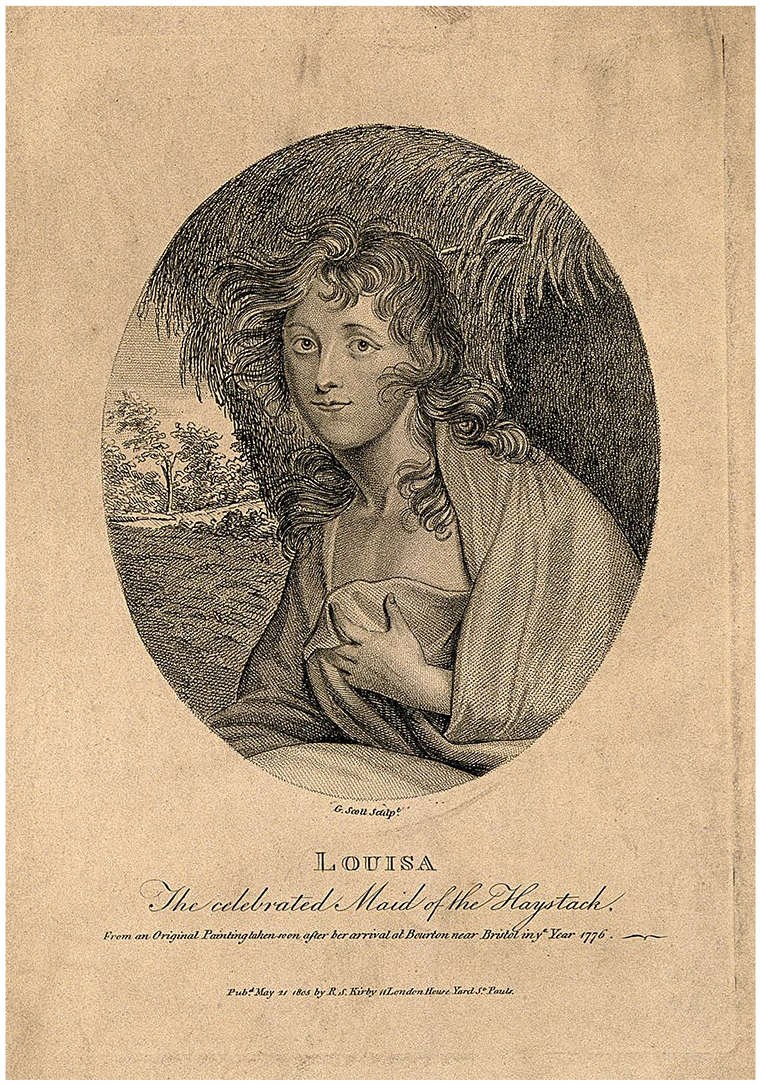
Louisa, Maid of the Haystack.
The death of Louisa in late 1800 brought renewed public interest in her story and what it signified. A lengthy obituary of ‘this very extraordinary woman’ appeared in various newspapers and periodicals, drawing together elements from the previously published pieces and the observations of an anonymous man who had visited her under the haystack and at Henderson’s madhouse (The Porcupine, 27 January 1801; London Courier and Evening Gazette, 31 January 1801; The Weekly Entertainer; or Agreeable and Instructive Repository, Vol. 37, 2 February 1801: 91–94; Gentleman’s Magazine 71 (1), 1801: 280–281). Over the next few years, more pamphlets, poems and ballads emerged. There was even a stage play entitled ‘The Maid of Bristol’, performed at the Haymarket Theatre in London in 1803 (Star, 12 March 1801; Sun, 17 June 1801; Salisbury and Winchester Journal, 29 August 1803; Tyne Mercury, Northumberland and Durham and Cumberland Gazette, 22, 29 May 1804; Boaden, 1803). Its writer James Boaden also happened to be co-author of one of the versions of Louisa’s history, issued in the same year (Anonymous, 1803). Perhaps not surprisingly, the play was only loosely based upon the real narrative, being primarily a tale of an innocent young woman left broken-hearted by a handsome soldier who is sent off to war and finds another love, whom he then marries. There is little direct mention of madness and the play even has a happy ending, with the original couple eventually reunited.
The assumption by Hannah More and others was that, among the dramatic circumstances that had occurred in Louisa’s life, an unwise romantic attachment and removal of her innocence by an unprincipled young man had played a significant part in her downfall. Whatever the real truth, this aspect served to reinforce critical appraisals of contemporary morality. For example, in 1787, ‘Philalethes’ (presumably Hannah More) reproduced the ‘authentic story’ of an innocent girl of nineteen, the daughter of a West Country merchant in reduced financial circumstances. Whilst in all her ‘bloom and beauty’, she met and fell in love with a dashing young army captain. Inevitably, he sought to ‘seduce her from the paths of virtue’ and presented her with a ‘dishonourable proposal’, which she felt bound to reject. In some distress, she revealed the cause to her brother, which resulted in a mutually fatal duel between him and the errant captain. Blaming herself as the cause of this and her father’s inconsolable grief for his dead son, the young woman became ‘bereft of her senses’ and had to be confined in a private madhouse. The conclusion drawn by the writer was that the ‘gay, licentious young men of our age’ ought to reflect on their behaviours. Not only should every man regard himself as the ‘guardian’ of the defenceless female sex, but every woman should ‘conduct herself with becoming pride and dignity’, especially at a time when men were so ‘daringly insulting’ (London Chronicle, 14–16 June 1787).
The perception of young men as immoral, selfish, thoughtless seducers, and of young women as prospective victims who had to guard their virtue and thereby preserve their reputation and mental well-being, gained considerable currency. These themes were pursued by the writer of Louisa’s obituary, who entertained little doubt that she had fallen victim to the wiles of a designing philanderer, which had precipitated her social descent and mental collapse: The conviction that it is possible for any man, making pretensions to honour, or even distinction from a brutal nature, so to betray, and so to abandon, in a foreign land, youth, beauty, the strongest sensibility, and perhaps the most engaging innocence, fills the mind with horror of the deed, and with shame and indignation for the character!
Although conceding that the ‘profligacy’ may in this particular case have been of ‘foreign production’, he insisted that instances of ‘similar atrocity’ abounded in England. The unscrupulous perpetrators would: make high pretensions to honour and principle, but. . .seek every opportunity of seducing from the abodes of paternal affection, or of innocent employment, whatever is the most fair and inexperienced; rioting in its ruin for a short season, and the committing the greater crime of abandonment on infamy! (London Courier and Evening Gazette, 31 January 1801).
In this or similar scenario, the likely result for the hapless, once innocent, female victim was disgrace, social ruin and a descent into penury. It was almost axiomatic that insanity would follow, most probably culminating in prolonged confinement in a madhouse.
With all its complicated and dramatic elements, the legend of Louisa, the ‘Maid of the Haystack’ strongly reinforced Georgian perceptions of female vulnerability to madness. The responses of various sections of the community to her evident plight illuminated more enlightened sensibilities toward insanity and its management than has sometimes been credited, and not solely in relation to female sufferers. Of course, attitudes toward mental disorder remained complex. Although the fear of violence or unpredictability persisted, the stigma attached to an apparently mad individual might be countered by an appreciation of genuine suffering and personal tragedy, especially if the person displayed residual signs of innocence, respectability or gentility. Throughout the 18th century, local communities often showed genuine, compassionate concern for mentally disordered people within their midst, as occurred in the case of Louisa. A wider preparedness to accept communal responsibility has been illustrated by James Moran in his study of the use of legal powers to protect the property of people incapacitated by presumed insanity (Moran, 2019: Chapters 3–5). However, collective community efforts had their limitations and there came a point where these were no longer adequate, requiring the deployment of various forms of specialist institutional facility. Even in the late 18th century, there were already a number of options available in the public, voluntary and private sectors. Louisa spent periods in the lunatic ward of a workhouse, a well-regarded private madhouse, and the lunatic section of a charitable hospital. However, in her unfortunate case, the damage she had sustained over an extended period was clearly too great to be repaired.
