



Abstract
This article investigates the diversity of social and political assertions in the work of Vladimir M Bekhterev. Its findings reveal that he drew social and political conclusions based on his doctrine of reflexology. Moreover, he propagated the use of statistical investigations by scientific and governmental institutions to estimate the social and healthcare needs of the population. These conclusions accord with Bekhterev’s desire for a transformation of society that would bring continued progress to people’s social and living conditions. Additionally, the findings of this research work also support the idea that Bekhterev should be regarded as an important protagonist of neuroethics, a relatively recent field of research.
Introduction
The turn of the twentieth century saw the decline of so-called brain psychiatry, which sought to link mental disorders to circumscribed brain lesions. From that time on, the clinical concept of psychiatry, which was mainly elaborated by Emil Kraepelin (b. 1856, Neustrelitz; died 1926, Munich), began its triumphant march (Gladstone, 1967: 112; Shorter, 1997: 100; Trenckmann, 1988: 201 ff.). At the same time, the Russian neurologist and psychiatrist Vladimir Michailovich Bekhterev 1 (b. 1857, Sorali; d. 1927, Moscow) was developing the concept of reflexology, and the Russian physiologist Ivan Michailovich Sechenov (b. 1829, Teplyi Stan; d. 1905, Moscow) could be regarded as one of the progenitors of reflexology (Koshtoyants, 1956). In his doctoral dissertation in 1860 at the Medico-Chirurgical Academy of Saint Petersburg, he argued that all voluntary movements arise from reflexes (Sechenov, 1860). Then, Nobel Prize winner Ivan Petrovich Pavlov (b. 1849, Ryazan; d. 1936, Leningrad) detected the conditioned reflex, which was the main inspiration for Bekhterev. Using reflexology as a universal concept, he hoped to throw light on the origins of mental diseases, healthy conditions, and the psychology of the masses. The concept also included social questions and influenced behaviourism, which developed at the same time, mainly in the USA (Engmann, 2020a). Coincidentally, the role of social factors in the origin and course of mental disorders was emphasized by several of his contemporaries. According to Sigmund Freud’s (b. 1856, Freiberg in Mähren; d. 1939, London) psychoanalytic theory, life events and social factors influence mental disorders. The American philosopher and psychologist William James (b. 1842, New York; d. 1910, Tamworth) also discussed the role of external stimuli and their subsequent mental association (James, 1892: 15; Malone, 1975). In Germany, too, the psychiatrist Karl Jaspers (b. 1883, Oldenburg; d. 1969, Basel) emphasized the role of social factors in the origin and course of mental disorders (Jäger, Lang and Becker, 2015). But what makes Bekhterev’s work novel?
Methods
I conducted a systematic review of all available and relevant original works by Bekhterev from the late nineteenth and early twentieth centuries, and in particular those which deal with reflexology. For this search through the historical literature, I had recourse to a catalogue of works (Bekhterev, 1954; Pfrepper, Pfrepper and Akimenko, 2007) and a biobibliographical lexicon (Engmann, 2020b). Additionally, a systematic online search in the Russian State Library and National Library of Russia was carried out. Moreover, most of Bekhterev’s influential work was translated into German soon after its publication in Russia. Thus, a huge amount of his work is also available outside Russia. The relevant secondary literature was also taken into account through a search in Medline.
Results
At the beginning of his career Vladimir Bekhterev (see Figure 1) focused on neuroanatomy, but research on psychology and psychiatry eventually became more important. His aspiration was to develop what he called an objective psychology: a psychology which in its diagnosis and concept would be independent of subjective perceptions and statements. Thus, he coined the terms ‘neuro-psyche’ and ‘objective psychology’ (Bechterew, 1909, 1912). The latter was also the title of a book (Bekhterev, 1907). The reflex arch of the conditioned reflex, in the narrow sense, viz., afferent – integrating centre – efferent, was taken as the basis of his concept. He thus emphasized that exogenous factors were those that mainly shape human behaviour. As a consequence of this choice, Bekhterev also drew political conclusions. As early as 1897, Bekhterev pointed out the importance of the milieu, from which man would be unable to stand out by his own means, or, in other words, the milieu shapes human behaviour. As a consequence, he argued that ‘those who govern must be capable of turning the perceptions and thoughts of the masses towards higher aims and noble tasks’ 2 (Bechterew, 1899: 82).
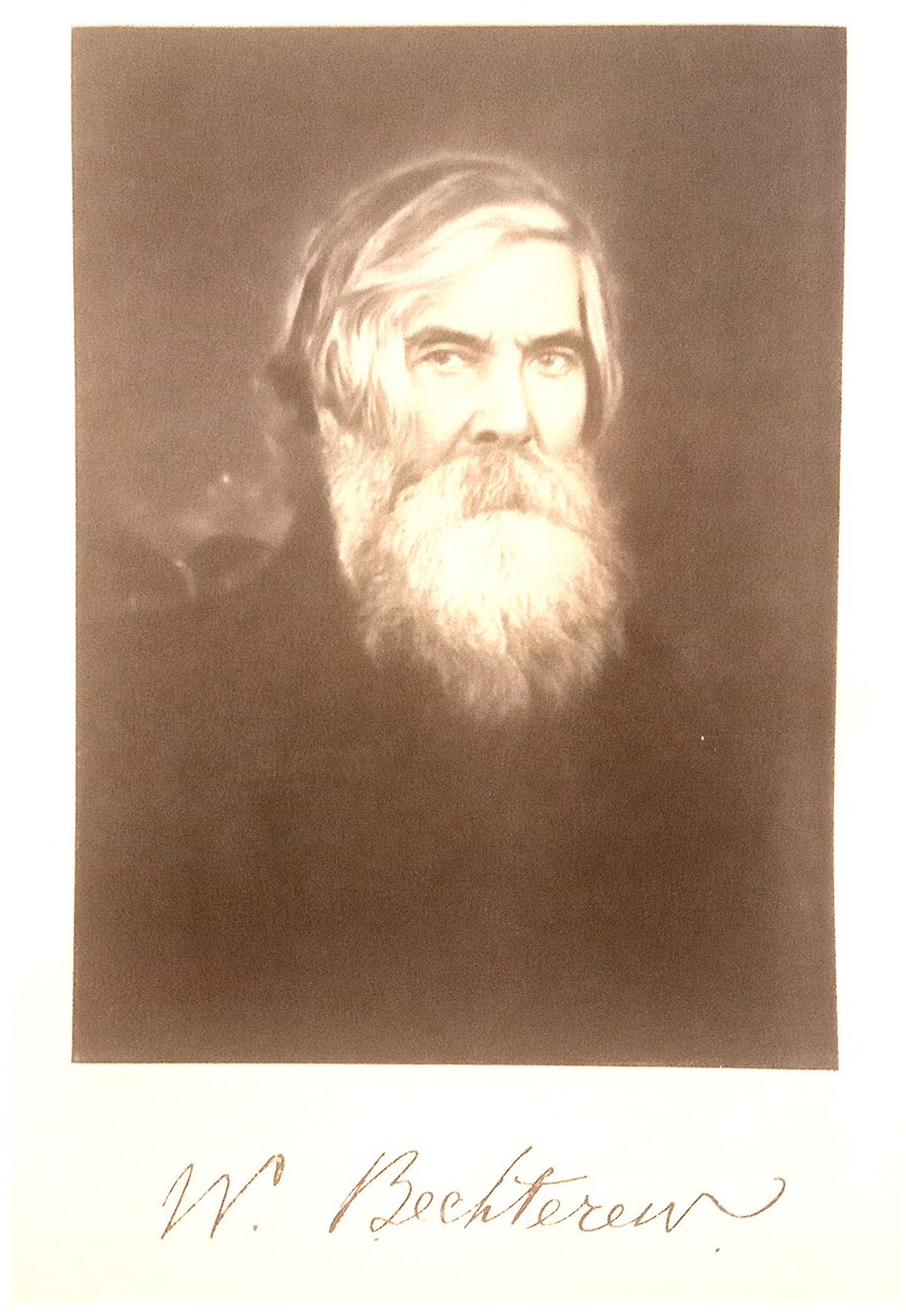
Old-age portrait of Vladimir Bekhterev, around 1925, taken from a special issue of the journal Zeitschrift für die gesamte Neurologie und Psychiatrie, 1925, which was dedicated to Bekhterev. (Source: Private archive of Birk Engmann.)
After laying the groundwork for his doctrine of reflexology, Bekhterev became interested in the topics of personality, forensic medicine, the behaviour of the masses, and even philosophical aspects in his subsequent works.
According to Bekhterev, the shaping of a personality in one’s personal life is mainly based on mental processing of external triggers. By way of example, he postulated that perpetual hunger leads to passiveness of personality and, moreover, weakness of character (Bechterew, 1906: 17). A few years later, Bekhterev defined personality as a ‘complex and undividable whole of higher reflexes’; furthermore, personality thrives when individual and social conditions are favourable (Bechterew, 1923: 267–8).
This emphasis on external triggers is also to be found in his forensic reflections. Bekhterev declared pauperism and alcoholism to be the roots of criminality. A criminal act is influenced by external and common factors which become embedded in the personality, but also by factors from the past, such as heredity and individual development. According to Bekhterev, this focus on the factors mentioned above would be an example of an objective or ‘psycho-reflexological’ method; in his own words: ‘Society itself produces criminals in its midst. The delinquent is a victim of his social-economic conditions. In the end, those conditions can stress a person’s biological system resulting in degeneration and mental diseases’ (Bechterew, 1914: 48). Bekhterev expressed a wish for ‘happy days without lords and servants’ which are yet to come, and, additionally, that delinquents should be cured in hospital-like institutions rather than being imprisoned (pp. 51, 53). Thus, he foresaw the future work of the psychiatrist in the protection of people’s health (Bekhterev, 1912).
In 1918 Bekhterev published a compendium on reflexology which was based on his own lectures and which had more than four reprints within ten years; it was also translated into German (Bechterew, 1926). He emphasized previous reflections of his own, according to which even thoughts are composed of different reflexes; he argued that single words and terms have a cluster structure, i.e. they could be divided into optical, acoustic, haptic compounds. In other words, he postulated that complex subjective phenomena consist of a complex of reflexes (Bechterew, 1926: 379). With regard to the exploration of the social world, Bekhterev wanted reflexology to replace psychology completely (p. 6). He defined social-economic factors as stimuli which inculcate many reflexes in the individual. Such inculcated reflexes constitute the superstructure of inherited reflexes (pp. 206, 209). The utterances and behaviour of a given personality would follow a set pattern. As a consequence, a collective is also just a collection of individuals joined through common interests (p. 10). In his work on ‘collective reflexology’ (Bechterew, 1928), he applied the above-mentioned pattern of a primordial reflex covered by inculcated reflexes to social structures such as society’s domination over individual personalities and, conversely, the shaping of one’s personality by society (p. 40). Hence, human needs are just conditioned reflexes. With the help of statistical methods, it would be possible to figure out the needs of the population. For example, health conditions, religious views, education levels and work abilities could be elicited. Moreover, statistics could be used to investigate correlations such as the relationship between numbers of suicides and the fact of living in urban centres. With the help of statistics, including questionnaires, reflexology could thus be used for the benefit of mankind (pp. 29–30). Bekhterev was also interested in mass psychology. He described crowd behaviour as being due to a ‘collective personality,’ requiring a talented person to lead it (p. 45). He considered the behaviour of such a collective personality to be based on the same reflexes as those underlying the personality of a single individual. As a consequence, the expressions of a crowd are constitutional in the sense that they follow an internal law or set pattern. In another publication (Bechterew, 1924) on the same topic, Bekhterev stated that work in a collective has advantages over the work of individual workers, since deviant opinions will be corrected by the collective; the collective controls all individual work and thereby prevents serious mistakes and excesses.
Generalized philosophical world views are also discernible in his publications. Hence, as he stated elsewhere, reflexology as the basis for any correlative activity could be taken as a mutual universal principle: every new form of being is based on primitive forms which determine whatever is new. Bekhterev referred to this as a principle of historical consistency (Bechterew, 1926: 297).
Discussion
Bekhterev’s contributions to ethics have not yet been considered in relevant textbooks on the history of psychiatry, especially on Soviet psychiatry (see for example: Calloway, 1992; Gladstone, 1967; Kannabikh, 1994; Shorter, 1997). In the Soviet Union, on the one hand Bekhterev was criticised for a ‘vulgar-mechanistic’ approach inherent in his doctrine of reflexology (BSE, 1950: 125), and on the other hand his doctrine was considered to be a reaction of growing subjectivism in psychology in his era (Rubinstein, 1960: 111–12; Yudin, 1951: 126). Others highlighted the unifying approach, which meant including the whole of psychiatry into the system of reflexology (Kannabikh, 1994: 492).) Social psychiatry only developed in the Soviet Union in the 1930s and 1940s, after his death, but Wortis (1950: 20) argued that the science of collective reflexology had been promoted by critics saying that social factors had been neglected by reflexology from the start. On the contrary, my research reveals that Bekhterev had already postulated a strong connection between social aspects and mental health long before he had established reflexology, let alone collective reflexology (Bechterew, 1899). Rather, Bekhterev intended to replace mass psychology by collective reflexology, and thereby replace all psychology by reflexology. In any case, in a recent Russian scientific paper (Mikhalkovska-Karlova, 2016), Bekhterev has been recognized as a precursor of bioethics, although the author focuses on his merits in founding the ‘Russian League Against Epilepsy’, which said the care of the sick was its main task. However, according to the findings of the present article, Bekhterev’s social postulates do not concern questions of care and support for the sick, but rather a transformation of many areas of government. Improved social conditions for the people were a major preoccupation in Bekhterev’s work, and one of the aims of his doctrine of reflexology was to deliver a scientific justification for those demands. Compared with the work of his contemporaries in psychology, psychiatry and neurology, Bekhterev’s approach to at least the ethical aspects of his subjects seems to be unique.
With regard to his social demands, the question is whether these follow any particular philosophical doctrine or not. Research reveals that Bekhterev’s work embraces a multiplicity of philosophical and social leverage points. With regard to ‘reflexology’, he built up a concept in which medical issues were accompanied by philosophical ones. Besides the conditioned reflex which was taken as the basis of behaviour, he considered thoughts and personality, both in individuals and in the masses, and used two philosophical doctrines as further foundations. One was the focus on verifiable experiences as the source of scientific theories. Here, Bekhterev came close to the philosophical school of Empirio-criticism, which had its acme in the early twentieth century. Indeed, in his later work on reflexology, he quoted one of its most influential thinkers, Richard Avenarius (b. 1843, Paris; d. 1896 Zurich), thereby neglecting Russian proponents (Bechterew, 1926: 303). Another recurring postulate was that of a ‘constitutional’ pattern of behaviour and even history and, to support this, he quoted Karl Marx (b. 1818, Trier; d. 1883, London) (Bechterew, 1928: 31). Nonetheless, Bekhterev could not be regarded as a proponent of Marxism. Instead of a violent uprising of the masses following one leader, according to the kind of programme experienced in the October revolution, Bekhterev argued according to the reflex paradigm; he thought that the motivation for the development of society towards a more peaceful one after World War I would have its roots in the way the cruel experiences of the people during the war would eventually alter their thoughts (Nikiforov, 1986: 225). The lack of consensus with official political doctrine in the Soviet Union after the revolution led, among other things, to his book on collective reflexology being banned (Nikiforov, Amirov and Mukhamedtsyanov, 2007: 120). Another remark regarding philosophical issues in reflexology is the postulate that complex subjective phenomena consist of a complex of reflexes (Bechterew, 1926: 379). Hence, he argued against the holism of the mental, and also against the Gestalt theory – a synonymous doctrine which emerged simultaneously with Bekhterev’s reflexology. To sum up, the philosophical issues did not follow a regular system, and Bekhterev did not favour any one in particular. Instead, it appears that he sought confirmation of the doctrine of reflexology in other disciplines. One may also ask whether Bekhterev should be regarded as a protagonist of neuroethics. In the literature of this field, very different origins have been postulated for neuroethics, such as eugenics, psycho-surgery, or research on consciousness (Faria, 2013; Fins, 2019; Illes and Bird, 2006). On the other hand, the term ‘medical ethics’ had already been coined by the English physician Thomas Percival (b. 1740, Warrington; d. 1804, Manchester) (Baker and McCullough, 2009: 68). The first extensive German treatise on this subject (Moll, 1902), written by Albert Moll (b. 1862, Lissa; died 1939, Berlin), was translated into Russian just a year later (Baker and McCullough, 2009: 68). Nevertheless, in the Russian Empire and the Soviet Union, the term was not used until the end of the 1920s (Lichterman, 2009). Concerning reflexology, Bekhterev recognized the interdependency of social factors which shape the human brain and the fact that humans could actively shape their social conditions (Bekhterev, 1927/2012). This very issue is one of the main topics in today’s neuroethics (Wexler, 2013) – a new discipline which emerged only in the second half of the twentieth century. The latter postulate makes Bekhterev’s view stand out among those of his colleagues. From the standpoint of his reflexology doctrine, he argued for radical political change as well as the implementation of purely scientific investigations into the needs of the population by means of surveys and statistics. Bekhterev’s approach also has implications for many social questions which are still important. For example, the reorganization of work over the last few decades, with an increase in night shifts, permanent availability and the requirement of high flexibility, are discussed as important factors influencing disorders (Chevance et al., 2020). Not just establishing correlations, but also motivating society to improve the social status of ordinary people was one of Bekhterev’s crucial desires.
Conclusion
Bekhterev’s concept of reflexology describes the relation between external stimuli and the central nervous system and its mental effector as being analogous to the reflex arc. In other words, the theory describes the impact of exogenous factors on affects and behaviour and on mutual interactions of the self and the environment. By elaborating this doctrine, Bekhterev always included the impact of social conditions on mental health. So, among other things, he asserted that progress in social and living conditions improves mental health and reduces crime; he demanded equal rights for the people, hospitals rather than prisons for delinquents, and so on. He directly deduced the need to improve the social conditions of the people from his concept of reflexology, and he also proposed that reflexology should be complemented by other, modern methods, such as statistical methods that use surveys or questionnaires to figure out the needs of the population. Generally, it seems that these social aspects of Bekhterev’s work have been underestimated, but in fact, much of his scientific work aimed to explore the social conditions of ordinary people and if possible improve them.
Footnotes
Declaration of conflicting interests
The author declared no potential conflicts of interest with respect to the research, authorship, and/or publication of this article.
Funding
The author received no financial support for the research, authorship, and/or publication of this article.