




Abstract
Gustav Specht (1860–1940) developed academic psychiatry in Erlangen. After studying medicine in Würzburg, Munich and Berlin, he became assistant medical director in the mental asylum of Erlangen. In 1897 he was appointed extraordinary, and in 1903 ordinary, Professor of Psychiatry. A good clinician and teacher, Specht worked during a time of paradigm change in psychiatry. He was an expert in chronic mania, and introduced the concept of the ‘grumbler’s delusion’. Paranoia he believed to be the core problem of psychopathology and considered the depressive syndrome as an ‘exogenous-type’ of reaction. For him, trauma was important in the genesis of mental illness, and his ‘hystero-melancholy’ anticipated the concept of borderline personality disorder.
Keywords
Specht’s life
Gustav Nikolaus Specht was born on 25 December 1860 in Schweinfurt, Lower Franconia, the tenth child of the merchant Adolph Gottfried Hermann Eduard Specht and his wife Maria Christina, née Will. After attending the town’s elementary school and humanist grammar school, Gustav Specht began his medical studies in Munich in 1879 (see Braun and Kornhuber, 2014d). On 10 April 1880 he was ‘discharged in peace on the basis of Section 36 d. of the Reserve Directive as permanently unfit for military service’ (UAE: II, 1, 53). 1 Specht spent two semesters of his five-year degree course in Würzburg. He graduated in Munich, where he received his licence to practise medicine on 27 February 1884 and his doctorate on 10 April 1884. Specht’s doctoral thesis was a 16-page ‘Contribution to the casuistics of tertiary syphilitic bursal diseases’, written ‘under the supervision of the Privy Councillor Professor Dr. Ritter J[ohann] N[epomuk] v. Nussbaum [1829–90]’ (Specht, 1884). Specht took up his first assistant post at the Bürgerspital hospital in Frankfurt, because ‘the practical doctor . . . was still [his] ideal at that time’ (Goldenes Buch in UAE: II, 1, 53). In the summer of 1884, he went to Berlin to study. ‘Captivated early on by the physical-mental dual nature of man’ (Kleist, 1941: 226), Specht also spent the winter semester of 1884–5 at the university in Berlin, where, under the influence of Carl Westphal (1833–90) and Emanuel Mendel (1839–1907), he became increasingly fascinated by the discipline of psychiatry. ‘His inclination towards humanistic activity of a philosophical and psychological nature may have contributed to his decision to turn completely to psychiatry’ (Ewald, 1941: 608). Because of this new direction, he returned to Franconia, where the first Bavarian district insane asylum had been opened in 1846 in Erlangen, Central Franconia, just under 20 km from Nuremberg (Braun and Kornhuber, 2013a, 2013b). There, Specht was trained by Friedrich Wilhelm Hagen (1814–88, see UAE: II, 1, 42; Bumm, 1889) and Anton Bumm (1849–1903, see UAE: II, 1, 28) (on Hagen and Bumm, see Braun and Kornhuber, 2013a). ‘One may remember on this occasion the tremendous importance which psychiatry then had in Erlangen, earlier than elsewhere’ (Kihn, 1930: 630). 2 Over the following 18 years (23 March 1885 to 30 September 1903), Specht worked in the Erlangen psychiatric hospital as an assistant physician, then as ‘2nd auxiliary physician’ (UAE: II, 1, 53) and finally as senior physician. Anton Bumm, who had succeeded Hagen from 1888, found – according to Specht (1924a: 255) – ‘overcrowding in the institution, which required the construction of a second district lunatic asylum’. The ‘excellent teachers [Hagen and Bumm], . . . with their clear eye for empiricism [were able] to offer . . . what . . . [Specht] was looking for’ (Ewald, 1941: 608). In the summer of 1889, Specht passed his physician’s examination as an entry requirement for the medical civil service in Munich and was appointed royal senior physician of the district lunatic asylum. Specht, ‘for whom academic aspirations were far from his mind’ (Kleist, 1941: 227), then became well known in the psychiatric world with his first publication, Die Mystik im Irrsinn (Specht, 1891).
In this book, Specht defended psychiatry with ‘consummate scientific and practical expertise, astute superiority, grit and pugnacity, wit and mockery’ against ‘the attacks of the formerly much-cited “philosopher” Baron Dr. du Prel [1839–99], which were a blend of occultism, ignorance and presumption’ (Kleist, 1941: 227). Over the coming years, Specht would remain committed to counteracting ‘superstition’ (Specht, 1891: 226; 1908/1909: 110). Bumm’s appointment in Munich in the autumn of 1896 prompted Specht to ‘unexpectedly turn to the academic profession, which was actually further from [his] original life plan’ (Goldenes Buch: UAE: II, 1, 53). Specht was distinguished by ‘extensive experience in matters of asylum management’, and was regarded as a ‘perceptive and scientifically well-trained psychiatrist’ (Tschakert, 1946: 104). For six months, he provisionally managed the institution as deputy director. August Würschmidt (d. 1919), an ‘expert proven in practice’ (Kleist, 1941: 227), was appointed director of the institution on 1 April 1897. Specht, on the other hand, was appointed non-tenured extraordinary ‘professor for psychiatry and the psychiatric clinic’ (Wittern, 1999: 187) in Erlangen on 17 March 1897, while retaining his position as senior physician at the district lunatic asylum. In order to ensure adequate training of physicians in the field of psychiatry, it was necessary to ‘create a separate sphere of activity with the necessary material for a real lunatic hospital’ (Kolde, 1910: 476–8). Specht conducted time-consuming negotiations between the university and the district council of Middle Franconia. To deepen his theoretical knowledge, he frequented Wilhelm Wundt’s (1832–1920) laboratory for experimental psychology in Leipzig from 24 April to 28 May 1899.
On 15 August 1901, in Nuremberg, Specht married Anna Elise Birkner, with whom he later had two sons, Hermann and Wilhelm. On 29 June 1903 a contract was signed between the Friedrich-Alexander-University and the district council of Middle Franconia. The extraordinariate for psychiatry was converted into a full professorship, and Specht was appointed to the post on 1 October 1903. He gave up his position as senior physician at the district lunatic asylum, and instead he was appointed director of the Psychiatric University Clinic, housed in a special ward of the district lunatic asylum (Figures 1 and 2). Specht, who ‘already had in his hands permission to build a self-contained clinic’ (Kihn, 1930: 630), saw his efforts brought to a temporary end by the outbreak of war in 1914. He went about improving the existing clinic with ‘exemplary energy and unwavering determination’ (p. 630), ‘and with endless difficulties he succeeded in improving the interior to an extent that no one would have thought possible’ (Fränkischer Kurier, 7 Oct. 1934 in Stadtarchiv Erlangen III. Nr. 41, p. 1). On 6 January 1923 Specht was awarded the title of ‘Geheimrat’ (Privy Medical Councillor) ‘on the occasion of the reintroduction of commendatory titles for meritorious scholars’ (Ewald, 1941: 608), an honour that paid special tribute to Specht’s research and teaching activities. Specht was appointed Dean of the Medical Faculty several times. On 1 April 1934 he became emeritus professor, while continuing to hold his teaching professorship until 30 September 1934. His successor Friedrich Meggendorfer (1880–1953) describes how difficult it was for Specht to withdraw from the clinic, his life’s work (Meggendorfer, 1940/41; see also Braun, 2017, 2020c, 2020d; Braun and Kornhuber, 2015b; Braun, Kornhuber and Frewer, 2017). On 24 October 1940 Specht died of a heart condition, and on 28 October the Erlanger Tagblatt newspaper paid tribute to ‘this distinctive personality of our university and city’ (Stadtarchiv Erlangen III. Nr. 41, p. 1): ‘The university commemorates him as the teacher who knew how to convey to generations of doctors, in an easy-to-understand way and with a spontaneous manner of presentation, what the practical physician needs to know about psychiatry.’
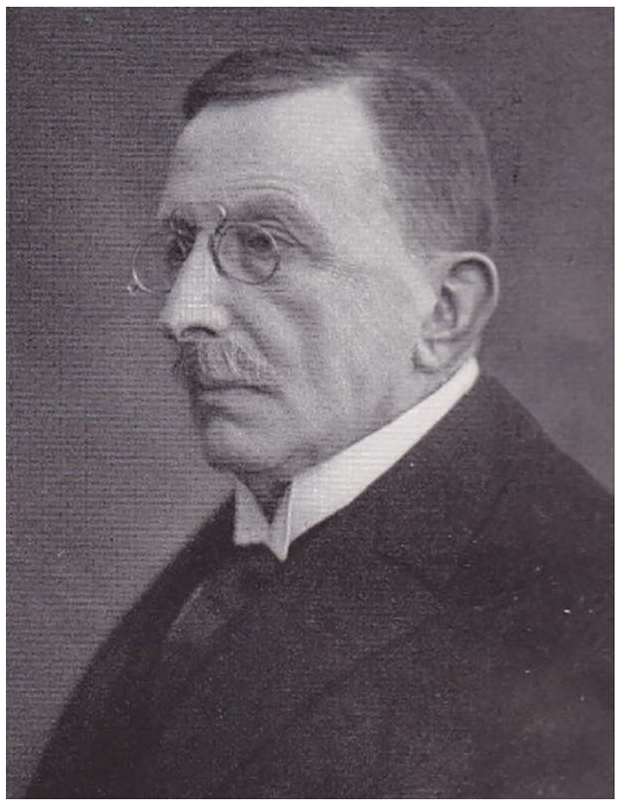
Portrait of Gustav Specht (from Kleist, 1941: 224).
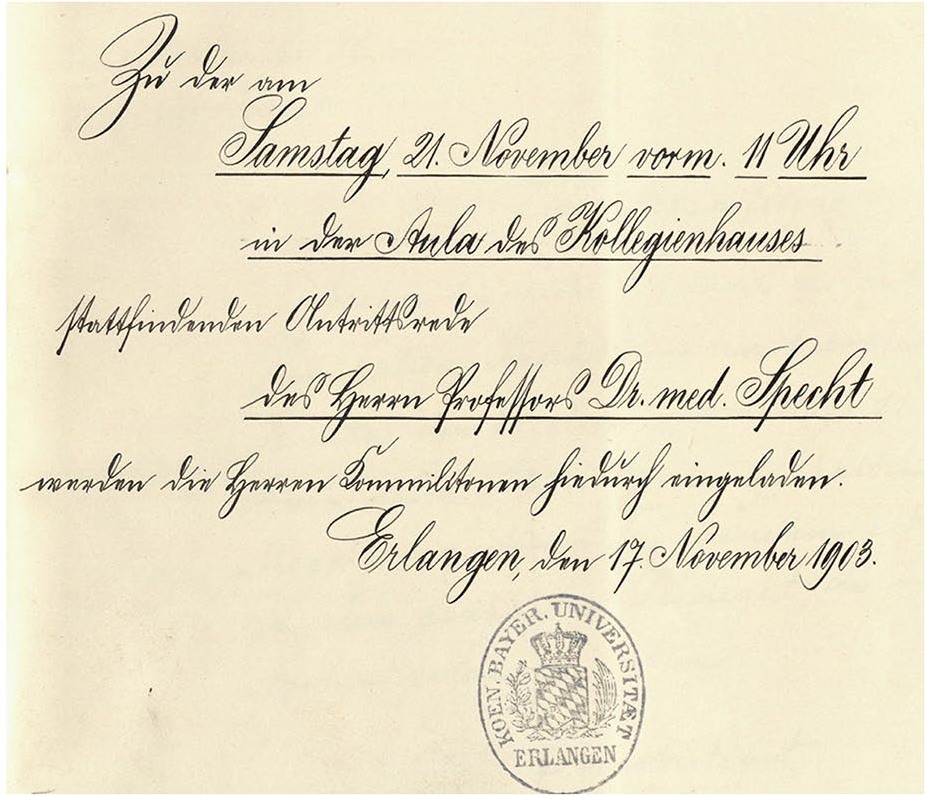
Invitation for Specht’s inaugural speech as vice-rector, 17 November 1903 (source: UAE: II, 1, 53).
In 1962, a street in Erlangen’s inner city was named after Gustav Specht. The application for the renaming emphasized that Erlangen had: so many university members who were purely scholars and important representatives of their subject . . . that up to now it is only those university professors who also stood out in the public sphere and through activity for the city who have been honoured with street names. (Stadtarchiv Erlangen III. Nr. 41, p. 1)
Specht the clinician
Specht saw himself primarily as a clinician and always emphasized that he had emerged from psychiatric practice. He was a master at delving into the mental state of his patients, and was able to detect fine and subtle differences and traces of changes and disturbances (Meggendorfer, 1940/41: 26).
An insight into his daily clinical work is provided by a document written by Specht to the Bavarian State Ministry for Instruction and Education on 13 February 1933: With the exception of a one-off four- to five-week recuperation leave, I have been in the clinic every day during the week from 9–1 and from 3:30–7 o’clock and on Sundays and holidays before noon from 10 to 1 o’clock and also often in the afternoon for a few hours.
Specht stressed that he did not announce his visits to the wards, but made them at unscheduled times: The nursing staff is never sure that I will not suddenly appear . . . . When complaints are made, the patients in question are called in immediately so that they can speak out before the council of physicians; in addition, I am available every hour of the day to each patient for discussion in private. (BayHStA: MK 44365)
In the fifth edition of Penzoldt-Stintzing’s Handbuch der gesamten Therapie, Specht wrote the chapter on ‘General treatment of mental illnesses’ (Specht G, 1917) – ‘exemplarily’ according to Kleist (1941: 237).
Specht on the defensive
In his function as clinic director, Specht had to go to court to justify the clinic’s internal matters. In 1910, the lawyer Dr Süssheim in Nuremberg: raised a complaint against the director of the psychiatric clinic of the University of Erlangen, Professor Dr. Specht . . . because the latter had retained letters addressed to Dr. Süssheim by G.S., a patient of the Erlangen District Lunatic Asylum, and had engaged in insulting outbursts against Dr. Süssheim. (UAE: II, 1, 53)
(G.S. had been sent by police order to the Erlangen District Lunatic Asylum and transferred to the psychiatric clinic.) There is an eight-page handwritten justification by Specht with regard to this legal dispute, which is preserved in the personnel file. In it, he admits that he had taken a single letter from G.S., addressed to Dr Süssheim, and, in full view of the patient, had thrown it in the wastepaper basket. Pursuant to Section 14 of the service regulations for the director of this asylum, it was a matter ‘under the supervision of the director . . . and . . . at his conscientious discretion . . . whether the letters are sent’. Specht denied, in the most definite manner, having used insulting language or even disrespectful remarks about the lawyer Dr Süssheim or about his party affiliation; he describes G.S.’s statements as figments of the patient’s imagination. On 21 January 1910 Specht was sent the opinion of the Royal State Ministry of the Interior for Church and School Affairs, to the effect that the ministry ‘would have considered it more appropriate if he had not destroyed the letter from [G.S.] to Dr. Süssheim, but had incorporated it into the [patient’s] personal file’.
Specht’s practice of private medical bills
While the above litigation was based on the initiative of a mentally ill plaintiff, Specht also dealt with the querulous features of mentally healthy people. On 21 April 1932 he had to justify himself to the government, following a complaint by the guardian of patient U. who had been charged private fees. In his statement, Specht emphasized that, given the straitened economic conditions in which even the upper-middle class was finding itself, he generally did not charge a private fee to patients of the second class. ‘Only in very isolated cases, in which the ability to pay is beyond doubt and willingness to pay is admitted, do I make an exception’ (BayHStA: MK 44365). Specht described in detail the circumstances which led him to believe that patient U. was able to pay. On 3 May 1932, the Bavarian State Ministry for Instruction and Education informed the Chamber of the Interior of Middle Franconia: that the charging of a fee for the treatment of a 2nd-class patient in a clinic [was] permissible and customary. The amount of the remuneration demanded by Privy Councillor Prof. Dr. Specht for the treatment of the senior teacher’s widow U. remains within reasonable limits.
On the allegation of patient abuse at the clinic
On 12 July 1932 a complaint was submitted to the State Ministry for Instruction and Education by a patient of Specht’s clinic. In addition to complaints about unhygienic conditions, the complainant claimed that in the psychiatric and mental hospital the sick were ‘not treated but mistreated’ (BayHStA: MK 44365). In his reply to the Ministry dated 13 February 1933, Specht argued that ‘mistreatment of the sick would show visible traces in the form of bruising, chapping, etc. over a longer period of time’. For the allegations to be true, the doctors must have gone through the departments with blinkers on. . . . Among the details of the complaint, the descriptions of the damp wrappings make a particularly gruesome impression. These wrappings are one of the modern therapeutic methods for unruly states of excitement; they are in use in all psychiatric institutions.
According to a letter of 24 February 1933 from the Ministry, the examination of the ‘conditions in the psychiatric and mental hospital of the University of Erlangen . . . had revealed nothing that could give rise to objections’.
On confidentiality formalities in the provision of expert opinion
In 1927/8, Chief Government Councillor O., as the head of the Pegnitz 3 District Office, submitted to a superior office a criticism of Speck’s work in providing expert opinions. ‘P.G.’, a beekeeper and master tree nurseryman from Fischstein, 4 had been sent to the Bayreuth Sanatorium and Nursing Home by order of the Pegnitz District Office due to alleged ‘delusions and notions of persecution’ (BayHStA: MK 72096, MK 72098) on 23 December 1924. The district physician in charge, Dr Ra, considered P.G. to be a ‘dangerous mental patient’, which made it necessary to detain him ‘by means of a provisional order’. This had been decided under the direction of Chief Government Councillor O. In his report of 25 March 1925, the institutional physician diagnosed a ‘querulatory psychosis’, but emphasized that the criterion of ‘danger to the community’ did not apply. Due to his own ‘long-standing knowledge of the personality of P. [and] very serious reservations about the correctness of the expert opinion and its basis’, Chief Government Councillor O. only forwarded this to the District Committee after ‘further investigations into the public dangerousness of P.’. Finally, O. decided that an expert opinion on P.’s mental condition should be drafted by the ‘Privy Medical Councillor Dr. Specht’. In order to obtain the most reliable possible verdict on P.G.’s illness, Specht largely allowed O. to inspect the files sent by the Pegnitz District Office. On 23 July 1925, Specht submitted a preliminary expert opinion in which he assessed P.G. as a ‘hypomanic psychopath’ who ‘was not to be regarded as dangerous to the public’. On 16 July 1928, having been requested to do so, Specht submitted a supplementary expert opinion, which is not preserved in the archive holdings. Chief Government Councillor O. regretted that this did not result in a ‘salvation of honour for the men severely slandered by the mentally ill P.G.’. Specht was acting ‘as a protector of the malign troublemaker P.’: ‘But this is not an independent, expert opinion of a learned professor at the height of his scientific activity and a director of the psychiatric university hospital in Erlangen, but a regrettable testimony of failure by an old man’. (BayHStA: MK 72096).
On 2 December 1928, although ‘the closer circumstances under which Prof. Specht submitted his first expert opinion’ were condemned by the Bavarian State Ministry for Instruction and Education, the State Minister G. conceded the following in favour of Specht: ‘It must be disconcerting that a man of the position and age of the Chief Government Councillor should allow himself to be carried away to the extent of making such grave insults to another worthy official’ (BayHStA: MK 72096). The disputes mentioned above may have enriched Specht’s scientific studies of ‘querulous madness’. In his 1912 paper he had addressed the following question: ‘Where does spirited advocacy of real or supposed legal claims end and mental disorder begin?’ (Specht, 1912: 1).
In addition to forensic psychiatry, Specht was also concerned with social psychiatry. For example, in one paper he stated his views on the formerly much-disputed question of family care of the mentally ill (Specht, 1911: 320; see also Braun and Kornhuber, 2014a, 2014b).
Specht as a scientist
Manic-depressive insanity and paranoia
Specht researched manic-depressive insanity intensively. His evening visits to a manic patient isolated by Hagen may have been an important impetus for this (Specht, 1930: 490: see also Specht 1906a). He regarded anxiety psychosis as a manic complication and described it as ‘a mixed form of manic-depressive insanity’ (Specht, 1907: 532). As a counterpart to the ‘silent mania’ that he described – albeit only in a single lecture (Kleist, 1941: 233) – Specht (1908a) wrote ‘Über die Struktur und klinische Stellung der Melancholia agitata’. As a result of the expansion of the mania-determining characteristics, he judged agitated melancholia to be a complication of a mixed circular disease. Specht did not believe the ‘fantastic overflow of fears and unhappy notions’ (p. 459) was compatible with the inhibition of thinking that is characteristic of depression. Thus he allows psychotic depression to merge into the manic-depressive mixed state. Within the manic spectrum of illness, Specht was particularly fascinated by chronic mania (Ewald, 1941: 609); he saw ‘chronic mania’ in psychiatric practice mostly misused as simply a ‘fuzzy diagnosis of confusion’ (Specht, 1905: 590). According to Specht, the hypomanic symptom complex formed ‘the core of the psychopathic phenomena’ (p. 593) that occur in the context of chronic mania. The secondary occurrence of ‘chronically irritable and expansive mood direction’, on the one hand, and ‘boastfulness’, on the other, can ‘gradually take on the deceptive appearance of paranoid delusions’ (pp. 593–4). Specht called for a ‘subtle differential diagnostic distinction, especially of this secondarily altered clinical picture, from other chronic disorders, especially paranoid ones, as a scientific and practical postulate’ (p. 596). The basic habitual affect in chronic mania – ‘whether it has hitherto been markedly euphoric or hypertensive or otherwise purely exaltative’ (Specht, 1908b: 824) – takes on ‘in periodic recurrence, and completely endogenously, a morose, wrathful or suspicious character’. Specht emphasized that ‘in all phases of circular insanity . . ., at least rudiments of paranoid thought direction’ appeared (p. 825). Although Gottfried Ewald (1888–1963) conceded that Specht may have ‘sometimes done too much and seen too much here’ (Ewald, 1941: 609), he nevertheless credited Specht with having so clearly recognized the significance of chronic mania, especially within querulantism, and so vividly highlighted it, that even Kraepelin had to concede to him and transform querulant mania into the type of the chronic-manic querulant. If Emil Kraepelin (1856–1926) saw the so-called ‘querulous madness’ as the model of genuine paranoia, Specht (1905: 594) clearly pointed out how the delusion of a chronically manic patient remains permanently ‘hanging on the apron strings of the pathological mood’. His description of the chronic manic querulous person, in whom ‘the development of the psychopathic state . . . [will] probably always coincide with the maturation of the personality’ (p. 591), may have been a significant contributory factor when Kraepelin ‘finally separated querulous mania from paranoia and classified it in the group of psychogenic disorders’ (Gutsch, 1918: 289). As early as 1912, Kraepelin mentioned Specht’s views in his lecture ‘On Paranoid Diseases’ (Kraepelin, 1912: 620).
Specht’s work on paranoia is closely related to the clinical picture of manic-depressive insanity. The disease concept of ‘insanity, paranoia’ had ‘in the decades since its introduction into psychiatry experienced a diversity of redefinition and delimitation unlike virtually any other’ (Gutsch, 1918: 286). Wilhelm Griesinger (1817–68) emphasized a state of mental weakness as an aetiological factor in the paranoia question, whereas Westphal, in accordance with the Mendel-Ziehn [sic]
5
definition of paranoia, mainly saw manic ideas and sensory delusions as relevant clinical symptoms. In the context of Kraepelin’s extensive reorganization of clinical psychiatry at the turn of the century, the disease concept of paranoia was increasingly called into doubt from both clinical and psychopathological standpoints. Specht (1901: 1) wrote: However, in the face of all the crumbling-away and the shifts . . ., the basic stock of the paranoia image has passed the stress test: there is still a primarily chronic madness and even the most modern of the moderns is forced to deal with it diagnostically.
He challenged the previous view of paranoia as a primary disease of the mind. Rather, he saw in it a ‘primarily disturbed affective life’ (p. 3).
Specht admitted the lack of empiricism concerning the affective origin of the paranoid delusion was a limiting factor of his considerations, especially since mood conspicuousness could be a separate phenomenon besides delusion. Specht’s ‘biologically oriented hypothesis of a “manic element” constitutive of the clinical picture of paranoia’ (Schmidt-Degenhard, 1998: 317) led him to the view of paranoia as an affect-psychotic mixed state: ‘I still maintain that pathological affect also represents a conditio sine qua non for the specific paranoia delusion’ (Specht, 1908b: 822).
[Specht’s] interpretation of paranoia as a uniquely formed manic-depressive type of illness . . . perhaps contains . . . a correct core after all: If we see the essence of the manic deflection or the depressive phase . . . in elementary and polar shifts of the sense of self, then the ‘pathology of self-esteem . . . is of central importance in the dynamics of paranoia’. (Schmidt-Degenhard, 1998: 317)
Even though Specht’s attempt to integrate paranoia into the disease entity of manic-depressive mania failed, ‘he was the first to give validity to the importance of the manic element in paranoia . . ., a decade ahead of his time’ (Ewald, 1941: 610).
Depressive type of exogenous reaction
Another area of psychiatry which ‘owes important suggestions and clarifying perspectives to Specht is the complex of questions surrounding the so-called exogenous reaction type’ (Meggendorfer, 1940/41: 28). Kraepelin taught that every psychosis-inducing exogenous damage to the brain or organism caused a specific mental disorder. According to him, sophisticated differential diagnosis should make it possible to distinguish alcohol-induced psychosis from cocaine-triggered psychosis and typhoid psychosis from paratyphoid A psychosis.
Kraepelin was mistaken here, however. Bonhoeffer later showed . . . : Again and again, it is a matter of clouding of consciousness, delirium, hallucinosis and states of the so-called amnesic symptom complex, be it mechanical effects on the brain, intoxications or infections. (Meggendorfer, 1940/41: 28–9)
Specht added depressive states to the doctrine of symptomatic psychoses developed by Karl Bonhoeffer (1868–1948). ‘Scientifically, Specht was in some ways an antagonist of Bonhoeffer’ (Leonhard, 1995: 28; Specht, 1913a: 105–6). The fact that exogenous psychoses can be accompanied by a depressive syndrome was illustrated by Specht on the basis of the case histories of carbon monoxide poisoning and influenza melancholia. In addition to his status as a professional observer here, he was unfortunate to have also played the role of patient: Some of his colleagues, however, thought he had a cyclothymic temperament and that it was in connection with this, probably without any external cause, that at some point a more serious fluctuation of a depressive nature had occurred. That he was of cyclothymic temperament can probably be confirmed. (Leonhard, 1995: 28)
The concept of vitality
Specht (1939: 1) dedicated his last publication as an ‘intimate-personal congratulatory gift . . . [to] a dear friend and former Erlangen work colleague, Karl Kleist [1879–1960]’ on his 60th birthday. While Specht considered the physiological-chemical as well as the endocrinological working hypotheses on manic-depressive insanity as ‘almost inconclusive’ thus far, he judged the ‘neurovegetative approach of the clinic coupled with brain localization considerations’ to be more promising. He described how he had ‘put the concept of vitality . . . to rights and . . . had become used to applying it to clinical practice’ (pp. 1–2). On the basis of a case history, Specht clarified that the ‘recovery function’ in manic patients does not take place in the regeneration processes of sleep. In order to deal with such a clinical fact in a scientific way, he introduced: the concept of vitality, which is becoming more and more common in personality assessment . . . . We clinicians cannot wait until the exact sciences, biology and natural philosophy, have come to terms with the problem of vitality. We, who continue to deal directly with the living human being, are compelled and justified to arrange the processes of life according to appearance for clinical use. (p. 3)
Specht saw increased vitality as an integral part of the manic symptom complex. Over the years, he wrote, he had learned to diagnose patients with low physical and mental affinity, despite many years of alcoholism, as chronic maniacs.
Although Specht was primarily concerned with promoting clinical psychiatry on the basis of psychological-physiological findings, he also published on the connection between vegetative-nervous disorders of the mentally ill and their histopathology of the diencephalon (Specht, 1924b). A paper asking the question ‘What are the special difficulties of a personal, factual, and financial nature that stand in the way of the welfare of alcoholics during wartime?’ was incorrectly attributed to Gustav Specht instead of Amtmann Specht of Heidelberg (Kreuter, 1996: 1384; Specht A, 1915; see also Braun et al., 2018; Lenz et al., 2017; Weinland et al., 2017). A lecture ‘Zur Methodik der psychologischen Untersuchung bei Unfallverletzten’ (Specht A, 1904), delivered to the Association of Southwest German Psychiatric Doctors, was also attributed to Gustav Specht instead of another namesake in Tübingen (Kreuter, 1996: 1384). Similarly, a paper on ‘Granatsplitter im linken Ventrikel nach Verletzung der Vena femoralis’ (Specht A, 1917) was incorrectly attributed to the ‘psychiatrist Prof. Dr. Gustav Specht by Kreuter (1996: 1384)’; it was actually written by a surgeon, OA 6 Dr. Specht. According to Gottfried Ewald (1941: 610), ‘[Specht] wrote relatively little, but what he wrote made sense, was well thought out and cast in a [coherent] mould’. Specht did not ‘put down in black and white everything [his collaborators] knew to be [his] insights’ (Kleist, 1941: 226).
Specht the teacher
‘G. Specht the researcher never forgot the doctor and the teacher’ (Erlanger Tagblatt, 24 Dec. 1930 in Stadtarchiv Erlangen III. Nr. 41, p. 1). Specht devoted a weekly hour of his psychiatry lecture to forensic psychiatry, and initiated a lecture for students of all faculties and a practical forensic psychiatry course on the social and forensic significance of mental disorders. Specht’s scientific examination of querulous madness and his special interest in forensic psychiatry were mutually dependent.
The clinical picture of querulous madness, more than that of any other form of mental disorder, is quite capable of placing both the judge and the civil servant in grave trouble of conscience and in agonizing uncertainty in his professional decisions. (Specht, 1912: 1)
Specht was a sought-after expert witness in court and regularly lectured ‘in the Legal-Psychological Society that he had co-founded, as well as in the Middle Franconian Association for Psychiatry and Neurology, which he also founded’ (Kleist, 1941: 237).
Specht taught a psychiatry based on exact clinical observation and psychological analysis. For him, no textbook knowledge could replace the experience gained from personal observation. In his lectures and talks, he brought, ‘with excellent creative power . . . the intricacies and illnesses of mental life tangibly and realistically to the fore’ (Erlanger Tagblatt, 24 Dec. 1930, in Stadtarchiv Erlangen III. Nr. 41, p. 1). Specht’s descriptions of the sick are said to have been distinguished by ‘admirable observation, by caring immersion in the state of the illness and by the greatest consideration’. One of Specht’s almost humorous presentations of patients has been preserved: Gentlemen, I knew this man’s grandparents – hardly a day when they were not intoxicated. I knew this person’s father – he died of delirium. The mother consumed a litre of brandy a day – and here, gentlemen, you see the sad product of such ancestry: an incurable drunkard! Then the patient rose and spoke: ‘Professor, may I say something?’ – ‘Please,’ – said the Privy Councillor. Whereupon the patient allowed himself to be questioned: Gentlemen, I knew this professor’s grandfather and grandmother, they suffered from chronic diarrhoea. I knew this professor’s father – he s**** himself to death. I knew this professor’s mother – she couldn’t get off the toilet – And here, gentlemen, you see the sad product of such ancestry: this big shxxxxx’. Since then, no lunatic has been allowed to speak in the lectures! (Erlanger Tagblatt, 24 Dec. 1930)
This episode obviously found its way into Steinbart’s medical anecdotes: In a psychiatric hospital, the professor presents a patient: this man’s father drank, not always, but sometimes. This man’s mother drank, not always, but sometimes; and the product is this notorious toppler! Then the patient spoke up, which the professor allowed. Pointing to the professor, the patient says: This man’s father had diarrhoea, not always, but sometimes; and the product is this notorious shithead! (Steinbart, 1970: 67–8)
In addition, the following notice by Krische dated 2 November 1950 concerning Specht’s ‘intelligence examination of a patient’ is stored in the Erlangen municipal archives: ‘Your name is Schuster [German for “cobbler”] and you’re a tailor, isn’t that strange? – I can’t find anything strange! Your name is Specht [German for “woodpecker”] and you’re an ass’ (Stadtarchiv Erlangen III. Nr. 41, p. 1).
On 22 February 1934 the Bavarian State Minister for Instruction and Education, Hans Schemm (1891–1935), received the following notice from a representative of the National Socialist German Student Association, Erlangen University Group, regarding the intended dismissal of Professor Specht: ‘Professor Specht still gives a very informative and good lecture despite his age. . . . The great expertise of Professor Specht makes the lecture particularly valuable’ (BayHStA: MK 44365).
According to Kleist (1941: 225), Specht held ‘the best clinic . . . that one could hear in Germany’. Specht himself regretted not being able to photographically reproduce ‘extensive verbatim medical records’ for ‘demonstratio ad oculos’ (Specht, 1908a: 455). He allowed work to proceed freely; through critical discussion groups he ensured ‘that only the best . . . held up’ (Kleist, 1941: 226), emphasizing ‘again and again the primacy of clinical psychiatry, the core area of our science’ (Meggendorfer, 1940/41: 26). Specht promoted his ‘assistants in their external advancement’ (Kleist, 1941: 226). Thus, ‘several of his assistants . . . became respected neurologists, two directors of institutions – [Josef] Klüber [1873–1936, an opponent of Nazi “euthanasia” 7 ], and Valentin Faltlhauser [1876–1961, the “euthanasia” criminal and expert within the T-4 “euthanasia” programme] – emerged from his school, and he saw his three senior physicians move one after the other into full professorships’ (p. 238). This referred to Karl Kleist, Gottfried Ewald and Berthold Kihn (1895–1964). Specht was proud that he had ‘never made a misdiagnosis’ in this regard. (He was spared the knowledge of Berthold Kihn’s and Valentin Faltlhauser’s work as experts within the T-4 programme and thus with his failure as a judge of character in these cases; Braun, 2020a; Braun, Frewer and Kornhuber, 2015; Braun and Kornhuber, 2014c). Karl Leonhard (1904–88), who among other achievements contributed to Specht’s Festschrift during his residency, would go on to become a full professor of psychiatry at the Charité hospital in Berlin (Leonhard, 1930; see also Braun, 2017: 299ff., 2021a; Braun and Kornhuber, 2015c, 2021b).
Historical context
First World War
Specht composed his inaugural speech as vice rector on the serious subject of war and mental disorder, with remarkable foresight: It is probably less well known to the lay world that psychiatry has recently come to play a rapidly growing role in military medicine in general, and especially in the event of war . . . . We need only point out the influence of the movements of the mind and physical exhaustion on the development of mental illness, . . . . But as far as the specific causal connection between war and psychosis is concerned, the matter is as follows. A number of the mentally ill in the war were certainly already sick when they went off to war. Another rather large group of disturbed persons, however, only really became ill during the war, but only because they would have fallen sick at this time anyway. (Specht, 1913b: 3, 6, 11)
The phenomenon of post-traumatic stress disorder in soldiers on active duty, which is intensively studied today (Zimmermann and Alliger-Horn, 2018), most closely corresponds to the clinical picture subsumed by Specht within emotional psychoses: It has already been said that those who are not psychopathically disposed do not become insane in war. This is . . . on the one hand a triviality, on the other not true, for under strain . . . even the ‘healthiest’ can be thrown off the track. (Specht, 1913b: 12, 14, 15)
Specht thus shows himself to be very progressive in his position on mental disorder related to war – in contrast to Panse (1940) and Becker (1955), for example. For the duration of his voluntary service in the army, Specht was awarded the function and title of ‘psychiatric advisor in an honorary capacity’ on 30 December 1915. In this function, in addition to his work as a full professor of psychiatry at the Erlangen Reserve Military Hospital, it was his duty to provide senior expert opinions ‘in particularly serious cases in the remaining area of the IIIrd Army Corps’ (UAE: II, 1, 53). In his paper ‘Einige historische und ästhetische Nebengedanken über die Erfahrungen mit den psychogenen Kriegsstörungen’, Specht (1919: 1406) saw a ‘further psychological deepening of what was ostensibly already known and . . . a sharpening of the view for what had hitherto been unrecognized’ as resulting from the war experience and regarded this as ‘a result for the future that is of lasting value and should not be underestimated’. He took a critical stance on the ‘psychogenic therapy’ used in military psychiatry and saw this as a treatment ethic that deviated seriously from the usual principles and a step backwards to ‘psychiatry 100 years ago’.
Hereditary health
According to Meggendorfer (1940/41: 28), Specht’s concepts had ‘fertilized hereditary-biological research’. For example, Specht substantiated his view of paranoia as a hybrid of manic-melancholic insanity by adding questions of heredity to the evidence of manic-melancholic illnesses in families of paranoiacs and querulous individuals. Meggendorfer (p. 30) wrote that Specht taught important insights regarding prognostic assessment in psychopathies: ‘The cyclothyme, especially the manic, gives a favourable, conservative impression; this justifies a good prognosis; the schizotyme is unfavourable; this has a destructive effect, shapes the prognosis unfavourably.’
Specht promoted hereditary biology by encouraging his collaborator W. Medow
8
to undertake investigations on the heritability question in psychology (Medow, 1914). For example, Medow wrote on behalf of the Royal Directorate of the Psychiatric Clinic Erlangen
9
to the Royal Directorate of the Psychiatric Clinic in Würzburg on 23 November 1913, enquiring about the medical history of the female patient B.K. (Figure 3); the letter says: For the purpose of a hereditary examination, we request that you briefly provide us with the medical history, diagnosis and any further information on the heredity of B.K., née E., who died in the clinic there in 84-86, allegedly due to paralysis after a stay of ¼ year.
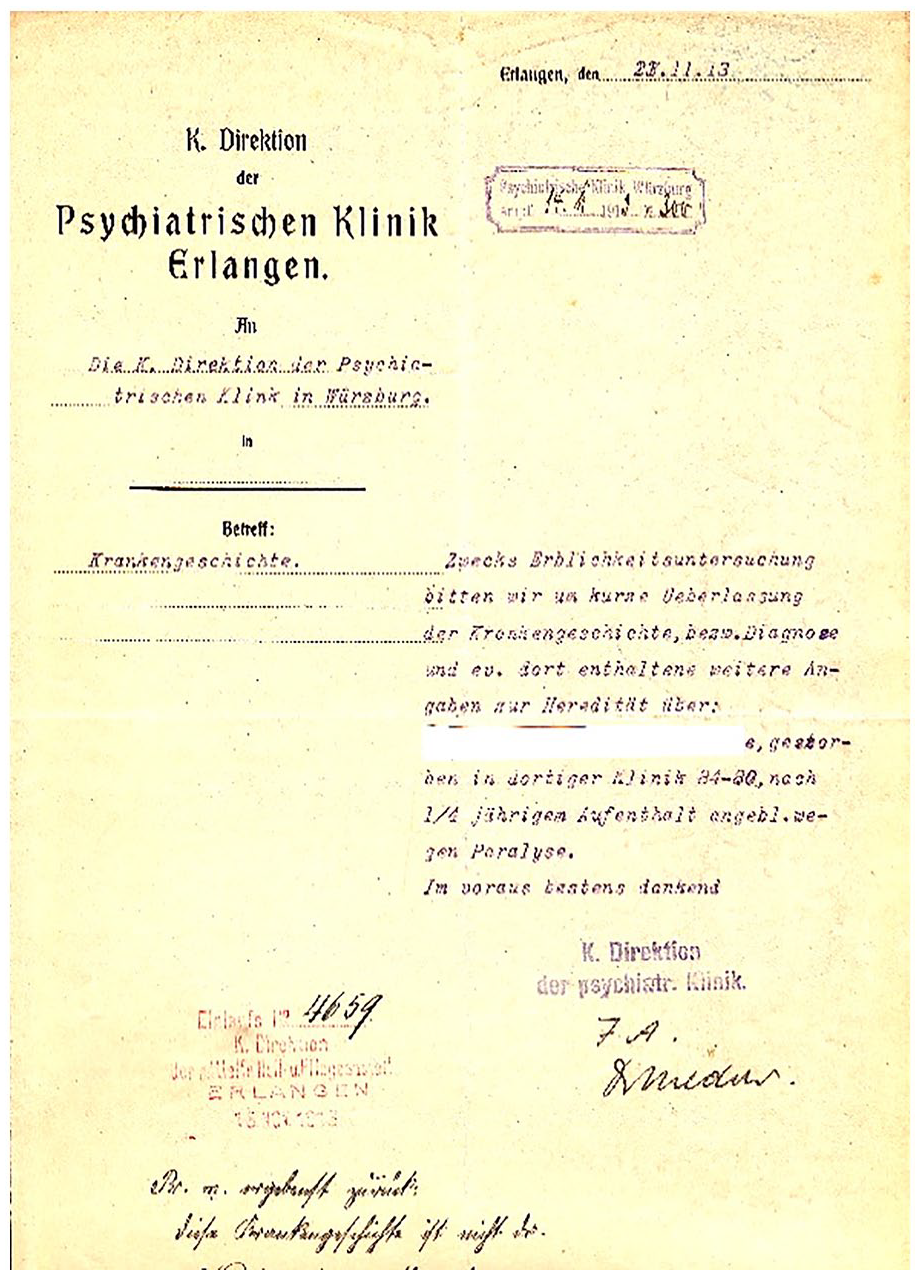
Medow’s request for a hereditary examination of a patient (source: APNK, Aufnr: 4659 integrated in 4357).
According to Medow (1914: 528), ‘only Specht . . . has so far emphasized the hereditary significance, with reference to the psychopathic prevalence of illness in the sexes that was found in the cases he considered’. Medow showed he was an opponent of negative eugenics when he stated that ‘artificial sterilization proves to be virtually worthless as a means of preventing mental illness and that the minimal advantages cannot outweigh the serious opposing ethical concerns’ (p. 544). Instead, Medow was a supporter of positive eugenics in the sense of ‘caution in marrying overly endangered individuals and promoting natural hygiene and fighting against germ-cell-damaging poisons’ (p. 545). Specht himself may even be regarded as sceptical about positive eugenics (Specht, 1917; see also Braun and Kornhuber, 2014d, 2021a). His position on hereditary hygienic measures changed in the context of increasingly dominant racial hygienic efforts. While Specht once promoted and partially surpassed Medow’s detached approach to eugenic measures, he later allowed his senior physician, Berthold Kihn, to propagate a negative eugenics adapted to the doctrine of the Nazi regime (Kihn, 1932; see also Braun, 2021c). In his letter of recommendation for Kihn, Specht emphasized that ‘Kihn had already paid attention to the theory of hereditary health . . . in 1931 10 in a study on the elimination of inferiors and in his treatment of choreatic phenomena’ (Proposals for the reoccupation of the vacated professorship of Gustav Specht, 12 May 1934, UAE: II, 1, 53; see also Kihn, 1933). While still an emeritus professor, Specht assigned a dissertation topic on ‘The offspring of schizophrenics and the GZVeN [Law for the Prevention of Genetically Diseased Offspring]’ (Fuchs, 1936).
The Nazi years
Specht’s change of perspective on hereditary health can be interpreted as an adaptation to the National Socialist regime. Similar motives might be behind his increasingly conciliatory behaviour toward Johannes Reinmüller (1877–1955), director of the Erlangen University Dental Clinic. On 4 April 1931 Specht ensured that he would be ‘considered excused from all senate meetings’ (UAE: II, 1, 53) by the Rector of Erlangen University, due to disagreements with Reinmöller: ‘That this voluntary-involuntary departure of mine from the Senate . . . leaves me with a profoundly painful feeling, will be understood.’ On 1 July 1931 Specht justified his actions in more detail: I do not want to reveal anything more about this either, about what unheard-of scenes on Reinmöller’s part we had to endure in the faculty. It can safely be said that nothing similar would have been tolerated in any faculty in Germany. In his defence, I once gave a psychiatric evaluation of his mental state to the faculty years ago. . . . Thus Prof. Reinmöller exerts a terrorizing influence in the senate, as he does in the faculty, which makes any objective discussion impossible.
Specht’s testimony that he provided a psychiatric evaluation of Reinmöller cannot be tested for accuracy. No such expert opinion could be found in the archival holdings consulted. Interestingly, Specht’s personnel file contains a letter from Reinmöller in Rostock to his colleague Hermann Euler (1878–1961), which reveals a kind of ‘nepotism’: Dear Euler! Many thanks for your letter! If you should move to Göttingen, I would not be fundamentally averse to going to Erlangen. Of course, the conditio sine qua non would be a tenured extraordinariate. I can’t possibly go back to being a private lecturer after years of being an associate professor and the first lecturer in our subject in Germany to be a full professor. Before I make a binding declaration, other questions would of course have to be discussed. If it should come to the point that you have decided to move to Göttingen, it would be best if I came to Erlangen for personal negotiations. With best regards. Reinmöller. (Reinmöller to Euler, 22 Nov. 1921, in UAE: II, 1, 53)
Reinmöller had received the first German chair of stomatology in Rostock in 1917, but in 1920 he was forced to resign because of his anti-republican statements. In 1921 he became a full professor at Erlangen, after Euler, who had been appointed to the Erlangen extraordinariate in 1911, had accepted the chair at Göttingen (Groß, 2018).
Specht’s personnel file also contains the following letter of recommendation from the Rostock Professor of Otorhinolaryngology, Otto Körner (1858–1935): Dear colleague! I’ll be glad to grant your wish. Reinmöller was not involved in the [Wolfgang] Kapp [1858–1922] Putsch. He was only falsely accused of this because of his known political views. After resigning from his professorship, he was still active as a speaker at political meetings on many occasions, most recently during the state elections at the beginning of this month, although he no longer appeared as the agent provocateur of the past, but only as a politician who was as calm and objective as possible. The patients, most of whom belong to the extreme left-wing parties, did not let his political appearance deter them from visiting his polyclinic. If he stays as he is now, I don’t think your university will have any trouble from his eventual appointment. Yours sincerely. Your humble servant O. Körner. (Letter, 23 March 1921, in UAE: II, 1, 53)
In the year of Adolf Hitler’s seizure of power, Reinmöller became Rector of the Friedrich-Alexander-University (Wendehorst, 1993: 187). On the occasion of Reinmöller’s 60th birthday on 25 May 1937, Specht sent his former adversary, who was Rector of the Julius-Maximilians-University of Würzburg from 1935 to 1937, ‘an old steel engraving of Erlangen in an old frame in memory of his years in Erlangen and the period when he worked in this responsible position’ (UAE: II, 1, 53). This gesture could indicate Specht’s efforts at a late reconciliation or his courting of protection by Reinmöller, a member of the NSDAP, SA and SS. 11
Historical context of psychiatry
Specht stands at the beginning of the split between university psychiatry and institutional psychiatry and ‘at the border of two psychiatric worlds, the time before and after Kraepelin and Wernicke’ (Kleist, 1941: 233). In the late nineteenth century, he was confronted with the increasing tendency of German-speaking psychiatry to move towards pure brain psychiatry. ‘The most prominent representatives of this direction were the Viennese Ordinarius Theodor Meynert (1883–1893) as well as the Breslau Ordinarius Carl Wernicke (1848–1905)’ (Ackerknecht, 1985: 73). 12 Parallel to the increasing importance of brain pathology, ‘gradually the clinical school . . . developed, which was to find its culmination in Kraepelin’ (Kleist, 1941: 233). Instead of defining the disease by classifying the symptoms as a cross-sectional diagnosis, the focus was to be on observing its overall progress in order to find a longitudinal diagnosis. After Specht had become acquainted with the purely psychological approach under ‘Hofrath’ (= councillor) Wilhelm Hagen (e.g. Hagen, 1841, 1847) and came to appreciate it, he was introduced to experimental-anatomical studies of the nervous system by Anton Bumm (e.g. Bumm, 1882, 1902) as a student of Bernhard von Gudden (1824–86; Steinberg and Falkai, 2021). Specht strove for a somatic and brain-pathological foundation of manic-melancholic insanity. Thus, he wrote on the relationship of the psychovegetative and diencephalon, arguing that ‘with the inclusion of the anatomically and physiologically vegetative nervous system in psychiatric research, a piece of brain territory has again been won for psychiatry, and that alone is worth talking about . . .’ (Specht, 1923: 443). A chapter by Specht (1924b) was also published in Die Lebensnerven, edited by Ludwig Robert Müller (1870–1962), the pioneer of autonomic nervous system research. 13 Specht’s psychopathological focus eventually broadened to include a neuro- and brain-pathological approach; ‘That these are but two separate paths to a common goal, however, he knew all along’ (Kleist, 1941: 235).
Specht’s scientific significance from today’s perspective
On 18 December 1935 the Bavarian State Ministry for Instruction and Education decided against congratulating Gustav Specht on his 75th birthday: ‘Prof. Specht has received a congratulatory letter for his 70th birthday. On the occasion of the 75th birthday, congratulations are only given to figures who occupy a very special position in scientific and public life’ (BayHSt: MK 44365). This was followed by a note, dated 2 October 1939 and headed ‘Honouring dismissed university teachers’, according to which ‘a letter of congratulations (on his 80th birthday) . . . was sent to Gustav Specht. There are no concerns about past and present political stances, nor about ancestry or previous membership of the Freemasons.’ This would have been a year earlier, but whether Gustav Specht actually received premature 80th birthday congratulations on his 79th birthday from the Bavarian Ministry cannot be determined.
Bipolarity
The recent genetic research results of the Swiss psychiatrist Jules Angst and the Italian-Swedish psychiatrist Carlo Perris (1928–2000) led to the differentiation of monopolar depression from the bipolar forms including pure mania (Angst and Marneros, 2001; Mühlbacher 2009). However, there are indications that a considerable proportion of supposedly unipolar recurrent depressions can be assigned to the bipolar spectrum in terms of progression, complications and treatment response, although the diagnostic criteria and treatment guidelines applied to date have so far paid little attention to this relatively new finding. The most important discriminatory component seems to be the constitutional predisposition to mood swings, not only into the depressive but also into the manic or at least hypomanic range (Yazici, 2014). This differential diagnostic dilemma lends renewed currency to some of Specht’s views. According to Specht (1901: 18–19), in the subsiding of a depressive psychosis, especially of the melancholic phase of a cyclic disorder . . . one not infrequently has the opportunity, as is well known, to observe a shifting-over of the contrary state patterns of melancholy and mania in the most manifold variations.
The special characteristic of the manic-depressive forms lay in their periodicity, Specht contended, whereas in simple melancholy or mania there could be no ignoring their great tendency to recurrence. However, the difference between recurrence and periodic recurrence remained undetermined (Specht, 1908a: 468). A recent publication shows results that unipolar mania has clinical characteristics that distinguish it from classic bipolar affective disorder (Yazici, 2014). The debate as to whether unipolar mania is a specific subtype of bipolar affective disorder or possibly a distinct nosological entity has still not reached a clear answer. In this context, Specht’s strict separation of the secondary manic permanent state from genuine chronic mania is worthy of note (Specht, 1905; see also Klüber, 1931).
Borderline personality disorder
Specht’s work ‘Ueber Hystermelancholie’ (Specht, 1906b) can be regarded as ground-breaking for our current understanding of the emotionally unstable borderline personality disorder (Stern, 1938). For Specht, too much theorizing was cultivated within the hysteria question, although it should be noted that in the medical categories of the time, this functional neurosis was composed of a constellation of the following symptoms: mood and character abnormality, seizures, sensory and sensitive disturbances, painful pressure points and paralysis with or without contractures (Schmiedebach, 2015). Today, the tendency to self-harm in borderline psychosis patients is countered by various measures, including teaching ‘skills’ to reduce cutting pressure, whereas Specht’s therapeutic motto for hysteromelancholic patients was ‘exceptional circumstances alone require exceptional measures’ (Specht, 1906b: 554). Thus, after mechanical restraint, Specht’s female patients were given ‘prompt psychic sedation’. In many cases the most prominent symptom is the suicidal tendency in the form of a persistently active instinct for self-destruction. Where this symptom appears, one may first think of hysteromelancholy. Whereas in other forms of melancholy we must always reckon with the occasional or furtive appearance of this danger, here it confronts us obtrusively in continual alarms, and is rendered all the more disagreeable by the fact that one may feel helpless in the face of it. (p. 553)
In particular, Specht emphasized ‘that these patients are indeed suffering severely’ (p. 554), and that the pain of the patients was deep-seated; he wanted the clinical picture to be described on the basis of broad clinical observation. Specht’s hope that the ‘disease form of hysteromelancholy . . . will definitely receive the clinical position it deserves’ (p. 557) has been fulfilled in the current clinical diagnosis of ‘emotionally unstable borderline personality disorder’.
Psychopathological discourse
Specht (1908a: 469) used the expression ‘terminological triviality’ to describe the established term ‘manic-depressive’, wanting to see it replaced by ‘manic-melancholic’. In doing so, he was pleading for a revitalization of the term ‘melancholia’, which in the nineteenth century had experienced a similar loss of meaning as the term ‘depression’ would undergo over the course of the twentieth century. This development towards a synonym for any undifferentiated degradation continues into the present century (Schott and Tölle, 2006: 412). Well-founded psychopathological knowledge can also help in the future to do justice, as far as possible, to the individual mental disorder of a patient suffering from depression.
The final words are those of Specht, in a statement that shows us the importance of an adequate psychopathological discourse: What presents itself to us in the bright light of immediate experience is psychopathic symptoms; they are our specific field of research. Distinguishing and summarizing them remains our very first task even if one day we move closer to the ideal conclusion of our discipline. (Specht, 1924b: 547)
Footnotes
Acknowledgements
Thanks to Frau Gerlinde Seeger, Frau Renate Wünschmann and Herrn Dr. Clemens Wachter. The topic of this paper was presented at the DGPPN-Kongress in Berlin (Braun and Kornhuber, 2014d), and we thank those who took part in the discussion.
Declaration of conflicting interests
The author(s) declared no potential conflicts of interest with respect to the research, authorship and/or publication of this article.
Funding
The author(s) received no financial support for the research, authorship and/or publication of this article.