




Abstract
Social situations are key determinants of cognition and behavior, and although several frameworks for representing situations have been proposed, these remain partial, nonintegrated, and not systematically mapped onto the rich space of situations encountered in everyday life. We address this problem by analyzing more than 20,000 detailed textual descriptions of dyadic social interactions obtained from participant-generated stories, published fiction, blogs, and autobiographical narratives. Our main methodological contribution is to use generative artificial intelligence to code these textual descriptions along a very large set of features and derive a detailed taxonomy of situational classes or categories of social interactions. We subsequently relate these situational classes to high-level situational variables like conflict, power, and duty, which have been identified by prior theory. In this way, our article provides a comprehensive, data-driven, and integrative framework for quantifying situational structure, advancing the study of social cognition and behavior.
Social situations exert a profound influence on human behavior and mental life (Bowers, 1973; Rauthmann et al., 2015; Reis, 2008; Ross & Nisbett, 1991). The same individual may act very differently and experience different mental states in different situations. Variations in situational context can also alter subjective evaluations, goals, and moral judgments regarding events and behaviors. For this reason, understanding the structure and dimensions of social situations has been a major topic of research in psychology for several decades (for reviews, see Rauthmann & Sherman, 2020; Ten Berge & De Raad, 1999; Yang et al., 2009).
Typically, different frameworks for understanding the structure of social situations emphasize different types of situational characteristics and are driven by distinct theoretical perspectives and empirical methods. For example, interdependence theory (IDT; Gerpott et al., 2018; Kelley & Thibaut, 1978) focuses on the nature of interactions between people and how these are shaped by people’s goals and their abilities to achieve their goals. By contrast, DIAMONDS (Rauthmann et al., 2014) (Duty, Intellect, Adversity, Mating, pOsitivity, Negativity, Deception, and Sociality) uses empirical assessment tools based on factor analyses of people's ratings of brief, one-sentence situational descriptions, whereas CAPTION (Parrigon et al., 2017; Complexity, Adversity, Positive Valence, Typicality, Importance, Humor, and Negative Valence) relies on lexical analysis of single-word adjectives in large-scale language data. Each proposes a distinct taxonomy of situational characteristics, with some variables that are shared and others that are unique.
The characteristics identified by IDT, DIAMONDS, and CAPTION correspond to high-level variables that drive human behavior and evaluation in social settings. Although significant research has examined which characteristics matter most, how they can be measured, and how they influence behavior (Columbus et al., 2021; Finkel et al., 2002; Gerpott et al., 2018; Halevy & Phillips, 2015; Rauthmann & Sherman, 2023; Thielmann et al., 2020), we currently do not have a rigorous understanding of how these characteristics relate to the situations commonly encountered in daily life. This is due to the diversity and complexity of real-life situations. Unlike the study of human personality, in which a modest sample of individuals rating themselves on a modest sample of personality traits can yield stable and predictive profiles, carving up the space of situations, and mapping different regions in this space to high-level situational characteristics, requires thousands of distinct situations (to ensure sufficient diversity) as well as rich descriptions of each situation (to provide sufficient details). Obtaining and coding such a data set is not feasible using standard survey-based methods, yet it is crucial if we are to make progress on one of the central research problems in psychology.
We address this challenge in this article. The centerpiece of our analysis is a large data set of short stories describing social interactions in daily life, generated by online participants (Mostafazadeh et al., 2016). We supplement this with short situational descriptions from several other types of sources, including blogs, novels, fiction published on social media, and reading-comprehension exams (Reddy et al., 2019; Rogers et al., 2020). We also study participant-generated autobiographical experiences from previous studies (Gerpott et al., 2018) and from a new study. In all, we analyze more than 20,000 dyadic situations—interactions between two people—with each situation described using several sentences of text.
Human coding of such a rich data set is not feasible, so we bring a new technological development to our empirical plan: artificial intelligence. We use a combination of different large-language-model (LLM) techniques (Brown et al., 2020; Devlin et al., 2019; Mikolov et al., 2013; Reimers & Gurevych, 2019) to extract high-level situational characteristics identified by IDT, DIAMONDS, and CAPTION from our data sets, as well as core situational cues like relationships, activities, locations, and goals (who, what, where, and why) that make up the observable dimensions of each situation (see also Bhatia & Aka, 2022; Bhatia et al., 2024; Demszky et al., 2023; Mihalcea et al., 2024). Drawing on the ideas of Rauthmann et al. (2014, 2015), we use the distribution of the situational cues to categorize situations into a discrete set of situational classes, which we then analyze in terms of the high-level psychological characteristics specified by IDT, DIAMONDS, and CAPTION. In this way, we provide a rigorous and integrative framework for mapping out everyday social situations and relating them to key theoretical dimensions in psychology.
Research Transparency Statement
New Survey on Social Situations
Main Analysis
Validation Studies
Study 1 (Validation on Existing Data).
Studies 2a and 2b (Validation on New Data).
Studies 3a and 3b (Expanded Validation Across the Full Rating Spectrum).
Study 4 (Validation of Dyadic Interaction Filtering).
Study 5 (Reliability Tests and Between-Model Consistency).
Study 6 (Evaluating Additional Models on Existing Data).
Study 7 (Evaluating Word-Embedding Approaches for Cue Classification).
Situational Variables
Situational characteristics
Rauthmann et al. (2014, 2015) describe situational representations as consisting of characteristics, classes, and cues. Characteristics refer to high-level (potentially subjective) psychological variables that capture core situational properties and determine how situations affect cognition and behavior. For our analysis, we specify twenty different characteristics, which we draw from existing taxonomies of situational structure.
Interdependence theory
The first of these taxonomies is interdependence theory (IDT; Kelley et al., 2003; Kelley & Thibaut, 1978). IDT focuses primarily on dyadic social situations and uses game-theoretic matrices to represent interactions. By analyzing the structure of such matrices, researchers have identified four dimensions that describe the key characteristics of interdependence across situations: mutual dependence (the degree to which the two parties are dependent on one another, or how much each party’s outcomes depend on how each acts); conflict (the degree to which the actions that result in the best outcome for one party result in the worst outcome for the other, or the covariation of interests in the situation); coordination (the degree to which one party’s actions influence how much a partner’s actions determine that party’s outcomes, or the joint control vs. partner control of the two parties); and power (the degree to which one party’s actions asymmetrically determine their own and the other’s outcomes; Gerpott et al., 2018; Halevy et al., 2012; Kelley et al., 2003; Kelley & Thibaut, 1978; Rusbult & Van Lange, 2008; Wolf et al., 2008). Subsequent work has added two additional dimensions to the original set of four: future interdependence (the degree to which actions in the situation can influence future outcomes and interactions, capturing the temporal structure of the situation) and information certainty (the degree to which each individual knows the other’s preferred outcomes and ability to influence outcomes; Gerpott et al., 2018; Kelley et al., 2003; Rusbult & Van Lange, 2008).
IDT has informed research on situational construal, highlighting how individuals’ perceptions and interpretations of interdependence shape their goals, motives, and actions in social interactions. For this reason, it has been applied to several psychological domains including the analysis of close relationships, of prosocial behavior, and of organizational behavior (Bachrach et al., 2006; Columbus et al., 2021; Finkel et al., 2002; Gerpott et al., 2018; Halevy & Phillips, 2015; Rusbult & Van Lange, 2003; Thielmann et al., 2020). Most relevant to this article, Gerpott et al. (2018) examined the degree to which people can differentiate situations on the six dimensions of IDT. They have found that all of these dimensions except for coordination yield reliable assessments. On the basis of this result, Gerpott et al. developed the Situational Interdependence Scale (SIS), which provides a multidimensional measure of the key properties of situations proposed by IDT. Our analysis here is based on the five dimensions of this scale—mutual dependence, conflict, power, future interdependence, and information certainty—and we use the wording of the SIS items for these dimensions to generate our LLM coding prompts. See Table 1 for a summary of IDT variables, and see Table A1 in the Appendix for examples of situations that are high on the IDT dimensions in our analysis.
Summary of Core Variables
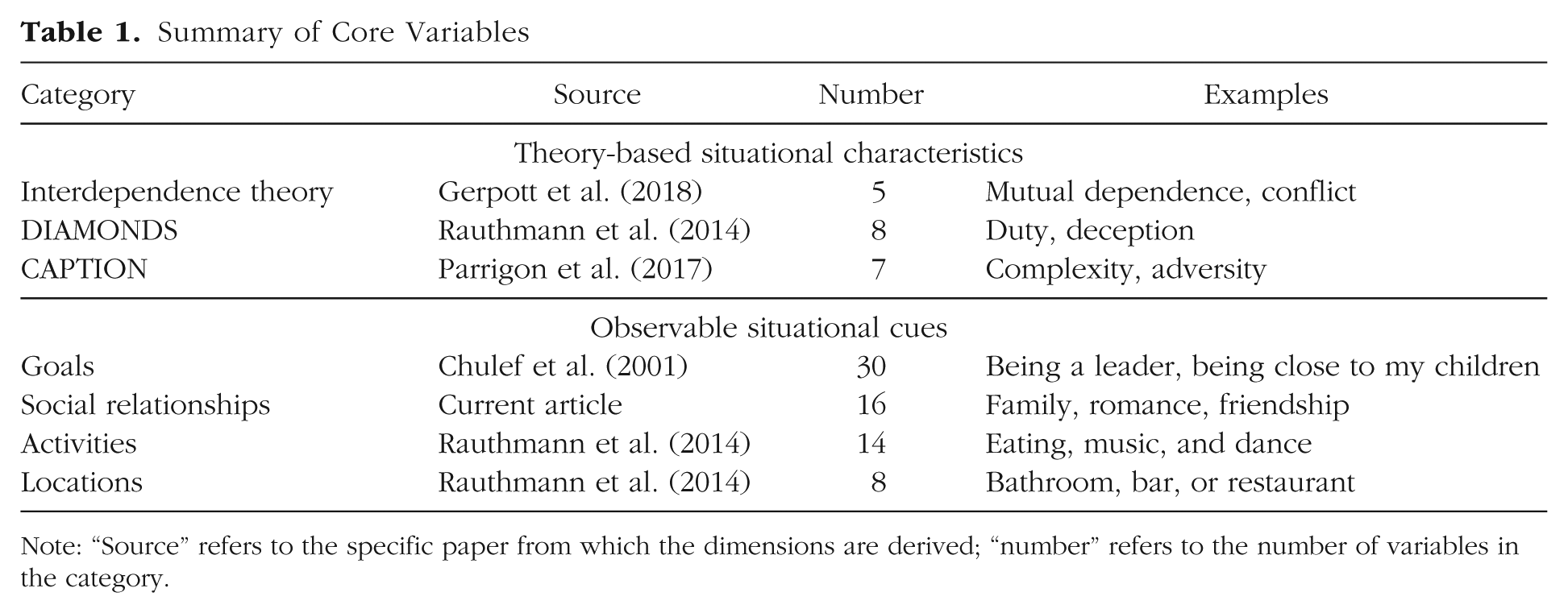
Note: “Source” refers to the specific paper from which the dimensions are derived; “number” refers to the number of variables in the category.
Diamonds
There also exist several alternate taxonomies that have a broader scope than IDT and include various nonsocial dimensions, which are likely to correlate and interact with the IDT variables in systematic ways (for reviews, see Rauthmann & Sherman, 2020; Ten Berge & De Raad, 1999; Yang et al., 2009). In this article, we combine our analysis of IDT with situational dimensions identified by two such situational taxonomies: DIAMONDS (Rauthmann et al., 2014) and CAPTION (Parrigon et al., 2017).
Rauthmann et al. (2014) derived the DIAMONDS taxonomy by factor-analyzing participant ratings of single-sentence items in the Riverside Situational Q-sort (RSQ), which they developed to be a comprehensive and inclusive inventory of situational descriptions (Sherman et al., 2010). Eight major dimensions consistently appeared in their analysis: duty (work-related qualities and social norms), intellect (intellectual engagement), adversity (threats and problems), mating (sexual and romantic content), positivity (pleasant and enjoyable aspects), negativity (unpleasant and stressful aspects), deception (mistrust and dishonesty), and sociality (social interaction and relationship formation). Rauthmann et al. found that each dimension was systematically related to specific situation cues, goal affordances, and behaviors, highlighting the conceptual value of the DIAMONDS model for organizing the vast and unconstrained space of situations in terms of their psychological characteristics. The DIAMONDS dimensions, and more generally the situational characteristics used in the RSQ from which it is derived, have also been shown to be useful in many applications, including in understanding perceptions of situational similarity, the link between personality and behavior, cross-cultural differences, and consequences of the COVID pandemic (Funder et al., 2021; Guillaume et al., 2016; Rauthmann & Sherman, 2023; Sherman et al., 2010). Finally, Rauthmann et al. used the DIAMONDS dimensions to construct a shorter form of the original RSQ, called RSQ-8, the wording of which we adapt in our coding analysis.
Caption
Although DIAMONDS relies on participant ratings of sentence-level situational descriptions, the CAPTION framework (Parrigon et al., 2017) is based on the analysis of single-word adjectives, allowing its proponents to consider a very large set of distinct situational properties. In all, Parrigon et al. identified seven major situation characteristics: complexity, adversity, positive valence, typicality, importance, humor, and negative valence. The complexity dimension captures the intricacy and intellectual stimulation of a situation; adversity reflects situations that are difficult and depleting; the positive- and negative-valence dimensions measure the overall positivity or negativity of a situation, respectively; typicality assesses how common and routine a situation is perceived to be; importance captures the significance and goal-relevance of a situation; and the humor dimension measures the lightheartedness and comedy in a situation. Notably, Parrigon et al. found that the CAPTION model is able to predict personality-relevant behaviors, emotions, and other psychological characteristics, in addition to other situational taxonomies like DIAMONDS. Finally, Parrigon et al. used the correlational structure of the adjectives to derive a smaller set of single-word items that capture the seven dimensions of CAPTION. We use this set of items for automated coding of CAPTION in our analysis. See Table 1 for a summary of DIAMONDS and CAPTION, and Table A1 in the Appendix for examples of situations that are high on these dimensions in our analysis.
Situational cues
In addition to situational characteristics, situations can be grouped into classes, or recurring situational templates. Although some prior taxonomies have attempted to empirically derive situational classes (Ten Berge & De Raad, 2001; Van Heck, 1984), these frameworks are fairly low in resolution and not systematically derived from established theory. By contrast, we derive situation classes from situational cues, which Rauthmann et al. (2014) defined as fundamental observable elements of situations that shape how they are represented. Specifically, we focus on four types of cues—who, what, where, and why—which we approximate using 68 distinct relationships, activities, locations, and goals at play in the situation respectively. These four types of cues have considerable presence in the literature on situations in psychology. For example, goals are closely related to IDT’s characteristics, as the specific configuration of goals determines the degree of dependence or conflict in the interaction. Goals are also likely to correlate systematically with the dimensions of the DIAMONDS and CAPTION taxonomies (e.g., situations high in the duty dimension may be associated with achievement-oriented or moral goals; see Yang et al., 2009, for a discussion). There are several existing instruments to measure individuals’ goals, however, we use a diverse and inclusive set of 30 goal clusters compiled by Chulef et al. (2001).
An additional category of cues relevant for our project is the specific type of social relationship between the actors. Relationships provide cues that shape individuals’ goals, expectations, and behaviors (Baldwin, 1992; Fiske, 1992; Haslam & Fiske, 1999; see Pervin, 1976, for an early taxonomy that stresses the value of social relationships for organizing situational structure, and Rauthmann et al., 2015, for a discussion of the role of such cues in situation representation). Unsurprisingly, one of the main applications of IDT has been in the study of close relationships (Holmes, 2000; Rusbult & Van Lange, 2003). However, less well understood is the association between the specific types of social relationships and the situational characteristics identified by the IDT, DIAMONDS, and CAPTION taxonomies discussed above. To test this, we compile a list of 16 different types of social relationships, and we code for these relationships in our analysis.
The final category of situational cues we consider pertains to the activities and locations of the interaction. Although not as theoretically central as goals and relationships, activities and locations nonetheless provide important contextual information (Rauthmann et al., 2015). The DIAMONDS taxonomy has been correlated with activities and locations in previous research (Rauthmann et al., 2014). In our current study, we aim to extend this line of inquiry by examining the co-occurrence of the twenty-two activities and locations tested in Rauthmann et al. with a broader set of situational characteristics. See Table 1 for a summary of the goals, relationships, activities, and locations analyzed in this article.
Data Sets
Existing data sets
Most prior work on situational analysis, including applications of IDT, DIAMONDS, and CAPTION, has relied on participant-generated ratings of situations (e.g., Gerpott et al., 2018; Parrigon et al., 2017; Rauthmann et al., 2014). However, this approach is impractical here, given the 88 distinct variables coded in this study. Instead, we analyze a total of 21,236 open-ended textual descriptions from multiple existing data sets, as well as one new data set. Our primary data set is ROCStories (Mostafazadeh et al., 2016), which consists of short participant-generated stories describing everyday events. We supplement this with descriptions from published fiction, online fiction, online blogs, reading-comprehension exams, and autobiographical summaries taken from the Conversational Question Answering (CoQA) data set (Reddy et al., 2019), the QuAIL data set (Rogers et al., 2020), and from Gerpott et al. (2018). These data sets are summarized in Table 2 and described in detail in the Supplemental Material available online (Section 1).
Data Sets Used
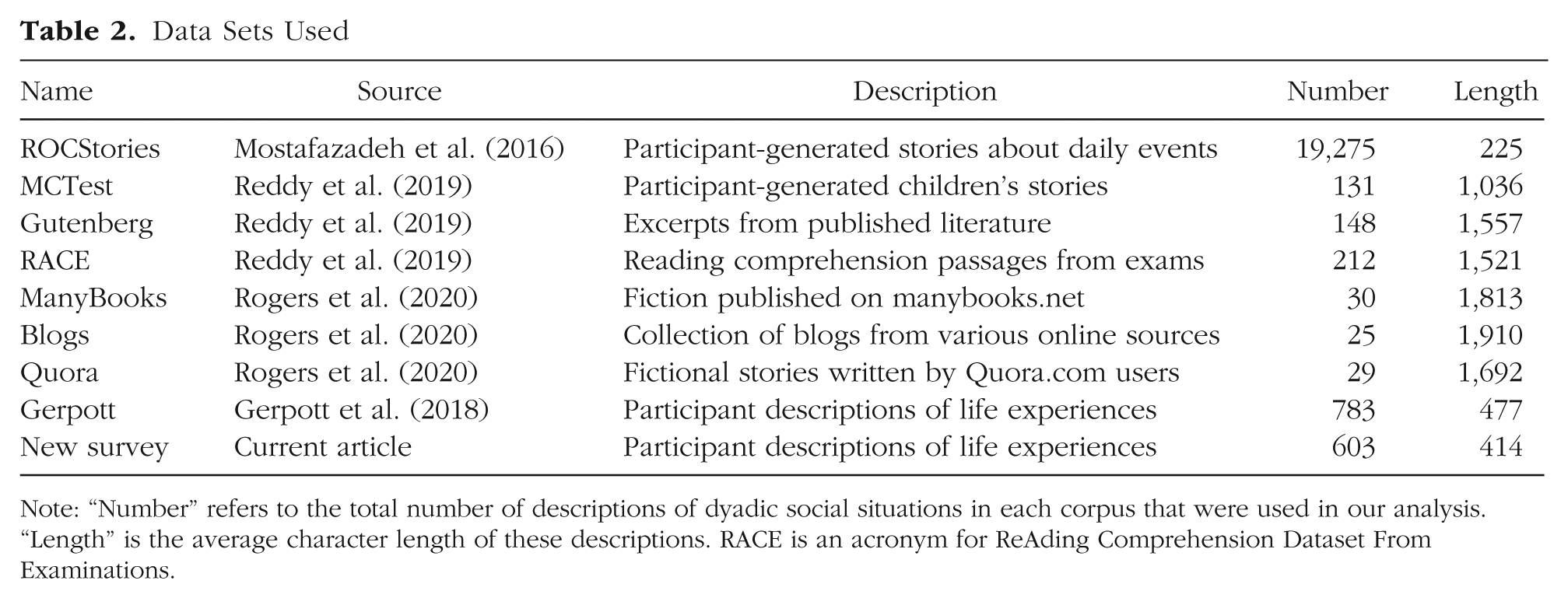
Note: “Number” refers to the total number of descriptions of dyadic social situations in each corpus that were used in our analysis. “Length” is the average character length of these descriptions. RACE is an acronym for ReAding Comprehension Dataset From Examinations.
New survey
In addition to analyzing existing data sets, we also collected new data in the form of text passages written by 201 participants that we recruited from Prolific Academic (Mage = 45 years; 58% female). Participants were U.S.-based and fluent in English, and they had an approval rate of 99+ and 10+ prior successful submissions on the platform. This was a convenience sample large enough for us to evaluate the representativeness of the content of our main data set (ROCStories). All participants were asked to generate three descriptions of social situations from their own lives in which they interacted with one (and only one) other person. Each description had to be at least 250 words in length, and participants were asked to include all relevant situational factors in the description. Participants also had to describe their relationship with their partner in a short sentence. To discourage the use of generative AI for solving this task, we did not allow participants to copy and paste text into the survey-input boxes (rather, they had to directly type their responses into these boxes). This survey generated a total of 603 autobiographical descriptions of dyadic social interactions.
Automated Coding
Pipeline
We analyzed textual descriptions of social situations using a suite of large-language-modeling techniques, including generative AI (GPT-3.5 and GPT-4; Brown et al., 2020), sentence embeddings from mpnet-base SBERT (Devlin et al., 2019; Reimers & Gurevych, 2019; Song et al., 2020), and word embeddings from Word2vec (W2V; Mikolov et al., 2013). The full coding procedure involved the following steps (see Fig. 1):
Identify dyadic interactions: GPT-4 first categorized each text as describing either an individual, a dyadic interaction, or a multiperson interaction. Only dyadic situations were retained for analysis.
Extract actors, relationships, and goals: GPT-3.5 turbo extracted a short textual description of primary actors, their partners, the relationship between them, and each individual’s higher-order goals.
Code relationships: We used distributed dictionary analysis (Garten et al., 2018) to classify relationships extracted in Step 2 into 16 categories. This was done using cosine similarity with Word2vec embeddings for different relationship words.
Code goals: Using distributed dictionary analysis, goal descriptions from Step 2 were mapped onto 135 goal categories from Chulef et al. (2001) using SBERT-based cosine similarity analysis. Goals were then aggregated into 30 variables for analysis using goal clusters specified by Chulef et al.
Code IDT dimensions: GPT-4 rated each situation on the five IDT dimensions (mutual dependence, conflict, power, future interdependence, and information certainty) using a 5-point scale adapted from Gerpott et al. (2018). We recoded the power variable in this scale into power asymmetry (low values for equal-power situations and high values for situations in which one has more power than the other).
Code DIAMONDS dimensions: GPT-3.5-turbo rated each situation on the eight DIAMONDS using a 5-point scale adapted from Rauthmann et al. (2014).
Code CAPTION Dimensions: Situations were coded on CAPTION’s seven dimensions using Word2vec-based similarity between situational descriptions and CAPTION-associated word lists, as described in Parrigon et al. (2017).
Code activities and locations: We extracted 22 activities and locations from Rauthmann et al. (2014) and coded situation descriptions on these using the distributed dictionary analysis described in Step 3.
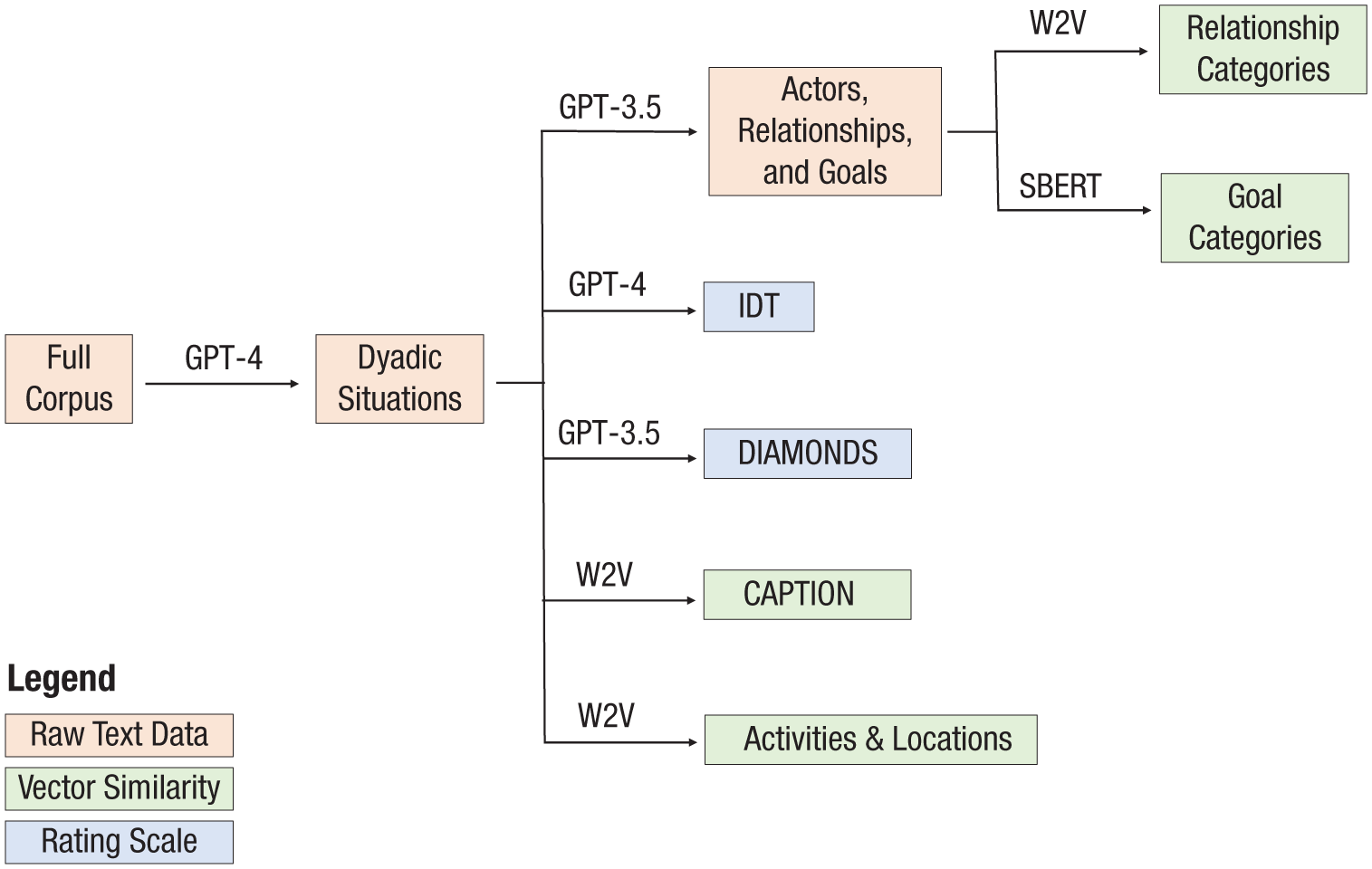
Overview of coding pipeline. We began with textual descriptions of social situations, which were passed through GPT-4 to determine whether they involved dyadic social interactions (Step 1). If so, these were then further coded into the key variables. First, we asked GPT to generate textual summaries of the actors, relationships, and goals in the text (Step 2), which we then coded on a smaller number of relationship (Step 3) and goal (Step 4) categories using cosine similarity, as assessed by Word2vec word embeddings (W2V) and Sentence-BERT sentence embeddings (SBERT), respectively. Then for the IDT (Step 5) and DIAMONDS (Step 6) variables we used GPT to provide ratings on the basis of the description in the text. Finally, CAPTION variables (Step 7) and the activities and locations (Step 8) were coded using cosine similarity, as assessed by Word2vec word embeddings (W2V). IDT = interdependence theory.
These steps are explained in detail in the Supplemental Material (Section 2; a list of all GPT prompts used is shown in Table S1, and word and sentence lists used in coding CAPTION dimensions, goals, relationships, and activities is shown in Table S2). At the time of the original analysis, our decisions to use different language models for different steps reflected both cost and capability constraints. For example, coding the IDT dimensions requires reasoning about potentially asymmetric relational structure (e.g., who holds power). In our own prior work, we found GPT-3.5 insufficient for these tasks (Bhatia, 2024), whereas GPT-4 had been shown by others to succeed in such cases (Han et al., 2024). By contrast, DIAMONDS dimensions are largely thematic, and prior work has shown GPT-3.5-class models perform well on such semantic annotation and text-classification tasks (Brown et al., 2020; Lepagnol et al., 2024; Puri & Catanzaro, 2019), making it a cost-effective choice. Similarly, we used Word2vec for classifying relationship, activity, and location categories, because these were typically expressed in single words (e.g., friend, eating, house), where word-level embeddings are sufficient to capture semantic content (Garten et al., 2018). By contrast, goals were expressed as full sentences (e.g., trying to get a promotion, wanting to spend more time with family). For these longer, compositional expressions, sentence-level embeddings from SBERT were necessary to provide a more accurate representation of meaning. We provide robustness and validation tests in the next section demonstrating the suitability of these methods.
Validation
To establish the validity of our coding approach, we conducted a series of validation studies (see Section 3 of the Supplemental Material). Study 1 applied GPT-4 to the Gerpott et al. (2018) data set, comparing its ratings of IDT dimensions to those of participants and trained human coders, and found that it achieved humanlike levels of agreement (Table S3). We then extended this analysis to new data from the ROCStories corpus in Studies 2a and 2b. Here we compared GPT’s high- and low-rated stories with human ratings (Figs. S1a and S1b in the Supplemental Material), and we found that found that human judgments consistently distinguished between these two categories. To address limitations of this known-groups design, in Studies 3a and 3b we repeated the experiments after sampling evenly across the full rating spectrum (1–5). These studies confirmed that human ratings aligned with GPT ratings across the entire scale (see Table S4). Study 4 then validated and confirmed the accuracy of the dyadic data-filtering step at the start of our analysis.
We also evaluated the reliability and consistency of the language models. In Study 5, GPT-4 showed strong test-retest reliability across both IDT and DIAMONDS dimensions, whereas GPT-3.5-class models (including Llama-3 and DeepSeek-V3 (Grattafiori et al., 2024; DeepSeek-AI et al., 2024) were reliable only for DIAMONDS (see Figs. S2a and 2b in the Supplemental Material). Study 6 further confirmed that only GPT-4 achieved high accuracy on the Gerpott benchmark data set (Table S5). Finally, in Study 7 we found that GloVe (Pennington et al., 2014), an alternate word-embedding model, produces results that are nearly identical to Word2vec for categorizing relationships, activities, and locations. Overall, our validation tests demonstrated the suitability of our specific LLM model choices for each step of our pipeline, confirm that their outputs mimic those of human coders, and indicate that the specific results are robust to the use of different models within the same class (e.g., replacing GPT-3.5 with Llama-3 or Word2vec with GloVe).
Results
Frequencies of variables
On the basis of the results of our validation studies, we concluded that our methodological approach is well-suited to the task of situational structure extraction at scale. Now we apply this approach to analyze situational structure in the ROCStories corpus—a large data set of short stories, describing everyday life events, that is generated by research participants. Of 52,666 stories in the 2017 release of ROCStories, 19,275 stories involved dyadic social interactions (as assessed by GPT in Step 1 of the coding pipeline described above). We passed the stories in this corpus through our coding pipeline in order to extract 68 situational cues corresponding to the goals, relationships, activities, and locations in the situations, along with 20 different theoretically relevant situational characteristics taken from the IDT, DIAMONDS, and CAPTION taxonomies.
Our first analysis examined the frequency of each characteristic and cue in the ROCStories data set (see Table S6). For IDT, we found that, on average, situations were high in mutual and future interdependence, but somewhat lower in conflict, power asymmetry, and information certainty. Average DIAMONDS ratings were likewise high in duty and sociability but low in mating and deception, and CAPTION ratings showed high positive valence and humor but low complexity and negative valence. Common goals involved sociability and entertainment, whereas religion, health, and aesthetics were rare. Family, romantic, and professional relationships were also prominent, as were home-based activities and locations. Although there is substantial nuance in the data set, these overall trends suggest the content of ROCStories (or at least the subset of dyadic situations that we analyze in this paper) skews toward socially oriented experiences with friends and family. This bias likely stems from the outsized role such connections play in people’s mental lives. (Later, we compare these variable frequencies with those autobiographical participant descriptions to evaluate the generalizability of this text corpus.)
Correlations of variables
To understand situational structure, we first examined correlations among the situational characteristics in our data set (Fig. S3). Within IDT, mutual dependence was strongly correlated with future interdependence and information certainty. Additionally, conflict was higher in interdependent contexts lacking information certainty and in situations with power asymmetries. Within DIAMONDS, adversity, deception, and negativity were strongly intercorrelated and were negatively related to positivity, sociability, and mating. For CAPTION, positive and negative valence correlated moderately because of shared emotional content but diverged on complexity (associated positively) and humor (associated negatively). Negative-valence dimensions for DIAMONDS and CAPTION were correlated with each other and with IDT’s conflict, whereas positive-valence dimensions correlated with IDT’s information certainty.
We also found meaningful correlations between situational characteristics and cues (Figs. S4 and S5). Conflict and negatively valenced situations were associated with goals such as defending against rejection or asserting freedom, whereas positive and cooperative settings were correlated with social goals. Achievement and career goals emerged prominently in situations high in future interdependence, intellect, and complexity. Social relationships also mapped systematically onto situational characteristics: family and friendships featured high information certainty and positivity, adversarial relationships featured high conflict and adversity, and caretaking roles featured power asymmetries. Activities related to cognitive growth (e.g., studying, reading) correlated with complexity, intellect, and future interdependence.
Situational classes
Although the relationships between situational cues and psychological characteristics are intuitive, they are too numerous and complex to describe exhaustively. To make the analysis tractable, we condensed the situations into discrete classes on the basis of the co-occurrence of situational cues. We used a combination of t-distributed stochastic neighbor embedding (t-SNE) (Van Der Maaten & Hinton, 2008) and k-means clustering (Steinley, 2006) for this process, and we used silhouette scores to select the optimal number of classes (k = 36; this number was shown to be stable across multiple random runs of the k-means clustering algorithm). We labeled each situational class on the basis of the 25 most prototypical situations in that class, using a combination of automated GPT-4o coding and manual refinement of GPT-generated labels. Figure 2 shows the situational classes generated through this process, and Table A2 presents descriptions of these classes along with the prototypical situation in each class. In addition to this first-level clustering, we conducted a second-level clustering analysis using the same k-means–silhouette procedure applied to the centroids of the 36 clustered identified about. This further grouped the clusters into three higher-order categories: (a) social, interpersonal, and romantic situations (SIR); (b) family, engagement, and community situations (FEC); and (c) transactional, institutional, and professional situations (TIP). Although the k-means procedure forces all classes into one of these categories, leading to a few less intuitive assignments (e.g., crimes and strange encounters grouped under FEC), the overall structure provides a clean and interpretable division of situational classes. The higher-order divisions are shown in Table A2 in the Appendix. Details of the clustering and labeling approach are provided in Section 4 of the Supplemental Material.
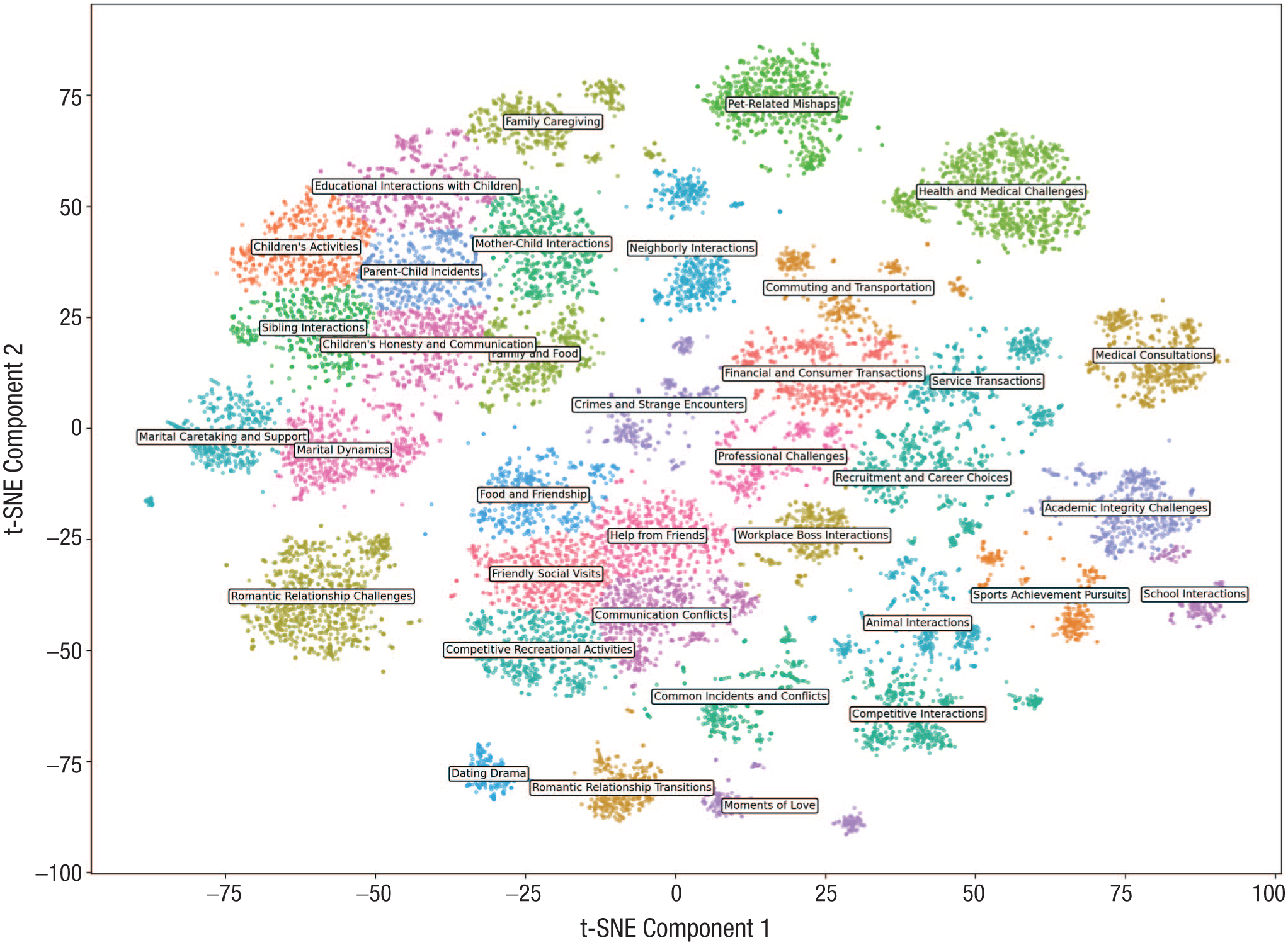
2-D projection of situations in the ROCStories corpus, clustered into 36 situational classes using k-means on the distribution of 68 situational cues (goals, relationships, activities, and locations). Each dot represents one situation, colored and labeled by its assigned class. t-SNE = t-distributed stochastic neighbor embedding.
Situational characteristics
To examine how situational characteristics varied across 36 situational classes, we computed effect sizes (Cohen’s d) for each characteristic within each situational class. Specifically, for every characteristic from the IDT, DIAMONDS, and CAPTION taxonomies, we compared its distribution within a given class to its distribution in all other classes. This analysis was repeated for all 36 classes and across all dimensions, and is shown in Figure 3, where rows represent classes and columns represent characteristics and cell values indicate effect size d. Characteristics with a higher effect size in a given class are much more commonly observed in that class than in other classes. Note that all absolute effect sizes greater than 0.058 cross the Bonferroni-corrected p value of .05/720 = .000069 for the associated t test, indicating that these results are not spurious patterns created by multiple comparisons.
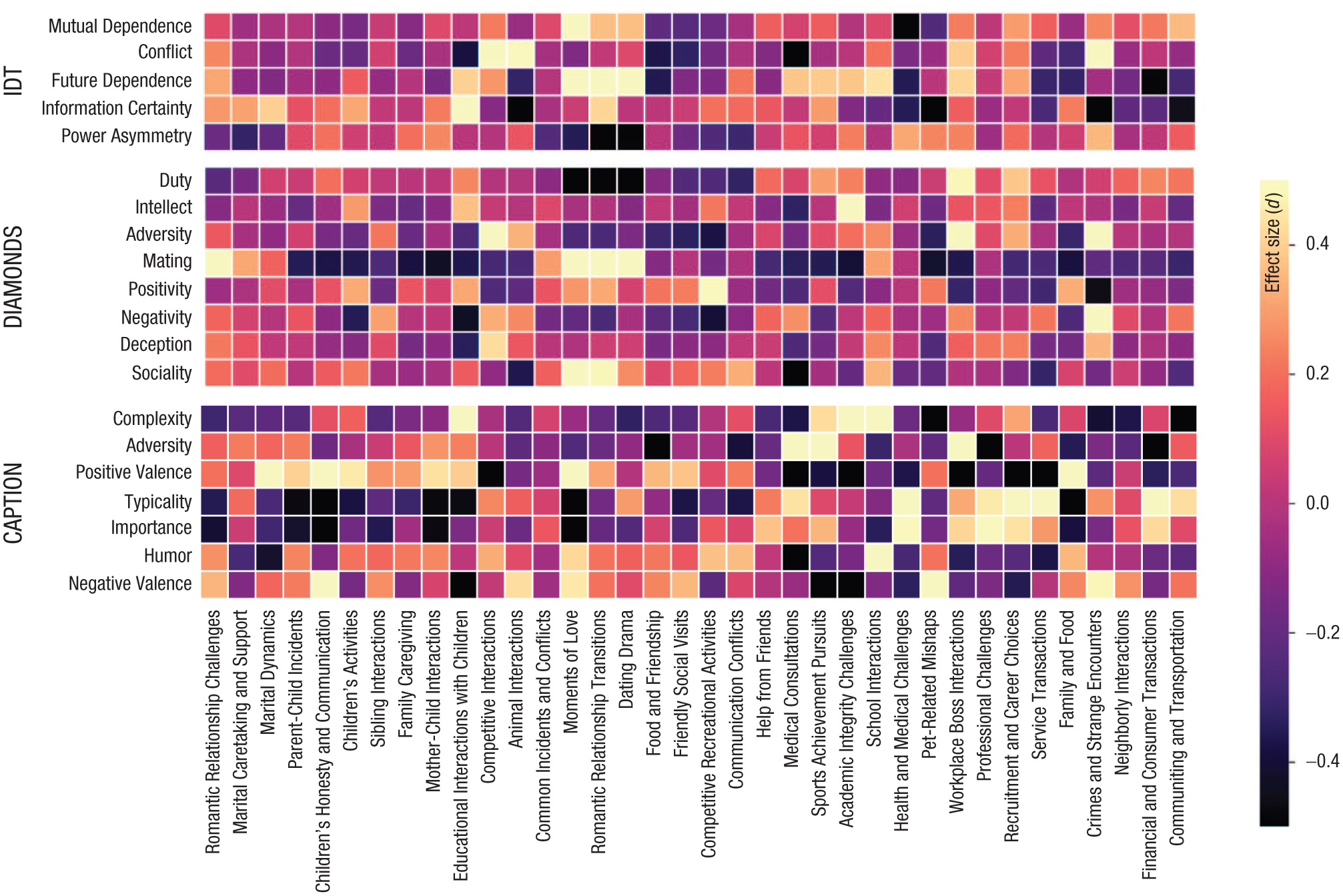
Heat map showing standardized effect sizes (Cohen’s d) for each situational characteristic across the 36 situational classes. Absolute effect sizes greater than 0.058 cross the Bonferroni-corrected p value of .05/720 = .000069 for the associated t test (this is roughly 55% of the effect sizes shown in the figure). IDT = interdependence theory.
We visualized subsets of these effects using two-dimensional scatterplots, plotting situation classes by their Cohen’s D scores on selected pairs of situation characteristics. Figure 4 plots situational classes by their effect sizes on IDT’s power asymmetry and conflict. The upper-right quadrant features high-conflict, high-power situations involving crime or workplace dynamics. The lower-left quadrant includes low-conflict, low-power contexts involving friendship and marriage. In contrast, medical consultations stand out in the lower-right quadrant as high in power asymmetry but low in conflict. Finally, the upper-left quadrant is mostly sparse. This could be because low-power differential situations may not involve high levels of conflict, or because when conflict is present in a situation, people focus on and describe the power asymmetries between the parties (Ury et al., 1988).
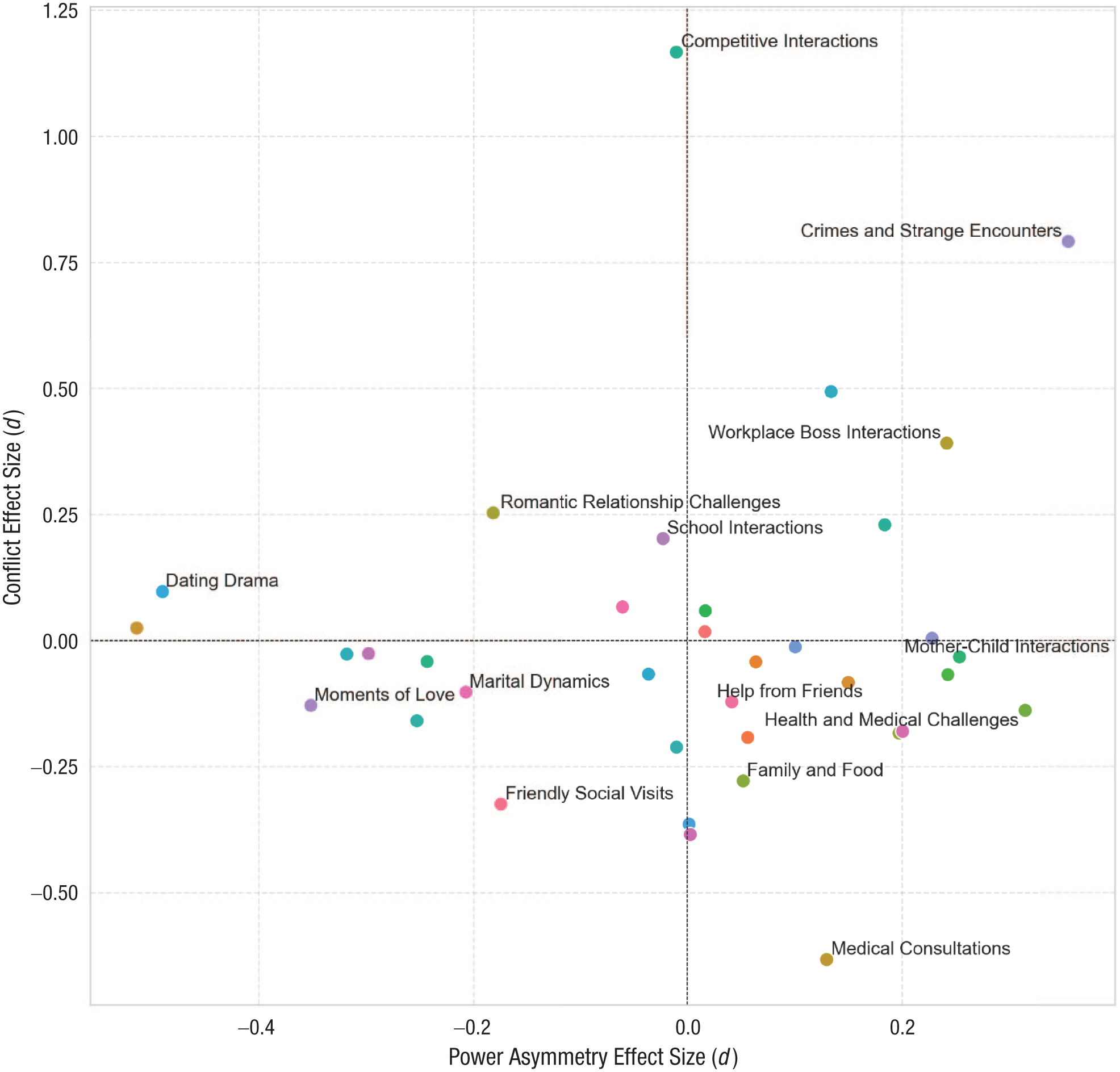
Situational classes plotted by their effect sizes (Cohen’s d) on power asymmetry (x-axis) and conflict (y-axis), two characteristics from the interdependence theory (IDT) taxonomy. Each point represents one of the 36 situational classes identified in Figure 2. Absolute effect sizes greater than 0.058 cross the Bonferroni corrected p value for the associated t test.
Figure 5 maps situational classes by their effect sizes on DIAMOND’s duty and sociality variables. The upper-right quadrant includes situations high in both duty and social connection, such as parenting. The upper-left quadrant features low-duty but high-sociality situations like romantic and social interactions. In the lower-right quadrant, professional and institutional situations show high duty but low sociality. Finally, the lower-left quadrant, which displays low-duty, low-sociality scenarios, is quite sparse, likely due to the limited range of interactions that occur without professional and moral obligations or interpersonal motives. Note that the three populated quadrants in this figure align with the three higher-order clusters identified earlier, suggesting that the space of situational classes identified in our analysis divides meaningfully along the dimensions of duty and sociality.
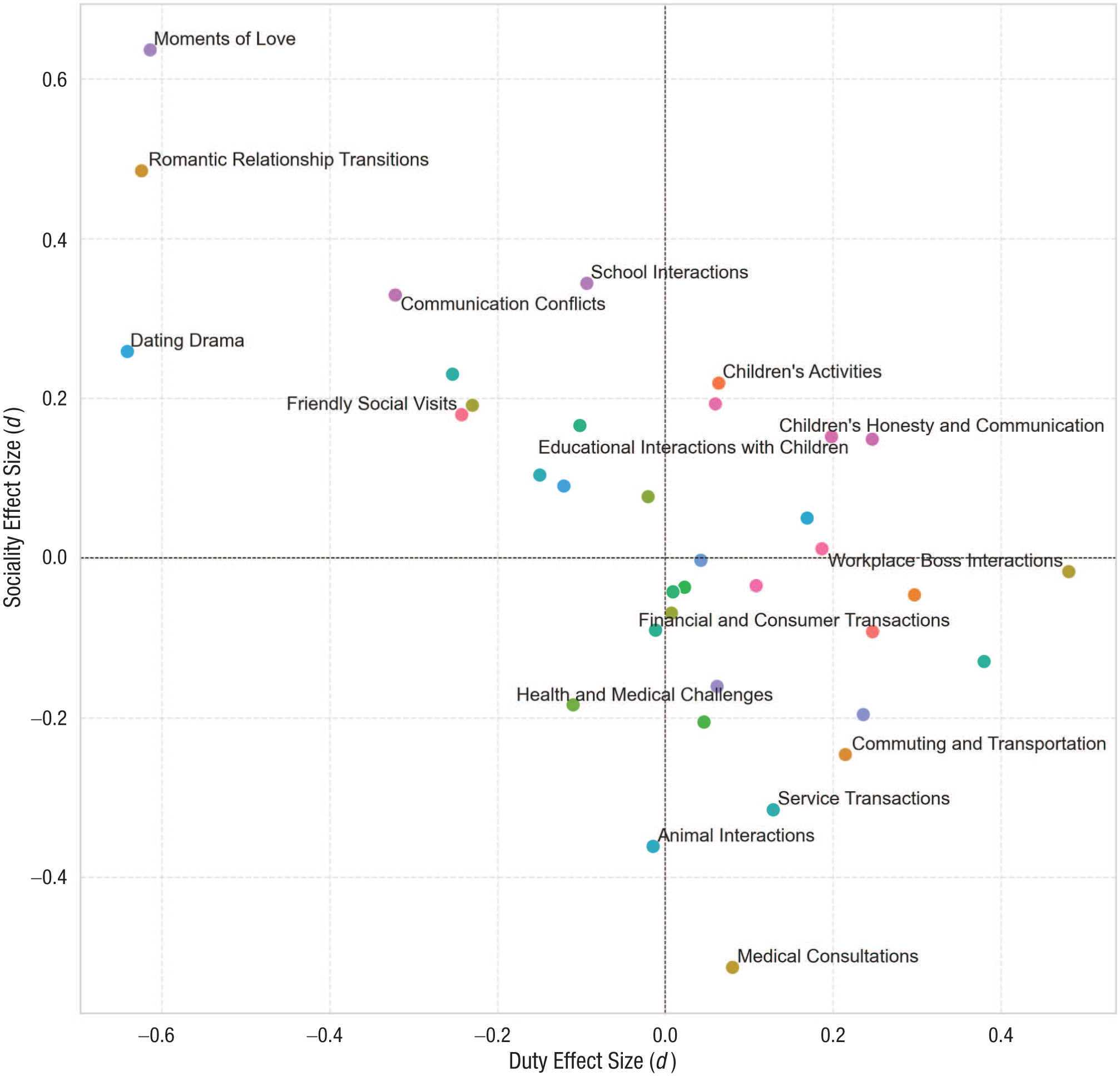
Situational classes plotted by their effect sizes (Cohen’s d) on duty (x-axis) and sociality (y-axis), two dimensions from the DIAMONDS taxonomy. Each point represents one of the 36 situational classes identified in Figure 2. Absolute effect sizes greater than 0.058 cross the Bonferroni corrected p value for the associated t test.
We also plotted the distribution of effect sizes using scatterplots and violin plots to assess variability of situational characteristics across classes (Fig. 6). This revealed that roughly 44% of IDT dimensions had small effect sizes (absolute d > 0.2), 6% medium (d > 0.5), and 1% large (d > 0.8). Likewise, DIAMONDS and CAPTION had 42% and 62% small, 5% and 15% medium, and 1% and 2% large effect sizes, respectively. These tests show that characteristics identified in prior theoretical taxonomies emerge systematically in different types of situations, with some characteristics having very strong associations with specific classes.
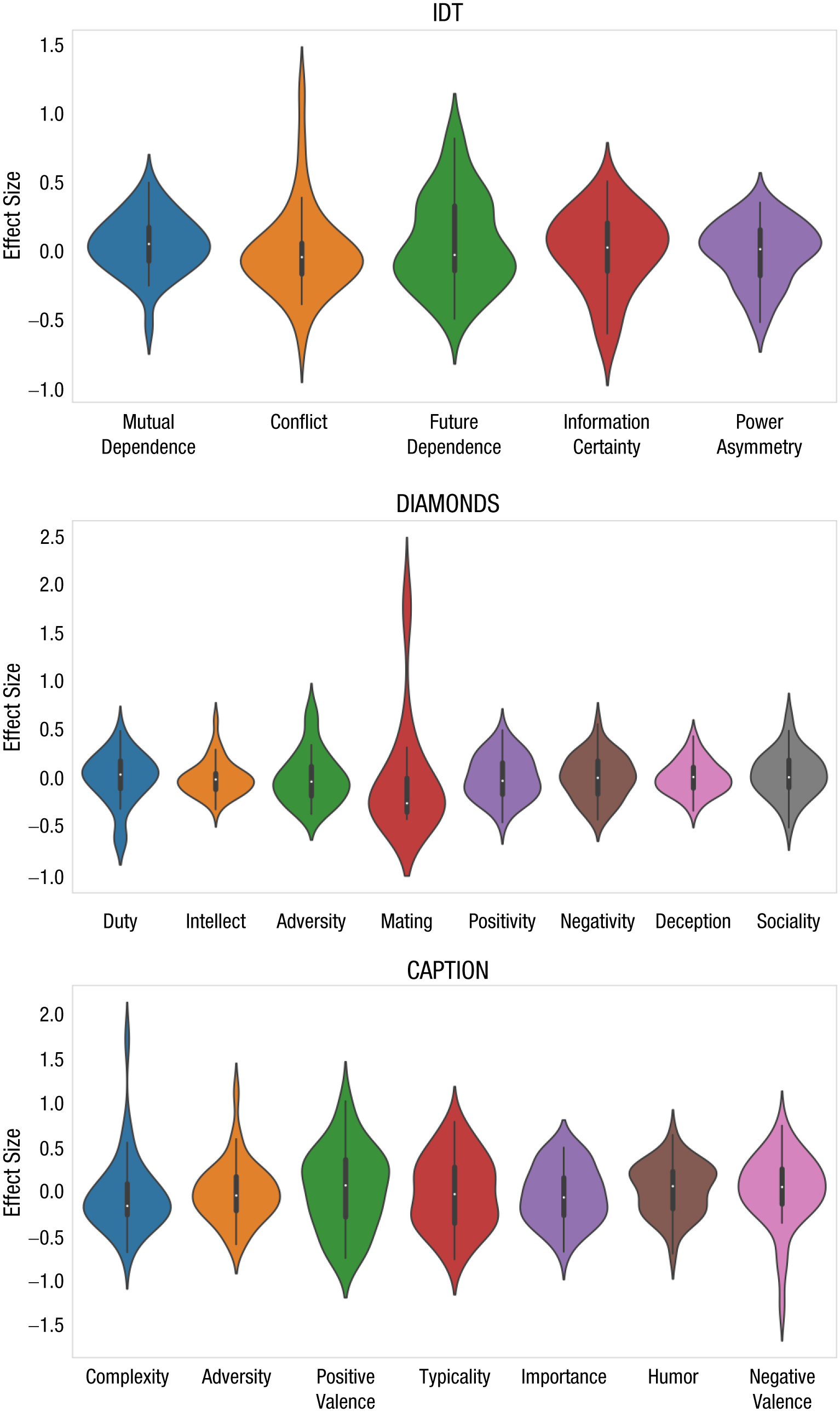
Violin plots showing the distribution of effect sizes (Cohen’s d) for each IDT dimension (top), DIAMONDS dimension (middle), and CAPTION dimension (bottom) across the 36 situational classes. IDT = interdependence theory.
To formally examine the shape of these distributions, we conducted Shapiro-Wilk tests of normality for each dimension (see Table S8 in the Supplemental Material). Consistent with visual inspection, most variables showed no evidence of deviation from normality, indicating that situational classes vary symmetrically around the mean for characteristics. By contrast, some variables showed strong evidence of nonnormality. For instance, IDT conflict, DIAMONDS mating, and CAPTION complexity were significantly right-skewed, with very large positive effect sizes concentrated in a small set of situational classes, while being absent in others, indicating that these characteristics dominate specific sets of situations rather than being evenly distributed across the situational space (all ps < .001, crossing the Bonferroni-corrected p value threshold of .05/20 = .0025). Looking back at Figure 3, we see that conflict is especially high in competitive interactions and crime, mating in romantic encounters, and complexity in educational settings. Such concentration likely shapes the psychological tenor of these classes, making features like conflict, mating, and complexity defining elements of how specific situations are perceived and how they guide behavior. This pattern suggests that these dimensions may occupy a distinctive role in situational psychology, perhaps exerting a stronger influence than other characteristics that are more evenly distributed across situational space.
Generalizing to additional data sets
To evaluate the generalizability of our findings, we evaluated the distribution of situational characteristics and cues in eight additional data sets, including children’s stories, reading-comprehension passages, blogs, online fiction, and most importantly, participant-generated autobiographical experiences from Gerpott et al. (2018) and our new survey.
Situational descriptions from eight data sets described earlier were processed using the same GPT-based coding pipeline as in the prior section. We began by examining the frequencies of the situational characteristics and cues across the data sets. These are shown in Table S7 in the Supplemental Material. We correlated these frequencies with the frequencies of the variables in the ROCStories corpus. These correlations are shown in the top panels of Figure 7. All the correlations here are very high and significantly positive (p < .0001, which exceeds the Bonferroni-correction threshold of 0.001), indicating that the aggregate situational content in these data sets is roughly similar. This is especially so for the Gerpott et al. data and our new survey data, indicating that the broad thematic content of ROCStories closely matches the content in participants’ descriptions of common autobiographical experiences.
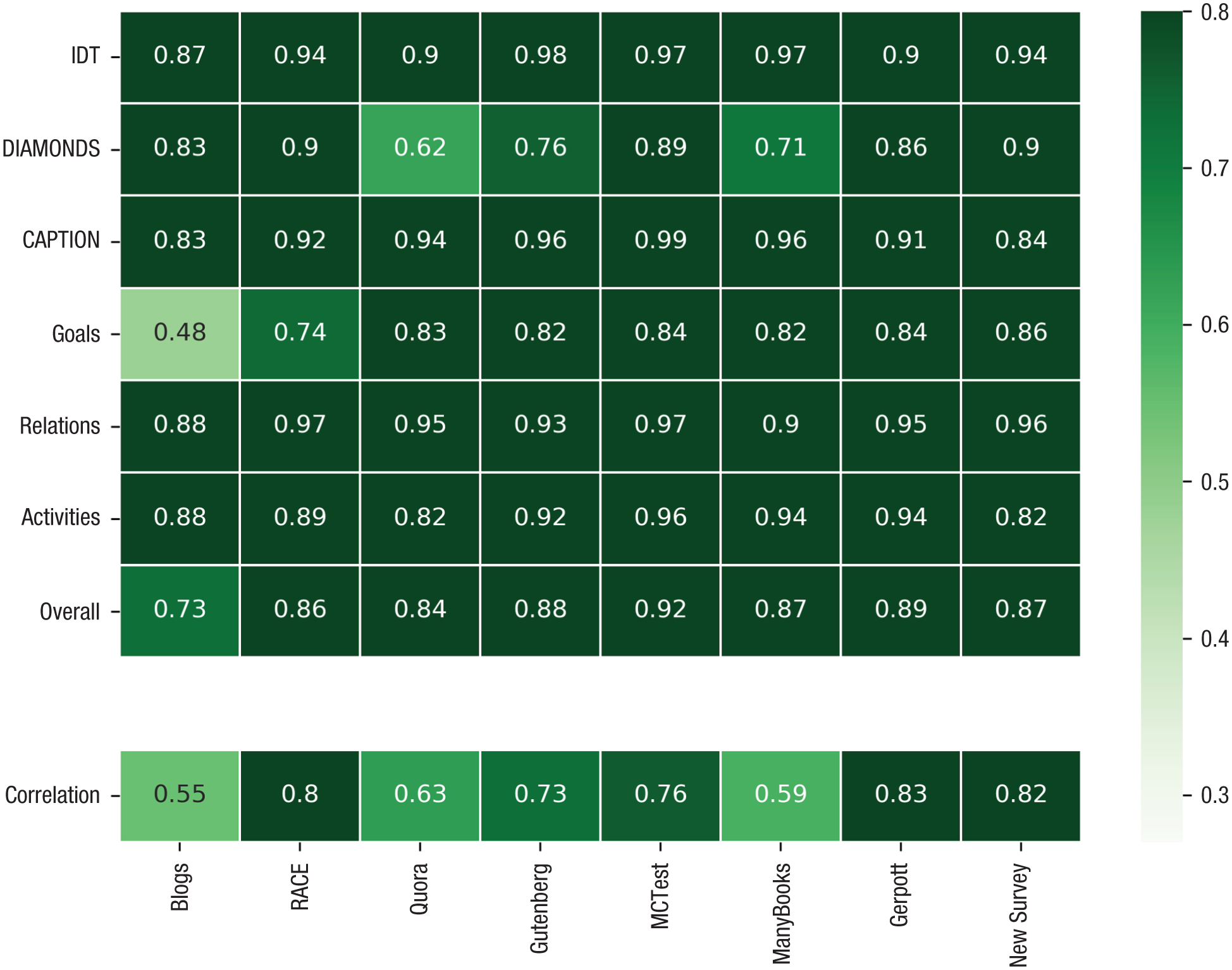
The relationship between ROCStories and other data sets. The top panels show the correlations in the frequencies of the variables, whereas the bottom panel displays the correlations in the matrix of cross-variable dissimilarities as assessed by representational-similarity analysis. IDT = interdependence theory.
Although the frequencies of the variables in our data sets are useful for understanding broad themes, it is the interrelationships of the individual variables that are most relevant for understanding situational structure. Thus, instead of analyzing the correlations of the frequencies of the variables across data sets, we needed to analyze the correlations of the similarities or dissimilarities between variables across data sets. We did this using representational-similarity analysis, the details of which are summarized in Section 4.3 of the Supplemental Material. The bottom of Figure 7 shows the matrix of correlations obtained from this analysis. Although all correlations shown in this figure achieved significance at p < .0001 according to the Mantel test (10,000 permutations), we found that the highest correlations were observed between ROCStories and participant-generated autobiographical experiences (Gerpott et al.’s situations as well as situations described in our new survey). This indicates that the ROCStories corpus, on which our main analysis is based, is very similar to the types of situational descriptions elicited in survey-based psychology studies, both in terms of the broader themes and in terms of the associations between its component variables. By contrast, we observed much lower correlations for published fiction and blogs, which tend to depict unusual or sensational situations—for example, atypical combinations of relationships, locations, and situational characteristics—designed primarily for entertainment or narrative effect.
General Discussion
A core challenge in psychology is understanding the structure of social situations: the patterns and psychological features that shape how people think, feel, and behave in social contexts. Foundational theories such as IDT, DIAMONDS, and CAPTION have proposed taxonomies of situational characteristics—high-level variables that influence downstream cognitions and behaviors. These are believed to emerge from and relate to concrete, observable cues: who is involved, what they are doing, where the interaction takes place, and why it is happening. However, few studies have systematically examined the relationships between cues and characteristics across the wide range of everyday experiences.
We addressed this gap by analyzing detailed narrative descriptions of dyadic social interactions. Our main innovation was using large language models (LLMs) to extract both observable situational cues and theoretically relevant situtational characteristics. After an extensive set of validation studies showing the suitability and accuracy of our coding pipeline, we applied our pipeline to a large corpus of over 20,000 short stories of daily life. We found systematic associations between situational characteristics proposed by existing taxonomies as well as between situational characteristics and observable cues, replicating and extending findings from earlier studies (e.g., Gerpott et al., 2018; Parrigon et al., 2017; Rauthmann et al., 2014), but at a much larger scale.
To better understand the nature of these associations, we derived a data-driven map of situational classes—discrete categories of social situations—using dimensionality reduction and clustering on situational cues (goals, activities, locations, and relationships). This revealed 36 discrete classes of situations that were themselves broadly clustered into three higher-order categories: social, interpersonal, and romantic situations; family, engagement, and community situations; and transactional, institutional, and professional situations. The large number of classes enabled us to treat them as a unit of analysis (a novel contribution, because prior frameworks lacked the granularity to support this level of systematic comparison), and to examine how higher-level situational characteristics distribute across classes. This approach yielded several important findings. For example, situational classes marked by conflict almost always co-occurred with a description of power asymmetry, whereas most classes were characterized by either duty (moral or professional obligations) or sociality (affiliative goals and interpersonal connection), with relatively few involving neither. More generally, many situational characteristics were approximately normally distributed across classes, but a subset, including conflict, mating, and complexity, showed highly skewed distributions. These characteristics were concentrated in a narrow set of classes, where they dominated the psychological tenor, which suggests that they occupy a distinctive role in situation representation. Finally, note that although our main results depend on a particular corpus of participant-generated stories, we have also shown that the structure of this corpus closely aligns with participant-generated autobiographical narratives from prior studies and from a new and representative U.S. sample. This indicates that the situational classes and psychological structures identified by our analysis capture the kinds of everyday interactions that are central to psychological research.
We are not the first to build a taxonomy of situational classes. For instance, Van Heck (1984) proposed 10 types of situations, including conflict, joint working, intimacy/relationships, and serving and trading. Likewise, Ten Berge and De Raad (2001) found that situations can be divided into categories such as adversity, amusement, positioning, conduct, and daily routine. Our framework goes beyond these earlier taxonomies in several ways. First, the scale of our data set allowed us to derive a much larger and more fine-grained set of situational classes, enabling new types of tests in which classes themselves serve as the unit of analysis. Second, our approach is theory driven: we coded objective situational cues and systematically linked them to established higher-order dimensions (e.g., IDT, DIAMONDS), rather than relying on small sets of ad hoc (potentially subjective) features. This is why we do not observe clustering around categories such as “rituals” or “excesses,” as in Van Heck’s work. Third, our data set draws on a broad and more representative sample of everyday experiences from adult participants. This leads to substantive differences: for example, family-related situations (a core part of adult life) emerged as highly prominent in our corpus but are absent in van Heck’s taxonomy. Likewise, activity-based classes such as van Heck’s “trading” appear in our taxonomy as more finely differentiated categories that vary systematically in their psychological characteristics (e.g., workplace interactions with a boss show much higher levels of conflict and power asymmetry than service transactions).
We believe that our paper offers researchers a rich descriptive catalogue of situations with which they can test and refine their theories. Such large-scale, high-resolution data sets are widely used in other fields, but are often lacking in psychology. This may be one reason why, despite the existence of many situational taxonomies, research on situational structure has failed to cohere around a unifying model. Our data set, by contrast, offers researchers a rich quantitative representation of 36 situation classes, and their association with observable cues and high-level theoretically relevant variables. This can be used to both model the distributional structure of situations (as in the current paper) and to formally study the effect of situations on interpersonal behavior (Columbus et al., 2021; Finkel et al., 2002; Rusbult & Van Lange, 2003), situation perception (Cantor et al., 1982; Champagne & Pervin, 1987; Helzer et al., 2023), goal pursuit (Higgins, 1997; Yang et al., 2009), and the interplay between situations and personality (Bowers, 1973; Reis, 2008; Ross & Nisbett, 1991; Thielmann et al., 2020). We expect this to be a major topic for future work.
We conclude by noting several limitations of our approach. Our analyses rely on short stories, which resemble the brief autobiographical narratives used in prior research but likely exclude more complex and nuanced situations. Future work should apply our methods to richer sources to test whether the observed patterns generalize to more elaborate contexts. A second limitation is that our findings depend on analyses conducted with current-generation language models. Although we validated their performance extensively, these models have known biases and constraints (Abdurahman et al., 2024; Wang et al., 2025), and future advances may improve both the reliability and interpretability of situational coding. Finally, our corpus is limited to English-language narratives, which constrains the cultural scope of our conclusions. Applying the same methods to corpora in other languages and cultural contexts will be essential for testing the universality of the situational patterns identified here.
A further limitation is that our approach is deliberately theory-guided and cue-based. By clustering on objective features (who/what/where/why), we prioritized interpretability and close linkage to established theory. In contrast, bottom-up, language-driven pipelines that cluster on the full situational description and that can be extended to other data—such as the immediate stream of words people read, hear, and produce (Mehl et al., 2006; Pennebaker & King, 1999)—may offer stronger predictive power. However, these methods can blur objective cues with higher-order characteristics and the narrator’s subjective construal of the situation. In our own pretests, for example, applying topic modeling to situational descriptions produced clusters that reflected subjective assessments and mental states of the writers, which were difficult to interpret theoretically (see Rauthmann et al., 2014, for a discussion). A productive path forward is to integrate the two approaches—using our cue-based taxonomy to provide structured situational units while augmenting it with bottom-up language features (including data from experience-sampling corpora or natural conversations), enabling models that jointly optimize theory-based explanation and fine-grained prediction of responses and behavior. We are optimistic that this will enable researchers to better understand and predict social behavior and cognition at scale, and we look forward to the insights that will emerge from this approach.
Supplemental Material
sj-pdf-1-pss-10.1177_09567976261418946 – Supplemental material for The Structure of Social Situations: Insights From the Large-Scale Automated Coding of Text
Supplemental material, sj-pdf-1-pss-10.1177_09567976261418946 for The Structure of Social Situations: Insights From the Large-Scale Automated Coding of Text by Sudeep Bhatia, Andrew Yang and Taya R. Cohen in Psychological Science
Footnotes
Appendix
Labels and Descriptions of 36 Situation Classes, Along With Prototypical Situation for Each Class. Each class is also assigned to one of three higher-order clusters: SIR (social, interpersonal, and romantic situations), FEC (family, education, and community situations), and TIP (transactional, institutional, and professional situations).

| Class label | Description | Prototypical situation |
|---|---|---|
| Friendly social visits [FEC] | Dyadic interactions centered on social visits and shared experiences, often involving friends and personal interests. Situations frequently include gifting, mutual support, and exploration of new activities together. | I visited a friend who worked at the Humane Society. She was showing me around the shelter. I locked eyes with a large black dog. I knew that dog belonged with me. He came home with me two days later. |
| Financial and consumer Transactions [TIP] | Situations involve individuals engaging in purchases, sales, or financial decisions, often with salespeople or service providers influencing outcomes. Outcomes range from successful acquisitions to financial mishaps or unanticipated consequences. | Scott had 45 minutes to spare during his lunch break. He went across the street to the outdoors store and looked at canoes. A salesman came up to Scott and told him the canoes were on sale. Scott bought a canoe at 50% off. Scott never expected to buy a canoe on his short lunch break! |
| Children’s activities [FEC] | Situations in this cluster involve parents or guardians engaging in activities with their children that foster bonding, learning, or enjoyment. Common themes include attending events together, creating or sharing experiences, and participating in educational or leisure activities. | Gary was invited to his niece's preschool graduation. At first, Gary was shocked at the concept of preschool graduation. However, Gary quickly got over the shock because of his niece. Gary decided he would bring her some balloons and a teddy bear. Gary could not wait to see his niece at her preschool graduation. |
| Sports achievement pursuits [TIP] | Individuals in this cluster engage in sports-related activities with the aim of improving their skills or achieving significant accomplishments. These situations often involve receiving guidance from coaches or mentors and result in personal or professional success in athletics. | Lim batted at the batting cage. He hit the ball so hard it busted through the chain fence. A baseball scout wanted to sign him to a local team. Lim agreed and signed. His first game he played he got three home runs. |
| Commuting and Transportation [TIP] | This cluster depicts stressful or awkward situations primarily occurring during commuting, involving vehicles or public transport. Interactions often involve conflicts, accidents, or discomfort between individuals in these shared spaces. | Dan had to really use the bathroom before boarding his flight. While in the bathroom, Dan heard the call to board his flight. Dan grabbed his suitcase and rushed out the bathroom. As Dan made it to the gate, a passenger told Dan his zipper was down. Dan was embarrassed that he had forgotten to zip up his zipper. |
| Romantic relationship transitions [SIR] | Situations in this cluster involve the evolving dynamics of romantic relationships, including moments of commitment, breakups, personal growth, and rekindling of past connections. They capture emotions of love, disappointment, and the impact of personal and relational decisions. | Jake was very proud of his body. He had been exercising for years to be in good shape. When Jake met Cassandra, she admitted not liking his big muscles. Jake tried to stop exercising as much but gained weight. He chose to exercise again to the dismay of Cassandra. |
| Medical consultations [TIP] | Situations involve individuals seeking medical advice or treatment for health concerns and experiencing varied outcomes. Common themes include diagnosis, prescription, relief, or ongoing management of conditions. | Allergy season was very hard on Jim. For his whole life he battled with seasonal allergies. They made him miserable. His doctor suggested he move to another area of the country to help. He moved to Nevada and his allergies were much better. |
| Workplace boss interactions [TIP] | Employees navigate challenges and negotiations with their bosses, often involving issues of punctuality, workload, and employment decisions. Situations vary from discussions of quitting, being reprimanded, receiving warnings, or navigating misunderstandings. | Joe was a young construction worker. He loved his job very much. One day Joe worked for 14 hours. His boss told him that was too many hours in one day. Joe told his boss he just loved working and apologized. |
| Romantic relationship challenges [SIR] | Situations in this cluster revolve around challenges, misunderstandings, and emotional experiences in romantic relationships. These scenarios often involve communication issues, personal insecurities, and efforts to resolve or navigate relationship conflicts. | Jane wasn't on birth control. She used condoms with her boyfriend. One month her period was late. Jane was scared and got a pregnancy test. She was relieved when it came back negative. |
| Family caregiving [FEC] | This cluster depicts caregiving situations often involving young children, focusing on parental duties, challenges, and emotional responses during moments of distress or routine activities. Situations often involve attempts to soothe, protect, and care for infants amid unforeseen difficulties or interruptions in routine. | My father went back to use the bathroom. I heard a loud bang just after he left the room. I ran back to see what happened. He had fell and hit his head. He died five days later from it. |
| Family and food [FEC] | Family members attempt to cook or prepare meals, often recreating traditional recipes or experiencing mishaps in the process. These situations typically involve learning from or sharing with relatives, showcasing family dynamics and the role of food in familial relationships. | Ethel always loved her grandmother's peach cobbler. That was the one thing she missed when she went away to school. One day, she called her grandmother for the recipe. She went to the store off campus and bought the supplies. Her peach cobbler tasted nothing like her grandmother’s. |
| Health and medical challenges [TIP] | Situations in this cluster involve health-related incidents and emotional distress, often leading to medical intervention. Characters experience physical ailments and emotional reactions, and seek relief or assistance through health-care services. | Rita fell out of the tree. She broke her arm in two places. The doctor put her arm in a cast. It is purple and looks really neat. I hope she will let me sign it. |
| Pet-related mishaps [FEC] | Situations involve unexpected challenges and mishaps occurring while managing, interacting with, or caring for pets, often resulting in distress or unintended outcomes. Scenarios typically feature attempts to control or protect pets, with varying degrees of success and emotional responses. | Cam was a very safe driver. He had never been in a wreck before, and avoided distractions. One day, Cam had to take his pet cat to the vet for a check-up. The cat did not know how safely Cam drives and was terrified. The cat jumped onto Cam’s shoulders in traffic, causing him to crash. |
| Sibling interactions [FEC] | Sibling interactions characterized by pranks, disputes, and a mix of playfulness and tension. Often involve misunderstandings, playful aggression, and the necessity to navigate shared spaces and emotions. | I was very angry at my brother. He came into my bedroom and punched me in the stomach. I doubled over, unable to breathe. I got up and looked for my Little League bat. I hit him in the head with it. |
| Mother–child interactions [FEC] | Situations involve children interacting with their mothers in various emotional and developmental contexts, ranging from seeking comfort and resolving conflicts to experiencing independence and life transitions. The focus is on familial relationships, emotional responses, and pivotal moments in growth and change. | James liked to decorate his room. He hung a big poster on his door. His mom told him to take it down. James refused! His mom took it down when he was at school. |
| Common incidents and conflicts [SIR] | This cluster contains situations involving unexpected incidents, minor conflicts, or negotiations typically between pairs of individuals. Themes include accidents, financial dealings, and resolutions in personal and professional contexts. | Tammy had a gambling addiction. Most forms are outlawed where she lives—except for dog racing. She goes every weekend. The owners have considered banning her for her own good. |
| Competitive interactions [SIR] | This cluster involves scenarios of competition, whether physical, intellectual, or verbal. Participants strive to achieve dominance or victory, often facing challenges, resistance, or moral dilemmas in pursuing their goals. | I was going down the road. I saw a wreck. I saw one car hit another. It spun around a couple times. It looked dangerous. |
| Recruitment and career choices [TIP] | Situations in this cluster involve individuals facing decisions about career paths or recruitment opportunities, often influenced by external agents like recruiters or employers. These scenarios highlight pivotal moments in which personal aspirations and professional offers intersect, leading to significant life decisions. | John just graduated high school. He was at a career fair trying to learn what career he wanted. A Navy recruiter approached John and asked him some questions. John was eventually convinced to come in for an actual interview. John was talked into joining the Navy and sent into war shortly after. |
| Competitive recreational activities [SIR] | Situations in this cluster involve friendly competitions between friends, often centering around sports, games, or bets, where the focus is on enjoying the activity and camaraderie, regardless of the outcome. These scenarios highlight themes of sporting events, gaming, and playful rivalry, often with an underlying sense of fun and friendship. | Toby and his buddy wanted to play horseshoes. They set the game up in his backyard. They began to play. Toby and his friend were both quite good. Toby won by just one point in the end. |
| Service transactions [TIP] | Situations in this cluster involve individuals engaging with service providers to address needs or resolve problems, often entailing transportation or personal care services. These interactions typically lead to feelings of satisfaction or frustration based on the outcomes of the service received. | I got a pedicure yesterday. The moment I sat down it was strange. I started to squeal. My feet were very ticklish. I did not like the feeling. |
| Marital caretaking and support [FEC] | Situations in this cluster involve interactions between spouses, highlighting themes of caretaking, communication, and emotional support. They often reflect everyday marital dynamics, conflicts, or shared experiences. | Josh started smoking when he was 10. Josh is now 30 years old. Josh now had a pregnant wife. So Josh decided to quit his habit of smoking. It was hard, but Josh did it. |
| Animal interactions [TIP] | Situations in this cluster involve human interactions with animals, often characterized by curiosity, excitement, or unexpected outcomes. Many scenarios depict attempts to observe, feed, or engage with animals that lead to surprise or learning experiences. | Marty loved to explore. One night Marty decided to explore through the mountains. He then saw a moose. Marty stood there in amazement. He smiled as the moose trotted away. |
| Neighborly interactions [FEC] | This cluster involves social interactions between neighbors, varying from casual encounters and misunderstandings to deeper personal connections and friendships. The situations capture a range of experiences, including communication challenges, cultural differences, supportive gestures, and developing relationships. | The teacher assigned a seat to each person on the first day. A strange girl sat next to me. For the entire day, she stared at me with a mad grin. I asked her if she had a problem. She didn’t bother to give me a response. |
| Dating drama [SIR] | Social situations involving dates characterized by nervousness, mishaps, and misunderstandings, often leading to unintended outcomes or abrupt endings. Interactions focus on attempts to impress or mitigate awkwardness, with varied success. | Steve felt very nervous preparing for his big date. The date was a few days ago and with the girl of his dreams! Steve went to the store for new clothes. He tried on everything nice and finally bought a shirt! He wore the shirt to the date and it went great. |
| Food and friendship [SIR] | These situations revolve around acts of sharing, preparing, or gifting food between friends, often highlighting generosity or hospitality. Many scenarios involve unexpected challenges or misunderstandings within the context of food-related interactions. | I took Diana out to dinner. She ordered several items out of the menu. When we had been eating for only 10 minutes, she stopped. She had to see a friend and left without a good explanation. Although I paid for the food, she didn’t express her gratitude. |
| Parent–child incidents [FEC] | Situations in this cluster involve incidents within parent-child relationships in which a parent intervenes or offers guidance following a child’s mishap or risky behavior. These events often present themes of learning, safety, or discipline. | Kate broke her little finger. She broke it falling off her bicycle. Kate’s mother bandaged the finger up. The finger took a very long time to heal. Her little finger is feeling much better now. |
| Academic Integrity challenges [TIP] | These situations involve students facing academic challenges, often related to integrity and adherence to assignment requirements. Common scenarios include plagiarism, incomplete work, and teacher-student interactions regarding performance and expectations. | Ben submitted his rough draft to the teacher. The teacher made corrections to the paper. Since his paper had so many mistakes, she didn’t grade it. The paper flew in the trash. Ben was confused when the teacher said that his paper was lost. |
| Crimes and strange encounters [FEC] | Situations involve unexpected crimes or unsettling encounters, often leading to distress or confrontation. Individuals face threats, misunderstandings, or misjudgments resulting in loss, surprise, or resolution. | I was very angry about the construction by my house. It was so loud that I couldn't sleep at night. I angrily complained to the construction manager. He told me that there was something he could do. He gave me a gift card to sleep at a hotel until it was quiet. |
| Moments of love [SIR] | Situations in this cluster involve individuals experiencing the development of romantic relationships, often leading to engagements or marriages. These scenarios typically feature moments of love at first sight, long-distance connections, or overcoming personal challenges to find love. | My great Aunt Hazel was my favorite relative. One day when I was 4 years old, we went on a trip to her farm. She had several goats and pigs on her acreage. I walked outside all day, looking at the flowers and playing. I loved petting the pigs and goats at her house that day. |
| School interactions [TIP] | This cluster encompasses social interactions and personal exchanges among classmates and peers in school settings, often involving misunderstandings or relationship dynamics. Scenarios feature themes of forming friendships, dealing with crushes, and navigating complex social situations. | A high school classmate asked me to be his [Facebook] friend. We chatted for awhile. He remembered a lot about me, and talked at length. I confessed I did not remember him at all. I apologized to him. |
| Communication conflicts [SIR] | Dyadic interactions involving miscommunications, misunderstandings, or confrontations that strain or redefine relationships. Often involve the use of digital communication, social media, or in-person discussions. | Matt was talking on the phone with his friend. The friend was really rude and didn’t let Matt talk much. At first Matt put up with it because he cared about his friend. Soon he decided that he wouldn’t allow it. He demanded that his friend apologize. |
| Educational interactions with children [FEC] | Situations involve parent-child interactions in which guidance, support, and learning are central themes, often in educational, developmental, or skill-building contexts. They commonly feature positive or instructive moments, highlighting parental support or corrective actions amidst children’s successes or mistakes. | She had made the dean’s list. She was very proud of herself. Finally, she had accomplished something. She rushed home to show her dad. He snorted and said it didn’t mean she was intelligent. |
| Children’s honesty and communication [FEC] | This cluster captures situations involving disclosures, secrets, or mishaps between children and parental figures, often highlighting themes of honesty, trust, and emotional reactions. The scenarios explore the complex dynamics of parent-child relationships in which resolutions involve communication and understanding. | Eleanor was dancing at her aunt’s wedding. Suddenly she bumped into a vase, which fell and shattered. She decided to be upfront and honest. Her aunt was so blissfully wed that she didn't even mind. Eleanor was glad she didn’t try to hide the vase. |
| Marital dynamics [FEC] | This cluster captures everyday interactions and mishaps between married couples, highlighting themes of communication, misunderstanding, and gestures of care. It reveals how small actions and accidents can impact relationships either positively through kindness or negatively through conflict. | Ashley took off her wedding ring to do the dishes. She forgot to put it back on. Her husband accidently knocked the ring down the sink. He didn’t notice what he did. Ashley never found out what happened to her ring. |
| Professional challenges [TIP] | Protagonists navigate occupational roles while encountering unexpected challenges, requiring problem-solving and adaptation. Situations often involve social interactions with clients or colleagues in professional settings, blending personal goals and workplace dynamics. | Ian decided to earn money walking dogs. He walked the neighbor lady’s dog Shadow one day. Shadow was not very cooperative. He kept pulling on his leash. But at least Ian got $20 for it. |
| Help from friends [SIR] | Situations involve individuals facing problems or needing assistance, often related to cars or unexpected events. Friends are called upon to help, and their supportive actions influence the outcomes. | Peter was leaving to go to work. His car wouldn’t start. The battery was dead. Peter called a friend. His friend jump-started his battery. |
Transparency
Action Editor: Zhicheng Lin
Editor: Simine Vazire
Author Contributions

References
Supplementary Material
Please find the following supplemental material available below.
For Open Access articles published under a Creative Commons License, all supplemental material carries the same license as the article it is associated with.
For non-Open Access articles published, all supplemental material carries a non-exclusive license, and permission requests for re-use of supplemental material or any part of supplemental material shall be sent directly to the copyright owner as specified in the copyright notice associated with the article.
